Hubbry Logo
Extensor hallucis longus muscleExtensor hallucis longus muscleMain
Open search
Extensor hallucis longus muscle
Community hub
Extensor hallucis longus muscle
logo
8 pages, 0 posts
0 subscribers
Be the first to start a discussion here.
Extensor hallucis longus muscle
from Wikipedia
Extensor hallucis longus muscle
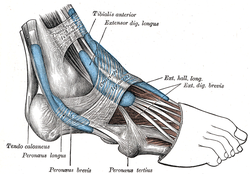
The mucous sheaths of the tendons around the ankle. Lateral aspect. (Ext. hall. long. labeled at upper left.)
Animation
Details
OriginArises from the middle portion of the fibula on the anterior surface and the interosseous membrane
InsertionInserts on the dorsal side of the base of the distal phalanx of the big toe
ArteryAnterior tibial artery
NerveDeep fibular nerve, L5 (L4-S1)
ActionsExtends (raises) the big toe and assists in dorsiflexion of the foot at the ankle. Also is a weak evertor/invertor
AntagonistFlexor hallucis longus, flexor hallucis brevis
Identifiers
Latinmusculus extensor hallucis longus
TA98A04.7.02.040
TA22650
FMA22533
Anatomical terms of muscle

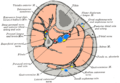
The extensor hallucis longus muscle is a thin skeletal muscle, situated between the tibialis anterior and the extensor digitorum longus. It extends the big toe and causes dorsiflexion of the foot. It also assists with foot eversion and inversion.

Structure

[edit]

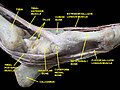
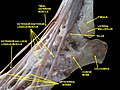
The muscle ends as a tendon of insertion. The tendon passes through a distinct compartment in the inferior extensor retinaculum of foot. It crosses anterior tibial vessels lateromedially near the bend of the ankle.[citation needed] In the foot, its tendon is situated at along the medial side of the dorsum of the foot.[1] Opposite the metatarsophalangeal articulation, the tendon gives off a thin prolongation on either side, to cover the surface of the joint. An expansion from the medial side of the tendon is usually inserted into the base of the proximal phalanx.[citation needed]

Origin

[edit]

The extensor hallucis longus muscle arises from the middle portion of[2] the anterior surface[citation needed] of the fibula and adjacent interosseous membrane of the leg.[3] Its origin is medial to the origin of the extensor digitorum longus muscle.[citation needed]

Insertion

[edit]

The muscle inserts at the base of the distal phalanx of the great toe.[4]

Nerve supply

[edit]

The muscle receives motor innervation from the deep fibular nerve (L5)[3] (a branch of common fibular nerve).

Relations

[edit]

The anterior tibial vessels and deep fibular nerve pass between this muscle and the tibialis anterior muscle.

Variation

[edit]

Occasionally united at its origin with the extensor digitorum longus.

The extensor ossis metatarsi hallucis, a small muscle, sometimes found as a slip from the extensor hallucis longus, or from the tibialis anterior, or from the extensor digitorum longus, or as a distinct muscle; it traverses the same compartment of the transverse ligament with the extensor hallucis longus.

Actions/movements

[edit]

The muscle extends the big toe (primary action), and causes dorsiflexion of the foot (secondary action).[3]

Additional images

[edit]

References

[edit]
[edit]
Revisions and contributorsEdit on WikipediaRead on Wikipedia
from Grokipedia
The extensor hallucis longus muscle is a slender muscle located in the anterior compartment of the lower leg, responsible for extending the great toe (hallux) at the metatarsophalangeal and interphalangeal joints while also contributing to dorsiflexion of the foot at the ankle joint. It originates from the middle third of the anterior surface of the and the adjacent , forming a thin, elongated belly that lies deep to the tibialis anterior and extensor digitorum longus muscles. The muscle's passes anterior to the , running between the tendons of the tibialis anterior and extensor digitorum longus, before inserting on the dorsal aspect of the base of the distal phalanx of the great toe. Innervated by the deep fibular (peroneal) nerve (L4-S1 nerve roots), the extensor hallucis longus receives its blood supply primarily from muscular branches of the anterior tibial artery, with possible contributions from the . In addition to its primary roles in toe extension and foot dorsiflexion, it provides weak inversion of the foot and plays a key role in the swing phase of by helping to clear the toes from the ground. Clinically, the muscle is relevant in conditions such as due to injury, extensor hallucis longus tendonitis from overuse, and , where increased pressure can impair its function; anatomical variants, including multiple tendon slips, occur in up to 35% of cases and may affect surgical tendon transfers.

Overview

Description

The extensor hallucis longus is a thin, elongated located in the anterior compartment of the lower leg, serving as one of four muscles in this region responsible for dorsiflexion and extension movements of the foot and toes. It lies deep within the compartment, positioned lateral to the and medial to the . This muscle plays a key role in the coordinated action of the lower limb's extensor group, contributing to upright posture and . The "extensor hallucis longus" derives from Latin anatomical terms: "extensor" for its action of extension, "hallucis" as the genitive of "hallux" referring to the great toe, and "longus" indicating its length.

Location

The extensor hallucis longus muscle is situated in the anterior compartment of the leg, specifically occupying a position lateral to the and medial to the . This compartment is bounded medially by the , laterally by the anterior intermuscular septum and , posteriorly by the , and anteriorly by the deep crural fascia. The muscle originates from the middle half of the anterior surface of the and the adjacent , placing it along the lateral aspect of the anterior crural region. From its origin, the muscle belly courses distally and medially through the anterior compartment, with its emerging to travel toward the ankle. The passes beneath the superior and inferior extensor retinacula at the ankle, which anchor it to prevent displacement, before continuing onto the dorsum of the foot. Along its path in the leg, the muscle lies in close proximity to the anterior tibial artery and vein, as well as the deep peroneal nerve, which course between the extensor hallucis longus and the tibialis anterior. Distal to the ankle, the crosses over the and extends along the medial aspect of the dorsum of the foot to reach the base of the distal of the hallux (big toe). This trajectory positions it superficially on the foot's dorsal surface, adjacent to the tendons of the extensor digitorum longus laterally.

Anatomy

Origin

The extensor hallucis longus muscle originates primarily from the middle half of the anterior surface of the . This attachment provides a stable proximal base along the lateral aspect of the lower leg, contributing to the muscle's positioning within the anterior compartment. An additional origin arises from the adjacent , located between the and and medial to the origin of the . The muscle fibers from these origins run obliquely downward and medially, forming a belly that transitions distally into a .

Insertion

The extensor hallucis longus muscle terminates distally via a long, slender that inserts primarily at the dorsal aspect of the base of the distal phalanx of the hallux (big toe). This attachment allows for targeted extension at the interphalangeal joint of the hallux. The emerges from the muscle belly in the anterior compartment of the leg, coursing inferomedially across the ankle and foot; it passes deep to both the superior and inferior extensor retinacula to prevent bowstringing and maintains stability during movement. Along the dorsum of the foot, the runs medial to the extensor digitorum longus and lateral to the tibialis anterior , where the lies between them. Prior to its main insertion, the frequently emits accessory slips, most commonly to the dorsal base of the proximal of the hallux or the base of the first metatarsal, though variations may include slips extending to adjacent structures such as the second . This tendon is notably thin and unipennate in structure, facilitating precise control, and is clinically palpable along the medial aspect of the dorsum of the foot or over the hallux during active extension, aiding in diagnostic assessments of motor function.

Relations

The extensor hallucis longus muscle occupies a central position within the anterior compartment of the leg, lying deep and medial to the extensor digitorum longus while being positioned lateral to the tibialis anterior. This arrangement places it adjacent to the extensor digitorum longus laterally, facilitating coordinated extension of the toes during dorsiflexion, and next to the tibialis anterior medially, which supports inversion movements. The anterior tibial vessels and the course anterior to the muscle between the tibialis anterior and extensor hallucis longus along the ; the , which pierces the intermuscular septum to enter the anterior compartment, travels alongside these structures along the . This proximity can lead to interactions during , though detailed nerve dynamics are addressed in innervation discussions. At the ankle, the extensor hallucis longus passes beneath the superior and inferior extensor retinacula, sharing compartments with the tendons of adjacent muscles to maintain alignment during foot movements. Near the ankle joint, the crosses the anterior tibial artery and from lateral to medial, potentially altering vascular dynamics.

Innervation and Vascular Supply

Nerve Supply

The extensor hallucis longus muscle receives its primary motor innervation from the deep branch of the (also known as the deep peroneal nerve), which is a terminal division of the originating from the in the posterior thigh. This nerve provides exclusive motor supply to the muscle, innervating all of its fibers to facilitate extension of the great toe at the metatarsophalangeal and interphalangeal joints. In most cases (about 90%), a single branch supplies the muscle, though dual innervation occurs in approximately 10% of individuals. The deep courses through the anterior compartment of the leg, adjacent to the muscle, before branching to the extensor hallucis longus typically in the proximal third of the leg, approximately 7-10 cm distal to the fibular head. The spinal root contributions to this innervation are primarily from the L5 , with variable contributions from L4 and S1 levels, reflecting the segmental organization of the . These root levels can be clinically tested through isolated extension of the great toe, as in this action often indicates L5 or dysfunction. Electrophysiological studies confirm that the extensor hallucis longus is predominantly supplied by L5, making it a reliable indicator for assessing lower integrity in conditions like disc herniation. Entrapment of the can lead to sensory and motor deficits affecting the extensor hallucis longus, manifesting as weakness in great toe extension and potential due to involvement of adjacent anterior compartment muscles. Common sites of compression include the anterior at the ankle or fascial septa in the leg, where hypertrophic muscles or fibrous bands may impinge the nerve, resulting in isolated or partial palsy of the extensor hallucis longus. Diagnosis typically involves to confirm in the muscle, with surgical decompression considered for refractory cases to restore innervation and function.

Blood Supply

The extensor hallucis longus muscle receives its primary blood supply from the muscular branches of the anterior tibial artery, which arises from the and courses through the anterior compartment of the leg to nourish the muscle belly. These branches provide essential to the muscle fibers, ensuring adequate oxygenation and nutrient delivery during dorsiflexion and toe extension activities. Additional vascular contributions come from branches of the fibular (peroneal) artery, which help supplement the blood flow to the muscle, particularly in its deeper aspects. Perforating branches from the fibular artery pass through the interosseous membrane to reach the muscle belly, enhancing overall arterial distribution within the anterior compartment. In the distal portion, the tendon of the extensor hallucis longus receives further supply from the dorsalis pedis artery, the direct continuation of the anterior tibial artery, which runs adjacent to the tendon on the dorsal aspect of the foot. Due to its location and shared vascular territory with other anterior compartment muscles, the extensor hallucis longus is particularly susceptible to ischemia in cases of anterior , where elevated intracompartmental pressure compromises arterial and can lead to muscle if not addressed promptly. This condition underscores the importance of the anterior tibial artery's role, as any disruption in its flow can rapidly affect the muscle's viability.

Function

Primary Actions

The extensor hallucis longus (EHL) muscle's primary action is the extension of the hallux, or big toe, at both the metatarsophalangeal (MTP) and interphalangeal (IP) joints, allowing the toe to lift dorsally relative to the foot. This movement is essential for precise toe positioning and is facilitated by the muscle's long tendon. The EHL also weakly inverts the foot at the . In addition to hallux extension, the EHL assists in dorsiflexion of the foot at the ankle joint, contributing to overall elevation of the foot during locomotion. This dual role is particularly evident during the gait cycle: the muscle activates around toe-off (pre-swing phase) to stabilize and extend the hallux, aiding propulsion by maintaining toe alignment for efficient push-off. During the swing phase, EHL contraction lifts the hallux to clear the ground, preventing tripping and ensuring smooth forward progression.

Antagonists and Synergists

The extensor hallucis longus (EHL) muscle primarily opposes the flexor hallucis longus (FHL), which flexes the interphalangeal and of the hallux, directly countering the EHL's extension action. This antagonistic relationship is essential for balanced movement during , where the FHL dominates in propulsion phases like push-off. Additional antagonists include the flexor hallucis brevis and other intrinsic foot flexors, such as the lumbricals and interossei, which flex the hallux at the and stabilize the toe against extension. These muscles collectively oppose EHL activity to prevent excessive hallux extension and maintain arch integrity during . In , the EHL collaborates with the tibialis anterior and extensor digitorum longus to dorsiflex the foot at the talocrural joint, enabling efficient toe clearance in the swing phase of walking. This cooperative action among anterior compartment muscles ensures coordinated elevation of the forefoot. The EHL also integrates functionally with the peroneus tertius (fibularis tertius) during combined movements, where the peroneus tertius contributes eversion alongside shared dorsiflexion to refine foot positioning and reduce inversion torque in dynamic activities.

Variations

Anatomical Variations

The extensor hallucis longus (EHL) muscle exhibits several anatomical variations, primarily involving its tendon morphology and insertions. The most common variation is the presence of accessory tendinous slips, often arising from the main tendon and inserting into adjacent structures such as the base of the proximal phalanx or the extensor hood of the great toe. Studies report a prevalence ranging from 10% to 81% for these accessory slips. Fusion or accessory slips connecting the EHL to the extensor digitorum longus (EDL) muscle represent a less frequent but documented deviation, typically involving a tendinous band from the EDL joining the in the distal or ankle region. This interconnection has been observed in isolated case reports, suggesting a low overall prevalence, potentially under 5%, though systematic large-scale studies are limited. Rare variations include complete absence (aplasia) of the EHL muscle, which is exceptionally uncommon and reported in bilateral cases during surgical or cadaveric examinations, with no established population due to its . Additionally, doubled or tripled tendons may occur, where the EHL divides into multiple slips inserting onto the distal and proximal phalanges or even extending to the second toe; in one cadaveric study of 104 specimens, two tendons were observed in 42.3% and three in 1.9%. Detection of EHL variations typically occurs through cadaveric in anatomical studies or advanced imaging modalities such as (MRI), which can visualize tendon multiplicity and insertions with high resolution, or for dynamic assessment.

Clinical Implications of Variations

Anatomical variations in the extensor hallucis longus (EHL) muscle, particularly accessory tendons or fused slips, carry significant clinical implications, especially in surgical and diagnostic contexts. These variations are notably prevalent in Asian populations, with studies reporting accessory tendons in 67.1% of Korean cadavers, 97.92% of Taiwanese specimens, and 100% of Chinese cases, compared to lower rates in other ethnic groups. Such prevalence underscores the need for population-specific awareness in clinical practice to avoid misinterpretation of normal as . Surgical risks are heightened by these variations, as fused or accessory tendons can complicate procedures like tendon repair, transfer, or anterior compartment . For instance, bifid or multiple slips (e.g., Type IIb or III variations) may lead to incomplete repairs, iatrogenic damage to adjacent structures such as the extensor hallucis brevis, or neurovascular injury during foot and ankle surgeries. In cases of merged slips, such as the extensor primi internodii hallucis fusing with the extensor hallucis brevis, operative management of deformities like clawed hallux becomes more challenging, potentially requiring modified approaches to prevent adverse outcomes. Diagnostic challenges arise when variations mimic tendon ruptures on , particularly , where accessory slips or thin structures can appear discontinuous, leading to erroneous diagnoses of tears or . This is especially relevant in trauma evaluations, where failure to recognize these variants may prompt unnecessary interventions. Effective management involves preoperative to delineate variations, with high-resolution or 3T MRI recommended to identify slip configurations and reduce surgical risks in affected patients. This approach is particularly valuable before elective foot surgeries in high-prevalence groups, ensuring tailored operative planning.

Clinical Significance

Injuries and Pathology

The extensor hallucis longus (EHL) muscle is susceptible to strains and ruptures, which are relatively uncommon but can arise from acute trauma or chronic overuse. Acute injuries often result from direct , such as lacerations from sharp objects impacting the dorsum of the foot, leading to partial or complete disruption. Overuse-related strains and ruptures are more prevalent in athletes engaging in repetitive activities, including runners and martial artists, where hyperplantarflexion or forceful dorsiflexion during kicking or foot strike exacerbates stress. In pathological conditions, the EHL is implicated in anterior , where swelling and increased intracompartmental pressure compromise muscle and function, often following trauma like tibial fractures. This syndrome primarily affects the anterior leg compartment, which houses the EHL alongside other dorsiflexors, leading to ischemia if untreated. Symptoms of EHL injuries typically include sharp or aching pain along the dorsum of the foot and ankle, particularly during extension or walking, accompanied by localized swelling and tenderness. Weakness in great extension is a hallmark, with severe cases contributing to due to impaired dorsiflexion, resulting in a slapping and increased fall risk. Risk factors for EHL pathology encompass biomechanical issues like foot overpronation, which alters load distribution and heightens strain during , as well as tight or ill-fitting that compresses the dorsum. Repetitive hyperextension of the toes or ankle, common in endurance sports, further predisposes the to microtrauma and degeneration. The muscle's relatively tenuous blood supply may exacerbate ischemic risks in these scenarios.

Diagnostic and Surgical Relevance

Diagnosis of extensor hallucis longus (EHL) muscle and tendon issues typically involves a combination of clinical examinations, electrophysiological studies, and imaging modalities. Clinical tests, such as resisted extension of the great toe at the metatarsophalangeal joint, assess muscle strength using the Medical Research Council scale to identify weakness indicative of tendon rupture or nerve involvement. In the context of spinal cord injury assessment for the L5 myotome (extensor hallucis longus), manual muscle testing follows standardized procedures: for grade 3, the patient is positioned supine with hip and knee slightly flexed, ankle neutral, and hallux plantarflexed; the examiner stabilizes the other toes and foot, with the command "Extend big toe up," allowing the patient to perform full range extension at the metatarsophalangeal (MTP) joint of the hallux. For grades 4-5, the hallux is fully dorsiflexed, and the examiner applies force toward plantarflexion on the proximal phalanx, with the command "Hold big toe up, don't let me push down." For grades below 2, the same or gravity-eliminated position is used, with palpation of the extensor hallucis longus tendon. Notes emphasize stabilizing other toes to avoid compensation by short extensors and focusing on MTP joint extension. Electromyography (EMG) evaluates nerve function by detecting denervation patterns, such as fibrillations and positive sharp waves, in the EHL; optimal needle insertion occurs at the junction of the middle and lower third of the tibia, approximately 12 cm above the bimalleolar line, to reliably diagnose deep peroneal nerve or L5/S1 root lesions. Magnetic resonance imaging (MRI) provides detailed visualization of tendon integrity, revealing disruptions in EHL fibers, fluid collections, or compartmental edema in cases of rupture or compartment syndrome. In surgical contexts, the EHL plays a key role in procedures addressing and . Tendon transfer surgeries, such as splitting the tibialis posterior tendon and suturing one slip to the EHL, restore dorsiflexion in cases of peroneal nerve palsy; this interosseous or circumtibial route approach allows active dorsiflexion to a neutral position (90°) or beyond in over 85% of patients. For anterior involving the EHL, decompresses the affected through incisions to release pressure, preventing muscle ; isolated EHL , though rare, follows similar principles but requires prompt intervention to avoid . Postoperative rehabilitation emphasizes progressive dorsiflexion strengthening to optimize recovery. Protocols typically begin with immobilization in a posterior splint for 2-4 weeks, followed by passive stretching and , advancing to active range-of-motion exercises, , and strengthening (e.g., toe crunches and static ) by weeks 6-12, enabling full with supportive . Early intervention, including surgical repair within weeks of EHL rupture, significantly improves functional outcomes, with patients achieving near-normal American Orthopaedic Foot and Ankle Society scores (mean 97/100) and restored hallux extension, compared to delayed cases prone to .

References

Add your contribution
Related Hubs
User Avatar
No comments yet.