Hubbry Logo
FarneseneFarneseneMain
Open search
Farnesene
Community hub
Farnesene
logo
8 pages, 0 posts
0 subscribers
Be the first to start a discussion here.
Farnesene
Farnesene
from Wikipedia
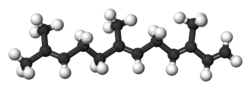
(E,E)-α-Farnesene
Skeletal formula of (E,E)-α-farnesene
Ball-and-stick model of (E,E)-α-farnesene
Names
IUPAC name
α: 3,7,11-trimethyl-1,3,6,10-dodecatetraene
Identifiers
3D model (JSmol)
1840984, 1840982, 1840983, 2204279
ChEBI
ChEMBL
ChemSpider
KEGG
UNII
  • InChI=1S/C15H24/c1-6-14(4)10-8-12-15(5)11-7-9-13(2)3/h6,9-10,12H,1,7-8,11H2,2-5H3/b14-10+,15-12+ checkY
    Key: CXENHBSYCFFKJS-VDQVFBMKSA-N checkY
  • InChI=1/C15H24/c1-6-14(4)10-8-12-15(5)11-7-9-13(2)3/h6,9-10,12H,1,7-8,11H2,2-5H3/b14-10+,15-12+
    Key: CXENHBSYCFFKJS-VDQVFBMKBY
  • C(=C/C/C=C(/CC/C=C(\C)C)C)(\C=C)C
Properties
C15H24
Molar mass 204.36 g/mol
Density 0.813 g/mL
Boiling point α-(Z): 125 at 12 mmHg (1.6 kPa)
β-(E): 124 °C
β-(Z): 95-107 at 3 mmHg (0.40 kPa)
Except where otherwise noted, data are given for materials in their standard state (at 25 °C [77 °F], 100 kPa).
checkY verify (what is checkY☒N ?)

The term farnesene refers to a set of six closely related chemical compounds which all are sesquiterpenes. α-Farnesene and β-farnesene are isomers, differing by the location of one double bond. α-Farnesene is 3,7,11-trimethyl-1,3,6,10-dodecatetraene and β-farnesene is 7,11-dimethyl-3-methylene-1,6,10-dodecatriene. The alpha form can exist as four stereoisomers that differ about the geometry of two of its three internal double bonds (the stereoisomers of the third internal double bond are identical). The beta isomer exists as two stereoisomers about the geometry of its central double bond.

Two of the α-farnesene stereoisomers are reported to occur in nature. (E,E)-α-Farnesene is the most common isomer. It is found in the coating of apples, and other fruits, and it is responsible for the characteristic green apple odour.[1] Its oxidation by air forms compounds that are damaging to the fruit. The oxidation products injure cell membranes which eventually causes cell death in the outermost cell layers of the fruit, resulting in a storage disorder known as scald. (Z,E)-α-Farnesene has been isolated from the oil of perilla. Both isomers are also insect semiochemicals; they act as alarm pheromones in termites[2] or food attractants for the apple tree pest, the codling moth.[3] α-Farnesene is also the chief compound contributing to the scent of gardenia, making up ~65% of the headspace constituents.[4]

β-Farnesene has one naturally occurring isomer. The E isomer is a constituent of various essential oils. It is also released by aphids as an alarm pheremone upon death to warn away other aphids.[5] Several plants, including potato species, have been shown to synthesize this pheromone as a natural insect repellent.[6]

See also

[edit]

References

[edit]
Revisions and contributorsEdit on WikipediaRead on Wikipedia
from Grokipedia
Farnesene was first identified in apple peels in 1966. Farnesene is a family of six closely related isomers with the molecular formula C₁₅H₂₄, consisting of branched alkenes that occur naturally as hydrocarbons derived from (FPP). The primary isomers are α-farnesene, which exists in four stereoisomeric forms such as (E,E)-α-farnesene, and β-farnesene, which has two stereoisomers; these compounds are acyclic, highly unsaturated, and exhibit low water solubility, making them suitable for various chemical applications. In nature, farnesene is widely distributed in plant essential oils, including those from apple peels, kiwifruit, chamomile, rose, perilla, and gardenia, where it contributes to aromas and serves ecological roles such as attracting pollinators or repelling herbivores. It also functions as a chemical signaling in , notably as an alarm in to signal danger and guide behaviors. Biosynthetically, farnesene is produced in and microbes through the action of farnesene synthase enzymes on FPP, a key intermediate in the , and it has demonstrated biological activities including and neuroprotective effects. Industrially, farnesene is produced via microbial fermentation using engineered strains of Saccharomyces cerevisiae or Escherichia coli, often from sugarcane or lignocellulosic biomass, with laboratory titers up to 25.55 g/L and industrial titers exceeding 100 g/L, enabling sustainable manufacturing that reduces carbon emissions by approximately 60% compared to petroleum-derived alternatives. This biotechnological production, pioneered by companies like Amyris, positions farnesene as a versatile renewable building block for biofuels—where it is hydroprocessed into farnesane, a drop-in diesel replacement certified for up to 10% blending in jet fuel—along with lubricants, cosmetics, fragrances, and precursors for vitamin E and synthetic rubbers.

Introduction

Definition and isomers

Farnesene refers to a set of six closely related acyclic sesquiterpenes with the molecular C15H24, all sharing a of 204.36 g/mol. These isomers are divided into two primary groups: α-farnesene, which comprises four geometric stereoisomers—(E,E)-α-farnesene, (Z,E)-α-farnesene, (E,Z)-α-farnesene, and (Z,Z)-α-farnesene—and β-farnesene, which includes two geometric isomers—(E)-β-farnesene and (Z)-β-farnesene. The arises from the configurations around the internal double bonds in their carbon chains. The α-farnesene isomers are structurally described as 3,7,11-trimethyldodeca-1,3,6,10-tetraene, featuring a linear chain with conjugated double bonds at positions 1-3 and 6-10, along with methyl branches at carbons 3, 7, and 11. This arrangement contributes to their role as volatile compounds in natural systems. In comparison, the β-farnesene isomers are 7,11-dimethyl-3-methylene-1,6,10-dodecatriene, characterized by an exocyclic methylene group at position 3, which differentiates them from the α series by shifting the double bond position and introducing a branched alkene functionality. The name farnesene originates from , a related alcohol isolated from the flowers of the Farnese tree (), honoring Cardinal Odoardo Farnese who cultivated the plant in the .

Discovery and

The first isolation of α-farnesene occurred in 1966, when researchers F. E. Huelin and K. E. Murray extracted a hydrocarbon from the natural wax coating of apple peels using chromatographic separation techniques, including , as part of broader investigations into fruit volatiles responsible for aroma and storage disorders like superficial scald. This compound was identified through comparison of its , , and mass spectra with known standards, marking the initial recognition of α-farnesene as a key component in apple physiology. In the 1970s, β-farnesene gained prominence in entomological research when it was identified as the primary alarm for multiple species, including economically significant pests like the green peach aphid. Isolation from aphid exudates involved solvent extraction and behavioral bioassays, where exposure to the compound triggered dispersal and defensive responses across interspecific groups, confirming its role in chemical communication. This discovery, reported by W. S. Bowers and colleagues in 1972, highlighted β-farnesene's ecological importance beyond plant sources. Early descriptions of farnesene employed trivial names such as "apple " to denote its origin in volatiles, reflecting its initial characterization without full stereochemical detail. Over time, evolved toward systematic IUPAC standards, incorporating configurational descriptors for its forms; for instance, the predominant apple-derived isomer is designated as (3E,6E)-α-farnesene to specify the trans double bonds at positions 3 and 6. The name "farnesene" itself derives from , a related alcohol first isolated in the early from the plant , underscoring the historical linkage to chemistry. Key milestones in farnesene research include structural confirmations in the 1980s using (NMR) , which provided precise elucidation of stereoisomers and oxidation products, building on earlier spectral data to resolve ambiguities in double-bond geometries. By the 2000s, genomic approaches linked farnesene production to genes; for example, of α-farnesene (AFS1) from apple in 2009 revealed a class III with six introns, enabling functional studies of biosynthetic regulation. These advances facilitated understanding of in farnesene pathways across .

Chemical properties

Molecular structure

Farnesene is an acyclic sesquiterpene hydrocarbon with the molecular formula C₁₅H₂₄, composed of a linear chain derived from the head-to-tail linkage of three isoprene units (each C₅H₈). The α-isomers possess a tetraene system featuring four carbon-carbon double bonds, specifically structured as 3,7,11-trimethyl-1,3,6,10-dodecatetraene, which includes a conjugated diene moiety at positions 1-4. In contrast, the β-isomers exhibit a triene configuration with an exocyclic double bond, named 7,11-dimethyl-3-methylene-1,6,10-dodecatriene, where the methylene group at position 3 creates a branched, non-conjugated arrangement of the double bonds. The of farnesene is primarily defined by the geometric isomerism (/) at its internal double bonds, as the molecule lacks chiral centers and is thus achiral in its natural forms, resulting in optical inactivity. The most prevalent natural α-isomer, (,)-α-farnesene, features trans () configurations at the double bonds in positions 3-4 and 6-7, contributing to its extended, linear conformation. For β-farnesene, the ()-isomer predominates in nature, with the trans configuration at the 6-7 double bond; synthetic variants may introduce through modifications, but unmodified forms remain achiral. In terms of bonding, the C=C double bonds in farnesene typically measure 1.34 , consistent with standard , while the in α-isomers shortens the intervening C-C single bond to approximately 1.47 due to partial π-overlap. This conjugation in the α-isomers leads to characteristic UV absorption around 232-233 nm, arising from the π → π* transition in the 1,3-diene unit. Farnesene is commonly represented using skeletal formulas that omit hydrogens and highlight the carbon chain and s; for instance, the (E)-β-farnesene , widely studied for industrial applications, can be depicted as a branched chain with the exocyclic methylene and trans at position 6. Three-dimensional models further illustrate its preferred s-trans conformation around the conjugated single bond in α-isomers, emphasizing the extended backbone.

Physical and chemical properties

Farnesene is a colorless to pale yellow liquid at , exhibiting a of 0.813 g/mL at 20°C. Its boiling points vary by , with (E,E)-α-farnesene boiling at 125°C under reduced of 12 mmHg and (E)-β-farnesene at 124°C. The refractive index is approximately 1.49 for both major isomers. Farnesene demonstrates good solubility in organic solvents such as , , and , but it is insoluble in , with an estimated aqueous of about 0.009 mg/L at 25°C. The optical properties of farnesene arise from its conjugated double bonds, particularly in the α-isomers, which exhibit strong UV absorbance with a molar extinction coefficient of approximately 20,000 M⁻¹ cm⁻¹ at 235 nm. Its volatility contributes to its characteristic aroma, with a vapor pressure of around 0.1 mmHg at 25°C, facilitating its role as a volatile compound in natural emissions. Chemically, farnesene is susceptible to auto-oxidation, especially under atmospheric conditions, yielding products such as 6-methyl-5-hepten-2-one (MHO) and conjugated trienols, which are implicated in oxidative degradation pathways. It undergoes hydrogenation to form farnesane (C₁₅H₃₂), a saturated hydrocarbon suitable for fuel applications, typically achieved via catalytic processes. Among the isomers, β-farnesene exhibits greater stability to oxidation compared to α-farnesene, attributed to its lower degree of conjugation, which reduces reactivity with atmospheric oxidants like ozone and hydroxyl radicals. This difference influences their persistence in biological and environmental contexts, with α-isomers more readily forming secondary organic aerosols upon oxidation.

Natural occurrence

In plants and fruits

Farnesene, particularly the (E,E)-α-farnesene , is a prominent volatile in the cuticular wax of apple fruits ( ), where it constitutes a significant portion of the emitted volatiles and contributes to the characteristic green apple odor. This compound is also present in the peels of citrus fruits such as grapefruit and , though in lower relative amounts compared to dominant monoterpenes like . Similarly, α-farnesene occurs in fruits (), notably in certain varieties from regions like the , adding to their fruity aroma profile. In essential oils derived from various plants, farnesene plays a key role in scent composition. It is the primary contributor to the floral aroma of gardenia (Gardenia jasminoides), comprising approximately 65% of the headspace volatiles. α-Farnesene is also found in kiwifruit (Actinidia spp.), particularly in fruits and flowers where it can comprise up to 30% of sesquiterpene emissions. In chamomile (Matricaria chamomilla), β-farnesene is a major component of the essential oil, reaching up to 42% in certain chemotypes. Trace amounts of farnesene occur in rose (Rosa spp.) essential oils, contributing to their aromatic profile. In perilla (Perilla frutescens), α-farnesene is present in leaves and seeds, adding to the plant's volatile emissions. In hop oils (Humulus lupulus), particularly from noble varieties like Saaz, β-farnesene is a notable sesquiterpene that imparts woody and herbal notes. In cannabis (Cannabis sativa), farnesene enhances the overall aroma with sweet, fruity, and earthy undertones reminiscent of green apple. In apples, production of α-farnesene exhibits seasonal variations, increasing progressively during development and peaking at , before accumulating further in the during post-harvest storage. Ecologically, farnesene serves as a volatile signal in , aiding in the attraction of pollinators through its fruity and floral emissions while also functioning to repel herbivores via repellent properties or by recruiting natural enemies. In apples, oxidation products of α-farnesene, such as conjugated trienes, accumulate in the peel during storage and are directly linked to the development of superficial scald, a post-harvest physiological disorder characterized by browning.

In insects and other organisms

Farnesene, particularly the (E)-β , serves as a key alarm in many species, where it is released from the cornicles of disturbed individuals to elicit rapid escape behaviors, such as walking away or dropping from host plants, thereby alerting and dispersing nearby members. In of the Reticulitermes, various farnesene s, including (Z,E)-α-farnesene, are components of soldier defensive secretions from the frontal gland, functioning in alarm communication and defense signaling to mobilize responses against threats. During alarm events in , individual emissions typically range from 1 to 50 ng of (E)-β-farnesene, sufficient to propagate signals within colonies despite rapid atmospheric dilution. Insect antennae exhibit high sensitivity to farnesene, enabling detection at very low thresholds on the order of picograms, which facilitates quick behavioral responses even at dilute concentrations in the environment. In fungi, farnesene occurs among microbial volatile emissions, with evidence suggesting involvement in ecological interactions. The role of farnesene in chemical communication shows evolutionary conservation across arthropods, appearing in diverse taxa from to for defensive purposes, while the (Z)-β is less prevalent but documented in certain species as part of aggregation or sex pheromones.

Biosynthesis

Natural biosynthetic pathway

Farnesene is synthesized in living organisms through the mevalonate (MVA) or methylerythritol phosphate (MEP) pathways, which generate the universal C5 precursors isopentenyl pyrophosphate (IPP) and dimethylallyl pyrophosphate (DMAPP). These precursors are sequentially condensed by prenyltransferases to form the C15 intermediate farnesyl pyrophosphate (FPP), serving as the immediate precursor for farnesene. In plants, the MEP pathway predominates in plastids for producing IPP/DMAPP, with subsequent export to the cytosol for sesquiterpene synthesis, while the MVA pathway operates in the cytosol and contributes IPP via acetyl-CoA. In insects, biosynthesis relies exclusively on the cytosolic MVA pathway. The key enzymatic step involves a synthase catalyzing the conversion of FPP to farnesene. This reaction begins with the Mg²⁺-dependent of FPP, forming a transient nerolidyl diphosphate intermediate through stereospecific rotation and loss of the diphosphate group. Subsequent and rearrangement yield farnesene and inorganic (PPi), as represented by the equation: (2E,6E)-farnesyl pyrophosphatefarnesene+PPi\text{(2E,6E)-farnesyl pyrophosphate} \rightarrow \text{farnesene} + \text{PP}_\text{i} The reaction is thermodynamically favorable, driven by PPi release. Flux through the pathway is regulated by FPP substrate availability, with low intracellular pools influencing production rates under varying physiological conditions. Organism-specific variations arise from compartmentalization and precursor sourcing. In plants, such as apple fruits where α-farnesene is abundant, the cytosolic MVA pathway supplies FPP for sesquiterpene synthases, though MEP-derived IPP can cross-talk via plastid-cytosol transport to augment pools during stress. In insects like aphids, where (E)-β-farnesene acts as an alarm pheromone, the MVA pathway in the cytosol directly feeds FPP into dedicated synthases, with production tightly linked to developmental cues. These differences ensure efficient farnesene accumulation tailored to ecological roles.

Key enzymes and regulation

The primary enzyme responsible for farnesene is farnesene synthase (FS), a class I synthase that catalyzes the conversion of the universal sesquiterpene precursor farnesyl diphosphate (FPP) into various farnesene isomers. For instance, (E)-β-farnesene synthase from (AaFS) specifically produces (E)-β-farnesene as the sole product, with optimal activity at 7.0 and a Km of approximately 1.5 μM for FPP. The active site of class I synthases like FS contains conserved aspartate-rich motifs, such as the DDXXD sequence, which coordinate two or three Mg²⁺ ions to facilitate the ionization of the FPP diphosphate group, initiating formation. Isoform specificity among farnesene synthases determines the production of α- or β-farnesene. α-Farnesene synthases, such as those from apple (Malus domestica), generate (E,E)-α-farnesene, a tetraene, through a mechanism involving initial FPP ionization to form an allylic , followed by a 1,3-hydride shift from C1 to C3 to delocalize the positive charge before at C4. In contrast, β-farnesene synthases like AaFS produce the triene (E)-β-farnesene via direct 1,4-elimination from the nascent farnesyl without rearrangement, representing one of the simplest cyclase reactions. These enzymes are encoded by genes in the synthase (TPS) family, particularly the TPS-b subclade TPS02, which includes synthases active in angiosperms for volatile production. Regulation of farnesene synthase occurs at multiple levels to fine-tune production in response to environmental cues. Transcriptionally, jasmonic acid (JA) signaling upregulates FS genes during stress responses, such as herbivore attack or cold exposure; for example, overexpression of the sandalwood (E,E)-α-farnesene synthase gene (SaAFS) enhances JA biosynthesis and improves cold tolerance in transgenic Arabidopsis. Post-translational modifications, including potential phosphorylation of regulatory residues, may modulate enzyme activity, though specific sites in FS remain under investigation. Additionally, some FS isoforms exhibit substrate inhibition by excess FPP at concentrations above 50 μM, providing a feedback mechanism to prevent overaccumulation. Specific examples illustrate context-dependent regulation. In apple fruit, the MdAFS1 gene encoding (E,E)-α-farnesene synthase is upregulated during , correlating with increased volatile emission that contributes to aroma development. In aphids, such as Rhopalosiphum padi, farnesene synthase genes are induced by crowding conditions, elevating (E)-β-farnesene production as an alarm to trigger dispersal and defense behaviors in the colony.

Production methods

Chemical synthesis

Farnesene can be synthesized through classical laboratory routes involving the head-to-tail coupling of C5 isoprenoid units, such as and geranyl precursors, to form the C15 chain. One established method is the catalytic trimerization of using catalysts like Ni(OR)(η³-C₃H₅)PPh(NEt₂)₂ (where R = n-C₁₁H₂₃ or n-C₁₅H₃₁), which produces a linear trimer fraction exceeding 70% yield, predominantly consisting of β-farnesene s. This approach achieves high selectivity for the trans-β isomer when employing optimized systems, yielding natural β-trans-farnesene alongside its double-bond 2,6-dimethyl-10-methylene-1,6-trans,11-dodecatriene. Another classical route utilizes Wittig olefination of geranylacetone with isopentenyl ylides to construct the polyene chain directly, followed by stereochemical adjustments if needed. For α-farnesene isomers, stereoselective multi-step syntheses have been developed, such as the of allylic halides in of (E,E)-α-farnesene, while controlling E/Z configurations. These methods often proceed through protected intermediates to maintain during carbon-carbon bond formation. Modern chemical syntheses build on these foundations with improved control over isomer purity. For instance, of β-farnesene can involve of under base-catalyzed conditions, though this generates some byproducts and requires purification for high trans selectivity. of using in provides access to (Z)-β-farnesene and α-isomers like (E,Z)-α and (Z,Z)-α-farnesene with good , avoiding acid-induced cyclization issues common in earlier attempts. Cross-metathesis represents a contemporary approach for the β-isomer, employing Grubbs catalysts to couple with isobutene, facilitating efficient C-C bond formation while minimizing side products. Despite these advances, challenges persist in controlling E/Z ratios, particularly for pure α-isomers, where efficiencies often fall below 50% on gram scales due to steric demands and purification needs. Scalability remains limited for laboratory routes, favoring biological methods for bulk production.

Microbial and industrial production

Microbial production of farnesene relies on of host organisms to overexpress farnesene synthase (FS) and enhance flux through the mevalonate (MVA) or 1-deoxy-D-xylulose-5-phosphate (MEP) pathways, providing isoprenoid precursors like (FPP). In , strains engineered with rewired central carbon metabolism and optimized MVA pathway expression have achieved titers of up to 130 g/L in fed-batch fermentations, with glucose-to-farnesene yields approaching 20%. Similarly, hosts expressing heterologous MVA pathways and FS from like have produced up to 8.74 g/L of β-farnesene, demonstrating versatility for bacterial systems. Amyris Inc. led the commercialization of microbial farnesene production, launching industrial-scale operations in 2013 at a facility in Brotas, , using engineered S. cerevisiae to ferment sugarcane-derived glucose. The process features high-density fed-batch fermentations in vessels up to 200,000 L, followed by extraction, distillation for purification, and to farnesane, enabling output rates exceeding 1 million liters annually at the site. By 2017, partnered with Royal DSM, selling the Brotas facility to DSM for continued manufacturing under long-term agreements. Amyris filed for Chapter 11 bankruptcy in 2023 and emerged in 2024; as of 2025, the Brotas plant continues to operate, producing farnesene as a key global supply hub. Advances in the 2020s have expanded host options, with Yarrowia lipolytica engineered for lipid-tolerant growth and MVA pathway compartmentalization, achieving titers of 28.9 g/L from glucose, 35.2 g/L from waste oils like or , and 7.38 g/L from lignocellulosic hydrolysates via C6 sugar utilization. These optimizations, including NADH-dependent overexpression and inhibitor-tolerant strains, have reduced production costs to around $2.3/kg, primarily through improved carbon efficiency and cheaper feedstocks. The sustainability of these processes stems from renewable feedstocks like sugarcane and lignocellulose, rendering production CO2-neutral compared to petrochemical routes, while recycling byproducts such as ethanol enhances overall efficiency. Recent research as of 2024 has explored additional hosts like Zymomonas mobilis for improved titers from alternative feedstocks.

Applications

In fragrances, flavors, and cosmetics

Farnesene, particularly the (E,E)-α-isomer, serves as a key agent in the , imparting characteristic green apple notes to beverages, candies, and other products. This contributes to the fresh, fruity profile reminiscent of ripe apples, where it is naturally abundant and synthetically replicated for commercial formulations. The β-isomer of farnesene is valued for its woody and undertones, enhancing the sensory complexity of teas and herbal infusions. In blended teas, β-farnesene occurs as a volatile component that supports earthy, aromatic profiles, making it suitable for addition in flavor compositions to achieve balanced notes. In , farnesene is incorporated into fragrance blends to evoke floral and green nuances, notably in accords where the α-isomer can constitute up to 65% of the flower headspace volatiles. Its mild, balsamic, and green-floral odor profile allows for use at concentrations of 5-20% in concentrates, providing depth to , lavender, and oriental compositions. As a , farnesene exhibits fixative properties due to its relatively low volatility, helping to prolong the longevity of lighter in formulations. Within cosmetics, farnesene and its hydrogenated function as emollients in lotions and creams, typically at levels of 0.5-2%, to enhance and provide a silky texture. These compounds, often derived biosynthetically, also contribute effects through their oxidation products, supporting formulation stability and protection. Farnesene holds GRAS status from the FDA for use, and its are deemed for cosmetic applications with low concerns for or when properly formulated. The global farnesene market, driven significantly by demand in flavors, fragrances, and , exceeded $315 million in 2020. The α-isomer's low threshold, around 0.1-1 ppb, underscores its potency in sensory applications, allowing trace amounts to influence overall profiles effectively.

In biofuels, polymers, and pharmaceuticals

Farnesene serves as a key platform chemical in production, primarily through its to farnesane, a branched C15 that acts as a drop-in blendstock for and diesel. This process saturates the double bonds in farnesene, yielding farnesane with an of approximately 43.3 MJ/kg, comparable to conventional fuels and enabling up to 10% blends in without engine modifications. Amyris's Biofene®, a bio-derived farnesene product, has been certified under ASTM D7566 standards for use in sustainable fuels, allowing up to 10% blends in commercial flights as demonstrated in partnerships with . In polymer applications, farnesene undergoes dimerization and to form polyfarnesene, a bio-based that offers a sustainable alternative to isoprene-derived synthetic rubbers used in tires and adhesives. Vulcanized polyfarnesene formulations, particularly when reinforced with , exhibit tensile strengths around 4.3 MPa and elongations at break up to 369%, providing flexibility and resilience suitable for industrial rubber compounds. Additionally, epoxidation of farnesene yields epoxy-functionalized derivatives that serve as precursors for , enhancing emulsification in personal care and cleaning products due to their amphiphilic nature. Farnesene acts as a vital precursor in pharmaceutical synthesis, notably for (), where it is converted to isophytol through , , and steps, followed by cyclization with a chroman ring. This bio-based route achieves an overall yield of about 92% for isophytol production, enabling large-scale manufacturing since 2017 and reducing reliance on feedstocks. β-Farnesene analogs have also shown potential by modulating activity, with derivatives under investigation for treating skin conditions such as through topical applications. Economically, farnesene's versatility positions it as a for petroleum-derived C15 olefins in these sectors, with the global market projected to reach approximately $729 million by 2025, driven by demand in renewable chemicals.

Biological roles

As insect pheromones

Farnesene isomers, particularly (E)-β-farnesene, serve as key alarm pheromones in various species, triggering dispersal behaviors upon predator attack or disturbance. In aphids such as those in the Aphidinae , exposure to (E)-β-farnesene causes individuals to cease feeding, raise antennae, and rapidly walk or drop from to escape threats, with dosages as low as 0.02 ng dispersing 50% of the most sensitive populations and up to 100 ng required for less sensitive ones. This response promotes colony-wide evasion, reducing predation risk, though efficacy varies by species density and environmental factors. In , (E,E)-α-farnesene acts as an alarm pheromone secreted by soldiers from the , eliciting rapid activation and defensive behaviors. Upon detection, workers and soldiers exhibit increased locomotion speeds—up to 4.87 mm/s in soldiers—accompanied by antennal scanning, movements, and vibrational alerts to nestmates, with soldiers responding faster ( 20 seconds) than pseudergates ( 40 seconds). These reactions facilitate group defense against intruders, highlighting farnesene's role in social alarm communication. α-Farnesene isomers also influence aggregation and in other , such as . In the (Solenopsis invicta), (Z,E)-α-farnesene functions as a component, but high concentrations delivered via aerosol disrupt trail orientation, causing worker disorientation and reduced efficiency by overwhelming the natural signal. This interference leads to loss of trail-following behavior, demonstrating farnesene's potential to modulate social dynamics. For aggregation, α-farnesene attracts pests like the (Cydia pomonella), where (E,E)-α-farnesene from apple volatiles stimulates oviposition and flight activity in females at low doses, while higher doses attract males. Field studies show that lures incorporating α-farnesene enhance trap captures, contributing to mating disruption strategies that reduce fruit damage in orchards. At the molecular level, farnesene detection involves specific odorant receptors in . In the pea aphid (Acyrthosiphon pisum), the receptor AphOR11, co-expressed with the conserved Orco subunit, binds (E)-β-farnesene in antennal sensilla, activating neurons with an EC₅₀ of approximately 2.12 × 10⁻⁷ M and thresholds below 10⁻⁸ M; this binding, facilitated by odorant-binding proteins like ApisOBP3 or ApisOBP7, initiates dose-dependent behavioral responses, where low concentrations may orient while higher ones repel via alarm signaling. RNAi knockdown of AphOR11 abolishes electrophysiological and avoidance responses, confirming its essential role. Synthetic farnesene lures have practical applications in , particularly for and moths in orchards. Dispensers releasing mixtures containing 15% (E)-β-farnesene significantly reduce densities (Myzus persicae and Aphis fabae) in fields at multiple sites, averting infestations without . In apple orchards, farnesene-enhanced mating disruption for achieves reductions of 30-70%, lowering chemical inputs while maintaining . These approaches leverage farnesene's behavioral effects to promote sustainable control, minimizing environmental impact.

In plant defense and stress response

Farnesene, particularly its α-isomer, serves as a key herbivore-induced volatile (HIPV) emitted by in response to biotic stresses such as attack, facilitating indirect defense through tritrophic interactions. This emission is primarily regulated by the (JA) signaling pathway, which activates synthase genes following feeding damage. For instance, in tea leaves (), attack by the geometrid Ectropis obliqua triggers an increase in α-farnesene levels compared to mechanical wounding alone, enhancing the 's volatile profile to deter further herbivory. Similarly, in apple (Malus domestica) fruit, attack contributes to elevated (E,E)-α-farnesene production, which acts as a repellent against pests like and an attractant for their natural enemies, such as wasps. These volatiles help repel colonizing and recruit predators or , thereby reducing damage without direct toxicity to the attackers. Under abiotic stresses like wounding and , farnesene accumulates via upregulation of the methylerythritol phosphate (MEP) pathway in plastids, bolstering resilience. Mechanical wounding, often simulating damage, induces α-farnesene emission within hours, as observed in black poplar () where JA-dependent volatiles including α-farnesene peak post-injury to signal neighboring or deter invaders. The MEP pathway's activation under such conditions ensures precursor availability for farnesene synthesis, linking primary metabolism to stress tolerance. Genetic studies underscore farnesene's role; in (Glycine max), the α-farnesene (GmAFS) shows 12-fold upregulation in leaves infested by two-spotted spider mites (), enhancing resistance through volatile-mediated deterrence. Silencing or reduced expression of such impairs volatile emission, leading to heightened susceptibility, as evidenced by decreased predator attraction in related terpene-deficient mutants. Farnesene exhibits synergy with other volatiles, such as (E)-β-ocimene, in mediating tritrophic interactions that amplify plant defense. In tea plants, co-emission of α-farnesene and β-ocimene upon attack creates a blended volatile signal that strongly attracts parasitoids while repelling herbivores, outperforming individual compounds in field assays. Lures combining farnesene and isomers have been shown to preferentially draw parasitoids without luring pests, illustrating their cooperative role in predator recruitment across plant-herbivore-predator networks. This interplay, rooted in shared JA induction, optimizes indirect defenses without excessive metabolic cost.

References

Add your contribution
Related Hubs
User Avatar
No comments yet.