


Community hub
Recent from talks
Contribute something
Nothing was collected or created yet.
TotalEnergies
View on Wikipedia
TotalEnergies SE is a French multinational integrated energy and petroleum company founded in 1924 and is one of the seven supermajor oil companies. Its businesses cover the entire oil and gas chain, from crude oil and natural gas exploration and production to power generation, transportation, refining, petroleum product marketing, and international crude oil and product trading. TotalEnergies is also a large-scale chemicals manufacturer.
Key Information


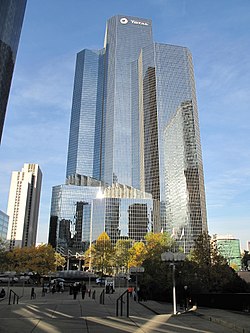
TotalEnergies has its head office in the Tour Total in La Défense district in Courbevoie, west of Paris. The company is a component of the Euro Stoxx 50 stock market index.[2] In the 2023 Forbes Global 2000, TotalEnergies was ranked as the 21st largest company in the world.[3]
| Company | Revenue (2021)(USD)[4] | Profit (2021)(USD) | Brands |
|---|---|---|---|
| ExxonMobil | $286 billion | $23 billion | |
| Shell plc | $273 billion | $20 billion | |
| TotalEnergies | $185 billion | $16 billion | |
| BP | $164 billion | $7.6 billion | Amoco Aral AG |
| Chevron | $163 billion | $16 billion | |
| Marathon | $141 billion | $10 billion | ARCO[5] |
| Phillips 66 | $115 billion | $1.3 billion | |
| Valero | $108 billion | $0.9 billion | — |
| Eni | $77 billion | $5.8 billion | — |
| ConocoPhillips | $48.3 billion | $8.1 billion | — |
History
[edit]1924–1985: Compagnie Française des Pétroles
[edit]The company was founded after World War I, when petrol was seen as vital in case of a new war with Germany. The then-French President Raymond Poincaré rejected the idea of forming a partnership with Royal Dutch Shell in favour of creating an entirely French oil company. At Poincaré's behest in 1924 Col. Ernest Mercier, with the support of 90 banks and companies, founded the Compagnie Française des Pétroles (CFP) (in English, the French Petroleum Company).
As per the agreement reached during the San Remo conference of 1920, the French state received the 25% share held by Deutsche Bank in the Turkish Petroleum Company (TPC) as part of the compensation for war damages caused by Germany during World War I. The French government's stake in TPC was transferred to CFP,[6] and the Red Line agreement in 1928 rearranged the shareholding of CFP in TPC (later renamed the Iraq Petroleum Company in 1929) to 23.75%.[7] The company from the start was regarded as a private sector company in view of its listing on the Paris Stock Exchange in 1929.
During the 1930s, the company was engaged in exploration and production, primarily from the Middle East. Its first refinery began operating in Normandy in 1933. After World War II, CFP engaged in oil exploration in Venezuela, Canada, and Africa while pursuing energy sources within France. Exploration in Algeria, then a French colony, began in 1946, with Algeria becoming a leading source of oil in the 1950s.[8]
In 1954 CFP branded its downstream products as Total in Africa and Europe.[8][9]
Total entered the United States in 1971 by acquiring Leonard Petroleum of Alma, Michigan and several Standard Oil of Indiana stations in Metro Detroit.[10]
In 1980, Total Petroleum (North America) Ltd., a company controlled 50% by CFP, bought the American refining and marketing assets of Vickers Petroleum as part of a sell-off by Esmark of its energy holdings. This purchase gave Total refining capacity, transportation, and a network of 350 service stations in 20 states.[11][12][13]
1985–2003: Total CFP and rebranding to Total
[edit]
The company renamed itself Total CFP in 1985, to build on the popularity of its gasoline brand.[9] Later in 1991, the name was changed to Total, when it became a public company listed on the New York Stock Exchange. In 1991, the French government held more than 30 percent of the company's stock but by 1996 had reduced its stake to less than 1 percent.[9][14] In the period between 1990 and 1994, foreign ownership of the firm increased from 23 percent to 44 percent.
Total continued to expand its retail presence in North America under several brand names. In 1989, Denver, Colorado–based Total Petroleum, Total CFP's North American unit, purchased 125 Road Runner retail locations from Texarkana, Texas–based Truman Arnold Companies.[15] By 1993, Total Petroleum was operating 2,600 retail stores under the Vickers, Apco, Road Runner, and Total brands. That year, the company began remodeling and rebranding all of its North American gasoline and convenience stores to use the Total name.[16] Four years later, Total sold its North American refining and retail operations to Ultramar Diamond Shamrock for $400 million in stock and $414 million in assumed debt.[17]
In 1996, the Girassol oil field was discovered and operated by TotalEnergies SE.[18] After Total's takeover of Petrofina of Belgium in 1999, it became known as Total Fina. Afterwards, it also acquired Elf Aquitaine. First named TotalFinaElf after the merger in 2000, its name reverted to Total in 2003. During that rebranding, the globe logo was unveiled.[19]
Total's leadership had been aware of the deleterious effects of global warming since at least 1971; The company nevertheless openly denied the findings of climate science until the 1990s; Total also pursued a number of strategies to cover up the threat and contribution to climate change.[20]
2003–2021
[edit]In 2003, Total signed for a 30% stake in the gas exploration venture in the Kingdom of Saudi Arabia (KSA) – South Rub' al-Khali joint venture along with Royal Dutch Shell and Saudi Aramco.[21] The stake was later bought out by its partners.
In 2006, Saudi Aramco and Total signed a memorandum of understanding to develop the Jubail Refinery and Petrochemical project in Saudi Arabia which targeted 400,000 barrels per day (bpd). Two years later, the two companies officially established a joint venture called Saudi Aramco Total Refining and Petrochemical Company (SATORP)- in which a 62.5% stake was held by Saudi Aramco and the balance 37.5% held by Total.[22][23]
Total withdrew in 2006 from all Iranian development work because of United Nations concerns that resulted in sanctions over possible weaponization of the Nuclear program of Iran.[24]
During the 2009–2010 Iraqi oil services contracts tender, a consortium led by CNPC (37.5%), which also included TOTAL (18.75%) and Petronas (18.75%) was awarded a production contract for the "Halfaya field" in the south of Iraq, which contains an estimated 4.1 billion barrels (650,000,000 m3) of oil.[25][26]
In 2010 Total and Erg merged their respective subsidiaries Total Italia and Erg Petroli, forming TotalErg, 49% controlled by the French group and 51% by the Italian one.[27][28][29][30][31]
As of 2010, Total had over 96,000 employees and operated in more than 130 countries.[32] In 2010, Total announced plans to pull out of the forecourt market in the United Kingdom.[33]
In 2012, Total announced it was selling its 20% stake and operating mandate in its Nigerian offshore project to a unit of China Petrochemical Corp for $2.5 billion.[34]
In 2013, Total started the operation at Kashagan with North Caspian Operating Company.[35] It is the biggest discovery of oil reserves since 1968. In 2013, Total increased its stake in Novatek to 16.96%.[36][37] In 2013, Total and its joint venture partner agreed to buy Chevron Corporation's retail distribution business in Pakistan for an undisclosed amount.[38]
In January 2014, Total became the first major oil and gas firm to acquire exploration rights for shale gas in the UK after it bought a 40 percent interest in two licences in the Gainsborough Trough area of northern England for $48 million.[39] In July 2014, the company disclosed it was in talks to sell its LPG distribution business in France to Pennsylvania-based UGI Corporation for €450 million ($615 million).[40]
On 20 October 2014, at 23:57 MST, a Dassault Falcon 50 business jet heading to Paris caught fire and exploded during takeoff after colliding with a snow removal vehicle in Vnukovo International Airport, killing four, including three crew members and CEO of Total S.A. Christophe de Margerie on board. Alcohol presence was confirmed in the blood of the driver of the vehicle on the ground.[citation needed] Patrick Pouyanne, who was Total's Refining Chief at that time, was appointed as CEO,[41] and also as chairman of Total in 2015.
In 2015, Total unveiled plans to cut 180 jobs in the United Kingdom, reduce refinery capacity and slow spending on North Sea fields after it fell to a $5.7bn final-quarter loss. The company said it would also sell off $5bn worth of assets worldwide and cut exploration costs by 30%.[42]
In 2016, Total signed a $224M deal to buy Lampiris, the third-largest Belgian supplier of gas and renewable energy to expand its gas and power distribution activities.[43]
In 2016, Total bought French battery maker Saft Groupe S.A. in a $1.1bn deal, to boost its development in renewable energy and electricity businesses.[44]
In 2016, Total agreed to acquire $2.2-billion in upstream and downstream assets from Petrobras as part of the firms' strategic alliance announced earlier that year.[45] For Total, these new partnerships with Petrobras reinforce Total's position in Brazil through access to new fields in the Santos Basin while entering the gas value chain.
Between 2013 and 2017, Total organized the ARGOS Challenge, a robotic competition with the aim to develop robots for their oil and gas production sites.[46] It was won by an Austrian-German team using a variant of the taurob tracker robot.[47]
In 2017, Total signed a deal for a total amount of $4.8b with Iran for the development and production of South Pars, the world's largest gas field.[48][49] The deal was the first foreign investment in Iran since in the 2015 sanctions over Iran's nuclear weaponisation were lifted by the JCPOA.[49]
In 2017, Total announced the acquisition of Maersk Oil for $7.45 billion in a share and debt transaction.[50] This deal positioned Total as the second operator in the North Sea.[51]
In 2017, Total signed an agreement with EREN Renewable energy to acquire an interest of 23% in EREN RE for an amount of €237.5 million.[52]
In November 2017, Total announced the launch on the French residential market of Total Spring, a natural gas and green power offering that is 10% cheaper than regulated tariffs. Total is thus pursuing its strategy of downstream integration in the gas and power value chain in Europe.[53]
On 10 January 2018 TotalErg was acquired by Gruppo API,[54][55] with the exception of the Special Fluids division, acquired by the newly formed Total Italia.[56]
In 2018, Total officially withdrew from the Iranian South Pars gas field because of sanctions pressure from the US.[57]
In 2019, Total announced the sale of a 30% stake in the Trapil pipeline network to crude oil storage operator Pisto SAS for €260 million.[58] Later that year, Total signed deals to transfer 30% and 28.33% of its assets in Namibia's Block 2913B and Block 2912 respectively to QatarEnergy. The company will also transfer 40% of its existing 25% interests in the Orinduik and Kanuku blocks of Guyana and 25% interest in Blocks L11A, L11B, and L12 of Kenya to QatarEnergy.[59]
In July 2020 the company changed its name from Total SA to Total SE as part of registration as a European company.[60]
In 2020, the company announced its intention to cut 500 voluntary jobs in France.[61]
In 2021, Total left the American Petroleum Institute lobby, due to differences in the common vision of how to tackle the fight against climate change.[62][63]
In 2021, Total said that it had registered an income of $3 billion for the period of January–March, which is close to the levels registered before the pandemic.[64]
2021–present: Rebranding to TotalEnergies
[edit]In 2021, the company announced a name change to TotalEnergies as an intended illustration of its investments in the production of green electricity.[65][66] At the Ordinary and Extraordinary Shareholders' Meeting in May of that year, shareholders approved the name change to TotalEnergies.[67]
In 2022, TotalEnergies announced it would end all operations in Myanmar, citing rampant human rights abuses and deteriorating rule of law since the 2021 Myanmar coup d'état and has also called for international sanctions targeting the oil and gas sector in the country, which is one of the main sources of revenue for Myanmar's government.[68]
As of 11 March 2022, Total was one of the only Western oil companies to continue operating in Russia after the Russian Invasion of Ukraine.[69][70]
In June 2022, TotalEnergies signed a partnership with QatarEnergy for the world's largest LNG expansion project, the North Field East (NFE). Holding the largest stake, 6.25%, TotalEnergies will hold the equivalent of one of the four trains.[71] In September 2022, an additional agreement was signed to include the North Field South (NFS) which is the second phase of the NFE. This gave TotalEnergies a stake of 9.375% of the 25% stakes available to international companies.[72][73]
On 30 March 2023, Total sold a shipment of LNG which it sourced from UAE to CNOOC on the Shanghai Petroleum and Natural Gas Exchange. It was reportedly the first trade to be settled in the renminbi (Chinese yuan) currency on the SHPGX.[74][75]
In July 2023, Iraq signed a $27 billion energy agreement with TotalEnergies to develop the country's energy sector and boost output of oil, gas and renewables.[76] Additionally, Indian Oil Corp, has signed liquefied natural gas (LNG) import deals with ADNOC LNG and TotalEnergies in the same month.[77]
In October 2023, TotalEnergies sold its Canadian operations to Suncor Energy for C$1.47 billion($1.07 billion).[78] TotalEnergies has agreed to buy liquefied natural gas from Qatar for 27 years, cementing the European nation's commitment to fossil fuels beyond 2050.[79]
In 2023, Total invested $300 million in a renewable energy joint venture with Adani Green Energy. The joint venture's portfolio capacity is 1,050 MW - 300 MW of operating capacity, 500 MW of solar projects under construction and 250 MW of projects under development, as well as solar and wind power projects in India.[80] At the end of January 2024, TotalEnergies reached an agreement with OMV to purchase a 50% stake in its joint venture in Malaysia (SapuraOMV) for $903 million. The deal includes the repayment of a $350 million loan from OMV to the joint venture.[81]
On 21 February 2024, TotalEnergies and Airbus entered a strategic partnership to meet emission-reduction goals through the use of sustainable aviation fuels (SAF). TotalEnergies will provide more than 50% of Airbus' European fuel requirements. Compared to fossil fuels, SAF can reduce CO2 emissions by up to 90%.[82][83]
TotalEnergies and QatarEnergy entered an agreement on 6 March 2024 to purchase participating interests in South Africa's Orange Basin offshore oil field. Under the agreement, TotalEnergies will have the exclusive right to operate its wells in Block 3B/4B with a 33% interest holding, while QatarEnergy will receive a 24% interest in the same block.[84][85]
On 22 April 2024, OmanLNG and TotalEnergies signed a deal in which OmanLNG will provide 800,000 metric tons of liquefied natural gas.[86]
On 14 November 2024, TotalEnergies announced that it will fill all of its upstream assets with real-time methane leak detection equipment by 2025 to help minimize the emissions. This is expected to help the company in its target of slashing methane emissions to nearly zero percent by 2030.[87]
On 15 November 2024, TotalEnergies, BP, Shell and Equinor promised to invest $500 million to increase the access to affordable energy, focusing primarily in sub-Saharan Africa, south and southeast Asia. This would include domestic solar energy systems, micro-electricity grids, energy production, transport, logistics and storage, e-mobility technologies, and modern cooking fuels such as liquefied petroleum gas (LPG).[88]
On 3 December 2024 TotalEnergies announced its plans to build a 0.3 gigawatt (GW) solar park in Saudi Arabia, while another leading company from France EDF has been assigned to build two solar parks with a total of 1.4 GW.[89]
In January 2025, TotalEnergies sold all of its service stations to Coly Energy Mali, a subsidiary managed by the Beninese company Bénin Petro.[90]
On February 18, 2025, TotalEnergies confirmed its departure from Burkina Faso, after 70 years of presence, in Burkina Faso.[91]
Organization
[edit]Business trends
[edit]The key trends of TotalEnergies are (as at the financial year ending 31 December):[92][93]
| Year | Revenue (US$ bn) |
Net income (US$ bn) |
Assets (US$ bn) |
Employees |
|---|---|---|---|---|
| 2011 | 228 | 16.8 | 224 | 96,104 |
| 2012 | 249 | 14.6 | 235 | 97,126 |
| 2013 | 235 | 11.5 | 237 | 98,799 |
| 2014 | 212 | 4.2 | 229 | 100,307 |
| 2015 | 143 | 5.0 | 224 | 96,019 |
| 2016 | 127 | 6.1 | 230 | 102,168 |
| 2017 | 149 | 8.6 | 242 | 98,277 |
| 2018 | 184 | 11.4 | 256 | 104,460 |
| 2019 | 176 | 11.2 | 273 | 107,776 |
| 2020 | 119 | –7.2 | 266 | 105,476 |
| 2021 | 184 | 16.0 | 293 | 101,309 |
| 2022 | 263 | 20.5 | 303 | 101,279 |
| 2023 | 237 | 21.3 | 283 | 101,279 |
Business segments
[edit]
In 2016, Total set up a new organization to achieve its ambition to become a responsible energy major.[94] It is composed of the following segments: Exploration & Production;[95] Gas, Renewables & Power; Refining & Chemicals; Trading & Shipping; Marketing & Services; and Total Global Services.
In 2016 Total created two new corporate divisions: People & Social Responsibility (Human Resources; Health, Safety & Environment; the Security Division; and a new Civil Society Engagement Division) and Strategy & Innovation (Strategy & Climate Division, responsible for ensuring that strategy incorporates the 2 °C global warming scenario, Public Affairs, Audit, Research & Development, the Chief Digital Officer and the Senior Vice President Technology).[94]
Head office
[edit]
The company's headquarters is in the Tour Total in the La Défense district in Courbevoie, France, near Paris.[96][97] The building was originally constructed between 1983 and 1985 for Elf Aquitaine; Total SA acquired the building after its merger with Elf in 2000.[97]
Subsidiaries
[edit]TotalEnergies Italia
[edit]Total Italia S.p.A. (originally Total Italia S.r.l.) is an Italian company that operates in the distribution of lubricants. It is a subsidiary of TotalEnergies SE.
It was founded in 2018 by the split of the Special Fluids branch from TotalErg in view of the acquisition by Gruppo API. It takes its name from the old Total Italia, dissolved in 2010 with the birth of TotalErg.
Operations
[edit]In May 2014, the company shelved its Joslyn North oil sands project in the Athabasca region of Alberta, Canada, indefinitely, citing concerns about operating costs. An estimated $11 billion has been spent on the project, in which Total is the largest shareholder with 38.5%. Suncor Energy holds 36.75%, Occidental Petroleum owns 15% and Japan's Inpex has a 10% interest.[98]
Total is involved in 23 projects of exploration and production[99] in Africa, Asia, Europe, North America, South America and Russia.
Investments
[edit]In 1937, Iraq Petroleum Company (IPC), 23.75 percent owned by Total,[100] signed an oil concession agreement with the Sultan of Muscat. IPC offered financial support to raise an armed force that would assist the Sultan in occupying the interior region of Oman, an area that geologists believed to be rich in oil. This led to the 1954 outbreak of Jebel Akhdar War in Oman that lasted for more than 5 years.[101]
Total has been a significant investor in the Iranian energy sector since 1990.[102] In 2017, Total and the National Iranian Oil Company (NIOC) signed a contract for the development and production of South Pars, the world's largest gas field. The project will have a production capacity of 2 billion cubic feet per day. The produced gas will supply the Iranian domestic market starting in 2021.[48]
During the European Union's sanctions against the military dictatorship Myanmar, Total is able to operate the Yadana natural gas pipeline from Burma to Thailand. Total is currently the subject of a lawsuit in French and Belgian courts for the condoning and use of the country's civilian slavery to construct the pipeline. The documentary 'Total Denial' shows the background of this project.[103] The NGO Burma Campaign UK is currently[when?] campaigning against this project.
Acquisitions
[edit]In 2011, Total agreed to buy 60% of photovoltaics company SunPower for US$1.38 billion.[104] By the 2013 annual reporting date, Total owned 64.65%.
In 2016, Total agreed to purchase French battery maker Saft Groupe S.A. for 1.1 billion euros.[105]
In 2016, Total signed a $224M deal to buy Lampiris, the third-largest Belgian supplier of gas and renewable energy to expand its gas and power distribution activities.[106]
In December 2016, Total acquired about 23% of Tellurian for an amount of 207 million dollars, to develop an integrated gas project.[107]
In 2017, Total announced it would buy Maersk Oil from A.P. Moller-Maersk in a deal expected to close in the first quarter of 2018.[108]
In 2018, Total announced it was buying 74% of the French electricity and gas provider Direct Énergie from their main stockholders, for 1.4 billion euros.[109]
In 2022, Total announced it had added 4 GW to its renewable energy portfolio through the acquisition of the Austin-based company, Core Solar.[110] The following month, Total entered an agreement with GIP to acquire a 50% stake in Clearway, one of the largest renewable energy owners in the United States.[111] As part of the transaction, GIP took a 50% minus one share stake in SunPower.[112]
In October 2023, TotalEnergies announced it was purchasing Quadra, a Germany based clean energy aggregator, for an undisclosed amount.[113]
In 2023, TotalEnergies acquired three gas-fired power plants with a total capacity of 1.5 GW in Texas from TexGen for $635 million.[114]
Western Sahara oil exploration
[edit]In 2001, Total signed a contract for oil-reconnaissance in areas offshore Western Sahara (near Dakhla), with the Moroccan "Office National de Recherches et d'Exploitations Petrolières" (ONAREP). In 2002, Hans Corell (the United Nations Under-Secretary-General for Legal Affairs) stated in a letter to the president of the Security Council that whenever the contracts are only for exploration they're not illegal, but if further exploration or exploitation are against the interests and wishes of the people of Western Sahara, they would be in violation of the principles of international law.[115] Finally, Total decided to not renew their license off Western Sahara.[116]
Energy Deal with ADNOC
[edit]In a move to cope with the 2021–2022 global energy crisis, which started with the onset of the Covid-19 pandemic and aggravated with Russia's 2022 invasion of Ukraine, France's TotalEnergies and UAE's ADNOC signed a strategic deal to partner on energy projects "for cooperation in the area of energy supplies".
The deal was secured on the second day of the UAE leader Sheikh Mohamed bin Zayed Al-Nahyan's visit to Paris in 2022. The visit marked the UAE president's first overseas state visit since assuming the post earlier that year.
The deal was aimed at identifying and targeting potential joint investment projects in the UAE, France, and elsewhere in the sectors of renewables, hydrogen, and nuclear energy, as told by the French government in one of its statements. According to French President Emmanuel Macron's aides, France had been eager to secure diesel supply from the UAE.[117]
The deal also received criticism from human rights groups that pressured Macron not to give the then "crown prince a pass on the UAE's atrocious human rights record", per the statement published by Human Rights Watch on its website.[118]
Controversies
[edit]Environmental and safety records
[edit]In 1999, the Total SA company was fined €375,000 for the MV Erika oil spill that stretched 400 kilometers from La Rochelle to the western tip of Brittany. The company was only fined that amount because they were only partially liable because Total SA did not own the ship. The plaintiffs had sought more than $1.5 billion in damages. More than 100 groups and local governments joined in the suit. The Total company was fined just over $298,000. The majority of the money will go to the French government, several environmental groups, and various regional governments. The Total SA company was also fined $550,000 for the amount of marine pollution that came from it. After the oil spill they tried to restore their image and have opened a sea turtle conservation project in Masirah in recent years.[citation needed]
Prior to the verdict in which Total was found guilty one of the counterparts in the incident, Malta Maritime Authority (MMA), was not to be tried for having any hand in the incident. In 2005, Total submitted a report to the Paris courts which stated that Total had gathered a group of experts which stated the tanker was corroded and that Total was responsible for it. The courts sought a second expert reviewing this information, which was turned down.[119]
In 2001, the AZF chemical plant exploded in Toulouse, France, while belonging to the Grande Paroisse branch of Total.[citation needed]
In 2008, Total was required to pay €192 million in compensation to victims of the pollution caused by the sinking of the ship MV Erika. This was in addition to the €200 million that Total spent to help clean up the spill. The company appealed twice against the verdict, losing both times.
In 2016, Total was ranked as the second-best of 92 oil, gas, and mining companies on indigenous rights in the Arctic.[120] According to the CDP Carbon Majors Report 2017, the company was one of the top 100 companies producing carbon emissions globally, responsible for .9% of global emissions from 1998 to 2015.[121] In 2021, Total was ranked as the 2nd most environmentally responsible company out of 120 oil, gas, and mining companies involved in resource extraction north of the Arctic Circle in the Arctic Environmental Responsibility Index (AERI).[122]
According to a 2021 study, Total personnel were aware about the role that their products played in global warming as early as 1971, as well as throughout the 1980s. Despite this awareness, the company promoted doubt regarding the science of global warming by the late 1980s, and ultimately settled on a position in the late 1990s of publicly accepting climate science, while still promoting doubt and trying to delay climate action.[123] In August 2024, South Africa's advertising regulator ruled that TotalEnergies' promotion of sustainability in an advertising campaign in the country was misleading. The campaign was run in collaboration with South Africa's nature conservation authority, Sanparks, to encourage people to visit the country's national parks.[124]
Bribery
[edit]Total has been accused of bribery on multiple occasions.
Total is being implicated in a bribe commission scandal which is currently[when?] emerging in Malta. It has emerged that Total had told Maltese agents that it would not be interested in doing business with them unless their team included George Farrugia, who is under investigation in the procurement scandal. George Farrugia has recently been given a presidential pardon in exchange for information about this scandal. Enemalta, Malta's energy supplier, swiftly barred Total and its agents, Trafigura from bidding and tenders. An investigation is currently underway and three people have been arraigned.[125][citation needed]
On 16 December 2008, the managing director of the Italian division of Total, Lionel Levha, and ten other executives were arrested by the public Prosecutor's office of Potenza, Italy, for a corruption charge of €15 million to undertake the oilfield in Basilicata on contract. Also arrested was the local deputy of Partito Democratico Salvatore Margiotta and an Italian entrepreneur.[126][127]
In 2010, Total was accused of bribing Iraqi officials during former president Saddam Hussein's regime to secure oil supplies. A United Nations report later revealed that Iraqi officials had received bribes from oil companies to secure contracts worth over $10bn.[128] On 26 February 2016, the Paris Court of Appeals considered Total guilty and ordered the company to pay a fine of €750,000 for corrupting Iraqi civil servants. The court's ruling overturns an earlier acquittal in the case.
In 2013, a case was settled that concerned charges that Total bribed an Iranian official with $60 million, which they documented as a "consulting charge," and which unfairly gave them access to Iran's Sirri A and Sirri E oil and gas fields. The bribery gave them a competitive advantage, earning them an estimated $150 million in profits. The Securities Exchange Commission and the Department of Justice settled the charges, expecting Total to pay $398 million.[129]
2022 Russian invasion of Ukraine
[edit]Following the 2022 Russian invasion of Ukraine which began on 24 February, many international, particularly Western companies pulled out of Russia. On 1 March, TotalEnergies announced it "will no longer provide capital for new projects in Russia" but has retained ownership of its 19.4% stake in privately owned Novatek, 20% stake in the Yamal project and 10% stake in Arctic LNG 2.[130] This has led to criticism as insufficient, particularly given complete divestment of other major Western energy companies, and the European Union announcement of becoming more energy independent from Russia.[131][132][133] Similarly in August 2022, an investigation by Global Witness showed that a Siberian gas field part-owned by TotalEnergies has been supplying a refinery, which is producing jet fuel for Russian warplanes. This contradicts Total's claims that this was unrelated to Russian military operations in Ukraine.[134] On 26 April, 2024, while presenting the firm’s interim financial report TotalEnergy CEO Patrick Pouyanne said that importing Russian LNG to EU is not a very profitable operation and if EU sanctions Russian LNG, the price of LNG will go up quickly and globally TotalEngergy's portfolio will benefit from it.[135] According to a 2024 analysis done by IEEFA, despite EU sanctions, Russian LNG import to France almost doubled to 4.4 billion cubic meters in the first half of 2024 compared to the same period a year ago.[136] On 30 September, 2025, Patrick Pouyanne suggested that Russian liquefied natural gas shipments could be redirected to other countries like India and Turkey if the European Union bans imports while sparing a key facility in Russia[137].
Africa
[edit]In December 2022, the NGOs Friends of the Earth, Survie and four Ugandan NGOs sent the oil group Total to court and accused it of violating the law on the duty of vigilance of large French companies in terms of human rights and environment.[138] The Tilenga Project, which TotalEnergies is undertaking in conjunction with China National Offshore Oil Corporation consists of drilling for oil in the Murchison Falls National Park, a habitat for diverse species of birds and animals.[139] The project also involves building a pipeline from the site in land-locked Uganda to Tanga in Tanzania. Critics of the project are concerned that, since the proposed pipeline passes through Lake Victoria and close to a number of wildlife areas in Tanzania and Kenya, oil spills could threaten the lake and could have adverse effects on the wildlife, some of which is endangered, in various national parks.[140] In March 2025, a judicial investigation was opened in France for involuntary manslaughter against totalenergies in Mozambique.[141]
Automobile and motorcycle OEM partnerships
[edit]TotalEnergies is an official recommended fuel and lubricants for all prominent Renault–Nissan–Mitsubishi Alliance members, including Renault (shared with BP), Nissan (shared with ExxonMobil), Infiniti, Dacia, Alpine and Datsun, Kia, three Stellantis marques (Citroën, Peugeot and DS), Honda (including Acura, shared with BP and ExxonMobil), Aston Martin, Mazda (shared with BP and its subsidiary Castrol), Sany and Tata Motors (shared with Petronas) for automobiles only as well as Peugeot Motocycles, Kawasaki Motors (fuel only), Energica, and Honda for motorcycles only.
Sponsorship
[edit]
Total has provided fuel and lubricants to professional auto racing teams.[citation needed]
Total has been a longtime partner of Citroën Sport in the World Rally Championship, Dakar Rally and World Touring Car Championship. Sébastien Loeb won nine WRC drivers titles, whereas Ari Vatanen and Pierre Lartigue won four editions of the Dakar Rally.[citation needed]
Total has been a partner of Peugeot Sport in Formula One from 1995 to 2000, the British Touring Car Championship in 1995 and 1996 and since 2001 in the World Rally Championship, Intercontinental Rally Challenge, 24 Hours of Le Mans, Intercontinental Le Mans Cup, Dakar Rally and Pikes Peak International Hill Climb.[citation needed] Total is also a partner of Peugeot Sport for its customer racing TCR Touring Car programme[citation needed] and its Le Mans Hypercar project in the FIA World Endurance Championship.[142]
Total was a partner of Renault Sport in Formula One from 2009 to 2016. Their logo appeared on the Red Bull Racing cars between 2009 and 2016, the Renault F1 cars in 2009, 2010 and 2016, and the Lotus F1 cars from 2011 to 2014. Total also partnered Caterham F1 Team in 2011–2014, Scuderia Toro Rosso in 2014–2015 and Williams F1 Team in 2012–2013.[citation needed]
Also, Total was the title sponsor of the Copa Sudamericana football tournament in 2013 and 2014.[citation needed]
In 2017, Total was appointed by FIA and ACO as official fuel supplier of the World Endurance Championship and 24 Hours of Le Mans from 2018–19 season onwards.[143]
Total is one of the official sponsors from 2013 to 2022 for one of the most popular and influential Mexican football teams, Club America.[144]
In 2016, Total secured an eight-year sponsorship package from the Confederation of African Football (CAF) to support 10 of its principal competitions. Total will start with the Africa Cup of Nations to be held in Gabon, therefore, renaming it Total Africa Cup of Nations.[citation needed]
Following Total's purchase of Direct Énergie in the summer of 2018, the Direct Énergie cycling team changed its name the following year to Total Direct Énergie ahead of that year's edition of Paris–Roubaix.[145] In 2021 the team changed its name again to Team TotalEnergies in time for that year's Tour de France.[146]
In 2019, the company's Chief Executive Officer, Patrick Pouyanne pledged that Total would make a €100 million contribution to the reconstruction of the Notre-Dame cathedral after it was extensively damaged in a fire.[147]
In 2020, the company confirmed a two-year sponsorship deal with CR Flamengo, being the first time a partner of a Brazilian football team.[148]
See also
[edit]

- 2005 Hertfordshire Oil Storage Terminal fire
- 2007 UK petrol contamination
- Centre Scientifique et Technique Jean Féger, main technical and scientific research center for Total in Pau, France
- ERAP
- Fossil fuels lobby
- Lindsey Oil Refinery
Notes
[edit]- ^ Data is based on the 2022 Fortune 500.
References
[edit]- ^ a b c d e f 2023 Annual Report (Form 20-F) (Report). US Securities and Exchange Commission. 29 March 2024. pp. F-9, F-11, F-58. Retrieved 20 March 2024.
- ^ "Euro Stoxx 50 | Index | 965814 | EU0009658145 | Börse Frankfurt (Frankfurt Stock Exchange)". Boerse-frankfurt.de. Archived from the original on 8 February 2019. Retrieved 4 November 2015.
- ^ "Forbes Global 2000". Forbes. Retrieved 12 June 2023.
- ^ "Fortune 500". Fortune. Retrieved 17 November 2022.
- ^ "Marathon Petroleum". Marathon Petroleum Corporation . Retrieved 26 October 2023.
- ^ "Milestones: 1921–1936, the 1928 Red Line Agreement". US Department of State. Archived from the original on 29 July 2012. Retrieved 18 August 2012.
- ^ "An Administrative/Biographical History of Iraq Petroleum Company". Retrieved 18 August 2012.
- ^ a b "Compagnie Française des Pétroles and Its Contribution to the Re-establishment of France's Position among the Oil Countries after the Second World War" (PDF). Archived from the original (PDF) on 12 May 2013. Retrieved 18 June 2012. by Mohamed Sassi, Research associate at Université de Paris-IV (Sorbonne)
- ^ a b c "Total company info on Britannica". Retrieved 18 June 2012.
- ^ "French toehold". The New York Times. 16 May 1971. Retrieved 8 July 2022.
- ^ Atlas, Terry (27 August 1980). "Esmark will sell TransOcean oil, gas unit to Mobil". Chicago Tribune. pp. 4–3. Retrieved 23 September 2015.
- ^ Cole, Robert J. (22 August 1980). "Mobil high bidder for Esmark oil holdings". Lawrence (KS) Journal-World. New York Times News Service. p. 24. Retrieved 23 September 2015.
- ^ "Jack Vickers". Colorado Business Hall of Fame. 2009. Retrieved 23 September 2015.
- ^ "Chapter 2". Eia.doe.gov. Archived from the original on 15 June 2010. Retrieved 8 December 2011.
- ^ "About Road Runner". Road Runner Stores. Archived from the original on 16 May 2015. Retrieved 23 September 2015.
- ^ "Total Petroleum to rebrand and restructure its stores throughout the Midwest" (Press release). PR Newswire. 14 January 1993. Archived from the original on 8 July 2017. Retrieved 23 September 2015.
- ^ Salpukas, Algis (16 April 1997). "Ultramar Diamond Shamrock Is to Acquire a Unit of Total". The New York Times. Retrieved 23 September 2015.
- ^ "Girassol, first Angola Block 17 deepwater field to produce". ogj.com. 2002. Retrieved 4 June 2013.
- ^ Spaeth, Tony. "Review of Total logo". Identityworks. Archived from the original on 3 May 2012. Retrieved 4 May 2012.
- ^ Bonneuil, Christophe; Choquet, Pierre-Louis; Franta, Benjamin (1 November 2021). "Early warnings and emerging accountability: Total's responses to global warming, 1971–2021". Global Environmental Change. 71 102386. Bibcode:2021GEC....7102386B. doi:10.1016/j.gloenvcha.2021.102386. ISSN 0959-3780. S2CID 239563490.
- ^ "Shell and Total sign a natural gas agreement – South Rub Al-Khali – Gas Processing". Gulfoilandgas.com. Retrieved 4 November 2015.
- ^ "Saudi Aramco Total Refining and Petrochemical Company (SATORP) completes US$8.5 Billion project financing for Jubail Refinery". Retrieved 18 August 2012.
- ^ "History of Saudi Aramco Total Refining and Petrochemical Company (SATORP)". Archived from the original on 27 August 2012. Retrieved 18 August 2012.
- ^ "Iran says China's state oil firm withdraws from US$5-billion natural gas deal; U.S. sanctions may be to blame". The Globe and Mail Inc. Associated Press. 6 October 2019.
- ^ "Shell walks away with Majnoon". upstreamonline.com. 11 December 2009.
- ^ "Halfaya trio sign on dotted line". upstreamonline.com. 27 January 2011. Retrieved 22 August 2012.
- ^ "Storia - Chi siamo - TotalErg". TotalErg (in Italian). Retrieved 19 April 2017.
- ^ "TOTAL e ERG creano TotalErg, nuova joint-venture nel settore della Raffinazione e Marketing in Italia". ERG Site (in Italian). Archived from the original on 27 May 2014. Retrieved 27 September 2014.
- ^ Industria (29 January 2010). "Compagnie petrolifere - NASCE LA TOTALERG". Quattroruote.it (in Italian). Retrieved 27 September 2014.
- ^ "Nasce TotalErg, terzo gruppo dei distributori". archiviostorico.corriere.it. Retrieved 27 September 2014.
- ^ "Microsoft Word - Comunicato Stampa TotalErg.doc" (PDF). TotalErg (in Italian). Retrieved 23 December 2010.
- ^ "Total.com – Businesses of the Total Group". Archived from the original on 27 December 2012. Retrieved 9 July 2010.
- ^ "Total to sell 500 UK petrol stations". The independent. 10 September 2010. Retrieved 18 August 2016.
- ^ "Total Sells Stake in Nigerian Project to Sinopec for $2.5 Billion". The Wall Street Journal. United States. 2012.
- ^ "Global Experience of Total – key to success in Kazakhstan". Investkz.com. Retrieved 4 November 2015.
- ^ "Press Center: Press Releases and Events | Total increased its stake in NOVATEK". www.novatek.ru. Archived from the original on 7 October 2013.
- ^ Registration Document 2013
- ^ Louise Heavens (18 September 2013). "France's Total snaps up Chevron's Pakistan retail network". Reuters.
- ^ "Total deal speeds up UK shale gas race". International: Reuters. 2014. Archived from the original on 8 January 2016.
- ^ "Total to sell LPG distribution business in France to UGI Corp unit for 450mn euros". Pennsylvania Sun. Archived from the original on 14 July 2014. Retrieved 3 July 2014.
- ^ "Total appoints Patrick Pouyanne as CEO after Christophe de Margerie dies in plane crash". The Daily Telegraph. Finance. 2014. Archived from the original on 22 October 2014.
- ^ Terry Macalister (12 February 2015). "Total to cut 180 UK jobs after $5.7bn loss | Business". The Guardian. Retrieved 4 November 2015.
- ^ "Total Acquires Lampiris to Expand Its Gas and Power Distribution Activities". www.businesswire.com. 14 June 2016. Retrieved 20 December 2016.
- ^ "Total to Buy Battery Maker Saft in Push to Expand Clean Energy". Bloomberg.com. 9 May 2016. Retrieved 20 December 2016.
- ^ "Total to buy $2.2 billion in Petrobras upstream, downstream assets". www.ogj.com. 21 December 2016. Retrieved 1 March 2017.
- ^ "Argos Challenge Website". ARGOS Challenge. Archived from the original on 12 August 2020. Retrieved 13 May 2017.
- ^ "The Argonauts Robot Wins the ARGOS Challenge!". Total Group Website. Retrieved 13 May 2017.
- ^ a b Reed, Stanley (3 July 2017). "Total Signs Deal With Iran, Exposing It to Big Risks and Rewards". The New York Times. ISSN 0362-4331. Retrieved 4 July 2017.
- ^ a b "Iran Signs a $5 Billion Energy Deal With France's Total". The Atlantic. 3 July 2017.
- ^ www.maersk.com, Mærsk -. "Total S.A. to acquire Mærsk Olie og Gas A/S for USD 7.45bn and make Denmark a regional hub". www.maersk.com. Archived from the original on 24 August 2017. Retrieved 29 August 2017.
- ^ "Total & Maersk Oil: combining the best of our expertise | Exploration & Production". Archived from the original on 20 May 2018.
- ^ "Total buys 23% stake in renewable energy company Eren". Financial Times. 19 September 2017. Retrieved 20 September 2017.
- ^ "Total ready for price war as it enters French retail power market". U.S. Retrieved 25 March 2018.
- ^ "Governance TotalErg - Chi siamo". TotalErg (in Italian). Archived from the original on 12 January 2018. Retrieved 21 January 2018.
- ^ "2018%2001%2010%20-%20CS%20closing%20api%20TE.pdf" (PDF). Gruppo API (in Italian). Archived from the original (PDF) on 17 January 2018. Retrieved 21 January 2018.
- ^ "Comunicato stampa". Total Italia (in Italian). Retrieved 19 April 2021.
- ^ "French energy giant Total officially pulls out of Iran". DW.com. 20 August 2018.
- ^ "Total Sells Trapil Stake for $290MM". www.rigzone.com. Retrieved 5 August 2019.
- ^ "French oil major Total signs asset transfer deals with Qatar Petroleum". Reuters. 27 August 2019. Archived from the original on 27 August 2019. Retrieved 27 August 2019.
- ^ "Total becomes European company, changes name". S&P Global. 21 July 2020. Retrieved 7 March 2024.
- ^ Bloomberg (13 December 2020). "Total in talks over 500 voluntary job cuts in France, CEO says". Energy Voice. Retrieved 13 December 2020.
- ^ "Total withdraws from the American Petroleum Institute | Total.Com". 15 January 2021.
- ^ Takahashi, Paul (15 January 2021). "Total to leave American Petroleum Institute over climate 'divergences'". Houston Chronicle. Retrieved 7 February 2021.
- ^ "Total back to pre-pandemic profit levels as oil prices rise". Reuters. 29 April 2021. Retrieved 29 April 2021.
- ^ "French oil giant Total rebrands as Total Energies in climate push". France 24. Agence France-Presse. 21 May 2021.
- ^ "French oil giant Total rebrands in Shift to Renewables". Mackinnon and Partners. 21 June 2021.
- ^ "Total is Transforming and Becoming TotalEnergies" (Press release). TotalEnergies. 28 May 2021.
- ^ "2 big energy firms exit Myanmar over human rights abuses by the military government". NPR. Associated Press. 21 January 2022. Retrieved 21 January 2022.
- ^ White, Sarah; Abboud, Leila (6 March 2022). "Oil major Total sticks with Russia despite exit of rivals". Financial Times. Retrieved 12 March 2022.
- ^ Jessop, Simon; Mallet, Benjamin (11 March 2022). "EXCLUSIVE Activist Clearway urges TotalEnergies to exit Russia or face vote". Reuters. Retrieved 12 March 2022.
- ^ Dahan, Maha El (12 June 2022). "QatarEnergy signs deal with TotalEnergies for North Field East project". Reuters. Retrieved 28 July 2023.
- ^ Mills, Andrew; Dahan, Maha El (24 September 2022). "QatarEnergy signs deal with TotalEnergies for North Field South expansion". Reuters. Retrieved 28 July 2023.
- ^ "ExxonMobil wins North Field East LNG stake". MEED. 22 June 2022. Retrieved 28 July 2023.
- ^ "China, France companies complete first cross-border Yuan settlement of LNG trade". Daily Times. 30 March 2023. Archived from the original on 30 March 2023. Retrieved 25 May 2023.
- ^ Shardul Sharma (29 March 2023). "China completes 1st LNG cross-border yuan settlement deal". www.naturalgasworld.com. Archived from the original on 29 March 2023. Retrieved 25 May 2023.
- ^ "Iraq, TotalEnergies sign massive oil, gas, renewables deal". Reuters. 10 July 2023.
- ^ Verma, Nidhi (17 July 2023). "Indian Oil signs long term LNG import deals with ADNOC LNG, TotalEnergies". Reuters.
- ^ "Suncor Energy to acquire TotalEnergies' Canadian oil sands stake for C$1.47 bln". Reuters. 4 October 2023. Retrieved 5 October 2023.
- ^ "France's Total signs 27-year LNG deal with Qatar".
- ^ "OMV to Sell Stake in Malaysian JV to TotalEnergies for $903 Mln". MarketWatch. Archived from the original on 31 January 2024. Retrieved 7 February 2024.
- ^ "Total Invests USD 300 Million In Joint Venture With Adani Green Energy". Outlook. 28 December 2023. Archived from the original on 7 February 2024. Retrieved 7 February 2024.
- ^ "TotalEnergies, Airbus sign partnership in sustainable aviation fuel". Reuters. 21 February 2024. Retrieved 17 April 2024.
- ^ Segal, Mark (21 February 2024). "Airbus, TotalEnergies Launch New Sustainable Aviation Fuel Partnership". ESG Today. Retrieved 17 April 2024.
- ^ "TotalEnergies, Qatar expand Orange Basin holdings to South Africa". Reuters. 6 March 2024. Retrieved 17 April 2024.
- ^ "TotalEnergies and QatarEnergy to foray into South Africa's Block 3B/4B". NS Energy. 7 April 2024. Retrieved 17 April 2024.
- ^ Saba, Yousef (22 April 2024). "Oman LNG signs supply deal with TotalEnergies". Reuters.
- ^ "Totalenergies to monitor methane on all upstream assets by 2025". 14 November 2024.
- ^ "TotalEnergies, BP, Equinor and Shell commit $500 million to boost energy access". 15 November 2024.
- ^ "France's EDF, TotalEnergies awarded Saudi solar tenders during Macron visit". 3 December 2024.
- ^ "Mali: TotalEnergies, le géant français des hydrocarbures, quitte le pays". 30 January 2025.
- ^ "Après le Mali, le groupe pétrolier français Total se retire du Burkina Faso". 21 February 2025.
- ^ "Totalenergies (ex Total) Fundamentalanalyse | KGV | Kennzahlen". boerse.de (in German). Retrieved 6 April 2024.
- ^ "Totalenergies (ex Total) 2013-2020". boerse.de (in German). Archived from the original on 17 August 2022. Retrieved 6 April 2024.
- ^ a b "Total Presents New Organization to Achieve Its Ambition of Becoming the Responsible Energy Major". BusinessWire.com. 19 April 2016.
- ^ "Exploration-Production". Exploration-Production (in French). Retrieved 4 June 2018.
- ^ "Total: Main indicators". Reuters. 15 October 2009. Archived from the original on 9 September 2012. Retrieved 19 October 2009.
- ^ a b "Total: l'héritage de la fusion". Le Journal du Net. Retrieved 8 July 2010.
- ^ "Cost escalation leads Total to put Joslyn oil sands project on hold". Edmonton Journal. Archived from the original on 5 June 2014. Retrieved 14 June 2014.
- ^ "Projects". Exploration & Production. 6 October 2016. Retrieved 28 February 2017.
- ^ "Milestones: 1921–1936 - Office of the Historian". history.state.gov.
- ^ Peterson, J. E. (2 January 2013). Oman's Insurgencies: The Sultanate's Struggle for Supremacy. Saqi. ISBN 978-0-86356-702-5. Retrieved 29 April 2018 – via Google Books.
- ^ "GAO-10-515R Iran's Oil, Gas, and Petrochemical Sectors" (PDF). United States Government Accountability Office. 23 March 2010. Archived from the original (PDF) on 5 November 2010. Retrieved 20 May 2010.
- ^ "totaldenialfilm.com". totaldenialfilm.com. Archived from the original on 23 September 2007. Retrieved 8 December 2011.
- ^ Herndon, Andrew; Martin, Christopher; Goossen, Ehren (29 April 2011). "Total Agrees to Buy SunPower for $1.38 Billion in Renewable-Energy Push". Bloomberg. Retrieved 30 April 2011.
- ^ "Total to Buy Saft to Boost Renewable Energy Business". 9 May 2016. Retrieved 9 May 2016.
- ^ "Total to buy Belgian green energy provider Lampiris – De Standaard". Reuters. 14 June 2017. Retrieved 20 December 2016.
- ^ "Ogfj.Com domain name is for sale. Inquire now". sell.sawbrokers.com.
- ^ "Maersk agrees to sell oil unit to Total in $7.45 bln deal". CNBC. 21 August 2017. Retrieved 21 August 2017.
- ^ Nabil Wakim (18 April 2018). "Total va acheter Direct Energie et espère bousculer le marché de l'électricité". Le Monde.fr (in French). Retrieved 18 April 2018.
- ^ "TotalEnergies adds 4GW to renewable energy portfolio with U.S. acquisition". uk.finance.yahoo.com. 27 April 2022. Retrieved 27 April 2022.
- ^ Release, Press (25 May 2022). "TotalEnergies acquires 50% of Clearway, the 5th-largest U.S. renewable energy player". POWER Magazine. Retrieved 24 August 2022.
- ^ "United States: TotalEnergies acquires 50% of Clearway, the 5th largest U.S. renewable energy player". TotalEnergies.com. 25 May 2022. Retrieved 24 August 2022.
- ^ Akella, Surya (27 October 2023). "TotalEnergies to buy German clean energy aggregator Quadra". Power Technology. Retrieved 21 May 2024.
- ^ "TotalEnergies acquires three TexGen gas-fired power plants for $635 million". Reuters. 13 November 2023. Retrieved 13 November 2023.
- ^ "Letter dated 29 January 2002 from the Under-Secretary-General for Legal Affairs, the Legal Counsel, addressed to the President of the Security Council" (PDF). UN. 12 February 2002. Archived from the original (PDF) on 7 December 2010. Retrieved 6 September 2010.
- ^ "Upstream Online: Total turns its back on Dakhla block, 2004". Western Sahara Resource Watch. 3 December 2004. Retrieved 2 September 2010.unreliable?
- ^ "France, UAE sign strategic deal to partner on energy projects". France24. 18 July 2022. Retrieved 18 July 2022.
- ^ "France's Energy Plans Should Not Include Ignoring UAE Abuses". Human Rights Watch. 15 July 2022. Retrieved 15 July 2022.
- ^ "The Malta Financial&Business Times". Businesstoday.com.mt. 23 February 2005. Retrieved 4 November 2015.
- ^ Overland, Indra (2016). "Ranking Oil, Gas and Mining Companies on Indigenous Rights in the Arctic". ResearchGate. Arran. Retrieved 2 August 2018.
- ^ The Carbon Majors Database CDP Carbon Majors Report 2017 (PDF). CDP and Climate Accountability Institute. 2017. Archived from the original (PDF) on 4 December 2021. Retrieved 9 April 2021.
- ^ Overland, Indra; Bourmistrov, Anatoli; Dale, Brigt; Irlbacher-Fox, Stephanie; Juraev, Javlon; Podgaiskii, Eduard; Stammler, Florian; Tsani, Stella; Vakulchuk, Roman; Wilson, Emma C. (2021). "The Arctic Environmental Responsibility Index: A method to rank heterogenous extractive industry companies for governance purposes". Business Strategy and the Environment. 30 (4): 1623–1643. doi:10.1002/bse.2698. hdl:11250/2832230. ISSN 0964-4733. S2CID 233618866.
- ^ Bonneuil, Christophe; Choquet, Pierre-Louis; Franta, Benjamin (2021). "Early warnings and emerging accountability: Total's responses to global warming, 1971–2021". Global Environmental Change. 71 102386. Bibcode:2021GEC....7102386B. doi:10.1016/j.gloenvcha.2021.102386. ISSN 0959-3780. S2CID 239563490.
- ^ "En Afrique du Sud, un régulateur épingle TotalEnergies pour "greenwashing"". lefigaro.fr. Le Figaro avec AFP. 22 August 2024. Retrieved 23 August 2024.
- ^ "Murder in Malta". The New Yorker. 11 December 2020.
- ^ "Tangenti per il petrolio in Basilicata: arrestati l'ad Total e un deputato del Pd". il Giornale (in Italian). 16 December 2008. Retrieved 16 December 2008.
- ^ "Tangenti, arrrestato l'amministratore delegato di Total Italia". La7 (in Italian). 16 December 2008. Archived from the original on 17 December 2008. Retrieved 16 December 2008.
- ^ "Total faces corruption investigation". 7 April 2010. Retrieved 8 April 2010.
- ^ "Total to Pay $398 Million for Corrupt Practices". JD Journal. 30 May 2013. Retrieved 4 November 2015.
- ^ Mallet, Benjamin; Lough, Richard (1 March 2022). "TotalEnergies stays put in Russia, but no capital for new projects". Reuters. Retrieved 13 March 2022.
- ^ "Exclusive-Activist Clearway urges TotalEnergies to exit Russia or face vote". euronews. 12 March 2022. Retrieved 13 March 2022.
- ^ Clinch, Matt (1 March 2022). "'History will judge them': Ukraine foreign minister slams Big Oil's links to Russia". CNBC. Retrieved 13 March 2022.
- ^ Thomas, Allister (2 March 2022). "'Toothless, useless': TotalEnergies slammed by former Shell Ukraine boss". Energy Voice. Retrieved 13 March 2022.
- ^ "French cash, Russian fuel, Ukrainian blood". Global Witness. 24 August 2022. Retrieved 8 September 2022.
- ^ Tetrel, Sophie (26 April 2024). "EU ban on Russian LNG would be "positive" – TotalEnergies CEO". MONTEL. Retrieved 6 October 2025.
- ^ "French imports of Russian LNG surge, but Ukraine supporters seek a stop". RFI. 9 August 2024. Retrieved 6 October 2025.
- ^ Bloomberg (30 September 2025). "TotalEnergies may redirect Russian LNG to Asia if EU bans imports". BusinessLine. Retrieved 6 October 2025.
- ^ "TotalEnergies de nouveau face à la justice pour son mégaprojet d'exploitation pétrolière en Ouganda". Le Monde.fr. 7 December 2022.
- ^ Moisan, Dorothée (19 April 2022). "Uganda oil project casts shadow over Total's eco-friendly image". The Guardian.
- ^ Latif Dahir, Abdi (14 March 2023). "An Oil Rush Threatens Natural Splendors Across East Africa". The New York Times.
- ^ "TotalEnergies visée par une information judiciaire pour homicide involontaire dans l'affaire de l'attaque djihadiste au Mozambique". Le Monde. 14 March 2023.
- ^ "Team Peugeot TotalEnergies unveils its driver line-ups at Le Mans". www.media.stellantis.com. Retrieved 7 August 2023.
- ^ "FIA WEC Secures Five Year Total Deal". sportspromedia.com. 20 April 2017. Retrieved 20 April 2017.
- ^ "Bienvenido Total * Club América - Sitio Oficial". Club América - Sitio Oficial (in Spanish). 18 January 2013. Retrieved 20 September 2023.
- ^ Long, Jonny (11 April 2019). "Total Direct Energie reveal new kit after title sponsor change". Cycling Weekly. Retrieved 5 March 2022.
- ^ Bonville-Ginn, Tim (16 June 2021). "Total Direct Energie change name and kit design after sponsor rebrand". Cycling Weekly. Retrieved 5 March 2022.
- ^ "Total CEO says company pledges 100 million euro to rebuild Notre-Dame". Reuters. 16 April 2019. Retrieved 11 July 2023.
- ^ "Total fecha patrocínio com o Clube de Regatas do Flamengo". Total Brasil | Postos de Combustível, Oléos lubrificantes automotivos e industriais. (in Brazilian Portuguese). 17 January 2020. Archived from the original on 22 December 2021. Retrieved 19 January 2020.
External links
[edit]
- Official website
- TotalEnergies on OpenSecrets, a website that tracks and publishes data on campaign finance and lobbying
- Documents and clippings about TotalEnergies in the 20th Century Press Archives of the ZBW

Last updated: 18 September 2023 | |
|

 CAC 40 companies of France CAC 40 companies of France | |
|---|---|
Last updated: 30 September 2023 | |
|
TotalEnergies
View on GrokipediaHistory
Founding and Early Development (1924–1985)
The Compagnie Française des Pétroles (CFP) was established on March 28, 1924, as a private entity under the initiative of the French government to secure domestic energy supplies and assert national interests in global oil markets, following World War I reparations that allocated France a share of former German oil concessions in the Ottoman Empire's territories.[1][11] With France lacking indigenous oil production, CFP was capitalized at 100 million francs, primarily by French banks and industrialists, and tasked with acquiring the 25 percent stake previously held by Deutsche Bank in the Turkish Petroleum Company (TPC), which controlled exploration rights in Mesopotamia (modern Iraq).[12][13] This stake was formalized through the 1920 San Remo Oil Agreement, enabling CFP to hold a 23.75 percent interest in TPC upon its reorganization as the Iraq Petroleum Company (IPC) in 1929.[14] CFP's early operations centered on upstream activities in the Middle East, where IPC secured an exploration concession in Iraq in 1925 and discovered commercially viable oil on October 14, 1927, at the Baba Gurgur field near Kirkuk, igniting a major blowout that highlighted the region's potential.[14][15] Production commenced in 1934, with CFP receiving its proportional share of crude from the Kirkuk facilities, which by the late 1930s supplied much of Europe's oil needs amid geopolitical tensions including the 1928 Red Line Agreement restricting independent ventures within former Ottoman borders.[16] To process imports, CFP built its first refinery at Gonfreville-l'Orcher in Normandy, operational from 1933 with an initial capacity of around 1 million tons annually, marking the company's entry into downstream refining amid France's push for self-sufficiency.[13] Post-World War II reconstruction spurred CFP's diversification, including the 1947 formation of its refining arm, Compagnie Française de Raffinage (CFR), and exploration ventures in Venezuela, Canada, and Africa.[17] A pivotal domestic milestone came with the discovery of the Lacq gas field in southwestern France in 1951, developed by CFP with first production in 1957; this sour gas reserve, containing high sulfur content, yielded over 8 trillion cubic feet of recoverable gas and reduced reliance on imports through innovative desulfurization technology.[18][19] By the 1950s, CFP expanded retail marketing, launching the Total brand for gasoline stations in France in 1954, which grew to over 1,000 outlets by the early 1960s, supporting integrated operations amid nationalizations elsewhere in the Middle East that spared Iraq's output until later decades.[1] Through the 1970s, CFP navigated oil crises by bolstering refining capacity to 12 million tons annually by 1961 and pursuing offshore and North Sea prospects, solidifying its role as France's primary oil major before the 1985 adoption of the Total moniker to emphasize consumer-facing identity.[17]Expansion and Rebranding to Total (1985–2003)
In 1985, Compagnie Française des Pétroles rebranded as Total CFP to capitalize on the recognition of its Total gasoline brand in the downstream sector.[12] This shift emphasized marketing and distribution while maintaining upstream operations in oil exploration and production. The French government's ownership remained significant, exceeding 30% of shares, which influenced strategic decisions amid efforts to enhance competitiveness in a deregulating energy market.[20] By 1991, following partial privatization and a public listing on the Paris stock exchange, the company adopted the name Total SA, marking a transition toward greater independence from state control and international orientation.[21] This period saw expansion in refining capacity and overseas assets, with investments in North Sea fields and African concessions to diversify production amid volatile oil prices. The government's stake reduction facilitated alliances and joint ventures, boosting reserves from approximately 1.5 billion barrels in the mid-1980s to over 6 billion by the late 1990s through targeted acquisitions and exploration successes.[14] A pivotal expansion occurred in December 1998, when Total agreed to acquire a controlling 41% stake in Belgian refiner Petrofina SA for about $12.9 billion in stock, exchanging nine Total shares for every two Petrofina shares and granting Petrofina's core shareholders a 12% stake in the enlarged entity.[22] The deal, completed in 1999, formed TotalFina and elevated the company to the world's sixth-largest oil major by market capitalization, enhancing refining and petrochemical capabilities, particularly in Europe and the U.S., with combined daily refining capacity exceeding 2 million barrels.[23] In September 1999, TotalFina launched a hostile bid for Elf Aquitaine, France's second-largest oil firm, which evolved into a friendly merger valued at $54.3 billion after Elf's board conceded; the transaction closed in March 2000, creating TotalFinaElf SA, the world's fourth-largest publicly traded oil company with over 5.5 million barrels per day in production capacity.[24][25] This integration consolidated upstream assets in Angola, the North Sea, and the Middle East, while downstream networks expanded to over 17,000 service stations globally, though it faced antitrust scrutiny from European regulators requiring asset divestitures.[26] By 2003, amid post-merger synergies that yielded annual cost savings of $1.5 billion, the group streamlined its branding to Total SA, reflecting operational integration and a focus on core oil and gas activities following the TotalFinaElf phase.[27] This era transformed Total from a primarily French entity into a multinational supermajor, with reserves doubling through mergers and exploration, though reliant on state-influenced decisions that prioritized national energy security over pure market dynamics.[14]Global Growth and Diversification (2003–2021)
In the years following its 2003 rebranding as Total, the company expanded its upstream operations globally, securing key concessions in high-potential regions to bolster hydrocarbon reserves and production capacity. A notable early move was obtaining a 30% participating interest in the South Rub' al-Khali natural gas exploration program in Saudi Arabia, marking deeper penetration into the kingdom's gas sector alongside Saudi Aramco and others. This aligned with Total's strategy to diversify beyond crude oil into natural gas, leveraging its established position in liquefied natural gas (LNG) projects like Qatar's North Field, where it held significant equity. By mid-decade, Total's production reached approximately 2.4 million barrels of oil equivalent per day, supported by developments in Angola's deepwater blocks and Nigeria's offshore fields, reflecting organic growth and joint ventures that extended operations across more than 100 countries.[14][28] Diversification efforts intensified in downstream and chemicals segments around 2004, when Total restructured its portfolio by creating Arkema as a standalone entity for specialty chemicals, intermediates, and polymers, while retaining and expanding core petrochemical operations. This included a joint venture with Samsung General Chemicals to build ethylene crackers in South Korea, enhancing Asian market access amid rising demand from the region's manufacturing boom. Such moves reduced reliance on volatile upstream cycles by integrating refining, marketing, and specialty products, with refining capacity growing to over 2 million barrels per day through upgrades in Europe and new facilities in the Middle East. Total's global footprint in marketing expanded via service station networks, reaching about 17,000 outlets worldwide by 2010, including entries into emerging markets like India and Brazil.[14] The 2010s saw accelerated diversification into gas, power, and nascent renewables, driven by strategic acquisitions that addressed energy transition pressures and portfolio resilience. In 2011, Total acquired a 60% stake in SunPower Corporation, a U.S.-based solar photovoltaic leader, investing over $1.4 billion to enter utility-scale solar amid policy incentives like the U.S. Investment Tax Credit. This positioned Total as an early mover in photovoltaics, though solar remained marginal to its hydrocarbon core. By 2016, the company purchased Saft Groupe S.A., a French battery specialist, for €1.1 billion, bolstering energy storage capabilities, and established a dedicated Gas, Renewables & Power (GRP) division to consolidate LNG trading (which grew to handle 40 million tons annually) with emerging low-carbon ventures.[14] Major upstream bolstering occurred in 2018, when Total acquired Maersk Oil for $7.45 billion, adding 900,000 barrels of oil equivalent per day in production primarily from the North Sea (UK, Norway, Denmark) and Algeria, elevating Total to the region's second-largest operator and diversifying reserve bases away from mature assets. Complementing this, Total bought ENGIE's upstream LNG portfolio, including a 16.6% stake in the Cameron LNG export terminal in Louisiana, USA, for $1.4 billion, enhancing flexible LNG supply chains amid global demand surges from Asia. In France, the $1.7 billion acquisition of Direct Energie, the third-largest power retailer, integrated 2.2 million customer accounts and green energy sourcing, marking entry into competitive electricity markets. A 2017 minority stake (23%) in Eren Groupe furthered renewables exposure in onshore wind and solar across Europe. These transactions, totaling over $10 billion in 2018 alone, increased hydrocarbon reserves to 11.9 billion barrels of oil equivalent and expanded operations to 130 countries, mitigating geopolitical risks through geographic and asset-type balance.[14] By 2021, Total's strategic evolution had shifted its portfolio toward integrated gas (LNG comprising 10% of investments) and early renewables (targeting 5 GW solar/wind capacity), while maintaining oil and gas as 90% of earnings, reflecting pragmatic adaptation to regulatory and market shifts without abandoning fossil fuel profitability. Production stabilized at around 3 million barrels of oil equivalent per day, with LNG liquefaction capacity exceeding 50 million tons annually, underscoring growth from opportunistic expansions rather than ideological pivots.[14][29]Rebranding to TotalEnergies and Energy Transition Strategy (2021–Present)
On February 9, 2021, Total's CEO Patrick Pouyanné announced the company's intent to rebrand as TotalEnergies to reflect its transformation into a multi-energy corporation focused on both traditional hydrocarbons and emerging low-carbon solutions.[30] Shareholders approved the name change at the annual general meeting on May 28, 2021, with the rebranding taking immediate effect thereafter.[31][20] The updated name and logo, featuring a faded design symbolizing evolution, aimed to encapsulate the firm's ambitions in renewables, electricity, and sustainable fuels alongside its core oil and gas operations.[32] TotalEnergies' energy transition strategy emphasizes a balanced "two-pillar" approach, maintaining robust investments in oil and gas to meet global demand while allocating significant capital to renewables and integrated power generation.[33] The company targets net-zero emissions by 2050, aligned with the Paris Agreement, through measures including a 40% reduction in Scope 1 and 2 emissions intensity by 2030 from 2015 levels and methane emissions below 0.2% by the same year.[34] Under its 2022-2025 capital allocation plan, approximately 50% of growth investments—totaling around $16-18 billion annually—are directed toward low-carbon electricity and renewables, with the remainder supporting oil and gas projects.[35] This includes plans to expand renewable capacity to 100 GW by 2030, up from over 10 GW achieved by 2022, and to integrate solar, wind, and storage into a vertically controlled value chain mirroring its hydrocarbon model.[29][36] Despite these commitments, TotalEnergies intends to grow overall energy production—encompassing oil, gas, and electricity—by about 4% annually through 2030, reflecting CEO Pouyanné's view that demand for all major energy sources will rise amid a "reasoned" transition rather than abrupt decarbonization.[37][38] Pouyanné has argued that fossil fuels remain essential for energy security and affordability, criticizing overly alarmist policies that could hinder supply.[39] Since 2020, the firm has invested over €20 billion in low-carbon initiatives globally, including €4 billion in France, yet critics, including environmental groups, contend the strategy prioritizes shareholder returns and fossil fuel expansion over rapid divestment.[40] In October 2025, a French court ruled that TotalEnergies misled consumers on its climate efforts, finding insufficient substantiation for certain advertising claims despite acknowledging progress in emissions reductions.[41] This judgment highlights ongoing scrutiny of the company's messaging amid its continued upstream investments, such as new LNG projects and oil developments in Africa and the Middle East.[42]Corporate Structure and Governance
Leadership and Executive Team
Patrick Pouyanné has served as Chairman and Chief Executive Officer of TotalEnergies SE since December 19, 2015, following the reunification of the Chairman and CEO roles by the Board of Directors.[43] He was initially appointed CEO on October 22, 2014, succeeding Christophe de Margerie after the latter's death in a plane crash.[44] Pouyanné's mandate was renewed by shareholders in May 2024 for a three-year term ending in 2027.[45] The Executive Committee, chaired by Pouyanné, functions as the primary decision-making body for operational management, implementing Board-approved strategies and authorizing investments exceeding specified thresholds, such as those over 1% of shareholders' equity for notification or over 3% for approval.[46] It meets approximately every two weeks and comprises presidents of major business segments and key functional leaders. As of October 2025, following recent appointments, the committee includes:| Name | Role | Key Details |
|---|---|---|
| Patrick Pouyanné | Chairman and Chief Executive Officer | Appointed CEO October 2014; Chairman since December 2015[43] |
| Jean-Pierre Sbraire | Chief Financial Officer | Joined committee prior to 2024; oversees financial strategy[47] |
| Aurélien Hamelle | President, Strategy & Sustainability | Appointed September 2024[47] |
| Helle Kristoffersen | President, Gas, Renewables & Power | Leads integrated LNG and power segments; appointed to committee pre-2024[47] |
| Namita Shah | President, OneTech | Oversees technology and innovation; active as of September 2025 presentations[48] |
| Bernard Pinatel | President, Refining & Chemicals | Manages downstream operations[46] |
| Catherine Remy | President, People & Social Engagement | Appointed August 1, 2025[46] |
| Nicolas Terraz | President, Exploration & Production | Appointed to replace Arnaud Breuillac; focuses on upstream activities[49] |
Organizational Headquarters and Global Footprint
TotalEnergies SE maintains its global headquarters at Tour Coupole, located at 2 place Jean Millier in the La Défense business district of Courbevoie, France, a high-rise area adjacent to Paris.[50] This facility serves as the central hub for executive leadership and strategic decision-making.[51] The company also operates a prominent North American headquarters at TotalEnergies Tower, 1201 Louisiana Street, Suite 1800, in Houston, Texas, supporting U.S.-focused operations in oil, gas, and renewables.[52] TotalEnergies has established a broad global footprint, with activities spanning approximately 120 countries and employing over 100,000 people as of 2024.[3] Its presence is diversified across continents, including significant operations in Europe (e.g., Austria, Belgium), Africa (e.g., Algeria, Angola), the Middle East, Asia-Pacific (e.g., Australia, Azerbaijan), and the Americas.[53] Key trading and shipping hubs facilitate international commodities flow, with primary centers in Geneva, Switzerland, for global commodities; Houston for U.S. oil and gas; and Singapore for Asia-Pacific markets.[54] The company's organizational structure emphasizes localized subsidiaries and affiliates to adapt to regional regulations and markets, such as Total Oil (Thailand) Co., Ltd. in Asia and TotalEnergies Marketing & Services SA for downstream activities.[55] This decentralized approach supports integrated energy operations while maintaining oversight from the Paris headquarters.[56]Board Composition and Shareholder Influence
The Board of Directors of TotalEnergies SE consists of 14 members, with nine classified as independent, following ratification at the annual shareholders' meeting on May 23, 2025.[57] The composition reflects diversity, including 45.5% women (six members) and a mix of nationalities with eight French and six non-French directors.[57] Patrick Pouyanné has served as Chairman and Chief Executive Officer since 2015, combining executive and oversight roles, while Jacques Aschenbroich holds the position of Lead Independent Director.[58] [59] Recent appointments include Valérie Della Puppa-Tibi (May 22, 2025), alongside independent directors such as Lise Croteau, Helen Lee, Laurent Mignon, Mark Cutifani, and Anelise Lara.[60] [61] The board oversees strategy definition, risk management, and executive performance, guided by the AFEP-MEDEF corporate governance code, with specialized committees for audit, remuneration, and nominations.[57] TotalEnergies' shareholding structure is broadly dispersed, with no controlling shareholder, fostering institutional and retail influence through voting at general meetings. As of mid-2025 data, major holders include:| Shareholder | Approximate Stake |
|---|---|
| Amundi Asset Management | 9.6%[62] |
| BlackRock, Inc. | 6.8%[63] |
| Total SA Employee Stock Ownership Plans | 7.7-8.9%[62] [64] |
| The Vanguard Group | 4.1%[63] |
Business Segments and Operations
Exploration and Production
TotalEnergies' Exploration and Production (E&P) segment focuses on the discovery, development, and extraction of oil and natural gas reserves across global basins, emphasizing technically challenging environments such as deep offshore fields in the Gulf of Mexico, Gulf of Guinea, and North Sea.[70] The company operates in key producing regions including Africa, the Middle East, North America, Asia, Europe, and Russia, leveraging subsurface expertise to optimize resource recovery while targeting cost efficiency and emissions reductions.[70] Hydrocarbon production reached approximately 2.5 million barrels of oil equivalent per day (Mboe/d) in the third quarter of 2025, marking a 4% year-on-year increase driven by project ramp-ups and portfolio optimization.[71] For the full year 2025, TotalEnergies anticipates upstream production growth exceeding 3%, supported by contributions from low-cost assets and new developments, amid a strategy to sustain output amid fluctuating commodity prices.[72] Proved reserves, certified under SEC standards, were predominantly located in the Middle East and North Africa as of year-end 2024, reflecting the company's focus on high-quality, long-life assets to underpin future production.[73] Exploration activities have prioritized high-potential frontier areas, yielding notable discoveries including multiple finds offshore Suriname (such as in Block 58), Namibia's Orange Basin, and Cyprus' eastern Mediterranean blocks like Cronos-1 and Zeus-1, which confirm substantial gas resources.[74][75] In June 2025, TotalEnergies acquired stakes in additional Suriname offshore blocks adjacent to its GranMorgu development, positioning for phased project advancements.[76] Earlier in January 2025, the company partnered with Eni on new Libyan exploration campaigns spanning shallow, deepwater, and ultra-deep offshore plays.[77] In the U.S., TotalEnergies entered 40 Chevron-operated Gulf of Mexico blocks in June 2025, expanding leaseholdings in a prolific producing province.[78] The segment's strategy prioritizes natural gas expansion, with goals to elevate its share to 50% of the overall energy sales mix by 2030 through selective investments in liquefied natural gas (LNG) integration and gas-focused developments, while enforcing strict methane intensity targets below 0.2% and avoiding high-emission projects.[79] Key ongoing projects include the Tilenga oil development and East African Crude Oil Pipeline (EACOP) in Uganda, designed to unlock landlocked reserves with engineered mitigation for environmental impacts, alongside U.S. Permian Basin expansions and Gulf of Mexico ramp-ups.[80] This approach balances volume growth—targeting 4-5% annual energy production increases through 2026—with capital discipline, allocating roughly $5-6 billion annually to E&P amid broader multi-energy diversification.[81]Integrated LNG
TotalEnergies maintains an integrated presence across the liquefied natural gas (LNG) value chain, encompassing upstream gas production, liquefaction, shipping, regasification, and downstream marketing, which enables risk mitigation and value capture amid market volatility.[82] As the world's third-largest LNG marketer by sales volume, the company reported approximately 20 million tonnes per annum (Mtpa) of equity LNG sales in 2024, supported by diversified equity positions in 12 liquefaction trains globally.[3] This integration positions LNG as a core pillar of TotalEnergies' multi-energy strategy, leveraging natural gas as a lower-emission alternative to coal for power generation and industrial use during the energy transition.[7] The company's LNG portfolio emphasizes geographic diversification and long-term offtake contracts to ensure stable cash flows, with over 80% of volumes backed by sales agreements averaging 10-15 years in duration.[83] In the United States, TotalEnergies has emerged as the leading LNG exporter since 2021, shipping more than 10 million tons annually from facilities like Cameron LNG in Louisiana, where it achieved the 1,000th cargo export in July 2025.[84] Key U.S. and North American projects include a 16.6% stake in Rio Grande LNG (Texas), enabling participation in up to 17 Mtpa of capacity across its trains, and the Energía Costa Azul LNG project in Mexico, with a 16.2% interest targeting 3 Mtpa from phase 1 operations starting in 2025.[85] Internationally, equity in Qatar's North Field East expansion (9.375% stake, adding ~8 Mtpa by 2026) and Nigeria LNG Train 7 (15% stake, 7.7 Mtpa capacity) bolster production, while the Mozambique LNG project advances with plans for additional phases to reach 13.2 Mtpa equity share post-final investment decision.[86] Recent initiatives, such as the April 2024 launch of the 1 Mtpa Marsa LNG plant in Oman (80% stake), further enhance midstream capabilities.[82] Strategically, TotalEnergies aims to expand its equity LNG marketing to 30 Mtpa by 2030, representing over 50% growth from 2024 levels, driven by sanctioned projects and selective upstream gas developments without reliance on Russian supplies.[7] This expansion is projected to yield more than 70% cash flow growth for the integrated LNG segment by 2030, assuming Brent crude at $70 per barrel and Henry Hub gas at $8 per million British thermal units, underpinned by low-cost liquefaction and flexible shipping assets including a fleet of 18 LNG carriers.[7] The approach prioritizes projects with competitive full-cycle costs below $3 per million British thermal units, ensuring resilience to price cycles while aligning with global demand growth for LNG as a transitional fuel.Refining and Chemicals
TotalEnergies' refining and chemicals segment transforms crude oil and natural gas into fuels, lubricants, and petrochemical intermediates, with a total refining capacity of 1.8 million barrels per day at year-end 2024.[87] The segment operates 16 major refining and petrochemical plants worldwide, including sites in France (Normandy, Donges, Feyzin), other European countries (Netherlands, Belgium, Germany), the United States (Port Arthur, Texas), Asia and the Middle East (Daesan, Korea; SATORP, Saudi Arabia; Qatar), and Africa (Cameroon, Côte d’Ivoire, Senegal, South Africa).[87] The Normandy platform, the largest in France, accounts for 12% of the country's refining capacity, while its petrochemical facilities produce 11% of France's plastics. The La Mède complex has been converted into a biorefinery focused on biofuels and new energies.[88][89] These facilities emphasize operational efficiency and market alignment, producing gasoline, diesel, jet fuel, and base chemicals to meet global demand.[90] Key refining platforms include the Port Arthur refinery in Texas, with a processing capacity of 238,000 barrels per day, integrated with petrochemical units for enhanced synergies.[91] In Saudi Arabia, the SATORP joint venture processes 460,000 barrels per day of crude oil, operational since 2014.[92] European operations, such as the Antwerp complex in Belgium (338,000 barrels per day integrated refining-petrochemical site), focus on high-value products but face regional oversupply challenges, prompting the planned shutdown of an older ethylene steam cracker unit with 570,000 tons per year capacity in 2025.[93] In petrochemicals, the segment produces olefins (7,469 kilotons per year), aromatics (6,939 kilotons per year), polyethylene (2,740 kilotons), polypropylene (3,050 kilotons), and polystyrene (1,017 kilotons) as of year-end 2024.[87] Ethylene production, a core olefin, benefits from expansions like the Port Arthur ethane cracker (1 million tons per year, commissioned post-2022) and Daesan upgrades increasing capacity by 30% in 2019.[94][95] Polymers output supports downstream applications, with a target of 1 million tons of circular polymers annually by 2030 across 17 global sites.[96] Strategically, the segment prioritizes high-grading refining operations for excellence, including planned capacity shutdowns resuming in 2025 amid normalizing markets.[81] Decarbonization efforts encompass green hydrogen projects (e.g., Masshylia and Zeeland, targeting 10-30 kilotons per year from 2029), carbon capture at Port Arthur via Bayou Bend (acquired March 2024), and biofuel expansions like La Mède reaching 285 kilotons per year by 2027.[87] Adjusted net operating income for refining and chemicals stood at $318 million in Q4 2024, with 2025 results projected in a similar range due to modest margin improvements.[97][71]Marketing and Services
The Marketing & Services segment of TotalEnergies encompasses the global supply and marketing of petroleum products, biofuels, low-carbon fuels, lubricants, aviation fuels, and new energies for mobility, alongside integrated energy services to support customer transitions to sustainable solutions.[87] This segment generated sales of $83.3 billion and adjusted net operating income of $1.36 billion in 2024.[87] TotalEnergies maintains a retail network of 13,148 service stations across nearly 100 countries as of December 31, 2024, operating under brands such as TotalEnergies, AS24, and Elf, with leading positions in France and Africa.[87] Regionally, the network includes 5,700 stations in Europe, 4,521 in Africa, 781 in the Americas, 1,162 in the Middle East, and 984 in Asia-Pacific.[87] These stations function as one-stop shops offering fuels, convenience stores, car washes, and electric vehicle (EV) charging, with nearly 78,000 charge points integrated globally by year-end 2024.[3] The company has pursued network optimization through divestments, including sales of operations in Germany and the Netherlands in March 2023, Belgium and Luxembourg in 2023, and Brazil in October 2024, alongside a €3.4 billion deal with Alimentation Couche-Tard for European stations completed in January 2024.[98][99][100] In specialty products, TotalEnergies ranks as the fourth-largest global distributor of lubricants, with sales of 35 thousand barrels per day in 2024, covering automotive lines like Quartz engine oils and industrial applications.[87] TotalEnergies synthetic lubricants, such as those in the Quartz line, are formulated with base oils from API Groups III (severely hydroprocessed), IV (polyalphaolefins, PAO), and V (e.g., esters, polyglycols).[101] The aviation sub-segment supplies jet fuel and avgas at over 600 airports worldwide, achieving volumes of 181 thousand barrels per day in 2024, including sustainable aviation fuel (SAF) options tailored to customer needs.[87] Bulk sales reached 384 thousand barrels per day, encompassing bitumen and special fluids.[87] Additional services include electricity and natural gas marketing, serving 5.6 million customer sites in France and 8.8 million across Europe in 2024, with 51 TWh of electricity and 99 TWh of gas supplied.[87] The segment's strategy emphasizes value over volume to improve margins, expansion of low-carbon offerings like biofuels and EV infrastructure, and efficiency gains through network divestments and integrated customer programs, aligning with broader downstream cash flow resilience.[81] Gross investments totaled $1.19 billion in 2024, offset by $1.33 billion in divestments.[87]Integrated Power and Renewables
The Integrated Power segment of TotalEnergies encompasses electricity generation from renewable and flexible sources, energy storage, trading activities, and the distribution of electricity and gas to business-to-business (B2B) and business-to-consumer (B2C) customers.[102] This segment integrates renewable power production—primarily solar, wind, and hydropower—with dispatchable gas-fired generation to ensure grid reliability and balance intermittent supply, while leveraging trading to optimize market exposure.[103] As of October 2025, the company reports approximately 32 GW of gross installed renewable electricity generation capacity worldwide, equivalent to the output of about 15 nuclear reactors, supporting electricity sales that have doubled since 2021 and now contribute nearly 10% of group EBITDA.[40][103] TotalEnergies' renewable portfolio emphasizes utility-scale projects, with significant expansions in solar and offshore wind. By the end of 2024, gross renewable capacity stood at 26 GW, including additions such as 1.5 GW from U.S. acquisitions like Danish, Cottonwood, and Hill projects, 1.3 GW in India, and 0.3 GW from Taiwan's Yunlin offshore wind farm.[104][8] In 2025, the company has pursued capital recycling by divesting 50% stakes in mature assets, such as a 604 MW wind, solar, and hydro portfolio in Portugal for strategic partnerships and a 1.4 GW solar portfolio in North America expected to yield $950 million post-refinancing, enabling reinvestment in higher-return developments while retaining operational control.[105][106] This approach targets a 12% return on average capital employed (ROACE) for the segment by 2030, with free cash flow positivity anticipated by 2028.[7] To address renewable intermittency, TotalEnergies has integrated flexible gas-fired power, acquiring 1.5 GW of capacity in Texas from TexGen in 2024 to serve the ERCOT grid, enhancing reliability for 27 million customers amid rising demand.[107][108] Electricity trading and retail operations further support this model, with B2B and B2C sales focused on long-term power purchase agreements (PPAs) and direct supply to end-users, including recent closures of international renewable acquisitions to bolster integrated offerings.[109] The strategy prioritizes economic viability over unsubstantiated expansion, limiting wholly owned renewable stakes to 50% in new projects to mitigate risks and align with overall energy transition goals of 35 GW gross renewable capacity by end-2025, scaling toward 100 GW long-term, with renewables electricity production targeted at 100-120 TWh by 2030.[110][111][3]Financial Performance and Strategy
Key Financial Metrics and Trends
TotalEnergies' adjusted net income for the full year 2024 stood at $18.3 billion, reflecting a decline from $21.4 billion in 2023, primarily driven by lower hydrocarbon prices and a 44% drop in European refining margins amid softer market conditions.[97] [6] Cash flow from operations reached $29.9 billion in 2024, supporting shareholder returns including a proposed dividend increase of 7% to €3.22 per share for fiscal year 2024, payable in 2025, consistent with the company's policy of progressive dividend growth.[97] [81] Adjusted EBITDA for 2024 was $39 billion, a 17.5% decrease from $47.2 billion in 2023, continuing a downward trend from the 2022 peak of approximately $60 billion influenced by elevated energy prices post-Ukraine invasion, while remaining substantially above the $14.8 billion low in 2020 amid COVID-19 demand collapse.[112] [97] The company's gearing ratio stayed below 10% entering 2025, bolstered by positive working capital contributions and disciplined capital allocation, with net debt at levels enabling robust liquidity for investments and buybacks.[113]| Year | Adjusted Net Income ($B) | EBITDA ($B) | Cash Flow from Operations ($B) |
|---|---|---|---|
| 2020 | ~10 (IFRS basis) | 14.8 | Not specified |
| 2022 | ~36 | ~60 | ~50 |
| 2023 | 21.4 | 47.2 | ~35 |
| 2024 | 18.3 | 39.0 | 29.9 |
Investment Allocations and Capital Returns
TotalEnergies maintains a disciplined capital allocation strategy emphasizing organic investments in high-return projects across its core segments, including exploration and production, integrated LNG, and integrated power, while divesting non-core assets to recycle capital.[81] In 2024, the company recorded organic investments of $16.4 billion, with net investments reaching $17.8 billion after $4.6 billion in acquisitions and $3.2 billion in divestments; roughly two-thirds were directed toward oil and gas projects ($11.9 billion), and one-third toward low-carbon energies ($4.8 billion, including $3.9 billion in integrated power).[72] [97] For 2025, organic capital expenditures are guided at approximately $17 billion, with net investments of $17-17.5 billion, prioritizing accretive growth in upstream oil and gas, LNG expansion, and integrated power while maintaining flexibility to reduce spending by up to $1 billion in adverse market conditions.[72] Looking ahead to 2026-2030, TotalEnergies plans annual net capital expenditures of $15-17 billion (starting at ~$16 billion in 2026), supported by a $7.5 billion savings program in capex and opex, with allocations balancing fossil fuels (aiming for 40% oil and 40% gas in the energy mix by 2030) and electricity generation (~20%, focused on renewables and flexible power).[81] This approach includes selective upstream acquisitions (e.g., U.S. gas assets), farm-downs of up to 50% in renewable projects to optimize returns, and rationalization of refining capacities, ensuring investments yield returns above the cost of capital amid volatile energy prices.[81] [110] The company's capital returns policy targets distribution of more than 40% of cash flow from operations (CFFO) to shareholders through cycles, combining progressive dividends and share buybacks, achieving a 50% payout in 2024.[72] [64] In 2024, TotalEnergies distributed $7.7 billion in dividends (up 7% to €3.22 per share) and repurchased $8 billion in shares (equivalent to 121 million shares), supporting a return on average capital employed of 14.8%.[97] [97] For 2025, the firm intends to sustain quarterly buybacks of $2 billion (totaling ~$8 billion, assuming reasonable market conditions) alongside a proposed 7.6% dividend increase for the final installment, reinforcing shareholder value amid projected CFFO stability.[72] [116]2025 Strategy Outlook and Production Goals
In its September 29, 2025, Strategy & Outlook presentation, TotalEnergies reaffirmed its multi-energy approach, emphasizing profitable growth across oil, gas, and electricity while maintaining financial discipline through cost efficiencies and capital recycling.[7] The company targets approximately 4% annual growth in total energy production (hydrocarbons plus electricity) from 2024 to 2030, driven by high-margin upstream projects and integrated LNG expansion, alongside selective low-carbon investments capped at around $4 billion annually.[81] This outlook aligns with the Board of Directors' September 24, 2025, confirmation of the strategy's two pillars: sustained hydrocarbon production and electricity/renewables development, amid expectations of strong oil fundamentals and normalized gas market volatility.[64] For hydrocarbon production specifically, TotalEnergies projects over 3% growth in 2025, exceeding the company's longer-term average, primarily from startups in offshore U.S., Brazil, Angola, and Suriname, as well as LNG projects like Mozambique's Area 1 and U.S. Gulf of Mexico developments.[81] This builds on 2024's production levels of approximately 2.8 million barrels of oil equivalent per day (boe/d), with gas representing a growing share through integrated value chains.[7] Electricity production is slated for around 20% annual growth in 2025, contributing to the overall energy mix expansion and targeting 100-120 terawatt-hours per year by 2030, supported by solar, wind, and flexible gas-fired capacity.[117] To underpin these goals, TotalEnergies anticipates $7.5 billion in savings from 2026-2030 via operational efficiencies, reducing net capital expenditures to $15-17 billion annually while prioritizing returns above 12% on equity for new projects.[118] The strategy also incorporates emissions management, with Scope 1 and 2 reductions targeted at 40% by 2030 from 2015 levels, though hydrocarbon expansion remains central to cash flow generation amid projected global demand persistence.[7] This balanced framework reflects TotalEnergies' positioning against peers, focusing on low-cost reserves and market-driven transitions rather than accelerated divestment of fossil assets.[81]Major Projects and Strategic Initiatives
Upstream Investments and Acquisitions
TotalEnergies has allocated significant capital to upstream activities, with net investments projected at $17-17.5 billion for 2025, emphasizing high-margin oil and gas projects to support a targeted 3% annual growth in hydrocarbon production from 2024 to 2030.[81] [7] This strategy includes organic development in existing fields, such as FPSO upgrades in Angola, Suriname, and Nigeria, alongside selective acquisitions to expand reserves in prospective basins.[81] In the United States, TotalEnergies enhanced its gas production portfolio to integrate with LNG operations. On September 27, 2024, it agreed to acquire a 45% interest in dry gas producing assets from Lewis Energy Group in the Eagle Ford shale, bolstering low-cost supply for export facilities.[119] Subsequently, on September 29, 2025, the company signed a deal with Continental Resources for a 49% stake in natural gas assets in the Anadarko Basin, Oklahoma, further securing upstream feedstock amid rising LNG demand.[120] Earlier in August 2025, TotalEnergies acquired a 25% working interest in 40 Chevron-operated offshore exploration blocks in the U.S. Gulf of Mexico, covering 1,000 km² and targeting deepwater prospects 175-330 km offshore.[121] Internationally, TotalEnergies expanded exploration acreage in South America. On June 27, 2025, it acquired a 25% interest in Block 53 offshore Suriname from Moeve (formerly CEPSA), adjacent to high-potential discoveries in the Guyana-Suriname basin, to pursue additional resource delineation.[122] In Southeast Asia, the company completed the acquisition of SapuraOMV Upstream on December 10, 4, acquiring 50% interests from both OMV and Sapura Upstream Assets, gaining control of gas production in Malaysia's offshore fields.[123] These moves align with final investment decisions (FIDs) on projects like Kaminho in Angola, reinforcing production ramps in Africa and Latin America.[72]Downstream and Midstream Developments
In 2025, TotalEnergies planned a major turnaround maintenance shutdown at its Antwerp refinery complex, Europe's largest integrated refining and petrochemical site with a capacity of approximately 340,000 barrels per day, scheduled for the second half of the year to enhance operational efficiency and upgrade equipment.[124][125] This followed weaker downstream margins in 2024, with the company targeting restoration of cash flows in 2025 through improved refining utilization rates amid global market pressures.[72] TotalEnergies also announced plans to permanently close one of its two steam crackers at the Antwerp site by the end of 2027, citing the need to streamline operations in a low-margin environment for petrochemicals, while maintaining integrated refining-chemicals synergies.[126] This decision aligns with broader industry trends of capacity rationalization, as European refining margins faced headwinds from oversupply and energy transition shifts.[127] On the midstream front, TotalEnergies advanced the Gas Midstream Project (GMP) within Iraq's Gas Growth Integrated Project (GGIP), initiating construction in early 2025 to process up to 600 million cubic feet per day of associated gas, including compression, dehydration, and pipeline infrastructure to curb flaring and supply downstream power generation.[128] The GMP forms part of the $27 billion GGIP initiative, aimed at monetizing Iraq's gas resources through midstream gathering and treatment systems feeding into integrated energy facilities.[129] Subsequent phases in September 2025 included launching construction of a seawater treatment plant and further Ratawi field developments to support midstream reliability.[130]International Partnerships and Joint Ventures
TotalEnergies has pursued international joint ventures to mitigate exploration risks, share capital expenditures, and access new reserves in upstream oil and gas sectors. In August 2025, a consortium led by TotalEnergies, alongside QatarEnergy and Société Nationale des Pétroles du Congo (SNPC), secured the Nzombo exploration block offshore Congo-Brazzaville, targeting potential hydrocarbon discoveries in a geologically promising area.[131] In Angola, the company operates multiple floating production storage and offloading (FPSO) units through joint arrangements, including partnerships that supported production from deepwater blocks as part of its 2025 strategy emphasizing low-equity models.[81] These ventures often involve national oil companies, enabling TotalEnergies to leverage local expertise while limiting financial exposure.[53] In the Middle East and Asia, TotalEnergies deepened upstream collaborations to bolster its liquefied natural gas (LNG) and conventional production portfolios. As ADNOC's largest international partner in the UAE, TotalEnergies holds stakes in several Abu Dhabi concessions, contributing to output exceeding 1 million barrels of oil equivalent per day across joint operations focused on efficient reservoir management.[132] In June 2025, it signed a strategic cooperation agreement and farm-out deals with PETRONAS, acquiring interests in offshore blocks in Malaysia and Indonesia to expand gas exploration amid rising regional demand.[133] In Qatar and Mozambique, consortium-based LNG projects, including the restarted $20 billion Mozambique initiative led by TotalEnergies in October 2025, involve equity-sharing with partners like ExxonMobil and ENI to accelerate final investment decisions post-security stabilization.[134] The company has also formed joint ventures in renewables and low-carbon technologies to diversify internationally. In February 2024, TotalEnergies entered a 75/25 joint venture with Vantage Drilling International to own and operate the Tungsten Explorer drillship, enhancing flexible drilling capacity for global upstream campaigns at a cost of $199 million for its majority stake.[135] For clean energy, partnerships include a July 2024 agreement with RWE for the OranjeWind offshore wind farm in the Netherlands and a September 2023 65/35 venture with European Energy for at least 4 gigawatts of onshore renewables across multiple European sites.[136][137] In Africa and Asia, a February 2025 framework with Masdar and EPointZero targets clean energy deployment for local communities, while a May 2024 alliance with Cathay Capital and Dajia Insurance aims to develop 1.5 gigawatts of industrial solar capacity in China.[138][139] These arrangements reflect a strategy of partnering with specialized firms to scale technologies like renewable natural gas, as seen in the April 2024 venture with Vanguard Renewables for 10 U.S.-based dairy digester projects yielding 0.8 terawatt-hours annually.[140]Environmental Performance and Sustainability Claims
Safety Records and Incident Management
TotalEnergies reports a Total Recordable Incident Rate (TRIR) of below its 2024 target of 0.62 per million hours worked, reflecting ongoing reductions in workplace accidents across its operations.[141] In 2023, the company achieved a TRIR meeting or below its target of 0.65, with all-personnel TRIR at 0.13 per 200,000 hours worked and employee-only at 0.10 per 200,000 hours worked.[142] Fatalities remain a key metric, with two contractor fatalities in 2023 and one in 2024, following three in 2022; the company maintains a zero-fatality objective while emphasizing contractor safety integration.[143][72]| Year | Fatalities | Key Notes |
|---|---|---|
| 2022 | 3 | All contractors; 263 total incidents reported.[144] |
| 2023 | 2 | Accident-related among contractors.[143] |
| 2024 | 1 | Ongoing progress noted, but incident occurred.[72] |