Hubbry Logo
Graham Island (Mediterranean Sea)Graham Island (Mediterranean Sea)Main
Open search
Graham Island (Mediterranean Sea)
Community hub
Graham Island (Mediterranean Sea)
logo
8 pages, 0 posts
0 subscribers
Be the first to start a discussion here.
Graham Island (Mediterranean Sea)
from Wikipedia

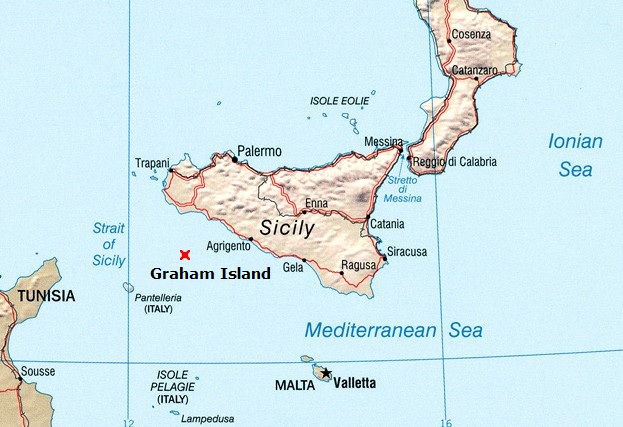
Graham Island (Italian: Isola Ferdinandea; French: Île Julia) is a submerged volcanic island in the Mediterranean Sea near Sicily. It forms the tip of the submarine volcano Empedocles, 30 km (19 mi) south of Sicily, which is one of a number of underwater volcanoes known as the Campi Flegrei del Mar di Sicilia.

Key Information

The island has emerged from sea level four times in recorded history. Seamount eruptions have raised it from the surface before erosion submerged it again.[4] The last prominent appearance occurred in July 1831, when the island emerged above sea level for six months. During that time, a four-way dispute over the island's sovereignty arose, which remained unresolved.

The island is still referenced on marine charts, as its top is only 6 metres (20 feet) short of breaking the surface; it thus becomes a potentially dangerous hidden obstacle for many seafaring vessels, whose keels most often run deeper than this.[5] It is also a small shoal on which near-surface maritime creatures dwell.

History

[edit]

Early history

[edit]

Volcanic activity at Graham Island was first recorded during the First Punic War during the 3rd century BC. The island has appeared and disappeared four or five times since then.[6] Several eruptions have been reported since the 17th century AD.[7] The island is located in a volcanic area known as the Campi Flegrei del Mar di Sicilia (Phlegraean Fields of the Sea of Sicily), in between Sicily and Tunisia in the Mediterranean Sea. Many submarine volcanoes (seamounts) exist in the region, as well as some volcanic islands such as Pantelleria.

1831 appearance

[edit]
Graham Island guarded by HMS Melville

Graham Island's most recent appearance as an island was in July 1831.[8] The first reports of high seismic activity and/or eruptions occurred during a period spanning from 28 June to 10 July 1831. These reports came from the nearby town of Sciacca.[2] On 28 June, the Royal Navy ships Britannia and Rapid were shaken by an earthquake between Sciacca and Pantelleria.[9] On 4 July, an odour of sulfur spread through the town reportedly in such quantities that it blackened silver.[2] On 12 July, Ferdinando Caronna, captain of the Psyche from Naples, reported seeing smoke coming out of the sea.[9] On 13 July, a column of smoke was clearly seen from St. Domenico. The residents believed it to be a ferry on fire.[2] On the same day, the brig Gustavo passed through the area, confirming a bubbling in the sea that the captain thought was a sea monster. Another ship reported dead fish floating in the water.[9]

By 17 July, a fully grown islet had formed enough to where Sicilian customs official Michele Fiorini was able to land there and to claim the island for the Kingdom of Sicily.[2][10] He planted an oar there to claim the newly emerged island for the Kingdom of the Two Sicilies.[10]

The eruptions of 1831 resulted in the island increasing in size to about four square kilometres (1+12 sq mi). At its maximum (in July and August 1831), it was 4,800 m (15,700 ft) in circumference and 63 m (207 ft) in height. It sported two small lakes, the larger of which was 20 metres (66 ft) in circumference and 2 m (6 ft 7 in) in depth.[2]

In the months ahead, Graham Island eventually became the subject of a four-way dispute over its sovereignty:

Diplomatic disputes over the island's status ensued.[9] Some observers at the time wondered if a chain of mountains would spring up, linking Sicily to Tunisia and thus upsetting the geopolitics of the region.[12] During the island's brief lifespan tourists began to travel to the island to see its two small lakes.

None of these ideas came to fruition, however, as the island soon sank back beneath the waters. The island was composed of loose tephra, easily eroded by wave action, and when the eruptive episode ended it rapidly subsided, disappearing beneath the waves in January 1832, before the issue of its sovereignty could be resolved. By 17 December 1831, officials reported no trace of it. As dynamically as the seamount appeared, it disappeared, defusing the conflict with it.[13]

In August 1831, observers around the world reported a discolored sun in the sky, tinted blue, purple, or green. Researchers have attempted to discover what volcanic activity was responsible for the stratospheric discharge that caused the discoloration, with an early consensus that Babuyan Claro in the Philippines was the most likely source. Yet, later research has concluded there was no 1831 eruption at Babuyan Claro,[14] and some have argued the smaller activity at Graham was the likely culprit.[15] Even later research ruled out a larger 1831 eruption of the Zavaritski Caldera, as the phenomenon predominated in a limited geographic range and lasted only a month.[16] Nat Turner, an enslaved preacher in Southampton County, Virginia, took the bluish-green sun as a divine sign to begin what became known as Nat Turner's slave rebellion.[17]

Recent seismic activity

[edit]
A seismograph, placed on the former island in 2006, is recovered in 2007

Fresh eruptions in 1863 caused the island to reappear briefly before again sinking below sea level.[2] After 1863, the volcano lay dormant for many decades, its summit just 8 m (26 ft) below sea level.

In 2000, renewed seismic activity around Graham Island led volcanologists to speculate that a new eruptive episode could be imminent, and the seamount might once again become an island.[18] In November 2002 the Institute of Geophysics and Volcanology in Rome observed minor seismic activity and gas emissions.[13] They put the time of resurfacing at a couple of weeks or months. Italian sailors put an Italian flag on the top of the bank to avoid other nations' claims if the former island resurfaced. Despite showing signs in both 2000 and 2002, the seismicity did not lead to volcanic eruptions and as of 2000 Graham's summit remains about 8 metres (26 ft) below sea level.[1]

To forestall a renewal of the sovereignty disputes, in November 2000 Italian divers planted a Sicilian flag on the top of the volcano in advance of its expected resurfacing.[13] In a ceremony attended by Prince Carlo, Duke of Castro (a descendent of Ferdinand II) and his wife Princess Camilla, a marble plaque was lowered into the water, with Prince Carlo proclaiming that the island "will always be Sicilian".[18] The marble plaque, weighing 150 kg (330 lb), was inscribed "This piece of land, once Ferdinandea, belonged and shall always belong to the Sicilian people."[5] Within six months, the plaque had fractured into twelve pieces.[19]

Scientific study

[edit]
A page out of the field journal of French geologist Constant Prévost. Illustrations by a French artist.

The sudden geologic phenomenon was observed and studied by numerous scientists. Among the Germans were Hoffmann, Schultz, and Philippi. Among the English were Edward Davy and Warington Wilkinson Smyth.[19] Among the French was Constant Prévost, who visited the island with an artist, and presented his findings in the Bulletin de la Société Géologique de France.[20] Among the Italians was Scinà Domenico (1765–1837) who published his observations in the "Effeméridi Sicilians" (1832, vol. 2), and Carlo Gemmellaro (1787–1866), teacher of geology and mineralogy at Catania University, who published "Actions of the Gioenia Academy of Catania" (1831, vol.8).[2] In 2006, further study revealed Graham Island to be just one part of the larger volcanic cone Empedocles.[6]

[edit]

During its emergence it was visited by Sir Walter Scott, and it provided inspiration for James Fenimore Cooper's The Crater, or Vulcan's Peak, Alexandre Dumas, père's The Speronara, Jules Verne's Captain Antifer and The Survivors of the Chancellor and Terry Pratchett's Jingo.

The island was also the subject of an episode of Citation Needed, a panel show made and hosted by British content creator Tom Scott.

A number of Cinderella stamps and art coins have been issued over the years, under fictional names such as Poste Isola Ferdinandea.[21]

In 2000, an unofficial minting of a penny was produced by a Sicilian artist, featuring the former island on one side and, unusually, a bust of Elizabeth II on the other. David Mannucci, the designer of the coin, had the idea to produce it after he "found out the existence of the ghost island" from a newspaper article. Besides the copper piece, he minted varieties in silver, copper "with protective enamel", and in silver "with protective enamel". While this Italian-made coin fittingly bears the Italian name for the former island, the art coin also features a bust of "Elizabeth II D.G.R." and bears a British denomination.[22]

See also

[edit]

References

[edit]
[edit]
Revisions and contributorsEdit on WikipediaRead on Wikipedia
from Grokipedia
was an ephemeral that emerged from a eruption in the Channel of the in 1831, situated atop the roughly 40–50 km offshore southwestern at depths of 150–250 meters. Preceded by intense seismic activity from late June to early , the Surtseyan-style rapidly built a cone of basaltic , , and , attaining a height of approximately 60 meters above and a diameter of 600 meters within weeks. The island's poorly consolidated deposits succumbed to wave and current erosion, leading to its complete submersion by December 1831 or January 1832, leaving only the underlying . During its brief visibility, the formation sparked territorial assertions by Britain (as Graham Island), (Julia), and the Kingdom of the Two Sicilies (Ferdinandea), though the claims lapsed with its disappearance; the modest eruption (VEI 3) generated local interest but insufficient for the widespread atmospheric anomalies of 1831, later linked to a distant volcanic event. Scientific expeditions, including from British and Sicilian vessels, documented the growth and decline, yielding early insights into volcanic processes and edifice instability in tectonically active rift zones.

Location and Physical Characteristics

Geographical Position and Bathymetry

The Graham Bank, site of the ephemeral Graham Island, is positioned in the Strait of Sicily within the central Mediterranean Sea, at approximately 37°11′N 12°44′E. This location places it roughly 35 kilometers southwest of Sicily's southwestern coast near Sciacca and midway between Sicily and the island of Pantelleria. Bathymetrically, the Graham Bank constitutes a shallow volcanic rising from surrounding seafloor depths of approximately 200 meters. The central Ferdinandea cone, now submerged, features a summit at 8 to 9 meters below , with the overall structure exceeding 400 meters in relief from base to apex. High-resolution surveys indicate a complex underwater topography including volcanic edifices, fault scarps, and pockmarks, characteristic of the broader Graham extending 40 to 50 kilometers offshore southwestern .

Geological Context

Volcanic Field and Tectonic Setting

The Graham Volcanic Field (GVF) comprises approximately ten monogenetic submarine seamounts aligned along a north-south trending belt in the northwestern Channel, situated 40–50 km offshore southwestern at water depths of 150–250 meters. These edifices, including the relict cone of , form clusters with steep slopes ranging from 18° to 30°, flat or pointed summits, and sub-vertical knolls indicative of phreatomagmatic activity. The field spans about 12 km in length and 1.4 km² in area, with individual cones rising roughly 100 meters from the seafloor, primarily composed of basaltic such as , lapilli, and from effusive and Surtseyan-type eruptions. The GVF's volcanism is embedded within the Sicily Channel Rift Zone, a continental rift system driven by Late Miocene–Quaternary extension amid the oblique convergence of the African and Eurasian plates, which has thinned the crust to 5–18 km thickness. This extensional regime, characterized by NW-SE oriented normal faults and the N-S trending Capo Granitola-Sciacca Fault Zone, facilitates alkaline magmatism from the Upper to , distinct from subduction-related processes. The field's N-S alignment parallels regional rift structures, such as those in the adjacent and grabens, while broader transpressive transfer zones influence magma ascent through lithospheric faults. Seismic activity in the region remains low (magnitudes <3.5), with hypocenters up to 20 km depth, associated with normal faulting, fluid seepage via pockmarks, and ongoing extensional dynamics that link the GVF to a larger volcanic province including and Linosa. Gas emissions persist at some vents, signaling potential hydrothermal activity tied to the rift's tectonic stress field.

Eruptive Mechanisms and Material Composition

The 1831 eruption forming Graham Island commenced as a submarine phreatomagmatic event in water depths of approximately 150–180 meters, triggered by the interaction of ascending magma with seawater, resulting in explosive hydromagmatic activity of Surtseyan type. Intense seismic swarms preceded the eruption from June to early July, culminating in the island's emergence on July 16–17. Initial hydrovolcanic explosions built a tephra cone that rapidly grew to a diameter of 600 meters and height of 60 meters above sea level by late July, with eruptive activity transitioning toward milder Strombolian-style ejections involving gas-driven lava fountains. The eruption ceased by August 16, after which wave erosion dismantled the unconsolidated edifice, leading to subsidence below sea level by December 1831–January 1832. The materials ejected were predominantly poorly consolidated alkali basalts and pyroclastic , lacking significant lava flows on the slopes. Samples reveal palagonitized layers indicative of rapid alteration from interaction, consistent with the hydromagmatic origin. Geochemical analyses confirm a basaltic composition typical of rift-related in the Sicily Channel, with associated gas emissions showing mantle-derived and carbon isotopes suggestive of magmatic sources influenced by crustal interactions. The loose, incoherent nature of the rendered the island highly susceptible to marine erosion, preventing long-term stability.

Historical Emergence and Disappearance

Pre-19th Century Indications

Historical accounts indicate that volcanic activity at the Graham Bank, the submarine volcanic field encompassing Graham Island, was first recorded during the First Punic War (264–241 BC), when an island reportedly emerged in the Strait of Sicily amid naval conflicts between Rome and Carthage. Ancient chroniclers, including those documenting the war's maritime engagements near Sicily, described phenomena consistent with submarine volcanism, such as fires at sea or floating ejecta, though precise locations and durations remain unverified by modern standards. These reports suggest an early surfacing of the seamount now identified as Empedocles, the volcanic edifice underlying Graham Island. Subsequent indications of activity are sparse and largely anecdotal, with claims of additional emergences during antiquity and possibly the medieval , totaling four or five recorded appearances before 1831. No detailed contemporary descriptions or archaeological evidence confirm these events, and they may conflate regional seismic or occurrences with specific island formation at the Graham Bank. Instrumental records were absent, limiting attribution to eyewitness naval or coastal observations rather than systematic surveys.

1831 Eruption Sequence

The 1831 eruption sequence commenced with precursors of elevated seismic activity reported from late June to early July, affecting coastal areas of southwestern . Submarine volcanic activity initiated around July 7, marked by underwater explosions and gas emissions, leading to the emergence of (known locally as Ferdinandea or Julia) above between July 16 and 17. The eruption was Surtseyan in style, involving phreatomagmatic interactions between ascending basaltic and , which produced a rapidly growing tuff cone composed primarily of palagonitized , interbedded , cinders, lapilli, , and lithic fragments of basalts. By mid-eruption, the island reached a maximum height of 60–65 meters above , a base diameter of approximately 600 meters, and a perimeter of about 1 kilometer. Peak activity occurred from mid-July to mid-August, featuring explosive phases with widespread seismicity, boiling seas, and emissions of toxic fumes observable from towns including Sciacca, Menfi, Mazzara, and Marsala. Eruptive output ceased by August 16, after roughly six weeks of activity, leaving a small mofette-emitting crater atop the unstable edifice. Post-eruption, the poorly consolidated proved highly susceptible to marine erosion; wave action reduced the island's height to 20 meters by September and below 1 meter by October, resulting in full submergence between December 1831 and January 1832. Contemporary observations, notably by geologist Carlo Gemmellaro—including a sketch dated August 11—provided key documentation of the cone's morphology and phreatomagmatic features.

Post-Emergence Changes and Subsidence

Following the initial emergence on July 16–17, 1831, Graham Island experienced rapid growth through continued Surtseyan-style eruptions, expanding to a of approximately and a of 60 above sea level by August 16. Eruptive activity, characterized by ejection and basaltic lava flows enriched in sodium, ceased around mid-August, leaving a smoking with waters indicative of ongoing (mofette activity). At its peak, the island measured about 300 meters in width and 1 kilometer in perimeter, composed primarily of loose, poorly consolidated and susceptible to marine processes. Post-eruption, wave action and currents initiated intense on the unconsolidated , progressively dismantling the structure without replenishment from new volcanic material. By 1831, the island's height had diminished to 20 meters, and it reduced to less than 1 meter above by , forming a summit terrace at 25–28 meters depth and a depositional at 36–43 meters. Subsidence was minimal from compaction—estimated at under 1 meter, analogous to post-eruptive settling observed at —and not significantly influenced by tectonic factors. The island fully submerged between December 1831 and January 1832, approximately six months after , due to the combined effects of and minor post-formational adjustments. Subsequent bathymetric surveys recorded the summit at 3 meters depth in , 8 meters in , and 9 meters in , reflecting ongoing minor but no renewed . The site's current quiescence includes intermittent gas emissions, with the cone's morphology preserved as a testament to rapid subaerial-to-submarine transition.

Subsequent Minor Events

In 1863, submarine eruptions at the Ferdinandea produced a brief re-emergence of land above , forming a temporary that subsided within weeks due to rapid by waves and structural instability of the unconsolidated volcanic materials. This event was significantly smaller in scale and duration than the 1831 emergence, lacking the explosive phases and territorial disputes of the earlier activity. The remained quiescent for over a century thereafter, with no further exposures recorded. Minor seismic tremors in the region were occasionally attributed to residual activity at Ferdinandea, such as those reported along the Sicilian coast in 1995. In , heightened seismic signals prompted geophysical monitoring and renewed discussions of potential hazards, though no eruption or emergence materialized. Weak, localized volcanic unrest in generated misleading reports of activity, including among naval observers, but bathymetric surveys confirmed no significant changes to the 's summit depth of approximately 8-10 meters below .

Geopolitical Consequences

National Claims and Disputes

The emergence of Graham Island in mid-July 1831 triggered territorial assertions by the Kingdom of the Two Sicilies, Britain, and France, owing to its location in the Sicilian Channel astride key Mediterranean shipping routes. The Kingdom of the Two Sicilies claimed it on grounds of geographic proximity to Sciacca and Pantelleria, naming it Ferdinandea after King Ferdinand II and deploying the corvette Etna to patrol and annex the site by early August. Britain regarded the formation as terra nullius and formalized its claim in early August 1831, when personnel from a British vessel landed, raised the , and designated it Graham Island in tribute to Sir James Graham, . France soon contested this by dispatching geologist Constant Prévost in late September, who surveyed the islet, affixed the tricolor flag to its summit, and renamed it Île Julia to evoke the Latin term for July, the emergence month. Spain expressed peripheral interest but took no substantive action to occupy or survey the island. Naval posturing ensued, including a tense September 1831 standoff between the Sicilian Etna and a British frigate, which mediation diffused short of hostilities. The ephemeral nature of the landform precluded resolution: wave erosion and ongoing volcanism reduced its height from approximately 60 meters in July to mere shoals by mid-December 1831, fully submerging it by January 1832 and nullifying all pretensions. No formal diplomatic accords ensued, as the site's return to submarine obscurity eliminated strategic value. The territorial claims over Graham Island triggered diplomatic protests among the involved powers, with the United Kingdom asserting sovereignty on August 2, 1831, when Captain Humphrey Fleming Senhouse of HMS St Vincent raised the British flag and named the formation after Sir James Graham, First Lord of the Admiralty, citing its proximity to the British colony of Malta. France countered by dispatching the corvette Le Normandie, which planted the tricolor and dubbed it Île Julia, invoking rights of discovery amid strategic interest in Mediterranean navigation routes. The Kingdom of the Two Sicilies, under Ferdinand II, proclaimed it Ferdinandea, arguing under customary international law principles of contiguity that the nearest landmass—Sicily, approximately 50 kilometers distant—conferred ownership, and dispatched vessels including the corvette Etna to enforce the claim. Naval standoffs ensued, notably a tense September 1831 encounter between British, French, and Sicilian ships that risked escalation to armed conflict, prompting hurried to avert hostilities. Delegations exchanged notes emphasizing prior naval presence and geological novelty, but no multilateral conference or arbitration materialized, as claimants prioritized possession over legal adjudication. Spain's involvement remained marginal, with informal assertions tied to historical Mediterranean interests but lacking on-site action. The island's rapid subsidence by November 1831, culminating in submersion below 8 meters by December 17, 1831, eliminated the physical basis for claims, effectively nullifying the dispute without formal resolution or treaty. Under 19th-century international law, ephemeral volcanic formations lacked stable title precedents, rendering post-subsidence arguments over the resulting Graham Bank shoal untenable for sovereignty purposes. No subsequent legal proceedings addressed residual rights, and the feature persists as a navigational hazard on charts without territorial contention.

Scientific Analysis

Eyewitness and Early Instrumental Data

Eyewitness reports of the 1831 eruption began with seismic activity detected on June 28, when tremors were felt in western and by vessels in the Sicily Channel. Floating fields were encountered by ships between July 1 and 3, signaling subsurface volcanic unrest. On July 10, the Sicilia, commanded by Captain Pietro Corrao, approached the site and observed intense submarine detonations ejecting a column of , , and debris approximately 60 meters high, accompanied by sulfurous fumes and boiling surface. The island's emergence occurred between July 16 and 17, initially as a low mound of and amid ongoing phreatomagmatic explosions characteristic of a Surtseyan eruption. By July 19, the feature was visible from afar, prompting visits by Sicilian naturalist Carlo Gemmellaro, who landed on July 25 and documented explosive activity, including ash plumes and intermittent lava flows forming a central . Gemmellaro's account, based on direct observation, described the island's rapid growth amid persistent steam emissions and seismic rumbling, with the terrain consisting of loose and hot fissures. Early measurements, primarily from nautical surveys, recorded the island reaching a of about 600 and a height of approximately 60 above by late , with a perimeter expanding to 4 kilometers by . British naval officers aboard HMS Etna conducted triangulation-based estimates confirming these dimensions and noting wave erosion at the base. Instrumental data were rudimentary, limited to barometric readings for elevation and visual for explosion intervals, as modern seismographs were not yet available; however, Catania logs captured associated tremors via early mechanical recorders. Gemmellaro's field notes and ship logs provided the primary quantitative data, including temperature probes of fumaroles exceeding 100°C and depth soundings around the perimeter revealing a submerged base at 150 meters below . These observations, corroborated across Italian, British, and French reports, underscored the eruption's explosive nature without reliance on advanced .

Modern Geophysical Surveys

The Italian Hydrographic Institute (IIM) has conducted systematic hydrographic surveys of Graham Bank since the late , transitioning to modern multibeam echo sounder (MBES) technology for high-resolution seabed mapping. Recent surveys include those in 2005 recording a minimum depth of 8.5 meters over the southeastern cone, 2012 using MBES to measure 9.5 meters (survey No. 9091), and 2014 confirming 9.0 meters during an ISPRA-CNR campaign. These efforts integrate digital elevation models and data to monitor morphological stability, revealing an NW-SE oriented volcanic edifice approximately 150 meters high with gullies, lava flows, and intermittent gas emissions suggestive of ongoing . Dedicated geophysical expeditions have employed advanced techniques to delineate the volcanic field's structure. During the 2012 "Ferdinandea" cruise, high-resolution multibeam via EM 2040 (200–400 kHz, 5-meter bin size, up to 0.7-meter resolution) mapped the Ferdinandea seamount's summit at 9 meters below , along with terraces at 25–30 meters and surrounding monogenetic cones at 150–250 meters depth exhibiting steep slopes (18–30°) and flat or pointed summits. Remotely operated (ROV) dives with PolluxII provided visual confirmation of volcanic knolls, sediment waves, and erosional features, integrating historical data from 1890–2014 to quantify post-1831 and . Further insights into subsurface processes derive from seismic reflection profiling and complementary bathymetry during the 2015 CNR ACUSCAL cruise aboard R/V Minerva-1, utilizing Reson SeaBat 7160 multibeam (44 kHz) and multichannel seismic lines. These revealed hummocky terrains with seamounts 97–152 meters high, pockmarks aligned NW–SE, fluid seepage indicators, and mass transport deposits across depths of 7–350 meters, underscoring tectonic-volcanic interactions and potential geohazards like slope instability. Such surveys highlight the bank's volcanic activity, with alignments of cones suggesting fault control, while gas chimneys and flares detected in high-resolution data indicate persistent magmatic unrest.

Evaluation of Climatic Impact Claims

Claims that the 1831 eruption of Ferdinandea (Graham Island) constituted one of the largest volcanic climate forcing events of the nineteenth century stem primarily from a analysis linking it to widespread observations of "blue suns"—an optical effect caused by stratospheric aerosol scattering—and a sulfate peak in ice cores. Proponents argued that, despite the eruption's modest (VEI) of 3, convective instability in the Mediterranean could have lofted aerosols into the , enhancing their global beyond expectations for such a small event. The eruption, occurring from July 10 to August 1831, produced a submarine basaltic cone reaching 65 meters above with ejecta volumes estimated at under 0.1 cubic kilometers, insufficient on its own for major hemispheric cooling under standard plume dynamics. However, this attribution overlooks empirical discrepancies in eruption scale and geochemical signatures. VEI 3 events, characterized by eruption columns rarely exceeding 10 kilometers, typically confine aerosols to the , where they wash out rapidly without sustained ; Ferdinandea's submarine nature further limited explosive height and sulfur yield, estimated at far less than the 13 teragrams required to explain the observed temperature drop of approximately 0.5–1°C in 1831–1833. Recent ice-core analyses, integrating isotopes and , identify the primary source of the 1831 layer as a VEI 5–6 eruption at in the (), dated to early 1831 via radiocarbon and historical correlations, with matching the plume's composition and magnitude. Contemporary accounts from the eruption site report localized steam plumes and minor ashfall but no evidence of high-altitude injection capable of global effects, contrasting with the explosive dynamics of stratospheric-forcing events like Tambora (1815, VEI 7). Earlier candidates, such as Babuyan Claro in the Philippines, were debunked due to mismatched historical records and overestimated magnitudes. While Ferdinandea may have contributed marginally to regional tropospheric haze—potentially influencing the blue-sun sightings in during late summer —its role in the broader climatic anomaly is negligible, as confirmed by the dominance of the distant, larger event in proxy records. This evaluation underscores the importance of integrating multiple lines of evidence over timing-based correlations alone, avoiding overattribution to proximate but underpowered eruptions.

Ongoing Monitoring and Hazards

Seismic and Volcanic Surveillance

The seismic and volcanic surveillance of the Graham Bank, encompassing the site of the former Ferdinandea Island, is integrated into broader efforts by the Italian National Institute of Geophysics and Volcanology (INGV), which monitors Sicilian volcanic districts including submarine features in the through its Etna Observatory. This includes assessment of regional along a north-south belt extending through the Graham Bank, where earthquakes are tracked via land-based and offshore seismic networks to evaluate potential volcanic-tectonic triggers. The area remains quiescent since the 1831 eruption, with persistent but low-level gas emissions indicating ongoing hydrothermal activity, prompting periodic geophysical surveys for hazard evaluation. The Italian Hydrographic Institute (IIM) contributes through long-term bathymetric monitoring to detect seabed alterations from seismic or volcanic processes, conducting surveys since the late using evolving instruments such as lead lines (e.g., 1890 at 6.5 m depth, 1925 at 8.0 m), single-beam echo sounders (SBES; e.g., 1947, 1977, 1988), and multibeam echo sounders (MBES; 2012 at 9.5 m depth over the former island pinnacle, 2014 at 9.0 m). These reveal gradual morphological changes attributed to wave erosion, currents, and episodic gas venting or minor seismic events, informing and volcanic stability. In 2012, INGV led the "Ferdinandea 2012" multidisciplinary cruise to investigate the Graham Volcanic Field, deploying three ocean bottom seismometers with hydrophones (OBS/H) adjacent to the bank for seismo-acoustic recordings, alongside high-resolution , remotely operated vehicle (ROV) imagery, and rock sampling to volcanic cones and assess eruption risks near Sicily's . Such temporary offshore deployments complement INGV's geochemical and geodetic networks, though proposals persist for permanent fixed stations to continuously measure parameters like gas flux and activity amid the field's under-explored . No major seismic swarms or precursory signals have been reported since , but surveillance emphasizes the potential for rapid re-emergence given the monogenic nature of the ~10 volcanic cones rising ~100 m from the .

Risk Assessment for Re-Emergence

The Graham Bank, site of the 1831 emergence of Ferdinandea (also known as ), forms part of a comprising approximately ten aligned seamounts at depths of 150–250 meters, with the Ferdinandea cone's summit currently at about 7–8 meters below . implies single-episode eruptions per vent, reducing the likelihood of reactivation at the exact Ferdinandea site compared to polygenetic systems; recurrence for analogous fields often spans tens to hundreds of thousands of years between events. Historical records document at least two eruptions in the (1831 and possibly 1837), alongside prehistoric activity over the past 20,000 years that produced larger ephemeral islands in the vicinity, indicating episodic but infrequent resurfacing tied to sufficient supply and dynamics. Re-emergence would require a phreatomagmatic or effusive event overcoming the shallow , potentially building a cone to 100 meters above as in before wave dominates; however, no instrumental data show precursory unrest such as , deformation, or hydrothermal signals since . The broader Sicily Channel exhibits low-to-moderate levels, with the Graham field classified as dormant absent triggers like tectonic strain accumulation. Quantitative probabilities remain unestablished due to sparse data, but qualitative assessments from geophysical surveys emphasize negligible near-term risk (decades to centuries), prioritizing instead regional submarine hazards like gas emissions or tsunamis from adjacent vents. Ongoing surveillance by Italy's National Institute of Geophysics and Volcanology (INGV) integrates bathymetric mapping, seismic networks, and occasional ROV deployments, detecting no anomalies indicative of ascent as of 2021 surveys; this supports a conservative profile, with re-emergence deemed improbable without detectable . Should activity resume, rapid shoaling could pose navigation perils, but empirical patterns from monogenetic fields suggest intervals exceeding historical precedents, aligning with causal factors like limited melt generation in thinned crust.

Implications for Maritime Safety

The Graham Bank, located in the Strait of Sicily approximately 35 kilometers southwest of Sicily's coast, features a volcanic edifice with a shallowest summit depth of 9 meters as recorded in 2014 hydrographic surveys by the Italian Hydrographic Institute (IIM). This shoal lies along major east-west commercial shipping routes transiting the Mediterranean, presenting a grounding risk to vessels with drafts exceeding or approaching 9 meters, particularly smaller craft or those deviating from primary lanes. Historical bathymetric data indicate gradual deepening from 6.5 meters in 1890 to 9 meters in recent decades, yet the structure's NW-SE oriented cones— including a southeastern cone with a 700-meter major axis—remain a persistent navigational obstacle marked on marine charts such as IIM Chart No. 1813. Ongoing volcanic-tectonic activity, evidenced by gas emissions and the 1831 emergence of Ferdinandea Island which reached 60 meters above before subsiding within months, underscores the potential for sudden bathymetric changes that could exacerbate hazards. The IIM conducts regular monitoring using multi-beam echo sounders (MBES) and integrates into national bathymetric databases to update nautical charts, ensuring awareness of any shoaling or eruptive that might affect vessel passage. Such is critical given the bank's position in frequented by diverse traffic, where uncharted alterations could lead to collisions or strandings without prior warning. To mitigate risks, authorities recommend implementing traffic separation schemes with defined lanes avoiding the , akin to those for other Mediterranean seamounts, and installing isolated danger marks compliant with International Association of Marine Aids to Navigation and Lighthouse Authorities (IALA) guidelines. Fixed monitoring stations or could further enhance real-time hazard detection, preventing disruptions to maritime commerce while accommodating the area's volcanic potential.

References

Add your contribution
Related Hubs
User Avatar
No comments yet.