Hubbry Logo
Ferruginous duckFerruginous duckMain
Open search
Ferruginous duck
Community hub
Ferruginous duck
logo
8 pages, 0 posts
0 subscribers
Be the first to start a discussion here.
Ferruginous duck
Ferruginous duck
from Wikipedia

Ferruginous duck
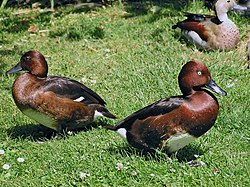
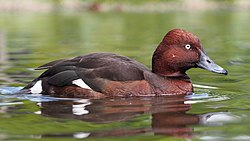
Male
Female
Scientific classification Edit this classification
Kingdom: Animalia
Phylum: Chordata
Class: Aves
Order: Anseriformes
Family: Anatidae
Genus: Aythya
Species:
A. nyroca
Binomial name
Aythya nyroca
Range of A. nyroca
  Breeding
  Resident
  Passage
  Non-breeding

The ferruginous duck (Aythya nyroca), also known as the ferruginous pochard, common white-eye or white-eyed pochard, is a medium-sized diving duck native to the Palearctic. The scientific name is derived from the Ancient Greek word, αἴθυιᾰ (aithuia), an unknown seabird mentioned by authors including Hesychius and Aristotle, and the Russian word, нырок (nyrok),[2] the Russian word for pochard, which occurs in the bird's Russian common name.

Description

[edit]

The breeding male is a rich, dark chestnut on the head, breast and flanks with contrasting pure white undertail coverts. In flight the white belly and underwing patch are visible. The females are duller and browner than the males. The male has a yellow eye and the females have a dark eye.[3]

Habitat

[edit]

The ferruginous duck prefers quite shallow fresh waterbodies with rich submerged and floating vegetation with dense stands of emergent vegetation on the margins. In some areas it will use saline or brackish pools or wetlands. On passage and wintering will also frequent coastal waters, inland seas and large, open lagoons.[4]

Distribution

[edit]

The breeding range of the ferruginous duck is from Iberia and the Maghreb east to western Mongolia, south to Arabia, although in the west is now scarce and localised and locally extirpated in some countries. The duck winters throughout the Mediterranean Basin and the Black Sea, smaller number migrate into sub-Saharan Africa via the Nile Valley.[4] Eastern birds winter in south and south-east Asia.[5]

Habits

[edit]

These are gregarious birds, but less social than other Aythya species but where common it can form large flocks in winter, often mixed with other diving ducks, such as tufted ducks and common pochards. Form pairs from January onwards and during courtship the male often curls his tail so that it dips into the water forming a triangular white patch of the undertail coverts. In areas where it is common it will form colonies at protected sites such as islands, often in association with gulls. Where scarce it nests singly, in dispersed and concealed sites.[4]

Eggs are laid from the end of April or early May in a nest which is sited on the ground close to water, or sometimes a floating nest is built among emergent vegetation. The eggs are incubated for 25–27 days and the fledging period is 55–60 days.[4]

These birds feed mainly by diving or dabbling. They eat aquatic plants with some molluscs, aquatic insects and small fish. They often feed at night, and will upend (dabble) for food as well as the more characteristic diving.[4]

Conservation

[edit]

The species is threatened by the degradation and destruction of its favoured habitats by anthropogenic causes which are very wide and varied including impoundment, drainage, pollution and mismanagement. The introduction of non-native species has also caused habitat degradation, e.g. the stocking of lakes with and accidental introduction of grass carp Ctenopharyngodon idella has caused reductions in plant and animal biomass available for the ducks to feed on. In addition, the increased threat of drought due to climate change may pose a threat to the species in the drier parts of its range. Increased disturbance by fishing boats and anglers among marginal vegetation could cause abandonment of the breeding sites or disrupt the timing of breeding particularly in populated areas, e.g. Western Europe. Ferruginous ducks are also threatened by hunting and large numbers are shot on passage in the autumn and in the wintering areas. Although protected in most European countries illegal and accidental hunting persists. It is one of the species to which the Agreement on the Conservation of African-Eurasian Migratory Waterbirds (AEWA) applies.[5] Among recent local initiatives it should be mentioned inclusion of the breeding habitats of the species in Armenia into network of Emerald Sites protected by the Bern Convention.[6]

[edit]

References

[edit]

Further reading

[edit]
[edit]
Revisions and contributorsEdit on WikipediaRead on Wikipedia
from Grokipedia
The ferruginous duck ( nyroca), also known as the common white-eye or white-eyed pochard, is a small to medium-sized diving in the family , characterized by its predominantly rusty-brown plumage, contrasting white belly and undertail coverts, whitish underwings, and pale eye in males, with females appearing duller and browner. It prefers shallow freshwater s, typically 30–100 cm deep, featuring dense emergent vegetation such as in eutrophic pools and marshes, where it breeds in temperate and subtropical zones across , southwestern Asia to , and . During winter, populations migrate to larger lakes, coastal marshes, and open waters in the , , and , foraging omnivorously—primarily on seeds of aquatic plants supplemented by —via diving, upending, or surface dabbling. Less social than congeners, it typically occurs in pairs or small groups of 2–5, forms seasonally monogamous pairs, and breeds from April to June with clutches of 7–10 eggs incubated for 24–28 days, fledging young after 55–60 days. The global population numbers 180,000–240,000 individuals and is decreasing, warranting its Near Threatened status primarily due to wetland drainage and degradation, alongside unregulated hunting and disturbance from .

Taxonomy and nomenclature

Classification and phylogeny

The Ferruginous duck ( nyroca) belongs to the domain Eukaryota, kingdom Animalia, phylum Chordata, class Aves, order , family , tribe Aythyini, genus , and . The binomial name was established by Johann Anton Güldenstädt in 1770 based on specimens from the region. No are currently recognized, reflecting its monotypic status within the species. Phylogenetically, A. nyroca is embedded within the genus , which includes 12 species of primarily and diving adapted for underwater via lobed feet and dense . The Aythyini encompasses Aythya alongside genera such as Netta and Oxyura, with Aythya distinguished by molecular and morphological traits like a more streamlined bill and affinity for freshwater habitats. Genetic evidence from supports Aythya's , though interspecific relationships vary by marker; nuclear loci sometimes reveal incomplete lineage sorting due to rapid diversification in the Pleistocene. Within , analyses of two mitochondrial genes recover A. nyroca as sister to the Australian Hardhead (A. australis), with this clade sister to Baer's Pochard (A. baeri), forming a basal group among "white-eyed" pochards characterized by eye-ring . A separate complete mitogenome study (16,623 bp sequenced from a specimen) positions A. nyroca closely with the (A. ferina), Redhead (A. americana), and (A. fuligula), using neighbor-joining topology with 1000 bootstrap replicates across 14 species. Such discrepancies highlight limitations of mitochondrial markers, which may prioritize maternal lineages over biparental nuclear data, and underscore hybridization propensities in with congeners like A. baeri and Ring-necked Duck (A. collaris), suggesting reticulate . Overall, A. nyroca's placement aligns with adaptive radiations in diving ducks, driven by foraging ecology rather than strict vicariance.

Etymology and common names

The scientific name Aythya nyroca combines the genus Aythya, derived from the Ancient Greek αἴθυια (aithuia), denoting an unidentified seabird referenced by classical authors including Aristotle and Hesychius, with the specific epithet nyroca, originating from the Russian vernacular nyrok applied to this diving duck species since its initial description by Johann Anton Güldenstädt in 1770 as Anas nyroca. The English common name "ferruginous duck" stems from the Latin ferrugo, signifying rust-colored iron, in reference to the male's characteristic chestnut or rusty-brown plumage that dominates its breeding appearance. Alternative common names include ferruginous pochard, reflecting its diving habits akin to other pochard species in the genus Aythya; white-eyed pochard, emphasizing the pale iris distinctive to adults; and common white-eye, a less frequent designation highlighting the same ocular trait.

Physical characteristics

Morphology and plumage

The ferruginous duck (Aythya nyroca) is a compact, medium-small diving measuring 38–42 cm in total length, with a of 63–72 cm and body mass typically ranging from 400–700 g, though some individuals reach up to 880 g. It possesses a relatively short body, longish neck, and notably peaked crown that contributes to its distinctive rounded head profile. The bill is broad and somewhat elongated for a diving , measuring approximately 4–5 cm, colored slate-gray with a blackish nail at the tip; legs and feet are dull orange-gray. Adult male plumage in breeding condition features a rich ferruginous (rusty-chestnut) brown overall, with darker brown upperparts glossed blackish, paler underparts, and a prominent U-shaped patch formed by the undertail-coverts visible in flight or when raised. The wings display specula (wing bars) on the secondaries, contrasting against the brown coverts and ; the crown is peaked, and the iris is strikingly pale yellow to . In (post-breeding) plumage, males resemble females but retain some brighter tones on the head and breast. Adult females exhibit duller, more uniform brownish lacking the male's vibrant ferruginous hue, with paler fringes on feathers creating a scaly appearance on the upperparts; the undertail white patch is less distinct, and the iris remains dark brown. Juveniles are similar to adult females but even more subdued, with buffier tones, finer scaling on the back, and initially dusky bills that darken with age; both juvenile sexes share the dark iris. molts occur twice annually: a pre-breeding molt in late winter produces the bright alternate , while a post-breeding molt in summer yields the basic () form, with flightlessness lasting 3–4 weeks during wing molt. ![Ferruginous_Pochard_female_RWD.jpg][center]

Sexual dimorphism and variation

The ferruginous duck (Aythya nyroca) displays moderate sexual dimorphism, characterized by differences in plumage vibrancy, eye coloration, and subtle structural variations between males and females. Adult males exhibit richer chestnut-brown plumage across the head, neck, breast, and flanks, with paler grayish-brown underparts, white undertail coverts, and a diagnostic bright pearly-white or pale yellow iris. The bill is blue-gray with a pale subterminal band and darker tip. In contrast, adult females possess duller, more sooty-brown overall plumage, lacking the males' intensity, and feature dark brown irises, which serve as a primary field identification cue for sexing. Females are also slightly smaller than males, though overlap in measurements occurs. Males do not undergo a pronounced eclipse plumage post-breeding, retaining much of their breeding appearance but potentially appearing duller during molt; however, the white iris persists, distinguishing them from females. variation exists within sexes, particularly in formative (first-year) birds, where males may show female-like feathering with a paling iris transitioning to adult traits, while juvenile females resemble adults but with worn, retained juvenile feathers. Geographic variation in is minimal across the ' range, with consistent reddish-brown tones prevailing, though local environmental factors may influence subtle shade differences undocumented in broad surveys. Age-related variation is evident in downy young, which are dark gray with pale cheek spots, molting into juvenile by 3-6 months that darkens to brown in s and acquires gray elements in males. Overall, dimorphism supports mate recognition and display functions, with males' brighter traits likely enhancing visibility during on open waters.

Distribution and habitat

Geographic range

The ferruginous duck (Aythya nyroca) breeds across a broad Palearctic range, extending from the and northwest in the west to in the east, encompassing central and eastern , the , and . Southern breeding populations occur in , the , , and sporadically in . The species is a partial migrant, with northern populations dispersing southward during winter while some southern groups remain resident year-round. Wintering grounds largely overlap with the southern periphery of the breeding range, including the Mediterranean Basin, , and , but extend further to the of West and , as well as up to eastern and Indochina. Vagrants have been recorded outside this core distribution, such as in , , and , though these do not indicate established populations. The overall range reflects adaptation to habitats, with distribution influenced by availability of suitable breeding and sites amid varying migratory behaviors.

Habitat preferences and requirements

The ferruginous duck (Aythya nyroca) primarily inhabits shallow freshwater wetlands, including eutrophic pools, marshes, and river deltas characterized by dense stands of emergent vegetation such as reedbeds, along with abundant submergent and floating aquatic plants. It avoids large open water bodies and flowing streams, favoring sites with littoral zones offering cover and shallow depths typically ranging from 30 to 100 cm, which support diving and predator evasion. These habitats provide essential invertebrate-rich substrates and aquatic vegetation like spp. and Chara spp. for feeding on seeds, plant parts, and benthic . For breeding, the selects well-vegetated micros with structured emergent cover for nest concealment, often building low platforms of reeds on the ground, islets, hummocks, or floating mats over water. Nest success correlates positively with proximity to deeper water edges and taller vegetation, while factors such as nest distance to open water and surface area influence size (averaging 9.8 eggs). In regions with habitat loss, it adapts to artificial wetlands like and reservoirs, particularly in . Non-breeding habitat requirements mirror those of the breeding season but extend to larger lakes, open lagoons, coastal marshes, and estuaries with reedbeds, where the exploits similar vegetated shallows for wintering and staging. Overall ecological needs emphasize mosaics of shallow, vegetated ponds to sustain dense populations, with degradation from drainage, , or disrupting these preferences and contributing to population declines.

Behavior and life history

Foraging and diet

The Ferruginous duck (Aythya nyroca) is omnivorous, primarily consuming seeds and vegetative parts of aquatic plants such as Potamogeton and Myriophyllum species, supplemented by mollusks (e.g., zebra mussels), crustaceans, aquatic insects, and small fish. In the breeding season, animal matter constitutes a higher proportion of the diet to support higher energy demands, whereas plant material predominates during winter when foraging efficiency favors abundant submerged vegetation. Foraging occurs mainly through diving in shallow freshwater bodies, typically at depths of 0.5–2 meters, where the submerges for 10–20 seconds to reach benthic prey or plants; it may also dabble, upend, or surface-feed in vegetated shallows. Diurnal feeding peaks early in the wintering period but declines seasonally, correlating with factors like rainfall, temperature, wind velocity, and group size, which influence prey availability and diving success; nocturnal increases correspondingly, comprising up to 50% of daily activity in some populations. In wintering flocks, individuals spend approximately 20–30% of daylight hours feeding, often in loose groups that facilitate vigilance while exploiting patchy resources.

Breeding and reproduction

The Ferruginous duck ( nyroca) exhibits seasonal breeding primarily in temperate wetlands of and , with pair formation initiating on wintering grounds as early as January. Nesting activities commence from mid-April to late June across much of its range, with peak egg-laying in early to mid-May in Mediterranean and eastern European populations. Nests are built exclusively by the , typically in concealed locations within dense emergent aquatic such as reeds or sedges, positioned over shallow (often 10–50 cm deep) on platforms of dead stems and leaves, and lined with down feathers for insulation. Nest favors areas with high density to minimize predation risk, though artificial nests in some studies show variable success influenced by structure. Clutch sizes average 9–10 eggs (range 7–12 in unparasitized nests), with one egg laid daily after the first; larger clutches (up to 14–16 eggs) often indicate intraspecific , which occurs in up to 18% of nests in some populations, or interspecific parasitism by species like the (Oxyura leucocephala). Eggs are pale buff or creamy white, measuring approximately 55–60 mm in length. Incubation is performed solely by the female, lasting 25–29 days, during which males typically abandon the and form post-breeding flocks. Ducklings are precocial and nidifugous, departing the nest within 24 hours of under maternal guidance; females lead to open water for , with fledging occurring at 50–60 days post-hatch. success varies with predation pressure and levels, often resulting in partial losses.

Migration and movements

The ferruginous duck (Aythya nyroca) exhibits partial migratory behavior, with northern and temperate populations undertaking seasonal movements to wintering grounds, while southern populations in warmer regions often remain sedentary or nomadic. Migrants from the northernmost breeding areas, such as those in and , relocate southward within or beyond the breeding range, primarily to avoid harsh winters, though exact drivers like food availability and formation on water bodies remain inferred from distribution patterns rather than direct tracking data. Wintering ranges overlap extensively with breeding areas in , the Mediterranean Basin, and parts of , but extend further to the , northeast and , and , including saline lakes with open water and lower vegetation cover compared to breeding sites. In , Hungarian breeding populations depart southward between early September and November, with spring return migrations peaking in late April in Siberian regions and mid-September for autumn departures elsewhere. Some western European birds disperse through the Mediterranean and regions, with subsets migrating into via the Valley, though post-breeding molt and flock formation precede these journeys, concentrating birds in thousands at stopover and winter sites. Migration routes between breeding, stopover, and wintering sites are poorly documented due to limited tracking studies, with reliance on banding recoveries and observational indicating variable paths influenced by habitat connectivity and . In , birds breeding in western China, such as , likely follow routes to or central for winter, while eastern populations are predominantly winter visitors to provinces like (up to 850 individuals) and (up to 4,000). occurs regularly in at least 26 countries outside the core range, potentially linked to overshoots during migration or exploratory movements, but does not represent primary population flows. Overall, movements reflect adaptations to dynamics, with northern shifts in wintering latitudes observed in some areas possibly shortening routes amid changing climates, though gaps persist.

Population dynamics and conservation

The Ferruginous duck ( nyroca) is classified as Near Threatened on the due to its moderately small population and ongoing declines driven by habitat degradation and hunting pressure. The global population is estimated at 180,000–240,000 individuals, encompassing breeding pairs primarily in and wintering flocks in and southern . Population trends indicate a moderate overall decline, with regional variations: the European breeding population, estimated at 17,400–30,100 pairs (equivalent to 34,800–60,300 mature individuals), has shown long-term decreases in many countries, including sharp reductions in from 1,000–3,000 pairs in the to 800–1,200 pairs by the . In contrast, wintering numbers in parts of , such as up to 4,000 individuals in Province, , suggest relative stability in some non-breeding areas, though data gaps persist. Morocco's wintering population, analyzed from 35 years of census data through 2018, exhibited fluctuations but no clear long-term recovery. Recent records, including the first confirmed breeding in in 2023, highlight potential range expansions in under-monitored regions, but the species remains regionally Vulnerable there, underscoring uneven monitoring and localized pressures. Overall, without intensified habitat protection, the global trajectory risks further deterioration, as evidenced by breeding in only 45 countries with trend data showing declines in over half.

Identified threats

The principal threats to the Aythya nyroca population are habitat loss and degradation, primarily from wetland drainage, agricultural intensification, and reedbed destruction, which reduce suitable breeding and sites across its range. These alterations have caused documented declines in key areas, such as the Mediterranean and , where conversion to fragments vegetated freshwater habitats essential for nesting. Over-hunting, including illegal shooting during migration and wintering, poses a high , particularly in regions with weak , contributing to elevated adult mortality rates. exacerbates vulnerabilities through increased frequency, which diminishes availability and water levels in breeding grounds like the and Caspian regions, leading to reduced . Additional pressures include aquatic pollution and from ingested shot, which affect ducks, though these are secondary to and impacts in most assessments.

Conservation measures and outcomes

The Ferruginous duck benefits from international conservation frameworks, including the International Single Species Action Plan (ISSAP) adopted under the Agreement on the Conservation of African-Eurasian Migratory Waterbirds (AEWA) in 2006, which emphasizes restoration, wetland protection, monitoring of breeding and wintering sites, of , and into across its range. In , the is listed under the EU Birds Directive (2009/147/EC), mandating special protection areas (SPAs) for key wetlands and prohibiting deliberate killing or disturbance during breeding; management actions, such as water level control and removal in Italian wetlands, have been prioritized to support breeding. National efforts in countries like include surveys and protection of traditional breeding lakes to halt declines, while EU-funded projects, such as LIFE18 NAT/DE/000797 in (2019–2025), target wetland recovery to boost wintering numbers of Aythya nyroca alongside other ducks through reedbed restoration and reduced disturbance. Outcomes of these measures show regional variability, with global populations classified as Near Threatened by IUCN due to suspected moderately rapid declines driven by ongoing habitat loss, particularly in , despite protections. In , restoration in Italian SPAs has sustained the continent's largest nesting population and contributed to recent increases there, while breeding numbers stabilized in eight countries (30% of monitored sites) between 1995 and 2015 under AEWA-guided actions. Morocco's wintering and breeding populations grew notably from 2010 to 2018, attributed to enhanced management and reduced , contrasting with fluctuations elsewhere. However, in areas without intensive intervention, such as parts of the Mediterranean and , populations continue to decline or remain unstable, underscoring the need for broader enforcement of hunting bans and climate-resilient habitat adaptations.

References

Add your contribution
Related Hubs
User Avatar
No comments yet.