Hubbry Logo
Finger (unit)Finger (unit)Main
Open search
Finger (unit)
Community hub
Finger (unit)
logo
8 pages, 0 posts
0 subscribers
Be the first to start a discussion here.
Finger (unit)
Finger (unit)
from Wikipedia
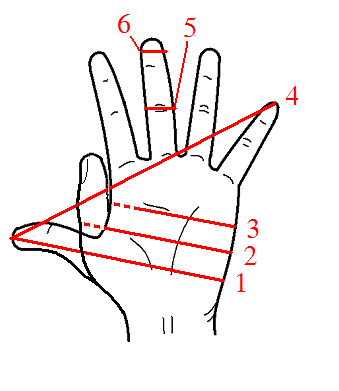
Some hand-based measurements, including the finger.
A chart of Imperial and US customary units.

A finger (sometimes fingerbreadth or finger's breadth) is any of several units of measurement that are approximately the width of an adult human finger. [Exactly which part of the finger should be used is not defined; the width at the base of fingernail (#6 in the sketch) is typically less than that at the knuckle (#5).]

The digit, also known as digitus or digitus transversus (Latin), dactyl (Greek) or dactylus, or finger's breadth – 34 of an inch or 116 of a foot.[1][2] (about 2 cm)

In medicine and related disciplines (anatomy, radiology, etc.) the fingerbreadth (literally the width of a finger) is an informal but widely used unit of measure.[3][4]

In the measurement of distilled spirits, a finger of whiskey refers to the amount of whiskey that would fill a glass to the level of one finger wrapped around the glass at the bottom.[5][6][7]

Another definition (from Noah Webster): "nearly an inch."[8][9]

Finger is also the name of a longer unit of length, used historically in cloth measurement, to mean one eighth of a yard or 41/2 inches.[8][10] (114.3 mm) Again, which finger and whose finger, is not defined.

These units have no legal status but remain in use for 'rough and ready' comparisons.

See also

[edit]

References

[edit]
Revisions and contributorsEdit on WikipediaRead on Wikipedia
from Grokipedia
The finger, also known as the fingerbreadth or digit, is an ancient and obsolete derived from the approximate width of an adult finger, serving as one of the smallest standardized measures in early systems across various civilizations. Typically equivalent to about 1.8 to 1.9 centimeters, it formed the foundational subunit for larger body-based lengths like the palm, hand, and , facilitating practical applications in , , and before the adoption of more uniform metric standards. In , the fingerbreadth was a key subdivision of the royal , which measured approximately 52.3 centimeters overall; with 28 fingerbreadths comprising the —divided into 7 handbreadths of 4 fingerbreadths each—the unit equated to roughly 1.87 centimeters and was essential for precise construction, as evidenced in monumental works like the pyramids dating to around 2600 BCE. The employed a similar finger measure of about 1.93 centimeters as their basic length unit, integrating 16 fingers into a foot (approximately 30.4 centimeters) and 24 into a , reflecting influences from Egyptian and Babylonian systems while adapting for Hellenistic engineering and surveying needs around the 5th century BCE. In , particularly among the Babylonians circa 1700 BCE, a comparable unit called the kus—approximating a finger's breadth—subdivided the into 30 parts, underscoring its role in early and record-keeping on tablets. The finger unit persisted into measurements, where it represented one-fourth of a handbreadth (itself one-sixth of a ), appearing in scriptural references such as the description of temple pillars in 52:21 to denote fine thicknesses of about 2.25 centimeters. During the medieval period in , variations of the fingerbreadth—often around 1.9 centimeters or three-quarters of an inch—continued in use for local trades like cloth assessment and , though inconsistencies arose due to reliance on individual until the 16th-century efforts leading to imperial systems. Today, the finger survives only as a historical curiosity, illustrating humanity's transition from anthropometric to scientific paradigms, with no formal role in modern SI units.

Definition and Origins

Definition

The finger, also known as the fingerbreadth or digit, is a historical unit of length derived from human anatomy, specifically approximating the breadth of an adult human finger. This measure typically refers to the width across the base or middle phalange, serving as a fundamental subdivision in early systems of measurement where body parts provided natural standards. While individual variations exist due to differences in hand size, historical standardizations fixed the finger at approximately 18-20 mm, or 0.7 to 0.8 inches, for consistency in applications like construction and trade. Importantly, the unit denotes breadth rather than the full length of a finger, which extends from the base to the tip and measures roughly three to four inches—far longer and not equivalent to larger spans like the handspan. It is also distinct from the thumb's width, which originated the inch as a separate unit of about 25.4 . In ancient Egyptian systems, for instance, the finger was standardized as one twenty-eighth of the royal , emphasizing its role as a precise, anatomical baseline for linear .

Etymology and Linguistic Roots

The linguistic roots of the finger unit trace back to ancient , where terms for the anatomical were extended to denote a based on its breadth. In Latin, digitus referred to both a or and a fundamental measure of , derived from the deik- meaning "to show" or "pronounce," reflecting the finger's role in pointing and counting. Similarly, in , the term dáktylos (δάκτυλος), meaning "" or "," formed the basis for the dáktylos as a unit of measure, often equated with a finger's breadth; its is uncertain but possibly pre-Greek, with potential links to Latin digitus through shared concepts of digital anatomy. The English word "" evolved from finger, rooted in Proto-Germanic fingraz (meaning "one of five terminal members of the hand"), and by the late medieval period, it was applied to measurement contexts, as in "fingerbreadth" or "finger's breadth," synonyms emphasizing the unit's width derived from the human digit. In , etsba (אֶצְבַּע), literally meaning "," was used in scriptural contexts for measurements involving the finger's dimensions, underscoring its anatomical and symbolic significance across ancient texts. Cross-linguistically, parallels abound in body-part nomenclature; for instance, Ancient Egyptian employed ḏbꜥ (often transliterated as djeba), denoting "" and serving as a basic linear unit, while Mesopotamian languages like Akkadian used equivalents such as ubānu for "," tying the measure directly to human in records.

Historical Usage

Ancient Civilizations

In , the finger unit, known as the dba, served as a fundamental subdivision of the royal (meh neswt), with 28 fingers comprising one cubit of approximately 52.5 cm. This system emerged around 3000 BCE during the Early Dynastic Period and was essential for precise architectural endeavors, including the construction of pyramids such as the , where rods marked with finger divisions facilitated alignment and scaling. Additionally, the finger unit contributed to gauging, enabling measurements of annual flood levels to assess and support agricultural planning tied to and production. In Mesopotamian and Sumerian societies, the finger (ubanu) functioned as a key subunit of the (ammatu), typically with 30 fingers per cubit of about 50 cm, as evidenced in texts from the third millennium BCE. Around 2500 BCE, during the height of Sumerian urbanization in cities like and , these measurements appeared in administrative records for , including the layout of temples, ziggurats, and canals, where finger subdivisions ensured proportional designs in plans. This sexagesimal-based system reflected the practical needs of early state bureaucracies in managing land allocation and construction. Biblical Hebrew texts reference the "fingerbreadth" (etzba), portraying it as a subunit in sacred and architectural contexts, such as in 52:21, which describes the bronze pillars of the as having a thickness of four fingerbreadths within an 18-cubit height. This measurement, drawn from ancient Israelite practices influenced by Near Eastern traditions, underscored the unit's role in temple , symbolizing precision in divine structures during the First Temple period around 1000–586 BCE. Standardization of the finger unit across these ancient Near Eastern civilizations relied on the breadth of a finger, typically the index or , estimated at 1.8–2 cm, with verification against the palm, which equated to four fingers. This anthropometric approach ensured consistency in , as seen in rods and textual descriptions, adapting to regional variations while maintaining utility in both secular and ritual applications.

Classical and Medieval Periods

In , the finger unit, known as the daktylos, served as a fundamental subdivision in the system of length measurements, equivalent to approximately 19.25 mm. The Greek foot, or , measured about 30.8 cm and consisted of 16 daktyloi, while the , or pechys, spanned roughly 46.2 cm and comprised 24 daktyloi. These units, inherited with modifications from earlier Egyptian models, were integral to architectural design and construction during the Classical period. For instance, the Parthenon's dimensions in the BCE were proportioned using multiples of the pous and its finger subdivisions, ensuring harmonic scaling in the temple's columns and . The Romans adapted the Greek daktylos into the digitus, standardizing it at around 18.5 mm, with 4 digiti forming a palm (palmus) and 16 comprising the foot (pes) of approximately 29.6 cm. This system facilitated precise engineering feats, including military fortifications and aqueducts, where the digitus allowed for fine adjustments in alignment and . Roman surveyors employed standards and tools like the groma to apply these units over vast distances, as evidenced in the construction of aqueducts such as the , where channel widths and slopes were calibrated to the pes and its subdivisions. During the Medieval period in , the finger unit persisted in Anglo-Saxon and Frankish measurement systems, primarily for land surveying and agricultural demarcation, where it denoted a small linear increment of approximately 1.9 cm (or three-quarters of an inch) for plotting boundaries and furrows. By the , however, the term "finger" was also used for a larger unit of 4.5 inches (11.4 cm) in to gauge cloth lengths in markets across and . This reflected broader economic changes, with the unit embedded in standards for and . In the , particularly under the from the 8th to 13th centuries, Arabic scholars preserved and refined the as a subdivision of the (dhirāʿ), which measured about 48 cm, drawing from Hellenistic and Persian traditions. This system informed engineering texts, such as those on and by Al-Jazari, where fingers subdivided cubits for designing waterwheels and mosques, ensuring precision in load-bearing structures and irrigation channels.

Variations Across Cultures

Short Finger (Fingerbreadth or Digit)

The short finger, commonly referred to as the fingerbreadth or digit, represents an ancient derived from the anatomical width of the distal phalange of the human . This served as a fundamental standard in various historical systems, approximating 3/4 inch or 19 mm in typical Greek applications. Known by synonyms such as digit (digitus in Latin) or dactyl (daktylos in Greek), the unit exhibited slight cultural variations; for instance, the Roman digitus was standardized at 18.5 mm, while the Egyptian equivalent measured 18.75 mm. Although primarily employed as a base unit in fractional hierarchies—such as 16 digits forming a foot or 28 comprising a —the short finger was occasionally subdivided further, for example, into smaller segments like grains in some medieval contexts, though such divisions were not widespread. Historical standards accounted for natural variability in finger breadth due to factors like or by relying on averaged values from adult males, ensuring consistency across applications; for example, official Roman specifications fixed the digitus at 18.5 mm despite individual differences. The unit played a role in ancient cubit systems, where it formed the smallest subdivision for precise linear measurements.

Long Finger (Cloth Measure)

The long finger served as a specialized in cloth measurement, equivalent to one-eighth of a yard, or 4.5 inches (114.3 mm). This measure emerged in English cloth markets during the 13th century as a practical tool for draping and estimating fabric lengths rapidly, allowing traders to assess bolts without requiring precise instruments. It was particularly suited to the wool trade, where consistent was essential for . In medieval European trade practices, the long finger was integrated into guild regulations for determining cloth bolt lengths, promoting uniformity in transactions across markets. With eight long fingers comprising a single yard, the unit simplified mental calculations for merchants handling yardage sales. Standardization efforts, such as those outlined in early statutes like the of , reinforced reliable measures for and textiles, indirectly supporting subdivisions like the long finger in English systems. The long finger remained in use through the early modern era but gradually declined following the 19th-century push for imperial standardization under acts like the Weights and Measures Act of 1824, which formalized the yard while diminishing smaller traditional units. Full metric adoption in Britain from the onward further marginalized it, though remnants persisted informally in tailoring for quick fabric assessments into the 20th century.

Conversions and Equivalents

Relation to Larger Units

In ancient Egyptian metrology, the finger, or digit, formed the base of a hierarchical system where 4 fingers equaled 1 palm, and 7 palms composed 1 royal cubit measuring approximately 524 mm. This structure enabled modular scaling essential for monumental architecture, such as the precise alignments in pyramid construction and temple surveying. The Greek and Roman systems similarly positioned the digit (daktylos in Greek or digitus in Latin) as the foundational unit, with 4 digits comprising 1 palm (palmē or palmus), 6 palms equaling 1 cubit (pechys or cubitus), and 16 digits corresponding to 1 foot (pous or pes); these relations supported proportional design principles in classical architecture, engineering, and urban planning. In medieval European measurement, particularly for cloth in , 3 fingers equaled 1 nail, and 8 nails formed 1 quarter-yard (though variations existed, with the full yard comprising 16 nails); this subdivision integrated into broader units like the (45 inches for fabric) and the (16.5 feet for land), facilitating trade and agrarian divisions. Biblical and Hebrew traditions defined the fingerbreadth (etzba) such that 4 fingerbreadths equaled 1 handbreadth (tefah), serving as a subunit within the (ammah) for sacred dimensions, as evidenced in temple measurements detailed in 40, where a measuring reed of six cubits each extended by one handbreadth underscored the system's precision.

Modern Metric and Imperial Equivalents

The short finger, also known as the fingerbreadth or digit, is standardized in modern equivalents as 0.75 inches or 1.905 centimeters (19.05 millimeters). In the context of ancient Roman measurements, the exact digitus equates to approximately 18.5 millimeters, derived from the Roman foot of 296 millimeters divided into 16 parts. The long finger, primarily used as a cloth measure, corresponds to 4.5 inches or 11.43 centimeters (114.3 millimeters). These values translate to metric conversions of approximately 0.01905 meters for the short finger and 0.1143 meters for the long finger. Due to variations in historical applications, these figures represent averages; contemporary archaeological recreations and replicas often standardize the short finger at 19 millimeters for consistency in replication efforts.
VariantImperial (inches)Metric (cm)Metric (mm)Metric (m)
Short finger/digit0.751.90519.05≈0.01905
Roman digitus≈0.7281.8518.5≈0.0185
Long cloth finger4.511.43114.30.1143

Legacy and Modern Applications

Influence on Standard Measures

The finger unit, known historically as the digit, served as a foundational body-based measure that contributed to the evolution of the inch in early English systems. In Anglo-Saxon England prior to the in , the inch (ynce) was defined as the length of three barleycorns laid end to end, approximating the width of a , while the digit represented the breadth of a finger at about three-quarters of an inch. This digit acted as a precursor to more standardized linear units, influencing the development of the inch through shared reliance on human anatomy for short-distance measurements in trade and craftsmanship. The finger's role extended to larger standardized measures via its integration into the cubit, leaving traces in the imperial foot and, by extension, the international yard. Ancient systems, including Greek and Roman, divided the foot into 16 digits, a proportion that persisted in the transition to the 12-inch imperial foot, where 12 inches equate to approximately 16 digits given the digit's length of 0.75 inches. This historical linkage from the —often subdivided into 24 digits—to the foot informed the structure of the yard as three feet, culminating in the 1959 International Yard and Pound Agreement, which fixed the yard at exactly 0.9144 meters to align imperial units globally while preserving these ancient proportions. In , the finger module remains essential for reconstructing ancient artifacts, particularly Egyptian statues proportioned according to the royal . The Egyptian royal , measuring about 52.5 centimeters, was divided into seven palms, each comprising four fingers (digits), yielding 28 fingers per ; this modular system dictated canonical proportions in , such as the 18- height (each fist four fingers wide) for standing figures, approximately 1.35 meters. Modern reconstructions employ these finger-based divisions to analyze and restore statues, ensuring fidelity to original principles derived from metrological rods inscribed with finger markings. During the 18th-century push for metric standardization in , finger subdivisions indirectly informed debates on decimalization, as reformers considered rationalizing traditional units like the pouce (thumb, akin to the digit) into base-10 systems before opting for the meridian-based meter. Although not directly adopted, these body-derived fractions highlighted the need for universal, decimal-compatible measures to supplant inconsistent regional variants. The finger unit is now obsolete in official measurement systems worldwide.

Contemporary Informal Uses

In contemporary culinary practices, the term "finger-thick" is commonly used in recipes to describe the approximate diameter or thickness of ingredients, such as cuts of , meats, or , allowing home cooks to gauge portions without precise measuring tools. For example, recipes may instruct to slice into finger-thick wedges for grilling or to select three-finger-thick steaks for optimal cooking. This informal application persists in professional and amateur cooking guides, providing a quick, body-based estimate rooted in the historical use of fingers as units. In crafts and DIY projects, the finger serves as a handy, tool-free reference for approximating widths, spacings, or thicknesses in activities like , jewelry making, and tailoring. Artisans might leave a finger-width space between pottery pieces during firing to prevent sticking or use finger breadth to estimate intervals stitching, ensuring practical accuracy in resource-limited settings. Such methods are particularly valued in traditional crafts where precision tools are unavailable, emphasizing intuitive, proportional gauging. In medical contexts, the Finger Tip Unit (FTU) provides a standardized yet informal way to measure topical creams and ointments for skin conditions like eczema, where one FTU equals the amount squeezed from a standard tube onto an adult's fingertip, covering an area roughly twice the size of an adult's flat hand with fingers together (about 2% of body surface area) but defined by volume rather than linear length. This system, developed to simplify dosing without scales, equates to roughly 0.5 grams per unit and is widely recommended for patient self-application to avoid overuse. Although derived from finger anatomy, the FTU focuses on quantity for therapeutic consistency rather than dimensional measurement. Culturally, small body-based measures like the fingerbreadth linger in idiomatic expressions such as "by a ," which conveys a razor-thin margin or narrow escape in English-language and everyday speech, evoking the precision of ancient body-based measures. This phrase appears in historical texts to describe minimal deviations or close calls and continues in modern prose to emphasize precarious situations.

References

Add your contribution
Related Hubs
User Avatar
No comments yet.