Hubbry Logo
Cape FinisterreCape FinisterreMain
Open search
Cape Finisterre
Community hub
Cape Finisterre
logo
8 pages, 0 posts
0 subscribers
Be the first to start a discussion here.
Cape Finisterre
Cape Finisterre
from Wikipedia

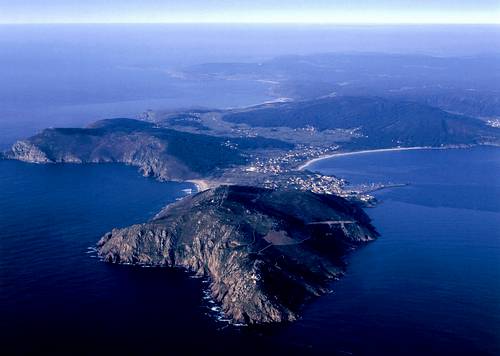
Cape Finisterre (/ˌfɪnɪˈstɛər/,[1][2] also US: /-tɛri/;[3] Galician: Cabo Fisterra [fisˈtɛrɐ]; Spanish: Cabo Finisterre [finisˈtere]) is a rock-bound peninsula on the west coast of Galicia, Spain.[4]

Key Information

In Roman times it was believed to be an end of the known world. The name Finisterre, like that of Finistère in France, derives from the Latin finis terrae, meaning "end of the earth". It is sometimes said to be the westernmost point of the Iberian Peninsula. However, Cabo da Roca in Portugal is about 16.5 kilometres (10.3 mi) farther west and thus the westernmost point of continental Europe. Even in Spain Cabo Touriñán is 124 metres (135 yards) farther west.

Monte Facho is the name of the mountain on Cape Finisterre, which has a peak that is 238 metres (781 ft) above sea level. A prominent lighthouse is at the top of Monte Facho. The seaside town of Fisterra is nearby.

The Artabri were an ancient Gallaecian Celtic tribe that once inhabited the area.

Geography

[edit]

Cape Finisterre has several beaches, including O Rostro, Arnela, Mar de Fora, Langosteira, Riveira, and Corbeiro. Many of the beaches are framed by steep cliffs leading down to the Mare Tenebrosum (or dark sea, the name of the Atlantic in the Middle Ages). The peninsula contains the port and municipality of Fisterra.

There are several rocks in this area associated with religious legends, such as the "holy stones", the "stained wine stones", the "stone chair", and the tomb of the Celtic crone-goddess Orcabella.[5]

Pilgrimage

[edit]
The Camino Way, Cape Finisterre

Cape Finisterre is the final destination for many pilgrims on the Way of St. James, the pilgrimage to the shrine of the apostle Saint James the Great in the Cathedral of Santiago de Compostela.[6] Cape Finisterre is about 90 km (50 miles) from Santiago de Compostela. The name of this route is Camino Finisterre.

The origin of the pilgrimage to Finisterre is not certain. However, it is believed to date from pre-Christian times and was possibly associated with Finisterre's status as the "edge of the world" and a place to see the last sun of the day.[7] The tradition continued in medieval times, when "hospitals" were established to cater to pilgrims along the route from Santiago de Compostela to Finisterre.[8]

Some pilgrims continue on to Muxía, which is a day's walk away.[9]

[edit]

Pre-Christian beliefs

[edit]

There are many pre-Christian sacred locations in the area; they are connected to a variety of myths.[10] There was an "Altar Soli" on Cape Finisterre,[11] where the Celts engaged in sun worship and assorted rituals.[12][13]

Greco-Roman historians called the local residents of Cape Finisterre the "Nerios".[14] Monte Facho was the place where the Celtic Nerios from Duio [gl][15] carried out their offerings and rites in honor of the sun. Monte Facho is the site of current archaeological investigations and there is evidence of habitation on Monte Facho circa 1000 BCE.[16] There is a Roman Road to the top of Monte Facho and the remnants of ancient structures on the mountain.[17]

San Guillerme, also known as St. William of Penacorada,[18] lived in a house located on Monte Facho. Near San Guillerme's house is a stone now known as "St William's Stone" (Pedra de San Guillerme). Sterile couples used to copulate on St. William's Stone to try to conceive, following a Celtic rite of fertility.[11]

Maritime history

[edit]

The Phoenicians sailed from this cape to trade with Bronze Age Britain, with a possible point of landing for the Phoenician traders being Mount Batten.[19]

As it is a prominent landfall on the route from northern Europe to the Mediterranean, several naval battles took place near the Cape. Notable battles include the First Battle of Cape Finisterre in 1747 during the War of the Austrian Succession and the Battle of Cape Finisterre in 1805 during the Napoleonic Wars. Both these battles were between the British Royal Navy and the French Navy, who were constantly battling for control of seas during the 18th century.[citation needed] The coast, known locally as the Costa da Morte (Death Coast),[20] has been the site of numerous shipwrecks and founderings, including that of the British ironclad HMS Captain, leading to the loss of nearly 500 lives, in 1870.[21]

Additionally, laws governing the colonies of the British Empire (including the 1766 amendment to the Sugar Act 1764) used the latitude of Cape Finisterre as the latitude past which certain goods could not be shipped north directly between British colonies. For instance, it was forbidden to ship sugar cane directly from Jamaica to Nova Scotia, as such a transaction crossed through this latitude. Instead, the laws required that the sugar cane be shipped first from Jamaica to Britain, where it would be re-exported to Nova Scotia.

Likewise, the latitude of Cape Finisterre was used to signal that a change of flags flown by Norwegian and Swedish merchant ships was required.[citation needed] Following independence and the subsequent union with Sweden in 1814, Norwegian merchant ships were required to fly the Swedish flag (until 1818) and the Swedish flag with the Norwegian (the Dannebrog with the Norwegian lion) flag in the canton. From 1818 to 1821, Swedish merchant ships also flew this flag in place of the Swedish flag (until 1844) when sailing south of Cape Finisterre.

Finisterre was the former name of the current FitzRoy sea area used in the UK Shipping Forecast. It was renamed FitzRoy in 2002 (in honour of the founder of the Met Office) to avoid confusion with the smaller sea area of the same name featuring in the marine forecasts produced by the French and Spanish meteorological offices.[citation needed]

In the 2010s and 2020s, the waters of Cape Finisterrre have been the venue for several orca attacks against sailboats at Atlantic Ocean.[22]

[edit]
  • In the Gilbert & Sullivan operetta Ruddigore, Richard Dauntless sings of shipping out in "a revenue sloop" and encountering a French merchantman "off Cape Finistere."
  • In the film Night Train to Lisbon (2013), Amadeu and Estafania spend the night and the morning in the car at Cape Finisterre. Then, Amadeu is shown sitting on the cliff writing his memoirs on which the film centers.
  • In Walter Farley's book The Black Stallion, a ship is last mentioned sailing north toward England "off Cape Finisterre on the coast of Spain" before foundering in a night storm.

Literature

[edit]
  • Sánchez-Carretero, Christina, ed. (2015). Walking to the End of the World. Heritage, Pilgrimage and the Camino to Finisterre. GeoJournal Library. Vol. 117. New York: Springer. doi:10.1007/978-3-319-20212-9. ISBN 978-3-319-20212-9.

See also

[edit]

References

[edit]
[edit]
Revisions and contributorsEdit on WikipediaRead on Wikipedia
from Grokipedia
Cape Finisterre (Galician: Cabo Fisterra) is a rocky peninsula extending into the Atlantic Ocean on the northwestern coast of Galicia, Spain, at approximately 42°53′N 9°16′W, historically believed by the ancient Romans to mark the westernmost edge of the known world and thus named Finis Terrae, meaning "end of the Earth." Geographically, the cape forms part of the rugged Costa da Morte ("Coast of Death"), a stretch notorious for its treacherous waters, shipwrecks, and dramatic cliffs battered by North Atlantic winds, with its modest summit at Monte Facho rising to oversee vast oceanic vistas. The area is part of protected coastal ecosystems, emphasizing conservation efforts amid tourism. The promontory culminates at the Faro de Fisterra, a lighthouse constructed in 1853 with a tower standing 17 meters tall, its focal plane situated 143 meters above sea level, serving as a navigational beacon since its activation. The site's history traces back to pre-Roman Celtic inhabitants, the Gallaeci, who constructed the Ara Solis altar on Monte Facho for sun worship rituals, viewing the cape as a sacred point where souls ascended to the heavens along the . Roman conquest in the late 1st century BCE integrated these pagan traditions, adding shrines to local deities like Berobreus, while early Christian influences emerged in the early medieval period with the hermitage of Saint William (San Guillerme) near the monte, likely dating to the 9th-11th century. In modern times, Cape Finisterre holds profound significance as the terminus of the Camino de Santiago's extension to Finisterre (approximately 89 km from ), with a further extension to (totaling about 115 km), that attracts pilgrims seeking symbolic closure and renewal at the "0 km" marker near the lighthouse, where traditions once included burning worn clothes or leaving boots as offerings—practices now restricted to protect the environment. This spiritual legacy, blending ancient mysticism with contemporary , underscores the cape's enduring role as a threshold between land and sea, myth and reality.

Geography and Environment

Physical Features

Cape Finisterre, known locally as Cabo Fisterra, is a rocky peninsula extending into the Atlantic Ocean on the western coast of Galicia, Spain, forming part of the rugged Costa da Morte region. This approximately 3.5-kilometer-long landform rises prominently from the sea, characterized by its dramatic coastal topography and exposure to oceanic forces. The peninsula's key landmarks include the Faro de Fisterra, a historic constructed in 1853 and situated at the cape’s western tip on Monte Facho, which reaches an elevation of 242 meters above . The features an octagonal stone tower standing 17 meters tall, with its light at a focal height of 143 meters and a range of 23 nautical miles, aiding along this hazardous coastline. Nearby, steep cliffs frame secluded coves, contributing to the area's isolated and windswept appearance. Geologically, the cape consists primarily of granite formations, including the distinctive Finisterre granite, part of the dating back around 380 million years, with subsequent erosion over millions of years sculpting the exposed rock faces and creating the peninsula's jagged profile. Schistose rocks are also present in the underlying migmatitic complex, interspersed with granitic intrusions that define the cape's resistant, pink-hued crags. Small offshore islands, such as O Petonciño and A Centola, further illustrate this eroded granitic landscape. Beaches like Praia da Arnela, with its fine white sands backed by dunes, and the more distant Praia do Porto do Busto exemplify the interspersed sandy pockets amid the rocky terrain. The cape is located at coordinates 42°52′57″N 9°16′19″W, positioning it as a notable but not the absolute western extremity of the in extends farther west—though it holds symbolic significance as a traditional endpoint of the European mainland in historical perception. Elevations vary from at the beaches to the 242-meter peak of Monte Facho, underscoring the cape's role as a prominent in Galicia's coastal morphology.

Climate and Ecology

Cape Finisterre experiences an classified under the Köppen system as Cfb, featuring mild temperatures throughout the year with an annual average of about 14°C, rarely dropping below 6°C in winter or exceeding 22°C in summer. The region receives high annual precipitation of 1,200 to 1,500 mm, predominantly as rain, contributing to frequent fog, overcast skies, and stormy conditions, particularly during winter when gales can reach speeds up to 100 km/h due to Atlantic influences. The cape's ecology is shaped by its exposed coastal position within the , supporting a diverse yet fragile influenced by the Atlantic climate and nutrient-rich . Vegetation consists primarily of scrubland dominated by heather (Calluna vulgaris), gorse (), and scattered maritime pines (), adapted to acidic soils and strong , though oak woodlands have largely been replaced by these species over time. Wind and wave action exacerbate of coastal cliffs and dunes, with rates reaching up to 1.8 meters per year in vulnerable rocky sectors. Biodiversity highlights include endemic flora such as Centaurea corcubionensis, a rare plant found along nearby coastal dunes, alongside seabird populations like yellow-legged gulls (Larus michahellis) and European shags (Gulosus aristotelis) that nest on cliffs. Marine life thrives in surrounding waters, with commercially important species such as sardines (Sardina pilchardus) supported by seasonal , and (Octopus vulgaris) in rocky intertidal zones. The area falls under the network, including the ZEC Costa da Morte site covering over 11,800 hectares from Sabón to , aimed at protecting habitats like coastal dunes and estuaries. Environmental threats include ongoing driven by storm surges and wave energy, from maritime traffic such as oil residues and debris, and projected sea-level rise. Recent studies adapting IPCC models to local conditions indicate a potential rise of 0.5 to 1 meter by 2100 under moderate to high emissions scenarios, threatening low-lying habitats and increasing flood risks.

Historical Development

Ancient and Pre-Christian Era

The region surrounding Cape Finisterre, part of the Costa da Morte in Galicia, Spain, features evidence of prehistoric human activity dating back to the Neolithic period, with over 600 megalithic sites cataloged, including dolmens and mámoas (tumuli). These structures, such as the Dolmen de Dombate near the cape, were constructed between approximately 4000 BCE and 2500 BCE, serving primarily as burial chambers and reflecting early communal rituals associated with death and the landscape. By around 500 BCE, Celtic tribes known as the Artabri inhabited the coastal areas near Cape Finisterre, establishing hillforts (castros) and engaging in solar-oriented rituals tied to the cape's dramatic sunsets over the Atlantic. The Artabri, described in classical sources as a Gallaecian Celtic group, viewed the cape as a liminal space where the sun descended into the ocean, symbolizing transitions to the , with offerings likely made at natural rock formations or early . Phoenician traders, active in Galicia from the 8th century BCE, influenced local and , possibly contributing to the erection of solar ; ancient geographer noted a "Solis Ara" (altar of the sun) at the promontory beyond Cape Nerium (modern Finisterre), aligning with Phoenician solar theology centered on deities like . During the Roman period, from the 1st century BCE to the CE, the cape was designated Finis Terrae (""), marking the western extremity of the known world as described by geographer in his , where he identifies Cape Nerium as the most westerly point of the inhabited earth. Romans maintained the Ara Solis for worship of the sun god Sol, integrating it into their pantheon while exploiting the region's trade routes for tin and other metals essential to bronze production; northern Galician mines, including those near Oestrymnis (close to the cape), supplied cassiterite via Atlantic ports, with amphorae and ceramics evidencing exchange along the western facade from to Finisterre. Archaeological excavations in the vicinity have uncovered artifacts underscoring this era's activity, including Celtic jewelry such as fibulae and torcs from castros like Borneiro, dating to the 2nd century BCE, alongside Roman coins (e.g., Augustan denarii) and metal ingots from coastal sites, highlighting the cape's role in pre-Christian exchange networks.

Medieval to Modern Periods

During the medieval period, from the 5th to 15th centuries, Cape Finisterre and the surrounding region of experienced minimal direct influences from the , which controlled much of the after the fall of , as the area's remote coastal location limited deeper integration until the 8th century. Moorish incursions were similarly brief and superficial in this northwestern corner, with the region quickly reconquered during the early stages of the . By the 9th century, had been incorporated into the emerging under Asturian-Leonese rule, fostering a period of relative stability marked by feudal agrarian economies and early Christian settlements. A notable development was the establishment of a Christian hermitage dedicated to San Guillerme (Saint William) near Monte Facho in the 11th or , built atop pre-existing pagan sites and symbolizing the of the landscape; the ruins of this hermitage remain a testament to early monastic life in the area. In the early , from the 16th to 19th centuries, the cape served as a strategic for Spanish naval operations during the Anglo-Spanish wars, with fleets frequently navigating its treacherous waters en route to the Atlantic; for instance, in 1596, a severe storm devastated a large off the coast, sinking over 20 vessels and highlighting the site's maritime perils. The area's role intensified during broader European conflicts, culminating in the First Battle of Cape Finisterre on May 14, 1747, where a British fleet under Admiral George Anson intercepted and defeated a French convoy bound for the , capturing four ships of the line, two frigates, and seven merchant vessels in a five-hour engagement approximately 30 miles offshore. This victory disrupted French colonial supply lines and underscored the cape's position as a critical chokepoint in transatlantic trade routes. The 19th and 20th centuries brought infrastructural responses to persistent shipwreck epidemics along the , where hundreds of vessels perished due to fog, rocks, and storms; the Cape Finisterre Lighthouse was constructed in 1853 atop a 138 meters above to mitigate these dangers, with its fixed white light visible for 31 nautical miles (57 km) and later augmented by a station in 1889. Under Francisco Franco's regime (1939–1975), the suppression of regional identities extended to Galicia, where use was banned in public spheres, Celtic cultural expressions were marginalized as backward, and local traditions in areas like faced censorship to enforce Spanish centralism. Following the after 1975, there was a revival of Galician cultural festivals, including traditional feasts in with roots in the , such as the "Danza dos Paos," which celebrated community and heritage through dance and music. In recent developments from the 2000s to 2025, the European Union provided funding through programs like LEADER for coastal infrastructure in Galicia, supporting the creation of the Camiño dos Faros trail network in the 2010s, which enhanced pedestrian paths around Finisterre and boosted sustainable access to the cape. Storm damage, including impacts from severe weather events like those in late 2023 that battered the Galician coast with high winds and waves, prompted repairs to coastal defenses and paths, funded partly by regional and EU resources to protect against erosion. The population of the Fisterra municipality has shown slight decline, from approximately 4,708 residents in 1900 to 4,704 in 2024, reflecting broader rural depopulation trends in Galicia amid emigration and aging demographics.

Religious and Cultural Significance

Pre-Christian Beliefs

In pre-Christian times, Cape Finisterre held profound significance in Celtic spirituality as a sacred site linked to sun worship, where the dramatic sunsets over the Atlantic symbolized the sun's daily "death" and renewal. The , who inhabited the region of Galicia from around the 1st millennium BCE, revered the sun god and viewed the cape as an altar for solar rituals, particularly during solstices, when fires were lit on the cliffs to honor the celestial cycle and facilitate transitions between life and the afterlife. Mythical beliefs portrayed the cape as the literal end of , a liminal threshold where the earthly realm met the otherworldly, influencing Roman interpretations of the site as the Ara Solis, or Altar of the Sun. Legends described it as a portal for departing beyond the sunset, with druidic practices possibly involving offerings cast from the cliffs to invoke safe passage or appease sea spirits. Archaeological evidence of prehistoric activity is found in petroglyphs at nearby sites like Campo Lameiro, dating to the BCE, featuring cup-and-ring patterns and other geometric designs. These carvings, often positioned on elevated outcrops overlooking the , suggest ritual use tied to solar observations and herbal offerings, reflecting a broader prehistoric emphasis on celestial and natural harmonies in Galician . Elements of these beliefs persist in Galician folk traditions, such as the , where a flaming punch of , sugar, and herbs is prepared with incantations to purify and ward off evil, echoing ancient Celtic fire ceremonies for spiritual protection. Observed during festivals like San Juan on June 23, this practice has been revived by neopagan groups since the early , blending historical sun and fire symbolism with contemporary interpretations of druidic rites.

Christian Pilgrimage Traditions

The Camino de Finisterre serves as a medieval extension of the Camino de Santiago, with pilgrims historically traveling from Santiago de Compostela to Cape Finisterre to collect scallop shells as proof of their journey, a practice rooted in the route's integration into the broader pilgrimage network since the 9th century. This extension, often called the "end of the world" due to ancient perceptions of the cape as the earth's westernmost edge, was formalized in the late 20th century when the Fisterra Town Hall introduced the Finisterrana certificate in 1997 to recognize completions of the route from Santiago. The route spans approximately 89-91 kilometers and typically takes 4-5 days to walk, with common stages including Santiago to Negreira (about 22 km), Negreira to Olveiroa (33 km), and Olveiroa to Finisterre (about 38 km, often split via Cee at 25 km and then 16 km to Finisterre). Pilgrims follow yellow arrows and scallop shell markers along the path, staying in municipal albergues that provide affordable lodging exclusively for holders, such as the Albergue de Peregrinos in Finisterre and others in intermediate towns like Olveiroa. Upon arrival at the cape, walkers can obtain the Finisterrana certificate from the local pilgrim hostel by presenting a stamped verifying the journey on foot or by . Key traditions include gathering at , marked as kilometer 0.0, where pilgrims once burned worn clothes or boots as a ritual of renewal—though now prohibited to prevent fires—and watching the sunset over the Atlantic, symbolizing closure and rebirth. Spiritually, the Camino de Finisterre represents the culmination of the pilgrimage as a for life's end, blending Christian with personal reflection on mortality and transformation, drawing from the cape's ancient role as a liminal space. Notable sites include the ruins of the 12th-century Hermitage of San Guillerme, overlooking the cape and evoking early hermit traditions, and the Church of Santa María das Areas (Nuestra Señora de las Áreas), established around 1199, which houses the image of the Virgin of the Sands and serves as a site for pilgrim masses. Recent years have seen a surge in participants post-COVID, though exact annual figures for this extension remain untracked by the Santiago Pilgrim's Office. As of 2024, overall Camino pilgrim numbers exceeded 400,000, indicating continued growth in interest for extensions like Finisterre.

Maritime Role

The Cape Finisterre region, part of Galicia's , has historically posed significant navigation challenges due to its powerful Atlantic currents, persistent fog, and jagged rocky outcrops, which have led to numerous shipwrecks over centuries and earned the area its ominous nickname, the "Coast of Death." Prior to the , rudimentary aids like coastal bonfires served as early warning beacons to alert mariners to these perils, though their effectiveness was limited by weather conditions and visibility. The primary navigational aid at the cape is the Faro de , constructed in 1853 as an octagonal tower rising 17 meters high, with its lantern positioned at a focal height of 143 meters above to achieve a visibility range exceeding 30 nautical miles. Originally powered by an , the lighthouse underwent in the , transitioning to incandescent bulbs that emit a white flash every 5 seconds, enhancing reliability for vessels in the area. It integrates with Spain's maritime safety framework through the Sociedad de Salvamento y Seguridad Marítima (SASEMAR), which operates a Maritime Rescue Coordination Centre (MRCC) at Finisterre to coordinate operations and monitor traffic. Supporting infrastructure includes post-2000 upgrades to coastal stations, such as those at Beo, Tahume, and Xastas, modernized with X- and S-band radars as part of the Finisterre (VTS) extension to improve real-time monitoring and collision avoidance. Navigational buoys mark hazardous reefs and channels along the coast, while EU-funded initiatives have bolstered protective measures like breakwaters in Galician ports to mitigate and storm impacts in this high-traffic zone. The cape lies adjacent to the Finisterre , a critical corridor for transatlantic shipping lanes that funnels international vessels through the region, underscoring its enduring role in global maritime routes. Technological advancements at the lighthouse reflect broader shifts in maritime signaling, evolving from manual oil lamps to fully automated electric systems by the late , reducing human intervention and increasing operational efficiency. Recent modernizations in the have further improved energy efficiency and light intensity while maintaining the 5-second flash pattern. Visitors can access the site year-round, with the climbable tower offering panoramic views via its spiral staircase, though the lantern room remains restricted for safety.

Shipwrecks and Naval Events

Cape Finisterre's treacherous waters have claimed numerous vessels over the centuries, earning the surrounding its ominous name due to frequent maritime disasters. Historical records indicate over 700 shipwrecks along the Galician coast, many concentrated near the cape, stemming from the onward. A prominent early example is the 1596 disaster during the Second , when severe storms scattered the fleet off the cape, resulting in the loss of 25 ships—including large galleons—and approximately 2,000 lives as they foundered on the rocky shores. In the , the cape continued to witness devastating losses, underscoring its perilous reputation. The British ironclad HMS Captain, an experimental , capsized in a on September 7, 1870, off the cape, claiming nearly 500 lives from its crew of 518 due to stability flaws exacerbated by high winds and rough seas. In 2022, an exploratory marine survey identified a potential wreck site off Cape Finisterre matching the configuration and dimensions of HMS Captain. Two decades later, the Royal Navy's HMS Serpent ran aground on Punta do Boi during a storm on November 10, 1890, breaking apart and resulting in 173 fatalities, with only three survivors reaching shore. These incidents highlight the cape's hazards, including gale-force winds exceeding Beaufort Force 10 and shallow rocky reefs that have ensnared ships despite navigational efforts. Naval engagements have also marked the site's history, amplifying its strategic maritime significance. The First Battle of Cape Finisterre on May 14, 1747, during the , saw a British squadron of 14 ships of the line under Admiral George Anson intercept and capture four French ships of the line, two frigates, and seven merchant vessels from a 30-ship , preventing supplies from reaching French forces in a five-hour action. Nearly six decades later, in July 1805, the Battle of Cape Finisterre—also known as Calder's Action—pitted a British fleet against a combined Franco-Spanish squadron returning from the , resulting in the capture of two enemy ships and serving as a critical prelude to the later that year. During , the waters around Cape Finisterre became a hunting ground for German U-boats, contributing to significant Allied losses. Several merchant vessels in convoys, such as the British steamers Pyrrhus (torpedoed by U-28 in February 1940) and Telena (sunk by U-37 in May 1940), were lost to attacks west of the cape, highlighting the area's role in the . Salvage and archaeological efforts have since recovered artifacts from these wrecks; for instance, in the 1990s, operations on the 1882 RMS —sunk in a collision off the cape with 57 lives lost—yielded thousands of gold sovereigns and other valuables from the seabed. Recent estimates from Galician maritime records suggest the total number of wrecks exceeds 800, with ongoing surveys continuing to uncover sites despite modern navigation aids that have reduced but not eliminated risks.

Contemporary Importance

Tourism and Economy

Cape Finisterre serves as a major draw for tourists and pilgrims, with the Fisterra-Muxía extension of the attracting around 50,000 visitors annually. The route experienced a 27% growth in pilgrim numbers in 2024 compared to the previous year, with 42% of participants being international, primarily from , , and the . Overall visitor numbers to the surrounding region, where Fisterra is the primary hub, reached 161,461 travelers in 2024, generating 324,721 overnight stays and supporting local recovery from the , which caused a roughly 30% decline in Spanish activity between 2019 and 2020 before a strong rebound by 2022. Peak season occurs in summer, particularly July and August, when coastal weather and extended daylight boost arrivals for hiking and sightseeing. Key attractions include guided tours of the historic Finisterre Lighthouse, constructed in 1853, which offers panoramic views of the Atlantic and draws crowds for sunset watching. Hiking trails, such as the coastal paths around the cape, provide access to rugged cliffs, beaches like Praia do Rostro, and the PR-G series of small routes that connect to nearby villages, emphasizing the area's dramatic seascapes. Seafood restaurants in town specialize in fresh catches, including sardines from the local port, blending with the region's heritage. Accommodations range from budget hostels and pilgrim albergues to mid-range hotels and , with options like the Parador de Finisterre offering sea views and modern amenities to cater to diverse budgets. The local economy relies on services, including guided walks, shops selling Camino memorabilia, and tours, alongside traditional operations at the sardine-focused port, which processes daily catches for regional markets. Growth in visitor numbers post-2010 has been driven by increased promotion of the Camino Finisterra-Muxía as an official extension, boosting in province through higher occupancy rates and diversified income streams. Recent trends emphasize , with 2023 EU-funded initiatives supporting eco-friendly hotels and low-impact infrastructure along the to balance growth with environmental preservation. These efforts contributed to economic revitalization in the region as of 2024, underscoring Fisterra's role in post-pandemic recovery.

Conservation and Challenges

Cape Finisterre, located within the Costa da Morte region of Galicia, Spain, holds protected status as part of the Special Area of Conservation (SAC) ES1110005 under the European Union's Natura 2000 network, which safeguards coastal habitats, dunes, and marine environments from development pressures. This designation emphasizes the area's ecological value, including its role as a key site for seabird populations along the western Iberian coast, where species such as shearwaters and gulls utilize the rocky shores and surrounding waters for breeding and foraging. Additionally, the main pilgrimage routes of the Camino de Santiago to Santiago de Compostela were inscribed on UNESCO's World Heritage List in 1993, with extensions in 2015 recognizing additional paths like the Primitive and Northern Ways for their cultural and historical significance while promoting sustainable management of associated landscapes; the Finisterre-Muxía extension, though spiritually important, is not formally part of this designation. The cape faces significant environmental challenges, particularly from , with projections indicating a of 0.28 to 1.01 meters along Spain's Atlantic coast by 2100 under various emissions scenarios, exacerbating and flooding risks in low-lying areas like the nearby rías and dunes. has intensified since the post-2019 surge in pilgrims and visitors, leading to trail degradation and on paths to the lighthouse and cliffs, as increased foot traffic compacts and disrupts cover. Conservation efforts include community-led initiatives in Galicia during the 2020s, such as those restoring native species on coastal lands affected by fires and , with projects planting thousands of trees to enhance and stabilize slopes near the . Anti-pollution measures involve ongoing monitoring of plastic waste transported by Atlantic currents, highlighted by the 2023-2024 nurdle spill incident that affected over 1,400 kilometers of Galician coastline, prompting enhanced cleanup and debris tracking programs to mitigate marine litter accumulation. Culturally, preservation actions encompass the 2022 restoration of local hermitage sites, such as the Ermita de San Guillerme overlooking Finisterre, to protect pilgrimage heritage amid rising visitor numbers. Emerging gaps in conservation include limited data on microplastic impacts, with 2025 studies revealing concentrations of small particles (10 μm to 5 mm) in Atlantic coastal waters around Galicia, posing risks to marine life but requiring further research on long-term ecological effects. Potential conflicts arise from debated offshore wind farm permits near the coast, as 2024 legal challenges in Galicia halted nearly 100 projects—representing about 2,500 MW—due to concerns over environmental assessments and public consultation, delaying renewable energy development while highlighting tensions between conservation and energy goals; however, an August 2025 ruling by the EU Court of Justice upheld the permitting process, allowing resumption of these projects.

Representation in Culture

Literature and Art

Cape Finisterre has inspired literary and artistic works across centuries, often symbolizing the boundary between and the unknown, evoking themes of isolation and transcendence. In , Roman authors portrayed the cape as the westernmost edge of the inhabited world, a notion rooted in geographic descriptions of Hispania's rugged coastline. , in his (completed in 77 CE), details the of the Artabri—corresponding to the Cape Finisterre region—as a remote coastal amid the Atlantic's perils, underscoring its role as an oceanic limit. Medieval literature further embedded the cape in narratives of spiritual journeying. The Liber Sancti Jacobi, also known as the (c. 1130–1170 CE), serves as the earliest comprehensive guide for pilgrims to , describing routes, perils, and rituals along the Camino through Galicia's western shores. This 12th-century compilation, attributed to various clerics, portrays pilgrim journeys through Galicia as transformative paths fraught with isolation yet leading to transcendent encounters with the divine. In the Romantic era, Galician mysticism infused poetic evocations of the cape's desolate beauty. Rosalía de Castro's Follas Novas (1880), a collection of verses in Galician, captures the melancholic essence of northwestern Spain's landscapes, reflecting themes of saudade—profound longing and isolation—that resonate with Finisterre's windswept isolation and spiritual depth. Castro's work, drawing on regional folklore and natural mysticism, portrays Galicia's coastal extremities as spaces for introspection and transcendence. Complementing this literary focus, 19th-century Spanish and British artists depicted the cape in maritime scenes, often emphasizing its dramatic cliffs. William Anderson's oil painting Battle of Cape Finisterre (early 19th century) illustrates naval engagements near the promontory, symbolizing human struggle against the sea's isolating vastness. The 20th and 21st centuries saw the cape romanticized in modern prose tied to . Camilo José Cela's Mrs. Caldwell Speaks to Her Son (1955, English 1968), a Nobel Prize-winning author's experimental , explores existential isolation amid Galicia's mythic during a journey in the region. Similarly, Paulo Coelho's (1987), a semi-autobiographical account of the , romanticizes the journey's end as a site of personal transcendence, with Finisterre embodying the ultimate "end of the world" for spiritual renewal—though the culminates in Santiago, it inspires extensions to the cape. Local reinforces these motifs; in , 2010s street murals and installations draw on Celtic-inspired patterns, blending ancient sun-worship symbols with modern pilgrimage iconography to evoke transcendence over isolation. Overarching themes in these works portray Finisterre as a liminal space: its isolation fosters profound , while the horizon promises transcendent liberation from worldly bounds. Cape Finisterre has been depicted in several films and documentaries that highlight its role as the symbolic endpoint of the Camino de Santiago pilgrimage. In the 2010 Spanish film Finisterrae, directed by Sergio Caballero, two ghosts embark on a surreal journey along the Camino to reach the cape, portraying it as the "end of the world" in a blend of comedy and existential themes. The 2013 documentary Walking the Camino: Six Ways to Santiago, directed by Lydia B. Smith, follows six international pilgrims on their trek to Santiago de Compostela and onward to Finisterre, emphasizing personal transformation amid the cape's dramatic Atlantic cliffs. Similarly, the 2010 drama The Way, starring Martin Sheen and directed by Emilio Estevez, popularized the broader Camino narrative and inspired many viewers to extend their journeys to Finisterre as a secular culmination. A 2019 BBC Travel article explored Finisterre's ancient "end of the world" lore in a modern context, drawing on its pagan roots and appeal to contemporary pilgrims seeking closure beyond Santiago. In music, the cape inspires both local folk traditions and broader indie references. Galician folk ensemble Milladoiro, formed in the 1970s, incorporates themes from the region—including Finisterre—in albums like A Galicia de Maeloc (1979), evoking the area's Celtic heritage through traditional instruments such as the gaita (bagpipe). Internationally, Spanish indie rock band released the song "Finisterre" in 2021 on their album Cable a Tierra, using the cape as a for emotional refuge and the edge of existence, with lyrics describing it as a "drowned anthem" amid personal and global turmoil. Bagpiper Carlos Núñez also titled a 2003 album Finisterre: The End of the Earth, blending Galician tunes with Celtic influences to celebrate the site's mythical boundary. Folklore surrounding Cape Finisterre is rooted in the treacherous , featuring tales of ghost ships and supernatural guardians. The 1890 wreck of the HMS Serpent off nearby Camariñas, which claimed 172 lives, has spawned legends of restless sailor spirits haunting the shores, buried in the Cementerio de los Ingleses. The 14th-century legend of the Santo Cristo de Fisterra describes a storm-tossed ship saved when its crew cast a wooden Christ image overboard; the figure now stands in 's church, credited with protecting fishermen. Galician meiga (witch) traditions, part of the region's "Terra Meiga" lore, portray these figures as ambiguous healers or sorceresses who might invoke sea spirits near Finisterre to calm tempests or curse the unwary. Modern folklore centers on the zero-kilometer stone at the lighthouse, a pilgrimage marker symbolizing the , where visitors or take selfies to mark personal rebirth, perpetuating its ancient aura. In recent years, Finisterre's global perception has grown through , with viral online content showcasing pilgrim challenges and sunset views at the cape, amassing millions of views across platforms and reinforcing its allure as a transformative destination.

References

Add your contribution
Related Hubs
User Avatar
No comments yet.