Hubbry Logo
Pinus pinasterPinus pinasterMain
Open search
Pinus pinaster
Community hub
Pinus pinaster
logo
8 pages, 0 posts
0 subscribers
Be the first to start a discussion here.
Pinus pinaster
Pinus pinaster
from Wikipedia

Pinus pinaster
Scientific classification Edit this classification
Kingdom: Plantae
Clade: Tracheophytes
Clade: Gymnospermae
Division: Pinophyta
Class: Pinopsida
Order: Pinales
Family: Pinaceae
Genus: Pinus
Subgenus: P. subg. Pinus
Section: P. sect. Pinus
Subsection: Pinus subsect. Pinaster
Species:
P. pinaster
Binomial name
Pinus pinaster
Distribution map
Synonyms

Maritime pine, cluster pine

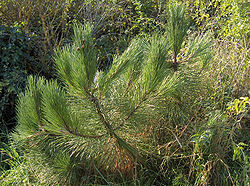
Pinus pinaster, the maritime pine[2][3] or cluster pine,[2] is a pine native to the south Atlantic Europe region and parts of the western Mediterranean. It is a hard, fast growing pine bearing small seeds with large wings.

Description

[edit]
The cone of P. pinaster

Pinus pinaster is a medium-size tree, reaching 20–35 metres (66–115 feet) tall with a trunk diameter of up to 1.2 m (4 ft), exceptionally 1.8 m (6 ft).

Pinus pinaster cones

The bark is orange-red, thick, and deeply fissured at the base of the trunk, somewhat thinner in the upper crown.

The leaves ('needles') are in pairs, very stout (2 millimetres or 116 inch broad), up to 25 cm (10 in) long,[4] and bluish-green to distinctly yellowish-green. The maritime pine features the longest and most robust needles of all European pine species.[4]

The cones are conic, 10–20 cm (4–8 in) long[4] and 4–6 cm (1+122+12 in) broad at the base when closed, green at first, ripening glossy red-brown when 24 months old. They open slowly over the next few years, or after being heated by a forest fire, to release the seeds, opening to 8–12 cm (3–4+12 in) broad.

The seeds are 8–10 mm (51638 in) long, with a 20–25 mm (1316–1 in) wing, and are wind-dispersed.

Similar species

[edit]

Maritime pine is closely related to Turkish pine, Canary Island pine and Aleppo pine, which all share many features with it. It is a relatively non-variable species, with constant morphology over the entire range.

Distribution and habitat

[edit]

Its range is in the western Mediterranean Basin and the southern Atlantic coast of Europe, extending from central Portugal and Northern Spain (especially in Galicia) to southern and Western France, east to western Italy, Croatia and south to northern Tunisia, Algeria and northern Morocco.[5] It favours a Mediterranean climate, which is one that has cool, rainy winters and hot, dry summers.[6]

It generally occurs at low to moderate altitudes, mostly from sea level to 600 m (2,000 ft), but up to 2,000 m (6,600 ft) in the south of its range in Morocco. The high degree of fragmentation in the current natural distribution is caused by two factors: the discontinuity and altitude of the mountain ranges causing isolation of even close populations, and human activity.[7]

Ecology

[edit]

Pinus pinaster is a popular topic in ecology because of its problematic growth and spread in South Africa for the past 150 years after being imported into the region at the end of the 17th century (1685–1693).[5] It was found spreading in the Cape Peninsula by 1772. Towards the end of the 18th century (1780), P. pinaster was widely planted, and at the beginning of the 19th century (1825–1830), P. pinaster was planted commercially as a timber resource and for the forestry industry.[5] The pine tree species invades large areas and more specifically fynbos vegetation. Fynbos vegetation is a fire-prone shrubland vegetation that is found in the southern and southwest cape of South Africa. It is found in greater abundance close to watercourses.[6] Dispersal, habitat loss, and fecundity are all factors that affect spread rate. The species favours acidic soils with medium to high-density vegetation,[6] but it can also grow in basic soils and even in sandy and poor soils, where only few commercial species can grow.[7]

Pinus pinaster is a diagnostic species of the vegetation class Pinetea halepensis.[8]

Larvae of the moth Dioryctria sylvestrella feed on this pine. Their boring activity causes large quantities of resin to flow from the wounds which weakens the tree and allows fungi and other pathogens to gain entry.[9]

Invasiveness

[edit]

Results of invasion

[edit]

Pinus pinaster is a successful invasive species in South Africa. One of the results of its invasion in South Africa is a decrease in the biodiversity of the native environment.[5] The increase of extinction rates of the native species is correlated with the introduction of these species to South Africa. Invasive species occupy habitats of native species often forcing them to extinction or endangerment. For example, invasive species have the potential to decrease the diversity of native plants by 50–86% in the Cape Peninsula of South Africa.[10] P. pinaster is found in shrubland in South Africa; when compared to other environments, shrublands have the largest decline of species richness when invaded by an invasive species (Z=–1.33, p<0.001).[11] Compared to graminoids, trees, annual herbs and creepers have a larger effect on decline of species richness (Z=–3.78; p<0.001).[11] Lastly, compared to other countries, South Africa had the largest species richness decline when faced with invasive species.[11] South Africa is not home to many insects and diseases that limit the population of P. pinaster back in its native habitat.[5] Not only is there evidence that alien plant invasions decrease biodiversity, but there is also evidence that the location of P. pinaster increases its negative effect on species richness.

In addition, depending on the regions P. pinaster invades, P. pinaster has the potential to dramatically alter the quantity of water in the environment. If P. pinaster invades an area covered with grasses and shrubs, the water level of the streams in this area would lower significantly because P. pinaster are evergreen trees that take up considerably more water than grasses and shrubs all year around.[12] They deplete run-off in catchment areas and water flow in rivers. This depletes the resources available for other species in the environment. P. pinaster tends to grow rapidly in riparian zones, which are areas with abundant water where trees and plants grow twice as fast and invade. P. pinaster takes advantage of the water available and consequently reduces the amount of water in the area available for other species.[12] The fynbos catchments on the Western Cape of South Africa are a habitat negatively affected by P. pinaster. Twenty-three years after planting the pines, there was a 55% decrease in streamflow in this area.[5] Similarly, in KwaZulu-Natal Drakensberg there was an 82% reduction in streamflow 20 years after introducing P. pinaster to the area. In the Mpumalanga Province, six streams completely dried up 12 years after grasslands were replaced with pines. To reinforce that, there is a negative effect from the invasive species P. pinaster, these areas of dense P. pinaster were thinned and the number of trees in the area decreased. As a result, the streamflow in the fynbos catchments of the Western Cape increased by 44%. The streamflow in the Mpumalanga Province increased by 120%.[5] As a result of P. pinaster growth, there is often less understory vegetation for livestock grazing. Once again there was a positive effect when some of the pines were removed and agreeable range grasses were planted. The grazing conditions for the sheep of the area were greatly improved when the P. pinaster plantation was thinned to 300 trees per hectare. The invasion of P. pinaster leads to the decrease of understory vegetation and therefore a decrease in livestock.[13]

It is sporadically naturalising in Oakland and San Leandro in northern California.

Ecological interactions

[edit]
Bark of P. pinaster

Pinus pinaster is particularly successful in regions with fynbos vegetation because it is adapted to high-intensity fires, thus allowing it to outcompete other species that are not as well adapted to high-intensity fires. In areas of fire-prone shrubland, the cones of P. pinaster will release seeds when in a relatively high-temperature environment for germination as a recovery mechanism. This adaptation increases the competitive ability of P. pinaster amongst other species in the fire-prone shrubland.[6] In a three-year observational study done in northwestern Spain, P. pinaster showed a naturally high regeneration rate.[14] Observations showed a mean of 25.25 seedlings per square metre within the first year and then slowly decreased the next two years due to intraspecific competition.[14] So not only does P. pinaster compete with other species, it competes within its own species as well. When the height of P. pinaster increased there was a negative correlation with the number of P. pinaster seedlings, results showed a decrease in P. pinaster seedlings (r=–0.41, p<0.05).[14]

Several other characteristics contribute to their success in the regions they have invaded, including their ability to grow rapidly and to produce small seeds with large wings. Their ability to grow quickly with short juvenile periods allows them to outcompete many native species while having small seeds aids in their dispersal. The small seeds with large wings are beneficial for wind dispersal, which is the key to reaching new areas in regions with fynbos vegetation.[6] Vertebrate seed dispersers are not commonly found in mountain fynbos vegetation; therefore those species that require the aid of vertebrate dispersal would be at a disadvantage in such an environment. For this reason, the small seed, low seed wing loading, and high winds found in mountainous regions all combine to provide a favourable situation for the dispersal of P. pinaster seeds.[6] Without this efficient dispersal strategy, P. pinaster would not have been able to reach and invade areas, such as South Africa, that are suitable for its growth. Its dispersal ability is one of the key factors that have allowed P. pinaster to become such a successful invasive species.[6]

In addition to being an efficient disperser, P. pinaster is known to produce oleoresins, such as oily terpenes or fatty acids, which can inhibit other species within the community from growing.[15] These resins are produced as a defence mechanism against insect predators, such as the large pine weevil. According to an experiment done in Spain, the resin canal density was twice as high in the P. pinaster seedlings attacked by the weevils compared to the unattacked seedlings. Since P. pinaster has the ability to regulate their production of defence mechanisms, it can protect itself from predation in an energy-efficient manner. The resins make the P. pinaster less vulnerable to damage from insects, but they are only produced in high concentrations when P. pinaster is under attack. In other words, P. pinaster does not waste energy producing resins in safe conditions, so the conserved energy can be used for growth or reproduction. These characteristics enhance the ability of P. pinaster survive and flourish in the areas it invades.[16] Both the traits of P. pinaster and the habitat in South Africa are conducive to the success of P. pinaster in this region of the world.

Options for biological control

[edit]

Insects and mites that feed on the seeds and cones of P. pinaster can be effective biological control options. An insect or mite that acts as an ideal biological control should have a high reproductive rate and be host-specific, meaning that it preys specifically on P. pinaster. The life cycle of the predator should also match that of its specific host. Two key characteristics the predator should also exhibit are self-limitation and the ability to survive in the presence of a declining prey population.[16] Seed feeding insects are an effective control because they have high reproductive rates and target the seeds without diminishing the positive effect of the plant on the environment. Controlling the spread of P. pinaster seeds in the region is the key to limiting the growth and spread of this species because P. pinaster has the ability to produce a large number of seeds that are capable of dispersing very efficiently.[5] One possible option is Trisetacus, an eriophyid mite. The main advantage to using this mite to control the population of P. Pinaster is its specificity to P. pinaster; it can effectively control the population of P. pinaster by destroying the growing conelets in P. pinaster while limiting its impact to only this species. Another possible option is Pissodes validirostris, a cone-feeding weevil that lays eggs in developing cones. When the larvae hatch, they feed on the growing seed tissue, preventing P. pinaster seeds from forming and dispersing. Although the adults feed on the trees as well, they do not do any damage to the seeds and only feed on the shoots of the tree, so they do not appear to negatively impact the growth of the trees. Different forms of P. validirostris have diverged to become host-specific to different pine trees. The type of P. validirostris that originated from Portugal appears to have specialised to P. pinaster; therefore, this insect may be used in the future to control the spread of P. pinaster in South Africa.[17] The uncertainties regarding the host-specificity of different types of P. validirostris, however, require more research to be completed before the introduction of the weevils into South Africa. An introduction of a species that is not host-specific to P. pinaster can lead to detrimental effects on both the environment and industries that are dependent on certain tree species. Two other biological control possibilities include the pyralid moth species Dioryctria mendasella and D. mitatella, but these species attack the vegetative tissue instead of just the seeds of P. pinaster, harming the plant itself.[5] As of now, the eriophyid mite and cone-feeding weevil seem to hold the most potential to controlling the spread of P. pinaster in the regions it has invaded because they destroy the reproductive structures of the target invasive species.

Uses

[edit]
Maritime pine forest in the Coastal Park in Esposende, Northern Portugal as seen from the foredunes.

Pinus pinaster is widely planted for timber in its native area, being one of the most important trees in forestry in France, Spain and Portugal. Landes forest in southwest France is the largest man-made maritime pine forest in Europe. It has also been cultivated in Australia as plantation tree, to provide softwood timber.[18] P. pinaster resin is a useful source of turpentine and rosin.[19]

In addition to industrial uses, maritime pine is a popular ornamental tree, often planted in parks and gardens in areas with warm temperate climates. It has become naturalised in parts of southern England, Uruguay, Argentina, South Africa and Australia.[20]

It is also used as a source of flavonoids, catechins, proanthocyanidins, and phenolic acids. A dietary supplement derived from extracts from P. pinaster bark called Pycnogenol is marketed with claims it can treat many conditions; however, according to a 2012 Cochrane review, the evidence is insufficient to support its use for the treatment of any chronic disorder.[21]

Pests

[edit]

Pestalotiopsis pini (a species of ascomycete fungi), was found as an emerging pathogen on Pinus pinea L. (Stone pine) and also on Pinus pinaster in Portugal. Evidence of shoot blight and stem necrosis were found in 2020. The fungus was found on needles, shoots and trunks of the pines.[22]

References

[edit]

Sources

[edit]

Further reading

[edit]
Revisions and contributorsEdit on WikipediaRead on Wikipedia
from Grokipedia

Pinus pinaster Aiton, commonly known as the maritime pine or cluster , is an species native to the coastal lowlands of the western Mediterranean Basin, encompassing southwestern from and to southern and parts of , as well as northwestern . It typically grows as a medium to large reaching 20-40 meters in height, with a straight trunk up to 1 meter in diameter, distinctive thick, scaly reddish-brown bark that fissures into large plates, and paired 12-25 cm long borne in fascicles.
The species is adapted to harsh coastal environments, favoring well-drained sandy or soils, tolerating drought, poor fertility, and salt-laden winds, which has facilitated its use in stabilizing dunes and rehabilitating degraded lands. Economically significant, P. pinaster is extensively cultivated for its durable timber in and , for naval stores and production, and as a source of pulp and pine nuts, forming the basis of large-scale plantations in its native range, particularly in , , and .
Despite these benefits, its fast growth, abundant seed production, and ability to form dense stands have rendered it invasive in non-native regions including , , , and , where it suppresses indigenous flora, modifies fire regimes, and disrupts hydrological balances, prompting management efforts under regulations. The species holds a conservation status globally due to its wide distribution and plantation extent, though localized threats from pests, pathogens, and affect wild populations.

Taxonomy and Description

Morphological Characteristics

Pinus pinaster is an typically reaching heights of 20–30 meters, with exceptional specimens up to 40 meters. It forms a straight trunk that can exceed 1 meter in , supporting an open, irregular crown of upswept branches in mature trees; younger specimens exhibit a more conical shape with curved branches. The bark is thick and deeply fissured, presenting a distinctive reddish-brown to orange-red color, which becomes rougher and more plate-like with age. occur in fascicles of two, measuring 10–20 cm in length (occasionally up to 30 cm), with a stiff, straight to slightly curved form, glossy dark green coloration, finely toothed margins, and sharp, prickly apices; they are notably robust and among the longest in European pine species. Seed cones are ovoid-conic, 10–20 cm long and 4–6 cm in diameter, initially green and maturing over two years to a shiny light brown; they are oblique at the base, slightly curved, and remain serotinous on branches for several years, with scales featuring a transverse and central umbo. The species develops a deep system, aiding stability in sandy soils.

Taxonomy and Etymology

Pinus pinaster Aiton belongs to the family Pinaceae, genus Pinus, and is classified within the subgenus Pinus, section Pinus, and subsection Pinaster. The full taxonomic hierarchy includes kingdom Plantae, phylum Coniferophyta (or Pinophyta), class Pinopsida, and order Pinales. This species serves as the type for subsection Pinaster Loudon, a Mediterranean clade of approximately seven pine species characterized by specific cone and needle traits. The binomial was formally described by Scottish botanist William Aiton in Hortus Kewensis (volume 3, page 412) in 1789, based on specimens cultivated at Kew Gardens. The genus name Pinus originates from the classical Latin term for pine trees, used by ancient Romans to denote various coniferous species valued for timber and resin. The specific epithet pinaster, coined by the Roman naturalist Pliny the Elder in the 1st century CE in Naturalis Historia, derives from pinus (pine) combined with the diminutive suffix -aster, implying a "wild pine" or one resembling but inferior to cultivated pines such as Pinus pinea. This reflects its native occurrence in uncultivated coastal habitats along the Mediterranean, contrasting with more domesticated stone pines. Common synonyms include Pinus maritima Lam. and Pinus hamptonii Ten., though P. pinaster Aiton remains the accepted name under the International Code of Nomenclature for algae, fungi, and plants.

Similar Species

Pinus pinaster is commonly confused with other Mediterranean Basin pines, particularly Pinus halepensis (Aleppo pine) and Pinus brutia (Turkish pine), due to shared habitats on sandy or coastal soils and reports of misidentification in eastern range extensions, such as . Distinguishing features include P. pinaster's longer needles (10-25 cm in pairs) and larger, ovoid-oblong cones (8-22 cm long, often clustered in groups of 2-3 and nearly sessile), compared to P. halepensis's shorter needles (6-15 cm) and smaller, symmetrical, slender cones (5-14 cm long with short stalks). Mature P. pinaster bark is thick, deeply fissured, and orange-red, contrasting with the thinner, grayish bark of P. halepensis. In introduced ranges like , P. pinaster may resemble Pinus radiata (Monterey pine) or Pinus elliottii (slash pine) in plantation settings, but differs in needle robustness and cone clustering; P. pinaster has the longest, thickest needles among European pines (up to 30 cm) and asymmetrical cones. Pinus pinea (stone pine) shares a Mediterranean origin but features shorter needles (8-16 cm), more globose crowns, and edible seeds, with lower PAH accumulation in needles indicating physiological differences from P. pinaster.
FeatureP. pinasterP. halepensisP. brutia / P. pinea
Needle length10-25 cm (pairs)6-15 cm (pairs)10-20 cm (pairs); 8-16 cm (pairs)
Cone length8-22 cm, clustered5-14 cm, solitary8-12 cm, variable; 10-15 cm, ovoid
Bark (mature)Thick, orange-redThin, grayGray-fissured; pale, plated
Habitat noteSandy dunesDry Coastal/maquis; nut-bearing

Native Distribution and Habitat

Geographic Range

Pinus pinaster is native to the western Mediterranean Basin, spanning southwestern and northwestern . Its core range includes , , southwestern , and western in Europe, along with , , and in . In the , populations extend from coastal dunes inland to higher elevations up to 1,000 meters in mountainous regions of and , reflecting adaptation to varied terrains within the native zone. In contrast, distributions in and are predominantly coastal, with limited inland penetration due to climatic constraints. North African occurrences are confined to coastal and near-coastal zones, often on sandy substrates influenced by Mediterranean climates. The ' native extent has been obscured in some areas by extensive historical planting for timber and , which began in the and complicates delineation of purely autochthonous stands. Genetic studies indicate distinct regional provenances, such as Atlantic ( and Spanish coastal) and Mediterranean (inland Iberian and North African) variants, underscoring the ' evolutionary across its range.

Soil and Climate Preferences

Pinus pinaster exhibits a strong preference for well-drained sandy soils with acidic to neutral , particularly lighter textures in coastal proximity. It tolerates nutritionally poor, saline, and shallow substrates but avoids peats, waterlogged gleys, and soils. The species favors siliceous materials of coarse texture, including dunes and other impoverished sites, with certain extending tolerance to conditions. In terms of climate, P. pinaster is optimized for Mediterranean patterns featuring cool, moist winters and hot, arid summers. It accommodates annual rainfall from 400 mm upward, provided adequate atmospheric , though humid to sub-humid regimes exceeding 600 mm support optimal growth. Frost tolerance reaches -15 °C, while summer droughts of up to four months with under 40 mm are endured, reflecting to xeric stresses across elevations from to 1,600 m in Iberia or 2,000 m in . As a light-demanding pioneer, it rejects shade and thrives under full solar exposure.

Historical Habitat Dynamics

During the (approximately 26,500–19,000 years ago), Pinus pinaster persisted in southern European refugia, particularly in the , including coastal , southern and southeastern , with possible extensions to coastal , as indicated by chloroplast DNA patterns and records showing co-occurrence with temperate hardwoods like Quercus and Corylus. These refugia were characterized by milder microclimates in coastal and low-elevation zones, allowing survival amid broader glacial contraction of pine distributions. Post-glacial warming initiated recolonization starting around 15,000–10,000 years (BP), with P. pinaster expanding northward from Iberian refugia via coastal migration routes influenced by long-distance dispersal and founder effects, as reconstructed from and analyses across the . By the mid-Holocene (circa 10,000–6,000 BP), data from reveal local persistence of pine forests resisting deciduous invasions, followed by accelerated expansion around 6,000 BP, often triggered by fire-disturbed landscapes that favored its serotinous cones and post-fire recruitment. This period marked a shift toward dominance in sandy, acidic soils of the western Mediterranean, aligning with increasing aridity and fire frequency. In the late Holocene (post-4,000 BP), habitat dynamics reflected interactions between climatic variability, natural fire cycles, and emerging human activities, with P. pinaster maintaining patchy distributions in fire-prone Mediterranean ecosystems but experiencing localized declines from overexploitation for timber and resin extraction dating to ancient Iberian and Roman periods. Pollen and charcoal records from central Spain's Sierra de Gredos indicate stable forests from circa 2,400 calibrated years BP, punctuated by expansions after anthropogenic fires that cleared competing vegetation, though prolonged human clearance led to fragmentation in some inland areas by the mid-20th century prior to modern reforestation. Overall, these dynamics underscore P. pinaster's adaptation to disturbance-driven habitats, with genetic structure largely predating the Last Glacial Maximum yet shaped by post-glacial bottlenecks.

Introduced Range and Dispersal

Global Introductions

Pinus pinaster, commonly known as maritime pine, has been widely introduced beyond its native Mediterranean Basin range for commercial forestry, resin production, and coastal dune stabilization. Initial plantings occurred in before 1596, establishing small populations that persist today. In , introductions began in the late 17th century, followed by extensive plantations that supported timber and efforts. These efforts capitalized on the species' fast growth and tolerance for poor, sandy soils, leading to deliberate dissemination across temperate and subtropical zones. In the Southern Hemisphere, P. pinaster was planted in Australia, New Zealand, Chile, and Uruguay starting in the 19th and early 20th centuries to meet demands for wood products and land rehabilitation. Australian plantations, particularly in the southwest, date to the 1920s, with seedlings often sourced from European stock adapted to similar climates. Similarly, in South Africa, post-1900 afforestation programs expanded coverage to over 500,000 hectares by the mid-20th century, emphasizing its role in pulpwood and naval stores industries. In Chile, introductions in the 19th century targeted arid coastal zones, where the pine's serotinous cones facilitated natural regeneration post-fire. These regions selected P. pinaster for its resilience to drought and nutrient-poor conditions, mirroring native habitat preferences. Establishment outside native areas has varied, with successful in disturbed landscapes but limited spread in intact ecosystems in some locales. , limited plantings occurred on sand-flats in the mid-20th century for stabilization, though without widespread invasion. Globally, introductions have covered millions of hectares, but ongoing monitoring highlights risks of unintended dispersal from plantations into adjacent wildlands, driven by prolific seed production—up to 100,000 seeds per mature tree annually. While economically valuable, these programs underscore the species' potential for self-sustaining populations in non-native environments conducive to its .

Invasion Mechanisms

Pinus pinaster primarily invades new areas through wind-dispersed produced in large quantities from serotinous cones, which store viable for multiple years until triggered by heat from or hot weather. Median distances range from 14 to 25 meters, though occasional long-distance events via turbulence can extend spread further, facilitating escape from plantations into adjacent habitats. This dispersal mechanism, combined with prolific annual release, generates high propagule pressure that overwhelms native in disturbed sites. The species' serotiny—where cones remain closed on branches until melts the resins—enables massive synchronous release post-disturbance, creating dense carpets near parent trees and promoting rapid of burned areas. This fire-adapted trait provides a competitive edge in fire-prone ecosystems, as seeds germinate readily on exposed mineral soil created by flames, while the 's thick bark and resprouting ability enhance adult survival. Recurrent fires amplify by increasing serotinous cone proportions in populations, forming a loop where denser pine stands lead to more intense burns that favor further pine over . Establishment is bolstered by P. pinaster's tolerance to nutrient-poor, sandy soils and , allowing seedlings to outgrow slower native competitors in open, post-fire niches. Rapid juvenile growth rates enable quick canopy closure, shading out plants and monopolizing resources like light and water, which suppresses and alters successional trajectories toward pine-dominated monocultures. In invaded grasslands and shrublands, this leads to homogenization, with dense thickets reducing native species richness by up to 50% in some cases.

Case Studies of Establishment

In , Pinus pinaster was introduced in the late for commercial forestry and has since established extensive invasive populations in the , particularly invading the fire-prone shrublands from adjacent plantations. Plantations account for a substantial proportion of propagule sources driving invasions into protected areas, with modeling from aerial imagery indicating that proximity to P. pinaster stands increases invasion risk by facilitating via wind and birds; one analysis across 69 protected areas quantified plantation-derived invasions covering up to 10% of some sites by 2010, exacerbating in this global hotspot. The species forms dense, even-aged cohorts that suppress native through shading and resource , while altering regimes toward more intense crown fires, as evidenced by post-fire regeneration densities exceeding 10,000 seedlings per in invaded montane and lowland . In southwestern , P. pinaster establishment has been documented primarily near historical plantations established in the early , with limited spread into native woodlands but pronounced invasion into seasonal and riparian zones. A 2020 study using chronosequence mapping and history revealed that invasions correlate with fire return intervals of 10-20 years, which cue serotinous cone release and survival, covering up to 5% of wetland edges adjacent to plantations by promoting in disturbed, moisture-retaining microsites; however, poor performance in nutrient-poor, summer-dry sands restricts broader terrestrial expansion, with densities rarely exceeding 500 stems per outside favored habitats. legacies, such as legacy seed banks from abandoned stands, sustain for decades post-harvest. In , P. pinaster was first introduced around 1839 for timber and shelterbelts, establishing self-sustaining populations that spread from initial plantings into open grasslands, scrublands, and coastal dunes, particularly in the and drier eastern regions. Regeneration is prolific on infertile, erosion-prone soils following fires or disturbances, with wind-dispersed seeds enabling upslope and downwind at rates of 50-100 meters per year; by the , it ranked among 386 priority environmental weeds, forming thickets that outcompete natives like Kunzea ericoides and modify by increasing . Fire adaptation, including thick bark and retained serotinous cones, allows persistence in a regime differing from its Mediterranean origin, with documented stands maturing in 10-15 years and producing viable seed crops annually thereafter.

Ecology and Life History

Reproduction and Growth Patterns

Pinus pinaster reproduces via wind-pollinated male and , with dispersal occurring primarily in spring and following shortly thereafter. require two to three years to mature, developing serotinous characteristics that seal scales with , retaining winged seeds until heat from or prolonged dry conditions causes them to open and release propagules for dispersal. This -dependent mechanism enhances post-disturbance , as seeds germinate readily on exposed mineral soil following canopy removal. Seed production typically begins at 15-20 years of age, with irregular but often abundant mast years influenced by climatic factors such as winter indices, which can predict crops three years in advance. exists among populations in the size threshold for initiating , with northern provenances showing earlier function onset relative to tree height compared to southern ones. Growth patterns in Pinus pinaster feature rapid juvenile expansion as a light-demanding pioneer, transitioning to slower mature-phase accretion, with dominant height increments averaging around 0.5-1 meter annually in early stands under favorable conditions. Trees attain reproductive maturity by 15-20 years, reaching maximum heights of 25-40 meters and breast-height diameters of 0.8-1.2 meters in optimal sites over 100-200 years. averages 200-300 years, moderated by site quality, disturbance regimes, and competition, with radial growth positively correlating to future cone production in mature individuals. Phenological stages include bud burst in , primary shoot elongation through summer, and influenced by water availability, enabling to Mediterranean climates. Early genetic selection for height growth shows stability across ages, supporting breeding for sustained productivity.

Fire Adaptation and Regeneration

displays key adaptations to recurrent in Mediterranean ecosystems, primarily through partial serotiny, where a portion of its cones remain closed on branches until heat from causes them to open and disperse . This trait ensures a persistent canopy , with serotiny levels varying by population and influenced by genetic factors and history, typically ranging from 20% to 80% closed cones per tree. The species also features thick bark, up to several centimeters in mature trees, which provides to the cambium layer during low-intensity surface , allowing many adults to survive and contribute to future seed production. Post-fire regeneration relies heavily on the synchronous release of serotinous seeds onto fire-cleared , which promotes high rates due to reduced and enhanced availability from . emergence peaks in the first year after , with densities often exceeding 10,000 per in optimal conditions, though subsequent is limited by herbivory, , and encroachment. severity plays a critical role: moderate crown fires enhance seed release but can reduce adult , while low-severity ground fires favor tree retention alongside regeneration; extreme severity may hinder establishment by consuming organic layers essential for rooting. The species' fire regime tolerance aligns with historical intervals of 15-50 years in native stands, where fire promotes pine dominance by outcompeting less fire-resilient hardwoods, though increasing fire frequency from and may shift regeneration dynamics toward failure in non-serotinous subsets. Non-serotinous cones provide baseline annually, buffering against long fire-free periods, but overall, P. pinaster thrives under a regime of periodic, low- to moderate-severity burns that cue its reproductive strategy.

Symbiotic and Trophic Interactions

Pinus pinaster forms obligate ectomycorrhizal (ECM) symbioses with diverse basidiomycete and ascomycete fungi, which enhance host nutrient acquisition, particularly and , from infertile s. These mutualistic associations improve water uptake, , and resistance to environmental stresses, including low availability and post-fire conditions. Pure culture syntheses have confirmed ECM formation with at least 98 fungal isolates, underscoring the species' broad compatibility with . Specific ECM partners, such as Hebeloma cylindrosporum, regulate mineral transporters that optimize symbiosis under nutrient limitation, while associations with fungi like Suillus luteus and Amanita species support pine vitality in native habitats. Mycorrhizal colonization also modulates antioxidant responses in P. pinaster roots and needles, potentially aiding defense against oxidative stress, though it may reduce overall plant antioxidant activity in some contexts. Genotypic variation in P. pinaster influences symbiosis efficiency, with certain provenances showing enhanced growth benefits from compatible fungi. In trophic interactions, P. pinaster occupies a basal role, supporting herbivores across multiple guilds. Seed predators, including and birds, exert selective pressure on size and production, amplified during masting events that promote and favor larger, more defended cones. herbivores induce emissions that attract parasitoids and predators, facilitating top-down control in multitrophic webs. Foliar and bark-feeding , along with occasional mammalian browsers, contribute to regulation, though specific predator-prey dynamics vary by region and stand density. These interactions underscore P. pinaster's integration into webs, where herbivory influences regeneration alongside symbiotic benefits.

Ecological Impacts and Invasiveness

Positive Ecosystem Roles

Pinus pinaster contributes to and , particularly in coastal and sandy environments, where its extensive root systems bind loose substrates and mitigate wind-induced degradation. In native s along the Iberian Peninsula's western coast, it has facilitated the of unstable sand dunes, transforming mobile sands into stabilized ecosystems that support subsequent vegetation succession. This role extends to introduced regions, such as parts of and , where plantations have been established specifically for dune fixation and habitat protection against marine influences. As a on nutrient-poor, thin soils, P. pinaster enhances site conditions for ecological recovery by improving and accumulation over time. In dune ecosystems, it acts as a barrier against salty winds and aerosols, preserving inland and reducing salt spray damage to associated . These protective functions underscore its value in conservation efforts, including coastal defense and prevention of habitat loss from erosive forces. In fire-adapted ecosystems, P. pinaster supports post-disturbance regeneration, aiding overall landscape resilience through rapid recolonization that maintains canopy cover and soil integrity. practices, such as , further optimize its carbon storage potential by enhancing retention and reducing mortality risks, thereby contributing to long-term atmospheric CO₂ sequestration.

Negative Invasion Effects

In regions outside its native Mediterranean range, Pinus pinaster establishes dense monocultures that outcompete native vegetation through rapid growth, prolific seed production, and wind-dispersal, leading to reduced and altered structure. In , invasions cover approximately 3,256 km², primarily in nutrient-poor shrublands of the Cape Floral Kingdom—a with over 8,600 species, 70% of which are endemic—where pine thickets displace flora and diminish habitat suitability for native . Such suppression has been linked to decreased alpha-diversity and evenness in invaded sites, exacerbating extinction risks for specialized endemics adapted to low-nutrient, fire-prone conditions. Invasions also modify fire regimes, as the species' serotinous cones and flammable litter promote higher fuel loads and more frequent, intense crown fires that exceed the tolerances of many native ecosystems. In South African fynbos, this shift disadvantages reseeding proteoids and favors further pine recruitment, creating a feedback loop that hinders native regeneration post-fire. Similarly, in southwestern Australia, pine incursions into wetlands near plantations degrade habitat structure, increasing flammability in moisture-dependent communities unadapted to such dynamics. Hydrological alterations represent another key impact, with P. pinaster exhibiting higher rates than co-occurring natives, resulting in reduced catchment runoff and . In , invasive pines collectively consume 3.3 billion m³ of water annually across 10 million hectares—far exceeding native usage—and have been associated with up to 82% decreases in in invaded catchments, drying riparian zones and altering downstream aquatic habitats. Accelerated in sloped invaded areas further compounds degradation, as pine root systems fail to stabilize substrates as effectively as diverse native assemblages. These effects underscore P. pinaster's classification among the most invasive s globally, particularly in ecosystems.

Management and Control Debates

In , where Pinus pinaster has become a Category 2 invader under the Conservation of Agricultural Resources Act, management primarily involves mechanical felling, herbicide application, and follow-up burning to prevent regeneration from the species' serotinous cones, which release seeds post-fire. These methods, implemented through programs like Working for Water, have cleared invasives from over 1 million hectares nationally since 1995, but P. pinaster stands in the (CFR) pose ongoing challenges due to their density and remote locations, with control costs exceeding R1 billion annually for pines alone. Debates center on biological control agents, first proposed by Kruger in 1977 for invasive pines including P. pinaster, which suggested seed or cone-targeting pathogens or to suppress spread without eradicating established trees. Foresters opposed this, citing risks of non-target effects on commercial pine plantations—valued at over R20 billion in timber —and the technical difficulties of host-specific agents for wind-dispersed pine and seeds, leading to stalled until recent evaluations in the . Proponents argue biocontrol could reduce reliance on labor-intensive mechanical methods, which employ thousands but fail to address seed banks persisting for decades, while critics highlight insufficient evidence of efficacy against Pinus species' fire-adapted resilience. Economic versus ecological trade-offs fuel contention, as harvesting invasive P. pinaster for timber or generates revenue—up to R500 per in some CFR operations—potentially funding further control, yet delays clearance by prioritizing marketable trees over rapid restoration in fynbos s. Conservationists aggressive eradication in protected areas to curb water loss (estimated at 5-7% of catchment yield per invaded ) and intensity increases, but forestry stakeholders emphasize sustained over eradication, given the ' role in job creation and the impracticality of full removal across millions of s. Public willingness to support control rises with on impacts, though visitor surveys in invaded sites show mixed perceptions, with only 40-60% prioritizing pine removal without incentives like payments for services. In regions like and , similar debates question plantation proximity to reserves, where P. pinaster escape contributes 20-50% to invasions, prompting calls for buffer zones or phased eradication models over indefinite chemical suppression, though feasibility declines post-establishment due to soil legacy effects altering native regeneration. Integrated strategies, combining early detection via with adaptive harvesting, are increasingly favored, but lack of unified policy—relying on ad-hoc legislation like South Africa's National Environmental Management: Biodiversity Act—hinders coordinated action.

Uses and Economic Value

Timber Production and Wood Properties

Pinus pinaster is a principal in commercial plantations across southwestern Europe, particularly in , , and , where it supports significant timber production alongside . In 's Landes de Gascogne region, maritime pine plantations span approximately 897,000 hectares dedicated primarily to wood output. These even-aged stands are typically established through planting or natural regeneration following fire or harvesting, with management involving initial thinnings to promote diameter growth and final clearcuts at maturity. lengths vary by site quality and objectives, often ranging from 40 to 80 years, with the optimal biological for maximum mean annual increment (MAI) around 80 years under certain conditions. Productivity metrics indicate MAI values up to 18.7 m³ ha⁻¹ year⁻¹ in modeled stands in northern , influenced by , , and silvicultural practices such as density control. Harvested timber is processed into sawn for , for , and other structural applications, contributing to regional economies where the species forms dominant plantation forests. The wood of P. pinaster exhibits straight and medium even texture, with reddish-brown heartwood and pale yellow to white sapwood that darkens over time; it emits a resinous during processing. Average dried is 500 kg m⁻³ (31 lbs ft⁻³), corresponding to a specific of 0.50 at 12% moisture content, though values range from 0.53 to 0.60 g cm⁻³ depending on ring position and site factors, with increasing from juvenile to mature wood and influenced by variables like . Mechanical properties include a modulus of rupture of 10,590 lbf in⁻² (73.0 MPa), elastic of 1,238,000 lbf in⁻² (8.54 GPa), and crushing strength of 5,660 lbf in⁻² (39.0 MPa), with longitudinal elastic spanning 11.4–17.8 GPa; strength parameters such as improve 50–60% from to bark but decline with tree height. Janka measures 390 lbf (1,740 N), reflecting moderate , though content can gum tools and clog abrasives; the wood glues and finishes adequately. Volumetric shrinkage averages 14.4%, with radial shrinkage at 4.5% and tangential at 9.0%. is limited, with heartwood showing moderate to low resistance to decay, necessitating treatments for outdoor or ground-contact uses; resinous portions from tapped trees display enhanced physical and mechanical traits compared to untapped wood. Juvenile wood generally underperforms in and strength relative to mature wood, underscoring the value of extended rotations for timber.

Resin Extraction and Industrial Applications

Resin extraction from Pinus pinaster entails mature trees, typically aged 30–50 years, by creating incisions or grooves in the stem bark to collect , a viscous comprising and resin acids. Traditional techniques involve V-shaped or horizontal grooves that remove bark and strips, often augmented with stimulant pastes containing to enhance flow by inducing production and resin duct proliferation. Alternative methods include circular grooves for reduced tree injury and mechanized approaches like the Biogemme system, which uses powered tools for precise wounding and activators to sustain yield over multiple seasons, typically three years per tree face. Yields depend on tapping intensity, site conditions, and climate; in Galicia, Spain, using the American bark streak method with two faces and 16 cm wound widths produced up to 4.8 kg of resin per tree in dry years like 2017, compared to 2.2 kg for single-face, narrower wounds, with higher outputs in warmer, southern locations. Traditional groove methods outperform circular ones by 1.43 times in resin volume, though modern variants prioritize sustainability to limit growth reduction, which can reach 10–20% in heavily tapped stands without age-specific adjustments. Tapping occurs seasonally from spring to autumn, influenced by temperature and dendrometric factors like diameter at breast height, with bi-monthly collections starting in June yielding variable monthly outputs. Oleoresin is steam-distilled to yield gum turpentine (15–20% volatile fraction, rich in α- and ) and gum (80–85% non-volatile resin acids like ). Gum from P. pinaster forests in exhibits consistent acid profiles via NMR analysis, supporting uses in adhesives, varnishes, inks, , and pharmaceuticals for its tackifying and emulsifying . functions as a in paints, polishes, and extraction media, while enable applications in chemicals, agrochemicals, and . In regions like and , resin co-production with timber enhances economic viability, though outputs remain lower than in high-yield species like Pinus elliottii.

Other Practical and Environmental Uses

Pinus pinaster is employed in projects for stabilizing coastal s and preventing , leveraging its tolerance to salt spray, fast growth, and adaptability to poor s. In regions like Portugal's Vagos dunes, maritime pine forests are managed primarily for dune stabilization and improvement, contributing to the maintenance of coastal ecosystems. Its use in of degraded areas further supports land rehabilitation by promoting vegetation cover on otherwise barren terrains. The species contributes to environmental services including through accumulation and storage in its plantations. Thinning practices in P. pinaster stands enhance long-term carbon retention by reducing and mortality, optimizing the forest's carbon balance compared to unthinned areas. Additionally, these forests aid in and landscape structuring, providing multifunctional benefits beyond production. In practical applications, Pinus pinaster serves as an ornamental tree in due to its aesthetic form and resilience to harsh conditions, making it suitable for parks and gardens in Mediterranean climates. Its cones and overall structure are sometimes utilized decoratively, enhancing visual appeal in managed green spaces. Recreationally, it supports outdoor activities in planted areas, combining utility with amenity value.

Pests, Diseases, and Vulnerabilities

Insect Pests

Thaumetopoea pityocampa, the pine processionary moth, represents the principal defoliator of Pinus pinaster across Mediterranean Europe and , where its larvae consume needles, inducing significant radial growth suppression persisting for at least two years after outbreaks and elevating susceptibility to secondary stressors. Outbreaks intensify in structurally simplified pine stands under heavy and with ample open areas lacking , correlating with defoliation rates that can exceed 80% in severe cases on young trees. Bark beetles of the Tomicus, particularly T. destruens, inflict damage by adults feeding on shoots—producing resin-flowing lesions and reddish foliage—and larvae girdling under bark, often targeting drought-stressed or fire-damaged P. pinaster trees, which facilitates mass attacks leading to localized mortality. This species exhibits a preference for P. pinaster over co-occurring pines under deficit conditions, with annual cycles involving trunk in winter followed by shoot dispersal in summer. The longhorn beetle bores galleries into weakened P. pinaster stems and roots, altering volatile emissions that may attract further vectors, while serving as the primary transmitter of the pinewood nematode Bursaphelenchus xylophilus in affected regions, compounding decline in infested stands. Other notable pests include the weevil Pissodes castaneus, which attacks leaders and causes fork formation in saplings, and the scale insect , inducing bast and tree death in coastal plantations of southwestern since the 1970s. These interactions underscore P. pinaster's vulnerability post-disturbance, where initial defoliation or predisposes trees to lethal scolytid invasions.

Pathogens and Diseases

Pinus pinaster is susceptible to several fungal pathogens that cause significant diseases, including pitch canker, root and butt rots, and needle blights. These infections can lead to reduced growth, mortality, and economic losses in plantations, particularly in Europe where the species is widely planted. Pitch canker disease, caused by the fungus Fusarium circinatum, is a major threat to P. pinaster, manifesting as resinous cankers on stems, branches, and cones, often resulting in tip dieback and tree decline. The pathogen, exotic to Europe, was first detected in Spain in 1990 and has spread, with P. pinaster populations showing variable resistance; for instance, a 2014 study screened families and found heritability estimates for resistance ranging from 0.18 to 0.32, indicating potential for breeding programs. In mature trees, infections via wounds or insects can reduce radial growth and increase mortality risk. Root and butt rot diseases are primarily induced by basidiomycete fungi such as Heterobasidion annosum s.l. and Armillaria ostoyae. H. annosum causes decay in roots and lower stems, with the first report on P. pinaster in occurring in 2012 from Basque Country plantations, where it was associated with stump infections post-felling. Infections by both pathogens significantly impair radial growth for up to three years prior to tree death, with A. ostoyae often linked to root colonization leading to windthrow vulnerability in dense stands. Needle diseases include Dothistroma needle blight, caused by Dothistroma septosporum and D. pini, which produce red-brown bands on needles, premature defoliation, and reduced ; P. pinaster exhibits moderate susceptibility, with symptoms exacerbated by wet conditions. Lophodermium needle cast, due to Lophodermium spp., affects young trees by causing needle and cast, contributing to seedling mortality in nurseries. Bacterial pathogens are less commonly reported, though secondary infections can occur in wounded tissues. Management typically involves silvicultural practices like to reduce and applications, though resistance breeding is emphasized for long-term control.

Abiotic Threats

represents a primary abiotic threat to Pinus pinaster, contributing to widespread decline across its range, particularly through cumulative deficits that impair growth resilience and elevate mortality rates in managed stands. Provenances from arid origins exhibit enhanced resistance to drought-induced cavitation and allocate more to for better access, yet overall vulnerability persists under prolonged stress. Combined drought and heat exacerbate these effects, reducing and increasing oxidative damage, though the species demonstrates partial resilience via stomatal regulation. Windstorms inflict severe mechanical damage, as seen in the 2009 Storm Klaus, which felled millions of cubic meters of timber in southwestern France's P. pinaster forests due to high wind speeds exceeding 150 km/h. Tree stability correlates with coarse architecture and depth, typically around 1 m in mature stands, where shallow rooting and dense planting heighten risk during gales. While P. pinaster possesses fire-adaptive traits such as thick bark insulating and serotinous cones releasing seeds post-, high-severity burns cause extensive canopy scorch (up to 70% reduction) and trunk damage, hindering ecophysiological recovery and regeneration. In invaded ecosystems, dense stands amplify loads, shifting fire regimes toward more frequent, intense events that overwhelm native adaptations. Soil salinity constrains growth in coastal or irrigated sites, with NaCl concentrations above 150 mM reducing , stem biomass, and across geographic origins, though moderate tolerance (up to 12 g/L salinity) allows persistence in spray-exposed dunes. Poor drainage and shallow water tables compound these effects, limiting survival in hypersaline conditions.

Genetic Diversity and Adaptation

Intraspecific Variation

Pinus pinaster displays substantial intraspecific variation, encompassing morphological, physiological, and genetic differences among populations across its native Mediterranean and Atlantic range. This variation is influenced by local environmental adaptations, with provenances from Atlantic (e.g., southwestern France, northern Spain, Portugal) and Mediterranean (e.g., Corsica, Sardinia, Tuscany) origins exhibiting distinct traits in growth, stress tolerance, and resource allocation. For instance, Atlantic provenances often demonstrate higher water-use efficiency, as evidenced by tree-ring isotopic analysis showing lower δ¹³C values indicative of conservative water strategies compared to more profligate Mediterranean counterparts under similar conditions. Two subspecies are recognized in and ecological contexts, reflecting ecogeographic divergence: P. pinaster subsp. pinaster, predominant in Mediterranean coastal and inland sites up to 800 m elevation, and subsp. atlantica, adapted to Atlantic lowlands up to 600 m in , Galicia (northwestern ), and the Landes (southwestern ), with the latter showing reduced tolerance to higher altitudes and drier conditions. These forms differ in cone morphology, growth rates, and habitat preferences, though taxonomic validity of subsp. atlantica remains debated due to clinal variation rather than discrete boundaries. Population-level genetic structure, assessed via allozyme markers and quantitative traits, reveals moderate differentiation (e.g., F_ST values around 0.05-0.10), with stronger divergence in adaptive traits like height and diameter growth under contrasting watering regimes. Physiological responses further highlight intraspecific diversity, particularly in stress acclimation. Seedlings from diverse provenances vary in (PSII) photochemical efficiency under winter freezing, with family-level genetic effects predominating and explaining up to 20-30% of variance in fluorescence parameters like F_v/F_m. Micro-geographic and macro-geographic variation also affects early-fitness traits such as and vigor, enabling local adaptation to heterogeneous soils and climates, though limits extreme divergence. Leaf phenotypic traits, including and nutrient content, show heritable intraspecific plasticity, contributing to differential performance in mixed stands.

Breeding and Provenance Selection

Breeding programs for Pinus pinaster (maritime pine) have been established primarily in and to enhance traits such as growth rate, stem straightness, wood quality, and yield. In , genetic improvement efforts began in the 1960s, leading to the development of improved varieties selected for growth and straightness through successive seed orchards. Similarly, the Galician program in , initiated in the , focuses on providing quality seed for , with current efforts advancing to a second generation via multi-trait selection emphasizing volume growth and disease resistance. In , breeding since the has realized substantial genetic gains, with 18-year-old yield trials demonstrating improved productivity from selected orchard stock. Selection criteria often incorporate multiple traits to balance productivity and resilience. Volume-based selection in programs like Galicia's prioritizes tree volume while considering stem form and , yielding heritable gains without excessive . Genetic improvement for growth and stem form has produced trees with more efficient conductivity but comparable vulnerability to , indicating safer hydraulic performance under selection pressure. production breeding, as in and Spanish initiatives, targets higher yields correlated with growth traits, though exists across families and provenances. Emerging genomic selection approaches, tested in French programs, promise accelerated gains by leveraging pedigree and trait for polygenic . Provenance selection is critical due to P. pinaster's high intraspecific and sensitivity to environmental factors like and . The ' range has been divided into 28 provenances based on genetic, phenotypic, and ecological distinctions, guiding seed source choices for plantations. influences seed mass, , and post- recruitment, with southern origins showing greater heat tolerance during wildfires. For timber production, central and northern Mediterranean provenances are preferred for faster growth in cooler sites, while coastal selections suit dune stabilization. Guidelines recommend matching provenance to site conditions to optimize adaptation, avoiding maladaptation risks from transferred stock. In breeding, open-pollinated orchards incorporate diverse provenances to maintain while capturing local adaptations.

Climate Change Responses

Observed and Projected Impacts

Observed mortality in Pinus pinaster stands has intensified due to recurrent droughts and compound climate events, particularly since the 1980s, with severe episodes in 2017 and 2019 triggering widespread dieback in Mediterranean regions. High stand density, advanced tree age, and prior cumulative water deficits exacerbate vulnerability, leading to hydraulic failure and carbon starvation as primary mechanisms. Planted stands exhibit higher mortality rates than naturally regenerated ones, reflecting reduced growth resilience and loss of functional homeostasis under prolonged stress. Growth responses show declining sensitivity to water availability, signaling heightened risk, while extreme climatic events imprint detectable signals in tree rings, indicating altered radial increment patterns. P. pinaster demonstrates moderate relative to co-occurring species like P. sylvestris, but faces challenges from warmer summers and reduced , contributing to regional forest decline. Projections under scenarios anticipate range contractions for many pine species, including P. pinaster, with up to 58% facing reduced suitability by 2070 due to intensified and extremes in core Mediterranean distributions. However, Atlantic populations in regions like may see expanded suitable in the near term, driven by milder winters and poleward shifts, though overall productivity could decline from prolonged summer droughts. Wildfire danger is forecasted to rise substantially in P. pinaster-dominated , amplifying post-fire mortality risks compounded by pre-fire legacies. , particularly from trials, may buffer some impacts by enabling to novel climates, potentially stabilizing survival rates across shifting environmental gradients. Nonetheless, without interventions, unmitigated warming could lead to functional shifts in composition, favoring more -resilient taxa over P. pinaster in southern ranges.

Adaptive Management Strategies

Adaptive management strategies for Pinus pinaster emphasize genetic enhancement and silvicultural adjustments to bolster resilience against projected increases in frequency and temperature under scenarios like RCP 4.5 and 8.5. selection prioritizes materials from drought-tolerant origins, such as Atlantic populations, which demonstrate superior growth and stability in variable inland sites despite significant genotype-by-environment interactions. Breeding programs target multi-trait improvements, including volume growth, stem form, and resistance to stressors, advancing to second-generation populations to exploit high additive in adaptive traits like needle and carbon discrimination plasticity, enabling potential micro-evolutionary responses. Silvicultural interventions, such as preventive , reduce inter-tree and stress, stabilizing by enhancing early and growth under drier conditions. Combining with adjusted lengths—ranging from short (25 years) for risk-prone areas to classic (45 years) for sustained yields—forms dynamic portfolios that mitigate declines, with periodic reevaluation recommended to adapt to evolving climate projections. Promoting mixed- stands further buffers against abiotic threats by leveraging P. pinaster's plasticity alongside complementary , as evidenced in Mediterranean contexts where mixtures counteract radial growth reductions linked to warming. Assisted migration emerges as a targeted approach, provenances to align with shifting envelopes, supported by the ' high evolvability in resource-acquisitive traits and phenotypic selection gradients favoring larger photosynthetic organs in productive environments. Model simulations underscore the urgency of these integrated strategies, projecting losses without intervention, while flexible combinations can preserve timber and functions. Overall, success hinges on maintaining and site-specific implementation to counter vulnerabilities like increased mortality in resin-tapped stands.

References

Add your contribution
Related Hubs
User Avatar
No comments yet.