Hubbry Logo
SailboatSailboatMain
Open search
Sailboat
Community hub
Sailboat
logo
8 pages, 0 posts
0 subscribers
Be the first to start a discussion here.
Contribute something
Sailboat
Sailboat
from Wikipedia
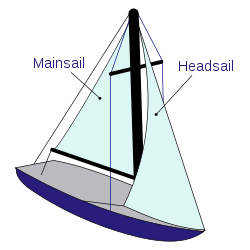
A typical monohull sloop with Bermuda rig
Sailboat on Lake Constance, Germany.

A sailboat or sailing boat is a boat propelled partly or entirely by sails and is smaller than a sailing ship. Distinctions in what constitutes a sailing boat and ship vary by region and maritime culture.

Types

[edit]

For a more complete list, see Category:Sailboat types.

Although sailboat terminology has varied across history, many terms have specific meanings in the context of modern yachting. A great number of sailboat-types may be distinguished by size, hull configuration, keel type, purpose, number and configuration of masts, and sail plan.

Popular monohull designs include:

Cutter

[edit]
A gaff cutter

The cutter is similar to a sloop with a single mast and mainsail, but generally carries the mast further aft to allow for two foresails, a jib and staysail, to be attached to the head stay and inner forestay, respectively. Once a common racing configuration, today it gives versatility to cruising boats, especially in allowing a small staysail to be flown from the inner stay in high winds.

Catboat

[edit]
A catboat

A catboat has a single mast mounted far forward and does not carry a jib. Most modern designs have only one sail, the mainsail; however, the traditional catboat could carry multiple sails from the gaff rig. Catboat is a charming and distinctive sailboat featuring a single mast with a single large sail, known as a gaff-rigged sail, and a broad beam that ensures stability. This type of vessel, named after the "cat" tackle used in sailing, has a rich history dating back to the 19th century in the coastal regions of the United States, particularly New England, where it was widely used by fishermen and sailors. With its straightforward design and uncomplicated rigging, the catboat offers a straightforward and laid-back sailing experience, making it an ideal choice for beginners and pleasure sailors alike. Even today, catboats continue to be cherished by enthusiasts who appreciate their heritage and enjoy their picturesque appearance while cruising through the waterways.

Dinghy

[edit]
A racing dinghy

A dinghy is a type of small open sailboat commonly used for recreation, sail training, and tending a larger vessel. They are popular in youth sailing programs for their short LOA, simple operation and minimal maintenance. They have three (or fewer) sails: the mainsail, jib, and spinnaker.

Ketch

[edit]
A ketch

Ketches are similar to a sloop, but there is a second shorter mast astern of the mainmast, but forward of the rudder post. The second mast is called the mizzen mast and the sail is called the mizzen sail. A ketch can also be Cutter-rigged with two head sails.

Schooner

[edit]
A gaff topsail schooner

A schooner has a mainmast taller than its foremast, distinguishing it from a ketch or a yawl. A schooner can have more than two masts, with the foremast always lower than the foremost main. Traditional topsail schooners have topmasts allowing triangular topsails sails to be flown above their gaff sails; many modern schooners are Bermuda rigged.

Sloop

[edit]
Bermuda rigged sloop at Convict Bay, Bermuda, c. 1879

The most common modern sailboat is the sloop, which features one mast and two sails, typically a Bermuda rigged main, and a headsail. This simple configuration is very efficient for sailing into the wind.

A fractional rigged sloop has its forestay attached at a point below the top of the mast, allowing the mainsail to be flattened to improve performance by raking the upper part of the mast aft by tensioning the backstay. A smaller headsail is easier for a short-handed crew to manage.

Yawl

[edit]
A yawl

A yawl is similar to a ketch, with a shorter mizzen mast carried astern the rudderpost more for balancing the helm than propulsion.

Hulls

[edit]

Traditional sailboats are monohulls, but multi-hull catamarans and trimarans are gaining popularity. Monohull boats generally rely on ballast for stability and usually are displacement hulls. This stabilizing ballast can, in boats designed for racing, be as much as 50% of the weight of the boat, but is generally around 30%. It creates two problems; one, it gives the monohull tremendous inertia, making it less maneuverable and reducing its acceleration. Secondly, unless it has been built with buoyant foam or air tanks, if a monohull fills with water, it will sink.

Multihulls rely on the geometry and the broad stance of their multiple hulls for their stability, eschewing any form of ballast. Some multihulls are designed to be as light-weight as possible while still maintaining structural integrity. They can be built with foam-filled flotation chambers and some modern trimarans are rated as unsinkable, meaning that, should every crew compartment be completely filled with water, the hull itself has sufficient buoyancy to remain afloat.

A multihull optimized for light weight (at the expense of cruising amenities and storage for food and other supplies), combined with the absence of ballast can result in performance gains in terms of acceleration, top speed, and manoeuvrability.

The lack of ballast makes it much easier to get a lightweight multihull on plane, reducing its wetted surface area and thus its drag. Reduced overall weight means a reduced draft, with a much reduced underwater profile. This, in turn, results directly in reduced wetted surface area and drag. Without a ballast keel, multihulls can go in shallow waters where monohulls can not.

There are trade-offs, however, in multihull design. A well designed ballasted boat can recover from a capsize, even from turning over completely. Righting a multihull that has gotten upside down is difficult in any case and impossible without help unless the boat is small or carries special equipment for the purpose. Multihulls often prove more difficult to tack, since the reduced weight leads directly to reduced momentum, causing multihulls to more quickly lose speed when headed into the wind. Also, structural integrity is much easier to achieve in a one piece monohull than in a two or three piece multihull whose connecting structure must be substantial and well connected to the hulls.

All these hull types may also be manufactured as, or outfitted with, hydrofoils.

Keel

[edit]

All vessels have a keel, it is the backbone of the hull. In traditional construction, it is the structure upon which all else depends. Modern monocoque designs include a virtual keel. Even multihulls have keels. On a sailboat, the word "keel" is also used to refer to the area that is added to the hull to improve its lateral plane. The lateral plane is what prevents leeway and allows sailing towards the wind. This can be an external piece or a part of the hull.

Most monohulls larger than a dinghy require built-in ballast. Depending on the design of the boat, ballast may be 20 to 50 percent of the displacement. The ballast is often integrated into their keels as large masses of lead or cast iron. This secures the ballast and gets it as low as possible to improve its effectiveness. External keels are cast in the shape of the keel. A monohull's keel is made effective by a combination of weight, depth, and length.

Sailing yacht with a fin keel

Most modern monohull boats have fin keels, which are heavy and deep, but short in relation to the hull length. More traditional yachts carried a full keel which is generally half or more of the length of the boat. A recent feature is a winged keel, which is short and shallow, but carries a lot of weight in two "wings" which run sideways from the main part of the keel. Even more recent is the concept of canting keels, designed to move the weight at the bottom of a sailboat to the upwind side, allowing the boat to carry more sails. A twin keel has the benefit of a shallower draft and can allow the boat to stand on dry land.

Multihulls, on the other hand, have minimal need for such ballast, as they depend on the geometry of their design, the wide base of their multiple hulls, for their stability. Designers of performance multihulls, such as the Open 60's, go to great lengths to reduce overall boat weight as much as possible. This leads some to comment that designing a multihull is similar to designing an aircraft.

A centreboard or daggerboard is retractable lightweight keel which can be pulled up in shallow water.

Mast

[edit]

On small sailboats, masts may be "stepped" (put in place) with the bottom end in a receptacle that is supported above the keel of the boat or on the deck or other superstructure that allows the mast to be raised at a hinge point until it is erect. Some masts are supported solely at the keel and laterally at the deck and are called "unstayed". Most masts rely in part or entirely (for those stepped on the deck) on standing rigging, supporting them side-to-side and fore-and aft to hold them up.[1][2] Masts over 25 feet (7.6 m) may require a crane and are typically stepped on the keel through any cabin or other superstructure.[3]

Auxiliary propulsion

[edit]

Many sailboats have an alternate means of propulsion, in case the wind dies or where close maneuvering under sail is impractical. The smallest boats may use a paddle;[3] bigger ones may have oars;[4] still others may employ an outboard motor, mounted on the transom; still others may have an inboard engine.[5][6]

See also

[edit]

References

[edit]
[edit]
Revisions and contributorsEdit on WikipediaRead on Wikipedia
from Grokipedia
A sailboat is a watercraft designed or intended to use sails as its primary means of propulsion, harnessing wind energy to move across water surfaces. These vessels range in size from compact, one- or two-person dinghies under 10 feet long to expansive ocean-crossing yachts exceeding 100 feet, and they serve purposes from recreational day sailing and competitive racing to long-distance cruising and exploration. Unlike powerboats, sailboats rely on aerodynamic principles, with sails acting like wings to generate lift and forward thrust, though many modern designs incorporate auxiliary engines for maneuvering in calm conditions or harbors. The history of sailboats traces back over 5,000 years to , where the earliest known record—a depiction of a under square —appears on a dating to around 3500 BC. Early civilizations, including the and Phoenicians, advanced technology for , warfare, and migration; for instance, the deployed more than 1,000 sail-powered ships during the circa 1200 BC. By the around 1000 AD, Norse seafarers used clinker-built longships with single square sails to explore and settle regions as far as . The Age of Sail from the 15th to 19th centuries marked a pinnacle of development, with innovations in hull design, multi-masted rigs, and navigation enabling European powers to colonize the , , and beyond while fueling global commerce. shifted from square sails, suited mainly for downwind travel, to fore-and-aft rigs including triangular sails, with early examples like the appearing in the Mediterranean by the AD, and further developments in the 18th and 19th centuries for Western vessels such as the gaff and Bermuda rigs; materials progressed from natural fibers like and to synthetic options such as and post-World War II. Sailboats are categorized by hull type, keel configuration, rig design, and intended use, reflecting their diverse applications in , , and occasional utility. Monohulls, the most common type, feature a single hull and are subdivided into keelboats with fixed underwater fins for stability—ideal for coastal cruising and reducing capsize risk—and centerboard or dinghies for shallow-water agility and racing. Multihulls like catamarans, with two parallel hulls connected by a deck or , offer exceptional stability, speed (often exceeding 20 knots), and spacious interiors, making them popular for family charters and tropical island hopping. Rig types include the simple , with one mast supporting a (aft) and headsail (forward, such as a or ), which provides balanced power for beginners and solo sailors; more complex setups like cutters or ketches add sails for enhanced performance in varied winds. Purpose-built variants encompass daysailers (14–20 feet, with minimal cabins for short outings), racers optimized for speed in regattas like the , and bluewater cruisers engineered for transoceanic voyages with reinforced hulls and self-sufficiency features. Millions of people worldwide engage in , supported by organizations promoting standards, certifications, and in the . In the United States alone, about 4 million people participated in in 2024.

Overview and History

Definition and Characteristics

A sailboat is a type of primarily propelled by sails that harness , distinguishing it from rowboats, which rely on oars or paddles, and motorboats, which use mechanical engines as their main . This reliance on wind acting on sails allows sailboats to navigate without , though auxiliary engines may be present for maneuvering in harbors or calm conditions. Key characteristics of sailboats include their hull designs, which are typically either displacement or planing types. Displacement hulls, common in larger cruising sailboats, push through the water by displacing a volume equal to the 's weight, offering efficient low-speed performance and good stability in varied conditions. Planing hulls, often found on smaller racing or daysailer models, are flatter and lighter, enabling the to rise onto the surface and achieve higher speeds when and forces overcome hull resistance. The overall design balances sail-generated power against hydrodynamic resistance to optimize speed, ability, and safety. Essential terminology describes sailboat geometry and its impact on performance. The beam is the maximum width of the hull, measured perpendicular to the centerline, which influences lateral stability—wider beams enhance righting moment in gusts but may increase drag. Draft refers to the vertical distance from the to the deepest point of the hull (often the ), affecting the boat's ability to resist and access shallow waters; deeper drafts improve upwind performance but limit versatility. Freeboard is the height from the to the deck edge, providing protection against waves and spray while contributing to reserve —higher freeboard suits offshore for safety, though it can raise the center of gravity. Sailboats have evolved from ancient rafts and reed bundles used for basic to sophisticated modern designs constructed primarily from , which offers durability, light weight, and ease of molding complex shapes. This progression emphasizes refined hydrodynamics and materials that enhance efficiency without altering the core -driven principle.

Historical Development

The earliest known sailboats date to around 3000 BCE in , where early wooden vessels on the were augmented with simple square sails for downwind travel, following initial rowed reed boats from 6000–3000 BCE. These lightweight boats, often up to 20 meters long, facilitated , , and transport in the and along the . In the , Polynesian outrigger canoes associated with the emerged around 1500–500 BCE, featuring a single hull stabilized by a float and crab-claw sails that allowed skilled navigators to traverse vast distances for settlement and resource gathering across islands from to . Meanwhile, in the Mediterranean, square-rigged vessels with rectangular sails on a single mast appeared by approximately 3100 BCE, enabling Minoan and Egyptian traders to conduct commerce across the Aegean and eastern seas using prevailing winds. During the medieval period in , fore-and-aft rigs began to evolve from Mediterranean influences, with the triangular sail—capable of better windward performance—appearing as early as the CE and becoming widespread by the for improved maneuverability in variable winds. By the 12th century, influences were appearing in various European designs, enhancing coastal and Baltic trade. The 15th to 17th centuries marked the Age of Sail's expansion, with the —a small, two- or three-masted vessel combining and square sails—developed by the Portuguese around 1440 for , proving agile enough for voyages along Africa's coast and across the Atlantic to and . The , emerging in the mid-16th century as a larger, square-rigged with high forecastles and multiple gun decks, became the backbone of Spanish treasure fleets and English naval power, carrying armaments and cargo on transatlantic routes while dominating conflicts like the Anglo-Spanish War. The saw sailboat design prioritize speed and endurance amid industrial competition, exemplified by clipper ships like the , launched in 1869, which featured sleek, raked hulls and vast sail areas to achieve record passages of under 100 days from to in the trade. Innovations included iron keels for structural strength against heavy loads and the integration of auxiliary steam engines on some vessels by the 1840s, allowing propulsion in light winds or canals while retaining sails for efficiency on open seas. These advancements supported booming global commerce but faced decline as steamships dominated by mid-century. In the 20th and 21st centuries, sailboats shifted toward recreational and high-performance uses, with construction emerging post-World War II around 1942, when resins and glass fibers enabled affordable, corrosion-resistant hulls molded in factories, democratizing ownership for leisure sailors. The , first raced in 1851 when the America defeated British yachts around the Isle of Wight, has continually spurred technological leaps, including the 2013 introduction of hydrofoils on catamarans that lifted hulls clear of the water for speeds exceeding 50 knots, and the 2024 event featuring foiling monohulls, influencing modern foiling designs in racing and beyond. Throughout history, sailboats have shaped cultural landscapes by powering networks that exchanged goods like spices, silks, and slaves, fostering from ancient extensions to 19th-century opium routes. In warfare, they enabled decisive , such as broadside engagements during the Age of Sail, where frigates and galleons projected imperial power and secured sea lanes in conflicts like the . For leisure, sailing transitioned from elite pursuits in 17th-century Dutch yacht clubs—symbolizing status and adventure—to a widespread cultural activity by the , promoting environmental awareness, personal skill-building, and communal traditions in regattas worldwide.

Principles of Sailing

Aerodynamic and Hydrodynamic Forces

Sails function as airfoils, generating lift through the application of , where the curved shape causes air to flow faster over the leeward side, creating lower pressure compared to the windward side. This pressure differential produces an upward and forward force perpendicular to the apparent wind direction, while drag acts parallel to it, opposing motion. The angle of attack—the angle between the sail's chord line and the apparent wind—must be optimized to maximize lift and minimize drag; excessive angles lead to , where airflow separates and lift drops sharply. Apparent wind is the resultant velocity experienced by the sails, combining true wind (ambient air movement) with the boat's velocity vector, often shifting forward and increasing in speed relative to true wind when sailing upwind. This apparent wind dictates sail trim and force generation, as the sails interact with it rather than true wind alone. Hydrodynamic forces arise from the hull's interaction with water, primarily through resistance components: skin friction, which results from viscous shear along the wetted surface and accounts for about one-third of total resistance at typical speeds, and , which stems from energy expended in creating bow and stern waves and also comprises roughly one-third. The counters —the sideways drift induced by sail forces—by generating hydrodynamic lift as water flows past it at an created by the boat's lateral motion, producing a lateral force that balances the sails' sideways thrust. In equilibrium, the forward from lift balances hydrodynamic drag from the hull and appendages, resulting in constant speed where along the boat's path is zero: Fnet=LsailDhull/keel=0\vec{F}_{net} = \vec{L}_{sail} - \vec{D}_{hull/keel} = 0
Add your contribution
Related Hubs
Contribute something
User Avatar
No comments yet.