


Community hub
Recent from talks
Contribute something
Nothing was collected or created yet.
First Battle of Memphis
View on Wikipedia| First Battle of Memphis | |||||||
|---|---|---|---|---|---|---|---|
| Part of American Civil War | |||||||
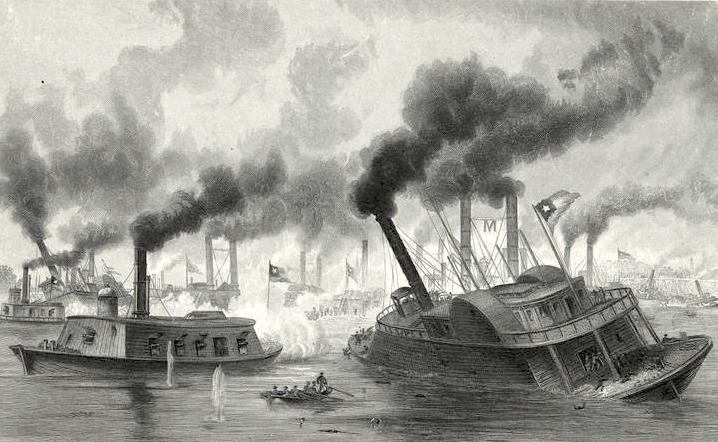
 Battle of the Rams by A. R. Waud | |||||||
| |||||||
| Belligerents | |||||||
 United States United States |
 Confederate States Confederate States | ||||||
| Commanders and leaders | |||||||
 Charles H. Davis Charles Ellet, Jr. † Charles H. Davis Charles Ellet, Jr. † |
 James E. Montgomery James E. Montgomery M. Jeff Thompson M. Jeff Thompson | ||||||
| Units involved | |||||||
|
Benton Louisville Carondelet Cairo St. Louis Ram Queen of the West Ram Monarch Ram Lancaster Ram Switzerland |
CSS General Beauregard CSS General Bragg CSS General Sterling Price CSS General Earl Van Dorn CSS General M. Jeff Thompson CSS Colonel Lovell CSS General Sumter CSS Little Rebel | ||||||
| Strength | |||||||
|
5 ironclads 4 rams | 8 rams | ||||||
| Casualties and losses | |||||||
|
1 ram disabled 1 mortally wounded |
7 rams destroyed or captured approx. 100 killed or wounded approx. 150 captured | ||||||

The First Battle of Memphis was a naval battle fought on the Mississippi River immediately north of the city of Memphis, Tennessee on June 6, 1862, during the American Civil War. The engagement was witnessed by many of the citizens of Memphis. It resulted in a crushing defeat for the Confederate forces, and marked the virtual eradication of a Confederate naval presence on the river. Despite the lopsided outcome, the Union Army failed to grasp its strategic significance. Its primary historical importance is that it was the last time civilians with no prior military experience were permitted to command ships in combat. As such, it is a milestone in the development of professionalism in the United States Navy.[1]
Background
[edit]The defending Confederates closely matched the advancing federal force in raw numbers, with eight rebel vessels opposing nine Union gunboats and rams, but the fighting qualities of the former were far inferior. Each was armed with only one or two guns, of a light caliber that would be ineffective against the armor of the gunboats. The primary weapon of each was its reinforced prow, which was intended to be used in ramming opponents.[2]
The Confederate rams were distinguished by a unique feature of their defense against enemy shot. Their engines and other interior spaces were protected by a double bulkhead of heavy timbers, covered on the outer surface by a layer of railroad iron. The gap between the bulkheads, a space of 22 in (56 cm), was packed with cotton.[3] Although the cotton was the least important part of the armor, it caught the public's attention, and the boats came to be called "cottonclads". Later in the war, ships' crews were often protected from small-arms fire by bales of cotton placed in exposed positions, and these vessels were also referred to as "cottonclads". They differed, however, from the originals of the category.[2]
The federal force consisted of five gunboats, four of which were known semi-officially as "Eads gunboats", after their builder, James Buchanan Eads, but more commonly as "Pook turtles", after their designer, Samuel M. Pook, and their strange appearance.[4] The fifth gunboat, flagship Benton, was also a product of the Eads shipyards, but was converted from a civilian craft. Each of these vessels carried from 13–16 guns. The other four vessels were naval rams from the United States Ram Fleet. They had no armament whatever, aside from the small arms carried by the officers. All of the rams had been converted from civilian riverboats and had no common design.[2][5]
Organization
[edit]Both sides entered the battle with faulty command structures. The federal gunboats were members of the Mississippi River Squadron, commanded directly by Flag Officer Charles H. Davis, who reported to Major General Henry W. Halleck. The gunboats were thus a part of the United States Army, although their officers were supplied by the navy.[6] The rams were led by Colonel Charles Ellet, Jr., who reported directly to Secretary of War Edwin M. Stanton.[7] Thus the federal "fleet" consisted of two independent organizations, with no common command outside of Washington.
The Confederate arrangement was even worse. The cottonclads were about half of a group of fourteen river steamers that had been seized at New Orleans and converted into rams to defend that city. Known as the "River Defense Fleet", it was split in two when the Confederate holdings on the river became threatened from both the north and the Gulf of Mexico. Six were retained below New Orleans to face the fleet of David G. Farragut, while eight were sent up to Memphis to block the Union descent down the river. Sending them this far north did not violate their original purpose, as Memphis was regarded as a shield for New Orleans. The northern (Memphis) section was commanded overall by James E. Montgomery, a riverboat captain in civilian life. The other boats were also commanded by former civilian riverboat captains, selected by Montgomery, and with no military training. Once under way, Montgomery's command ceased, and the rams operated independently. The futility of this arrangement was recognized immediately by military men, but their protests were disregarded.[8] Furthermore, the captains would neither learn how to handle the guns themselves, nor assign crew members to the task, so gun crews had to be drawn from the Confederate Army. The gunners were not integrated into the crews, but remained subject to the orders of their army officers.[9]
Cottonclad River Defense Fleet
[edit]-
 USS (ex-CSS) Little Rebel
 -
 (Ex CSS) USS General Bragg probably photographed at Cairo or Mound City, Illinois, circa 1862–63.


Battle
[edit]
As a result of the federal victory at Corinth, the railroads that linked Memphis with the eastern part of the Confederacy had been cut, severely reducing the strategic importance of the city. Therefore, in early June 1862, Memphis and its nearby forts were abandoned by the rebel army. Most of the garrison were sent to join units elsewhere, including Vicksburg and only a small rear guard was left to make a token resistance. The River Defense Fleet was also to have retreated to Vicksburg, but it could not get enough coal in Memphis. Unable to flee when the federal fleet appeared on June 6, Montgomery and his captains had to decide whether to fight, or scuttle their boats. They chose to fight, steaming out in the early morning to meet the advancing flotilla and the rams trailing behind it, with Memphis citizens cheering them on.[10]
The battle started with an exchange of gunfire at long range, the federal gunboats setting up a line of battle across the river and firing their rear guns at the cottonclads coming up to meet them as they entered the battle stern first. Two of the four rams advanced beyond the line of the gunboats and rammed or otherwise disrupted the movements of their opponents; the other rams misinterpreted their orders and did not enter the battle at all. With the federal rams and gunboats not coordinating their movements and the Confederate vessels operating independently, the battle soon was reduced to a melee. It is agreed by all that the ram flagship, Queen of the West, initiated hostilities by slamming into CSS Colonel Lovell. She was then rammed in turn by one or more of the remaining cottonclads. Ellet was at this time wounded by a pistol shot in his knee, thereby becoming the only casualty on the Union side. (In the hospital, he contracted measles, the childhood disease that killed some 5,000 soldiers during the war. The combination of the disease and the debilitation caused by his wound was too great, and he died on June 21.[11]) The remainder of the battle is obscured by more than the fog of war. Several eyewitness accounts are available; however, they are mutually contradictory to a greater degree than usual.[12] All that is certain is that at the end of the battle, all but one of the cottonclads were either destroyed or captured, and one Yankee boat, Queen of the West, was disabled. The sole boat to escape, CSS General Earl Van Dorn, fled to the protection of the Yazoo River, just north of Vicksburg.
Results
[edit]The battle, which took less than two hours in the early morning hours of June 6, resulted in the immediate surrender of the city of Memphis to federal authority by noon that day.
The Confederate casualties totaled approximately 100 killed or wounded and another 150 taken prisoner. The Union forces captured and repaired CSS General Price, CSS General Bragg, CSS Sumter, and CSS Little Rebel, and added them to the Mississippi River Squadron.[13]
The battle of Memphis was, aside from the later appearance of the ironclad CSS Arkansas, the final challenge to the federal thrust down the Mississippi River against Vicksburg. The river was now open down to that city, which was already besieged by Farragut's ships, but the federal army authorities did not grasp the strategic importance of the fact for nearly another six months. Not until November 1862 would the Union Army under Ulysses S. Grant attempt to complete the opening of the river.[2]
The poor performance of the River Defense Fleet, both at Memphis and at the earlier Battle of New Orleans, was the final demonstration that naval operations had to be commanded by trained professionals subject to military discipline.[2] The Ellet Rams remained in federal service, but they had no other opportunity for combat of the sort for which they were intended. They were soon transformed into an amphibious raiding body, the Mississippi Marine Brigade (with no connection to the United States Marine Corps), led by Ellet's brother, Lieutenant Colonel (later Brigadier General) Alfred W. Ellet. The demand for increased professionalism also resulted in the elimination of privateering,[14] although the River Defense Fleet was not composed of privateers in the usual meaning of the term.
The battle remains a cautionary tale, demonstrating the ill effects of a poor command structure. It is also one of only two purely naval battles of the war,[citation needed] excluding single-ship actions, and took place 500 mi (800 km) from the nearest open water. The other was the Battle of Plum Point Bend, also on the Mississippi.
Another civil war military engagement took place in Memphis, namely the Second Battle of Memphis in April 1864, when Confederate general, Nathan Bedford Forrest led a nighttime cavalry raid on Memphis with the intent of freeing Confederate prisoners and capturing Union generals encamped there. The raid failed in both goals, but forced the Union Army to guard the area more diligently.
See also
[edit]

References
[edit]- ^ Abbreviations used in this article: ORA – War of the Rebellion; a compilation of the official records of the Union and Confederate Armies, 70 volumes in four series; Washington: US Government Printing Office, 1880–1901. ORN – Official records of the Union and Confederate Navies in the War of the Rebellion, 30 volumes in two series; Washington: US Government Printing Office, 1894–1922.
- ^ a b c d e Groce, W. Todd, Battle of the Rams, North & South – The Official Magazine of the Civil War Society, Issue 4, p. 24.
- ^ ORA I, v. 52/1, pp. 37–38.
- ^ ORA III, v. 2, p. 815.
- ^ ORN I, v. 23, p. 34.
- ^ ORN I, v. 22, p. 280.
- ^ ORN I, v. 23, p, 75.
- ^ ORA I, v. 6, p. 817.
- ^ ORA I, v. 10/1, p. 589; ORN I, v. 23, p. 699.
- ^ ORA I, v. 52/1, pp. 37–40.
- ^ ORA I, v. 17, p. 9.
- ^ At least five independent accounts of the battle exist: ORN I, v. 23, pp. 119–121, 125–135, 136–138, 139–140; ORA I, v. 10/1, pp. 912–913, 925–927, with some repetitions.
- ^ Bearss, Edwin C. (1966). Hardluck Ironclad: The Sinking and Salvage of the Cairo. Baton Rouge: Louisiana State University Press. p. 76. ISBN 978-0-8071-0684-6. Retrieved October 1, 2020.
- ^ Robinson, Confederate privateers, p. 1; Luraghi, History of the Confederate Navy, p. 71.
Further reading
[edit]- National Park Service battle description
- CWSAC Report Update
- Anderson, Bern. By sea and by river: the naval history of the Civil War. New York: Da Capo Press, 1962.
- Crandall, Warren Daniel, History of the Ram Fleet and the Mississippi Marine Brigade in the War for the Union on the Mississippi and its tributaries: the story of the Ellets and their men, Press of the Buschart Brothers, 1907.
- Hearn, Chester G. Ellet's Brigade: the strangest outfit of all. Baton Rouge, Louisiana: Louisiana State University Press, 2000.
- Johnson, Robert Underwood, and Buel, Clarence Clough, eds. Battles and leaders of the Civil War. Secaucus, New Jersey, n.d.; reprint ed., New York: Century, 1887, 1888.
- Joiner, Gary D., Mr. Lincoln's Brown Water Navy – The Mississippi Squadron, Rowman & Littlefield Publishers, Inc., 2007.
- Luraghi, Raimondo.A history of the Confederate Navy (translated by Paolo E. Coletta). Annapolis, Maryland: Naval Institute Press, 1996.
- Musicant, Ivan. Divided waters: the naval history of the Civil War. New York: HarperCollins, 1995.
- Robinson, William Morrison Jr. The Confederate privateers. Yale University, 1928. Reprint, Univ. of South Carolina, 1990.
- Scharf, J. Thomas (1996) [1887]. History of the Confederate States navy from its organization to the surrender of its last vessel. New York: Gramercy Books. ISBN 0-517-18336-6.
External links
[edit]
- Civil War Lecture: Battle of Memphis on YouTube
- . Encyclopedia Americana. 1920.
- Naval Battle of Memphis, 1862 at the Historical Marker Database
35°07′45″N 90°09′21″W / 35.1291°N 90.1558°W
| Background |
| ||||
|---|---|---|---|---|---|
| Battles | |||||
Involvement (by city or town) | |||||
| Leaders |
| ||||
| Aftermath | |||||
| Related topics | |||||


First Battle of Memphis
View on GrokipediaThe First Battle of Memphis, also known as the Naval Battle of Memphis, was a one-sided naval engagement fought on June 6, 1862, on the Mississippi River immediately north of Memphis, Tennessee, during the American Civil War. Union forces under Flag Officer Charles H. Davis of the Western Gunboat Flotilla and Colonel Charles Ellet Jr. of the Ram Fleet, comprising five ironclad gunboats and several steam rams, overwhelmed the Confederate River Defense Fleet of eight cottonclad rams commanded by Captain James E. Montgomery. The rapid Union assault, emphasizing ramming tactics, sank or captured seven of the eight Confederate vessels within about 30 minutes, with the eighth escaping downstream, resulting in the flotilla's effective destruction and the surrender of Memphis that same day.[1][2][3] The battle demonstrated the tactical superiority of Ellet's innovative ram fleet, which led the attack by disabling key Confederate ships such as the CSS Colonel Lovell and CSS General M. Jeff Thompson, allowing the slower ironclads—including USS Benton, Carondelet, Cairo, Louisville, and St. Louis—to deliver finishing gunfire. Confederate losses totaled around 180, with approximately 100 killed or wounded and 150 crewmen captured, while Union casualties were limited to a single wound to Ellet himself, who died from complications two weeks later.[1][3][2] Strategically, the Union victory eliminated the last significant Confederate naval threat on the upper Mississippi River, securing control of Memphis—a major cotton export hub and transportation nexus—and facilitating Union advances southward toward Vicksburg, Mississippi, while denying the Confederacy vital riverine mobility and supply lines.[1][3][2]
Strategic Context
Role in the Mississippi River Campaign
The Union strategy in the American Civil War, encapsulated in Winfield Scott's Anaconda Plan, emphasized naval control of the Mississippi River to bisect the Confederacy, severing trans-Mississippi states from the eastern theater and disrupting Confederate logistics and commerce.[4] This objective required systematic reduction of Confederate fortifications and naval forces along the river, beginning with captures of Forts Henry and Donelson in February 1862, followed by Island No. 10 in April, which opened the middle Mississippi to Union advances.[1] By May 1862, following the Battle of Shiloh and evacuation of Corinth, Mississippi, Confederate defenses contracted toward Memphis, Tennessee—the Confederacy's fifth-largest city and a vital commercial hub handling cotton exports and steamboat traffic.[5] Union Flag Officer Charles Henry Davis's Mississippi Flotilla, augmented by Colonel Charles Ellet's ram fleet, pressed southward from Cairo, Illinois, to challenge the Confederate River Defense Fleet under Captain James E. Montgomery, which had retreated from Fort Pillow.[1] Montgomery's force, comprising eight cottonclad gunboats and rams improvised from merchant vessels, represented the Confederacy's last concentrated naval effort to contest Union dominance above Vicksburg.[6] The engagement on June 6, 1862, decisively eliminated this Confederate squadron, with all eight vessels sunk, captured, or scuttled, resulting in over 100 Confederate casualties and no Union warship losses.[7] This outcome secured Memphis for the Union without significant ground resistance, as local Confederate troops withdrew, yielding control of the upper Mississippi River and its tributaries.[6] Strategically, it isolated Vicksburg as the primary remaining Confederate bastion, enabling Union forces to redirect resources southward for the subsequent Vicksburg Campaign, which culminated in the city's surrender on July 4, 1863, and full Federal mastery of the Mississippi.[6] The battle underscored the Union's growing naval superiority through ironclad gunboats and innovative ramming tactics, while exposing Confederate vulnerabilities in purpose-built warships and coordination.[8]Confederate Defenses and Vulnerabilities
The Confederate defenses at Memphis primarily consisted of the River Defense Fleet, an improvised squadron of eight converted civilian steamboats tasked with obstructing Union naval advances along the Mississippi River. These vessels, including the CSS General Beauregard, General Bragg, Sterling Price, Earl Van Dorn, M. Jeff Thompson, Colonel Lovell, General Sumter, and Little Rebel, were reinforced with double bulkheads filled with cotton bales and partial iron plating scavenged from railroad tracks, earning them the designation of "cottonclads." Armament was sparse, with most ships mounting only one or two light-caliber guns, such as 32-pounders, while the Beauregard carried four VIII-inch shell guns and one 42-pounder; the fleet's primary offensive capability relied on reinforced bows for ramming tactics rather than sustained gunfire. Land-based defenses were minimal, comprising a token militia force without substantial fortifications, as Confederate strategy emphasized the fleet's mobility to contest river control following the evacuation of heavier defenses upstream.[3][1][6] Significant vulnerabilities stemmed from the fleet's hasty construction and civilian origins, rendering the wooden-hulled ships susceptible to Union ironclads' heavier firepower despite their cotton padding, which offered limited protection against shelling. Crewed by inexperienced rivermen under captains lacking military discipline, the squadron suffered from fragmented leadership, with nominal commander Captain James E. Montgomery—a former river pilot—facing challenges in enforcing unity, exacerbated by rival claims from Brigadier General M. Jeff Thompson of the Missouri State Guard. This absence of coordinated command structure led to disjointed tactics, as vessels operated semi-independently, a flaw highlighted in prior skirmishes like the tactical win at Plum Point Bend on May 10, 1862, which inflicted damage but failed to alter the strategic imbalance due to inadequate repairs and limited coal supplies for sustained operations or retreat.[8][3][1] Strategically, the fleet's isolation was compounded by the Confederacy's broader naval handicaps, including the splitting of river forces to counter threats from both northern and Gulf approaches, leaving Memphis without robust army support or completed ironclads like the Arkansas, which remained under construction at other yards. These factors—outgunned armament, improvised builds prone to capture and repurposing, and command disarray—rendered the defenses fragile against the Union Mississippi Flotilla's superior organization and firepower, ultimately facilitating the rapid fall of the city on June 6, 1862.[6][1][8]Prelude to Engagement
Union Advance and Preparations
Following the Union capture of Island No. 10 on April 7, 1862, and subsequent repairs to ironclads damaged during the Confederate ram attack at Plum Point Bend on May 10, Flag Officer Charles H. Davis assumed command of the Western Gunboat Flotilla on May 9 after Andrew H. Foote's wounding.[1][3] The flotilla, positioned near Fort Pillow approximately 40 miles north of Memphis, maintained a bombardment using 13 mortar boats firing 13-inch shells against the Confederate stronghold from April 14 onward, aiming to neutralize river obstructions and defenses while coordinating with ground forces under Major General William T. Sherman.[3] Confederate evacuation of Fort Pillow on June 4 exposed Memphis to direct naval threat, prompting Davis to prepare an immediate downriver advance to exploit the vulnerability and sever Confederate river supply lines.[1] A key reinforcement was the U.S. Ram Fleet, authorized by Secretary of War Edwin M. Stanton and organized by civilian engineer Colonel Charles Ellet Jr., which joined Davis's flotilla at Fort Pillow by May 25.[1][3] Comprising four converted civilian steamers—Queen of the West, Monarch, Switzerland, and Lancaster No. 3—strengthened with reinforced prows, iron plating amidships, and coal-filled bunkers for impact resistance, these unarmed vessels emphasized ramming tactics to counter Confederate rams, compensating for the flotilla's limited maneuverability post-Plum Point damages.[1] Ellet advocated aggressive employment of the rams, though Davis exercised caution, integrating them behind the gunboats to avoid uncoordinated risks amid low water levels that restricted deep-draft ironclads.[3] On June 5, with Fort Pillow secured, Davis's combined force—five ironclad gunboats (Benton, St. Louis, Louisville, Cairo, Caronddelet) supported by Ellet's four rams—departed southward, covering the roughly 40-mile distance overnight.[1] Arriving off Memphis around 4:00 a.m. on June 6, the flotilla formed a battle line with gunboats in the van and rams in reserve, prepared to engage the Confederate River Defense Fleet while avoiding city batteries, reflecting Davis's strategy of methodical river dominance to facilitate broader Mississippi Campaign objectives.[1][3]Confederate River Defense Organization
The Confederate River Defense Fleet, operating semi-independently from the regular Confederate States Navy, was established as a privately contracted force to bolster riverine defenses through the conversion of civilian steamboats into rams.[1] In late 1861, former Mississippi River steamboat captains Joseph E. Montgomery and J.H. Townsend proposed the concept to Confederate authorities, emphasizing low-cost, steam-powered vessels capable of ramming enemy ironclads; they received authorization to procure and arm steamboats for this purpose, with Montgomery appointed as senior captain.[9][1] The fleet's organization reflected a pragmatic response to the Confederacy's limited industrial capacity, relying on civilian expertise and minimal naval oversight rather than fully integrating into the CSN's chain of command.[10] By early 1862, Montgomery's fleet comprised eight cottonclad rams, converted from commercial paddlewheel steamers at yards near New Orleans; these vessels featured reinforced bows for ramming, sides protected by tightly packed cotton bales (typically 2-3 feet thick) lashed to the hulls, and light armament of 1-2 smoothbore guns each, prioritizing mobility over firepower.[3][11] The ships included the CSS General Bragg (Montgomery's flagship), CSS Little Rebel, CSS General Earl Van Dorn, CSS General M. Jeff Thompson, CSS General Sterling Price, CSS Sumter, CSS Colonel Lovell, and CSS General Beauregard, with crews drawn largely from civilian river men supplemented by Confederate naval personnel.[12][13] This improvised structure allowed rapid deployment but exposed vulnerabilities, such as inconsistent training and reliance on ramming tactics against superior Union ironclads.[10] In April 1862, following Union advances and the evacuation of Island No. 10, the fleet steamed northward from New Orleans under Montgomery's command to reinforce Confederate positions above Memphis, arriving to contest the Mississippi River's upper reaches after earlier successes at Plum Point Bend on May 10.[3][14] The organization's strategy centered on aggressive close-quarters attacks to exploit the rams' speed (up to 12 knots) and the river's bends for ambushes, though coordination with CSN ironclads like the CSS Arkansas remained limited due to divided authority.[1] By June 6, 1862, the fleet positioned itself downstream of Memphis to intercept the approaching Union flotilla, marking its final stand before the city's fall.[6]Opposing Naval Forces
Union Mississippi Flotilla Composition
The Union Mississippi Flotilla, temporarily under the command of Flag Officer Charles H. Davis following Andrew Foote's wounding, comprised ironclad gunboats, timberclad gunboats, and Colonel Charles Ellet's specialized steam rams for the engagement on June 6, 1862.[1] Davis's gunboat squadron formed the core firepower, while Ellet's independent Ram Fleet provided ramming capability, though the units operated with limited coordination due to inter-service tensions.[15] The ironclad component included five City-class gunboats: USS Benton, USS Carondelet, USS Cairo, USS Louisville, and USS St. Louis, each mounting approximately 13 heavy guns such as 9-inch Dahlgrens and 8-inch smoothbores, protected by iron plating over wooden hulls designed for riverine combat.[3] These vessels, originally part of the Western Gunboat Flotilla, emphasized armored protection and broadside firepower to dominate Confederate river defenses.[16] Supporting the ironclads were two timberclad gunboats, USS Lexington and USS Tyler, converted commercial steamers with lighter wooden planking reinforced by thick timber bulwarks; Tyler carried 9 guns, including 8-inch and 32-pounder smoothbores, while Lexington had a similar armament suited for scouting and flanking maneuvers.[17] Ellet's Ram Fleet, authorized by Secretary of War Edwin Stanton and crewed largely by Ellet family members and civilian volunteers, featured unarmed steamers modified with reinforced prows, coal bunkers as battering rams, and minimal small arms for boarding; the participating vessels were the flagship Queen of the West (commanded by Ellet himself), Monarch, and Lioness, prioritizing speed and impact over gunnery to exploit vulnerabilities in Confederate cottonclads.[1][17] This hybrid composition reflected the Union strategy of combining naval ordnance with innovative ramming tactics to break Confederate river control.| Vessel Type | Ships | Armament (approx.) | Role |
|---|---|---|---|
| Ironclad Gunboats | USS Benton, Carondelet, Cairo, Louisville, St. Louis | 13 guns each (9-inch Dahlgrens, 8-inch smoothbores) | Primary firepower and armored assault[3] |
| Timberclad Gunboats | USS Lexington, Tyler | 9 guns each (8-inch, 32-pounders) | Support, scouting[17] |
| Steam Rams | Queen of the West, Monarch, Lioness | Small arms only; reinforced bows | Ramming and disruption[17] |
Confederate Cottonclad and Ram Fleet
The Confederate cottonclad and ram fleet, organized as the River Defense Service under the Confederate Army rather than the regular navy, was commanded by Captain James E. Montgomery, a former Mississippi River steamboat pilot commissioned in the Confederate States Navy.[1][2] This independent force aimed to counter Union naval superiority through ramming tactics, leveraging speed and reinforced bows over heavy gunnery.[3] In early 1862, eight paddlewheel steamboats were converted into rams primarily at Memphis and New Orleans, featuring iron-sheathed prows for collision damage, double-layered wooden bulkheads filled with cotton bales for improvised armor against projectiles, and limited artillery—typically one or two light guns per vessel.[1][3] The cotton cladding provided buoyancy and some absorption of cannon fire but offered minimal resistance to Union ironclads' heavier armament. Crews consisted of civilian river men, emphasizing maneuverability in riverine combat.[18] The fleet's composition for the engagement on June 6, 1862, included the following vessels, with CSS Sumter serving as Montgomery's flagship:| Vessel Name | Notes |
|---|---|
| CSS Sumter (General Sumter) | Flagship ram; rammed Union vessels earlier in campaign.[1] |
| CSS General Bragg | Equipped with one gun; later captured and converted to Union use.[3] |
| CSS General Price | Ram with light armament; damaged multiple Union rams.[1] |
| CSS General Earl Van Dorn | Cotton-protected ram; sunk in the battle.[2] |
| CSS General M. Lovell (Colonel Lovell) | Focused on ramming; destroyed during engagement.[3] |
| CSS General M. Jeff Thompson | One of the converted steamboats; lost at Memphis.[19] |
| CSS Little Rebel | Smallest vessel; captured intact and repurposed by Union forces.[18] |
| CSS Stonewall Jackson (or Sovereign) | Auxiliary ram; fate sealed in the defeat.[1] |
The Battle Unfolds
Initial Confrontation
The Union flotilla, consisting of five ironclad gunboats under Flag Officer Charles H. Davis and Colonel Charles Ellet's ram squadron, departed from positions north of Memphis early on June 6, 1862, advancing southward along the Mississippi River toward the city.[2] The Confederate River Defense Fleet, numbering eight vessels including cottonclad rams like the CSS Colonel Lovell under Commodore James E. Montgomery, was positioned just below the Memphis bluffs to contest the approach.[1] Arriving off Memphis around 5:30 a.m., the Union force initiated the engagement with desultory gunfire from the gunboats, which inflicted minimal damage amid the morning haze and distance.[2] At approximately 5:40 a.m., Ellet's flagship ram Queen of the West surged forward without orders, ramming the leading Confederate vessel, CSS Colonel Lovell, with sufficient force to nearly bisect it and cause it to sink rapidly; during this strike, Ellet sustained a wound to his leg from small-arms fire.[1] [3] This aggressive maneuver disrupted Confederate formations, prompting Montgomery's ships to scatter and return fire haphazardly, while Ellet's second ram, Monarch, followed suit by damaging additional Confederate steamers in the ensuing close-quarters chaos.[1] The initial clash, observed by crowds on the Memphis shoreline, quickly devolved into a melee as Union ironclads closed range, their heavier armament beginning to tell against the lighter, improvised Confederate defenses.[2]Key Ship Engagements and Tactics
The Union flotilla employed a combined arms approach, with ironclad gunboats providing suppressive fire while Colonel Charles Ellet's rams executed high-speed ramming maneuvers against the Confederate cottonclads. The gunboats, including USS Benton, Carondelet, Louisville, Cairo, and St. Louis, advanced in line abreast to deliver long-range broadsides before closing for point-blank engagements, leveraging their heavier armament of 8- to 9-inch Dahlgren guns. Confederate tactics centered on ramming with improvised cotton-protected bows, but suffered from decentralized command under civilian rivermen captains, leading to uncoordinated actions and friendly collisions.[3][1] The initial clash featured Ellet's flagship, Queen of the West, charging the Confederate lead ship CSS Colonel Lovell at full steam, striking its starboard bow and nearly bisecting it, causing the vessel to sink rapidly with heavy loss of life among its crew. In retaliation, the CSS General Sumter rammed Queen of the West, damaging its paddle wheel and forcing it to withdraw for repairs, though the Union ram remained operational. Simultaneously, the Union ram Monarch evaded ramming attempts by CSS General Beauregard and General Sterling Price, which instead collided head-on, disabling Price's side wheel and exposing both to Union gunfire.[3][1][8] Union gunboats then exploited the disarray, with Carondelet and others pounding the crippled Confederates; CSS General M. Jeff Thompson ran aground under fire, its magazine exploding and destroying the ship. The CSS Little Rebel was rammed by Monarch and shelled into submission, later captured intact by Union forces. Most remaining Confederate vessels, including Beauregard, Price, and Sumter, were sunk or forced to surrender within 30 minutes of intense combat, while only CSS General Earl Van Dorn escaped northward. This melee underscored the effectiveness of Union coordination and firepower over Confederate ramming reliance, marking the final major riverine battle emphasizing rams as primary weapons.[1][3][20]Destruction of the Confederate Squadron
The destruction of the Confederate squadron unfolded rapidly during the early morning engagement on June 6, 1862, as Union rams and gunboats closed with the outnumbered and outgunned Confederate River Defense Fleet. Commanded by Captain James E. Montgomery, the Confederate vessels—primarily unarmored cottonclads protected by bales of cotton—attempted to maneuver aggressively but were systematically rammed and shelled. The Union rams Queen of the West and Monarch, under Colonel Charles Ellet's command, delivered devastating blows, striking multiple targets in quick succession while supported by gunfire from Commander Charles Henry Davis's ironclads.[1] Key losses included the CSS Colonel Lovell, sunk after repeated ramming by Queen of the West and Monarch. The CSS General M. Jeff Thompson ran aground and exploded when its magazine detonated under Union fire. Montgomery's flagship, CSS Little Rebel, was abandoned amid the chaos and captured intact by Union forces, later commissioned as USS Little Rebel. The CSS General Beauregard sank following a collision with the CSS General Sterling Price, which itself was damaged but initially afloat before being captured. Additional captures encompassed the CSS Sumter and CSS General Bragg, the latter repurposed by the Union as USS General Bragg.[1][3] Only the CSS General Van Dorn evaded destruction, escaping northward up the Yazoo River. Of Montgomery's eight-vessel squadron, seven were either sunk or captured within roughly 90 minutes, crippling Confederate naval power on the upper Mississippi. Confederate losses included approximately 180 killed or wounded, with 161 crewmembers taken prisoner; many perished in the river during the rout.[2][1]| Confederate Ship | Fate |
|---|---|
| CSS Colonel Lovell | Sunk by ramming |
| CSS General M. Jeff Thompson | Aground and exploded |
| CSS Little Rebel | Abandoned and captured |
| CSS General Beauregard | Sunk after collision |
| CSS General Sterling Price | Captured after damage |
| CSS Sumter | Captured |
| CSS General Bragg | Captured |
| CSS General Van Dorn | Escaped |
Immediate Outcomes
Capture and Surrender of Memphis
Following the destruction of the Confederate squadron on the morning of June 6, 1862, the Union flotilla under Flag Officer Charles Henry Davis anchored off the Memphis levee, where the remaining Confederate vessels were burning or captured.[2] With naval defenses eliminated and no significant land fortifications or troops to resist, Confederate officials, including military authorities, began evacuating the city to avoid further destruction.[1] Colonel Charles Ellet Jr., commander of the ram fleet, dispatched a boat from one of his vessels to approach the shore and formally demand the city's unconditional surrender, leveraging the overwhelming Union presence on the river.[21] Memphis Mayor John T. Parkinson, facing the untenable position without Confederate naval or military support, agreed to the terms later that day, surrendering the city intact to Union naval forces around midday.[3] [7] The capitulation occurred without ground combat or significant resistance, as Union ironclads and rams positioned to shell the city if needed, deterring any organized defense.[2] Union sailors and marines briefly secured key waterfront areas, including cotton stores and public buildings, while Davis accepted the formal transfer of authority, marking the first major Confederate urban center lost on the Mississippi River.[1] The surrender enabled rapid Union occupation, with naval personnel enforcing order amid reports of sporadic civilian unrest and fleeing Confederate sympathizers.[3] Reinforcements from Major General William T. Sherman's troops arrived by June 7 to establish full administrative control, but the navy's decisive action ensured the city's fall hinged on the morning's naval victory.[7] This event severed a critical Confederate supply hub, yielding control of western Tennessee's river access without the casualties typical of contested sieges.[1]Casualties, Captures, and Losses
The Union flotilla experienced negligible personnel losses, with a single casualty reported: Colonel Charles Ellet Jr., commander of the ram fleet, who suffered a non-fatal wound from friendly fire during the chaos of ramming maneuvers.[2] No Union sailors were killed, and the ironclads under Captain Henry Walke sustained only minor damage from Confederate gunfire.[1] Confederate personnel losses were severe, with estimates of approximately 100 killed or wounded, many perishing from drowning as ships foundered under Union rams and cannon fire.[2] The U.S. Navy documented the capture of 161 crew members from the wrecked vessels, though the total number of prisoners may have been higher due to survivors pulled from the Mississippi River.[1] Material losses compounded the Confederate defeat, as seven of the eight cottonclad rams and gunboats in Captain James E. Montgomery's River Defense Fleet were destroyed or seized: the CSS Colonel Lovell, General M. Lovell, Sterling Price, Sumter, and Jeff Thompson were sunk, while the CSS Little Rebel and General Bragg were captured intact by Union forces and later commissioned into Federal service.[2] Only the CSS General Van Dorn evaded destruction by steaming upriver to safety.[1] Union rams Queen of the West and Monarch ran aground after collisions but were refloated, repaired, and returned to action without permanent loss.[2]| Side | Personnel Casualties (Killed/Wounded) | Captured Personnel | Vessels Lost/Captured |
|---|---|---|---|
| Union | 0 killed; 1 wounded | 0 | 0 (2 temporarily grounded, later repaired) |
| Confederate | ~100 | 161+ | 7 of 8 (5 sunk, 2 captured) |