Hubbry Logo
Balanced budgetBalanced budgetMain
Open search
Balanced budget
Community hub
Balanced budget
logo
8 pages, 0 posts
0 subscribers
Be the first to start a discussion here.
Balanced budget
Balanced budget
from Wikipedia

A balanced budget (particularly that of a government) is a budget in which revenues are equal to expenditures. Thus, neither a budget deficit nor a budget surplus exists (the accounts "balance"). More generally, it is a budget that has no budget deficit, but could possibly have a budget surplus.[1] A cyclically balanced budget is a budget that is not necessarily balanced year-to-year but is balanced over the economic cycle, running a surplus in boom years and running a deficit in lean years, with these offsetting over time.

Balanced budgets and the associated topic of budget deficits are a contentious point within academic economics and within politics. Some economists argue that moving from a budget deficit to a balanced budget decreases interest rates,[2] increases investment,[2] shrinks trade deficits and helps the economy grow faster in the longer term.[2] Other economists,[3] especially (but not limited to) those associated with Modern Monetary Theory (MMT), downplay the need for balanced budgets among countries that have the power to issue their own currency, and argue that government spending helps boost productivity, innovation and savings in the private sector.[4]

Economic views

[edit]

Mainstream economics mainly advocates a cyclic balanced budget, arguing from the perspective of Keynesian economics that permitting the deficit to vary provides the economy with an automatic stabilizer—budget deficits provide fiscal stimulus in lean times, while budget surpluses provide restraint in boom times. Keynesian economics does not advocate for fiscal stimulus when the existing government debt is already significant.

Alternative currents in the mainstream and branches of heterodox economics argue differently, with some arguing that budget deficits are always harmful, and others arguing that budget deficits are not only beneficial, but also necessary.

Schools which often argue against the effectiveness of budget deficits as cyclical tools include the freshwater school of mainstream economics and neoclassical economics more generally, and the Austrian school of economics. Budget deficits are argued to be necessary by some within post-Keynesian economics, notably the chartalist school:

Larger deficits, sufficient to recycle savings out of a growing gross domestic product (GDP) in excess of what can be recycled by profit-seeking private investment, are not an economic sin but an economic necessity.[5]

Budget deficits can be calculated by subtracting the total planned expenditure from the total available budget. This will then show either a budget deficit (a negative difference) or a budget surplus (a positive difference).

Modern Monetary Theory

[edit]

Modern Monetary Theory (MMT) is a school of thought founded by economist Bill Mitchell and Hedge Fund Manager Warren Mosler, and has since been further developed by economists such as Stephanie Kelton and L. Randall Wray.[6] MMT advocates argue that a balanced budget is not required in the short term, or over the course of the business cycle in countries with monetary sovereignty, defined as follows:

A monetary sovereign is a country which:

  1. Issues its own currency,
  2. Does not fix its currency's exchange rate to another currency or commodity, and
  3. Does not have significant levels of foreign currency-denominated debt. [7]

Because such a country can issue its own currency, it can never run out of that currency and does not need to increase revenues in order to increase expenditure. Thus, the only constraint on expenditures is the inflation which it may generate if the economy is making full use of its capital and labour.. MMT advocates therefore argue for that budget deficits should be used to achieve full employment through a government employment program called a 'jobs guarantee'. This is based on the view that a government deficit creates a 'private sector surplus' by increasing incomes and creating savings.[8]

Political views

[edit]

United States

[edit]

In the United States, the fiscal conservatism movement believes that balanced budgets are an important goal. Every state other than Vermont has a balanced budget amendment, providing some form of ban on deficits, while the Oregon kicker bans surpluses of greater than 2% of revenue. The Colorado Taxpayer Bill of Rights (the TABOR amendment) also bans surpluses and requires the state to refund taxpayers in event of a budget surplus.

The last time that the budget was balanced or had a surplus was the 2001 United States federal budget, under 42nd President Bill Clinton.

Numerous sources have stated that as of 2023, a balanced budget is no longer possible without massive reductions in spending by the United States federal government according to the Congressional Budget Office[9] and several independent sources.[10][11] Extreme spending reductions on numerous entitlements would also not likely be popular, even if such cuts would be sufficient to bring a balanced budget to the United States, "Federal debt will rise from 98 percent of GDP in 2023 to 181 percent in 2053."[12]

Sweden

[edit]

Following the over-borrowing in both the public and private sector that led to the Swedish banking crisis of the early 1990s and under influence from a series of reports on the future demographic challenges, a wide political consensus developed on fiscal prudence. In the year 2000 this was enshrined in a law that stated a goal of a surplus of 2% over the business cycle, to be used to pay off the public debt and to secure the long-term future for the cherished welfare state. Today the goal is 1% over the business cycle, as the retirement pension is no longer considered a government expenditure.

United Kingdom

[edit]

In 2015 George Osborne, the Chancellor of the Exchequer, announced that he intended to implement a law whereby the government must deliver a budget surplus if the economy is growing.[13] Academics have criticised this proposal with Cambridge University professor Ha-Joon Chang saying the chancellor was turning a blind eye to the complexities of a 21st-century economy that demanded governments remain flexible and responsive to changing global events.[14]

Since 1980, there have been only six years in which a budget surplus has been delivered: twice when the Conservatives' John Major was Chancellor of the Exchequer, in 1988 and 1989, and four times when Labour's Gordon Brown was Chancellor, in 1998, 1999, 2000 and 2001.[15]

Balanced budget multiplier

[edit]

Because of the multiplier effect, it is possible to change aggregate demand (Y) keeping a balanced budget. Suppose the government increases its expenditures (G), balancing the increase by an increase in taxes (T). Since only part of the income taken away from households would have actually been spent, the change in consumption expenditure will be smaller than the change in taxes. Therefore, the net change in spending (increased government spending and decreased consumption spending) at this point is positive, and the induced second and subsequent rounds of spending are also positive, giving a positive result for the balanced budget multiplier. In general, and in the absence of induced changes in interest rates and the price level, a change in the balanced budget will change aggregate demand by an amount equal to the change in spending. Let the consumption function be:

The goods market equilibrium equation is:

where I is exogenous physical investment and NX is net exports. Using the first equation in the second one yields the following solution for Y:

and taking differences of the variables and setting and we have

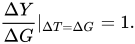
Then dividing through by gives the balanced budget multiplier as

[16]

This is named the Haavelmo theorem which demonstrates that the balanced budget multiplier rises its maximum value when any increase of the public spending is corresponded by an equal increase of the fiscal imposition , so as to avoid a higher level of public debt. The deficit spending, that is the growth of public spending without an equal amount of monetary entrance into the State Treasury, is always a less efficient political choice in order to speed up the GNP.

However, the balanced budget is made smaller when resulting changes in the interest rate change investment spending and money demand and when resulting changes in the price level affect money demand.

See also

[edit]

References

[edit]
Revisions and contributorsEdit on WikipediaRead on Wikipedia
from Grokipedia
A balanced budget occurs when an entity's total revenues equal its total expenditures over a specified period, resulting in neither a surplus nor a deficit, and is most commonly applied to fiscal planning to ensure revenues match spending obligations. In governmental contexts, achieving a balanced budget promotes long-term fiscal by preventing the accumulation of public debt that could otherwise crowd out private investment and impose intergenerational burdens through higher future taxes or . Proponents argue that persistent deficits, even if temporarily stimulative, erode as evidenced by reduced national savings available for productive . Economically, the concept intersects with Keynesian analysis via the balanced budget multiplier theorem, which posits that a simultaneous increase in and taxes, each by the same amount, expands national income by that full increment due to the being less than unity, though empirical estimates of fiscal multipliers often fall below unity, suggesting limited or context-dependent expansionary effects. Historical U.S. examples, such as the late surpluses under the administration, coincided with robust GDP growth, low unemployment, and added millions of jobs, transforming prior deficits into fiscal surpluses amid a technology-driven expansion. However, such outcomes reflect conjunctural factors like economic booms rather than isolated causation from balancing, as subsequent fiscal deteriorations post-2001 tripled debt-to-GDP ratios through unchecked spending and shifts. Debates persist over strict annual balancing versus cyclical approaches, with critics of rigid rules warning they could exacerbate recessions by overriding automatic stabilizers like progressive taxation and , potentially amplifying downturns absent deficit financing. Empirical studies on constitutional balanced budget rules indicate they correlate with improved fiscal discipline across jurisdictions, though enforcement challenges and political incentives often undermine adherence, highlighting the tension between theoretical prudence and practical . Ultimately, sustained balance demands disciplined revenue-expenditure alignment, informed by causal links between deficits and diminished growth prospects, prioritizing empirical fiscal restraint over short-term discretionary impulses.

Definition and Basic Principles

Core Concept and Types

A balanced budget in refers to a fiscal plan where a government's total anticipated revenues exactly match its total projected expenditures for a given period, typically a , yielding neither a deficit nor a surplus. This equilibrium ensures that spending on public goods, services, and transfers is funded solely by inflows such as taxes, fees, and other non-debt sources, preventing reliance on borrowing. Historically rooted in principles of fiscal , the concept posits that matching revenues to outlays promotes long-term by avoiding accumulation, though its application varies by and economic conditions. Distinctions arise in how balance is measured, leading to primary types: actual and structural. An actual balanced budget reflects the observed equality between recorded and expenditures in a specific period's , as reported by standards. This type captures real-time fiscal outcomes but can be distorted by one-off events or economic volatility, such as windfalls from booms or spending spikes during emergencies. In contrast, a structural balanced budget adjusts the actual figures to estimate the underlying fiscal position absent cyclical influences from the , such as automatic stabilizers like progressive es that decline in recessions. Calculated by purging cyclical components—often using output gaps and elasticity estimates—it reveals whether recurring revenues sustainably cover recurring expenditures at potential output levels, providing a gauge of medium-term . For instance, the defines the structural balance as the actual position minus estimated effects, enabling policymakers to assess true fiscal discipline beyond temporary downturns. Governments like those in the often target structural balance under fiscal rules to enforce , as actual balances may misleadingly appear healthy during expansions due to inflated receipts. Additional variations include time-framed balances, such as (confined to one year) or biennial (spanning two years to allow minor fluctuations), but these pertain more to than conceptual typology. Overall, prioritizing structural over actual balance mitigates risks of procyclical errors, where apparent equilibrium masks persistent imbalances.

Relation to Fiscal Deficits and Surpluses

A balanced budget exists when a government's revenues precisely match its expenditures in a given fiscal period, yielding a budget balance of zero and avoiding both deficits and surpluses. This equilibrium implies no net borrowing requirement for funding operations, as the fiscal balance—calculated as total revenues minus total expenditures—equals zero. In formula terms, if TT represents tax revenues and other inflows while GG denotes on goods, services, and transfers, a balanced budget satisfies T=GT = G. Fiscal deficits occur when G>TG > T, forcing governments to finance the shortfall through borrowing, which adds to public debt accumulation. For instance, , annual federal deficits from 1973 to cumulatively reached $22 trillion, reflecting persistent excess spending over revenues and contributing to rising national debt. Surpluses, conversely, arise when T>GT > G, enabling debt reduction or accumulation of reserves; the U.S. recorded such surpluses in fiscal years 1946 through 1949, post-World War II, as revenues from economic recovery outpaced spending. The relationship underscores fiscal sustainability: balanced budgets stabilize debt-to-GDP ratios over time by eliminating deficit-induced growth in liabilities, whereas chronic deficits exacerbate burdens, potentially crowding out private investment or raising costs. Surpluses, though rarer in modern practice, reverse this dynamic by permitting , as seen historically when U.S. levels declined relative to GDP during surplus periods. Primary balances, excluding payments, further refine this linkage, where even a balanced overall may mask underlying deficits if exceeds zero.

Historical Development

Classical Economics and Early Practices

In classical economic thought, public debt was regarded as a significant impediment to prosperity, with advocates emphasizing fiscal restraint to prevent resource misallocation and intergenerational inequity. , in An Inquiry into the Nature and Causes of the (1776), described public debt as "oppressive and ruinous," arguing that it diverts savings from productive private investments to government consumption, thereby elevating interest rates and stifling essential for growth. He critiqued the sophistry of claims that national debt merely represented money owed domestically—"we owe it to ourselves"—insisting that such debts impose real burdens through future taxation or , hidden during wartime but ultimately paid by reduced private sector vigor. extended this critique, contending that unfunded debt distorts economic incentives by anticipating higher future taxes, which discourage saving and labor; he advocated financing expenditures, especially wars, through immediate taxation rather than borrowing to maintain fiscal transparency and avoid perpetual indebtedness. John Stuart Mill refined these arguments, acknowledging that debt could be tolerable if funded by "disposable" or foreign capital without crowding out domestic investment, but he warned against its use for unproductive ends, favoring gradual repayment through budget surpluses to ensure sustainability without abrupt tax hikes. Collectively, classical economists privileged balanced budgets in peacetime as a principle of sound fiscal husbandry, rooted in the causal link between government profligacy and diminished national wealth, contrasting sharply with mercantilist tolerance for deficits to amass bullion. Early governmental practices reflected these principles, with most 19th-century regimes striving for budgetary equilibrium outside of wartime exigencies to avert debt spirals. In Britain, post-Napoleonic War reforms under in the implemented income taxes and expenditure cuts to generate surpluses, reducing debt from over 200% of GDP in 1815 to about 30% by 1900 through consistent fiscal discipline. The similarly prioritized balance; from independence through the Civil War era, federal outlays averaged under 2% of GDP in peacetime, with surpluses post-1865—such as annual excesses averaging $100 million from 1866 to 1893—halving the war-incurred debt from $2.7 billion to $1 billion by century's end. This pattern held into the early 20th century, as from 1900 to 1916, receipts and expenditures balanced at roughly 2.1% of GDP, underscoring a norm where deficits were exceptional and swiftly rectified to preserve creditworthiness and low borrowing costs. Such practices empirically supported classical warnings, as unchecked debt in prior eras, like Britain's pre-Smith accumulation, had necessitated devaluations or without yielding sustained growth advantages.

20th Century Shifts and Keynesian Influence

The orthodoxy of annually balanced budgets, rooted in 19th-century , faced severe challenges during the starting in 1929, as fiscal measures in countries like the and Britain exacerbated economic contraction by reducing . In the U.S., President Herbert Hoover's administration attempted spending cuts and tax increases, including the Revenue Act of 1932, which raised rates but failed to restore equilibrium, resulting in federal deficits averaging 3 percent of GDP from 1930 to 1932. These policies aligned with Treasury View doctrines in Britain, which prioritized budget balance over stimulus, contributing to prolonged unemployment rates exceeding 20 percent in both nations by 1933. John Maynard Keynes's The General Theory of Employment, Interest, and Money, published in February 1936, provided a theoretical framework challenging this approach by arguing that insufficient private investment during downturns necessitated government to boost demand via the multiplier effect, where initial expenditures generate amplified income through successive rounds of consumption. Keynes posited that rigid adherence to balanced budgets could trap economies in equilibrium, advocating instead for countercyclical —deficits in recessions funded by surpluses in booms—to achieve without . This marked a from viewing government budgets as inherently self-correcting to instruments of macroeconomic stabilization, influencing policymakers who observed that pre-Keynesian retrenchment had deepened the Depression rather than resolving it. Adoption accelerated post-1936, particularly after the 1937-1938 , when President shifted from initial budget-balancing efforts—such as the 1937 balanced budget rhetoric—to expanded , increasing federal outlays to stimulate demand in line with Keynesian prescriptions. The programs, including expenditures peaking at $3.3 billion in 1938, exemplified this, though deficits reached 5.4 percent of GDP that year. further entrenched the practice, with U.S. deficits surging to 26.9 percent of GDP in 1943 to finance mobilization, normalizing large-scale fiscal intervention and eroding taboos against peacetime imbalances. By the 1940s, Keynesian ideas permeated policy, as seen in the U.S. Employment Act of 1946, which mandated federal responsibility for maximum employment, effectively subordinating annual balance to economic objectives. This influence persisted into the postwar era, fostering a consensus where fiscal rules emphasized cyclical balance over strict annual orthodoxy, though critics later attributed rising structural deficits—U.S. federal budgets in surplus only four years from 1947 to 2000—to loosened discipline.

Economic Theory and Arguments

Case for Fiscal Discipline and Sustainability

Fiscal discipline through balanced budget policies prevents the accumulation of excessive public , which empirical studies associate with reduced . Research indicates that debt-to-GDP ratios exceeding 70-80% often trigger negative growth effects, as high indebtedness crowds out private investment by elevating interest rates and diverting resources to debt servicing rather than productive uses. A of studies estimates that each 1 increase in the lowers annual GDP growth by approximately 0.013 percentage points, compounding over time to significant output losses. Such discipline enhances sustainability by curbing rising interest payments, which in high-debt scenarios consume a growing share of budgets and limit fiscal flexibility for or emergencies. For instance, sustained deficits lead to intergenerational inequity, as current expenditures are financed through future tax burdens or , effectively transferring costs to unborn generations without their consent. Budget surpluses, conversely, function as , boosting and long-term income levels by increasing available funds for . From a causal perspective, unchecked deficits erode confidence, prompting risk premiums on government bonds that amplify borrowing costs and potential crises, as observed in episodes where spirals necessitated or defaults. Balanced budgets signal commitment to , stabilizing expectations and fostering environments conducive to steady growth, as evidenced by U.S. states with stringent balance requirements exhibiting lower deficits and surpluses during fiscal stress. Historical precedents, such as the late U.S. federal surpluses coinciding with robust expansion and low , underscore how discipline can align with underlying economic capacity, avoiding the volatility of boom-bust cycles driven by debt-fueled stimulus.

Counterarguments: Countercyclical Needs and Modern Monetary Perspectives

Proponents of countercyclical argue that rigid balanced budget mandates prevent governments from using deficits to counteract economic contractions, where demand falls short. , in his 1936 work The General Theory of Employment, Interest, and Money, contended that during recessions, fiscal expansion—through higher or lower taxes—boosts via the multiplier effect, leading to higher output without proportional inflation if idle resources exist. This approach views deficits not as fiscal sins but as tools to stabilize cycles, with automatic stabilizers like progressive taxes and providing built-in countercyclical support; empirical estimates suggest these stabilizers reduce GDP volatility by 10-20% in advanced economies. Historical examples include the U.S. spending from 1933, which correlated with GDP growth averaging 9% annually through 1937, though causation remains debated due to concurrent monetary factors and incomplete recovery until mobilization. Modern Monetary Theory (MMT), articulated by economists such as and further popularized by , challenges balanced budget orthodoxy by emphasizing that monetary sovereigns—like the U.S. with its dollar—face no inherent solvency risk from deficits, as they spend by crediting rather than taxing or borrowing first. Under MMT, government deficits directly increase private sector net financial assets, enabling savings without corresponding private dis-saving; taxes serve primarily to curb by reducing spending capacity, not to "fund" expenditures. Proponents claim this framework justifies sustained deficits to achieve and public investment, as seen in Japan's 250% since the 1990s without default or uncontrolled , attributing stability to domestic currency issuance and demand leakage via aging demographics. However, mainstream critiques highlight MMT's dismissal of dynamics and historical episodes, such as the U.S. 1970s where deficits exceeded 4% of GDP amid oil shocks, underscoring that resource constraints can trigger price pressures regardless of monetary sovereignty. The capacity of the United States to maintain substantial federal deficits without immediate discernible negative effects on citizens is frequently linked to the U.S. dollar's role as the world's primary reserve currency. This status fosters enduring global demand for U.S. Treasury securities, permitting deficit financing at low interest rates and in the government's own currency, thereby averting abrupt crises akin to those in nations lacking such privileges. Deficit expenditures can also yield short-term stimulative benefits by elevating aggregate demand, fostering growth and employment, especially when supported by accommodative monetary policy. The U.S. has sidestepped hyperinflation associated with deficits in other contexts, owing to robust financial markets, institutional trust, and the Federal Reserve's liquidity management tools. Yet, this dynamic does not obviate enduring risks, including mounting debt service obligations and prospective diminishment of investor assurance amid ongoing fiscal disparities. Empirical support for these counterarguments is mixed; while IMF analyses credit countercyclical deficits with shortening the 2008-2009 —U.S. stimulus under the 2009 American Recovery and Reinvestment Act added an estimated 2-3% to GDP by 2010 per models—meta-studies find average fiscal multipliers below 1 in non-ZLB conditions, suggesting limited bang-for-buck and risks of crowding out private investment. MMT's predictions fare poorer, with no controlled tests isolating its mechanisms, and simulations indicating deficits above 5% of GDP persistently raise long-term rates by 20-50 basis points via expectations. Thus, while offering theoretical flexibility, these perspectives often overlook causal evidence that procyclical in (2010-2018) deepened depression but U.S.-style deficits post-2020 fueled exceeding 9% in 2022 without proportional growth.

Balanced Budget Multiplier Mechanics

The balanced budget multiplier describes the net impact on equilibrium national income from simultaneous and equal increases in (ΔG) and taxation (ΔT = ΔG), under simplifying assumptions of a closed economy with and net exports. In the canonical Keynesian framework, this multiplier equals 1, implying that output rises by exactly the amount of the spending increase, as the contractionary effect of higher taxes is partially offset by induced consumption from the initial spending injection. The mechanics derive from the standard expenditure multiplier model. is Y = C + I + G + NX, where consumption follows C = c₀ + c₁(Y - T), with c₁ as the (0 < c₁ < 1), I and NX fixed, and T denoting lump-sum taxes. Solving for equilibrium yields Y = \frac{1}{1 - c₁}(c₀ + I + G + NX - c₁ T). Under balanced budget conditions (ΔI = ΔNX = 0, = ΔG), the change in output simplifies to ΔY = \frac{1}{1 - c₁}(ΔG - c₁ ΔG) = \frac{1 - c₁}{1 - c₁} ΔG = ΔG, yielding a multiplier of \frac{ΔY}{ΔG} \vert_{ΔT = ΔG} = 1. This result holds because government spending directly adds to demand, while the tax increase reduces disposable income and thus consumption by c₁ ΔT, leaving a secondary round of spending (1 - c₁) ΔG that propagates through the multiplier chain without further leakage from taxes. However, the derivation assumes non-distortionary lump-sum taxes, no forward-looking household behavior (e.g., , where agents save taxes anticipating future reductions), fixed interest rates precluding crowding out of private investment, and a stable c₁ unaffected by fiscal composition. Extensions incorporating or endogenous labor supply can yield multipliers below, at, or even above 1, depending on parameters like wage rigidity.

Empirical Evidence

Impacts on Debt Accumulation and Economic Stability

Empirical analyses of U.S. states, where 49 impose balanced budget requirements, reveal that stricter rules—particularly end-of-year mandates—correlate with substantially lower public debt accumulation. States enforcing such provisions from 1970 to 1991 maintained higher general fund surpluses, averaging reductions in deficits through spending cuts rather than revenue hikes, resulting in per capita debt levels approximately 20-30% below those in jurisdictions with weaker rules. These effects persist in post-2000 data, with compliant states exhibiting debt-to-GDP ratios under 10% on average versus over 15% in less constrained peers, as fiscal discipline prevents deficit carryovers and rainy-day fund depletions during downturns. Cross-national evidence reinforces this pattern: fiscal rules akin to balanced budgets, including expenditure caps, have reduced s by 5-10 percentage points in adopting economies from 1990 onward, with variants outperforming or rules alone in curbing accumulation. In , the 2009 debt brake—limiting structural deficits to 0.35% of GDP since 2016—stabilized the at around 60-70% through the 2010s eurozone crisis and , avoiding the spirals seen in peers like (exceeding 130%) by enforcing automatic stabilizers without unchecked borrowing. Regarding economic stability, lower debt trajectories from these rules diminish vulnerability to interest rate shocks and crowding out of private investment, as evidenced by U.S. states with robust requirements enjoying borrowing costs 10-20 basis points below national averages due to perceived lower default risks. High debt burdens, conversely, empirically drag growth by 0.02-0.1% per percentage point increase in debt-to-GDP, amplifying instability via higher taxes or inflation to service obligations, a pattern observed in pre-rule eras of unchecked deficits. While some analyses highlight short-term procyclicality—such as amplified revenue shortfalls in recessions under strict enforcement—the net effect favors long-term stability through sustained fiscal space and reduced crisis probability, as debt-constrained regimes exhibit fewer boom-bust cycles than high-debt counterparts.

Comparative Outcomes in Rule-Adopting Jurisdictions

In the United States, 49 of 50 states enforce balanced budget requirements through constitutional or statutory provisions, with outcomes varying by rule stringency. States mandating year-end balance demonstrate significantly higher general fund surpluses, as end-of-year requirements exert positive effects on fiscal balances compared to prospective-only rules. Empirical analysis from 1946 to 1994 reveals that strong balanced budget rules correlate with lower state borrowing costs, evidenced by interest rates 10-20 basis points below those in states with weaker rules, and contribute to sustained low deficits independent of economic rationales. Facing deficits, states with stringent provisions increase budgeted revenues and cut expenditures more aggressively; for example, a $100 deficit shock prompts a $44 spending reduction in strong-rule states versus only $11 in weaker ones. However, stricter rules can heighten fiscal volatility, as they compel procyclical adjustments like spending cuts or tax hikes during recessions, amplifying downturns in revenue-sensitive budgets. Switzerland's federal debt brake, approved by in 2001 and effective from 2003, targets structural balance by offsetting extraordinary expenditures with compensatory measures over the cycle. Post-adoption, synthetic control evaluations estimate an average budget balance improvement of 3.6 percentage points from 2003 to 2014, stabilizing debt at around 40% of GDP by curbing deficits during booms and allowing flexibility in slumps. The rule has reformed budget processes, prioritizing expenditure restraint and long-term sustainability, with federal debt declining from 57% of GDP in 2001 to 20% by 2019 before effects. Cantonal adaptations show similar fiscal tightening, though partial coverage in some rules limits full effects on overall debt. Overall, the mechanism has fostered sound finances without evident growth suppression, as real GDP per capita rose 1.5% annually post-implementation. Germany's debt brake, constitutionally embedded in and applying from , caps federal structural deficits at 0.35% of GDP (0% for states), aiming for debt stabilization below 60% of GDP. Pre-COVID, it facilitated debt-to-GDP reduction from 81% in to 59% in 2019 through enforced , lowering primary deficits and public borrowing needs. Synthetic control studies confirm modest positive impacts on fiscal balances but highlight trade-offs, including restrained public investment that may have contributed to stagnant productivity growth averaging 0.5% annually from -2019. Suspensions during the financial crisis and 2020 pandemic underscore escape clauses, yet critics argue the rule's rigidity exacerbates economic stagnation by limiting countercyclical spending, with Germany's GDP growth lagging peers at 1.3% versus 1.8% annually over -2019. Cross-jurisdictional comparisons reveal that well-designed rules—featuring structural adjustments and enforcement mechanisms—consistently yield lower accumulation and improved primary balances, with adopters showing 1-4 percentage point better fiscal outcomes than non-adopters in from advanced economies. U.S. states and exemplify fiscal discipline enhancing stability, while Germany's experience illustrates design flaws amplifying procyclicality in low-growth contexts, though all cases affirm reduced long-term risks over unchecked deficits. Outcomes hinge on rule specificity, with overly rigid variants risking evasion or volatility, yet empirical aggregates favor adoption for absent robust alternatives.

United States: State Requirements and Federal Proposals

All 50 U.S. states impose balanced budget requirements, with 49 embedding them in their constitutions and Vermont relying on statutory provisions and historical practice to ensure expenditures do not exceed revenues in enacted budgets. These mandates typically require the governor to submit a balanced budget proposal, the legislature to enact one without deficit financing for ongoing operations, and the closure of any prior-year deficits before approving new spending; capital projects may be funded via bonds, but operating budgets must align revenues with expenditures annually. Such rules have contributed to states maintaining lower per capita debt levels compared to the federal government, with state debt-to-GDP ratios averaging around 15% in recent years versus federal figures exceeding 120%. State enforcement varies: most prohibit deficit carryover into the next fiscal year, compelling mid-year adjustments like spending cuts or revenue measures during downturns, as seen in responses to the 2008 recession where states reduced outlays by 5-10% on average without federal borrowing authority. Exceptions allow temporary borrowing or rainy-day funds, but these are capped—e.g., no more than 5% of general fund expenditures in many states—to prevent evasion; Wyoming and Alaska, reliant on volatile resource revenues, use constitutional savings mandates to buffer cycles. Compliance is high, with states achieving balance in 95% of fiscal years since 1970, fostering fiscal stability but occasionally amplifying recessions through procyclical cuts absent federal aid. The federal government lacks any constitutional balanced budget requirement, relying instead on statutory measures like the Congressional Budget Act of 1974, which sets non-binding targets, and the debt ceiling, which caps borrowing but has been raised over 100 times since 1917 without enforcing balance. Proposals for a federal balanced budget amendment (BBA) date to 1936, with renewed efforts during high-deficit periods; for instance, in 1982, the House passed a version by 301-123, but Senate ratification thresholds (two-thirds approval) proved insurmountable. The closest passage occurred in 1995, when the House approved H.J. Res. 1 by 300-132, and the Senate fell one vote short at 65-35, amid debates over waivers for or spending. Recent federal BBA initiatives include a 2024 bipartisan proposal by Representatives Gluesenkamp Perez and (H.J. Res. 11), mandating balance within two years of unless waived by three-fifths congressional vote for emergencies, aiming to curb chronic deficits that have driven national debt from $5.7 trillion in 2001 to $35.3 trillion by October . Proponents, including governors like and , argue that state successes demonstrate feasibility, noting federal exemptions for Social Security and interest payments while requiring three-fourths state ; critics from institutions like on Budget and Priorities contend it risks rigid , though empirical state data shows enforced balance correlating with sustained growth post-adjustments. No BBA has achieved the requisite 38-state , leaving federal unconstrained by such structural limits.

European Models: Germany's Debt Brake and Swiss Rules

Germany's Schuldenbremse (debt brake), enshrined in the via amendments passed on June 23, 2009, and effective from 2011 for states and 2016 for the federal level, mandates that (states) maintain balanced budgets while capping the federal structural deficit at no more than 0.35% of nominal GDP annually. This rule applies to cyclically adjusted figures to account for economic fluctuations, with exemptions permitted only for extraordinary events such as or severe economic crises exceeding a defined threshold of output decline. Implementation involves independent assessments by bodies like the Federal Statistical Office and the Stability Council, which monitor compliance and recommend compensatory measures if deficits breach limits, such as spending cuts in subsequent years. Post-enactment, Germany's public fell from 81% in 2010 to 59% by 2019, attributed in part to the rule's constraints amid favorable growth, though suspensions occurred during the and the , during which federal deficits surged to 4.3% of GDP in 2020. Recent reforms have adjusted the framework for specific priorities: in 2022, off-budget funds were created for pandemic recovery, and on March 21, 2025, a constitutional change exempted defense expenditures exceeding 1% of GDP from the brake, enabling up to €500 billion in special funds for and needs, reflecting geopolitical pressures from Russia's invasion of . Critics, including economists at the German for Economic Research, argue the rule's rigidity has constrained countercyclical spending, contributing to subdued growth averaging 0.5% annually from 2019 to 2023, though proponents credit it with fostering fiscal discipline absent in peers like , where debt-to-GDP exceeded 110% by 2023. Empirical analyses indicate the brake reduced structural deficits by enforcing multi-year adjustments, but evasion via one-off measures and guarantees has occasionally undermined transparency. Switzerland's debt brake, adopted by on November 18, 2001, and implemented from 2003, operates as a constitutional expenditure rule rather than a strict deficit cap, limiting federal structural spending growth to match cyclically adjusted revenues, with deficits not exceeding 0.5% of GDP on average over the . Administered by the Federal Finance Administration, it distinguishes between ordinary expenditures (capped) and extraordinary ones (for crises like wars or pandemics, requiring repayment plans), using a three-year compensation mechanism to offset overruns in boom years against shortfalls in downturns. This design promotes procyclical revenue use for debt reduction while preventing spending spikes, with compliance enforced through parliamentary oversight and independent fiscal projections. Since inception, the rule has stabilized federal gross debt at around 40% of GDP through multiple cycles, including the 2008 crisis and , where extraordinary spending reached CHF 20 billion in 2020 but was offset by subsequent surpluses, lowering the debt ratio from 42% in 2003 to 38% by 2022. Synthetic control studies estimate it improved the primary balance by 3.6 to 3.7 percentage points in the post-2003 period compared to counterfactual scenarios without the rule, fostering resilience without stifling growth, as Switzerland's GDP per capita rose 25% from 2003 to 2023. Unlike deficit-focused rules, its expenditure orientation has minimized procyclical risks, though cantonal variations exist without a national mandate. Both models share roots in reaction to rising in the early —Switzerland's influencing Germany's design—but diverge in mechanics: Switzerland's revenue-linked cap allows automatic stabilizers to function more freely, yielding consistent surpluses in expansions (e.g., 1.2% of GDP average 2010-2019), while Germany's tighter federal limit has prompted more frequent exemptions and debates over amid aging demographics. suggests Switzerland's approach has proven more effective in long-term consolidation, with ratios declining 15 percentage points by 2010 pre-rule influences notwithstanding, versus Germany's post-2009 gains partly offset by suspensions.

Other International Examples

Chile adopted a structural fiscal balance rule in 2001, requiring the to target a cyclically adjusted surplus equivalent to 0.5% to 1% of GDP, with adjustments for long-term price trends and economic output gaps to avoid procyclical policies. This framework, overseen by an independent fiscal council, facilitated countercyclical fiscal responses during commodity booms and busts, contributing to a exceeding $20 billion by 2010 and debt reduction from 13% of GDP in 2000 to near zero by 2007. Empirical assessments indicate the rule enhanced fiscal sustainability without stifling growth, as evidenced by average annual GDP expansion of 4.5% from 2001 to 2011, though deviations occurred during the 2008-2009 recession when the target was temporarily suspended. New Zealand's Fiscal Responsibility Act of 1994 established non-binding principles for prudent fiscal management, mandating governments to articulate long-term objectives aimed at achieving and maintaining net worth sufficient for , reducing debt to prudent levels, and pursuing operating surpluses on average over the economic cycle. The Act emphasizes transparency through regular fiscal strategy reports and pre-election economic and fiscal updates, which have constrained deficits by increasing public and political accountability. Post-enactment, New Zealand recorded operating surpluses from 1998 to 2008, reducing net debt from 36% of GDP in 1994 to a net position by 2007, though adherence weakened during the with deficits peaking at 9.3% of GDP in 2009. Brazil enacted the Fiscal Responsibility Law (LRF) in 2000 amid recurring fiscal crises, imposing binding limits on primary deficits, public debt trajectories, and personnel expenditures (capped at 60% of revenues for states and municipalities), with automatic sanctions like spending freezes for non-compliance. Applicable to federal, state, and local governments, the LRF prohibited deficits exceeding revenue growth and required multi-year budgeting, which correlated with improved primary balances from -3.1% of GDP in 1999 to surpluses averaging 3.5% from 2003 to 2008. However, enforcement challenges persisted, including and judicial overrides, leading to renewed debt accumulation post-2014 when public debt rose above 90% of GDP by 2020, prompting a 2023 fiscal framework revision targeting gradual deficit reduction to zero by 2026.

Political Implementation and Debates

Historical and Recent Policy Efforts

Efforts to mandate balanced budgets through constitutional or statutory measures began in the 1930s, with repeated proposals for a (BBA) introduced in , though none achieved the required two-thirds approval in both chambers for submission to states. In 1982, President publicly supported a BBA, arguing it would enforce fiscal discipline absent from statutory controls. The Balanced Budget and Emergency Deficit Control Act of 1985, known as Gramm-Rudman-Hollings, represented a key statutory push by setting binding deficit targets with automatic sequestration triggers, but the invalidated its automatic delegation of cuts to the Comptroller General in Bowsher v. Synar (1986), leading to revised versions that ultimately failed to eliminate deficits. By 1995, amid growing deficits, the House approved a BBA (H.J. Res. 1) requiring outlays not to exceed receipts by more than specified percentages, phasing to balance by 2002, but the fell two votes short of the two-thirds threshold needed. In the 2000s and 2010s, Tea Party-aligned Republicans revived BBA advocacy during debt ceiling crises, with House votes in 2011 (H.J. Res. 1) passing narrowly but stalling in the Senate, reflecting partisan divides where Democrats often opposed it as overly rigid amid recessions. Recent efforts intensified post-2020 amid surging debt from pandemic spending; in the 117th Congress (2021-2022), H.J. Res. 22 proposed prohibiting outlays exceeding receipts unless approved by three-fifths majorities, but advanced little. In the 119th Congress (2025-2026), Representatives introduced H.J. Res. 11 and H.J. Res. 17, both mandating annual outlays not exceed receipts without supermajority waivers, alongside Rep. Eric Burlison's August 2025 proposal adding a strict national debt cap at current levels adjusted only for inflation and population growth. These initiatives cite escalating deficits—projected at $2.7 trillion by 2035—as justification, though critics from institutions like the Center on Budget and Policy Priorities argue they risk procyclical austerity without addressing revenue shortfalls. Internationally, political campaigns for balanced budget rules gained traction in the late amid fiscal strains. Switzerland's "debt brake," limiting structural deficits to zero, passed via 2001 with 85% voter approval, driven by conservative and centrist parties emphasizing long-term stability over short-term spending. In , the 1997 (SGP) emerged from negotiations, politically binding EU members to deficits under 3% of GDP and debt below 60%, though enforcement waned post-2008 until reforms in 2011 imposed stricter penalties. Germany's 2009 debt brake, constitutionally enshrined after negotiations between Christian Democrats and Social Democrats, capped structural deficits at 0.35% of GDP for federal budgets, reflecting post-financial consensus on averting instability. Recent EU efforts culminated in the 2024 fiscal framework revision, politically adopted amid debates over green investments, requiring medium-term plans to achieve debt reduction while allowing flexibility for crises, as pushed by fiscal hawks in northern member states. In , Chile's 2000 structural balanced budget rule, legislatively enacted under President Ricardo Lagos's center-left administration, targeted cyclically adjusted surpluses, politically justified by copper revenue volatility and yielding average surpluses until commodity booms ended. These cases highlight recurring political tensions between deficit hawks prioritizing sustainability and opponents wary of constraining countercyclical policy.

Advocacy Versus Opposition Dynamics

Advocacy for balanced budget requirements, particularly constitutional amendments , has been led by fiscal conservative organizations and Republican lawmakers emphasizing the need for enforceable fiscal discipline amid persistent deficits and rising national debt exceeding $37 trillion as of 2025. Groups such as argue that voluntary restraint has repeatedly failed, necessitating a constitutional mechanism to prevent overspending, reduce debt burdens on , and promote long-term through mandatory balance or supermajority approval for deficits. Similarly, has highlighted in 2025 that unchecked federal spending fuels and erodes , positioning a as essential for restoring without relying on political promises. Recent legislative efforts underscore this push, including H.J.Res. 17 introduced by Representative on August 15, 2025, which proposes prohibiting federal outlays from exceeding receipts in any , building on historical precedents like the Senate's 69-31 approval of a similar in 1982. Opposition primarily emanates from progressive think tanks, labor unions, and Keynesian-oriented economists who contend that rigid balanced budget rules undermine countercyclical by forcing spending cuts or tax hikes during economic downturns, when revenues naturally decline and automatic stabilizers like increase outlays. The Center on Budget and Policy Priorities warns that such amendments risk exacerbating recessions through procyclical , potentially turning mild slowdowns into severe contractions absent flexibility for deficits. A 2016 statement by Nobel laureates and leading economists, coordinated by the , asserted that balanced budget mandates would mandate perverse actions in recessions, ignoring empirical realities of falling tax collections and rising welfare needs. The has echoed these concerns, opposing amendments since at least 2014 for compelling harmful fiscal tightening regardless of economic conditions, often prioritizing social program protections. The interplay between these camps reveals a partisan divide, with gaining traction among Republicans during periods of high deficits—such as post-2008 and post-COVID eras—while Democrats and allied groups resist, citing threats to entitlement spending and discretionary programs. Despite repeated ional majorities supporting balanced budget amendments since the 1970s, achieving the two-thirds threshold for constitutional proposal has proven elusive, as seen in the 1995 House passage failing in the by one vote, reflecting by interest groups fearing funding cuts and broader skepticism from surveys like the IGM Economic Experts Panel, where most economists oppose strict versions due to amplified output volatility. This dynamic persists internationally, as in Europe's debt brake debates, where conservative proponents prioritize sustainability against left-leaning critiques of rigidity, though U.S. efforts remain the most prominent due to the absence of statutory equivalents.

Criticisms and Challenges

Risks of Procyclical Effects

Balanced budget requirements can induce procyclical by necessitating spending reductions or tax increases during economic downturns, when tax revenues decline and automatic stabilizers such as increase outlays, thereby amplifying contractions rather than mitigating them. In expansions, such rules may constrain surpluses needed for saving or countering overheating, though the primary risk manifests in recessions where fiscal contraction deepens output declines. Empirical studies of U.S. states, nearly all of which mandate balanced budgets, demonstrate that stricter enforcement correlates with heightened procyclicality and exacerbated business cycles. For instance, states with rigorous balanced budget rules experienced more severe GDP drops during the 2008–2009 recession due to mandated cuts in spending and services, reducing multipliers that could have supported recovery. of state-level data from 1970 to 2006 further shows that stringent rules lead to more procyclical current operations and health policies, lowering long-term growth by 0.5–1% annually in affected states compared to those with looser requirements. Internationally, Germany's debt brake, implemented in 2009 and requiring structural deficits below 0.35% of GDP, has faced criticism for procyclical effects stemming from imprecise cyclical adjustments in revenue forecasts, which force austerity during slumps despite escape clauses for emergencies. During the 2020 COVID-19 downturn, reliance on such adjustments delayed fiscal response, contributing to sharper initial output contractions before suspensions were enacted, highlighting how rigid rules can override countercyclical needs absent flexible implementation. Proponents argue that well-designed rules with buffers mitigate these risks, yet evidence from rule-adopting jurisdictions indicates persistent vulnerability without adequate rainy-day funds or indexed stabilizers.

Evasion Tactics and Enforcement Issues

Governments subject to balanced budget requirements frequently resort to accounting maneuvers to circumvent restrictions without formally violating them. Common tactics include the use of one-time revenues, such as proceeds from asset sales or legal settlements, to fund recurrent operating expenses, thereby artificially balancing current-year budgets while deferring fiscal imbalances. In U.S. states, for instance, officials have sold tobacco settlement rights or state properties to generate non-recurring income, masking structural deficits estimated to exceed $100 billion collectively during the 2008-2012 period. Other methods involve deferring expenditures, such as delaying vendor payments or shifting costs to future fiscal years, and accelerating through gimmicks like prepaying taxes. Off-balance-sheet financing exacerbates evasion, particularly for capital projects, where public-private partnerships or special-purpose entities are employed to exclude from official calculations. In jurisdictions distinguishing between operating and capital budgets, capital outlays are often financed through long-term borrowing not subject to annual balance mandates, leading to cumulative accumulation despite surface compliance. Proposals for federal balanced budget amendments in the U.S. anticipate similar loopholes, including reclassifying as discretionary or leveraging guarantees that avoid immediate scoring under congressional rules. Enforcement remains a persistent challenge due to the absence of robust, independent mechanisms in most systems. In 49 U.S. states with balanced budget provisions as of , requirements typically mandate balanced proposals from governors and legislatures, but only 15 states empower courts to enforce compliance, with judicial intervention occurring in fewer than 5% of potential violations since the . The U.S. Government Accountability Office has documented lax oversight, noting that states often rely on self-reported compliance without standardized audits, enabling manipulations like diversions totaling billions during fiscal crises. Internationally, enforcement varies by institutional design. Germany's debt brake, embedded in the since 2009, has faced evasion attempts through special funds for , but the invalidated such shifts in 2021, ruling them unconstitutional and mandating repayment of €60 billion in evaded liabilities. Switzerland's debt brake, adopted in , incorporates cyclically adjusted targets enforced by parliamentary review and automatic compensatory deficits in surplus years, achieving net debt reduction from 37% of GDP in 2003 to 25% by 2019, though critics note reliance on political consensus during exceptions like the suspension in 2020. Weak enforcement correlates with rule stringency; looser provisions invite more evasion, as evidenced by empirical studies showing U.S. states with statutory rather than constitutional mandates exhibiting 20-30% higher deficit persistence.

References

Add your contribution
Related Hubs
User Avatar
No comments yet.