Hubbry Logo
Fisher BuildingFisher BuildingMain
Open search
Fisher Building
Community hub
Fisher Building
logo
8 pages, 0 posts
0 subscribers
Be the first to start a discussion here.
Fisher Building
Fisher Building
from Wikipedia

Fisher Building
Fisher Building in December 2021
Fisher Building is located in Michigan
Fisher Building
Fisher Building is located in the United States
Fisher Building
Map
Interactive map
Location3011 W. Grand Blvd.
Detroit, Michigan
Coordinates42°22′9.5″N 83°4′37″W / 42.369306°N 83.07694°W / 42.369306; -83.07694
Area486,991 square feet (45,242.9 m2)
ArchitectAlbert Kahn Associates with Joseph Nathaniel French as chief architect
Architectural styleArt Deco
NRHP reference No.07000847
Significant dates
Added to NRHPOctober 14, 1980[2]
Designated NHLJune 29, 1989[1]
Designated MSHSOctober 21, 1975

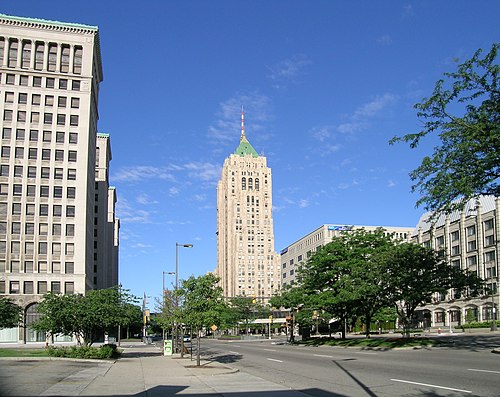
The Fisher Building is a landmark skyscraper located at 3011 West Grand Boulevard in the heart of the New Center area of Detroit, Michigan. The ornate 30-story building, completed in 1928, is one of the major works of architect Albert Kahn, and is designed in an Art Deco style, faced with limestone, granite, and several types of marble. The Fisher family financed the building with proceeds from the sale of Fisher Body to General Motors. It was designed to house office and retail space.[3]

The building, which contains the elaborate 2,089-seat Fisher Theatre,[4][5] was designated a National Historic Landmark on June 29, 1989. It also houses the headquarters for the Detroit Public Schools and the studios of radio stations WJR, WDVD, and WUFL.

History

[edit]
A 1930s postcard depicting the Fisher Building

Initially, architect Joseph Nathaniel French of Albert Kahn Associates planned for a complex of three buildings, with two 30-story structures flanking a 60-story tower. However, the Great Depression caused the project to be scaled back to a single tower.[6]

The Fisher brothers located the building across from the General Motors Building (Cadillac Place), as General Motors had recently purchased the Fisher Body Company. The two massive buildings spurred the development of a New Center for the city, a business district north of its downtown area.

The building's hipped roof was originally covered with gold leaf tiles, but during World War II these tiles were covered in asphalt because it was feared that the reflective surface would attract enemy bombers.[3] After the war, the asphalt could not be removed from the gold tiles without harming them, so they were replaced with green tiles. Since the 1980s, these tiles have been illuminated at night with colored lights to give them a gold appearance. On St. Patrick's Day, the lights are changed to green and, in recent years, to celebrate the NHL playoffs, the tower is illuminated with red lights in honor of the Detroit Red Wings.

In 1974, Tri-Star Development purchased the Fisher Building and adjoining New Center Building for approximately $20 million.[7]

In 2001, FK Acquisition LLC, a real estate firm based in Southfield, purchased the two buildings from TrizecHahn Corporation for $31 million.[8] FK Acquisition LLC lost the buildings to its lender in 2015.

In 2002, Detroit Public Schools (DPS) paid the owner of the Fisher Building $24.1 million to purchase five floors to house administrative offices, citing the high cost of renovations needed at the Maccabees Building, the previous headquarters, to comply with building and safety codes.[9][10]

In July 2015, Southfield-based developer Redico LLC, in partnership with HFZ Capital Group of New York City and Peter Cummings of The Platform, a Detroit-based development company, taking advantage of the general decline in Detroit real estate values, purchased the Fisher Building and adjacent Albert Kahn Building, plus 2,000 parking spaces in two parking structures and three surface lots in New Center for only $12.2 million at auction. Redico said the partnership plans to transform the two buildings, which are connected by an underground pedestrian concourse, into what it called a "true urban" mixed-use development, with a mix of office, retail, residential and entertainment uses. The multi-year project has a potential cost of $70 million to $80 million in addition to the purchase price. The Redico interest was purchased by Cummings and his partner in The Platform, Dietrich Knoer, in 2016.[11][12]

In 2023, Michigan State University acquired 79% of the owner of the Fisher Building, which means MSU owns it.[13]

Architecture

[edit]

The Fisher Building rises 30 stories with a roof height of 428 feet (130 m), a top floor height of 339 feet (103 m), and the spire reaching 444 feet (135 m). The building has 21 elevators. Albert Kahn and Associates designed the building with Joseph Nathaniel French serving as chief architect.[14] French took inspiration from Eliel Saarinen's Tribune Tower design of 1922, seen in the emphasis on verticality and the stepped-back upper stories. The building is unlike any other Albert Kahn production.[15] It has been called "Detroit's largest art object".[3]

In 1929, the Architectural League of New York honored the Fisher Building with a silver medal in architecture.[16] The opulent three-story barrel vaulted lobby is constructed with forty different kinds of marble, decorated by Hungarian artist Géza Maróti, and is highly regarded by architects.[4][5] The sculpture on the exterior of the building was supplied by several sculptors including Maróti, Corrado Parducci, Anthony De Lorenzo and Ulysses Ricci.[17]

Radio

[edit]

Designs called for two flagpoles atop the gilt roof. While they were installed, they were essentially unusable as a radio antenna was installed when one of the building's oldest tenants, radio station WJR, leased space in December 1928. On-air hosts often mention that broadcasts originate "from the golden tower of the Fisher Building." This was a requirement of the station's original lease in exchange for a nominal rent.[18] Two other radio stations, WDVD-FM (the former WJR-FM) and WUFL, also have broadcast studios in the building.

In 1970, building employees discovered a storage room sealed with tape. None of the staff knew what the room contained or why it was sealed. When they located the key, they found the flags of 75 nations that apparently were created in 1928 and intended to be flown for foreign visitors.[3]

Fisher Theatre

[edit]

The building is also home to the Fisher Theatre, one of Detroit's oldest live theatre venues. The theatre, designed by the Chicago-based architectural firm of Anker S. Graven & Arthur G. Mayger, originally featured a lavish Aztec-themed interior in the Mayan Revival style, and once had Mexican-Indian art, banana trees, and live macaws that its patrons could feed.[19] After the Depression, the theatre operated primarily as a movie house until 1961. Originally containing 3,500 seats, the interior was renovated into a 2,089-seat playhouse that allowed for more spacious seating and lobbies for patrons at a cost of $3.5 million. The decor was changed to a simple mid-century design.

The Nederlander Organization opened the "new" Fisher Theatre on October 2, 1961 and operated it until April 2021 when it sold the venue to the Ambassador Theatre Group.[20][21] It primarily features traveling productions of Broadway shows and has hosted numerous out-of-town tryouts.

Pre-Broadway Engagements at the Fisher:[22][23]

Art

[edit]

Befitting the Fisher Building's history in association with art, three nationally recognized fine-art galleries have occupied space in the structure including the Gertrude Kasle Gallery and London Fine Arts Group.

See also

[edit]

References

[edit]
[edit]
Revisions and contributorsEdit on WikipediaRead on Wikipedia
from Grokipedia
The Fisher Building is an iconic skyscraper in the New Center area of , , completed in 1928 as a tribute to the city by the of the Fisher Body Corporation. Designed by renowned architect Albert Kahn, the 30-story structure rises 441 feet and features a lavish marble-clad exterior with 325,000 square feet of the material, intricate mosaics, bronze detailing, and hand-painted vaulted ceilings, earning it the nickname "Detroit's Largest Art Object." Originally envisioned as part of a three-building complex that would have been the world's largest commercial development, the project was scaled back to a single L-shaped tower due to the impending , yet it still cost approximately $9 million (equivalent to approximately $170 million in 2025 dollars), with a quarter of the budget dedicated to artistic embellishments. Constructed in just 15 months using 12,000 tons of steel and 350,000 cubic yards of concrete and marble, the building exemplifies opulence with contributions from artists like Geza Maroti for frescoes and mosaics, and Corrado Parducci for sculptures. Its three-story grand lobby arcade showcases over 40 varieties of marble and 641 ornate bronze elevator doors, while the rooftop, once topped with gold leaf tiles known as the "Golden Tower," was later covered in green terra cotta after but is now illuminated in gold at night. The building also includes the historic Fisher Theatre, which opened in November 1928 as a and , and an adjacent 11-story parking garage with innovative double-helix ramps. Underground tunnels connect it to the nearby Building and New Center Building, facilitating pedestrian access in Detroit's New Center district. Recognized for its architectural excellence, the Fisher Building received a from the Architectural League of New York in 1929 and was listed on the in 1980 before being designated a in 1989. Today, majority owned by the endowment since 2023, it serves as a mixed-use destination with offices, retail shops, restaurants, and event spaces, symbolizing Detroit's automotive and enduring cultural significance. Ongoing renovations since 2015, including HVAC and elevator upgrades, have preserved its status as one of Kahn's masterpieces and a premier landmark.

Background

Location and Specifications

The Fisher Building is situated at 3011 West Grand Boulevard in Detroit's New Center neighborhood, approximately three miles northwest of the city's . This location positions it as a key element in the area's early 20th-century urban development, adjacent to major thoroughfares and opposite the General Motors Building. The structure features an L-shaped footprint with approximately 1.1 million square feet of total floor area, with a central 30-story tower flanked by two 11-story wings. Rising to 444 feet at its , the building measures 428 feet to the roof and 339 feet to the top floor, making it one of Detroit's prominent skyscrapers upon completion. Completed in 1928, it was designed by the firm of Albert Kahn Associates, with Joseph Nathaniel French serving as the lead architect. The project was funded by the seven using proceeds from their 1919 sale of a in Fisher Body Corporation to , which provided them substantial wealth from their automotive body manufacturing success. The building's opulent design earned it the nickname "Detroit's Largest Art Object," a phrase attributed to architect Albert Kahn, reflecting its status as a lavish rather than a purely functional office tower.

Historical Context

The —Fred J., William A., Lawrence P., Charles T., Edward F., Alfred J., and Howard A.—hailed from , where their father, Lawrence Fisher Sr., operated a successful carriage-making business that instilled in them a strong work ethic and collaborative spirit. In 1908, the brothers relocated to and founded the Company, which quickly became a leading supplier of automobile bodies, innovating closed-body designs that made cars more practical for all seasons. By 1919, had acquired a 60% stake in the company for approximately $27.6 million, and in 1926, GM purchased the remaining 40% in exchange for 664,720 shares of its stock valued at about $208 million, providing the brothers with substantial wealth that they directed toward various philanthropic and investment ventures, including the development of the Fisher Building. During , stood as the epicenter of the American automotive industry, fueled by rapid industrialization, , and economic prosperity that transformed the city into a hub of and wealth. The era's optimism and the brothers' success in the auto sector inspired ambitious projects that symbolized 's rising status, with the Fisher Building envisioned as a family vanity endeavor to showcase opulence and compete with the grandeur of New York City's emerging skyscrapers. This period of boom allowed for extravagant investments in architecture, reflecting the brothers' desire to contribute to their adopted city's skyline and cultural landscape. Originally conceived as a monumental three-building complex in Detroit's New Center area, the project was announced in January 1927 with plans to create the world's largest commercial structure on over 332,000 square feet of land at an estimated cost of $30 million. However, the 1929 stock market crash and ensuing drastically curtailed these ambitions, reducing the scope to a single 30-story tower completed in for about $9 million, with a significant portion allocated to artistic embellishments. This scaling back highlighted the era's sudden economic volatility, yet preserved the core vision of a that would endure as a testament to pre-Depression exuberance. The intended the building as a philanthropic gift to , dubbing it their "huge testimonial to faith in " and emphasizing public accessibility through features like shops, offices, and a theater, rather than pursuing purely commercial profit. This civic-minded approach aligned with their broader charitable efforts, using proceeds from the sale to foster community beauty and development in the Motor City.

History

Planning and Construction

The planning for the Fisher Building began in 1927 when the Fisher brothers, having amassed wealth from their automotive body manufacturing business, commissioned the project as a monumental gift to . The site in the emerging New Center area, at the corner of Second Avenue and West Grand Boulevard, was selected for its strategic location amid the developing commercial hub and proximity to , avoiding the high costs and congestion of downtown land acquisition. This choice involved purchasing 32 parcels totaling over 332,000 square feet, reflecting the brothers' vision for a self-contained urban complex. Architect Albert Kahn was tasked with the design, blending aesthetics with subtle Gothic verticality to create an ornate skyscraper that emphasized grandeur and functionality. Kahn collaborated closely with Hungarian sculptor Géza Maróti, who contributed symbolic decorative motifs inspired by American industry and culture, ensuring the building's artistic elements were integrated from the outset. The original plan envisioned a three-tower complex—including two 29-story structures and a 60-story central tower—but economic shifts, including the onset of the , scaled it back to a single 30-story tower with an attached 11-story base and integrated Fisher Theatre. Construction commenced with on August 23, 1927, and proceeded rapidly over 15 months amid the era's economic optimism, culminating in completion by November 1928 at a cost of $9 million (equivalent to approximately $160 million in 2025 dollars). Key engineering decisions included incorporating 21 high-speed elevators—among the fastest at the time, reaching 800 feet per minute—and designing as a core feature from the planning stage to serve as a cultural . The build demanded substantial resources, such as 12,000 tons of and 350,000 cubic yards of concrete, but proceeded without major delays due to efficient coordination by contractors H.G. Christman and Burke & Co. The building's dedication in November 1928 featured the lighting of its golden tower, coinciding with the Fisher Theatre's opening on November 16, drawing large crowds to celebrate the achievement. Initial tenants encompassed professional offices, retail shops along the ground-level arcade, and studios, with station securing space shortly after to broadcast from the "golden tower." This launch positioned the Fisher Building as an immediate hub for commerce and entertainment in New Center.

Ownership Changes and Key Events

Following its completion in 1928, the Fisher Building received immediate acclaim for its architectural excellence, earning a from the Architectural League of New York in 1929 as the most beautiful commercial building erected that year. Initially managed by the through their company, the building served as both a commercial hub and a symbolic gift to the city of , emphasizing aesthetic grandeur over immediate profitability. However, the onset of the in 1929 profoundly affected its trajectory, prompting the abandonment of ambitious expansion plans that would have added two 29-story towers and a 60-story central structure to create a larger complex. During in the 1940s, the building underwent practical modifications for ; its distinctive gold-leaf roof tiles, intended to evoke a "cathedral of commerce," were covered with asphalt to reduce visibility during potential blackouts and bombing threats. After the war, the roof was resurfaced with green terra cotta tiles and illuminated at night to maintain its landmark status, though the original remained concealed until later restorations. The Fisher interests retained ownership and oversight of the property through this period, navigating postwar economic recovery while sustaining its role as a key office and retail destination in Detroit's New Center district. The first major ownership transition occurred in 1962, when the building—along with the adjacent New Center Building—was sold for approximately $15 million to a group including philanthropist Max M. Fisher, who maintained an there until his death in 2005. Fisher sold the properties in 1974 to Tri-Star Development Inc., a Canadian firm, for about $20 million, marking the end of direct family involvement. Tri-Star later transferred ownership to Trizec Corporation, under which the building continued as a mixed-use property with stable tenancy. In 2001, Southfield-based FK Acquisition LLC, affiliated with the Farbman Group, acquired the Fisher Building and the Albert Kahn Building (formerly New Center Building) from TrizecHahn Corporation for roughly $31 million, positioning it as a centerpiece in their portfolio of historic properties. The following year, in 2002, the Detroit Public Schools district purchased five upper floors for $24.1 million to establish its administrative , a move that boosted occupancy but later drew scrutiny amid the district's financial challenges. Ownership shifted again in 2015 after FK Acquisition defaulted on a , leading to an where a including Southfield-based Redico LLC and New York-based HFZ secured the Fisher Building, Albert Kahn Building, and related parking assets for $12.2 million. This acquisition initiated a phase of revitalization efforts focused on increasing tenancy from below 40% to over 90%. In June 2023, the endowment and MSU Federal Credit Union acquired a 79% stake in the property— including adjacent surface lots—for $21 million, partnering with remaining investors to support ongoing operations and community integration.

Architecture

Exterior Design

The Fisher Building exemplifies architecture with a , blending modernist verticality and ornate detailing to create a distinctive skyline presence in . Designed by Albert Kahn, the structure's exterior emphasizes vertical lines and geometric motifs, departing from Kahn's typical industrial restraint to incorporate decorative flourishes that evoke the era's optimism. The facade features a base of for the lower levels, clad in various marbles throughout, which contributes to the building's robust yet elegant profile. Setbacks at various heights produce a terraced effect, forming an overall "" silhouette that steps inward toward the tower, enhancing the sense of upward momentum. Atop the 30-story tower rises a , bringing the total height to 441 feet, the building's focal point, crowned by a green-tiled hipped originally covered in but replaced with terra cotta tiles after ; these tiles have been illuminated with colored lights since restorations in the , recreating a golden glow at night. Sculptural elements adorn the exterior, including eagle motifs symbolizing American industry and progress, crafted by Hungarian artist Geza Maroti, alongside intricate friezes that add rhythmic texture to the surfaces. In 1929, the Architectural League of New York awarded the building a for excellence, recognizing it as the most beautiful commercial structure erected that year. As a since 1989, the Fisher Building's exterior symbolizes Detroit's prosperity during the automotive boom, serving as a enduring civic monument to the city's industrial heritage.

Interior Features and Materials

The interior of the Fisher Building exemplifies lavish craftsmanship, particularly in its three-story barrel-vaulted arcade lobby, which serves as the building's grand public entrance and promenade area designed for visitor admiration and retail shops. The lobby incorporates over 40 varieties of marble sourced from around the world, including Carthage marble for the overall finish, vari-hued Italian marble (in shades of rose, light browns, and creams) for the floors, for the second- and third-floor concourses, and polished European marble for the walls, creating a shimmering, multicolored expanse that highlights the building's opulent construction quality. The lobby's ceiling features hand-painted barrel vaults adorned with and intricate frescoes depicting , , redheaded cherubs, muses, and hemlock motifs in vibrant colors, evoking Hungarian artistic influences through the work of designer Géza Maróti, a Budapest-born artist who contributed sculptures, mosaics, and overall decorative schemes themed around commerce, transportation, music, and drama. These frescoes were executed by artists Antonio and Tomas de Lorenzo using oil colors and , at a cost exceeding $20,000 in 1928 (equivalent to about $265,000 today), and have been maintained through periodic cleaning with to preserve their sheen, with a major restoration in 2017 by EverGreene Architectural Arts involving and imitation gold leaf. Sculptural elements enhance the lobby's artistic reputation, including bronze shields featuring Mercury and four elemental figures (air, earth, fire, and water) by Maróti, as well as interior plaster sculptures and eagles by Corrado Parducci, complemented by three nearly 10-foot-tall panels near the arcade center depicting birds of paradise and eagles in gold, blues, grays, greens, oranges, and siennas. details are ubiquitous, with 420 tons of bronze finishings overall, including recessed grilles, hardware, medallions inlaid in the floors, and plaques; the arcade also features tiles known for their iridescent glazes, integrated into floors alongside Rookwood pottery for decorative accents. The building's 21 elevators further underscore its material splendor, equipped with 641 ornate cast bronze doors (both interior and exterior) featuring heavy ornamental brass cabs and marble accents that reflect the era's attention to even utilitarian spaces. Ongoing maintenance, including regular polishing of the marble surfaces, ensures the preservation of the interiors' luster, with over $30 million invested in upgrades during the first eight years of recent ownership to sustain this level of detail.

Facilities

Fisher Theatre

The Fisher Theatre opened on November 11, 1928, as a movie palace and house within the newly completed Fisher Building, boasting an original capacity of 3,500 seats. Designed by the Graven & Mayger, its interior featured an elaborate Mayan Revival theme inspired by ancient ruins in Mexico's Yucatan Peninsula, incorporating ornate decorations, tropical plants, a fountain, and even live macaws to evoke an exotic atmosphere. In 1961, the undertook a major renovation to transform the venue into a legitimate Broadway-style theater, reducing the seating to 2,089 for improved intimacy and sightlines while investing nearly $4 million in upgrades. The original Mayan-themed interior was largely stripped away, replaced by a aesthetic with marble walls, Indian rosewood and walnut paneling, crystal chandeliers, bronze accents, and enhanced acoustics to support live performances. The renovated theater reopened on October 2, 1961, under Nederlander management, which operated it until April 2021, when ownership transferred to the Ambassador Theatre Group. Since its reopening, the Fisher Theatre has served as a premier venue for national Broadway tours and pre-Broadway tryouts, hosting landmark productions such as the world premiere tryout of Hello, Dolly! starring Carol Channing in January 1964, as well as early runs of Fiddler on the Roof, Sweet Charity, and The Wiz. Touring shows like Motown the Musical have also drawn large audiences, celebrating Detroit's musical heritage with performances in 2017 and subsequent years. As one of Detroit's most esteemed cultural institutions, the Fisher Theatre maintains the largest subscription base for Broadway shows in the region, underscoring its enduring role in live entertainment through technical enhancements and consistent high-profile programming.

Radio Broadcasting

The Fisher Building has played a significant role in radio broadcasting since its opening, serving as the longtime home for WJR, a 50,000-watt AM station on 760 kHz known as "The Goodwill Station." WJR relocated its studios to the building on December 16, 1928, shortly after the structure's completion, and adopted the enduring slogan "WJR Detroit, from the Golden Tower of the Fisher Building" to emphasize its prominent location atop the 441-foot tower. This move marked WJR as one of the building's first major tenants, with early operations including remote broadcasts from the adjacent Fisher Theatre stage, where live performances were aired to audiences in the late 1920s and 1930s. In the 1930s, WJR solidified its reputation as a "" through international outreach programming and high-profile events, leveraging the building's central location to facilitate connections with global dignitaries and promote Detroit's cultural scene. The station's technical infrastructure included a tower on the building's roof, which relayed audio signals to its primary transmitter site in Riverview, Michigan, ensuring reliable 50,000-watt broadcasts across the . A notable historical emerged in 1970 when building maintenance staff discovered a sealed storage room containing approximately 75 international flags dating to 1928, originally intended for a world tour display but forgotten; these were later restored and exhibited in the building's arcades. Today, WJR continues to operate its main studios and offices from the eighth floor of the Fisher Building, alongside FM station WDVD (96.3 MHz), which shares the space for its hot adult contemporary programming. WUFL (93.1 FM), a contemporary Christian station, also maintains studios there as a low-profile tenant focused on community outreach. Following the 2023 ownership transition, where Michigan State University's endowment acquired a 79% stake in the property for $21 million, no significant changes have impacted the radio operations, allowing broadcasts to proceed uninterrupted amid the building's ongoing preservation efforts.

Art Galleries

The Fisher Building has served as a prominent art destination in since its completion in 1928, embodying the ' philanthropic vision to contribute a cultural landmark to the city as a memorial to their father. The structure's lavish interiors, featuring artworks integrated throughout, immediately positioned it as "Detroit's largest art object," drawing visitors to experience its artistic ambiance alongside commercial and entertainment spaces. Dedicated gallery spaces within the building have historically showcased modern and , enhancing its role in Detroit's cultural scene. The Gertrude Kasle Gallery operated on the third floor from 1965 to 1976, introducing local audiences to works by New York School abstract expressionists such as and , and fostering a new generation of collectors. Similarly, the London Fine Arts Group, also on the third floor, occupied significant space during the 1960s, 1970s, 1980s, and 1990s, presenting pieces that highlighted emerging artists and international trends. While lacking a permanent museum, the Fisher Building supports dynamic art displays through rotating exhibits featuring Detroit-based and international artists, often tied to community events and art fairs. For instance, the Beacon Project from 2016 to 2018 hosted temporary installations in the arcade, including photographic series on local makers and civil rights-themed works by artists like Olayami Dabls, emphasizing the building's ongoing commitment to accessible cultural enrichment. Integrated elements, such as the symbolic mosaics and frescoes by Hungarian artist Géza Maróti, provide a foundational artistic context for these exhibits without serving as standalone gallery pieces. This approach underscores the building's significance as a living art venue, perpetuating its nickname through evolving, non-permanent presentations rather than fixed collections.

Preservation and Modern Use

Landmark Status and Recognition

The Fisher Building was listed on the on October 14, 1980, recognizing its architectural and historical importance. It achieved status on June 29, 1989, as a superbly designed complex exemplifying fine craftsmanship. These designations highlight the building's significance under National Register Criterion C for its exceptional architectural design, including the innovative use of setbacks, vertical piers, and lavish interior materials like multiple varieties of and detailing. The structure's cultural role stems from its creation by the as a monumental gift to , tied to the automobile industry's growth and intended to foster urban development in the New Center area. At the state level, it is recognized as a Historic Landmark for its local prominence and association with the Fisher family's contributions to American industry. In 1929, the Architectural League of New York awarded the building its in for the most beautiful commercial structure erected the previous year. During the 1970s, amid Detroit's urban decline and economic challenges, early preservation initiatives focused on maintaining the building's integrity, culminating in its National Register listing to safeguard it from potential deterioration or loss. Regarded as a symbol of 's resilience, the Fisher Building inspires public appreciation through guided tours that explore its features and historical context, alongside educational programs highlighting its role in the city's architectural heritage.

Recent Developments and Renovations

In 2015, The Platform acquired a stake in the Fisher Building and invested over $30 million in maintenance, upgrades, and improvements through 2023, including HVAC system upgrades and elevator replacements, enhancing occupancy from 40% to about 70% and preserving its features. In June 2023, Michigan State University's endowment purchased a 79% stake for $21 million through a that includes The Platform and the MSU Federal , aiming to leverage the building and adjacent parking lots for to support educational and tech initiatives in . Restoration efforts intensified in 2024 with a comprehensive facade assessment using scanning and high-resolution photography to identify issues in the building's , , , and brick cladding. This led to a make-safe campaign involving the removal and stabilization of damaged elements, installation of protective netting and shoring, and plans for permanent repairs such as replacing corroded steel with resistant materials and mortar joints. Semiannual monitoring was established in 2024 to track structural movement, with phased renovations projected to extend the facade's lifespan by up to 50 years. Today, the Fisher Building serves as a hub for offices, including the headquarters of , retail spaces such as and MATURE, and event venues, while actively recruits education and technology tenants to foster innovation in the New Center area. Future plans emphasize mixed-use redevelopment, incorporating residential components on nearby parking lots to complement the existing office and retail functions, though no major construction has been reported as of November 2025. These efforts face challenges in New Center's urban revitalization, including extending economic growth beyond amid issues and financing hurdles for historic properties.

References

Add your contribution
Related Hubs
User Avatar
No comments yet.