


Community hub
Recent from talks
Contribute something
Nothing was collected or created yet.
Flexi disc
View on Wikipedia
The flexi disc (also known as a phonosheet, Sonosheet or Soundsheet, a trademark) is a phonograph record made of a thin, flexible vinyl sheet with a molded-in spiral stylus groove, and is designed to be playable on a normal phonograph turntable.
Flexible records were commercially introduced as the Eva-tone Soundsheet in 1962.[1][2] They were very popular among children and teenagers. They were mass-produced by the state publisher in the Soviet government.
History
[edit]Before the advent of the compact disc, flexi discs were sometimes used as a means to include sound with printed material such as magazines and music instruction books.[3] A flexi disc could be moulded with speech or music and bound into the text with a perforated seam, at very little cost and without any requirement for a hard binding.[4] One problem with using the thinner vinyl was that the stylus's weight, combined with the flexi disc's low mass, would sometimes cause the disc to stop spinning on the turntable and become held in place by the stylus.[3] For this reason, most flexi discs had a spot on the face of the disc for a coin, or other small, flat, weighted object to increase the friction with the turntable surface and enforce consistent rotation. If the turntable's surface is not completely flat, it was recommended that the flexi disc be placed on top of a full sized record.[5]
In Japan, starting in the early 1960s, Asahi Sonorama published the monthly Asahi Sonorama magazine which included an inserted flexi disc ("Sonosheet").[6]
Every year between 1963 and 1969, the Beatles made a special Christmas recording which was made into a flexi disc and sent to members of their fan club. While the earlier discs largely contained 'thank you' messages to their fans, the later Christmas flexis were used as an outlet for the Beatles to explore more experimental areas; the 1967 disc, for example, became a pastiche of a BBC Radio show and even included a specially recorded song entitled "Christmas Time (Is Here Again)."[7]
In 1964, the National Geographic Society released Song and Garden Birds of North America, which included 6 sound discs (12 sides) bound alternating with pages giving the titles and birds on the recordings.[8] The work was done by Arthur A. Allen and Peter Paul Kellogg of the Cornell Laboratory of Ornithology.
The August 1965 issue of National Geographic Magazine included a soundsheet of the funeral of Sir Winston Churchill narrated by David Brinkley. The recording has the sounds of the funeral procession to St. Paul's, a hymn sung by the leaders of the world, and an excerpt of the funeral sermon. Excerpts from various recordings of Churchill's speeches are included. The recording ends with bagpipes accompanying Churchill's coffin to the funeral barge on the Thames, as the public phase of the funeral ends.[9]
During the 1970s, MAD magazine included Soundsheets in several special editions. One was a dramatization of Gall in the Family Fare, its parody of All in the Family, packaged with MAD Super Special #11 (1973). The Summer 1980 edition of MAD Super Special (published in 1979) featured "It's a Super-Spectacular Day", a song with eight different versions pressed into eight concentric grooves; which version was played depended on where the needle was dropped onto the disc. Another issue included "It's a Gas", a song whose lyrics were belches.[10][11] There was also a "Mad Disco" special issue containing a Soundsheet.
ABBA/Live 77 was a special single-sided promo gold flexi disc given as a bonus to children who sold magazines and books at Christmas for Jultidningsförlaget, a publishing company using door sales as their main distribution channel. The disc contained excerpts from the Swedish group's recent concert appearance in Australia.
A two-sided flexible sheet record of the songs of humpback whales (produced by Roger Payne) was included with the January 1979 issue of National Geographic Magazine. With a production order of 10,500,000 copies, it became the largest single press run of any record at the time.
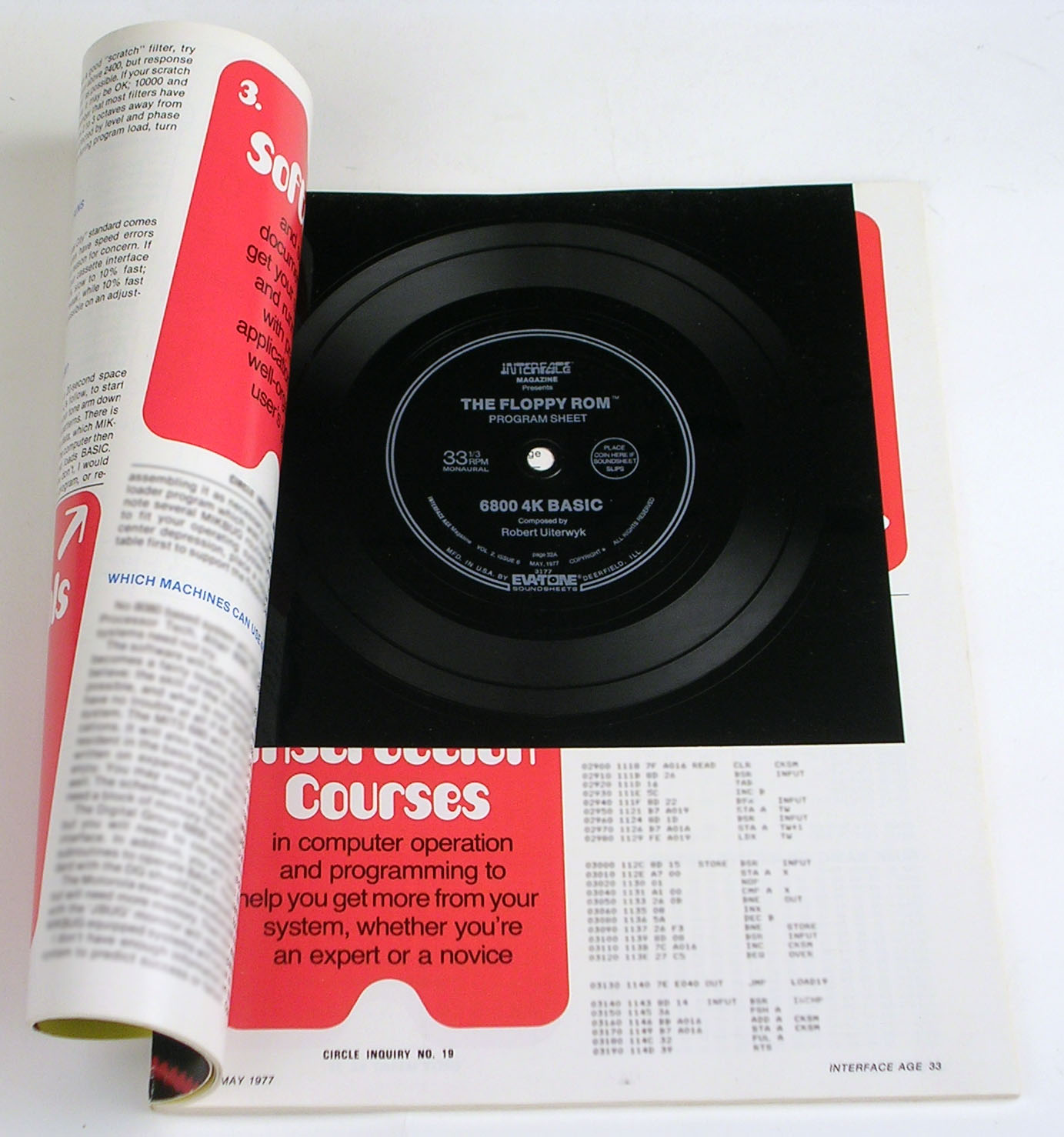
Computer magazines began to provide software in audio form on flexi discs from June 1979 until 1986, as an alternative to a reader manually typing in a printed program code listing. They were intended to be dubbed by the user onto an audio cassette tape, from which the program could then be loaded into the computer.[12]
While flexi-discs were usually just used as occasional giveaways, from 1980 to 1982, Flexipop made a speciality of giving away such a disc with each edition. Compact discs and the internet have rendered flexi discs largely obsolete, but gimmick discs are still produced occasionally: Amelia's Magazine included a one-sided Libertines flexi of What Katie Did.[13][14]
American manufacturer Eva-Tone, believed to be one of the last manufacturers of flexi discs, stopped production of the product in August 2000.[4]
As of December 2010, Pirates Press, an independent record manufacturing company based in San Francisco, California, US, had started production of flexi discs of various sizes and color.
In November 2010 extreme metal magazine Decibel began releasing flexi discs with each issue, starting with the January 2011 issue. The content on the disc features "100 percent exclusive songs" from artists that have been previously featured in the publication.[15][16]
In October 2011, the Los Angeles-based record company, Side One Dummy Records, teamed up with Alternative Press to offer a Title Fight flexi disc (containing 2 previously unreleased B-Sides) along with a year of AP subscription as a limited edition offer. Due to manufacturing delays the discs arrived packaged with the November issue of AP magazine in mid December.[17]
On April 2, 2012, Third Man Records released 1000 flexi discs tied to blue helium balloons into the air in Nashville, Tennessee. The discs contained the first release of "Freedom At 21", a track on Jack White's debut solo album, Blunderbuss. It is estimated that fewer than 100 of the discs will ever be found and they will be a valuable collector's item for many years.[citation needed]
On April 20, 2012, Domino Recording Company released a zine exclusively for Record Store Day that included five individual, multi-colored flexi-discs, each containing a song by Dirty Projectors, Real Estate, Cass McCombs, John Maus, and Villagers. The Dirty Projectors disc was previewed on April 19 by frontman Dave Longstreth via a YouTube video of him playing the record on a turntable.[18][19]
In 2012, Rookie online magazine released its first hardcopy edition, Rookie Yearbook One,[20] which contained a red flexi disc with two songs written specifically for the site: "I Don't Care" by Dum Dum Girls and "Rookie" by Supercute!.
In the summer 2013 issue of German fanzine PUNKROCK!, the punk rock band Riots, based in Oslo, Norway, gave away a free 2-track exclusive flexi disc to the 200 odd subscribers of the fanzine. This flexi featured 2 tracks, "Riots" and "We're All Slaves".[21] This was pressed by Pirates Press out of the US.
Shortly before the release of the 2014 Foo Fighters album Sonic Highways, some of the pre-orders came with a cover of Two Headed Dog on flexi disc.
In the summer 2015, PizzaDischi, an independent record manufacturing company based in Italy, has started production of flexi discs too, in collaboration with the European Slimer Records independent label run by Panda Kid members, dedicated to limited and rare edition of worldwide artists.[citation needed]
In 2021, Lizzo started selling flexi discs of her song "Rumours" as part of her merchandising.[22]
In the Soviet Union
[edit] | This section needs additional citations for verification. (July 2025) |

Flexi discs were mass-produced from 1964 to 1991 by the Soviet government as inserts in the popular Krugozor magazine for teens. The appearance of the Soviet flexi disc was always the same vivid blue (see image), and the discs are familiar to virtually anyone who grew up in the Soviet Union and even the post-Soviet era. In 1969 in addition to the successful audio-magazine Krugozor, the government also launched the audio-magazine for children Kolobok, which also consisted of flexi disks.
Because of a shortage of vinyl recording material (and official censorship of some Western music) during the Soviet era, bootleg recordings known as Ribs, Bones or roentgenizdat were produced on discarded medical X-ray prints. The musician Stephen Coates of UK band The Real Tuesday Weld has created the X-Ray Audio Project devoted to these.[23][24][25]
Human League track
[edit]"Flexi Disc" is also the title of a spoken-word track recorded by electronic band the Human League on a flexi disc which accompanied their 12" single "The Dignity of Labour" in 1978. Re-released as a bonus track on their album Reproduction, the song is a discussion between the band members concerning the advantages and disadvantages of the flexi disc format and the possibility of including one with the album to provide commentary.[3][26]
See also
[edit]References
[edit]- ^ Penchansky, Alan (November 10, 1979). "New Building for 'Soundsheets' Firm". Billboard. Vol. 91, no. 45. New York: Billboard Publications. p. 88. ISSN 0006-2510.
- ^ US Trademark for "Soundsheets" was granted to Eva-Tone Soundsheets, Inc. in 1982. The term was first used in commerce in April 1962. Trademark Serial Number: 73399790, Registration Number: 1258434
- ^ a b c Foley, Ryan (June 18, 2007). "Disposable Pop: A History of the Flexi Disc". Stylus Magazine. Archived from the original on December 2, 2010. Retrieved March 18, 2010.
- ^ a b "Soundsheet Product Line is Retired". Eva-tone. August 2000. Archived from the original on October 25, 2004. Retrieved March 18, 2010.
- ^ Cumella, Mike (2000). "The Bendable Sounds of Flexi-Discs". Least Common Denominator. No. 25. Jersey City, NJ: WFMU. Retrieved March 18, 2010.
- ^ "Asahi Sonorama to Be Dissolved, Asahi Shimbun Takes over Manga Operation". Comi Press. 2007-06-22. Archived from the original on 11 October 2008. Retrieved 2016-10-13.
- ^ Runtagh, Jordan (2020-12-13). "Beatles' Rare Fan-Club Christmas Records: A Complete Guide". Rolling Stone. Retrieved 2021-05-31.
- ^ Wetmore, Alexander; Grosvenor, Melville Bell; Allen, Arthur A; National Geographic Society (U.S.) (1964). Song and garden birds of North America. National Geographic Society. ISBN 978-0-87044-006-9. OCLC 907896.
{{cite book}}: ISBN / Date incompatibility (help) - ^ "The Sound of Living History". National Geographic. 128 (2): 198. August 1965. Retrieved 16 March 2023.
- ^ "Question about "It's A Gas" by Alfred E. Newman". Steve Hoffman Music Forums. 2006. Retrieved 2018-04-29.
- ^ "Alfred E. Neuman – It's A Gas". Discogs. 1966. Retrieved 2018-04-29.
- ^ "Video games in vinyl grooves". discogs.com. Retrieved 8 June 2017.
- ^ "Forum". Frenchdogwrittles.myfastforum.org. Archived from the original on 2011-05-01. Retrieved 2014-05-16.
- ^ "Stylus article". Stylusmagazine.com. Archived from the original on 2010-12-02. Retrieved 2014-05-16.
- ^ "Decibel Announces Exclusive Flexi Disc Series!". Decibel. November 18, 2010. Retrieved November 23, 2010.
- ^ Rosenberg, Axl (November 16, 2010). "Decibel Gets Even Awesomer, Introduces Monthly Exclusive Flexi Discs Starting in 2011". MetalSucks. Retrieved November 23, 2010. In 2011 independent London-based record label X-Ray Recordings set up, releasing predominantly limited edition runs of flexidiscs for new bands. Their first release with post-punk band Trogons has now sold out and they continue to release more flexidiscs on a semi-regular bases.
- ^ "Title Fight Flexi Disc 7" with AP Magazine Subscription". Side One Dummy. October 20, 2011. Retrieved December 18, 2011.
- ^ Maloney, Devon (April 19, 2012). "Hear Dirty Projectors' Record Store Day Demo 'You Against the Larger World'". SPIN. Retrieved May 19, 2012.
- ^ ""Smugglers Way Vol. 1," Domino USA". Domino USA. April 20, 2012. Retrieved May 19, 2012.
- ^ "Rookie » Rookie Yearbook One". Rookiemag.com. Retrieved 2014-05-16.
- ^ "| Seite 2". Punkrock-fanzine.de. 2013-11-08. Archived from the original on 2013-12-03. Retrieved 2014-05-16.
- ^ "Rumors Flexi Disc Single". Lizzo. Retrieved 2022-12-24.
- ^ The X-Ray Audio Project an archive of information and examples of Soviet 'roentgenizdat' flexi discs [1]
- ^ More "rock on bones" roentgenizdat flexi records
- ^ Vitaliev, Vitali, Dancing with String Bags in the Snow, column in Engineering & Technology Magazine, Vol. 9, Iss. 8, September 2014, p.106, The Institution of Engineering and Technology, London
- ^ "League History". TheHumanLeague.net. Archived from the original on February 10, 2010. Retrieved March 18, 2010.
External links
[edit]
- The Internet Museum of Flexi / Cardboard / Oddity Records
- The Historical Political Development of Soviet Rock Music
- Presenter: Paul Bayley (2010-05-27). "The Wonderful Weightless World of the Flexidisc". BBC. BBC Radio 4.
{{cite episode}}: Missing or empty|series=(help) - All Vinyl Experience Flexidiscs & Lyntone Discography
- Partial, created by now adult fans, collection of some of digitalised Krugozor and Kolobok magazines (audio pages are in WMA)
- The X-Ray Audio project site devoted to the Soviet era, bootleg recordings known as roentgenizdat
Flexi disc
View on GrokipediaOverview
Definition and Physical Properties
A flexi disc is a phonograph record composed of a thin, flexible sheet of polyvinyl chloride (PVC) featuring a molded spiral groove for stylus playback on standard turntables.[5] These discs typically measure 7 inches (178 mm) in diameter and are engineered for rotation at 33⅓ revolutions per minute, accommodating approximately 6 minutes of audio per side.[6] The format's design prioritizes low-cost production and ease of distribution, often as inserts in publications.[7] Physically, flexi discs exhibit a thickness between 0.2 and 0.9 mm, rendering them significantly more pliable than rigid vinyl records, which facilitates bending and mailing without breakage.[8] The PVC material provides sufficient durability for playback while maintaining flexibility, though its thin profile contributes to reduced audio fidelity compared to standard vinyl due to increased susceptibility to surface noise and groove wear.[9] Manufacturing involves pressing the PVC sheet similarly to conventional records but with specialized molds to preserve the material's elasticity.[5] This construction allows flexi discs to conform to irregular surfaces during storage, such as being stapled or folded into magazines.[4]Advantages and Limitations
Flexi discs offered significant cost advantages in production and distribution compared to rigid vinyl records, with manufacturing expenses substantially lower due to their thin, lightweight construction from materials like polystyrene or vinyl sheeting.[10][11] This affordability facilitated widespread use for promotional purposes, allowing inclusion in magazines, books, cereal boxes, and direct mailings without prohibitive shipping costs.[12] Their flexibility also provided durability against shattering, unlike brittle shellac discs or even some early vinyl formats that could crack upon impact.[1] Despite these benefits, flexi discs suffered from inferior audio fidelity, producing noisier playback with reduced dynamic range and frequency response owing to the thin medium's inability to maintain groove stability.[2][4] The material's tendency to warp or fail to lie flat on turntables exacerbated surface noise and distortion during playback.[4] Longevity was limited, as repeated plays caused rapid groove wear and degradation, rendering them unsuitable for archival or frequent use.[2] Storage posed challenges due to their sensitivity to bending, heat, and pressure, often leading to damage over time.[2]History
Precursors and Early Experiments
Early experiments with flexible phonograph records date to the early 1900s, when European inventors developed "talking postcards" featuring thin, resin-coated surfaces etched with audio grooves for personal messages playable on standard phonographs.[2][11] These devices, patented as early as 1905, allowed users to record short greetings or sounds onto postcard-sized media, which could be mailed and reproduced at low volumes, though production was limited and the format largely faded by the 1910s due to technical limitations and the dominance of rigid shellac discs.[2] In the 1930s, further innovation occurred with Durium records, thin flexible discs made from a synthetic resin laminated onto cardboard, produced by the Durium company for the "Hit of the Week" series in the United States.[11] These single-sided, 6.5-inch records, often featuring popular artists, were sold for 15 cents at newsstands and designed for disposable listening, but the venture collapsed amid the Great Depression, with fewer than 100 issues released between 1930 and 1931.[11] Post-World War II scarcity in Eastern Europe spurred underground experimentation, particularly in the Soviet Union, where individuals repurposed discarded X-ray films into makeshift flexible records known as "roentgenizdat" or "bone music."[13] Starting in the late 1940s, these hand-cut, 23 cm discs—often centered with a cigarette butt for the spindle hole—circulated forbidden Western jazz and rock music among dissidents, enduring up to 100 plays despite poor fidelity and fragility, as vinyl was restricted for official use.[13] Similar practices emerged in Hungary during the 1930s, but the Soviet variant persisted into the 1960s as a low-cost evasion of state censorship.[13] These precursors highlighted the appeal of lightweight, inexpensive media but suffered from inconsistent quality and lacked standardized manufacturing.Commercial Introduction in the West
The flexi disc, marketed as the Eva-Tone Soundsheet, was commercially introduced in the United States in 1962 by Eva-Tone Incorporated, an American company based in Deerfield, Illinois.[1][2] This innovation built on earlier experimental flexible records but refined the manufacturing process using a thin sheet of plastic or coated paper, enabling mass production at low costs of approximately 4 to 6.3 cents per unit.[2] The format's flexibility allowed it to be inserted into magazines, books, newspapers, and packaging without damage, making it ideal for promotional distribution.[1][12] Early adoption focused on advertising and novelty items, targeting children, teenagers, and general consumers through newsstands, vending machines, and product inserts.[12] One of the first notable uses occurred in 1964 when The Beatles distributed flexi discs to fan club members as part of their annual Christmas messages, a practice that continued through 1969.[1][12] In 1965, National Geographic included a flexi disc in a commemorative issue honoring Winston Churchill, narrated by David Brinkley and distributed to 4.5 million readers, demonstrating the format's scalability for large-scale promotions.[2] The following year, Insulite Ceilings advertised via a flexi disc in Popular Mechanics featuring comedians Bob and Ray.[2] Political campaigns also embraced the medium; in 1968, Richard Nixon's presidential bid produced over one million Soundsheets emblazoned with "Nixon’s The One!" containing a campaign speech, targeted at voters in key states.[1] Other creative applications included a Johnny Cash recording embossed on a Snowdrift shortening can, highlighting the disc's adaptability for branded merchandise.[12] In Europe, commercial uptake lagged slightly but followed similar promotional patterns, with UK production by companies like Lyntone Recordings emerging in subsequent decades for magazine inserts.[14] The low-cost, durable nature of flexi discs facilitated their rapid integration into Western marketing strategies, distinguishing them from rigid vinyl records.[1][2]Expansion and Peak in the 1960s-1980s
Following the 1962 commercial introduction of the Eva-Tone Soundsheet in the United States, flexi discs expanded rapidly as a low-cost promotional medium during the 1960s.[2] Producers capitalized on their lightweight construction and minimal manufacturing expense, estimated at 4 to 6.3 cents per disc, to enable mass distribution.[2] A landmark example occurred in 1965 when National Geographic distributed 4.5 million copies of a flexi disc tribute to Winston Churchill, narrated by David Brinkley.[2] The following year, Insulite Ceilings promoted home insulation via a flexi disc insert in Popular Mechanics magazine, featuring comedians Bob and Ray in "The Quietized Home."[2] Fan clubs and political campaigns further drove adoption. The Beatles issued annual Christmas flexi discs exclusively for UK fan club members from 1963 to 1969, totaling seven releases with custom picture sleeves and inserts.[15][1] Richard Nixon's 1968 presidential campaign disseminated over one million flexi discs to supporters.[1] The 1970s and 1980s represented the peak era, with tens of millions of flexi discs produced and sold primarily as magazine inserts and product giveaways.[1] In the UK, New Musical Express included a flexi disc sampler of The Rolling Stones' Exile on Main Street in 1972, while ABBA offered a live recording giveaway in 1977.[16][1] Flexipop! magazine, launched in 1980, bundled a flexi disc with every issue, showcasing tracks from artists including The Jam, Depeche Mode, and Adam Ant, and achieved peak sales exceeding 90,000 copies.[16][1] Large-scale commercial promotions culminated in McDonald's 1988-1989 "Million Dollar Song" campaign, which distributed 78 million flexi discs.[1]Decline in the Late 20th Century
The decline of flexi discs in Western markets accelerated during the 1980s, primarily due to the rising dominance of compact cassettes, which offered greater portability, ease of home recording, and durability for promotional and consumer use compared to the fragile, low-fidelity flexi format. Cassettes, introduced widely in the 1960s but surging in popularity by the late 1970s, displaced flexi discs in applications like magazine inserts and giveaways, as they allowed for longer playback times (up to 90 minutes per side versus flexi's typical 3-5 minutes per side) and resisted warping or degradation from repeated handling.[1] The introduction of the compact disc (CD) in 1982 further eroded flexi disc viability, as CDs provided uncompressed digital audio with far superior fidelity, no surface noise, and immunity to physical wear—attributes that rendered analog vinyl derivatives like flexi discs obsolete for both commercial and promotional purposes. By the late 1980s, major record labels shifted production toward CDs, which captured over 50% of the U.S. music market by 1991, sidelining lightweight formats amid falling vinyl pressing costs and the end of flexi's niche as a cost-saving insert medium. Flexi discs' inherent limitations, including rapid groove wear after 10-20 plays and inconsistent playback on standard turntables, compounded their marginalization as digital alternatives proliferated.[12][2] Production volumes, which had peaked at tens of millions annually in the 1970s and early 1980s for promotional tie-ins, plummeted through the 1990s as manufacturers like Eva-Tone scaled back operations amid evaporating demand. The last significant U.S. flexi disc runs ended around 2000, marking the format's effective sunset in mainstream Western use, though sporadic niche revivals occurred later via independent labels. In contrast, Soviet-era flexi production persisted until 1991, tied to state-controlled media distribution, but collapsed with the USSR's dissolution and the influx of Western digital technologies.[1][11]Technical Specifications
Materials and Construction
Flexi discs are primarily constructed from thin sheets of polyvinyl chloride (PVC), a flexible thermoplastic polymer valued for its durability and moldability in phonographic applications.[5][9] The material's flexibility derives from its composition, typically featuring plasticizers that reduce rigidity compared to standard vinyl records. Thickness generally ranges from 0.2 to 0.9 millimeters, enabling the disc to bend without cracking while maintaining sufficient structural integrity for playback.[8][4] The construction process involves pressing or molding a spiral groove into one side of the PVC sheet, encoding analog audio signals via lateral variations in groove walls, akin to conventional phonograph records.[5] A central hole, usually 0.25 inches in diameter, is die-punched for compatibility with standard turntable spindles.[17] Unlike rigid vinyl LPs, which use heated PVC pellets compressed in hydraulic presses, flexi discs employ specialized thin-film extrusion and embossing techniques to form shallow grooves, limiting groove depth to about 0.75 mm and contributing to inherent audio fidelity constraints.[4] Certain variants, such as promotional "sound sheets," incorporate a clear plastic film—often polystyrene or PVC—laminated onto a printed cardboard substrate, enhancing printability for magazine inserts while preserving groove integrity.[1] These constructions prioritize low-cost mass production over longevity, with the flexible base allowing easy mailing and storage but increasing susceptibility to warping under heat or pressure.[18]Manufacturing Process
Flexi discs are primarily manufactured by pressing thin sheets of polyvinyl chloride (PVC) foil using hydraulic presses equipped with metal stampers that replicate the audio groove from a master recording.[5][9] This method mirrors the compression molding process for standard vinyl records but employs lighter materials and lower pressures to accommodate the disc's flexibility and reduced thickness, typically around 0.75 mm.[1] The PVC sheets, available in colors such as transparent, blue, white, green, or yellow, are cut from larger formats like 200 x 180 mm before or after pressing, yielding 7-inch (180 mm) diameter discs.[9] The production begins with direct metal mastering (DMM) to create precise stampers, followed by attachment of these stampers—one for the grooved side and a blank or patterned plate for the reverse—to the pressing molds.[9] Under controlled heat (to soften the PVC without degrading it) and pressure, the material is formed into the final shape, often one-sided only, with playback speeds standardized at 33⅓ or 45 rpm.[5] Post-pressing steps include optional hot foiling for simple one-color graphics, perforation for magazine binding (typically 18 mm from the edge), and punching of the center hole.[9] For picture flexi discs, full-color CMYK printing is applied to the reverse side prior to pressing, embedding the image within the PVC layers.[9] Test pressings, usually 5–15 unprinted samples, verify audio fidelity and structural integrity before full runs.[9] An earlier, alternative process for paper-based flexi discs, known as "Soundsheets," was patented by Eva-Tone Incorporated in 1962 and involved printing multiple records (up to 24 per 25 x 38-inch sheet) on clay-coated paperboard using offset presses, followed by laminating a 1-mil cellulose acetate film with rubber-based adhesive.[1] Grooves were then embossed into the film via heated letterpresses (e.g., Heidelberg windmill models) applying approximately 15 tons of pressure per impression at over 2,000 impressions per hour, with tissue packing and rubber blankets ensuring uniform depth. Sheets were guillotined and finished, enabling integration into printed media like cereal boxes via "windowing" with acetate patches; this method emphasized low cost and lightweight output (4.5–6.5 grams per disc) but yielded lower durability compared to PVC variants.[1]Playback Compatibility and Audio Fidelity
Flexi discs are compatible with standard phonograph turntables, typically played at 33⅓ or 45 rpm speeds using a stylus designed for vinyl records.[20] Due to their thin construction—often around 0.75 mm thick—they may slip or halt during playback without added stabilization, such as placing a heavier coin on the label area or positioning a 7-inch rigid record underneath for support.[4][2][3] Optimal playback requires adjusting the cartridge's tracking force to 0.25–0.5 grams lighter than standard settings (e.g., 1–1.25 grams if normally 1.5 grams) to reduce groove damage and stylus bounce caused by the disc's flexibility and low mass.[4] Users must restore normal tracking force after playing to avoid affecting subsequent rigid records.[4] While no specialized equipment is essential, careful handling prevents warping or curling, which can exacerbate playback issues on automated or high-pressure tonearms.[2] Audio fidelity is markedly lower than that of rigid vinyl, with inherent limitations from the material's low density, including elevated surface noise, distortion, and reduced dynamic range.[3][4] Instability from imperfect flatness during playback often introduces wow and flutter, while repeated plays lead to rapid groove wear and degradation, limiting longevity to novelty use rather than audiophile listening.[2][4] The format performs adequately for spoken-word content but struggles with musical reproduction, where fidelity shortcomings become more apparent.[3] Modern manufacturing has marginally improved quality over historical examples, yet it remains inferior to standard vinyl.[4][20]Applications and Uses
Promotional and Insert Media
Flexi discs gained prominence as low-cost promotional media starting in the early 1960s, primarily through inserts in magazines, newspapers, and product packaging due to their lightweight construction and minimal production expenses compared to standard vinyl records.[12] The format's affordability enabled widespread distribution, often featuring advertisements, celebrity endorsements, or exclusive audio content to engage consumers directly.[2] In 1962, the Eva-Tone company introduced commercial flexi discs under the name Soundsheets, establishing them as a staple for marketing campaigns that persisted through the 1980s.[1] Eva-Tone specialized in producing these discs for promotional purposes, including inserts in publications like Popular Mechanics, where a 1966 edition included a flexi disc with comedians Bob and Ray promoting Insulite Ceilings.[2] Music magazines frequently bundled flexi discs to offer preview tracks or unreleased material, enhancing subscriber appeal; for instance, the UK publication New Musical Express (NME) distributed a 1972 flexi disc featuring an exclusive Rolling Stones track, "Exile on Main St. Blues," tied to the album's promotion.[4] Beyond music periodicals, flexi discs appeared in diverse promotional contexts, such as food packaging and zines, peaking in the 1970s and 1980s with cereal box inserts and fast-food tie-ins like Burger King discs.[21] Dedicated publications like the UK’s Flexipop! magazine, launched in 1980, included a flexi disc with every issue, showcasing artists including The Jam and Depeche Mode to drive sales through bundled audio novelty.[16] This insert strategy capitalized on the discs' ease of mailing and printing compatibility, though their thin material limited reuse and fidelity, confining them largely to one-time promotional listens.[22]Official and Underground Uses in the Soviet Union
In the Soviet Union, flexi discs were officially mass-produced from 1964 to 1991 as low-cost inserts in state-approved publications, primarily to distribute ideologically compliant audio content amid chronic shortages of rigid vinyl records.[3] These thin, flexible plastic records, often bright blue, featured light pop music, children's songs, propaganda speeches, and patriotic anthems, serving as an accessible medium for disseminating government narratives.[23] Production occurred at specialized facilities, such as the Moscow plant, with discs embedded in magazines like Krugozor to reach wide audiences without requiring separate playback media.[24] A notable example is the 1972 publication Conquest of Space, which included a flexi disc with recordings of speeches by cosmonautics pioneers Konstantin Tsiolkovsky, Sergei Korolev, and Yuri Gagarin, alongside the Communist Party anthem "Internationale" transmitted from the Luna-10 satellite.[23] This format's affordability and ease of integration into print media made it ideal for official educational and ideological purposes, peaking in usage during the 1950s through 1980s when material constraints limited standard phonograph record output.[23] Parallel to official production, underground networks exploited similar flexible recording techniques to circumvent censorship of Western-influenced genres like jazz and rock 'n' roll, which were deemed ideologically subversive by Soviet authorities from the late 1940s onward. Bootleggers, often operating in clandestine workshops, created illicit "flexi"-style records using scavenged materials, with roentgenizdat—recordings etched onto discarded hospital X-ray films—emerging as the predominant method by the 1950s.[2] Known as "bone music" for the visible skeletal imagery, these handmade, lathe-cut discs replicated banned tracks in real-time, producing variable sound quality but enabling black-market distribution to urban youth and dissidents.[2] [23] Roentgenizdat production, which predated widespread Western flexi disc commercialization, involved sourcing X-rays discarded after a one-year retention period and etching grooves manually, yielding thin, playable media sold discreetly for small fees equivalent to a few rubles.[2] While not molded vinyl like official flexi discs, these functioned analogously as portable, concealable phonosheets for forbidden content, including early rock and Beatles songs, sustaining underground music scenes through the 1960s despite risks of arrest for operators.[2] Some bootlegs extended to polyethylene or other plastic flexi variants, mirroring official formats but loaded with uncensored Western imports.[25]Specialized and Niche Applications
Flexi discs found specialized application in the distribution of computer software during the late 1970s and early 1980s, particularly through hobbyist magazines targeting early home computer users. Known as "Floppy ROMs," these were flexi discs encoded with audio representations of machine code or programs using standards like the Kansas City Standard, allowing readers to play the disc on a turntable, record the output to an audio cassette, and then load the data into their computers via built-in cassette interfaces.[26][2] The first Floppy ROM appeared in the May 1977 issue of Interface Age magazine, featuring a 4K BASIC interpreter program developed by Robert Uiterwyk, pressed at 33⅓ RPM and containing approximately 6 minutes of audio data. This innovation enabled cost-effective software sharing in an era when magnetic floppy disks were expensive and not yet ubiquitous for consumer use, appealing to the growing community of microcomputer enthusiasts.[26][2] Subsequent issues and other publications extended this practice; for instance, a September 1978 Interface Age release included additional data vinyl, while UK magazine Your Computer distributed a flexi disc with the game Othello in 1982, compatible with systems like the ZX Spectrum. This method persisted into the mid-1980s, bridging the gap between analog audio playback and digital computing until cassette and floppy distribution became more practical.[27][2] Beyond computing, flexi discs occasionally served niche educational roles, such as instructional audio inserts in specialized publications, though these overlapped with broader promotional uses and lacked the technical encoding of Floppy ROMs. Their flexibility and low production cost made them suitable for one-off or limited-run distributions where durability was secondary to accessibility.[10]Cultural Impact and Reception
Adoption in Music and Media
Flexi discs saw widespread adoption in the music industry from the early 1960s as an economical medium for promotional releases and fan engagement. Introduced commercially by Eva-Tone in 1962, these thin plastic records enabled bands to distribute exclusive content at minimal cost, often at 33⅓ or 45 RPM.[3] The Beatles exemplified early mainstream use by issuing annual Christmas flexi discs to fan club members from 1963 to 1969, featuring spoken messages, songs, and sketches that fostered direct artist-fan interaction unavailable on standard vinyl.[15] This approach extended to other artists, including David Bowie, who released flexi discs as promotional tie-ins, highlighting the format's role in building hype for albums and tours.[1] In print media, flexi discs became a staple insert for music magazines and zines, bridging audio and editorial content during the 1960s through 1980s. Publishers like those behind the UK’s Flexipop! magazine included a flexi disc with every issue starting in 1980, presenting tracks from diverse acts such as The Jam, Depeche Mode, and Adam Ant to attract readers and promote emerging music scenes.[16] Similarly, heavy metal bands like Napalm Death and Pallbearer contributed exclusive recordings to Decibel magazine’s flexi inserts, sustaining the format’s niche appeal into the 2010s for genre-specific promotion.[12] Overall, tens of millions of flexi discs circulated globally by the early 1990s, underscoring their utility in democratizing music distribution before digital alternatives dominated.[1] The format’s adoption peaked in punk, indie, and underground scenes, where low production barriers allowed DIY labels to press limited runs for samplers and EPs. Eva-Tone and Lyntone dominated manufacturing, supplying media outlets and artists with pressings that prioritized accessibility over high fidelity, thus embedding flexi discs in the cultural fabric of analog-era music dissemination.[13]Criticisms of Quality and Durability
Flexi discs have been criticized for their inferior audio fidelity compared to standard vinyl records, primarily due to their thin construction and manufacturing process, which results in shallower grooves and increased surface noise during playback.[1] [18] The format's instability, often failing to lie perfectly flat on a turntable, exacerbates issues like skipping and distortion, limiting effective playback to low-fidelity applications such as spoken word rather than high-quality music reproduction.[4] [3] Durability concerns stem from the material's flexibility and thinness, typically around 0.02 inches thick, making flexi discs prone to rapid degradation with repeated plays—often viable for only a few listens before grooves wear out or skipping becomes pronounced.[2] Scratches accumulate more easily than on rigid vinyl due to shallower molding, accelerating surface noise and fading over time.[1] Storage challenges further compound these problems, as exposure to heat or humidity can cause warping, rendering discs unplayable.[28]Collectibility and Modern Revival
Flexi discs have developed a dedicated collector base due to their historical use in promotional giveaways, magazine inserts, and limited-edition releases, which often results in low survival rates and scarcity in pristine condition. Their thin, flexible construction makes them prone to warping, creasing, and damage, elevating the value of well-preserved examples among vinyl enthusiasts.[22][4] Rare flexi discs command significant market prices; for instance, the Beatles' annual Christmas fan club flexi discs from the 1960s, originally distributed to members, now sell for around £100 or more on secondary markets owing to their limited print runs and cultural significance. Similarly, a 1982 Factory Records Christmas flexi disc, produced in an edition of 4,400 copies as a Hacienda club gift featuring New Order, fetches collector premiums due to its association with post-punk history. Other outliers include a limited Mayhem flexi disc edition, listed at approximately $345, highlighting demand for niche metal and punk variants.[16][29][30] In recent years, flexi discs have experienced a revival within independent music scenes, particularly punk and indie labels seeking affordable, novelty formats for merchandise and limited releases. San Francisco-based Pirates Press House revived production around 2013, pressing flexi discs for local bands and treating them as customizable art objects to appeal to DIY aesthetics and collectors. This resurgence aligns with broader vinyl nostalgia, with platforms like Bandcamp incorporating flexi discs into 2024 promotional mailings for album launches, blending retro appeal with modern distribution.[31][32] Such efforts underscore flexi discs' enduring niche viability despite their acoustic limitations, driven by scarcity and subcultural cachet rather than mainstream adoption.[4]References
- https://www.[wfmu](/page/WFMU).org/MACrec/Flexi_Manu_Process.html