Hubbry Logo
search
logo

Fock space

logo
Community Hub0 Subscribers
Read side by side
from Wikipedia

The Fock space is an algebraic construction used in quantum mechanics to construct the quantum states space of a variable or unknown number of identical particles from a single particle Hilbert space H. It is named after V. A. Fock who first introduced it in his 1932 paper "Konfigurationsraum und zweite Quantelung" ("Configuration space and second quantization").[1][2]

Informally, a Fock space is the sum of a set of Hilbert spaces representing zero particle states, one particle states, two particle states, and so on. If the identical particles are bosons, the n-particle states are vectors in a symmetrized tensor product of n single-particle Hilbert spaces H. If the identical particles are fermions, the n-particle states are vectors in an antisymmetrized tensor product of n single-particle Hilbert spaces H (see symmetric algebra and exterior algebra respectively). A general state in Fock space is a linear combination of n-particle states, one for each n.

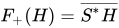
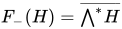
Technically, the Fock space is (the Hilbert space completion of) the direct sum of the symmetric or antisymmetric tensors in the tensor powers of a single-particle Hilbert space H,
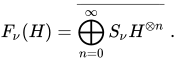
Here is the operator that symmetrizes or antisymmetrizes a tensor, depending on whether the Hilbert space describes particles obeying bosonic or fermionic statistics, and the overline represents the completion of the space. The bosonic (or fermionic) Fock space can alternatively be constructed as (the Hilbert space completion of) the symmetric tensors (or alternating tensors ). For every basis of H, there is a natural basis of the Fock space, the Fock states.

Definition

[edit]

The Fock space is the (Hilbert) direct sum of tensor products of copies of a single-particle Hilbert space


Here , the complex scalars, consists of the states corresponding to no particles, the states of one particle, the states of two identical particles etc.

A general state in is given by

where

  • is a vector of length 1 called the vacuum state and is a complex coefficient,
  • is a state in the single particle Hilbert space and is a complex coefficient,
  • , and is a complex coefficient, etc.

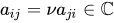
The convergence of this infinite sum is important if is to be a Hilbert space. Technically we require to be the Hilbert space completion of the algebraic direct sum. It consists of all infinite tuples such that the norm, defined by the inner product is finite where the particle norm is defined by i.e., the restriction of the norm on the tensor product

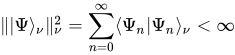
For two general states and the inner product on is then defined as where we use the inner products on each of the -particle Hilbert spaces. Note that, in particular the particle subspaces are orthogonal for different .


Product states, indistinguishable particles, and a useful basis for Fock space

[edit]

A product state of the Fock space is a state of the form

which describes a collection of particles, one of which has quantum state , another and so on up to the th particle, where each is any state from the single particle Hilbert space . Here juxtaposition (writing the single particle kets side by side, without the ) is symmetric (resp. antisymmetric) multiplication in the symmetric (antisymmetric) tensor algebra. The general state in a Fock space is a linear combination of product states. A state that cannot be written as a convex sum of product states is called an entangled state.

When we speak of one particle in state , we must bear in mind that in quantum mechanics identical particles are indistinguishable. In the same Fock space, all particles are identical. (To describe many species of particles, we take the tensor product of as many different Fock spaces as there are species of particles under consideration). It is one of the most powerful features of this formalism that states are implicitly properly symmetrized. For instance, if the above state is fermionic, it will be 0 if two (or more) of the are equal because the antisymmetric (exterior) product . This is a mathematical formulation of the Pauli exclusion principle that no two (or more) fermions can be in the same quantum state. In fact, whenever the terms in a formal product are linearly dependent; the product will be zero for antisymmetric tensors. Also, the product of orthonormal states is properly orthonormal by construction (although possibly 0 in the Fermi case when two states are equal).

A useful and convenient basis for a Fock space is the occupancy number basis. Given a basis of , we can denote the state with particles in state , particles in state , ..., particles in state , and no particles in the remaining states, by defining
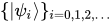
where each takes the value 0 or 1 for fermionic particles and 0, 1, 2, ... for bosonic particles. Note that trailing zeroes may be dropped without changing the state. Such a state is called a Fock state. When the are understood as the steady states of a free field, the Fock states describe an assembly of non-interacting particles in definite numbers. The most general Fock state is a linear superposition of pure states.

Two operators of great importance are the creation and annihilation operators, which upon acting on a Fock state add or respectively remove a particle in the ascribed quantum state. They are denoted for creation and for annihilation respectively. To create ("add") a particle, the quantum state is symmetric or exterior- multiplied with ; and respectively to annihilate ("remove") a particle, an (even or odd) interior product is taken with , which is the adjoint of . It is often convenient to work with states of the basis of so that these operators remove and add exactly one particle in the given basis state. These operators also serve as generators for more general operators acting on the Fock space, for instance the number operator giving the number of particles in a specific state is .

Wave function interpretation

[edit]

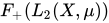
Often the one particle space is given as , the space of square-integrable functions on a space with measure (strictly speaking, the equivalence classes of square integrable functions where functions are equivalent if they differ on a set of measure zero). The typical example is the free particle with the space of square integrable functions on three-dimensional space. The Fock spaces then have a natural interpretation as symmetric or anti-symmetric square integrable functions as follows.

Let and , , , etc. Consider the space of tuples of points which is the disjoint union

It has a natural measure such that and the restriction of to is . The even Fock space can then be identified with the space of symmetric functions in whereas the odd Fock space can be identified with the space of anti-symmetric functions. The identification follows directly from the isometric mapping .

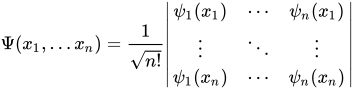
Given wave functions , the Slater determinant

is an antisymmetric function on . It can thus be naturally interpreted as an element of the -particle sector of the odd Fock space. The normalization is chosen such that if the functions are orthonormal. There is a similar "Slater permanent" with the determinant replaced with the permanent which gives elements of -sector of the even Fock space.
Relation to the Segal–Bargmann space

[edit]

Define the Segal–Bargmann space [3] of complex holomorphic functions square-integrable with respect to a Gaussian measure:

where Then defining a space as the nested union of the spaces over the integers , Segal[4] and Bargmann showed[5][6] that is isomorphic to a bosonic Fock space. The monomial corresponds to the Fock state


See also

[edit]

References

[edit]
[edit]
Revisions and contributorsEdit on WikipediaRead on Wikipedia
from Grokipedia
In quantum mechanics, Fock space is a Hilbert space that describes the quantum states of systems with a variable or indeterminate number of identical particles—enabling the representation of states across different particle numbers within a single framework.[1][2] It is constructed as the direct sum F(H)=n=0Hn\mathcal{F}(H) = \bigoplus_{n=0}^\infty H^{\otimes n}, where HH is the single-particle Hilbert space—with the n=0n=0 term being the vacuum state—and higher terms symmetrized for bosons—or antisymmetrized for fermions—to account for indistinguishability and statistics.[3][4][5][6][7] This structure facilitates the use of creation and annihilation operators, which obey canonical commutation relations [ai,aj]=δij[a_i, a_j^\dagger] = \delta_{ij} for bosons or anticommutation relations {bi,bj}=δij\{b_i, b_j^\dagger\} = \delta_{ij} for fermions—allowing precise counting of occupation numbers in basis states.[3][2][8][9] Named after Soviet physicist Vladimir Fock—who introduced the concept in 1932—Fock space emerged as a key tool in second quantization to handle many-body problems beyond fixed particle numbers—such as in quantum field theory and statistical mechanics.[10][11] For bosonic systems—like photons—the symmetric Fock space Γs(H)\Gamma_s(H) permits unlimited occupation of states (ni0n_i \geq 0)—embodying Bose-Einstein statistics—while the fermionic antisymmetric Fock space Γa(H)\Gamma_a(H) enforces the Pauli exclusion principle—with at most one particle per state (ni{0,1}n_i \in \{0,1\}).[1][12] These spaces underpin the formalism for quantum gases, superconductors, and relativistic fields—where the vacuum serves as the ground state—annihilated by all destruction operators.[3]

Basic Concepts

Single-particle Hilbert space

The single-particle Hilbert space H1\mathcal{H}_1 is defined as a separable Hilbert space, meaning it possesses a countable orthonormal basis and is complete with respect to the norm induced by its inner product, providing the mathematical framework for describing the quantum states of an individual particle over its configuration space.[13] This separability ensures that H1\mathcal{H}_1 can accommodate infinite-dimensional representations typical in quantum mechanics, allowing for a dense countable set of basis vectors that span the space.[14] In the context of building more complex quantum systems, H1\mathcal{H}_1 forms the essential prerequisite structure. For non-relativistic particles moving in three-dimensional Euclidean space, H1\mathcal{H}_1 is commonly realized as L2(R3)L^2(\mathbb{R}^3), the space of square-integrable complex-valued functions ψ(r)\psi(\mathbf{r}) with respect to the Lebesgue measure, where the norm ψ2=R3ψ(r)2d3r<\|\psi\|^2 = \int_{\mathbb{R}^3} |\psi(\mathbf{r})|^2 d^3\mathbf{r} < \infty ensures physical wave functions are normalizable.[15] In relativistic settings, such as for particles obeying the Klein-Gordon or Dirac equation, H1\mathcal{H}_1 is often formulated in momentum space to incorporate Lorentz invariance, taking the form of L2(R3,d3p/(2ωp))L^2(\mathbb{R}^3, d^3\mathbf{p}/(2\omega_{\mathbf{p}})) with ωp=p2+m2\omega_{\mathbf{p}} = \sqrt{\mathbf{p}^2 + m^2}, where the measure accounts for the relativistic energy-momentum relation on the mass shell.[16] The inner product on H1\mathcal{H}_1 is ψϕ=ψ(r)ϕ(r)d3r\langle \psi | \phi \rangle = \int \psi^*(\mathbf{r}) \phi(\mathbf{r}) d^3\mathbf{r} in the position representation, enabling the computation of probabilities and overlaps between states.[17] Basis states, such as position eigenstates r|\mathbf{r}\rangle or momentum eigenstates p|\mathbf{p}\rangle, are orthonormal in the distributional sense: rr=δ3(rr)\langle \mathbf{r} | \mathbf{r}' \rangle = \delta^3(\mathbf{r} - \mathbf{r}') and pp=δ3(pp)\langle \mathbf{p} | \mathbf{p}' \rangle = \delta^3(\mathbf{p} - \mathbf{p}'), reflecting the continuous spectrum of these observables despite the states not being square-integrable themselves.[18] These generalized eigenstates form a complete set, allowing any state in H1\mathcal{H}_1 to be expanded as ψ(r)=rψ\psi(\mathbf{r}) = \langle \mathbf{r} | \psi \rangle or in momentum space via Fourier transform. As the foundational space, H1\mathcal{H}_1 underpins the construction of many-particle Hilbert spaces through tensor products, where the state of NN distinguishable particles occupies H1N\mathcal{H}_1^{\otimes N}, facilitating the description of interactions and correlations in multi-particle quantum systems.[13] Fock space extends this framework to accommodate variable particle numbers via a direct sum over such tensor products.[13]

Many-particle states for distinguishable particles

For a system of NN distinguishable particles, each described by the single-particle Hilbert space H1\mathcal{H}_1, the many-particle Hilbert space HN\mathcal{H}_N is constructed as the tensor product HN=H1N\mathcal{H}_N = \mathcal{H}_1^{\otimes N}.[19][20] This structure allows the state of the system to be specified independently for each particle, reflecting their distinguishability. The dimension of HN\mathcal{H}_N is the NNth power of the dimension of H1\mathcal{H}_1, enabling a basis expansion with NN-fold products of single-particle basis states.[21] States in HN\mathcal{H}_N are represented by wave functions ψ(x1,x2,,xN)\psi(x_1, x_2, \dots, x_N), where xix_i denotes the coordinates (position, spin, etc.) of the iith particle. The inner product between two such states ψ\psi and ϕ\phi is given by the integral over all variables: ψϕ=ψ(x1,,xN)ϕ(x1,,xN)dx1dxN\langle \psi | \phi \rangle = \int \psi^*(x_1, \dots, x_N) \phi(x_1, \dots, x_N) \, dx_1 \dots dx_N, assuming the single-particle space is L2L^2 with respect to the appropriate measure.[20][21] This ensures the Hilbert space is complete and equipped with a positive-definite inner product. A simple example is the two-particle state formed as a product of orthonormal single-particle states ϕa(x1)\phi_a(x_1) and ϕb(x2)\phi_b(x_2), yielding ψ(x1,x2)=ϕa(x1)ϕb(x2)\psi(x_1, x_2) = \phi_a(x_1) \phi_b(x_2).[20] For normalization, the condition ψ(x1,x2)2dx1dx2=1\int |\psi(x_1, x_2)|^2 \, dx_1 dx_2 = 1 holds directly if ϕa(x1)2dx1=1\int |\phi_a(x_1)|^2 \, dx_1 = 1 and ϕb(x2)2dx2=1\int |\phi_b(x_2)|^2 \, dx_2 = 1, due to the separability of the integral. Orthogonality follows similarly: for distinct pairs, say ϕa,ϕb\phi_a, \phi_b and ϕc,ϕd\phi_c, \phi_d, the inner product ψ(x1,x2)χ(x1,x2)dx1dx2=0\int \psi^*(x_1, x_2) \chi(x_1, x_2) \, dx_1 dx_2 = 0 if aca \neq c or bdb \neq d, leveraging the orthonormality ϕa(x)ϕc(x)dx=δac\int \phi_a^*(x) \phi_c(x) \, dx = \delta_{ac}.[19][20]

Indistinguishable particles and symmetrization

In quantum mechanics, systems of indistinguishable particles require that the many-particle wave functions be adapted to account for their identical nature, projecting onto specific symmetry subspaces of the full tensor product Hilbert space HN=HN\mathcal{H}_N = \mathcal{H}^{\otimes N}, where H\mathcal{H} is the single-particle Hilbert space. This adaptation arises from the symmetrization postulate, which mandates that the total wave function of identical particles must transform either symmetrically (for bosons) or antisymmetrically (for fermions) under arbitrary permutations of particle labels.[22] For identical bosons, which obey Bose-Einstein statistics, the wave function ψ(x1,,xN)\psi(x_1, \dots, x_N) must be totally symmetric under particle exchange. The symmetrization operator SBS_B projects onto this symmetric subspace via
SBψ(x1,,xN)=1N!PSNPψ(x1,,xN), S_B \psi(x_1, \dots, x_N) = \frac{1}{N!} \sum_{P \in S_N} P \psi(x_1, \dots, x_N),
where SNS_N denotes the symmetric group of all N!N! permutations PP, and the operator PP exchanges the coordinates accordingly. The resulting symmetric subspace HNB\mathcal{H}_N^B consists of all states invariant under such permutations, ensuring no distinction between particles.[23] In contrast, identical fermions, such as electrons, follow Fermi-Dirac statistics and require totally antisymmetric wave functions, as dictated by the Pauli exclusion principle, which prohibits two fermions from occupying the same quantum state. The antisymmetrization operator SFS_F is given by
SFψ(x1,,xN)=1N!PSN(1)PPψ(x1,,xN), S_F \psi(x_1, \dots, x_N) = \frac{1}{N!} \sum_{P \in S_N} (-1)^{|P|} P \psi(x_1, \dots, x_N),
where P|P| is the parity of the permutation (even or odd). This projects onto the antisymmetric subspace HNF\mathcal{H}_N^F, where exchanging any two particles introduces a minus sign. A fundamental consequence is the Pauli exclusion principle, originally formulated to explain atomic spectra.[24] An explicit basis for HNF\mathcal{H}_N^F is provided by Slater determinants, which construct antisymmetric states from single-particle orbitals ϕi(x)\phi_i(x):
Ψ(x1,,xN)=1N!det(ϕ1(x1)ϕ1(x2)ϕ1(xN)ϕ2(x1)ϕ2(x2)ϕ2(xN)ϕN(x1)ϕN(x2)ϕN(xN)). \Psi(x_1, \dots, x_N) = \frac{1}{\sqrt{N!}} \det \begin{pmatrix} \phi_1(x_1) & \phi_1(x_2) & \cdots & \phi_1(x_N) \\ \phi_2(x_1) & \phi_2(x_2) & \cdots & \phi_2(x_N) \\ \vdots & \vdots & \ddots & \vdots \\ \phi_N(x_1) & \phi_N(x_2) & \cdots & \phi_N(x_N) \end{pmatrix}.
This form automatically enforces antisymmetry and the exclusion principle, as the determinant vanishes if any two orbitals are identical.[24]

Construction of Fock Space

Direct sum over particle numbers

The Fock space provides a unified Hilbert space framework for systems with an indefinite number of indistinguishable particles, accommodating superpositions across different particle numbers. It was originally introduced by Vladimir Fock in the context of second quantization to describe the configuration space of quantum systems. Formally, given a single-particle Hilbert space H\mathcal{H}, the bosonic Fock space Fs\mathcal{F}_s is defined as the direct sum
Fs=N=0HNs, \mathcal{F}_s = \bigoplus_{N=0}^\infty \mathcal{H}_N^s,
where H0s=C\mathcal{H}_0^s = \mathbb{C} is the one-dimensional vacuum sector, and for N1N \geq 1, HNs\mathcal{H}_N^s denotes the Hilbert space of symmetrized NN-fold tensor products of H\mathcal{H}, i.e., the subspace of HN\mathcal{H}^{\otimes N} invariant under permutations of the factors.[1] Similarly, the fermionic Fock space Fa\mathcal{F}_a is
Fa=N=0HNa, \mathcal{F}_a = \bigoplus_{N=0}^\infty \mathcal{H}_N^a,
with HNa\mathcal{H}_N^a being the antisymmetrized NN-fold tensor product subspace of HN\mathcal{H}^{\otimes N}.[1] These constructions ensure that states respect the statistics of bosons (symmetric under exchange) or fermions (antisymmetric under exchange).[25] A general element (state) of the Fock space takes the form Ψ=N=0ΨN\Psi = \bigoplus_{N=0}^\infty \Psi_N, where ΨNHN\Psi_N \in \mathcal{H}_N (with HN\mathcal{H}_N denoting either HNs\mathcal{H}_N^s or HNa\mathcal{H}_N^a) and ΨN=0\Psi_N = 0 for all but finitely many NN in the algebraic direct sum; the full Fock space is the completion thereof with respect to the inner product.[1] The inner product between two states Ψ=N=0ΨN\Psi = \bigoplus_{N=0}^\infty \Psi_N and Φ=N=0ΦN\Phi = \bigoplus_{N=0}^\infty \Phi_N is defined sector-wise as
ΨΦ=N=0ΨNΦNHN, \langle \Psi | \Phi \rangle = \sum_{N=0}^\infty \langle \Psi_N | \Phi_N \rangle_{\mathcal{H}_N},
where HN\langle \cdot | \cdot \rangle_{\mathcal{H}_N} is the inner product on HN\mathcal{H}_N.[1] This orthogonal direct sum structure preserves the Hilbert space properties across sectors. When H\mathcal{H} is a separable Hilbert space, the resulting Fock space F\mathcal{F} (bosonic or fermionic) is also separable and complete, forming a Hilbert space whose basis can be constructed from an orthonormal basis of H\mathcal{H}.[1] The separability arises from the countable direct sum of separable spaces, while completeness follows from the uniform boundedness of the sector norms in the completion process.[26] As an illustrative example for bosons, consider a system where particles occupy discrete modes labeled by a basis of H\mathcal{H}; states with a fixed particle number NN, such as those specifying occupation numbers in each mode (summing to NN), lie entirely within the sector HNs\mathcal{H}_N^s.[26]

Creation and annihilation operators

In the context of Fock space, which is constructed as a direct sum over Hilbert spaces of varying particle numbers, creation and annihilation operators provide the dynamical framework for transitioning between these sectors by adding or removing particles.[27] For bosonic particles, the creation operator a(f)a^\dagger(f) for a single-particle state fH1f \in \mathcal{H}_1 acts on a Fock space state Ψ=NΨN\Psi = \oplus_N \Psi_N by appending ff to the NN-particle component via the symmetric tensor product, yielding a(f)Ψ=NN+1(fΨN)a^\dagger(f) \Psi = \oplus_N \sqrt{N+1} (f \otimes \Psi_N), where the square root factor ensures normalization consistent with the bosonic commutation relations.[28] The annihilation operator a(g)a(g) is the adjoint of the creation operator, satisfying a(g)=[a(g)]a(g) = [a^\dagger(g)]^\dagger, and removes a particle in the direction of gH1g \in \mathcal{H}_1.[28] For fermionic particles, the creation operator a(f)a^\dagger(f) similarly appends ff but uses the antisymmetric exterior product to enforce the Pauli exclusion principle, defined as a(f)Ψ=N(fΨN)a^\dagger(f) \Psi = \oplus_N (f \wedge \Psi_N), where \wedge denotes the wedge product in the antisymmetric tensor algebra.[29] The corresponding annihilation operator a(g)a(g) is again the adjoint, with the fermionic nature imposing anticommutation relations that prevent double occupancy.[29] The algebraic structure of these operators is governed by their commutation or anticommutation relations: for bosons, [a(f),a(g)]=fg1[a(f), a^\dagger(g)] = \langle f | g \rangle \mathbf{1}, where 1\mathbf{1} is the identity operator and the inner product fg\langle f | g \rangle projects onto the vacuum sector; for fermions, the anticommutator {a(f),a(g)}=fg1\{a(f), a^\dagger(g)\} = \langle f | g \rangle \mathbf{1} holds, with all other anticommutators vanishing.[28][29] In a basis expansion, the field operators are expressed as linear combinations over an orthonormal basis {ϕk}\{\phi_k\} of the single-particle space, such that the creation field operator is ψ^(x)=kϕk(x)ak\hat{\psi}^\dagger(x) = \sum_k \phi_k(x) a^\dagger_k, where ak=a(ϕk)a^\dagger_k = a^\dagger(\phi_k) creates a particle in the mode ϕk\phi_k at position xx, and the annihilation field ψ^(x)\hat{\psi}(x) is its adjoint.[27]

Vacuum state and number operator

The vacuum state in Fock space, denoted 0|0\rangle, represents the absence of any particles and is the unique normalized vector in the zero-particle sector of the direct sum construction, expressed as 0=(1,0,0,)|0\rangle = (1, 0, 0, \dots), where the leading 1 corresponds to the scalar state in the one-dimensional Hilbert space H(0)\mathcal{H}^{(0)} for zero particles, and all subsequent components in the n-particle sectors H(n)\mathcal{H}^{(n)} (n \geq 1) are zero vectors.[30] This state satisfies the normalization condition 00=1\langle 0 | 0 \rangle = 1.[31] It is annihilated by every annihilation operator acting on the space, such that a(f)0=0a(f) |0\rangle = 0 for any single-particle wave function f in the underlying one-particle Hilbert space.[31][32] The total number operator N^\hat{N}, which measures the overall particle count in a given state, is constructed from the creation and annihilation operators. In a discrete orthonormal basis {ϕk}\{ \phi_k \} of the single-particle space, it takes the form N^=kakak\hat{N} = \sum_k a_k^\dagger a_k, where aka_k and aka_k^\dagger are the mode-specific annihilation and creation operators.[32] Equivalently, in the continuous position representation using field operators, N^=dxψ^(x)ψ^(x)\hat{N} = \int dx \, \hat{\psi}^\dagger(x) \hat{\psi}(x), where ψ^(x)\hat{\psi}(x) and ψ^(x)\hat{\psi}^\dagger(x) annihilate and create particles at position x, respectively.[31] Multi-particle states in Fock space are generated by successive applications of creation operators to the vacuum, and these states, labeled by occupation numbers n=(n1,n2,)\vec{n} = (n_1, n_2, \dots) with nkn_k denoting the number of particles in mode k, serve as eigenstates of N^\hat{N}: N^n=(knk)n\hat{N} | \vec{n} \rangle = \left( \sum_k n_k \right) | \vec{n} \rangle.[32] The eigenvalue knk\sum_k n_k gives the total particle number, and the normalization of such states follows from that of the vacuum, ensuring nn=1\langle \vec{n} | \vec{n} \rangle = 1 for properly symmetrized or antisymmetrized combinations appropriate to bosons or fermions.[31]

Properties and Basis

Occupation number basis

The occupation number basis constitutes a canonical orthonormal basis for Fock space, consisting of states labeled by a vector n=(n1,n2,)\vec{n} = (n_1, n_2, \dots ), where each nkn_k denotes the number of particles occupying the kk-th single-particle mode from a complete orthonormal basis of the single-particle Hilbert space H1\mathcal{H}_1. This representation, introduced in the context of second quantization, facilitates the description of arbitrary many-particle states without fixing the particle number, allowing for superpositions across different particle sectors. For bosonic particles, the basis states are constructed as
n=k(ak)nknk!0, |\vec{n}\rangle = \prod_k \frac{(a^\dagger_k)^{n_k}}{\sqrt{n_k!}} |0\rangle,
where aka^\dagger_k is the creation operator for mode kk, $n_k = 0, 1, 2, \dots $ are non-negative integers, and 0|0\rangle is the vacuum state annihilated by all annihilation operators aka_k. For fermionic particles, the Pauli exclusion principle restricts the occupation numbers to nk=0n_k = 0 or 11, yielding basis states of the form
n=k:nk=1ak0, |\vec{n}\rangle = \prod_{k: n_k=1} a^\dagger_k |0\rangle,
with the product taken over modes where particles are present; the fermionic anticommutation relations ensure automatic antisymmetrization. These states form an orthonormal set, satisfying nm=δnm\langle \vec{n} | \vec{m} \rangle = \delta_{\vec{n}\vec{m}}, and collectively span the entire Fock space F\mathcal{F}. The completeness relation for the occupation number basis is
nnn=I, \sum_{\vec{n}} |\vec{n}\rangle \langle \vec{n} | = I,
where the sum runs over all possible occupation vectors n\vec{n}, guaranteeing that any state in F\mathcal{F} can be expanded in this basis. This basis aligns with the direct-sum structure of Fock space over total particle numbers N=knkN = \sum_k n_k. The infinite-dimensional nature of F\mathcal{F} arises from the unbounded possibilities for n\vec{n} (unlimited for bosons, exponentially many configurations for fermions), but when H1\mathcal{H}_1 is separable, the basis ensures well-defined convergence properties for operators and states.

Product states in Fock space

In Fock space, the basis states denoted by occupation number vectors n=(n1,n2,)\vec{n} = (n_1, n_2, \dots), where nkn_k represents the number of particles in the kk-th single-particle orbital ϕk\phi_k, correspond to symmetrized product states of these orbitals when expressed in the position representation. These states provide a concrete realization of the abstract occupation number basis, ensuring proper accounting for particle indistinguishability by incorporating the required exchange symmetry. For identical bosons, the NN-particle wave function with fixed occupations knk=N\sum_k n_k = N is the symmetrized product, mathematically expressed as a permanent:
ψn(x1,,xN)=1knk!Pkj=1nkϕk(xP(jk)), \psi_{\vec{n}}(\mathbf{x}_1, \dots, \mathbf{x}_N) = \frac{1}{\sqrt{\prod_k n_k!}} \sum_P \prod_k \prod_{j=1}^{n_k} \phi_k(\mathbf{x}_{P(j_k)}),
where the sum runs over all distinct permutations PP that assign the NN particle coordinates to the occupied orbitals according to the multiplicities nkn_k. This form arises naturally in the configuration space formulation of second quantization for indistinguishable particles, guaranteeing full symmetry under particle exchange. For identical fermions, the corresponding basis states for a set of NN singly occupied distinct orbitals {ϕ1,,ϕN}\{\phi_1, \dots, \phi_N\} take the form of a Slater determinant:
ψn(x1,,xN)=1N!det[ϕj(xi)]i,j=1N. \psi_{\vec{n}}(\mathbf{x}_1, \dots, \mathbf{x}_N) = \frac{1}{\sqrt{N!}} \det \left[ \phi_j(\mathbf{x}_i) \right]_{i,j=1}^N.
This antisymmetric construction enforces the Pauli exclusion principle, with each orbital occupied by at most one particle (nk=0n_k = 0 or 11), and was introduced as a practical method to satisfy fermionic symmetry in multi-electron systems. These symmetrized product representations serve as the fundamental "useful basis" for Fock space, as they eliminate overcounting of physically equivalent states that would occur in treatments of distinguishable particles by avoiding explicit particle labels. Instead, the occupation vector n\vec{n} fully specifies the state, with permutations of coordinates leaving ψn\psi_{\vec{n}} invariant due to the built-in symmetry. This uniqueness for fixed n\vec{n} highlights the role of Fock space in modeling indistinguishable particles without redundancy.

Wave function representation

In Fock space, a general state is expressed as a linear superposition across sectors of different particle numbers NN, where each NN-particle component incorporates the appropriate symmetrization or antisymmetrization to account for the indistinguishability of particles. This representation bridges the operator formalism of second quantization with the intuitive wave function picture from first quantization. The construction ensures that states with definite particle numbers are orthogonal, allowing for a natural description of systems with variable particle occupancy. The explicit form of such a state for identical particles is
Ψ=N=01N!dξ1dξNψN(ξ1,,ξN)ψ^(ξ1)ψ^(ξN)0, |\Psi\rangle = \sum_{N=0}^\infty \frac{1}{\sqrt{N!}} \int d\xi_1 \cdots d\xi_N \, \psi_N(\xi_1, \dots, \xi_N) \hat{\psi}^\dagger(\xi_1) \cdots \hat{\psi}^\dagger(\xi_N) |0\rangle,
where ψN(ξ1,,ξN)\psi_N(\xi_1, \dots, \xi_N) is the NN-particle wave function, which must be fully symmetric for bosons or fully antisymmetric for fermions, ξi\xi_i denote the single-particle coordinates (position, momentum, or other degrees of freedom), ψ^(ξ)\hat{\psi}^\dagger(\xi) are the creation operators at those coordinates, and 0|0\rangle is the vacuum state.[10] This integral form arises from expanding the state in a continuous basis of the single-particle Hilbert space, with the normalization factor 1N!\frac{1}{\sqrt{N!}} applying to both bosonic and fermionic cases, ensuring proper normalization consistent with commutation/anticommutation relations.[10] The functions ψN(ξ1,,ξN)\psi_N(\xi_1, \dots, \xi_N) provide the amplitude for finding the system in a specific configuration of NN particles at positions ξ1,,ξN\xi_1, \dots, \xi_N, interpreted probabilistically upon projection onto a fixed-NN subspace.[10] The inner product between two general states Ψ|\Psi\rangle and Φ|\Phi\rangle with corresponding wave functions ψN\psi_N and ϕN\phi_N is
ΨΦ=N=0ψN(ξ1,,ξN)ϕN(ξ1,,ξN)dξ1dξN, \langle \Psi | \Phi \rangle = \sum_{N=0}^\infty \int \psi_N^*(\xi_1, \dots, \xi_N) \phi_N(\xi_1, \dots, \xi_N) \, d\xi_1 \cdots d\xi_N,
which decomposes into independent contributions from each particle-number sector, guaranteeing orthogonality across different NN.[10] In some formulations, particularly those emphasizing path integrals, the state can be viewed briefly as a functional Ψ[ψ^]\Psi[\hat{\psi}] over the field operators ψ^\hat{\psi}, facilitating connections to functional integral methods for computing dynamics. Product states, which fix a single NN in the superposition, serve as special cases of this general representation.

Applications

Second quantization in many-body physics

In many-body physics, second quantization reformulates the quantum mechanical description of interacting particles using Fock space, where states are labeled by occupation numbers rather than explicit coordinates of indistinguishable particles. This approach employs field operators ψ^(x)\hat{\psi}^\dagger(x) and ψ^(x)\hat{\psi}(x), which create and annihilate particles at position xx, acting on the Fock space to naturally accommodate varying particle numbers NN. The many-body Hamiltonian is expressed as
H^=dxψ^(x)h(x)ψ^(x)+12dxdyψ^(x)ψ^(y)V(x,y)ψ^(y)ψ^(x), \hat{H} = \int dx \, \hat{\psi}^\dagger(x) h(x) \hat{\psi}(x) + \frac{1}{2} \iint dx \, dy \, \hat{\psi}^\dagger(x) \hat{\psi}^\dagger(y) V(x,y) \hat{\psi}(y) \hat{\psi}(x),
where h(x)h(x) is the single-particle operator (typically including kinetic energy and external potentials) and V(x,y)V(x,y) represents the two-body interaction potential.[33] This form arises from quantizing the classical field operators, ensuring antisymmetry for fermions or symmetry for bosons through the appropriate commutation relations.[33] The single-particle term dxψ^(x)h(x)ψ^(x)\int dx \, \hat{\psi}^\dagger(x) h(x) \hat{\psi}(x) captures non-interacting dynamics, such as the kinetic energy 22m2-\frac{\hbar^2}{2m} \nabla^2 for electrons, while the two-body term accounts for interactions like Coulomb repulsion V(x,y)=e2xyV(x,y) = \frac{e^2}{|x-y|}.[33] In discrete lattice models, such as those for solids, the formalism adapts to site-based operators ciσc^\dagger_{i\sigma} and ciσc_{i\sigma}, where ii denotes lattice sites and σ\sigma spin, yielding a similar structure but with sums over sites instead of integrals. A canonical example is the Hubbard model, which describes strongly correlated electrons in narrow bands:
H^=ti,j,σ(c^iσc^jσ+c^jσc^iσ)+Uin^in^i, \hat{H} = -t \sum_{\langle i,j \rangle, \sigma} \left( \hat{c}^\dagger_{i\sigma} \hat{c}_{j\sigma} + \hat{c}^\dagger_{j\sigma} \hat{c}_{i\sigma} \right) + U \sum_i \hat{n}_{i\uparrow} \hat{n}_{i\downarrow},
with hopping amplitude tt, on-site repulsion UU, and number operators n^iσ=c^iσc^iσ\hat{n}_{i\sigma} = \hat{c}^\dagger_{i\sigma} \hat{c}_{i\sigma}.[34] This lattice Fock space representation facilitates studies of phenomena like Mott insulation and antiferromagnetism.[34] The primary advantages of second quantization lie in its ability to handle particle interactions and indefinite NN seamlessly, avoiding explicit symmetrization of wave functions. For instance, mean-field approximations like Hartree-Fock become straightforward, replacing the full interaction with effective single-particle potentials derived from expectation values in Fock space, enabling tractable computations for systems like electron gases.[33] This framework also simplifies perturbation theory and diagrammatic expansions, making it indispensable for non-relativistic many-body problems in condensed matter.[33]

Fock space in quantum field theory

In quantum field theory (QFT), the Fock space provides the Hilbert space for describing the quantum states of relativistic fields, incorporating both particle creation and annihilation while respecting Lorentz invariance and locality. For a free real scalar field of mass mm, the single-particle Hilbert space H1\mathcal{H}_1 is constructed as the space of square-integrable wave functions over three-momentum space equipped with the Lorentz-invariant measure, given by H1=L2(R3,d3k/((2π)32ωk))\mathcal{H}_1 = L^2(\mathbb{R}^3, d^3k / ((2\pi)^3 2 \omega_k)), where ωk=k2+m2\omega_k = \sqrt{|\vec{k}|^2 + m^2} is the relativistic energy.[35] This space arises from the positive-frequency solutions to the Klein-Gordon equation on a Cauchy hypersurface, ensuring that single-particle states transform irreducibly under the Poincaré group.[36] The full Fock space F\mathcal{F} is then the symmetrized direct sum F=N=0HN\mathcal{F} = \bigoplus_{N=0}^\infty \mathcal{H}_N, where HN=H1N\mathcal{H}_N = \mathcal{H}_1^{\odot N} denotes the N-particle sector for identical bosons, with the vacuum sector H0=C\mathcal{H}_0 = \mathbb{C}. Multi-particle states are generated by applying creation operators a(k)a^\dagger(\vec{k}) to the vacuum state 0|0\rangle, which annihilates all annihilation operators a(k)0=0a(\vec{k}) |0\rangle = 0. These operators satisfy the canonical commutation relations [a(k),a(k)]=(2π)32ωkδ3(kk)[a(\vec{k}), a^\dagger(\vec{k}') ] = (2\pi)^3 2 \omega_k \delta^3(\vec{k} - \vec{k}'), derived from the mode expansion of the field operator ϕ(x)=d3k(2π)32ωk(a(k)eikx+a(k)eikx)\phi(x) = \int \frac{d^3k}{(2\pi)^3 2 \omega_k} \left( a(\vec{k}) e^{-i k \cdot x} + a^\dagger(\vec{k}) e^{i k \cdot x} \right) at equal times.[35] A representative N-particle state in the momentum basis is thus k1,,kN=a(k1)a(kN)0/N!|\vec{k}_1, \dots, \vec{k}_N \rangle = a^\dagger(\vec{k}_1) \cdots a^\dagger(\vec{k}_N) |0\rangle / \sqrt{N!}, which is invariant under Poincaré transformations when the total four-momentum is on-shell.[36] This construction extends to fields with particles and antiparticles by including separate creation operators for each, forming a Fock space that encompasses both sectors in a direct sum. However, Haag's theorem reveals fundamental limitations for interacting theories: it proves that no unitary operator can map the free-field Fock space to an interacting-field representation while preserving the canonical commutation relations at spacelike separations, implying that interacting fields cannot be defined on the same Hilbert space as free fields in a straightforward manner. This result undermines the standard interaction picture in perturbative QFT, necessitating alternative approaches like the LSZ reduction formula or algebraic QFT to handle interactions consistently.[36]

Usage in quantum optics and Bose-Einstein condensates

In quantum optics, Fock space provides the natural framework for describing states of definite photon number in a single electromagnetic mode, denoted as $ |n\rangle $, where $ n $ is the number of photons and the vacuum state $ |0\rangle $ corresponds to no photons. These Fock states form an orthonormal basis in the Hilbert space for the mode, enabling precise treatments of non-classical light-matter interactions.[37] A seminal application is the Jaynes-Cummings model, which describes a two-level atom coupled to a quantized field mode via the Hamiltonian $ \hat{H} = \omega a^\dagger a + \frac{\Omega}{2} \sigma_z + g (a \sigma_+ + a^\dagger \sigma_-) $, where $ a^\dagger $ and $ a $ are the creation and annihilation operators for photons, $ \sigma_z, \sigma_+, \sigma_- $ are atomic Pauli operators, $ \omega $ is the field frequency, $ \Omega $ the atomic transition frequency, and $ g $ the coupling strength. This model, solvable exactly in Fock space, reveals phenomena like Rabi oscillations and collapse-revival dynamics when the field is in a coherent state superposition of Fock states. Optical Fock states exhibit sub-Poissonian photon number statistics, characterized by a variance $ \Delta n^2 < \langle n \rangle $, with the ideal Fock state achieving $ \Delta n = 0 $, making them ultimate number-squeezed states useful for quantum metrology and reducing phase noise in interferometry.[38] Experimental realizations of such states have been achieved through conditional measurements, such as heralding from parametric down-conversion sources; a 2013 experiment produced multi-photon Fock states up to n=3 in well-defined spatiotemporal modes with fidelities exceeding 80%.[39] These methods project squeezed vacuum or coherent states onto Fock components using photon-number-resolving detectors. More recent advances (as of 2024) have demonstrated the generation of large Fock states up to n=100 photons in superconducting microwave cavities, achieving quantum-enhanced metrology with sensitivity gains of up to 14.8 dB for displacement sensing and approaching the Heisenberg limit.[40] In Bose-Einstein condensates (BECs), Fock space describes the many-body wave function of identical bosons, allowing derivations of effective mean-field descriptions from the full second-quantized Hamiltonian. The Gross-Pitaevskii equation, governing the condensate order parameter $ \psi(\mathbf{r},t) $, emerges as an approximation for dynamics starting from initial data in Fock space close to the ground state, with rigorous bounds on convergence in the dilute limit where interaction strength scales as $ 1/N $ for $ N $ particles. This equation, $ i \hbar \partial_t \psi = [-\frac{\hbar^2}{2m} \nabla^2 + V(\mathbf{r}) + g |\psi|^2] \psi $, captures condensate evolution while excitations are treated in the orthogonal Fock subspace.[41] Bogoliubov theory extends this by diagonalizing quadratic fluctuations around the condensate in Fock space, introducing quasiparticle operators $ \beta_k^\dagger = u_k a_k^\dagger + v_k a_{-k} $ that create excitations with dispersion $ E_k = \sqrt{\epsilon_k (\epsilon_k + 2 \mu)} $, where $ \epsilon_k = \hbar^2 k^2 / 2m $ and $ \mu $ is the chemical potential. These Bogoliubov quasiparticles represent collective modes in the BEC, such as sound waves at low momentum, and have been observed in trapped gases through time-of-flight expansion and Bragg spectroscopy.

Mathematical Connections

Relation to Segal-Bargmann space

The Segal–Bargmann space is the Hilbert space consisting of entire analytic functions on Cd\mathbb{C}^d that are square-integrable with respect to the Gaussian measure dμ(z)=(1/π)dez2d2zd\mu(z) = \left(1/\pi\right)^d e^{-|z|^2} d^2 z.[42] For the single-mode quantum harmonic oscillator, the Segal–Bargmann transform defines a unitary map U:L2(R)HBU: L^2(\mathbb{R}) \to \mathcal{HB} from the Schrödinger representation to the Segal–Bargmann space HB\mathcal{HB}, where HB\mathcal{HB} denotes the case d=1d=1.[43] This transform is given by the integral (Uf)(z)=K(x,z)f(x)dx(Uf)(z) = \int_{-\infty}^\infty K(x,z) f(x) \, dx, with the Bargmann kernel K(x,z)=π1/4e2zxz2/2x2/2K(x,z) = \pi^{-1/4} e^{\sqrt{2} z x - z^2/2 - x^2/2}.[43] This construction extends naturally to the bosonic Fock space, which arises as the symmetric tensor product over multiple modes or particles, yielding the Segal–Bargmann space on Cd\mathbb{C}^d for dd modes.[42] The extension proceeds via coherent states, which serve as an intermediary basis linking the occupation number representation in Fock space to the monomial basis of holomorphic functions.[43] The transform is an isometry that conjugates the creation and annihilation operators to differential operators on the holomorphic space, satisfying UaU1=ddzU a U^{-1} = \frac{d}{dz} and UaU1=zU a^\dagger U^{-1} = z.[42] In the multi-mode setting, multiplication by the coordinate zkz_k acts as the creation operator for the kk-th mode, while differentiation zk\frac{\partial}{\partial z_k} acts as the corresponding annihilation operator.[42]

Fock space and coherent states

Coherent states in Fock space are defined as the eigenstates of the annihilation operator aa, satisfying aα=ααa |\alpha\rangle = \alpha |\alpha\rangle, where α\alpha is a complex eigenvalue. These states can be expressed in the occupation number basis as α=eα2/2n=0αnn!n|\alpha\rangle = e^{-|\alpha|^2/2} \sum_{n=0}^\infty \frac{\alpha^n}{\sqrt{n!}} |n\rangle, or equivalently as the action of the displacement operator on the vacuum: α=eαaαa0|\alpha\rangle = e^{\alpha a^\dagger - \alpha^* a} |0\rangle. This definition originates from the work of Schrödinger, who constructed such states as minimum uncertainty wave packets for the harmonic oscillator, and was later formalized by Glauber in the context of quantum optics.[44] Key properties of coherent states include their normalization, αα=1\langle \alpha | \alpha \rangle = 1, and the fact that they minimize the uncertainty product for position and momentum, achieving the Heisenberg limit ΔxΔp=/2\Delta x \Delta p = \hbar/2. The set of coherent states forms an overcomplete basis in Fock space, characterized by the resolution of unity d2απαα=I\int \frac{d^2\alpha}{\pi} |\alpha\rangle \langle \alpha | = I, which allows for the expansion of any state in the space as a continuous superposition of coherent states. This overcompleteness property, introduced by Glauber, facilitates applications in quantum optics and many-body systems by providing a non-orthogonal basis that interpolates between classical and quantum descriptions. For systems with multiple modes, coherent states generalize to α=kD(αk)0|\vec{\alpha}\rangle = \prod_k D(\alpha_k) |0\rangle, where D(αk)=eαkakαkakD(\alpha_k) = e^{\alpha_k a_k^\dagger - \alpha_k^* a_k} is the displacement operator for the kk-th mode, and α=(α1,α2,)\vec{\alpha} = (\alpha_1, \alpha_2, \dots) labels the state. The multi-mode resolution of unity follows as kd2αkπαα=I\int \prod_k \frac{d^2\alpha_k}{\pi} |\vec{\alpha}\rangle \langle \vec{\alpha} | = I. This extension, also due to Glauber, is essential for describing multi-particle or multi-field configurations in Fock space. Coherent states in Fock space are related to the Segal-Bargmann space through a unitary transform that maps them to holomorphic functions in the complex plane.

Bargmann-Fock realization of oscillators

The Bargmann-Fock realization offers a holomorphic representation of the quantum harmonic oscillator within Fock space, mapping states to analytic functions on the complex plane. This approach, introduced by Valentine Bargmann, transforms the occupation number basis into a space where quantum operators act via multiplication and differentiation, facilitating calculations in quantum mechanics and field theory.[45] In the Fock space occupation number basis, the Hamiltonian of the single-mode quantum harmonic oscillator is given by
H^=ω(aa+12), \hat{H} = \hbar \omega \left( a^\dagger a + \frac{1}{2} \right),
where aa^\dagger and aa are the creation and annihilation operators satisfying [a,a]=1[a, a^\dagger] = 1, and the energy eigenstates n|n\rangle (with n=0,1,2,n = 0, 1, 2, \dots) have eigenvalues (n+1/2)ω(n + 1/2) \hbar \omega.[46] This form arises naturally in the second-quantized description of the oscillator, aligning with the Fock space structure for indistinguishable particles or modes. In the Bargmann representation, the wave functions corresponding to the number states n|n\rangle are expressed as holomorphic functions
ψn(z)=znn!, \psi_n(z) = \frac{z^n}{\sqrt{n!}},
where zCz \in \mathbb{C} parameterizes the complex plane. The inner product between two states represented by functions ψ(z)\psi(z) and ϕ(z)\phi(z) is defined by
ψϕ=ψ(z)ϕ(z)ez2d2zπ, \langle \psi | \phi \rangle = \int \psi^*(z) \phi(z) \, e^{-|z|^2} \frac{d^2 z}{\pi},
ensuring orthonormality nm=δnm\langle n | m \rangle = \delta_{nm}. This integral is taken over the entire complex plane, with d2z=dxdyd^2 z = dx \, dy for z=x+iyz = x + i y, and the Gaussian weight enforces the Hilbert space structure.[47] The ladder operators are realized differentially: addza \mapsto \frac{d}{dz} and aza^\dagger \mapsto z (multiplication by zz), reproducing the commutation relations under the given inner product. The position and momentum operators follow from the canonical relations $ \hat{x} = \sqrt{\frac{\hbar}{2 m \omega}} (a + a^\dagger) $ and $ \hat{p} = i \sqrt{\frac{\hbar m \omega}{2}} (a^\dagger - a) $, yielding realizations
x^2mω(z+z),p^imω2(zz). \hat{x} \to \sqrt{\frac{\hbar}{2 m \omega}} \left( z + \frac{\partial}{\partial z} \right), \quad \hat{p} \to i \sqrt{\frac{\hbar m \omega}{2}} \left( z - \frac{\partial}{\partial z} \right).
These differential operators act on the holomorphic wave functions, preserving the analyticity and enabling exact solutions for oscillator dynamics.[48] For a system of multiple non-interacting oscillators, the Fock space is the tensor product of single-mode Fock spaces, realized in the Bargmann-Fock framework as the space of holomorphic functions of several complex variables z=(z1,,zN)\mathbf{z} = (z_1, \dots, z_N). The multi-mode wave functions are products ψn(z)=k=1Nzknknk!\psi_{\mathbf{n}}(\mathbf{z}) = \prod_{k=1}^N \frac{z_k^{n_k}}{\sqrt{n_k!}}, with the inner product extending to ψ(z)ϕ(z)ez2d2NzπN\int \psi^*(\mathbf{z}) \phi(\mathbf{z}) e^{-|\mathbf{z}|^2} \frac{d^{2N} \mathbf{z}}{\pi^N}. Operators for each mode act independently on the corresponding variable, such as akzka_k \mapsto \partial_{z_k} and akzka_k^\dagger \mapsto z_k, facilitating applications in multi-particle or multi-field systems.[49]

References

User Avatar
No comments yet.