Hubbry Logo
Table footballTable footballMain
Open search
Table football
Community hub
Table football
logo
8 pages, 0 posts
0 subscribers
Be the first to start a discussion here.
Table football
Table football
from Wikipedia

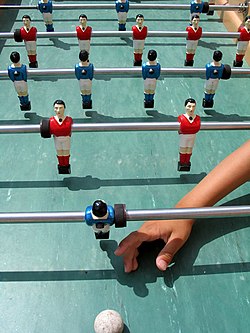
Table football, known as foosball (fußball)[a] or table soccer in North America, is a tabletop game loosely based on association football.[1] Its objective is to move the ball into the opponent's goal by manipulating rods which have figures attached resembling football players of two opposing teams. Although its rules often vary by country and region when the game is played casually, competitive-level table football is played according to a unified code.

Key Information

History

[edit]
Table football

Patents for similar table games date back as early as the 1890s in Germany and France. In 1921, Harold Searles Thornton patented the game in the United Kingdom as "Apparatus for playing a game of table football", seen as the first patent for a game with the same core playing features as the modern game.[2][3] His design inspiration came from a box of matches.[3]

Children enjoy table football

Belgian magazine Le Soir illustré claimed in 1979 the French inventor Lucien Rosengart (1881–1976) came up with the game of table football in the 1930s when he was looking for things to keep his grandchildren entertained during the cold winter months. He called the game babyfoot.[4][5]

Galician inventor Alejandro Finisterre patented his invention of table football, futbolín, in Madrid in 1937. His version is the one used in modern-day table football.[6]

The game was eventually brought to the United States in the 1950s by Lawrence Patterson, reaching its peak of popularity there in the 1970s, when it could be found in bars and pool halls throughout the country.[3] The name foosball became common in the United States via German imports that called it "tischfußball" (lit. "table football").[7][8]

In 2002, the International Table Soccer Federation (ITSF) was established in France with the mission of promoting the game. It acts as an organising sports body, regulating international competitions and establishing the game with the International Olympic Committee and General Association of International Sport Federation.[3]

The game

[edit]
Table football during Wikimedia's hackathon

The game involves using figures mounted on rotating bars to kick a ball into the opposing goal. Table football tables can vary in size, but a table for adult play is typically 150 cm long and 90 cm wide, while smaller tables are typically built for children usage. The table usually contains eight rows of foos men, which are plastic, metal, wooden, or sometimes carbon-fibre figures mounted on horizontal metal bars. Each team of one or two human players controls four rows of foos men, one row each for the goalkeeper, defenders, midfield and strikers. Players manipulate the rods to control the figures, using them to hold up, pass or 'kick' the ball. Games begin when the ball is served through a hole at the side of the table, or simply placed by hand at the feet of a figure in the centre of the table. A coin toss is usually used to determine which player or team serves first. If it is not the first match or if the ball gets out of play or if the ball suddenly stops out, then the team scored last would get the serve after he scores one. The term for when the ball leaves the table or gets stopped somewhere out of the men-like figures’ reach is dead ball.[9] Expert players have been known to move balls at speeds up to 56 km/h (35 mph) in competition.[10]

A Greek table football player

The rules prohibit "over 360-degree shots", or "spinning": using the palm of the hand to swiftly spin the bar all around, instead of using wrist strokes to kick the ball with a bar-mounted figure.[11] Since the establishment of the International Table Soccer Federation (ITSF), the rules have become standardised in most international competitions. The rules say that a full 360-degree rotation before or after hitting the ball is considered spinning, and thus forbidden (although, if a spinning rod hits the ball backwards into their own goal, it will count as a goal for the opposing team). If an ungrasped rod is spun by the force of a ball hitting a player figure on the rod, the spin will be considered legitimate.[11]

The winner is determined when one team scores a predetermined number of goals, typically five, ten or eleven in competition. When playing Bonzini competitions, the target number of goals is seven and players must win by at least two clear goals.

The following arrangement is common to ITSF competition tables,[12] though there are substantial variations, particularly in Spain and South America, where the Futbolín table model (or variants) is common and uses a different configuration. Looking from left to right on one side of the table, the configuration is usually as follows:

Row Position Number
of men
(variant)
Typical colours
1 Goalkeeper 1 (3) red or black
2 Defence 2 (3) red or black
3 Opponent's attack 3 (2) blue or white
4 Midfield 5 (4) red or black
5 Opponent's midfield 5 (4) blue or white
6 Attack 3 (2) red or black
7 Opponent's defence 2 (3) blue or white
8 Opponent's goalkeeper 1 (3) blue or white

Table football can be played by two individuals (singles), and also with four people (doubles), in which there are teams of two people on either side. In this scenario, one player usually controls the two defensive rows and the other team member uses the midfield and attack rows. In informal matches, three or four players per side are also common.

Federations

[edit]

Competition

[edit]
A Garlando style table with a game in progress
An 11-per-side Leonhart table football game in Berlin
The largest table football using 1-metre Buddy Bear figures was set up in Berlin for the 2006 FIFA World Cup

Table football is often played for fun in pubs, bars, workplaces, schools, and clubs with few rules. Table football is also played in official competitions organized by a number of national organizations, with highly evolved rules and regulations.

The ITSF now regulates International events including the annual World Championships and the World Cup. The World Cup was originally intended to coincide with the FIFA World Cup, but since January 2009 it has run annually. In the ITSF World Cup and World Championships 2013, almost 500 players from 30 countries congregated in Nantes, France to compete.

Polish president Lech Kaczyński and coach of the Polish national team Leo Beenhakker play table football

The ITSF World Tour has also recently expanded to include Asian countries. China, Taiwan and Malaysia played host to ITSF sanctioned tournaments in 2013.[13] In 2016, the Philippines hosted The Manila Bay Open.

Tables

[edit]

A vast number of different table types exist. As of 2019, there are 5 official ITSF table brands (Bonzini, Roberto Sport, Garlando, Tornado, Leonhart), which are involved in an ITSF World Cup and World Championships and which may host an ITSF World Series.[14] In the past, these brands also included Fireball, Eurosoccer and Tecball. Moreover, ITSF recognises additional brands for international and professional tournaments, namely Warrior, Fireball, Ullrich Sport, Rosengart and Guardian.

Several companies have created "luxury versions" of table football tables. There was a 7-metre table created by artist Maurizio Cattelan for a piece called Stadium. It takes 11 players to a side. Differences in the table types have great influence on the playing styles. Most European tables have one goalie whose movements are restricted to the goal area while they have corners that are sloped, while a minority of brands in America utilises 3 goalies and flat corners. Another major difference between table types is found in the balls, which can be made of wood (cork in the case of traditional French tables), various forms of plastic or rarely even marble and metal, varying the speed of shots a great deal, as well as the "grip" between the man and the ball and the ball and the playing surface.

Robotic players

[edit]

The table football robot Foosbot is claimed to have been beaten by a human several times, but has been tested against expert players.[15][16] Yet another table football robot is under development by two students at the Technical University of Denmark. The robot uses a camera mounted above an ordinary table.[17] Another bot has been developed by two students at the EPFL in Switzerland.[18]

Specific terms

[edit]

"Snake-shot" or "roll-over" are both terms used to describe when the ball is shot from the offensive players striker position with a pin near the forward of the ball and full utilization of the degrees of motion allowed. After the pin the offensive player uses their wrist to rotate their striker and shoot the ball with maximum strength towards the desired angle[19]

"Back-stabbing" - a term used when the ball is hit against the wall. Afterward, it rebounds into the back of the opposing defensive player and ends up in the opponent's goal. This move is rarely seen in professional matches due to the high skills required for execution but can be highly effective against well-organized defenses. The element of surprise and special techniques are employed to catch the opponent off guard.[citation needed]

See also

[edit]

Notes

[edit]

References

[edit]
[edit]
Revisions and contributorsEdit on WikipediaRead on Wikipedia
from Grokipedia
Table football, also known as foosball or table soccer, is a that simulates , in which opposing players or teams manipulate rotating rods affixed with miniature figures to control a small and score goals by propelling it into the opponent's net at either end of a rectangular cabinet-like table. The game typically features eight rods per side—four controlled by each player in a two-player —representing positions such as goalkeepers, defenders, midfielders, and forwards, with the objective outdoor soccer by outscoring the opponent within a set time or to a predetermined goal total. The origins of table football trace back to late 19th-century , where early patents for rod-based tabletop games emerged in countries like , , and , though these precursors differed from modern designs by lacking fully enclosed fields or precise player figures. The first recognizable patent for a contemporary version was patented in 1923 by British inventor Harold Searles Thornton, who registered "Apparatus for Playing a Game of Table Football" in the , inspired by soldiers playing with matchboxes during ; Thornton later patented a similar design in the United States in 1927. Commercial production began in the 1930s, with Spanish inventor Alejandro Finisterre patenting a version in 1937 amid the , and the game gained traction in and the U.S. post-World War II, evolving into a recreational pastime in bars, homes, and arcades. Competitive play emerged in the mid-20th century, with forming the first league in 1950, leading to the establishment of national federations across by the . Key rules, standardized by the International Table Soccer Federation (ITSF) since its founding in 2002, prohibit excessive rod spinning (beyond 360 degrees), require the ball to be in motion during play, and mandate re-serves from the side where the ball exited, with matches typically lasting 5 to 10 minutes per half or to 5 goals in tournament formats. Official tables, such as those from manufacturers like Bonzini, Garlando, , Roberto Sport, and Leonhart, must meet ITSF specifications for dimensions (approximately 150 cm long by 78 cm wide by 86 cm high), rod materials, and player configurations to ensure fair play in sanctioned events. Today, table football is governed internationally by the ITSF, a non-profit organization headquartered in that promotes the through world championships, tours, and anti-doping protocols—including the first tests conducted in 2025—with more than 60 member countries and annual events attracting thousands of competitors in categories including singles, doubles, juniors, seniors, and women. The ITSF also launched the World Champions League in 2025 to expand club competitions globally. The fosters global community and skill development, blending strategy, reflexes, and teamwork, while commercial tables remain popular for casual entertainment worldwide.

History

Origins and Early Development

The earliest documented concepts for table football-like games emerged in during the late , with patents for similar tabletop soccer apparatus filed in and in the 1890s, though these were rudimentary and not widely adopted. The game as recognized today originated in the , where Thornton, inspired by a 1921 football match and a box of matches, developed a prototype featuring a rectangular wooden table with goals at each end and multiple horizontal rods controlling player figures. Thornton filed a on October 14, 1922, for "Apparatus for playing a game of table football" ( Patent No. 205991), which was granted on November 1, 1923; this design included eight rods per side, attached figures, and a playing field simulating a . Early prototypes, including Thornton's, were constructed primarily from for the cabinet and playing surface, with basic metal passing through the sides to manipulate the figures, often using simple bearings for rotation. These materials provided a functional but fragile structure, prone to warping from humidity and bending under vigorous play, while the handcrafted assembly drove high production costs that restricted manufacturing to small-scale operations in the UK during the . Commercial production began tentatively in in the late and , with French inventor Rosengart introducing "baby-foot" tables around 1931, designed for café use and featuring improved wooden cabinets, and German "kicker" models emerging shortly after, emphasizing sturdy metal components for bar settings. In , during the , Alejandro Finisterre patented "futbolín" in 1937 as a therapeutic game for injured children, using affordable wood and wire rods to promote rehabilitation through simulated soccer play. Across , these early tables spread primarily through pubs and homes, but durability issues and economic constraints from the interwar period limited widespread availability. In the United States, Thornton's relative, Louis Thornton of , imported and adapted the design, securing a U.S. in 1927 (No. 1,615,491), yet initial imports remained niche, confined to novelty sales before broader adoption post-World War II.

Modern Evolution and Global Spread

Following , table football experienced a significant boom in the United States, where returning soldiers introduced the game after encountering it in during the war. This led to increased commercialization, with the development of durable, tournament-style tables that facilitated its transition from a casual pastime to a structured recreational and competitive activity. Key emerged in the , including , which became synonymous with professional play due to its robust design and counterbalanced rods, revolutionizing the sport's accessibility in bars and arcades. In , Italian manufacturer Garlando entered the market in , producing high-quality tables that emphasized craftsmanship and soon rivaled American models in international popularity. The and marked a period of rapid expansion, driven by the proliferation of coin-operated tables in arcades, taverns, and recreational venues across the U.S. and ; the adoption of molding techniques during this era drastically reduced production costs, enabling affordable home versions and broader consumer adoption. This surge transformed table football into a staple of social entertainment, with sales peaking as manufacturers scaled up to meet demand in public and private settings. The game's global spread accelerated in the late 20th century, particularly in , where adapted it as "futebol de mesa," blending local soccer culture with competitive leagues that drew thousands of participants. In Asia, established organized leagues in the , fostering a dedicated player base through school and club programs, while adoption in grew through community centers and international exchanges, promoting it as an accessible in resource-limited areas. Key milestones included the inaugural U.S. Open tournament in 1975, which professionalized competition and attracted top players nationwide, and the formation of the International Table Soccer Federation (ITSF) in 2002 in , which standardized rules and coordinated worldwide events to elevate its status as a global sport. In recent years up to 2025, the sport has seen innovations focused on and , with manufacturers introducing eco-friendly tables constructed from renewable materials like recycled plastics and to align with environmental standards. Digital integrations, such as automated scoring systems and app-connected features for tracking matches, have enhanced competitive play and fan engagement, particularly in circuits, while maintaining the game's core analog appeal.

Gameplay

Basic Rules and Objectives

Table football, commonly known as foosball, is played on a specialized table featuring eight horizontal rods—four per side—that extend through the cabinet and control rows of pivoting player figures. Each side typically has 11 to 13 figures distributed across : one goalie rod (1 or 3 figures), a two-man defensive rod, a five-man midfield rod, and a three-man attacking rod, with the exact configuration varying by approved table brands such as Garlando or under ITSF standards. The ball enters play through a dedicated serve hole located near the midfield rod on one side of the table. The primary objective is to score more goals than the opposing by using the controlled figures to propel a small into the opponent's goal at the far end of the table. A standard game is usually played to the first reaching 5 goals, with matches often structured as best-of-three or best-of-five games to determine the overall winner. Core rules mandate that players manipulate the to strike the with the attached figures; freely spinning without ball contact is illegal, as is excessive jiggling, lifting, or shaking of the table, which can disrupt fair play. Players have 10 seconds to play the from the 5-rod and 15 seconds from other (goalie and 2-rod combined), after which possession is awarded to the opponent. Serving begins with the placed in the serve hole and released to roll onto the five-man rod, with serve rights alternating to the that conceded the previous goal after each score. Games are contested in singles format, where one player per side controls all four rods simultaneously, or doubles format, where two players per side divide responsibilities—typically one handling the two defensive rods (goalie and two-man) and the other the two offensive rods (five-man and three-man)—to coordinate defense and attack. Common fouls include reaching into the playfield to touch the ball by hand or any body part, causing the ball to leave the table boundaries, or deadening the ball intentionally; such violations render the ball out of play, typically resulting in a re-serve by the opposing team or, for fouls such as hand contact with the ball, a point award to the non-offending side if it prevented a goal, or a penalty shot or possession award otherwise.

Techniques, Strategies, and Player Roles

Table football, commonly known as foosball, demands precise techniques for effective play, particularly in passing and shooting. One fundamental technique is the tic-tac passing series, which involves rapid, alternating bounces of the ball between adjacent players on the 5-bar rod to maintain possession and evade defenders. This method, often starting with controlled power to let the ball's momentum do the work, allows for quick midfield control and sets up offensive opportunities. Shooting techniques further enhance scoring potential; the pull shot retracts the rod to strike the ball laterally toward the goal, while the push shot advances the rod forward for a direct drive. The , a more advanced maneuver, combines wrist rotation with lateral rod movement to curve the ball unpredictably past the . Rod control speed is crucial across these techniques, as excessive velocity can lead to loss of accuracy, whereas measured spins ensure the ball stays under the player's influence. Strategies in competitive table football balance offense and defense to exploit opportunities while minimizing vulnerabilities. Defensive blocking prioritizes positioning the 2-bar and goalie to cover potential shot paths, often pairing players at angles—front man backward, back man forward—to maximize coverage without gaps. In contrast, aggressive offense focuses on rapid transitions from midfield control to forward shots, using tic-tac passes to draw defenders out of position. Ball control in the midfield, particularly with the 5-bar, enables sustained pressure, while adapting to opponent weaknesses—such as anticipating pull shots by shifting goalie alignment—involves psychological elements like feigned openings to induce errors. Player roles vary by format, emphasizing coordination in team play. In doubles matches, one player typically manages the 3-bar and 5-bar rods for midfield offense and passing, while the other controls the 2-bar and goalie rods for defense and counterattacks; once the ball is in play, players remain on their assigned rods. Singles play requires a single player to handle all eight rods, demanding seamless full-table coordination and quick shifts between offensive and defensive duties. Effective doubles success hinges on non-verbal cues for synchronized movements, such as signaling passes or blocks. Skill progression in table football evolves from basic coordination to professional-level precision. Beginners focus on consistent ball pinning and simple wrist flicks to propel shots, gradually building speed and accuracy through repetitive drills. Intermediate players refine timing for tic-tac passes and snake shots, emphasizing relaxed grips for fluid rod control. At the professional level, mastery involves split-second adaptations, such as varying shot power to counter defensive setups. Common errors can undermine performance, particularly over-spinning rods, which reduces control and often results in turnovers or dead balls, as it violates rules against uncontrolled rotations. In team play, poor communication—such as failing to anticipate a partner's block or pass—leads to misaligned defenses and lost possessions, emphasizing the need for practiced synergy.

Equipment

Table Designs and Components

Table football tables consist of a rectangular cabinet enclosing a horizontal playfield, designed to simulate a soccer pitch while allowing rods to pass through the side walls for player control. The core structure includes a wooden or cabinet that supports the playfield, typically elevated on four legs for optimal playing height. Side and end walls are constructed from or plexiglass to contain the within the field and provide clear visibility during gameplay. Metal rods, usually 5/8 inch (16 mm) in , protrude through the side walls, enabling rotational movement without direct hand contact with the ball. Key functional components enhance gameplay flow and stability. Goal areas positioned at each end of the playfield, with openings spanning the width between the side walls (typically around 25-27 inches) to allow the ball to enter the scoring chute. Scorekeepers, either manual sliding markers or electronic displays, are mounted above the goals to track points accurately. Ball return chutes at the ends allow scored balls to return to the serving side efficiently, minimizing downtime. Leg levelers, adjustable feet on the table's base, ensure a flat, stable surface even on uneven floors, preventing ball deflection during play. Materials have evolved significantly for durability and performance. Prior to the 1960s, tables were primarily built from , which provided a sturdy but heavy frame prone to warping over time. Modern designs shifted to laminated particleboard cabinets coated with or similar laminates on the playfield surface, offering low-friction play, resistance to wear, and lighter weight for easier transport. These laminates, often 1.5 mm thick, ensure consistent ball roll and longevity in tournament settings. Plexiglass walls, typically 8-10 mm thick, replace early wooden or metal barriers for shatter resistance and reduced weight. ITSF regulations standardize dimensions to promote fair competition across brands. The overall table measures approximately 56 inches (142 cm) long, 30 inches (76 cm) wide, and 36 inches (91 cm) high, with the playfield itself spanning 43.7-47.2 inches (111-120 cm) in length and 25.2-27.6 inches (64-70 cm) in width. Rod clearance must allow at least 0.5 inches of play to prevent binding, and the playfield height from the floor is fixed at 36 inches for ergonomic access. These specs apply to official tables from approved manufacturers like Tornado and Garlando. Proper maintenance is essential to preserve functionality and extend table life. The playfield should be cleaned regularly with a mild soap solution or rubbing alcohol to remove dust, residue, and silicone buildup, using a soft cloth to avoid scratches. Rods require lubrication with 100% silicone spray every few months—applied sparingly to bushings and wiped clean—to minimize friction and ensure smooth rotation. Avoid oil-based lubricants, as they attract dirt and degrade performance. Periodic checks for levelness using the leg adjusters prevent uneven wear on components.

Figures, Rods, and Accessories

Table football figures, also known as players or men, are the miniature athletes attached to that players manipulate to control the . In standard configurations, each side features 11 figures distributed across four rods: one goalie on the goalie rod, two defenders on the defensive rod, five midfielders on the midfield rod, and three attackers on the offensive rod. These figures are typically constructed from durable , though wooden variants exist in some traditional designs, and are counterbalanced to ensure they remain upright and aligned during rapid rotations, preventing them from flopping and disrupting play. The feet of the figures vary in design, with flat soles providing enhanced grip and kicking power for precise shots, while rounded feet allow for smoother movement and passing across the field. Rods, the horizontal bars to which figures are fixed, form the core mechanism for gameplay control. They are commonly made of hollow for reduced weight and increased speed, with a standard diameter of 5/8 inch (approximately 15.9 mm) to balance rigidity and maneuverability; aluminum rods are also used in some models for even lighter operation. Each rod extends through the table's side walls and features ergonomic handles, often plastic or rubberized for secure grip, at one end. The rods support twisting and spinning motions—up to 360 degrees without penalty in most rules—to simulate player actions, facilitated by high-quality bearings or bushings at the side walls for smooth, frictionless . Rod weight directly influences play dynamics, as lighter hollow designs enable faster spins and quicker responses, enhancing offensive speed, while heavier solid rods offer greater control for defensive positioning. Accessories enhance functionality, maintenance, and personalization of table football equipment. Replacement balls are essential, standardized at approximately 35 mm (1.38 inches) in diameter and made from or cork-core materials for optimal bounce and grip on the playfield; cork variants provide better control in professional settings due to their textured surface. Scorekeeping aids, such as sliding beads mounted along the table's edges, allow players to track goals without interruption. Protective covers shield the table from dust and damage when not in use, while custom handles—available in various grips like rubber or ergonomic shapes—improve player comfort during extended matches. Customization options allow users to figures and rods to preferences or team aesthetics. Figures come in contrasting colors, typically red and blue for each side, to improve visibility during fast-paced play, and can be adjusted for height or tightened on rods to optimize alignment, which is crucial for accurate passing and shot precision. Such modifications ensure figures maintain consistent contact with the ball, reducing errors in ball handling and contributing to in gameplay.

Organizations and Competitions

Governing Federations and Leagues

The International Table Soccer Federation (ITSF), founded on August 26, 2002, in , acts as the central global authority for table soccer, promoting the sport's development, standardizing equipment and play, and fostering unity among diverse regional styles such as American and European Bonzini variants. As a non-profit organization headquartered in , , the ITSF sanctions international competitions, maintains official player and national rankings, and enforces policies including anti-doping compliance aligned with the (WADA) code to ensure integrity in professional play. In the , the United States Table Soccer Federation (USTSF), established in 2002 as one of the ITSF's founding members, provides national-level , focusing on domestic , player certification through rankings, and alignment with international standards to support unified rule application across borders. The USTSF traces its roots to earlier efforts in professionalizing the sport via tours and leagues, evolving into a structured body that coordinates with the ITSF for global participation. Regional federations play key roles in local standardization and growth under the ITSF umbrella. The European Table Soccer Union (ETSU), formed in 1976, was instrumental in early continental coordination, organizing leagues and contributing to rule harmonization before integrating efforts with the ITSF. In , the Brazilian Table Soccer Federation (Futebol de Mesa do Brasil), created on January 21, 2007, and affiliated with the ITSF since 2014, codifies national rules and promotes competitive play while adhering to international guidelines. Asian bodies include the Japan Table Soccer Federation, founded on July 2, 1999, and ITSF-affiliated since 2007, which focuses on regional development, player training, and youth initiatives to expand the sport's footprint. The ITSF's roles extend to comprehensive rule codification through its Standard Matchplay Rules (SMR), which have undergone periodic updates—such as refinements to matchplay procedures and penalties—to accommodate global styles and ensure equitable competition, with ongoing revisions informed by federations and players. Player certification occurs via official rankings and tournament validations, while anti-doping policies mandate testing at sanctioned events to uphold professional standards. By 2025, the ITSF includes national federations from over 50 countries, with recent expansions such as the Haitian Table Soccer Federation, and emphasizes inclusivity by integrating women's divisions and youth categories into rankings and events to broaden participation.

Major Tournaments and Events

The International Table Soccer Federation (ITSF) organizes the premier global competitions in table soccer, including the World Championships and the . The World Championships, which began in 2002, feature competing in singles and doubles across men's, women's, and junior categories (under 18 years as of December 31). These events emphasize freestyle rules and are held annually or biennially. The , the sport's flagship national team competition, debuted in 2006 in , , where 20 teams and 200 players participated, with winners varying by category. Subsequent World Cups have expanded internationally, such as the 2025 event in , , which included multitable formats to accommodate diverse player qualifications and featured the first anti-doping tests, all with negative results. In the United States, the US Open stands as the largest annual singles and doubles tournament, organized by International Foosball Promotions (IFP) and predominantly using tables. Professional foosball tours, including precursors to the modern US Open, emerged in the mid-1970s with high-stakes events like the 1975 Tournament Soccer Quarter Million Dollar Tour, marking the onset of organized competitive play on American soil. The contemporary US Open continues this tradition, drawing top professionals for open divisions and offering substantial competition on standardized equipment. European competitions trace their roots to the European Table Soccer Union (ETSU), established in 1976 to coordinate continental play. The ETSU facilitated the first European Cup tournaments, fostering rivalries among national teams from countries like , , and under freestyle regulations. Today, ITSF-sanctioned European events, such as the annual European Champions Cup, build on this legacy by qualifying top performers from regional tours for broader international contention. Major tournaments typically feature divisions for open (professional), women's, and junior players, with formats including singles, doubles, and play to promote inclusivity and skill development. Prize money has grown significantly, reaching up to $155,000 in total pools for events like the 2025 World Foosball Tour (WFT) World Championships in New Orleans, where winners in open categories can claim tens of thousands individually. Other high-profile prizes include $70,000 at the UAE Foosball Championships, underscoring the of the sport. Historical milestones include the first major international gathering in 1982 in , which helped unify fragmented regional scenes, and large-scale events like the 2013 ITSF and Championships that attracted hundreds of players from dozens of countries. Record attendance has been noted at Brazil-hosted tournaments in the 2010s, boosting the sport's visibility in . Post-2020, tournaments adapted to global challenges with expanded online registration systems and virtual qualifiers to maintain momentum during restrictions, enabling broader participation without initial travel. Hybrid formats combined in-person finals with remote preliminaries, as seen in ITSF Pro Tour events that resumed safely.

Variations and Advanced Topics

Regional Styles and Table Variations

Table football exhibits significant regional variations in table design, playstyles, and rules, reflecting local preferences and historical developments. The American style, popularized by Tornado tables since the 1970s, prioritizes speed and aggressive play through features like loose bearings on hollow chrome steel rods, which enable rapid rod movements and powerful shots. This configuration fosters a fast-paced game focused on ball control via counterbalanced plastic figures and a hard, level playing surface, often with three figures on the goalie rod to cover more ground. In contrast, European styles, dominant in Italy and France, emphasize precision and tactical passing on tables like Garlando or Bonzini models, which use tighter rod tensions and telescopic rods for enhanced safety and control. These tables typically feature a single figure on the goalie rod and metal or composite figures molded directly to the rods, promoting fluid, pinned-position play where the ball is maneuvered with subtle wrist actions rather than sheer force. Rule differences further distinguish these styles, particularly regarding spinning. In the United States, many leagues permit rod spinning—rotating the handle more than 360 degrees without contacting the ball—as a legal tactic for defense or offense on Tornado-style tables, aligning with the emphasis on power. European regulations, however, strictly prohibit spinning to maintain skill-based play, viewing it as lacking and potentially damaging equipment; this rule is enforced in competitions using Garlando or similar tables. Table dimensions also vary: American models are commonly around 4 feet by 2 feet with a focus on compact, arcade-friendly setups, while European tables often measure closer to 5 feet in length for more expansive field play. Beyond these major styles, other regions showcase unique adaptations. In Germany, solid-rod tables from manufacturers like Leonhart provide greater rigidity and power transmission, suiting a playstyle that rewards strong, direct shots on durable, precision-engineered surfaces made from solid wood. Portable or freestanding table designs without traditional legs are available in various regions, catering to casual, space-efficient play in homes or outdoor settings. These adaptations highlight cultural shifts, such as the prevalence of robust tournament tables in Europe versus lighter, portable mini-versions for recreational use in various regions.

Robotic Players and Innovations

Early experiments in robotic table football emerged in the early , with the development of KiRo, an autonomous robot created by researchers at the in . Presented in , KiRo utilized a camera mounted above the table to observe the playing field and controlled four rods on one side of a standard table, enabling it to compete against human players by reacting to ball movements and executing basic shots and defenses. This system marked one of the first fully autonomous implementations, demonstrating AI-driven rod control through real-time image processing and motor actuation, though it was limited to reactive play without advanced strategy. Advancements in the introduced more sophisticated systems integrating and . In 2016, students at the (EPFL) in developed a robotic foosball player capable of defeating average human opponents, using a under the transparent table surface to track the ball at 300 frames per second and linear actuators for precise rod movements. Similarly, engineers created an AI-controlled table that year, employing to analyze plays and predict ball trajectories, achieving wins against novice players in exhibition matches. By the 2020s, projects like the 2022 neuromorphic robot from explored brain-inspired computing for faster decision-making, while independent developer Xander Naumenko's Foosbar in 2024 demonstrated near-human speed in passing and shooting, using custom servos and AI to outperform casual players. Innovations have extended beyond full robotic players to enhance and customization. Sensor-equipped tables, often featuring overhead or under-table cameras for tracking, allow real-time analysis of player performance and automated scoring, as seen in 2023 prototypes that generate commentary and highlight reels during games. simulations, such as Foosball VR released in 2018, provide immersive practice environments mimicking physical rod control with haptic feedback, enabling solo on tactics without a physical table. Additionally, has enabled custom figures, with open-source designs on platforms like allowing users to create personalized players with optimized grips for better control since the mid-2010s. These technologies find applications in and AI research, serving as benchmarks for multi-agent learning and real-time control, as outlined in recent studies evaluating foosball as a for robot coordination. In , robotic systems feature in exhibitions and viral demonstrations, such as human-versus- matches that highlight AI capabilities. For , automated opponents support players with intellectual disabilities or motor impairments by adjusting difficulty and providing evaluative feedback, as demonstrated in a 2019 system designed for therapeutic play. Despite progress, challenges persist, including control latency from sensor processing and actuation delays, which hinder responses to fast-paced play, and difficulties in adapting algorithms to the unpredictability of opponents' strategies. As of 2025, robotic players remain confined to prototypes and recreational demos, with no integration into professional competitive table football.

Specific Terminology and Culture

Table football, commonly known as foosball, features a specialized that reflects its tactical depth and competitive nuances. Key terms include "jiggling," which refers to subtly shaking the table to disrupt an opponent's control or ball movement, often considered a form of but regulated in formal play to prevent excessive distraction. The "worm" describes a repetitive , where the ball is maneuvered in a winding path through defensive lines using quick rod manipulations, prized for its unpredictability in offensive strategies. A "dead ball" occurs when the ball comes to a complete stop within the playing field and becomes unreachable by any figures on the rods, typically resulting in a replay from the last serving side. Precise passing between the three-man and five-man offensive rods enables rapid ball advancement with minimal exposure to defense. Beyond the table, foosball has ingrained itself as a cultural staple, particularly in bars and pubs across the and , where it serves as an accessible fostering social bonds among patrons through casual and shared excitement. This communal role extends to family gatherings and recreational venues, promoting interaction and light-hearted rivalry that strengthens relationships. In media, foosball has appeared in films like the 2007 short 2 Strangers and a Foosball, which humorously explores romance and at a foosball party, highlighting its appeal as a social backdrop. Video games have also incorporated foosball elements, including tabletop simulations tied to major soccer brands, such as FIFA-licensed portable versions that blend digital and physical play for broader accessibility. The foosball community thrives through dedicated clubs, local leagues, and online platforms, with sites like Foosball.com—established in the 1990s—serving as hubs for forums, tutorials, and player discussions that connect enthusiasts worldwide. Professional tours in the 2020s, such as the World Foosball Tour, have elevated players like Tommy Yore and Hannah Smith to prominence within the sport, drawing crowds and streaming audiences akin to niche celebrity circuits. Globally, tournaments function as vibrant social events, blending competition with camaraderie, while gender inclusion has advanced notably; women's world championships, organized by bodies like the International Table Soccer Federation (ITSF), have been held regularly since the early , promoting parity and expanding participation. The recreational foosball market highlights its cultural footprint, with estimates in the hundreds of millions of USD as of 2025. Etiquette in foosball emphasizes , with players expected to respect opponents, avoid physical interference during play, and adhere to distraction rules that limit excessive noise or movement. Trash-talking persists as a tradition in informal settings, adding levity and psychological edge, but is moderated in competitive environments to maintain fairness and enjoyment for all.

References

Add your contribution
Related Hubs
User Avatar
No comments yet.