Hubbry Logo
Arches of the footArches of the footMain
Open search
Arches of the foot
Community hub
Arches of the foot
logo
8 pages, 0 posts
0 subscribers
Be the first to start a discussion here.
Arches of the foot
Arches of the foot
from Wikipedia
Arches of the foot
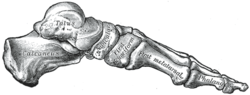
Skeleton of foot. Medial aspect.
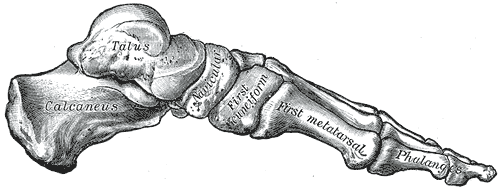
Skeleton of foot. Lateral aspect.
Details
Identifiers
Latinarcus pedis
Anatomical terminology

The arches of the foot, formed by the tarsal and metatarsal bones, strengthened by ligaments and tendons, allow the foot to support the weight of the body in the erect posture with the least weight.

They are categorized as longitudinal and transverse arches.

Structure

[edit]

Longitudinal arches

[edit]

The longitudinal arches of the foot can be divided into medial and lateral arches.[1]

Medial arch

[edit]
Skeleton of foot. Medial aspect.

The medial arch is higher than the lateral longitudinal arch. It is made up by the calcaneus, the talus, the navicular, the three cuneiforms (medial, intermediate, and lateral), and the first, second, and third metatarsals.[1]

Its summit is at the superior articular surface of the talus, and its two extremities or piers, on which it rests in standing, are the tuberosity on the plantar surface of the calcaneus posteriorly and the heads of the first, second, and third metatarsal bones anteriorly. The chief characteristic of this arch is its elasticity, due to its height and to the number of small joints between its component parts.[1]

Its weakest part (i.e., the part most liable to yield from overpressure) is the joint between the talus and navicular, but this portion is braced by the plantar calcaneonavicular ligament a.k.a. spring ligament, which is elastic and is thus able to quickly restore the arch to its original condition when the disturbing force is removed. The ligament is strengthened medially by blending with the deltoid ligament of the ankle joint, and is supported inferiorly by the tendon of the tibialis posterior, which is spread out in a fanshaped insertion and prevents undue tension of the ligament or such an amount of stretching as would permanently elongate it.[1]

The arch is further supported by the plantar aponeurosis, by the small muscles in the sole of the foot (short muscles of the big toe), by the tendons of the tibialis anterior and posterior and fibularis longus, flexor digitorum longus, flexor hallucis longus and by the ligaments of all the articulations involved.[1]

Lateral arch

[edit]
Skeleton of foot. Lateral aspect.

The lateral arch is composed of the calcaneus, the cuboid, and the fourth and fifth metatarsals.[1]

Two notable features of this arch are its solidity and its slight elevation. Two strong ligaments, the long plantar and the plantar calcaneocuboid, together with the extensor tendons and the short muscles of the little toe, preserve its integrity.[1]

Fundamental longitudinal arch

[edit]

While these medial and lateral arches may be readily demonstrated as the component antero-posterior arches of the foot, the fundamental longitudinal arch is contributed to by both, and consists of the calcaneus, cuboid, third cuneiform, and third metatarsal: all the other bones of the foot may be removed without destroying this arch.[1]

Transversal arch

[edit]
Cross section of feet showing metatarsal bones forming anterior arch: A = normal position, B = flattened arch

In addition to the longitudinal arches the foot presents a series of transverse arches.[1]

At the posterior part of the metatarsus and the anterior part of the tarsus the arches are complete, but in the middle of the tarsus they present more the characters of half-domes, the concavities of which are directed downward and medialward, so that when the medial borders of the feet are placed in apposition a complete tarsal dome is formed. The transverse arch is composed of the three cuneiforms, the cuboid, and the five metatarsal bases. The transverse arch is strengthened by the interosseous, plantar, and dorsal ligaments, by the short muscles of the first and fifth toes (especially the transverse head of the adductor hallucis), and by the fibularis longus, whose tendon stretches across between the piers of the arches.[1]

Function

[edit]

The medial longitudinal arch in particular creates a space for soft tissues with elastic properties, which act as springs, particularly the thick plantar aponeurosis, passing from the heel to the toes. Because of their elastic properties, these soft tissues can spread ground contact reaction forces over a longer time period, and thus reduce the risk of musculoskeletal wear or damage, and they can also store the energy of these forces, returning it at the next step and thus reducing the cost of walking and, particularly, running, where vertical forces are higher.[2]

Clinical significance

[edit]

Research shows that men are more likely to have arched feet than women, and studies have reported that women are more likely to have flat feet than men.[3] Women who do have arched feet who experience pregnancy and may experience a flattening of their arched feet, as the surge of female sex hormones such as estrogen can cause the tendons in their feet to soften and relax, to the extent that their arched feet become flat.[4]

The anatomy and shape of a person's longitudinal and transverse arch can dictate the types of injuries to which that person is susceptible. The height of a person's arch is determined by the height of the navicular bone. Collapse of the longitudinal arches results in what is known as flat feet.[5] A person with a low longitudinal arch, or flat feet will likely stand and walk with their feet in a pronated position, where the foot everts or rolls inward. This makes the person susceptible to heel pain, arch pain and plantar fasciitis.[6] Flat footed people may also have more difficulty performing exercises that require supporting their weight on their toes.

People who have high longitudinal arches or a cavus foot[7] tend to walk and stand with their feet in a supinated position where the foot inverts or rolls outward. High arches can also cause plantar fasciitis as they cause the plantar fascia to be stretched away from the calcaneus or heel bone. Additionally, high or low arches can increase the risk of shin splints as the anterior tibialis must work harder to keep the foot from slapping the ground.[8]

Evolution and other animals

[edit]

The non-human apes (the gibbons, gorillas, orangutans, chimpanzees and bonobos) tend to walk on the lateral side of the foot, that is with an 'inverted' foot,[9] which may reflect a basic adaptation to walking on branches. It is often held that their feet lack longitudinal arches, but footprints made by bipedally walking apes, which must directly or indirectly reflect the pressure they exert to support and propel themselves [10][11] do suggest that they exert lower foot pressure under the medial part of their midfoot.

However, human feet, and the human medial longitudinal arch, differ in that the anterior part of the foot is medially twisted on the posterior part of the foot,[12] so that all the toes may contact the ground at the same time, and the twisting is so marked that the most medial toe, the big toe or hallux, (in some individuals the second toe) tends to exert the greatest propulsive force in walking and running. This gives the human foot an 'everted' or relatively outward-facing appearance compared to that of other apes. The strong twisting of the anterior part of the human foot on the posterior part tends to increase the height of the medial longitudinal arch. However, there is now considerable evidence that shoe-wearing also accentuates the height of the medial longitudinal arch [13] and that the height of the medial longitudinal arch also differs very considerably between individuals and at different speeds.[14]

The presence of high-arched feet in modern humans is a result of natural selection for long-distance running.[15] On the other hand, the primitive trait of arch-less feet in our great ape relatives has been maintained because of selection for grasping tree branches as a part of their arboreal lifestyle.[16] Divergence between ape feet and human feet began with the early human ancestor Ardipithecus ramidus, when strengthened plantar tissue evolved, which supported early terrestrial propulsion before evolving a true arch.[17] However, the skeletal longitudinal arch structure itself did not begin to evolve until Australopithecus afarensis had evolved a relatively low longitudinal arch (compared to modern humans) and the first signs of a transverse arch accompanying it.[17]

It is not yet agreed to what extent the early human ancestor Australopithecus afarensis, (3.75 million years ago onwards) had acquired a functionally human-like foot,[9] but the medial twist of the forefoot evident in fossil footbones of this species, and in the Laetoli footprint trail in Tanzania generally attributed to this species, certainly appears less marked than is evident in fossil footbones of Homo erectus (sometimes called Homo georgicus) from Dmanisi, Georgia (c. 1. 8 million years ago) [18] and the roughly contemporaneous fossil footprint trail at Ileret, Kenya attributed to Homo erectus ergaster.[19]

See also

[edit]

References

[edit]

Bibliography

[edit]
[edit]
Revisions and contributorsEdit on WikipediaRead on Wikipedia
from Grokipedia
The arches of the foot are curved structural formations in the human foot that enable efficient , shock absorption, and during walking and running. These arches consist of two longitudinal arches—a higher and more mobile medial longitudinal arch on the inner side and a lower, more rigid lateral longitudinal arch on the outer side—and a transverse arch that spans the width of the midfoot in the . The medial longitudinal arch extends from the heel () to the ball of the foot, incorporating the talus, navicular, three , and the first three metatarsals, with its apex at the talus serving as a keystone for stability. In contrast, the lateral longitudinal arch is shorter and flatter, formed by the , cuboid, and fourth and fifth metatarsals, providing a stable base for weight transmission. The transverse arch comprises an anterior portion at the metatarsal heads and a posterior portion along the tarsal bones, creating a half-dome shape that maintains foot width and flexibility. These arches are passively supported by a network of ligaments, including the plantar calcaneonavicular (spring) ligament for the medial arch, the long and short plantar ligaments for the lateral arch, and the deep transverse metatarsal ligaments for the transverse arch, which collectively prevent collapse under load. Dynamic support comes from muscles such as the tibialis posterior and (extrinsic) and intrinsic foot muscles like the abductor hallucis and flexor digitorum brevis, which help maintain arch integrity during movement. Functionally, the arches adapt to uneven surfaces, distribute body weight across the foot's contact points (, midfoot, and forefoot), and act as elastic levers that store and release energy for efficient , while also protecting underlying nerves and vessels. Abnormalities in arch structure, such as (pes planus) or high arches (), can disrupt these functions, leading to pain, altered biomechanics, and conditions like .

Anatomy

Medial longitudinal arch

The medial longitudinal arch is the taller and more resilient of the foot's two longitudinal arches, located along the inner aspect and characterized by its elasticity, which enables effective adaptation to ground surfaces during movement. It spans the length of the foot in the , providing essential elevation to the midfoot and facilitating weight distribution. This arch is primarily composed of the posteriorly, the talus, navicular, and three in the midfoot, and the first three metatarsals anteriorly, forming a gentle curve that maintains the foot's structural integrity. Key ligamentous structures provide static support to this arch, with the —commonly known as the spring ligament—serving as the primary stabilizer by bracing the head of the talus against the navicular, preventing excessive flattening. Additional reinforcement comes from the complex of the ankle, which helps maintain medial stability, as well as contributions from the plantar and interosseous ligaments between the tarsal bones. The arch's dynamic support is predominantly supplied by muscles, with the tibialis posterior acting as the chief stabilizer through its insertion across multiple points on the medial arch bones, enabling active maintenance of the curve during . Intrinsic foot muscles, including the abductor hallucis and flexor hallucis brevis, offer supplementary aid by contracting to resist pronation and support the forefoot segment. Structurally, the medial longitudinal arch exhibits its highest elevation at the superior aspect of the talus head, which serves as the summit, imparting a resilient quality due to the presence of multiple flexible articulations between its bony components. This elasticity arises from the synovial joints, such as those at the talonavicular articulation, allowing controlled deformation under load while returning to shape. The talus-navicular joint represents the weakest point in the arch, where ligamentous failure can lead to structural compromise if support is inadequate. In adults, the arch's height typically measures 36-55 mm, underscoring its dominant role in overall foot morphology.

Lateral longitudinal arch

The lateral longitudinal arch of the foot is a flatter and less elevated structure compared to the medial longitudinal arch, providing a rigid base along the outer edge of the foot for direct ground contact and load transfer. It spans from the to the lateral forefoot, contributing to the overall longitudinal balance of the foot while integrating with the transverse arch for reinforcement at the metatarsal bases. This arch is characterized by minimal and increased , distinguishing it from the more elastic and higher medial counterpart. The bony framework of the lateral longitudinal arch consists primarily of the lateral portion of the as the posterior pillar, the as the keystone, and the fourth and fifth metatarsals forming the anterior pillar. A fundamental component within this structure is the transitional rigid base involving the , , third , and third metatarsal, which maintains integrity even under stress. The anterior pillar is relatively long but weaker, while the posterior pillar is shorter and stronger, with the arch's ends—the heads of the fourth and fifth metatarsals anteriorly and the lateral of the posteriorly—typically contacting the ground. Rigidity is enhanced by bony locks at the -metatarsal joints, limiting mobility through fewer articulations compared to the medial arch. Key ligaments supporting the lateral longitudinal arch include the long plantar ligament, which spans from the plantar surface of the across the to the bases of the third, fourth, and fifth metatarsals, acting as a primary stabilizer, and the short plantar ligament, connecting the to the at the for added firmness. The plantar and dorsal ligaments, such as the dorsal metatarsocuboid and dorsal calcaneocuboid, provide supplementary reinforcement. These elements create a bowstring-like tension beneath the arch, maintaining its low profile with the highest point at the level of the on the superior . Muscular support for the lateral longitudinal arch is provided by the tendon, which inserts on the base of the first metatarsal and medial cuneiform but aids lateral stability through its groove on the , along with the and tertius. Intrinsic muscles, including the abductor digiti minimi, flexor digiti minimi brevis, and the lateral portions of the flexor digitorum brevis and longus, contribute limited dynamic support as tie beams. The first layer of sole muscles and the lateral compartment of the further elevate the arch's summit, enhancing its overall stiffness and minimal flexibility for lateral load handling.

Transverse arch

The transverse arch of the foot extends across the midfoot in a , perpendicular to the longitudinal arches, and plays a crucial role in the foot's overall structural integrity by providing lateral stability and adapting to varying loads. It consists of two components: the posterior transverse arch, formed by the tarsal bones, and the anterior transverse arch, involving the metatarsal heads, creating a recessed half-dome configuration that enhances weight distribution across the forefoot. This arch integrates with the longitudinal arches to form a three-dimensional vault, briefly contributing to load spreading during activities. The bony framework of the transverse arch is primarily composed of the , the three (medial, intermediate, and lateral), the , and the bases of all five metatarsals, which articulate to produce the characteristic half-dome shape. The posterior portion, located at the level of the tarsal bones, is more rigid due to the interlocking wedge-shaped cuneiforms and cuboid, while the anterior portion at the metatarsal heads remains flexible to facilitate during gait phases like toe-off. When the soles of both feet are opposed, as in squatting positions, the bilateral transverse arches complete a full dome structure, optimizing ground contact and stability. Support for the transverse arch is maintained by a network of ligaments that bind the bones and prevent collapse under load. Key structures include the interosseous ligaments connecting the to each other and the cuboid-metatarsal ligaments that anchor the metatarsal bases, ensuring precise alignment and resisting lateral shear forces. Additionally, the deep transverse metatarsal ligaments span between the metatarsal heads, further reinforcing the anterior arch's integrity. Muscular contributions are essential for dynamic support and elevation of the transverse arch. The tendon of the muscle inserts at the base of the first metatarsal, acting to elevate and lock the medial aspect of the arch during , thereby preventing excessive pronation. The , with its transverse and oblique heads, provides intrinsic stability by drawing the metatarsals together and resisting arch flattening. The height and adaptability of the transverse arch are influenced by both osseous and elements, with ligaments, tendons, and the plantar contributing substantially to its overall elevation and resilience, allowing the foot to adjust width for terrain variations.

Biomechanics

Load distribution and shock absorption

The arches of the foot serve as mechanical levers that efficiently distribute body weight during static standing and dynamic , preventing excessive stress on any single structure. The medial longitudinal arch supports the majority of the load, primarily through the talar dome, while the lateral longitudinal arch bears the remainder, and the transverse arch aids in spreading pressure across the forefoot metatarsals to maintain balance and reduce localized strain. This distribution allows the foot to adapt to varying terrains, with the spring ligament providing key stability to the medial arch under compressive forces. A primary function of the foot arches is shock absorption during the initial contact phase of , where ground reaction forces at strike can reach 2-3 times body weight in walking and up to 5 times in running. The elastic deformation of the medial longitudinal arch, supported by the and subtalar fat pads, dissipates these impact forces, minimizing the transmission of jarring vibrations to the skeletal system and reducing injury risk. Studies show that flexible arches, such as those in neutral or pronated feet, attenuate peak accelerations more effectively than rigid high arches, with mean heel-strike accelerations as low as 1.3 g in optimal configurations compared to over 2.1 g in cavus feet. The plays a crucial role in this mechanism by winding up under tension like a spring during early stance, storing elastic that is later released for efficient movement. Research indicates that the longitudinal arch contributes 8-17% of the required per stride in running, with the alone storing and returning up to 17 J of energy through low-hysteresis recoil. This energy recycling enhances overall economy by reducing the metabolic demand on lower limb muscles. By optimizing load transfer, the arches also mitigate peak plantar pressures under the metatarsal heads compared to flattened configurations and distribute forces more evenly across the forefoot. This occurs through controlled pronation and supination, allowing the foot to conform to uneven surfaces while maintaining structural integrity and preventing hotspots that could lead to tissue overload.

Propulsion and stability

The arches of the foot play a pivotal role in by facilitating the storage and release of during the cycle. The medial longitudinal arch, in particular, compresses during early stance to absorb impact and recoils in late stance, releasing stored to assist toe-off and forward . This recoil mechanism, often termed the "foot spring," is actively regulated by intrinsic foot muscles such as the abductor hallucis and flexor digitorum brevis, which lengthen eccentrically during compression and shorten concentrically to enhance return. The transverse arch complements this by locking the metatarsal heads into a stable configuration, transforming the foot into a rigid that efficiently transmits during push-off. In terms of stability, the arches maintain postural equilibrium through the windlass mechanism, where dorsiflexion of the tightens the , elevating and stabilizing the medial longitudinal arch to resist midfoot collapse. This tightening provides a stable base, enabling the foot to withstand inversion and eversion torques, with measured inversion resistance averaging around 20 Nm in healthy individuals. The mechanism ensures the foot transitions from a flexible adaptor during initial contact—briefly referencing the energy storage phase of shock absorption—to a rigid structure for balanced weight transfer. The differential properties of the arches further support balance adaptation during varied locomotion. The lateral longitudinal arch's inherent rigidity helps prevent excessive lateral roll by providing a firm outer foundation, limiting supination deviations. Conversely, the medial longitudinal arch's flexibility permits controlled pronation, allowing the foot to adapt to uneven terrain and absorb minor irregularities without compromising overall stability. Overall, these propulsion and stability functions enhance energy efficiency, particularly in running, where arch recoil recycles approximately 17% of the mechanical work per stride, reducing metabolic cost by up to 6% compared to scenarios with restricted arch function. This recycling, estimated from storage of about 17 J in the arch structures, underscores the arches' contribution to economical bipedal movement, echoing evolutionary adaptations for sustained locomotion.

Clinical significance

Disorders of the arches

Disorders of the foot arches encompass a range of pathological conditions that compromise the structural integrity of the medial longitudinal, lateral longitudinal, or transverse arches, leading to altered and potential pain. These conditions can be congenital or acquired, often resulting from , dysfunction, neuromuscular issues, or systemic factors. Common manifestations include abnormal pronation or supination, which disrupt normal load distribution and increase susceptibility to secondary injuries such as stress fractures or degeneration. Pes planus, commonly known as , involves the collapse of the medial longitudinal arch, either congenitally or through acquired mechanisms, resulting in excessive foot pronation during . This leads to symptoms including , midfoot , and lower extremity discomfort due to compensatory overuse of surrounding muscles and tendons. Risk factors for pes planus include , which increases mechanical stress on the arch-supporting structures, and , which can cause inflammatory weakening of ligaments and joints. estimates indicate that flat feet affect 20-30% of the adult population, with higher rates observed in certain demographics. Demographic factors play a significant role in arch disorders, with pes planus being more common in women than men, particularly after age 40, due to hormonal and biomechanical influences. often induces temporary arch flattening through the action of relaxin, a that loosens ligaments to accommodate fetal growth, leading to increased pronation and potential persistent changes in arch height postpartum. Pes cavus, or high-arched feet, features exaggerated elevation of the medial and lateral longitudinal arches, promoting excessive supination and uneven weight distribution. This condition commonly manifests with claw toe deformities, where the toes curl downward, and formation under pressure points due to reduced foot contact area. is frequently associated with underlying neurological disorders, such as Charcot-Marie-Tooth disease, which impairs nerve function and muscle balance supporting the arches. Prevalence of pes cavus is approximately 10% in the general adult population. Associated conditions further highlight arch vulnerabilities. Posterior tibial tendon dysfunction represents a primary cause of adult-acquired flatfoot, where progressive tendon degeneration leads to medial arch collapse, overpronation, and hindfoot . Symptoms typically include swelling and along the inner ankle and midfoot, exacerbated by weight-bearing activities. Transverse arch collapse, often termed splayfoot, involves spreading of the , broadening the forefoot and increasing pressure on the central metatarsal heads, which precipitates or forefoot . This deformity arises from ligamentous or repetitive stress, contributing to discomfort during prolonged standing.

Diagnosis and assessment

Diagnosis and assessment of foot arch abnormalities involve a combination of clinical examinations, physical evaluations, modalities, and quantitative measurements to identify deviations from normal arch structure and function. Clinical tests provide initial screening for arch height and mobility. The wet footprint test, performed by wetting the foot and standing on a flat surface to capture the imprint, classifies arches as flat (complete footprint), normal (partial midfoot impression), or high (minimal midfoot contact). The navicular drop test measures medial longitudinal arch collapse by comparing navicular height in non-weight-bearing and positions, with normal values under 10 mm indicating minimal pronation. Physical assessment includes to evaluate pronation or supination patterns, where excessive medial foot roll (overpronation) suggests flat arches and lateral roll (supination) indicates high arches. assesses tenderness along the arches and integrity of supporting ligaments, such as the or tibialis posterior tendon, to detect or laxity. Imaging techniques offer detailed visualization of bony and structures. Weight-bearing X-rays evaluate arch angles, including the calcaneal pitch (normal range 20-30°), where values below 18° suggest flat arches and above 30° indicate high arches. MRI is particularly useful for assessing abnormalities, such as tibialis posterior tears contributing to arch collapse. enables dynamic evaluation of function and detects conditions like in real-time. Quantitative measures enhance precision in . The arch index, derived from by dividing the midfoot area by the total area, ranges from 0.21 to 0.26 in normal arches, with values above 0.26 indicating and below 0.21 suggesting high arches. Pedobarography maps plantar distribution during , revealing abnormal loading under the arches, such as increased forefoot in . Differential diagnosis distinguishes congenital from acquired arch disorders through family history and age of onset; congenital often present in childhood with genetic links, while acquired forms develop later due to trauma or dysfunction.

Management and treatment

of arch-related disorders typically begins with conservative approaches aimed at alleviating symptoms, improving function, and preventing progression, with surgical interventions reserved for cases unresponsive to non-operative measures.

Conservative Treatments

Orthotic insoles provide essential arch support and are a cornerstone of non-surgical management for conditions like (pes planus), where medial posting helps redistribute weight and reduce strain on the medial longitudinal arch. Custom-made foot orthoses have been shown to significantly reduce foot pain in compared to sham devices, by accommodating the high arch and improving pressure distribution. Stretching exercises targeting the and calf muscles, such as stretches, help maintain flexibility and alleviate tension in flat feet.

Footwear Modifications

Appropriate footwear plays a key role in supporting arch function; for high arches (), rocker-bottom shoes facilitate smoother propulsion by promoting forward foot roll and reducing forefoot pressure. Wide toe boxes are recommended for transverse arch collapse to prevent crowding and minimize metatarsal stress, allowing natural foot splay during .

Physical Therapy

Physical therapy focuses on strengthening key muscles to enhance arch stability; heel raises effectively target the , which supports the medial longitudinal arch in flatfoot deformities. Taping techniques, such as low-dye or augmented low-dye methods, offer temporary stabilization by elevating the navicular and reducing arch deformation in pes planus.

Surgical Options

For severe or progressive flatfoot, reconstructive procedures like spring ligament repair restore medial arch integrity by addressing ligamentous instability. In , osteotomies—such as calcaneal or midfoot procedures—correct the elevated arch and improve foot alignment to prevent ulceration and instability. (fusion) is indicated for severe instability in both conditions, fusing joints like the subtalar or midfoot to achieve long-term stability when conservative measures fail.

Preventive Measures

Weight management is crucial to reduce mechanical load on the arches, particularly in overweight individuals with , thereby mitigating pain and deformity progression. Early intervention in children, including or exercises during growth phases, can prevent worsening of flexible into rigid deformities.

Development and evolution

Embryological and postnatal development

The development of the foot arches initiates during the embryonic stage through mesenchymal condensations of mesodermal origin, which begin forming the skeletal precursors around 6-8 weeks of gestation and contribute to the basic architecture by 8-10 weeks. These condensations outline the tarsal and metatarsal elements, with the cartilaginous skeleton of the foot established by the 6th week in an equinus position; by the 9th week, digital formation occurs alongside the initial development of the transverse arch as the first and fifth metatarsal heads descend. The longitudinal arches' bases emerge as the foot rotates to a supine position around the 12th week, supported by early hindfoot structures including the talus and calcaneus, which ossify first—calcaneus at approximately 24 weeks and talus at 28 weeks in utero—to provide foundational stability. Ligamentous and muscular components mature progressively to reinforce the arches. The spring ligament, essential for medial arch support, develops as a distal elongation of the tibialis posterior tendon between 10-15 weeks of gestation, becoming more defined in mid-term fetuses. Similarly, the , which dynamically upholds the medial longitudinal arch, forms from somitic by the 8th week, with its elongating distally, coinciding with fibrillar matrix organization in the by approximately 20-22 weeks. Postnatally, the arches appear flattened at birth due to a prominent fatty pad obscuring the medial longitudinal arch, resulting in physiologic flatfoot that persists through infancy and until ages 3-5 years as decreases and weight-bearing activities promote elevation. Arch height then increases progressively with skeletal maturation; the navicular ossifies around 3-4 years and the ossifies around birth, achieving full adult configuration by ages 10-12 through and biomechanical adaptation to upright posture. In adulthood, age-related changes include gradual stiffening of the arches after age 50 due to reduced tissue elasticity, with potential partial collapse in the elderly from ligament laxity and weakening of supportive tendons, leading to less pronounced arches and increased pronation. Influencing factors encompass both genetic and environmental elements; variations in collagen genes (e.g., COL1A1 and COL3A1) contribute to arch morphology, as seen in connective tissue disorders where defective collagen leads to persistent flatfoot. Environmentally, early weight-bearing and walking, particularly in barefoot conditions, enhance arch development by stimulating muscular and ligamentous strengthening during the toddler years.

Evolutionary history

The evolutionary history of the foot arches in hominins reflects adaptations tied to the transition from arboreal to habitual . In early hominids such as approximately 4.4 million years ago, the foot retained an ape-like morphology with a divergent hallux and a relatively flat structure lacking pronounced longitudinal arches, facilitating both terrestrial and rather than efficient upright walking. This configuration suggests that bipedal traits emerged gradually, with the foot serving as a transitional structure between great and later hominin forms. By the time of around 3.2 million years ago, fossil evidence indicates the development of a partial medial longitudinal arch, particularly in the rearfoot, which provided initial stiffness and support for bipedal locomotion. Analysis of specimens like the fourth metatarsal from , reveals a transversely arched forefoot and a rigid midfoot, enabling heel-to-toe progression and partial shock absorption during walking, though the arch was not as fully developed as in modern humans. These features mark a key step in hominin foot , enhancing stability on varied terrains while retaining some arboreal capabilities. In the genus Homo, particularly Homo erectus from about 1.8 million years ago, the arches became more fully formed, contributing to advanced bipedal efficiency suited for long-distance travel and endurance running. The longitudinal arch acted as a spring mechanism, storing and returning elastic energy during gait cycles, which improved propulsion and reduced metabolic cost by facilitating a medial twist at toe-off. This adaptation likely supported persistence hunting and foraging over extended distances, with the arch's stiffness providing shock absorption to mitigate impact forces on hard substrates. In modern Homo sapiens, the arches have been further refined through genetic selection, with studies identifying genetic variations influencing foot morphology in bipedal lineages. These genetic factors, combined with selective pressures for locomotor economy, have resulted in arches that enhance , with the transverse arch contributing to the foot's longitudinal stiffness. Cultural practices, including the use of dating back at least 40,000 years, have influenced arch development; however, habitual shoe-wearing in modern populations is associated with reduced arch height and altered foot mechanics compared to unshod groups, where arches tend to be higher and more flexible due to natural loading.

Arches in other animals

In quadrupedal mammals such as dogs and , foot structures are generally characterized by minimal or absent longitudinal arches, adapted for distributing weight across four limbs during . These animals exhibit postures, walking primarily on their toes with proximal hindfoot positioning that prioritizes speed and stability over arched support, particularly in carnivores where lateral foot dominance enhances agile movement. This contrasts with bipedal designs by emphasizing broad weight spreading rather than shock absorption via pronounced arches. Non-human , including apes like chimpanzees, typically lack a rigid longitudinal arch, instead possessing a flexible midfoot that facilitates arboreal grasping and quadrupedal locomotion. In chimpanzees, the foot remains functionally flat-footed, with midfoot joints allowing dorsiflexion and eversion to conform to irregular surfaces during climbing or . , exhibiting semi-bipedal tendencies, show a slight medial rise in the foot structure compared to more arboreal apes, providing modest longitudinal support during occasional upright posture, though their arches remain substantially flatter and more deformable than those in humans. Among other vertebrates, birds display feet with fused tarsometatarsal bones forming an elongated, reversed arch-like structure that elevates the ankle and aids perching or . Reptiles, such as and snakes, generally feature flat, or sprawling foot structures suited for low-friction crawling, with minimal arching to maximize ground contact and lateral undulation. possess unique cushioned foot pads supported by a transversely oriented ligamentous structure that mimics an arch, distributing immense body weight while providing shock absorption through fatty and cartilaginous layers. Functional variations in arch structures are evident in specialized locomotor adaptations; marine mammals like whales have entirely lost hindlimb-derived feet and any associated arches during their transition to fully aquatic life, relying instead on fluke propulsion. feature hindfeet with elongated toes and a robust fourth digit, incorporating transverse elements for enhanced stability and during saltatorial hopping. The evolutionary divergence of foot arches highlights their absence in pre-bipedal mammalian ancestors, where flat or flexible midfoot configurations supported quadrupedal or arboreal lifestyles, with pronounced arches re-evolving uniquely in humans to enable efficient upright posture and load distribution. This adaptation underscores the specialized of arched feet in bipedal hominins relative to the diverse, non-arched morphologies across other species.

References

Add your contribution
Related Hubs
User Avatar
No comments yet.