


Community hub
Recent from talks
Contribute something
Nothing was collected or created yet.
Ford Falcon (FG)
View on Wikipedia
| Ford Falcon (FG) | |
|---|---|
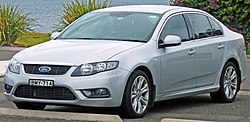
 Ford Falcon G6 Limited Edition | |
| Overview | |
| Manufacturer | Ford Australia |
| Production | February 2008 – October 2014 |
| Assembly | Australia: Melbourne, Victoria (Broadmeadows) |
| Designer | Steve Park |
| Body and chassis | |
| Class | Full-size |
| Body style | 4-door sedan 2-door coupé utility 2-door cab chassis utility |
| Layout | FR layout |
| Platform | E8 |
| Powertrain | |
| Engine | Inline-four
|
| Transmission | 4-speed M93LE automatic (E-Gas) 5-speed 5R55S automatic (I6) 6-speed 6HP 21 automatic (I4) 6-speed 6HP 26 automatic (I6, V8) 6-speed TR-6060 manual |
| Dimensions | |
| Wheelbase | 2,838 mm (111.7 in) |
| Length | 4,955 mm (195.1 in) (XT) |
| Width | 1,868 mm (73.5 in) |
| Height | 1,453 mm (57.2 in) |
| Curb weight | 1,704 kg (3,757 lb) (XT) |
| Chronology | |
| Predecessor | Ford Falcon (BF) |
| Successor | Ford Falcon (FG X) |
The Ford Falcon (FG) is a full-sized car that was produced by Ford Australia from 2008 to 2014. It was the first iteration of the seventh and last generation of the Falcon. Its range no longer featured the Fairmont luxury badge, replaced instead by the G Series.
Introduction and changes
[edit]The FG series Falcon was first previewed at a press event on 17 February 2008 and sold until October 2014.
- Range change
To make a fresh start, Ford Australia decided to revolutionize the designation of all models within the range. In particular, the long-standing Futura, Fairmont, and Fairmont Ghia models were replaced by the more contemporary G6 and G6 E models. The FG moniker references the now-discontinued Fairmont Ghia.[1] The FG was superseded in December 2014,[2] by the FG X series.
- Powertrains
The standard FG Falcon engine is a 24-valve, 4.0-litre, in-line six (I6) with variable cam timing, which produces peak power of 195 kW (261 hp) at 6000 rpm and[3] peak torque of 391 N⋅m (288 lb⋅ft) at 3250 rpm on regular 91-octane fuels. This power output raises up to 210 kW and 422 N⋅m with 98-octane fuels. From July 2010, all I6 engines (excluding E-Gas models) meet Euro 4 emission standards. The ZF six-speed automatic is an optional extra, the XR6 series having a five-speed as standard. This, combined with hardware updates, has improved fuel consumption to 9.9 L/100 km (29 mpg‑imp; 24 mpg‑US) for all entry-level, naturally aspirated petrol sedans and 10.7 L/100 km (26 mpg‑imp; 22 mpg‑US) for the equivalent utility variants.[4] The high-performance, turbocharged version of the I6 produces 270 kW (362 hp) at 5250 rpm and 533 N⋅m (393 lb⋅ft) of torque from 1950 rpm; this engine is available in the XR6 Turbo and G6 E Turbo with the 10-second over-boost function that increases torque to 640 Nm and power to 324 kW. The Turbo variant makes as much as 515 N⋅m (380 lb⋅ft) of torque at just 1250 rpm.
In 2011, Ford introduced a new LPG system to the Falcon; marketed as "EcoLPI", the system features liquid injection as opposed to the vapour setup used in the previous E-Gas system. The new injection setup is accompanied by new lightweight pistons and rings, a higher compression ratio of 12.0:1, and other modifications that improve power and economy. The power has risen 27% from 156 to 198 kW (209 to 266 hp) at 5000 rpm, and torque has risen 10% from 374 to 409 N⋅m (276 to 302 lb⋅ft) at 3250 rpm. These figures virtually match the petrol version for power and torque when running on 95 octane fuel. In addition to the power gains, fuel use has dropped by around 15%, while the peak power of 198 kW (266 hp) is reached at just 5000 rpm. In addition to the engine improvements, the new LPG system now features a six-speed automatic as standard. The new system was available from July 2011 and was an option on models fitted with the naturally aspirated, I6 engine.[5]
Ford introduced the 2.0L Ecoboost engine in 2012. which will reputedly use 20% less fuel and emit significantly less CO2 emissions than the current 4.0L engine. The engine was to have at least 179 kW (240 hp) and 353 N⋅m (260 lb⋅ft), with peak torque from 2,000 to 5,500 rpm.[6] The fuel consumption was estimated at 8 L/100 km (29 mpg‑US; 35 mpg‑imp).[7] The Falcon would be the first rear-drive application using the Ecoboost engine, but not capable of matching 380 N⋅m (280 lb⋅ft) of torque available at as low as 1500 rpm on the 4.0L petrol version due to the 4.0L petrol version's twin independent variable cam timing, a new intake manifold, new cam profiles, and combustion-chamber changes over the Barra182. The Barra190 and 195 were virtually identical except for the intake manifold and an extra knock sensor for the Barra195, allowing it to use (as above) RON98 to gain significant torque and power gains.
- Safety
The FG range achieved an ANCAP five-star safety rating, being the first Australian manufactured car to do so, achieving a score of 35.6 out of 37.[8]
Model range
[edit]The Ford FG Falcon comprised seven different trim levels, divided into three distinct groups:
- Base - Falcon
- Luxury - G6 series
- Sports Falcon - XR
The specific models included the Falcon XT; the luxury G6, G6E, and G6E Turbo; and the sports XR6, XR6 Turbo, and XR8. The utility variants included the base Falcon Ute, R6, XR6, XR6 Turbo, and XR8.
- Falcon XT
The XT is the base model of the FG Falcon range. It has a standard suspension tune; the rear suspension is Ford's Control Blade IRS, and the front suspension is the virtual pivot link, the same architecture as found in the Territory. The brakes are carried over from the BF Falcon. The engine is the revised I6 Barra engine, which now produces 195 kW (261 hp) at 6000 rpm and 391 N⋅m (288 lb⋅ft) of torque.
The naturally aspirated XT engine specification is identical to the nonturbo XR6, G6, G6E, and Utility vehicle variants powered by the 4.0 L engine. At launch, the standard transmission was a new five-speed auto, replacing the previous Australian designed and made four-speed. The ZF six-speed automatic was optional from the launch in 2008. In July 2010, the six-speed was made standard. Both the five- and six-speed transmissions retain the 2.73:1 final open-differential ratio, with LSD optional on XR6 models.
The new styling is based around the kinetic design Ford Europe uses for their cars. The interior was improved from the previous model. The centre console was lifted to make for a more luxurious and spacious feeling. The interior is more roomy and has better entry and exit for front and rear passengers. The XT is now better equipped, with an MP3-compatible CD player, 3.5 mm (0.14 in) auxiliary audio input jack, single-zone automatic climate control, cruise control, 60/40 split fold-down rear seat back, front and rear power windows, four airbags, dynamic stability control with emergency brake assist, and a driver-fatigue warning system.[9] From 1 September 2008, all XT models were specified with alloy wheels as standard equipment, previously an extra-cost option. This replaced the 16" x 6.5" steel wheels that used plastic wheel covers or centre hubcaps.[10]
- Falcon XR6
The base model in the XR range, which features the same 4.0 L I6 engine found in the XT, G6, and G6E, coming with a different ECU with a unique sport-tune. It came with a five- or six-speed automatic transmission, or a six-speed manual transmission, 17 x 8-inch, five-spoke alloy wheels; optional 18- or 19-inch wheels were available, Sports Control Blade independent rear suspension, Sports body kit with side skirts and rear bumper, rear spoiler, front fog lamps, leather-wrapped steering wheel with mounted audio controls, Bluetooth as an extra, alloy pedal covers, and cloth sports seats. As of July 2010, the five-speed automatic was no longer available to purchase due to the range upgrading to the ZF six-speed across all models.
- Falcon XR6 Turbo
The Turbo model of the XR6 came with all of the features of the standard XR6 plus 18 x 8-inch, five-spoke, alloy wheels, limited-slip differential, and upgraded front brakes (322 mm rotors instead of the standard 298 mm) without an option for 328 x 26 mm ventilated rear discs as found on BF Mk1 XR6T and XR8 models, losing on the braking capacity overall with 303 x 16 mm solid rear discs, the same hardware found on the original BA XT from 2002. It uses the same 4.0 L I6 turbo engine that is found in the G6E Turbo. The six-speed automatic transmission used in turbocharged models is the 6HP26, which is rated to handle more torque than the 6HP21 used in the FGX nonturbo models. Performance-wise, it is considered the fastest model in the FG Falcon range capable of 0–100 km/h (0-62 mph) in 4.8 s, excluding the Falcon-based FPV models from Ford Australia's partner Ford Performance Vehicles. The inline-six turbocharged engine has a maximum power of 270 kW (362 hp) and maximum torque of 533 N⋅m (393 lb⋅ft). The I6 engine also has the ability to provide the driver with an "over-boost" feature, which engages temporarily when the throttle is fully depressed at speed and correct atmospheric measures are met. Once correct conditions have been met, the engine provides an increase in boost pressure up to 12 psi from a standard maximum of 10 psi, which allows for power around 330 kW (443 hp).
Both the XR6 and XR6 Turbo can be optioned with the "XR Luxury Pack", which adds sports leather seats and black carbon-look trim inserts, dual-zone climate control, 19- x 8-inch alloy wheels, and premium sound. The "Tech Pack", also available, adds Bluetooth and iPod integration; both option packs add almost all the features from the G6E (minus reversing camera, curtain and side thorax airbags, an eight-way power-adjustable driver's seat and memory mirrors, overhead sunglasses holder, and mirror indicators)
- Falcon XR8

The XR8 had the same features found in the XR6 Turbo. The bulging hood and supporting emblems on the side skirts differentiated it visually from other XR models. The V8 was in a similar state of tune to the Boss 290 in the BA-BF FPV V8 models (though not exactly the same), with a maximum power of 290 kW (389 hp) and maximum torque of 520 N⋅m (380 lb⋅ft); however, its performance figures were similar to those of the XR6 Turbo despite having a 20 kW (27 hp) advantage according to official figures. A unique feature of the FG XR8 was a semi-active muffler, which opened above 2800 rpm for a throatier sound. However, the XR8 was less agile through corners than I6 variants due to a significantly heavier front end. The XR8 sold poorly compared to the XR6 Turbo, with the majority of volume being in utility sales.
The Falcon XR8 was discontinued in June 2010 as a result of its 5.4-litre engine not complying with the Euro IV emissions standard adopted by Australia at that time. The Euro IV emissions would have robbed the engine of power and torque and would have required further investment and development. Although initially expected to be reintroduced with the 5.0-litre "Coyote" engine used in the Ford Mustang GT during 2011,[11] the model was reintroduced in 2014 with the FG-X series Falcon, featuring the 5.0-litre supercharged Miami motor.[12]
- G Series

Up from the XT, this is the base model in the G Series. The G6 is the direct replacement for the Futura. It is powered by the same 4.0 L engine and was originally mated to the five-speed automatic (upgraded to the ZF six-speed automatic in 2010). Besides the suspension, which is the sport-luxury tune found in the G6E, the drivetrain of the car is the same as the XT. Equipment levels are increased in the G6. It comes with front fog lights, a leather-wrapped steering wheel with mounted audio controls, rear parking sensors, sports body kit with side skirts and rear bumper, and 17-inch alloy wheels.
A G6 Limited Edition consisting of just 1500 units, based on the G6. How many of these 1500 units were fitted with the EcoBoost engine is unknown. The G6 Limited Edition added leather seats in Shadow, Bluetooth, iPod integration, sports leather-wrapped steering wheel, unique fog-lamp bezels, unique front grille (upper and lower), a unique rear-bumper insert, side-curtain airbags, and 18-inch alloy wheels (17-inch on the E-Gas model).
The G6E, a step up from the G6, is the replacement for the old Fairmont Ghia. It includes all of the features of the G6, plus a ZF six-speed automatic transmission, dual-zone automatic climate control, a premium audio system, leather seats, Bluetooth mobile phone integration, reversing camera, curtain and side thorax airbags, an eight-way, power-adjustable driver's seat, 17 x 8-inch, 10-spoke alloy wheels, front scuff plates, and an overhead sunglass console. It also features Mercedes-Benz-styled side indicators on the side mirrors, similar to those on premium European cars.
GPS-equipped Ford Falcons (Ford G Series)[13] can warn of traffic incidents via a traffic message channel.[14]
The G6E Turbo is the same as the G6E, except it has an I6 turbocharged engine, 18 x 8-inch, seven-spoke alloy wheels, lowered suspension, piano-black centre console rather than silver, iPod integration, turbo decals, and a boot-mounted spoiler. The engine is the same as that found in the XR6 Turbo.
From April 2009, an update was introduced. This involved an improvement in fuel consumption on I6 models fitted with the optional six-speed automatic. The LPG E-Gas models, like the petrol-powered versions of the FG sedan range, had been awarded the full five stars in the Australasian New Car Assessment Program crash-safety test. The five-star rating, up from four, was not due to any structural changes to the FG, but by the introduction of electronic stability control (ESC), which was previously only fitted to petrol-powered FG sedans. ESC also was made standard on the E-Gas BF III Falcon wagons still in production (previously unavailable). ESC fitment was extended to the utility body styles from May 2009, excluding the base XL and R6 Ute, where it was optional.[15] From June 2010, all sedan models received Bluetooth mobile phone and iPod integrations as standard equipment.
-
 Ford Falcon XT
 -
 Ford Falcon XT
 -
 Ford Falcon XR6
 -
 Ford Falcon XR6
 -
 Ford Falcon XR6 50th Anniversary
 -
 Ford Falcon XR6 50th Anniversary
 -
 Ford Falcon XR6 Turbo
 -
 Ford Falcon XR6 Turbo
 -
 Ford Falcon XR8
 -
 Ford Falcon XR8
 -
 Ford Falcon G6
 -
 Ford Falcon G6
 -
 Ford Falcon G6E
 -
 Ford Falcon G6E
 -
 Ford Falcon G6E Turbo
 -
 Ford Falcon G6E Turbo
_XT_sedan_(2009-09-17).jpg)
_XT_sedan_(2016-01-19)_02.jpg)
_XR6_sedan_(15089320959).jpg)
_XR6_sedan_(2016-01-10)_02.jpg)
_XR6_50th_Anniversary_sedan_(2016-11-13).jpg)

_XR6_Turbo_sedan_(2009-10-04).jpg)
_XR6_Turbo_sedan_(2009-06-19).jpg)

.jpg)


_G6E_sedan_(2015-12-07)_01.jpg)

_G6E_Turbo_sedan_(19345594535).jpg)

FG II
[edit]The FG II, introduced in 2011, was the first major visual upgrade for the FG Falcon since its introduction in 2008. The MkII has a revised front fascia similar to that of the SZ Ford Territory, including a smaller upper grille and a larger octagonal lower grille, along with revised headlight and fog light assemblies; G6E and G6E turbo models came standard with LED running lights. All new specification levels (except XT and XL) got the new Interior Command Centre, the unit is an 8-inch touch screen with 2D and 3D maps, SUNA traffic updates, overspeed and speed camera warnings, and street house number display, and is fully integrated.
Improved safety features on the MkII included six airbags (dual front, side, and curtains) as standard on all sedan models, the Generation 9.0 dynamic stability control system was standard across the range and rear parking sensors were now standard. The MkII was placed on sale in late 2011, with a turbocharged four-cylinder EcoBoost engine option becoming available in early 2012.[16]
-
 Ford Falcon XT (Mk II)
 -
 Ford Falcon XT (Mk II)
 -
 Ford Falcon XR6 (Mk II)
 -
 Ford Falcon XR6 Limited Edition (Mk II)
 -
 Ford Falcon XR6 Limited Edition (Mk II)
 -
 Ford Falcon G6 (Mk II)
 -
 Ford Falcon G6 (Mk II)
 -
 Ford Falcon G6E (Mk II)
 -
 Ford Falcon G6E (Mk II)
_XT_sedan_(2015-08-07)_01.jpg)
_XT_sedan_(2015-08-07)_02.jpg)
_XR6_sedan_(19905065122).jpg)
_XR6_Limited_Edition_sedan_(2016-07-07)_01.jpg)
_XR6_Limited_Edition_sedan_(2016-07-07)_03.jpg)
_G6_sedan_(2018-05-02)_01.jpg)
_G6_sedan_(2018-05-02)_02.jpg)
_G6E_EcoBoost_sedan_(22380970376).jpg)
_G6E_EcoBoost_sedan_(21784216164).jpg)
Safety
[edit]

FPV range
[edit]_utility_01.jpg)

As with the previous Falcon BA and BF series, Ford Performance Vehicles (FPV) produced high-performance versions of the Falcon FG. They included the F6 and V8-powered GT, GT-P, and GT E variants of the sedan, and the F6 Ute and V8-powered Pursuit and Super Pursuit models based on the Falcon Ute. The F6 models featured a 4.0 L, turbocharged DOHC 24-valve, I6 engine, which produced a maximum power of 310 kW (416 hp) at 5,500 rpm and maximum torque of 565 N⋅m (417 lb⋅ft) across the range from 1,950 to 5,200 rpm. All other models were powered by a 5.4 L Boss V8 engine, which produces 315 kW (422 hp) at 6,500 rpm and 551 N⋅m (406 lb⋅ft) of torque at 4,750 rpm. As of October 2009, FPV released a luxury F6-E model variant, which was equipped the same as a GT E, but with an F6 engine. Also in October 2009, FPV released a GS model to commemorate the historic GS nameplate from the 1970s, which was sold in lieu of a Falcon XR8. It was limited to 250 sedans and 75 utilities, and was powered by a detuned V8 from the GT. Its distinguishing exterior features included unique "GS" decals and dark argent wheels.
In October 2010, FPV introduced a supercharged, all-alloy, DOHC four valves per cylinder Coyote "Miami" 5.0 L; 302.1 cu in (4,951 cc) V8 engine to replace the older 5.4 L Boss unit. A 315 kW (422 hp) version was introduced in the FPV GS model (which replaces the defunct XR8 model) and a 335 kW (449 hp) version was developed for the FPV GT, GT E, and GT-P models.
Limited editions in this series included the Fifth-Anniversary,[21] GT "Black", GT "R-Spec", and most importantly, the GT F "351". These cars had more powerful engines (335 kW (449 hp) for the first two and 351 kW (477 PS; 471 bhp) at 6000 rpm and 570 N⋅m (420 lbf⋅ft) at 2500-5500 rpm of torque for the GT F)[22] and both the "R-Spec" and "351" also featured an enhanced handling package highlighted by wider 9-inch rear wheels. Further, the dynamometer testing showed that this engine makes significantly more power than the quoted 315, 335, 345, and 351 kW, figures in excess of 380-400 kW (510-535 hp) at the rear wheels or about 450-470 kW (600-630 hp) at the flywheel. They also introduced launch control and the "351" nomenclature of the GT F, which has become the "Final GT Falcon" ever, represents both its engine output and pays tribute to the original Falcon GT's cubic-inch displacement.[23][24][25][26][27]
References
[edit]- ^ Hagon, Toby (24 February 2009). "Ford FG Falcon: why FG as a model code?". Drive. Fairfax Media. Archived from the original on 5 September 2011. Retrieved 4 January 2010.
- ^ "AIMS: 2014 Ford Falcon teaser". carpoint.com.au.
- ^ Skentzos, George (17 February 2008). "2008 Ford Falcon engine line-up | Car Advice | Reviews". Car Advice. Retrieved 13 November 2011.
- ^ "2010 Ford Falcon Gains Safety Updates, ZF Six-Speed Auto, Euro IV Emissions Compliance : The Motor Report". The Motor Report. 7 April 2010. Retrieved 8 April 2010.
- ^ Beissmann, Tim (4 April 2011). "2011 Ford Falcon EcoLPi LPG on sale mid-year | Car Advice | Reviews". Car Advice. Retrieved 13 November 2011.
- ^ Ford announces 2.0L Ecoboost and dual clutch gearbox for 2010 Retrieved from green.autoblog.com
- ^ GoAutoMedia (18 September 2009). "Ford Falcon – Frankfurt show: Ford's EcoBoost future revealed". GoAuto. Archived from the original on 24 September 2009. Retrieved 17 October 2009.
- ^ "Yahoo!7 News". Au.news.yahoo.com. Retrieved 17 October 2009.[permanent dead link]
- ^ "Ford Falcon XT Key Features"
- ^ "Ford FG Falcon specification & pricing update". Australian Car Advice. 8 September 2008. Retrieved 17 September 2008.
- ^ Dowling, Joshua (6 October 2010). "Falcon XR8 will return". carpoint.com.au. Retrieved 25 November 2010.
- ^ "Ford confirms plant closures". The Sydney Morning Herald. 23 May 2013. Archived from the original on 31 December 2013. Retrieved 24 May 2013.
- ^ "SUNATraffic.com.au". SUNATraffic.com.au. Archived from the original on 26 November 2011. Retrieved 13 November 2011.
- ^ Fung, Derek (13 August 2008). "Suna's traffic messaging service now in Sydney and Brisbane – Cars". Cnet.com.au. Retrieved 13 November 2011.
- ^ "Ford gives Falcon a boost". CarPoint. 2 April 2009. Retrieved 2 April 2009.
- ^ Ford Falcon FG MkII first images and details, – CarAdvice.
- ^ "ANCAP results for Ford Falcon all variants". ancap.com.au. 2008.
- ^ "ANCAP results for Ford Falcon Ute variants with dual frontal airbags". ancap.com.au. 2008.
- ^ "ANCAP results for Ford Falcon Ute variants fitted with ESC and 4 airbags". ancap.com.au. 2008.
- ^ "ANCAP results for Ford Falcon Ute all variants". ancap.com.au. 2011.
- ^ "FPV 5th Anniversary GT 2008 AIMS". Drive. 8 October 2008. Retrieved 16 February 2023.
- ^ "2014 Ford FPV GT-F 6-speed". automobile-catalog. Retrieved 30 June 2018.
- ^ "Ford Performance Vehicles – FPV GT Black Edition". Drive. Archived from the original on 4 July 2015. Retrieved 17 May 2015.
- ^ "Kloster Ford – FPV announces GT BLACK". klosterford.com.au. Archived from the original on 9 March 2016. Retrieved 17 May 2015.
- ^ "FPV GT RSPEC on Sale in Australia, "Finest Handling GT in History"". The Motor Report.
- ^ Joshua Dowling (10 June 2014). "2014 FPV Falcon GT-F review – first drive". CarsGuide.
- ^ "FPV GTF 351: The Last Falcon GT Arrives". The Motor Report. 10 June 2011.
External links
[edit]
Ford Falcon | |||||
|---|---|---|---|---|---|
| North America |  | ||||
| Argentina | |||||
| Australia |
| ||||
| Engines | |||||
Ford Falcon (FG)
View on GrokipediaDevelopment and Design
Origins and Launch
The development of the Ford Falcon (FG) began in 2003 under the leadership of Ford Australia, with exterior design overseen by Steve Park, who had previously contributed to earlier Falcon generations.[8][9] Codename Project Orion, the initiative aimed to refresh the Falcon lineup amid declining domestic sales and increasing competition, incorporating global design influences while retaining Australian engineering priorities.[8] A major approval milestone was achieved late in 2005. Earlier phases included sketching and scale modeling starting in 2003, with a full-size clay prototype presented by November 2004, and further refinements continuing into 2006. Design leadership transitioned from Simon Butterworth to Scott Strong in March 2006, who oversaw final refinements.[9] The FG Falcon was unveiled on February 17, 2008, at Ford Australia's Broadmeadows assembly plant in Melbourne, Victoria, marking the replacement for the preceding BF series introduced in 2005.[10][11] Production commenced immediately at the facility to sustain operations and capture market share.[12] The launch introduced the new G6 luxury lineup, which superseded the Fairmont and Futura variants from prior models, offering updated styling and features to appeal to premium buyers.[6] Positioned as a direct rival to the Holden Commodore, the FG sought to reclaim leadership in Australia's full-size sedan and utility segments through enhanced competitiveness.[11] Central to the FG's design objectives were improvements in fuel efficiency, dynamic handling, and broader export viability, particularly to Asia-Pacific markets including China and the Middle East.[13] Engineers focused on aerodynamic refinements and suspension tweaks to boost economy and road manners, while the platform's adaptability supported right- and left-hand-drive configurations for international appeal.[9][8] These goals reflected Ford Australia's strategy to evolve the Falcon beyond domestic utility into a more globally oriented product. The FG series continued until the FG X facelift in 2014.[13]Platform and Styling
The Ford Falcon (FG) was built on an evolved version of the BA/BF platform, incorporating targeted modifications to improve chassis rigidity and weight distribution for enhanced handling and structural integrity. Key updates included a revised front suspension with aluminum components and high-strength steel, which reduced unsprung weight by 22 kg compared to the BF model, alongside a wider rear track and monotube shock absorbers to better control body motion. The sedan's wheelbase was extended by 9 mm to 2,838 mm over the BA/BF, while the ute variant measured 3,104 mm, contributing to more balanced dynamics without altering the overall rear-wheel-drive layout.[14] Available in three primary body styles, the FG catered to diverse needs with a 4-door sedan for passenger comfort, a 2-door coupé utility (ute) for light commercial use, and a 2-door cab chassis utility for fleet and customization applications. Exterior styling emphasized a bolder, more contemporary aesthetic, highlighted by an aggressive front fascia incorporating a larger grille for improved airflow and visual presence, paired with aerodynamic refinements that achieved a drag coefficient of 0.312. Standard taillights utilized efficient lighting technology, with later variants adopting LED elements for enhanced visibility and durability. Inside, the FG featured a comprehensively redesigned interior layout, centered on a modern dashboard with intuitive controls and higher-quality soft-touch materials that elevated perceived refinement to levels comparable with premium European sedans. Ergonomics were prioritized through well-shaped, adjustable seating, a logical instrument cluster, and steering wheel-mounted functions, creating a driver-focused cabin with generous rear space and a boot capacity exceeding 500 liters in the sedan. Overall dimensions for the sedan included a length of 4,955 mm, width of 1,868 mm, and curb weight of around 1,700 kg, balancing size with maneuverability.[15][16][17]Powertrain Options
Engines
The Ford Falcon (FG), produced from 2008 to 2016, featured a range of inline-six and V8 petrol engines, with later additions including LPG and turbocharged four-cylinder options to meet evolving efficiency and emissions standards. The lineup centered on the Barra family of engines, emphasizing performance and durability for the Australian market, while incorporating direct injection and variable cam timing for improved power delivery and fuel economy. These engines were paired with rear-wheel-drive configurations, delivering outputs suitable for sedans, utes, and performance variants. The base engine was the 4.0-liter DOHC direct-injection variable cam timing (DI-VCT) inline-six petrol unit, producing 195 kW at 6,000 rpm and 391 Nm at 3,250 rpm. This naturally aspirated Barra engine offered a combined fuel economy of 9.0 L/100 km in sedan applications, balancing everyday usability with responsive acceleration. It represented an evolution from prior Falcon generations, with enhanced refinement and mid-range torque for highway cruising. For higher performance, the 4.0-liter turbocharged inline-six, also from the Barra family, delivered 270 kW at 5,750 rpm and 533 Nm from 2,000 to 4,750 rpm in models like the XR6 Turbo. This forced-induction variant used an intercooled setup to provide strong low-end pull, enabling 0-100 km/h times around 5.6 seconds, while maintaining a focus on drivability over outright top speed. The initial V8 option was the 5.4-liter Boss quad-cam unit, rated at 290 kW at 5,750 rpm and 520 Nm at 4,750 rpm, exclusive to the XR8 until its discontinuation in 2010 due to tightening emissions regulations. In 2014, with the FG X update, Ford introduced the supercharged 5.0-liter Coyote V8 (known as the Miami variant in Australia), producing 335 kW at 5,750 rpm and 570 Nm from 2,200 to 5,000 rpm in base XR8 guise.[18] This aluminum-block engine featured a roots-type supercharger and direct injection, offering superior refinement and power density compared to the outgoing 5.4-liter, with limited editions reaching 351 kW through FPV tuning. To address fuel cost and environmental concerns, Ford launched the EcoLPI variant in 2011, a dedicated liquid petroleum gas (LPG) version of the 4.0-liter inline-six using multipoint injection for cleaner combustion. It generated 198 kW at 5,000 rpm and 409 Nm at 3,250 rpm, with slightly higher torque than the petrol counterpart due to LPG's properties, and achieved approximately 15% reductions in CO2 emissions compared to equivalent gasoline models.[19] In 2012, the lineup expanded with the 2.0-liter EcoBoost inline-four turbocharged engine, outputting 179 kW at 5,500 rpm and 353 Nm at 2,000 rpm, paired with a combined fuel economy of approximately 8.0 L/100 km. This downsized unit employed twin-scroll turbocharging and direct injection to deliver efficient performance, marking Ford's push toward global engine architectures in the Falcon.| Engine | Type | Displacement | Power | Torque | Introduction Year | Notes |
|---|---|---|---|---|---|---|
| Barra I6 Petrol | Inline-6, naturally aspirated, DOHC DI-VCT | 4.0 L | 195 kW @ 6,000 rpm | 391 Nm @ 3,250 rpm | 2008 | Base engine; 9.0 L/100 km combined |
| Barra I6 Turbo | Inline-6, turbocharged, DOHC | 4.0 L | 270 kW @ 5,750 rpm | 533 Nm @ 2,000-4,750 rpm | 2008 | XR6 Turbo; intercooled |
| Boss V8 | V8, naturally aspirated, DOHC | 5.4 L | 290 kW @ 5,750 rpm | 520 Nm @ 4,750 rpm | 2008 | XR8 until 2010 |
| EcoLPI I6 | Inline-6, LPG, multipoint injection | 4.0 L | 198 kW @ 5,000 rpm | 409 Nm @ 3,250 rpm | 2011 | Dedicated LPG; lower CO2 |
| EcoBoost I4 | Inline-4, turbocharged, DOHC DI | 2.0 L | 179 kW @ 5,500 rpm | 353 Nm @ 2,000 rpm | 2012 | Efficient option; ~8.0 L/100 km |
| Coyote V8 SC | V8, supercharged, DOHC DI | 5.0 L | 335 kW @ 5,750 rpm | 570 Nm @ 2,200 rpm | 2014 | FG X XR8; roots supercharger |