


Community hub
Recent from talks
Contribute something
Nothing was collected or created yet.
Frangipane
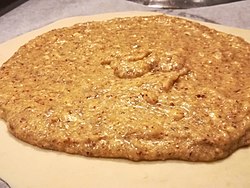
View on Wikipedia Frangipane cream before baking | |
| Type | Custard |
|---|---|
| Place of origin | France |
| Main ingredients | Almonds or almond flavouring, butter, sugar, eggs |


Frangipane (/ˈfrændʒɪpæn, -peɪn/ FRAN-jih-pa(y)n) is a sweet almond-flavoured custard, typical in French pastry, used in a variety of ways, including cakes and such pastries as the Bakewell tart, conversation tart, Jésuite, and galette des rois.[1] A French spelling from a 1674 cookbook is franchipane, with the earliest modern spelling coming from a 1732 confectioners' dictionary.[2] Originally designated as a custard tart flavoured by almonds or pistachios, it came later to designate a filling that could be used in a variety of confections and baked goods.
It is traditionally made by combining two parts of almond cream (crème d’amande) with one part pastry cream (crème pâtissière). Almond cream is made from butter, sugar, eggs, almond meal, bread flour, and rum; and pastry cream is made from whole milk, vanilla bean, cornstarch, sugar, egg yolks or whole eggs, and butter. There are many variations on both of these creams as well as on the proportion of almond cream to pastry cream in frangipane.[3][4]
On Epiphany, the French cut the galette des rois – a round cake made of frangipane layers – into slices to be distributed by a child known as le petit roi (the little king), who is usually hiding under the dining table. The cake is decorated with stars, a crown, flowers and a special bean hidden inside the cake. Whoever gets the piece of the frangipane cake with the bean is crowned "king" or "queen" for the following year.
Etymology
[edit]The word frangipane is a French term used to name products with an almond flavour.[5] The word comes ultimately from the last name of Marquis Muzio Frangipani or Cesare Frangipani.[2][6] The word first denoted the frangipani plant, from which was produced the perfume originally said to flavour frangipane.[7] Other sources say that the name as applied to the almond custard was an homage by 16th-century Parisian chefs in name only to Frangipani, who created a jasmine-based perfume with a smell like the flowers to perfume leather gloves.[2][8][9][10]
See also
[edit]
References
[edit]Notes
- ^ Ayto, John (2013). The Diner's Dictionary. Oxford University Press.
- ^ a b c Davidson, Alan (2014). "frangipane". In Jaine, Tom (ed.). The Oxford Companion to Food (3rd ed.). Oxford: Oxford University Press. doi:10.1093/acref/9780199677337.001.0001. ISBN 978-0-19-967733-7.
- ^ Suas, Michel (2011). Advanced Bread and Pastry: A Professional Approach. Delmar, Cengage Learning.
- ^ Jørgensen, Johannes (1913). Saint Francis of Assisi : a biography. University of Connecticut Libraries. New York: Longmans, Green, and Co. p. 257.
"Illam autem comestionem vocant Romani mortariolum quae fit de amygdalis et zucario et de aliis rebus." Spec. (ed. Sab.) p. 221. Sabatier identifies this favourite food of Francis with the well-known stone-hard Roman mostaccioli (see Jorgensen's "Pilgrimsbogen," p. 61). On the other side f. Edouard d'Alencon: Frere Jacqueline, p. 19, n. 2; in mortariolum (in Old French mortairol) he sees rather "cette creme d'amandes bien connue aujourd'hui sous le nom de frangipane," a name in which he finds an allusion to Jacopa's name (her married name was Frangipani).
- ^ "FRANGIPANE : Etymologie de FRANGIPANE". www.cnrtl.fr. Retrieved 2023-08-04.
- ^ "A pastry dough alternative: Frangipane". Newsday. Tribune Content Agency. 2013-07-22.
the Marquis Muzio Frangipani. Frangipani wasn't a great cook. Rather, he popularized almond-scented gloves among the European aristocracy.
- ^ "frangipane | Definition of frangipane in English by Oxford Dictionaries". Oxford Dictionaries | English. Archived from the original on September 25, 2016. Retrieved 2019-03-21.
- ^ Johansen, Katia (December 2004). "Fleeting fragrance: the history, preservation, and display of perfumed costume" (PDF). International Journal of Costume. 4 (2): 42.
- ^ Bender, David A. (2006). "frangipane (frangipani)". Bender's dictionary of nutrition and food technology. Arnold E. Bender (8th ed.). Boca Raton, FL: CRC Press. ISBN 0-8493-7601-7. OCLC 71842325.
Originally a jasmine perfume which gave its name to an almond cream flavoured with the perfume.
- ^ "New Look for Pudding: FRANGIPANI PUDDING". The Washington Post and Times-Herald. 20 June 1963. p. D14.
Bibliography
- "Frangipane." Oxford Companion to Food (1999), 316.
Frangipane
View on GrokipediaEtymology and History
Etymology
The term "frangipane" derives from the Italian noble family Frangipani, whose name originated in the 11th century from the Latin phrase frangere il pane, meaning "to break the bread," in reference to the family's reputed distribution of bread to the poor during famines in medieval Rome.[6] This etymology is documented in historical accounts of the family's rise as a powerful Roman patrician clan, evolving from earlier names like Anicia to Frangipani based on this charitable act.[7] In the 16th century, the association with almonds emerged through Marquis Muzio Frangipani, a member of the family who served as a marshal in France and developed a popular perfume scented with bitter almonds for leather gloves at the court of King Louis XIII; this almond fragrance became so iconic that it linked the family name to almond-flavored products.[3] Historical accounts vary slightly on the details, with some attributing the invention to Muzio himself and others to a contemporary like Cesare Frangipani, but all emphasize the perfume's influence on the culinary term. The word entered French culinary lexicon as franchipane in a 1674 cookbook, referring to an almond-flavored custard tart, before standardizing to the modern spelling frangipane in a 1732 confectioners' dictionary, where it denoted almond-based confections and creams.[9] This evolution reflects the term's shift from perfumery to gastronomy, solidifying its use for almond-centric preparations in French pâtisserie.[10]Historical Origins
The origins of frangipane as a culinary preparation trace back to 16th-century Italy and its adoption in France, linked to the Frangipani family of nobility. The story begins with Marquis Muzio Frangipani, an Italian nobleman who served at the court of King Louis XIII of France, where he developed a popular perfume using bitter almonds to scent leather gloves, masking their odor and imparting a distinctive almond aroma.[1] This fragrance captivated Parisian society in the early 17th century, inspiring a local pastry chef to experiment with an almond-based cream that replicated the scent, thus giving rise to the sweet filling known as frangipane around the 1600s.[11] The first printed recipes for frangipane appear in French cookbooks of the mid-17th century, marking its transition from perfume-inspired novelty to a formalized pastry component. In 1653, François Pierre de La Varenne included instructions for "franchipane" in his influential work Le Pastissier françois, describing a layered tart with a cream filling using thin pastry cases, though this early version did not specify almonds.[7] While early preparations like La Varenne's were cream-based, by a 1674 cookbook the term referred to a custard tart incorporating almonds and pistachios to create a more custard-like consistency with the nutty flavor.[1][9] This evolution continued into the 18th century, when frangipane refined into the velvety almond custard familiar today, blending ground almonds, butter, sugar, and eggs for use in tarts and pastries.[5] Frangipane's integration into French culinary tradition occurred primarily through royal courts and guild systems, where it became a staple in noble pastries despite sparse written records. Adopted in the kitchens of Versailles and among Parisian confectioners, it symbolized refined elegance, often featured in elaborate desserts for aristocracy.[12] The limited documentation stems from the era's guild practices, which emphasized oral transmission of recipes to protect trade secrets, allowing frangipane to spread via apprenticeships and courtly exchanges rather than widespread publication until the 19th century.[13]Composition and Preparation
Ingredients
Frangipane, in its basic form known as almond cream or crème d'amande, relies on a few primary ingredients that create its signature nutty, creamy, and sweet profile. Ground almonds (or almond meal/flour) form the nutty base, providing structure and intense almond flavor while keeping the mixture gluten-free.[14] Butter contributes creaminess and richness, allowing the filling to spread smoothly and bake into a tender texture.[2] Sugar adds sweetness to balance the almonds' earthiness, while eggs serve as a binder, adding moisture and helping the mixture set during baking.[15] Typical ratios for this almond cream base use equal parts by weight of softened butter, granulated sugar, and ground almonds—often around 100 grams (about ½ cup) each—combined with 1 to 2 large eggs for cohesion.[16] A small amount of all-purpose flour or cornstarch, roughly 20 to 30 grams (2 to 3 tablespoons), may be added for slight thickening without altering the delicate consistency.[10] For enhanced flavor, a teaspoon of rum, almond extract, or vanilla extract can be incorporated, amplifying the aromatic notes derived from the historical use of almonds in perfumery.[3] In classic French versions, frangipane evolves into a custard-like filling by blending the almond cream with pastry cream (crème pâtissière) in a 2:1 ratio of almond cream to pastry cream, resulting in a lighter, more stable texture suitable for layered pastries.[14] The pastry cream component includes milk or cream for silkiness, additional eggs or yolks for richness, sugar, vanilla for subtle depth, and cornstarch as a thickener.[17] When preparing ground almonds, blanched varieties are preferred over unblanched to prevent bitterness from the skins, ensuring a smoother, milder taste.[18] Nut allergies must be considered, as almonds are the dominant ingredient; substitutions like ground hazelnuts or pistachios can be used in adapted recipes, though they alter the traditional flavor.[19]Preparation Methods
Frangipane preparation begins with the basic almond cream method, where softened butter is creamed with sugar until light and fluffy, typically using a stand mixer or by hand to achieve a smooth base. Eggs are then incorporated one at a time, beating well after each addition to prevent curdling and ensure emulsification, followed by gently folding in ground almonds and a small amount of flour to form a thick, spreadable paste that holds its shape yet pipes easily.[10][19] For the custard variation, known as crème frangipane, a pastry cream base is first prepared by heating milk infused with vanilla until steaming, then tempering egg yolks mixed with sugar and cornstarch before returning the mixture to the heat to thicken into a smooth custard. This pastry cream is then combined in a 2:1 ratio with the basic almond cream—two parts almond cream to one part pastry cream—stirred until homogeneous, and chilled to firm up before use, resulting in a lighter, more stable filling suitable for baking.[14][17] Key techniques for success include using room-temperature butter and eggs to promote even blending and avoid separation or graininess in the emulsion. When baked, frangipane transforms under moderate heat, typically at 350°F (175°C) for 20 to 30 minutes, where it sets into a tender, moist cake-like texture with a golden surface, thanks to the eggs and flour providing structure while the almonds contribute nuttiness.[16][20][21] For storage, prepared frangipane should be kept in an airtight container in the refrigerator for up to 3 days to maintain freshness, or frozen for up to 1 month, thawing in the fridge before bringing to room temperature for use; note that approximately 1 cup of ground almonds yields about 2 cups of finished filling, scaling easily for batches.[22][10][19]Culinary Applications
Traditional Dishes
The galette des rois, also known as the king cake, is a quintessential French pastry traditionally baked for Epiphany on January 6, consisting of two layers of puff pastry enclosing a rich frangipane filling. This ritualistic dessert holds deep cultural significance in France, where it commemorates the arrival of the three wise men to Bethlehem, with a hidden fève—a small porcelain figurine or bean—placed inside the cake; the finder is crowned king or queen for the day, a tradition tracing back to the 14th century when the Catholic Church adapted pagan Roman Saturnalia customs to Christian observance.[23][24] The Bakewell tart represents an iconic English adaptation of frangipane, featuring a shortcrust pastry base layered with jam, followed by a frangipane topping and often finished with fondant icing or flaked almonds, originating in the town of Bakewell, Derbyshire, in the 19th century. Its creation is attributed to a culinary mishap at the White Horse Inn, transforming it into the beloved dessert that symbolizes regional pride and afternoon tea traditions in Britain.[25] Pithiviers, a classic French pastry from the 17th century, consists of two rounds of puff pastry sandwiching a frangipane filling, distinguished by its domed shape and intricate spiral scoring on the top to allow steam to escape during baking. Named after the town of Pithiviers in the Loire Valley, it gained prominence in the 18th century when refined by the cook of the Prince de Condé, emphasizing France's artisanal pastry heritage without the ceremonial fève of the galette des rois.[26][27] Other traditional European pastries incorporating frangipane include the jésuite, a triangular puff pastry pocket filled with almond cream and topped with icing and sliced almonds, so named in the 18th century for its resemblance to the tricorne hat of Jesuit priests. Similarly, the conversation tart, originating in late 18th-century France, features delicate rounds of puff pastry with a frangipane center glazed in royal icing, historically enjoyed at social gatherings to spark conversation among guests.[28][29]Modern Uses
In contemporary baking, frangipane has evolved beyond classic pastries into versatile fruit-topped tarts that highlight seasonal produce. Bakers often pair it with pears or cherries arranged atop the almond cream filling, baked in a tart shell at approximately 375°F for 25 to 35 minutes until the frangipane puffs and sets with a golden crust.[30][31] Adaptations frequently incorporate gluten-free crusts made from almond flour or oat-based doughs, allowing for inclusive dietary options while maintaining the creamy texture of the filling.[32] These tarts emphasize the almond cream's ability to complement tart fruits, creating balanced, visually appealing desserts suitable for modern patisserie.[33] Frangipane also finds innovative applications in cakes and layered desserts, where its rich, nutty profile enhances complex confections. In almond cakes, such as berry frangipane varieties, the cream serves as a moist filling or swirl, baked into tender layers for a subtle marzipan-like flavor.[34] For macarons, it acts as a stable filling, piped between crisp shells to add creaminess without overpowering the delicate meringue.[35] In multi-component entremets, frangipane layers provide structure and almond depth, often combined with chocolate ganache for decadent contrasts, as seen in chocolate-frangipane tarts featuring cocoa-infused almond cream topped with fruit or caramel.[36][37] Beyond baked goods, frangipane inspires non-pastry desserts through adaptable, spoonable forms. Unbaked or lightly cooked versions form the base for almond panna cotta, where the cream is blended with gelatin and milk for a silky, set custard evoking frangipane's essence.[38] Similarly, it enriches ice cream bases, incorporating ground almonds and butter into custards for flavors like frangipane swirl, yielding creamy, scoopable treats with toasty nut notes.[39] Vegan adaptations replace butter with plant-based alternatives and eggs with aquafaba, enabling frangipane in dairy-free tarts or creams while preserving the original's smooth consistency.[40] The ease of preparing frangipane—requiring just a few pantry staples mixed into a custard-like base—has boosted its popularity in 21st-century home baking, particularly through trends favoring seasonal pairings. Since the 2010s, recipes like cranberry frangipane tarts have surged, combining the cream's sweetness with tart winter berries for festive, accessible desserts that encourage experimentation.[2][32] This versatility aligns with modern baking's focus on customization, from nut variations to fruit integrations, making frangipane a staple for both novice and professional bakers.[41]Variations and Related Concepts
Regional Variations
In Italian cuisine, frangipane manifests as crema frangipane, a straightforward almond cream composed of butter, sugar, eggs, and ground almonds, distinct from some French variants by omitting pastry cream and emphasizing a denser, nut-forward texture. This preparation is commonly employed as a filling for crostata, an open-faced tart with fruit or jam layers, reflecting a tradition of almond-based desserts in Roman baking practices that trace their almond perfume influences to the 16th-century Frangipani family.[42][43] The British adaptation appears prominently in the Bakewell pudding and its evolution into the Bakewell tart, originating in the early 19th century in Derbyshire, England. The pudding, born from an 1820s mishap at the White Horse Inn where an egg-based almond custard mixture was mistakenly used as a filling over jam in flaky pastry, features a thick almond custard layer that prefigures modern frangipane. By the late 19th century, this developed into the tart form with shortcrust pastry, raspberry jam, and a richer frangipane topping of flaked almonds, sometimes incorporating a custard element for added creaminess, solidifying its status as a regional staple.[44][45] American interpretations, particularly in Southern baking, incorporate local ingredients like pecans into lighter frangipane hybrids for pies and tarts, blending the traditional almond base with nutty, caramelized profiles suited to holiday desserts such as pecan-frangipane tarts. These adaptations emerged in the 20th century, drawing on the region's pecan abundance to create moist, buttery fillings that complement bourbon or maple flavors.[46] Globally, contemporary fusions extend frangipane into Middle Eastern-inspired desserts, such as pistachio-frangipane layers in baklava-like tarts, where ground pistachios replace almonds for a vibrant green hue and floral notes enhanced by honey and orange blossom syrups. In Asian contexts, innovations include matcha-infused or black sesame frangipane in tarts and croissants, merging the cream's richness with umami earthiness for pastries like matcha-black sesame tarts, popular in modern patisseries blending Japanese and French techniques.[47][48]Distinction from Similar Terms
Frangipane, as a culinary term, specifically denotes a sweet, almond-flavored custard or cream filling used in pastries, whereas frangipani refers to the genus Plumeria of tropical flowering trees known for their fragrant blooms or to a perfume evoking jasmine and almond notes derived from those flowers; the terms share etymological roots in the Italian Frangipani family but have no overlap in practical application.[49] In contrast to marzipan, which is a dense, uncooked paste primarily composed of ground almonds and sugar used for molding decorative shapes or candies, frangipane is a lighter, egg-enriched cream that incorporates butter and bakes to a soft, custard-like texture suitable for fillings in tarts and cakes.[50][51] Frangipane differs from pure almond cream, also known as crème d'amande, which consists of butter, sugar, eggs, and almond flour without additional components; while some traditional French definitions form frangipane by blending almond cream with pastry cream (crème pâtissière) in ratios such as two parts almond cream to one part pastry cream for a thicker, more stable custard, other usages (including modern and regional variants) refer to the almond cream alone as frangipane.[14][52][2] A common source of confusion arises from the historical link to the Frangipani family's invention of an almond-based perfume in the 16th century, leading some to mistakenly associate frangipane in baking with floral essences from the plumeria flower, though the custard relies solely on almond flavoring without any botanical extracts.[53]References
- https://daily.[jstor](/page/JSTOR).org/plant-of-the-month-frangipani/