Hubbry Logo
Puff pastryPuff pastryMain
Open search
Puff pastry
Community hub
Puff pastry
logo
8 pages, 0 posts
0 subscribers
Be the first to start a discussion here.
Puff pastry
Puff pastry
from Wikipedia
Puff pastry
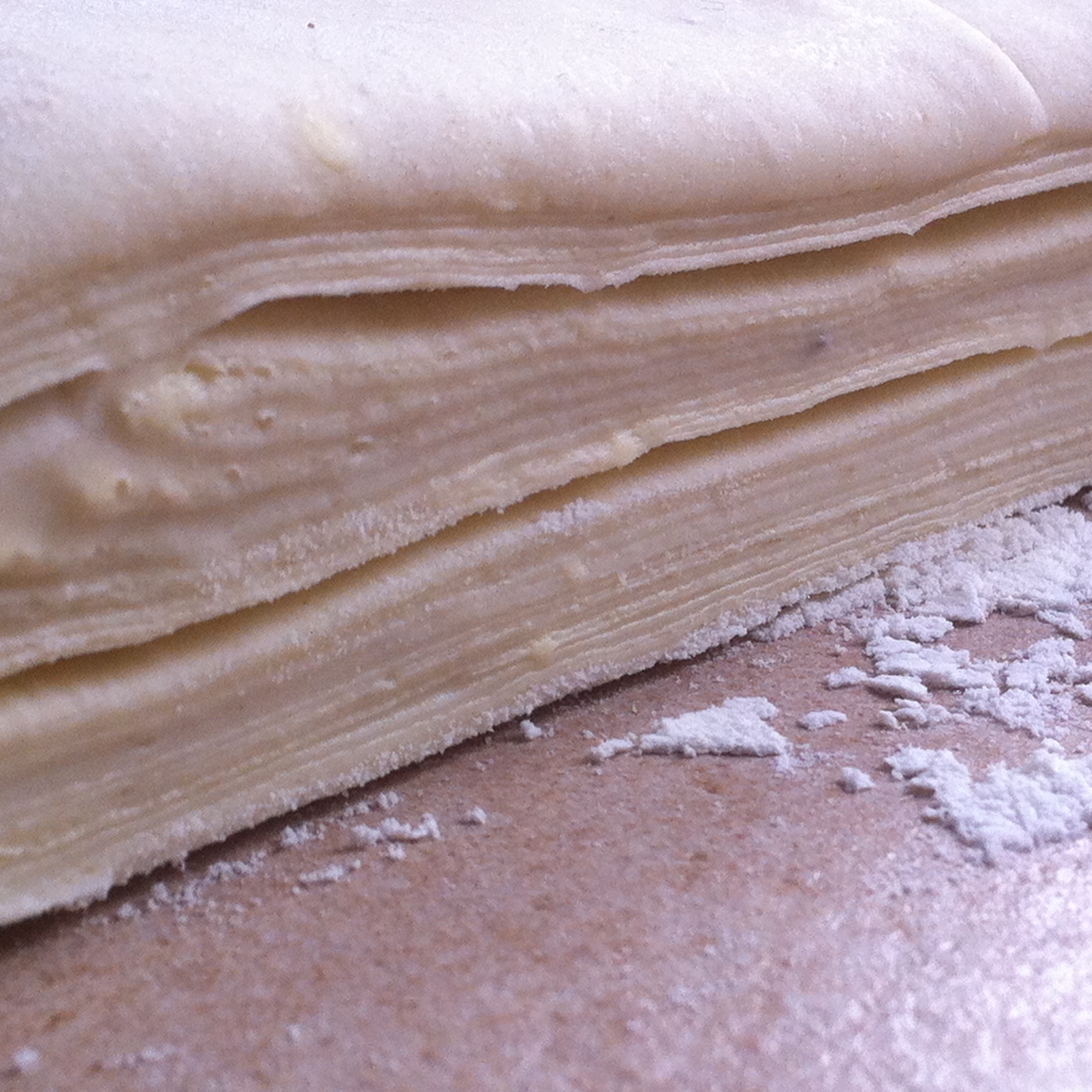
Puff pastry before baking, with layers clearly visible
Alternative namespâte feuilletée
TypePastry
Main ingredientsButter or other solid culinary fat, flour, water
  • Cookbook: Puff pastry
  •   Media: Puff pastry

Puff pastry, also known as pâte feuilletée, is a light, flaky pastry, its base dough (détrempe) composed of wheat flour and water. Butter or other solid fat (beurrage) is then layered into the dough. The dough is repeatedly rolled and folded, rested, re-rolled and folded, encasing solid butter between each resulting layer.

This produces a laminated dough. During baking, gaps form between the layers left by the fat melting; the pastry is leavened by steam from the water content of the fat as it expands, puffing the separate layers. The pastry layers crisp as the heated fat is in contact with its surfaces.

History

[edit]
Spanish pastry in Madrid

While modern puff pastry was developed in France in the 17th century, related laminated and air-leavened pastry has a long history. In Spain, likely built upon Arab or Moorish culinary traditions, the first known recipe for pastry using butter or lard following the Arab technique of making each layer separately, appears in the Spanish recipe book Libro del arte de cozina ('book on the art of cooking') by Domingo Hernández de Maceras, published in 1607.[1] Hernández, the head cook of a college of the University of Salamanca, already distinguished between filled puff pastry recipes and puff pastry tarts, and even mentions leavened preparations. Francisco Martínez Motiño, head chef to Philip II of Spain (1527–1598),[2] also gave several recipes of puff pastry in his Arte de cocina, pastelería, bizcochería y conservería published in 1611.[3] In this book, puff pastry is abundantly used, particularly to make savoury game pies.[4]

A palmier, or "palm leaf", design

The oldest known documented recipe for puff pastry in France was included in a charter by Robert, bishop of Amiens in 1311.[5] The first recipe to explicitly use the technique of tourage (the action of encasing solid butter within dough layers, keeping the fat intact and separate, by folding several times) was published in 1651 by François Pierre La Varenne in Le cuisinier français.[6][7] Modern French puff pastry was then developed and improved by the chef M. Feuillet and Antonin Carême.[8][9][10]

The method is sometimes considered the idea of the famous painter Claude Gellée when he was an apprentice baker in 1612. Historical evidence for this is negligible, but it is retained as culinary lore.[9] The story goes that Lorrain was making a type of very buttery bread for his sick father, and the process of rolling the butter into the bread dough created a croissant-like finished product.[11]

Production

[edit]
Home made puff pastries with sugar

The production of puff pastry dough can be time-consuming, because it must be kept at a temperature of approximately 16 °C (60 °F) to keep the shortening from melting and the layers melding; it must rest in between folds to allow gluten strands time to link up and thus retain layering. Therefore, between each step the dough is rested and chilled. Before re-rolling, the dough is rotated ninety degrees, so that it is rolled at right angle relative to the previous "turn" (as each step is usually referred to). After rolling, another thin layer of butter is applied, the folding and resting are repeated. The chef Julia Child's method has 72 layers[a] for rough-puff pastry (pâte demi-feuilletée) and 729 layers[b] for pâte feuilletée fine.[12]

The number of layers in puff pastry is calculated with the formula:

where is the number of finished layers, the number of folds in a single folding move, and is how many times the folding move is repeated. For example, twice-folding (i.e. in three), repeated four times gives layers.

Commercially made puff pastry is available in grocery stores. Common types of fat used include butter, vegetable shortenings, lard and margarine. Butter is the most common type used because it provides a richer taste and superior mouthfeel. Shortenings and lard have a higher melting point therefore puff pastry made with either will rise more than pastry made with butter, if made correctly. Puff pastry made in this manner will, however, often have a waxy mouthfeel and more bland flavor. Specialized margarine formulated for high plasticity (the ability to spread very thin without breaking apart) is used for industrial production of puff pastry.

Variants and distinctions

[edit]
Rustico leccese: Puff pastry filled with mozzarella, béchamel, tomato, pepper and nutmeg

Since the process of making puff pastry is generally laborious and time-intensive, faster recipes are fairly common: known as "blitz",[13]: 490  "rough puff", or "flaky pastry".[14] Some of these recipes combine the butter into the détrempe rather than adding it in the folding process and are thus similar to a folded short crust. Many retain the layering process, but the number of steps ("turns" or "tours") is reduced. Alternatively, or in addition, the butter is scattered over the dough-layer surface in small pieces, or grated, rather than in a single mass or block. Time and effort to evenly distribute the fat in a single mass is thus avoided, and chilling time may be reduced as less handling of the butter generally keeps it at a lower temperature.[13]

This process makes rough-puff more similar to another laminated pastry, phyllo (or filo). The dough for phyllo is stretched and rolled to its final pre-baking size. Layering is done immediately before baking, with a small amount of oil or melted fat (usually butter) brushed on one layer of dough, which is then topped with another layer that is also brushed with the fat; the layering is repeated as often as desired. When the phyllo bakes it becomes crispy, but since it contains somewhat less water, it does not expand to the same degree as puff pastry. Puff pastry also differs from Austrian strudel dough, or strudelteig, which more closely resembles phyllo, in that strudelteig is stretched (and rolled) into a very thin sheet. Most of the fat is incorporated into strudelteig, rather than applied to sheets. For strudel, pastry layers are achieved by rolling the (lightly fat-coated) dough around the filling multiple times; some phyllo pastry dishes also use this method.

Similar to Puff Pastry, Viennoiserie, is a baker's yeast leavened dough, is used to create croissants, Danish pastry or pain au chocolat. Viennoiserie is considered a separate category of dough and is neither a pastry or a bread.

Uses

[edit]
A chicken pot pie made with puff pastry

See also

[edit]

Notes

[edit]

References

[edit]

Further reading

[edit]
[edit]
Revisions and contributorsEdit on WikipediaRead on Wikipedia
from Grokipedia
Puff pastry, known as pâte feuilletée in French, is a delicate, multilayered composed primarily of , , and a large quantity of , which is incorporated through a process to create hundreds of thin, alternating layers of and fat that separate and rise dramatically during , resulting in a light, flaky, and airy texture. The origins of puff pastry remain obscure, with early references to layered pastries dating to a 1311 charter by , of . Versatile in both sweet and savory applications, puff pastry forms the foundation for iconic dishes such as the elegant (also called ), crisp vol-au-vents filled with creams or ragouts, hearty encasing tender beef and mushrooms, simple palmiers (elephant ears) dusted with sugar, fruit tarts, and pot pie crusts, prized for its ability to provide structure and texture without overpowering fillings.

Introduction

Definition and Characteristics

Puff pastry is a type of created by encasing a block of within a basic made from and , which is then repeatedly folded and rolled to produce hundreds of thin, alternating layers of and . This process results in up to 729 distinct layers in fully developed puff pastry, achieved through six tri-fold turns during preparation. The hallmark characteristics of puff pastry include its extreme flakiness, lightness, and dramatic volume expansion during , where it can rise to five times its original height as the melts and the within it turns to , separating the layers and creating lift. This yields a crisp, golden-brown exterior that shatters easily, contrasted by a tender, airy interior with visible separations between the delicate layers. Unlike non-laminated pastries, which rely on or chemical leaveners for rise, puff pastry achieves its structure solely through physical and generation, without any biological or chemical agents. Sensorially, puff pastry delivers a rich, buttery flavor derived from the high fat content interspersed throughout, paired with a light, ethereal texture that emphasizes its visual appeal through the pronounced layering effect post-baking. These qualities make it distinct from denser or softer doughs, positioning it as a versatile base for both sweet and savory applications where maximum lift and crispness are desired.

Ingredients

Puff pastry requires a few primary ingredients to create its signature flaky, layered structure through and steam generation during . The base , known as détrempe, is made from high-gluten , which provides the necessary protein content for elasticity and structure to encase the fat layers without tearing; cold hydrates the while keeping the cool to prevent premature melting; a small amount of salt enhances flavor and strengthens the network; and a portion of unsalted is incorporated into the for initial binding. The separate butter block, or beurrage, consists almost entirely of high-fat unsalted , which forms thin, impermeable layers that create the pastry's rise when it releases moisture as in the . Traditional recipes use with at least 80-82% content, as found in European-style varieties, to minimize and maximize flakiness compared to standard American at around 80% . Typical ratios emphasize balance for optimal layering: the détrempe is formulated at approximately 2:1 flour to water by weight, with salt at about 2-3% of the flour weight and initial butter at 10-15% of the flour weight; the butter block then equals the total weight of the détrempe for classic full puff pastry. These proportions ensure the dough remains pliable yet sturdy during folding. Optional additions to the détrempe include a small amount of lemon juice or , which acts as an acid to relax the slightly and improve workability without significantly altering texture. For finishing baked goods, an may be applied to the surface for a golden sheen, though it is not part of the itself. considerations are paramount: European-style is preferred for its higher and lower moisture, which supports better separation of layers, while is avoided in traditional recipes due to its inferior ability to create distinct, flaky strata.

History

Origins

The origins of puff pastry are rooted in medieval , with the earliest known documented reference appearing in a 1311 charter by Robert of , which describes a flaky layered pastry technique possibly influenced by methods. While possible influences from earlier Middle Eastern or Byzantine layered pastries—such as thin-sheeted doughs brushed with fat—have been proposed due to culinary exchanges during the and trade routes, no direct evidence connects these to the butter-laminated method characteristic of modern puff pastry. A specific event often cited in the invention narrative involves experimentation in the 1640s by an apprentice named Claude Gellée (also known as Claudius Gelée or Le Lorrain), who, working under a bakery in Lorraine, sought to create a nourishing bread for his ill parent by repeatedly folding dough around slabs of butter, resulting in the serendipitous rise of distinct layers upon baking. This tale, while legendary and lacking contemporary documentation, underscores the trial-and-error innovation typical of early modern baking practices in France. The technique gained formal recognition in the 1640s, with the earliest definitive attribution to French chef François Pierre La Varenne, who detailed the feuilletage (leafing) process in his influential 1651 cookbook Le Cuisinier françois, marking the first printed recipe for what would become a cornerstone of French pâtisserie. Under the reign of (r. 1643–1715), puff pastry assumed a prominent role in the opulent French court at Versailles, where it evolved from humble adaptations into a refined, versatile element for both savory and sweet preparations. Chefs like La Varenne, serving noble households, elevated the pastry through precise folding and butter incorporation, transforming it into a symbol of culinary artistry amid the era's emphasis on elaborate banquets and display. This development laid the foundation for puff pastry's integration into , distinguishing it from coarser medieval doughs.

Development and Spread

In the early , French chef significantly refined puff pastry techniques through his systematic documentation in Le Pâtissier royal parisien (1815), where he detailed the preparation of pâte feuilletée by enclosing chilled butter within a base and executing successive folds and rollings to produce the signature flaky layers. This approach emphasized precise temperature control and resting periods between folds to prevent butter leakage, elevating the pastry from a rudimentary method to a cornerstone of . Carême's work, drawing on his experience as a tourier (pastry turner), made the process more reproducible for professional pâtissiers across . The spread of puff pastry beyond accelerated in the , particularly to Britain, where Carême served as chef to the Prince Regent from 1816 to 1820 and influenced prominent English cooks. His teachings introduced layered pastry methods into British gastronomy, leading to the incorporation of pâte feuilletée in dishes such as vol-au-vents and elaborate pies documented in contemporary English texts like ’s The Modern Housewife (1849). Industrial advancements, including the adoption of mechanical dough sheeters in European bakeries by the late 1800s, further facilitated consistent production and wider distribution. French immigrants played a pivotal role in the pastry's global dissemination during the 1800s, carrying techniques to the Americas where they integrated into regional cuisines; for instance, in New Orleans, puff pastry became essential for Creole specialties like pâté en croûte. In colonial , French settlers and chefs adapted it for local baked goods, influencing early hybrid pastries amid British dominance. By the , commercialization expanded access: mechanical sheeters enabled large-scale bakery output from the 1910s onward, while frozen puff pastry sheets, first widely marketed by brands like in the post-World War II era, allowed home bakers to achieve professional results without labor-intensive preparation. The 2010 UNESCO listing of the French gastronomic meal as further affirmed puff pastry's role in preserving culinary traditions worldwide.

Production

Basic Preparation

The preparation of puff pastry begins with creating the détrempe, a simple lean formed by sifting all-purpose and salt together in a large to ensure even distribution and remove lumps. Ice-cold water is gradually incorporated using a or hands, mixing just until the ingredients come together into a cohesive, pliable ball that is smooth but not sticky; overmixing or excessive should be avoided to prevent developing too much , which can result in a tough texture. The is then lightly kneaded on a floured surface for a few strokes to achieve uniformity, wrapped in plastic, and rested in the for 30 to 60 minutes, allowing the to relax and the to firm up for easier handling later. Simultaneously, the beurrage or block is prepared by starting with high-quality, unsalted European-style that is very cold, ideally straight from the . The is placed between two sheets of and gently pounded with a or beaten to flatten it into a uniform square or rectangle, about 1/2 inch (1 cm) thick and sized to match the détrempe after rolling—typically around 8 inches (20 cm) square for standard recipes. If the proves difficult to shape due to its firmness, a small amount of can be lightly dusted onto it to improve workability without altering the fat layers significantly. The shaped block is then chilled in the until it reaches a malleable consistency, around 60°F (15°C), firm enough to hold its shape but pliable for incorporation into the . To enclose the butter, the rested détrempe is removed from the and rolled out on a lightly floured surface into a cross or plus shape, with a thicker central square roughly the size of the block and thinner arms extending outward. The chilled block is positioned in the center of this cross, and the arms are folded upward and over the , pressing the edges firmly to seal it completely and prevent any butter from leaking out during subsequent handling. Any excess edges are trimmed if necessary to ensure a tight package. Throughout these initial steps, strict is essential to maintain the integrity of the layers; all work should occur in a cool kitchen environment at or below 68°F (20°C), with components returned to the as needed to keep the solid and the chilled, avoiding any softening that could lead to greasy results or uneven .

Folding and Layering Techniques

The process in puff pastry creation builds the signature flaky layers by repeatedly rolling and folding the around the block, distributing fat evenly to separate thin sheets of during . After enclosing the in the initial sheet, the package is gently rolled into a long approximately three times longer than wide, ensuring the remains cool and pliable without breaking through the . This foundational step sets the stage for successive turns that exponentially increase the layer count. A single turn, also referred to as the letter fold, involves rolling the to a uniform and folding it into thirds like a : one end is folded over the middle third, followed by the opposite end folded over the first fold. This technique triples the number of layers with each application and is typically performed in sequence with double turns to achieve the desired structure. In contrast, the double turn, or book fold, requires rolling the to about twice its desired final width, then folding the short edges inward to meet at the center before folding the entire piece in half along that centerline, effectively quartering the and multiplying layers by four. One common method uses three single turns and three double turns for classic puff pastry, yielding over 729 alternating -butter layers for optimal rise and flakiness. Between each turn, the rests in the for 20 to 30 minutes to relax the , prevent shrinkage, and solidify the , maintaining distinct layers. This chilling is essential after every one or two turns, with a total of six turns completed over 2 to 3 hours to avoid overworking the . Following the final rest, the is rolled out to a thickness of 1/8 to 1/4 inch, depending on the application, and may be lightly docked with a or scored to control expansion. Starting from 1 pound of prepared and , the process produces large sheets suitable for multiple uses, such as several turnovers or bases for tarts.

Variants

Traditional Types

Classic full puff pastry, also known as pâte feuilletée in French tradition, is prepared using the direct method where a block of chilled is encased in a basic flour-and-water , followed by multiple rolling and folding turns to create thin, alternating layers of and fat. This process typically involves six single turns, resulting in 729 layers, though additional turns can yield even more layers for an exceptionally fine rise. The full process requires extensive chilling between turns to keep the butter firm, often spanning 2-3 days to achieve optimal and prevent the layers from merging during . Rough puff pastry, sometimes called quick or blitz puff, simplifies the traditional approach by incorporating directly into the through cutting or grating, followed by minimal and 4-6 irregular folds without extended resting periods. This method produces coarser, less uniform layers compared to full puff, but it allows for a faster preparation time of 1-2 hours, making it more accessible for home bakers while still delivering a flaky texture suitable for everyday applications. Inverse puff pastry, or pâte feuilletée inversée, reverses the classic construction by forming a butter-flour block (beurrage) that encases a plain water-flour dough, then undergoing similar rolling and folding to build layers. The result is a flakier, more consistent pastry with crisp layers, suitable for various applications like pot pies and tarts. Like full puff, it typically involves multiple turns to achieve hundreds of layers, but the inverted fat distribution enhances consistency during baking. In French tradition, all-butter formulations using high-fat-content (at least 82%) European are preferred for superior flavor and lift, with traditional for maximum layers. In contrast, American commercial production frequently employs or for cost efficiency, resulting in a more robust but less delicate product.

Modern and Regional Variations

In contemporary , vegan adaptations of puff pastry have gained popularity by substituting traditional butter with plant-based alternatives such as vegan margarine or , which require adjustments to maintain the fat's solidity during layering to achieve comparable flakiness. These versions often rely on stick-style vegan butters for optimal results, as softer spreads can lead to denser textures, though the overall rise may be slightly less pronounced due to differences in fat composition and water content compared to dairy-based doughs. Commercial quick variants, such as pre-rolled frozen puff pastry sheets, incorporate stabilizers and preservatives to enhance shelf stability and ease of use, allowing bakers to thaw and bake without proofing for consistent results in home and professional settings. Regionally, Spanish hojaldre employs alongside or in place of to yield an exceptionally flaky texture, leveraging lard's higher for superior layer separation during . In , puff pastry is adapted for samosas to create a crisp exterior for traditional spiced fillings, offering a convenient alternative to handmade maida-based wrappers. Japanese interpretations of often feature matcha-infused creams layered between puff pastry sheets, blending the French classic with green tea's earthy notes for a visually striking, subtly bitter . Post-2020 innovations include gluten-free puff pastry formulations using blends combined with starches like for structure, enabling flaky results without while addressing dietary restrictions through accessible rough-puff methods. Sustainable options have advanced with the integration of cultured , which undergoes for enhanced flavor depth, or carbon-derived fats that reduce agricultural dependency, offering environmentally conscious alternatives that perform comparably in layering and puffing.

Uses

Savory Applications

Puff pastry serves as an ideal top crust for savory pot pies, such as , where its flaky layers seal in creamy fillings of meat, vegetables, and gravy while allowing for a crisp exterior. For tarts and quiches, it forms blind-baked bases that are pre-cooked empty with weights to maintain shape and prevent sogginess from egg custard or vegetable fillings. To facilitate even and avoid buildup, cooks cut venting slits into the pastry top before placing it in the oven. In standalone pastries, puff pastry creates vol-au-vents, hollow puffed cases that are filled post-baking with savory ragouts like creamy or stews. Beef Wellington employs the pastry to encase a seared wrapped in and , forming a dramatic centerpiece that bakes to golden perfection. Sausage rolls wrap spiced meat fillings, often seasoned with herbs, , or , into logs of pastry for portable appetizers or snacks. Effective techniques ensure optimal rise and texture: an applied to the surface promotes a shiny, golden finish, while preheating the to 400-425°F (200-220°C) encourages rapid puffing from separation in the layers. Bases for filled tarts benefit from 10-15 minutes of initial blind at the same temperature to set the structure before adding fillings. The multi-layered structure of puff pastry provides essential support to hold savory fillings without collapsing. Culturally, British Cornish pasties adapt puff for their crimped, handheld form enclosing beef, potato, and onion, offering a lighter alternative to traditional shortcrust. In , feuilletés feature the pastry topped or filled with melted cheese or sautéed mushrooms, baked briefly for a rustic yet elegant starter.

Sweet and Dessert Uses

Puff pastry's flaky layers provide an ideal base for elegant layered desserts, where thin sheets are baked until crisp and stacked with creamy fillings. The classic , also known as a , features multiple layers of puff pastry alternated with pastry cream or , often topped with a or dusting for a refined finish. Palmiers, or elephant ears, offer a simpler twisted variation; the pastry is rolled in granulated sugar, folded into a log, sliced, and baked to create caramelized, heart-shaped cookies with a crunchy texture enhanced by the sugar's melting and crisping. In tarts and pastries, puff pastry encases or supports fruit-based fillings to create handheld or open-faced treats. Fruit turnovers involve cutting the dough into squares, filling with sweetened fruits like apples or berries, folding into triangles, sealing, and baking until golden. Danish-inspired pastries adapt the dough for fruit-filled spirals or pockets, such as those with or compote layered inside for a tender, buttery contrast to the juicy filling. Napoleon slices, a shorter version of , use the same puff pastry layers but in rectangular form, often with fresh berries between cream fillings for a lighter . Baking adaptations for sweet uses emphasize enhancing caramelization and controlling rise with fillings. Dusting the pastry with granulated or before baking promotes a glossy, caramelized exterior as the sugar melts and browns during oven time. For filled desserts, a lower around 375°F (190°C) allows even browning and prevents the exterior from overcooking while the interior filling sets properly. Iconic recipes highlight puff pastry's versatility in fruit-forward sweets. Apple turnovers, filled with cinnamon-spiced apple chunks and baked to a flaky crispness, exemplify a comforting classic that balances tart fruit with warm spices. A simple vegetarian version typically uses ready-made puff pastry, with a filling prepared from peeled and cubed tart-sweet apples mixed with sugar, cinnamon, optional chopped walnuts for texture, and corn starch to thicken the mixture. The dough is rolled out and cut into squares, each filled with 1–2 tablespoons of the mixture, folded into triangles or envelopes, edges sealed with a fork, and small holes poked for steam escape; the turnovers are then placed on a parchment-lined tray, brushed with cream or egg, and baked at 180–200°C for 20–25 minutes until golden, optionally dusted with powdered sugar before serving warm. Strawberry tartlets use blind-baked puff pastry rounds or rectangles topped with fresh strawberries and glaze for a vibrant, summery presentation. Modern twists include chocolate-filled rugelach hybrids, where puff pastry replaces traditional dough, rolled around chocolate spread or chips, sliced, and baked into bite-sized, flaky spirals.

Science and Practical Aspects

Mechanism of Puffing

The mechanism of puffing in puff primarily relies on the generation and entrapment of during , which causes the layered structure to expand dramatically. As the pastry enters a hot , typically preheated to around 425°F (218°C), the layers—composed largely of with approximately 15-20% —begin to melt between 90-95°F (32-35°C), releasing that rapidly vaporizes into upon reaching 212°F (100°C). This expands the thin sheets apart, with the layers acting as semi-impermeable barriers that trap the vapor and prevent it from escaping, leading to a height increase of 200-300% or more in well-prepared . Additionally, small pockets of air incorporated during the folding process contribute to the lift by expanding thermally under heat. The role of gluten in this process is crucial yet restrained, forming a weak, extensible network that allows the layers to separate without rupturing. Minimal during preparation limits development, while the coats particles, inhibiting excessive protein hydration and cross-linking that would otherwise create a tough, elastic structure. This delicate balance ensures the remains pliable enough to enclose the during but fragile enough to yield to steam pressure, preserving the flaky texture. Heat transfer dynamics further govern the puffing action, with rapid initial conduction from the vaporizing quickly to drive "oven spring"—the peak expansion phase occurring in the first 5-10 minutes of . As the exterior sets and forms a crust, internal continues to push layers outward until the structure stabilizes. The volume increase can be conceptually understood through the phase change of to , where H₂O at 100°C expands to approximately 1,700 times its volume as gas under , though in , this is modulated by the confined layers: Vsteam1700×Vliquid H₂OV_{\text{steam}} \approx 1700 \times V_{\text{liquid H₂O}} This underscores the exponential lift, with fat barriers ensuring directed expansion between sheets.

Storage, Troubleshooting, and Tips

Proper storage is essential to maintain the flaky texture and prevent spoilage of puff pastry dough. For homemade or unused portions, wrap the dough tightly in followed by aluminum foil or a freezer bag to protect against , and it can be frozen for up to 6 months. Thaw frozen dough overnight in the to ensure even defrosting without compromising the layers, and once thawed, use it within 2 days when refrigerated at 40°F (4°C) or below to avoid . Troubleshooting common issues during preparation and helps achieve optimal results by addressing factors that disrupt the puffing mechanism, where from in the separates -encased layers. leakage often occurs if the becomes too warm during handling, leading to the fat melting and seeping out; to fix this, chill the more frequently, such as for 30 minutes after each folding stage or before , to keep the solid. A dense result typically stems from overworking the , which develops excess and compresses the layers; reduce and handle gently to preserve air pockets. Uneven rise can result from poor edge enclosure during folding, allowing to escape prematurely; reseal edges firmly with light pressure or additional to ensure uniform expansion. Several practical tips enhance success when working with puff pastry, particularly in home settings. Maintain a cool environment below 70°F (21°C) to prevent the from softening prematurely, as warmer temperatures accelerate melting and hinder . Using a chilled slab for rolling keeps the cool longer due to the stone's properties, reducing the need for frequent breaks. Scale recipes by weight rather than volume for precision, as measurements can vary significantly and affect the -to- ratio critical for flakiness. For vegan adaptations using plant-based butters, which have lower melting points, incorporate extra chilling periods—up to 45 minutes between folds—to mimic the stability of . Baking puff pastry requires careful handling to achieve its characteristic flaky and puffed texture. Frozen puff pastry, a convenient option for home use, should be thawed in the refrigerator overnight or at room temperature for 30–40 minutes until pliable but still cold, preserving the integrity of the butter layers. Gently roll out on a lightly floured surface if needed, taking care to avoid overworking the dough. Cut into desired shapes, docking by pricking with a fork in areas where rise is not desired, while leaving other areas intact for maximum expansion. Optionally, brush with beaten egg or milk for a golden color and shine. Place on a parchment-lined baking sheet and bake in a preheated oven at 400–425°F (200–220°C) for 10–25 minutes depending on thickness and recipe, until golden brown, puffed, and crisp. Starting at the higher temperature promotes initial oven spring, with possible reduction for even cooking. The pastry must remain cold throughout handling to maintain layering, and the oven door should not be opened early to avoid collapse from temperature drop and steam loss. Food safety practices are crucial when preparing puff pastry, especially with fillings. Avoid cross-contamination by washing hands, utensils, and surfaces with hot, soapy water before and after handling raw ingredients, and use separate boards for and fillings to prevent bacterial transfer. For filled pastries, bake until the internal reaches 190°F (88°C) to ensure pathogens in , , or egg-based fillings are destroyed, verifying doneness with a food thermometer inserted into the center.

References

Add your contribution
Related Hubs
User Avatar
No comments yet.