


Community hub
Recent from talks
Contribute something
Nothing was collected or created yet.
 | This article needs additional citations for verification. (November 2018) |

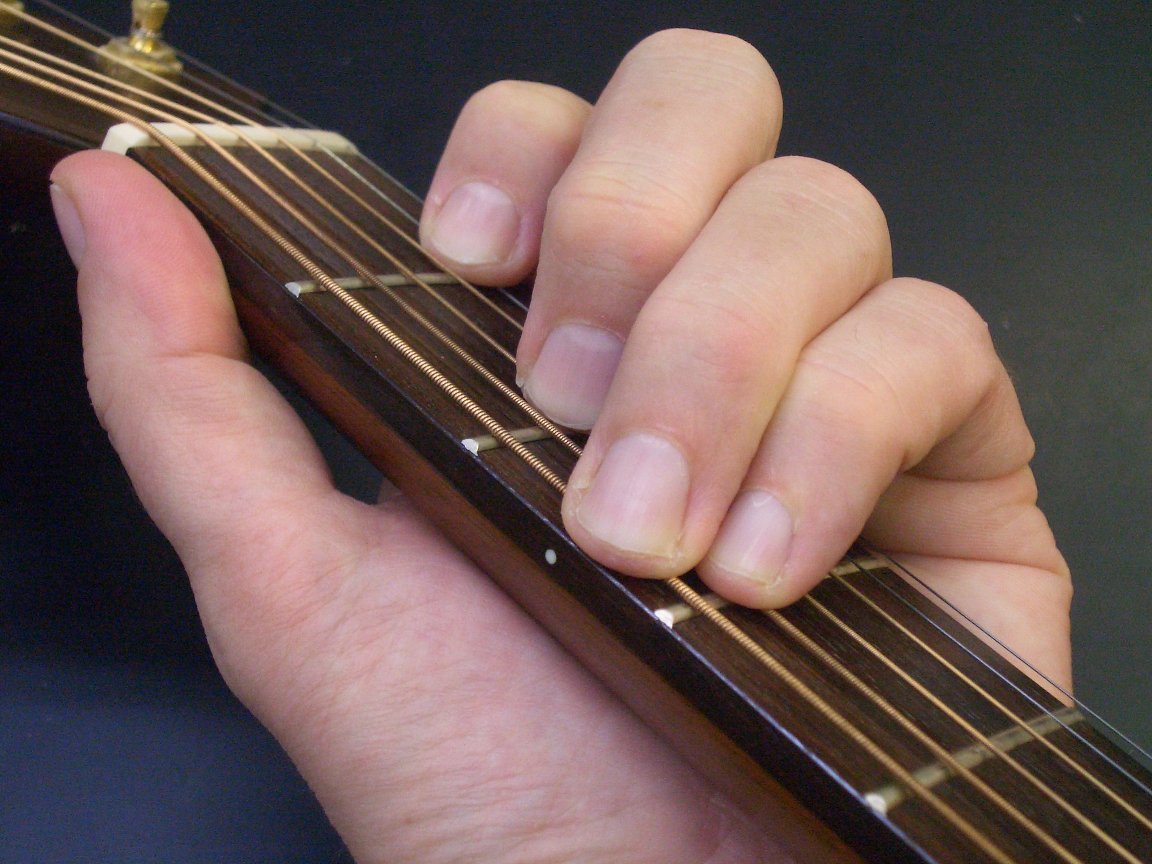
A fret is any of the thin strips of material, usually metal wire, inserted laterally at specific positions along the neck or fretboard of a stringed instrument. Frets usually extend across the full width of the neck. On some historical instruments and non-European instruments, frets are made of pieces of string tied around the neck.
Frets divide the neck into fixed segments at intervals related to a musical framework. On instruments such as guitars, each fret represents one semitone in the standard western system, in which one octave is divided into twelve semitones.
Fret is often used as a verb, meaning simply "to press down the string behind a fret". Fretting often refers to the frets and/or their system of placement.
Explanation
[edit]Pressing the string against the fret reduces the vibrating length of the string to that between the bridge and the next fret between the fretting finger and the bridge. This is damped if the string were stopped with the soft fingertip on a fretless fingerboard.
Frets make it much easier for a player to achieve an acceptable standard of intonation since the frets determine the positions for the correct notes. Furthermore, a fretted fingerboard makes it easier to play chords accurately.
A disadvantage of frets is that they restrict pitches to the temperament defined by the fret positions. A player may still influence intonation, however, by pulling the string to the side to increase string tension and raise the pitch. This technique (commonly called "bending") is often used by electric guitarists of all genres, and is an important part of sitar playing. On instruments with frets that are thicker off the fingerboard, string tension and pitch vary with finger pressure behind the fret. Sometimes a player can pull the string toward the bridge or nut, thus lowering or raising the string tension and pitch. However, except for instruments that accommodate extensive string pulling, like the sitar, much less influence on intonation is possible than on unfretted instruments.
Equal temperament
[edit]Since the intonation of most modern western fretted instruments is equal tempered, the ratio of the distances of two consecutive frets to the bridge is (the twelfth root of two), or approximately 1.059463.[1] Theoretically, the twelfth fret should divide the string in two exact halves. To compensate for the increase in string tension when the string is pressed against the frets, the bridge position is adjusted slightly so the 12th fret plays exactly in tune.
![{\displaystyle {\sqrt[{12}]{2}}}](https://wikimedia.org/api/rest_v1/media/math/render/svg/bc835f27425fb3140e1f75a5faa35b1e8b9efc35)

Many instruments' frets are not spaced according to the semitones of equal temperament.
Examples
[edit]Some examples are:
- Appalachian dulcimer with frets in a diatonic scale;
- the Turkish Saz with frets spaced according to the Makam system of Turkish folk music;
- the Arabic buzuq with frets spaced according to the Arabic maqam system;
- the Persian setar and tar with frets spaced according to the Persian Dastgah system;
- the Turkish tanbur with as many as 5 frets per semitone, to cover all of the commas of the Turkish Makam system.
Variations
[edit]Fan frets (also fanned frets, slanted frets), or multi-scale: while frets are generally perpendicular to the instrument's neck centerline and parallel to each other, on a "fanned" fretboard, the frets are angled (spread like a fan) with only one center fret perpendicular to the neck's centerline. This gives the lower-pitched strings more length and the higher strings shorter length (comparable to a piano or a harp where heavier strings have different lengths). The idea is to give more accurate tuning and deeper bass. Some think that fanned frets might be more ergonomic. Fanned frets first appeared on the 16th-century Orpharion, a variant of the cittern, tuned like a lute. John Starrett revived the idea in the late seventies on his innovative instrument, the Starrboard. Rickenbacker employed a slanted fret, but it was not multi scale, or fanned. Novax Guitars among others offers such guitars today. The appearance of angled frets on these modern instruments belies the antiquity of this technique.
Scalloped fretboard: Scalloping involves removing some of the wood between some or all of the fret. This is intended to allow a lighter touch for more precise fingering, while easing bends or vibratos (since there's no contact between the fingertips and the wooden surface of the fingerboard). It has some popularity with musicians playing heavy metal music, although the concept can also be seen in ancient instruments such as the sitar. Scalloped fretboards have not found widespread popularity because tonally accurate play requires a much lighter fretting hand than most guitarists can achieve, and often significantly heavier strings as well.
Fat frets: on older guitars (especially the Fender Stratocaster), frets were typically made out of thin wire, and some electric guitar players replaced that with thicker wire, for "fat frets" or "jumbo frets". Fat frets make bending easier, and they change the feel of the guitar. As well, large frets, offering more metal, remain playable much longer than thin frets. A side effect of a thicker fret is a less precise note, since the string is held over a wider surface, causing a slight inaccuracy of pitch, which increases in significance as frets wear.[2]
Semi-fretted instruments
[edit]It is also possible to find semi-fretted instruments; examples include the Malagasy kabosy and the Afghan Rubab. Semi-fretted versions of guitars and other fretted string instruments, however, are usually one-off, custom adaptations made for players who want to combine elements of both types of sound. One arrangement is for the frets to extend only part of the way along the neck so that the higher notes can be played with the smooth expression possible with a fretless fingerboard. Another approach is the use of frets that extend only partway across the fretboard so that some courses of strings are fretted and others fretless, for example Ryszard Latecki's Latar.
Fret intonation
[edit]Instruments with straight frets like guitars require a special compensation on the saddle and nut. Every time a string is fretted it is also stretched, and as it stretches the string rises in pitch, making all fretted tones sound sharp. When the saddle is positioned properly, however, the fretted tones all sound sharp to the same degree as long as the distances between the frets are correct. With the right nut compensation, the pitch of the unfretted string can be raised by the same amount. As a result, when the tension of the strings is lowered, the pitches of all notes, both fretted and unfretted, become correct.
Fret wear
[edit]On instruments equipped with steel strings, such as folk guitars and electric guitars, frets are eventually bound to wear down as the strings cut grooves into them. When this happens, the instrument may need refretting (the frets are removed and replaced) or, in less severe cases, "fret dressing" (the frets are leveled, polished, and possibly recrowned). Often, a few fret dressings can be performed on a guitar before it requires complete refretting.
Tied gut frets, used on instruments such as the lute or viol, wear quickly, and must be replaced regularly.
Fret buzz
[edit]Fret buzz is one of the many undesirable phenomena that can occur on a guitar or similar stringed instrument. Fret buzz occurs when the vibrating part of one or more strings physically strikes the frets that are higher than the fretted note (or open note). This causes a "buzzing" sound on the guitar that can range from a small annoyance, to severe enough to dampen the note and greatly reduce sustain. Sometimes, fret buzz can be so minimal that there is only a small change in the tone (timbre) of the note, without any noticeable buzzing. Fret buzz can be caused by different things:[3]
- Low action
- Improperly installed fretbars
- Strings too loose
- Improper relief of guitar neck
Fret buzz is evident in some famous recordings; an example is "Friends" by Led Zeppelin (although this example is undoubtedly caused by alternate open tunings that reduce string tension).[citation needed] In some songs, such as "My Last Serenade" by Killswitch Engage, the guitars are tuned to Dropped C and the low tension of the strings is used to create fret buzz by the bass player in order to create a dirty sound.
History
[edit]


It is not known when frets were first used. An early example from about the 3rd century C.E. was discovered in 1907 in the Niya ruins in Xinjiang, China, a broken lute's neck with two gut frets intact.[4] The neck and pegbox of the lute are similar to the lute painted on the wall in the Dingjiazha Tomb No. 5 (384–441 A.D.[5]), which also has frets. Buddhist artworks from the 6th-10th centuries C.E. in the Mogao Caves (558-907 C.E.) and Yulin Caves (618-907 C.E.) appear to have frets. Some long lutes in the Utrecht Psalter (c. 850 C.E.) in France also appear fretted, as do citoles from Spain in the Cantigas de Santa Maria (c. 1280).
See also
[edit]References
[edit]- ^ Mottola, R.M. (1 January 2020). Mottola's Cyclopedic Dictionary of Lutherie Terms. LiutaioMottola.com. p. 2. ISBN 978-1-7341256-0-3.
- ^ Hunter, Dave (February 2014). "What's the Big Deal About Jumbo Frets?". Guitar Player.
- ^ "Buzz Diagnosis". Archived from the original on 2011-01-08. Retrieved 2011-01-22.
- ^ "Lute". The British Museum.
Fragment of a wooden lute. This is only the neck of the instrument, the body has not survived...There are marks showing at the top of the fingerboard where two strands of gut, probably with a third strand on top of them to raise the height of the strings, served as a nut. The surviving doubled strand of gut was a fret, and the slightly thicker single strand may have been a fret for higher notes...Registration number 1907,1111.90
- ^ Zhu, Fengsh (September 2014). "墓主燕居行乐图探考 (translation: Exploring Yanjuxing's Tomb". 活力杂志 [Translation: Vitality Magazine]. 黑龙江 [Heilongjiang]: 黑龙江日报报业集团 [Heilongjiang Daily Newspaper Group]. Archived from the original on 24 September 2018. Retrieved 24 September 2018.
[Information about the magazine article this ran in is at www.xueshu.com/hl/201410/3683520.html]
External links
[edit]

 | This article includes a list of general references, but it lacks sufficient corresponding inline citations. (June 2009) |
- Konrad Schwingenstein: Intonation of stringed instruments with straight frets, http://www.pepithesecond.com
- Calculating Fret Positions – An article on calculating fret positions for any equal tempered instrument on Liutaio Mottola Lutherie
- How to replace frets Archived 2007-09-30 at the Wayback Machine – Photo story
- Installing the Frets in a Fretted Stringed Musical Instrument Archived 2021-01-26 at the Wayback Machine – An article on fret installation for a new instrument on Liutaio Mottola Lutherie
- Dressing the Frets in a Fretted Stringed Musical Instrument Archived 2021-01-26 at the Wayback Machine – An article on fret dressing on Liutaio Mottola Lutherie
- Fix Guitar String Buzz – Article about guitar string buzz problems and fixes on Guitar Repair Bench
- Re-fret Bound and Unbound Fretboards – Article about removing, installing, leveling, crowning, and dressing guitar frets on Guitar Repair Bench

Fundamentals
Definition and Purpose
A fret is any of a series of thin, raised ridges, typically made of metal wire, embedded laterally across the fingerboard (or neck) of a stringed musical instrument to divide the string's length into discrete segments.[1] These ridges, when the string is pressed against them by the player's fingers, shorten the effective vibrating length of the string from the bridge, thereby producing higher pitches corresponding to specific notes in a musical scale.[2][9] The primary purpose of frets is to facilitate accurate pitch production and consistent intonation across the instrument's range, allowing players—particularly beginners—to locate notes reliably without advanced finger placement skills.[10] By providing fixed division points, frets divide the scale length into semitones or other tempered intervals, supporting systems like equal temperament for harmonic compatibility in ensemble playing.[11] This design enhances playability and tonal clarity, as the hard fret surface allows the string to vibrate more freely and sustain longer compared to direct fingertip contact alone.[9] Frets are a defining feature of many chordophones, including guitars, lutes, banjos, ukuleles, and ouds, where they enable polyphonic chordal and melodic performance.[12] Historically, frets originated on early plucked string instruments to mark precise division points for tuning and pitch production, akin to the movable bridges used on the ancient monochord for demonstrating harmonic ratios.[13] This innovation, evident in medieval lutes and their precursors, allowed for standardized scales and facilitated the evolution of complex musical traditions.[12]Basic Mechanics
In fretted string instruments, such as the guitar, the primary mechanism for altering pitch involves pressing a string against a fret with a finger, which shortens the effective vibrating length of the string from the bridge to the point of contact at the fret.[14] This reduction in length increases the frequency of vibration, thereby raising the pitch; the pitch rises proportionally to the inverse of the length ratio, as a halved length doubles the frequency, corresponding to an octave higher.[14][15] The fundamental physics governing this process is described by the wave equation for a vibrating string under tension, where the frequency of the fundamental mode is given by with as the vibrating length, as the string tension, and as the linear mass density of the string.[15] Frets enforce discrete values of by providing fixed contact points along the fingerboard, allowing players to select specific pitches from the open-string fundamental.[16] Tension and mass density remain constant for a given string unless adjusted at the tuning pegs or bridge, so changes in pitch are achieved solely through length variation via fret contact.[17] Proper finger placement requires only light pressure to ensure the string contacts the fret without excessive force, as the fret's raised position facilitates clear vibration termination. Over-pressing can slightly bend the string beyond the fret, effectively shortening further and causing a small upward intonation shift due to the altered geometry.[18] Frets also enable efficient multi-string interactions, such as barring, where a single finger presses across multiple strings at the same fret to form chords, allowing simultaneous sounding of notes at identical relative positions from the bridge.[19] This technique leverages the uniform spacing of frets to maintain consistent pitch intervals across strings.[14]Temperament and Calculation
Equal Temperament
Equal temperament is a musical tuning system that divides the octave into twelve equal semitones, with each semitone corresponding to a frequency ratio of , approximately 1.05946.[20] This equal division ensures that the logarithmic interval, measured in cents, is uniformly 100 cents per semitone, providing a consistent scale for fixed-pitch instruments.[20] Adopted as the foundation of modern Western music over the past two centuries, it approximates just intervals while prioritizing uniformity across the chromatic scale.[20] In fretted instruments such as guitars and lutes, equal temperament dictates fret placement to produce these uniform semitone intervals along the neck, aligning all strings to the same pitch standard regardless of position.[21] This configuration is particularly suited to the Western chromatic scale, enabling seamless execution of melodies and harmonies in any key while minimizing audible beating in chords through even distribution of intonation discrepancies.[22] Fret positions are directly derived from this temperament to maintain the equal semitone progression from the nut onward. The primary advantages of equal temperament include the ability to perform in all twelve keys without retuning, making it highly practical for ensemble playing and solo improvisation on instruments like guitars.[23] It supports unrestricted modulation between keys, a cornerstone of complex Western compositions, and parallels the fixed tuning of pianos where versatility across tonalities is essential.[23][20] However, equal temperament compromises on the purity of intervals found in just intonation, which relies on simple integer frequency ratios, leading to slight dissonance in contexts emphasizing consonant harmonies such as unaccompanied thirds.[24] For instance, the major third is tempered wider by about 14 cents compared to its just ratio, potentially causing subtle harshness in solo or a cappella settings.[24] Equal temperament gained prominence for fretted instruments in Renaissance Europe due to the practical challenges of unequal spacing on fixed frets, as advocated by theorists like Vincenzo Galilei in the late 16th century, and solidified as the standard across Europe by the 18th century amid growing demands for chromatic flexibility.[25][21]Fret Position Formulas
The position of the nth fret on a stringed instrument tuned to equal temperament is calculated to ensure that each fret corresponds to a semitone interval, dividing the octave into 12 equal parts logarithmically. The standard formula for the distance from the nut to the nth fret, denoted as , is given by: where is the scale length (the vibrating length of the open string from nut to bridge). This positions the frets such that the vibrating string length behind the nth fret is , producing a frequency increase of times the open string frequency.[18][26] The derivation stems from the inverse relationship between string length and frequency in the physics of vibrating strings: frequency is proportional to , where is the vibrating length. In equal temperament, each semitone multiplies the frequency by the constant , the twelfth root of 2. Thus, the length at the nth fret is the open length divided by the cumulative product , or . The fret position from the nut is then the difference , yielding the formula above. This geometric progression ensures consistent semitone intervals across the fretboard.[18] Practical adjustments to this formula may account for fret height compensation, where the string contacts the top of the fret rather than the fingerboard, requiring fret slots to be placed slightly closer to the nut. A common historical approximation is the "rule of 18," where the first fret is placed at approximately from the nut, and subsequent frets are positioned by dividing the remaining distance by 18 iteratively. This rule approximates the exponential spacing and inherently incorporates typical bridge saddle compensation (offset of about ) for improved intonation, though the more precise constant for uncompensated positions is 17.817, derived from . For accuracy, modern calculations use the exact exponential formula with software offsets.[26][27] For a typical 24-fret guitar with a scale length of 25.5 inches (648 mm), the first fret is positioned at approximately 1.43 inches (36.3 mm) from the nut, calculated as . The 12th fret falls at exactly half the scale length (12.75 inches or 324 mm), marking the octave, while the 24th fret is at inches (486 mm). These positions compress progressively toward the body, reflecting the logarithmic nature of pitch perception.[18][28] Fret calculators and software facilitate precise computation for custom scales, incorporating the equal temperament formula and optional compensations. Tools like the StewMac Fret Position Calculator allow input of scale length and number of frets to output positions in inches or millimeters, often using the 17.817 rule for iterative placement. Open-source alternatives, such as those based on the twelfth root of 2, enable luthiers to generate fretboard layouts for non-standard instruments.[28][26] Variations exist for non-equal temperaments, such as just intonation, where fret positions are derived from rational frequency ratios rather than logarithmic division. For instance, a perfect fifth (seven semitones) uses the ratio 3/2, so the vibrating length at that fret is , positioning the fret at from the nut. Full scales accumulate products of such ratios (e.g., 9/8 for major second, 5/4 for major third), though this limits transposition across keys and is less common in modern fretted instruments. Historical systems, like the Pythagorean scale, similarly employed powers of 3/2 for fifths, but equal temperament's formula predominates for versatility.[18][29]Design and Variations
Materials and Construction
Frets are typically constructed from metal alloys to ensure durability and precise string contact. The most common material for guitar frets is nickel-silver, an alloy composed of copper, zinc, and approximately 18% nickel, which provides a balance of moderate hardness for wear resistance and a warm tone.[30][31][32] Stainless steel frets, made from a corrosion-resistant alloy, offer superior hardness that enhances longevity and produces a brighter tone with increased sustain due to their hardness and other acoustic properties.[30][31][33] Brass frets, an alloy of copper and zinc, are softer and impart a vintage warmth to the instrument's sound, though they exhibit lower wear resistance compared to harder alloys.[31] Synthetic materials like plastic are occasionally used in budget instruments for cost efficiency, but they lack the hardness and tonal qualities of metal frets. Key properties of fret materials include hardness, which determines resistance to wear from string friction; density, influencing sustain and tonal brightness; and corrosion resistance, particularly important for stainless steel in humid environments.[32][31] Nickel-silver, with a Vickers hardness around HV5/200, strikes a practical balance for most players, while stainless steel's higher HV 300 rating makes it ideal for heavy use.[32] Material choice can influence fret wear rates, with harder options like stainless steel extending service life.[33] Fret construction features a T-shaped cross-section, consisting of the tang—a barbed lower portion embedded into the neck's fretboard slots—and the crown, the rounded upper surface that contacts the strings.[32] Slots are precisely cut using a fret saw guided by a jig to match the fretboard's radius and scale length.[34] During installation, individual fret pieces are trimmed to length, their tangs are nipped at the ends if needed, and the frets are hammered or pressed into the slots using specialized tools like a fret press or hydraulic press for secure seating, sometimes with glue for added stability.[34] Post-installation, the frets undergo leveling with a straightedge and abrasive beam to ensure even height, followed by crowning with triangular files to restore the rounded profile, and final polishing for smooth playability.[35] Modern innovations in fret construction include pre-slotted fretboards, where slots are factory-cut for easier assembly, and cryogenic treatment of nickel-silver wire, which enhances hardness and wear resistance without altering the alloy's composition.[32] These advancements, such as cryogenically treated "cryowire," improve longevity while maintaining traditional workability.[32]Shapes and Configurations
Frets on stringed instruments exhibit a variety of shapes designed to optimize playability, durability, and tone. Standard shapes include rectangular-crowned frets, which feature a flat top and are commonly used on Gibson guitars for their stability and resistance to wear under heavy playing.[32] V-shaped frets, narrower and often found on pre-WWII and vintage Fender models, provide enhanced finger comfort by allowing the fingertips to rest more naturally without excessive pressure on the fingerboard.[32] Jumbo frets, characterized by their taller and wider profile, improve visibility of the fret positions and facilitate easier string bending, making them popular on modern electric guitars.[36] Configurations of frets vary to accommodate different fingerboard geometries and playing techniques. Straight frets, parallel to the bridge, are the norm on most Western guitars, ensuring uniform intonation across the neck. Curved frets, bent to match the radius of the fingerboard, appear on instruments with arched tops or radiused boards, such as certain classical guitars, to maintain consistent string height and action.[37] Scalloped configurations, where the wood between frets is indented or "scooped out," enhance bending ease by providing additional clearance under the strings, reducing fingerboard contact during aggressive techniques.[38] Instrument-specific variations highlight cultural adaptations in fret design. On the sitar, tied gut frets—loops of gut or nylon thread knotted around the neck—allow for adjustable positioning and produce a characteristic buzzing sympathetic resonance. Fan frets, angled outward in a fanned layout on multi-scale guitars, optimize string tension by assigning longer scales to lower strings and shorter ones to higher strings, improving playability across extended ranges.[39] Fret layouts typically feature 12 to 24 frets on guitars, with the exact number depending on the instrument's scale and design—fewer on classical models for focus on open-position playing, and more on electrics for higher-register access. Spacing progresses logarithmically, becoming closer at higher frets to reflect the equal temperament scale, as determined by standard fret position formulas.Specialized Applications
Semi-Fretted Instruments
Semi-fretted instruments incorporate frets on select strings or fingerboard sections, creating a hybrid system that blends the pitch accuracy of fretted areas with the expressive range of unfretted portions. This design facilitates nuanced playing styles where fixed notes coexist with continuous intonation, distinguishing it from fully fretted or entirely fretless configurations. Such instruments appear in both traditional and innovative applications, emphasizing versatility in pitch control.[40] Traditional examples include the archlute, a Baroque-era lute variant featuring a fretted neck for upper courses while the extended bass rider holds unfretted diatonic bass strings, allowing open-string drones and simple bass lines without fret interference.[41] Similarly, the Afghan rubab uses four tied frets exclusively on its three main melody strings to define semitones, leaving the two or three drone strings and up to 15 sympathetic strings unfretted for resonant sustain and harmonic depth.[42] In some lutes, movable gut frets are applied selectively to upper courses, enabling temperament adjustments, while lower bass courses remain largely unfretted in practice to preserve their fundamental tones.[43] The Persian setar exemplifies semi-fretted principles in non-Western traditions through its 24 to 28 movable gut frets (known as parde) along the fingerboard, which can be repositioned for microtonal scales essential to classical Persian music, offering flexibility akin to fretless play while guiding discrete pitches.[44] This setup balances structural support for accurate intonation on melody lines with adjustable intervals for expressive ornamentation. Advantages of semi-fretted systems lie in their ability to combine reliable discrete pitches on fretted sections for melodic clarity with microtonal flexibility on unfretted areas for slides, bends, and subtle inflections, a trait particularly valued in traditions like Persian dastgah where precise yet variable tuning is paramount.[44] However, challenges arise from potential intonation inconsistencies between fretted and unfretted zones, as string tension and finger pressure variations can cause pitch discrepancies, necessitating careful setup and player expertise to achieve harmonic coherence.[40] In modern applications, experimental guitars and basses employ partial fretting for extended techniques, such as the Ibanez SRAS7 hybrid model, where lower strings are fretted for stable bass lines and upper strings are fretless for fluid glissandi and overtones, enabling composers and performers to explore timbral contrasts and unconventional phrasing.[40] This approach contrasts with fully fretless instruments by providing targeted pitch anchors amid broader expressive freedom.Fretless Comparisons
Fretless instruments, including the violin, double bass, and fretless bass guitar, produce pitch by pressing strings against a smooth fingerboard, relying entirely on the player's finger placement to shorten the vibrating string length without the aid of raised metal dividers.[45] This design contrasts sharply with fretted instruments, where fixed frets ensure precise intonation and simplify note location, making them more accessible for beginners who can develop muscle memory without constant tuning adjustments.[46] However, fretless models offer unique advantages in expressiveness, allowing performers to execute seamless slides, wide vibrato, and subtle microtonal variations that enhance emotional depth but demand rigorous ear training and finger precision to maintain accurate pitch.[47] To aid intonation on fretless basses, many feature visual aids such as side-position dots, painted lines indicating traditional fret locations, or temporary adhesive tapes applied to the fingerboard for reference during practice.[48] These techniques are especially prominent in jazz, where fretless bass guitars enable melodic solos and gliding phrases, as exemplified by Jaco Pastorius's influential work on albums like Jaco Pastorius (1976), and in folk styles, including variants of the Turkish saz family adapted for continuous intonation in regional traditions.[47] Fretless configurations also appear in ethnic plucked instruments like the oud, a pear-shaped lute central to Turkish and Middle Eastern music, where the absence of frets facilitates quarter-tone scales and ornamentation.[49] Converting a fretted bass guitar to fretless involves removing the metal frets, filling the slots with epoxy or wood, and refinishing the fingerboard, providing an economical path to explore the design but risking uneven playability and intonation if not performed by a skilled luthier.[50] Fretted basses deliver a consistent, articulate tone with defined note attacks suitable for rhythmic drive, whereas fretless versions yield a warmer, more sustained sound with richer overtones due to direct string-to-wood contact, though this can reduce percussive clarity in styles like slap bass.[51] Culturally, fretless instruments prevail among bowed strings, such as the violin and double bass in classical and orchestral settings, and in select plucked ethnic traditions, emphasizing fluid phrasing over fixed pitches.Technical Issues
Intonation Adjustment
Intonation in fretted string instruments ensures that pitches remain accurate across the fretboard, but frets often result in sharp or flat notes deviating from equal temperament due to the physical effects of string thickness, which increases tension and stiffness when pressed, and neck relief, which alters string geometry and vibrating length.[18] These issues stem from the fact that fretting shortens the string but raises its pitch beyond theoretical expectations because of inharmonicity caused by the string's intrinsic stiffness and the deformation at the fret contact point.[52] For instance, higher frets amplify these deviations, with stiffness contributing up to 65% of the error at the 12th fret in classical guitars.[52] Measurement of intonation typically involves tuning the open string, then comparing the 12th-fret harmonic (a natural overtone) to the fretted note at the same position using a chromatic tuner; if the fretted note is sharp, the effective scale length is too short, and if flat, too long.[53] This method, often extended to the 17th fret for verification, quantifies errors in cents, where uncompensated setups can exceed 14 cents deviation, unacceptable for professional play.[18] Primary adjustment methods include nut and saddle compensation, where the bridge saddle is moved forward or backward to lengthen or shorten the scale for individual strings, and fret leveling combined with precision filing to achieve uniform height and eliminate localized pitch inconsistencies.[53] Truss rod tweaks adjust neck relief to maintain optimal string action, preventing excessive height that exacerbates intonation errors.[53] Real-world deviations from ideal fret position formulas necessitate these compensations, as theoretical equal-temperament placements ignore string stiffness and pressing dynamics.[18] Influencing factors encompass scale length variations, typically 640–660 mm in guitars, which affect compensation amounts, and string gauge, where thicker strings demand greater saddle setbacks (up to 0.998 cm) due to higher stiffness.[18] Compensated nuts, common in acoustic guitars, provide initial corrections by slightly offsetting string slots to address low-fret inaccuracies.[53] Essential tools for these adjustments include feeler gauges to measure string-to-fret clearance, fret rockers—precision straightedges that rock on high or low frets to identify leveling needs—and specialized files for crowning frets evenly.[54] In contemporary practice, digital intonation analyzers such as strobe tuners offer cent-level precision for measurements, while software simulations optimize nut and saddle positions by modeling string physics and fret interactions.[55][56]Buzz and Wear
Fret buzz refers to the unwanted rattling or metallic noise produced when a vibrating string contacts an adjacent fret, often resulting from low string action where the strings are set too close to the fretboard.[57] This issue can also arise from uneven frets, where some frets protrude higher than others due to manufacturing inconsistencies or prior wear, or from neck warp that alters the fretboard's curvature.[58] High humidity levels can exacerbate neck warp by causing the wood to swell unevenly, while poor setup—such as inadequate truss rod adjustment—may fail to compensate for these environmental changes.[58] Diagnosing fret buzz typically involves checking string height at the 12th fret, inspecting fret evenness with a straightedge, and assessing neck relief by sighting down the fretboard edge. Common fixes include raising the string action via bridge or saddle adjustments to provide clearance for string vibration, refretting to level and recrown uneven frets, or adding neck relief through truss rod tightening to restore proper bow.[57][58] In some cases, persistent buzz may manifest as dead spots, where specific notes lack sustain due to wolf tones—resonant frequencies in the instrument's body that interfere with string vibration, often noticeable on lower frets.[59] Fret wear occurs primarily through corrosion from finger sweat and oils, as well as mechanical flattening of the fret crowns due to repeated abrasion by strings during playing.[60] Visible signs include dull, tarnished surfaces, flattened tops that reduce the rounded contact point with strings, and grooves worn into the metal, all of which can lead to a muffled or inconsistent tone.[61] Regular maintenance helps mitigate wear; cleaning frets with lemon oil removes buildup and conditions the surrounding fretboard, ideally performed every six months or during string changes to prevent corrosion.[62] For heavy players, full fret replacement is typically needed every 5-10 years, depending on playing intensity and fret material, as worn frets compromise playability and tone.[61] Acoustic guitar strings, often made of harder bronze or phosphor bronze, accelerate fret wear compared to the softer nickel-plated steel strings used on electrics, due to increased abrasiveness during bending and fretting.[63] Materials like stainless steel frets offer greater resistance to both corrosion and flattening than traditional nickel silver.[60]Historical Development
Origins in Ancient Instruments
The earliest evidence of frets on stringed instruments appears in ancient Egyptian necked lutes dating to the New Kingdom period (c. 1550–1070 BCE), where tied gut frets were used to divide the neck for precise pitch production. These lutes, often depicted in tomb paintings and reliefs, featured long necks extending from bowl-shaped resonators covered in animal skin, with gut frets tied around the neck to facilitate stopped notes.[64] Similarly, Mesopotamian tanburs from the third millennium BCE, long-necked lutes central to early Near Eastern music, incorporated frets as suggested by later iconographic evidence from Akkadian-era artifacts showing performers in ensemble settings.[65] These instruments represent the initial adaptation of frets to enhance intonation on plucked strings, predating their spread to other regions. In Asia, fretted instruments emerged independently with precursors to the Indian veena around 300 BCE, where movable frets allowed for microtonal adjustments essential to early scalar systems.[66] The veena's antecedents, including stick zithers and arched harps referenced in Vedic texts, evolved to include tied frets on the neck to produce subtle pitch variations beyond equal temperament, which developed later in Western traditions.[67] In China, precursors to the pipa, such as the ruan lute from the Qin Dynasty (circa 221–206 BCE), featured straight necks with multiple frets tied or fixed to divide the string length, influencing courtly performances and drawing from Central Asian prototypes like the barbat.[68] Early frets were constructed from organic materials including gut, leather strips, or ivory ties, wrapped around the neck to create raised divisions without permanent alteration to the wood.[69] Gut, often from animal intestines like sheep, was the most common due to its pliability and availability, allowing musicians to adjust positions slightly for tuning; leather and ivory provided durability in humid climates or for decorative purposes in elite instruments. These non-metallic frets contrasted with later metal bar frets, prioritizing flexibility over rigidity. Frets served primarily to aid ensemble playing in ancient royal courts, ensuring consistent pitches across instruments like lutes and tanburs during communal rituals and performances.[70] Their placement was influenced by monochord divisions, where a single string was segmented mathematically to derive harmonic intervals, a principle echoed in Mesopotamian and Egyptian music theory for scalable tuning.[71] African influences, such as the Ethiopian krar lyre with its ancient bowl-shaped form, represent a persistent fretless tradition tracing to Nilotic origins, contrasting with the adoption of frets in other regions.[72] Medieval developments bridged ancient and European traditions, with the Arabic oud (typically fretless) influencing the fretted lute through Islamic Spain and Sicily by the 12th–13th centuries, introducing tied gut frets to facilitate just intonation in court music.[73]Modern Evolution
The evolution of frets from the Renaissance onward marked a shift from tied gut constructions to durable metal designs, enabling greater precision and compatibility with evolving string materials. In 16th-century Spain, the vihuela featured tied gut frets, typically numbering around eight to ten on its neck, allowing for intricate polyphonic music while maintaining the instrument's lute-like tuning.[74] This fretting system was adopted across the lute family in Europe, where tied frets facilitated adjustable intonation for the period's gut strings and facilitated the instrument's spread in Renaissance courts.[73] By the 19th century, the advent of steel and wire-wound strings necessitated more robust frets to withstand higher tension, leading to the introduction of fixed metal bar frets on early guitars. These bar frets, square-bottomed with a radiused top to match the fingerboard, were pressed into slots and represented the first widespread use of metal in fret construction, improving durability and playability on parlor guitars.[8] Industrial manufacturing techniques, including mechanical pressing, enabled mass production of these frets, particularly for American makers like C.F. Martin, transforming guitar construction from artisanal to scalable.[75] In the early 20th century, Gibson advanced this design by incorporating bar frets into their archtop guitars, such as the L-1 models from the 1900s onward, where the frets served dual purposes of pitch division and neck reinforcement against string tension.[75] The 1929 patent for T-shaped frets by Clinton F. Smith further refined installation by allowing wire to be hammered tang-first into slots, a method that became standard and facilitated the transition to electric guitars.[8] Mid-20th-century innovations focused on material enhancements for electric instruments; Fender's 1950s Stratocasters employed narrow nickel-silver frets, optimized for smooth bends and slides in emerging rock and blues styles, setting a benchmark for low-profile designs.[76] The 1980s saw the patenting of fanned frets by luthier Ralph Novak, which angled frets to accommodate varying scale lengths per string for improved intonation on extended-range guitars; Strandberg later popularized this in their headless models starting in the 2000s.[77] Contemporary advancements emphasize functionality and sustainability. LED-lit frets, as in the Fretlight system introduced in the early 2000s, embed super-bright LEDs into the fretboard to visually guide players, particularly for learning complex scales and chords via app integration.[78] For environmental impact, composite materials like Richlite—made from recycled paper and non-toxic resins—are increasingly used for fretboards, offering ebony-like density and stability while reducing reliance on endangered hardwoods.[79] The electric guitar's dominance since the 1950s drove global standardization, with 22-fret necks and medium-jumbo nickel-silver frets becoming ubiquitous across genres from classical adaptations to rock and metal shredding.[75] This standardization has fueled a custom culture, exemplified by Warmoth's offerings since 1980, where players select fret sizes, materials like stainless steel for longevity, and exotic inlays tailored to genres like progressive metal.[80]References
- https://en.wiktionary.org/wiki/fret
- https://en.wikisource.org/wiki/A_Dictionary_of_Music_and_Musicians/Frets