Hubbry Logo
Reentrant tuningReentrant tuningMain
Open search
Reentrant tuning
Community hub
Reentrant tuning
logo
8 pages, 0 posts
0 subscribers
Be the first to start a discussion here.
Reentrant tuning
Reentrant tuning
from Wikipedia
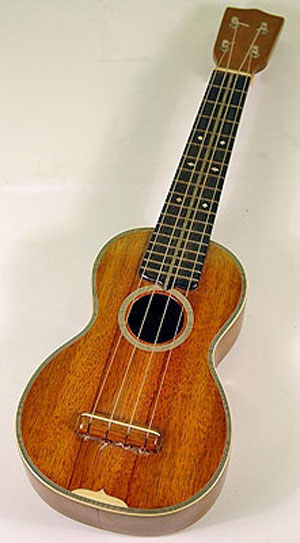
Soprano ukulele, an instrument which is almost always tuned in re-entrant fashion

On a stringed instrument, a break in an otherwise ascending (or descending) order of string pitches is known as a re-entry. A re-entrant tuning, therefore, is a tuning which does not order all the strings (or more properly the courses) from the lowest pitch to the highest pitch (or vice versa).

Most common re-entrant tunings have only one re-entry. In the case of the ukulele, for example, the re-entry is between the third and fourth strings, while in the case of the Venezuelan cuatro it is between the first and second strings.

Instruments

[edit]

Instruments usually tuned in this way include:

Instruments often (but not always) re-entrantly tuned include:

Instruments not usually considered re-entrant, but which have common re-entrant alternate tunings:

The standard tunings for instruments with multi-string courses, such as the twelve string guitar, eight string bass, or Colombian tiple are not considered re-entrant, as the principal strings of each course are ordered from lowest to highest.

Ukulele

[edit]

Ukuleles other than the tenor and baritone are most commonly tuned in re-entrant fashion; the tenor often is as well, and occasionally the baritone. These conventional re-entrant tunings G4–C4–E4–A4 are sometimes known as high 4th tunings or high G tuning.[2]

Non-re-entrant tunings, also known as low 4th tunings, exist for these instruments.[3]

Charango

[edit]
Charango tuning

The Andean charango, a small 5-course, 10-string guitar frequently made from an armadillo shell, is most usually tuned in re-entrant fashion, with re-entry before and after the octave strung third course.

Other members of the charango family, such as the hualaycho and charangon are usually similarly tuned; the ronroco is often, but not always tuned re-entrantly.

Ten-string guitar

[edit]
Narciso Yepes' re-entrant tuning for the ten string guitar

The ten string classical guitar was originally designed for a specific re-entrant tuning invented by Narciso Yepes, now called the Modern tuning also. Both this and other re-entrant tunings, such as the Marlow tunings, are now used, as well as non re-entrant tunings such as the Baroque; nevertheless the advantage of the Yepes re-entrant tuning over the other tunings is that it provides sympathetic resonance over all the 12 notes of the scale while the rest do not. These tunings may also be used on related instruments, such as ten string electric and jazz guitars.

Cuatro

[edit]
Traditional re-entrant cuatro tuning

The Venezuelan cuatro is a member of the guitar family, smaller in size and with four nylon strings. It is similar in size and construction to the ukulele. The traditional "Camburpinton" tuning is re-entrant (A3–D4–F
4
–B3), but with the re-entry between the second and first strings, rather than between third and fourth as in the ukulele. The results are very different in tone.

Other tunings of the Venezuelan cuatro are not re-entrant, however they are not as popular as the "Camburpinton" tuning.

The Venezuelan instrument is one of several Latin American instruments by the name of cuatro, which is Spanish for four. Despite the name, not all instruments called 'cuatro' have four strings. The ten-string, five-course Puerto Rican cuatro is not tuned re-entrantly, but in straight fourths. The cuatro Cubano also is not tuned re-entrantly.

Tenor guitar

[edit]
Tenor guitar re-entrant tuning

A variety of tunings are used for the four string tenor guitar, including a relatively small number of re-entrant tunings. One example of a re-entrant tuning for tenor guitar is D4–G3–B3–E4 with strings 3–1 as for the normal 6-string guitar, but string 4 tuned to D an octave above the 4th string of the 6 string guitar.

Banjo

[edit]
Upper neck and head of a bluegrass banjo, showing the shorter 5th string

The fifth string on the five string banjo, called the thumb string, also called the "drone string", is five frets shorter than the other four and is normally tuned higher than any of the other four, giving a re-entrant tuning such as the bluegrass G4-D3-G3-B3-D4. The five string banjo is particularly used in bluegrass music and old-time music.

The four string plectrum banjo (more often used in jazz) and the four string tenor banjo (common in Irish traditional music) lack this shorter string, and are rarely tuned in re-entrant fashion.

References

[edit]
Revisions and contributorsEdit on WikipediaRead on Wikipedia
from Grokipedia
Reentrant tuning is a method of configuring the pitches of strings (or courses) on a such that they do not ascend or descend monotonically from lowest to highest, instead incorporating a discontinuity where one or more subsequent strings are tuned to a lower pitch than the preceding one, often described as a "reentry" into a lower register. This contrasts with linear tunings, like those on modern classical guitars, and results in a non-sequential pitch order that defines the instrument's characteristic sound. A classic example is the of the soprano ukulele, G4–C4–E4–A4, where the highest string (G4 at approximately 392 Hz) precedes the lowest (C4 at 261 Hz), creating the reentrant effect and contributing to the instrument's bright, jangly . Similarly, the Venezuelan cuatro employs A3–D4–F♯4–B3, with the fourth string (B3) tuned an octave below what a linear progression might suggest, producing a lively, resonant tone integral to traditional Venezuelan music. Reentrant tuning traces its origins to the period in , appearing in early guitar and designs as early as the , such as the four-course guitar's tuning of aa–dd–gg–bb–e, where the third course (gg) served as the lowest pitch. It continued into the era with the five-course guitar, featuring reentrant configurations like the third course as the bass, which allowed for combined low bass and treble voicings under a single hand position. This tuning persisted in various cultural traditions, becoming common in Latin American and Asian instruments centuries ago, though it declined in favor of linear systems with the rise of the six-string guitar in the . Beyond the and cuatro, reentrant tuning is employed in diverse instruments worldwide, including the five-string (with its high-pitched fifth string acting as a drone), the Andean , the Mexican , the Brazilian , the Indian (in certain configurations), the Venezuelan bandola llanera, and even some tenor guitars or baroque lutes. These applications span folk, classical, and traditional genres, often in smaller-bodied instruments suited to chordal and melodic playing. The primary advantages of reentrant tuning include simplified chord formation through compact fingerings that leverage the non-linear layout, enhanced drone effects for rhythmic and harmonic sustain (as in the banjo's fifth string), and a unique timbral brightness that emphasizes higher , making it ideal for percussive strumming and intimate settings. In modern contexts, it remains a hallmark of variants like the and sizes, though linear alternatives (e.g., low-G tuning) offer bass extension at the cost of the traditional "reentrant voice."

Overview

Definition

Reentrant tuning is a system used in certain stringed instruments where the pitches of the strings, or courses, do not ascend or descend monotonically from lowest to highest as one progresses across them from one end of the instrument to the other. Instead, the pitch sequence features at least one deviation, such as a lower-pitched string following a higher one, breaking the linear progression typical of most fretted or bowed string instruments. The term "reentrant" derives from the pitch sequence "re-entering" a lower register after an initial high note, creating a non-sequential that contrasts with standard tunings. For instance, in the common gCEA configuration, the first string (g) sounds higher than the subsequent C string, causing the overall pitch to drop before rising again. This results in non-monotonic pitch patterns, such as a high-low-high sequence in four-string setups, where the outermost string starts high, dips to a lower pitch on the next, and then climbs progressively. These patterns emphasize certain overtones and facilitate specific playing techniques unique to reentrant instruments. Reentrant tuning specifically refers to the primary pitches of the strings or courses exhibiting this non-linear order, distinguishing it from octave-paired configurations in instruments like the 12-string guitar, where secondary strings provide octave doublings but the main course pitches remain monotonically ascending.

Comparison to Linear Tuning

Linear tuning configures the open strings of a stringed instrument in a strict ascending or descending order of pitch, resulting in a monotonic progression where each successive string is higher (or lower) in pitch than the previous one. This setup is exemplified by the standard guitar tuning E2-A2-D3-G3-B3-E4, which allows for a smooth, continuous increase in pitch from the lowest bass string to the highest treble string. In comparison, reentrant tuning disrupts this linear by tuning at least one to a pitch that does not follow the expected order, often re-entering a lower register after reaching a higher pitch. For instance, the standard ukulele tuning g4-C4-E4-A4 (where are numbered from farthest to nearest the player) features the fourth (g4) higher than the third (C4), creating a non-monotonic . This break in serves tonal purposes, such as producing a brighter, more resonant sound through the use of a thinner, higher-tension on the lowest course, and ergonomic purposes, enabling simpler fingerings for compact chord shapes. The core distinction lies in their pitch progressions: linear tuning maintains consistency for techniques emphasizing melodic continuity, while reentrant tuning prioritizes and strumming applications by altering the expected flow. Linear configurations facilitate bass-to-treble sweeps and single-note lines that ascend predictably across the fretboard, akin to guitar playing styles. Reentrant setups, conversely, yield distinctive chord voicings that leverage the pitch inversion for richer, more varied timbres in or accompaniment contexts. To visualize the difference, consider the approximate frequencies (in Hz, based on A4=440 Hz standard) for a four-string :
String Position (4 to 1)Reentrant Tuning (Standard High G)Frequency (Hz)Linear Tuning (Low G Variant)Frequency (Hz)
4 (farthest)G4392G3196
3C4262C4262
2E4330E4330
1 (nearest)A4440A4440
In the reentrant example, the progression dips from 392 Hz to 262 Hz before rising, forming a non-linear "V" shape in pitch plotting. The linear version ascends steadily from 196 Hz to Hz, mirroring the guitar's stepwise increase and supporting techniques like sweeping arpeggios from bass to treble without pitch reversal.

Historical Development

Origins in Early Instruments

Reentrant tuning first appeared in European instruments during the period, particularly in lutes and early four-course guitars of the . These small-bodied plucked instruments, popular across , , , and , typically employed linear configurations with ascending pitches, though reentrant variants were also used to facilitate specific chord shapes and melodic passages. In typical tunings, the fourth course served as the lowest pitch, often with octave doubling (requinta) for fuller tone in compact designs. For instance, the guitar's common tuning—such as g/g'–c'/c'–e'/e'–a'/a'—featured octave doubling on the lowest (fourth) course, allowing performers in both folk and courtly settings to achieve a fuller sound without increasing instrument size. Reentrant tunings, where the fourth course was tuned higher than the third (e.g., g'–c'–e'–a'), appeared in some sources like Cerreto (1601). By the 17th and 18th centuries, reentrant tuning continued in with the five-course guitar, where configurations often tuned the third course as the lowest pitch (bass), enabling combined low bass and treble voicings under a single hand position. This practice spread through colonial influences, notably shaping the Andean in . Derived from the Spanish de mano and early guitarra española introduced by conquistadors, the was adapted by Quechua and Aymara communities in regions like , , using local materials such as shells for resonance. The instrument retained elements of the 's multi-course setup, incorporating reentrant variations in early forms to suit indigenous playing styles and produce balanced, projecting tones in communal , as evidenced by colonial-era carvings depicting players in churches dating to the 1720s–1750s. In the , reentrant tuning persisted in Portuguese folk instruments from , such as the and its relative, the rajão, which served as direct precursors to the Hawaiian . The , a four-stringed treble guitar, and the five-stringed rajão (tuned D-G-C-E-A, with the third string as the lowest pitch) were brought to by Madeiran immigrants around 1879, influencing the ukulele's development through adaptations for local strumming and traditions. These instruments' reentrant schemes provided tonal brightness and ease of chord formation in small-bodied designs, bridging classical European roots with emerging Pacific folk practices.

Evolution and Modern Use

Reentrant tuning spread to in the late through immigrants from and the , who arrived aboard the Ravenscrag in 1879 and introduced the , a small four-stringed instrument with reentrant tuning. Local luthiers, including Manuel Nunes, Augusto Dias, and Jose do Espírito Santo, adapted the into the , retaining the reentrant GCEA tuning derived from the Portuguese rajão. This adaptation quickly integrated into Hawaiian musical ensembles, where the 's bright, reentrant sound complemented and performances. By the early 20th century, amid a Hawaiian music boom fueled by tourism and recordings, the reentrant GCEA tuning became standardized for and concert ukuleles, solidifying the instrument's role in Hawaiian popular music. In the post-World War II era, reentrant tuning gained prominence in folk and revivals across diverse traditions. In the , the —tuned in a reentrant pattern such as GCEAE—emerged as a staple in Bolivian and Peruvian folk ensembles, reflecting a broader resurgence of indigenous-influenced music amid and . Similarly, , the 5-string banjo's reentrant gDGBD tuning (open G) became integral to , pioneered by in the 1940s and 1950s, where the short fifth string enabled rapid rolls and drone effects central to the genre's high-energy style. These developments highlighted reentrant tuning's adaptability in rhythmic, chordal folk contexts, from Andean huayño to Appalachian string band traditions. Contemporary applications of reentrant tuning reflect ongoing debates and innovations, particularly within ukulele communities. Since the 1990s ukulele revival—driven by festivals, online resources, and artists like —the high-G (reentrant) versus low-G (linear) tuning discussion has intensified, with low-G favored for its bass range and fingerstyle versatility, while high-G preserves the instrument's signature chime for strumming and traditional Hawaiian repertoire. Experimental uses have extended to modern guitars, as seen in Frank Gambale's tuning for 7-string instruments (E2-A2-D3-G3-B3-E4-A4), which facilitates complex voicings by emulating a Nashville tuning on an extended-range setup. Key figures and events have propelled reentrant tuning's global evolution. performer , active in the 1920s and 1930s, popularized the through recordings, films, and instructional materials, emphasizing its reentrant tuning for accessible, melodic playing that influenced generations of players. In Andean traditions, the annual Feria y Festival Nacional e Internacional del in Aiquile, —held since 1984—has fostered revival by showcasing charango craftsmanship and performances, drawing international artisans and reinforcing reentrant tuning's cultural significance in conservation.

Musical Properties

Advantages

Reentrant tuning facilitates easier chord formation by allowing simple finger shapes that produce full, compact voicings, as the strings span a narrower pitch range, bunching notes closely together for a cohesive . For instance, on the , the standard chord can be formed using open strings and minimal fretting, leveraging the high to complete the without requiring barre chords or complex stretches. The tuning contributes to tonal balance by emphasizing higher pitches across the strings, which imparts a bright, chime-like quality without the lower strings overpowering the overall sound. This creates a sparkling ideal for strumming, where the reentrant high string adds clarity and to chords, enhancing their richness. It supports advanced techniques such as campanella fingerstyle playing, where notes are distributed across different strings to produce a sustained, harp-like effect with bell-like overtones. The close pitch proximity between the reentrant string and others enables seamless string alternation, allowing previous notes to ring while new ones are played, which is particularly effective for chord-melody arrangements and drone effects. In smaller instruments like the and , reentrant tuning aids volume equalization by maintaining an even tonal projection, as the limited pitch span prevents bass-heavy dominance and ensures balanced output in or solo settings.

Challenges

Reentrant tuning presents a notable for beginners, particularly those accustomed to linear-tuned instruments like the guitar, where strings progress monotonically from low to high pitch. The non-linear pitch order—such as the high G string on a sitting above the subsequent C and E—can confuse fretboard navigation, scale practice, and construction, as players expect the lowest-positioned string to provide the bass foundation. This discontinuity requires adjustment, often leading to initial frustration in transitioning musicians who must relearn basic patterns to accommodate the "reentry" of lower notes on inner strings. A primary limitation of reentrant tuning is its restricted bass range, which reduces the instrument's capacity for low-end essential in certain musical contexts. For instance, a standard reentrant tuning (G4-C4-E4-A4) offers a chromatic span of 10 from the lowest open pitch (C4) to the highest (A4), compared to 15 in a linear low-G configuration (G3-C4-E4-A4). This narrower low-end spectrum hinders the execution of bass lines, foundations, or solo melodies that demand deeper pitches, often compelling players to compensate with higher voicings or alternative techniques. Reentrant tuning also imposes genre-specific restrictions, making it less suitable for bass-heavy or intricate fingerstyle playing prevalent in styles like . The absence of a true bass limits the ability to articulate walking bass lines or complex chord-melody arrangements that rely on low-register notes, frequently necessitating retuning to a linear setup for such . While reentrant configurations excel in strumming and chordal , jazz performers often favor linear tunings to access guitar-like bass responses without sacrificing playability.

Instruments

Ukulele

The standard reentrant tuning for the ukulele is gCEA, where the fourth string (G) is tuned to G4, the third to C4, the second to E4, and the first to A4, resulting in the high G string pitched above the adjacent C string and producing the instrument's signature bright, plucky timbre. This configuration, first documented in print in Ernest Kaai's 1906 ukulele method book, deviates from linear ascending pitch order to emphasize a chime-like quality in chord voicings. In late 19th-century Hawaii, Portuguese immigrants introduced small four-string instruments like the and rajão, from which the ukulele's reentrant tuning was adapted by taking the top four strings of the rajão (G-C-E-A) to suit local musical styles, including the emerging genre that blended Hawaiian themes with English lyrics and Western harmonies. This adaptation occurred around the 1880s in , where the instrument quickly gained popularity for its portability and resonant strumming potential in informal gatherings and performances. A common variation from the traditional high-G reentrant setup is the low-G tuning (G3-C4-E4-A4), which creates a linear pitch progression similar to the top four guitar strings and extends the instrument's bass range for more versatile accompaniment. To achieve balanced tension in low-G configurations, manufacturers recommend using a thicker gauge for the fourth string, such as a wound 0.030-inch diameter, to match the feel and playability of the higher strings without excessive slack. The reentrant high-G tuning particularly facilitates island-style strumming patterns, such as the rhythmic down-up sequence known as the island or Hawaiian strum (down-rest-down-up-rest-up-down-up), by allowing compact chord shapes that highlight the ukulele's bright overtones and support the flowing, syncopated rhythms central to hapa haole and traditional Hawaiian music. This setup enables players to execute full-voiced majors and sevenths with minimal finger movement, enhancing the instrument's role in communal strumming and chordal accompaniment.

Charango

The , a small Andean with ten strings arranged in five paired courses, employs a standard reentrant tuning of G4-C5-E5-A4-E5, where the fourth course (A4) dips below the adjacent higher-pitched courses, creating a non-linear pitch progression that emphasizes brighter, higher tones overall. This configuration, with the highest course tuned to E5, facilitates a distinctive chime-like quality suited to the instrument's compact design. In Argentine styles, the tuning is often transposed a fourth lower to D3-G4-C5-F4-B4, adapting to regional musical preferences while retaining the reentrant structure. Traditionally constructed with an armadillo-shell for its body—approximately 66 cm in total length—and fitted with strings, the 's small scale and lightweight build demand a tuning that balances projection across its limited volume. The reentrant design aids this by prioritizing higher pitches on outer courses, enhancing and clarity in strumming patterns without overwhelming the instrument's tonal range, thus ensuring even sound dispersion in ensemble settings. Central to Bolivian and Peruvian folk traditions, the charango's reentrant tuning supports its role in genres like , where rapid, dense strumming patterns drive rhythmic vitality. This setup enables open chord voicings that align naturally with pentatonic scales prevalent in , allowing players to execute full, resonant harmonies with minimal fretting for authentic modal expressions.

Banjo

The five-string utilizes reentrant tuning in its standard open G configuration, gDGBD (with the short fifth string tuned to a high G an octave above the third string's G), where the pitch sequence dips rather than ascends linearly across the strings. This setup, characteristic of bluegrass and old-time styles, positions the fifth string as a thumb-accessible drone that rings openly without . Reentrant tuning on the five-string evolved in 19th-century American , adapting from African gourd instruments—such as the and xalam—brought by enslaved West Africans to the , where animal-skin heads and resonators were initially replicated before transitioning to wooden rims and necks. Early , popularized by white performers imitating musicians, incorporated the short fifth string for rhythmic emphasis, laying the foundation for modern five-string designs despite the era's racial appropriations. In clawhammer technique, the reentrant fifth string supports downward strumming and bum-ditty rhythms by providing a consistent high drone that underscores syncopated accents and melodic lines. Similarly, Scruggs-style three-finger rolls—forward, backward, and thumb-index patterns—leverage the short string's pitch to create layered drones and percussive drive, enhancing the banjo's choppy, syncopated pulse in ensemble playing. Variations distinguish the reentrant five-string , typically strung with wires including a fourth for bright projection, from the plectrum banjo, a four-string model lacking the short fifth string and tuned linearly to CGBD for chordal strumming in contexts. banjos, another four-string variant with a shorter scale, often employ strings for a warmer, less aggressive tone compared to the construction of five-string models.

Tenor Guitar

The , a four-stringed instrument with a body and neck similar to a standard guitar but scaled down, typically features a shorter scale of approximately 23 inches, allowing it to be tuned an octave higher than the top four strings of a six-string guitar. This design draws from family influences, particularly in its adoption of fifths-based tunings that facilitate chordal playing in settings. Reentrant variants emerged as adaptations to enhance playability for compact voicings, where the lowest-tuned string does not produce the lowest pitch, echoing the reentrancy of instruments like the or certain tunings. A common reentrant tuning for the is CGDA with the C strung high (C4 instead of the linear C3), resulting in pitches of C4-G3-D4-A4, where the G3 becomes the effective . This configuration, similar in interval structure to the viola but reentrant due to the elevated C, supports melodic chordal roles by providing a brighter, more ukulele-like without requiring low bass extension. In Irish and Celtic contexts, an adjusted DGBE reentrant tuning—often with a high D4 (D4-G3-B3-E4)—offers versatility for traditional sessions, adapting the standard linear Chicago tuning (D3-G3-B3-E4) to prioritize higher-range chord shapes and easier fingerstyle rhythm. These reentrant setups contrast with linear alternatives like standard CGDA or GDAE, which maintain ascending pitches but demand different string tensions. Historically, reentrant guitars gained prominence in bands, where players transitioning from tenor banjos used the high C variant of CGDA for strumming chord progressions that mimicked guitar rhythms while fitting compact ensembles. In , particularly Irish traditional styles, these tunings enable seamless integration into sessions alongside fiddles and flutes, allowing for drone-enhanced chords and rhythmic accompaniment without overpowering the melody. The reentrant design excels in creating compact chord voicings—such as close-position triads—that emphasize mid-to-high register harmonics, ideal for group dynamics where low bass is provided by other instruments like or . For optimal setup in reentrant tunings, the 23-inch scale length necessitates lighter gauges to balance tension, particularly for the high C or D strings, preventing excessive stress on the neck while maintaining playability. Recommended gauges for high C CGDA on a 23-inch scale include a .010-.012 for the A and high C (plain steel), .016 for D (plain steel), and .024-.028 for G (wound ), ensuring even tension around 15-20 lbs per . This lighter setup supports the instrument's chordal rhythm focus, derived from mandolin-derived techniques, by allowing fluid strumming and picking without the floppiness of overly thin strings or the rigidity of linear low-bass configurations.

Cuatro

The Venezuelan cuatro is a four-stringed plucked instrument that employs reentrant tuning in its standard configuration of –D4–F♯4–B2 (from highest to lowest course), where the lowest string (B2) is tuned an below the expected linear progression, creating a discontinuity that produces a lively, resonant tone integral to traditional Venezuelan . This tuning, which uses single nylon strings, supports the cuatro's role in genres like , where rapid strumming and picking techniques drive rhythmic vitality and . The reentrant design facilitates compact chord voicings and drone effects, emphasizing higher overtones for a bright, projecting in ensemble settings. The instrument typically features a small, guitar-like body with a scale length of about 53 cm, constructed from resonant woods to enhance its tonal clarity. Recognized as Venezuela's national instrument, the cuatro's reentrant tuning enables players to execute full harmonies with minimal finger movement, preserving the instrument's characteristic ring central to traditions. Regional variations may include transpositions, but the core reentrant structure remains, adapting to local styles while upholding the tuning's percussive and melodic potential.

Ten-string Guitar

The extends the range of the standard by incorporating four additional bass strings, creating a total of ten strings designed primarily for enhanced resonance and polyphonic capabilities in classical and music. Developed in the early , this instrument features a wider to accommodate the extra strings while maintaining playability on the upper six, which retain the conventional tuning. The lower strings are positioned along the lower bout, allowing players to access deeper bass notes alongside the standard range. A typical reentrant tuning for the , as popularized by Spanish guitarist Narciso Yepes, is F♯₂–G♯₂–B♭₂–C₃–E₂–A₂–D₃–G₃–B₃–E₄ from lowest to highest pitch. This configuration introduces reentrancy between the seventh string (C₃) and the sixth string (E₂), where the pitch drops, enabling the bass strings to vibrate sympathetically with notes played on the upper courses without disrupting the familiar hand positions. The reentrant high pitch in the lower courses supports harp-like arpeggios by facilitating fluid sweeps across the extended string array. Yepes introduced this design in 1963 to expand the guitar's expressive potential in classical , performing and commissioning works that exploited its polyphonic advantages, such as Bruno Maderna's Y después (1972) and Maurice Ohana's (1976). The added strings provide continuous chromatic support, enriching harmonic depth and sustain for complex compositions from the onward. In contexts, the ten-string variant occasionally appears for its resonant qualities in solo performances, though it remains more associated with classical extensions. Technically, the wider —often 52–55 mm at the nut—accommodates the additional strings spaced at approximately 8–10 mm intervals, ensuring ergonomic play while the reentrant tuning permits seamless high-register access on the upper strings without retuning the instrument. This setup aids composers in writing intricate , as the sympathetic vibrations from the bass strings enhance tonal clarity across the full range.

References

Add your contribution
Related Hubs
User Avatar
No comments yet.