Hubbry Logo
FuhengFuhengMain
Open search
Fuheng
Community hub
Fuheng
logo
8 pages, 0 posts
0 subscribers
Be the first to start a discussion here.
Fuheng
Fuheng
from Wikipedia

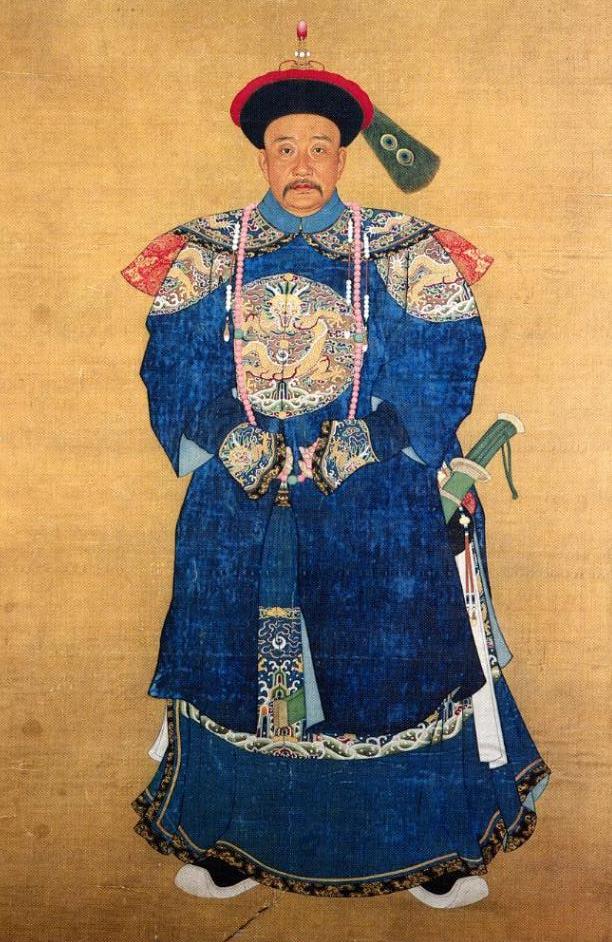
Fuheng (Manchu: ᡶᡠᡥᡝᠩ, romanizedFuheng; simplified Chinese: 傅恒; traditional Chinese: 傅恆; pinyin: Fùhéng; Burmese: ဖူဟင်း; 1720 – July 1770), courtesy name Chunhe (春和), was a Qing dynasty official from the Fuca clan of the Manchu Bordered Yellow Banner,[1] and was a younger brother of the Empress Xiaoxianchun. He served as a senior minister at the court of his brother-in-law, the Qianlong Emperor, from the 1750s to his death in 1770. He is best known for leading the Qing troops in the fourth and last invasion of Burma in the Sino-Burmese War.

Key Information

Prior to his appointment as the commander-in-chief of the Burma campaign, Fuheng was chief grand councilor to the emperor, and one of the emperor's most trusted advisers. Fuheng was one of the few senior officials that fully backed the Qianlong Emperor's decision to eliminate the Dzungars in the 1750s when most at the court thought war was too risky. His nephew Mingrui led the Burma campaign of 1767–1768.[2] His son Fuk'anggan was a senior general in the Qing military.

Fuheng was unsuccessful in the Burma campaign. In December 1769, he signed a truce with the Burmese, which the emperor did not accept. He died of malaria, which he contracted during his three-month invasion of Burma, when he got back to Beijing.[3]

Biography

[edit]

Born into a distinguished family

[edit]

Fuheng was born into a prestigious family. His ancestor Wangjinu (旺吉努) pledged allegiance to Nurhaci at the outset of his military campaigns, leading his clan in support. His great-grandfather Hashitu (哈什屯) served as a Grand Councillor during the reigns of the Taizong and Shizu emperors of the Qing dynasty,[4] rising to the highest policy-making body of the Qing court. His grandfather Mingsihan earned the favor of the Kangxi Emperor and was promoted to Minister of Revenue and Grand Councillor. He firmly supported the Emperor’s proposal to abolish the regional feudal domains, contributing significantly to the restoration and development of social production and the suppression of the Revolt of the Three Feudatories during Kangxi’s reign. He was highly praised by the Emperor. Fuheng’s uncles Maska, Maqi, and Mawu were all prominent figures during the Kangxi and Yongzheng reigns. His father, Li Rongbao, held the post of Commander-in-Chief of Chahar.[5] Fuheng’s elder sister was none other than Empress Xiaoxianchun.[6]

Campaign against Jinchuan

[edit]
Conquest of fortresses in Jinchuan by Qing troops

At the time, the general Necin was leading the offensive against Jinchuan, but his efforts proved fruitless. In the ninth month, the Qianlong Emperor reassigned Fuheng to temporarily oversee the duties of the Governor-General of Sichuan and Shaanxi and to direct military operations. Shortly thereafter, he was appointed Grand Secretariat of the Hall of Preserving Harmony.[7] Four million taels of silver were allocated from the Ministry of Revenue and various provincial treasuries for military expenses, and an additional 100,000 taels were drawn from the imperial treasury for rewards. In the eleventh month, Fuheng set out. The Emperor hosted a farewell banquet at the Chonghua Palace, personally performed ritual offerings at the Tangzi Hall, and ordered the imperial princes and Grand Secretary Lai Bao to escort him to Liangxiang.[8]

Soon after, due to Fuheng’s swift march and strict discipline, the Emperor ordered a commendation and proposed promoting him to Grand Tutor to the Heir Apparent and further to Grand Guardian.[7] Fuheng declined, but the Emperor refused to accept his refusal.[9]

Previously, the tusi (native chieftain) of Lesser Jinchuan, Liang’erji, had feigned surrender and acted as a spy for Saruoben (莎羅奔). Zhang Guangsi, believing Wang Qiu, allowed Liang’erji to lead ethnic minority troops, and every movement by the Qing army was immediately known to the enemy. On his way, Fuheng submitted a memorial requesting the execution of Liang’erji and his associates. Upon nearing the front, he ordered Vice General Ma Liangzhu to summon Liang’erji under pretenses. When he arrived at Bangga Mountain, Liang’erji’s crimes were publicly denounced, and he was executed. The Qianlong Emperor praised Fuheng’s decisiveness and bestowed upon him the double-eyed peacock feather again, forbidding any refusal.[10]

In December, Fuheng arrived at Kasa and moved the camp to the old fortress, ordering General Ye Daxiong to observe the Jinchuan fortifications. In 1749, Fuheng submitted a memorial analyzing the reasons for previous defeats and proposed a multi-pronged offensive strategy.[11]

Although the Qianlong Emperor initially believed that Jinchuan was not a significant threat, upon learning of its formidable terrain, he ordered a withdrawal by imperial decree through Empress Dowager Xiaoshengxian. However, Fuheng was in the midst of capturing several fortresses with generals Ha Panlong and Ha Shangde. The Emperor, concerned about the harsh conditions, gifted Fuheng three catties of ginseng and repeatedly issued edicts recalling him. Nonetheless, in recognition of his merit, and on Empress Dowager Xiaoshengxian’s decree, Fuheng was ennobled as a First Class Duke Loyal and Brave, and was granted a bejeweled hat top and Four-Clawed Dragon Court Robe.[7] Fuheng firmly opposed the withdrawal and declined the honors, but the Emperor refused to relent.[12]

At this point, Fuheng and Commander-in-Chief Yue Zhongqi planned a deeper incursion. Saruoben sent emissaries to plead for surrender. Fuheng demanded Saruoben personally surrender, bound. Saruoben later dispatched Chuosijia and others to plead for mercy from Yue Zhongqi, who personally entered Leuwuwei and escorted Saruoben and his son Langka to Fuheng’s camp, where they formally surrendered.[13] Saruoben offered a Buddha statue and ten thousand taels of silver; Fuheng declined the silver. Saruoben then requested to use the silver to build a shrine for Fuheng.[14]

The next day, Fuheng led his troops back. The Qianlong Emperor issued a commendation edict, and following the precedent of Yangguli, awarded him two leopard-tail spears and two imperial bodyguards. In the third month, as the troops returned to the capital, the Emperor sent his eldest son Yonghuang and Prince Yu Guanglu to welcome him outside the city. Shortly afterward, the Emperor established an ancestral temple for the Fuca clan to honor Fuheng’s great-grandfather, grandfather, and father. He also granted Fuheng a mansion inside Dong’anmen.[15]

Pacification of the Dzungars

[edit]

In 1754, a civil war broke out among the Dzungar tribes. The Qianlong Emperor intended to launch a military campaign and sought the opinions of his ministers; only Fuheng supported the plan. In the twentieth year (1755), the Qing army captured Ili and took Dawachi prisoner. The Qianlong Emperor issued an edict promoting Fuheng once again to First-Class Duke. Fuheng submitted a memorial in firm refusal, weeping as he did so, and the Emperor finally consented. Not long afterward, the Emperor had portraits of one hundred meritorious officials displayed in the Ziguang Pavilion; Fuheng’s portrait was placed in the foremost position.[16]

In 1756, General Celing was tasked with pursuing Amursana. The Qianlong Emperor ordered Fuheng to go out and inspect the army, traveling to Elinhabirga to assemble the Mongol taijis and oversee military organization. Shortly after Fuheng’s departure, a memorial arrived from Celing reporting that he had already led his troops deep into enemy territory. The Emperor then recalled Fuheng.[17]

Campaign against Burma

[edit]

In 1768, General Mingrui was defeated in his campaign against Burma. In the second month, the Qianlong Emperor appointed Fuheng as Imperial Commissioner to lead the expedition, with Arigūn and Agui as Deputy Generals, and Shuhede as Associate Minister, to continue the war against Burma.[18]

In the following year, during the second lunar month, Fuheng set out with his troops and entered Yunnan in the third month. In the fourth month, he arrived at the border town Tengyue. Upon reaching the frontier, Fuheng observed that the area of Wengushan contained many towering trees, particularly Zhuangnan and Yehuai, which were ideal for shipbuilding. The nearby area of Niuniuba was cool and free of miasma, making it suitable for construction. He secretly ordered Fu Xian to lead 3,000 Qing troops and over 460 craftsmen from Huguang to begin building warships, while drafting a strategy to advance by both land and water directly toward the Burmese capital, Ava. The Qianlong Emperor highly approved of this plan.[19]

In August 1769, Fuheng departed from Tengyue and launched a surprise attack on Burma, winning initial victories.[20] By the October, the warships at Niuniuba were completed, and the Qing forces advanced by both land and water, routing the Burmese navy. In November, they captured the strategic military post of Xinjie, which had previously fallen to the Burmese. In the eleventh month, they attacked Laokuantun, a critical hub of north-south land and river traffic that was heavily fortified and difficult to capture. The Burmese had established strong wooden and river fortifications and fiercely resisted. The region was plagued by mist and high humidity, and the poor climate adversely affected the Qing troops, particularly the Manchu soldiers who were unaccustomed to such conditions. Many fell ill with tropical diseases.[21]

Originally numbering over 31,000 in both land and naval forces, the Qing army suffered heavy losses, with more than half perishing. Several key commanders—including Grain Transport Commissioner Fu Xian, General Wu Shisheng, Deputy General Arigūn, Vice Commander Yong Rui, and Commanders Wufu and Ye Xiangde—died of illness. Fuheng himself contracted a serious disease and became gravely ill. Upon learning of this, the Qianlong Emperor ordered Agui to assume military command and instructed Fuheng to return immediately to the capital.[22]

At the same time, the Burmese king and military leaders, fearing the might of the Qing army, expressed willingness to end the conflict. Seizing the opportunity, the Qianlong Emperor approved peace talks between the Qing forces and the Burmese.[23]

Family

[edit]
Sons of Fuheng
Fuk'anggan (1754–1796)
Fulong'an (1746–1784)
Fuchang'an (1760–1817)
  • Consort, of the Yehe-Nara clan (福晋 葉赫那拉氏):[24]
    • Fuling'an, Knight Commandant of the Cloud (雲騎尉 福靈安; ?–1767), 1st son
    • Fulong'an, Duke Zhongyong of the First Class (一等忠勇公 福隆安; 1746–1784), 2nd son; married Princess Hejia, the Qianlong Emperor's 4th daughter by Imperial Noble Consort Chunhui, and had issue (two sons)
    • Fuk'anggan, Prince Jiayong of the Second Rank (嘉勇郡王 福康安; 1753–1796), 3rd son
  • Concubine, of the Li clan (李氏):
    • Fuchang'an, Marquis Chengjing (誠靖侯 福長安; 1760–1810), adopted son[25]
  • Concubine, of the Sugiya clan (孙佳氏)
  • Unknown:
[edit]

See also

[edit]

References

[edit]
Revisions and contributorsEdit on WikipediaRead on Wikipedia
from Grokipedia
Fu Heng (傅恒, Chunhe; c. 1720 – September 1770) was a Manchu statesman and general of the who served as a Grand Secretary in the during the Qianlong Emperor's reign. As the younger brother of , he benefited from familial ties to the throne but earned his position through administrative competence and military service, rising from imperial bodyguard to one of the most influential officials in the Grand Council. Fu Heng's career highlighted the interplay of , capability, and imperial favoritism in Qing , where he advised on for nearly two decades while overseeing key bureaucratic functions. His most notable achievements included leading the successful suppression of the first Jinchuan in 1747–1749, demonstrating effective command in rugged terrain against tribal forces. However, his later command of the fourth and final Qing invasion of Burma during the (1765–1769) exposed the empire's logistical vulnerabilities; despite initial advances, tropical diseases, supply shortages, and unfamiliar environment compelled a withdrawal without conquest, marking a pragmatic limit to expansionist ambitions rather than outright defeat. Afflicted by illness—likely —during , Fu Heng died en route to , yet received posthumous honors from the emperor for his dedication. His legacy endures through his descendants, including his son , who continued the family's prominence.

Early Life and Family Background

Birth and Ancestry

Fu Heng (傅恒), Chunhe (春和), was born in 1720 into the Fuca (富察) clan, a prominent Manchu family registered under the of the system. As the tenth son of Li Rongbao (李榮保), who held the position of superintendent of Chahar, Fu Heng grew up in a household connected to imperial administration through military and regional governance roles. His elder sister, Fuca Rongxiao (富察·容曉), became (孝賢純皇后), consort to the , which elevated the family's status within the imperial court. The Fuca clan's origins trace to early Manchu consolidation under the Aisin Gioro, with their progenitor Wangjinu (旺吉努) submitting his kin to Nurhaci during the initial phases of the Later Jin state's formation around 1616, securing hereditary privileges in the banner system. This allegiance positioned the clan among the trusted bannermen who transitioned from Jurchen tribal structures to the Qing military aristocracy. Fu Heng's great-grandfather, Hashitun (哈什屯), advanced to minister of deliberation (議政大臣) under Emperors Taizong (Hong Taiji) and Shizu (Shunzhi), integrating the family into the nascent dynasty's core decision-making council during the conquest of China. Such roles underscored the clan's martial and advisory contributions, fostering a legacy of loyalty that persisted through Fu Heng's generation.

Early Education and Court Entry

Fu Heng, born in as the tenth son of Li Rongbao, a prominent Manchu of the Fucha clan affiliated with the , received a traditional education emphasizing , riding, , and the Confucian classics, as was customary for children of elites preparing for imperial service. His family's distinguished lineage, tracing back to early Jurchen allies of , positioned him within the Manchu administrative and military aristocracy. Following the elevation of his elder sister to in 1738, Fu Heng benefited from familial proximity to the . In , at age 18, he entered service as a blue-feathered guard (lanling shiwei) in the Imperial Bodyguard (Qianlong 5th year), marking his initial formal role in the palace guard system responsible for ceremonial and protective duties. This appointment leveraged the privileges extended to relatives of the empress, facilitating his integration into the inner circles of power. By 1742, Fu Heng had advanced to a regular guard in the Imperial Bodyguard and was concurrently appointed deputy lieutenant general of the guards for the Chinese , alongside roles in the Imperial Clan Court and as a member of an imperial household unit, reflecting early recognition of his capabilities amid rapid promotions. These positions underscored the blend of hereditary status and merit that propelled his ascent in the Qing bureaucratic and military .

Rise in the Imperial Court

Initial Appointments and Relations with Qianlong

Fu Heng, a Manchu of the and younger brother of Qianlong's first , entered imperial service in 1740 at age approximately 20 as a blue-plume guard, a low-ranking position in the palace guard units responsible for the emperor's security. His familial connection to the empress, who had risen to that position in 1738 after marrying Qianlong in 1734, facilitated swift advancement despite his youth and limited prior experience. In 1742, Fu Heng was promoted to imperial bodyguard and concurrently appointed as a minister of the Imperial Household Department, tasked with overseeing the Yuanming Yuan (Old Summer Palace), an expansive imperial estate undergoing development under Qianlong's patronage. This assignment, granted at age 22, reflected the emperor's early trust in Fu Heng's administrative discretion, as managing the palace involved handling construction, finances, and daily operations amid the court's opulent expansions. Qianlong's favoritism toward Fu Heng stemmed from the empress's influence and the Fuca clan's loyalty, positioning him as a reliable inner-court figure amid potential factional tensions in the early reign. By 1743, Fu Heng advanced to vice minister of the Board of Revenue, marking his transition from palace security to fiscal administration, where he handled revenue collection and expenditure oversight critical to sustaining military campaigns and court extravagance. His relations with Qianlong during this period were characterized by personal proximity and deference; the emperor reportedly permitted Fu Heng to ride horseback within the —a rare privilege underscoring intimate confidence not extended to most officials. This bond, rooted in kinship but reinforced by Fu Heng's demonstrated reliability, laid the foundation for his later elevation to the Grand Council following the empress's death in and the disgrace of rival minister Naper.

Administrative Ascendancy

Fuheng's administrative prominence began in earnest during the early years of the Qianlong Emperor's reign, following his initial court service as an imperial bodyguard and manager of the around 1742. By the 1750s, leveraging his familial ties as the brother of , he ascended to the elite ranks of central governance, securing appointment as a Grand Secretary (daxueshi) and member of the Grand Council (junjichu), the Qing dynasty's pivotal privy council responsible for drafting edicts, coordinating policy, and advising on both civil and military matters. This body, formalized under Yongzheng but expanded under Qianlong, handled the empire's most sensitive administrative functions, including personnel appointments, fiscal oversight, and frontier management, with Fuheng emerging as one of its most influential voices amid a predominantly cautious . Serving continuously in the Grand Council from approximately 1750 to 1768, Fuheng advised Qianlong on diverse administrative challenges, including the integration of conquered territories and the refinement of bureaucratic procedures. In 1757, as a grand minister of state (junji dachen), he directed the appointment of six officials, comprising translators and administrators, to enhance the handling of multilingual documents essential for empire-wide governance, reflecting his role in streamlining communication across linguistic divides in a multi-ethnic realm. His tenure marked a period of consolidated Manchu influence in the council, where he often aligned with the emperor's assertive policies—such as the expansionist campaigns in the northwest—against widespread official reservations, thereby bolstering central authority over provincial administrations. This alignment, rooted in personal trust rather than mere kinship, elevated Fuheng's stature, positioning him as a counterweight to factional inertia and enabling decisive interventions in policy formulation. By the mid-1760s, Fuheng had risen to lead the Grand Council, succeeding figures like Necin, and assumed oversight of key departments such as the Imperial Household, where he managed palace finances and ceremonial protocols with meticulous efficiency. His administrative acumen was evident in efforts to renovate cultural institutions, including the 1768 refurbishment of the at the under his supervision as Grand Secretary, underscoring a commitment to Confucian orthodoxy amid imperial expansion. These roles solidified his ascendancy, transforming him from a court insider into a linchpin of Qianlong's governance apparatus, though his influence increasingly intertwined with military imperatives by the late 1760s.

Military Campaigns

Suppression of Jinchuan Rebellions

The First Jinchuan Rebellion erupted in 1747 in the rugged mountainous region of western , where Tibetan-Qiang chieftains of the Lesser Jinchuan (Xiao Jinchuan) resisted Qing authority amid disputes over land and tribute obligations. Initially, the appointed veteran commander Zhang Guangsi to lead Qing forces, comprising Manchu bannermen and Han Green Standard troops, but the campaign stalled due to logistical challenges in the terrain and allegations of corruption within the general staff. By early 1749, Zhang was executed for and , prompting Qianlong to elevate Fu Heng, then a junior grand councillor and his brother-in-law through marriage to a Fucha clan consort, as the new commander despite his limited prior military experience. Fu Heng arrived at the front in with reinforcements, emphasizing disciplined coordination between elite bannermen for assaults and Green Standard units for support, while improving supply lines through Sichuan's difficult passes. He focused on besieging fortified towers and monasteries that served as rebel strongholds, such as those at Luobowa Mountain, where Qing and overcame defensive advantages through persistent sieges rather than direct assaults. Assisted by generals including Yue Zhongqi's successors and local auxiliaries, Fu Heng's forces captured key positions, leading to the surrender of rebel leaders like the monk Sangcuo by mid-, effectively pacifying the region. The campaign concluded with Qing imposition of direct administration, relocation of some chieftains, and integration of Jinchuan under hereditary rule subordinated to imperial oversight, though at significant cost exceeding 70 million taels in expenditures. Qianlong credited Fu Heng with the victory, promoting him to higher ranks and commemorating the success in imperial inscriptions, portraying it as a triumph of strategic resolve over initial setbacks. However, the suppression highlighted vulnerabilities in Qing frontier warfare, including high casualties from and attrition—estimated at over 50,000 troops deployed with substantial losses—and reliance on personal imperial favor for command appointments. Fu Heng's role solidified his position as a trusted military administrator, though later campaigns revealed ongoing tensions in the area that resurfaced in the .

Pacification of the Dzungar Khanate

In 1754, internal strife plagued the following the death of Galdan Tseren in 1745, as Dawaci overthrew the designated heir Tsewang Dorji Namjal and appealed to the Qing for support against rivals. , seeking to exploit the disarray, consulted his officials on launching a campaign to subdue the Dzungars, who had long threatened Qing borders. While many cautioned against the endeavor due to the remote terrain and supply difficulties across the , Fu Heng alone urged immediate and total conquest, arguing that hesitation would allow the Dzungars to regroup. His resolute stance influenced 's decision to proceed, marking Fu Heng's emergence as a key strategic advisor in frontier affairs. Fu Heng was appointed as the supervising Grand Councilor for the pacification efforts, providing overall direction from while delegating field operations to generals such as Bandi and later Agui and Zhaohui. The initial invasion in spring 1755 saw Qing banner troops advance in multiple columns, culminating in the capture of the Dzungar capital at Ili (Ghulja) on , where Dawaci surrendered after defeats at Ubashi Nor and other sites. Fu Heng coordinated , reinforcements, and political integration, ensuring the campaign's momentum despite harsh conditions that claimed thousands of lives from disease and exposure. By late 1755, much of submitted, but the defection and rebellion of in 1756 necessitated renewed offensives. Qing forces pursued Amursana through 1757, defeating his coalitions of Dzungars, , and , forcing him to flee to Russian territory where he died in exile. Fu Heng's administrative oversight facilitated the resettlement of loyal and Han colonists, transforming the region into the Qing province of . Post-conquest policies under Fu Heng's guidance emphasized demographic control, including the encouragement of migration from other Mongol tribes and the suppression of Dzungar remnants, which drastically reduced the native Oirat through warfare, , and imperial edicts targeting rebels. In recognition of his contributions, Qianlong elevated Fu Heng to the rank of Duke of the First Class. Fu Heng later served as chief editor of the official Pingding Zhunga'er fanglüe (Records of the Pacification of the Dzungars), completed in , a multi-volume detailing military engagements, imperial rescripts, maps of , and administrative reforms. Spanning front matter, main narratives, and appendices, the work not only chronicled the 1755–1759 operations but also justified the campaign as a , it within Qianlong's .

Sino-Burmese War and Its Outcomes

Following the deaths of previous commanders and the setbacks in earlier invasions during the (1765–1769), Fuheng was appointed commander-in-chief of the Qing expeditionary forces against Burma in 1768. His leadership marked the fourth and final major Qing incursion, launched in late 1769 with a force emphasizing secured supply lines and coordinated advances. The campaign unfolded over three months, during which Qing troops penetrated deeper into Burmese territory than prior efforts but encountered formidable obstacles, including rugged terrain, scorched-earth tactics by Burmese forces, and rampant tropical diseases such as . Fuheng, recognizing the unsustainable losses from illness and , authorized a strategic withdrawal to minimize further casualties, averting the suffered by earlier armies. In December 1769, he negotiated and signed a truce with Burmese representatives, establishing a border along the Tengchong-Tengyue line, though rejected the agreement, insisting on unconditional submission. Fuheng contracted during the expedition and succumbed to the disease in 1770 after returning to . The broader war outcomes reflected a disguised defeat for the Qing: no territorial conquests were achieved, retained independence under the , and nominal tributary relations resumed only sporadically thereafter, with the first Burmese mission to occurring in 1784. Despite Qianlong's inclusion of the campaign among his as a triumph, it incurred massive human and financial tolls—estimated at over 70,000 Qing soldier deaths across all invasions and 9.8 million taels in expenditures—exposing limitations in Qing overextension into Southeast Asian jungles and prompting a reevaluation of ambitions. Fuheng's prudent preserved more troops than predecessors, but the endeavor underscored the empire's vulnerabilities to environmental and logistical challenges rather than military prowess.

Political and Administrative Roles

Leadership in the Grand Council

Fu Heng, leveraging his position as the younger brother of the Qianlong Emperor's first empress, ascended to the Grand Council (Junjichu) in after swift promotions from lower bureaucratic roles, marking his entry into the Qing dynasty's highest deliberative body for policy and military affairs. His appointment reflected imperial trust, enabling him to process palace memorials (zouzhe) and advise on critical state matters, including the coordination of administrative and fiscal policies. As a Manchu bannerman, Fu Heng helped maintain ethnic balance in the council's leadership, succeeding figures like Necin and ensuring continuity in Manchu oversight of central governance. Under Fu Heng's influence, the Grand Council streamlined decision-making by handling urgent edicts and secret military dispatches, with him often leading night-long sessions to draft responses and imperial rescripts. In , as a grand (junji dachen), he directed the appointment of officials to manage multilingual documents, enhancing the council's capacity for overseeing frontier campaigns and inner Asian . His approach prioritized and propriety, as evidenced by his refusal of undue honors while punctiliously executing duties, which bolstered the council's role as the emperor's privy advisory organ over traditional Six Ministries. Fu Heng's tenure solidified the Grand Council's evolution from a military-focused entity into a comprehensive , where he advocated for decisive actions like the 1750s Dzungar conquests, countering court hesitancy with empirical assessments of strategic gains. By 1768, he had assumed formal leadership, coordinating multi-ethnic officials amid growing administrative demands, though his health declined amid ongoing Burma frontier operations supervised from . This period underscored his skill in employing capable subordinates and mediating factional tensions, contributing to the council's efficiency until his death in 1770.

Other Contributions to Governance

Fu Heng demonstrated administrative acumen in fiscal management as Vice Minister of the Board of Revenue (Hubu you shilang), a position he assumed in 1743 at age 21, where he oversaw aspects of state finances including revenue collection and expenditure during the early Qianlong era's economic expansion. His tenure emphasized prudent resource allocation, contributing to the stability of the empire's budget amid growing military and infrastructural demands, though specific policy innovations attributable to him remain undocumented in primary records. In 1751, Fu Heng led the compilation of the Huang Qing Zhi Gong Tu (Illustrated Tribute Bearers of the Imperial Qing), a comprehensive atlas commissioned by the depicting the attire, features, and customs of officials and envoys from China's provinces, frontier regions, and states, spanning over 100 illustrations to symbolize imperial harmony and the integration of diverse peoples under Manchu rule. This project, directed by Fu Heng on behalf of the court, served governance by visually propagating the Qing's universal and "inner-outer as one" (zhongwai yijia) , countering potential ethnic divisions and legitimizing expansionist policies through ethnographic documentation rather than mere narratives. Fu Heng's concurrent service in the Board of Personnel (Libu) further supported bureaucratic governance by influencing evaluations and promotions, prioritizing competence and loyalty in an era when the Grand Council's nature risked favoritism; his reputation for personal integrity helped sustain merit-based elements within the Manchu-dominated hierarchy. These roles underscored his utility in bridging military priorities with civilian administration, though critics later noted the system's inherent limited broader reforms.

Death, Legacy, and Assessments

Final Years and Demise

Fu Heng returned to in early 1770 after leading the Qing expedition into , where tropical diseases had decimated his forces during the rainy season advance. He had contracted amid the campaign's logistical failures and high casualties from illness, which compelled a withdrawal despite initial gains. Weakened by the fever, Fu Heng petitioned the for leniency regarding the expedition's inconclusive results, emphasizing environmental hardships over strategic errors. The emperor, though critical of the army's performance, accepted the report without severe reprisal, allowing Fu Heng to retain his positions amid his deteriorating health. Fu Heng died of complications on July 13, 1770, at age 49, shortly after his arrival in the capital. Qianlong honored him with a , personally overseeing rites and bestowing the posthumous title Wenzhong (文忠), denoting scholarly merit and steadfast service. His demise marked the end of a favored courtier's career, with no indications of in official , though the Burma venture's costs—over 50,000 troops lost primarily to disease—highlighted limits to Qing .

Achievements and Strategic Successes

Fu Heng demonstrated strategic foresight by advocating the complete elimination of the in the , at a time when most senior officials opposed the Qianlong Emperor's aggressive policy due to anticipated costs and risks. His support proved pivotal, enabling the Qing campaigns from to 1759 that annihilated Dzungar resistance, annexed the vast region—spanning approximately 1.5 million square kilometers—and incorporated diverse Mongol, Kazakh, and Uyghur populations into the empire, thereby securing the northwest frontier against Russian and other threats. In the Great Jinchuan campaign of 1748, Fu Heng, acting as the Sichuan-Shaanxi Governor-General, personally led Qing forces to subdue the Tibetan Buddhist chieftain Sha Luo Ben and his son, capturing key strongholds after prolonged sieges and integrating the Jinchuan territories into direct imperial administration, which stabilized the southwestern highlands and prevented further ethnic unrest. These military successes, combined with Fu Heng's oversight in compiling official campaign records such as the Pingding Zhun ge er fang lue, contributed substantially to the Qianlong Emperor's celebrated "Ten Great Campaigns," enhancing Qing prestige and territorial integrity through decisive action over appeasement.

Criticisms, Failures, and Controversies

Fu Heng's oversight of the final phase of the (1765–1769) represented a significant military failure for the , resulting in heavy casualties without strategic gains. Commanding an army of approximately 50,000 troops mobilized from multiple provinces, Fu Heng invaded Burmese territory in October 1769 via the northern route through , aiming to avenge prior defeats and subdue the . However, the expedition encountered insurmountable challenges from rugged terrain, inadequate supply lines, and endemic tropical diseases such as and , which killed far more soldiers than combat—estimates suggest over 70% of the force perished from illness alone. The campaign's ineffective execution drew criticism for poor timing and planning, as the invasion coincided with the peak of Burma's rainy and seasons, amplifying logistical breakdowns despite Fu Heng's prior analysis of earlier invasions' shortcomings. Burmese forces, employing guerrilla tactics under King , avoided direct confrontations while exploiting the Qing's vulnerabilities, leading to a . On December 22, 1769, Fu Heng negotiated a truce with Burmese envoys, allowing Qing withdrawal in exchange for nominal Burmese submission, though this accord was initially repudiated by the as insufficiently triumphant. Historians characterize the outcome as a "disguised defeat," wherein the Qing claimed victory to preserve imperial prestige—Qianlong incorporated it into his vaunted "" as the tenth martial feat—but failed to annex territory, install a regime, or neutralize the Burmese threat, effectively marking the limits of Qing expansionism in . Fu Heng's role amplified scrutiny, as his prior successes in Jinchuan and Dzungar campaigns raised expectations; detractors, including later Qing officials, faulted him for overreliance on bannermen unadapted to and underestimation of environmental factors. The emperor's insistence on portraying the war as resolved favorably masked underlying strategic overreach, contributing to long-term resource strain on the dynasty.

Family and Descendants

Immediate Family

Fu Heng's principal consort hailed from the , a branch linked to the imperial lineage. He also took secondary consorts, including one surnamed Li. He had four sons and two daughters. The sons were Ful Ling'an (the eldest, died 1767), Fulong'an (born 1746, died 1784), Fu Chang'an, and (born 1754, died 1796). The daughters included one named Danxiang and another of the , the latter of whom married Chunying, the Prince Rui of the second rank.

Notable Offspring and Lineage


Fu Heng fathered four sons and two daughters, primarily with his principal consort from the Yehe Nara clan. The sons included Fuling'an (the eldest), Fulong'an (born 1746, died 1784), Fuk'anggan (born 1754, died 1796), and Fu Chang'an (died 1806). The daughters married into imperial royalty: one became the primary consort of Yongcheng, the Chengzhe Qinwang (eleventh son of the Qianlong Emperor), and the other the primary consort of Mian Yi of the Ruizhong Qinwang lineage.
Among these, emerged as the most distinguished offspring, inheriting his father's military prowess and rising to high command. Appointed as a general early in his career, he suppressed the Lin Shuangwen rebellion in in 1787–1788, led campaigns against the Gurkhas in 1791–1792, and participated in the invasion of in 1788–1789, earning multiple hereditary titles including Duke of the First Class and commendations for strategic successes. His rapid promotions and favor from the fueled unsubstantiated rumors of illegitimacy, though official records consistently identify him as Fu Heng's legitimate son, with no empirical evidence supporting alternative parentage. Fulong'an served in administrative roles, including as a provincial , but died relatively young without achieving equivalent military renown. Fu Chang'an pursued a military path, commanding forces in the of 1791–1792 alongside his brother, yet faced later accusations of corruption and mismanagement, leading to demotion. Fuling'an held lesser bureaucratic positions, contributing to the family's administrative influence but lacking prominent exploits. The lineage through these sons perpetuated the Fuca clan's noble status into the early , though it declined amid broader Manchu elite attrition, with no subsequent descendants reaching the heights of Fu Heng or .
Fu Heng's descendants maintained ties to imperial service, but the family's prominence waned after the Jiaqing era, exemplifying the transient nature of Qing bureaucratic dynasties despite initial favor.

Depictions in Fiction and Culture

Fu Heng appears as a prominent character in the 2018 Chinese television series Story of Yanxi Palace (延禧攻略), a historical drama set during the Qianlong Emperor's reign that aired on iQiyi from July 21 to September 29, 2018, and garnered over 150 billion views online by October 2018. In the series, Fu Heng—portrayed by actor Xu Kai—is depicted as a noble Manchu official from the Fuca clan, the emperor's trusted advisor, brother-in-law via his sister the Empress Xiaoxianchun, and a figure entangled in palace politics, military campaigns, and romantic subplots, often shown as loyal, scholarly, and morally upright amid court intrigues. The portrayal draws loosely from historical records but amplifies dramatic elements, such as his unrequited affection for the protagonist Wei Yingluo and involvement in events like the Burmese campaign, where he falls ill, diverging from strict historicity for narrative tension. No major literary works or novels centered on Fu Heng have achieved widespread recognition, though he features peripherally in some Qing-era exploring the Qianlong court, often as a symbol of bureaucratic amid imperial favor. Culturally, Fu Heng's legacy in popular media reinforces themes of and in palace dramas, contributing to the genre's popularity in and , but scholarly analyses note the dramatized image prioritizes over empirical accuracy, such as idealizing his role in and campaigns.

References

Add your contribution
Related Hubs
User Avatar
No comments yet.