Hubbry Logo
Genesis ApocryphonGenesis ApocryphonMain
Open search
Genesis Apocryphon
Community hub
Genesis Apocryphon
logo
8 pages, 0 posts
0 subscribers
Be the first to start a discussion here.
Genesis Apocryphon
Genesis Apocryphon
from Wikipedia
Genesis Apocryphon

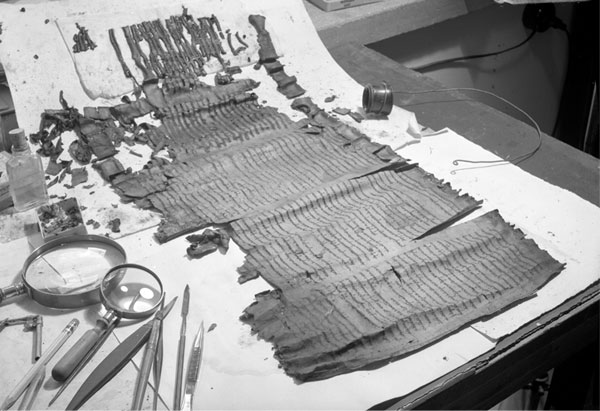
The Genesis Apocryphon (1Q20), also called the Tales of the Patriarchs or the Apocalypse of Lamech and labeled 1QapGen,[1] is one of the original seven Dead Sea Scrolls discovered in 1946 by Bedouin shepherds in Cave 1 near Qumran, a small settlement in the northwest corner of the Dead Sea. Composed in Aramaic, it consists of four sheets of leather.[2] Furthermore, it is the least well-preserved document of the original seven.[3] The document records a conversation between the biblical figure Lamech, son of Methuselah, and his son, Noah, as well as first and third person narratives associated with Abraham. It is one of the nonbiblical texts found at Qumran.[2] A range of compositional dates for the work have been suggested from the 3rd century BC to 1st century AD.[4] Palaeography and Carbon-14 dating were used to identify the age of the documents.[2] It is 13 inches in length and 2.75 inches in width at its widest point in the middle.[5]

Discovery and state of the document

[edit]

The Genesis Apocryphon was one of the seven major scrolls found at Qumran in Cave 1. It is one of the collection in the Dead Sea Scrolls, which has over 800 documents in fragmentary form. All documents have been found in various states of preservation in twelve caves of the cliffs that parallel the northwest shore of the Dead Sea and in the general location of Qumran.[5] The scroll was found in the Spring of 1947 by Bedouin shepherds, after throwing a rock into a cave while looking for their lost sheep.

Along with the Isaiah Scroll, the commentary on Habakkuk, and the Manual of Discipline, this document was sold by the Bedouin who discovered it to Mar Athanasius Yeshue Samuel, the superior at the Monastery of Saint Mark the Evangelist and the Virgin Mary of Jerusalem.[5] The four scrolls were transferred from Jerusalem to Syria and to Lebanon under certain political conditions in the area. There were plans made to transfer the scrolls to the U.S. but permission was later retracted because it was insisted that a high price could be asked for the scrolls if they remained unrolled and unraveled.[5] The four scrolls were then announced for sale in the Wall Street Journal for $250,000 and were purchased by Israel on February 13, 1955.[5] The Genesis Apocryphon joined the Isaiah Scrolls, War Scroll and the Thanksgiving Psalms, which had been purchased from Bedouins by Eleazar Sukenik of the Hebrew University of Jerusalem.[5] The seven main scrolls found in Cave 1 at Qumran, came to be housed in the Shrine of the Book in West Jerusalem.

J. Biberkraut was called upon to conduct the unrolling of the Genesis Apocryphon. When it was opened, it was found to lack the beginning and the end of the text.[5] What is called Column 1, the inner most end of the scroll shows traces and signs that another piece of skin had originally been there.[5] Moreover, the last line on Column 22 ends in the middle of a sentence, showing that there is text missing. At certain points, the scroll also displays holes where ink has corroded through the document, creating missing areas within the scroll.

In 1968, The Jerusalem Post reported that a change in the humidity of the Shrine of the Book had affected the condition of the Genesis Apocryphon.[5] The change was allegedly caused by the opening of a wall during construction and renovations. This resulted in the wrinkling of the parchment on some of the Dead Sea Scrolls documents, and the document most affected was the Genesis Apocryphon.[5]

Genre

[edit]

Parabiblical writings

[edit]

The literary genre of the Genesis Apocryphon lies within the "rewritten bible" category, which can be closely compared to the Targum, Midrash, and parabiblical or parascriptural genres.[6] The term "parascriptural" can be used as an umbrella term for a broad class of texts that in various ways extend the authority of scripture by imitation and interpretation.[7] The "rewritten bible" category is the result of extending scripture which was a somewhat common practice during the Second Temple period.[6] Writers employed several different methods of rewriting scripture: rearranging passages, adding detail, and clarifying points that were open to misinterpretation.[8]

The Genesis Apocryphon is heavily influenced by the Book of Jubilees, the Book of Enoch, and the Book of Genesis account. It records the story of Genesis in the same chronological order, but by using these editing methods, it presents the patriarchs as examples to emulate. The main process is effectively substitution, or replacing the text of Genesis with new narrative, but the Genesis Apocryphon also adds more detail to the story of the patriarchs and their ancestry. Most prominently, the approach extends scripture by means of supplementation, incorporating traditions from other sources, especially Jubilees and Enochic writings, into the story of Genesis.[9] For example, the Genesis Apocryphon seeks to justify Abram's poor treatment of Sarai in Egypt (Genesis 12) by adding that Abram had a prophetic dream from God that sanctions his actions towards his wife.

The new narrative contained in the Genesis Apocryphon is not intended to be a new edition of Genesis, but the work is remarkable for its creative and imaginative freedom. Typologically, the Genesis Apocryphon represents a flexible attitude to the scriptural text and the desire to provide deeper insight into the lives of the patriarchs.[9]

Contents

[edit]

The Genesis Apocryphon is a retelling of the stories of the patriarchs.[5] It can be separated into books; the Book of Lamech, the Book of Noah and the Book of Abraham.[5] The Genesis Apocryphon is largely based upon 1 Enoch, the Book of Jubilees and Genesis and therefore was most likely written after them. Most of the stories are told in first person, written in Hasmonaean Aramaic,[10] and based on biblical narratives but include other subjects and details previously unknown.[5] Although the material is typically a free reworking of biblical material, occasionally there is word-for-word translation or paraphrasing from Genesis.

Two noteworthy passages added to the account of Genesis are the story of Sarai's extraordinary beauty and Abram's exploration of the Promised Land through a dream. Sarai's beauty is praised greatly, using language similar to the Song of Songs, by Egyptian courtiers who have visited Abram, so much so that the Pharaoh abducts Sarai to be his wife. Abram's exploration of the Promised Land thoroughly describes a large extent of the geography of the Promised Land.[11]

Due to the scrolls' close proximity to Qumran, the date of composition and the relationship between 1 Enoch and the Book of Jubilees scholars believe the Essenes might be the authors of the Genesis Apocryphon. Since there have been no other copies found in the 820 fragments at Qumran, Roland de Vaux suggests that it could be the original autograph.[5] Although the scroll does not present any Essene theology or exegetical, doctrinal meditations demonstrating a clear author,[11] the references to Enoch 1 and the Book of Jubilees suggest that it was accepted and used at Qumran.

Cols. 0–5

[edit]

This passage is very fragmentary, but seems to contain the story of the Watchers (Heb: עירין) or Nephilim found in 1 Enoch 1–36, based on Gen 6:1–4.[9] Columns 2–5 tell the story of the birth of Noah, using both third person accounts, and first person language from the point of view of Lamech, Noah's father.[9] The text deals with Lamech and his wife. A portion of column 2 states:

She said to me, "O my master and [brother, recall for yourself] my pregnancy. I swear to you by the Great Holy One, by the Ruler of Hea[ven] that this seed is yours, that this pregnancy is from you, that from you is the planting of [this] fruit [and that it is] not from any alien, or from any of the Watchers, or from any heavenly bein[g.] - trans. by Reeves

The section closes with Lamech appealing to his father Methuselah to go and approach Enoch, who is Lamech's grandfather, for guidance on this dispute. Enoch tells Methuselah about the coming apocalypse, and tells him that the reason Noah is so beautiful is because he is righteous and is meant to father the new world. Enoch instructs Methuselah to assure Lamech that he is Noah's father. Columns 3–5 contain Enoch's speech, which overlaps well with the Aramaic text found in 1 Enoch 106–107 from 4QEn. It is this overlap that provides the strongest evidence that the Genesis Apocryphon was using the Book of Enoch as a source, rather than being dependent on common traditions.[9]

Cols. 6–17

[edit]

This passage opens with the title "[A Copy of] The Book of the Words of Noah".[12] In addition, the Aramaic word for "copy" parallels the Greek "A Copy of the Testament of X" in the Testaments of the Twelve Patriarchs.[13] The framework for this section is established to be a "copy" of an authoritative record of either an edict or a patriarchal discourse.[14] The narrative is written in first person from Noah's point of view and is his testament about the events that took place during his life. Column 6 begins with Noah's declaration that he is a righteous man who has been warned about darkness. He marries, has sons and daughters, and arranges marriages to the children of his brother for all his offspring, "in accordance with the law of the eternal statute" (col. 6, line 8).

Some time later, a Watcher, also known as "an emissary of the [Great] Holy One" (col. 6, line 13), comes to Noah with a warning about an upcoming flood. Noah heeds the being's proclamation, and thus survives the flood in an ark with his family. When the flood has ceased, the ark comes to rest in the Ararat mountains, and Noah leaves the boat to give a thank offering to God. He and his family explore the land and praise God for the beauty that is found there. God appears to Noah and makes a covenant with him to rule over the earth, so long as he and his sons do not consume blood. This covenant between God and man is made manifest by a rainbow "a sign for [Noah] in the clouds" (col. 12, line 1). Noah and his family adhere to the covenant by cultivating the land. Children are born to Noah's sons, and he plants a vineyard. Four years after the flood, Noah holds a festival in his vineyard to praise God. He falls asleep, drunk on wine, and a vision of a cedar and an olive tree comes to him. The interpretation of the vision is also granted to Noah; he is the cedar tree with many shoots because he will have many descendants. However, most of them will be evil, and a "man coming from the south of the land, the sickle in his hand, and fire with him" (col. 15, line 10) will come to judge those who rebel. The passage ends with a detailed description of how Noah divides up the land among his sons, who in turn divide their shares of land among their sons.[8]

Cols. 19–22

[edit]

This series of columns is a retelling of the story of Abram, though with much closer adherence to the biblical Genesis than the Noah account, sometimes even translating portions of the Genesis text verbatim.[9] Unfortunately, column 18 has been lost, but is speculated to have contained the beginning of the Abram story from Genesis 11–12, as column 19 begins with Abram already in Canaan. Prior to Abram's journey to Egypt, there is mention of him in Hebron, which is not mentioned in Genesis. However, it is recorded in Jubilees that he passes through Hebron, and in fact the remaining timeline of the Abram story in the Apocryphon follows the timeline in Jubilees.[15]

Suffering from a famine, Abram decides to enter Egypt, the land of the children of Ham. Before entering Egypt, Abram receives revelation in the form of a dream. Abram dreams of a cedar tree and a date palm growing from a single root. People come to cut down and uproot the cedar, leaving the palm to itself. However, the date palm objects and says "Do not cut the cedar down, for the two of us grow from but a single root." So the cedar is spared and is not cut down. Abram deduces that he is the strong cedar, and that Pharaoh will seek to kill him while sparing Sarai. Abram instructs Sarai to say she is his sister so that they can avoid this. Sarai was very distressed by this dream as they entered Egypt, and for five years was exceedingly careful so that the Pharaoh of Zoan would not see her. Eventually members of the Egyptian court visit Abram and Sarai, and one attendant, Hyrcanos describes Sarai's wondrous beauty in a poem. In Column 20, Pharaoh had her brought to him after hearing of her immense beauty. Sarai ensures that Abram is spared by declaring he is her brother. Abram weeps along with Lot the night that Sarai is taken. He asks God to have vengeance and show his power against Pharaoh and his household. God sends a spirit to torment the Pharaoh of Zoan and the men of his household. After two years of attempting to understand why his household was afflicted, Pharaoh sent his attendant to Abram and Lot. Lot tells the attendant the truth, and Pharaoh becomes angry and sends Sarai back to Abram along with a substantial amount of wealth and gifts.

After leaving Egypt and settling back in Canaan Abram and Lot grow flocks together. Eventually they decide to divide their land since their flocks were too numerous and the land couldn't support them. After Abram and Lot split ways and Lot leaves, Abram is very generous and the text makes large note (col. 21, line 6) of his grief at their parting (line 7).

After this day Lot parted from me because of the conduct of our shepherds. He went and settled in the valley of the Jordan, and all his flocks with him, and I too added much to what he had. He kept pasturing his flocks and came to Sodom. He bought himself a house in Sodom and dwelt in it. I was dwelling on the mountain of Bethel, and it grieved me that Lot, the son of my brother, had parted from me. (col. 21, lines 5–7)[9]

Publication

[edit]

The Genesis Apocryphon was the most damaged out of the first four scrolls found in Cave 1 making the publication history difficult, lengthy yet interesting. The scroll is dated palaeographical to 25 BC through 50 AD[11] which coincides with the radiocarbon dating estimate of 89 BC – 118 AD. Due to its fragile condition the Genesis Apocryphon was the last to be identified. The extent of the damage included missing fragments, faded lettering, and patches of ink that had leaked through the parchment, requiring infrared imaging technology to render some passages legible.[7] In April 1949 New Jersey, the scroll was partially unrolled for the scroll to be identified by John C. Trever.[6] The portion read was identified as the previously lost "Book of Lamech". June 1, 1954, due to the growing controversy over the scrolls Samuel Marr placed the famous Wall Street Journal ad to sell the four Dead Sea Scrolls.[6] The State of Israel bought the four scrolls and brought them to the Hebrew University of Jerusalem to be translated. In time, (1955), eight small fragments were excavated from Cave 1 believed to be a part of the fourth scroll. Józef Milik edited the fragments and published them under the name Apocalypse de Lamech[11] based on Trever's previous identification; the fragments were given the publication number 20. All other texts related were added to this number 1Q20.

Avigad and Yigael Yadin led the initial major publication of the Genesis Apocryphon in 1956.[6] It dealt mostly with the last three columns that were very well preserved.[11] The publication included very meticulous transcriptions and translations that stood well against later re-readings and photographic technology.[6] The Genesis Apocryphon was renamed at this time due to the additional reading about other patriarchs. Jonas C. Greenfield, Elisha Qimron, Morgenstern and Sivan published the rest of the unpublished columns in 1995.[6] In between this time a German translation by Beyer and two commentaries by Joseph Fitzmyer was also published. Also, in 1991, Wise and Zuckerman arranged the eight fragments of 1Q20 and the Trever Fragment into a more coherent order. More recently a 3rd edition of Fitzmyer's commentary was published containing the newly publish columns. Martin Abegg and Michael Wise collaborated in 2005 to create an English translation of the Genesis Apocryphon. These publications and commentaries are not a complete list of translations and commentaries related to the Genesis Apocryphon but are the most significant.[6]

References

[edit]

Bibliography

[edit]
[edit]
Revisions and contributorsEdit on WikipediaRead on Wikipedia
from Grokipedia
The Genesis Apocryphon is an ancient manuscript among the Dead Sea Scrolls, discovered in Cave 1, that retells and expands biblical narratives from the in a first-person style, focusing primarily on the stories of and Abraham during the Second Temple period. The manuscript, designated as 1Q20, was one of the initial scrolls unearthed in 1947 near and acquired by Israeli archaeologist from a antiquities dealer; it was the last of the seven Cave 1 scrolls to be unrolled due to its fragile condition, with additional fragments later found in Cave 4. The scroll measures approximately 3 meters in length when unrolled, written on leather in a formal Jewish script, and paleographic analysis dates the handwriting to the late first century BCE or early first century CE, though the composition itself is estimated by scholars to originate between the mid-second century BCE and the first century CE based on linguistic and thematic features. Modern imaging techniques, such as spectral analysis, have aided in deciphering previously illegible sections, revealing more of its narrative detail. In content, the Genesis Apocryphon begins with a dialogue between Lamech and his son concerning Noah's miraculous birth, followed by Noah's account of the and its aftermath, including the division of the earth among his sons; the preserved text then shifts to Abraham's journeys, portraying him as a , healer, and interpreter of ancient traditions, with expansions on events like his time in where he reads from an Enochic book to assert divine authority. These retellings incorporate interpretive additions, such as detailed geographic descriptions, dream visions, and halakhic elements like Noah's observance of laws, drawing parallels to texts like the and later Targums while emphasizing themes of patriarchal legitimacy and scribal tradition. The employs pseudepigraphic elements to enhance the authority of its figures, blending biblical fidelity with creative elaboration typical of the "rewritten Bible" genre. The Genesis Apocryphon holds significant value in biblical and Jewish studies as a rare example of literature from the period, offering insights into interpretive practices, linguistic evolution, and cultural concerns like lineage purity and divine election without direct ties to the Qumran community's sectarian doctrines. Its expansions on Genesis narratives illuminate how ancient Jewish scribes engaged with scripture to address contemporary theological questions, influencing later midrashic traditions and providing a window into the diversity of Jewish thought before the .

Discovery and Preservation

Discovery

The Genesis Apocryphon was discovered in 1947 by Bedouin shepherds from the Ta'amireh tribe while searching for a lost goat in a cave near Khirbet Qumran on the northwest shore of the Dead Sea, as part of the initial cache of seven major Dead Sea Scrolls found in what became known as Cave 1. Additional fragments were later discovered in Cave 4. The scrolls, including the Genesis Apocryphon bundled with others such as the Great Isaiah Scroll, were stored in jars and quickly entered black-market dealings after the shepherds sold fragments to antiquities dealer Khalil Iskander Shahin (known as Kando) in Bethlehem. These transactions involved smuggling across borders amid regional tensions, with the Genesis Apocryphon among four parchment scrolls acquired by Archbishop Mar Athanasius Yeshue Samuel of the Syrian Orthodox Monastery of St. Mark in Jerusalem in July 1947. In April 1949, in , John C. Trever examined and partially unrolled the tightly bound fourth scroll (the Genesis Apocryphon), identifying it as an text retelling portions of Genesis. The scroll remained in the possession of Archbishop , who smuggled it to the in 1949 for safekeeping at his church in amid the 1948 Arab-Israeli War. The Genesis Apocryphon, along with three other scrolls, was purchased from Archbishop for $250,000 on July 1, 1954, through negotiations led by ; the acquisition was announced on February 13, 1955, bringing them to . Due to its fragile state, the scroll was not fully unrolled until 1956. Today, it is housed in the at the .

Physical Characteristics and Condition

The Genesis Apocryphon is inscribed on pale leather using black ink, forming a scroll approximately 31 cm in height and 2.83 m in length as preserved, with individual columns averaging about 7 cm in width. This manuscript, discovered in Cave 1 at , exhibits no illustrations or illuminations, consistent with typical textual production. The document comprises 22 columns in total, penned in the Hasmonean formal square script characteristic of manuscripts. Its condition is poor, marked by the complete absence of the beginning and end sections; column 18 is largely missing or illegible, while columns 0 and 21 survive only as fragments. Damage stems primarily from environmental humidity and post-discovery handling, contributing to faded ink, crumbling edges, and substantial text loss across the scroll. Conservation efforts have focused on non-invasive techniques to stabilize and document the artifact, including high-resolution and initiatives by the , which facilitate virtual reconstruction and scholarly analysis without further physical manipulation.

Genre and Composition

Genre Classification

The Genesis Apocryphon is classified as a parabiblical text and a prime example of "rewritten Bible" literature from , a characterized by the retelling and expansion of biblical narratives from the Book of Genesis through interpretive additions that fill gaps, explain ambiguities, and enhance dramatic elements. This approach blends exegetical interpretation with midrashic elaboration, where the text not only paraphrases canonical stories but also introduces new details to convey theological or moral insights, distinguishing it from straightforward translations or commentaries. The work draws its primary narrative framework from the , while incorporating influences from other texts such as the , evident in shared divine epithets and chronological motifs, and the , particularly in apocalyptic and visionary styles. Unique to the Apocryphon are features like first-person dream-visions—for instance, Noah's symbolic cedar dream foretelling his sons' futures—and extended dialogues, such as the conversation between Lamech and his wife Bitenosh regarding Noah's birth, which add personal and revelatory dimensions absent from the . As a component of the expansive Jewish literary tradition, the Genesis Apocryphon aligns with other pseudepigraphal works that employ interpretive expansions, such as the Testament of the Twelve Patriarchs, though its composite structure suggests a mixed genre (Mischgattung) combining loosely connected sections. Its composition in further distinguishes it from the predominantly Hebrew biblical scrolls at , reflecting a vernacular adaptation suited to Aramaic-speaking Jewish communities. The narrative style uniquely mixes autobiographical first-person accounts with historiographical retellings, creating an intimate yet authoritative retelling of patriarchal history.

Language, Dating, and Authorship

The Genesis Apocryphon is written in (a Western Middle Aramaic dialect), representing a transitional form between and later Western forms, with affinities to the of the and other Qumran texts such as 4QEnoch and 4QBirth of Noah. Key linguistic features include the widespread use of the first-person pronoun ʾănā (אנא), the relative particle -d- (–ד), and the causative verbal prefix ʾ- (א), alongside numerous Hebrew loanwords that reflect bilingual influences in . The choice of aligns with the Hellenistic Jewish cultural milieu, where it served as a for expressing divinely revealed wisdom, evolving from earlier structures used in Achaemenid administration. The script is formal Hasmonaean, characterized by plene (e.g., ʿălêkā in 5.9 and 20.26), which developed from Achaemenid prototypes and is typical of square scripts. Paleographic examination places the manuscript's production in the late 1st century BCE to early CE, with script forms resembling those of early documents dated around 50 BCE–70 CE. Radiocarbon analysis corroborates this, yielding a calibrated range of 89 BCE–118 CE (as of recent calibrations), with a median near the turn of the era. A 2025 study employing AI for handwriting analysis alongside radiocarbon data proposes that some may date 50–150 years earlier than prior estimates. The composition date is broader, likely spanning the late 3rd century BCE to early 1st century BCE, potentially in multiple stages, though scholarly consensus leans toward the early to mid-2nd century BCE (ca. 200–150 BCE) based on linguistic evolution and parallels with pre-Jubilees traditions. This timeline is supported by comparisons to texts like the Aramaic Levi Document, indicating a post-Ptolemaic but pre- origin. No individual author is named, and attribution remains hypothetical, with proposals centering on scribal circles within the Essene community at or affiliated priestly/sectarian groups in broader . Émile Puech and Cana Werman link it directly to Qumran sectarian production due to shared apocalyptic motifs, while Florentino García Martínez suggests it draws from a common Aramaic "" exemplar circulating among Jewish writers. Conversely, Joseph A. Fitzmyer contends it lacks explicit Essene theological markers and was likely composed outside Qumran, imported as a non-sectarian work reflecting wider Hellenistic Jewish . Devorah Dimant further posits a origin independent of Qumran, emphasizing its parabiblical genre ties to non-sectarian traditions.

Narrative Contents

Noah Cycle (Columns 1–17)

The Noah Cycle in the Genesis Apocryphon encompasses columns 1–17 of the scroll, presenting an expanded narrative centered on 's birth, the Flood, and post-Flood events, primarily in and drawing from but elaborating upon Genesis 5–9. This section shifts to a first-person perspective from beginning in column 6, emphasizing his divine election, righteousness, and role as a mediator between and humanity, with unique additions such as detailed dialogues and apocalyptic dream-visions that underscore themes of purity and judgment. The text survives in varying degrees of fragmentation, with columns 1–5 particularly damaged, yet it preserves a cohesive story of 's extraordinary origins and his apportionment of the earth. Columns 1–5 focus on the fragmentary account of Noah's birth, highlighting Lamech's suspicions of angelic parentage due to the child's unusual appearance and supernatural light at birth. In column 2, Lamech confronts his wife Batenosh, accusing her of relations with the Watchers or , but she denies it emphatically in a that stresses her fidelity and Noah's human conception. Lamech then seeks counsel from his father (column 5), who consults in a visionary journey to confirm Noah's legitimacy; reveals that is a righteous child destined to bring relief from the earth's corruption and to execute , without angelic involvement. This episode echoes motifs from 1 Enoch 106–107 but uniquely portrays as a figure of pure divine favor, named by Lamech in anticipation of his salvific role. The narrative references the Watchers and as agents of pre-Flood wickedness, reinforcing Noah's election as a counter to their influence. From columns 6–12, the text transitions to Noah's first-person narration of his adulthood, the , and immediate aftermath, providing expanded details on events briefly sketched in Genesis. In column 6, Noah describes growing to manhood, marrying Emzara, and fathering three sons (, , ) and daughters, while observing humanity's moral decay and the giants' violence; he receives an initial vision warning of impending destruction by . Column 7 details God's command to build the ark, with Noah instructing his sons on its construction using and specifying preservation methods for animals, including provisions and segregation of species to maintain order. The account in columns 10–11 recounts the deluge's onset, the ark's floating on waters for a year, and Noah's daily offerings; post-, in column 10, Noah emerges to offer expiatory sacrifices that atone for the , receiving God's covenantal promise of no future floods and dominion over creation. Columns 11–12 depict Noah and his sons surveying the cleansed , planting seeds, and establishing a on Mount Lubar in the Ararat range, where grapes yield wine after four years; a celebratory meal ensues, but the text avoids explicit blame on Noah for drunkenness, instead framing it as a communal event. Columns 13–15 introduce 's symbolic dream-visions, which serve as divine authorization for the earth's division and prophetic insights into future transgressions. In column 13, dreams of a massive olive tree uprooted by winds, symbolizing the world's turmoil, followed in column 14 by an interpretation where a cedar tree represents , its branches his sons— as the central trunk, with and as lesser boughs—foretelling harmony disrupted by 's son seizing 's allotted land. This vision reinterprets the vineyard incident from Genesis 9:20–27, shifting emphasis to 's future curse for violating boundaries rather than 's immediate offense, and includes a warrior figure from the south enacting judgment. Column 15 extends the with visions of evil acts, fire, and , culminating in 's resolve to divide the lands equitably among his descendants to prevent strife. These dreams uniquely blend priestly and apocalyptic elements, portraying as a prophetic divider akin to figures in Jubilees. The cycle concludes in columns 16–17 with Noah's detailed division of the earth among his sons and grandsons, using a geographic schema influenced by Hellenistic Ionian maps and presented in a clockwise then counterclockwise progression. Noah assembles , , and , adjuring them to adhere to their inheritances without encroachment, and allocates northern regions to (from the Tina River to Gadera), central and eastern lands to (including the for and Media for ), and southern areas to (reaching the River). Specific grandsons receive portions, such as in Persia, in , and in , with the text echoing but simplifying Jubilees 8–9 by omitting some mountain boundaries and emphasizing Shem's primacy. A curse falls on for his anticipated seizure of land from his brothers, ensuring servitude to Shem's line. Column 17 ends fragmentarily, with column 18 lost, transitioning implicitly toward later patriarchal narratives.

Abraham Cycle (Columns 19–22)

The Abraham cycle in the Genesis Apocryphon, spanning columns 19 through 22, shifts to a recounted by Abram himself, expanding upon the biblical account in Genesis 12:1–20 with additional visionary and interpretive elements. This section begins with Abram's departure from and his journey southward, paralleling Genesis 12:1–9 but embellished with details such as his worship at Bethel, where he builds an altar and invokes the Most High . A key addition occurs in column 19, where Abram experiences a prophetic dream en route to , foretelling danger: cedar and palm trees symbolize Abram and Sarai, with the cedar defending the palm against assailants, interpreted by Abram as his impending peril and Sarai's abduction due to her beauty. This dream motif, absent from the , justifies Abram's subsequent instruction to Sarai to pose as his sister, transforming the biblical episode into a divinely forewarned ordeal. Upon arriving in Egypt amid famine, as in Genesis 12:10, the narrative intensifies the intrigue surrounding Sarai's allure in columns 20–21. Egyptian princes extol her beauty to Pharaoh, leading to her forcible removal to his palace, where she is adorned and prepared as a consort, echoing but elaborating Genesis 12:14–15 with vivid descriptions of her enhanced grace through divine intervention. Divine retribution strikes Pharaoh and his household with plagues—afflictions on his flesh and those of his servants—mirroring Genesis 12:17 but specified as an evil spirit tormenting them until Abram prays for their healing and exorcises the affliction. Pharaoh, realizing the cause, confronts Abram, who accuses him before God, prompting Pharaoh's oath that he has not touched Sarai and his restitution through lavish gifts of slaves, livestock, silver, and gold, enabling their safe departure. The cycle concludes abruptly in column 22 with Abram and Sarai leaving enriched, returning to the and Bethel, but no column 23 survives to continue the narrative beyond this point. Unique to this section is its autobiographical style, which personalizes the events and integrates prophetic dreams and angelic-like divine oversight, distinguishing it from the third-person biblical version while maintaining close paraphrastic fidelity in places. These embellishments underscore themes of divine protection and covenantal promise, with the dream sequence serving as a interpretive bridge to future events alluded to in Genesis 15.

Publication and Study

Initial Publication

The Genesis Apocryphon was first examined and photographed in February 1948 by John C. Trever, a researcher at the American Schools of Oriental Research (ASOR), with support from Millar Burrows, ASOR's president, while the scroll was held at the Syrian Orthodox Patriarchate in . These early images allowed initial identification of its script and content related to Genesis narratives, though the scroll remained tightly rolled and unopened due to its fragile state. Preliminary scholarly reports followed, including Burrows' announcement of the scrolls' discovery in Bulletin of the American Schools of Oriental Research (BASOR) 111 (October 1948) and Trever's specific identification of the Apocryphon as an text in BASOR 115 (October 1949). Publication efforts were significantly delayed by the 1948 Arab-Israeli War, which disrupted access to the scrolls amid geopolitical tensions and forced relocations for safekeeping, limiting initial study to a small circle of authorized scholars like Sukenik and his team at the Hebrew University. The scroll's brittle leather condition further postponed unrolling until 1956, when specialized techniques allowed partial access to its contents. The formal initial publication occurred in 1956 as a facsimile edition prepared by Nahman Avigad and , issued by the Magnes Press of the Hebrew University under the title A Genesis Apocryphon: A from the of Judaea. This volume provided high-quality reproductions, transliterations, and explanatory notes, focusing primarily on the better-preserved columns 19–22, marking the first comprehensive scholarly release of an Aramaic manuscript from the Dead Sea s. As the earliest detailed edition of a non-biblical Qumran text in , it ignited broader academic interest in the diverse literary traditions preserved among the scrolls. The is currently housed in the at the in .

Modern Scholarship and Translations

Following the initial publication in 1956, scholarly work on the Genesis Apocryphon advanced through detailed transcriptions and commentaries, with Joseph A. Fitzmyer's second revised edition of The Genesis Apocryphon of Qumran Cave 1: A Commentary (1971) providing a comprehensive transcription, English translation, and philological analysis that became a foundational for subsequent studies. This edition incorporated corrections to earlier readings and emphasized the text's syntax and vocabulary, facilitating deeper linguistic research. A major advancement came with Daniel A. Machiela's The Dead Sea Genesis Apocryphon: A New Text and Translation with Introduction and Special Treatment of Columns 13–17 (2009), which offered a revised transcription based on high-resolution photographs, an updated English translation, and focused syntactic reconstructions to address fragmentary passages, particularly in the Noah and Abraham cycles. Machiela's work integrated newly identified fragments and emphasized the scroll's compositional layers, serving as a standard study edition for research. English translations also appeared in broader collections, such as Martin G. Abegg Jr. and Michael O. Wise's contribution to The Dead Sea Scrolls: A New Translation (revised edition, 2005), which rendered the text accessibly while noting interpretive ambiguities. Technological innovations enhanced readability of the damaged , with in the 1990s revealing additional text in faded areas, such as details in column 13. In the 2010s, through projects like the Digital Library further clarified ink traces and erasures across multiple columns, enabling refinements to transcriptions without physical handling. The scroll's fragments appear in the Discoveries in the Judaean Desert series (Vol. 1, 1955, for initial Cave 1 notes), though its primary edition remains outside the series; related texts, including Tobit, were published in Vol. 23 (1995). Translations extend to French (e.g., in Józef T. Milik's related studies) and Hebrew (in the 1956 by Nahman Avigad and ), supporting international scholarship. Recent research includes Machiela's post-2020 contributions, such as his 2023 analysis of Noah's sacrifice in the Apocryphon alongside the Levi Document and a 2024 reevaluation of its language in contexts, as well as Hillel Mali's 2025 study on Noah's sacrifice and its relation to Jubilees, advancing syntactic and comparative studies.

Significance and Interpretations

Theological and Historical Role

The Genesis Apocryphon plays a significant theological role in by expanding key themes from the canonical , particularly divine protection, covenantal promises, and the election of the righteous. Through its narrative retellings, such as the story of 's miraculous birth and survival of the flood, the text emphasizes God's safeguarding of the elect lineage amid cosmic threats, portraying as a luminous, priestly figure whose legitimacy is divinely affirmed to counter suspicions of angelic parentage. This bridges canonical Genesis traditions with apocryphal elaborations, as seen in its integration of Enochic motifs that underscore covenantal continuity from times into the post-flood era, thereby reinforcing Israel's inheritance as a divine allotment rather than a mere territorial gift. Historically, the Apocryphon reflects the cultural and religious concerns of 2nd-century BCE under the , a period marked by responses to Hellenistic influences and efforts to assert through scriptural reinterpretation. Composed likely in the mid-2nd century BCE, its use of —evident in the manuscript's linguistic features blending with contemporary idioms—provides crucial evidence for the vernacular's role as a vehicle for religious literature and possibly liturgical expression prior to the , paralleling the linguistic milieu of early rabbinic and Christian communities. The text's geographic and legal expansions, such as Noah's visionary allocation of lands via Hellenistic-style lot-casting, address contemporary anxieties over territorial integrity and purity, legitimizing Shem's (and thus Israel's) claim to against encroaching Hellenistic cultural pressures. The Apocryphon's interpretive approach also offers insights into proto-sectarian or Essene-like perspectives, with its priestly-Noachic traditions highlighting ritual purity and divine election in ways that prefigure later sectarian emphases on separation from impurity. It exhibits parallels with flood imagery, such as the theme of through water and divine preservation of the righteous, influencing early Christian by providing a narrative model for covenantal faithfulness amid judgment. Furthermore, its midrashic expansions fill exegetical gaps in Genesis, like the detailed account of Noah's birth to affirm his human-divine election, while contributing to broader traditions that shaped rabbinic interpretations of patriarchal s.

Scholarly Debates and Modern Views

Scholarly debate persists regarding the authorship of the Genesis Apocryphon, with early attributions to the Essene community at now widely contested in favor of a broader Jewish . Initial identifications linked the text to Essene scribes due to its discovery in Cave 1 and thematic overlaps with sectarian writings, but subsequent analyses, including linguistic and paleographic studies, suggest it reflects a wider Jewish tradition rather than exclusive Essene composition. The unity of the text's composition remains a point of contention, with scholars divided on whether it represents a single-authored work or a composite document assembled from multiple sources. Proponents of narrative unity argue that the scroll's overarching structure, including first-person patriarchal speeches and thematic coherence, indicates deliberate authorial design, potentially from a single hand in the late . In contrast, evidence of stylistic shifts, such as varying dialects and interpolated ic motifs, supports a composite view, akin to the layered formation of 1 , where earlier traditions were redacted over time. The relationship between the Genesis Apocryphon and the has fueled extensive discussion, centering on whether the Apocryphon depends on Jubilees or draws from parallel oral or written traditions. Shared elements, including the division of the earth among Noah's sons and Noah's atoning sacrifice, suggest possible literary dependence, with some arguing that the Apocryphon's expansions on Genesis 12–15 postdate Jubilees' chronological framework. Others propose independent development from a common Noachic tradition, as the texts diverge in details like the portrayal of Abram's Egyptian sojourn, highlighting unresolved questions about their and mutual influence. Post-2020 research has emphasized the Aramaic original's pivotal role in textual criticism of biblical narratives, particularly through reevaluations of the Apocryphon's contributions to understanding Genesis variants. Recent studies of the Aramaic Dead Sea Scrolls corpus, including the Apocryphon, underscore its value for reconstructing pre-Masoretic Hebrew traditions, with new readings of damaged passages like column 20:10 revealing nuances in Pharaoh's interactions with Sarai absent from the Hebrew Bible. Debates continue over the reconstruction of column 18, where fragmentary remains and vacat markings complicate interpretations of narrative transitions, prompting calls for advanced imaging to resolve ambiguities in the Abram cycle. The Apocryphon's influence on the community's worldview is increasingly examined through its integration of apocalyptic and patriarchal themes, suggesting it reinforced sectarian emphases on covenantal purity and divine . Aramaic texts like the Apocryphon provided a scriptural basis for communal identity, blending Genesis retellings with eschatological visions that aligned with 's dualistic outlook, though direct authorship ties remain debated. Modern interpretations highlight questions of roles in the Sarai narrative, where her portrayal as both passive victim and wise intercessor has sparked analysis of agency and eroticization in literature. Scholars note how the Apocryphon's expansion of Genesis 12 elevates Sarai's role, potentially drawing on traditions to depict her as a figure akin to Lady Wisdom, while critiquing patriarchal constraints on female voices. Potential links to Enochic literature are evident in shared motifs like the Watchers and Noah's birth, with the Apocryphon's references to Enochic books indicating a broader pseudepigraphal network that informed exegesis. Recent approaches, including AI-assisted handwriting analysis and fragment matching, have advanced DSS studies, offering new tools for dating and reconstructing texts like the Apocryphon. These methods, combining radiocarbon data with , challenge prior paleographic timelines and facilitate precise alignments of Aramaic fragments, enhancing textual reliability. Critiques of earlier translations, such as those by Fitzmyer, point to potential biases in rendering dynamics and Enochic allusions, urging revisions that prioritize the Aramaic's interpretive layers over with canonical Genesis.

References

Add your contribution
Related Hubs
User Avatar
No comments yet.