Hubbry Logo
Lamech (father of Noah)Lamech (father of Noah)Main
Open search
Lamech (father of Noah)
Community hub
Lamech (father of Noah)
logo
8 pages, 0 posts
0 subscribers
Be the first to start a discussion here.
Contribute something
Lamech (father of Noah)
from Wikipedia

Lamech (/ˈlmɪk/;[1] Hebrew: לֶמֶךְ Lemeḵ, in pausa לָמֶךְLāmeḵ; Greek: Λάμεχ Lámekh) was a patriarch in the genealogies of Adam in the Book of Genesis. He is part of the genealogy of Jesus in Luke 3:36.[2]

Key Information

Bible narrative

[edit]

And Lamech lived an hundred eighty and two years, and begat a son:

And he called his name Noah, saying, This same shall comfort us concerning our work and toil of our hands, because of the ground which the LORD hath cursed. And Lamech lived after he begat Noah five hundred ninety and five years, and begat sons and daughters:

And all the days of Lamech were seven hundred seventy and seven years: and he died.

Biblical genealogy

[edit]

Lamech is the eighth-generation descendant of Adam (Genesis 5:25), the son of Methuselah, and the father of Noah (Genesis 5:29), in the genealogy of Seth in Genesis 5. In Genesis 5:12-25, Lamech was a son of Methuselah, who was a grandson of Jared, who was a grandson of Kenan descended from Adam.[3]

Genesis 5:28–31 records that Lamech was 182[4] (according to the Masoretic Text; 188 according to the Septuagint[5]) years old at the birth of Noah and lived for another 595[5] years, attaining an age at death of 777[5] years, five years before the Flood in the Masoretic chronology. With such numbers in this genealogical account, Adam would still have been alive for about the first 56 years of Lamech's life.

Adam[a]Eve[a]
Cain[a]Abel[b]Seth[c]
Enoch[d]Enos[e]
Irad[f]Kenan[g]
Mehujael[f]Mahalalel[h]
Methushael[f]Jared[i]
Adah[j]Lamech[f]Zillah[j]Enoch[k]
Jabal[l]Jubal[m]Tubal-Cain[n]Naamah[n]Methuselah[o]
Lamech[p]
Noah[q]
Shem[r]Ham[r]Japheth[r]
  1. ^ a b c Genesis 4:1
  2. ^ Genesis 4:2
  3. ^ Genesis 4:25; 5:3
  4. ^ Genesis 4:17
  5. ^ Genesis 4:26; 5:6–7
  6. ^ a b c d Genesis 4:18
  7. ^ Genesis 5:9–10
  8. ^ Genesis 5:12–13
  9. ^ Genesis 5:15–16
  10. ^ a b Genesis 4:19
  11. ^ Genesis 5:18–19
  12. ^ Genesis 4:20
  13. ^ Genesis 4:21
  14. ^ a b Genesis 4:22
  15. ^ Genesis 5:21–22
  16. ^ Genesis 5:25–26
  17. ^ Genesis 5:28–30
  18. ^ a b c Genesis 5:32

In Islam

[edit]

In Islam, Lāmik (Arabic: لامك) is also mentioned in Islam in the various collections of tales of the prophets who preceded Muhammad, which mentions him in an identical manner. He is the father of the islamic prophet Nuh.

Prophetic naming

[edit]

When Lamech named his son Noah, he prophesied: "This [same] shall comfort us concerning our work and toil of our hands, because of the ground which the LORD hath cursed." (Genesis 5:29) The people were cumbered with the toil of cultivating a ground that had been cursed in Genesis 3:17, and they hoped for relief through Noah. Albert Barnes noted: "In stating the reason of the name, they employ a word which is connected with it only by a second remove. נוּח nûach and נחם nācham are stems not immediately connected; but they both point back to a common root נח (n-ch) signifying 'to sigh, to breathe, to rest, to lie down.'"[6] At Noah's sacrifice in the new world after the flood, the LORD said, "I will not again curse the ground any more for man’s sake; for the imagination of man’s heart [is] evil from his youth; neither will I again smite any more every thing living, as I have done."[7]

Tomb

[edit]

According to a local Afghan legend, Lamech was buried 50 km (31 mi) from Mihtarlam. Ghaznavid Sultan Mahmud of Ghazni built a tomb and gardens over the presumed burial site. Mihtarlam itself is said to be named after Lamech.[8][9]

[edit]

Lamech is portrayed by Marton Csokas in the 2014 film Noah, handing his son the skin of the serpent who tricked Adam and Eve to eat the Forbidden Fruit in the Garden of Eden, before he is murdered by Tubal-cain with a battle axe.

References

[edit]
Revisions and contributorsEdit on WikipediaRead on Wikipedia
from Grokipedia
Lamech was a biblical in the , identified as the son of and the father of in the genealogy tracing from through . He lived a total of 777 years, fathering at the age of 182 and having other sons and daughters thereafter. As the ninth generation from in this lineage, Lamech named his son with the hope that he would provide relief from the laborious toil imposed by the ground's curse following humanity's fall. The of Lamech's name remains uncertain, with possible connections to Akkadian terms for a junior or roots suggesting "mighty youth," though no definitive Hebrew origin is established. In the Priestly tradition of Genesis 5, Lamech's lifespan and position parallel structural elements in the Cainite , emphasizing themes of and divine order before the . His brief narrative highlights anticipation of redemption through , linking the pre-flood era's hardships to future deliverance. Beyond the canonical text, literature expands on Lamech's story, portraying him as initially doubting Noah's parentage due to the child's extraordinary appearance, suspecting angelic involvement amid reports of divine-human intermingling. In works like 1 and the , Lamech consults his father and to confirm Noah's human lineage, resolving fears tied to the "" narrative in Genesis 6. These traditions underscore Lamech's role in bridging the antediluvian world's moral decline with Noah's righteous heritage.

Biblical Account

Genesis Narrative

In the Book of Genesis, Lamech is depicted as the ninth generation from through the line of , succeeding and preceding his son in the antediluvian lineage. This genealogy traces the descendants of Adam's son Seth, emphasizing the continuity of righteous humanity before the . Lamech's life overlaps with that of , as the patriarch lived for 56 years after Lamech's birth, according to the chronological framework provided in the text. The narrative highlights Lamech's fatherhood of , whom he begat at the age of 182 years. Upon naming his son, Lamech declares, "He will comfort us in the labor and painful toil of our hands caused by the ground the has cursed" (Genesis 5:29, NIV). This statement reflects the ongoing hardship faced by humanity due to the curse on the following the expulsion , positioning Noah as a hoped-for source of relief amid the toil of pre- existence. Following Noah's birth, Lamech lived an additional 595 years, during which he fathered other sons and daughters, bringing his total lifespan to 777 years before his death (Genesis 5:30–31, NIV). This account underscores Lamech's role as a bridge figure in the Sethite , linking the early generations to the pivotal events of the narrative.

Genealogy and Lifespan

Lamech occupies a key position in the Sethite lineage outlined in Genesis 5, as the son of and the father of , in addition to other unnamed sons and daughters. This traces the righteous line from through , distinguishing this Lamech from the earlier Lamech in the Cainite of Genesis 4:18–24, who fathered Jabal, Jubal, and . The provides specific ages for Lamech's life events, stating that he lived 777 years in total. In comparison, the offers variant ages, reflecting differences in ancient textual traditions. The table below summarizes these for clarity:
EventMasoretic TextSeptuagint (Brenton)
Age of Methuselah at Lamech's birth187 years167 years
Age of Lamech at Noah's birth182 years188 years
Years lived after Noah's birth595 years565 years
Total lifespan777 years753 years
Based on the Masoretic Text's ages and traditional biblical chronologies, such as that developed by , Lamech is calculated to have been born around 3130 BC and to have died in 2353 BC, shortly before the . Lamech also appears in the genealogy tracing ' ancestry back to , listed as the father of and son of (Luke 3:36).

Name and Significance

Etymology

The of Lamech, the father of in the Sethite (Genesis 5:25–31), is spelled לֶמֶךְ (Lemek). Unlike 's name, which receives an explicit interpretive explanation in the biblical text as signifying "rest" or "comfort" (Genesis 5:29), no such derivation is provided for Lamech's name itself. consistently describe Lemek as deriving from an unused root of uncertain meaning in , precluding a definitive within the language of the text. Scholarly proposals for the name's origin often draw on comparative Semitics. Traditional interpretations render it as "powerful" or "conqueror," reflecting a sense of strength or dominance possibly implied by the consonantal structure l-m-k, though no attested Hebrew root directly supports this. One variant suggests a connection to "to be low" or "humble," linking the name to a rare verb form implying humility or depression, but this remains speculative without clear attestation. Ancient Near Eastern parallels have also been invoked to explain the name. In Akkadian, the term lumakku—attested in lexical lists as denoting a junior or cultic functionary—bears phonetic similarity to Lemek and has been proposed as a potential influence, particularly given the Mesopotamian cultural context underlying Genesis genealogies. This connection is advanced by Umberto Cassuto in his commentary on Genesis, who relates the name to lumakku to highlight priestly or mediatory connotations in the setting. An alternative Arabic etymology interprets Lemek as "mighty youth" or "vigorous youth," aligning with the robust lifespans and patriarchal roles in the narrative. offer no direct parallel, though broader Northwest Semitic underscore the name's obscurity in regional name lists. Debates among scholars, including early lexicographers like , emphasize the name's opacity, with proposals ranging from associations with "lamentation" (based on phonetic resemblance to roots for ) to "wild man" (evoking untamed vigor), but these lack firm linguistic grounding and are not widely accepted. Overall, the remains unresolved, reflecting the archaic and non-explanatory nature of many pre-flood names in Genesis.

Prophetic Naming of Noah

In Genesis 5:29, Lamech names his newborn son , declaring, "He will comfort us in the labor and painful toil of our hands caused by the ground the has cursed." This statement embeds a prophetic , linking Noah's name—derived from the Hebrew root nāḥam, meaning "to comfort" or "console"—to relief from the primordial pronounced on the earth after and Eve's disobedience in Eden (Genesis 3:17–19), where decreed that the ground would yield thorns and thistles, making human labor arduous. The naming act thus anticipates divine intervention to mitigate humanity's ongoing struggle with a cursed creation. The finds fulfillment following the , when emerges as the righteous survivor through whom renews the world. In Genesis 8:21, after Noah's post-Flood produces a pleasing aroma, the vows internally, " will I the ground because of humans," echoing Lamech's expectation of surcease from toil. This promise culminates in the Noahic covenant of Genesis 9:1–17, where blesses Noah and his sons to "be fruitful and increase in number and fill the earth," commanding and while pledging to destroy all life with a , symbolized by . These assurances directly alleviate the 's severity, restoring earth's productivity without fully revoking it, as human labor remains challenging (Genesis 3:18). Rabbinic interpreters emphasize the naming as a legitimate of respite from cursed labor. The , an early Aramaic translation, renders the verse as "This shall console us from the works and from the labour of our hands from the earth which the Lord hath cursed," underscoring relief tied to human sin's consequences on the soil. In Midrash Genesis Rabbah, rabbis like Rabbi Yochanan affirm the interplay between 's name and its midrashic explanation, noting that the text's structure—"He called his name Noah, saying, 'This one will comfort us'"—validates both as interconnected, portraying the name as divinely inspired foresight rather than mere wordplay. Early Christian patristic views, such as those of Augustine, extend the prophecy typologically, seeing Noah as a "new Adam" who partially fulfills Lamech's hope through the Flood's renewal but ultimately prefigures Christ, the "last Adam," who brings complete rest from sin's curse (1 Corinthians 15:45). This interpretation highlights Noah's role in salvation history as a bridge from judgment to covenantal grace. The prophecy was uttered at Noah's birth, roughly 600 years before the Flood, when Noah was 600 years old at its onset (Genesis 7:6).

Interpretations in Scholarship

Distinctions from Other Lamech

In the biblical narrative, a distinct figure named Lamech appears in the genealogy of Cain, representing the fifth generation from him through Enoch, Irad, Mehujael, and Methushael (Genesis 4:18). This Cainite Lamech is depicted as the first recorded polygamist, taking two wives, Adah and Zillah, and fathering notable descendants: Jabal, associated with tent-dwelling and livestock; Jubal, linked to music and instruments; Tubal-Cain, a forger of bronze and iron tools; and a daughter, Naamah (Genesis 4:19–22). He is further characterized by a violent boast in what is known as the "Song of the Sword," declaring that he would avenge himself seventy-sevenfold against anyone who harmed him, surpassing Cain's protection (Genesis 4:23–24). This Cainite Lamech stands in sharp contrast to the Sethite Lamech, the father of , who belongs to the parallel of outlined in Genesis 5, a line preserved as righteous leading to the survivor. While the Cainite lineage culminates in cultural innovations but ends abruptly before the deluge, signifying a cursed trajectory with no continuation post-, the Sethite Lamech's descendants include and thus persist, with no shared offspring, events, or narrative intersections between the two figures. As detailed in the and Lifespan section, the Sethite Lamech lived 777 years, fathering at age 182 and dying five years before the . Biblical scholars emphasize that the identical names reflect separate, non-overlapping lineages within the genealogies, likely functioning as homonyms in Hebrew to underscore thematic parallels and divergences between the Cainite and Sethite branches. The similarity has prompted discussions of potential in ancient interpretive traditions, as seen in scholarly analyses proposing that early redactors distinguished the figures to avoid merging the ungodly and godly lines.

Theological and Symbolic Roles

In theological interpretations, Lamech functions as a pivotal figure bridging the era of long-lived patriarchs in Genesis 5 and the impending , symbolizing a fleeting glimmer of amid the escalating wickedness of humanity described in Genesis 6:5, where "every inclination of the thoughts of his heart was only evil all the time." This positioning underscores Lamech's role in the narrative arc from creation to , representing the persistence of divine favor even as corruption mounts. Modern scholarship, particularly in Claus Westermann's analysis, portrays Lamech as embodying the burdensome toil imposed on humanity by the curse of the ground in Genesis 3:17, with his in Genesis 5:29 expressing weary anticipation of relief from laborious existence in a fallen world. Typological readings extend Lamech's to as a of Christ, the ultimate source of consolation.

Religious Traditions

In Judaism

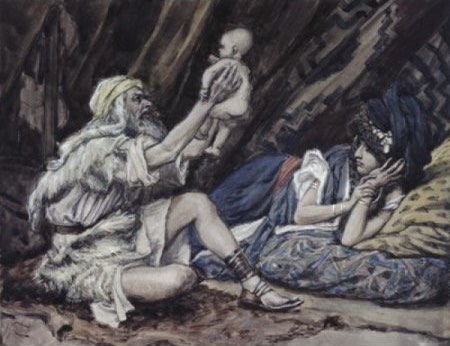
In Jewish interpretive traditions, midrashic literature expands on Lamech's reaction to Noah's birth, portraying him as initially fearful of his son's extraordinary appearance. According to aggadic accounts compiled in Louis Ginzberg's Legends of the Jews, Lamech described Noah as having skin white as snow and hair white as wool, prompting him to flee to his father Methuselah in doubt of Noah's humanity. Methuselah consulted the prophet Enoch, who reassured them that Noah was a righteous descendant destined to bring comfort amid the world's toil, thus affirming Lamech's role in the prophetic lineage. Rabbinic sources present varied views on Lamech's righteousness, often tying it to his prophetic naming of as a source of relief from the ground's curse (Genesis 5:29). Some aggadot, such as those in Sefer HaYashar, note that Lamech died five years before the . In , Lamech's position is emphasized in chronological works like , which records him fathering at age 182 and living until just before the deluge, bridging the generations from to the post- world and underscoring the Sethite line's preservation amid moral decay. Kabbalistic perspectives in the Zohar interpret Lamech's naming of Noah as emblematic of divine comfort descending into human limitation, alleviating the curse of toil through Noah's future innovations like agricultural tools. This act symbolizes the flow of mercy (chesed) into the lower realms, representing humanity's constrained yet hopeful connection to the divine amid earthly struggles. While no major holidays or rituals center on Lamech, he appears in rabbinic commentaries on the Flood narrative in parashat Noach, illustrating themes of prophetic foresight and generational transition in the Torah reading cycle.

In Christianity

In Christian theology, Lamech is recognized as an ancestor of Christ through the presented in the Gospel of Luke, where he appears as the son of and father of in the lineage tracing back from Jesus to (Luke 3:36). This placement underscores Lamech's role in the unbroken chain connecting the first to the "last Adam," , emphasizing the continuity of God's redemptive plan across generations. Early Church Fathers, such as of Lyons, invoked the from to Christ in Against Heresies to affirm the unity of Scripture and refute Gnostic dualism, portraying the line as evidence of Christ's recapitulation of —reversing the fall and restoring humanity to divine communion. Patristic commentators highlighted Lamech's prophetic utterance upon Noah's birth (Genesis 5:29) as divinely inspired, despite his lack of recorded personal virtue. , in his homilies on Genesis, explained that God often grants prophetic insight through ordinary or unworthy individuals, as with Lamech, to reveal future relief from toil, paralleling the comfort ultimately found in Christ. The number 777 associated with Lamech's lifespan (Genesis 5:31) was interpreted symbolically by some early interpreters as denoting divine completeness or perfection, reflecting the sacred of seven multiplied for emphasis, though it ultimately points to human mortality and the need for eternal life in Christ. During the Reformation, , in his commentary on Genesis, viewed Lamech's words not merely as relief from agricultural labor but as a broader inspired by the , addressing the curse on the ground from Genesis 3:17–19 and foreshadowing spiritual consolation for the entire human race through . Calvin emphasized Lamech's faith persisting amid widespread before the , portraying him as a figure of quiet in a degenerate age. No dedicated saints, feasts, or liturgical commemorations honor Lamech in Christian tradition, reflecting his subdued role compared to more prominent patriarchs like . In modern evangelical thought, Lamech's prophecy is often seen as a typological foreshadowing of the gospel, where Noah's role in preserving life through the Flood prefigures Christ's salvation from judgment, bringing ultimate "comfort" and rest from sin's curse (Hebrews 4:9–10). This interpretation ties Lamech's hope to the messianic promise, illustrating how even pre-Flood figures anticipate redemption in Jesus.

In Islam

In Islamic tradition, Lāmik (also rendered as Lamik or Lamech) is recognized as the father of the prophet Nūḥ (Noah), though he is not named directly in the Quran. The Quranic narratives of Nūḥ's mission and the flood, such as in Surah Hud (11:25–49), imply his familial context within the prophetic lineage from Adam, emphasizing Nūḥ's role as a messenger to his people without specifying parental details. Classical tafsīr and prophetic biographies, including Ibn Kathīr's Qisas al-Anbiyāʾ (Stories of the Prophets), explicitly identify Lāmik as Nūḥ's father in the genealogical chain: Nūḥ ibn Lāmik ibn Mitūshilkh ibn ibn Yārid ibn Mahlābīl ibn Qaynan ibn Anūsh ibn ibn Ādam. This lineage underscores Lāmik's place in the unbroken succession of righteous forebears leading to the prophets, though he is not depicted as a prophet himself. Lāmik holds a minor but revered role in and exegetical traditions as a figure of the pre-flood era, symbolizing continuity in the divine covenant through his descent from righteous ancestors, yet without attributed prophetic warnings or extended narratives about his life.

Legendary Traditions

Tomb and Relics

In local Afghan Islamic tradition, the tomb of Lamech, father of Noah, is situated in . This attribution of the regional name "Lamghan" to the biblical stems from longstanding Muslim , where the location is revered as his burial place. According to legend, the tomb—known locally as the Shrine of Mehterlam Baba—was discovered during an expedition by Ghaznavid around 1000 CE, who constructed a and surrounding gardens over the presumed grave to honor the site. The structure serves as a place of for locals, though it has not been extensively documented in historical records beyond 19th-century surveys. No verified relics or artifacts associated with Lamech have been identified. Scholars regard these tomb traditions as pious legends, akin to those surrounding other biblical patriarchs, which emerged to foster religious and cultural identity without verifiable historical basis or excavation findings.

Cultural Depictions

In Literature and Art

Lamech, the ninth-generation descendant of and father of , appears sparingly in literature and art, typically as a transitional figure in the antediluvian genealogy rather than a central character with focus. His portrayals emphasize his role in the line of , highlighting themes of longevity and prophetic hope amid human decline before the . In medieval , Lamech is depicted in series of biblical patriarchs, often in sculptural or ivory carvings that visualize the Genesis 5 lineage. Similar representations appear in illuminated manuscripts, such as 13th- and 14th-century English and French Bibles, where Lamech is illustrated among standing or enthroned patriarchs in trees or friezes, underscoring the unbroken righteous line leading to . Renaissance art occasionally incorporates Lamech within broader Genesis cycles, though explicit naming scenes are rare. Jewish artistic traditions feature Lamech in illuminated biblical codices as part of Seth's lineage, emphasizing his brief but pivotal blessing on as a restorer from labor's . These depictions, while not as dramatic as those of Noah himself, serve to bridge creation and redemption narratives. In literature, Lamech features in expansions of the biblical account, particularly in apocryphal and poetic works exploring pre-Flood humanity. John Milton's (1667) alludes to the antediluvian world's moral decay through the lens of in Books 11 and 12, with 's birth as a prophetic pivot in the line leading to redemption. Medieval poetry, such as the 14th-century Cursor Mundi, recounts Lamech's life briefly in its world history, focusing on his 777 years and hopeful naming of as , positioning him as a symbol of fading patriarchal vitality. 19th-century Victorian poetry evokes Lamech as an of weary foreboding, aligning with broader Romantic interests in biblical antiquity as metaphors for industrial-era decline.

In Film and Modern Media

Lamech, the biblical father of Noah, has received limited but notable attention in 20th- and 21st-century film and media, often as a supporting figure emphasizing lineage and pre-flood themes. His most prominent portrayal occurs in Darren Aronofsky's epic Noah, where he is depicted as a patriarchal leader passing on a sacred birthright to his young son . Played by , Lamech performs a ritual blessing over Noah using a talisman made from the skin of the serpent from the , symbolizing humanity's fall and the hope of redemption. This scene underscores Lamech's role as guardian of divine legacy, drawing from extra-biblical traditions like the to highlight his connection to purity. Later, Lamech is killed by the antagonist Tubal-Cain during an attack on their lineage, motivating Noah's lifelong commitment to stewardship and vengeance against corruption. The film's inventive expansion of Lamech's character, absent from the sparse Genesis account, has been praised for its visual symbolism while critiqued for diverging from scripture. Beyond live-action cinema, Lamech appears in brief supporting roles within animated Bible adaptations, where he typically serves to introduce Noah's and foreshadow the flood's judgment. In the ongoing iBIBLE project, an aiming to visualize the entire , Lamech is featured in episodes covering Genesis 4-6, portrayed as a righteous figure reacting to the moral decay of his era and naming his son with prophetic hope for relief from toil. This depiction aligns with the series' goal of making scriptural narratives accessible through , including Lamech's interactions amid the rise of Cain's . Similar minor appearances occur in other educational animated retellings, reinforcing his role as a bridge between Seth's line and the ark's builder without extensive character development. In modern , Lamech emerges as a central in biblical-inspired novels exploring pre-flood . J. R. Lowe's Heroes of Old , beginning with Lamech (2024), reimagines him as a complex leader navigating violence, faith, and family in a corrupt world, drawing on Genesis while inventing personal struggles like alliances with and preparations for the deluge. This series positions Lamech as a heroic yet flawed , emphasizing themes of divine warning and human resilience. Such works expand Lamech's legacy beyond , influencing reader interest in lore. The 2014 Noah film has notably amplified Lamech's visibility in contemporary eschatological discourse, prompting online and scholarly discussions about pre-flood figures as archetypes of and renewal in end-times . Portrayals like the serpent-skin have fueled debates on symbolic connections between Eden's and apocalyptic themes, appearing in analyses that link Lamech to broader narratives of restoration. While memes specifically about Lamech remain scarce, the film's release correlated with surges in searches and forums exploring biblical patriarchs in relation to modern cataclysms.

References

Add your contribution
Related Hubs
Contribute something
User Avatar
No comments yet.