



Community hub
Recent from talks
Contribute something
Nothing was collected or created yet.
Georgian Railway
View on WikipediaGeorgian Railway (Georgian: საქართველოს რკინიგზა, romanized: sakartvelos rk'inigza) is a fully state-owned railway company of Georgia, both managing infrastructure and operating freight and passenger travel in Georgia.
Key Information

.jpg)
A vital artery linking the Black Sea and the Caspian Sea, it sits on the shortest route between Europe and Central Asia.[2] Built to 1,520 mm (4 ft 11+27⁄32 in) standard Russian gauge, at present the fully electrified mainline of the Georgian Railway is 1,323.9 km (total: 1,576 km) in length, consisting of 1,422 bridges, 32 tunnels, 22 passenger and 114 goods stations.[3] In 2017, Georgian Railways passenger ridership was 2,684,000,[4] of which 100,000 were international passengers, the rest domestic.[5]
History
[edit]The railway was founded in 1865,[2] and operations started in 1871 between Poti and Kvirila (present day Zestaponi). The first passenger train ran on October 10, 1872, from Poti to Tbilisi central station.[2]
From this central spine, the railway network expanded with links to: Rioni to Kutaisi (1877), Rioni-Tkibuli (1887), Zestaponi to Chiatura (1895). The Tbilisi to Baku line became operational in 1883, allowing transportation of Azeri oil through the port of Batumi. In 1899, the Kars–Gyumri–Tbilisi railway connection between Georgia and Armenia was established.[2] The Khashuri to Borjomi link was built in 1894, with the 900 mm (2 ft 11+7⁄16 in) Borjomi to Bakuriani narrow-gauge line operational from 1902, to serve the higher level skiing community. The Kakheti railway branch line was completed in 1915.[2]
The second major development of Georgian railways was due to rapid industrialisation and need for better distribution of agricultural products, including tea, citrus and wine produce. This resulted in the construction of the branch lines to: Natanebi-Ozurgeti (1924); Brotseula-Tskaltubo (1934), Senaki-Ingiri-Gali (1930), Gali-Ochamchire-Sokhumi (1938), Gori-Tskhinvali (1940). The construction of the Sokhumi-Adler allowing direct connection to the Russian Railways network started during World War II (later Soviet Railways), and was in full operation by 1949.[2]
The Marabda to Akhalkalaki line opened on 31 December 1986.[2]
The rail connection between Kars and Tbilisi via Gyumri (Alexandropol, Leninakan) that began in 1889 ended in 1993 with the closing of the Turkish-Armenian border.[citation needed]
Modernisation
[edit]


Following the dissolution of the Soviet Union, the Georgian Government took control of many of the key assets of the former Soviet Railways in the former Georgian SSR and undertook an aggressive privatisation campaign. The railway assets of Georgia were formed into the new 100% government-owned company JSC Georgian Railway – the biggest employer in the country (12,700 employees), which operates under the public law of the Enterprise Management Agency, part of the Ministry of Economic Development. It is charged with both management and maintenance of the rail infrastructure, as well as all operations of passenger and freight services. The team which forms the management body consist of The Assembly of Partners, the Supervisory Board and the Board of Directors. Company revenue in 2014 was $US287 million with a high EBITDA margin of 48.9%, debt was $US560 million. More than 95% of revenue comes from freight operations, more than half of which is transit.[3]
Until 2004 Georgian Railway had been significantly affected by corruption. On the one hand, modernization and maintenance of the railway were neglected; for example, out of 11,000 rail cars, only 7,000 were in operation. On the other hand, the football stadium of Lokomotiv Tbilisi, the team of Georgian Railway, had one of the most modern sports sites in the country. General manager Akaki Chkhaidze was arrested in 2004 and spent several months in custody, before he redeemed himself for 3 million US dollars.
The railway company was restructured in the same year, and the general manager became subordinate to a supervisory board. From June 2004 until October 2005 David Onoprishvili, a former finance minister and a professor at Vanderbilt University in Nashville, Tennessee, was general manager. [citation needed]
As part of a modernization program, 2,445 employees were laid off, while wages for remaining employees were increased by about 17 percent. Tariffs for goods (freight) transport were lowered, while modernized, air-conditioned rail cars and express services were launched for passengers, including four Stadler passenger trains. A program of new and renovated station buildings commenced in 2006. The station building of the Tbilisi central station, excluding the rail infrastructure, was reconstructed and officially inaugurated in May 2010. The stations Makhinjauri (a suburb of Batumi) and Kobuleti also received new station buildings.
The 63 kilometres (39 mi) long Zestaponi–Moliti–Khashuri section (“Gorges” section) is a part of the main Georgian railway line across mountaineous terrain, with very steep gradient and tight curves. The track alignment imposes very low speeds on the line, and it leads to various operational problems. Currently it takes ca. 1.5 hours for a passenger train to cover the section, and much longer for freight trains because of brakes overheating. For this reason, the company is modernizing the section in order to increase capacity, reduce travel time, and improve safety as well as railway operation. Along this section of track several new tunnels, of which the new ca. 8.4 kilometres (5.2 mi) T9 tunnel will be the longest rail tunnel in Georgia,[6][7] will be built. The T9 tunnel will consist of two parallel tubes connected with cross passages at intervals of 300 m.[6] The project is planned to be completed in late 2019. After the completion of the tunnel, travel time for passenger trains on the Tbilisi - Batumi route will be reduced by 40 minutes.[6]
Infrastructure
[edit].svg) | |||||||||||||||||||||||||||||||||||||||||||||||||||||||||||||||||||||||||||||||||||||||||||||||||||||||||||||||||||||||||||||||||||||||||||||||||||||||||||||||||||||||||||||||||||||||||||||||||||||||||||||||||||||||||||||||||||||||||||||||||||||||||||||||||||||||||||||||||||||||||||||||||||||||||||||||||||||||||||||
| Technical | |||||||||||||||||||||||||||||||||||||||||||||||||||||||||||||||||||||||||||||||||||||||||||||||||||||||||||||||||||||||||||||||||||||||||||||||||||||||||||||||||||||||||||||||||||||||||||||||||||||||||||||||||||||||||||||||||||||||||||||||||||||||||||||||||||||||||||||||||||||||||||||||||||||||||||||||||||||||||||||
|---|---|---|---|---|---|---|---|---|---|---|---|---|---|---|---|---|---|---|---|---|---|---|---|---|---|---|---|---|---|---|---|---|---|---|---|---|---|---|---|---|---|---|---|---|---|---|---|---|---|---|---|---|---|---|---|---|---|---|---|---|---|---|---|---|---|---|---|---|---|---|---|---|---|---|---|---|---|---|---|---|---|---|---|---|---|---|---|---|---|---|---|---|---|---|---|---|---|---|---|---|---|---|---|---|---|---|---|---|---|---|---|---|---|---|---|---|---|---|---|---|---|---|---|---|---|---|---|---|---|---|---|---|---|---|---|---|---|---|---|---|---|---|---|---|---|---|---|---|---|---|---|---|---|---|---|---|---|---|---|---|---|---|---|---|---|---|---|---|---|---|---|---|---|---|---|---|---|---|---|---|---|---|---|---|---|---|---|---|---|---|---|---|---|---|---|---|---|---|---|---|---|---|---|---|---|---|---|---|---|---|---|---|---|---|---|---|---|---|---|---|---|---|---|---|---|---|---|---|---|---|---|---|---|---|---|---|---|---|---|---|---|---|---|---|---|---|---|---|---|---|---|---|---|---|---|---|---|---|---|---|---|---|---|---|---|---|---|---|---|---|---|---|---|---|---|---|---|---|---|---|---|---|---|---|---|---|---|---|---|---|---|---|---|---|---|---|---|---|---|---|---|---|---|---|---|---|---|---|---|---|---|---|---|---|---|---|---|
| Track gauge | 1,520 mm (4 ft 11+27⁄32 in) | ||||||||||||||||||||||||||||||||||||||||||||||||||||||||||||||||||||||||||||||||||||||||||||||||||||||||||||||||||||||||||||||||||||||||||||||||||||||||||||||||||||||||||||||||||||||||||||||||||||||||||||||||||||||||||||||||||||||||||||||||||||||||||||||||||||||||||||||||||||||||||||||||||||||||||||||||||||||||||||
| Length | 1,576 km (979 mi) | ||||||||||||||||||||||||||||||||||||||||||||||||||||||||||||||||||||||||||||||||||||||||||||||||||||||||||||||||||||||||||||||||||||||||||||||||||||||||||||||||||||||||||||||||||||||||||||||||||||||||||||||||||||||||||||||||||||||||||||||||||||||||||||||||||||||||||||||||||||||||||||||||||||||||||||||||||||||||||||
| Other | |||||||||||||||||||||||||||||||||||||||||||||||||||||||||||||||||||||||||||||||||||||||||||||||||||||||||||||||||||||||||||||||||||||||||||||||||||||||||||||||||||||||||||||||||||||||||||||||||||||||||||||||||||||||||||||||||||||||||||||||||||||||||||||||||||||||||||||||||||||||||||||||||||||||||||||||||||||||||||||
| Website | www | ||||||||||||||||||||||||||||||||||||||||||||||||||||||||||||||||||||||||||||||||||||||||||||||||||||||||||||||||||||||||||||||||||||||||||||||||||||||||||||||||||||||||||||||||||||||||||||||||||||||||||||||||||||||||||||||||||||||||||||||||||||||||||||||||||||||||||||||||||||||||||||||||||||||||||||||||||||||||||||
| |||||||||||||||||||||||||||||||||||||||||||||||||||||||||||||||||||||||||||||||||||||||||||||||||||||||||||||||||||||||||||||||||||||||||||||||||||||||||||||||||||||||||||||||||||||||||||||||||||||||||||||||||||||||||||||||||||||||||||||||||||||||||||||||||||||||||||||||||||||||||||||||||||||||||||||||||||||||||||||


.jpg)
Due to the challenging mountainous geography of Georgia, railway engineers have often been faced with some difficult challenges. In 1890, the dual tracking of the Tsipa tunnel was completed, allowing faster passage of East-West traffic.[2]
On August 16, 1932, for the first time in the USSR, the first electric traction train ran in the Surami pass. The General Electric Company produced the initial eight electric locomotives of Class S for the service, followed by an additional 21 Class Ss built by the Kolomna and Dinamo works between 1932 and 1934. By November 1967 all Georgian railway was electrified, including the Borjomi-Bakuriani narrow-gauge line.[2] (Some lines are no longer electrically operated due to political and economic instability and war, particularly in Abkhazia and South Ossetia.)
Post World War II, from 1946 the USSR army engineers with the prospect of connection to their system introduced modern communications, automatisation and Automatic Block Signalling systems. This was followed by the introduction of on train and guard radio communication systems, a process which was completed by 1949.[2]
Rolling stock
[edit]At Georgia independence, Georgian Railway operated Soviet trains. Maintenance, repair and modernisation were performed at "Elmavalmshenebeli" plant in Tbilisi and "Carriage-Building Company" in Rustavi.
In 2009 Georgian Railway took delivery of the first of an order of eight inter-city EMUs produced by CSR Nanjing Puzhen Rolling Stock, China, at a cost of US$6M each. The 3 kV dc trains have a maximum speed of 130 km/h and each four-car set seats a total of 300 passengers in first and second class accommodation.
In 2016 four double-decker electric trains, model ESh2, of the Swiss company Stadler Rail AG were ordered at a cost of US$11M each. The 3 kV DC trains have a maximum speed of 160 km/h and each four-car set seats a total of 530 passengers in business class, first and second class accommodation.
As of 2022, there were 176 locomotives and 4,469 freight cars in service.[8]
Gallery
[edit]-
 VL11 electric locomotive
 -
 Seated coach interior
 -
 ER2 electric multiple unit
 -
 ER2 unit interior
 -
 ER2T
ER2T -
 ER2M electric multiple unit
 -
 ES electric multiple unit
 -
 VMK electric multiple unit
 -
 GRS (ESh2) electric multiple unit
 -
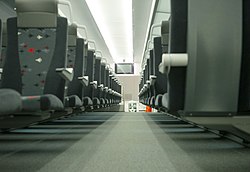 GRS (ESh2) unit interior
 -
 Georgian Rail 001-01, at Borjomi train station


Incidents
[edit]Following the 2008 South Ossetia war, Russian army forces entered parts of Georgia and damaged key Georgian assets. This included a railway bridge near the western Georgian town of Kaspi,[9] and application of mines to the mainline west of Gori resulted in the complete derailment and resultant fire of an oil train.[10]
The lines located in Abkhazia and South Ossetia are not under the control of the Georgian Railway. Lines from Nikozi to Tskhinvali (5 km) and from Ochamchire to Enguri River are not in use; much of the track and overhead on these two lines have been looted, and stations such as Gali have been destroyed or heavily damaged. Lines from Psou River to Ochamchire and from Ochamchire to Tkvarcheli are operated by separatist Abkhazian Railways.
Railway links with adjacent countries
[edit]
 Azerbaijan – open – 1,520 mm (4 ft 11+27⁄32 in) (Tbilisi-Baku line); a through 1,435 mm (4 ft 8+1⁄2 in) (standard-gauge) connection proposed[citation needed]
 Armenia – open – 1,520 mm (4 ft 11+27⁄32 in) (Tbilisi–Gyumri–Yerevan line)
 Turkey – open – standard-gauge line (Akhalkalaki–Kars); this standard-gauge line is connected with Georgia's 1,520 mm (4 ft 11+27⁄32 in) railway at Akhalkalaki.[11][12]
 Russia – closed – 1,520 mm (4 ft 11+27⁄32 in) – via the breakaway Abkhazia – de jure closed since the War in Abkhazia (1992–1993), de facto operates partly by Abkhazian Railway without track from Enguri to Sokhumi.


Sponsorships
[edit]As of 2020, the company has been the official jersey sponsor of the Georgia men's national basketball team.[citation needed]
Gallery of stations
[edit]


See also
[edit]References
[edit]- ^ "Archived copy" (PDF). Archived from the original (PDF) on 2017-02-08. Retrieved 2016-09-27.
{{cite web}}: CS1 maint: archived copy as title (link) - ^ a b c d e f g h i j "Georgian Railway - History". Georgian Railway LLC. Retrieved 2008-08-23.
- ^ a b "Georgian Railway - About Us". Georgian Railway LLC. Archived from the original on 2007-08-22. Retrieved 2008-08-23.
- ^ "Georgian Railway – 2017 Annual Report" (PDF). Retrieved 18 January 2020.
- ^ Nana Bolashvili, Andreas Dittmann, Lorenz King, Vazha Neidze (eds.): National Atlas of Georgia, 138 pages, Steiner Verlag, 2018, ISBN 978-3-515-12057-9
- ^ a b c "Milestone achieved for Georgia's longest rail tunnel". 4 June 2018. Archived from the original on 2024-09-29. Retrieved 2024-09-29.
- ^ Georgian Railway - Georgian Railway Modernization Project (PDF) (Report). p. 8. Archived from the original (PDF) on 2023-05-31. Retrieved 2024-09-29.
- ^ "Company Presentation" (PDF). railway.ge. 2021.
- ^ "Damaged Georgian railway to open in 10 days". Ynetnews. Israel News. 2008-08-17. Retrieved 2008-08-23.
- ^ Rising, David (2008-08-24). "US warship sails into Georgia with aid; Georgians blame Russia for oil train hitting mine". Chicago Tribune/Associated Press. Archived from the original on 2008-08-17. Retrieved 2008-08-24.
- ^ Станцию Ахалкалаки в Грузии спроектируют в Азербайджане (Georgia's Akhalkalaki station will be designed by an Azerbaijani firm). Interfax, 17.11.2009. (in Russian)
- ^ "Baku-Tbilisi-Kars Railway Line Officially Launched". Radio Free Europe/Radio Liberty. 30 October 2017. Retrieved 4 November 2017.
External links
[edit]


Georgian Railway
View on GrokipediaGeorgian Railway (Georgian: საქართველოს რკინიგზა, Sakartvelos Rkinigheba), officially Joint Stock Company Georgian Railway, is the state-owned entity responsible for the operation and maintenance of Georgia's rail network, encompassing both infrastructure management and the provision of freight and passenger services.[1] Established on October 10, 1872, with the inaugural passenger train service from the Black Sea port of Poti to Tbilisi, it forms a vital artery for domestic connectivity and regional transit linking Europe to Asia through the Caucasus.[2] The network totals 1,992 kilometers in length, with 1,108 kilometers electrified, primarily on broad gauge (1,520 mm) tracks that include single- and double-track sections, tunnels, and bridges essential for navigating Georgia's mountainous terrain.[3] As a key component of international corridors such as TRACECA and the Middle Corridor revival of ancient Silk Road routes, Georgian Railway facilitates significant freight volumes, including oil products from the Caspian region, minerals, and containerized goods destined for Black Sea ports like Poti and Batumi.[4] Freight operations have shown resilience, with cargo throughput reaching approximately 11-15 million tons annually in recent years, rebounding from post-Soviet declines through infrastructure upgrades and subsidiary formations for logistics and terminals.[5] Passenger services prioritize safety and comfort, serving major routes like Tbilisi to Batumi with modern rolling stock, including double-deck electric multiple units introduced in 2016, though volumes remain modest compared to freight, handling hundreds of thousands of travelers quarterly.[6][7] The company's strategic position has drawn investments for modernization, yet it faces challenges from geopolitical tensions affecting cross-border traffic and competition with road transport.[8]
Overview
Network Characteristics
The Georgian Railway network operates on a 1,520 mm broad gauge, consistent with the former Soviet rail standard, which facilitates connectivity with neighboring Azerbaijan, Armenia, and Russia but requires transshipment for standard-gauge links to Turkey and Europe.[8] [9] As of the end of 2023, the total length of railway lines stood at 1,576.5 kilometers, encompassing main lines, sidings, and station tracks, with main operational rails measuring approximately 1,442 km.[10] Of this, 98.4%—or about 1,551 km—was electrified, primarily at 3,000 V DC, enabling efficient electric traction across the network with minimal diesel reliance.[10] [3] The configuration includes roughly 850 km of single-track sections and 295 km of double-track, concentrated on high-traffic corridors to support bidirectional freight flows, though bottlenecks persist in mountainous areas like the Zestafoni–Khashuri gorges due to terrain constraints.[8] Key routes form an east-west mainline axis spanning from the Azerbaijani border at Sadakhlo through Tbilisi to Black Sea ports at Poti and Batumi, totaling over 500 km of core infrastructure vital for oil, minerals, and container transit.[8] North-south branches connect to Armenia via the Marabda–Kars extension potential and historically to Russia, while domestic lines radiate to Zestafoni, Kutaisi, and secondary hubs.[9] The network supports 51 passenger stations and 100 goods yards, prioritizing freight with capacities exceeding 10 million tons annually on international corridors, though capacity expansions are limited by single-track dominance outside doubled segments.[8] [9]Ownership and Governance
JSC Georgian Railway is wholly owned by the Government of Georgia, which holds 100% of the shares directly since December 2022, following a transfer from the state-owned JSC Partnership Fund (previously known as the Development Fund in some contexts).[11][12] Prior to 2011, ownership was directly under the government, with the intermediary fund established to manage state assets during post-independence privatization efforts.[11] This structure positions Georgian Railway as a strategic state monopoly responsible for national rail infrastructure and operations, with oversight aligned to the Ministry of Economy and Sustainable Development.[12] Governance follows a three-tier corporate model typical of joint-stock companies under Georgian law: the General Meeting of Shareholders (GMS), comprising government representatives as the sole shareholder; a Supervisory Board; and a Management Board.[11] The GMS approves major strategic decisions, including budgets, major borrowings (those exceeding 1% of authorized capital), and charter amendments, ensuring state control over fiscal and developmental priorities.[11] The Supervisory Board, consisting of five members (mostly independent non-executive directors elected for one-year terms), oversees strategy, risk management, and executive appointments; as of late 2023, it was chaired by Konstantine Guntsadze, with members including Oleg Bichiashvili, Giorgi Muskhelishvili, Beka Injia, and David Samkharashvili.[11] It operates committees for audit, nomination, and remuneration to enhance transparency and accountability.[11] The Management Board, led by the General Director (CEO), handles day-to-day operations and is structured around three Strategic Business Units: Freight, Passenger, and Infrastructure, each directed by specialized executives reporting to the CEO.[11] Lasha Abashidze has served as General Director since May 7, 2025, succeeding David Peradze who held the position from 2017.[13] Freight tariffs are deregulated, allowing market-based setting without prior approval, while passenger services receive state subsidies via a Public Service Contract (effective 2024–2028, with GEL 8 million allocated in 2024) to cover losses and maintain affordability as a social obligation.[11] Ongoing governance reforms emphasize corporatization and alignment with EU standards, including compliance with Directive 2012/34 since 2021, which mandates separate financial reporting for infrastructure and transport activities.[11] This involves shifting dispatching functions to the Infrastructure Unit and potential restructuring into a holding company with subsidiary SBUs to promote competition and efficiency.[11] International assistance, such as an EU twinning project with Poland (2021–2023), has supported regulatory modernization, while internal updates to charters and policies over the past decade have incorporated independent oversight mechanisms.[11] These measures address post-Soviet legacy issues like integrated operations, aiming for sustainable financing without compromising state strategic interests.[14]Historical Development
Imperial and Early Soviet Era
The Transcaucasus Railway, the foundational network for what became Georgian Railway, began construction in 1865 under the Russian Empire to connect the Black Sea port of Poti with interior regions, primarily for strategic military and economic purposes, including facilitating troop movements and resource extraction.[2] The initial section from Poti to Kvirila (near present-day Zestaponi) opened to traffic on August 14, 1871, marking the first operational railway in Georgia, with the official inauguration of the Caucasian Railway considered October 10, 1872, following extension to Tbilisi.[15][16] This line, built to standard Russian gauge of 1,524 mm, rapidly expanded: by 1875, it linked to Vladikavkaz in the North Caucasus via Rostov-on-Don, enhancing regional connectivity; the extension eastward to Baku was completed in 1883 to transport oil from the Caspian fields to Black Sea ports like Poti and Batumi (annexed in 1878), boosting freight volumes significantly.[17] Further branches, such as the Tbilisi-Batumi line operational by the 1890s, solidified the network's role in imperial trade and defense, with total Transcaucasian mileage reaching over 1,000 km by 1900, though challenges like mountainous terrain required engineering feats including inclines at Surami Pass.[15] During World War I and the ensuing Russian Civil War (1917–1921), the railways in Georgia faced disruptions from military occupations, strikes—including a 1905 railway workers' strike that spread to Tbilisi—and sabotage, yet remained vital for Bolshevik forces advancing into the Caucasus.[18] Following the Red Army's invasion and establishment of Soviet control in Georgia by February 1921, the fragmented networks across the emerging Transcaucasian republics were unified in 1921 into the Caucasian Railways, headquartered in Tbilisi, transitioning from private imperial operation to state oversight under the new regime.[19] By 1922, as the USSR formalized, the Transcaucasus Railway operated as a subsidiary of the Soviet Railways system, prioritizing reconstruction amid post-war devastation; early initiatives focused on repairing war damage, standardizing operations, and initiating modest expansions to support industrialization, such as branches into Abkhazia and South Ossetia regions.[16] A landmark in early Soviet development occurred on August 16, 1932, when the world's first commercial electric traction service in the USSR commenced on the Surami incline section near Tbilisi, using 3 kV DC overhead lines to overcome steep gradients that previously relied on steam locomotives and funicular assists, marking a shift toward electrification driven by Five-Year Plan imperatives for efficiency in freight haulage, particularly oil and minerals.[20] This innovation, implemented amid Stalin-era forced collectivization and rapid infrastructure pushes, expanded the network's capacity despite resource constraints, with Georgia's railways handling increased Soviet-wide traffic by the mid-1930s, though output lagged behind pre-war imperial peaks due to political purges affecting management and labor.[17] By the late 1930s, the system integrated into broader Transcaucasian SFSR logistics, underscoring railways' causal role in centralizing economic control and resource extraction under Soviet planning.[19]Late Soviet Modernization
In the 1960s, the Georgian Railway initiated comprehensive electrification projects, beginning with the challenging Zestaponi-Zugdidi section in 1965 to capitalize on the republic's extensive hydroelectric capacity for reliable power supply. This effort extended to the broader network, enabling electric traction to replace steam and diesel operations, which improved energy efficiency and reduced operational costs in a terrain marked by steep gradients and mountainous routes.[21] Track doubling efforts commenced in 1967, focusing on principal lines to alleviate bottlenecks and accommodate rising freight volumes from industrial expansion in the Georgian SSR, including mineral exports and agricultural distribution. These upgrades, combined with electrification, enhanced throughput and reliability, positioning the system as technically advanced by 1990 prior to post-Soviet disruptions.[19] Modernization also incorporated signaling improvements and locomotive upgrades suited to 3 kV DC and emerging AC systems, aligning with USSR-wide electrification standards that emphasized heavy-haul capabilities for trans-Caucasus connectivity. By the late 1980s, these investments had doubled key capacities, though economic stagnation in the final Soviet years limited further expansions like proposed cross-Caucasus links.[19][21]Post-Independence Challenges and Reforms
Following independence from the Soviet Union in 1991, Georgian Railway, established as a separate entity managing a 1,443 km network, encountered acute operational and economic difficulties amid the broader post-Soviet collapse. Freight volumes plummeted due to the loss of subsidized integrated markets and Georgia's internal economic crisis, dropping from Soviet-era peaks of around 64 million tons in 1985 to just 4.7 million metric tons by 1995, representing only 13% of prior production levels. Infrastructure rapidly deteriorated from under-maintenance and aging equipment, with track quality declining steadily and rolling stock becoming obsolete, exacerbating bottlenecks and safety risks.[22][23][19][24] Civil unrest and regional conflicts further compounded these issues, including the 1992–1993 Abkhazian war, which severed key transit routes like the line to Russia via Abkhazia, isolating the network from northern markets and contributing to sustained low traffic. Passenger services also collapsed, with domestic ridership falling sharply alongside freight, while theft and vandalism targeted rails and signaling systems amid hyperinflation and governance instability under President Shevardnadze. By the late 1990s, the railway operated as a state monopoly with limited investment, relying on outdated Soviet-era locomotives and wagons, many over 30 years old, leading to inefficiencies and high operational costs.[25][26][22] Reforms accelerated after the 2003 Rose Revolution under President Saakashvili, with modernization efforts focusing on infrastructure rehabilitation and capacity expansion to revive transit potential. Key initiatives included the Georgian Railway Modernization Project, which upgraded critical sections like the 63 km Zestafoni–Khashuri line to raise throughput from 27 million tons to 48 million tons annually and increase speeds beyond the prior 60 km/h limit. Governance improvements involved corporatization as JSC Georgian Railway, establishment of subsidiaries like GR Logistics in 2009 for terminal operations, and investments in new rolling stock to address aging fleets where over 50% of wagons exceeded 35 years by the mid-2010s. The 2017 completion of the Baku–Tbilisi–Kars (BTK) line enhanced regional connectivity, boosting dry freight to 5.9 million tons by 2018, though liquid cargo volumes halved since 2014 due to market shifts. Ongoing structural reforms, including unbundling infrastructure from operations to align with international standards, aim to improve transparency, safety, and competition, supported by self-financing and international partnerships.[22][2][27][28]Infrastructure
Track Network and Electrification
The track network of JSC Georgian Railway consists primarily of 1,520 mm broad-gauge lines, inherited from the Soviet-era infrastructure and compatible with neighboring rail systems in Azerbaijan, Armenia, and Russia. As of December 2023, the operational network spans 1,408 km, including approximately 850 km of single-track sections and 295 km of double-track lines concentrated on high-traffic corridors such as the main east-west route from Azerbaijan through Tbilisi to the Black Sea ports of Poti and Batumi. The mainline totals 527 km and supports key international transit functions under the TRACECA framework, linking the [Caspian Sea](/page/Caspian Sea) region to Europe via ferry connections and the Baku–Tbilisi–Kars extension, where gauge transitions to 1,435 mm standard from Akhalkalaki into Turkey.[11][2][8] Electrification extends to 98% of the network, covering roughly 1,380 km and enabling efficient electric locomotive operations across most freight and passenger routes. The fully electrified 527 km mainline facilitates speeds up to 100–120 km/h for freight and higher for passengers, with overhead catenary infrastructure upgraded during post-Soviet modernization to handle increased volumes along the Caucasus corridor. A residual non-electrified portion includes remote branches and the narrow-gauge (914 mm) Borjomi–Bakuriani line, a 27 km tourist route preserved for heritage purposes. These enhancements, including signaling and track renewals, have prioritized capacity on double-track segments to support growing oil, mineral, and container transit from Central Asia.[11][9][3]Key Stations and Yards
Tbilisi Central Railway Station functions as the principal hub of the Georgian Railway network, accommodating the bulk of domestic passenger services and freight interchanges while connecting to primary lines radiating westward to the Black Sea ports, eastward to Azerbaijan, and northward toward Russia via disputed routes. Located at 1 Station Square in the capital, it supports daily operations including high-speed services to Batumi and Kutaisi, with infrastructure upgraded to integrate ticketing, retail, and metro linkages for multimodal access.[29][30] Batumi Railway Station ranks among the network's vital coastal endpoints, serving Adjara region's passenger demand and facilitating transfers to ferry and port activities, with platforms handling routes from Tbilisi and connections to Turkey via planned extensions. Poti Railway Station, proximate to Georgia's largest Black Sea port, prioritizes freight throughput, including container block trains to Tbilisi operating four times weekly as of August 2025, supported by a dedicated marshalling yard featuring cranes for cargo handling, albeit constrained to 5-ton lifts that limit efficiency for heavier loads.[31][32][33] Kutaisi Railway Station anchors central-western Georgia's connectivity, linking to the international airport and regional lines while processing passenger and local freight volumes. Samtredia emerges as a pivotal junction yard, directing traffic flows to Poti, Batumi, and Zugdidi for Abkhazian access, enabling efficient sorting and rerouting amid the network's 1,576 km of broad-gauge track. Batumi additionally hosts a large marshalling yard for freight classification, essential for mountainous terrain logistics and export preparation.[20][8]Rolling Stock and Equipment
Locomotives and Power Systems
The Georgian Railway maintains a fully electrified network powered by a 3.3 kV DC overhead catenary system, with electricity supplied via 53 high-voltage substations, including 26 rectifier substations for traction power conversion.[3][34] This Soviet-era standard, implemented progressively from the 1950s onward, supports mainline operations across the 1,577 km of electrified track, enabling efficient electric traction while minimizing reliance on diesel for revenue services.[12] The primary locomotives are electric models of the VL10 and VL11 series, consisting of twin-section (eight-axle) DC units manufactured by the Novocherkassk Electric Locomotive Plant (NEVZ) between 1961 and 2005; these form the entire freight hauling fleet, with the VL11 variant featuring modular booster sections for enhanced power output up to 6,480 kW in multi-section configurations.[21] As of 2022, the active electric locomotive inventory totaled 89 units dedicated to freight and mixed duties, supplemented by 25 locomotives allocated for passenger train hauling.[35] Diesel locomotives, numbering fewer than 10 operational units, are restricted to shunting and yard maneuvers due to the network's electrification.[36] Fleet aging has prompted modernization efforts, including a 2023 tender for procuring new DC electric locomotives with associated maintenance services to replace obsolete units and boost capacity amid rising freight volumes.[37] These Soviet-designed locomotives, while reliable for heavy-haul operations on gradients like those in the Transcaucasus, exhibit higher maintenance demands compared to contemporary AC systems, contributing to ongoing investments in overhauls estimated at tens of millions of GEL annually.[35]Wagons and Maintenance Practices
The wagon fleet of Georgian Railway primarily consists of freight railcars, including platform cars, box cars, open-top box cars, cement hoppers, tank cars, and grain hoppers, alongside a smaller number of passenger wagons. As of December 31, 2023, the active freight railcar inventory stood at 4,392 units, with 3,113 in working condition and 6,883 deemed serviceable overall, reflecting a slight decline from 4,469 active units in 2021.[11][27] Passenger wagons numbered 34 active units in 2023, down from 40 in 2021, supporting domestic and international services.[11][27] Approximately 47% of freight transport in 2021 utilized wagons owned by Georgian Railway, with the remainder comprising 23% from other railways and 30% from private operators, indicating reliance on external rolling stock to meet demand.[27] A significant portion of the wagon fleet exhibits advanced age, contributing to higher maintenance needs and operational risks. In 2023, 64% of freight railcars exceeded 35 years of age, while 100% of passenger wagons were in this category; similar patterns persisted in 2021, with 56% of freight railcars over 50 years old and substantial shares aged 31-35 years.[11][27] This aging profile has prompted selective acquisitions, such as 100 semi-wagons purchased in 2023 and plans for an additional 300, alongside 480 containers acquired in 2014 to bolster containerized freight capacity.[11] Revenue streams tied to wagons include rentals generating GEL 4.158 million in 2023 (a 2.1% increase from 2022) and cross-border charges yielding GEL 15.705 million (up 61.9%), underscoring their economic role amid fluctuating cargo volumes.[11] Maintenance practices emphasize preventive and corrective measures to sustain fleet reliability, with scheduled depot repairs conducted every 1-3 years post-manufacture and biennially thereafter, complemented by capital overhauls at mid-life and life extensions via third-party providers—up to 150-200% of original useful life plus two 5-year increments.[11][27] Unscheduled repairs address technical deficiencies and usage intensity, while routine inspections occur before and after loading/unloading and en route at freight stations to ensure safety and compliance.[11][27] Annual renovation programs maintain operational availability, supported by network-wide repair shops and aging depots undergoing refurbishment under the Railway Modernization Project (2010-2024), which targets a 10% reduction in maintenance costs.[27] Expenditures on repairs reached GEL 12.824 million in 2023, a 21.3% rise from 2022, partly due to heightened rolling stock utilization; earlier, USD 72.9 million from green bond proceeds (as of 2023) funded acquisition and upkeep, with total investments in property, plant, and equipment—including wagons—totaling GEL 351.5 million from 2019-2023.[11] Hazardous waste from decommissioned wagons, amounting to 89,546 kg in 2023, is processed responsibly to mitigate environmental impact.[11]Current Operations
Freight Transportation
Freight transportation forms the core of Georgian Railway's operations, generating approximately 71% of the company's revenue in the first half of 2024. The railway's network, with a capacity of up to 27 million tons annually, primarily facilitates east-west transit corridors linking the Black Sea to the Caspian Sea, handling both domestic and international cargo flows. In 2024, total freight volume reached 13.7 million tons, marking a 0.9% increase from 13.6 million tons in 2023, following a decline from the 2022 peak of 14.8 million tons amid post-pandemic adjustments and one-time export surges.[38][5][39] Cargo is categorized into dry and liquid types, with dry comprising about 63% of volumes in early 2024, including metal ores (16%), chemicals (13%), construction materials (12%), metals and industrial products (10%), and agriculture (9%). Liquid cargo, at 37%, is dominated by oil products (19% of total). In 2023, key commodities included coal, crude oil, oil products, and natural gas (collectively 30% of volume), alongside metal ores and mining products. Transit cargo accounted for 56.9% of 2023 volumes (7.7 million tons), underscoring Georgia's role in regional logistics, while imports (22.6%), local traffic (12%), and exports (8.5%) filled the remainder.[39][10][5]| Year | Freight Volume (million tons) | Year-over-Year Change |
|---|---|---|
| 2022 | 14.8 | - |
| 2023 | 13.6 | -8.3% |
| 2024 | 13.7 | +0.9% |
Passenger Services
Georgian Railway operates passenger services primarily on domestic mainline and suburban routes, supplemented by limited international connections, utilizing a mix of modern electric multiple units (EMUs) and older electric trains. The network serves key population centers, with Tbilisi as the primary hub, offering affordable fares competitive with bus services to promote regional connectivity and tourism. Services emphasize safety, timeliness, and comfort, supported by electrification across the entire 1,576 km network.[41][12] Principal domestic routes include the high-demand Tbilisi–Batumi line, spanning approximately 270 km along the Black Sea coast, with multiple daily departures (typically three or more, increasing in summer) using Stadler Kiss double-decker EMUs capable of 160 km/h, completing the journey in about 5 hours. Other significant lines connect Tbilisi to Zugdidi (western Georgia, ~5 hours), Poti, Ozurgeti (upgraded in 2025 for faster service with additional seating), and Borjomi, alongside suburban electro trains to destinations like Gardabani. Frequencies vary by route and season; for example, the relaunched Kutaisi–Sachkhere service operates daily from March to November. International services include seasonal sleeper trains from Tbilisi to Yerevan, Armenia (every two days, ~10 hours, with air-conditioned 2- or 4-berth compartments), while the Tbilisi–Baku route to Azerbaijan remains suspended as of 2025 due to border issues.[20][42][43] Trains offer economy (2nd class) and business (1st class) seating on daytime services, with fares starting at 35 GEL for Tbilisi–Batumi economy seats and rising to 75 GEL for business class; international sleepers provide 1st, 2nd, and 3rd class options at 85–150 GEL. Amenities on modern Stadler trains acquired in 2016–2017 include air-conditioning, Wi-Fi, and dining cars, contrasting with basic conditions on older electro trains used for shorter suburban runs. Passengers may carry up to 36 kg of hand luggage free of charge, with tickets requiring personal identification and available up to 20 days in advance via online platforms like tickets.railway.ge or station offices; sales cease 10 minutes before departure, and children under 5 travel free without a seat. Refunds follow a tiered policy based on notice period.[41][42][44]| Route | Approximate Duration | Daily Departures (Typical) | Train Type |
|---|---|---|---|
| Tbilisi–Batumi | 5 hours | 3+ (more in summer) | Stadler EMU |
| Tbilisi–Zugdidi | 5 hours | 1–2 | Electric train |
| Tbilisi–Yerevan (seasonal) | 10 hours | Every 2 days | Sleeper |
| Tbilisi–Ozurgeti | 3–4 hours (post-2025 upgrade) | Multiple | Upgraded electric |