Hubbry Logo
German Corpse FactoryGerman Corpse FactoryMain
Open search
German Corpse Factory
Community hub
German Corpse Factory
logo
8 pages, 0 posts
0 subscribers
Be the first to start a discussion here.
German Corpse Factory
from Wikipedia

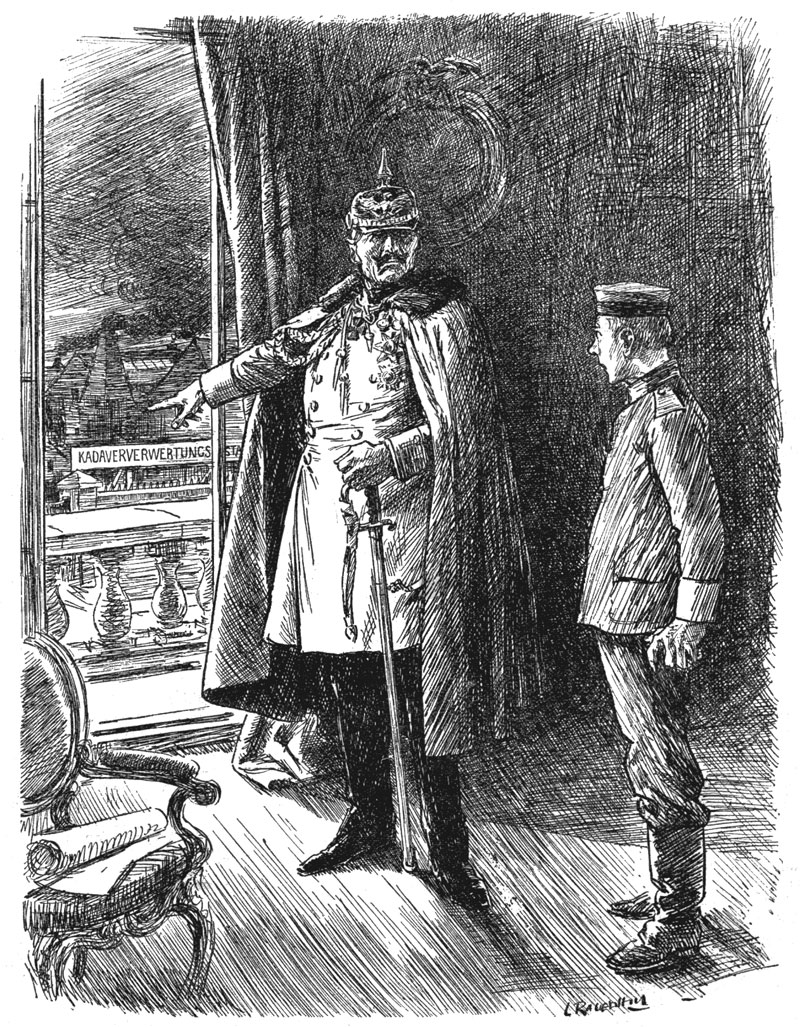
Wilhelm II to a recruit. "And don't forget that your Kaiser will find a use for you—alive or dead."
Punch, 25 April 1917

The German Corpse Factory or Kadaververwertungsanstalt (literally "Carcass-Utilization Factory"), also sometimes called the "German Corpse-Rendering Works" or "Tallow Factory"[1] was a recurring work of atrocity propaganda among the Allies of World War I, describing the German Empire's supposed use of human corpses in fat rendering. In the postwar years, investigations in Britain and France revealed that these stories were false.[2]

According to a typical version of the story, the Kadaververwertungsanstalt was a special installation operated by the Germans in which, due to fat product scarcety amid the allied blockade, German battlefield corpses were rendered down for fat, which was then used to manufacture nitroglycerine, candles, lubricants, and even boot dubbin. It was supposedly operated behind the front lines by the DAVG — Deutsche Abfall-Verwertungs Gesellschaft ("German Waste Utilization Company").

Historian Piers Brendon has called it "the most appalling atrocity story" of World War I,[3] while journalist Phillip Knightley has called it "the most popular atrocity story of the war."[4] After the war, John Charteris, the former Chief of Intelligence at the British Expeditionary Force, allegedly stated in a speech that he had invented the story for propaganda purposes, with the principal aim of getting the Chinese to join the war against Germany.

Recent scholars do not credit the claim that Charteris created the story.[5] Propaganda historian Randal Marlin says "the real source for the story is to be found in the pages of the Northcliffe press", referring to newspapers owned by Lord Northcliffe. Adrian Gregory presumes that the story originated from rumours that had been circulating for years, and that it was not "invented" by any individual: "The corpse-rendering factory was not the invention of a diabolical propagandist; it was a popular folktale, an 'urban myth', which had been circulated for months before it received any official notice."[6]

History

[edit]

Rumours and cartoons

[edit]

Rumours that the Germans used the bodies of their soldiers to create fat appear to have been circulating by 1915. Cynthia Asquith noted in her diary on 16 June 1915: “We discussed the rumour that the Germans utilise even their corpses by converting them into glycerine with the by-product of soap.”[7] Such stories also appeared in the American press in 1915 and 1916.[7] The French press also took it up in Le Gaulois, in February, 1916.[7] In 1916 a book of cartoons by Louis Raemaekers was published. One depicted bodies of German soldiers being loaded onto a cart in neatly packaged batches. This was accompanied with a comment written by Horace Vachell: “I am told by an eminent chemist that six pounds of glycerine can be extracted from the corpse of a fairly well nourished Hun... These unfortunates, when alive, were driven ruthlessly to inevitable slaughter. They are sent as ruthlessly to the blast furnaces. One million dead men are resolved into six million pounds of glycerine."[7] A later cartoon by Bruce Bairnsfather also referred to the rumour, depicting a German munitions worker looking at a can of glycerine and saying "Alas! My poor Brother!" (parodying a well-known advertisement for Bovril).[7]

By 1917 the British and their allies were hoping to bring China into the war against Germany. On 26 February 1917 the English-language North-China Daily News published a story that the Chinese President Feng Guozhang had been horrified by Admiral Paul von Hintze's attempts to impress him when the "Admiral triumphantly stated that they were extracting glycerine out of dead soldiers!". The story was picked up by other papers.[7]

In all these cases the story was told as rumour, or as something heard from people supposed to be 'in the know'. It was not presented as documented fact.[7]

The Corpse factory

[edit]

The first English language account of a real and locatable Kadaververwertungsanstalt appeared in the 16 April 1917 issue of The Times of London. In a short piece at the foot of its "Through German Eyes" review of the German press, it quoted from a recent issue of the German newspaper Berliner Lokal-Anzeiger a very brief story by reporter Karl Rosner of only 59 words in length, which described the bad smell coming from a "Kadaver" rendering factory, making no reference to the corpses being human.[8][5] The following day, 17 April 1917, the story was repeated more prominently in editions of The Times and Daily Mail (both owned by Lord Northcliffe at the time), The Times running it under the title Germans and their Dead,[9] in the context of a 500-plus word story which the editorial introduction stated came from the 10 April edition of the Belgian newspaper l'Indépendance Belge published in England, which in turn had received it from La Belgique, another Belgian newspaper published in Leiden, The Netherlands. The Belgian account stated specifically that the bodies were those of soldiers and interpreted the word "kadaver" as a reference to human corpses.[10]

The story described how corpses arrived by rail at the factory, which was placed "deep in forest country" and surrounded by an electrified fence, and how they were rendered for their fats which were then further processed into stearin (a form of tallow). It went on to claim that this was then used to make soap, or refined into an oil "of yellowish brown colour". The supposedly incriminating passage in the original German article was translated in the following words:

We pass through Evergnicourt. There is a dull smell in the air, as if lime were being burnt. We are passing the great Corpse Utilization Establishment (Kadaververwertungsanstalt) of this Army Group. The fat that is won here is turned into lubricating oils, and everything else is ground down in the bones mill into a powder, which is used for mixing with pigs' food and as manure.

A debate followed in the pages of The Times and other papers. The Times stated that it had received a number of letters "questioning the translation of the German word Kadaver, and suggesting that it is not used of human bodies. As to this, the best authorities are agreed that it is also used of the bodies of animals." Letters were also received confirming the story from Belgian and Dutch sources and later from Romania.[citation needed]

The New York Times reported on 20 April that the article was being credited by all the French newspapers with the exception of the Paris-Midi, which preferred to believe that the corpses in question were those of animals rather than humans. The New York Times itself did not credit the story, pointing out that it appeared in early April and that German newspapers traditionally indulged in April Fools' Day pranks, and also that the expression "Kadaver" was not employed in current German usage to mean a human corpse, the word "Leichnam" being used instead.[11] The only exception was corpses used for dissection—cadavers.[citation needed]

On 25 April the weekly British humorous magazine Punch printed a cartoon entitled "Cannon-Fodder—and After," which showed the Kaiser and a German recruit. Pointing out of a window at a factory with smoking chimneys and the sign "Kadaververwertungs[anstalt]," the Kaiser tells the young man: "And don't forget that your Kaiser will find a use for you—alive or dead."[12]

On 30 April the story was raised in the House of Commons, and the government declined to endorse it. Lord Robert Cecil declared that he had no information beyond newspaper reports. He added that, "in view of other actions by German military authorities, there is nothing incredible in the present charge against them." However, the government, he said, had neither the responsibility nor the resources to investigate the allegations. In the months that followed, the account of the Kadaververwertungsanstalt circulated worldwide, but never expanded beyond the account printed in The Times; no eyewitnesses ever appeared, and the story was never enlarged or amplified.

Some individuals within the government nonetheless hoped to exploit the story, and Charles Masterman, director of the War Propaganda Bureau at Wellington House, was asked to prepare a short pamphlet. This was never published, however. Masterman and his mentor, Prime Minister David Lloyd George, never took the story seriously.[citation needed] An undated anonymous pamphlet entitled A 'corpse-conversion' Factory: A Peep Behind the German Lines was published by Darling & Son, probably around this time in 1917.

A month later, The Times revived the rumour by publishing a captured German Army order that made reference to a Kadaver factory. It was issued by the VsdOK, which The Times interpreted as Verordnungs-Stelle ("instructions department"). The Frankfurter Zeitung, however, insisted that it stood for Veterinar-Station (veterinary station). The Foreign Office agreed that order could only be referring to "the carcasses of horses."[13]

Paul Fussell has also suggested that this may have been a deliberate British mistranslation of the phrase Kadaver Anstalt on a captured German order that all available animal remains be sent to an installation to be reduced to tallow.[14]

Postwar claims

[edit]

Charteris' speech

[edit]

On 20 October 1925, the New York Times reported on a speech given by Brigadier General John Charteris at the National Arts Club the previous evening.[15] Charteris was then a Conservative MP for Glasgow, but had served as Chief of Army Intelligence for part of the war. According to the Times, the brigadier told his audience that he had invented the cadaver-factory story as a way of turning the Chinese against the Germans, and he had transposed the captions of two photographs that came into his possession, one showing dead soldiers being removed by train for funerals, the second showing a train car bearing horses to be processed for fertiliser. A subordinate had suggested forging a diary of a German soldier to verify the accusation, but Charteris vetoed the idea.[16]

On his return to the UK, Charteris unequivocally denied the New York Times' report in a statement to The Times, saying that he was only repeating speculation that had already been published in the 1924 book These Eventful Years: The Twentieth Century In The Making. This referred to an essay by Bertrand Russell, in which Russell asserted that,

Any fact which had a propaganda value was seized upon, not always with strict regard for truth. For example, worldwide publicity was given to the statement that the Germans boiled down human corpses in order to extract from them gelatine and other useful substances. This story was widely used in China when that country's participation was desired, because it was hoped that it would shock the well-known Chinese reverence for the dead... The story was set going cynically by one of the employees in the British propaganda department, a man with a good knowledge of German, perfectly well aware that "Kadaver" means "carcase," not "corpse,"...[17]

Charteris stated that he had merely repeated Russell's speculations, adding the extra information about the proposed fake diary:

Certain suggestions and speculations as regards the origins of the Kadaver story, which have already been published in These Eventful Years (British Encyclopedia Press) and elsewhere, which I repeated, are, doubtless unintentionally, but nevertheless unfortunately, turned into definite statements of fact and attributed to me. Lest there should still be any doubt, let me say that I neither invented the Kadaver story nor did I alter the captions in any photographs, nor did I use faked material for propaganda purposes. The allegations that I did so are not only incorrect but absurd, as propaganda was in no way under G.H.Q. France, where I had charge of the Intelligence Services. I should be as interested as the general public to know what was the true origin of the Kadaver story. G.H.Q. France only came in when a fictitious diary supporting the Kadaver story was submitted. When this diary was discovered to be fictitious, it was at once rejected.[18]

The question was once again raised in Parliament, and Sir Laming Worthington-Evans said that the story that the Germans had set up a factory for the conversion of dead bodies first appeared on 10 April 1917, in the Berliner Lokal-Anzeiger, and in the Belgian newspapers l'Independance Belge and La Belgique.[citation needed]

Sir Austen Chamberlain finally established that the British government accepted that the story was untrue, when in a reply in Parliament on 2 December 1925 he said that the German Chancellor had authorised him to say on the authority of the German government, that there was never any foundation for the story, and that he accepted the denial on behalf of His Majesty's Government.[citation needed]

Interwar and World War II

[edit]

The claim that Charteris invented the story to sway the opinion of the Chinese against the Germans was given wide circulation in Lord Arthur Ponsonby's highly influential book, Falsehood in War-Time, which examined, according to its subtitle, an "Assortment of Lies Circulated Throughout the Nations During the Great War". In his 1931 book Spreading Germs of Hate, pro-Nazi writer George Sylvester Viereck also insisted that Charteris had originated the story:

The explanation was vouchsafed by General Charteris himself in 1926 [sic], at a dinner at the National Arts Club, New York City. It met with diplomatic denial later on, but is generally accepted.[19]

Charteris's alleged 1925 comments later gave Adolf Hitler rhetorical ammunition to portray the British as liars who would invent imaginary war crimes.[20] The widespread belief that the Kadaververwertungsanstalt had been invented as propaganda had an adverse effect during World War II on rumours emerging about the Holocaust. One of the earliest reports in September 1942, known as the "Sternbuch cable" stated that the Germans were "bestially murdering about one hundred thousand Jews" in Warsaw and that "from the corpses of the murdered, soap and artificial fertilizers are produced".[21] Victor Cavendish-Bentinck, chairman of the British Joint Intelligence Committee, noted that these reports were rather too similar to "stories of employment of human corpses during the last war for the manufacture of fat which was a grotesque lie."[21] Likewise, The Christian Century commented that "The parallel between this story and the ‘corpse factory’ atrocity tale of the First World War is too striking to be overlooked.”[21] German scholar Joachim Neander notes that "There can be no doubt that the reported commercial use of the corpses of the murdered Jews undermined the credibility of the news coming from Poland and delayed action that might have rescued many Jewish lives."[21]

Recent scholarship

[edit]

Modern scholarship supports the view that the story arose from rumours circulating among troops and civilians in Belgium, and was not an invention of the British propaganda machine. It moved from rumour to apparent "fact" after the report in the Berliner Lokal-Anzeiger appeared about a real cadaver-processing factory. The ambiguous wording of the report allowed Belgian and British newspapers to interpret it as proof of the rumours that human corpses were used. Phillip Knightley says that Charteris may have concocted the claim that he invented the story in order to impress his audience, not realising a reporter was present.[16] Randal Marlin says that Charteris's claim to have invented the story is "demonstrably false" in a number of details. However, it is possible that a fake diary was created but never used. Nevertheless, this diary, which Charteris claimed to still exist “in the war museum in London”, has never been found. It is also possible that Charteris suggested that the story would be useful propaganda in China, and that he created a miscaptioned photograph to be sent to the Chinese, but again there is no evidence of this.[20]

Adrian Gregory is highly critical of Lord Ponsonby's account in Falsehood in War-Time, arguing that the story, like many other anti-German atrocity tales, originated with ordinary soldiers and members of the public: “the process was bottom-up more than top-down,” and that in most of the false atrocity stories “the public were misleading the press”, rather than a sinister press propaganda machine deceiving an innocent public.[22] Joachim Neander says that the process was more like a "feedback loop" in which plausible stories were picked up and used by propagandists such as Charteris: "Charteris and his office most probably did not have a part in creating the 'Corpse factory' story. It can, however, be safely assumed that they were actively involved in its spreading." Furthermore, the story would have remained little more than rumour and tittle-tattle if it had not been taken up by respectable newspapers such as The Times in 1917.[23]

Israeli writer Shimon Rubinstein suggested in 1987 that it was possible that the story of the corpse factory was true, but that Charteris wished to discredit it in order to foster harmonious relations with post-war Germany after the 1925 Treaty of Locarno. Rubinstein posited that such factories were “possible pilot-plants for the extermination centers the Nazis built during World War II.”[24] Joachim Neander has commented that the absence of any reliable evidence that the “Corpse factory” establishments actually existed, completely undermines Rubinstein’s claims.[23]

Similar claims in later conflicts

[edit]

During the 2022 Russian invasion of Ukraine, a claim emerged in 2023 that the Russian military was concealing its losses with a similar method of packing human corpses into meat, often referred to as "mobik meat cubes". These claims were never able to be verified and have since been dismissed as another case of disinformation in the Russian invasion of Ukraine.[25]

See also

[edit]

Notes

[edit]
Revisions and contributorsEdit on WikipediaRead on Wikipedia
from Grokipedia
The German Corpse Factory refers to a propaganda allegation that the established industrial facilities, known as Kadaververwertungsfabriken, to process the bodies of deceased soldiers into raw materials such as fats for manufacturing , , candles, and lubricants amid wartime shortages. Originating from rumors circulating among Allied troops as early as 1915, the story gained widespread traction in April 1917 when British newspapers reported it as fact, attributing the intelligence to a neutral Swedish source and captured German documents. In reality, the claims stemmed from a deliberate mistranslation of the German term Kadaver, which denoted animal carcasses—specifically —processed for glycerine and other products due to resource constraints, rather than human remains. The fabrication, amplified by British propaganda efforts to vilify the enemy and boost recruitment, provoked international outrage and was instrumental in shaping perceptions of German barbarity during the conflict's final stages. Postwar investigations, including admissions from involved propagandists, confirmed the story as a hoax, with no empirical evidence of human corpse rendering ever substantiated. Its legacy extended into the interwar period, where Nazi propagandists cited it to discredit Allied atrocity narratives, thereby undermining early reports of Nazi death camps during World War II and illustrating the long-term causal repercussions of wartime disinformation.

Origins and Early Rumors

Pre-1917 Whispers and Neutral Sources

Vague rumors of German forces processing human remains emerged as early as mid-1915, stemming from reports by Belgian refugees and observers near the Western Front battlefields. These accounts described unusual odors emanating from German-held areas, which some interpreted as evidence of systematic rendering of corpses for industrial use, amid the chaos of unburied dead and resource shortages. However, such claims lacked , , or official corroboration, remaining speculative whispers circulated in neutral or Allied-adjacent circles without governmental endorsement or widespread dissemination. In January 1916, a Dutch newspaper, reporting from neutral territory, published details of a captured order referencing Kadaver-Verwertungs-Anstalten—facilities for utilizing animal carcasses to extract fats, glycerin, and other byproducts amid wartime shortages. The term Kadaver, typically denoting animal remains in German veterinary and industrial contexts, was mistranslated in some interpretations to imply human bodies, though the original article did not specify or allege such usage. This neutral-source report, based on verifiable documentation, focused on pragmatic animal rendering practices rather than atrocity, and did not provoke immediate Allied amplification or investigation into human applications. Prior to 1917, these premonitions stayed confined to unverified anecdotes and linguistic curiosities, with no concrete proof of human corpse factories or systematic . Neutral observers, including Dutch journalists, emphasized economic necessity over barbarism, and the absence of detailed accounts or forensic underscored the unsubstantiated nature of the speculations. Allied governments refrained from endorsing or propagating the rumors at this stage, allowing them to dissipate without shaping broader narratives.

The April 1917 Breakthrough and Initial Reports

In mid-April 1917, the rumor of German factories processing human corpses transitioned from vague whispers to publicized claims in neutral European press, marking a breakthrough in its dissemination. Reports alleged that German authorities were systematically extracting fats and glycerin from fallen soldiers' bodies to produce , munitions components, lubricants, and fertilizers, purportedly under an army directive emphasizing resource conservation amid wartime shortages. These accounts described industrial operations, including a facility near Gerolstein operated by the 8th Army Corps with 78 workers, electrified perimeters, and autoclaves for boiling corpses to yield usable byproducts. The initial trigger traced to a misinterpreted Order of December 21, 1916, referencing "Kadaver" (carcasses), which neutral outlets misconstrued as encompassing human remains rather than animal ones, compounded by a war correspondent's dispatch on efficient disposal practices. On April 20, 1917, the Swiss Gazette de Lausanne published details under the heading "The German allows nothing to go to waste," framing the practice as emblematic of Teutonic efficiency turned barbaric, without providing named sources or physical evidence. This report echoed earlier unverified claims from U.S. consuls about fat collection in hospitals but amplified the scale to battlefield dead. By late April, the story proliferated to other neutral Swiss outlets, such as the Berner Tagblatt on April 29, 1917, which reiterated the factory descriptions and industrial yields without independent corroboration. These publications noted the rumor’s horrific allure as a symbol of enemy depravity, fueling public outrage in neutral territories like and contributing to incidents such as anti-German riots in tied to similar reports. Despite German embassy protests decrying the claims as fabrications—as echoed in the Freiburger Nachrichten on April 29, 1917, labeling it a "disgusting, repeatedly refuted lie"—no neutral investigations verified the allegations, relying instead on and linguistic ambiguities around "Kadaver." The absence of concrete proof, such as site inspections or documents, underscored the story’s foundation in wartime speculation rather than empirical observation.

Factual Basis: Animal Rendering Misconstrued

German Industrial Practices for Animal Carcasses

During , the Allied naval severely restricted Germany's access to imported fats and oils, which were essential for manufacturing soap, lubricants, and explosives precursors such as glycerin; pre-war annual consumption of animal and vegetable fats had reached approximately 2.6 million tons. To address this scarcity, German authorities established industrial processes to recover usable materials from animal carcasses, particularly those of and mules that perished in large numbers on the battlefields and in transport. The War Raw Materials Department (Kriegsrohstoffabteilung), led by industrialist Walter Rathenau from onward, coordinated these efforts as part of broader raw material substitution strategies to sustain the war economy. Facilities known as Kadaververwertungs-Anstalten (carcass utilization establishments) were constructed or adapted for this purpose, employing specialized equipment such as compressed-steam boilers to render animal remains efficiently. These plants processed carcasses by heating them under pressure to separate fats, glycerin, proteins, and bones, yielding products for industrial reuse: extracted fats served as bases for nitroglycerin production in munitions, lubricants for machinery, candles, and boot polish, while byproducts like bone meal were used as fertilizers. German military veterinary services documented the recovery of these materials from equine losses, which were substantial given the army's reliance on over 500,000 horses for logistics and artillery by 1917, with mortality rates exacerbated by disease, wounds, and overwork. Operations emphasized amid blockade-induced constraints, with carcasses collected from front lines and civilian sources to maximize output without alternative imports. German records from the period, including those of the Kriegsrohstoffabteilung, confirm the focus exclusively on animal remains, aligning with veterinary and industrial protocols that treated Kadaver—the German term for non-human carcasses—as for chemical extraction rather than burial. This systematic rendering supported wartime production but remained distinct from any unsubstantiated claims of human processing, as verified by postwar German documentation and neutral observers.

Linguistic and Translational Errors Involving "Kadaver"

In German, the term Kadaver specifically denotes the carcass of an , distinct from Leiche or Leichnam, which refer to human corpses. This lexical distinction appears in contemporary dictionaries and military parlance, where Kadaver was used for rendering animal remains into fats, glycerine, and fertilizers, a standard industrial practice amid wartime shortages. The pivot to human atrocity narratives stemmed from translations in April 1917 reports originating from Dutch intermediaries and amplified by British propaganda organs, which rendered Kadaver as "corpse" despite awareness of its primary animal connotation. These documents, including army orders intercepted and publicized via , described Kadaververwertungsanstalten (carcass utilization factories) but substituted "corpse" to evoke horror, ignoring the term's routine application to equine and remains. German rebuttals in 1917 highlighted this error, noting Kadaver appeared in veterinary and agricultural contexts, not human disposal protocols. Causally, the mistranslation exploited wartime exigencies where animal losses vastly outnumbered human ones amenable to centralized rendering; mobilized over 4 million pre-war, with total equine deaths across all belligerents exceeding 8 million, yielding abundant, logistically feasible fat sources for munitions like nitroglycerine. Human bodies, by contrast, offered negligible yields—scarce adiposity amid , dispersed battlefields, and cultural taboos against —rendering large-scale extraction uneconomical and improbable compared to established animal processing infrastructure. This semantic sleight aligned with imperatives but collapsed under scrutiny of primary linguistic and material realities.

Propaganda Amplification During the War

British Intelligence and Official Endorsement

British General Headquarters (GHQ) intelligence, under Brigadier-General John Charteris, officially endorsed the German corpse factory allegation in April 1917 by disseminating it through military channels as corroborated intelligence derived from captured documents and deserter testimonies. This validation portrayed the facilities as systematic operations rendering human remains for glycerine production essential to munitions, framing German resourcefulness as industrial cannibalism. Charteris directed the fabrication of supporting materials, including altered photographs and forged diaries designed for placement on deceased German soldiers to simulate authentic discoveries by Allied forces. Coordination extended to the War Propaganda Bureau at , which amplified GHQ's output within domestic atrocity narratives to counteract spring 1917 , including French mutinies following the and stalled British advances on the Somme. The bureau integrated the endorsed claim into drives, leveraging it to evoke moral revulsion and sustain enlistments amid declining voluntary service rates, with over 2.5 million British men already mobilized by early 1917. MI7, the army's dedicated propaganda and press section, further institutionalized the narrative by referencing corpse factories as factual in internal bulletins and operational orders circulated to troops, overriding reservations from field officers who questioned the evidence's reliability. This tactical exploitation of anti-German prejudices aimed to unify Allied resolve, even as the story's evidential basis—rooted in documented German animal carcass processing—remained internally contested but publicly unyielding.

Media Sensationalism, Cartoons, and Public Reaction

The corpse factory allegations were prominently featured in British newspapers from mid-April 1917 onward, with The Times publishing an interview on April 20, 1917, with a purported eyewitness describing German facilities processing soldiers' remains into fats for soap, explosives, and pig food, framing it as industrialized cannibalism. Similarly, The Daily Mail on April 17, 1917, sensationalized the reports under headlines emphasizing German "corpse utilization" for wartime necessities, leveraging lurid details to evoke moral outrage and portray the enemy as uniquely barbaric. Press lords like Alfred Harmsworth (Lord Northcliffe), controlling multiple outlets, amplified these stories without independent verification, prioritizing emotional impact over source scrutiny to sustain public fervor amid war fatigue. Visual media intensified the horror through cartoons that distilled the narrative into visceral symbols. Punch magazine ran a satirical illustration on April 25, 1917, showing the directing conveyor belts of mutilated bodies into vats, captioned to mock German efficiency in desecration and reinforcing stereotypes of Teutonic ruthlessness. Belgian artist Louis Raemaekers, whose anti-German works circulated widely in Allied publications, contributed to the with depictions of bundled corpses awaiting processing, though his most direct corpse-themed cartoons predated the factory specifics; these images, reprinted in newspapers and pamphlets, bypassed textual skepticism to imprint grotesque factories on the popular imagination. Public response manifested in surges of , with letters to editors and parliamentary debates reflecting in the claims as emblematic of German depravity, sustaining and bond drives despite underlying doubts. Contemporary accounts, including testimonies in print, cited the story as galvanizing resolve, though no precise metrics link it to immediate enlistment spikes; instead, it exacerbated anti-German riots and consumer boycotts, with entrenching acceptance amid a litany of atrocity reports. Some journalists internally questioned the —citing vague "neutral" origins and lack of —but subordinated such reservations to patriotic imperatives, as revealed in reflections on press . This dynamic underscored ethical tensions, where verification yielded to narrative utility in shaping collective resolve.

Postwar Admissions and Debunking

Charteris' 1925 Revelations and British Backpedaling

In a speech delivered on 21 October 1925 at the in New York, Brigadier-General John Charteris, who had served as Chief of Intelligence for the British Expeditionary Force during the war, disclosed that British propagandists had fabricated a entry intended to be concealed on the body of a deceased German , anticipating its discovery by neutral parties to lend authenticity to atrocity rumors including the corpse factory claim. This , which Charteris framed as a wartime necessity to counter German morale, appeared in the Manchester Guardian on 26 October 1925, prompting immediate uproar in Britain where press outlets expressed indignation over the implications for official credibility. Charteris swiftly retracted elements of his admission, asserting on 25 October 1925 that his comments had been misconstrued and denying any personal invention of the story, while insisting it derived from legitimate intelligence derived from neutral sources and captured materials. The British , in response, requested Charteris's complete remarks for review amid public and parliamentary scrutiny, with initial official statements emphasizing that the corpse factory narrative remained "substantially true" insofar as it stemmed from misinterpreted German industrial practices reported by neutrals, rather than outright fabrication. Under mounting pressure from German diplomatic protests, Foreign Secretary Sir addressed on 2 December 1925, relaying assurances from German Chancellor that no such human processing facilities had ever existed, thereby conceding the absence of any factual basis for the allegations and marking an official retreat from wartime endorsements. Concurrent Allied examinations of postwar German records, including industrial logs and facility blueprints, substantiated this by demonstrating that referenced "Kadaververwertung" operations exclusively handled animal remains for glycerin and production, devoid of human involvement or the scale alleged in . These empirical findings prioritized over narrative denial, underscoring the story's origins in linguistic ambiguities and resource scarcity-driven animal rendering rather than systematic atrocity.

Interwar Reassessments and German Counterarguments

In the interwar years, German officials and intellectuals systematically rebutted the corpse factory allegations by presenting archival evidence from wartime industrial operations, including factory ledgers and chemical production records from facilities like those operated by the firm Otto Römmert in Wiesau, which documented processing exclusively of animal carcasses for glycerin and fertilizers, with capacities aligned solely to livestock yields rather than human volumes. These reassessments, disseminated through publications and diplomatic channels, highlighted the absence of any human remains in output tallies—estimated at 1,200 tons of animal fats annually—and attributed the myth's persistence to mistranslations of the German term Kadaver, which legally and industrially denoted non-human animal bodies. Such documentation was leveraged in Weimar-era critiques to expose methodological flaws in Allied intelligence, including reliance on unverified neutral eyewitness accounts from Switzerland. Weimar Republic figures, including Foreign Ministry spokesmen, invoked the debunked story during reparations negotiations and Reichstag sessions in the early to underscore Allied duplicity, arguing that fabricated atrocities inflated perceptions of German war guilt under Article 231 of the , thereby justifying exorbitant indemnity demands totaling 132 billion gold marks. This counter-narrative portrayed the hoax as emblematic of broader propaganda excesses that masked Britain's own resource shortages, such as glycerin deficits from naval blockades, and was cited in 1921-1923 diplomatic protests to demand revisions to the treaty's punitive clauses. Early Nazi propagandists, including in pre-1933 writings, extended these arguments to decry Versailles as a victors' injustice rooted in systematic deception, using the corpse factory as a to rally domestic support against compliance with payments. Philosopher , in his 1924 essay "Those Eventful Years" critiquing mechanics, referenced the corpse factory narrative as a fabricated escalation designed to influence neutral powers, specifically its timed release in Chinese media in April 1917 to thwart Germany's Shantung concessions and sway away from amid looming entry into the war on the Allied side. Russell contended that the story exemplified how belligerents engineered atrocity myths not from empirical observation but from calculated psychological operations, eroding public discernment and enabling escalatory policies detached from battlefield realities, with the eventual exposure revealing the technique's reliance on uncorroborated "official" endorsements over verifiable data.

Broader Impacts and Recurring Patterns

Influence on World War II Atrocity Narratives

Nazi propagandists in the 1930s and 1940s frequently invoked the World War I corpse factory hoax to discredit Allied reports of German atrocities, portraying them as recycled fabrications akin to the earlier debunked claims. By referencing the British admission of the hoax's falsity, such as the 1925 revelations by intelligence officer John Charteris, Nazi outlets argued that stories of concentration camp killings were similarly invented to demonize , thereby fostering domestic skepticism toward foreign accusations. This tactic equated emerging evidence of systematic extermination with wartime exaggerations, delaying internal recognition and complicating Axis responses to verified . Allied efforts to publicize Nazi crimes faced heightened doubt during World War II, exacerbated by the corpse factory precedent, particularly regarding rumors of soap manufactured from human fat. Initial reports of such practices, circulating from 1942 onward, evoked comparisons to the WWI story, prompting widespread dismissal as improbable or propagandistic even among some Western audiences. Despite eyewitness accounts and limited forensic evidence of experimental soap production using human remains at sites like the Danzig Anatomical Institute—where anatomist Rudolf Spanner processed fat from camp victims into approximately 40 kilograms of soap between 1944 and 1945—the scale was far from industrial, mirroring the WWI hoax's overstatement and fueling incredulity. The Nuremberg International Military Tribunal (1945–1946) ultimately distinguished genuine Nazi operations through extensive documentation, including confessions, camp records, and survivor testimonies confirming executions of over 1.1 million at Auschwitz alone, rather than body-rendering for commodities. Yet the corpse factory's legacy persisted, contributing to initial public hesitancy; British wartime observers noted that "in this the atrocity stories are true yet few seem to be believed," attributing delays in policy responses partly to eroded trust from prior deceptions. This skepticism underscored how a single verified falsehood could cast long shadows over subsequent, empirically substantiated revelations.

Parallels in Subsequent Conflicts and Propaganda Tactics

The rumor that mass-produced from the fat of Holocaust victims represented a direct recycling of the corpse factory motif, alleging industrial desecration of human remains amid wartime resource shortages to manufacture everyday products. This claim, which surfaced in Allied as early as 1942, portrayed the as economically desperate and barbarically utilitarian, evoking visceral revulsion to demonize the enemy and sustain public support for the . Postwar forensic analyses, including those by the and subsequent historical inquiries, found no evidence of systematic industrial-scale production, though isolated experiments with for were documented in places like the Danzig Anatomical Institute; the motif's exaggeration undermined initial credibility of genuine reports, as skeptics invoked the debunked precedent. Similar tactics persisted in later conflicts, where leveraged body desecration narratives for moral outrage, often tying alleged enemy practices to scarcity-driven horrors without full verification. In the , U.S. and South Vietnamese accounts amplified reports of North Vietnamese and mutilations of captured soldiers' bodies—such as , ear collection, and ritualistic —to portray communists as savages, boosting domestic resolve and justifying escalated operations like the , which targeted over 80,000 suspected VC infrastructure members by 1972; while some incidents were corroborated, systemic exaggeration inflated perceptions, contributing to policy shifts like increased bombing campaigns amid public war fatigue. Defenders of such stories, including military psychologists, argued they served as essential tools by humanizing the stakes and countering enemy narratives, yet critics highlighted ethical costs, including eroded trust when partial truths emerged, mirroring how World War I's corpse factory admissions fueled interwar cynicism toward atrocity claims. Causal patterns reveal propaganda's reliance on economic desperation themes—reusing verifiable shortages (e.g., fats for explosives in both world wars) to fabricate utilitarian corpse exploitation—yielding short-term unity but long-term skepticism when empirical data exposed fabrications, as in Soviet-era whispers of body rendering or North Korean POW processing tales during the , which lacked substantiation beyond defector anecdotes and echoed prior motifs without industrial proof. These recurrences underscore a tactical continuity: visceral, body-focused horrors prioritize emotional impact over precision, influencing outcomes like heightened enlistment or aid but risking backlash when verifiable facts, such as chemical analyses disproving mass human sourcing, prevail.

Contemporary Scholarly Perspectives

Key Historical Analyses and Debunkings

Joachim Neander's 2013 monograph The German Corpse Factory: The Master Hoax of British Propaganda in the First World War provides a comprehensive archival confirming the story as fabricated , drawing on primary documents from German military records and Allied files to demonstrate that alleged "corpse factories" processed only animal remains. Neander documents facilities such as the Rüdnitz , which rendered animal carcasses into fats, glue, and meal under regulations like the Order of December 21, 1916, explicitly targeting equine and waste amid wartime shortages. Similarly, the Neufchâtel-sur-Aisne and Evergnicourt sites handled horse carcasses and refuse, yielding measurable outputs like 57 tons of fat from 1.5 million animal carcasses processed by the Belgian Central Oil Office by June 1, 1916, with no evidence of human input in production logs. Neander traces the hoax's origins to deliberate British forgery, rejecting notions of innocent error by detailing how the Northcliffe press—via and —and manipulated a German advertisement from the Chemiker-Zeitung (April 7, 1917) and the Berliner Lokal-Anzeiger, intentionally mistranslating "Kadaver" (animal carcasses) as human "corpses" to amplify atrocity narratives. This was coordinated through the War Propaganda Office at , with fabricated elements like tampered photographs introduced by figures such as General Charteris, disseminated globally starting , 1917, to exploit fat shortages without regard for factual German practices of animal rendering. Technical debunkings emphasize the chemical and logistical inefficiencies of human processing, rendering it implausible under first-principles scrutiny of yield and risk. A single human corpse yields merely 7-8 ounces of glycerin, or about 4 from 1,000 bodies, far below the scalability of animal sources, which avoided contamination from diseases like prevalent in battlefield remains. extraction methods were unsuitable for heterogeneous human tissues, and alternatives like sugar fermentation—known since —provided superior glycerin without the biohazards, as corroborated by contemporary chemical assessments integrated into postwar analyses.

Implications for Understanding Wartime Disinformation

The German corpse factory exemplifies how wartime thrives on unverified rumors amplified through media channels, underscoring the critical need to prioritize such as primary documents and corroborated eyewitness testimonies over anonymous or secondhand accounts. Originating from a distorted German on animal carcass utilization for fats and fertilizers, the fabrication mutated into claims of human corpse processing absent any supporting forensic or logistical proof, only later refuted by archival reviews confirming no such facilities existed for soldiers. This case propelled historiographical shifts toward rigorous verification protocols, as articulated by Arthur Ponsonby in his catalog of war lies, which argued that falsehoods erode rational judgment and demanded postwar reliance on official records to dismantle rumor-driven narratives. Institutional tendencies in media and academia to downplay Allied propaganda inventions, often recasting them as inadvertent errors amid a "just war" framework, have perpetuated incomplete assessments of disinformation's mechanics, favoring ethical rationalizations over scrutiny of strategic incentives. Ponsonby's analysis revealed systematic patterns—such as atrocity amplification for recruitment—yet subsequent narratives in establishment outlets minimized these as outliers, preserving morale-boosting myths at the expense of causal transparency regarding state power dynamics. Such selectivity, evident in delayed official admissions until 1925 despite internal doubts, illustrates how confirmation biases in interpretive institutions can retard full reckoning with propaganda's engineered nature. Balancing tactical gains against enduring repercussions, the boosted Allied sentiment and neutral sway—circulating in over 200 publications worldwide by mid-1917—yet its unmasking via British backpedaling fostered public cynicism toward authority, catalyzing realist evaluations of as driven by survival imperatives rather than moral consistency. This duality promotes a measured : acknowledging enhancements from while weighing trust erosion, as Ponsonby warned that "the injection of the poison of ... by means of falsehood is a greater " than battlefield losses, urging evidence-based realism to mitigate recurrent manipulations.

References

Add your contribution
Related Hubs
User Avatar
No comments yet.