Hubbry Logo
Phonological history of Spanish coronal fricativesPhonological history of Spanish coronal fricativesMain
Open search
Phonological history of Spanish coronal fricatives
Community hub
Phonological history of Spanish coronal fricatives
logo
8 pages, 0 posts
0 subscribers
Be the first to start a discussion here.
Phonological history of Spanish coronal fricatives
from Wikipedia

In Spanish dialectology, the realization of coronal fricatives is one of the most prominent features distinguishing various dialect regions. The main three realizations are the phonemic distinction between /θ/ and /s/ (distinción), the presence of only alveolar [s] (seseo), or, less commonly, the presence of only a denti-alveolar [] that is similar to /θ/ (ceceo).

While an urban legend attributes the presence of the dental fricative to a Spanish king with a lisp, the various realizations of these coronal fricatives are actually a result of historical processes that date to the 15th century.

Origins

[edit]

Castilian 'lisp'

[edit]

A persistent urban legend claims that the prevalence of the sound /θ/ in Spanish can be traced to a Spanish king who spoke with a lisp, whose pronunciation spread via prestige borrowing to the rest of the population. This myth has been discredited by scholars.[1] Lundeberg (1947) traces the origins of the legend to a chronicle of Pero López de Ayala which says that Peter of Castile "lisped a little" ("ceceaba un poco"). However, Peter reigned in the 14th century and the sound /θ/ began to develop in the 16th century (see below). Moreover, a true lisp would not give rise to the systematic distinction between /s/ and /θ/ that characterizes standard Peninsular pronunciation. For example, a lisp would lead one to pronounce siento ('I feel') and ciento ('hundred') the same (as [ˈθjento]) whereas in standard Peninsular Spanish they are pronounced [ˈsjento] and [ˈθjento] respectively.

The misnomer "Castilian lisp" is used occasionally to refer to the presence of [θ] in Peninsular pronunciation (in both distinción and ceceo varieties).

Historical evolution

[edit]
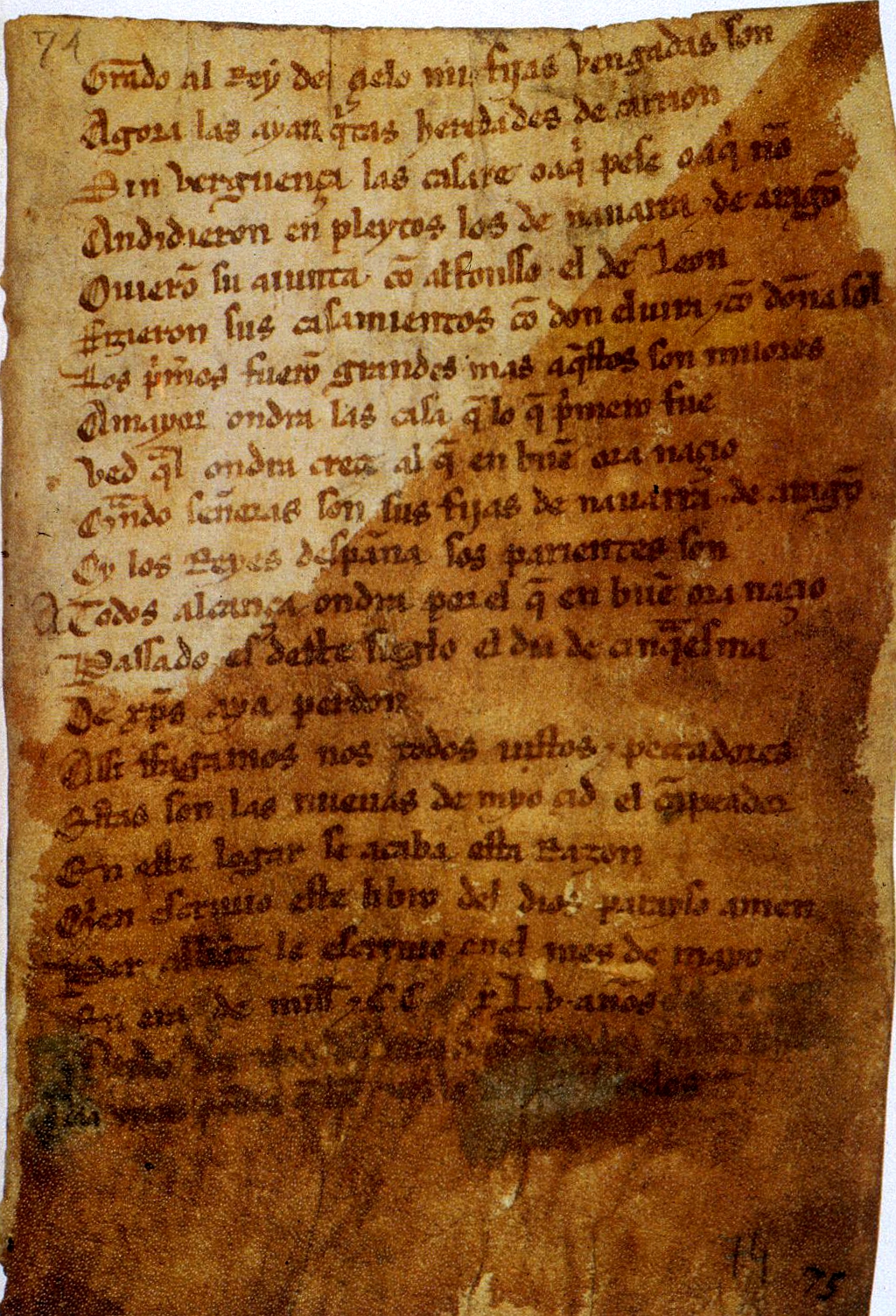
Historical development of the Spanish sibilants. Text is in Spanish; Roman numerals represent centuries AD.

In the 15th century, Spanish had developed a large number of sibilant phonemes: seven by some accounts,[2] eight by others[3] (depending on whether /d͡ʒ/ and /ʒ/ are considered contrasting), more than any current dialect. During the 16th and early 17th centuries these phonemes merged differently as they evolved into those of the different modern dialects.[4][5] There were four pairs of voiceless versus voiced sibilants: dental/alveolar affricates /t͡s/ vs. /d͡z/ (spelled ⟨c⟩ or ç vs. ⟨z⟩); dental/alveolar fricatives /s/ (spelled ⟨ss⟩ when intervocalic, ⟨s⟩ otherwise) vs. /z/ (intervocalic only, spelled ⟨s⟩); postalveolar affricates /t͡ʃ/ (spelled ⟨ch⟩) vs. /d͡ʒ/; and postalveolar fricatives /ʃ/ (spelled ⟨x⟩) vs. /ʒ/. Both /d͡ʒ/ and /ʒ/ were spelled ⟨g⟩ before ⟨e⟩ or ⟨i⟩, and ⟨j⟩ elsewhere. It is likely that /d͡ʒ/ deaffricated and merged with /ʒ/ before the year 1500.[6] The main difference between the prestige dialect of north central Spain and dialects to the south (such as Andalusian Spanish) was that, in the north, the dental/alveolar continuants were more retracted than the affricates (the former pair can be represented as /s̺/ and /z̺/ and the latter as /t͡s̪/ and /d͡z̪/),[clarification needed] keeping their phonemic distinction, while in the south they were homorganic.[7] The first step away from that system was the deaffrication of /d͡z̪/ in the first quarter of the 16th century. Because of a differing place of articulation, this still contrasted with /z̺/ in the prestige dialect of north central Spain, though it was a complete merger for southern dialects.[8]

Pronunciation Orthography
voiced affricate → fricative postalveolar ///ʒ/ ⟨g⟩ before ⟨e⟩, ⟨i⟩; ⟨j⟩ elsewhere
voiceless fricative /ʃ/ ⟨x⟩
voiceless affricate /t͡ʃ/ ⟨ch⟩
voiced fricative apicoalveolar // intervocalic ⟨s⟩
voiceless fricative // ⟨s⟩ in syllable onset or coda; ⟨ss⟩ between vowels
voiced affricate → fricative coronal /d͡z̪/// ⟨z⟩
voiceless affricate /t͡s̪/ ⟨c⟩ before ⟨e⟩, ⟨i⟩; ⟨ç⟩ before ⟨a⟩, ⟨o⟩, ⟨u⟩

The second step was the devoicing of voiced sibilants.[8] In the north, /z̺/ and /ʒ/ were lost, but /z̪/ remained contrastive with its new pronunciation /s̪/, because there had been no voiceless /s̪/ previously. This sound contrasted with two acoustically similar sounds: dentoalveolar /t͡s̪/ and apicoalveolar /s̺/. By 1600, /t͡s̪/, too, had deaffricated and merged with the earlier /s̪/ that had already developed from /z̪/.[8] Subsequent changes to the sound system of Spanish retained the contrasts while enhancing the segments by increasing articulatory distance amongst their rather subtle acoustic contrasts, an appropriate step due to the high productivity of these phonemes in differentiating frequently used minimal pairs. The dentoalveolar one was moved "forward" to interdental /θ̟/, losing its former sibilance in the process (which increased its acoustic distance to the remaining sibilant ⟨s⟩), and the prepalatal one was moved "backward" to velar /x/, also losing its former sibilance, all in all resulting in the three-way distinction of modern Standard Peninsular pronunciation:

Original 6-way contrast Deaffrication 1 Devoicing Deaffrication 2 Modern distinción Orthography
/d͡z̪//t͡s̪/ /z̪//t͡s̪/ /s̪//t͡s̪/ /s̪/ [θ̟] ⟨z⟩ or ⟨c⟩ (before ⟨e⟩, ⟨i⟩)
/z̺//s̺/ /s̺/ [s̺] ⟨s⟩
/ʒ//ʃ/ /ʃ/ [x] ⟨j⟩ or ⟨g⟩ (before ⟨e⟩, ⟨i⟩)

In the south, the devoicing process and deaffrication of /t͡s/ gave rise to new fricatives that were indistinguishable from the existing ones. The process of increasing articulatory distance still applied, however, and /ʃ/ retracted to /x/ in the south just as it did in the north.[4] In a number of ceceo areas (particularly the southernmost provinces like Cádiz) /s/ developed into a non-sibilant apico-dental [θ̺], perceptually similar to the interdental /θ̟/ used by Standard Peninsular speakers for orthographic ⟨c⟩/⟨z⟩. In seseo areas (particularly in the westernmost provinces like Seville and Huelva), the resulting phoneme developed a predorsal alveolar realization [s̻] (like English ⟨s⟩), perceptually similar to the apicoalveolar [s̺] used by Standard Peninsular speakers for orthographic ⟨s⟩. This seseo variety was the pronunciation that most impacted Latin America, as many emigrants to the Americas were from Andalusian and Canarian ports. In addition, several generations of Spanish speakers had lived and grown in the Americas before /θ/ appeared in Castilian.[9]

Original 6-way contrast Deaffrication 1 Devoicing Deaffrication 2 Modern seseo Modern ceceo Orthography
/d͡z//t͡s/ /z/ – /s/ + /ts/ /s//ts/ /s/ [s̻] [θ̺] ⟨z⟩, ⟨c⟩ (before ⟨e⟩, ⟨i⟩), ⟨s⟩
/z//s/
/ʒ//ʃ/ /ʃ/ [x] ⟨j⟩ or ⟨g⟩ (before ⟨e⟩, ⟨i⟩)

The development of the sibilants in Ladino (which split off from Castilian and other Peninsular varieties in the 15th century) was more conservative, resulting in a system closer to that of Portuguese.[10]

Distinction

[edit]

Distinction (Spanish: distinción) refers to the differentiated pronunciation of the two Spanish phonemes written ⟨s⟩ and ⟨z⟩ or ⟨c⟩ (only before ⟨e⟩ or ⟨i⟩, the so-called "soft" ⟨c⟩):

  1. ⟨s⟩ represents a voiceless alveolar sibilant /s/ (either laminal as in English, or apical);
  2. ⟨z⟩ and soft ⟨c⟩ represent a voiceless dental fricative /θ/ (the ⟨th⟩ in think).

By the early 1700s the six sibilant phonemes of medieval Spanish had all merged into three phonemes in the dialects with this distinction and two phonemes elsewhere, but spelling still reflected the older pronunciation system. From 1726 to 1815 the RAE reformed spelling, resulting in a modern Spanish orthography which reflects the system with distinction.[11] This distinction is universal in Central and Northern parts of Spain, except for some bilingual speakers of Catalan and Basque, according to Hualde (2005), as well as some bilingual speakers of Galician whose dialect has this trait (but not all).

In most of Spain, this distinction is between an apical [] and a dental [θ]. That said, in most regions of Andalusia which distinguish /s/ and /θ/, the distinction involves a laminal [s]. According to Penny (2000), the distinction between a laminal /s/ and /θ/ is native to most of Almería, eastern Granada, most of Jaén, and northern Huelva, while the distinction between an apical /s/ and /θ/, as found in the rest of Peninsular Spanish, is native to the very northeastern regions of Almería, Granada and Jaén, to northern Córdoba, not including the provincial capital, and to a small region of northern Huelva.[12]

Lack of distinction

[edit]
Most Peninsular Spanish dialects have [s]/[θ] contrast (distinción), while such contrast is absent in Latin America, the Philippines, the Canary Islands, and some parts of southern Spain (seseo/ceceo).[13]
Distinción in European Spanish

In most Spanish-speaking regions and countries the phonemic distinction between /s/ and /θ/ does not exist. These varieties of Spanish are sometimes said to exhibit neutralización ('neutralization') as opposed to distinción.

Seseo

[edit]

Seseo [seˈseo] is a lack of distinction between /s/ and /θ/ with both being realized as [s]. For example, the words casa ('house') and caza ('hunt') would be pronounced with the same [s] sound. This can result in ambiguity but can usually be interpreted depending on the context of which the sentence is spoken. Seseo is the most widespread pronunciation among Spanish speakers worldwide and occurs in nearly all speakers in Hispanic America. While it is a minority pronunciation in Spain itself, seseo is considered standard in all varieties of Latin American Spanish, as well as in the Philippines. It coexists with distinción and ceceo in parts of Spain (e.g. in the Canary Islands, much of Andalusia, historically in southern Murcia, western Badajoz, and the western coast of Galicia).[14][15] Traditional dialect atlases (e.g., Alvar (1991)) show one variant or another used in adjacent regions. In Spain, seseo is considered "more socially acceptable or perhaps 'less substandard' than ceceo".[16]

Ceceo

[edit]

Ceceo [θeˈθeo] (sometimes transcribed in English sources according to pronunciation as thetheo) is a phenomenon found in a few dialects of southern Spain in which /s/ and /θ/ are not distinguished and there is only one coronal fricative phoneme realized as the voiceless denti-alveolar sibilant [s̟], a sibilant sounding somewhat like [θ], but not identical.[17] Ceceo is found primarily in some varieties of Andalusian Spanish, and historically in two villages of southeastern Murcia.[18] That said, Hualde reports that there is some evidence of the phenomenon in parts of Central America. A publication of the University of Oviedo also notes that ceceo can be found in Argentina and Chile.[19] Other linguists have noticed the use of ceceo in parts of Puerto Rico, Honduras, and Venezuela.[20][21] A similar sound characterized as a "voiceless apico-or corono-post-dental slit fricative" has been observed in Nicaragua, El Salvador, Honduras, Colombia, Puerto Rico, and Venezuela;[22][23] In these places, ceceo is a largely rural pronunciation and is often stigmatized.[24]

In El Salvador, some speakers use a [θ]-like fricative in the syllable instead of the usual glottal [h], [s], or phonetic zero, rendering todos 'all' (plural) as [ˈtoðoθ], more usually pronounced [ˈtoðoh] or [ˈtoðo] (the latter homophonous with todo 'all' (singular)). Salvadoran Spanish occasionally weakens, but almost never completely deletes, /s/ in onset positions, and this [sᶿ] allophone is more common in onset positions than coda ones.[25] According to Brogan 2018, this is the result of a gestural undershoot. It is on an acoustic continuum between [s] and [h], representing an intermediate degree of lenition.[26] Brogan 2018 identifies this with the ceceo of Andalusian and other dialects.[27] The following table gives an example of the three pronunciation patterns discussed so far:

La casa ('the house') La caza ('the hunt')
Distinción /la ˈkasa/ /la ˈkaθa/
Seseo /la ˈkasa/
Ceceo /la ˈkas̟a/

Ceseo or seceo

[edit]

Many speakers of ceceo and seseo dialects in Spain show sociolinguistic variation in usage. In some cases, this variation may arise when a ceceo or seseo speaker more or less consciously attempts to use distinción in response to sociolinguistic pressure (hypercorrection). However, as, for instance, in the case of the variation between the standard velar nasal and alveolar pronunciation of the nasal in -ing in English (walking versus walkin'), the switching may be entirely unconscious. It is perhaps evidence of the saliency of three-way ceceo-seseo-distinción variation that inconsistent use has elicited evaluative comments by some traditional Spanish dialectologists. For instance, Dalbor (1980) discussed it as "sporadic or chaotic switching [between [s] and [θ]] and the use of intermediate sounds impossible to determine with precision".[28] Obaid (1973) proposes the synonymous terms ceseo [θeˈseo] and seceo [seˈθeo] to refer to these "mixed" patterns, and notes surprise at a speaker who produced all four possible pronunciations of Zaragoza ([θaɾaˈɣoθa], [saɾaˈɣosa], [θaɾaˈɣosa] and [saɾaˈɣoθa]) within the space of a few minutes.[29] In fact, sociolinguistic variation is typically highly structured in terms of how often each variant will appear given various social and linguistic independent variables. The Spanish spoken by the inhabitants of the Canary Islands is exclusively seseante, but exclusive seseo is quite rare in mainland Spain – even in areas, such as Seville, listed as being majority seseante.

See also

[edit]

References

[edit]

Sources

[edit]
[edit]
Revisions and contributorsEdit on WikipediaRead on Wikipedia
from Grokipedia
The phonological history of Spanish coronal fricatives traces the evolution of sounds articulated with the coronal region of the tongue, primarily the voiceless alveolar /s/ and interdental /θ/, from their complex medieval sibilant system through key processes like deaffrication, devoicing, and articulatory shifts, culminating in dialectal distinctions such as the Castilian distinción (preserving /s/ vs. /θ/) versus the widespread seseo merger (both realized as /s/) in Latin American and southern Iberian varieties. These fricatives emerged from Vulgar Latin's simpler /s/ and /z/, which expanded in early medieval Spanish into a richer inventory of six sibilants—including dental (/s/ /z/ from /ts/ /dz/), apico-alveolar (/S/ /Z/ from Latin /s/ /z/), and palato-alveolar (/ʃ/ /ʒ/ from /tʃ/ /dʒ/) series—due to orthographic distinctions reflecting affricate-fricative pairs. During the 13th–15th centuries, deaffrication transformed intervocalic affricates into fricatives across the , simplifying the coronal series while maintaining contrasts in place and voice, as evidenced in texts from and Toledo showing variable spellings for /dʒ/ and /z/. Devoicing followed in the 15th–16th centuries, starting in northern and central regions like Castile and spreading southward, neutralizing voiced /z/ and /Z/ to voiceless /s/ and /S/ due to low functional load and poor perceptual discriminability, with syllable-final positions losing voice contrast by around 1550. This period also saw early signs of merger in central areas, such as seseo in 14th-century Toledo documents and 15th-century texts, driven by dialect mixing during the . The late 15th to brought a pivotal in , where the palato-alveolar /ʃ/ velarized to /x/, and the dental /s/ shifted to interdental /θ/ to avoid merger with the apico-alveolar /S/, which remained /s/, establishing the modern coronal fricative contrast by the mid-16th century, as supported by orthographic evidence from Nebrija's 1503 and quantitative analysis of corpora. In southern dialects like Andalusian, however, dialectal koineization led to rapid reduction: coronal fricatives merged into a single /s/ (seseo) or /θ/ (ceceo) by the mid-16th century, with palato-alveolars further aspirating to /h/ or deleting by the 17th century, influencing Latin American Spanish through colonization. Today, the distinción remains prestigious in northern/central , while seseo dominates globally, reflecting ongoing sociolinguistic prestige dynamics.

Origins in Latin and Early Romance

Coronal Fricatives in Classical and Vulgar Latin

In Classical Latin, the phonological inventory included a single coronal fricative, the voiceless /s/, which was derived from Proto-Indo-European *s and retained its voiceless quality across all positions without developing voiced counterparts or interdental realizations like /θ/. This /s/ appeared frequently in initial (e.g., spirare 'to breathe'), medial (e.g., hostis 'enemy'), and final positions (e.g., est 'is'), often serving as a stem-final marker or case ending, and it assimilated predictably in clusters such as [sp], [st], or [sk] while remaining stable before voiced consonants in prefixes through historical loss rather than voicing. The absence of voiced coronal fricatives like /z/ or /ð/ reflected a broader pattern where obstruents were voiceless in adjacent positions, limiting the coronal series to stops /t, d/ and the fricative /s/, with /f/ as the sole non-coronal fricative. During the Vulgar Latin period (roughly 1st–5th centuries CE), innovations began to affect coronal sounds, though /s/ largely maintained its voiceless stability in most environments, as seen in words like sanus 'healthy', which preserved the original /s/ without alteration into early Romance forms. A key development was the palatalization of velars /k/ and /g/ before front vowels /e, i/ or the glide /j/, leading to alveolopalatal stops [c, ɟ] that often affricated to [ts, dz] in Western varieties, as evidenced by inscriptions from the 2nd–3rd centuries CE such as Prastetium for Praesetecium and tribunitiae for tribuniciae, indicating early /k/ → [ts] shifts. For instance, cena (/kēna/ 'dinner') underwent this change to [ts]ēna in Vulgar Latin, setting the stage for further evolution into affricates or fricatives in descendant languages, while these processes interacted with coronal /s/ in sequences like /ks/ or /sj/ to produce palatal fricatives [ʃ]. Additionally, intervocalic /s/ underwent voicing to in some contexts, particularly in Western Romance areas, as reconstructed from outcomes in early texts and inscriptions showing variable realizations. Evidence from 2nd–5th century inscriptions and peripheral texts, such as those reflecting simplified prefixed forms (e.g., dīmittere from dis-mittere), highlights /s/'s stability overall alongside emerging affricates, with no /θ/ emerging in coronal positions. These changes, documented in epigraphic records like Crescentsianus (2nd–3rd centuries), illustrate the gradual divergence from Classical norms during the Roman Empire's later phases.

Initial Developments in Ibero-Romance

The adaptation of Latin coronal sounds in early Ibero-Romance was shaped by pre-Roman substrates, including Celtic and Iberian languages, which influenced the retention of /s/ and the formation of affricates in . Celtic substrates, spoken by indigenous populations in northern and central Iberia, contributed to processes that preserved intervocalic voicing distinctions in , contrasting with stricter devoicing in other Romance areas. Iberian substrates in the east may have reinforced alveolar realizations, aiding the survival of coronal contrasts amid simplifications. These substrate effects are evident in early toponyms and loanwords, where sibilant retention avoided complete merger seen in Gallo-Romance. During the 5th-8th centuries, the evolution of /ts/ from palatalized /k/ and /g/ before front vowels proceeded variably in Ibero-Romance compared to other Romance branches. In , part of western Romània, velar palatalization produced affricates like /ts/, which simplified to fricatives or retained affricative quality, contrasting with Italo-Romance where it typically resulted in /tʃ/. Northern Ibero-Romance dialects, influenced by isolation, saw the emergence of dental affricates (/ts/, /dz/) as to later coronal systems, while central and southern varieties showed earlier deaffrication due to substrate mixing. This period's changes, documented in fragmentary Latin inscriptions from , highlight a divergence from eastern Romance, where palatalization was delayed or absent. Latin affricates served as to these developments. Mozarabic texts from the 8th-10th centuries provide evidence of early /s/ versus affricate contrasts in southern Ibero-Romance, reflecting substrate-influenced vernaculars under Arabic rule. In jarchas and liturgical fragments, orthographic distinctions like for /s/ and <ç> or for affricates (/ts/, /dz/) indicate preserved oppositions, such as in rhymes pairing sal (~ /s/) with forms derived from palatalized clusters. These contrasts persisted longer in Mozarabic than in northern dialects, aiding dialect mixing during the . The Basque substrate in northern likely reinforced coronal distinctions, with its three-way fricative system (laminal vs. apical alveolars) possibly stabilizing /s/-/θ/ precursors against merger. A key divergence occurred between proto-Castilian and Galician-Portuguese, where /ts/ simplified to /s/ earlier in the latter by the 8th-9th centuries, reflecting western substrate and geographic isolation. In Galician-Portuguese, affricates deaffricated rapidly to fricatives without retaining dental quality, as seen in early glosses, while Castilian maintained affricative stages into the due to Basque-influenced stability in the north. This early split set the stage for later Castilian coronal complexity.

Medieval Sibilant System

Old Spanish Sibilants

During the 9th to 13th centuries, the phonological system of , as spoken in the emerging Castilian dialect, included a rich inventory of seven or eight , encompassing both and that contrasted in voicing, , and place. This system derived from developments in the Ibero-Romance varieties, with distributed across dental, apico-alveolar, and palato-alveolar places of articulation. The inventory typically comprised the voiceless apico-alveolar /s̺/ and its voiced counterpart /z̺/, the voiceless dental /ts/ and voiced /dz/, the voiceless palato-alveolar /tʃ/ and voiced /dʒ/, and the voiceless palato-alveolar /ʃ/ (with /ʒ/ sometimes analyzed as a separate , yielding eight in total). These sounds played a crucial role in distinguishing lexical items, reflecting the phonological complexity of medieval Castilian before later simplifications. Among these, the coronal were particularly prominent, featuring the apico-alveolar /s̺/—which evolved directly from Latin /s/—and the dental /ts/, with deaffrication beginning to produce a dental [s̪] toward the end of this period in some contexts. The coronal segments contrasted in , with /s̺/ articulated with the tip raised toward the alveolar ridge and [s̪] involving a dental , allowing for phonemic distinctions such as between apico-alveolar and dental realizations. Voicing pairs further enriched the system, as voiceless /s̺/ and /ts/ opposed voiced /z̺/ (from intervocalic ) and /dz/, enabling contrasts like casa [ˈka s̺a] 'house' (with apico-alveolar) versus caça [ˈka t̪sa] or [ˈka s̪a] 'hunt' (with dental or emerging , though minimal pairs varied by ). This coronal subsystem bore a heavy functional load, supporting numerous minimal pairs and morphological alternations in the language. Evidence for these distinctions appears in early documents, such as the 10th-century Glosas Emilianenses, where orthographic variations—like the use of for apico-alveolar /s̺/ and <ç> or for dental or affricate sounds—indicate awareness of coronal contrasts among scribes. For instance, the word ciento (from Latin centum) was realized with an affricate /ts/ or emerging [s̪], reflected in spellings like <çiento>, while sino (from Latin sinō) featured the apico-alveolar /s̺/, spelled . Such examples from glosses and early poetry highlight how coronal sibilants maintained robust phonological oppositions, with rhymes and assonances in 12th- and 13th-century texts further confirming the voiced-voiceless and apical-dental distinctions before the onset of mergers in later periods.

Key Sound Changes Leading to Fricatives

During the 13th to 15th centuries, the Old Spanish system, which featured a rich of seven distinct sounds including affricates and fricatives, underwent significant simplification through several interconnected phonological processes that directly contributed to the emergence of coronal fricatives. These changes reduced the contrasts in place and manner of articulation, particularly among coronal segments, setting the stage for the modern realizations of /s/ and /θ/. A primary shift was the deaffrication of the coronal affricates /ts/ (from Latin -tt- and -c-) and /dz/ (from Latin -d- before front vowels), which lost their stop component to become fricatives, beginning in the mid-13th century in northern areas like Burgos and becoming more widespread by the 15th century. In many regions, /ts/ evolved into a dental [s̪], while the apico-alveolar [s̺] derived from Latin /s/; /dz/ simplified to a voiced dental [z̪] before further merger. This process was largely complete by the early 15th century in central areas like Castile, as evidenced by orthographic variations in texts such as the Alfonsine corpus, where spellings like <ç> and interchangeably represent these emerging fricatives. Regional divergences emerged prominently during this period, with northern Castilian dialects retaining a dental fricative [s̪] from /ts/, while southern varieties simplified it to alveolar . In the north, interdentalization of the dental fricative—a key innovation—did not take hold until the mid-16th century, transforming [s̪] into [θ] later on, as reflected in spelling reforms that increasingly distinguished from to capture the new articulation. Southern paths, influenced by Andalusian substrates, favored merger into , avoiding the interdental quality altogether. For voiced sibilants, depalatalization led to their merger or loss, with /dz/ often reducing to [z̪] in intervocalic positions before devoicing, further streamlining the coronal inventory. By the 15th century, texts like the Cancionero de Juan Alfonso de Baena (c. 1445–1454) show variable realizations of these fricatives, with inconsistent spellings indicating ongoing transitions and dialectal mixing. The Reconquista migrations, involving northward-to-southward population movements into repopulated territories like Toledo and , accelerated these changes by promoting dialect leveling and the diffusion of northern fricative traits southward. This interplay of internal phonological pressures and external demographic factors solidified the coronal fricatives' roles in the evolving Spanish system by the close of the medieval period.

Emergence of Modern Coronal Fricatives

Development of the Distinción

The development of the distinción, the phonemic contrast between /s/ and /θ/ in northern and central Spanish dialects, represents a key innovation in the phonological evolution of Castilian Spanish during the 16th century. This contrast arose in Old Castile as a result of a shift affecting the dental sibilant /s̪/, which had originated from the deaffrication of Latin /ts/ in preconsonantal and pre-palatal contexts (e.g., Latin caelum > Old Spanish çielo /s̪jelo/). By the early 1500s, this /s̪/ underwent dissibilation to the interdental fricative /θ/, while the apico-alveolar /S/ (from other sources, such as Latin /s/) remained distinct as /s/. This change created a new opposition where /θ/ derived from earlier affricates or palatalized sibilants before front vowels (/e, i/), contrasting with /s/ from non-palatal sources. The phonological rule governing the distinción can be summarized as follows: in Castilian dialects, the fricative /θ/ appears in words spelled with (before or ) or , while /s/ occurs in positions spelled with . For instance, casa (from Latin casa) evolved to /ˈka.sa/ with alveolar /s/, preserving the apico-alveolar realization from Latin /s/, whereas cielo (from Latin caelum) developed into /ˈθje.lo/ with interdental /θ/ from the earlier dental sibilant. This rule solidified the merger of voiced and voiceless sibilants into voiceless forms earlier in the century, followed by the articulatory shift in the dental series, completing the modern system by the mid-17th century in central Castile. Medieval deaffrication of affricates like /ts/ to sibilants served as a precursor to this innovation, setting the stage for the later fricative adjustment. Standardization of the distinción was reinforced through 18th- and early 19th-century orthographic reforms by the Real Academia Española (RAE), founded in 1713 to regulate the language. Initial proposals in 1726 and subsequent publications, including the 1741 Orthographía española and the definitive 1815 Ortografía de la lengua castellana, maintained the etymological distinctions in spelling (<c/z> vs. ) to align with the Castilian pronunciation, thereby enforcing the /θ/-/s/ contrast as the normative standard. These reforms prioritized the central Castilian variety, spreading its influence through education and printing. Variations in the realization of /θ/ emerged during this period, with apical (tip-of-tongue) articulations in rural northern areas contrasting with more laminal (blade-of-tongue) forms in urban centers, though both remained interdental fricatives. A persistent attributes the origin of /θ/ to a 14th-century speech impediment of King Peter I of Castile (r. 1350–1369), suggesting courtiers imitated his "" out of loyalty, but this is unfounded as the sound change occurred two centuries later as a natural phonological evolution unrelated to any individual.

Rise of Mergers in Southern Dialects

In the 15th and 16th centuries, southern Spanish dialects, particularly in , underwent significant phonological simplification of the coronal system inherited from , leading to the merger of the dental affricates /ts/ and /dz/ with the existing /s/ and /z/ . This process resulted in either a complete merger to the alveolar /s/ (proto-seseo), prevalent in urban centers like , or to the interdental /θ/ (proto-ceceo), more common in rural and coastal areas . The changes were driven primarily by internal mechanisms of simplification, such as the dissibilation of affricates into and auditory indeterminacy between and [θ], rather than substantial influence from the superstrate, which had minimal impact on evolution . An substrate may have contributed to articulatory relaxation, but the core developments stemmed from ongoing leveling of the medieval inventory . The merger in Andalusian varieties predated the retention of distinción in northern Castile, reflecting a trend toward phonemic reduction amid social mobility and dialect contact during the Reconquista's aftermath and the early modern period . Proto-seseo emerged through the replacement of apico-alveolar with a predorsodental or coronal variant, while proto-ceceo arose from the overgeneralization of dental realizations of affricates, extending /θ/ to former /s/ positions . By the early 16th century, these mergers were widespread in Andalusia, with Seville serving as a key hub due to its rising prestige as a port and cultural center during the Golden Age . Evidence for these changes appears in 16th-century texts from Seville, including spelling inconsistencies such as paço for passo or caza for casa, indicating uniform realization of coronal fricatives as /s/ or /θ/ . Contemporary observations, like Fray Juan de Córdoba's 1578 remarks on regional pronunciation variations, further attest to the established southern patterns . This Andalusian innovation spread via migration to the Americas, where seseo became dominant in colonial Spanish by the 1540s, as documented in texts like the 1578 Del arte en lengua zapoteca .

Types of Coronal Realizations

Seseo

Seseo refers to the phonological process in which the coronal s orthographically represented by ⟨c⟩ (before ⟨e⟩ or ⟨i⟩) and ⟨z⟩ merge with ⟨s⟩, resulting in a single alveolar realization, typically or the laminal [s̪], thereby neutralizing the phonemic contrast between /s/ and /θ/ found in distinción dialects. This merger eliminates distinctions in minimal pairs, such as casa 'house' and caza 'hunt', both pronounced as [ˈkasa]. In seseo varieties, the sound is generally a voiceless alveolar . Historically, seseo emerged in the in western and central , where it arose from the progressive weakening and merger of medieval , and it spread widely through the influence of Andalusian colonizers from ports like and between the 16th and 18th centuries. This dialectal feature became dominant across , reflecting the prestige of Andalusian speech during the colonial period, and it is also prevalent in the as well as eastern and rural areas of . Examples of seseo include gracias as [ˈɡɾasjas] and zapato as [saˈpato], where the initial coronal in the latter aligns with the alveolar of zapato. Sociolinguistically, seseo holds prestige status in Latin American Spanish, where it serves as the normative realization and is considered the standard across diverse national varieties, contributing to a unified pan-Hispanic identity in the . In Spain, however, its use is more variable, often marking southern regional identity in while contrasting with the northern distinción, though it lacks the same universal prestige on the .

Ceceo

Ceceo is a dialectal feature in characterized by the neutralization of the opposition between the alveolar /s/ and the interdental /θ/ in favor of a realization closer to [θ] or an advanced coronal such as [s̟] or [θ̺]. This merger affects all instances of the graphemes , (before or ), and , resulting in a uniform interdental or near-interdental articulation across these positions. For instance, the word ('yes') is pronounced [θí], and casa () becomes [ˈkaθa]. Articulatory variations in ceceo often involve laminal or apical tongue contact, producing a fricative that may range from a clear interdental [θ] to a more sibilant [s̟] with interdental qualities, depending on the speaker and context. Examples include sol ('sun') as [θol] and cielo ('sky') as [ˈθjelo], where the coronal fricative consistently adopts the interdental or advanced form regardless of etymological origin. This realization stems from historical sound changes in southern Ibero-Romance, where sibilants underwent devoicing and fricativization, leading to mergers like ceceo in specific regions. The core geographic distribution of ceceo is in western , particularly in provinces such as and , where it remains a hallmark of local speech in rural and semi-urban settings. Scattered rural pockets persist in parts of , including coastal areas of and regions in , reflecting early Andalusian colonial influence but often stigmatized and recessive. In these areas, ceceo is typically confined to informal, non-standard varieties and is less common in urban centers. Recent sociolinguistic studies indicate an urban decline in ceceo usage, with increasing adoption of distinción among younger, educated speakers in Andalusian cities due to dialect contact and . However, it persists in informal speech, particularly in rural contexts, with post-2020 research in areas like showing mixed production rates—around 55% in casual conversation but only 20% in formal reading—highlighting its resilience outside urban standardization pressures. This variability underscores ceceo's role as a marker of regional identity amid ongoing phonological shifts.

Ceseo and Other Variations

Ceseo, also termed seceo, denotes the variable pronunciation of Spanish coronal fricatives by individual speakers, who inconsistently alternate between the alveolar and dental [θ] realizations for orthographic and <c,z> (before or ), typically in a sociolinguistically conditioned or hypercorrect fashion rather than as a stable merger. This hybrid pattern arises from awareness of the prestigious distinción norm but incomplete adoption, leading to context-dependent shifts, such as [θ] in formal or emphatic speech and elsewhere. Unlike pure seseo or ceceo, ceseo reflects intra-speaker variability influenced by age, , , and setting, with younger, urban females more likely to approximate distinción intermittently. This realization predominates in the , where seseo forms the baseline but variable [θ] insertions occur due to peninsular influences, and in central and western , particularly around and , amid ongoing dialect leveling. varieties indirectly exhibit traces through Canarian migration, though full seseo prevails there, with occasional hypercorrect [θ] in educated speech. In transitional zones like , bordering , mixed distinción-seseo patterns emerge, with speakers blending norms based on social networks. Other less common variants include rare voiced coronal fricatives, such as intervocalic or [ð]-like realizations, preserved in isolated archaic or rural speech pockets, echoing voicing before modern devoicing. Twenty-first-century sociophonetic studies, including 2022 analyses of variation in European Spanish, highlight how in bilingual contexts—such as Spanish-English in Andalusian communities—amplifies ceseo-like instability, with articulatory adjustments favoring in informal bilingual exchanges.

Phonological and Sociolinguistic Aspects

Allophonic Variations and Processes

In Spanish dialects, the /s/ exhibits a range of allophonic realizations, particularly in coda positions, where it varies from the canonical to a lenited [s̝], [aspirated ], or complete [∅]. These variations are prominent in and Andalusian varieties, where aspiration and deletion occur frequently in syllable-final contexts, influenced by phonetic environment and social factors. In distinción dialects, /s/ is often realized as an apico-alveolar [s̺], especially in north-central , distinguishing it from the laminal [s̪] in other regions. Key phonological processes affecting /s/ include aspiration and lenition, most notably in word-final or preconsonantal positions. Aspiration typically transforms /s/ into , as in the progression from underlying [kas] to [kah] and ultimately [ka] in casual speech, a rule generalized as /s/ → / ___ (pause or consonant). Intervocalic lenition of /s/ occurs gradiently in some varieties, weakening it to a voiced or further to [s̝] or , particularly in Caribbean Spanish, where voicing and reduction are conditioned by adjacent vowels. In seseo dialects, where /s/ and /θ/ merge as /s/, these processes apply uniformly to the merged phoneme, enhancing variability without altering phonemic distinctions. For the phoneme /θ/ in distinción areas, allophonic variation is more constrained but includes degrees of frication, from a strong voiceless dental fricative [θ] to a weaker, approximant-like [θ̞] in intervocalic contexts, reflecting subtle lenition patterns. Realizations approaching are rare and context-specific, occasionally reported in transitional zones but not as standard allophones. Illustrative examples highlight these processes: in , the phrase "los amigos" is realized as [loh amiɣo], with word-final /s/ aspirated to and potentially elided in faster speech. In Castilian distinción varieties, /θ/ maintains clear frication in words like "casa" [ˈkaθa], but levels of frication can vary acoustically based on speech rate, with reduced intensity in lenited forms. Recent research on L2 acquisition underscores the complexity of these allophones; a 2024 study found that advanced English-speaking learners of Spanish in distinción contexts successfully approximate the apico-alveolar [s̺], often producing it with longer duration than natives, influenced by positive attitudes toward Castilian norms.

Dialectal Distribution and Standardization

The distinción, characterized by the phonemic contrast between /s/ and /θ/, predominates in central and northern . In contrast, seseo, where both sounds merge into an alveolar , is the norm across , as well as in the among remaining Spanish speakers, and in the . Ceceo, involving a merger realized as interdental [θ] for both, remains marginal globally, largely confined to rural areas of southern . Since its establishment in 1713, the Real Academia Española (RAE) has championed distinción as the prestige variety rooted in Castilian norms, influencing pronunciation standards in through dictionaries and guidelines. However, the RAE fully accepts seseo in orthographic conventions, recognizing its equivalence in representing the merged phoneme without requiring distinction in spelling for American and other seseo varieties. Media exposure, particularly through national broadcasting and international Spanish-language content, has reinforced distinción in formal contexts while exposing speakers to regional variations, contributing to ongoing phonetic accommodation. Sociolinguistically, ceceo carries significant stigma in , often associated with rural or lower-status speech and prompting educated Andalusian speakers to adopt distinción or seseo in formal settings to avoid . In the , seseo functions as a neutral, unmarked variant, aligning with the dominant regional identity and facing no comparable social penalties. Recent post-2020 trends indicate shifts toward mixed realizations in urban areas, driven by increased migration and , with some Andalusian communities splitting ceceo mergers toward distinción amid societal modernization. Despite these patterns, research gaps persist, particularly regarding limited data on potential ceceo-like realizations or resurgences in 2020s urban Latin American contexts, where rapid urbanization may foster hybrid variants; as of 2025, no significant documentation of such trends has emerged.

References

Add your contribution
Related Hubs
User Avatar
No comments yet.