Hubbry Logo
GododdinGododdinMain
Open search
Gododdin
Community hub
Gododdin
logo
8 pages, 0 posts
0 subscribers
Be the first to start a discussion here.
Gododdin
Gododdin
from Wikipedia

The Gododdin (Welsh pronunciation: [ɡɔˈdɔðɪn]) were a Brittonic people of north-eastern Britannia, the area known as the Hen Ogledd or Old North (modern south-east Scotland and north-east England), in the sub-Roman period. Descendants of the Votadini, they are best known as the subject of the 6th-century Welsh poem Y Gododdin, which memorialises the Battle of Catraeth and is attributed to Aneirin.

Key Information

The name Gododdin is the Modern Welsh form, but the name appeared in Old Welsh as Guotodin and derived from the tribal name Votadini recorded in Classical sources, such as in Greek texts from the Roman period.[1]

Kingdom

[edit]

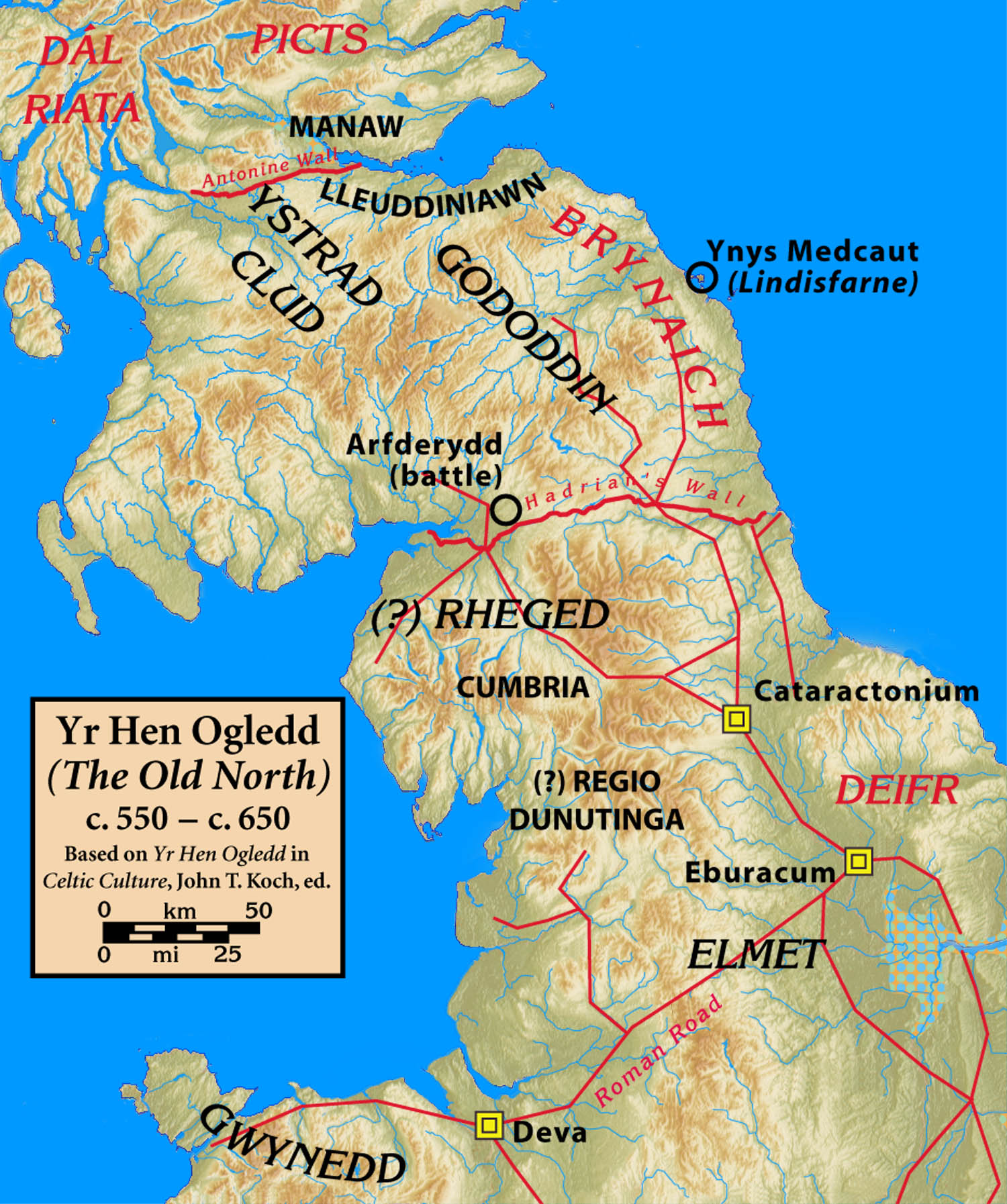
It is not known exactly how far the kingdom of the Gododdin extended, possibly from the Stirling area to the kingdom of Bryneich (Bernicia), and including what are now the Lothian and Borders regions of eastern Scotland. It was bounded to the west by the Brittonic Kingdom of Strathclyde, and to the north by the Picts. Those living around Clackmannanshire were known as the Manaw Gododdin.[2][3] According to tradition, local kings of this period lived at both Traprain Law and Din Eidyn (Edinburgh, whose English name is ultimately a calque, with the Old English -burh corresponding to the Welsh din; in Scottish Gaelic it is still known as Dùn Èideann), and probably also at Din Baer (Dunbar, Scottish Gaelic Dùn Bàrr). Gododdin included districts such as Manaw Gododdin and Eidyn south of the Firth of Forth.

Cunedda, legendary founder of the Kingdom of Gwynedd in north Wales, is supposed to have been a Manaw Gododdin warlord who migrated southwest during the 5th century.[4]

Later history

[edit]
Map of place-names between the Firth of Forth and the River Tees: in green, names probably containing Brittonic elements; in red and orange, names probably containing the Old English elements -ham and -ingaham respectively. Brittonic names lie mostly to the north of the Lammermuir and Moorfoot Hills and may reflect the territory of the Gododdin.[5]

In the 6th century, Bryneich was invaded by the Angles and became known as Bernicia. The Angles continued to press north. In around 600 the Gododdin raised a force of about 300 men to assault the Angle stronghold of Catraeth, perhaps Catterick, North Yorkshire. The battle, which ended disastrously for the Britons, was memorialised in the poem Y Gododdin.[6]

In 638, Eidyn, modern Edinburgh, was under siege and fell to the Angles,[7] for the Gododdin seem to have come under the rule of Bernicia around this time. To what extent the native population was replaced or assimilated is unknown. Bernicia became part of Northumbria.[8] Shortly afterwards this came under a unified England, then in 1018 Malcolm II brought the region as far as the River Tweed under Scottish rule.

See also

[edit]

Notes

[edit]

References

[edit]

Further reading

[edit]
[edit]
Revisions and contributorsEdit on WikipediaRead on Wikipedia
from Grokipedia
The Gododdin, also known as the or Guotodin, were a Brythonic Celtic people and kingdom located in the eastern coastal region of modern southern and northeastern , stretching from the to the River Tyne and centered around (including the area of present-day ). Known to the Romans from the AD, they came under direct Roman rule between 138 and 162 AD before serving as a between and the , gaining independence in the post-Roman era around the late . The kingdom's is illuminated primarily through the early medieval Welsh poem , attributed to the and composed around 600 CE, which commemorates a disastrous defeat at the (near modern Catterick, ) circa 597 CE, where a coalition of Gododdin warriors, alongside and other , clashed with invading Angles. This battle, detailed in a series of elegies in the poem, marked a pivotal decline for the Gododdin, leading to their eventual conquest by Northumbrian Angles in 638 CE with the fall of their capital, Din (). Key rulers of the Gododdin included Lot (c. 470–490 CE), the first independent king after breaking from influences like the kingdom of Alt Clut; his son (c. 490–510 CE), a semi-legendary figure; and later Morcant Bulc (c. 560–590 CE), and Mynyddog Mwynfawr (fl. c. 597 CE), who led forces at Catraeth. The , preserved in the 13th-century Book of Aneirin manuscript but originating from oral traditions in , stands as the earliest surviving Welsh poem and offers vivid insights into the culture, heroic ethos, and linguistic heritage of the Brittonic north. It describes 300 elite s feasting at before their ill-fated campaign, emphasizing themes of bravery, loyalty, and sacrifice amid the broader Saxon invasions that fragmented post-Roman British kingdoms. The Gododdin's legacy endures in , with possible Arthurian echoes in the poem—such as a comparing a to —highlighting their role in the cultural memory of Celtic resistance against Anglo-Saxon expansion.

Name and Etymology

Tribal Origins

The Votadini were a Brittonic Celtic tribe documented in the 2nd century AD by the geographer Claudius Ptolemy in his Geographia, where they are listed as one of the peoples inhabiting northern Britannia. Ptolemy positions their territory between the River Tyne in the south and the Firth of Forth in the north, encompassing much of what is now northeastern England and southeastern Scotland. This placement aligns with their role as a coastal and lowland group, distinct from more upland tribes like the Selgovae to the west. Additional Roman sources corroborate the 's territorial extent in northeastern . The , a 3rd-century AD road register, includes place-names within their domain, such as stations along routes traversing from the Tyne to the Forth, indicating Roman administrative recognition of the region. Similarly, the late 7th-century lists over a dozen sites in the area, including Oleaclauis near the mouth of the River Tweed, associated with late Roman military enclosures and pottery finds that reflect ongoing Roman interaction with Votadini lands. These documents collectively affirm the tribe's control over a strategic east of the , favorable for trade and defense. In the , the functioned as , allied troops supporting the Roman administration against northern threats, a status evidenced by the absence of major Roman garrisons in their core territories east of . Their principal at in served as a key center during this period, occupied from the 2nd to 4th centuries with abundant Roman imports including metalwork, , and coins that point to a pro-Roman elite dynasty. Archaeological hints and later Roman references further suggest their role as or formal allies, maintaining stability in the frontier zone. This partnership transitioned into the sub-Roman era, facilitating the tribe's evolution into an independent kingdom.

Linguistic Evolution

The name "Gododdin" evolved from the Latin "Votadini," the designation used by Roman sources such as Ptolemy's Geography for a Brittonic tribe in northern Britain. This tribal name likely derives from a Proto-Celtic root *wo-tādo-, related to an Indo-European term meaning "to stand," possibly denoting "foundation" or "support," and may have originated as an epithet for an ancestral figure whose followers adopted it. In the transition from to , the name underwent phonetic changes, including the loss of the initial /v/ sound (reflected as "Votadini" in Latin) to /w/ in early forms like *Wotadini or *Wotodin, and subsequently to /gw/ or /g/ yielding "Guotodin" by the 5th–7th centuries. This shift aligns with broader Brythonic sound changes where initial /w/ before vowels often became /gw/ in Welsh, as seen in other place and tribal names. By , further and simplification produced "Gododdin," the form used in modern Welsh to refer to the people or their territory. Variations appear in early medieval sources: the 7th-century poem employs "Gododdin" (or close orthographic equivalents like "Godoðin") to describe the warriors of the kingdom, while 9th-century texts such as the record "Guotodin" in the phrase "Manau Guotodin," distinguishing a northern coastal subgroup associated with the Votadini's descendants. The term "" (or "Manau Gododdin") similarly combines "Manaw" (possibly from a Brittonic root for the region) with "Gododdin," denoting this coastal extension of the core territory. These forms reflect ongoing orthographic fluidity in Welsh manuscripts before standardization.

Geography

Location and Extent

The Gododdin kingdom, part of the broader Hen Ogledd or Old North, occupied a core territory in what is now southeast Scotland and northeast England during its peak in the early medieval period. This region primarily encompassed the (East, Mid, and West), , and parts of , with its heartland centered on the coastal plains and river valleys of . The kingdom's boundaries were defined by natural features: to the north by the , providing a maritime limit adjacent to Pictish territories; to the south by the River Tyne, marking a transitional zone toward emerging Anglo-Saxon influences; to the west by the Pennine foothills and upland areas associated with neighboring Brittonic groups like the ; and to the east by the coast, facilitating connectivity. Archaeological and textual evidence suggests the kingdom's extent may have extended westward toward and the Basin, incorporating up to the Gargunnock , and southward into Teviotdale and the upper basin, though these margins were fluid due to political pressures. This geographical scope evolved from the earlier and Roman-era lands of the tribe, whose core settlements in and formed the foundation for the post-Roman Gododdin polity. Estimates of territorial size are approximate, but the region spanned roughly from the southward to the River Tyne, covering diverse topographies including the Merse plain and . The environmental context supported a , with fertile lowlands in the coastal plain and basin ideal for , as evidenced by field systems and crop-mark sites identified through . Coastal access along the and enabled trade, reflected in imported goods found at high-status sites like , a major serving as an earlier tribal center. Defensive hillforts and promontory forts, such as those at and in the Lammermuirs, capitalized on the uplands for strategic oversight, underscoring the kingdom's reliance on elevated terrain amid regional instabilities.

Key Settlements and Sites

Din Eidyn, modern Edinburgh's Castle Rock, served as the probable capital of the Gododdin kingdom, functioning as a fortified hillfort with evidence of continuous occupation from the Iron Age through the sub-Roman period. Archaeological investigations have revealed defensive ditches up to 13 meters wide and over 10.7 meters deep, alongside Roman-era artifacts such as a Trumpet Brooch and a Dragonesque Brooch, suggesting high-status activity and Brittonic cultural persistence into the early medieval era. Buried deposits from the 2nd to 11th centuries, including potential middens, indicate ongoing settlement that aligns with the Gododdin's political center. Traprain Law, a prominent hillfort in East Lothian, represents an earlier major center for the Gododdin, likely their initial capital before the shift to Din Eidyn in the 5th century. Covering approximately 16 hectares at its peak, the site shows occupation from the Bronze Age onward, with extensive ramparts and evidence of a substantial settlement that supported political and economic functions. The 1919 discovery of the Traprain Law Treasure—a hoard of over 1,000 late Roman silver items, including hacked plates and vessels—highlights the site's wealth and connections to Roman Britain, underscoring Brittonic elite continuity through post-Roman adaptation of such materials. Dunbar, known anciently as Din Baer, emerged as a key coastal stronghold for the Gododdin, leveraging its promontory position for defense and maritime access. Excavations at Castle Park have uncovered a Roman-era promontory fort that transitioned into an early historic settlement, featuring 7th-century timber buildings, a Grubenhaus weaving shed with loomweights, and an 8th-century stone hall, all pointing to organized community and craft activities. High-status finds like a gold and garnet cross-pendant and bone tools further illustrate the site's strategic and cultural role within the Gododdin territory. Catterick in stands as a potential site for Catraeth, a location associated with Gododdin military endeavors, though direct archaeological ties remain limited. The area's Roman heritage, including the fort of Cataractonium, suggests it lay on the periphery of Gododdin influence, with Brittonic place-name elements indicating cultural overlap. Across these sites, archaeological evidence such as penannular brooches, hand-built pottery, and adapted Roman silverware demonstrates Brittonic continuity from the into the early medieval period, reflecting the Gododdin's adaptation of pre-existing structures and materials for their post-Roman society.

History

Formation in the Sub-Roman Period

Following the Roman withdrawal from Britain around 410 AD, the , a Brittonic tribe that had served as allies to the Romans in safeguarding the northern frontier against incursions from the , transitioned into the independent kingdom of Gododdin during the sub-Roman period of the 4th and 5th centuries. This evolution took place amid a widespread in post-Roman Britain, where centralized imperial authority collapsed, allowing tribal groups to assert over their territories stretching from the southward to the River Tyne. Archaeological evidence, such as the refortification of the major at around 400 AD—with extensive ramparts enclosing a reduced summit area—demonstrates this political consolidation and the continuity of defensive traditions into the sub-Roman era. Historical records for early Gododdin leadership remain sparse, relying on later traditions and inferences from archaeological and toponymic evidence rather than contemporary accounts. In later traditions, the first named post-Roman ruler is the semi-legendary Lot (Lleu), associated with a reign around 470 AD in Arthurian lore, though historical evidence is lacking. These sites not only served defensive purposes but also symbolized elite control, with ongoing occupation reflecting a warrior-based society that bridged pre-Roman tribal organization and emerging early medieval kingdoms. The Gododdin kingdom navigated its formative years through strategic interactions with neighboring powers, including alliances with the to the north and the Brittonic (Alt Clut) to the west, which helped secure its position in the unstable post-Roman landscape. These relationships, rooted in shared Brittonic cultural ties and mutual defense needs, are inferred from later confederations and regional dynamics, such as joint resistance efforts against external threats. Simultaneously, the Gododdin faced mounting pressures from Anglo-Saxon migrant groups advancing northward in the late , particularly in the southern fringes of their territory near the , foreshadowing intensified conflicts in subsequent periods.

The Battle of Catraeth

The , known primarily from the poem and dated around 600 AD by tradition, is debated among scholars for its , with no corroborating contemporary records, but is generally accepted as representing a major British counteroffensive against the expanding Anglo-Saxon kingdom of . Led by Mynyddog Mwynfawr, of Gododdin, the expedition involved an elite force of approximately 300 warriors drawn primarily from Gododdin territory around Din Eidyn (modern ), supplemented by allies from neighboring British regions such as and possibly further afield. This raid targeted Catraeth, identified as Catterick in northern , a strategic Anglo-Saxon outpost amid their southward push into former British lands. In preparation, the warriors feasted for a full year at Mynyddog's stronghold in , consuming that fueled their heroic resolve and bound them in oaths of valor. The force then marched south over rugged terrain to launch a surprise assault on Bernician holdings. emphasized the prowess of these elite fighters, who employed a mix of charges with spears and swords in disciplined formations, alongside elements of skirmishing using javelins for hit-and-run maneuvers—hallmarks of late sub-Roman British warfare. No specific leader names beyond Mynyddog survive in historical records outside poetic allusions, underscoring the battle's reliance on collective heroism rather than individual command. The engagement resulted in catastrophic losses for the British coalition, with nearly all 300–360 warriors slain, leaving only one reported survivor to carry tales of the defeat. This strategic failure decimated Gododdin's military capacity, yet the heavy toll on Bernician forces provided a temporary respite from further Anglo-Saxon incursions into the north. The event's elegiac accounts in the poem immortalize the fallen as paragons of mead-inspired bravery, though fuller literary analysis appears elsewhere.

Conquest by Anglo-Saxons

The conquest of Gododdin by forces from the kingdom of represented the culmination of mounting pressures on the British realm, including the devastating losses at the earlier in the . In 638 AD, King Oswald of led or oversaw the siege of Din Eidyn, the fortified heartland of Gododdin located at modern-day , resulting in its fall and the effective loss of the kingdom's core territories. This event, recorded in the as the "siege of Etin," marked a pivotal shift, as Din Eidyn's strategic position atop made it a formidable stronghold, likely surrendering under prolonged pressure rather than through direct assault. Following the capture of Din Eidyn, Bernician expansion continued apace, with Gododdin lands being progressively annexed and integrated into the Anglo-Saxon polity by the 650s AD. brother and successor, , who ascended after death in 642 AD, played a key role in consolidating this control, extending Bernician influence northward and securing the former Gododdin territories against residual British resistance. British elites in these regions may have faced displacement to more westerly areas or gradual assimilation into the emerging Northumbrian , though direct evidence for their fates remains sparse. Archaeological findings support the narrative of Anglo-Saxon consolidation, revealing evidence of 7th-century settlements in the region, including timber halls and sunken-featured buildings (grubenhäuser) indicative of Bernician occupation at sites like . These structures reflect the establishment of administrative and economic outposts, underscoring the transformative impact of Oswald and Oswiu's campaigns on the cultural landscape of what had been Gododdin.

Integration into Scotland

By the 9th and 10th centuries, Northumbrian control over the former Gododdin territories in had significantly waned, exacerbated by intensified Scandinavian raids and settlements that fragmented the region. Danish forces established dominance in , while the Northumbrian dynasty at maintained only nominal authority over and the Borders, leaving the area vulnerable to incursions from Alba (the emerging Scottish kingdom), (), and a consolidating . Amid this instability, remnants of the Brittonic-speaking population associated with Gododdin may have sought refuge in neighboring Brittonic strongholds such as to the west or even further south in , though direct evidence for such migrations remains limited and based on broader patterns of displacement in the Hen Ogledd. The decisive shift occurred in 1018 at the on the , where Malcolm II of Alba, allied with Owain the Bald of , defeated Northumbrian forces led by Eadwulf Cudel. This victory marked the effective end of the Bamburgh dynasty's influence and facilitated the conquest of up to the , incorporating the core of former Gododdin lands into the Kingdom of Scotland. The battle not only reduced Cumbrian () claims but also solidified Scottish expansion southward, with thereafter under the rule of Scottish kings, though it retained distinct regional identities as "Lothian" and even "" in some contexts into the 13th century. In the long term, the political entity of Gododdin fully dissolved under Scottish integration, with no evidence of a distinct revival or autonomous governance. Brittonic cultural traces endured through place names—such as (from Din , "fort of ") and —and elements of preserved in later medieval traditions, reflecting the enduring legacy of the region's pre-Scottish heritage amid Gaelic and Anglo-Norman influences.

Literature and Culture

The Y Gododdin Poem

The Y Gododdin is a medieval Welsh poem attributed to the bard Aneirin, who is said to have composed it around 600 AD in Old Welsh or early Brythonic following the Battle of Catraeth, where he purportedly survived as one of the few witnesses. The work serves as an elegiac commemoration of the Gododdin warriors' heroic but doomed expedition, drawing on oral traditions of the post-Roman Brythonic kingdoms. The poem survives in a single manuscript, the Book of Aneirin (Llyfr Aneirin), a 13th-century compiled in around 1250–1300 and now held at the . This manuscript contains two versions of the text (A and B), copied by different scribes, with the A version preserving what scholars consider the more archaic form and the B version showing later interpolations or variants. The document includes a rubric explicitly crediting with the composition, though modern analysis suggests the core may date to the late with possible expansions up to the 7th century. Structurally, consists of approximately 90 stanzas forming a series of elegies for around 300 named or alluded-to warriors, each praising their valor, lineage, and feats in the battle through vivid, hyperbolic descriptions. The verse employs alliterative patterns for rhythmic emphasis, as seen in lines like "twrf tân a tharan a rhyferthi" evoking the clamor of , and draws on kennings—compound metaphors common in early Celtic poetry—such as "battlehounds" for warriors or "bull of " to denote ferocity. This modular form, akin to listing devices in other Celtic literatures, builds a collective portrait of excellence while lamenting the warriors' sacrifice after a year of feasting at the court of their lord, Mynyddawg Mwynfawr. One stanza provides the earliest surviving reference to Arthur in Welsh literature, comparing a hero named Gwawrddur unfavorably: "He fed black ravens on the ramparts of a fortress, though he was no ," implying Arthur's renown as a benchmark for prowess by the time of composition.

Depictions of Society

The society of Gododdin, as depicted primarily in the poem , centered on a warrior elite bound by a heroic code that prized martial prowess, loyalty to kin and territory, and reckless bravery in battle. Warriors were portrayed as an aristocratic class, equipped with horses, ornate armor, and gold-torqued adornments, forming retinues that exemplified status through equestrian skill and combat ferocity. Feasting halls served as key social institutions, where leaders like Mynyddog Mwynfawr hosted lavish year-long banquets to prepare and obligate warriors for expeditions, fostering bonds through communal indulgence. Mead-drinking rituals were ritualistic elements of these gatherings, symbolizing honor and debt; warriors were eulogized for their capacity to consume without excess, reinforcing ideals of restraint amid valor. The economy and daily life of Gododdin appear rooted in an agrarian foundation, with cattle herding and supporting a tribal structure amid post-Roman transitions in northern Britain. in lingering Roman-era goods, such as imported metals or ceramics, likely persisted in limited networks, supplementing local production, though the poem emphasizes warfare and plunder as primary wealth generators rather than . Evidence for or rigid class divisions is scant, suggesting a relatively fluid dominated by noble warriors and their dependents, with daily existence oriented toward subsistence farming and military readiness. Gender roles in Gododdin sources reflect a male-dominated warrior culture, with women mentioned only peripherally in the poetry, often in passing as objects of affection or symbols of loss rather than active participants. By the 6th century, implicit Christian influences permeated the society, as seen in references to heavenly rewards for the fallen, indicating a shift from earlier pagan elements toward a Brittonic Christianity integrated with heroic traditions. Lingering pagan motifs, such as oaths to tribal ancestors, may have coexisted, but the poem's eulogies align more closely with Christian notions of eternal dwelling places.

Legacy

In Medieval Welsh Tradition

In medieval Welsh literary tradition, the kingdom of Gododdin played a central role in narratives of the Hen Ogledd, or "Old North," representing the lost Brythonic realms north of the Humber-Mersey line that were romanticized as exemplars of heroic resistance against Anglo-Saxon incursions. , the early elegiac poem commemorating the , stood as a foundational text in this corpus, paralleling the prophetic and battle poems attributed to , such as those praising Urien of , to form a cohesive body of "Cynfeirdd" (early poets) verse that evoked a shared Brittonic identity and martial ethos. These works were revered in Welsh courts as symbols of ancestral valor, influencing the development of cywydd and later praise poetry by embedding motifs of feasting, warfare, and elegy into the national literary imagination. During the 9th to 12th centuries, traditions surrounding Gododdin were actively preserved and adapted in the princely courts of , particularly and , where oral recitation by bards maintained the poem's archaic language and structure amid a shifting political landscape. Allusions to Gododdin appear in the , such as Triad 31, which names the retinue of Mynyddawg Mwynfawr at Catraeth as one of the "Three Noble s of the Island of Britain," and references heroes like Gwawrddur Hirflach and Cynon of Gododdin as exemplary fighters. Welsh genealogies further integrated Gododdin into southern identities, tracing the lineage of 's rulers back to , a semi-legendary figure originating from Manau Gododdin, thereby claiming heroic descent to legitimize territorial claims and cultural continuity. Gododdin's literary legacy intertwined with those of neighboring Brittonic kingdoms like (Ystrad Clud) and through shared exile motifs in Welsh poetry, where northern heroes were recast as archetypes of lost sovereignty. Common themes—such as the mead-hall banquet before doomed battles and the lament for fallen lords—link to elegies for figures like Eugein of and the Rheged warlord Urien, preserved in the same manuscript traditions and recited to evoke a pan-Brittonic . This cross-kingdom resonance reinforced Gododdin's place in medieval Welsh identity as a bridge between northern exile lore and southern resilience.

Archaeological and Modern Scholarship

The discovery of the Traprain Law silver hoard in 1919 provided crucial evidence of sustained interactions between the Votadini, the Brittonic people ancestral to the , and the late Roman world. Unearthed during excavations at the of in , the hoard consists of over 160 fragments of high-quality Roman silver , mostly hacked into pieces for or redistribution, dating primarily to the 4th and early 5th centuries AD. Scholars interpret this as likely a diplomatic gift or payment from Roman authorities to secure the Votadini's alliance against northern threats, highlighting economic and cultural ties in the sub-Roman period. More recent archaeological work at , a key coastal site associated with Gododdin territory, has illuminated 7th-century societal transitions. Excavations at Castle Park between 1988 and 1991 uncovered stratified remains of an early historic , including timber halls, debris, and imported goods indicative of elite occupation from the 6th to 7th centuries. These findings reveal a shift from Brittonic to Anglian around the mid-7th century, coinciding with the historical of Gododdin lands by Northumbrian forces, as evidenced by the appearance of Anglo-Saxon style artifacts like brooches. Modern scholarship on the Gododdin has centered on debates over the dating and historical context of the poem Y Gododdin, the primary literary source for the kingdom, including questions about its unity and potential composite authorship from multiple poets over time. Traditional views, advanced by linguists like Kenneth Jackson, date the core poem to the late 6th or early 7th century AD, composed shortly after the Battle of Catraeth as a contemporary elegy by the bard Aneirin. In contrast, John T. Koch proposes an earlier origin, arguing on linguistic grounds—including archaic Brythonic features and loanwords—that the poem's composition began in the mid-6th century or possibly the late 5th, reflecting a sub-Roman heroic tradition rather than a post-Anglian lament. The identification of the Battle of Catraeth's location has also sparked discussion, with a scholarly consensus favoring Catterick (ancient Cataractonium) in as the site. This view stems from phonetic correspondences between "Catraeth" and the Latin place-name, supported by historical evidence of Deiran Anglo-Saxon control there by the late , positioning it as a plausible frontier clash site for Gododdin warriors. Alternative proposals, such as sites in southern , have been largely dismissed due to mismatches in and . Despite these advances, significant gaps persist in the for Gododdin-specific evidence, notably the scarcity of inscriptions or monumental artifacts directly attributable to the kingdom. Unlike contemporary regions like or southwest Britain, which yield stones and Latin dedications from the 5th–7th centuries, the Gododdin heartland lacks such , limiting direct insights into , elites, and identity. This absence underscores reliance on indirect proxies like imported goods and settlement patterns. Ongoing research employing (aDNA) and is addressing these voids by tracing in early medieval northern Britain, with updates through 2025 revealing nuanced migration patterns in Gododdin territories. A high-resolution genomic study of 1,556 individuals from early medieval indicates substantial mobility from the 5th to 8th centuries, with evidence of between local Iron Age-descended Britons and incoming groups from and Anglo-Saxon England. data from 6th–7th century burials in the Lothians, such as at , further suggest diverse origins for inhabitants, including possible elite influxes and non-local individuals, challenging notions of abrupt population replacement during the Anglo-Saxon conquest.

References

Add your contribution
Related Hubs
User Avatar
No comments yet.