Recent from talks
Nothing was collected or created yet.
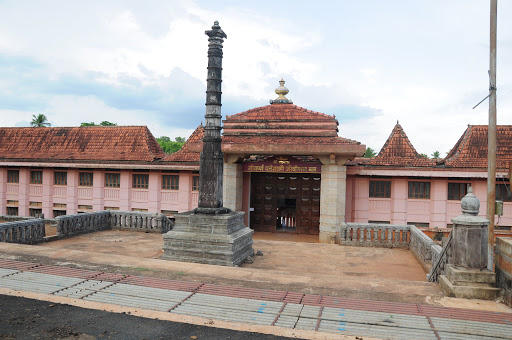
Gokarna Math
View on Wikipedia
Shree Samsthana Gokarn Partagali Jeevottam Math or Partagali Math ( also known as Gokarna Matha, Partagali Jivottama Math) is the first Gaud Saraswat Mathas of the Dvaita order, a system established by Jagadguru Madhvacharya in the 13th century AD. This matha also called Partagali Jivottama and is headquartered in Partagali, a small town in South Goa, on the banks of the river Kushavati.[1]
Key Information
There is still ongoing research to establish who exactly founded the math and when exactly it was founded. As per historic lore it is said that it was initiated by Shri Raghuthama Theertharu (Bhavabodharu) of Uttaradi Matha. Shri Raghuttama Tirtha (also known as Raghuttama Yati) (Śrī Raghūttama Tīrtha, (c. 1537 - c. 1596)[2] was a Hindu philosopher, dialectician, scholar, theologian and saint. Born in an aristocratic Deshastha Brahmin family, he was brought up in mutt under the direction of Raghuvarya Tirtha. HIs Brindavan or the final resting place in Tirukoilur, Tamil nadu attracts followers from wide afar.
It is also said that this matha was formed after it split away from Palimar at Udupi initiated by Shimad Ananda Theertharu (Madhvacharya).
The first pontiff of the matha was Narayanatirtha. Shri Narayana Theertharu was a great scholar of the Dvaita order and earned the name "Shri Paada Wodayaru", for which he is still known today. The math became well known as Jivottama Matha after the third pontiff, Jivottama Tirthar. The deity worshiped by the institution is Shri Veera MoolaRama devaru and Shri Veeravittala devaru
During the late 1950s, Shri Dwarakanatha Theertharu established several educational institutions and republished several seminal works.
This math was also a victim of Portuguese Christian missionary activities that drove the original establishment from Madgao to Bhatkal in Karnataka and Karwar District in Karnataka.
History
[edit]In the true sense, establishment of Shree Mutt renowned as the Shree Samsthan Gokarn Partagali Jeevottam Mutt coincidentally took place in the Himalayas at Badrikashram on Chaitra Shukla 2, saka 1397 (1475 A.D.)
Shree Madhvacharya had established Ashtamuttas (eight mutts) at Udupi to disseminate the Dvaita philosophy of the Madhva sect. Of these eight, one was the Palimaru Math. The Saraswat community spread along the Western Coast of India, following the philosophy of the Vaishnava sect had accepted the spiritual guidance of this Palimaru Math.
The tenth Acharya of the Palimaru Math Shree Ramchandra Teerth, while on a pilgrimage to the Himalayas accompanied by his entourage, was taken seriously ill. The place being inaccessible and remote from Udupi, it was not possible to establish any contact with the headquarters of the Mutt at Udupi. Fearing that the lineage of the Acharyas of the Mutt may be severed in case he breathes his last at the feet of Lord Narayan, and the tradition of the Mutt would be curtailed, as an alternative arrangement he ritually conferred the discipleship on an eligible Saraswat bhrahmachari (celibate bachelor). Having thus initiated him into the Mutt tradition by giving diksha and having bestowed the name of Shree Narayan Teerth on him, the Guruswami advised him to return to Udupi after duly completing his pilgrimage.
After being duly initiated into renunciation, Shree Narayan Teerth resolved to complete his pilgrimage to the sacred spots and shrines of North India. Thus moving from places of pilgrimage such as Kurukshetra and Brahmavarta to Brahmahruda, he finally arrived at the world-renowned pilgrim centre of Varanasi. This ancient land of Vaishnavas is considered as the abode of rest of Lord Madhava.
The holy month of Kartik had drawn near and the Swamiji was aware of the extraordinary significance of the sacred dip at the Panchaganga ghat at this auspicious time. In fact, it has been mentioned in the Ramayana that Lord Ram had made a year-long sojourn at Varanasi on the way to his vanavas (disbandment).
It so happened that, during the very month of Kartik, the princess of Kashi (Varanasi), along with her companions arrived at the ghat for the gangasnaan (holy bath). As had been her practice, she kept her ornaments on the bank over the clothes and dipped into the water. But due to the extreme cold, she began to shiver and quickly rushing for dry clothes on the shore and pulled them on.
Having completed their bath, as the entire troupe was about to return to the palace, it was discovered that the diamond studded bangle of the princess was lost. But where could it go? Who could have dared to steal the bangle of the princess? An intense search was launched but to no avail.
An hermit was seen engaged in japa anushtthan (ritual of chant-worship) at one corner of the ghat. Many had seen this alien sannyasin (ascetic) there. Although there was a hue and cry over the lost ornament of the princess, it had not disturbed the Concentration of the hermit engrossed in his worship. However, the soldiers disturbed his meditation and accosted him with their suspicion. His reply was spontaneous and forthright:
"We are ascetics who have renounced the world. What enticement could wealth and ornaments hold for the like of us? When we don't even covet a square meal a day, why would we turn traitors to our own belief of non-accumulation and astheya vrata (nonsteaking) ?"
Although Shree Narayan Teerth was unmoved by the accusation, the soldiers refused to be dissuaded by his candid speech and searched him. But they were crestfallen when they found nothing on his person!
There was no iota of doubt left about the innocence of Shree Narayan Teerth, when the waters of the river receded the bangle was discovered in the shallow riverbed near the bank.
The royal family sought forgiveness of Shree Narayan Teerth. The King of Kashi heard that an innocent sanyasin had been harassed by the royal household. He Was deeply disturbed. He felt that he had to seek personal forgiveness for his high handedness of the royalty. Coming to the Panchaganga ghat, he fell at the feel of Shree Narayan Teerth.
"We are ashamed of what has come to pass. Swamiji may kindly forgive us." The King prayed.
Shree Narayan Teerth replied, "Oh Royal Prince' In your kingdom dharma and religiosity have always been given generous patronage. On this Panchaganga ghat, mother Ganga has turned the corner of her stream to become ishyanyaplava (oriented towards the North-East). We belong to the Gaud Saraswat Brahmin community from the distant land of Aparant, but we are deeply devoted to Mother Ganga in the holy land of Kashi. We desire that more and more people or our community should visit this sacred place to seek the darshan of Mother Ganga and bathe in the holy waters: So we intend to have Mutt premises here. If your Royal Highness takes active interest in this project, it would be a virtuous act of benevolence."
The repentant King of Kashi was much relieved by the words of Shree Narayan Teerth. He helped the construction of a modest of a mutt premises on the very ghat facing Shree Bindu Madhav temple on the banks of the ishyanyaplava Ganga. Having ritually installed the pancha-dhatumaya (quinta-metallic) idol of Shree Laxmi Narayan and having made adequate arrangements for the daily pooja of the deity.
Shree Narayan Teerth Swamiji had established the arch Mutt in the Varanasi region, in the absence of any clear perception regarding the existing and ideal relations between the Mutt and the society. The primary objective behind the establishment of a Mutt would be solely to raise the banner of one's sect in a leading place of pilgrimage and to provide a secure shelter to the pilgrims who venturing forth to remote lands in search of spiritual solace and benediction. [Nonetheless his great venture had also launched a new tradition since] This was the initial Mutt of the Vaishnav sect of Saraswat Brahmins.
Having thus established the first Mutt at Kashi, Shree Narayan Teerth Swamiji returned to Udupi. After some time, the venerable Guru Shree Ramchandra Teerth Swamiji having recovered from his ailment believed to be incurable, also returned to his own Mutt. On seeing Shree Narayan Teerth, the Guruswami was puzzled. He was in two minds. The Dravid Brahmins wanted him to cancel the authority over the Peetha granted to Shree Narayan Teerth; while he himself was aware of the worth of the Batu who had served him so well during his pilgrimage and who having taken diksha as his disciple had planted the banner of his glory in the holy region of Varanasi.
As a way out, the revered Guru made Shree Vidyanidhi Teerth as his successor and advised Shree Narayan Teerth to organize the Saraswat Brahmin community and to create a separate Mutt tradition. Accordingly, Shree Narayan Teerth arrived at Bhatkal and having erected a Mutt premises there began the spread of faith among the Saraswat community in the land of Parashur am.
That was the beginning of the Shree Samsthan Gokarn Partagali Jeevottam Mutt which is considered as the emblem of Saraswat identity and the rallying point for their unification. Devoted for over 530 years to preserve and organize a people forced to be disorganized and committed to serve and energize a community ordained to undergo many an ordeal by fate and compelled to be dispersed by history, the success story of the Mutt also contains the history of the Saraswat community. In this long march ahead, the Mutt has had the rare fortune of having an unhindered lineage of 23 Swamijis. The tiny sapling planted on the banks of lshyanyaplava Ganga by H.H. Shree Narayan Teerth Swamiji and nurtured by this long unbroken tradition has today in the form of the holy Mutt burgeoned like a mighty, banyan tree with its branches spread far and wide.[3][4][5]>
Deities
[edit]Main Deities of Samsthan Gokarna Math are charaprathishta (literally, a moving installation) idols of Lord Shri Veera Vittala and Lord Shri Rama.
Guru System
[edit]Gokarna Math follows a Guru system, wherein the head of the Math appoints a shishya, who succeeds the Guru. According to the Math's tradition, the shishya should be unmarried, and is selected at a very young age.
Shri Gokarna Math are followers of the Dvaita school of Vaishnavite philosophy founded by Madhwacharya.
Mathadipathi
[edit]As of 24 October 2025
- Current Mathadipathi
The spiritual head, or the Mathadipathi is the administrative head of the math and its properties. As a math specific to the Gowd Saraswat Brahmins, the mathadhipathi seldom mingle with members of other communities. The mathadhipathi is not a mere spiritual head of the community. In the past, the mathadhipathi exercised powers over secular matters of the community too. The current Mathadhipathi of Sri Gokarna Math Samsthan is H.H. Vidyadheesha Theertha Swamiji.
Guru Parampara
[edit]| SL No | Name | Purvashrama Name | Birth (A.D) | Ashrama Sveekar | Vrindavan | Ref | |||||
|---|---|---|---|---|---|---|---|---|---|---|---|
| Date | Place | Date | Age | Place | Date | Age | Place | ||||
| 1 | Shri Narayana Theertha | - | - | - | 1517 AD | Bhatkal | |||||
| 2 | Shri Vasudeva Theertha | - | - | - | 1518 AD | Pandarpur | |||||
| 3 | Shri Jeevothama Theertha | - | - | - | 1588 AD | Bhatkal | |||||
| 4 | Shri Purushothama Theertha | - | - | - | 1588 AD | Gokarnam | |||||
| 5 | Shri Anujeevothama Theertha | - | - | - | 1637 AD | Dicholi | |||||
| 6 | Shri Ramachandra Theertha | - | - | - | 1665 AD | Rivon | |||||
| 7 | Shri Digvijaya Ramachandra Theertha | - | - | - | 1669 AD | Ankola | |||||
| 8 | Shri Raghuchandra Theertha | - | - | - | 1683 AD | Honavar | |||||
| 9 | Shri Lakshmi Narayana Theertha | Madhav Nayak | - | - | 1703 AD | Nasik | |||||
| 10 | Shri Lakshmikantha Theertha | - | - | 1707 AD | Honavar | ||||||
| 11 | Shri Ramakantha Theertha | - | - | - | 1750 AD | Ankola | |||||
| 12 | Shri Kamalakantha Theertha | - | - | - | 1758 AD | Gokarnam | |||||
| 13 | Shri Shrikantha Theertha | - | - | - | 1772 AD | Partagali | |||||
| 14 | Shri Bhuvijaya Ramachandra Theertha | - | - | - | 1803 AD | Ankola | |||||
| 15 | Shri Ramaanatha Theertha | - | - | - | 1804 AD | Venkatapur | |||||
| 16 | Shri Lakshminaatha Theertha | - | - | - | 1821 AD | Baroda | |||||
| 17 | Shri Ananda Theertha | - | - | - | 1828 AD | Partagali | |||||
| 18 | Shri Poornaprajna Theertha | - | - | - | 1879 AD | Partagali | |||||
| 19 | Shri Padmanabha Theertha | - | - | - | 1892 AD | Partagali | |||||
| 20 | Shri Indirakantha Theertha | - | - | - | 1942 AD | Partagali | |||||
| 21 | Shri Kamalanatha Theertha | Vaikunth Narayan Acharya | - | - | 1943 AD | Partagali | |||||
| 22 | Shri Dwarakanatha Theertha | Govind Acharya | - | - | 25 March 1973 | Partagali | |||||
| 23 | Shri Vidyadhiraja Teertha | Raghavendra Acharya | 3 Aug 1945 | Gangolli | 26 Feb 1967 | 22 | Mumbai | 19 July 2021 | 75 | Partagali | |
| 24 | Shri Vidyadheesh Teertha | Uday Bhat Sharma | 10 Oct 1995 | Bhatkal | 9 Feb 2017 | 22 | Partagali | Present Mathadipathi | - | ||
Samadhi/Vrindavan
[edit]According to a custom followed in the Gokarna Math, after Swamiji passes away, the mortal remains of the departed Swamiji are buried in the earth after suitably embalming the body with preservatives - salt, camphor, heaps of Tulsi leaves etc. - usually in the Math premises or in temples associated with the Math. Subsequently, a memorial structure is constructed over the site. The entire place is known as the Vrindavana or Samadhi of the Swamiji. Arrangements are made for the daily pujas in the Vrindavana and the Punya Tithi (death anniversary) of the Swamiji is duly celebrated with special pujas and prayers and Abhishekam to the Hanuman idol for his blessing to the Matha Samsthan and its followers.
References
[edit]- ^ "Welcome to GSB Konkani". Archived from the original on 1 December 2017. Retrieved 3 December 2017.
- ^ East and West, Volumes 9-11. Instituto italiano per il Medio ed Estremo Oriente. p. 123.
At to Raghuttama Tirtha, his biography has been summarized by the learned editor, as can be reconstructed from the available sources. He is said to have been born in 1537 and died in 1596.
- ^ The History of the Dvaita School of Vedanta and Its Literature by B.N.K. Sharma, 3rd Edition - 2000 (Motilal Banarsidass)
- ^ Madhva Matagalu by Dr Krishna Kolarakulkarni, 2nd Edition (Bhagyalakshmi Publishers - Bangalore)
- ^ "Official Website of Gokarn Math or Partagli Jivothama". Archived from the original on 24 June 2012.
Gokarna Math
View on GrokipediaHistory
Founding and Early Establishment
The Shree Samsthan Gokarn Partagali Jeevottam Math, adhering to the Dvaita Vedanta philosophy propounded by Jagadguru Madhvacharya in the 13th century AD, traces its specific origins to 1475 AD when Shri Narayana Teertha, a Gaud Saraswat Brahmin initiated into sanyasa by Shri Ramachandra Teertha of the Udupi Phalimar Math, established the institution to serve the Vaishnava Saraswat community.[3][5] Shri Narayana Teertha founded the first branch in Kashi (Varanasi) on the banks of the Ganga River, constructing the math with support from the local ruling king, marking the initial establishment as a center for Dvaita scholarship and worship among migrating Saraswats fleeing invasions by the Bahamani Sultanate.[3][6] Subsequently, Shri Narayana Teertha established a second branch in Bhatkal, Karnataka, expanding the math's presence in the region to accommodate the community's needs amid historical displacements.[3][5] The third pontiff, Shrimad Jeevottam Teertha (tenure 1518–1588 AD), relocated the headquarters to Gokarna in 1545 AD, renaming it Shree Gokarn Math and installing the idol of Bhoo-Vijay Vitthal, which solidified its role as a spiritual hub for idol worship and philosophical dissemination in the Dvaita tradition.[3] This period saw the math gain prominence as Jeevottam Math, reflecting the pontiff's influence, while maintaining continuity with the Phalimar lineage for Gaud Saraswat Brahmins.[5] Further consolidation occurred under the sixth pontiff, Shri Ramchandra Teertha, who founded the Partagali branch on the banks of the Kushavati River in South Goa in 1656 AD (Shaka 1577, Manmath Samvatsara), which eventually became the primary seat due to its strategic location and growing community adherence.[7][3] These early establishments emphasized unhindered guru succession, deity installations like Digvijay Vitthal and Veer Vitthal, and resilience against regional upheavals, laying the foundation for over 23 successive swamijis in the lineage.[5][8]Key Developments and Expansions
The Shree Samsthan Gokarn Partagali Jeevottam Math expanded its institutional footprint through the establishment and renovation of branch mathas across regions inhabited by the Gowd Saraswat Brahmin community. Early developments included the founding of a sub-matha at Gokarna by the third pontiff, Shri Jeevottama Teertharu, in the late 15th century, marking a shift from the initial Bhatkal base to secure spiritual continuity amid regional instability.[5] [9] Significant renovations occurred under subsequent pontiffs. The ninth pontiff, Shri Laxminarayana Teertha, oversaw the restoration of the Varanasi branch matha in 1695 AD, residing there for eight years to supervise the extensive works.[10] The sixteenth pontiff, Shri Lakshminath Teertha, renovated the Gokarna matha premises around 1703-1704 AD (Shaka era 1625), revitalizing the structure originally built by Shri Jeevottama Teertharu.[9] [7] In the modern era, the twenty-second pontiff, Shri Vidyadhiraja Teertha, directed restorations of aging matha branches and temples, alongside the construction of new mathas in Saraswat settlements; this included renovations at sites such as Basroor, Ankola, Mangalore, and Gangolli, with new establishments at Yellapur and Manki.[5] [11] As of 2025, under the current pontiff Shri Vidyadheesh Teertha Swamiji, the Partagali headquarters is undergoing major renovation and expansion in preparation for the matha's 550th anniversary celebrations, preserving its architectural and spiritual heritage.[12] These efforts also encompass the installation of a 77-foot statue of Lord Rama at the Kendra Math premises.[13]Historical Challenges and Resilience
The Gaud Saraswat Brahmin community, central to the math's founding and sustenance, experienced early disruptions from 14th-century Muslim invasions that unsettled their settlements in Goa and surrounding regions.[14] These incursions fragmented traditional practices and prompted migrations, setting a precedent for the community's adaptive strategies.[15] The most acute historical challenges arose during Portuguese colonial rule, commencing with the conquest of Goa in 1510 and escalating through the Inquisition established in 1560, which enforced policies of temple demolition, idol confiscation, and coerced conversions targeting Hindu institutions.[15] [16] Vaishnava maths like Gokarna Partagali faced direct threats, with Portuguese authorities viewing them as centers of resistance to Christianization; this led to the relocation of math establishments from vulnerable sites such as Madgao to more secure areas including Bhatkal in Karnataka.[17] [16] Community members often fled southward to coastal Karnataka and Kerala, transporting sacred idols in secretive "flight of the deities" to evade destruction.[18] [19] Resilience manifested through persistent underground worship, strategic branch establishments in Hindu-ruled territories, and unwavering adherence to the Dvaita guru parampara, which spanned over 23 pontiffs since 1475.[1] The math's core at Partagali endured by leveraging community networks for protection and revival, defying eradication efforts and reasserting its role as a unifying Vaishnava hub post-persecution.[19] Later pontiffs, such as the 20th, Shri Indirakanta Tirtha, navigated additional unprecedented internal and external pressures, further bolstering institutional continuity.[20] This adaptability ensured the math's expansion, including new sub-maths in Maharashtra, Goa, and beyond, preserving Saraswat spiritual identity amid adversity.[21]Deities and Worship Practices
Primary Deities
The primary deities of Gokarna Math are the charaprathishta (portable) idol of Lord Shri Rama and the panchadhatu (five-metal alloy) idol of Shri Veera Vitthala. The Rama idol, symbolizing righteousness and divine kingship from the Ramayana, was bestowed upon Shri Narayan Teerth—the math's founding pontiff—during his initiation (diksha) by Shri Ramachandra Teerth of the Palimaru Math in the 16th century.[8] Shri Veera Vitthala, representing a fierce, protective manifestation of Vishnu akin to the Pandharpur deity but emphasizing martial valor, serves as the personal ishta devata (chosen deity) of the pontiffs and receives daily worship by the Mathadipathi.[8][5] The Veera Vitthala idol originated from a pilgrimage to the Gandaki River undertaken by Shri Jeevottam Teerth, the third pontiff, around 1520 CE, during which three panchadhatu idols—Veera Vitthala, Bhoo-Vijay Vitthala, and Dig-Vijay Vitthala—were retrieved from a stream.[8] The Veera form was enshrined at the main math in Partagali, Goa, continuing a tradition of personal pontifical veneration unbroken to the present day.[5] Complementing these, the Bhoo-Vijay Vitthala idol was ritually installed at the original Gokarna sub-math in Karnataka, while Dig-Vijay Vitthala resides at the Basroor sub-math, reflecting the math's networked devotional practices across sites.[8][5] These deities align with the math's Dvaita Vedanta lineage, prioritizing Vishnu-centric bhakti through tangible, movable icons conducive to processions and itinerant worship.[5]Rituals and Festivals
Daily rituals at Gokarna Math center on the worship of its primary chara pratishta (movable) deities, Shri Veera Vitthala and Shri Rama, with the mathadipathi personally conducting the daily pooja for the Veera Vitthala idol, a practice maintained since its discovery over 500 years ago by Shrimad Jeevottam Teerth during a Gandaki yatra.[8] The standard daily schedule includes Suprabhat Seva and Nirmalya Visarjan Pooja from 6:00 AM to 7:00 AM, followed by Madhyahna Maha Pooja, Bhiksha Seva, and Annapoorna Pooja from 10:00 AM to 12:00 PM, and concluding with Ratri Pooja in the evening around 8:00 PM.[22] These observances adhere to Vaishnava traditions rooted in the Dvaita Vedanta lineage of Jagadguru Madhvacharya, emphasizing disciplined guru-shishya parampara in devotional service.[1] Major festivals emphasize Rama and Krishna worship, reflecting the math's foundational icons. Shree Ram Navami Mahotsav, held annually on Chaitra Shukla Navami (typically March or April), stands as the preeminent event, featuring elaborate pujas, abhisheka, and processions of the Rama idol, drawing thousands of devotees for the celebration of Lord Rama's birth.[8] [23] Sri Krishna Janmashtami, observed on Shravana Krishna Ashtami (July or August), involves special pujas and abhisheka to the deities, commemorating Krishna's birth with bhajans and ritual bathing of idols.[23] Other key observances include Rathotsava, a chariot procession festival for the deities; Vardhanti, marking the pontiff's ascension anniversary with ceremonial honors; and Chaturmasya Vrata, a four-month monsoon retreat beginning around July, focused on intensive scriptural study and austerity.[24] [25] The Hindu New Year (Yugadi or Ugadi) initiates the calendar with Ramayana-themed rituals invoking Lord Shiva and Rama's avatara narrative.[26] These events, often spanning multiple days, incorporate community bhiksha, nama japa sessions, and kalyana utsavas like Seeta Rama Kalyanotsav, reinforcing the math's role in preserving Goud Saraswat Brahmin Vaishnava customs.[22]Organizational Structure
Guru System and Succession
The guru system of Shree Samsthan Gokarn Partagali Jeevottam Math, commonly known as Gokarna Math, operates within the Dvaita Vedanta framework established by Jagadguru Madhvacharya in the 13th century, emphasizing a hierarchical disciplic lineage where the mathadhipati holds supreme spiritual authority over the Gowd Saraswat Brahmin community.[1] The pontiff imparts Vedic knowledge, oversees ritual practices, and propagates dualistic philosophy, maintaining doctrinal purity through direct guru-shishya transmission. This system ensures continuity of teachings from Madhvacharya via an unbroken chain of initiated successors. Succession follows the traditional Madhva practice of the reigning mathadhipati selecting and grooming an uttaradhikari, typically a proficient young scholar from the community, through sannyasa initiation and rigorous training in scriptures, rituals, and math administration. The successor assumes full responsibilities upon the pontiff's samadhi, preserving institutional stability and parampara integrity. For example, Shrimad Vidyadhiraj Teerth Swamiji, the 23rd pontiff, inducted Shrimad Vidyadheesh Teerth Swamiji—born on 10 October 1995—as shishya swamiji, who ascended as the 24th mathadhipati on 31 July 2021 following his guru's passing earlier that year.[27][28] This methodical process has sustained the math's 24-generation lineage since its founding circa 1475, with each pontiff contributing to expansions, such as establishing branches in Gokarna and Partagali.[29] The system's emphasis on merit-based selection from within the community underscores its role in fostering committed leadership aligned with Dvaita principles.[30]Role and Responsibilities of the Mathadipathi
The Mathadipathi, or pontiff, of the Shree Samsthan Gokarn Partagali Jeevottam Math functions as the supreme spiritual authority, upholding the Dvaita Vedanta philosophy founded by Jagadguru Madhvacharya in the 13th century. In this capacity, he guides devotees, particularly Gowd Saraswat Brahmins, in religious observance and doctrinal adherence, emphasizing devotion to Vishnu and the math's core tenets of dualism. This includes leading key rituals such as daily Krishna prayers and annual festivals, as well as personal vows like the Chaturmasya Vrat, observed from July 27 to September 18 in recent years to foster spiritual discipline.[1][31] Administratively, the Mathadipathi oversees the math's properties, branch establishments in locations including Bhatkal, Basrur, Mangalore, and others, and ensures operational continuity across its headquarters in Partagali, Goa. He manages resources to support temple maintenance, pilgrimages, and community welfare initiatives, drawing on the math's historical role in preserving Saraswat identity amid migrations and political changes.[2][17] A critical responsibility involves perpetuating the guru parampara through the selection and initiation of a shishya as successor, maintaining unbroken lineage as seen in transitions like the appointment of Shrimad Vidyadheesh Teerth Swamiji in July 2021. This ensures doctrinal purity and institutional resilience, with the pontiff also directing events such as punyatithis to honor predecessors and reinforce communal bonds.[30][27]Guru Parampara
Overview of the Lineage
The Guru Parampara of Shree Samsthan Gokarn Partagali Jeevottam Math comprises a continuous succession of 24 pontiffs, initiating with Shri Narayana Teertharu, who established the matha around 1476 AD after receiving sannyasa initiation in the Dvaita tradition.[32] This lineage embodies the guru-shishya tradition, wherein each Mathadhipati imparts esoteric knowledge, selects a worthy disciple from the Gowd Saraswat Brahmin community, and formally installs them as successor prior to attaining samadhi, ensuring doctrinal purity in Madhvacharya's Dvaita Vedanta philosophy of dualism between the individual soul and Supreme Reality.[32] The parampara emphasizes rigorous scriptural study, propagation of Vaishnava bhakti, and institutional leadership, with pontiffs often composing commentaries, undertaking pilgrimages, and overseeing branch maths (shakhas) across India. Key early figures include Shri Vasudeva Teertharu (1517–1518), a brief transitional pontiff, followed by Shri Jeevothama Teertharu (1518–1588), under whose tenure the matha gained prominence and adopted the name Jeevottam Math, reflecting his scholarly contributions to Vedanta texts and long stewardship amid regional migrations of the GSB community.[32] [17] Subsequent pontiffs, such as Shri Purushothama Teertharu (1588) and Shri Anujeevothama Teertharu (1588–1637), fortified the institution through expansions and defenses against external pressures, maintaining the parampara's focus on Hari sarvotamattva (supremacy of Vishnu) and Vayu jeevottamatva (primacy of Vayu as the foremost devotee). The lineage has endured over five centuries, adapting to historical upheavals like Portuguese incursions in Goa while preserving oral and textual transmissions of Madhva's works.[32] In the modern era, the parampara continues under Shri Vidyadheesh Teertharu (2021–present), the 24th pontiff, who succeeded Shri Vidhyadhiraja Teertharu (1973–2021) and upholds responsibilities including ritual oversight, community guidance, and initiatives like the matha's 550th anniversary celebrations in 2025.[32] This succession underscores the matha's role as the primordial Vaishnava institution for GSBs, distinct from other Madhva ashtamathas yet aligned in philosophical orthodoxy, with vrindavans (memorial shrines) of deceased pontiffs serving as pilgrimage sites linked to specific deities and locations.[32] The parampara's integrity relies on documented tenures and hagiographic records maintained by the matha, prioritizing empirical continuity over unsubstantiated claims.[32]Notable Pontiffs and Their Contributions
Shri Narayana Teertha, the inaugural pontiff installed in 1517 AD, founded the math in Bhatkal and initiated the propagation of Dvaita Vedanta among the Gowd Saraswat Brahmin community, laying the foundational structure for the institution's missionary activities.[17] The third pontiff, Shri Jeevottama Teertha (c. 1518–1588 AD), served for 70 years, establishing branches in Gokarna and Partagali, which led to the math being renamed Jeevottama Matha in his honor due to his ascetic rigor and leadership in consolidating the math's influence amid regional challenges.[3][33] The 22nd pontiff, Dvarakanatha Tirtha, mobilized millions in funds for developmental initiatives, including infrastructure and religious programs, while managing political upheavals to ensure the math's continuity and expansion.[21] Shri Vidyadhiraja Teertha, the 23rd pontiff (until 2021), oversaw the reconstruction of ancient branch maths across India, revived traditional Vedic rituals such as yagas and yajnas, conducted pilgrimages to sacred sites, and founded the Shri Kashi Math Welfare Fund in Udupi in 1956 to support community welfare.[11][34] Shrimad Vidyadheesh Teerth Swamiji, the 24th and current pontiff installed on July 30, 2021, at age 26, upholds the guru parampara's focus on doctrinal preservation and community engagement, continuing the lineage's adaptive response to contemporary needs.[27]Memorials and Sacred Sites
Samadhi and Vrindavan
In the tradition of Shree Samsthan Gokarn Partagali Jeevottam Math, samadhi refers to the final liberation attained by a pontiff (Swamiji), with the mortal remains interred at the site of departure, often within math premises or affiliated branches. A memorial enclosure, termed vrindavan or samadhi sthana, is subsequently erected over the burial spot to enshrine the remains and facilitate ongoing worship. These sites serve as focal points for devotion, featuring daily rituals including pooja and naivedya offerings to honor the pontiff's spiritual legacy in propagating Dvaita Vedanta.[35] Vrindavans are typically constructed as structured memorials resembling sacred groves, emphasizing the pontiff's eternal presence and role in the guru parampara. This practice aligns with ascetic customs in Vaishnava mathas, where the site becomes a pilgrimage point for devotees seeking blessings and guidance. Arrangements ensure perpetual maintenance, underscoring the math's continuity across generations.[35] Notable vrindavans exist at various branch maths corresponding to where pontiffs attained samadhi. For example, at Ankola Math, the vrindavan commemorates the Swamiji who entered samadhi on March 25, 1973 (Shake 1894 Paridhavi Samvatsara, Falguna Bahula Shashthi), following acceptance of bhiksha; daily worship persists there as a testament to his contributions. Other instances include samadhis at locations like Dicholim, reflecting the decentralized nature of the math's 33 shakas (branches) across India. These memorials reinforce the institution's historical resilience, particularly during periods of adversity such as Portuguese missionary pressures in Goa.[35]Associated Temples and Shrines
The Shree Samsthan Gokarn Partagali Jeevottam Math in Partagali, Goa, encompasses principal temples enshrining charaprathishta (movable processional) idols of Lord Veera Vittala and Lord Rama, reflecting its Vaishnava Dvaita tradition.[2] Stone idols of Shri Ramachandra, Sita Devi, and Lakshmana, discovered during excavations behind the math premises, are also worshipped within the complex.[36] These deities underscore the math's emphasis on Rama worship and Madhva-inspired devotion, with Veera Vittala serving as the personal deity of successive pontiffs.[6][37] The math oversees 33 branch institutions (shaka mathas) nationwide, many of which house affiliated temples and shrines propagating its spiritual lineage.[38] Key examples include:- Shri Maruti Mandir (Rivona Math), located in Rivona, Goa, functioning as a branch math with Hanuman-centric worship under the math's parampara.[36]
- Shri Laxmi Narayan Mandir, in Nashik, Maharashtra, established as a dedicated unit for Vishnu devotion aligned with the math's Dvaita practices.[39]
- Shree Ram Mandir, in Dadar, Mumbai, administered by math devotees and featuring Rama as the central deity in line with the samsthan's traditions.[8]
- Sri Venkatramana Temple, in Gangolli, Karnataka, formally entrusted to the math by a Saraswat Brahmin family during the pontificate of Shri Dwarakanatha Teertharu in the 17th century for perpetual worship.[21]
- Shree Raghunath Temple, in Bhatkal, Karnataka, maintained as an extension of the math's Rama bhakti observances.[40]
