Hubbry Logo
DikshaDikshaMain
Open search
Diksha
Community hub
Diksha
logo
8 pages, 0 posts
0 subscribers
Be the first to start a discussion here.
Diksha
Diksha
from Wikipedia

Initiation (dīkṣā) of a sacrficer (yajamāna) in a Vedic Soma-yajña

Diksha (Sanskrit: दीक्षा, IAST: dīkṣā) also spelled diksa, deeksha or deeksa in common usage, translated as "preparation or consecration for a religious ceremony",[1] is giving of a mantra or an initiation by the guru (in Guru–shishya tradition) of Indian religions such as Hinduism, Buddhism, and Jainism. Diksha is given in a one-to-one ceremony, and typically includes undertaking a serious spiritual discipline.[2]

Dīkṣā can be of various types, through the teacher's sight, touch, or word, with the purpose of purifying the disciple or student. Initiation by touch is called sparśa dīkṣā. The bestowing of divine grace through diksa is sometimes called śaktipāta.[3] Another type of dīkṣā, into a monastic order, involves a vow of celibacy, the renunciation of personal possessions, and the abandonment of worldly duties, including family ties. Dīkṣā has the same meaning in Jainism. Dīkṣā is also called Charitra or Mahanibhiskraman in Jainism.

In Hinduism, initiation takes the form of one of several rituals, depending on the individual and the tradition involved.

Vishnu Yamala (tantra) says: "The process that bestows divya jñānaṃ (transcendental, spiritual knowledge) and destroys sin (pāpa), the seed of sin and ignorance, is called dīkṣā by the spiritual persons who have seen the Truth (desikais tattva-kovidaih)."[4]

Etymology

[edit]

The word is derived from the Sanskrit root ("to give") plus kṣi ("to destroy") or alternately from the verb root dīkṣ ("to consecrate").[3][5]

Shaivism

[edit]

In Shaivism, dikṣā (initiation) takes various forms. Cākṣuṣī dīkṣā involves the guru imparting energy through a spiritually charged gaze. Sparṣa dīkṣā is given by placing the right hand on the initiate's head, while Vācikī dīkṣā involves chanting the saṃhitāmantra aloud, preceded by withdrawal of the guru's senses in meditation. Mānasī dīkṣā is the mental equivalent of Vācikī dīkṣā. Śāstrī dīkṣā occurs during the study of the scriptures. Yoga dīkṣā is bestowed when the disciple realizes Śiva-tattva through yoga. Hautrī dīkṣā is initiation through agnikārya (sacred fire ritual), which, when internal, is Jñānavatī dīkṣā and when external, Kriyāvatī dīkṣā. Kriyāvatī dīkṣā is further divided: sabīja and nirbīja, with nirbīja having subcategories of sadyo nirvāṇada and dehapātānte nirvāṇada, and sabīja into loka dharminī and śiva dharmini, with loka dharminī further divided into nirādhikāra and sādhikāra.[6]

Tantra

[edit]

Tantra mentions five types of dīkṣā: initiation by a ritual or samaya-diksa; sparsa-diksa is an initiation by touch and is done without a ritual; vag-diksa is done by word or mantra; sambhavi-diksa is arising from perception of external appearance of the guru; mano-diksa refers to initiation performed in the mind.[7]

The Bengali saint Anandamayi Ma often gave sparśa dīkṣā (divine touch) or dṛk dīkṣā(through her look), through which she bestowed śaktipāta (divine grace).[8]

Shakta

[edit]

Dīkṣā for Shaktas is described in various texts such as Śāradātilaka Tantra (chapters 3–5), Prapañcasāra Tantra (chapters 5–6), and Śrītattva-Cintāmaṇi (chapters 2–5).[5] These works describe four types of diksha rituals: Kriyāvatī, Varṇamayī, Kalāvatī, and Vedhamayī.[9][10]

  • Kriyāvatī dīkṣā involves the guru taking the caitanya of the disciple into himself and uniting with his own, purifying it, and then returning it to the disciple. The guru then offers the pūrṇāhuti and recites the mūlamantra.[11]
  • Varṇamayī dīkṣā involves the guru putting the letters (varṇa) into the body of the disciple and withdrawing them from the various parts of the body. The elements of the body dissolve and the disciple then attains a divine body. With the caitanya of the disciple having had become one with the Paramatma, the guru transfers the varṇa back into the disciple completing the dīkṣā. [12]
  • Kalāvatī dīkṣā involves the guru uniting the 5 kalā (which are the powers of the bhūta), namely nivṛtti, pratiṣṭhā, vidyā, śānti, and śāntyatīta, with the appropriate parts of the disciples body.[13]
  • Vedhamayī dīkṣā involves the piercing of the mystical lotuses present in different parts of the body. The guru meditates on the deities and transfers different letters of the alphabet to the deity at each stage, uniting that deity with that lotus. This is successively done until Śakti is penetrated into the Paramatma along with the self of the disciple, resulting in the disciple gaining knowledge and becoming Shiva.[13]

Ramakrishna Mission

[edit]

The Ramakrishna Mission, originating from Ramakrishna and Swami Vivekananda, gives its initiation through mantra-dīkṣā.[14] The initiate is expected to be knowledgeable about the sect, its practices and its history. To accomplish that, the initiate is made to read 4 books (namely Sri Ramakrishna – Life and Teachings, Sri Sarada Devi – Life and Teachings, Swami Vivekananda – His Life and Legacy, and The Gospel of Sri Ramakrishna) that encompass these aspects.[15] If the initiate is deemed worthy, then the leader of the mission gives mantra-dīkṣā using the Ramakrishna Mantra, resulting in the initiate leading the life of a renunciant.[14]

Vaishnav

[edit]

Pushtimarga

[edit]
Vallabha (left) giving Kr̥ṣṇa (center) a sacred thread after having received the Brahmasambandha mantra.

The Pushtimarga Sampradaya initiates its devotees through a two-step process. The first part, known as śaraṇa mantropadeśa, is administered in infancy or at a later age if requested. A descendant guru of Vallabhacharya has the initiate repeat the aṣṭākṣara mantra 3 times, and is given a kaṇṭhī. The second part, known as Brahma-sambandha, takes place before marriage or once the initiate is considered mature enough to grasp its significance. The guru administers the brahma-sambandha mantra, completing the initiation.[16]

Gaudiya

[edit]

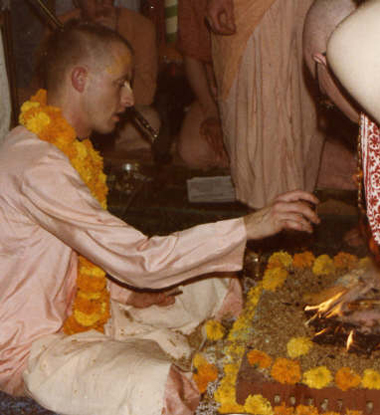
For members of ISKCON (part of the Gaudiya Vaishnava tradition) the first dīkṣā, or harināma-dīkṣā initiation, is performed as part of a fire sacrifice where grains, fruit, and ghee are offered into the sacred fire.[17]

Swaminarayana

[edit]

Dīkṣā takes place in the Swaminarayan Sampradaya in three ways: (1) brahmachari, (2) sadhu/bhagvati, and (3) parshadi. This diksha is administered by the acarya for the Vadtal and Ahmedabad dioceses and the guru for the other sects. The initiate bathes, has the hair cut, and comes before the guru. As part of a vedic ritual, the initiate receives the guru mantra, which translates to "I take refuge in Swaminarayana". The initiate is then given the sacred thread, new clothes, a pagh, a bowl for eating, along with a new name.[18][19]

Jainism

[edit]
The Initiation Ceremony of Mahavira, Folio from the Kalpa Sutra and Kalacharyakatha.

To join the Jain ascetic community, novices initially undergo a period of training where they memorize key texts and learn the principles of ascetic life. During the initiation ceremony, the presiding senior ascetic bestows a new name and symbolic implements: Śvetāmbaras receive robes, an alms bowl, a whisk, a staff, and sometimes a mouth-shield (in the case of Sthānakvāsī and Terāpanthī initiates), while Digambaras, who adopt nudity, are given only a whisk and a water pot. Traditionally, novices pulled out their hair as a sign of renunciation, though shaving the head is now customary. After initiation, ascetics join a lineage tracing back to Mahāvīra (for Digambaras) or his disciple Sudharman (for Śvetāmbaras) and are guided by senior ascetics who oversee their conduct and scriptural learning.[20][21]

Other living examples

[edit]

Other living traditions and sects approach dīkṣā in various ways.

  • Transcendental Meditation (TM) began initiation under the guidance of Maharishi Mahesh Yogi in the late 1950s. New members were initiated through a "devotional ritual (puja) whose focus was Brahmananda Saraswati and the Shankaracharya lineage. Initiates were given a specially suited mantra, and taught how to practice meditation."[22]
  • The Saiva Siddhanta Yoga Order (of Hinduism Today's Himalayan Academy) invites spiritually inclined young men under 24 (or under 23 outside the USA) to pursue a monastic path. The initiation process begins with a written introduction to the Satguru, followed by a guided aspirancy and supplicancy period involving celibacy, spiritual study, and temple service, progressing to renewable two-year vows and ultimately, lifetime monastic vows under the guidance of the Satguru.[23]

References

[edit]

Sources

[edit]

See also

[edit]
Revisions and contributorsEdit on WikipediaRead on Wikipedia
from Grokipedia
Diksha (: dīkṣā, दीक्षा) is a foundational ritual in , whereby a disciple is consecrated by a to formally enter a spiritual tradition, typically involving the transmission of sacred , mantras, or vows that mark the beginning of disciplined religious practice and purification of the . This ceremony symbolizes a profound transformation, often described as a rebirth or awakening, enabling the initiate to access esoteric teachings and progress toward liberation (). In broader Hindu contexts, diksha serves as a rite of passage that bridges the ordinary and the sacred, varying across traditions such as Vedic, Tantric, Vaishnava, and Shaiva. In Vedic rituals, it consecrates the sacrificer (yajamana) prior to a yajna (sacrifice), ritually transforming them into a symbolic embryo to ensure ritual purity and efficacy, as detailed in ancient texts like the Brahmana literature. Within Tantric Shaivism, particularly in the Mantramarga and Kaula paths, diksha is a powerful mechanism for spiritual elevation, involving the guru's transmission of divine energy (shaktipata) to pierce impurities (mala), karma, and illusion (maya), thereby qualifying the disciple for advanced practices like mantra recitation and meditation that lead to union with Shiva. Scholars such as Alexis Sanderson emphasize its role in removing socio-religious barriers, making liberation accessible within one lifetime through processes like samavesa (divine immersion) and vedha (spiritual piercing). The ritual's forms are diverse, reflecting the tradition's adaptability. In Pancharatra Vaishnavism, diksha includes harinama (chanting initiation) and mantra diksha, performed through a ceremonial yajna where the disciple vows devotion to Vishnu, purifying body, mind, and soul for bhakti (devotional worship), as outlined in primary texts like the Narada Pancharatra. Common elements across types—such as samaya diksha (basic vow-based initiation), vishesha diksha (special empowerment), and nirvaniya diksha (complete liberation)—involve the guru's touch, gaze, or word to instill mantra-vīrya (mantric potency), often accompanied by vows of ethical conduct and austerity. While primarily Hindu, analogous initiations appear in Jainism for monastic entry, underscoring diksha's enduring significance as a catalyst for ethical and mystical growth in Indian spiritual traditions.

Origins and Terminology

Etymology

The term Diksha (Sanskrit: dīkṣā, दीक्षा) derives from the Sanskrit verbal root dīkṣ (दीक्ष्), meaning "to consecrate," "to initiate," or "to dedicate oneself," with origins traceable to the Proto-Indo-European root deḱ- ("to offer"). An alternative analysis breaks it down as a compound of ("to give") and kṣi ("to destroy"), symbolizing the bestowal of spiritual insight to eradicate ignorance. The root incorporates elements of diś ("to point out" or "to show the path"), underscoring the initiatory guidance toward higher awareness. In early Vedic literature, including the Brāhmaṇas associated with the and the , dīkṣā denoted a solemn preparatory rite for yajña (sacrificial rituals), involving the and consecration of the patron or sacrificer to ensure spiritual readiness. Over time, its usage evolved in the to encompass initiation into esoteric doctrines, marking entry into advanced philosophical or mystical instruction. The term exhibits phonetic adaptations across modern Indian vernaculars, reflecting linguistic evolution. Contemporary variations include dīkṣā or dīkshā (दीक्षा, commonly transliterated as "Deeksha") in and tīṭcai (தீட்சை) in Tamil, retaining the core of consecration. Semantically, diksha has influenced cognate concepts in terminology, such as upanishad ("sitting down near" a teacher), both evoking the transmission of profound knowledge through proximity and .

Historical Development

The origins of Diksha trace back to the (c. 1500–500 BCE), where it functioned primarily as a consecration rite essential for preparing the sacrificer before performing major yajnas, such as the Soma sacrifice. In this context, Diksha symbolized a rebirth, purifying the participant and aligning them with divine forces to ensure the efficacy of the sacrifice. The , a prose commentary attached to the Shukla Yajurveda, provides detailed descriptions of the rite, including preparatory acts like shaving the hair and beard, trimming nails, bathing, and donning a specially anointed garment and antelope skin, often performed in the afternoon to invoke cosmic order. These practices elevated the sacrificer to a quasi-divine status, akin to an embryo in the womb of the gods, warding off malevolent forces and facilitating union with deities like and Soma. During the Upanishadic era (c. 800–200 BCE), Diksha underwent a significant transition, shifting from a purely ritualistic consecration tied to sacrificial performance toward a more introspective initiation within the guru-shishya tradition, aimed at imparting spiritual knowledge and . Texts like the , part of the Sama Veda, portray Diksha as an ascetic preparation involving hunger, thirst, and abstinence from pleasures, metaphorically representing the sacrificer's inner discipline for attaining higher wisdom. This evolution emphasized the guru's role in guiding the disciple through vows and teachings, marking the entry into esoteric knowledge that transcended external rituals, as seen in dialogues where initiates seek enlightenment from teachers like Uddalaka Aruni. In the medieval period (c. 500–1500 CE), Diksha expanded through the and Agamas, integrating with emerging and tantric movements to serve as a formal entry into devotional and esoteric paths, often involving transmission and vows of allegiance to specific deities. The , such as the , elaborate on Diksha as a transformative rite linking the devotee to Shiva's grace, while Agamic texts like the Shaiva and Vaishnava Agamas detail graded initiations (, vishesha, nirvani) for temple worship and yogic practices, adapting Vedic roots to sectarian contexts. Key figures like (c. 788–820 CE), in his commentaries on the and , underscored the necessity of guru-initiated transmission for , reinforcing Diksha's role in purifying the seeker's for non-dual realization without delving into tantric elaborations.

Core Concepts

Definition and Purpose

Diksha is an initiation ritual in through which a consecrates a disciple, formally admitting them into a spiritual tradition and imparting sacred knowledge, such as mantras or vows, to begin disciplined practice and purification. Its purpose is to effect a transformative "rebirth," awakening inner spiritual potential—often through energy transmission ()—to remove impurities, karma, and , thereby enabling progress toward liberation (). Philosophically, it bridges the mundane and divine, qualifying the initiate for esoteric practices while emphasizing ethical commitment and guru-disciple bond, though forms and emphases vary across Vedic, Tantric, and devotional traditions.

General Ritual Process

The ritual process of Diksha in commonly follows a framework of preparation, main rite, and post-initiation, though specifics vary by tradition such as Vaishnava or Shaiva. In the preparation phase, the disciple undergoes purification, such as bathing to cleanse impurities and for discipline, while taking vows of ethical conduct, , or abstaining from intoxicants. Preliminary instruction (shiksha) from the covers basic principles, including chanting or , to build devotion and moral purity. The main rite centers on the guru's transmission of sacred knowledge and energy, signifying entry into . This often involves the guru's touch or gesture (e.g., on the head or heart) and whispering a personal for and divine connection. A homa fire may invoke deities and purify the space, sometimes with (pouring sanctified water) for blessings. In the post-initiation phase, the disciple's new status is reinforced through oaths of secrecy for the mantra and instructions, along with guidelines for ongoing sadhana like japa (mantra repetition) or ethical observances. Symbols may include tilak markings with sacred ash or vermilion on the forehead, a sacred thread (yajnopavita) for ritual eligibility, or a new spiritual name denoting rebirth. These mark the initiate's empowered transition. Eligibility typically requires committed individuals, often adults but including adolescents in traditions like , who show ethical conduct, faith in the guru-disciple relationship, and readiness for principles such as truthfulness and non-violence. This often follows guru observation and sincerity testing. Outcomes can include immediate experiences like or , alongside long-term karmic purification and heightened , fostering growth toward liberation through integrated practices.

Diksha in

Initiation Practices

In Shaiva traditions, Diksha serves as the formal entry into various Shaiva sampradayas, marking the disciple's commitment to as the supreme deity and often incorporating of the lingam as a central element of the rite. This initiation purifies the (pasu) from bonds (pasa) through the grace of (pati), enabling participation in Shaiva rituals and community life. The process typically begins with the guru assessing the disciple's readiness via saktipata, the descent of divine power, which manifests as intense devotion or longing for liberation. Key practices during Shaiva Diksha include the transmission of the Panchakshari mantra, "," which encapsulates 's five aspects and is imparted directly by the to invoke divine protection and realization. This mantra transmission is often accompanied by nyasa, the ritual imposition of s on the body to align the disciple's form with 's energies, and techniques to control breath and vital forces, facilitating inner purification. In temple settings, the rite may involve offerings to the , symbolizing the formless absolute, with the disciple receiving a or for personal worship post-initiation. The role of Diksha varies between major Shaiva schools: in , it is a structured, temple-based emphasizing purity and hierarchical progression toward liberation, as detailed in texts like the Mrigendra Agama, where removes the three malas (anava, karma, maya) through application and leads to states like Mantramahesvara. In contrast, adopts a more meditative approach, focusing on visesa diksha for direct experiential union with Shiva's consciousness, integrating practices like "Sauh" with breath awareness to realize non-dual identity without extensive external . The Mrigendra Agama exemplifies historical Shaiva by prescribing Diksha for soul refinement via and , culminating in ascent to pure realms.

Key Shaiva Traditions

In the Lingayat or Virashaiva tradition, Diksha, known as linga-diksha, serves as a foundational rite marking a devotee's lifelong commitment to through the receipt of the ishta linga, a personal emblem of the deity worn continuously from initiation until death. This ceremony, typically performed by a around age 10-12 but sometimes earlier, involves the whispering of the ("") into the initiate's ear, symbolizing the infusion of and ethical precepts for spiritual salvation. Central to this practice is the rejection of hierarchies, as the rite affirms equality among all initiates regardless of social background, fostering a casteless community united in devotion to . Within the Nath Sampradaya, Diksha emphasizes disciplines and esoteric transmission, progressing through graded that culminate in the Kanphata or Darshani rite, where the physically pierces the initiate's earlobes to insert kundalas, redirecting vital energies toward spiritual awakening. Lower levels, such as Avalambi or Aughara, involve receiving a guru-mantra and symbolic items like a whistle for nada-anusandhana meditation, building foundational practices focused on arousal and . The 's touch during these rituals, particularly the ear piercing, activates subtle energy channels, while secret siddhis—perfected powers derived from through the lineage of Matsyendranath—are transmitted orally, ensuring the initiate's path to mukti remains guarded and personalized. Modern Shaiva groups, such as the in , adapt traditional Diksha ceremonies to serve communities, offering progressive initiations like samaya diksha for youth and nirvana diksha for advanced seekers, which integrate scriptural mantras with ethical training to suit contemporary lifestyles. Founded in 1949 and established its international headquarters on Kauai in 1970, the Church emphasizes these rites as inner awakenings, training global leaders through its seminary to preserve South Indian Saivite heritage while accommodating Western cultural contexts. The 19th- and 20th-century revivals of Shaiva traditions revitalized Diksha practices amid colonial challenges, with figures like influencing broader Hindu reforms by promoting the guru-disciple initiation as essential for spiritual power transmission, drawing from Shaiva-Vedantic syntheses in his teachings.

Diksha in Shaktism

Shakta Initiation Rites

In Shakta traditions, Diksha serves as the formal initiation into the worship of , the supreme feminine energy embodying creation, preservation, and destruction, granting the disciple access to esoteric and spiritual empowerment through the guru's transmission of and rituals. This process emphasizes the disciple's alignment with as the dynamic power of the universe, often culminating in the awakening of inner divine energy for liberation. A prominent example is the Sri Vidya tradition, where initiates receive the pancadasi and guidance on the Shri Yantra, a mystical diagram representing the goddess Lalita Tripurasundari, to facilitate union with the divine feminine. Central to Sri Vidya Diksha is the recitation and internalization of the , a comprising one thousand names of the that invokes her liberating grace and cosmic sovereignty, recited during to purify the practitioner and attune them to her subtle energies. The rite typically involves preparatory purification through nyasa (placement of mantras on the body), (repetition), and vows of chastity and fasting, progressing to advanced stages like purnabhisheka, where the initiate is fully consecrated as a Shakta capable of . Shakta initiation rites vary between the left-hand (vamacara) and right-hand (dakshinacara) paths, with the former incorporating the panchamakara—the five "M"s (madya for wine, mamsa for meat, matsya for fish, mudra for grain, and maithuna for ritual union)—either literally for advanced viras to transcend taboos or symbolically in subtler forms to avoid literal transgression. In contrast, right-hand practices emphasize pure bhakti through mental visualization and offerings like milk or sweets as substitutes, ensuring accessibility for less advanced practitioners while maintaining focus on Devi's grace. Key scriptural foundations include the , which describes Diksha as the imparting of divine knowledge through ceremonial instruction, equating devotion to with ultimate wisdom and unity of all deities under her supreme form. The Kaula Tantras, such as the Kularnava Tantra, further elaborate these rites, portraying initiation as a monistic path where the guru reveals the subtle essence of , often through secret rituals like on a corpse to dissolve ego and affirm non-duality. A distinctive gender aspect in Shakta Diksha is the frequent of women as gurus or priestesses, reflecting the tradition's reverence for the feminine as inherently divine; women initiates often receive maternal forms of consecration, yielding amplified spiritual fruits, and participate equally without or barriers based on competency. This inclusivity underscores Shakti's role as the activating force, with women embodying in rituals and lineages.

Ramakrishna Mission

The Ramakrishna Mission was founded by Swami Vivekananda on 1 May 1897 in Belur, near Kolkata, as a philanthropic and spiritual organization inspired by the life and teachings of his guru, Sri Ramakrishna Paramahamsa (1836–1886). Ramakrishna's spiritual realizations represented an eclectic synthesis of Shakta devotion to the Divine Mother, Vaishnava bhakti, Tantric practices, and Advaita Vedanta, which Vivekananda adapted into a universal framework emphasizing practical spirituality and service to humanity. This foundation integrates Shakta elements, such as mantra transmission, within a broader Vedantic outlook that transcends sectarian boundaries. Within the , diksha takes the form of diksha, a spiritual initiation where a sacred is imparted to awaken the devotee's inner potential, transmitted through an unbroken guru-parampara originating from and . For monastic aspirants, the process begins with a probationary period of service and study, followed by diksha, which confers the yellow robe and a spiritual name, and culminates in vows of renunciation after several years. Lay devotees receive diksha, often termed initiation for those committing to and disciplined life, without requiring monastic vows; this is open to householders seeking personal spiritual growth. Only the President, Vice-Presidents, or select senior monks at global centers are authorized to perform these initiations. A distinctive aspect of diksha in the is its emphasis on selfless service (seva) as the primary expression of , prioritizing humanitarian work—such as , healthcare, and —over elaborate esoteric rituals, in line with Vivekananda's vision of "worship through work." Unlike traditional initiations restricted by or , these practices are universally accessible, welcoming individuals from all backgrounds, religions, , and to foster inner and social . This non-sectarian approach reflects Ramakrishna's of religions, making diksha a tool for ethical living and global outreach rather than . Today, the Mission's 295 branch centers worldwide conduct mantra diksha ceremonies annually, often during significant occasions like the founder's birthday or foundation day celebrations, initiating numerous devotees across and abroad, as of October 2025. These global institutions, including those in the United States, , and , continue the lineage's tradition of blending contemplative practice with active benevolence, serving millions through educational and welfare programs.

Diksha in Vaishnavism

Pushtimarga

Pushtimarga, founded by the philosopher-saint Vallabhacharya (1479–1531), represents a distinctive Vaishnava tradition centered on bhakti toward Krishna, where spiritual progress relies primarily on divine grace (pushti) rather than ascetic effort or ritualistic merit. This path emphasizes intimate, aesthetic devotion through the service (seva) of personal deity forms (sevya-svarupa), often childlike images of Krishna, fostering a direct, familial bond between the devotee and the divine. Vallabhacharya's teachings, drawn from scriptures like the Bhagavata Purana—on which he composed his seminal commentary, the Subodhini—underscore that initiation into this tradition establishes an eternal connection, enabling the soul to partake in Krishna's lila (divine play) without the need for laborious sadhana. Central to Pushtimarga is the initiation rite known as Brahmasambandha (or Brahma Sambandh Diksha), a transformative process that unites the initiate's soul with , personified as Krishna, through complete surrender. Performed exclusively by authorized male descendants of Vallabhacharya, known as Vallabhkul acharyas, the involves the bestowal of sacred , including the Ashtakshara Mantra—an eight-syllable invocation derived from 18.66 ("sarva-dharmān parityajya mām ekaṁ śaraṇaṁ vraja")—and the Gadya Mantra (Brahma Sambandh Mantra), which affirms the devotee's eternal servitude to Krishna. The , selected for their purity and devotion, assesses the initiate's eligibility as a pushti jiva (soul graced by divine predisposition) before proceeding, often reciting passages from Vallabhacharya's Siddhanta Rahasya to elucidate the vow of dedication. Following mantra transmission, the initiate receives permission to commence seva, involving daily offerings (bhog) and worship with materials (samagri) like food, clothing, and adornments for the . In Pushtimarga, Bal Diksha (childhood ) is a key practice, typically administered from the 41st day after birth, allowing young ren to enter the tradition early and begin training in Krishna seva. This early rite, distinct from the (Nam-Nivedan Samskar), instills lifelong devotion by integrating the into household worship routines, emphasizing playful, affectionate service to Krishna as a child (bal charitra). For adults, often aligns with a commitment to naisthika brahmacharya in the sense of unwavering, pure devotion, though the tradition predominantly supports grihastha () life while prohibiting other sectarian affiliations post-. The process culminates in the devotee's purification from past sins, enabling unmediated access to grace, as Vallabhacharya initiated his first disciple, Damodardas Harsani, through this method. Pushtimarga maintains strict exclusivity, restricting Diksha to those who approach a Vallabhkul guru and adhere to preparatory vows, such as fasting (upvas) the day prior and seeking permission days in advance. Participation is hereditary among initiated families, with rituals shrouded in secrecy to preserve their sanctity—mantras and detailed seva procedures are disclosed only to initiates, guarding against dilution or misuse. This closed transmission ensures the tradition's esoteric depth, warning against unqualified gurus who might confer initiation recklessly, thereby transforming sacred Brahmasambandha into mere confusion. Vallabhacharya's own pilgrimages spread the path widely, yet its core remains intimate and guarded, prioritizing concealed devotional sentiment (bhava) for authentic growth.

Gaudiya Vaishnavism

, founded by (1486–1534), regards diksha as the essential entry point into the , marking the disciple's formal commitment to the path of Krishna consciousness through devotion and surrender to a qualified . This initiation aligns with Chaitanya's emphasis on as the primary means of spiritual realization, where the guru imparts the foundational knowledge of one's eternal relationship (sambandha-jnana) with Krishna, setting the stage for ongoing practice. In this tradition, diksha is not merely ceremonial but a transformative rite that purifies the disciple and connects them to the disciplic succession (parampara), as outlined in foundational texts like the Bhakti-rasamrita-sindhu by Rupa Gosvami. The tradition recognizes two primary forms of diksha: Harinama Diksha, the basic initiation focused on chanting the Hare Krishna maha-mantra, and Pancha Samskara, a more comprehensive rite comprising five sacraments. Harinama Diksha involves the guru bestowing the sacred Hare Krishna mantra upon the disciple after observing their sincerity, typically requiring at least one year of preliminary devotion, and serves as the initial step for cultivating constant remembrance of Krishna. Pancha Samskara, as detailed by Bhaktivinoda Thakura in his 1885 work of the same name, encompasses tapa (austerity and repentance), nama (chanting), mantra (empowerment with a specific mantra), mudra (sacred markings or tattoo on the body symbolizing devotion), and samaskara (overall purification), ensuring a holistic transformation that embeds the disciple in Vaishnava identity. During the diksha process, the imparts the mantra—a potent eighteen-syllable of Krishna as the cowherd protector—as the core element, which is meditated upon to awaken spontaneous devotion (raganuga ). This , drawn from texts like the Gopal Tapani Upanishad, facilitates internal visualization of Krishna's pastimes and fosters an emotional, aspirant-based that follows the moods of the eternal associates in , distinguishing Gaudiya practice from more ritualistic forms. The ceremony emphasizes humility, vow-taking, and the disciple's resolve to follow regulative principles, with the guiding the internalization of the to cultivate raganuga sadhana. In the modern era, A.C. Bhaktivedanta Swami Prabhupada (1896–1977) adapted these practices for global dissemination through the International Society for Krishna Consciousness (ISKCON), incorporating a fire yajna (sacred offering into consecrated flames) as part of the initiation ritual to symbolize purification and divine acceptance. Prabhupada's guidelines required candidates to chant at least sixteen rounds of the Hare Krishna mantra daily and adhere strictly to four regulative principles—no meat-eating, illicit sex, intoxication, or gambling—for a minimum period before receiving diksha, thereby maintaining the tradition's emphasis on genuine austerity while making it accessible worldwide. This adaptation has enabled millions to enter the Gaudiya lineage, preserving Chaitanya's teachings amid diverse cultural contexts.

Swaminarayan Sampradaya

The , founded by Sahajanand Swami (1781–1830), regards as a pivotal rite of entry into its ethical and devotional framework, symbolizing commitment to moral discipline and communal harmony. This initiation underscores the tradition's emphasis on reforming personal conduct and fostering social welfare through adherence to . The kanthi dhari, a necklace of wooden beads worn around the neck, serves as the primary symbol of initiation, representing surrender to divine authority and protection from moral lapses. Diksha in this manifests in distinct forms tailored to ascetics and householders, both rooted in vows against vices such as meat-eating, alcohol consumption, , , and false statements. Parshad diksha initiates young men into the ascetic order as parshads, who don white robes and dedicate themselves to lifelong service, study, and under the guidance of senior sadhus; this often occurs in temple assemblies, marking a transition to communal . For householders, initiation—known as diksha—involves receiving the kanthi and pledging to the 's ethical code, enabling active participation in devotional activities while maintaining family life. The process typically unfolds in a temple setting, where a qualified performs rituals including the tying of the kanthi and recitation of key precepts from the Shiksha Patri, the foundational ethical text authored by Sahajanand outlining 212 rules for righteous living. This verbal transmission instills the vows and reinforces communal bonds, as initiates publicly affirm their resolve before the assembly. Diksha is mandatory for full membership, integrating individuals into the sampradaya's global network, which encompasses over 1,000 temples and centers worldwide, promoting ethical living as a collective endeavor.

Diksha in Tantra

Types of Tantric Initiation

In Tantric traditions, particularly within Shaiva lineages such as , diksha represents a hierarchical system of initiations that guide the disciple from preliminary vows to profound spiritual realization. These types are systematically outlined in foundational texts such as Abhinavagupta's Tantraloka (c. 975–1025 CE), where is portrayed as a progressive awakening of divine consciousness through ritual and inner practice. The structure emphasizes a movement from external, ritualistic observances to internalized sadhana, ensuring the disciple's readiness for escalating levels of commitment and detachment. While this is central to Shaiva , parallels and adaptations exist in Shakta and Vaishnava tantric lineages, though with distinct types; for example, Shakta traditions like Sri Vidya feature Mantra Diksha and Shaktabhisheka Diksha, while Vaishnavism includes Samkshipta and Ativistara Diksha. The foundational type is Samaya Diksha, a promise-based initiation that establishes the basic vow (samaya) for entry into the tantric path. This level is designed for householders and lay practitioners, involving simple rituals such as mantra transmission, recitation of stotras, and visits to sacred sites, without requiring separation from worldly duties. It serves as a prelude to deeper engagement, purifying the disciple's intentions and introducing core tantric disciplines like ethical conduct and preliminary meditation. In the Tantraloka, Abhinavagupta describes it as accessible to all aspirants, fostering initial shaktipat (descent of grace) to awaken kriya-shakti, the latent spiritual energy. Building upon Samaya Diksha, higher levels include Vishesha Diksha (special ) and its variant Nirvishesha Diksha, which differentiate based on the degree of separation from worldly life. Vishesha Diksha entails more intensive rituals, such as deity-specific sadhana and advanced practices, preparing the disciple for partial detachment while still allowing roles; it is often pursued by those intending to become putrakas (spiritual heirs) or acharyas (teachers). In contrast, Nirvishesha Diksha emphasizes non-distinction from the divine, involving deeper internalization without rigid worldly severance, suitable for advanced practitioners within orthodox . These forms mark a transition to internal sadhana, where external rituals yield to contemplative practices like visualization and energy work. Prerequisites typically include completion of vows, demonstrated devotion, and guidance from a qualified to ensure spiritual maturity. The pinnacle is Acala Diksha, the full ascetic initiation conferring unshakable (acala) stability in divine realization. Reserved for advanced aspirants, it demands complete renunciation of worldly attachments, transforming the disciple into a siddha (perfected being) capable of guiding others. As per the Tantraloka, this level integrates all prior initiations, culminating in total merger with Paramashiva through profound shaktipat and transcendence of dualities. It applies particularly in the Kaula path (esoteric tantra), where intense practices like those involving shakti (divine feminine energy) accelerate liberation, contrasting the more restrained Samaya approach. These types, while rooted in Shaiva contexts, share emphasis on guru-disciple transmission for both bhukti (enjoyment) and mukti (liberation) across Tantric traditions.

Esoteric Elements

In Tantric , the esoteric dimension centers on the transmission of subtle energies and symbolic instruments that facilitate profound inner transformation, often veiled in secrecy to preserve their potency. Central to this is shaktipāta, the descent of divine power from the to the disciple, which awakens the dormant kundalini-shakti coiled at the base of the spine and propels it through the chakras, the psychoenergetic centers along the . This energy transfer typically occurs through direct methods such as the 's touch (sparśa-dīkṣā), gaze (dṛṣṭi-dīkṣā), or even thought (mānasa-dīkṣā), bypassing ordinary intellectual comprehension and inducing immediate spiritual , such as tremors, bliss, or visions, as the disciple's ego barriers dissolve and alignment with the of Śiva-Śakti is achieved. The process, rooted in texts like the Kula-Ārnava-, transforms the initiate from a (paśu-bhāva) to liberated , with the acting as a conduit for this alchemical infusion of sat-cit-ānanda (being--bliss). Esoteric tools amplify this transmission, including yantras—geometric diagrams embodying divine forms that serve as focal points for meditation and energy channeling during initiation—mudrās (ritual gestures that seal and direct prāṇic flows), and bīja-mantras (seed syllables invoking core vibrational essences). In Shakta Tantra, the bīja-mantra "Hrīṃ" exemplifies this, representing the transformative power of Śakti as the goddess Bhuvaneśvarī or Māyā, chanted to activate heart-centered energies and dissolve dualities within the disciple's subtle body during dīkṣā. These elements are consecrated through nyāsa, where mantras and mudras are placed on the body to create a śākta-deha (empowered form), enabling the initiate to internalize cosmic patterns and harness siddhis (supernatural abilities) as byproducts of awakening. Secrecy forms the protective veil of these practices, with initiates bound by solemn pledges () of non-disclosure to unqualified persons, ensuring the sanctity of the oral lineage and preventing misuse that could lead to spiritual downfall or karmic penalties. Breach of these vows, as outlined in Tantric traditions, invites severe consequences such as loss of initiatory grace, rebirth in lower realms, or energetic backlash, underscoring the oath's role in maintaining the esoteric purity of dīkṣā. The Kulacūḍāmaṇi Tantra, a key nigama text in Kaula Śaivism, elaborates this inner through dialogues between Bhairavī and , describing dīkṣā as a meditative purification of chakras via visualization of fierce deities like Kālī, culminating in the transmutation of gross elements into subtle (amṛta) that ascends the suṣumṇā channel for union with the divine. This alchemical process, guarded by pledges like "Na kaśmecit pravaktavyam yadoccheścchāsvataṃ sukham" (do not reveal this to anyone for eternal happiness), fosters non-dual realization by refining the disciple's inner substances—blood, breath, and mind—into immortal essence.

Diksha in Jainism

Renunciate Diksha

Renunciate diksha in , known as muni diksha or sadhvi diksha, represents the ultimate into monastic life, where individuals fully renounce worldly attachments to pursue spiritual liberation through . This ceremony transforms a into a , committing them to a lifelong of (aparigraha), strict adherence to (ahimsa), and mendicancy, forsaking family, wealth, and material comforts in favor of wandering and self-discipline. The rite emphasizes complete detachment, enabling the initiate to focus on destroying karma and attaining (liberation), and is typically undertaken after years of preparation, including temporary vows and guidance from a spiritual preceptor. The process of renunciate diksha is administered by an initiating , a senior or , who oversees the solemn rituals marking the transition. Central to the ceremony is the acceptance of the five great vows (mahā-vratas): non-violence, truthfulness, non-stealing, , and , which form the ethical foundation of monastic conduct and are binding without exception. In both and Śvetāmbara sects, the initiate undergoes keśa-loça (hair plucking), where the hair is removed by hand in handfuls—traditionally five—to symbolize the shedding of ego and worldly ties; this act is performed publicly or in a to affirm the irreversible commitment. For monks, the rite culminates in nudity, representing total and equality with the liberated Jinas, while nuns in this sect wear simple white garments due to traditional gender considerations; Śvetāmbara mendicants, both monks and nuns, don white robes as a mark of purity. The ceremony often includes a where the initiate discards royal or fine attire, distributes possessions, and receives alms utensils, underscoring the shift to a life of and austerity. Jain scriptures, particularly the Kalpa Sūtra composed around the 4th century BCE by Ācārya Bhadrabāhu, provide the foundational descriptions of renunciate diksha, detailing the lives of the Jinas as exemplars. The text recounts , the 24th Tīrthaṅkara (c. 599–527 BCE), who at age 30 renounced his princely life in Kuṇḍagrāma by distributing his wealth, proceeding to a sacred park under a śāla tree, plucking his hair in five handfuls, and adopting nudity after an initial period of clothing, thereby initiating 12 years of intense asceticism leading to omniscience. Similar accounts of other Jinas, such as Pārśvanātha under a dhātrī tree and Nemi under an aśoka tree, reinforce diksha as a timeless path to enlightenment modeled on these divine figures. Today, renunciate diksha remains a vital practice, with several thousand initiated Jain monks and active worldwide, predominantly in , though the numbers have declined due to modern societal pressures. Among Śvetāmbaras, nuns outnumber monks, reflecting greater female participation in monastic orders, while ascetics maintain stricter traditions of nudity and mendicancy. These mendicants travel in groups, observing silence during certain periods and relying on lay supporters for sustenance, thereby sustaining the Jain sangha's role in preserving doctrinal purity.

Lay Initiation Practices

Lay initiation practices in Jainism enable householders, or śrāvakas and śrāvikās, to formally commit to a structured ethical framework without adopting full renunciation. Central to this is upāsaka dikṣā (lay initiation), where initiates pledge to observe the aṇu-vratas—the five lesser vows of ahiṃsā (non-violence), satya (truthfulness), acaur ya (non-stealing), brahmacarya (chastity), and aparigraha (non-possession)—alongside seven supplementary vows: three guṇa-vratasdīk-vrata (limits on travel and activities), bhoga-upabhoga-parimāṇa-vrata (limits on consumption and possessions), and anartha-dāṇḍa-vrata (avoiding purposeless harm)—and four śikṣā-vratas (disciplinary vows, including samayika for meditative equanimity, deśāvakāśika-vrata for limiting activities, posadhopavāsa-vrata for periodic fasting, and atithi-saṃvibhāga-vrata for almsgiving). These vows are taken in a ceremonial setting guided by a monk or nun, often involving recitation of oaths like the samayika pledge to maintain mental and physical restraint for 48 minutes, symbolizing detachment from worldly distractions. The core purpose of lay initiation is to establish a progressive spiritual discipline that curbs karmic bondage, fostering gradual purification of the soul toward mokṣa (liberation) without requiring saṃnyāsa (ascetic renunciation). By adhering to these vows, householders mitigate the influx of negative karma through daily ethical choices, such as vegetarianism, mindful consumption, and non-harmful professions, thereby advancing through the 11 pratimā stages of lay spiritual development—from basic refuge in the Jinas to preparatory mendicancy—while balancing familial responsibilities. This approach democratizes the path to enlightenment, making Jain principles accessible to non-ascetics and emphasizing incremental self-control as a foundation for ultimate freedom from the cycle of rebirth. Sectarian variations exist between the Śvetāmbara and traditions in administering lay initiation. In Śvetāmbara practice, married householders of both genders freely undertake upāsaka dikṣā, integrating vows seamlessly into domestic life with flexibility for women and family obligations, reflecting a view that spiritual progress is attainable within worldly roles. lay initiation, by contrast, stresses stricter observance of the vows, often with greater emphasis on and detachment even for householders, aligning with the sect's broader doctrinal focus on rigorous as essential for karmic purification, though still permitting married initiates. In contemporary contexts, particularly among the Jain diaspora, organizations like the Federation of Jain Associations in North America (JAINA) promote lay vows and ethical practices through educational initiatives, such as pathshala curricula and youth programs, to sustain traditions amid modern challenges.

Diksha in Buddhism

Vajrayana Abhisheka

In Vajrayana Buddhism, abhisheka, often translated as "empowerment," serves as the essential initiation ritual that authorizes practitioners to engage in tantric sadhanas aimed at realizing enlightenment through the union of method and wisdom. This ritual, performed by a qualified guru, transmits the blessings of enlightened qualities, purifying obscurations and ripening the practitioner's mindstream for advanced practices. Unlike preliminary Buddhist ordinations, abhisheka specifically enables the visualization of oneself as a meditational deity (yidam) within a mandala, fostering direct insight into the empty, luminous nature of reality. It is a cornerstone of Highest Yoga Tantra (Anuttarayoga Tantra), where the guru acts as the conduit for the deity's power, ensuring the transmission remains unbroken from the Indian tantric lineages to Tibetan traditions. The abhisheka unfolds through four progressive levels, each addressing specific aspects of body, speech, mind, and ultimate awareness to prepare the practitioner for the complete path. The first, the vase empowerment (Skt. kalaśābhiṣeka; Tib. bum pa'i dbang), involves the guru pouring consecrated water or other substances over the disciple's head, symbolizing the purification of bodily defilements and the bestowal of the indestructible vajra body; this authorizes engagement in the generation stage (utpattikrama) of deity yoga and plants the seed for realizing the emanation body (nirmāṇakāya). The second, the secret empowerment (Skt. guhyābhiṣeka; Tib. gsang ba'i dbang), employs symbols like the vajra and bell to purify speech-related karma, unblock subtle channels and winds (prāṇa), and grant blessings of vajra speech, enabling mantra recitation and the completion stage (sampannakrama) practices that lead to the enjoyment body (saṃbhogakāya). The third, the knowledge-wisdom empowerment (Skt. jñāna-prajñābhiṣeka; Tib. sherab yeshe'i dbang), often involving nectar or symbolic union, purifies mental obscurations, enhances the essence drops (bindu), and introduces non-dual bliss-emptiness, authorizing advanced meditations on the dharmakāya. Finally, the precious word empowerment (Skt. śabdābhiṣeka; Tib. rin po che'i tshig dbang), the most profound, points out the innate nature of mind beyond concepts, purifying all remaining veils and authorizing Dzogchen or Mahāmudrā realizations, culminating in the essential nature body (svabhāvakāya). These stages, using ritual implements such as water, vajra, bell, and name, progressively dismantle dualistic perceptions, allowing the practitioner to embody the deity's enlightened activity. During the ritual, the visualizes the meditational arising within the and bestowing upon the assembly, often reciting mantras and guiding disciples in their own visualizations to receive the transmission directly from the through the guru's enlightened mind. This process not only ripens the practitioner's capacity for tantric sadhana but also establishes a profound commitment, binding the disciple to ethical conduct and guru devotion for the practice's efficacy. The concludes with instructions on maintaining the blessings, ensuring the sadhana leads to swift enlightenment by transforming ordinary perception into pure visionary experience. Rooted in seminal tantric texts from the 8th century CE, such as the Hevajra Tantra, has been central to Tibetan Buddhist lineages such as , , and . A pivotal figure in establishing in Tibet was , the 8th-century tantric master invited by King , who conducted initiations for key disciples in the Chimphu caves near Samyé Monastery, transmitting cycles like the Kagyé (Eight Transmissions) that incorporated these empowerments to subdue local spirits and propagate . His initiations empowered figures such as Yeshé Tsogyal and , ensuring the survival and flourishing of tantric Buddhism in the Himalayan region despite early challenges. These practices continue in contemporary Tibetan traditions, emphasizing the guru's role in preserving the ritual's transformative power.

Comparative Aspects

Both Hindu diksha and its Vajrayana Buddhist counterpart, abhisheka, emphasize guru-disciple transmission as a core mechanism for spiritual empowerment, where the teacher imparts esoteric knowledge and practices to the initiate. In both traditions, this initiation serves as a path to awakening, often involving secrecy to protect sacred teachings from misuse by the unprepared. A key parallel lies in the samaya vows, which mirror the promises of conduct and devotion in Hindu samaya diksha and Buddhist samaya commitments, binding the initiate to ethical and ritual obligations that sustain the transformative process. Despite these overlaps, philosophical divergences shape their orientations: Hindu diksha often centers on realizing the eternal (atman) and its unity with the divine, while Buddhist abhisheka directs toward insight into (shunyata) and the absence of inherent (anatman). Additionally, Buddhist initiations reject caste-based restrictions, allowing access regardless of social birth, in contrast to certain Hindu diksha forms historically tied to varna considerations. Historically, these practices intertwined through Indo-Tibetan tantric exchanges from the 7th to 12th centuries, where Hindu tantric elements influenced the development of abhisheka, fostering shared ritual frameworks amid cultural synthesis in regions like and . In modern interfaith dialogues, figures like the have highlighted these parallels, describing and as "twin brothers" united in ethical training yet distinct in views of self and selflessness, promoting mutual understanding of as a universal spiritual gateway.

Contemporary and Other Examples

Modern Hindu Adaptations

In the , established by in 1982, the Sudarshan Kriya breathing technique functions as a simplified of Diksha, providing participants with a structured into rhythmic breathwork for stress relief and emotional balance, as has stated that performing Sudarshan Kriya for the first time constitutes receiving diksha. Taught through a multi-day course led by certified instructors, this practice emphasizes accessibility for modern audiences by integrating ancient with contemporary wellness needs, without requiring elaborate rituals or monastic commitment. The , active from the 1970s until Osho's death in 1990, reinterpreted through Neo-Sannyas , a personal commitment ceremony involving energy transmission from the to the disciple, often paired with neo-tantric dynamic to suit urban, psychologically repressed individuals. These hour-long sessions, comprising physical movements, , and , serve as equivalents to traditional by facilitating emotional release and inner transformation in a non-dogmatic, experiential format. The World Spiritual University offers Raja Yoga initiation via a foundational seven-day course, where participants commit to daily vows of , purity, and ethical living to cultivate soul consciousness, with practices frequently held in gender-segregated centers to foster focused spiritual discipline. Founded in 1937 and predominantly women-led, this approach adapts Diksha for lay practitioners by prioritizing and self-mastery over ascetic , enabling both men and women to integrate the vows into everyday life. Post-2000 adaptations have enhanced inclusivity in Hindu practices, including online formats for global reach—such as the Art of Living's live virtual Sudarshan Kriya sessions—and women-led initiations, exemplified by the 2025 Mahakumbh where over 7,000 women received sannyas across traditionally male-dominated akharas, including over 200 in the Juna Akhada. These changes reflect broader efforts to democratize spiritual entry points, accommodating diverse demographics while preserving core transformative elements.

Global and Syncretic Practices

In the Hindu diaspora, particularly in Western countries like the , Diksha practices have been adapted to accommodate modern lifestyles and cultural contexts while retaining core ritual elements. In communities such as the Punjabi Hindu population in , initiations often involve visiting gurus from who perform ceremonies including transmission, application of tilak, floral offerings, and the bestowal of a spiritual name, emphasizing rebirth and purification. These rituals are typically conducted in temples or homes, with adaptations like preliminary "trial initiations" to assess commitment, reflecting the challenges of distance and individualism in diaspora settings. Gurus maintain ongoing guidance through telephone or internet, blending traditional Hindu devotion with Western therapeutic approaches to support disciples' integration into secular societies. The International Society for Krishna Consciousness (ISKCON) exemplifies global dissemination of Diksha, with initiation ceremonies conducted worldwide since the 1960s under A.C. Bhaktivedanta Swami Prabhupada. In Western countries, including the US and Europe, devotees receive Harinama Diksha, involving vows of chanting the Hare Krishna mantra, adherence to vegetarianism, and moral regulations, often during temple gatherings that attract diverse participants. This practice has initiated thousands globally, adapting Vedic chants and fire rituals to multicultural audiences while preserving Gaudiya Vaishnava orthodoxy, contributing to the growth of Krishna bhakti in non-Indian contexts. Syncretic forms of Diksha appear in interfaith movements, notably the Christian Movement originating in mid-20th-century , which has influenced global Hindu-Christian dialogue. Here, Diksha is reinterpreted as a transformative Christian , incorporating Hindu elements like recitation and vows but centered on Christ, symbolizing spiritual rebirth without proselytization. Pioneered by figures such as Swami Abhishiktananda (Henri Le Saux) post-Vatican II's , this ritual fosters enculturation by blurring religious boundaries, allowing Christian to embody Advaita-inspired unity while upholding core doctrines. Its adoption highlights Diksha's adaptability in promoting interreligious harmony beyond traditional Hindu frameworks.

References

  1. https://en.wiktionary.org/wiki/%E0%A4%A6%E0%A5%80%E0%A4%95%E0%A5%8D%E0%A4%B7%E0%A4%BE
  2. https://en.wiktionary.org/wiki/%E0%A4%A6%E0%A5%80%E0%A4%95%E0%A5%8D%E0%A4%B7%E0%A4%BE#Hindi
Add your contribution
Related Hubs
User Avatar
No comments yet.