Hubbry Logo
Guru–shishya traditionGuru–shishya traditionMain
Open search
Guru–shishya tradition
Community hub
Guru–shishya tradition
logo
8 pages, 0 posts
0 subscribers
Be the first to start a discussion here.
Guru–shishya tradition
from Wikipedia
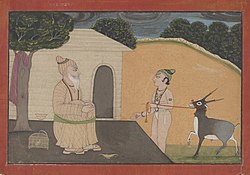
The traditional guru–disciple relationship. Watercolour, Punjab Hills, India, 1740.

The guru–shishya tradition, or parampara (lit.'lineage'), denotes a succession of teachers and disciples in Indian-origin religions such as Hinduism, Jainism, Sikhism and Buddhism (including Tibetan and Zen traditions). Each parampara belongs to a specific sampradaya, and may have its own gurukulas for teaching, which might be based at akharas, gompas, mathas, viharas or temples. It is the tradition of spiritual relationship and mentoring where teachings are transmitted from a guru, teacher, (Sanskrit: गुरु) or lama, to a śiṣya (Sanskrit: शिष्य, disciple), shramana (seeker), or chela (follower), after the formal diksha (initiation). Such knowledge, whether agamic, spiritual, scriptural, architectural, musical, arts or martial arts, is imparted through the developing relationship between the guru and the disciple.

It is considered that this relationship, based on the genuineness of the guru and the respect, commitment, devotion and obedience of the student, is the best way for subtle or advanced knowledge to be conveyed. The student eventually masters the knowledge that the guru embodies.

Etymology

[edit]

Guru–shishya means "succession from guru to disciple".

Paramparā (Sanskrit: परम्परा, paramparā) literally means an uninterrupted row or series, order, succession, continuation, mediation, tradition.[1] In the traditional residential form of education, the shishya remains with their guru as a family member and gets the education as a true learner.[2]

History

[edit]

In the early oral traditions of the Upanishads, the guru–shishya relationship had evolved into a fundamental component of Hinduism. The term "Upanishad" derives from the Sanskrit words "upa" (near), "ni" (down) and "ṣad" (to sit) — so it means "sitting down near" a spiritual teacher to receive instruction. The relationship between Krishna and Arjuna in the Mahabharata, and between Rama and Hanuman in the Ramayana, are examples of Bhakti. In the Upanishads, gurus and disciples appear in a variety of settings (e.g. a husband answering questions about immortality; a teenage boy being taught by Yama, Hinduism's Lord of Death). Sometimes the sages are women, and the instructions may be sought by kings.[citation needed]

In the Vedas, the knowledge of Brahman (brahmavidya) is communicated from guru to shishya by oral tradition (sabda).[3] Mundaka Upanishad describes receiving spiritual knowledge in verse 1.2.12:[4]

In order to learn the transcendental science, one must submissively approach a bona fide spiritual master, who is coming in disciplic succession and is fixed in the Absolute Truth.

— Mundaka Upanishad, Verse 1.2.12

The disciplic succession (guru–parampara) ensures that the knowledge is preserved unaltered through a succession line of teachers.[5]

Arrangements

[edit]

Sampradaya, Parampara, Gurukula and Akhara

[edit]

Traditionally the word used for a succession of teachers and disciples in ancient Indian culture is parampara (paramparā in IAST).[6][7] In the parampara system, knowledge (in any field) is believed to be passed down through successive generations. The Sanskrit word figuratively means "an uninterrupted series or succession". Sometimes defined as "the passing down of Vedic knowledge", it is believed to be always entrusted to the ācāryas.[7] An established parampara is often called sampradāya, or school of thought. For example, in Vaishnavism a number of sampradayas are developed following a single teacher, or an acharya. While some argue for freedom of interpretation others maintain that "Although an ācārya speaks according to the time and circumstance in which he appears, he upholds the original conclusion, or siddhānta, of the Vedic literature."[7] This parampara ensures continuity of sampradaya, transmission of dharma, knowledge and skills.

Akhara is a place of practice with facilities for boarding, lodging and training, both in the context of Indian martial artists or a Sampradaya monastery for religious renunciates.[8] For example, in the context of the Dashanami Sampradaya sect, the word denotes both martial arts and religious monastic aspects of the trident wielding martial regiment of renunciate sadhus.[9]

Common characteristics of the guru–shishya relationship

[edit]

Within the broad spectrum of the Indian religions, the guru–shishya relationship can be found in numerous variant forms including tantra. Some common elements in this relationship include:

  • The establishment of a teacher/student relationship.[10][11]
  • Diksha (formal initiation): A formal recognition of this relationship, generally in a structured initiation ceremony where the guru accepts the initiate as a shishya and also accepts responsibility for the spiritual well-being and progress of the new shishya.
  • Shiksha (transmission of knowledge): Sometimes this initiation process will include the conveying of specific esoteric wisdom and/or meditation techniques.
  • Gurudakshina, where the shishya gives a gift to the guru as a token of gratitude, often the only monetary or otherwise fee that the student ever gives. Such tokens can be as simple as a piece of fruit or as serious as a thumb, as in the case of Ekalavya and his guru Dronacharya.
  • Guru gotra, refers to the practice of adopting the name of guru or the parampara as one's gotra (surname) instead of gotra at birth. The disciples of same guru, especially in the same cohort, are referred to as guru bhrata (brother by virtue of having same guru) or guru bhagini (sister by virtue of having same guru).

In some paramparas there is never more than one active master at the same time in the same guruparamaparya (lineage),[12] while other paramparas might allow multiple simultaneous gurus at a time.

Titles of gurus

[edit]

Gurunath is a form of salutation to revere the guru as god.

In paramapara, not only is the immediate guru revered, the three preceding gurus are also worshipped or revered. These are known variously as the kala-guru or as the "four gurus" and are designated as follows:[13]

  • Guru: Refer to the immediate guru.
  • Parātpara-guru: Refer to guru who is the source of knowledge for sampradaya or tradition, e.g. for the Śankaracharya's this is Vedavyāsa.
  • Parameṣṭhi-guru: Refer to the highest guru, who has the power to bestow mokṣa, e.g. for the Śankaracharya's this is usually depicted as Lord Śhiva, being the highest guru.

Psychological aspects of relationship

[edit]

The relation of Guru and Shishya is equated with that of a child in the womb of mother.[10] Rob Preece, in The Wisdom of Imperfection,[14] writes that while the teacher/disciple relationship can be an invaluable and fruitful experience, the process of relating to spiritual teachers also has its hazards.

As other authors had done before him,[15] Preece mentions the notion of transference to explain the manner in which the guru/disciple relationship develops from a more Western psychological perspective. He writes, "In its simplest sense transference occurs when unconsciously a person endows another with an attribute that actually is projected from within themselves". Preece further states that when we transfer an inner quality onto another person we may be giving that person a power over us as a consequence of the projection, carrying the potential for great insight and inspiration, but also the potential for great danger. "In giving this power over to someone else they have a certain hold and influence over us it is hard to resist, while we become enthralled or spellbound by the power of the archetype."[14]

Guru–shishya relationship by sampradaya

[edit]

There is a variation in the level of authority that may be granted to the guru. The highest is that found in bhakti yoga, and the lowest is in the pranayama forms of yoga, such as the Sankara Saranam movement. Between these two there are many variations in degree and form of authority.[original research?]

Advaita Vedanta sampradaya

[edit]

Advaita Vedānta requires anyone seeking to study Advaita Vedānta to do so from a guru (teacher). The guru must have the following qualities:[16]

  1. Śrotriya — must be learned in the Vedic scriptures and sampradaya[16]
  2. Brahmaniṣṭha — figuratively meaning "established in Brahman"; must have realised the oneness of Brahman in everything and in himself.[16]

The seeker must serve the guru and submit his questions with all humility so that doubt may be removed.[17] According to Advaita, the seeker will be able to attain liberation from the cycle of births and deaths (moksha).

Śruti sampradaya

[edit]

The guru–shishya tradition plays an important part in the Shruti tradition of Vaidika dharma. The Hindus believe that the Vedas have been handed down through the ages from guru to shishya. The Vedas themselves prescribe for a young brahmachari to be sent to a Gurukul where the Guru (referred to also as acharya) teaches the pupil the Vedas and Vedangas. The pupil is also taught the Prayoga to perform yajnas. The term of stay varies (Manu Smriti says the term may be 12 years, 36 years or 48 years). After the stay at the Gurukul the brahmachari returns home after performing a ceremony called samavartana.

The word Śrauta is derived from the word Śruti meaning that which is heard. The Śrauta tradition is a purely oral handing down of the Vedas, but many modern Vedic scholars make use of books as a teaching tool.[18]

Shaktipat sampradaya

[edit]

The guru passes his knowledge to his disciples by virtue of the fact that his purified consciousness enters into the selves of his disciples and communicates its particular characteristic. In this process the disciple is made part of the spiritual family (kula) – a family which is not based on blood relations but on people of the same knowledge.[19]

Bhakti yoga

[edit]

The best known form of the guru–shishya relationship is that of bhakti. Bhakti (devotion) means surrender to God or guru. Bhakti extends from the simplest expression of devotion to the ego-destroying principle of prapatti, which is total surrender. The bhakti form of the guru–shishya relationship generally incorporates three primary beliefs or practices:

  1. Devotion to the guru as a divine figure or Avatar.[citation needed]
  2. The belief that such a guru has transmitted, or will impart moksha, diksha or shaktipat to the (successful) shishya.
  3. The belief that if the shishya's act of focusing their bhakti upon the guru is sufficiently strong and worthy, then some form of spiritual merit will be gained by the shishya.[citation needed]

Prapatti sampradaya

[edit]

In the ego-destroying principle of prapatti (Sanskrit, "Throwing oneself down"), the level of the submission of the will of the shishya to the will of God or the guru is sometimes extreme, and is often coupled with an attitude of personal helplessness, self-effacement and resignation. This doctrine is perhaps best expressed in the teachings of the four Samayacharya saints, who shared a profound and mystical love of Siva expressed by:

  • Deep humility and self-effacement, admission of sin and weakness;
  • Total surrender to God as the only true refuge; and
  • A relationship of lover and beloved known as bridal mysticism, in which the devotee is the bride and Siva the bridegroom.

In its most extreme form it sometimes includes:

  • The assignment of all or many of the material possessions of the shishya to the guru.
  • The strict and unconditional adherence by the shishya to all of the commands of the guru. An example is the legend that Karna silently bore the pain of a wasp stinging his thigh so as not to disturb his guru Parashurama.
  • A system of various titles of implied superiority or deification which the guru assumes, and often requires the shishya to use whenever addressing the guru.
  • The requirement that the shishya engage in various forms of physical demonstrations of affection towards the guru, such as bowing, kissing the hands or feet of the guru, and sometimes agreeing to various physical punishments as may sometimes be ordered by the guru.
  • Sometimes the authority of the guru will extend to all aspects of the shishya's life, including sexuality, livelihood, social life, etc.

Often a guru will assert that he or she is capable of leading a shishya directly to the highest possible state of spirituality or consciousness, sometimes referred to within Hinduism as moksha. In the bhakti guru–shishya relationship the guru is often believed to have supernatural powers, leading to the deification of the guru.

Buddhism sampradaya

[edit]

In the Pali Buddhist tradition, magae the Bhikkus are also known as Sekhas (SN XLVIII.53 Sekha Sutta).

In the Theravada Buddhist tradition, the teacher is a valued and honoured mentor worthy of great respect and a source of inspiration on the path to Enlightenment.[20] In the Tibetan tradition, however, the teacher is viewed as the very root of spiritual realisation and the basis of the entire path.[21] Without the teacher, it is asserted, there can be no experience or insight. The guru is seen as Buddha. In Tibetan texts, emphasis is placed upon praising the virtues of the guru. Tantric teachings include generating visualisations of the guru and making offerings praising the guru. The guru becomes known as the vajra (figuratively "diamond") guru, the one who is the source of initiation into the tantric deity. The disciple is asked to enter into a series of vows and commitments that ensure the maintenance of the spiritual link with the understanding that to break this link is a serious downfall.[citation needed]

In Vajrayana (tantric Buddhism) as the guru is perceived as the way itself. The guru is not an individual who initiates a person, but the person's own Buddha-nature reflected in the personality of the guru. In return, the disciple is expected to show great devotion to their guru, who he or she regards as one who possesses the qualities of a Bodhisattva. A guru is regarded as one which has not only mastered the words of the tradition, but one that with which the student has an intense personal relationship; thus, devotion is seen as the proper attitude toward the guru.[22]

The Dalai Lama, speaking of the importance of the guru, said: "Rely on the teachings to evaluate a guru: Do not have blind faith, but also no blind criticism." He also observed that the term 'living Buddha' is a translation of the Chinese words huo fuo.[23]

Order and service

[edit]

In Indic religions namely Jainism, Hinduism, Buddhism, Sikhism selfless service to Guru, accepting and following all his/her orders carries very significant and valued part of relationship of Shishya (disciple) with his/her Guru.[10] Orders of Guru are referred as Guru Agya/Adnya/Hukam. Service of Guru is referred as Guru Seva.[24] In Sikhism, the scripture Adi Granth is considered to be last Guru hence the book is worshiped as like human Guru.

See also

[edit]

References

[edit]

Sources

[edit]

Further reading

[edit]
[edit]
Revisions and contributorsEdit on WikipediaRead on Wikipedia
from Grokipedia
The guru–shishya tradition, also known as guru-shishya parampara, is a venerable lineage-based system in and other Indian spiritual traditions, wherein a (enlightened teacher or spiritual guide, literally "dispeller of ") imparts sacred knowledge, moral values, and practical wisdom to a shishya (disciple or ) through a deeply personal, reverential, and often lifelong relationship. This oral and experiential transmission emphasizes holistic development, including intellectual, ethical, and spiritual growth, distinguishing it from formal classroom by fostering surrender, devotion, and direct guidance tailored to the disciple's needs. Originating in the over 3,000 years ago and elaborated in the (circa 800–200 BCE), the tradition evolved through ancient gurukulas—residential learning centers where disciples lived with and served their gurus, absorbing teachings through observation, practice, and rigorous discipline. Historical texts like the , , and underscore the guru's divine status, equating them to a parental or godly figure, as in the phrase "Acharya Devo " from the latter, responsible for preserving Vedic knowledge amid invasions and societal upheavals, such as the destruction of institutions like Nalanda in 1193 CE. This parampara played a pivotal role in sustaining Hinduism's decentralized without a central ecclesiastical authority, transmitting scriptures, philosophies, and arts like and dance across generations. In practice, the relationship demands mutual commitment: the shishya offers guru dakshina (a token of gratitude, often service or material offering) and implicit obedience, while the guru verifies and personalizes knowledge to dispel ignorance and guide toward (liberation). Though rooted in merit and spiritual readiness, it later incorporated influences but remains adaptable; today, it informs modern in , , and , contrasting with Western models by integrating reverence and holistic nurturing over transactional learning. Notable figures like and exemplify its enduring impact on Indian thought and global perceptions of spiritual guidance.

Origins and Terminology

Etymology

The term guru in is etymologically derived from the roots gu, signifying darkness or ignorance, and ru, denoting that which removes or dispels, thereby connoting a teacher who eliminates spiritual ignorance. This interpretation underscores the guru's role as an enlightened guide leading the disciple from obscurity to . Linguistically, guru traces back to an Indo-European root meaning "heavy," evolving semantically to imply importance, reverence, and authority in teaching. The counterpart term shishya (or śiṣya) originates from the verbal root śās, meaning "to command," "instruct," or "," with the kyap applied to form a denoting one who is taught or governed. Thus, shishya refers to a disciple or who submits to the guru's guidance, emphasizing obedience, learning, and personal in the tradition. This highlights the relational dynamic where the shishya actively receives and internalizes instruction. Early textual references to guru-shishya interactions appear in the , such as 6.14.2, which states ācāryavān puruṣo veda ("one who has a knows"), implying the necessity of a knowledgeable guide for attaining wisdom, as illustrated by the metaphor of a blindfolded traveler reaching a destination through intelligent inquiry under direction. This verse, part of Uddalaka Aruni's teachings to his son Shvetaketu, exemplifies the foundational transmission of knowledge from to disciple. Related terms like further enrich this linguistic framework; derived possibly from ācāra (proper conduct) or ācarati (to approach for instruction), acharya denotes a teacher who exemplifies righteous behavior and imparts through personal conduct, distinguishing it from mere transmission. Unlike Western mentorship, which often emphasizes formal, transactional, and secular skill-building focused on and , the guru-shishya paradigm fosters a sacred, holistic bond aimed at spiritual liberation and lifelong devotion.

Key Concepts

The guru–shishya tradition constitutes a foundational lineage-based relationship in , wherein a (spiritual teacher) imparts sacred knowledge and guidance to a shishya (disciple) through personal, direct transmission rather than institutionalized or impersonal methods. This parampara (lineage) emphasizes the 's role as a living conduit of , fostering a profound interpersonal bond that ensures the continuity of spiritual teachings across generations. Unlike modern educational systems, it prioritizes and inner awakening over structured curricula. Central to this tradition are several core principles that define the dynamics between and shishya. The is revered as the embodiment of divine knowledge and spiritual energy (), serving not merely as an instructor but as a transformative force capable of awakening the disciple's latent potential. The shishya, in turn, practices , or complete surrender and humility, submitting ego and will to the 's guidance to facilitate personal growth and . , the formal —often involving the transmission of a or silent blessing—marks the shishya's entry into the lineage, establishing a sacred commitment and granting spiritual within the tradition. These elements underscore the tradition's focus on devotion, service, and mutual trust as pathways to enlightenment. In distinction from formal education, which typically emphasizes intellectual acquisition and rote memorization, the guru–shishya tradition seeks holistic transformation encompassing spiritual, ethical, and dimensions, aiming to integrate with moral virtues like and selfless service for ultimate liberation (). This approach cultivates not just but the disciple's entire being, promoting unity between the individual soul (atman) and the universal reality (). The philosophical underpinnings are rooted in ancient scriptures, such as the (4.34), which instructs: "Just try to learn the truth by approaching a spiritual master. Inquire from him submissively and render service unto him. The self-realized souls can impart unto you because they have seen the truth."

Historical Development

Ancient Roots

The guru–shishya tradition emerged during the (c. 1500–500 BCE), where it served as the primary mechanism for the oral transmission of sacred knowledge embedded in the and . In this era, knowledge was not committed to writing but preserved through meticulous recitation and memorization, with the guru imparting the texts directly to the shishya in a lineage-based system to ensure fidelity and depth of understanding. This approach was essential for maintaining the integrity of Vedic hymns and philosophical inquiries, as the guru's role extended beyond instruction to embodying the living transmission of wisdom. A prominent example of this dynamic appears in the , one of the oldest attached to the Shukla Yajurveda, where the sage instructs King of on profound metaphysical truths. In dialogues spanning multiple sections (particularly 4.1–4.5), , as the authoritative , engages Janaka in a Socratic-like exchange, elucidating concepts such as the nature of the self (atman) and the ultimate reality (), while emphasizing the disciple's humility and readiness to receive. This relationship exemplifies the tradition's role in preserving shruti—the "heard" knowledge directly revealed to ancient seers and passed orally without alteration—ensuring its esoteric essence remained intact across generations. The tradition was further shaped by the influence of ascetic (sramana) movements contemporaneous with late Vedic developments, which emphasized and personal discipline, paralleling the guru's guidance in spiritual cultivation. Early educational settings, such as the initial forms of gurukulas in forest retreats, functioned as secluded academies where gurus and shishyas resided together, fostering an immersive environment for Vedic study amid natural . These settings, often led by rishis in remote woodlands, reinforced the oral by integrating daily rituals and , distinct from urban societal norms. Societally, access to this tradition was initially structured along caste lines, with gurus predominantly from Brahmin lineages who held ritual and intellectual authority as custodians of Vedic lore. Brahmins, positioned at the apex of the varna system, were entrusted with teaching eligible shishyas—typically young males from higher varnas—through the upayana ceremony, marking entry into studentship (brahmacharya). This exclusivity ensured the tradition's purity but also reflected the hierarchical organization of ancient Indian society, where knowledge transmission reinforced social order.

Evolution in Medieval and Modern Periods

During the medieval period (c. 500–1500 CE), the guru–shishya tradition expanded significantly through its integration into bhakti movements and tantric lineages, adapting to broader devotional and esoteric practices while building on ancient Vedic roots as a baseline for spiritual transmission. In the bhakti movements, which emphasized personal devotion over ritualistic orthodoxy, the guru–shishya parampara became central, with saint-poets and reformers serving as gurus who guided disciples toward direct communion with the divine through oral teachings, songs, and communal practices. This tradition paralleled Sufi influences, fostering a guru-chela (teacher-disciple) bond essential for navigating the path of devotion, as seen in the emphasis on spiritual reciprocity where the guru dispelled ignorance and the shishya offered unwavering commitment. A prominent example is Ramanuja (1017–1137 CE), the philosopher of Vishishtadvaita Vedanta, who established a structured lineage of gurus and disciples within the Sri Vaishnava sampradaya, transmitting teachings on qualified non-dualism through direct initiation and scriptural interpretation to ensure doctrinal continuity. In tantric lineages, the tradition took on esoteric dimensions, with gurus imparting mantras, initiations (diksha), and ritual knowledge in secretive settings, allowing for fluid roles such as female gurus in certain Shakti-oriented schools, thereby broadening accessibility beyond orthodox Vedic confines. The advent of British colonial rule in the 18th–20th centuries posed severe challenges to the guru–shishya tradition, as policies like Thomas Macaulay's 1835 Minute on Education prioritized Western curricula and marginalized indigenous systems such as gurukuls, leading to their decline and forcing transmissions into underground or private networks to preserve esoteric knowledge amid cultural suppression. This marginalization disrupted formal institutional frameworks, confining the tradition to informal, often hidden, guru-disciple interactions in rural or monastic settings. Revival efforts gained momentum in the late through figures like (1863–1902), who, as a disciple of Paramahamsa, reinterpreted the guru–shishya bond to emphasize social service (seva) alongside spiritual initiation, founding the in 1897 to institutionalize teachings for a modern audience. Vivekananda's approach extended the tradition to Western and female disciples, promoting universalist and enlisting them in educational reforms, such as establishing schools to revive Hindu women's learning while adapting monastic discipline to colonial-era nationalism. In the 20th–21st centuries, the guru–shishya tradition underwent democratization, shifting from exclusive residential models to inclusive formats via ashrams, digital platforms, and global outreach, influenced by technological advancements and communities seeking cultural continuity abroad. Modern ashrams, such as the Kauai's Hindu Monastery (founded 1970), blend traditional Shaivite practices like daily worship and with structured programs, serving as hubs for both in-person and virtual discipleship while maintaining self-regulatory disciplines (e.g., and svadhyaya). Online teachings have further transformed accessibility, with monks offering free resources like the Himalayan Academy's Master Course Trilogy—a two-year email-supported program—alongside videos, podcasts, webinars, and apps (e.g., Spiritual Workout and SivaSiva), enabling global learners to engage asynchronously while preserving the guru's role as a catalyst for inner awakening through the "1:9 steps" rule of minimal intervention. The (2020–2023) accelerated this digital shift, enhancing virtual initiations and global participation among communities. has amplified this evolution among communities, where digital tools facilitate real-time interaction and cultural transmission, reaching millions and fostering hybrid identities that adapt the parampara to urban, multicultural contexts. A key event in this trajectory was the establishment of the in 1875 by Swami , who, fulfilling a promise to his guru Virjananda Saraswati, promoted Vedic authority and guru guidance rooted in rational inquiry, explicitly rejecting blind faith in favor of scrutiny and ethical reform to counter colonial distortions of .

Core Relationship Dynamics

Characteristics of the Bond

The guru–shishya bond is characterized by unconditional trust, where the disciple places absolute faith in the guru's guidance, words, and actions as essential for spiritual progress. This trust forms the foundation of a lifelong commitment, with the relationship viewed as sacred and enduring, often extending beyond formal instruction into perpetual devotion and service. The guru serves as both a compassionate guide, imparting knowledge and wisdom, and a disciplinarian, enforcing discipline to foster the disciple's growth and self-restraint. In turn, the shishya demonstrates obedience through selfless service, known as seva, which includes daily acts of humility such as prostrations and attending to the guru's needs without expectation of reward. The relationship typically unfolds in distinct stages, beginning with pariksha, or initial testing, where the guru evaluates the disciple's , , and qualifications before acceptance. Upon acceptance, the bond deepens into intensive instruction and surrender, with the shishya fully committing to the guru's directives. Eventually, the disciple achieves independence, having internalized the teachings and become capable of guiding others, though the connection remains lifelong. Ethical guidelines, as outlined in texts like the , elevate the guru to a god-like status, equating them with divine forms such as , , and , while emphasizing the disciple's duty to serve without doubt or judgment. However, the guru is not portrayed as infallible; warnings against false or exploitative gurus underscore the need for discernment to prevent misuse of , ensuring the relationship remains transformative rather than transactional. Historically, the bond has been male-dominated, with gurus predominantly men and female participation often limited to roles as disciples, reflecting patriarchal structures in traditional Indian society. Rare exceptions include female figures like Gargi Vachaknavi, an ancient Upanishadic philosopher who engaged in profound debates and guided through personal wisdom, and Chudala, who taught her husband in the Yoga Vasistha.

Roles and Titles

In the guru–shishya tradition, the guru assumes multifaceted roles central to the disciple's spiritual and intellectual growth. As a teacher, the guru provides upadesha, or instructional guidance, imparting knowledge of scriptures, , and practical disciplines to dispel and foster . The guru also serves as an initiator through diksha, a sacred rite of formal induction that transmits mantras, awakens spiritual potential, and establishes the disciple's commitment to the path. Additionally, the guru acts as a spiritual parent, offering unconditional guidance akin to a second birth, nurturing the shishya's moral, ethical, and devotional development beyond mere instruction. Subtypes of gurus reflect contextual responsibilities within this framework. A kulaguru functions as the family or lineage guru, providing ongoing spiritual counsel and rituals for a specific household or clan, ensuring continuity of traditions across generations. The shishya, in turn, fulfills duties of diligent learning, selfless service, and unwavering devotion to the guru, embodying obedience as the foundation of receptivity to wisdom. This includes absorbing teachings, performing tasks without expectation of reward, and eventually propagating the knowledge by mentoring others, often progressing to guru status to sustain the tradition. Common titles denote levels of mastery and authority in the tradition. signifies the primary spiritual teacher who removes darkness through enlightenment. emphasizes one who exemplifies and teaches righteous conduct (achara), often in scriptural or contexts. refers to a renunciate master who has mastered the self and guides through ascetic wisdom. Paramahamsa is a revered for the supreme realized soul, transcending worldly bonds like the swan separating milk from water, symbolizing ultimate discernment. Regional variations highlight adaptive expressions of these roles. In , the holds the eternal guru title, serving as the perpetual spiritual guide and successor to the human , embodying divine wisdom for all devotees. Succession mechanisms preserve the parampara (lineage) through deliberate processes. The guru typically nominates a qualified shishya as successor based on spiritual maturity and fidelity to the teachings, or the role emerges naturally among disciples who demonstrate readiness to uphold the chain of transmission.

Psychological Dimensions

The guru–shishya relationship exhibits parallels to , particularly in how the guru functions as a secure base that supports the shishya's emotional and spiritual exploration. In John Bowlby's framework, a secure attachment figure provides a foundation of safety from which individuals can venture into personal growth, reducing anxiety and fostering resilience. Similarly, within this tradition, the guru offers psychological stability, enabling the shishya to confront inner obstacles and pursue ego dissolution, a process akin to adaptive developmental outcomes in attachment research. This dynamic instills qualities like hope and hardiness, aligning spiritual with positive trajectories. Traditional views emphasize the shishya's total surrender to the as a pathway to , the profound state of meditative union and . This act of submission is believed to channel the guru's grace, dissolving the ego and facilitating enlightenment, as the disciple's devotion opens access to . However, risks of dependency and undue guru worship have been critiqued within the tradition itself; warned that excessive faith in the guru's personality could foster weakness and , potentially hindering independent spiritual progress, though he affirmed the value of intense, balanced devotion for accelerated growth. Modern psychological interpretations, such as those from Carl Jung, frame the guru as a manifestation of the "wise old man" archetype—an unconscious symbol of profound wisdom and the self's guiding spirit—projected by the shishya onto the mentor during spiritual development. This archetypal encounter aids integration of the psyche's deeper layers, promoting individuation through the withdrawal of projections over time. Complementing this, studies on transference in spiritual mentorship describe how shishyas unconsciously transfer unresolved parental or authority-related emotions onto the guru, creating a therapeutic space for emotional resolution if handled with awareness, though it demands careful navigation to avoid distortion. Despite these benefits, the relationship's inherent power imbalances pose significant psychological risks, including exploitation and , as evidenced by non-specific historical scandals where gurus leveraged devotees' for personal gain, underscoring the need for ethical boundaries to prevent dependency from turning harmful.

Institutional Frameworks

Sampradaya and Parampara

In , a constitutes a sectarian school or tradition that upholds doctrinal purity and philosophical coherence through an organized succession of gurus in the guru-shishya framework. These schools serve as custodians of specific interpretive lineages, ensuring that teachings remain faithful to foundational texts and practices. A prominent example is the Dashanami Sampradaya within , which categorizes sannyasins into ten named orders—such as Giri, Puri, and Bharati—under four cardinal mathas founded by in the 8th century CE, thereby systematizing monastic authority and succession. Closely intertwined with is the concept of parampara, which refers to the continuous, unbroken chain of spiritual transmission from to shishya, forming a lineage that validates the authenticity and of teachings. This chain is often depicted as branching "guru-shishya trees," where each master initiates and empowers disciples to perpetuate , emphasizing direct, oral conveyance of esoteric knowledge over written texts alone. In the parampara, for instance, Adi Shankara's lineage branches into four primary streams through his key disciples—Padmapāda (head of the Dwaraka in the west), Sureśvara ( in the south), Hastāmalaka ( in the east), and Totakāchārya (Badarinath in the north)—each overseeing a aligned with one of the four to propagate non-dualistic philosophy. The primary functions of and parampara include the codification of sacred knowledge into structured commentaries and texts, as well as the standardization of rituals and initiatory practices to prevent dilution across generations. These mechanisms foster a network of mutual recognition among lineages, reinforcing communal adherence to core doctrines like those in Shaiva or Advaita traditions. Titles within these structures, such as the ten dandi designations in Dashanami orders, denote progressive stages of and responsibility in the succession. Despite their resilience, and parampara have faced significant challenges, including breaks in transmission caused by historical disruptions like Islamic invasions from the 12th century onward, which demolished key monastic centers and redirected patronage away from indigenous learning systems. These interruptions fragmented lineages, compelling survivors to operate in secrecy or relocate, thereby testing the tradition's adaptability while underscoring its dependence on stable socio-political environments for continuity.

Gurukula and Akhara Systems

The system represented a foundational institutional framework in ancient , functioning as residential schools where students, known as shishyas, lived in close proximity to their to immerse themselves in learning and holistic development. This immersive environment emphasized oral transmission of sacred texts like the , fostering not only intellectual growth but also moral and spiritual discipline through daily coexistence and service to the guru. Renowned centers such as exemplified this tradition, attracting scholars from across regions for advanced studies in subjects ranging from philosophy to astronomy under multiple gurus, blending gurukula immersion with broader academic exchange. In parallel, the Akhara system provided a distinct yet complementary framework, particularly within martial and ascetic traditions like those of the Nath Sampradaya, where physical training intertwined with spiritual discipline. Akharas served as gymnasiums and monastic centers for wrestling () and combat arts, transforming the body into a site of devotion and self-mastery, as detailed in ethnographic studies of North Indian practices. In these settings, disciples underwent rigorous regimens under a guru's guidance, combining exercises like in earthen pits with rituals honoring deities such as , thereby embodying the guru-shishya bond through embodied asceticism. The Nath tradition's akharas, in particular, integrated yogic principles with martial prowess to defend , as seen in historical akharas affiliated with processions. Daily routines in gurukulas and akharas reinforced the guru-shishya dynamic through structured immersion and service. The process typically began with the initiation ceremony, a sacred thread ritual marking the shishya's formal entry into learning, often performed between ages eight and twelve, symbolizing commitment to the guru's tutelage. Shishyas contributed to household chores—such as fetching water, tending cattle, and cleaning—as acts of seva (service), which cultivated and practical skills alongside academic pursuits. Instruction relied on oral methods, culminating in regular oral examinations where gurus tested recitation and comprehension of texts, ensuring precise memorization without written aids. In akharas, routines mirrored this with early morning prayers, physical drills, and ethical discourses, all under the guru's oversight to harmonize body, mind, and spirit. The gurukula and akhara systems experienced significant decline during the British colonial period, as Western-style formal education supplanted indigenous models through policies like the 1835 English Education Act, which prioritized English-medium schools and marginalized Vedic learning. Post-independence, the shift to centralized, secular schooling further eroded these traditions, with government emphasis on modern institutions leading to the near-disappearance of residential by the mid-20th century. However, revival efforts emerged in the late 20th and early 21st centuries, driven by cultural organizations and educators seeking to blend ancient principles with contemporary needs, including the establishment of modern gurukulas that incorporate eco-friendly designs and to promote environmental awareness alongside traditional teachings.

Variations Across Traditions

Hindu Sampradayas

In the Hindu sampradayas, the guru-shishya tradition manifests through diverse doctrinal lenses, serving as the primary mechanism for transmitting spiritual knowledge and practices within established lineages. These sampradayas, rooted in Vedic and post-Vedic texts, emphasize the guru's role in guiding disciples toward realization, often via and , while maintaining continuity through parampara structures common across Hindu traditions. Within , the guru-shishya bond facilitates the non-dual transmission of jnana, or liberating knowledge, primarily through the four mathas established by in the 8th century CE. , regarded as an incarnation of , appointed his key disciples—Padmapada, Hastamalaka, Totaka, and Suresvara—as heads of these mathas (, Dwaraka, , and Jyotirmath) to propagate his commentaries on the , , and . The guru imparts the essence of Advaita, teaching the illusory nature of duality and the sole reality of , ensuring the tradition's persistence via rigorous scriptural study and meditative inquiry under the mathadhipati's guidance. Bhakti traditions, particularly in Vaishnava s such as the , center the guru-shishya relationship on devotional surrender (prapatti) to as the supreme deity, with the guru embodying the ideal . Originating from in the 14th-15th century, this structures discipleship hierarchically—from novice sevak to renunciate , teacher, and leader—advancing through merit, ritual service, and recitation of texts like the . The guru exemplifies moral discipline and emotional devotion, distinguishing Ramanandi practice from more ecstatic Krishna-focused sects by prioritizing ethical conduct and communal in mathas like Tilakdasji Mandir. In Shakta and Tantric lineages, exemplified by Kaula traditions, the guru-shishya dynamic involves shaktipat, the direct transmission of spiritual energy () from to disciple via touch, gaze, or thought during (). As outlined in the Kularnava Tantra, a foundational Kaula text, the —qualified by realization of oneness—tests disciples for purity and devotion before bestowing intense (tivra) or supreme (tivratara) shaktipat, which awakens and leads to bliss or instant liberation. Initiations maintain strict to protect esoteric from the unqualified, with the embodying Shiva- unity and guiding practices like the rituals under the guise of orthodox worship. Shaiva traditions, such as those in the Nath Panth, revere the as incarnate, the eternal Adiguru who dissolves the disciple's ego through grace and yogic instruction toward samarasa, or Shiva-consciousness. Drawing from the Siddhanta Paddhati by (11th century), the —symbolizing pure consciousness and inseparable from —imparts oral teachings on awakening, meditation, and Shri contemplation, elevating the disciple beyond maya within 12 years of service. This lineage, founded by Matsyendranath, prioritizes direct experience over rituals, with the as the cosmic witness facilitating merger of individual self with .

Buddhist Lineages

In , the –shishya tradition adapts the ancient Indian teacher-disciple relationship into a non-theistic framework emphasizing guidance toward enlightenment through ethical discipline and direct transmission of teachings. The equivalent of the is often the kalyāṇamitra, or spiritual friend, who supports the disciple's moral and meditative development, particularly in contexts where association with such a friend is essential for abandoning unskillful qualities and cultivating skillful ones in line with the , the monastic code governing conduct and community harmony. In traditions, this role evolves into that of the lama or root , a qualified who introduces the disciple to the nature of mind, provides tantric instructions, and ensures adherence to principles as the foundation for esoteric practices. Transmission in relies on the oral preservation of the suttas—discourses attributed to —maintained by the saṅgha through rigorous memorization and recitation, a process integral to the unbroken lineage sustained via that induct into the monastic order and affirm their commitment to the Dhamma. ordination, occurring in two stages from (sāmaṇera) to full (upasampadā), not only perpetuates this oral heritage but also embeds the disciple in a communal structure where senior monks serve as kalyāṇamitras, guiding ethical training and scriptural fidelity to prevent doctrinal deviation. In and especially Buddhism, the guru–shishya bond intensifies through practices like , a meditative visualization where the disciple merges their mind, body, and speech with the guru—often represented as a —to purify obscurations and receive blessings for realizing the enlightened nature. This is complemented by empowerments, known as wang in Tibetan, ritual ceremonies conducted by the that purify negative karma, plant the seeds of accomplishment, and authorize engagement with specific practices or tantras, thereby ripening the disciple's potential for rapid path progress. A prominent example is the Gelugpa school's parampara, founded by in the 15th century, which traces an unbroken lineage of doctrinal and meditative transmission from through Indian masters like Nāgārjuna and Asaṅga, emphasizing scholarly rigor and observance in Tibetan monastic institutions. Historically, Buddhist lineages trace their spread from Emperor Ashoka's third-century BCE missions, which dispatched elders to regions like to establish oral traditions, evolving through Central Asian transmissions to and by the seventh and eighth centuries CE, where forms flourished under royal patronage. This dissemination culminated in enduring paramparas, such as the lineage within Gelugpa, instituted in the with Gendun Drub as the first and continuing through the today, symbolizing the unbroken continuity of compassionate guidance and tantric across continents.

Other Indian Traditions

In , the guru-shishya tradition manifests through the role of the , who serves as the spiritual and administrative leader of monastic orders, guiding disciples along the path established by the , the 24 enlightened ford-makers of the current cosmic age. The oversees the transmission of doctrinal knowledge and ethical conduct within lineages tracing back to figures like , the 24th , who initiated 11 principal disciples known as ganadharas to propagate his teachings. This parampara emphasizes rigorous ascetic discipline and the core vow of (non-violence), which is taught as an absolute principle applicable to all life forms, influencing both personal practice and communal interactions. Jain monastic communities are divided into the Digambara and Svetambara sects, each maintaining distinct yet parallel approaches to guru-shishya instruction on . Digambara acharyas, adhering to sky-clad , impart teachings on non-violence through extreme renunciation, including to symbolize detachment from worldly attachments, while Svetambara leaders, who wear white robes, focus on scriptural and moderated practices to instill in daily life and . In both orders, the disciple's commitment involves (initiation), where the shishya vows to embody alongside other mahavratas (great vows), fostering a lineage-based ethical toward (liberation). In Sikhism, the guru-shishya dynamic evolved through a succession of ten human gurus, beginning with (1469–1539) and culminating with (1666–1708), who embodied ethical and spiritual guidance for their disciples. These gurus transmitted core principles such as oneness with the divine (), equality, and selfless service (seva), drawing followers known as —meaning "disciples"—through personal instruction and communal living. Guru Gobind Singh formalized the transition from human leadership by declaring the , the eternal scripture, as the perpetual guru, ensuring the continuity of teachings without a living successor. The Khalsa initiation rite, established by Guru Gobind Singh in 1699, represents a profound shishya commitment, where initiates (amritdhari Sikhs) receive amrit (nectar) and adopt the five Ks (articles of faith) as symbols of disciplined ethical living. This process underscores the disciple's pledge to uphold Sikh values like and , transmitted through the guru's bani (utterances) compiled in the , rather than ongoing personal mentorship. Across , the guru-shishya tradition shares an emphasis on ethical transmission, prioritizing values such as , , and selfless service to cultivate inner purity and social harmony. However, both differ from Hindu variants by placing less stress on absolute personal surrender to the ; in , the focus remains on self-reliant ascetic practices under guidance, while centers devotion on the scripture and community ( ) post the tenth , promoting equality over hierarchical devotion. In modern contexts, interfaith overlaps in the guru-shishya tradition emerge through movements like , which advocates Vedic universalism and to spiritual instruction, fostering dialogues that blend ethical teachings from diverse Indian faiths without rigid sectarian boundaries.

Practices and Obligations

Initiation Processes

The processes in the guru–shishya tradition mark the formal entry of a disciple (shishya) into a sacred relationship with the , often involving rituals of purification, vow-taking, and symbolic transmission of or energy. These ceremonies emphasize the disciple's readiness, surrender, and rebirth into a spiritual life, varying across Vedic and tantric contexts but always underscoring the guru's pivotal role in conferring eligibility for or liberation. A foundational rite, particularly in Vedic traditions, is the ceremony, which initiates boys of the three upper varnas (Brahmins, Kshatriyas, and Vaishyas) into the student stage of brahmacarya, traditionally at ages of 8 years for Brahmins, 11 for Kshatriyas, and 12 for Vaishyas. This sacred thread ceremony, also known as the investiture of the yajñopavīta (sacred cord), involves the formally receiving the boy, who vows total allegiance and suspension of family ties. Key procedures include purifying the candidate of impurities through ritual baths, adorning him with the three-stranded cord symbolizing the trinity of deities or sacred fires, and imparting the Gāyatrī mantra for daily recitation (e.g., "Oṃ bhūr bhuvaḥ svaḥ, tat savitur vareṇyaṃ...") to invoke divine wisdom. The rite concludes with a communal meal, signifying the boy's transition to adulthood and entry into the for residential study under the . Beyond the , dīkṣā () represents a deeper spiritual entry, sanctifying the shishya for esoteric practices aimed at liberation (mokṣa). Common types include jñāna dīkṣā, focused on imparting for intellectual awakening; mantra dīkṣā, where the guru whispers a secret (e.g., "Oṃ namaḥ Śivāya") into the disciple's ear after purification rites like abhiṣeka (consecrated water anointing); and śaktipāta dīkṣā, involving the transmission of spiritual energy through touch, gaze, or thought to awaken the disciple's inner potential. Procedures typically begin with testing the shishya's devotion, endurance, and worthiness, followed by vows of renunciation (), (viveka), faith (śraddhā), and secrecy, often culminating in a symbolic "" rite denoting death to worldly life and reception of prasāda (blessed remnants) for further purification. Variations in dīkṣā reflect broader tradition-specific approaches, such as the emphasized in tantric lineages versus the relative openness in paths. In tantric contexts, like those outlined in the Kularṇava Tantra, initiations demand strict confidentiality of esoteric knowledge to preserve its potency, with the guru assessing and approving any external influences on the shishya, often through private rituals like foot placement on the head to channel grace. traditions, conversely, favor more accessible, devotion-centered ceremonies without such stringent , prioritizing emotional surrender and public vows of allegiance to foster communal spiritual growth. Post-initiation, many lineages impose a probationary period where the shishya demonstrates adherence through service and proficiency before full integration. Symbolic elements unify these processes, highlighting the guru's divine . Central is the guru's physical contact—placing a hand or foot on the shishya's head—to transfer authority and energy, often accompanied by transmission as a personal spiritual anchor. The sacred thread or cord, in , embodies ongoing commitment, while in dīkṣā, elements like the or śaktipāta symbolize the shishya's inner rebirth and direct link to the divine through the .

Service and Discipleship

In the guru–shishya tradition, service, or seva, forms the cornerstone of the disciple's duties, encompassing physical, , and spiritual dimensions that sustain the relationship and facilitate learning. Physical seva typically involves everyday tasks such as cooking, cleaning, fetching water, and tending to the guru's household or , which instill humility, discipline, and self-reliance in the shishya while allowing immersion in the guru's environment. Intellectual seva includes assisting in scholarly pursuits, such as preparing for debates (shastrarthas), transcribing texts, or engaging in discussions to sharpen analytical skills, thereby contributing to the guru's endeavors. Spiritual seva entails supporting the guru's meditative or ritual practices, like maintaining a conducive atmosphere for or participating in devotional activities, which aids the shishya's own path toward as outlined in ancient texts. The progression of a shishya through stages of discipleship begins following initiation and evolves from novice to advanced levels, marked by increasing responsibility and depth of engagement. As a novice, the disciple focuses on foundational obedience and basic seva, gradually advancing to more complex roles that demonstrate mastery, such as independently applying teachings in practical scenarios or assisting in guiding junior shishyas. This structured advancement culminates in eventual teaching authorization, where the guru deems the shishya ready to propagate knowledge, often after years of rigorous testing and holistic development encompassing theoretical study, practical skills, and ethical maturation. Disciples bear key obligations that preserve the tradition's , including the non-disclosure of esoteric and the propagation of the lineage after the guru's passing. is maintained through oral transmission within the gurukul, ensuring that sacred teachings remain protected from misuse and passed only to worthy successors. Upon the guru's departure, the advanced shishya assumes responsibility for continuing the parampara, teaching new disciples and upholding the lineage's core principles to sustain cultural and spiritual heritage across generations. A historical example of such service in discipleship is the mentorship of toward , where the shishya rendered dedicated service in statecraft, including strategic planning and administrative tasks, under the 's guidance to build political acumen and establish the .

Contemporary Adaptations

Modern Interpretations

In the late 20th and early 21st centuries, the –shishya tradition has faced significant critiques regarding the potential for within guru cults, particularly following high-profile scandals post-1970s that exposed exploitation under the guise of spiritual authority. Cases such as the allegations at the Satyananda in , where institutional cover-ups enabled child exploitation from the 1970s onward, and similar incidents in the Osho ( involving and communal of children, highlighted how unchecked power dynamics could lead to physical, emotional, and sexual harm. Reformers like Osho emphasized accountability by distinguishing intimate trust from blind faith in the –disciple bond, arguing that true discipleship involves awareness rather than unquestioning obedience, thereby urging disciples to maintain critical discernment to prevent manipulation. Philosophical reevaluations have integrated the tradition with contemporary psychology, particularly transpersonal therapy, which views the guru–shishya dynamic as a model for therapeutic trust and . In this framework, the acts as a guide facilitating the disciple's integration of spiritual experiences, akin to the counselor-client relationship in Vedic-inspired counseling where the emphasis is on empowerment through wisdom rather than dependency. Similarly, in , mindfulness programs draw from guru–shishya principles by incorporating chanting and to foster ethical awareness and emotional regulation, as seen in initiatives by schools that adapt the tradition to promote and in secular settings. Feminist perspectives have challenged the tradition's patriarchal norms by highlighting the rise of female gurus, such as (Ammachi), who embody self-enlightenment and mass initiation through physical embrace, thereby subverting male-dominated lineages and promoting in spiritual leadership. These figures reverse traditional sex-role stereotypes by performing "rhetoric of saintliness" that empowers women as authoritative guides, fostering grassroots activism against subordination in Hindu contexts. Ethical reforms within the tradition prioritize discernment over blind faith, as exemplified in teachings, where stressed that true religion rejects imposed beliefs in favor of rational and personal verification in . This approach encourages disciples to cultivate (discernment) alongside faith, ensuring the guru–shishya relationship supports intellectual autonomy and ethical integrity rather than subservience.

Global Influences

The Guru–shishya tradition has significantly influenced global spiritual landscapes through the diaspora of Indian communities and institutions, particularly via the (ISKCON). Founded in 1966 in by , ISKCON adapted the Gaudiya Vaishnava guru system to Western contexts during the countercultural movements of the late 1960s and 1970s, establishing temples and initiating disciples under a structured parampara (lineage) that emphasized devotional service and scriptural study. By the 1990s, this expansion had led to over 225 centers across 60 countries, including 50 in the United States, fostering guru-disciple relationships that integrated traditional initiation rites like with communal living in ashrams. However, ISKCON faced severe controversies, including widespread physical, emotional, and sexual in its gurukulas (boarding schools) during the 1970s and 1980s; the organization publicly acknowledged these issues in 1998, leading to reforms such as the establishment of child protection policies, educational improvements, and a compensation fund for survivors. Similarly, teachers such as globalized the tradition by establishing the Ramamani Iyengar Memorial Yoga Institute in in 1975, which became a hub for international students and certified instructors, promoting precise postural alignment and therapeutic practices as a form of embodied discipleship. Iyengar's international tours from the 1970s onward trained thousands worldwide, transforming ashrams into global networks that emphasized long-term mentorship over casual instruction. In Western adaptations, the tradition has blended with movements and psychotherapeutic approaches, reinterpreting the guru's role as a facilitator of personal transformation rather than absolute authority. During the 1970s and 1980s, spirituality incorporated guru-shishya elements into frameworks, viewing the mentor-disciple bond as a tool for ego dissolution and inner awakening, often drawing from Eastern texts like the to parallel therapeutic alliances. Contemporary figures like exemplify this hybrid style, offering structured online programs such as the School of Awakening, where participants engage in guided presence practices akin to shishya discipline, without traditional rituals but emphasizing direct experiential transmission. Tolle's , influenced by non-dual traditions, promotes a democratized form of guidance accessible through books, retreats, and digital communities, aligning the guru's wisdom with Western psychological concepts of and emotional regulation. Challenges in this global spread include tensions between cultural misappropriation and efforts to maintain authentic transmissions, particularly in exiled traditions like . As Tibetan lamas fled to the West following the 1959 Chinese annexation, they preserved guru-disciple lineages through rigorous initiations and empowerments (wang), adapting to diaspora centers while guarding against dilution by commercialized spirituality. Critics highlight instances where Western interpretations strip the tradition of its devotional depth, leading to superficial adoptions that prioritize individual empowerment over communal obligation, yet authentic lineages persist through organizations like the Vajrayana Institute, which emphasize unbroken oral transmissions. As of 2025, digital globalization has spurred online adaptations of the guru-shishya tradition, enabling hybrid virtual gurukulas that combine live video sessions with app-based personalized guidance. Platforms like the Dron-Acharya app revive the parampara by offering AI-assisted practice tracking alongside direct guru interactions, allowing disciples worldwide to receive tailored feedback on or , thus extending ashrams into accessible digital spaces. This trend, amplified by post-pandemic shifts, integrates rooted ethical teachings with modern tools, as seen in virtual retreats that foster (seva) through global online sanghas, though it raises questions about the intimacy of physical proximity in traditional discipleship.

References

Add your contribution
Related Hubs
User Avatar
No comments yet.