Hubbry Logo
search
logo
381853

Google Santa Tracker

logo
Community Hub0 Subscribers
Read side by side
from Wikipedia

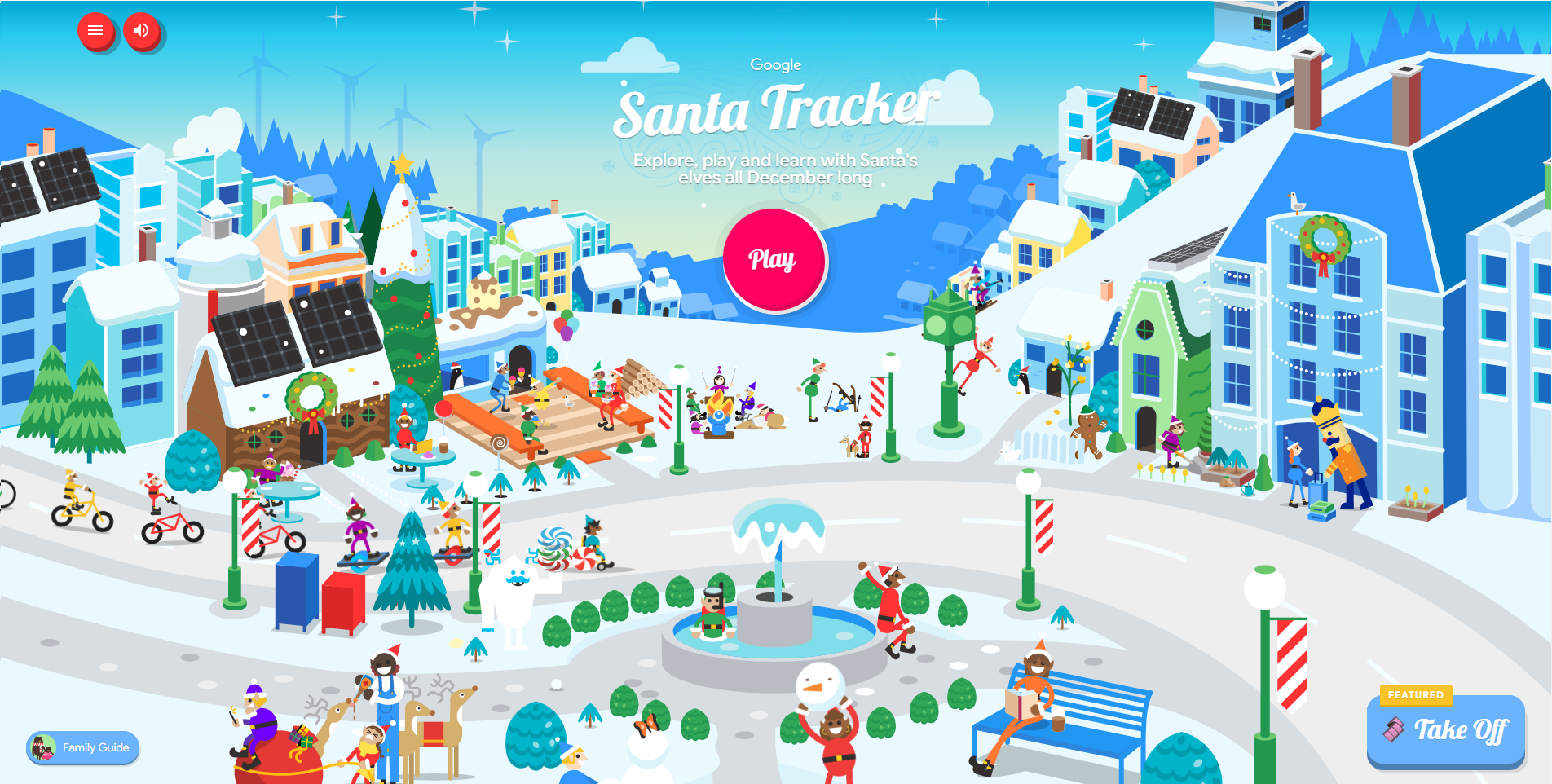
Google Santa Tracker is an annual Christmas-themed entertainment website, launched on December 1, 2004 by Google, that simulates[3] the tracking of the legendary character Santa Claus on Christmas Eve,[4] using pre-determined location information.[5] It also allows users to play, watch, and learn through various Christmas-themed activities. The site was inspired by NORAD Tracks Santa, which has operated since 1955.

Key Information

History

[edit]

In early 2004, employees at Google stated that "they felt like it could be better for users to 'visualize' where Santa is currently at" in response to the NORAD Tracks Santa service.[6] Later that year, Keyhole, Inc. was acquired by Google and they launched a paid service titled the "Keyhole Earth Viewer" (Google Earth's original name), where they would launch a service within the program titled the "Keyhole Santa Radar". The service received 25,000 viewers in its debut, and 250,000 the following year.[7]

In 2007, NORAD and Google formally announced a partnership which would last for the next five years.

In 2015, Google announced that Google Santa Tracker is now open source through GitHub.[8] This would mean that its users could install Google Santa Tracker as an APK file on Android devices. They also announced a handful of custom watch faces for Android Wear.

In 2018, the Santa Tracker added several features for students and educators. On December 4, 2018, the website fully launched a suite of games and lesson plans about coding basics and Christmas traditions around the world. The site also features information about non-profit organizations Khan Academy and Code.org.[9] The 2018 Google Santa Tracker page also allowed users to use the Google Assistant to simulate a call to Santa or listen to a Christmas story.[10] The website had 42.2 million visitors in December of that year.[11] The website claimed that Santa had delivered 5.6 billion presents in 2019.[12]

Between 2020 and 2021 during the COVID-19 pandemic, Santa, Mrs. Claus and the elves were depicted to be wearing face masks.[13] The face masks were removed in 2022.

Website

[edit]

Every Christmas Eve, the Google Santa Tracker begins to simulate tracking of Santa at about midnight in the furthest east time zone (10:00am UTC). The map shows Santa alternating between traveling and handing out presents in cities. Santa appears to travel approximately one time zone west per hour. Santa usually arrives at cities around midnight. Counters simulate to viewers how far Santa has traveled so far, how long until he reaches the viewer's city on the map, the distance from the viewer's city, and the total number of presents delivered. Santa is depicted as having helpers with him, including the standard reindeer and elves, along with penguins and a snowman.

For each city that Santa is said to visit, the first few paragraphs of the corresponding Wikipedia article are shown, giving an overview of the city. The website also shows photos with the city in the background and a depiction of Santa or his helpers in the foreground. The temperature of the city is accurately given using data from The Weather Channel. Not every large city is visited; some large cities close to other large cities are skipped, while smaller cities that are far from any other populated place are occasionally featured. Even when Santa is traveling, the counter showing the total presents delivered increases, but at a slower rate than when Santa is in a city. This rate is faster or slower depending on the population of the city Santa is in.[14]

Google Santa Tracker (GST) after Santa’s return to the North Pole

The 2015 site also featured a "This Just In" section. This section features photos resembling those taken on social media websites, which feature Santa and his helpers partaking in various activities, including imitating the cover of Abbey Road, delivering presents, and taking selfies. Users can also watch animated sketches and play games.[15] Since 2020, no new content has been produced for the site.

References

[edit]
[edit]
Revisions and contributorsEdit on WikipediaRead on Wikipedia
from Grokipedia
Google Santa Tracker is an annual interactive web application developed by Google that enables users worldwide to monitor Santa Claus's fictional journey delivering presents on Christmas Eve via a real-time map powered by Google Maps. Launched in 2004 as a simple tracking tool integrated with Google's mapping software, it has evolved into a multifaceted holiday experience featuring daily unlockable games, educational content about global cultures and geography, and festive animations to engage families and children during the Christmas season.[1][2] The project originated from Google's interest in applying its geospatial technologies to a whimsical tradition, initially providing basic visualizations of Santa's route before expanding significantly in 2012 with a redesigned interface, advanced route algorithms, and collaborative development involving external partners like Upperquad.[3][4] Over the years, a dedicated core team of Google engineers, supplemented by up to 20 volunteers annually, has iterated on the tracker to incorporate emerging technologies such as Google Assistant voice queries for location updates and contributions from Google Maps Local Guides for authentic on-route imagery.[1] This evolution positions it as a modern counterpart to longstanding traditions like NORAD's Santa tracker, emphasizing interactivity and education while testing web innovations in a playful context.[5] Key features include a Santa Village hub accessible from early December, where users unlock mini-games like Code Lab for coding basics, Elf Maker for customization, and Santa Selfie for virtual photos, alongside a countdown to the live tracking event starting on December 24 at approximately 10:00 a.m. GMT.[6][7] The platform supports multiple languages and devices, with integrations allowing searches like "track Santa" directly on Google or the Maps app, and it has notably influenced broader Google initiatives, such as holiday Doodles and experimental AI features.[3][1]

Overview

Concept and Purpose

Google Santa Tracker is a Christmas-themed entertainment website developed by Google that simulates the real-time tracking of Santa Claus delivering gifts worldwide.[8] It serves as an interactive digital experience centered on Santa's annual journey, encouraging users to explore holiday-themed content through play and visualization tools like maps.[9] The primary purposes of Google Santa Tracker are to foster holiday excitement, promote digital literacy through engaging gameplay, and provide accessible, family-friendly content without any commercial intent.[1] By incorporating elements such as coding challenges and interactive stories, it aims to blend fun with subtle educational value, helping users learn basic programming and geographic concepts in a festive context.[10] This approach emphasizes community and creativity over profit, as the project is maintained by volunteer Google employees passionate about holiday traditions. The project has been open-sourced since 2015, allowing community contributions. Targeted primarily at children and families, Google Santa Tracker holds broad appeal across the globe, offering content suitable for young learners while involving parents in shared digital holiday activities. Its non-commercial ethos distinguishes it from sponsored holiday trackers, prioritizing pure entertainment and learning to enhance the Christmas spirit.[1]

Launch and Availability

Google Santa Tracker was initially launched to the public on December 1, 2004, originating as a straightforward experiment integrated with Google Earth to simulate Santa's global journey.[1] This debut version focused on basic mapping to engage users in tracking Santa's route on Christmas Eve, marking the start of an annual holiday tradition hosted by Google.[11] The tracker becomes available each year in early December, when the website at santatracker.google.com activates with pre-launch activities such as interactive games and educational content to build anticipation.[12] Full live tracking commences around 10:00 a.m. GMT on December 24, allowing users worldwide to follow Santa's real-time progress as he delivers presents across time zones.[7] Access is entirely free and web-based, optimized for mobile devices through progressive web app (PWA) technology that supports offline functionality and home screen installation, ensuring seamless use on smartphones and tablets without requiring a download.[13] Previously, dedicated Android app versions were offered from 2014 to 2019 but were discontinued thereafter, with no native iOS app ever released; users now rely on the responsive web platform for all interactions.[14] Globally accessible, the Santa Tracker supports multiple languages, enabling broad reach and including region-specific customizations such as integrations with local holiday traditions through interactive maps and cultural content.[15] Activation occurs annually on December 24 with enhancements to mobile responsiveness, building on the PWA framework to improve performance across diverse devices and networks.[16]

History

Origins and Early Years (2004–2011)

The Google Santa Tracker originated in 2004 following Google's acquisition of Keyhole, Inc., a mapping software company whose Earth Viewer technology formed the basis for what would become Google Earth. A team of engineers from the newly integrated Keyhole group, led by Brian McClendon, developed an initial version called the "Keyhole Santa Radar" as a fun experiment to visualize Santa Claus's journey on a 3D globe. Inspired by the longstanding NORAD Tracks Santa program, this rudimentary tracker displayed a basic animated path of Santa's sleigh over a static map, accessible primarily through the Earth Viewer application and hosted on limited server resources that strained under about 25,000 users on Christmas Eve.[17] Over the next several years, the tracker evolved modestly within Google's mapping division, remaining a low-profile holiday feature with minimal promotion and no dedicated marketing budget. In 2005, it transitioned to the newly launched Google Earth platform, incorporating custom icons designed by Google doodler Dennis Hwang to depict Santa and his reindeer, while server capacity expanded to handle around 250,000 users. By 2006, enhancements included 3D models created in SketchUp—such as Santa's workshop and sleigh—and integration with NORAD's real-time location data feeds, attracting over 1 million users. The 2007 iteration marked a partnership with NORAD, where Google hosted the official noradsanta.org site, adding multilingual support, YouTube videos of Santa's flyovers, and a mobile-friendly Google Maps version, which tested the company's infrastructure with several million visitors. These updates were shared through internal Google blogs like the Google Earth Lat/Long blog, where early user feedback highlighted enthusiasm for the interactive mapping but also requests for smoother performance during peak hours.[17][1] From 2008 to 2010, the project continued under Google Labs-like experimental initiatives, focusing on incremental improvements such as photo integrations from Panoramio, Twitter updates via @noradsanta, and enhanced mobile tracking, while keeping the core experience as a whimsical Easter egg embedded in Google Earth and Maps. User engagement grew steadily, with millions participating annually, but the feature stayed simple, emphasizing visualization over elaborate content. A key milestone came in 2011, when Google introduced basic interactivity with a public countdown timer to Santa's departure, real-time tracking options across Google Maps and Earth, and enhanced mobile web monitoring, laying the groundwork for broader accessibility without yet venturing into games or multimedia expansions. This version drew positive responses via Google blog comments, underscoring its role as an engaging, family-oriented tradition that subtly showcased Google's geospatial technologies.[18][1]

Expansion and Annual Updates (2012–Present)

In 2012, Google pivoted the Santa Tracker to a fully interactive website featuring a virtual Santa's Village with games and activities, marking a significant expansion from its earlier map-based origins. This launch was developed by Google's internal teams in collaboration with Bay Area design studio Upperquad, introducing HTML5-based experiences accessible via web browsers. The site debuted on December 24, allowing users to follow Santa's journey in real time while engaging with pre-Christmas countdown content.[19][20][21] The following year, 2013, saw further enhancements with the release of a dedicated Android app, enabling mobile tracking and additional flight simulation games to build anticipation for Christmas Eve. In 2015, Google open-sourced the Santa Tracker's code on GitHub, facilitating community contributions, and introduced Code Lab, an educational coding challenge where users programmed Santa's movements using block-based logic to navigate grids and animations. This update also incorporated Firebase for analytics and remote configuration, supporting iterative improvements based on user data without any direct monetization model.[6][5][22] Subsequent years brought integrations with emerging Google technologies. In 2018, voice interactions were added via Google Assistant, allowing users to query Santa's location or simulate calls to the North Pole. The 2019 edition introduced augmented reality (AR) features, including Santa Selfie, where users could capture interactive photos with a 3D AR Santa overlay in their environment using mobile cameras. By December 2019, the site reported over 42 million visitors and simulated Santa delivering 5.6 billion presents, underscoring its scale.[23][7][24] The 2020 rollout adapted to the COVID-19 pandemic by depicting Santa, Mrs. Claus, and elves wearing face masks across the site to promote safety awareness, while maintaining full virtual operations with no interruptions to tracking or games. These annual updates, driven by internal engineering teams and open-source contributions, have consistently emphasized accessibility and educational value without commercial intent.[25][1]

Features

Live Santa Tracking

The Live Santa Tracking feature simulates Santa Claus's global journey on Christmas Eve through an interactive, GPS-like map interface powered by Google Maps, displaying his position starting from the North Pole and progressing westward across time zones.[1][26] The route follows predefined paths based on real-world geography, covering over 500 locations worldwide, with Santa alternating between flight and delivery stops; position updates occur in real-time throughout the event, integrating the Google Maps API to ensure geographical accuracy.[27][26] Users engage via a zoomable world map that highlights Santa's current location, a progress indicator for gifts delivered, and estimated arrival times for nearby areas, such as notifications approximating "Santa is approaching your region."[28][29] Along the route, the tracker includes fun facts and user-contributed photos from Google Local Guides, offering cultural insights for visited sites like seasonal traditions in Tokyo or Sydney.[7] As a fictional entertainment tool rather than genuine surveillance, the feature activates solely from December 24 to 25 each year, emphasizing holiday excitement over literal monitoring.[29][30]

Interactive Games and Activities

Google Santa Tracker features a suite of more than 20 mini-games and interactive activities that users can access throughout December, designed as an advent calendar where new content unlocks daily to build excitement for Christmas. These games immerse players in Santa's North Pole village, with themes centered on elf tasks, reindeer training, and holiday preparations, such as packing the sleigh or crafting gifts.[31][32] Representative examples include Present Bounce, a physics-based puzzle game where players launch presents into chimneys using bouncy mechanics to solve levels; Snowball Storm, an action-oriented shooter in which users hurl snowballs at targets to clear paths for Santa; and Code Lab, a block-based coding challenge that teaches programming concepts through elf automation tasks. The games emphasize short, engaging sessions to encourage daily returns, with progressive challenges in titles like Code Lab that increase in complexity across multiple levels.[8][33] Launched in 2012 as part of the tracker's interactive redesign in collaboration with agency Upperquad, the initial offerings included about five core games, such as a gift-dropping simulation and an elf rocket race, marking a shift from simple tracking to playful entertainment. Subsequent years saw expansions, with over two dozen activities by 2019 and around 30 mini-games by 2021, incorporating diverse genres from puzzles to simulations while maintaining the daily unlock structure.[34][35][31] The activities are optimized for accessibility, running directly in web browsers on desktops and mobile devices with touch-friendly controls, requiring no downloads for the core experience—though an optional Android app enhances offline play and notifications. This design supports broad participation, including family sharing, and briefly integrates coding elements in select games to blend fun with subtle learning.[8][36]

Educational and Multimedia Content

The Google Santa Tracker incorporates a dedicated Code Lab series, offering a progression of coding challenges that introduce young users to programming fundamentals through engaging, holiday-themed scenarios. These challenges utilize Blockly, a visual block-based programming tool akin to Scratch, developed in collaboration with MIT's Media Lab, to teach concepts like loops, conditionals, and sequencing, such as programming an elf to sort presents or optimizing Santa's delivery route to avoid obstacles. Released progressively throughout December, the levels build in complexity, allowing users to create animations and simulations tied to the Santa narrative, fostering problem-solving skills in an accessible format.[37][38][39] Complementing the coding activities, the Tracker features multimedia elements designed to educate users on cultural aspects of the holiday season. Short videos and animations highlight global Christmas traditions, such as Las Posadas in Mexico or the Yule Lads in Iceland, providing insights into diverse celebrations and customs around the world. Interactive tools like the Santa Selfie enable users to customize and capture virtual photos with Santa, serving as a digital photo booth that encourages creativity and sharing. These resources extend beyond entertainment, with augmented reality experiences available via Google Search integration (e.g., "Santa Search" for 3D AR views on compatible devices).[8][40][41][42] The educational goals of these components emphasize promoting STEM literacy, particularly in computer science, by making abstract concepts tangible through playful contexts. Google collaborates with educators and organizations like Code.org to support classroom integration, offering free downloadable lesson plans and activity guides tailored for K-12 settings. This approach has positioned the Santa Tracker as a valuable tool for teachers, with resources aligned to curricula on coding and cultural awareness. Some interactive games within the Tracker unlock pathways to these educational modules, seamlessly transitioning from play to structured learning.[39][43][44] Overall, the educational and multimedia offerings have driven significant engagement, contributing to the Tracker's appeal to tens of millions of global users each holiday season.[45][5]

Development and Technology

Technical Implementation

The frontend of Google Santa Tracker is constructed using HTML5 for structural elements, CSS3 (compiled from Sass) for styling, and modern JavaScript with ES modules and frameworks like LitElement for dynamic interactions. Interactive scenes, such as games and animations, are loaded as iframes within a host application, allowing modular development and cross-origin communication via a custom API.[10] Geospatial rendering for the live tracking map relies on the Google Maps JavaScript API, which displays Santa's simulated route over a global map interface. Santa's position data is generated through backend-simulated feeds rather than real-time GPS tracking, ensuring a consistent, entertainment-focused experience that mimics flight paths based on predefined routes and timestamps.[46][47] The backend infrastructure operates on Google Cloud Platform, leveraging services like Firebase for real-time monitoring, crash reporting, and remote configuration to maintain performance during high-traffic periods. In 2011, the system handled peaks of 1.6 million requests per second on Christmas Eve, demonstrating scalability for global audiences without service disruptions.[48][49] As a Progressive Web App (PWA), Santa Tracker incorporates service workers to cache assets and enable offline access to games and static content, reducing latency and supporting installation on devices for a native-like experience. Content delivery utilizes Google's global network infrastructure for low-latency distribution, though specific CDN details are not publicly detailed.[13][16] Security measures align with child privacy standards, including compliance with the Children's Online Privacy Protection Act (COPPA) through Google's broader policies for kid-directed services, which limit data collection from users under 13 without parental consent. Scalability is supported by ongoing engineering practices, such as performance optimization and load monitoring, though annual stress-testing specifics remain internal.[50] In recent iterations, elements of machine learning have appeared in experimental features, but 2023 updates focused on clarifying non-use of user data for AI training in interactive components, prioritizing privacy over personalization.[51]

Collaborations and Partnerships

Google Santa Tracker has engaged in several key external collaborations to develop its interactive features and expand its global appeal. From 2007 to 2011, Google partnered with the North American Aerospace Defense Command (NORAD) as a technology provider for the NORAD Tracks Santa program, integrating real-time Santa tracking data into Google Earth and Google Maps to enhance the holiday experience for users worldwide. This alliance leveraged Google's mapping expertise to visualize Santa's journey, drawing millions of visitors during the annual event.[52] Following the end of the NORAD partnership in 2012—when NORAD shifted to Microsoft—Google collaborated with Upperquad, a Bay Area-based design and animation studio in San Francisco, to overhaul the Santa Tracker into a fully interactive digital village. Upperquad contributed to the creation of the site's advent calendar-style layout, including the initial suite of holiday games such as elf training activities and present-wrapping simulations, which added engaging animations and user-driven content that defined the tracker's modern format. This pro-bono effort brought diverse creative talent to the project and influenced its visual and playful aesthetic for subsequent years.[53][21] Subsequent updates have incorporated internal synergies within Google, notably with the Google Assistant team starting in 2018, enabling voice-activated interactions like simulated calls to Santa and narrated Christmas stories to make the experience more accessible for younger users. Additionally, during the 2020 COVID-19 pandemic, the tracker featured safety-themed elements, such as masked characters and messages encouraging hygienic holiday practices, to promote public health awareness amid global restrictions. These partnerships have facilitated the inclusion of international artists for localized animations and multilingual content, ensuring cultural relevance across over 50 languages while coordinating live events across diverse time zones presents logistical challenges for seamless global delivery.[1][33]

Reception and Impact

Popularity and User Engagement

Google Santa Tracker has experienced substantial growth in user base. Engagement was particularly high during the holiday season, reflecting the tracker's optimization for access across devices.[8] Key drivers of this popularity include built-in social sharing features, such as the "Share Santa's Location" option, which allows users to post real-time updates on social media platforms. Additionally, viral marketing through integrated Google Doodles has boosted visibility, drawing millions to the site via search and homepage links during the holiday period.[23] The tracker's family-oriented design and educational elements appeal to a broad audience. Repeat engagement is encouraged through email reminders and personalized notifications, fostering annual returns among loyal users.[13] Analytics indicate sustained interest driven by enhanced mobile features and global accessibility.[54] Google clarifies the tracker as a fun simulation to maintain its whimsical intent. In 2024, the tracker continued with interactive features and live tracking on December 24-25.[8]

Cultural and Comparative Influence

Google Santa Tracker has become integrated into many families' holiday rituals, serving as a digital centerpiece for Christmas Eve anticipation and shared excitement among children and parents worldwide.[55] Its interactive elements, such as real-time tracking and daily activities, foster bonding moments, often used alongside traditional practices like leaving cookies for Santa.[56] In media, the tracker has garnered mentions in outlets highlighting its role in modern holiday celebrations, though specific parodies remain limited in documented sources. Comparatively, Google Santa Tracker contrasts with the NORAD Tracks Santa initiative, which originated in 1955 as a military-run effort focused on a straightforward map-based tracking using radar simulations and has maintained a more traditional, less interactive format since its inception.[57] Unlike emailSanta.com, which specializes in personalized video letters from Santa without any tracking functionality, Google's version excels in gamification—offering mini-games, videos, and coding challenges—that leverage technological innovation to engage users beyond mere location monitoring.[58] Criticisms of the tracker include debates over its contribution to the commercialization of holidays, with some observers noting how tech giants like Google amplify consumer-oriented festive experiences, though the company positions the tool as a neutral, fun public service without direct sales integration.[5][59] On a global scale, the tracker enhances cross-cultural appeal by incorporating content on diverse holiday traditions, such as Diwali lanterns in India or Lunar New Year customs in Asia, adapting its features to resonate in non-Christian regions and broadening its reach beyond Western Christmas observances.[31][60]

References

User Avatar
No comments yet.