Hubbry Logo
Great Baltimore FireGreat Baltimore FireMain
Open search
Great Baltimore Fire
Community hub
Great Baltimore Fire
logo
8 pages, 0 posts
0 subscribers
Be the first to start a discussion here.
Great Baltimore Fire
from Wikipedia

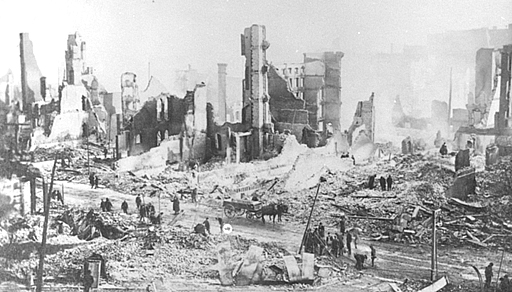
An illustration of the aftermath of the Great Baltimore Fire in February 1904

The Great Baltimore Fire raged in Baltimore, Maryland from Sunday February 7 to Monday February 8, 1904. More than 1,500 buildings were completely leveled, and some 1,000 severely damaged, bringing property loss from the disaster to an estimated $100 million.[1] 1,231 firefighters helped bring the blaze under control, both professional paid truck and engine companies from the Baltimore City Fire Department (B.C.F.D.) and volunteers from surrounding counties and outlying towns, as well as out-of-state units that arrived on the major railroads. The fire destroyed much of central Baltimore, including over 1,500 buildings covering an area of some

140 acres (57 ha).From North Howard Street in the west and southwest, the flames spread north through the retail shopping area as far as Fayette Street and began moving eastward, pushed by the prevailing winds. Narrowly missing the new 1900 Circuit Courthouse, now the Clarence M. Mitchell Jr. Courthouse, fire passed the historic Battle Monument Square from 1815 to 1827 at North Calvert Street, and the quarter-century-old Baltimore City Hall, built in 1875 on Holliday Street; and finally spread further east to the Jones Falls stream which divided the downtown business district from the old East Baltimore tightly-packed residential neighborhoods of Jonestown (also known as Old Town) and newly named "Little Italy". The fire's wide swath burned as far south as the wharves and piers lining the north side of the old "Basin" (today's "Inner Harbor") of the Northwest Branch of the Baltimore Harbor and Patapsco River facing along Pratt Street.

It is considered the third worst conflagration in an American city, surpassed only by the Great Chicago Fire of 1871, and the San Francisco Earthquake and Fire of 1906. Other comparable major urban disasters are the Galveston Hurricane of 1900 and most recently, Hurricane Katrina that hit New Orleans and the Gulf of Mexico coast in August 2005. One reason for the fire's long duration was the lack of national standards in firefighting equipment. Although fire engines from nearby cities (such as Philadelphia and Washington, D.C. as well as units from New York City, Virginia, Wilmington, and Atlantic City) responded with horse-drawn pumpers, wagons, and other related equipment (primitive by modern-day standards, but only steam engines were motorized in that era) carried by the railroads on flat cars and in box cars, many could not help since their hose couplings did not fit Baltimore's fire hydrants.

Much of the destroyed area was rebuilt in relatively short order, and the city adopted a building code, stressing fireproof materials. Perhaps the greatest legacy of the fire was the impetus it gave to efforts to standardize firefighting equipment in the United States, especially hose couplings.

Background

[edit]

In centuries past, fires regularly ravaged cities, frequently destroying large areas within. Close living quarters; lax, unenforced, or non-existent building codes; and a widespread dearth of firefighting services were all contributing factors to the frequency and extent of urban fires. The rapid expansion of American cities during the nineteenth century also contributed to the danger.[citation needed]

In addition, firefighting practices and equipment were largely unstandardized, with each city having its own system. As time passed, these cities invested more in the systems that they already had, increasing the costs of any conversion. In addition, early equipment was often patented by its manufacturer.[2] By 1903, over 600 sizes and variations of fire hose couplings existed in the United States.[2] Despite efforts to establish standards being made since the 1870s, they had little effect: no city wanted to abandon its system, few saw any reason to adopt standards, and equipment manufacturers did not want competition.[2]

Progression of the fire

[edit]
John E. Hurst Building, site of the fire's outbreak

Fire was reported first at the John Hurst and Company building on West German Street at Hopkins Place (modern site at the southwest corner of the Baltimore Civic Center of 1962, currently the CFG Bank Arena) in the western downtown at 10:48 a.m. on Sunday, February 7, and quickly spread. Soon, it became apparent that the fire was outstripping the ability of the city's firefighting resources to fight it, and calls for help were telegraphed to other cities. By 1:30 p.m., units from Washington, D.C. were arriving on the Baltimore and Ohio Railroad at Camden Street Station. To halt the fire, officials decided to use a firebreak, and dynamited buildings around the existing fire. This tactic, however, proved unsuccessful. Not until 5:00 p.m. the next day was the fire brought under control, after burning for thirty hours.

One reason for the fire's duration was the lack of national standards in firefighting equipment. Fire crews and fire engines came from as far away as Philadelphia and Washington that day (units from New York City were blocked by a train accident; they arrived the next day – Monday, February 8). The crews brought their own equipment. Most could only watch helplessly after discovering that their hoses could not connect to Baltimore's gauge size of water hydrants, although a machine shop in the Locust Point area of the city did start making coupling rings to overcome this problem. High winds and freezing temperatures further contributed to the fire's extent and firefighters' difficulties.[3] As a result, the fire burned over 30 hours, destroying 1,545 buildings[3] spanning 70 city blocks—amounting to over 140 acres (57 ha).[4]

While Baltimore was criticized for its hydrants, this problem was not uniquely its own. During that era, American cities used more than six hundred different sizes and variations of fire hose couplings.[5] As outside firefighters returned to their home cities, newspapers published interviews that condemned Baltimore and exaggerated locals' response during the crisis.[who?] In addition, many newspapers published accounts by travelers who, in actuality, had only seen the fire as their trains passed through Baltimore. Nonetheless, the responding agencies and their equipment did prove useful, since the uncoupleable hoses only represented a small part of the transported equipment. Ultimately, the tragedy led to the standardization of hydrants nationwide.[6][7]

In addition to firefighters, outside police officers, the Maryland National Guard, and the Naval Brigade were utilized during the fire to maintain order and protect the city. Police and soldiers not only kept looters away, but also prevented civilians from inadvertently interfering with firefighting efforts. The Naval Brigade secured the waterfront and waterways to keep spectators away. Officers from Philadelphia and New York also assisted the City Police Department.

Thomas Albert Lurz (b. January 9, 1874), a Baltimore native and letter carrier with the U.S. Post Office, rescued tons of mail from the burning Central Post Office on the east side of Battle Monument Square, on North Calvert Street, between East Lexington and Fayette Streets. Lurz gathered a group of men who loaded bags of mail onto horsedrawn wagons, took them to North and Pennsylvania Avenues, and stood guard until the Maryland National Guard arrived (for which he later received a commendation).[citation needed] Meanwhile, back at the General Post Office, employees spraying water on the building's sides and roof, which minimized damage and saved the 1889 Italian Renaissance edifice with its nine towers and central tall clock tower (later razed and replaced by the current 1932 building, later converted to city use as Courthouse East).

Aftermath

[edit]

In the aftermath, 35,000 people were left unemployed.[8] Over $150 million (in 1904 USD) worth of damage was done, which is approximately $3.84 billion in 2014 dollars.

Immediately after the fire, The Baltimore News quoted Mayor Robert McLane: "To suppose that the spirit of our people will not rise to the occasion is to suppose that our people are not genuine Americans. We shall make the fire of 1904 a landmark not of decline but of progress." McLane then refused assistance, "As head of this municipality, I cannot help but feel gratified by the sympathy and the offers of practical assistance which have been tendered to us. To them I have in general terms replied, 'Baltimore will take care of its own, thank you.'"[9]

Two years later, on September 10, 1906, The Sun reported that the city had risen from the ashes and that "One of the great disasters of modern time had been converted into a blessing."[10]

Great Baltimore Fire of 1904, looking West from East Pratt and North Gay Streets
Same view in 1906, 2 years after the fire

Most agreed that the Great Fire directly caused no deaths.[11] An autobiography written by Alice Mae Cawthorne tells of a couple named Mr. and Mrs. Chambre who lost their twin daughters in the Baltimore fire. There are also reports of a merchant suffering a heart attack while evacuating goods from his store. It may be that deaths were not recorded accurately. In 1907 a bronze historical marker commemorating "The Great Fire" was placed next to the main western entrance of the "Wholesale Fish Market" (now the Port Discovery children's museum), one of three new adjoining Centre Market structures replacing the old burned second "Centre Market" building and Maryland Institute of 1851. Since the late 1980s, the structure has been renamed the Port Discovery children's museum. This major commemorative tablet reads "Lives Lost: None."[12] However, a recently rediscovered newspaper story from The Sun[13] tells of the charred remains of a "colored man" being pulled, almost two weeks after the fire, from the harbor basin, near the modern Inner Harbor area USS Constellation Dock (old Pier 2).[14]

Five lost lives were indirectly attributed to the fire. Two members of the 4th Regiment of the Maryland National Guard, Private John Undutch of Company 'F', and Second Lieutenant John V. Richardson of Company 'E', both fell ill and died of pneumonia. Fireman Mark Kelly and Fire Lieutenant John A. McKnew also died of pneumonia and tuberculosis due to exposure during the Great Fire.[15] Martin Mullin, the proprietor of Mullin's Hotel (on the northwest corner of West Baltimore and North Liberty Streets, above Hopkins Place), a block to the north of the John E. Hurst Building, where the fire started, also later died.[16]

Mayor McLane's mysterious and sudden death later that year, ruled a suicide, was also attributed by some of his contemporaries to the stress of post-fire reconstruction.[17]

Legacy

[edit]

As a result of the fire, Baltimore finally adopted a city building code after seventeen nights of hearings and multiple City Council reviews. The city's downtown "Burnt District" was rebuilt using more fireproof materials, such as granite pavers.[citation needed] Public pressure, coupled with demands of companies insuring the newly re-built buildings, spurred the effort.[3]

The National Fire Protection Association adopted a national standard for fire hydrant and hose connections. However, inertia remained. Conversion was slow and still remains incomplete. One hundred years after the Baltimore Fire, only 18 of the 48 most populous American cities were reported to have national standard fire hydrants.[18] Hose incompatibility contributed to the Oakland firestorm of 1991: although the standard hose coupling has 2.5 inches (64 mm) diameter, Oakland's hydrants had 3-inch (76 mm) couplings.[2]

H. L. Mencken, future famed columnist/commentator/author and linguist, survived the fire at the beginning of his blossoming journalism and literary career, but the offices of his newspaper, the Baltimore Herald (at the northwest corner of St. Paul and East Fayette Streets), were destroyed on the northern edge of the "Burnt District". Mencken related the fire and its aftermath near the end of the second volume of his autobiographical trilogy, Newspaper Days: 1899–1906, published 1941, "When I came out of it at last I was a settled and indeed almost a middle-aged man, spavined by responsibility and aching in every sinew, but I went into it a boy, and it was the hot gas of youth that kept me going."[19]

The Herald printed an edition the first night of the fire on the press of The Washington Post, in exchange for providing photographs to The Post, but could not continue this arrangement because of a long-standing arrangement between The Washington Post and the Baltimore Evening News. For the next five weeks The Herald was printed nightly on the press of the Philadelphia Evening Telegraph and transported 100 miles (160 km) to Baltimore on a special train, provided free of charge by the B&O Railroad. The fire also devastated the city's other major newspapers, including The Sun with its famous "Iron Building", considered the forerunner of modern steel skyscrapers, built 1851 at East Baltimore Street. Across the intersecting South Street-Guilford Avenue was the publishing headquarters of the Baltimore Evening News, founded 1871 and built in 1873 with its mansard roof and corner clock tower. Baltimore's oldest news publication, The Baltimore American (dating back to 1773 or 1796 by various accounts and owned and published by local civic titan, General Felix Agnus), was also burnt out of its offices and forced to have papers printed out-of-town and shipped back by train.

The "Box 414 Association", which has assisted the Baltimore City Fire Department for many years, acts like a local American Red Cross, or military United Service Organization (USO), sending refreshments and break-time trucks to the sites of major alarms and fires to provide exhausted firefighters some comfort and snacks. It is named after the first alarm box pulled on the morning of Sunday, February 7, 1904.

The BCFD memorializes the fire annually at the bronze statue of a firefighter at the Department's old headquarters, facing City Hall, the War Memorial Building and the broad ceremonial plaza in between at East Lexington and North Gay Streets. Observances are also held at the closest street corner to the Great Fire's beginnings at South Howard and West Lombard Streets alongside the old Civic Center/Arena. The Maryland Historical Society commemorated the fire's centennial in 2004 with a website, two books and various events, lectures, and tours through the auspices of the Fire Museum of Maryland on York Road in Lutherville-Timonium-Cockeysville in Baltimore County. Several commemorative stories and special sections were published during the month in Baltimore's only remaining daily newspaper, The Baltimore Sun, and the four local television stations' and several documentaries and interviews/discussion programs on the city's public radio network (NPR) station, WYPR-FM, also commemorated the event.

The folk song "Baltimore Fire" by Charlie Poole and the North Carolina Ramblers, recorded on Columbia Records (15509-D, May 6, 1929) also commemorates the event.

Fire!, fire!, I heard the cry
From every breeze that passes by
All the world was one sad cry of pity
Strong men in anguish prayed
Calling out to the heavens for aid
While the fire in ruins was laid
Fair Baltimore, the beautiful city

More recently, the Baltimore-based rock band J. Roddy Walston and the Business memorialized the fire in "Nineteen Ought Four", on their album Hail Mega Boys.

See also

[edit]

39°17′19.3″N 76°37′9″W / 39.288694°N 76.61917°W / 39.288694; -76.61917[20]

References

[edit]
[edit]
Revisions and contributorsEdit on WikipediaRead on Wikipedia
from Grokipedia
The Great Baltimore Fire was a catastrophic urban conflagration that ravaged , , from February 7 to 8, , destroying 1,526 buildings across 70 city blocks in the city's commercial core and causing an estimated $150 million in (equivalent to over $5 billion today). The blaze originated around 10:50 a.m. on Sunday, February 7, from a spark igniting packing cases in the basement of the John E. Hurst & Company store at Hopkins Place and German Street, and it spread rapidly southeast toward the and east across Jones Falls, fueled by gusty winds exceeding 30 miles per hour. Despite the immense destruction—encompassing 140 acres, including wholesale districts, banks, and warehouses—the fire claimed few direct lives, with reports citing zero to five fatalities, though it left over 35,000 people jobless by obliterating key economic hubs. The response involved more than 1,500 firefighters from Baltimore and at least 20 other cities, including New York, , and , who battled the flames for over 30 hours using streams from fireboats and to create firebreaks, but efforts were severely hampered by incompatible hose couplings that prevented efficient use of out-of-state equipment. In the immediate aftermath, relief committees distributed aid to the affected population, while insurance companies covered nearly 90% of claims, facilitating a swift economic rebound as capital poured in for reconstruction. The city established the Burnt District Commission in March 1904 to clear debris and replan the area, resulting in widened streets, reduced grades, new public spaces, and fire-resistant buildings constructed with steel, concrete, and brick—transforming Baltimore's skyline and emphasizing modern . Nationally, the accelerated reforms by the National Board of Fire Underwriters, leading to standardized tools, improved building codes, and enhanced municipal that influenced across the .

Historical Context

Baltimore's Urban Landscape in 1904

By the turn of the , had emerged as a prominent East Coast port city, fueled by rapid industrialization throughout the . Its population reached approximately 508,957 by 1900, reflecting a dramatic increase from 169,000 in , driven by waves of immigrants and rural migrants seeking opportunities in and trade. As the world's largest flour market in the 1820s and a hub for clipper ships trading globally, Baltimore's economy centered on shipping exports like , , and —handling 10 million tons of annually by 1900—alongside burgeoning sectors such as textiles, canning, and steel production at facilities like Sparrows Point. Wholesale and retail trade dominated, with domestic commerce valued at $70–$80 million yearly by the mid-19th century, supported by railroads and steamboats that positioned the city as a key distribution point for the region and beyond. The city's dense commercial district clustered around the Inner Harbor, where narrow streets and closely packed warehouses amplified fire risks through the storage of highly flammable goods. This area, extending from Fells Point to Federal Hill, featured multi-story warehouses along wharves like Brown's and Belt's, stocked with , , , and other combustibles essential to the port's operations. German Street (now Redwood Street), in the heart of the garment and wholesale district near Hopkins Place and Liberty Street, housed major firms such as John E. Hurst & Company, a key wholesaler of notions and textiles that exemplified the sector's economic vitality. These establishments, often employing hundreds in garment production and trade, contributed to Baltimore's role as a powerhouse, with firms like Sonneborn's works and Wise Brothers operations underscoring the reliance on immigrant labor in sweatshops. Urban growth patterns following the Civil War exacerbated vulnerabilities, as the population surged 25% per decade, leading to overcrowding in the expanding city core. in 1888 added 23 square miles, spurring the of over 40,000 new houses, but much of the commercial zone retained wooden frames and brick structures lacking modern fire-resistant features, a legacy of lax 19th-century building practices that prioritized rapid development over . The gridiron street layout, while facilitating trade, created tight alleys and rowhouses filled with flammable materials, heightening the potential for rapid spread in an era before stringent codes—'s first formal regulations dated only to 1859 and proved insufficient for the city's scale. This boom transformed into a vibrant but precarious urban landscape, where economic prosperity intertwined with physical densities that intensified inherent risks.

Firefighting Challenges Pre-Fire

In the early 20th century, U.S. firefighting grappled with profound technological and organizational shortcomings, exemplified by the absence of national standards for essential equipment like fire hoses and hydrants. By 1903, a study by the National Bureau of Standards identified over 600 incompatible sizes and variations in fire hose couplings across American cities, preventing seamless interoperability during mutual aid operations as departments from different regions could not connect their hoses to local hydrants. Efforts to establish uniform standards had begun in the 1870s through organizations such as the National Association of Fire Engineers, which advocated for consistent thread designs and diameters at annual conferences; however, these initiatives repeatedly failed due to prohibitive costs for retrofitting existing hydrants and apparatus, resistance from manufacturers profiting from proprietary systems, and local traditions that prioritized customized equipment over national conformity. Baltimore's fire department embodied these broader challenges while transitioning from its volunteer roots. Formed in 1747 with rudimentary ordinances, the city's initially relied on competing volunteer companies that often prioritized rivalries over efficiency, prompting their disbandment in in favor of a professional force of 153 paid members. Despite this shift, the department remained under-equipped for urban-scale emergencies, depending on steam-powered engines that required constant manual fueling with shoveled by hand and horse-drawn hose wagons limited by narrow streets and traffic. These apparatus, while an advancement over hand-pumped engines, lacked the mobility and power needed for rapid response in a growing industrial port city. Compounding equipment issues was Baltimore's inadequate water infrastructure, which relied on gravity-fed reservoirs and manual sources like buckets or cisterns for supplementation, with steam pumps delivering only 500 to 1,000 gallons per minute per engine—far below the volume required to suppress intense commercial blazes. This limited capacity stemmed from an early 19th-century municipal system focused on basic supply rather than high-pressure delivery, leaving hydrants vulnerable to pressure drops during prolonged operations. Such deficiencies mirrored systemic risks evident in prior U.S. conflagrations, including the of 1871, where wooden construction, high winds, and insufficient water pressure destroyed 17,450 buildings and left 100,000 homeless, yet failed to spur widespread reforms in equipment or standards.

Outbreak and Progression

Ignition and Initial Spread

The Great Baltimore Fire ignited on the morning of Sunday, February 7, 1904, at approximately 10:48 a.m., in the basement of the John E. Hurst & Co. located at the corner of Hopkins Place and German Street (now Redwood Street) in . The blaze is believed to have started from a discarded or that ignited among highly flammable materials such as packing boxes, fabrics, and paper goods stored near the shaft. Upon arrival within minutes, firefighters from Engine Company 15 and Truck Company 2 entered the five-story building with hoses, but a massive —likely from a gasoline tank—forced their evacuation and propelled flames upward through the structure, rapidly engulfing the entire . The fire's initial spread was accelerated by the building's dense stock of combustibles and strong northwest winds, with gusts later exceeding 30 miles per hour, which fanned embers across rooftops and into adjacent structures. Within the first 10 minutes, the Hurst building's roof and floors collapsed, sending sparks southward and eastward; by 11:48 a.m., the flames had jumped German Street to the National Exchange Bank and consumed buildings along Hopkins Place and Liberty Street. High winds continued to drive the , with embers igniting rooftops blocks away, leading to the loss of at least a dozen structures in the opening hour. Over the next two hours, the fire expanded unchecked to Baltimore Street and south toward Conway Street, devouring an estimated 20 to 30 buildings by 1:00 p.m. as it expanded eastward along Baltimore Street. Eyewitnesses, including city officials observing from the dome of City Hall, described thick columns of smoke and intense heat visible for miles, drawing large crowds of spectators that clogged streets and impeded access to hydrants and equipment. These gatherings, combined with the Sunday morning timing when many businesses were closed but residents were out, exacerbated the chaos as flames met in midair and embers scattered widely.

Efforts to Contain the Blaze

As the Great Baltimore Fire spread rapidly through the city's commercial district starting on the morning of February 7, 1904, initial firefighting efforts were hampered by equipment incompatibilities. Firefighters from and , who arrived by train that evening, found their hose couplings did not match Baltimore's hydrants, delaying effective water delivery and forcing improvised connections or manual labor. Similar issues affected responders from other cities, underscoring the lack of national standards for fire equipment at the time. To create firebreaks and halt the blaze's advance, Mayor Robert M. McLane authorized the use of to demolish buildings in its path, a desperate tactic employed amid high winds and intense heat. However, these explosions often proved ineffective, sometimes scattering burning debris and accelerating the fire's spread rather than containing it. Inexperienced handlers and gusty conditions further undermined the strategy, with multiple attempts failing to topple structures cleanly. Over the course of the 30-hour conflagration, 1,231 firefighters were deployed, including members of the and additional units from at least a dozen other cities in states such as New York, , and , as well as Water for suppression efforts came from city hydrants, ships in the harbor, and direct drafting from the Jones Falls river, though pressure often faltered under the demand. By the morning of February 8, with the fire having consumed much of the downtown core, commanders shifted to defensive tactics, prioritizing the protection of critical landmarks like the and infrastructure such as the yards. The blaze was finally contained around 5:00 p.m. on February 8, 1904, after exhausting available fuel in the commercial district and reaching natural barriers like the Jones Falls, where combined efforts of local and out-of-state units proved decisive.

Destruction and Immediate Response

Extent of Damage and Casualties

The Great Baltimore Fire devastated the downtown business district of , destroying 1,526 buildings across 140 acres, encompassing approximately 70 city blocks. This destruction primarily affected commercial structures, including banks, office buildings, s, and warehouses, leaving vast swaths of the city's core reduced to smoldering ruins. The fire's path followed a northeasterly trajectory from its origin near the Hurst & Co. , fueled by high winds and combustible materials. Property losses from the were estimated at $150 million in 1904 dollars, equivalent to approximately $5.5 billion in 2025 dollars when adjusted for . No direct fatalities were officially reported, a remarkable outcome given the fire's scale and duration, though five indirect deaths occurred among firefighters and civilians due to exhaustion, , and related injuries sustained during the blaze. The five indirect deaths included two members of the (Private John Undutch and Private John Richardson) who succumbed to , along with three firefighters from exhaustion and related illnesses. The human toll extended beyond casualties, leaving approximately 35,000 people jobless as over 2,500 businesses were obliterated. Due to the fire's focus on the commercial district, residential displacement was limited. The fire produced dense smoke clouds visible from a distance, and debris from the destruction was later disposed of in nearby areas.

Emergency Aid and Relief

Following the Great Baltimore Fire, which displaced thousands of residents and destroyed vast swaths of the city's business district, Mayor Robert McLane emphasized self-reliance in recovery efforts, declaring that Baltimore would rebuild without federal financial assistance while welcoming non-monetary support from other cities. McLane rejected offers of federal aid but initially accepted private donations totaling around $60,000 via telegrams, though much of the later $200,000 in contributions was returned to donors as a gesture of independence. Supplies and personnel aid arrived promptly from cities including New York and , where fire companies and equipment were dispatched to assist in containment and early recovery logistics. Temporary shelters were quickly established in city parks, schools, and undamaged buildings to house the displaced, with local committees coordinating the distribution of essential items such as food, blankets, and medical supplies. The Citizens' Relief Committee, appointed by McLane and funded by a $250,000 state appropriation, focused on immediate humanitarian needs, disbursing aid to over 1,000 families through partnerships with established charities for provisions like groceries and nursing care to address exposure-related illnesses. Although the played a limited role compared to later disasters, community-led initiatives filled gaps in relief, providing hot meals and bedding to those affected in the chaotic days following the blaze. To maintain order amid fears of looting in the ruined district, the Maryland National Guard was deployed starting the afternoon of February 8, 1904, with the 4th and 5th regiments and Troop A patrolling under Lawson Riggs to safeguard property and assist police. Insurance companies and officials conducted rapid on-site assessments amid the debris, initiating claims processing to help businesses and individuals recover losses, though the scale of destruction—estimated at over $100 million—complicated early evaluations. Community efforts proved vital, as churches, synagogues, and local businesses organized free meal services and supply drives, with groups like the South Baltimore Jewish community offering , bread, and clothing to firefighters and victims alike, sustaining thousands in the first week.

Reconstruction and Economic Recovery

Rebuilding the City

The rebuilding of following the Great Baltimore Fire of proceeded with remarkable speed, driven by a collective determination to restore the city's commercial core. The Burnt District Commission, established in March 1904, coordinated debris removal, street expansions, and urban replanning to facilitate rebuilding. Within six months of the blaze, 236 buildings were under in the burned district, and by one year later, over 200 new structures had been completed with an additional 170 in progress. The business district was fully restored by 1906, less than two years after the destruction, marking one of the swiftest urban recoveries in American history. Reconstruction efforts emphasized fireproof construction techniques, drawing inspiration from Chicago's post-1871 fire innovations, where steel-frame buildings had proven resilient. Baltimore's developers widely adopted steel skeletons, , and brick facades to replace the wooden and cast-iron structures that had fueled the . These materials not only enhanced safety but also allowed for taller, more efficient buildings suited to the city's growing commerce. In response, city officials enacted a new in late 1904, mandating non-combustible materials for commercial zones to prevent future disasters. This initiative included the expansion of street widths in the affected area to improve firefighting access and traffic flow, with plans approved for widening key thoroughfares like those in the downtown core. Notable projects under this framework included the reconstruction of the building, completed in 1906 at and Charles streets as a modern steel-frame headquarters for the newspaper. Private investments accelerated the process, with insurance payouts and bank loans providing critical capital for the economic recovery. Architects such as Joseph Evans Sperry contributed by designing utilitarian warehouses and commercial spaces, often in collaboration with out-of-town firms, exemplifying the shift to durable, modernist designs.

Financial and Social Impacts

The Great Baltimore Fire of 1904 inflicted severe financial damage, with total property losses estimated at $150 million, equivalent to over $5 billion in 2025 dollars. This destruction encompassed more than 1,500 buildings in the city's commercial core, representing approximately 10-15% of Baltimore's assessed property value at the time and temporarily paralyzing trade and commerce in the affected district. Insured losses reached around $50 million, though actual payouts totaled about $30.5 million due to policy limits, expiration clauses during the blaze, and other contractual disputes that delayed or reduced settlements for some policyholders. Nearly 90% of claims were ultimately paid, averting widespread insurer failures, but the strain contributed to higher premiums nationwide and greater scrutiny of fire insurance practices. The event prompted reforms, including the National Board of Fire Underwriters' issuance of new guidelines in 1905 for risk assessment and rate-setting to prevent future vulnerabilities. Socially, the fire displaced 35,000 workers—roughly 7% of the city's —disrupting livelihoods in the business district and initially driving some firms to temporary relocation outside the core, which widened existing class divides as lower-wage sectors recovered more slowly. Women and recent immigrants, who comprised a large share of the affected labor force in retail and , faced acute and instability in the immediate aftermath. Despite these hardships, reconstruction efforts created thousands of jobs, aiding a swift economic rebound that modernized Baltimore's infrastructure and attracted fresh capital to shipping and industry. By , the influx of investments had revitalized the and manufacturing base, propelling industrial output from $150 million in 1904 to $700 million by 1927.

Legacy and Reforms

Architectural and Urban Changes

The Great Baltimore Fire of 1904 prompted a fundamental shift in the city's architectural practices, emphasizing fire-resistant to prevent future catastrophes. In the ensuing years, particularly between 1905 and 1920, new downtown buildings widely incorporated steel skeletons for structural support, combined with non-combustible cladding such as terra cotta and exteriors, which provided effective fire barriers. Flat roofs also became standard, replacing the more vulnerable pitched designs common in pre-fire structures. These innovations were codified in the city's new building regulations, which mandated fireproof materials for commercial edifices in the burned . Urban planning in Baltimore underwent significant revisions to enhance safety and functionality, drawing on the fire's lessons to modernize the city's layout. The Burnt District Commission, established shortly after the blaze, oversaw the widening of key thoroughfares including St. Paul Street, Pratt Street, Light Street, German Street, Lombard Street, Charles Street, and Hopkins Place, expanding street areas by approximately 35,000 square feet to improve fire apparatus access and reduce congestion. These efforts included lowering street grades and establishing uniform building lines and sidewalks, while proposals from the Olmsted Brothers firm advocated for a new diagonal street from Pratt and Light to Baltimore and Liberty to better connect the harbor with the commercial core, though not all were implemented due to property owner resistance. Additionally, early zoning measures emerged, such as a 1904 Maryland state law limiting building heights around Mount Vernon Place to preserve views and prevent overshadowing of historic structures, marking one of the nation's first such restrictions. Improved alley access was integrated into these plans, facilitating rear entry for services and emergency response in commercial zones, with zoning gradually separating high-density business areas from residential neighborhoods to mitigate fire spread risks. The fire's uneven destruction inadvertently aided the preservation of certain landmarks, sparing areas like and enabling their later protection as s. 's survival, including its and surrounding rowhouses, allowed for targeted enhancements under the , such as formal gardens and balustrades at Mount Vernon Place redesigned by Carrère & Hastings in the 1910s and 1920s, which reinforced its role as a cultural anchor. This preservation momentum contributed to formal historic district designations in the mid-20th century, safeguarding the area's 19th-century architecture amid broader downtown redevelopment. The event left enduring cultural markers in Baltimore's landscape, embedding the fire into the city's identity and shaping its 20th-century skyline. A prominent historical marker at the fire's origin site on Hopkins Place commemorates the blaze's start on February 7, 1904, and its containment the following day, serving as a public reminder of the disaster's scale. The reconstructed skyline, with its fireproof high-rises, symbolized resilience and influenced ongoing urban aesthetics, while annual commemorations like the fundraiser have tied the event to preservation efforts, such as restorations in . The fire accelerated Baltimore's alignment with Progressive Era urban reforms, mirroring initiatives in cities like , where comprehensive planning emphasized coordinated public spaces and infrastructure upgrades. In , the catastrophe provided an impetus for adopting City Beautiful principles—focusing on aesthetic and functional city design—through commissions that prioritized widened boulevards and preserved green spaces, much like Cleveland's 1903 Group Plan for civic centers, thereby modernizing the city's core faster than pre-fire incremental changes would have allowed.

Advancements in Fire Safety Standards

The Great Baltimore Fire of 1904 served as a pivotal catalyst for the National Fire Protection Association (NFPA) to prioritize standardization of firefighting equipment, particularly hose threads, which had proven incompatible during the blaze when aid from neighboring jurisdictions arrived with mismatched couplings. In response, the NFPA established a committee that surveyed national variations and adopted its first standard for fire hose couplings in 1905, specifying 7.5 threads per inch for 2.5-inch hoses and 4 threads per inch for 4.5-inch pumper connections. This standard saw gradual adoption through the 1910s as municipalities updated their equipment, achieving widespread national implementation by 1925, thereby enabling seamless mutual aid across regions. Prompted by the fire's devastation, Baltimore enacted a stringent in 1905 that mandated automatic sprinkler systems in large commercial structures and required robust fire walls to compartmentalize blazes, setting a for fire-resistive . This local ordinance influenced the National Board of Fire Underwriters (NBFU) to publish the first model National later that year, incorporating similar provisions for sprinklers in high-risk buildings and fire walls along property lines to prevent spread. The NBFU code, directly inspired by Baltimore's reforms, was adopted or adapted as a basis for building regulations in over 20 states by the , promoting uniform measures nationwide. The fire also accelerated technological advancements in , highlighting the limitations of horse-drawn engines that struggled with rapid deployment and endurance during the prolonged response. In the years following , fire departments increasingly promoted and adopted motorized engines, with the first commercial gasoline-powered models entering service around , offering faster response times and greater reliability over equine transport. Enhanced hydrant designs emerged concurrently, incorporating the new standardized threads and improved water flow capacities to address the pressure failures observed in . On a broader scale, the Baltimore Fire contributed to NFPA's ongoing efforts in developing standards, building on the 1905 hose and initiatives to enforce better materials and practices nationwide. Today, remains a in preparedness training programs, emphasizing in response, while the 2004 centennial commemorations underscored persistent needs for full , as even a century later, not all major U.S. cities utilized uniform hydrant connections.

References

Add your contribution
Related Hubs
User Avatar
No comments yet.