


Community hub
Recent from talks
Contribute something
Nothing was collected or created yet.
2015 Baltimore protests
View on Wikipedia


On April 12, 2015, Baltimore Police Department officers arrested Freddie Gray, a 25-year-old African American resident of Baltimore, Maryland. Gray's neck and spine were injured while he was in a police vehicle and he went into a coma. On April 18, protests occurred in front of the Western district police station.[1][2] Gray died on April 19.
Further protests were organized after Gray's death became public knowledge, amid the police department's continuing inability to adequately or consistently explain the events following the arrest and the injuries. Spontaneous protests started after the funeral service, although several included violent elements. Civil unrest continued with at least twenty police officers injured, at least 250 people arrested, 285 to 350 businesses damaged, 150 vehicle fires, 60 structure fires,[13] 27 drugstores looted,[14] thousands of police and Maryland National Guard troops deployed, and with a state of emergency declared in the city limits of Baltimore.[15][16] The state of emergency was lifted on May 6.[17] The series of protests took place against a historical backdrop of racial and poverty issues in Baltimore.[18][19]
On May 1, 2015, Gray's death was ruled by the medical examiner to be a homicide. Six officers were charged with various offenses, including second-degree murder, in connection with Gray's death.[20] Three officers were subsequently acquitted; in July 2016, following the acquittals, Baltimore City State's Attorney Marilyn Mosby dropped charges against the remaining three officers.[21]
Events
[edit]April 12: Gray's arrest
[edit]On April 12, 2015, Freddie Carlos Gray Jr., a 25-year-old African-American man, was arrested by the Baltimore City Police Department for possession of a “switchblade”, in the 1700 block of Presbury Street in the Sandtown-Winchester neighbourhood.[22][23] Two weeks later, State's Attorney Marilyn Mosby stated that Gray had been carrying a legal pocketknife, not an illegal switchblade as alleged by police.[24] However, court opinions later recognized the knife as being a spring-assisted knife and that the police officers correctly identified it as illegal under the Baltimore City Code, including in an officers' defamation suit filed against Mosby.[25] Gray was seen to be in good health at the time of the arrest.
While being transported in a police van, Gray sustained injuries to his neck, including his vocal box and spinal cord. He fell into a coma and was taken to a trauma center. The BCPD could not immediately account for the injuries and released contradictory and inconsistent information regarding the timeline of the arrest, transportation and whether Gray had received appropriately prompt medical treatment.[1][2] On May 23, 2016, officer Edward Nero was found not guilty of all charges against him in connection with the death of Freddie Gray.[26] Shortly after that, the remaining officers who had not yet stood trial had all charges against them dropped.[21]
April 18–24: Protests begin
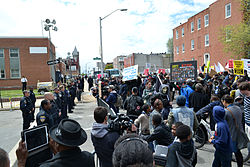
[edit]On April 18, 2015, immediately outside the Western District police station, hundreds of Baltimore citizens protested against the apparent mistreatment of Freddie Gray as well against inadequate and inconsistent information on police actions during the arrest and transport. Gray died at approximately 7am on April 19, 2015.[23] Later that day, in response to Gray's death, Baltimore City Police Commissioner, Anthony Batts said, "I extend my deepest sympathies to his family" while also saying, "All Lives Matter" in a nod to the "Black Lives Matter" mantra shouted at protests.[27]
Protests continued during six nights in Baltimore's streets. On April 21, 2015, the Baltimore City Police Department released the identities of the six officers involved in Gray's arrest.[23] That evening, protesters marched from the site of Gray's arrest to the Western District police station. On April 23, two people were arrested.[28] Tensions flared, but according to the Baltimore City Police Department, the remaining protesters that day were peaceful.[29] On April 24, a coalition of organizations including the ACLU, the NAACP, CASA de Maryland, and Leaders of a Beautiful Struggle requested Governor Larry Hogan to act and address issues of police brutality.[30]
April 25: Violence escalates
[edit]On April 25, 2015, protests were organized in downtown Baltimore. Protesters marched from the Baltimore City Hall to the Inner Harbor. After the final stage of the official protest event, some people became violent, damaging at least five police vehicles and pelting police with rocks.[31] Near Oriole Park at Camden Yards, some groups of violent protesters also smashed storefronts and fought with baseball fans arriving at the stadium for a scheduled game between the Baltimore Orioles and the Boston Red Sox. As a result of the violence, those attending the baseball game were forced[32] to remain inside the stadium for their safety.[33] At least 34 people were arrested during the riots, and six police officers were injured.[34][35]
J.M. Giordano, a photographer for Baltimore City Paper, was taking pictures of the protest when he was "swarmed" and beaten by two police officers in riot gear.[36] Sait Serkan Gurbuz, a Reuters photographer with visible press credentials, who photographed the scuffle from a public sidewalk, was tackled, handcuffed and walked to the Western District station. He was cited for failure to obey and later released. Subsequently, City Paper published a video on its website documenting the violence.[36][37]
During a press conference, Baltimore mayor Stephanie Rawlings-Blake said, "most protesters were respectful but a small group of agitators intervened".[34] She also stated that "It's a very delicate balancing act. Because while we try to make sure that they were protected from the cars and other things that were going on, we also gave those who wished to destroy space to do that as well. And we worked very hard to keep that balance and to put ourselves in the best position to de-escalate."[38] The phrase "we also gave those who wished to destroy space to do that as well" was interpreted by some conservative-leaning news sources[39] as an indication that the mayor was giving permission to protesters to destroy property.
Two days later, the mayor's Director of Strategic Planning and Policy, Howard Libit, released a statement clarifying the mayor's remarks:
What she is saying within this statement was that there was an effort to give the peaceful demonstrators room to conduct their peaceful protests on Saturday. Unfortunately, as a result of providing the peaceful demonstrators with the space to share their message, that also meant that those seeking to incite violence also had the space to operate. The police sought to balance the rights of the peaceful demonstrators against the need to step in against those who were seeking to create violence. The mayor is not saying that she asked police to give space to people who sought to create violence. Any suggestion otherwise would be a misinterpretation of her statement.[40]
April 27
[edit]Funeral
[edit]A funeral service was held for Freddie Gray at the New Shiloh Baptist Church on April 27 at , after a one-hour public viewing.[41] A large attendance included civil rights leaders, families of other people killed by police, and politicians including Congressman Elijah Cummings, Cabinet Secretary Broderick Johnson, White House adviser Heather Foster, and Elias Alcantara of the Office of Intergovernmental Affairs.[42]
Gray is buried at Woodlawn Cemetery in Baltimore County, Maryland.[43][44]
Preemptive actions
[edit]A photograph of the April 25 protesters standing on a Baltimore police car was superimposed with the text "All HighSchools Monday @3 We Are Going To Purge From Mondawmin To The Ave, Back To Downtown #Fdl" ("Purge" being a reference to the film series)[45] and distributed on social media[46] and as flyers.[47] In response, Mondawmin Mall was closed at 2:15 p.m.[48] and police in riot gear were deployed to the area. In preparation for the 'purge' police shut down the Mondawmin metro stop and also blockaded many of the nearby streets.[49] As a result, students from Frederick Douglass High School, which is across the street from Mondawmin Mall, had considerable difficulty leaving the area via public transportation when their classes ended an hour after the "purge" began, and contributed to the swelling crowd.[49][50]
According to eyewitness reports,[49] expecting the "purge" to start at 3 p.m., Baltimore police pre-emptively de-boarded all buses going through the area, shut down the nearby Mondawmin Metro station and cordoned off the area around the mall. Eyewitnesses saw police detain students in that general area. The police, in full riot gear, detained the students for a full half-hour before the first brick was thrown. Meghann Harris, a teacher in the Baltimore school system, said on Facebook, "If I were a Douglass student that just got trapped in the middle of a minefield BY cops without any way to get home and completely in harm's way, I'd be ready to pop off, too."[51]
Other closings in preparation or response to the riot included the University of Maryland Baltimore, which closed its campus in downtown Baltimore at citing a police warning regarding "activities (that) may be potentially violent and UMB could be in the path of any violence",[52] Baltimore City Community College, Coppin State University, the Lexington Market, the National Aquarium, and the Enoch Pratt Free Library system.[48][53] The Baltimore Kinetic Sculpture Race was rescheduled from May 2 to June 14.[54] A Baltimore Orioles baseball game against the Chicago White Sox scheduled for the evening at Oriole Park at Camden Yards, and the first of a three-game series,[55] was also postponed due to the unrest.[56]
Spread of violence
[edit]Initially 75–100 people who appeared to be high school students began throwing bricks and bottles at police near Mondawmin Mall[57] after police refused high school students access to their primary means of getting home (the transportation hub at Mondawmin Mall),[58] while ordering them to disperse and go home. The violence rapidly spread, and by later that day two patrol cars were destroyed and fifteen officers were injured.[52] A police cruiser was destroyed, and some officers suffered broken bones.[59][60] A CVS Pharmacy location in West Baltimore was looted and burned by rioters;[61] no one in the CVS was hurt because employees had been evacuated before the CVS was looted and burned.[62] In East Baltimore, the Mary Harvin Senior Center, an under-construction senior housing and services project, burned to the ground; it was rebuilt and opened in April 2016.[63]
April 28
[edit]Morning
[edit].jpg)
At about , firefighters extinguished flames and helped residents cleaning up after the overnight rioting.[64] Soldiers from the 1st Battalion, 175th Infantry Regiment, Maryland Army National Guard arrived in Baltimore to provide security to vital infrastructure and to give additional support to police.[64] At about , the Baltimore mayor's office reported that there were 144 vehicle fires, 15 structural fires, and nearly 200 arrests.[64][65] One person had been badly hurt due to an arson.[65]
At , it was announced that Maryland Gov. Larry Hogan was temporarily moving his office from Annapolis to Baltimore and that Hogan would visit scenes around Baltimore.[64] At approximately 9:00 a.m., Hogan visited an intersection on West Baltimore that was heavily affected by the rioting with damaged vehicles and a looted convenience store, thanking those in the area for help cleaning up the streets.[64]
In one incident that went viral during the previous night, Baltimore mother, Toya Graham, repeatedly struck and berated her son on TV for throwing rocks at police. Graham stated that she didn't want her son to end up like Freddie Gray, but also that he shouldn't seek justice by rioting.[66][67][68] At on April 28, Baltimore Police Commissioner Anthony Batts praised Graham, stating, "I wish I had more parents that took charge of their kids out there."[66][69][70]
Baltimore County police spokesman Cpl. John Wachter also announced that Security Square Mall was going to be closed for the rest of the day following the spreading of rumours that planned actions were going to occur there. The Social Security Administration and the Centers for Medicare and Medicaid Services also closed.[71]
Afternoon and evening
[edit]At noon, in the area where Freddie Gray was arrested, hundreds of volunteers were seen cleaning up debris left from the rioting.[64] Police blocked off some of the area to assist with the clean up while hardware stores in the neighbourhood donated trash bags and brooms and city workers drove in trucks to carry away piles of trash and shattered glass.[64]
At , President Obama stated that there had been too many worrying interactions between police and black citizens, but said there was "no excuse" for the violence of rioters in Baltimore. At about 1:30 p.m., crowds gathered at a damaged drug store where Rev. Jesse Jackson was visiting, with Jackson saying, "It was painful because it destroyed a lot of neighbourhood businesses and hurt a lot of people, but the violence is driven by that alienation." At a speaking event by Capt. Eric Kowalczyk discussing incidents that occurred on April 27, demonstrators gathered peacefully, though one individual was arrested and pepper spray was used when some protesters became disorderly. At , Mayor Stephanie Rawlings-Blake took back comments calling rioters "thugs", saying that occasionally, "my little anger interpreter gets the best of me." Baltimore religious leaders announced that 14 churches throughout the city were open to give food to children that relied on schools to provide daily meals.[72]
At , the CEO of Baltimore City Public Schools, Gregory Thornton, announced that Baltimore City Public School classes and after-school events would occur on April 29. Just before , several hundred protesters gathered around the CVS store that was looted, with some individuals separating the protesters and police, while a local pastor told demonstrators over a loud speaker to respect the curfew, saying, "Let's show the world, because the eyes of the world are on Baltimore right now." A police spokesman, Captain Eric Kowalczyk, stated that authorities were attempting to inform Baltimore residents of the curfew in multiple ways, through police in patrol cars, sending messages through a police helicopter over the city and by calling residents through a Reverse 911 system.[72]

At , hundreds of demonstrators, some throwing bottles at police, remained in the streets while police in riot gear began to move the crowds with speakers from helicopters overhead broadcasting, "You must go home. You cannot remain here. You will be subject to arrest." Tensions began to grow after individuals began to throw objects at police. Shortly after , smoke bombs or fireworks were thrown from the crowd and police equipped with riot shields began to slowly advance on the gathering with some people beginning to disperse. At , Baltimore Police tweeted that "Officers are now deploying pepper balls at the aggressive crowd". They then tweeted at "People who remain on the street – who do not meet the exceptions – are now in violation of the emergency curfew" with police moving across the intersection and the crowd dispersing down side streets away from the area. At , military vehicles were seen driving through the streets to disperse the remaining crowd numbered with dozens of people. At , the CVS intersection was clear except for police and media workers who were exempt from the curfew. At , Baltimore Police Commissioner Anthony Batts stated that the curfew seemed to work and that ten people were arrested; seven for violating the curfew, two people for looting and one for disorderly conduct.[72]
Between start of curfew and late night, 35 people, including one juvenile, had been arrested for violating the curfew.[73]
April 29 – May 3
[edit]After the riots, many small business owners struggled to clean up.[74] Over 200 small businesses were unable to reopen by April 29.[75] Residents of all ages, genders, and races came together to help clean Baltimore's streets.[76][77] Eighteen were arrested for curfew violations on April 29.[78]
.jpg)
From April 29 to May 3, 2015, FBI surveillance aircraft used FLIR cameras to record video of civil unrest. In August 2016, 18 hours of footage was released following a FOIA request from the American Civil Liberties Union.[79][80]
By April 30, over forty Korean American-owned businesses had been damaged by the riots.[81] Chinese American and Arab American owned stores were also targeted, with looters directed by African American gangs towards those businesses.[82][83]
Forty people were arrested for such night violations on May 1.[84]
After the largest peaceful rally on Saturday, May 2, 2015, 46 people were arrested during the night time curfew.[85]
One person arrested on May 2 was News2Share journalist Ford Fischer. He was handcuffed and initially charged with violating curfew, despite the police confirming that he was credentialed media. After confirming the charge as "curfew violation" to another journalist, the police changed it to a civil citation for "Disorderly Conduct." As of May 21, he still faces that citation.[86] This all came after the police department had confirmed that media are exempt from the curfew via Twitter.[87]
The night curfew on the city was lifted on May 3.[88] Meanwhile, all charges against violators were dropped. It was found that in section 14-107 of the state's public safety code, only the governor and not the mayor has the authority to issue a curfew. It was decided that the arrests of violators were punishment enough.[89] Those who committed violations of the law other than curfew violations have still been prosecuted.[90]
The Maryland National Guard withdrew completely from Baltimore on May 4.[91]
Result of investigation
[edit]Initially, the Baltimore Police Department suspended six officers with pay pending an investigation of Gray's death.[92] The six officers involved in the arrest were identified as Lieutenant Brian Rice, Sergeant Alicia White, Officer William Porter, Officer Garrett Miller, Officer Edward Nero, and Officer Caesar Goodson.[93] On April 24, 2015, Police Commissioner Anthony Batts said, "We know our police employees failed to get him medical attention in a timely manner multiple times."[94] Batts also acknowledged police did not follow procedure when they failed to buckle Gray in the van while he was being transported to the police station. The U.S. Department of Justice also opened an investigation into the case.[95]
Charges filed, acquittals, and charges dropped
[edit]On May 1, 2015, after receiving a medical examiner's report ruling Gray's death a homicide, state prosecutors said that they had probable cause to file criminal charges against the six officers involved. Mosby said that the Baltimore police had acted illegally and that "No crime had been committed [by Freddie Gray]".[96] Mosby said that Gray "suffered a critical neck injury as a result of being handcuffed, shackled by his feet and unrestrained inside the BPD wagon."[97][98] Mosby said officers had "failed to establish probable cause for Mr. Gray's arrest, as no crime had been committed",[99] and charged officers with false imprisonment, because Gray was carrying a pocket knife of legal size, and not the switchblade police claimed he had possessed at the time of his arrest.[24] All six officers were taken into custody and processed at Baltimore Central Booking and Intake Center.[100][101]
The trial of Officer William G. Porter, a black officer and the first of the six charged officers to go to trial, ended in a mistrial.[102] The Prosecution had intended to have Porter testify against both his supervisor on the day, Sgt. Alicia White, and the driver of the van, Officer Caesar Goodson Jr. The trials ran into significant delays due to multiple motions being filed by both sides in the cases. On May 23, 2016, Officer Edward Nero was found not guilty on all four counts he was charged with, including two counts of misconduct in office, misdemeanor reckless endangerment, and misdemeanor assault in the second degree.[103]
In addition to Nero, two others officers were subsequently acquitted. In July 2016, following the acquittals, Baltimore City State's Attorney Marilyn Mosby dropped charges against Porter and the remaining two officers.[21]
Related protests
[edit]
On April 29, 2015, protesters marched through New York City, blocking off traffic in key areas, including the Holland Tunnel and West Side Highway.[104] Carmen Perez, director of the criminal justice reform group Justice League, said, "It's all about solidarity, We're here to spread the message of peace from Baltimore's initial protests."[105] More than 100 people were arrested,[106] and the police did not allow the protest to take form before making arrests.[107]
Anti-police brutality protests were also held in Denver in solidarity with the Baltimore protests. Eleven people were arrested on April 29, 2015, following physical altercations in which police used pepper spray on protesters who rallied around Colfax Avenue and Broadway street. The confrontation occurred shortly after 7 p.m. when an officer was knocked off his motorcycle by a protester and assaulted by five others. Police reported force was used in response to the incident. By 7:40 p.m., Broadway street was cleared for traffic as protesters relocated to the 16th Street Mall.[108]
There were also solidarity protests in the cities of Ann Arbor,[109] Albuquerque,[110] Boston,[111] Cincinnati,[112] Minneapolis,[113] Oakland,[114] Philadelphia,[115] Seattle,[116] and Washington, D.C.[117]
Reactions
[edit]Preventive actions
[edit]Government actions
[edit]At a press conference in the evening, the mayor announced there would be a citywide curfew of 10 p.m. to 5 a.m. starting April 28.[11][118][119] The Baltimore solicitor's office stated that a limitation of the curfew to only certain neighbourhood could potentially be viewed as racial discrimination.[89] neighbouring Anne Arundel and Baltimore Counties cancelled school field trips and activities scheduled in Baltimore City until May 3.[48][120] Officials also announced that Baltimore's city schools would be closed on Tuesday.[121]
Maryland Governor Larry Hogan declared a state of emergency and activated the Maryland National Guard.[10][122] Major General Linda Singh of the Maryland National Guard commented that there would be a "massive number" of soldiers in Maryland on the night of April 27, and that up to 5,000 soldiers could be deployed.[123] Maryland State Police activated 500 officers for duty in Baltimore, and requested an additional 5,000 state police officers from other states.[124]
Business owners in the city complained that the curfew required establishments with later hours to close their doors early, thereby costing them revenue from later hours customers and hurting their employees by forcing them to work fewer hours.[125][126] Some businesses complained that the curfew cost them as much as $50,000.[127] While those with night jobs were given an exemption to be allowed to travel to work, early closing hours continued to cost employees work hours.[73] Despite criticism of curfew enforcement, Mayor Rawlings-Blake stood by the curfew, saying it was necessary to maintain control.[90]
U.S. Attorney General Loretta Lynch requested an independent civil rights investigation into the Freddie Gray case in hopes of calming the violence in Baltimore.[128]
Sports actions
[edit]The Baltimore Ravens had cancelled their NFL Draft party in response to the riots.[129][130]
After consulting with Major League Baseball, the Baltimore Orioles announced that their second game in a series against the Chicago White Sox would also be postponed, and that their game on April 29 would be played in the afternoon behind closed doors. This was believed to be the first behind closed doors game in Major League Baseball history (it is occasionally seen in soccer as punishment for spectator behaviour).[131][132] The attendance for the game was officially recorded as zero, thus breaking the previous record (of six, set in 1882) for the lowest attendance at a Major League Baseball game.[133] The two cancelled games were made up as a doubleheader on May 28. The team also moved its May 1–3 series against the Tampa Bay Rays from Camden Yards to Tropicana Field, but still played as the home team (despite the Rays hosting it).[55]
Gang involvement
[edit]After Baltimore police determined there was a "credible threat" of gang violence against police officers across the country, many departments across the US heightened their security in response: for example the Los Angeles Police Department ordered their officers to ride in pairs.[134] Baltimore police claimed evidence to support the idea that the Black Guerrilla Family, the Bloods, and the Crips were "teaming up" to target police officers.[135] Later, however, leaders of both the Bloods and the Crips denied the allegations,[136] released a video statement asking for calm and peaceful protest in the area,[137] and joined with police and clergy to enforce the curfew.[138] At one occasion, gang members helped to prevent a riot at the Security Square Mall by dispersing would-be rioters.[139] On other occasions, rival gang members helped each other to protect black-owned businesses, black children, and reporters, diverting rioters to Korean-, Chinese-, and Arab-owned businesses instead.[140] On yet another occasion, the Bloods, the Crips, and the Nation of Islam were seen taking a picture together and working together to dispel violence while peacefully demonstrating.[141]
Critical opinions
[edit]On April 28, President Barack Obama strongly condemned the violence during a White House press conference, saying, "There's no excuse for the kind of violence that we saw yesterday. It is counterproductive. ... When individuals get crowbars and start prying open doors to loot, they're not protesting. They're not making a statement. They're stealing. When they burn down a building, they're committing arson. And they're destroying and undermining businesses and opportunities in their own communities. That robs jobs and opportunity from people in that area." Obama went on to applaud the actions of peaceful protesters who he felt were being undermined by the violence, and called upon the nation to take meaningful action to collectively solve poverty and law enforcement issues fueling what he described as "a crisis".[142]
On social media and elsewhere, Mayor Rawlings-Blake and President Obama were criticized for calling the rioters "thugs" on April 28.[143]
When asked about the postponement of the Baltimore Orioles game, the Orioles' chief operating officer, John P. Angelos, said:
My greater source of personal concern, outrage and sympathy ... is focused neither upon one night's property damage nor upon the acts, but is focused rather upon the past four-decade period during which an American political elite have shipped middle class and working class jobs away from Baltimore and cities and towns around the U.S. to third-world dictatorships ... plunged tens of millions of good hard working Americans into economic devastation and then followed that action around the nation by diminishing every American's civil rights protections in order to control an unfairly impoverished population living under an ever-declining standard of living and suffering at the butt end of an ever-more militarized and aggressive surveillance state. The innocent working families of all backgrounds whose lives and dreams have been cut short by excessive violence, surveillance, and other abuses of the Bill of Rights by government pay the true price, an ultimate price, and one that far exceeds the importance of any kids' game played tonight, or ever....[144]
Online reaction
[edit]The protests were originally covered on social media with the hashtag #BaltimoreRiots. However, by April 28, the more popular hashtag to cover the protests became #BaltimoreUprising. The change may have occurred in response to a decline in violent actions, or may have been the promotion of a new political narrative by social media users.[145][146]
Dr. Denise Meringolo, an associate professor and public historian at the University of Maryland, Baltimore County,[147] and Joe Tropea, Curator of Films and Photographs at the Maryland Historical Society,[148] co-founded the Preserve the Baltimore Uprising digital archive to capture images and oral histories related to the protests directly from the local community.[149]
Increase in violence and decrease in policing
[edit]Baltimore recorded 43 homicides in the month of May, the second deadliest month on record and the worst since December 1971 when 44 homicides were recorded. There have also been more than 100 non-fatal shootings in May 2015.[150] Police commissioner Anthony Batts blames looted drugs, stolen from 27 pharmacies and two methadone clinics, as well as street distribution and turf wars for the spike in crime.[151][152]
The increase in shootings has occurred along with a 50% decline in arrests since the charging of six officers in Gray's death in custody.[153] The heavy police presence in crime-ridden neighbourhoods is no longer apparent with one resident stating, "Before it was over-policing. Now there's no police."[153] One officer speaking anonymously stated, "After the protests, it seems like the citizens would appreciate a lack of police presence, and that's exactly what they're getting."[154] Batts stated that his officers are "not holding back" despite encountering hostility in the Western District whenever they make an arrest with "30 to 50 people surrounding them at any time;"[153] he also stated that his officers feel "confused and unsupported" in the wake of the charges. The president of the police union said his members are "afraid of going to jail for doing their jobs properly."[154]
According to media reports, looting at 27 drugstores and two methadone clinics resulted in an increase in black market access to opiates.[155][156]
See also
[edit]


References
[edit]- ^ a b c Fenton, Justin (April 18, 2015). "Hundreds at Baltimore police station protest over man's injuries during arrest". The Baltimore Sun. Archived from the original on May 5, 2015. Retrieved May 5, 2015.
- ^ a b c Valcourt, Derek (April 19, 2015). "Freddie Gray Dies In Hospital One Week After Arrest In Baltimore". WJZ-TV. Retrieved May 5, 2015.
- ^ Simpson, Ian (April 18, 2015). "Crowds protest death of man after arrest by Baltimore police". Reuters. Retrieved May 5, 2015.
- ^ Terhune, Virginia (May 1, 2015). "Montgomery County Police Sends 40 Plus Officers to Assist Baltimore". The Gazette. Archived from the original on May 5, 2015.
- ^ "Montgomery County police chief talks Baltimore, community relations". WTOP. May 2015. Retrieved May 2, 2015.
- ^ "Why Cell Phone and Body Cameras Aren't Enough For the Anti-Police Brutality Movement". The National Journal. May 1, 2015. Retrieved May 1, 2015.
Pennsylvania State Troopers in riot gear deploy Friday in Baltimore. (Win McNamee / Getty)
- ^ a b "Accurately charging people arrested in Baltimore proves to be legal challenge". The Washington Post. May 4, 2015. Retrieved May 5, 2015.
- ^ Stolberg, Sheryl Gay (April 28, 2015). "Baltimore's Streets Fill With Civilians and National Guard Troops". The New York Times. Retrieved April 29, 2015.
- ^ Wood, Pamela (May 1, 2015). "Man charged with damaging hoses at CVS fire". The Baltimore Sun. Retrieved May 2, 2015.
- ^ a b Shapiro, Emily (April 27, 2015). "Maryland Gov. Declares State of Emergency After Violent Clashes in Baltimore". ABC News. Retrieved April 27, 2015.
- ^ a b Muskal, Michael; Hennigan, W.J. (April 27, 2015). "Baltimore mayor orders curfew; 'thugs' trying to tear down city, she says". Los Angeles Times. Retrieved April 27, 2015.
- ^ Sherman, Natalie (May 11, 2015). "GBC aims to help ex-offenders in wake of Baltimore's troubles". The Baltimore Sun. Retrieved May 12, 2015.
- ^ Wenger, Yvonne (May 13, 2015). "Damage to businesses from Baltimore rioting estimated at about $9 million". The Washington Post. Retrieved August 14, 2015.
- ^ Oppel, Richard A. Jr. (June 12, 2015). "West Baltimore's Police Presence Drops, and Murders Soar". The New York Times. Retrieved August 14, 2015.
- ^ "Baltimore riots live updates: About 200 arrested after violence, fires sweep city". Los Angeles Times. April 28, 2015. Retrieved April 28, 2015.
- ^ Simpson, Ian; Strobel, Warren (April 28, 2015). "Thousands of police descend on Baltimore to enforce curfew after riots". Reuters. Retrieved April 29, 2015.
- ^ Calamur, Krishnadev (May 6, 2015). "Maryland Governor Lifts State Of Emergency In Baltimore". NPR.org. Retrieved August 14, 2015.
- ^ David Ettlin (May 5, 2015). "Racial tension haunts Baltimore across chasm of 45 years". Baltimore Post-Examiner. Retrieved February 6, 2016.
- ^ Keller, Michael; Kim, E. Tammy; Kutsch, Tom; Vo, Lam Thuy (April 29, 2015). "Baltimore: The divided city where Freddie Gray lived and died". Al Jazeera America. Retrieved July 23, 2020.
- ^ Blinder, Alan (May 1, 2015). "Prosecutors Charge 6 Baltimore Officers in Freddie Gray Death". The New York Times. Retrieved May 1, 2015.
- ^ a b c Sherl Gay Stolberg & Jess Bidgood, All Charges Dropped Against Baltimore Officers in Freddie Gray Case, The New York Times (July 27, 2016).
- ^ McDonell-Parry, Amelia; Barron, Justine (April 12, 2017). "Death of Freddie Gray: 5 Things You Didn't Know". Rolling Stone. Retrieved August 2, 2020.
- ^ a b c "Timeline: Freddie Gray's arrest, death and the aftermath - Baltimore Sun". data.baltimoresun.com. Archived from the original on November 19, 2015. Retrieved November 18, 2015.
- ^ a b "Freddie Gray: Baltimore police to face criminal charges". BBC News. May 1, 2015. Retrieved May 1, 2015.
- ^ "Nero v. Mosby, 890 F.3d 106, (D. Md. 2017)". January 27, 2017. Retrieved February 2, 2025.[dead link]
- ^ Fieldstadt, Elisha (May 23, 2016). "Officer Charged in Freddie Gray Case, Edward Nero, Not Guilty on All Counts". NBC News. Retrieved May 23, 2016.
- ^ Sun, Baltimore. "Freddie Gray dies a week after being injured during arrest". baltimoresun.com. Retrieved May 6, 2016.
- ^ Ileto, Christine (April 23, 2015). "Police Make Arrests; Protests Continue Over Freddie Gray's Death". WJZ-TV. Retrieved May 5, 2015.
- ^ Yan, Holly; Fantz, Ashley; Hutcherson, Kimberly (April 23, 2015). "Freddie Gray death: Protesters, police scuffle in Baltimore". CNN. Retrieved May 5, 2015.
- ^ "Civil rights groups call on Hogan to convene special session". baltimoresun.com. Retrieved November 18, 2015.
- ^ Stolberg, Sheryl Grey (August 27, 2015). "National Guard Activated in Baltimore as Police and Youths Clash After Funeral for Freddie Gray". The New York Times. Retrieved April 28, 2015.
- ^ Fiammetta, ike (April 25, 2015). "Fans Asked to Stay Inside Camden Yards due to Baltimore Protests". Sports Illustrated. Retrieved May 19, 2015 – via Google News.
- ^ "Fans at Orioles-Red Sox asked to stay in Camden Yards after violent protest". USA Today. April 25, 2015. Retrieved April 28, 2015.
- ^ a b Marquez, Miguel; Almasy, Steve (April 25, 2015). "Freddie Gray death: 12 arrested during protests". CNN. Retrieved April 25, 2015.
- ^ Wenger, Yvonne; Campbell, Colin. City leader calls for peace after 35 arrested, 6 officers injured Archived April 27, 2015, at the Wayback Machine, The Baltimore Sun, April 26, 2015.
- ^ a b Serpick, Evan (April 26, 2015). "City Paper photo editor J.M. Giordano beaten by police at Freddie Gray protest". City Paper (Baltimore). Retrieved April 28, 2015.
- ^ Associated Press (April 25, 2015). "The Latest: Baltimore mayor calls for peace after protests". The Washington Post. ISSN 0190-8286. Archived from the original on May 18, 2015. Retrieved April 27, 2015.
- ^ Baltimore Mayor: ‘Gave Those Who Wished to Destroy Space to Do That’, CBS News Baltimore, April 25, 2015
- ^ "Baltimore mayor's 'balancing act' gave protestors permission to turn violent". Fox News. April 27, 2015. Retrieved April 28, 2015.
- ^ Kevin Harris (April 27, 2015). "Rawlings-Blake Administration Issues Statement Regarding Mayor's Comments on the Rights of Protesters". Retrieved April 28, 2015.
- ^ "Freddie Gray Funeral Held Amid Alleged Credible Threat to Law Enforcement". ABC News. April 27, 2015.
- ^ Yan, Holly; Fantz, Ashley (April 27, 2015). "Freddie Gray funeral draws White House officials, Eric Garner's family". CNN.
- ^ Marbella, Jean; Pitts, Jonathan (April 28, 2015). "Friends, family bid farewell to Freddie Gray". The Baltimore Sun. Retrieved May 6, 2015.
- ^ Smialowski, Brendan (April 27, 2015). "Freddie Gray is buried at Woodlawn Cemetery in Baltimore, Maryland, on April 27, 2015". Yahoo! News. Retrieved May 6, 2015.
- ^ Image Archived May 1, 2015, at the Wayback Machine cited in The New York Times "Mapping the Clashes"
- ^ "Mapping the Clashes Between Baltimore Police and Protesters". The New York Times. April 27, 2015.
- ^ "Baltimore Purge: Flyers Imitating 'The Purge' Reportedly Called For Violence, Contributed To Riots". Inquistr. April 28, 2015.
- ^ a b c WMAR Staff. "Concerns over violence leads to area closings in Baltimore". WMAR. Archived from the original on April 30, 2015. Retrieved April 27, 2015.
- ^ a b c Brodey, Sam; McLaughlin, Jenna (April 28, 2015). "Eyewitnesses: The Baltimore Riots Didn't Start the Way You Think". Mother Jones.
- ^ P. Kenneth Burns (April 30, 2015). "Douglass Students Say They Got A Bad Rap". WYPR.
- ^ Bump, Philip (April 28, 2015). "Just one in four urban black Americans trust the police". The Washington Post. Retrieved April 30, 2015.
- ^ a b Bacon, John (April 27, 2015). "Baltimore police, protesters clash; 15 officers hurt". USA Today. Retrieved April 27, 2015.
- ^ Stolberg, Sheryl Gay (April 27, 2015). "National Guard Called Out in Baltimore as Police and Youths Clash After Funeral for Freddie Gray". The New York Times. Retrieved April 27, 2015.
- ^ "AVAM's Kinetic Sculpture Race rescheduled for June 14". The Baltimore Sun. Retrieved October 3, 2015.
- ^ a b "Orioles-White Sox game will be played Wednesday, closed to public". ESPN. April 28, 2015. Retrieved April 29, 2015.
- ^ "Tonight's Orioles game postponed amid violence downtown". The Baltimore Sun. Archived from the original on February 7, 2016. Retrieved April 27, 2015.
- ^ Fuchs, Eric (April 28, 2015). "A confrontation between cops and teenagers kicked off the horrifying Baltimore riots". Business Insider.
- ^ Wing, Nick (April 28, 2015). "Police Throw Rocks Back At Protesters In Baltimore". The Huffington Post.
- ^ "7 officers wounded in Baltimore protests". HeraldTribune.com. Archived from the original on May 5, 2015. Retrieved April 28, 2015.
- ^ Bacon, John (April 28, 2015). "Baltimore police, protesters clash; 15 officers hurt". CNN. Retrieved April 30, 2015.
- ^ Ford, Dana (April 27, 2015). "Baltimore protests turn violent; police injured". CNN. Retrieved April 27, 2015.
- ^ "CVS got employees out of Baltimore store just before looting and fire". CNN. April 27, 2015. Retrieved April 30, 2015.
- ^ "Mary Harvin Senior Center reopens year after fire". April 27, 2016.
- ^ a b c d e f g "LATEST ON POLICE-CUSTODY DEATH: OBAMA: NO EXCUSE FOR RIOT". Associated Press. April 28, 2015. Archived from the original on April 28, 2015. Retrieved April 28, 2015.
- ^ a b "Baltimore riots: Security beefed up, cleanup starts after looting, fires". CNN. April 28, 2015. Retrieved April 28, 2015.
- ^ a b "Mom filmed berating her son at Baltimore riots didn't 'want him to be a Freddie Gray'". The Washington Post.
- ^ Reimer, Susan (April 30, 2015). "Send in the moms to stop Freddie Gray rioting". The Baltimore Sun. Retrieved May 7, 2015.
- ^ Rosenbaum, Sophia; Fredericks, Bob (April 28, 2015). "Baltimore Mom of the Year: 'I don't want him to be a Freddie Gray'". The New York Post. Retrieved May 7, 2015.
- ^ "VIDEO: Mom beats child for throwing rocks at Baltimore Police". WMAR. Archived from the original on April 29, 2015. Retrieved April 29, 2015.
- ^ "VIDEO: Angry mom beats son suspected of rioting in Baltimore". ABC7 New York.
- ^ "Baltimore County squashes rumors of another 'purge' outside city". Baltimore Sun. April 28, 2015. Retrieved April 30, 2015.
- ^ a b c "LATEST ON POLICE-CUSTODY DEATH: COURT WAITS COULD INCREASE". Associated Press. April 29, 2015. Archived from the original on April 29, 2015. Retrieved April 29, 2015.
- ^ a b "Second Night of Baltimore Curfew Arrives Quietly". Al Jazeera America. April 29, 2015. Retrieved May 4, 2015.
- ^ Joseph Weber. "Riots rattle Baltimore homeowners, merchants key to urban revitalization". Fox News.
- ^ ABC News. "Baltimore Riot Damage Adds Burden to Small Businesses". ABC News.
- ^ "Cleaning up after Baltimore riots". CNN. April 29, 2015. Retrieved May 7, 2015.
- ^ Keady, Cameron (April 28, 2015). "Baltimore Residents Come Together To Clean Up City After Riots". The Huffington Post. Retrieved May 11, 2015.
- ^ "Protests Resume in Baltimore With Hundreds Marching on City Hall - WSJ". Wall Street Journal. wsj.com. April 30, 2015. Retrieved May 4, 2015.
- ^ "FBI Dumps 18 Hours of Spy Plane Footage From Black Lives Matter Protests". August 6, 2016.
- ^ "Protests in Baltimore, Maryland 2015, Aerial Surveillance Footage".
- ^ "Count of damaged Korean-owned Baltimore businesses rises to 40". Korean Times. April 30, 2015. Retrieved June 16, 2015.
Duggan, Paul; Jenkins, Jennifer (May 24, 2015). "After the Baltimore riots, a Korean storeowner picks up the pieces". Columbia Daily Tribune. Columbia, Missouri. The Washington Post. Retrieved June 16, 2015.
Halpin, Dennis P. (May 25, 2015). "The Other Racial Divide". The Weekly Standard. 20 (35). Archived from the original on June 17, 2015. Retrieved June 16, 2015.
Collins, David (April 30, 2015). "Korean businesses especially hard hit by looters". WBAL. Baltimore, Maryland. Retrieved June 16, 2015. - ^ Nixon, Ron (April 27, 2015). "Amid Violence, Factions and Messages Converge in a Weary and Unsettled Baltimore". The New York Times. Retrieved June 16, 2015.
- ^ Aizenmen, Nurith (April 30, 2015). "Baltimore Unrest Reveals Tensions Between African-Americans And Asians". NPR. Retrieved June 16, 2015.
- ^ "After 'Victory Rally,' Arrests Made of Violators of Baltimore Curfew - ABC News". abcnews.go.com. Retrieved May 4, 2015.
- ^ W.J. Hennigan (May 3, 2015). "As Baltimore curfew ends, celebratory crowds peacefully gather". Los Angeles Times. Retrieved May 7, 2015.
- ^ "Journalist Arrested Trying to Record Baltimore Police Making Arrest". October 12, 2021.
- ^ "Baltimore Police Tweet".
- ^ Nuckols, Ben; Dishneau, David (May 3, 2015). "Baltimore mayor lifts curfew 6 days after riots". Associated Press. Archived from the original on July 22, 2015. Retrieved July 17, 2015.
- ^ a b Justin Fenton (May 11, 2015). "Mayor's authority to impose curfew questioned". The Baltimore Sun. Retrieved July 12, 2015.
- ^ a b "Mayor Defends Baltimore Curfew, Says It Was Necessary To Keep Peace". cbslocal.com. May 12, 2015.
- ^ Scott Dance; Chris Kaltenbach (May 3, 2015). "Baltimore moves on as curfew is lifted, National Guard leaves". Baltimore Sun. Archived from the original on July 8, 2015. Retrieved May 9, 2015.
- ^ "Protesters rally in Baltimore over the death of Freddie Gray". CNN. April 21, 2015.
- ^ Miller, Jayne. 6 officers suspended in Freddie Gray case, WBAL, April 20, 2015. Retrieved April 30, 2015.
- ^ Payne, Ed; Almasy, Steve; Pearson, Michael (April 24, 2015). "Police: Freddie Gray didn't get timely medical care after arrest". CNN. Retrieved April 24, 2015.
- ^ Boswell, Craig (April 21, 2015). "Feds investigating Baltimore man's death in police custody". CBS News. Retrieved April 22, 2015.
- ^ Swaine, Jon; Laughland, Oliver; Jalabi, Raya (May 1, 2015). "Freddie Gray death: cries of 'justice' in Baltimore after six officers charged". The Guardian. Retrieved May 1, 2015.
- ^ Blinder, Alan; Pérez-Peña, Richard (May 2015). "6 Baltimore Police Officers Charged in Freddie Gray Death". The New York Times. Retrieved May 1, 2015.
- ^ Simpson, Scott Malone (May 2015). "Six Baltimore police officers face murder, other charges in death of black man". Reuters. Retrieved May 1, 2015.
- ^ Blinder, Alan; Perez-Pena, Richard (May 1, 2015). "6 Baltimore Police Officers Charged in Freddie Gray Death". The New York Times. Retrieved May 1, 2015.
- ^ "Six officers charged in death of Freddie Gray". The Baltimore Sun. Archived from the original on May 1, 2015. Retrieved May 1, 2015.
- ^ "Six officers charged in death of Freddie Gray". The Baltimore Sun. Archived from the original on May 1, 2015. Retrieved May 1, 2015.
- ^ "Prosecutors to appeal judge's order blocking Porter testimony in trials of other officers". The Baltimore Sun. Retrieved February 6, 2016.
- ^ Fenton, Justin; Rector, Kevin (May 23, 2016). "Freddie Gray case: Baltimore Police Officer Edward Nero found not guilty of all charges". The Baltimore Sun. Retrieved May 31, 2016.
- ^ "Protesters clash with NYPD, disrupt Holland Tunnel and West Side Highway in bid to support Baltimore activists". Daily News. New York. April 29, 2015. Retrieved April 30, 2015.
- ^ Mueller, Benjamin; Surico, John (April 30, 2015). "Over 100 Arrested as New Yorkers Protest the Death of Freddie Gray". The New York Times. Retrieved April 30, 2015.
- ^ "More Than 100 Arrested in Freddie Gray Protests in NYC: Sources". NBC New York. Archived from the original on May 18, 2015. Retrieved May 11, 2015.
- ^ "NYPD Cracks Down Hard On Baltimore Solidarity "Shut It Down" Protest". Gothamist. April 30, 2015. Archived from the original on April 30, 2015. Retrieved April 30, 2015.
- ^ Joe Rubino; John Frank (April 29, 2015). "Police User Pepper Spray on Downtown Protesters, 11 Arrested". The Denver Post. Retrieved April 30, 2015.
- ^ "Ann Arbor community members protest police brutality". Michigan Daily. May 4, 2015. Retrieved May 14, 2015.
- ^ Goldsmith, Alex (April 29, 2015). "Albuquerque's 'Baltimore' protests stay peaceful". KRQE. Retrieved May 4, 2015.
- ^ "Boston demonstrators marching in support of Baltimore's Freddie Gray protesters – Metro – The Boston Globe". BostonGlobe.com.
- ^ Ellis, Ralph; Payne, Ed; St. Claire, Pat (April 30, 2015). "In Philadelphia, police clash with supporters of Baltimore protests". CNN. Retrieved April 30, 2015.
- ^ "#BlackLivesMatter Protesters March Through Minneapolis". WCCO-TV. April 29, 2015.
- ^ "Oakland: Protesters marching in solidarity with Baltimore told to disperse late Monday". Mercury News.
- ^ "Rally, March Held In Philadelphia In Solidarity With Baltimore Protests". KYW-TV.
- ^ "Seattle demonstrators support protests in Baltimore". The Seattle Times. April 29, 2015.
- ^ "Demonstrators Take to DC Streets, Support Baltimore Protest". NBC4 Washington. April 29, 2015.
- ^ "Violent clashes flare in Baltimore after Freddie Gray funeral". Al Jazeera. Associated Press. April 27, 2015. Retrieved April 27, 2015.
- ^ "Baltimore Mayor Imposes Curfew, Says 'Thugs' Trying To Tear Down City". CBS Baltimore. Associated Press. April 27, 2015. Retrieved April 27, 2015.
- ^ "Gov. declares state of emergency; activates National Guard". WBAL-TV. April 27, 2015. Retrieved April 27, 2015.
- ^ Bacon, John; Welch, William M. (April 27, 2015). "Baltimore police, protesters clash; 15 officers hurt". USA TODAY. Retrieved April 27, 2015.
Police said more than two dozen people were arrested. The city's schools were canceled for Tuesday.
- ^ "Governor Larry Hogan Signs Executive Order Declaring State Of Emergency, Activating National Guard" (PDF). Government of Maryland. Retrieved April 27, 2015.
- ^ Laughland, Oliver; Lewis, Paul; Jacobs, Ben; Swaine, Jon (April 27, 2015). "Baltimore state of emergency declared as Freddie Gray protesters clash with police – live". The Guardian.
- ^ @matthewhaybrown (April 27, 2015). "Maryland State Police activating 500 officers for Baltimore; requesting up to 5,000 from neighboring states" (Tweet) – via Twitter.
- ^ "How Baltimore's Mandatory Curfew Is Affecting Area Restaurants and Bars - Eater". eater.com. April 29, 2015. Retrieved May 4, 2015.
- ^ "Baltimore's curfew takes a toll on city businesses". rawstory.com. May 3, 2015. Retrieved May 4, 2015.
- ^ "The Baltimore Sun". baltimoresun.com. Archived from the original on June 28, 2019. Retrieved July 13, 2015.
- ^ Rector, Kevin (January 22, 2017). "Civil rights investigation into Freddie Gray's death unresolved as Trump takes office". The Baltimore Sun. Retrieved February 7, 2017.
- ^ "Ravens Cancel Draft Party Event". Baltimore Ravens. April 28, 2015. Archived from the original on April 30, 2015. Retrieved April 29, 2015.
- ^ Smith, Michael David (April 28, 2015). "Ravens cancel draft party amid riots in Baltimore". NBC Sports. Retrieved April 29, 2015.
- ^ Ghiroli, Brittany (April 28, 2015). "Today's White Sox-Orioles game closed to fans". Major League Baseball. Archived from the original on April 29, 2015. Retrieved April 29, 2015.
- ^ Almasy, Steve (April 28, 2015). "Orioles game on Wednesday will have no fans". CNN. Retrieved April 28, 2015.
- ^ Dan Connolly, Orioles start fast in empty park, emerge from surreal day with 8–2 win over White Sox, The Baltimore Sun (April 29, 2015). Retrieved May 1, 2015.
- ^ Winton, Richard (April 27, 2015). "LAPD officers to ride in pairs after Baltimore police warn of gang threat". Los Angeles Times. Retrieved April 27, 2015.
- ^ "Baltimore police say gangs 'teaming up' to take out officers". The Baltimore Sun. April 27, 2015. Retrieved April 28, 2015.
- ^ Porter, Tom (April 28, 2015). "Bloods and Crips gangs reject claims of kill-a-cop pact". International Business Times. Retrieved April 29, 2015.
- ^ "Gangs call for calm in Baltimore". The Baltimore Sun. April 27, 2015. Retrieved April 29, 2015.
- ^ Berman, John; Castillo, Mariano (April 28, 2015). "Baltimore gangs will help enforce curfew". CNN. Archived from the original on May 18, 2015. Retrieved April 29, 2015.
- ^ Haake, Garrett W (April 28, 2015). "Gang members help prevent riot at Baltimore mall". WUSA. Archived from the original on April 29, 2015. Retrieved April 29, 2015.
- ^ Nixon, Ron (April 27, 2015). "Amid Violence, Factions and Messages Converge in a Weary and Unsettled Baltimore". The New York Times. Retrieved April 30, 2015.
- ^ Ryan Gorman (April 28, 2015). "Baltimore gangs call for peace after riots". Business Insider. Retrieved April 30, 2015.
- ^ "President Obama Condemns Violence After More Than 200 People Are Arrested in Baltimore". KTLA. April 28, 2015. Retrieved April 28, 2015.
- ^ Josh Levs (April 29, 2015). "After Baltimore riots, some leaders slam 'thug' as the new n-word". CNN. Retrieved April 30, 2015.
- ^ Mosendz, Polly (April 27, 2015). "As Riots Consume Baltimore, Orioles Postpone Baseball Game". Newsweek. Retrieved April 29, 2015.
- ^ Justin Wm. Moyer (April 29, 2015). "'Baltimore riots' transform into 'Baltimore uprising'". The Washington Post. Retrieved May 21, 2015.
- ^ Damien Cave (April 28, 2015). "Defining Baltimore: #Riot, #Uprising or #Disturbance?". The New York Times. Retrieved May 21, 2015.
- ^ "Denise Meringolo - History department - UMBC". history.umbc.edu. Retrieved April 2, 2020.
- ^ "Joe Tropea's schedule for 2018 Conference for High Impact Research". 2018conferenceforhighimpactresea.sched.com. Retrieved April 2, 2020.
- ^ "Home · Preserve the Baltimore Uprising: Your Stories. Your Pictures. Your Stuff. Your History". baltimoreuprising2015.org. Retrieved April 2, 2020.
- ^ Robert Lang (May 31, 2015). "Baltimore's Murder Total For May Climbs To 43". WBAL.
- ^ Amara, Kate (June 4, 2015). "Police Commissioner Anthony Batts blames stolen opiates for recent violence". The Baltimore Sun. Retrieved June 5, 2015.
- ^ Fantz, Ashley (June 5, 2015). "In Baltimore, allegations of police doing less as drugs are rampant". CNN. Retrieved June 5, 2015.
- ^ a b c "Baltimore Gets Bloodier As Arrests Drop Post-Freddie Gray". CBS News. May 28, 2015.
What is happening, there is a lot of levels of confusion in the police organization. There are people who have pain, there are people who are hurt, there are people who are frustrated, there are people who are angry," Batts said. "There are people, and they've said this to me, 'If I get out of my car and make a stop for a reasonable suspicion that leads to probable cause but I make a mistake on it, will I be arrested?' They pull up to a scene and another officer has done something that they don't know, it may be illegal, will they be arrested for it? Those are things they are asking.
- ^ a b Daniel Dale (May 30, 2015). "After the riots, Baltimore has worst murder month since 1996". Toronto Star.
- ^ Oppel, Richard A. Jr. (June 12, 2015). "West Baltimore's Police Presence Drops, and Murders Soar". The New York Times. Retrieved June 21, 2015.
[A] flood of black-market opiates stolen from 27 pharmacies during looting in April, enough for 175,000 doses now illegally available for sale.
- ^ "DEA: 80 percent more drugs taken during pharmacy looting during Baltimore unrest than previously reported".
Further reading
[edit]- Why Baltimore Rebelled. Jacobin. April 28, 2015.
- The rebellion in Baltimore is an uprising against austerity, claims top US academic. The Guardian. May 2, 2015.
- Linda Steiner and Silvio Waisbord (Ed.): News of Baltimore : race, rage and the city, New York : Routledge, Taylor & Francis Group, 2017, ISBN 978-1-138-65106-7
External links
[edit]
- Timelines
- Live blogs:
- The Baltimore Sun Archived April 28, 2015, at the Wayback Machine
- CBS Baltimore
- The Washington Post
- The New York Times, CNN Archived April 28, 2015, at the Wayback Machine, Slate
- Maps:
- Helicopter video:
- East of Mondawmin (beginning at Woodbruck and Westbury)
- North and Pennsylvania (attack on police car 057, CVS looted, CVS burning)
- North and Fulton (liquor store looted)
| Topics |   | |
|---|---|---|
| Attractions |
| |
| Entertainment | ||
| Education | ||
| Government | ||
| History | ||
| Industry | ||
| Parks | ||
| Sports | ||
| Transportation | ||
| Misc. | ||


| People |
| ||||||||||||||||||||||||||||
|---|---|---|---|---|---|---|---|---|---|---|---|---|---|---|---|---|---|---|---|---|---|---|---|---|---|---|---|---|---|
| Events |
| ||||||||||||||||||||||||||||
| Locations |
| ||||||||||||||||||||||||||||
| Deaths protested |
| ||||||||||||||||||||||||||||
| Other cases protested | |||||||||||||||||||||||||||||
| In popular culture |
| ||||||||||||||||||||||||||||
| Activist groups |
| ||||||||||||||||||||||||||||
| Proposed legislation | |||||||||||||||||||||||||||||
| Groups associated with opposition | |||||||||||||||||||||||||||||
| Related |
| ||||||||||||||||||||||||||||
2015 Baltimore protests
View on GrokipediaBackground
Freddie Gray's Arrest and Death
On April 12, 2015, at approximately 8:40 a.m., Baltimore Police Lieutenant Brian Rice, along with Officers William Porter and Edward Nero on bicycle patrol, observed 25-year-old Freddie Carlos Gray Jr. in the 1700 block of Presbury Street in Baltimore's Sandtown-Winchester neighborhood; Gray made eye contact with Rice and then fled on foot, prompting a pursuit.[7][8] Officers apprehended Gray shortly after, placing him in handcuffs with his hands behind his back.[1] During the arrest, Officer Nero discovered a spring-assisted knife clipped to Gray's pants, which appeared to violate Baltimore City Code Article 19, Subtitle 25, Section 36(a) prohibiting concealed "dangerous or deadly weapons," thereby establishing probable cause for the arrest on charges of possession of an illegal switchblade.[1] Gray requested a medic but was initially denied; he was then hobbled with leg cuffs and placed prone in the compartmentalized rear of a police transport van without a seatbelt, a practice Baltimore Police Department policy permitted for non-compliant detainees at the time.[1] The van, driven by Officer Caesar Goodson Jr., made several stops en route to the Western District police station. At the first stop, officers shackled Gray's ankles to his wrists in a "three-point" restraint and placed him in a seated position; at the second stop, Porter found Gray lying face-down and complaining of leg pain, assisting him to a kneeling position without providing medical aid beyond inquiring about his condition.[1] Between the second and sixth stops, Gray sustained a severe spinal injury—a nearly complete transection of the spinal cord between the C4 and C5 vertebrae—consistent with his head and torso forcefully striking the van's interior walls or floor, as determined by multiple medical experts reviewing the case, though the precise mechanism remained disputed due to lack of direct video evidence from inside the van.[1] At the third stop, Porter discovered Gray unresponsive, unresponsive on the floor with his head and shoulders against the van's partition; officers propped him up but noted shallow breathing and no detectable pulse initially, yet failed to promptly call for medical assistance or seatbelt him per department procedures for distressed prisoners.[1] The van continued to the fourth stop to pick up another detainee before arriving at the station at the sixth stop around 9:24 a.m., where Gray was found in cardiopulmonary arrest.[8] Gray was rushed to Shock Trauma Center, where he lapsed into a coma and was placed on a ventilator; he died on April 19, 2015, at 7:14 a.m. from medical complications arising from the spinal injury, including extensive spinal cord necrosis.[1] The Office of the Chief Medical Examiner, led by Dr. Carol Allan, conducted the autopsy and ruled the manner of death a homicide, attributing it to a "high-energy" injury to the neck consistent with acceleration-deceleration trauma, exacerbated by the failure to seatbelt Gray or provide timely medical intervention during transport, though the examiner noted the injury could not have occurred solely from initial handcuffing or hobbling at the scene.[9][10] No pre-existing spinal fractures were identified that could explain the acute transection, despite Gray's history of reported back issues; forensic pathologists later opined the trauma resembled that from a significant fall or vehicle crash impact.[1] The U.S. Department of Justice investigation confirmed the injury occurred in the van but found insufficient evidence of intentional misconduct to support federal civil rights charges.[1]Pre-Existing Conditions in Baltimore
Baltimore's inner-city neighborhoods, including Sandtown-Winchester where Freddie Gray resided, exhibited severe socioeconomic challenges characterized by high poverty and unemployment rates. Citywide, the poverty rate stood at approximately 23.5% in the years leading up to 2015, with median household incomes in Sandtown-Winchester/Harlem Park at just $24,006, among the lowest in the city.[11][12] Unemployment in Sandtown exceeded 50% for working-age residents (ages 16-64), far surpassing city averages, amid broader deindustrialization and population decline that eroded economic opportunities.[13][14] Violent crime plagued these areas, with Baltimore recording around 200 homicides annually from 2010 to 2014, yielding per capita rates exceeding 30 per 100,000 residents—among the highest in the United States.[15] Neighborhoods like Sandtown experienced crime levels well above citywide figures, contributing to a cycle of fear and instability that strained community cohesion.[14] Educational outcomes in Baltimore City Public Schools reflected systemic underperformance, with high school dropout and withdrawal rates hovering around 3-4% annually in the early 2010s, though cumulative four-year adjusted cohort rates indicated broader attrition issues.[16] Chronic absenteeism affected over 40% of high school students in 2011-2012, correlating with lower graduation rates that lagged state averages despite some improvements by 2014.[17] Housing conditions deteriorated due to decades of disinvestment, resulting in over 16,000 vacant and abandoned properties citywide by early 2015, with vacancy rates in inner-city areas like Sandtown reaching 20-30% in affected blocks.[18] These blighted structures, stemming from population loss of over 100,000 residents since 1970, fostered environmental hazards and reduced property values, exacerbating neighborhood decline.[19] Police-community relations were marked by mutual distrust, fueled by complaints of excessive force and unconstitutional stops, particularly in African American neighborhoods. The Baltimore Police Department's zero-tolerance enforcement strategies, including high arrest rates for low-level offenses, generated thousands of civilian complaints annually, though the Civilian Review Board proved largely ineffective in sustaining investigations or reforms prior to 2015 due to limited access to records and police cooperation. These patterns, documented through internal data and federal review, intensified perceptions of over-policing amid under-protection from rampant crime, setting a volatile backdrop for unrest.Chronology of Protests and Violence
Initial Demonstrations (April 12–24)
On April 12, 2015, at approximately 8:40 a.m., Baltimore Police Department officers on bicycle patrol in the Gilmore Homes neighborhood observed 25-year-old Freddie Gray making eye contact before he fled on foot.[7] Officers pursued and apprehended Gray, discovering a switchblade knife in his pocket, which violated Maryland law prohibiting concealed carry of such weapons.[20] He was handcuffed, placed in a police transport van without a seatbelt, and during the ride—known later as involving multiple stops—sustained severe injuries including a nearly complete spinal cord severance at the C4-C5 level and a crushed larynx.[7] Gray became unresponsive en route, received medical attention, and was hospitalized in a coma, where he died on April 19 at 7:39 a.m. from those injuries.[21] The first organized demonstration occurred on April 18 outside the Western District police station, where Gray had been arrested, with hundreds of residents gathering peacefully, raising their hands in a "don't shoot" gesture and turning their backs to officers in solidarity.[22] These initial protests focused on demands for accountability regarding Gray's treatment in custody, amid concerns over police practices in Baltimore's high-crime areas.[23] Following Gray's death announcement on April 19, spontaneous protests erupted outside the same station, drawing crowds calling for a full investigation and charges against the involved officers.[21] Over the subsequent days through April 24, demonstrations grew in scale, with marches through west Baltimore neighborhoods, to the Inner Harbor, and rallies at sites like Gilmor Homes and City Hall, involving up to 1,000 participants on April 20.[22] Activities remained largely non-violent, including chants, sit-ins, and blocking intersections to draw attention, though police made arrests for traffic obstructions and minor disturbances, such as on April 21 when two protesters were detained at the station.[24] On April 23, protesters assembled at War Memorial Plaza near City Hall, where Baltimore Police Commissioner Anthony Batts engaged with community leaders amid escalating calls for transparency in the investigation led by the state prosecutor's office.[21] These early gatherings, organized by local activists and amplified by social media, highlighted longstanding tensions over policing in predominantly Black communities but stayed within legal bounds without widespread property damage or clashes, setting the stage for intensified scrutiny before charges were filed on May 1.[25]Escalation to Disorder (April 25)
On April 25, 2015, protests over Freddie Gray's death, which occurred on April 19 following his arrest on April 12, drew thousands to downtown Baltimore. Demonstrators marched from City Hall through the Inner Harbor toward Camden Yards, coinciding with a Baltimore Orioles baseball game.[26][27] Authorities anticipated up to 10,000 participants and deployed additional officers via mutual aid requests made earlier in the week.[28] While many protests remained peaceful, with marchers chanting and carrying signs, a subset escalated into disorder. Protesters threw rocks, bricks, water bottles, and other debris at police, damaged five police vehicles on Howard Street, and smashed windows at businesses including a Michael Kors store, a Subway, and a 7-Eleven.[26][27][28] Skirmishes involved shoving matches near the ballpark, prompting police in riot gear to form lines and use metal barricades to contain the crowd.[26] Police made 12 arrests in response to the violence, focusing on agitators after initial hesitation due to a "soft approach" policy that delayed full riot gear deployment and arrests.[26][27][28] No injuries to officers or protesters were reported specifically for this day, though the incidents marked the onset of broader unrest. Mayor Stephanie Rawlings-Blake stated that 95% of demonstrators were respectful, attributing disruptions to a small group of agitators, while Gray's mother, Fredericka Gray, urged an end to violence, noting it contradicted her son's wishes.[26][27] This escalation foreshadowed more intense clashes in subsequent days.[28]Funeral and Widespread Riots (April 27)
The funeral service for Freddie Gray was held on April 27, 2015, at New Shiloh Baptist Church in Baltimore, beginning at 11:00 a.m. Eastern Time, with thousands of mourners in attendance following a public viewing.[29][30] Eulogies by family members and clergy, including Rev. Jamal Bryant, highlighted Gray's life amid community grief, with Bryant urging attendees that "most of us are not out there destroying our city" while acknowledging widespread familiarity with cases like Gray's.[30][31] The service occurred under heightened security due to a reported credible threat against law enforcement, though no incidents disrupted the event itself.[30] Following the funeral, spontaneous gatherings in the Penn North neighborhood escalated into widespread riots by early afternoon, marked by looting, arson, and clashes with police.[32] Rioters targeted businesses such as a CVS pharmacy, which was looted and set ablaze, and vandalized police vehicles by setting at least six on fire while throwing bricks and bottles at officers in riot gear.[33][34] Violence spread to downtown areas, resulting in at least 15 Baltimore police officers injured, including some with concussions and broken bones from projectiles.[35] Authorities reported over 100 arrests by evening, with no civilian fatalities but significant property damage exceeding initial estimates in the affected corridors.[35] In response to the unrest, Maryland Governor Larry Hogan declared a state of emergency around 5:00 p.m. and mobilized up to 5,000 National Guard troops to assist local law enforcement, marking the first such activation in Baltimore since 1968.[33][32] Baltimore Mayor Stephanie Rawlings-Blake condemned the violence as actions by "thugs" exploiting the situation, while emphasizing that the majority of protesters remained peaceful.[32] The riots subsided later that evening with increased police presence, but the events underscored underlying tensions in the city's Sandtown-Winchester neighborhood, where Gray resided.[25]Continued Unrest and Containment (April 28–May 3)
On April 28, Maryland Governor Larry Hogan deployed approximately 2,000 Maryland National Guard troops to Baltimore to assist local police in containing unrest following the previous day's riots.[36] A citywide curfew from 10:00 p.m. to 5:00 a.m. was imposed, applying to all residents except essential workers and first responders, as part of the state of emergency declared the prior evening.[37] Scattered clashes occurred between protesters and law enforcement, with reports of objects thrown at officers, resulting in 20 additional police injuries by 11:00 p.m.[38] Over the following days, enforcement of the curfew and increased presence of National Guard and state police led to a marked reduction in violence. On April 29, police in riot gear dispersed hundreds of defiant protesters after curfew, leading to at least 10 arrests, including seven for curfew violations in west Baltimore.[39] Cumulative injuries to law enforcement reached 98, with 43 officers hospitalized and 13 placed on medical leave.[38] By April 30 and May 1, incidents of violence were minimal, with arrests primarily for curfew non-compliance and no major disorders reported.[38] The announcement of criminal charges against six Baltimore police officers on May 1 in connection with Freddie Gray's death contributed to de-escalation, as protests remained largely peaceful.[33] On May 2, 17 individuals were arrested for curfew violations amid otherwise orderly demonstrations.[38] The curfew was lifted at 10:35 a.m. on May 3, coinciding with the start of National Guard withdrawal at 12:45 p.m., as unrest subsided.[38] A peaceful rally occurred at Baltimore City Hall that day, marking a shift toward non-violent expression.[32]State Investigation Findings
The Baltimore Police Department completed its internal investigation into Freddie Gray's death on April 30, 2015, and formally delivered the findings to the office of Maryland State's Attorney Marilyn Mosby on May 1, 2015.[40] Mosby's office conducted an independent review, incorporating witness interviews, video evidence, and the medical examiner's report, before announcing charges against six officers later that day.[41] The investigation determined that Gray's arrest on April 12, 2015, lacked probable cause, as officers observed no illegal activity beyond possession of a folding knife that did not violate state law or Baltimore ordinances.[41] Officers then placed Gray into a transport van without securing him with a seatbelt, in violation of department policy, and made three stops during the 45-minute journey without providing medical assistance despite his audible distress and requests for help.[41] The city's chief medical examiner ruled Gray's death a homicide, attributing it to a severe spinal injury—comparable to those from diving accidents or trauma—sustained while unrestrained in the van, exacerbated by officers' failure to follow procedures for prisoner safety and care.[9] However, the police investigation's findings diverged from Mosby's public characterization on key points, including the legality of Gray's knife, which department policy classified as illegal due to its spring-assisted opening mechanism, providing arguable probable cause for the arrest.[42] Internal police analysis also indicated insufficient evidence linking specific officer actions directly to the spinal injury, with the medical examiner later testifying in trials that the injury's mechanism was undetermined and not conclusively tied to a "rough ride" or direct force.[9] These initial state findings supported charges ranging from second-degree murder to manslaughter and misconduct against the officers, but three acquittals in bench trials and evidentiary challenges led Mosby to drop all remaining charges on July 28, 2016, citing an inability to secure convictions beyond a reasonable doubt.[5]Legal Proceedings
Charges Against Officers
On May 1, 2015, Baltimore State's Attorney Marilyn J. Mosby announced the filing of criminal charges against six Baltimore Police Department officers implicated in the arrest and transport of Freddie Gray, whose death on April 19, 2015, was ruled a homicide by the medical examiner.[43] [44] The charges alleged failures to provide medical aid, improper restraint in the police van, and an illegal arrest after Gray fled officers upon making eye contact on April 12, 2015; the switchblade knife found on Gray was determined to be legal under Maryland law.[44] The most serious charge, second-degree depraved-heart murder, carried a maximum penalty of 30 years and was filed solely against van driver Officer Caesar R. Goodson Jr.[44] Involuntary manslaughter charges, punishable by up to 10 years, were brought against Goodson, Officer William G. Porter, Lieutenant Brian W. Rice, and Sergeant Alicia D. White.[44] Second-degree assault charges, with a maximum of 15 years, were leveled against all six officers, often in multiple counts.[44] Additional charges included misconduct in office (up to 5 years per count), false imprisonment (up to 3 years), and manslaughter by vehicle.[44]| Officer | Primary Role | Key Charges Filed (Maximum Penalties) |
|---|---|---|
| Caesar R. Goodson Jr. | Van driver | Second-degree depraved-heart murder (30 years); involuntary manslaughter (10 years); second-degree assault (15 years); manslaughter by vehicle, gross negligence (10 years); manslaughter by vehicle, criminal negligence (3 years); misconduct in office (5 years)[44] |
| William G. Porter | Accompanied Gray in van | Involuntary manslaughter (10 years); second-degree assault (15 years); misconduct in office (5 years)[44] |
| Brian W. Rice (Lt.) | Supervised arrest and van | Involuntary manslaughter (10 years); two counts second-degree assault (15 years each); two counts misconduct in office (5 years each); false imprisonment (3 years)[44] |
| Edward M. Nero | Assisted in arrest | Two counts second-degree assault (15 years each); two counts misconduct in office (5 years each); false imprisonment (3 years)[44] |
| Garrett E. Miller | Assisted in arrest | Two counts second-degree assault (15 years each); two counts misconduct in office (5 years each); false imprisonment (3 years)[44] |
| Alicia D. White (Sgt.) | Supervised second van stop | Involuntary manslaughter (10 years); second-degree assault (15 years); misconduct in office (5 years)[44] |
Trial Outcomes and Dismissals
The trials of the six Baltimore Police Department officers charged in connection with Freddie Gray's death—Caesar Goodson, William Porter, Garrett Miller, Edward Nero, Alicia White, and Brian Rice—culminated in no criminal convictions.[46] Charges were filed by Baltimore State's Attorney Marilyn Mosby on May 1, 2015, alleging manslaughter, assault, and misconduct related to Gray's arrest, transport, and medical care.[1] Four officers proceeded to trial before Circuit Court Judge Barry Williams, who acquitted three in bench trials, while Porter's jury trial ended in a mistrial; charges against all remaining officers were dropped on July 27, 2016, after prosecutors cited insufficient evidence to meet the burden of proof despite their belief in the officers' responsibility.[47] [5] Officer William Porter, charged with manslaughter, second-degree assault, and reckless endangerment, faced the first trial starting December 2, 2015; the jury deadlocked on December 16, 2015, resulting in a mistrial, as jurors could not reach consensus on whether Porter acted with gross negligence in failing to secure Gray with a seatbelt or promptly seek medical aid.[48] Porter testified in subsequent trials but did not face retrial after charges were dropped in July 2016.[49] Edward Nero, charged with assault, reckless endangerment, and misconduct in office for aiding Gray's arrest without probable cause and failing to secure him, was acquitted on all counts in a bench trial on May 23, 2016; Judge Williams ruled the prosecution failed to prove Nero acted illegally or with criminal intent, noting Gray's actions initiated the chase and arrest.[50] Caesar Goodson, the van driver charged with second-degree depraved-heart murder, manslaughter, assault, and misconduct for the rough ride and lack of medical attention, was acquitted on all charges on June 23, 2016, following a bench trial; the judge found insufficient evidence that Goodson's actions directly caused Gray's spinal injury, emphasizing the prosecution's inability to establish foreseeability or causation beyond reasonable doubt.[51] Lieutenant Brian Rice, charged with manslaughter, assault, and misconduct for supervising the arrest and transport, was acquitted on July 18, 2016, in a bench trial; Williams determined the state did not prove Rice's orders or oversight constituted criminal negligence, as Gray's condition deteriorated unpredictably during transport.[52] Garrett Miller and Alicia White, charged with assault, misconduct, and reckless endangerment for their roles in the arrest and van stops, had all charges dropped on July 27, 2016, without proceeding to trial; prosecutors stated they could no longer sustain convictions after the acquittals exposed evidentiary weaknesses, including unreliable witness testimony and forensic disputes over injury timing.[53] The U.S. Department of Justice declined federal civil rights charges against the officers in September 2017, citing insufficient proof of deliberate indifference.[1]| Officer | Key Charges | Outcome | Date |
|---|---|---|---|
| William Porter | Manslaughter, assault, reckless endangerment | Mistrial; charges dropped | Dec. 16, 2015; July 27, 2016 |
| Edward Nero | Assault, reckless endangerment, misconduct | Acquitted (bench trial) | May 23, 2016 |
| Caesar Goodson | Depraved-heart murder, manslaughter, assault | Acquitted (bench trial) | June 23, 2016 |
| Brian Rice | Manslaughter, assault, misconduct | Acquitted (bench trial) | July 18, 2016 |
| Garrett Miller | Assault, misconduct, reckless endangerment | Charges dropped | July 27, 2016 |
| Alicia White | Assault, misconduct, reckless endangerment | Charges dropped | July 27, 2016 |
Immediate Responses
Government and Police Measures
Following the outbreak of riots on April 27, 2015, Baltimore Police Department officers donned riot gear and deployed in lines to contain crowds in West Baltimore, where protesters threw rocks, bottles, and other objects, injuring at least seven officers.[54] Police used non-lethal munitions, including tear gas canisters and pepper balls, against groups of up to 200 protesters who refused dispersal orders.[55] Initial arrest policies lacked clear guidance, leading to varied enforcement during the unrest.[28] That evening, Maryland Governor Larry Hogan declared a state of emergency and activated up to 5,000 Maryland National Guard personnel to address the escalating violence, with approximately 2,000 troops mobilized by April 28 to support local law enforcement.[36][56] The Guard's deployment focused on protecting infrastructure and assisting police in maintaining order, arriving in Baltimore on April 28 amid ongoing looting and arson.[36][34] On April 28, Baltimore Mayor Stephanie Rawlings-Blake imposed a citywide curfew from 10:00 p.m. to 5:00 a.m., enforced by police and National Guard units, to reduce nighttime violence and gatherings that had fueled prior riots.[57] The curfew remained in effect until May 3, 2015, with exemptions for essential workers, and was credited by police with contributing to a decline in overnight incidents.[58][59]Community and Private Sector Reactions
Local clergy and community leaders responded to the unrest by organizing peaceful marches and issuing public calls for non-violence. On April 26, 2015, following initial looting and clashes, Baltimore's faith leaders released a joint statement urging demonstrators to maintain order and focus on constructive dialogue rather than destruction.[60] [61] Dozens of pastors, including Rev. Jamal Bryant, who delivered Freddie Gray's eulogy, marched through affected neighborhoods on April 27, locking arms and kneeling in prayer to separate protesters from police lines and de-escalate tensions.[62] [63] United Methodist clergy positioned themselves between rock-throwing youth and riot-geared officers, aiming to prevent further violence amid the April 27 riots.[64] Residents and former gang members also intervened directly to curb disorder. On April 27, groups of locals formed human barriers to protect police from thrown objects and to shield businesses from looters in Sandtown-Winchester, with some residents shouting at rioters to stop damaging their own community.[65] Rev. Warren Savage, a former gang affiliate, worked streetside to redirect gang members' energies toward non-violent protest, emphasizing progress over retaliation.[66] These grassroots efforts contrasted with sporadic violence, as community figures like pastors highlighted that destruction exacerbated underlying issues like poverty rather than resolving grievances over Gray's death.[67] Private sector entities faced immediate disruptions, with widespread closures and property damage prompting defensive measures. On April 27, businesses near Mondawmin Mall, including CVS and a liquor store, were looted and set ablaze, leading to temporary shutdowns across West Baltimore as owners boarded up storefronts amid fears of further arson.[68] Retail chains like Rite Aid reported significant losses from theft, contributing to an estimated $9 million in insured damages citywide, though uninsured small businesses absorbed heavier uncompensated hits.[69] In response, local business owners criticized inadequate police protection and later pursued legal action, culminating in a $3.5 million city settlement in March 2022 for affected properties.[69] Some enterprises, such as those in the Inner Harbor, launched informal recovery drives, but broader private investment awaited post-unrest stabilization efforts.[70]Gang Truces and Local Dynamics
Amid the unrest following Freddie Gray's death on April 19, 2015, members of rival Baltimore gangs including the Bloods, Crips, and Black Guerrilla Family announced a truce on April 27, emphasizing community protection over inter-gang violence or targeting law enforcement.[71][72] Gang representatives publicly stated the alliance aimed to safeguard local residents and businesses from looting and further disorder, with one Bloods member declaring, "We don't want nobody to get hurt," while denying any intent to harm police officers.[65] This development echoed temporary gang ceasefires during the 1992 Los Angeles riots, where rival factions similarly paused hostilities amid widespread civil disorder.[73] Baltimore Police Commissioner Anthony W. Batts initially warned on April 27 that intelligence indicated the truce was a pact among gangs to "take out" officers, prompting heightened alerts.[72] However, gang members refuted this characterization in interviews, asserting their focus was de-escalation; for instance, Crips and Bloods affiliates collaborated with community activists to disperse crowds near police lines during the April 29 curfew enforcement, preventing mass confrontations.[39][65] Local pastors and gang leaders also convened joint meetings, such as in a Sandtown-Winchester storefront, where participants in colored bandannas discussed frustrations with policing and explored non-violent solutions, fostering temporary unity across divides.[66] In neighborhood dynamics, the truce manifested in practical actions like gangs patrolling areas to deter looting and escorting students to school on April 28, the first day classes resumed post-riot, amid National Guard presence.[74] This grassroots intervention complemented efforts by clergy and residents to contain unrest in high-crime areas like Sandtown-Winchester, where Freddie Gray resided, though skeptics noted the fragility of such alliances given Baltimore's entrenched gang rivalries, which contributed to over 200 homicides annually pre-unrest.[75] By early May, reports indicated the pact had helped reduce immediate flare-ups, with gang members crediting it for inspiring longer-term violence reduction initiatives, though sustained impact remained limited amid rising citywide crime post-protests.[75]Long-Term Impacts
Property Damage and Economic Costs
The April 27, 2015, unrest caused extensive property damage in West Baltimore's Sandtown-Winchester neighborhood, where rioters looted, vandalized, and set fire to over 200 businesses, including a CVS pharmacy that was looted and burned, along with liquor stores, check-cashing outlets, and senior living facilities.[76][77] Private commercial property damage was estimated at $9 million by city officials, encompassing losses from arson, breakage, and theft that affected primarily small, minority-owned enterprises already operating in economically distressed areas.[78] Insurance payouts for riot-related claims totaled $12.9 million by August 2015, including $11.6 million for commercial properties and $1.3 million for noncommercial claims such as vehicles and residences.[76][79] Overall economic costs to the city, incorporating police overtime, emergency response, cleanup, and public property repairs, reached an estimated $20 million, with broader regional impacts cited at $30.5 million in a request for federal disaster aid that was ultimately denied by FEMA.[80][81][82] Long-term effects included prolonged business closures and relocations, contributing to at least $33.2 million in combined public and private costs when factoring in state emergency expenditures of $19.4 million; by November 2015, most affected businesses had reopened, but residual challenges persisted for owners navigating insurance disputes and reconstruction.[83] In 2022, Baltimore settled lawsuits from damaged business owners for $3.5 million, acknowledging unresolved compensation issues from the events.[84]Spike in Violent Crime Rates
Following the April 2015 protests and riots sparked by Freddie Gray's death, Baltimore experienced a sharp escalation in violent crime, with homicides surging from 211 in 2014 to 344 in 2015—a 63% increase—and remaining elevated at 318 in 2016.[85] Non-fatal shootings also doubled in 2015 compared to the prior year, contributing to overall violent crime rates rising by approximately 58% citywide in the immediate aftermath of Gray's death on April 19.[86] These figures marked Baltimore's highest homicide total since 1993, straining police resources and public safety amid ongoing unrest.[87] The spike has been linked to a phenomenon of reduced proactive policing, often termed the "Freddie Gray effect," where officers, facing departmental scrutiny, federal investigations, and charges against colleagues in Gray's case, curtailed high-risk engagements like foot patrols and investigatory stops.[88] Arrests for violent offenses dropped significantly post-April 2015, with police morale reportedly undermined by fears of prosecution and civil liability, enabling criminals to perceive diminished deterrence.[89] Empirical analyses, including quasi-experimental studies, confirm this causal link, showing localized increases in violence correlating with areas of heaviest protest activity and subsequent police withdrawal.[86]| Year | Homicides | % Change from Prior Year | Non-Fatal Shootings |
|---|---|---|---|
| 2014 | 211 | - | ~500 (est.) |
| 2015 | 344 | +63% | ~1,000 |
| 2016 | 318 | -8% | ~900 (est.) |