Hubbry Logo
Green darnerGreen darnerMain
Open search
Green darner
Community hub
Green darner
logo
8 pages, 0 posts
0 subscribers
Be the first to start a discussion here.
Green darner
Green darner
from Wikipedia

Green darner
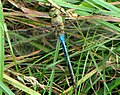
Adult Male, Florida USA
Adult female, Blackwell Forest Preserve, Illinois[1]
Scientific classification Edit this classification
Kingdom: Animalia
Phylum: Arthropoda
Class: Insecta
Order: Odonata
Infraorder: Anisoptera
Family: Aeshnidae
Genus: Anax
Species:
A. junius
Binomial name
Anax junius
(Drury, 1773)
Synonyms[3][4]
  • Libellula junia Drury, 1773
  • Anax spiniferus Rambur, 1842
  • Anax ocellatus Hagen, 1867
  • Anex junius (Drury)
  • Gomphus junius (Drury, 1773)
  • Anax severus Hagen, 1867

The green darner or common green darner[5] (Anax junius), after its resemblance to a darning needle, is a species of dragonfly in the family Aeshnidae. One of the most common and abundant species throughout North America, it also ranges south to Panama.[6] It is well known for its great migration distance from the northern United States south into Texas and Mexico.[7][8] It also occurs in the Caribbean, Tahiti, and Asia from Japan to mainland China.[9] It is the official insect for the state of Washington in the United States.[10]

The green darner is a large dragonfly; males grow to 76 mm (3.0 in) in length with a wingspan up to 80 mm (3.1 in).[9][11]

Females oviposit in aquatic vegetation, eggs laid beneath the water surface. Nymphs (naiads) are aquatic carnivores, feeding on insects, tadpoles, and small fish. Adult darners catch insects on the wing, including ant alates, moths, mosquitoes, and flies.

Taxonomy

[edit]

Dru Drury described this species as Libellula junius in 1773.[12] There are not currently any recognized subspecies. There are three recognized synonyms: Anax spiniferus Rambur, 1842; Anax ocellatus Hagen, 1867; Anax severus Hagen, 1867.[3]

Distribution

[edit]

Common green darners are commonly found throughout the continental United States and southern Canada, occasionally ranging as far south as Panama, particularly in the winter.[13] There are also populations in Hawaii and the Caribbean. Vagrant individuals have been seen far outside of their normal range including sightings in Alaska, Russia, China, Japan, France, the United Kingdom, India, and Bermuda. These vagrant sightings are likely migrating individuals blown off-course by strong winds or storms.[9]

Characteristics

[edit]

Common green darners are large dragonflies, ranging from 6.8 to 8 centimetres (2.7 to 3.1 in)[14] in length and a wingspan of up to 10 centimetres (3.9 in).[13] Both sexes have an unmarked green thorax. Mature males have bluish-purple abdomens (the first few abdominal segments are the brightest) with a black dorsal stripe that broadens near the end of the abdomen. Immature males and most females have reddish-brown abdomens, but some females are patterned like adult males. Wings are initially clear but usually become amber-tinted with age, especially in females.[13][9] Both sexes have a black 'bulls-eye' mark on the face (more precisely, the frons) in front of their eyes, a distinguishing field mark that separates them from the superficially similar comet darner (Anax longipes).[15][13] This species oviposits in tandem which is a unique behavior among North American darners.[15][13]

Natural history

[edit]

Diet and predators

[edit]

Both the adult and the nymphal stage are predators. Nymphs prey upon immature aquatic insects (including their own species), small crustaceans, small tadpoles, and small fish. Adults primarily prey on winged insects, including wasps, flies, butterflies, and other Odonates. The primary predators of common green darner nymphs are fish. Adults are preyed upon by birds and occasionally robber flies, spiders, and other large dragonflies.[9]

Habitat

[edit]

Nymphs develop in lakes, ponds, and slow streams and rivers.[13] Adults are most frequently seen around nymph habitat but they are strong fliers and can be found in a wide variety of habitats including grasslands, forests, and urban areas.[9]

Migration

[edit]

There are several species of migratory dragonflies in North America, but common green darners are the best studied.[16] Other migratory species include:

The large geographic range and migratory behavior of the common green darner has made it a challenge to piece together its complex life history. Recent research has indicated that the annual life cycle of Anax junius is likely composed of at least three different generations.[8] The first generation emerges in the southern end of its range in early spring and migrates northwards through spring and summer. The second generation emerges in the northern end of its range in summer and migrates southwards in fall. The third generation occurs in the south during the winter and does not migrate. Common green darners migrate in fall and spring but for several reasons the southward movement in fall is more noticeable.[16]  

By attaching micro-radio transmitters to common green darners, researchers have found them to be capable of migrating up to 140 kilometres (87 mi) in a day, though they typically cover less distance per day. A group of researchers used stable isotope analysis on individuals collected between Ontario and Mexico during fall and documented that >90% of individuals moved southward, with an average distance of 900 kilometers.[16]

A study published in 2019 attached miniaturized radio transmitters to common green darners in the Great Lakes region and tracked their movement with the Motus Wildlife Tracking System. Individuals moved at an average groundspeed of 16 kilometres per hour (9.9 mph).[17]

[edit]

References

[edit]
[edit]
Revisions and contributorsEdit on WikipediaRead on Wikipedia
from Grokipedia
The common green darner (Anax junius) is a large and vividly colored dragonfly species in the family Aeshnidae, characterized by its bright green thorax, olive-green head with prominent compound eyes, and an abdomen that measures 68–78 mm (2.6–3 inches). Males typically display a striking blue abdomen, while females have a duller brownish-orange one that can sometimes appear blue, with both sexes featuring a wingspan of 9–10 cm (3.5–4 inches). As one of the largest and fastest-flying dragonflies in North America, it is easily recognizable by the bullseye-like marking on its forehead in front of the eyes and its overall robust, hawklike build. Widespread across , the common green darner inhabits warm, still or slow-moving freshwater environments such as ponds, lakes, marshes, wetlands, and slow streams, where it is abundant from spring through late fall. Its aquatic larvae, or naiads, are streamlined predators that dwell in these waters, feeding on small , tadpoles, and even , while the adults are agile aerial hunters that prey on flying including mosquitoes, flies, moths, , and smaller dragonflies. Though harmless to humans—lacking a and only capable of a mild pinching bite when handled—the is nicknamed "" or "devil's darning needle" for its beneficial role in controlling insect pests. A notable aspect of the common green darner is its migratory behavior, with some northern populations undertaking long southward journeys in late summer and fall, often in swarms along coastal routes like the , before laying eggs and dying off. The next generation emerges in spring to migrate northward, completing a multi-generational cycle, while other individuals may overwinter as naiads in milder climates. Reproduction involves males and females forming a characteristic "wheel" mating position, after which the female uses her to deposit hundreds of eggs directly into aquatic vegetation or submerged wood. With over 30,000 ommatidia in their compound eyes providing near-360-degree vision, these ancient —fossils of which date back more than 300 million years—play a key ecological role as both predators and prey in ecosystems.

Taxonomy

Classification

The green darner (Anax junius) is classified in the kingdom Animalia, phylum , class Insecta, order , suborder Epiprocta, infraorder Anisoptera, family , genus , and species A. junius. This placement situates it among the true dragonflies, characterized by their robust bodies and predatory habits, within the diverse order Odonata that encompasses both dragonflies and damselflies. Within the family Aeshnidae, known as darners for their large size and hawklike flight, the genus Anax forms a monophyletic group, with Hemianax recognized as its sister taxon based on morphological and molecular evidence. Phylogenetic studies using multigene datasets, including mitochondrial and nuclear markers, confirm the monophyly of Anax, with strong support (posterior probability >0.95) for its internal clades. A. junius occupies a position in one such clade (Clade 2), closely related to A. walsinghami and A. strenuus, which diverged approximately 5 million years ago; this Nearctic-dominated group is distinct from the Eurasian/African Clade 1 that includes A. imperator. These relationships highlight the genus's cosmopolitan distribution and evolutionary history of migration. No subspecies are currently recognized for A. junius, establishing it as a monotypic species across its wide range, with taxonomic revisions focusing instead on genus-level phylogenetics rather than intraspecific variation.

Nomenclature

The green darner was originally described by British entomologist Dru Drury in 1773 as Libellula junius in his publication Illustrations of Natural History, placing it initially within the genus Libellula of the family Libellulidae. Over time, taxonomic revisions reclassified it to the genus Anax in the family Aeshnidae, reflecting a more accurate systematic position based on morphological and phylogenetic evidence. Recognized synonyms include Anax spiniferus (Rambur, 1842) and Anax ocellatus (Hagen, 1867), which were later synonymized under A. junius. The genus name originates from the word anax, meaning "lord," "master," or "king," a reference to the imposing size and robust build of species in this group. The specific epithet junius is thought to possibly honor a person, such as a female member of the Roman Junius family (e.g., linked to ), or allude to the month of , when the species is commonly observed, though the precise remains uncertain. Common names for the species include "green darner" and "common green darner," derived from its prominent green thorax and the abdomen's resemblance to a needle used in . In 1997, it was designated the official state of Washington following advocacy by students at Crestwood Elementary School in .

Description

Adult morphology

The adult green darner (Anax junius) is a large , with a body length ranging from 6.8 to 8 cm and a reaching up to 10 cm; males typically average 76 mm in length, while females are slightly larger. The body exhibits a robust build, characterized by a short, sturdy and a long, slender that tapers toward the tip, giving the its common name due to its resemblance to a needle. Coloration is striking and sexually dimorphic. The is uniformly bright green in both sexes, complemented by large compound eyes that are green (duller in males) and occupy most of the head, along with a distinctive black "bull's-eye" spot on the forehead. The in mature males is bluish- with a dark dorsal stripe and bright blue lateral stripes (which may appear purple in cooler conditions), whereas females display a reddish-brown to rusty . The four wings are translucent and clear, often developing an tint at the base with age, particularly in females, and the hindwings include a characteristic anal loop formed by the anal veins. Sexual dimorphism extends to reproductive structures at the abdominal tip. Males bear claspers—comprising superior appendages (cerci) and inferior appendages (paraprocts)—adapted for grasping the female's head during , while females possess a well-developed consisting of two valves for depositing eggs into substrates. These features distinguish adults from nymphs, which lack such specialized appendages and exhibit different coloration patterns.

Nymphal characteristics

The nymphs of the green darner (Anax junius), also known as naiads, are aquatic larvae characterized by a streamlined, elongated body adapted for predation and in freshwater habitats. They typically reach lengths of up to 45 mm in their final instars, with an oval-shaped that tapers posteriorly, a broad head bearing large compound eyes positioned laterally, and a relatively short . Their coloration is generally drab green-brown, providing effective among submerged vegetation and sediments. Prominent adaptations include a large, prehensile labium that functions as a scoop-like structure, extendable from the face to rapidly capture prey, featuring spatulate prementum and hooked palpal lobes for grasping. Respiration is facilitated by internal gills housed within a rectal chamber, which stores and enables by expelling it forcefully for quick escapes or attacks. The ends in three caudal appendages—comprising an epiproct and paired paraprocts— that assist in swimming and defense, while the overall body form supports agile movement in water. Predatory mouthparts are robust, with toothed mandibles for processing captured prey and a well-developed tentorium supporting the head. Development proceeds through 10–13 instars, during which the nymphs molt periodically to accommodate growth, developing visible wing pads in later stages. This molting process allows for progressive enlargement and refinement of morphological features, culminating in preparation for emergence as adults.

Distribution and habitat

Geographic range

The green darner (Anax junius) has a broad native range across , occurring throughout the continental in all states, southern Canada (from to ), , and extending southward through to and . It is also native to various Caribbean islands and the . Introduced populations have become established in and , as well as in parts of ranging from to . Additionally, rare vagrant individuals have been recorded outside this range, including in (such as the in 1998 and ) and (notably in the 1940s). Within its native North American range, the green darner is one of the most common and widespread species, often reaching high local abundances in suitable areas.

Habitat requirements

The nymphs of the green darner (Anax junius) inhabit still or slow-moving freshwater bodies, such as ponds, lakes, marshes, and sluggish streams, where they typically occupy shallow waters less than 0.5 meters deep along vegetated edges for and . These aquatic environments provide submerged, emergent, and floating , ideally covering 50–70% of the area, which offers shelter from predators and sites for ambushing prey. Nymphs develop in permanent or semi-permanent waters that support their 3–5 month growth period in warmer regions, overwintering in cooler northern latitudes. Adult green darners prefer open terrestrial habitats adjacent to water bodies, including fields, meadows, urban parks, and grasslands, where they perch on herbaceous vegetation or exposed structures for hunting and . They avoid dense interiors, favoring sunny, unobstructed areas that facilitate aerial and patrols. During migration, these open landscapes serve as key stopover sites for resting and refueling. Water quality is critical for green darner survival, with nymphs thriving in warm conditions of 20–30°C that accelerate development, alongside neutral levels around 6.0–7.0 for optimal physiological function. Moderate supports oviposition by females, who select emergent in these settings. While preferring clean waters, green darner nymphs exhibit some tolerance to , allowing persistence in mildly degraded habitats compared to more sensitive odonates.

Life history

Reproduction

The green darner (Anax junius) exhibits mating behaviors typical of the family, with s actively patrolling breeding sites over aquatic habitats to locate receptive s and defend territories against rivals. These patrol flights often involve rapid, low-altitude pursuits that serve as an aerial display to attract s and deter intruders. Upon encountering a potential mate, the initiates tandem formation by grasping the behind her head or with his cerci, allowing her to assess his suitability before proceeding. Mating typically occurs in the characteristic "" or copulatory position, either in flight or while perched on , where the transfers from his primary genitalia at the abdomen's tip to secondary genitalia on abdominal segments 2–3 for storage. The female then curls her abdomen to receive the , completing ; this process can last several minutes. Green darners are polygynandrous, with females capable of multiple matings per reproductive period to ensure fertilization success. Following , the pair remains in as the female oviposits, dipping her into the water to insert eggs into slits in aquatic plants, stems, or mud using her sharp ; the male guards her to prevent displacement by rival males. Females lay huge clutches, often numbering in the hundreds per batch, with larger individuals producing multiple batches over the breeding season. Breeding primarily takes place in spring and summer, aligning with peak availability of suitable habitats.

Development and life cycle

The development of the green darner (Anax junius) encompasses three primary stages: , , and , with durations influenced by temperature, photoperiod, and geographic location. Eggs are small (approximately 1 mm in length), typically laid singly or in small clusters on submerged or emergent aquatic vegetation, and hatch after at least 6–7 days, often triggered by low oxygen levels. Hatching occurs in spring or summer depending on oviposition timing, marking the onset of the aquatic nymph phase. Nymphs emerge as small, predatory larvae that inhabit freshwater environments such as , lakes, and slow-moving , feeding on smaller aquatic to fuel growth through 10–13 instars. Development typically spans 3–5 months for migratory cohorts but 11–12 months for resident/overwintering nymphs in northern regions, where they enter during colder months and resume growth in spring. This stage is characterized by rapid molting in warmer conditions for migratory cohorts or slower progression with overwintering for resident ones, allowing adaptation to seasonal variations. Final-instar nymphs crawl out of the water onto vertical stems or other supports, typically at night, to undergo eclosion, shedding their to reveal the form. Newly emerged s, known as tenerals, remain sexually immature for several days while their wings harden and coloration develops, a vulnerable phase lasting about 1–2 weeks. The lifespan averages 5–7 weeks, during which individuals mature and contribute to the next generation before dying. The life cycle exhibits generational variation, with at least three cohorts annually: the first and second are obligate migrants with abbreviated nymphal development (3–5 months) to align with long-distance movements, while the third generation in southern regions completes a full local cycle without migration. gradients drive these patterns, with warmer southern waters accelerating development and northern overwintering extending it, ensuring synchronized emergence for breeding and migration.

Ecology

Diet

The nymphs of the green darner (Anax junius) are voracious aquatic predators that primarily consume a variety of invertebrates, including amphipods, midge larvae (such as Chaoborus), cladocerans like Daphnia, other aquatic insects (e.g., beetles, chironomids, and damselfly nymphs), tadpoles, larval salamanders, and occasionally small fish or conspecifics. They employ an ambush predation strategy, remaining stationary in shallow waters near vegetation and using a specialized, extendable labium to rapidly stab and capture prey with hooked palps before retracting it to the mandibles for consumption. This sit-and-wait tactic favors active, visually detectable prey, with foraging activity occurring solitarily to minimize cannibalism risks. In fishless ponds and wetlands, green darner nymphs function as apex predators, exerting strong top-down control on invertebrate communities and influencing overall aquatic food web dynamics. Adult green darners are aerial carnivores that hawk insects on the wing or snatch them from perches and vegetation, targeting a broad range of flying prey such as flies, mosquitoes, moths, butterflies, wasps, and other dragonflies, as well as occasional terrestrial insects like beetles and true bugs. Foraging occurs primarily during daylight hours and at dusk, with individuals often patrolling territories or joining feeding swarms; their large compound eyes and agile flight enable high capture success rates. These adults exhibit opportunistic and size-selective predation, prioritizing larger, energy-rich items within reach while consuming up to 20% of their body weight daily to fuel rapid metabolism and migratory demands.

Predators and threats

The nymphs of the green darner (Anax junius) face predation primarily from aquatic organisms, including such as bass and sunfish, amphibians like frogs and salamanders, and larger including other odonates and . Cannibalism among larger conspecific nymphs also contributes to mortality in dense populations. Adult green darners are preyed upon by birds such as and kingbirds, robber flies (), spiders, and occasionally amphibians or during oviposition near . Their rapid flight and keen vision help evade many attacks, but they remain vulnerable when flying low or roosting. Predation imposes high mortality on green darners, with survival rates from to adulthood estimated as low as 10%, implying up to 90% loss primarily to predators. Adults experience lower but significant predation during vulnerable periods like from the larval stage. Non-human threats to green darners include , which degrades aquatic habitats and directly harms sensitive during their prolonged larval phase. extremes pose risks to larvae, as development requires a minimum temperature of 8.7°C, and deviations can delay or increase mortality. Pesticides further threaten populations by contaminating and reducing the abundance of prey essential for both and adults.

Behavior

Territoriality and foraging

Male green darners establish and defend linear territories along the edges of , lakes, and , typically patrolling areas up to several hundred meters in length through alternating flapping and gliding flights conducted about 1-2 meters above the water surface. These patrols serve to monitor for receptive females and repel intruders, with resident males engaging in aggressive aerial chases against rival males, often reaching speeds of up to 56 km/h to drive them away. Such territorial defense is most intense during the breeding season, where physical confrontations like ramming or biting may occur if chases fail to deter competitors. Foraging in green darners is predominantly diurnal, with adults active from early morning until dusk and peak hunting activity occurring midday when insect prey is abundant. As aerial hawkers, they capture flying such as small flies, mosquitoes, beetles, and other odonates mid-flight using their spiny legs to form a basket-like trap, or occasionally by perching briefly on before launching pursuits. At night, they roost motionless in tall grasses or shrubs, conserving energy after daily bouts that can cover irregular territories extending beyond water bodies into open fields. These gatherings are transient and driven by prey availability rather than cooperative behavior, with minimal interference beyond occasional territorial disputes. The green darner's compound eyes, comprising nearly 30,000 ommatidia, provide near-360-degree vision that enhances detection of both rival males during territorial patrols and distant prey during flights, though acuity is reduced directly above and below the body. This panoramic visual field allows rapid orientation toward movement in the horizontal plane, critical for aerial maneuvers in cluttered habitats.

Migration

The green darner (Anax junius) exhibits a multi-generational migration pattern, particularly in northern populations, where adults migrate southward in the fall from breeding grounds in and the , while their offspring undertake the northward return migration in the spring. This annual cycle involves at least three generations: the first emerges in the southern U.S. or , migrates north to breed, produces a second generation that remains or moves locally, and a third that migrates south, with grandchildren completing the northward leg the following year. The migration spreads reproductive effort across diverse water bodies, enhancing survival by reducing localized predation and resource competition. Migration distances typically span a minimum of 659 km northward and 681 km southward per generation, with total annual circuits averaging around 900 km when accounting for multi-leg journeys from the Gulf Coast to northern limits. Radio-tracked individuals achieve average groundspeeds of 16 km/h, with maximum daily advances reaching 122 km, often facilitated by tailwinds. Flights occur intermittently during the day, averaging every 2.9 days, with tracked individuals achieving an average net advance of 58 km over 6.1 days (11.9 km per day). Routes generally follow east-west oriented weather fronts, with southward movements in late summer to fall tracking cooler conditions toward the and northward spring migrations aligning with warming fronts. Migration is triggered primarily by thresholds, such as a 9.17°C thermocline for northward advances and 8.7°C for development enabling emergence, supplemented by photoperiod cues like day length. likely involves a sun and sensitivity to magnetic fields, though these mechanisms remain under study. Recent post-2019 genomic research has begun identifying adaptations in flight muscle and energy metabolism genes that support these long-distance capabilities. During stopovers, green darners utilize habitats for resting and foraging to replenish energy.

Conservation

The green darner (Anax junius) is classified as Least Concern on the , a status reflecting its extensive range across and beyond, with no immediate threats to its global persistence. This assessment has remained unchanged since 2014, underscoring the species' resilience and abundance in diverse habitats. Additionally, NatureServe assigns it a global rank of G5, denoting that it is secure worldwide due to its widespread occurrence and lack of significant population pressures. Population trends for the green darner are stable in most of its range, with the described as common and not experiencing notable declines according to the latest assessments. It is frequently encountered in ponds, lakes, and wetlands, where adults are often observed in groups during breeding seasons. No large-scale reductions have been documented, and its migratory behavior contributes to sustained local abundances across latitudes. Monitoring efforts through programs provide ongoing evidence of these trends. For instance, the Dragonfly Pond Watch initiative by the Xerces Society tracks sightings of green darners at water bodies, revealing consistent presence and emergence patterns year after year, which affirm the species' healthy status. Similar observations from platforms like further support stable detection rates without indications of rarity. Regional variations show the green darner as particularly abundant in temperate and northern areas due to migration, while southern resident populations maintain steady numbers without reported vulnerabilities in recent assessments.

Threats and protection

While habitat loss, , pesticides, and pose risks to dragonflies and odonates more broadly, no significant threats have been identified specifically for the green darner (Anax junius), consistent with its Least Concern status and stable populations. General pressures include habitat degradation from drainage and , with approximately 22% of global lost since 1970 according to the 2025 Global Wetland Outlook, at an ongoing annual rate of 0.52%. These activities can affect the permanent and semi-permanent water bodies essential for larval development and breeding in odonates. , particularly from agricultural runoff containing nutrients and sediments, can compromise in ponds and marshes, potentially increasing larval mortality and reducing prey availability for dragonflies. Climate change may alter temperature-dependent migration cues for odonates, potentially disrupting multi-generational journeys of up to 1,500 miles, as warmer conditions could shift breeding timings and extend ranges unevenly. Increased use, interacting with rising temperatures, has contributed to declines in some species by reducing prey abundance and heightening toxicity risks. In introduced ranges, such as parts of the and Pacific islands, competition from may intensify under changing climates, though specific impacts on the green darner remain understudied. Additionally, natural threats like predation can compound these stressors in altered environments. While no species-specific legal protections exist for the green darner, it benefits indirectly from broader efforts, including the designation of over 2,500 Ramsar sites worldwide that safeguard critical habitats for odonates by promoting wise use and restoration. , its status as the official state insect of Washington since 1997 raises public awareness and supports educational initiatives that encourage habitat-friendly practices, such as creating chemical-free ponds. These measures, combined with calls to reduce near water bodies, help mitigate risks, though implementation varies by region. Ongoing research highlights the need for long-term monitoring of impacts on green darner populations, including how shifting temperatures affect migration resilience and larval survival. Studies from the , such as those analyzing over 40 years of observational data, underscore the interactive effects of pesticides and warming on odonates, emphasizing the urgency for expanded tracking programs to inform adaptive conservation strategies.

References

Add your contribution
Related Hubs
User Avatar
No comments yet.