Hubbry Logo
Ground-effect trainGround-effect trainMain
Open search
Ground-effect train
Community hub
Ground-effect train
logo
8 pages, 0 posts
0 subscribers
Be the first to start a discussion here.
Ground-effect train
Ground-effect train
from Wikipedia
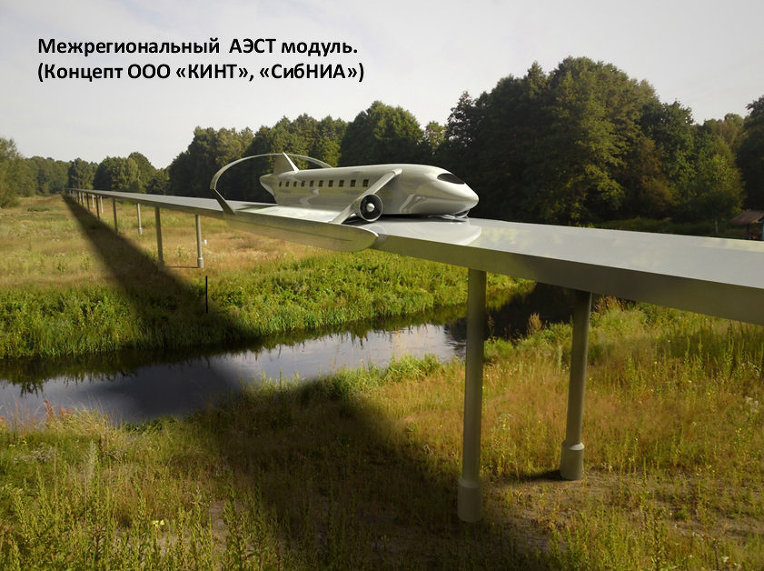
A ground-effect train (a concept art).
A ground-effect train (concept art)

A ground-effect train is a conceptualized alternative to a magnetic levitation (maglev) train. In both cases the objective is to prevent the vehicle from making contact with the ground. Whereas a maglev train accomplishes this through the use of magnetism, a ground-effect train uses an air cushion; either in the manner of a hovercraft (as in hovertrains) or using the wing–in–ground-effect design.

Details

[edit]

The advantages of a ground-effect train over a maglev are lower cost due to simpler construction. Disadvantages include either constant input of energy to keep the train hovering (in the case of hovercraft-like vehicles) or the necessity to keep the vehicle moving for it to remain off the ground (in the case of wing–in–ground-effect vehicles). Furthermore, these vehicles may be drastically affected by wind, air turbulence, and weather. Whereas the magnetic levitation train can be built to operate in a vacuum to minimise air resistance, the ground-effect train must operate in an atmosphere in order for the air cushion to exist.

Development work has been undertaken in several countries since the middle 20th century. No ground-effect train has entered regular commercial service.

Yusuke Sugahara and his team of researchers at Tohoku University, in Sendai, Japan have developed the Aero-Train that uses wings attached to a fuselage to fly inches off the ground. Dubbed a ground-effect vehicle the train is designed to be completely powered by wind and solar energy – making this a true zero-carbon transportation system.[1][2]

See also

[edit]

References

[edit]
[edit]
Revisions and contributorsEdit on WikipediaRead on Wikipedia
from Grokipedia
A ground-effect train is a high-speed that levitates inches above a specialized track by exploiting the wing-in-ground (WIG) effect, where air trapped between the vehicle's stubby wings and the surface creates a high-pressure for lift, minimizing without relying on or wheels. This technology operates within a U-shaped guideway or channel with side walls for lateral stability, using aerodynamic forces similar to those in to control pitch, roll, and yaw autonomously. The vehicle achieves at speeds as low as 50 km/h and can reach up to 500 km/h in advanced concepts, propelled by electric motors or propellers while flying 5-10 cm above the track. Modern development of wing-in-ground effect trains originated in at Tohoku University's Institute of Fluid Science in the late 1990s, with initial unmanned prototypes tested by 2000 using passive stabilization via vertical fins interacting with guideway walls. By 2011, robotic models demonstrated active three-axis control, paving the way for manned experimental versions under the "Aero-Train" . As of 2025, the project remains in experimental stages with no manned prototypes deployed. Research continued into the 2020s, focusing on aerodynamic performance enhancements like multi-directional wing configurations to optimize lift-to-drag ratios and reduce noise from vortex interactions in the ground-effect regime. Key advantages include energy consumption one-quarter that of systems, resulting in CO2 emissions as low as 3.6 g per person per km, along with lower construction costs due to simpler compared to magnetic systems. However, challenges persist in achieving flight stability amid disturbances, managing aeroacoustic from trailing edges and wakes, and scaling to passenger capacities of 300 or more without stalling risks at high angles of attack. Ongoing efforts aim to integrate advanced control systems and flow optimization for practical deployment in commuter networks.

Definition and Principles

Ground Effect Phenomenon

The ground effect is an aerodynamic phenomenon characterized by increased lift and reduced induced drag experienced by a operating in close proximity to a surface, such as the ground or , due to the compression and restriction of airflow beneath the vehicle. This occurs as the vehicle's wings or aerodynamic surfaces interact with the surface, creating a high-pressure air cushion that modifies the flow field. The physics underlying ground effect involves the restriction of airflow beneath the or skirt-like structures, which limits the downward deflection of air and reduces compared to free flight. According to , the faster airflow over the upper surface of the creates lower above, while the proximity to the ground traps slower-moving, higher- air below, enhancing the pressure differential and thus lift generation. The lift force LL is given by the equation L=12ρv2ACL,L = \frac{1}{2} \rho v^2 A C_L, where ρ\rho is air , vv is , AA is the area, and CLC_L is the lift ; in ground effect, CLC_L increases significantly due to the altered flow, with studies showing increases of more than 20% for certain configurations at low height-to-chord ratios. This effect also diminishes induced drag by up to 47.6% at heights equivalent to one-tenth the , improving overall aerodynamic efficiency. The phenomenon was first notably observed in aviation during low-altitude flights of the 1929 flying boat, where operations just above wave height exploited the increased provided by ground effect to extend range during transatlantic attempts. This early recognition highlighted the potential for performance gains in surface-proximate flight, influencing subsequent vehicle designs. Ground effect can be distinguished into quasi-static and dynamic types based on the mechanism sustaining the air cushion. Quasi-static ground effect, akin to operation, relies on powered augmentation—such as fans or propellers—to maintain a pressurized air layer independent of forward speed, enabling stationary or low-speed hover. In contrast, dynamic ground effect is motion-dependent, utilizing from the vehicle's forward velocity to compress air under the wings, which requires sustained speed to generate and sustain lift. This foundational principle underpins in ground-effect trains by adapting aerodynamic cushioning for rail-like guidance.

Levitation Mechanisms

Ground-effect trains employ two primary levitation mechanisms to achieve sustained hover over a track: air-cushion levitation, which provides static support through pressurized air, and wing-in-ground-effect (WIG) levitation, which relies on dynamic aerodynamic forces. Air-cushion levitation, often implemented in hovertrain configurations, utilizes fans or compressors to generate a pressurized air skirt that traps air beneath the vehicle, creating an upward lift force against gravity. This mechanism enables static hovering at heights typically ranging from 10 to 30 cm above the track surface, independent of vehicle speed. In contrast, levitation generates lift through the aerodynamic interaction between the vehicle's wings or body and the ground, amplifying pressure beneath the structure when operating in close proximity to the surface. This dynamic approach requires forward motion typically exceeding 40 km/h to generate sufficient lift, with prototypes achieving levitation at speeds as low as 35 km/h, and typical operating heights of 5 to 20 cm where the ground effect is most pronounced. Key engineering features enhance the performance of these mechanisms. For air-cushion systems, flexible designs, often constructed from durable fabrics or rubberized materials, encircle the vehicle's underside to minimize air leakage and retain within a , allowing efficient lift at low cushion volumes. In WIG systems, optimized profiles and stability aids such as canards or active control surfaces help regulate pitch, roll, and vertical positioning to counteract perturbations during high-speed travel. Energy demands differ significantly between the mechanisms. Air-cushion requires continuous power for air , with typical consumption around 25 kW per to sustain the cushion against leakage and vehicle weight. levitation, however, demands minimal additional power for lift once the vehicle reaches operational speed, as the aerodynamic forces are primarily derived from forward motion rather than mechanical input. Safety considerations focus on maintaining precise ground clearances to prevent contact and ensure the efficacy of the ground effect. Minimum clearances of at least 10 cm for air-cushion systems and 5 cm for configurations are essential to avoid structural impacts from track irregularities or dynamic instabilities. Maximum heights are limited to approximately 30 cm for air cushions and 20 cm for to preserve the pressure amplification from ground proximity, beyond which lift efficiency diminishes rapidly.

Historical Development

Early Concepts and Experiments

The origins of ground-effect train concepts trace back to early 20th-century experiments with ground-effect vehicles (GEVs), where aircraft designers observed enhanced lift and reduced drag when flying close to the surface. Early observations of the ground effect phenomenon during low-altitude flights laid foundational insights into aerodynamic efficiency near surfaces that later influenced transportation applications. By the 1910s, flying boats such as Henri Fabre's 1910 hydroplane demonstrated practical low-altitude operations over water, exploiting ground effect for stability and fuel savings, which sparked interest in adapting similar principles to overland travel. In the and early , ekranoplan-like GEVs emerged as experimental platforms, with Finnish engineer Toivo Kaario designing a wing-in-ground-effect craft in 1931 and providing the first practical demonstration of sustained low-level flight in 1935, achieving improved performance metrics compared to conventional . This period saw theoretical extrapolations to rail systems, as engineers envisioned wing configurations over tracks to minimize . A landmark experiment was the 1929 flying boat's demonstrations, where the massive 12-engine relied on ground effect for efficiency during low flights, showcasing gains that Soviet engineer Vladimir Levkov extrapolated in the to hybrid vehicles for faster surface . Levkov's L-series prototypes, developed between 1934 and 1939, combined air cushions with ground proximity for naval applications but inspired ideas for low-drag overland movement. Rail-specific proposals gained traction in the 1930s, drawing from systems for inspiration in creating low-friction environments. Concepts for air-cushion-assisted rail cars aimed to reduce wheel-rail contact, with early designs proposing enclosed air flows to simulate tube propulsion on open tracks. By the mid-20th century, theoretical studies on aerodynamic rail levitation advanced these ideas, though practical applications to trains awaited later developments. In the 1950s, patents formalized "air-ride" innovations in Britain and the , building on aviation-derived ground-effect principles. British engineer Cockerell's 1955 (GB854211A) for radial air-jet cushions influenced adaptations for frictionless guidance, while Walter A. Crowley's 1957 concept for a triangular-tracked air-cushion was patented as U.S. No. 3,090,327 in 1963. These efforts emphasized conceptual scalability from GEV experiments to rail, prioritizing energy efficiency over wheeled .

Major Prototypes of the 20th Century

While early 20th-century efforts focused on aviation-derived GEVs primarily over water, rail-specific wing-in-ground-effect train prototypes did not materialize until the late . Concepts for overland WIG vehicles drew from ekranoplans and theoretical work, but practical development of tracked WIG systems began with unmanned models in in the 1990s, as covered in subsequent sections. No major WIG ground-effect train prototypes were built in the early to mid-, distinguishing this technology from contemporaneous air-cushion vehicles like the .

Modern Projects and Research

Japanese Initiatives

Japan has played a pioneering role in ground-effect train research since the early 2000s, building on its extensive experience with technologies such as the High-Speed Surface Transport (HSST) system developed in the 1970s and 1980s. This work has focused on aerodynamic as a potentially more energy-efficient alternative for , emphasizing stability and control in constrained environments like U-shaped guideways. A key milestone was the 2011 prototype Aero-Train developed by researchers at , led by Yusuke Sugahara. This utilized wing-in-ground (WIG) effect for , employing stubby wings and multiple propellers to generate lift from within a U-shaped channel. The vehicle achieved stable at approximately 10 cm above the track and reached speeds of up to 30 km/h during tests, demonstrating feasibility for higher velocities in full-scale designs targeting 200 km/h. Stability was maintained through an autonomous robotic managing pitch, roll, and yaw axes, addressing inherent instabilities in ground-effect dynamics via real-time feedback. In the , Japanese efforts expanded to experiments and dynamic modeling to mitigate challenges like sensitivity, incorporating active control mechanisms such as adjustable flaps for enhanced lateral stability. These advancements were published through platforms supported by the Japan Science and Technology Agency (JST), reflecting national investment in innovative transport solutions. Ongoing research as of 2023 includes collaborative projects at on the design and optimization of multidirectional wings under static effects to enhance Aero-Train performance. A 2018 announcement of collaboration with aimed at developing an Aero-Train system for deployment by 2025, but no further advancements have been reported as of November 2025.

Other Contemporary Efforts

In , research on ground-effect technologies has seen a revival through EU-funded initiatives in the and , focusing on hybrid wing-in-ground (WIG) effect systems for efficient transport, including potential freight applications over water or land interfaces. The Horizon 2020 AIRSHIP project, for instance, investigated sustainable WIG craft designs to enhance maritime and short-haul connectivity, emphasizing low-emission propulsion and aerodynamic efficiency in ground-effect operations. In the United States, conceptual work on ground-effect vehicles has primarily focused on over-water applications, with startups like Craft advancing electric prototypes since the . The model is designed for 290 km/h speeds and 290 km range, targeting coastal routes, with over $60 million in funding and pre-orders; such maritime developments may offer indirect insights into for land-based systems. China's efforts in the 2020s have centered on simulations and prototypes for vehicles, with recent developments like the jet-powered "Bohai Sea Monster" ekranoplan prototype spotted in 2025, testing ground-effect stability for high-speed maritime surface travel. These simulations highlight potential efficiency gains in humid coastal environments but prioritize maritime over rail applications. As of 2025, global non-Japanese research on ground-effect trains has produced no operational pilots beyond laboratory and scaled testing, with emphasis on computational models demonstrating aerodynamic advantages like reduced drag and energy use compared to traditional high-speed rail.

Technical Aspects

Vehicle Design Features

Ground-effect train vehicles are engineered to leverage aerodynamic principles for levitation, typically incorporating specialized bodies that minimize drag while maximizing lift close to the ground. Designs vary between wing-in-ground (WIG) configurations, which use low-aspect-ratio wings to exploit compressed air beneath the vehicle, and air-cushion systems, which employ flexible skirts to trap pressurized air for support. In WIG designs, such as the Japanese Aero-Train prototypes, the body features a tandem wing arrangement with front and rear levitation wings of modified NACA 6412 airfoils, spanning 3.3 meters with a 0.7-meter chord length, set at incidence angles of 4.8 degrees and 2.8 degrees respectively to optimize pitch stability and lift. These wings integrate vertical side wings for lateral guidance along a U-shaped track, with the overall structure constructed from lightweight carbon fiber reinforced polymer (CFRP) and glass fiber reinforced polymer (GFRP) composites, resulting in a total vehicle mass of approximately 420 kg for experimental models. Air-cushion vehicles, like the French Aérotrain and British RTV 31, utilize faired underbodies with box-like girders and wing-like extensions to house lift pads, featuring rubberized fabric skirts or peripheral jets that form a 15 cm deep seal to contain the air cushion and reduce leakage. Propulsion systems in ground-effect trains integrate seamlessly with the levitation mechanism to maintain forward momentum and height. WIG vehicles often employ electric motors driving propellers, as seen in the Aero-Train's dual 640 mm diameter propellers powered by DC motors and a 175 V, 12.8 Ah , providing efficient for speeds up to 100 km/h in tests without mechanical contact. Air-cushion designs typically use linear induction motors (LIM) for non-contact propulsion, such as the Merlin-Gérin LIM in the I80, which generates electromagnetic fields along the track to accelerate the vehicle, or early jet-assisted variants like the prototype's turbojet delivering approximately 12.5 kN of . Lift in air-cushion systems is supported by integrated fans or compressors, exemplified by the Rohr Aerotrain's dual 1-meter fans producing 267 N (60 lbf) of lift at 2.5 PSI pressure to sustain the cushion. Regenerative capabilities in some electric LIM setups recover during deceleration, though specific air compression methods for braking remain experimental. Control systems ensure stability against perturbations, relying on sensors and actuators to manage pitch, roll, and yaw. In WIG trains like the Aero-Train, active control employs flaperons on the wings and rudders on vertical tails (0.5 m² area, positioned 2.5 m aft) for , with displacement sensors providing real-time height feedback to a PID controller operating at 50 Hz via servomotors, reducing roll oscillations by over 50% in simulations and tests. Air-cushion vehicles use centring pads that press against the guideway's sides for lateral stability, supplemented by gyroscopic or electronic feedback in prototypes to counter crosswinds, though specific gust tolerance data is limited to operational envelopes below 15 m/s. Horizontal and vertical tails in WIG designs further enhance longitudinal and directional stability without active intervention. Passenger accommodations prioritize compactness due to the low height of 10-30 cm, resulting in low-profile cabins with 1.5-2 m headroom and vibration-damping materials to mitigate aerodynamic . capacities range from small test models accommodating 2-4 occupants to full-scale designs like the RTV 31, intended for 100 passengers in a two-deck , or the planned for 80 seated passengers in streamlined interiors resembling cabins. These features emphasize safety and comfort through padded seating and climate control, adapted from standards to handle sustained low-altitude travel.

Track and Infrastructure Requirements

Ground-effect trains, particularly those employing air-cushion , necessitate dedicated guideway infrastructure optimized for non-contact suspension and . The track typically consists of a smooth, in an inverted-T or U-shaped configuration to facilitate lateral guidance and stability, with elevated structures 5 meters above ground to enhance safety and reduce environmental exposure. segments, often 120 meters in length supported by numerous pillars, form the backbone of such systems, as demonstrated in the French spanning 18 kilometers. Surface specifications emphasize exceptional to minimize aerodynamic drag and ensure stable hover at low clearances. Guideways require high-quality polishing, with vehicle-to-track suspension heights limited to 1-2 cm via plenum skirts, where roughness power directly influences ride quality and energy efficiency at operational speeds up to 500 km/h. is constrained to large radii with banking for comfort, typically exceeding 500 meters to prevent excessive lateral forces, while shallow grades support efficient . Composite materials may supplement for enhanced durability in modern designs. Supporting includes fully segregated rights-of-way devoid of grade crossings, dedicated elevated guideways spanning 2-4 meters in width to accommodate dimensions, and specialized stations featuring deceleration ramps to sustain during stops. Power delivery relies on embedded or overhead lines, often at 25 kV AC, integrated with linear induction motors for , demanding wayside capacities of 10-30 MW to enable high-speed operations without onboard fuel dependency. Maintenance protocols focus on periodic resurfacing to uphold surface integrity, proving less intensive than conventional rail due to the absence of wheel-rail wear, though guideway protection from and environmental factors remains essential. Historical estimates place costs at $5-7.5 million per kilometer (1974 dollars, equivalent to approximately $30-45 million today adjusted for ), with annual upkeep around $0.5 million per kilometer for resurfacing in operational systems. Hybrid integration with existing rail networks is feasible for low-speed segments, allowing transitions to air-cushion modes on dedicated tracks.

Comparison with Other High-Speed Technologies

Versus Conventional Rail

Ground-effect trains differ fundamentally from conventional rail systems in their propulsion and levitation mechanisms, primarily leveraging aerodynamic ground effect to hover above a guideway rather than relying on wheel-rail contact. This elimination of mechanical friction enables significantly higher operational speeds, with conceptual designs targeting 400–600 km/h, compared to the maximum operational speeds of approximately 300 km/h for most conventional high-speed rail (HSR) systems like the Shinkansen or TGV. Without wheels in constant contact, ground-effect trains avoid the wear and tear associated with conventional rail, reducing maintenance needs for rolling components and extending infrastructure longevity. In terms of energy efficiency, ground-effect trains may exhibit higher consumption rates than the 0.05–0.1 kWh per passenger-km typical for HSR, though the elevated speeds can offset this by shortening overall trip durations, potentially lowering total energy expenditure per journey when factoring in reduced idle times and optimized routing for medium- to long-haul distances. This aerodynamic approach prioritizes lift-to-drag ratios by proximity to the ground, though it demands precise control to maintain stability. Infrastructure requirements for ground-effect trains emphasize dedicated guideways, often U-shaped channels that provide lateral guidance without traditional rails, simplifying construction by obviating the need for complex switches or turnouts operable at high speeds. Unlike conventional rail's standard gauge compatibility, which allows shared use with freight and regional lines, ground-effect systems face integration challenges, necessitating entirely new, segregated corridors to accommodate their low-clearance flight paths. These designs can leverage modified existing rights-of-way, potentially cutting costs compared to the precision-engineered tracks required for HSR's wheel-rail interface. Regarding safety, ground-effect trains mitigate derailment risks inherent to conventional rail by eliminating wheel-rail adhesion limits and contact points prone to under high centrifugal forces or track irregularities. This non-contact operation enhances stability in straight-line travel, with active control systems addressing pitch and roll dynamics. Conversely, their minimal ground clearance—often inches—increases vulnerability to or environmental obstructions, requiring advanced sensors and shielding not typically needed in wheeled systems. profiles present another contrast: ground-effect trains may generate higher levels than HSR due to aerodynamic effects, compared to HSR's regulated 75 dB(A) maximum in , though mitigation via enclosure designs is under exploration. Recent research as of has focused on aeroacoustic from trailing edges and wakes in ground-effect regimes to address these challenges.

Versus Maglev Trains

Ground-effect trains employ aerodynamic using the wing-in-ground (WIG) effect to create lift through motion over a track, contrasting with trains' (EMS) or (EDS) that rely on magnetic fields for without physical contact. This motion-based method in ground-effect systems requires continuous power for to maintain the dynamic air cushion and hover, making it speed-dependent for optimal lift, whereas 's EMS uses attractive forces from electromagnets for low-speed stability and EDS induces repulsive forces at higher speeds, often becoming passive above approximately 100 km/h without constant energy input for . In terms of infrastructure costs, ground-effect trains offer a potential advantage due to simpler track designs, such as guides without embedded magnetic coils, estimated at around €8 million per kilometer for modern concepts like the Spacetrain, compared to tracks requiring specialized electromagnetic components that drive costs to $40–100 million per mile (approximately $25–62 million per kilometer). Both technologies achieve high speeds exceeding 400 km/h, with ground-effect prototypes demonstrating viability at such velocities, but systems like the line maintain operational reliability in adverse weather conditions such as rain, while ground-effect trains may face disruptions from affecting air cushion stability. Additionally, ground-effect trains avoid the noise and complexity of superconducting magnets used in some designs, potentially resulting in quieter operation. Reliability differences stem from power dependencies: ground-effect systems demand ongoing electrical or mechanical input for propulsion, posing risks of failure if power is lost and potentially complicating emergency evacuations due to the hover height, similar to maglev's elevated clearance challenges. In contrast, maglev's EDS configuration achieves passive levitation during motion, enhancing fault tolerance once at speed, though both non-wheeled designs share issues like track alignment precision for safe operations. Prototypical examples highlight these trade-offs, such as the operational Shanghai Maglev, employing EMS to sustain 431 km/h commercially since 2004, underscoring ground-effect's experimental status against maglev's deployed infrastructure.

Advantages and Limitations

Operational Benefits

Ground-effect trains offer significant cost savings in both initial and ongoing compared to systems, primarily due to the absence of expensive rare-earth magnets and the simpler infrastructure requirements, such as a U-shaped guideway without complex electromagnetic components. Maintenance costs are also lower, as the mechanism involves no physical contact with the track and fewer moving parts than wheeled or magnetic systems, minimizing . In terms of efficiency, the wing-in-ground effect provides high lift-to-drag ratios, enabling reduced aerodynamic drag and of less than half that of conventional and about one-fifth that of trains at comparable speeds. This results in lower energy use per kilometer at high speeds, supported by stable levitation at approximately 10 cm above the guideway, which eliminates . The smoother ride quality further enhances by reducing passenger discomfort and structural stress during travel at speeds up to 500 km/h. Environmentally, ground-effect trains are designed for integration with sources, such as solar panels along the guideway, allowing potential operation without fossil fuels and resulting in lower emissions than diesel-powered options. The electric , combined with the inherent efficiency of the ground-effect , supports reduced overall for high-volume transport corridors. Capacity and comfort are optimized through spacious, enclosed cabins that accommodate up to 360 passengers per , enabling high throughput of around 20,000 passengers per hour in frequent-service scenarios similar to established high-speed networks. The aerodynamic design and attitude control systems provide a weather-resistant environment with minimal , offering a comfortable experience even at elevated speeds. As of 2025, ground-effect trains remain experimental, with ongoing research at institutions like .

Challenges and Drawbacks

Ground-effect trains face significant technical challenges related to weather sensitivity, as adverse conditions can impair operational stability. High winds and gusts, particularly those exceeding 10-14 m/s, may disrupt the precise altitude control required for maintaining the ground effect, leading to potential instability during cruise. To address these issues, proposed solutions include automated control systems for dynamic stability adjustment and enclosed or elevated tracks to minimize exposure to environmental disturbances. Energy demands represent another critical drawback, stemming from the power required for to sustain speeds in the ground-effect regime. Low-speed operations may require additional control inputs for stability. For instance, power requirements can be intensive for prototypes, highlighting the need for efficient electric systems compared to conventional rail. Mitigation efforts focus on optimized integration and adaptive controls to reduce energy during steady-state flight. Noise pollution and ecological impacts further complicate deployment, with ground-effect trains generating aerodynamic from propellers and air flow, potentially exceeding conventional rail levels. This can propagate and disturb nearby communities and . Low-altitude trajectories along tracks also risk disrupting habitats through overflight effects, causing behavioral changes and stress in species. Infrastructure demands may harm ecosystems via construction disturbances. Mitigation measures include aerodynamic via optimized designs, sound barriers along routes, and careful path planning to avoid sensitive ecological zones. Regulatory and economic hurdles pose substantial barriers to , as certifying hybrid rail-air vehicles under appropriate standards proves costly and complex. High R&D investments have historically delayed progress in similar technologies. Solutions involve international guidelines and collaborative efforts to streamline approvals and reduce development timelines.

Future Outlook

Current Status as of 2025

As of November 2025, ground-effect train technology, which leverages aerodynamic lift from the proximity to the ground to reduce and enable high speeds, remains confined to conceptual designs, academic simulations, and small-scale experimental models, with no operational prototypes or commercial deployments worldwide. Current focuses on dynamic stability control, with studies demonstrating that wing-in-ground effect models experience body oscillations at 2-5 second intervals even under active aileron-flap corrections, highlighting ongoing hurdles in maintaining posture during guideway travel. The global landscape is dominated by lab-scale investigations rather than field testing; for instance, simulations in explore aerodynamic performance but lack dedicated funding for pilot programs amid priorities for established systems. In and , no government-backed initiatives for ground-effect trains have advanced beyond theoretical papers, overshadowed by the proliferation of () networks. A 2025 review on the evolution of Ground Effect Flight Transit Vehicles (GEFT) highlights progress in digital prototypes and innovations for potential benefits in transit applications. Barriers to adoption persist, including the maturity of competing technologies like prototypes of 600 km/h trains, which have attracted substantial investments (over $10 billion in since 2010), compared to negligible funding—estimated under $100 million globally—for ground-effect research. Stability issues, high infrastructure demands for precise guideways, and energy efficiency concerns relative to proven further impede progress. Patent activity shows modest momentum in related systems, signaling theoretical interest without transformative breakthroughs. Overall, the field lags behind 's commercial viability, confining ground-effect trains to exploratory studies.

Potential Developments and Applications

Future developments in ground-effect train technology are poised to leverage advancements in and systems to enhance performance and efficiency. Researchers have proposed integrating AI-driven controls for real-time adjustment of aerodynamic forces, enabling vehicles to maintain stability amid disturbances such as wind or track irregularities. This approach could optimize lift and dynamically, reducing while supporting higher speeds. Additionally, hybrid concepts combining air cushions with alternative fuels like offer potential for speeds exceeding 700 km/h, as explored in designs aiming for average velocities of 540 km/h and peaks up to 720 km/h on dedicated tracks. Potential applications extend to urban short-haul routes, such as 100-200 km connections between cities and , where ground-effect trains could provide rapid, low-friction transit, minimizing travel times for commuters and reducing reliance on for regional routes. In , these systems suit flat terrains due to their high capacities—up to 50% of gross vehicle weight—and minimal needs compared to traditional rail, potentially streamlining in expansive, low-relief areas. For developing regions, ground-effect trains present a cost-effective alternative to , with projected expansions into and leveraging simplified track designs to connect underserved coastal or inland networks without extensive . Economic viability hinges on achieving construction costs below $15 million per kilometer, potentially enabling widespread by 2035 through scaled production and material efficiencies. Such reductions could position ground-effect systems to capture a notable portion of global markets, supported by zero-emission operations via fuel cells that cut annual CO2 emissions by tens of thousands of tons on major routes. Realizing these advancements faces hurdles, including the requirement for substantial pilot funding exceeding $1 billion to develop full-scale prototypes and test tracks, as inferred from comparable high-speed project budgets. Environmental assessments are critical, particularly for impacts in populated areas, where air cushion mechanisms may generate vibrations and airborne sounds comparable to or exceeding conventional rail, necessitating strategies like enclosed tracks or advanced .

References

Add your contribution
Related Hubs
User Avatar
No comments yet.