


Community hub
Recent from talks
Contribute something
Nothing was collected or created yet.
Gravity train
View on Wikipedia
 | This article needs additional citations for verification. (January 2013) |


A gravity train is a theoretical means of transportation for purposes of commuting between two points on the surface of a sphere, by following a straight tunnel connecting the two points through the interior of the sphere.
In a large body such as a planet, this train could be left to accelerate using just the force of gravity, since during the first half of the trip (from the point of departure until the middle), the downward pull towards the center of gravity would pull it towards the destination. During the second half of the trip, the acceleration would be in the opposite direction relative to the trajectory, but, ignoring the effects of friction, the momentum acquired during the first half of the trajectory would equal this deceleration, and as a result, the train's speed would reach zero at approximately the moment the train reached its destination.[1][better source needed]
Origin of the concept
[edit]In the 17th century, British scientist Robert Hooke presented the idea of an object accelerating inside a planet in a letter to Isaac Newton. A gravity train project was seriously presented to the French Academy of Sciences in the 19th century. The same idea was proposed, without calculation, by Lewis Carroll in 1893 in Sylvie and Bruno Concluded. The idea was rediscovered in the 1960s when physicist Paul Cooper published a paper in the American Journal of Physics suggesting that gravity trains be considered for a future transportation project.[2]
Mathematical considerations
[edit]Under the assumption of a spherical planet with uniform density, and ignoring relativistic effects as well as friction, a gravity train has the following properties:[3]
- The duration of a trip depends only on the density of the planet and the gravitational constant, but not on the diameter of the planet.
- The maximum speed is reached at the middle point of the trajectory.
For gravity trains between points which are not the antipodes of each other, the following hold:
- The shortest time tunnel through a homogeneous earth is a hypocycloid; in the special case of two antipodal points, the hypocycloid degenerates to a straight line.
- All straight-line gravity trains on a given planet take exactly the same amount of time to complete a journey (that is, no matter where on the surface the two endpoints of its trajectory are located).
On the planet Earth specifically, since a gravity train's movement is the projection of a very-low-orbit satellite's movement onto a line, it has the following parameters:
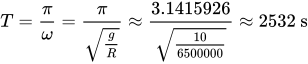
- The travel time equals 2530.30 seconds (nearly 42.2 minutes, half the period of a low Earth orbit satellite), assuming Earth were a perfect sphere of uniform density.
- By taking into account the realistic density distribution inside the Earth, as known from the preliminary reference Earth model, the expected fall-through time is reduced from 42 to 38 minutes.[4]
To put some numbers in perspective, the deepest current bore hole is the Kola Superdeep Borehole with a true depth of 12,262 meters; covering the distance between London and Paris (350 km) via a hypocycloidical path would require the creation of a hole 111,408 metres deep. Not only is such a depth nine times as great, but it would also necessitate a tunnel that passes through the Earth's mantle.
The straight line path between London and Paris would only require a maximum depth of 2.4 kilometres - well within the depths reached by deep mines. Such a tunnel would have an initial declination of 1.57 degrees.
Mathematical derivation
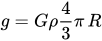
[edit]Using the approximations that the Earth is perfectly spherical and of uniform density , and the fact that within a uniform hollow sphere there is no gravity, the gravitational acceleration experienced by a body within the Earth is proportional to the ratio of the distance from the center to the Earth's radius . This is because underground at distance from the center is like being on the surface of a planet of radius , within a hollow sphere which contributes nothing.



On the surface, , so the gravitational acceleration is . Hence, the gravitational acceleration at is


Diametric path to antipodes
[edit]In the case of a straight line through the center of the Earth, the acceleration of the body is equal to that of gravity: it is falling freely straight down. We start falling at the surface, so at time (treating acceleration and velocity as positive downwards):


Differentiating twice:
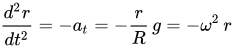
where . This class of problems, where there is a restoring force proportional to the displacement away from zero, has general solutions of the form , and describes simple harmonic motion such as in a spring or pendulum.


In this case so that , we begin at the surface at time zero, and oscillate back and forth forever.
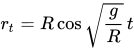

The travel time to the antipodes is half of one cycle of this oscillator, that is the time for the argument to to sweep out radians. Using simple approximations of that time is



Straight path between two arbitrary points
[edit]
For the more general case of the straight line path between any two points on the surface of a sphere we calculate the acceleration of the body as it moves frictionlessly along its straight path.
The body travels along AOB, O being the midpoint of the path, and the closest point to the center of the Earth on this path. At distance along this path, the force of gravity (directed from point X towards the center of the Earth, along ) depends linearly on distance to the center of the Earth as above. (Expressed in terms of , and using the shorthand for length OC, ). We have:


The resulting acceleration on the body, because it is on a frictionless inclined surface, is :


But , so substituting both:


which is exactly the same for this new , distance along AOB away from O, as for the in the diametric case along ACD. So the remaining analysis is the same, accommodating the initial condition that the maximal is the complete equation of motion is

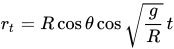
The time constant is the same as in the diametric case so the journey time is still 42 minutes; it's just that all the distances and speeds are scaled by the constant .

Dependence on radius of planet
[edit]The time constant depends only on so if we expand that we get


which depends only on the gravitational constant and the density of the planet. The size of the planet is immaterial; the journey time is the same if the density is the same.
In fiction
[edit]In the 2012 movie Total Recall, a gravity train called "The Fall" goes through the center of the Earth to commute between Western Europe and Australia.[5][6]
See also
[edit]References
[edit]- ^ Newton, Isaac. Philosophiæ Naturalis Principia Mathematica.
- ^ "To Everywhere in 42 Minutes". Time. February 11, 1966.
- ^ Robin Davis: A Physicist's Pipe Dream
- ^ Klotz, Alexander R. (2015). "The gravity tunnel in a non-uniform Earth". American Journal of Physics. 83 (3): 231–237. arXiv:1308.1342. Bibcode:2015AmJPh..83..231K. doi:10.1119/1.4898780. S2CID 118572386.
- ^ Martinez, Jason (August 13, 2012). "The Science of Total Recall". Wolfram-Alpha Blog. Retrieved March 30, 2018.
- ^ Rothman, Lily (August 6, 2012). "Spoiler Alert: The 8,000-Mile Hole in Total Recall". Time. Retrieved March 30, 2018.
- Description of the concept Gravity train and mathematical solution (Alexandre Eremenko web page at Purdue University).
External links
[edit]Gravity train
View on GrokipediaDefinition and Concept
Basic Principle
A gravity train is a theoretical transportation system for moving a vehicle between two points on the surface of a spherical celestial body, such as Earth, via a straight-line tunnel excavated through its interior, with propulsion provided exclusively by the body's gravitational field and no external energy input required.[4] The vehicle, assumed to be a point mass or low-friction capsule, is released from rest at the starting point on the surface.[6] In operation, the vehicle experiences an initial acceleration along the tunnel due to the component of gravitational force parallel to the path, directed toward the tunnel's lowest point: the Earth's center for a diametric tunnel connecting antipodal points, or the geometric midpoint for shorter chordal tunnels between non-antipodal locations.[4] This acceleration increases the vehicle's speed until it reaches maximum velocity at the bottom, after which the gravitational component reverses direction, causing symmetric deceleration as the vehicle ascends to the exit point, arriving with zero velocity.[6] The motion is idealized as frictionless, ignoring air resistance, tunnel wall friction, and other dissipative effects that would occur in practice.[4] The model further assumes the spherical body has uniform mass density throughout, which linearizes the gravitational restoring force along the tunnel and enables analytical solutions.[6] Under these conditions, the vehicle's path exhibits simple harmonic motion, similar to that of a pendulum undergoing small oscillations or a mass attached to a spring, where the acceleration is directly proportional to the displacement from the equilibrium (lowest) point but opposite in direction.[4] This oscillatory behavior ensures periodic motion if not damped, with the period independent of the tunnel's specific length for uniform density spheres.[6]Distinction from Related Systems
The term "gravity railroad" typically refers to 19th-century inclined-plane railways designed for freight transport, such as the Mauch Chunk Switchback Railway constructed in 1827 in Pennsylvania, which relied on gravity to propel loaded coal cars downhill along surface slopes while using mules or animal power to haul empty cars uphill.[7] These systems were engineered for efficiency in mining operations but operated entirely on the Earth's surface, following contoured terrain rather than straight subsurface paths.[8] In contrast, vacuum-tube transit concepts, such as the gravity-vacuum transit proposed by engineer Lawrence K. Edwards in the 1960s, envisioned underground low-pressure tubes to minimize air resistance, with vehicles propelled primarily by gravity along inclined routes but supported by additional infrastructure like dynamic airlocks and potentially magnetic suspension systems.[9] Similarly, modern initiatives like the Hyperloop, as detailed in Elon Musk's 2013 conceptual whitepaper, utilize near-vacuum tubes for pods accelerated by linear electric motors and levitated via magnetic bearings, emphasizing engineered propulsion over unassisted gravitational motion.[10] The theoretical gravity train differs fundamentally by positing straight-line tunnels bored directly through a planetary body's interior, such as from one surface point to its antipode, where motion arises solely from the conversion of gravitational potential energy into kinetic energy in a frictionless environment, resulting in simple harmonic oscillation without any post-launch energy input. Unlike surface-based gravity railroads or vacuum-assisted systems, which depend on inclines, pumps for pressure maintenance, or electromagnetic aids, gravity trains exploit the uniform gravitational field inside a spherical mass for bidirectional travel along chordal or diametric paths.[11]History and Development
Origin of the Concept
The concept of a gravity train, involving travel through tunnels bored through a planet under the influence of gravity alone, originated as a theoretical thought experiment in the late 17th century amid early explorations of universal gravitation. Robert Hooke, in a letter to Isaac Newton dated November 24, 1679, speculated on the motion of a body dropped into a hypothetical straight-line path through the Earth, suggesting it would accelerate toward the center and describing the trajectory as resembling an ellipse if gravity were constant inside the planet.[12] This idea was part of Hooke's broader writings on gravity.[13] Newton replied on November 28, 1679, engaging with the speculation by sketching a spiral path for the falling body in a rotating Earth frame and debating the deflection due to rotation, which he calculated as eastward.[12] Their exchange, continuing through early 1680, highlighted disagreements—Hooke favoring an elliptical path under constant force, while Newton argued for precession based on varying gravity—but it marked the first detailed intellectual discussion of motion in subterranean channels.[12] This correspondence occurred against the backdrop of the Hooke-Newton dispute over gravitational theory, with Hooke claiming priority in inverse-square ideas from his 1666 Royal Society lecture.[14] Newton's Philosophiæ Naturalis Principia Mathematica (1687) provided implicit support for the concept through Proposition 12 of Book I, the shell theorem, which demonstrates that inside a spherically symmetric mass distribution, the gravitational field is zero for a hollow shell and proportional to distance from the center for a solid uniform sphere—enabling simple harmonic motion in a diametric tunnel without explicitly proposing travel applications.[15] Though not directly addressing tunnels, this mathematical framework, derived from the inverse-square law of gravitation, established the physical feasibility of oscillatory paths through planetary interiors as a tool for illustrating gravitational principles.[16]Historical Proposals
The concept of gravity trains gained traction in the 19th century through practical engineering applications and speculative theoretical proposals. Early precursors emerged in the form of gravity railroads, which utilized inclines to harness gravitational force for transporting goods without continuous engine power. A prominent example is the Delaware and Hudson Canal Company's gravity railroad, completed in 1829 in Pennsylvania, USA, designed to haul anthracite coal from mines over the Moosic Mountains to canal boats; loaded cars descended under gravity while empty ones were pulled uphill by stationary engines or mules, demonstrating efficient use of terrain for industrial transport.[17] Theoretical subsurface gravity trains were proposed around the same period, building on earlier mathematical explorations of motion through planetary interiors. In the 19th century, an anonymous group presented a detailed project for a straight-line gravity train tunnel through the Earth to the French Academy of Sciences, envisioning rapid global transit powered solely by gravity; however, the academy deferred consideration due to the era's technological constraints.[18] These ideas were influenced by prior calculations, such as those by Robert Hooke in the late 17th century, who outlined the acceleration of objects falling through hypothetical Earth tunnels in correspondence with Isaac Newton, estimating transit times based on gravitational attraction.[19] In the 20th century, renewed interest arose through scientific publications that analyzed gravity trains as potential future infrastructure. Physicist Paul Cooper's 1966 paper in the American Journal of Physics, titled "Through the Earth in Forty Minutes," rigorously modeled the dynamics of a frictionless train in a diametric tunnel, calculating a 42-minute journey from pole to pole and advocating for its consideration in long-term transportation planning, though it highlighted immense engineering barriers. Speculations like Cooper's were sometimes prompted by mentions in science fiction, which spurred physicists to verify the underlying orbital-like motion analogies. No full-scale gravity trains have been implemented, as proposals consistently stalled due to limitations in deep-drilling technology and the immense geological challenges of excavating straight-line tunnels through varying densities and high pressures.[18] A brief modern analog appeared in 2022 when Australian mining firm Fortescue announced the "Infinity Train," a battery-electric system for iron ore haulage that recharges downhill via regenerative braking to power uphill segments, but the project was scaled back in September 2025 amid high costs[20] and it remains a surface-based, non-subsurface design.[21] Over time, the notion evolved from 19th-century incline-based systems for resource extraction to idealized subsurface concepts for passenger transit, continuing to inform debates on sustainable, gravity-assisted high-speed transport.Physics Fundamentals
Gravitational Field Inside a Sphere
The gravitational field inside a spherical body of uniform density can be determined using Gauss's law for gravity, which relates the flux of the gravitational field through a closed surface to the enclosed mass.[22] For a sphere of radius and uniform mass density , consider a Gaussian surface that is a concentric sphere of radius . The enclosed mass is then , and the symmetry implies a radial field uniform over this surface.[22] Applying Gauss's law yields the magnitude of the gravitational acceleration at distance from the center: directed toward the center, where is the gravitational constant.[22] This expression demonstrates that increases linearly with , vanishing at the center () and attaining its maximum value of at the surface ().[22] At the center, the net field is zero, resulting in stable equilibrium for a test mass placed there, as contributions from all surrounding mass elements cancel out.[23] In contrast, for points outside the sphere (), the field behaves as if all mass were concentrated at the center, following the inverse-square law: , where is the total mass.[23] Inside the sphere, however, the field is harmonic, meaning it is directly proportional to the displacement from the center, akin to a restoring force in simple harmonic motion.[23] This analysis assumes a perfectly homogeneous density throughout the sphere, which simplifies the mathematics but approximates real planetary bodies like Earth only to a first order.[24] In Earth's case, the denser iron-nickel core (surrounded by the less dense mantle) causes deviations: gravitational acceleration remains nearly constant through much of the mantle rather than increasing linearly, reaching a maximum at the core-mantle boundary before decreasing towards the center.[24][25] The radial nature of the field inside a uniform sphere is often illustrated in diagrams showing field lines converging toward the center, with arrow lengths (representing field strength) starting from zero at the center and growing proportionally outward to the surface, emphasizing the linear variation and spherical symmetry.[23]Motion Dynamics in a Tunnel
In a straight tunnel bored through a spherically symmetric body such as Earth, modeled with uniform density, the motion of a frictionless object is governed by the component of the internal gravitational field along the tunnel axis. The gravitational acceleration at a distance from the body's center is directed toward the center with magnitude , where is the surface gravity and is the radius. For a position along the tunnel, the component of this vector onto the tunnel direction yields an effective acceleration that acts as a restoring force toward the tunnel's midpoint, the point closest to the center. The component of the gravitational field along the tunnel direction results in a restoring acceleration exactly proportional to the displacement from the midpoint, .[2] Under the frictionless assumption, this linear restoring force results in simple harmonic motion (SHM) for the object along any straight chord tunnel connecting two surface points. The equation of motion is , where is the angular frequency, identical for all chords regardless of their length or orientation. The midpoint serves as the equilibrium point, where the net force along the tunnel vanishes, and the object oscillates symmetrically around it with amplitude equal to half the tunnel length. Energy conservation dictates that the object's gravitational potential energy converts to kinetic energy during descent, reaching maximum velocity at the lowest (midpoint) of the tunnel. The potential inside the body is quadratic, , ensuring the total mechanical energy remains constant and supporting the harmonic nature of the motion.[26] For Earth, assuming uniform density, the full oscillation period—the time for a round trip through the tunnel and back—is approximately 84 minutes, equivalent to the orbital period of a hypothetical circular orbit at the surface. Consequently, a one-way transit from one surface endpoint to the other takes half this duration, about 42 minutes.Mathematical Derivations
Diametric Path Through the Center
The diametric path for a gravity train consists of a straight-line tunnel extending through the center of a spherical body such as Earth, with a total length of , where is the radius of the sphere.[26] For a body of uniform density, the gravitational force on a mass at a displacement from the center (along the tunnel axis) arises solely from the mass enclosed within radius , leading to a restoring acceleration proportional to . Specifically, the equation of motion is , where is the gravitational constant and is the total mass of the sphere.[18] This follows from Gauss's law for gravity, as the field inside a uniform sphere is .[27] The differential equation describes simple harmonic motion with angular frequency .[18] The general solution for position is , where is the amplitude and is the phase constant; the corresponding velocity is .[18] For a train released from rest at the surface (, ), the constants are and , yielding and .[26] The time to traverse from one surface point to the antipode ( to ) corresponds to half the oscillation period, , where is the surface gravity; for Earth ( km, m/s²), this yields approximately 42 minutes.[26] The maximum speed occurs at the center (, when ), given by km/s for Earth.[18] At the center, the kinetic energy equals the loss in gravitational potential energy from the surface.[18] For a uniform sphere, the potential at the surface is and at the center is , so the decrease .[27] This full conversion to kinetic energy assumes no dissipation, such as from air resistance or tunnel friction.[26]Chord Paths Between Arbitrary Points
In a gravity train along a straight-line chord connecting two arbitrary points on the surface of a uniform-density sphere of radius , the geometry is defined by the central angle subtended by the chord at the sphere's center, where ranges from 0 (diametric path) to (surface tangent). The chord length is , and the radial distance from the center to the chord's midpoint is .[18][28] The gravitational acceleration along the chord, with displacement measured from the midpoint (where ), is , where is the gravitational constant and is the sphere's mass; this linear restoring force confirms simple harmonic motion (SHM) with angular frequency .[29][30] The one-way travel time from one endpoint to the other corresponds to half the period of the SHM, given by , which is independent of and thus the same for all chord lengths—approximately 42 minutes for Earth.[29][31] The maximum speed occurs at the midpoint and equals , where is surface gravity; this decreases with shorter chords, for example reaching about 3 km/s for points separated by roughly 5000 km along the surface.[29][18]Dependence on Planetary Radius
The travel time for a gravity train along a diametric path through a spherically symmetric body of uniform density is half the period of simple harmonic motion, given by where is the gravitational constant and is the average density of the body.[18] This formula reveals that the period depends solely on the density , independent of the body's radius .[18] Consequently, for any uniform-density sphere, the one-way transit time across the full diameter remains constant regardless of the planet's size, as the gravitational restoring force scales proportionally with displacement from the center, yielding identical oscillatory behavior.[18] For Earth, with an average density of approximately 5514 kg/m³, this yields a one-way travel time of about 42 minutes.[32][18] On the Moon, the lower average density of roughly 3340 kg/m³ results in longer transit times, approximately 53 minutes for a diametric journey.[33][34] Gas giants like Jupiter, despite their much larger radii, have an average density of about 1326 kg/m³, leading to extended periods around 85 minutes due to the reduced gravitational strength per unit volume.[35][18] In real celestial bodies with non-uniform density distributions, such as Earth—where denser material concentrates toward the core—the travel time for a diametric path is approximately 38 minutes, while for chord paths it ranges from about 38 to 42 minutes.[36] For extremely high-density objects like neutron stars, with average densities on the order of kg/m³, the transit time would be extraordinarily brief, on the scale of milliseconds, highlighting the profound sensitivity to density.[37][18] This density-dependent scaling implies that gravity train travel times are universal for uniform-density bodies of equivalent composition, enabling rapid inter-point transport across vastly different scales—from small asteroids to large planets—provided the density matches.[18]Feasibility and Challenges
Engineering and Technical Hurdles
Constructing a gravity train tunnel through Earth's interior poses insurmountable engineering challenges with current technology, primarily due to the vast scale and hostile subsurface environment. A straight-line tunnel connecting antipodal points would require excavating over 12,700 km, penetrating the crust, mantle, and core—depths more than 1,000 times greater than the deepest borehole ever drilled, the Kola Superdeep Borehole at 12.262 km.[38] Drilling through such layers would encounter escalating temperatures exceeding 5,700°C in the core and pressures over 300 GPa, conditions that deform or melt conventional drill bits and equipment long before reaching significant depths. Maintaining structural integrity of the tunnel walls represents another critical barrier, as surrounding rock would undergo viscoelastic creep under gigapascal-level stresses, leading to gradual deformation and potential collapse over time.[40] For efficient operation, the tunnel would need to operate in near-vacuum conditions to reduce aerodynamic drag at high velocities, but sustaining this vacuum against pervasive influxes of groundwater, magmatic fluids, and atmospheric gases through micro-fractures in the heterogeneous geology would demand unprecedented sealing technologies and continuous pumping systems.[41] Vehicle design for a gravity train introduces further technical hurdles, requiring capsules capable of enduring peak speeds approaching 8 km/s while exposed to the intense heat, pressure, and corrosive chemistries of the deep interior.[5] Passengers and cargo would face additional risks from residual radiation emanating from radioactive isotopes like uranium and thorium concentrated in the mantle and crust, which contribute to geothermal heat flux.[42] Realistic Earth conditions exacerbate these issues beyond idealized models. The planet's non-uniform density profile, derived from seismic tomography, slightly reduces theoretical transit times (e.g., to about 38 minutes for a diametric path) but complicates the oscillatory motion, introducing perturbations that could destabilize vehicle guidance and tunnel alignment.[5] Seismic activity, including earthquakes, would propagate amplified stresses through the tunnel structure, heightening the risk of fractures or catastrophic failure in an already fragile deep subsurface environment. Although gravity provides the primary propulsion, practical implementation demands supplemental energy inputs: a small initial impulse to counteract surface friction and Earth's rotation, plus robust braking mechanisms at endpoints to dissipate kinetic energy safely and prevent overshoot. These requirements underscore the gap between theoretical viability and engineering reality for gravity trains on Earth.Economic and Practical Limitations
The construction of a gravity train network on Earth would entail enormous expenses, primarily due to the need for extensive, deep subterranean tunneling through challenging geological conditions. For instance, extrapolating from the Gotthard Base Tunnel's cost of approximately $12 billion for 57 kilometers—equating to about $210 million per kilometer—a single diametric tunnel spanning Earth's 12,742-kilometer diameter could exceed $2.6 trillion, while a global network connecting major cities might surpass $100 trillion in speculative analyses based on similar mega-projects like the Channel Tunnel, which cost $15 billion for 50 kilometers or roughly $300 million per kilometer.[43][44] These figures dwarf even ambitious endeavors such as the International Thermonuclear Experimental Reactor (ITER), estimated at $22-45 billion, highlighting the prohibitive scale for infrastructure alone. Operational challenges further compound the impracticality, including high maintenance demands in inaccessible underground environments prone to seismic activity, geothermal heat, and structural degradation over time. Safety concerns are acute, as a single point of failure—such as a tunnel breach or system malfunction—could strand passengers in extreme conditions, with limited evacuation options and risks amplified by the high velocities involved. Moreover, gravity trains offer low passenger throughput compared to established systems; for example, they would handle far fewer travelers per hour than aviation or conventional rail, limiting economic returns despite zero propulsion energy needs.[19] In comparison, alternatives like Hyperloop systems present more viable options for high-speed ground transport, with construction costs estimated at $75 million per kilometer for vacuum-tube designs—significantly lower than deep gravity tunnels—while enabling powered acceleration for shorter routes. Maglev trains, such as those in Japan, achieve speeds over 500 km/h at costs around $50-100 million per kilometer, offering reliable service without the depth-related hazards. For intercontinental distances, aviation remains superior, providing global connectivity at lower upfront infrastructure costs and higher capacity, rendering gravity trains obsolete for practical deployment.[45] Applications on other celestial bodies, such as the Moon or Mars, appear marginally more feasible due to lower gravity, shallower tunneling requirements, and absence of a molten core, potentially reducing heat and pressure issues. However, even these remain economically unviable in the near term; NASA's Flexible Levitation on a Track (FLOAT) initiative for lunar rail transport emphasizes maglev over pure gravity systems, citing logistical benefits for resource hauling but underscoring high initial costs for extraterrestrial infrastructure. Analogous surface-based concepts, like Fortescue Metals Group's paused downhill electric "gravity train" for mining in 2025, demonstrate partial viability for specialized, non-subsurface uses but were halted due to escalating expenses, reinforcing the overall barriers.[46][47] Ultimately, while gravity trains embody theoretical elegance in leveraging planetary physics for transit, their astronomical costs, operational risks, and inferiority to modern alternatives ensure they remain a conceptual curiosity rather than a practical solution.[19]Cultural and Modern References
In Fiction and Media
The concept of gravity trains has inspired various depictions in science fiction literature, often portraying them as efficient subsurface transportation systems powered by planetary gravity. In Hugo Gernsback's 1911 novel Ralph 124C 41+, a subterranean magnetic train links Europe to North America, envisioned as a high-speed marvel tunneling through the Earth to enable rapid intercontinental travel.[48] This early portrayal highlights the allure of subsurface motion for futuristic commuting, blending scientific speculation with imaginative engineering, though powered by magnetism rather than gravity alone. In the late 20th century, John Varley's 1977 novel The Ophiuchi Hotline revisits and modernizes the underground gravity train idea, depicting advanced vessels that leverage gravitational forces for seamless subsurface journeys across planetary bodies.[48] Varley's narrative uses the train as a narrative device to explore interstellar intrigue, emphasizing the technology's potential for covert and swift transit while incorporating elements of genetic engineering and alien contact. Film adaptations have further popularized gravity trains through dramatic visualizations of subsurface travel. The 2012 remake of Total Recall, directed by Len Wiseman, features "The Fall," a massive gravity train that bores through the Earth's core to connect the United Federation of Britain with The Colony (a post-apocalyptic Australia), completing the journey in just 17 minutes via free-fall acceleration.[49] These cinematic elements dramatize the perils and thrills of gravity-driven paths, often amplifying speeds and simplifying physics for narrative tension. Such fictional representations frequently exaggerate achievable velocities—realistic calculations suggest a diametric gravity train would take approximately 42 minutes to traverse the Earth, not the shorter times depicted—or overlook challenges like uneven density and friction, thereby inspiring public interest in gravitational dynamics while prioritizing entertainment over strict scientific accuracy.[49]Contemporary Analogs and Proposals
In the realm of high-speed transportation, the Hyperloop concept, outlined in Elon Musk's 2013 white paper, proposes passenger pods traveling through low-pressure vacuum tubes using magnetic levitation and linear induction motors, achieving speeds up to 760 mph while minimizing air resistance in a manner reminiscent of early gravity train principles.[10] This design, though powered, draws from vactrain ideas that leverage enclosed tunnels for efficient transit, with ongoing developments including test tracks worldwide.[50] China's advancements in maglev technology serve as a partial analog, with a June 2025 test achieving 650 km/h (404 mph) for a 1.1-ton vehicle over a 600-meter vacuum tube track, demonstrating ultra-high-speed potential in controlled environments akin to gravity-assisted systems.[51] Earlier trials in 2024 reached 623 km/h (387 mph) in a low-vacuum tube, highlighting engineering progress toward commercial hyperloop-like networks without full reliance on gravity alone.[52] In mining operations, Fortescue Metals Group developed a battery-electric "gravity train" locomotive from 2022 to 2025, designed to haul iron ore downhill while recharging via regenerative braking, eliminating the need for external power and enabling zero-emission transport over Australia's Pilbara routes.[53] The system, dubbed the Infinity Train, completed a 685-mile trial in June 2025 but was paused in October 2025 due to escalating costs and technical hurdles, despite its potential to move over 200 million tons of ore annually.[47] Similar gravity-powered concepts appear in global mining, including downhill ore conveyance in regions like South America's Andean operations, where elevation gradients naturally assist loaded trains uphill-empty returns.[54] For extraterrestrial applications, NASA has explored levitation-based transport in lunar and Martian contexts, such as the 2024 Flexible Levitation on a Track (FLOAT) system, which uses unpowered magnetic robots levitating over flexible tracks to navigate low-gravity environments without traditional propulsion.[55] Proposals also leverage natural lava tubes—vast underground voids formed by ancient volcanism—for shielded transit networks, with studies indicating Martian tubes could span kilometers in diameter due to reduced gravity, potentially hosting rail systems for resource extraction or habitat connectivity.[56] Related orbital ring concepts, involving rotating space elevators with track-like infrastructure, extend these ideas to near-Earth transport but remain theoretical.[57] Recent academic research has advanced theoretical models of gravity trains, including a 2024 study on variable-mass systems where the train's payload affects oscillation periods in Earth-crossing tunnels, optimizing travel times under realistic mass variations.[58] Published in the Revista Mexicana de Física E, this work analyzes energy and mass reduction during transit, confirming simple harmonic motion persists but with adjustments for practical implementation.[59] As of 2025, no full-scale gravity train projects are operational worldwide, with efforts confined to prototypes, simulations, and niche applications like mining trials.References
- https://www.jpl.[nasa](/page/NASA).gov/edu/resources/teachable-moment/asteroid-mission-aims-to-explore-mysteries-of-earths-core/