


Community hub
Recent from talks
Contribute something
Nothing was collected or created yet.
Gummy candy
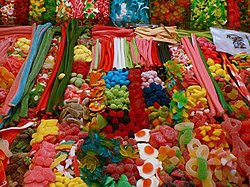
View on Wikipedia Collection of gummy candies at a market in Barcelona | |
| Alternative names | Gummies, jelly sweets |
|---|---|
| Type | Confectionery |
| Place of origin | United Kingdom Germany |
| Main ingredients | Gelatin/natural gum |
| Variations | Gummy bear, Jelly Babies, gummy worms |
Gummies, fruitgums, gummi candies, gummy candies, or jelly sweets are a broad category of gelatin- or gum-based chewable sweets. Popular types include gummy bears, Sour Patch Kids, Jelly Babies and gummy worms. Various brands such as Bassett's, Haribo, Albanese, Betty Crocker, Hersheys, Disney and Kellogg's manufacture various forms of gummy snacks, often targeted at young children. The name gummi originated in Germany,[1] with the terms jelly sweets and gums more common in the United Kingdom.
History
[edit]![[icon]](https://en.wikipedia.org/wiki/File:Wiki_letter_w_cropped.svg) | This section needs expansion. You can help by adding to it. (December 2010) |
Gummies have a long history as a popular confectionery. The first gelatin based shaped candy was the Unclaimed Babies, sold by Fryers of Lancashire in 1864.[2]
In the 1920s, Hans Riegel Sr. of Germany started his own candy company and eventually popularized the fruit flavored gummy candy with gelatin as the main ingredient.[3] By the start of World War II, the company started by Riegel employed over 400 people and produced multiple tons of candy each day.[3] The company was named Haribo, and it became a main producer of gummy bears.
Ingredients
[edit]Gummy candies are made mostly of corn syrup, sucrose, gelatin, starch and water. In addition, minor amounts of coloring and flavoring agents are used. Food acids such as citric acid and malic acid are also added in order to give a sharp flavor to gummies. It is often that other gelling agents are used in place of gelatin to make gummy candies suitable for vegans or vegetarians, such as starch and pectin.[4]
Types of gummies
[edit] | This section needs additional citations for verification. (August 2017) |
| This section needs expansion. You can help by adding to it. (August 2017) |
Jelly Babies
[edit]
The Jelly Babies gum candy was the first commercially available shaped gum candy. It originated in the United Kingdom. They were first produced by Fryers of Lancashire in 1864 and sold as "Unclaimed Babies". By 1918 they were (and still are) produced by Bassett's in Sheffield as Jelly Babies.[citation needed]
Bears
[edit]
The gummy bear originated in Germany, where it is popular under the name Gummibär (rubber bear) or Gummibärchen (little rubber bear). Hans Riegel Sr., a maker from Bonn, produced these sweets under the Haribo company name, which he started in 1920.[5]
Cola Bottles
[edit]

Cola bottles are sweets in the shape of classic Coca-Cola-style bottles with a cola flavor. They are produced by numerous companies. "Fizzy Blue Bottles", made by Lutti (formerly part of the French division of the Leaf Company, now controlled by a private investment group), are sweets typically found in a pick and mix selection. These are very similar to cola bottle gummies in shape, but they are usually sour and coloured blue and pink. "Blue Bottles", a variation from another company, are identifiable by the small rims around the sides, and are chewier and thicker, with a sweeter taste. There are also Lime cola bottles which typically retain the brownish-red colour and replace the clear top with a green colour. and mint flavoured bottles which replace the cola flavor for a mint flavor and are typically green instead of brown-red.[citation needed]
Rings
[edit]Ring-shaped gummy is often covered in sugar or sour powder. The most common and popular flavor is the peach ring. Other flavors include green apple, melon, blue raspberry, strawberry, and aniseed — although these are typically coated in chocolate. A commonly known producer of gummy rings is Trolli, for which the gummy rings are an important asset.[6]
Red frogs
[edit]In Australia, jelly confectionery in the shape of frogs has been very popular since the 1930s[citation needed]. They are colored red or green, although they are usually referred to as "red frogs". These have influenced the shape, structure, consistency and formula that makes gummy bears. Red frog gummies are not associated with the Red Frogs Association.[citation needed]
Roadkill
[edit]In 2004, Trolli's U.S. arm introduced a roadkill themed gummy candy in the shape of flattened animals. In February 2005, following complaints by the New Jersey Society for the Prevention of Cruelty to Animals, Kraft decided to stop production of the controversial Trolli U.S. Road Kill Gummies. The society complained that the products, shaped as partly flattened squirrels, chickens and snakes, would give children an incorrect message on the proper treatment of animals.[7]
Teeth
[edit]In Australia, jelly confectionery in the shape of teeth has been very popular since the 1930s.[citation needed] They are colored pink and white, with pink representing the gums and teeth being white. They have a slight minty flavor, similar to mint toothpaste.[citation needed]
Vitamin
[edit]
There are also several multi-vitamin gummy products, usually marketed for children, such as Flintstones Chewable Vitamins.[8] They are more palatable and appealing to children than equivalent vitamin pills.
Worm
[edit]Worm-shaped gummy candy can be attributed to the German confectionery manufacturer Trolli in 1981.[9] They are a popular choice among Halloween trick-or-treaters, and sold with different flavors and coatings.
Health considerations
[edit]Times Scientists have studied adding the tooth-protecting sugar substitute xylitol to gummies to fight tooth decay.[10]
Choking risks are higher with gummy candies; research shows that "hard, round foods with high elasticity or lubricity properties, or both, pose a significant level of risk," especially to children under three years of age.[11] This can be resolved with the Heimlich maneuver.
Storage
[edit]Storage of gummy candies in conditions of high humidity will result in the moisture migration of water molecules from the surrounding environment into the candy. If gummy candies are exposed to an environment that is high in moisture content, it is likely that moisture will permeate the candy and increase its relative moisture content. An increase of the candies moisture content will increase the molecular mobility of particles in the candy, leading to a variety of unwanted outcomes such as:
- Sucrose crystallization and subsequent grainy texture.
- A sticky candy surface.
- Diffusion of flavors out of the candy.
- Possibility of microbial growth.
Moisture migration of gummy candies can be prevented by storing candies in conditions where the surrounding environment is equal to their own moisture content.[12]
See also
[edit]References
[edit]- ^ Magazine, Bon Appetit. "A Brief History of Gummy Bears - Bon Appétit". Bon Appétit. Retrieved 2016-10-13.
- ^ Potts, Lauren (28 December 2015). "Sweet success: Unravelling the Jelly Baby's dark past". BBC News.
- ^ a b Burt, Jacqueline (10 October 2014). "A Brief History of Gummy Bears". Bon Appetit. Retrieved 2022-01-12.
- ^ Burey, P.; Bhandari, B.R.; Rutgers, R.P.G.; Halley, P.J.; Torley, P.J. (January 2009). "Confectionery Gels: A Review on Formulation, Rheological and Structural Aspects". International Journal of Food Properties. 12 (1): 176–210. doi:10.1080/10942910802223404.
- ^ "History". Haribo.
- ^ "Trolli - trolliapfelringe225g". Trolli.de. Archived from the original on 2011-08-31. Retrieved 2011-12-15.
- ^ "Trolli Road Kill dies under pressure from animal activists" (Press release). Kraft Foods Inc. 1 March 2005. Archived from the original on 26 October 2012.
- ^ "Flintstones Vitamins | Multivitamins & Supplements for Kids". www.flintstonesvitamins.com. Retrieved 2016-09-27.
- ^ "Today is: Gummi Worm Day". Yahoo Finance. 2022-07-15. Retrieved 2023-09-07.
- ^ "Gummy Bears Can Fight Cavities". OneIndia.in. ANI. 2008. Archived from the original on 6 February 2009. Retrieved 19 February 2010.
- ^ Altkorn, Robert; Chen, Xiao; Milkovich, Scott; Stool, Daniel; Rider, Gene; Bailey, C. Martin; Haas, Angela; Riding, Keith H.; Pransky, Seth M.; Reilly, James S. (July 2008). "Fatal and non-fatal food injuries among children (aged 0–14 years)". International Journal of Pediatric Otorhinolaryngology. 72 (7): 1041–1046. doi:10.1016/j.ijporl.2008.03.010. PMID 18455807.
- ^ Ergun, R.; Lietha, R.; Hartel, R. W. (29 January 2010). "Moisture and Shelf Life in Sugar Confections". Critical Reviews in Food Science and Nutrition. 50 (2): 162–192. doi:10.1080/10408390802248833. PMID 20112158.
External links
[edit]
Gummy candy
View on GrokipediaHistory
Origins in Early Confections
The precursors to modern gummy candy can be traced to ancient confections involving mixtures of honey, fruit juices, and natural gelling agents, which produced chewy textures enjoyed by civilizations such as the Egyptians and Romans. These early sweets, often formed by evaporating fruit purees or combining honey with boiled fruits like figs or dates, represented rudimentary attempts at preserving and texturizing sweetness without refined sugar, which was unavailable until later trade routes expanded.[4] Such preparations relied on natural pectin from fruits or starch for partial gelation, providing a proto-gummy consistency that foreshadowed later innovations in chewy candies.[5] In medieval Arabic cuisine, gelatin extraction emerged as a key technique, with recipes in texts like Kitab al-Tabikh (dating to around the 13th century, though drawing on earlier traditions) describing fish jellies made by boiling collagen-rich materials to create a setting broth, which could be sweetened for dessert applications.[6] This method, utilizing animal or fish byproducts for their gelling properties, marked an early systematic use of collagen hydrolysis— the chemical process breaking down proteins into gelatin—predating European adaptations. In Europe, by the 13th and 14th centuries, English recipes for "geleye" involved simmering meat, fish, or hides to extract gelatin, then clarifying and setting it with wine, spices, or sugar for both savory aspics and rudimentary sweets, demonstrating causal links between animal-derived gelling and structured confections.[7] These practices, limited by labor-intensive extraction without industrial pressure cooking (invented in 1682), confined production to elite households but established the empirical foundation for scalable gelatin sweets.[8] Middle Eastern starch-based jellies, such as precursors to Turkish delight (lokum), further influenced the lineage, employing cornstarch or agar-agar from seaweed boiled with sugar and rosewater to yield translucent, chewy blocks as early as Ottoman confectionery traditions before the documented 1777 invention of modern lokum by Hacı Bekir in Istanbul. Candy historian Beth Kimmerle identifies Turkish delight as a direct descendant in the evolution of gummy candies, alongside glutinous rice-based chews from Japan, due to their shared emphasis on elastic, fruit-infused gels achievable without pure gelatin. These early forms prioritized empirical trial-and-error in gelling agents—starch for opacity and chew, pectin or collagen for clarity and firmness—over theoretical chemistry, reflecting causal realism in confectionery development where texture stability directly enabled portability and appeal.[5] By the 18th century, European adaptations sweetened and colored these gels, as seen in Hannah Glasse's 1747 recipes for fruit-flavored gelatin molds, bridging medieval aspics to 19th-century portable candies.[9]Invention of Gelatin-Based Gummies
Hans Riegel Sr., a German confectioner from Bonn, is credited with inventing the first bear-shaped gelatin-based gummy candies in 1922.[10] After founding Haribo in 1920 with a small-scale operation using a copper kettle, Riegel drew inspiration from the trained dancing bears (Tanzbären) performing at local street festivals and markets to create these novel treats.[10] [5] The original Tanzbären differed from modern gummy bears, being larger, slimmer, and initially produced in a single gold color with fruit flavors, relying on gelatin derived from animal collagen for their signature chewy texture.[10] This innovation built on prior gelatin applications in confections, such as the 1909 introduction of British wine gums by Charles Gordon Maynard, but Riegel's bear design represented a pivotal advancement in shaping and mass production techniques using licorice molds and manual processes.[11] Riegel's wife, Gertrud, played a key role by testing recipes and aiding in production from their home kitchen.[5] Although gelatin jellies and similar sweets predated Riegel's work—tracing back to Middle Eastern origins like Turkish delight refined in Europe—the gummy bear's compact, fruit-gum format enabled broader appeal and scalability, setting the foundation for the modern gummy candy industry.[5] By the 1960s, Haribo refined the product into the multicolored Goldbears, but the 1922 prototype established the core gelatin-based formula that emphasized chewiness over firmer jelly textures.[10]Commercialization and Global Spread
Haribo initiated commercial production of gummy bears, known initially as Gummibärchen or Dancing Bears, in 1922 after their invention by founder Hans Riegel Sr. in Bonn, Germany.[10] Early manufacturing relied on small-scale, artisanal methods, including a copper kettle for boiling sugar and manual molding, limiting output to modest volumes sold locally.[12] By 1933, Haribo had scaled operations with a dedicated production facility and 400 employees, enabling broader distribution within Germany.[2] World War II disrupted production, but post-1945 rebuilding under Riegel's sons, Hans Jr. and Paul, drove rapid recovery; employment grew from 30 to 1,000 workers by 1950, facilitating European expansion in the 1950s and 1960s.[10] The 1960 launch of Goldbears—featuring standardized shapes, five fruit flavors (raspberry, lemon, strawberry, pineapple, orange), and improved gelatin formulas—supported mass marketing across Europe, bolstered by the company's first television advertisements in 1962 using the slogan "Haribo makes children happy."[2] Goldbears received trademark protection in 1967, solidifying Haribo's market position.[2] International commercialization accelerated in the 1980s, with Haribo establishing a U.S. office in Baltimore, Maryland, in 1982 to distribute imports amid rising demand.[10] This followed domestic U.S. production starts, such as Herman Goelitz Candy Company's (later Jelly Belly) first American-made gummy bears in 1981, which adapted the format for local tastes and spurred competition from brands like Trolli.[13] Haribo's U.S. presence strengthened over time, achieving the top gummi brand status by 2018 and planning a dedicated factory in Pleasant Prairie, Wisconsin, opening in 2023.[2] Today, Haribo operates in over 120 countries with 16 global production sites, producing 160 million Goldbears daily, while the broader gummy category has expanded via licensees and rivals like Albanese and Hershey.[10][14]Ingredients and Formulation
Core Components
Gelatin is the primary gelling agent in traditional gummy candy formulations, derived from animal collagen through hydrolysis, providing the characteristic chewy texture via thermoreversible gelation.[15] It typically constitutes 6-10% of the dry weight in recipes, blooming in water to form a hydrated network that sets upon cooling.[16] Variations in bloom strength (e.g., 200-250 bloom) influence firmness, with higher strengths yielding denser gels.[17] Sweeteners form the bulk of the formulation, traditionally comprising sucrose (40-50%) and glucose or corn syrup (35-50%) in conventional recipes, which dissolve during heating to create a viscous syrup and prevent sugar crystallization for a smooth mouthfeel.[15] These carbohydrates contribute to sweetness, body, and shelf stability by maintaining low water activity, typically around 0.65-0.75 Aw to inhibit microbial growth.[18] Natural and modern alternative sweeteners are discussed in the Alternative and Modern Additives subsection. Water, often 20-25% of the initial mixture, acts as the solvent for hydrating gelatin and dissolving sugars, with final moisture content reduced to 12-20% post-drying for optimal texture and preservation.[18] Acidulants like citric acid (0.5-1%) are integral to core recipes, lowering pH to 3-3.5 for tartness, flavor enhancement, and to facilitate gelatin setting by stabilizing the gel matrix.[19]Alternative and Modern Additives
Alternative gelling agents have been developed to replace animal-derived gelatin in gummy candy production, primarily to accommodate vegan, vegetarian, kosher, and halal dietary preferences. Pectin, a polysaccharide extracted from citrus fruits or apples, functions as a gelling agent in acidic, high-sugar environments, typically requiring 0.5-2% concentration for effective gel formation in confections. [20] Agar-agar and carrageenan, both derived from red seaweeds, provide firmer textures compared to gelatin; agar-agar gels at lower concentrations (around 1%) but sets more rigidly, while carrageenan enhances elasticity and stability in hybrid formulations. [21] These plant-based alternatives often necessitate formulation adjustments, such as precise pH control and co-gelling with starches, to mimic gelatin's chewiness, as their thermo-reversible properties differ. [22] Starch-based modifiers, including modified corn or tapioca starch, serve as thickeners, binders, and stabilizers in gummy recipes, contributing to viscosity and preventing syneresis (water separation) during storage. [23] Xanthan gum and gellan gum are additional hydrocolloids used in low dosages (0.1-0.5%) to improve texture and suspension of particulates, particularly in pectin- or agar-based systems. [24] Modern additives extend beyond structural roles to incorporate functional ingredients, transforming gummies into nutrient delivery vehicles. Vitamins such as C, D, B6, E, and biotin are commonly fortified, with formulations enabling up to 100% daily value per serving while maintaining sensory qualities. [25] Collagen peptides and minerals like calcium are added for purported joint and bone health benefits, often in gelatin-based gummies where the protein matrix aids bioavailability. [26] Natural colorants from fruits and vegetables, alongside alternative sweeteners such as stevia, monk fruit extracts, allulose, honey, maple syrup, tapioca syrup, and brown rice syrup, address consumer demands for reduced sugar and artificial additives. There is no single universally agreed "best" natural sweetener for making gummies, as it depends on desired texture, flavor, and dietary preferences. Allulose is frequently recommended for achieving a chewy texture similar to traditional sugar gummies, as it mimics sugar's properties (including bulk, solubility, and non-crystallization) while being natural and low-calorie. Other popular natural options include honey or maple syrup (for flavor and simplicity in homemade recipes) and tapioca syrup or brown rice syrup (for invert sugar-like properties that improve chewiness). These alternatives may alter gel strength and require stabilizers like sorbitol for moisture retention. [21] Citric acid not only imparts tartness but also acts as a preservative by lowering pH, inhibiting microbial growth in high-water-activity products. [27] These innovations, driven by market growth in functional confections projected to reach USD 2.4 billion by 2030, prioritize stability testing to ensure additive compatibility without compromising shelf life or texture. [26]Production Methods
Gelation and Shaping Processes
The gelation process in gummy candy production primarily relies on gelatin, a collagen-derived protein that forms a thermoreversible hydrogel network upon cooling, providing the characteristic chewy texture.[28] Gelatin is first bloomed by hydrating it in cold water for 30-60 minutes to absorb moisture and swell, typically at a concentration of 6-12% by weight depending on desired firmness.[29] This hydrated gelatin is then dissolved in a hot sugar syrup (containing sucrose, glucose syrup, and water) heated to approximately 105-110°C to achieve a Brix level of 75-85%, ensuring complete solubilization while incorporating flavors, colors, and acids.[30] Upon cooling to room temperature or below (often via controlled cooling tunnels at 10-20°C), the gelatin molecules undergo coil-to-helix transitions and aggregate into junction zones, forming a viscoelastic gel matrix above the glass transition temperature but with sufficient structure for demolding.[28] [31] Alternative gelling agents like pectin, derived from citrus or apple sources, enable vegan formulations but require distinct conditions for gelation, including high sugar content (typically >65%), low pH (2.5-3.5 via citric acid), and calcium ions for low-methoxyl pectin or heat-activated cross-linking for high-methoxyl variants.[32] Unlike gelatin's room-temperature setting, pectin gels form through a hot process where the mixture is heated to 80-100°C, deposited, and rapidly cooled to prevent syneresis, yielding a shorter, less elastic texture compared to gelatin's bounce.[33] Pectin-based gelation accommodates better flavor release but demands precise pH and Brix control to avoid weak or brittle results.[34] Shaping follows gelation via deposition into molds, traditionally using starch moguls where cornstarch trays absorb excess moisture and define shapes like bears or worms during 12-48 hours of setting at 20-25°C and 50-60% humidity.[1] Modern starchless methods employ automated depositors to fill lubricated silicone or polycarbonate molds with the hot gel mass (at 40-60°C to maintain flow), followed by cooling tunnels reducing temperature to 15-20°C over 20-30 minutes for rapid solidification without sticking.[35] Demolding involves vibration or air blasts to release pieces, often followed by oil or sugar coating to prevent adhesion and enhance shelf stability.[36] These processes ensure uniformity, with extrusion variants for rope-like shapes cut post-gelation.[37]Quality Control and Variations
Quality control in gummy candy production emphasizes adherence to Good Manufacturing Practices (GMP) as mandated by regulatory bodies such as the U.S. Food and Drug Administration (FDA), which require validation of processes to prevent contamination and ensure product uniformity.[38] Manufacturers implement in-line sensors for real-time monitoring of critical parameters, including cooking temperature (typically 80-100°C to achieve proper gelatin bloom), Brix levels (solids content around 75-80% for optimal gelation), pH (adjusted to 3-4 for stability), and water activity (below 0.65 to inhibit microbial growth).[35] [39] These controls mitigate variations in texture and shelf life, with automated systems rejecting batches exceeding tolerances, such as gelatin inconsistencies that could cause syneresis (moisture separation).[27] Post-deposition quality assurance includes sensory and physicochemical testing, such as texture analyzers measuring chewiness and elasticity via compression force (e.g., 5-15 Newtons for standard bears), alongside microbial assays for pathogens like Salmonella and mold counts limited to under 10 CFU/g per FDA standards.[40] [41] Contaminant screening verifies raw material purity, including heavy metals in gelatin (below 10 ppm lead) and absence of undeclared allergens, with periodic third-party audits ensuring compliance.[42] Counting and packaging systems further enhance precision, reducing overfill errors to less than 1% by weight through vibratory or vision-based verification.[43] Variations in production arise from gelling agent selection, with traditional animal-derived gelatin (bloom strength 200-250) yielding chewy textures via starch molding—where slurry is deposited into cornstarch trays, cooled for 18-24 hours, and washed—contrasting pectin- or starch-based vegan alternatives that require higher cooking temperatures (up to 110°C) and rapid cooling to prevent crystallization.[1] [21] Extrusion processes for continuous production enable complex shapes like worms or 3D figures, differing from batch casting by using cooled depositors at 40-50°C for precise filling, though they demand tighter humidity control (below 50% RH) to avoid sticking.[44] Functional variations incorporate additives like vitamins or fiber, necessitating adjusted drying times (4-8 hours at 20-30°C) to maintain homogeneity without compromising gel matrix integrity.[36] Regional adaptations, such as European preferences for harder pectins, reflect formulation tweaks for cultural texture expectations, verified through accelerated stability tests simulating 6-12 months of storage.[45]Varieties
Traditional Shapes and Flavors
The archetypal shape of traditional gummy candies is the bear, first commercialized as Haribo's Gold-Bären in 1922 by German confectioner Hans Riegel Sr. in Bonn.[10] These candies, inspired by the trained "dancing bears" of German circuses, measure roughly 2 cm (0.8 in) in length and established the standard for fruit-flavored, gelatin-based confections molded into animal forms.[11] Prior to bears, early gelatin candies from the 1860s, such as Fryers of Lancashire's Unclaimed Babies, adopted humanoid shapes, but these lacked the precise molding techniques that popularized bears globally.[46] Traditional flavors for gummy bears center on five primary fruit varieties: raspberry (red), strawberry (green), lemon (yellow), orange (orange), and pineapple (translucent or white).[47] Haribo's formulation, unchanged in core profile since inception, uses these to evoke natural fruit essences through flavor compounds, with regional adaptations like apple replacing strawberry in some European variants post-2007.[48] This palette derives from post-World War I ingredient availability, favoring citrus and berry extracts for their stability in gelatin matrices, as documented in early Haribo production records.[10] In Turkey, these gelatin-based confections are known as "jöle şekerleme," a term encompassing similar fruit-flavored gummy candies, often in shapes like bears and with flavors including strawberry, orange, and lemon.[49] Beyond bears, other enduring traditional shapes include cola bottles and rings, emerging in the mid-20th century among European producers like those in the UK, mimicking beverage containers or simple loops for visual appeal and uniform chew.[50] These maintain fruit flavors akin to bears, such as cherry for cola simulations or lime for rings, prioritizing sensory consistency over novelty.[51] Empirical consumer data from the era indicates shape recognition enhanced perceived authenticity, with bears achieving over 100 million units sold annually by Haribo by the 1950s.[52]Novelty and Functional Types
Novelty gummies extend beyond conventional bear shapes to include creative forms such as worms, sharks, dinosaurs, sushi replicas, pizza slices, hamburgers, emojis, and space-themed objects, aimed at increasing visual novelty and market differentiation.[53] These shapes often incorporate sour coatings or mixed fruit flavors to heighten sensory appeal, with examples like gummy sharks featuring blue-white oceanic designs and fruity tastes.[54] Elongated worm shapes, distinct from the original 1920s bear invention, emerged as a popular variant in subsequent decades, contributing to the diversification of gummy offerings.[55] Functional gummies integrate bioactive ingredients into the gelatin base to deliver targeted nutritional or therapeutic effects, such as vitamins, minerals, probiotics, or botanicals, positioning them as hybrid confection-supplements.[21] Common formulations include multivitamin variants providing essentials like vitamin D3, CoQ10, lycopene, and omega-3 fatty acids (DHA/EPA), often marketed for adult daily intake.[56] Other types feature apple cider vinegar for digestive support, ashwagandha for stress reduction, collagen for joint health, or mushroom extracts for immune enhancement, reflecting consumer demand for convenient wellness delivery.[57] Ingredients like vitamin C, zinc, and selenium are frequently added for purported immune benefits, though efficacy depends on dosage and bioavailability.[58] The functional segment has grown significantly, comprising about 29% of total gummy sales by 2025, driven by innovations in gelling agents and natural sweeteners to accommodate active compounds.[59] Examples of functional enhancements also encompass pistachio green hull extract for antioxidants, stevia for low-calorie sweetening, and starch modifications to improve texture stability in nutrient-fortified recipes.[60] Market analyses project the global functional gummies sector to expand from USD 22.54 billion in 2024 to USD 37.27 billion by 2032, underscoring their rising role in bridging confectionery and nutraceuticals.[61] Despite added sugars in many products, sugar-free options using alternative sweeteners have proliferated to align with health-conscious preferences.[62]Physical and Sensory Properties
Texture Mechanics
The texture of gummy candy arises primarily from the formation of a thermoreversible gel network by gelling agents, which imbues the confection with viscoelastic properties characterized by elasticity and chewiness. Gelatin, derived from collagen, swells in hot water to form a sol that sets into a gel upon cooling, creating a three-dimensional matrix that immobilizes syrup and provides rubbery resilience distinguishing gummies from softer jellies.[28][63] This network's strength depends on gelatin's bloom value, a measure of gel rigidity where higher values (typically 175-250 for gummies) yield firmer, more chew-resistant products by requiring greater force for deformation.[64][65] Viscoelastic mechanics manifest in gummies as a solid-like response where the storage modulus (G') exceeds the loss modulus (G"), indicating predominant elastic recovery over viscous flow during mastication. Chewiness, quantified as the work needed to reduce the candy to a swallowable state, correlates with gumminess (hardness multiplied by cohesiveness) and is empirically assessed via texture profile analysis instruments that simulate biting cycles.[63][66] Factors such as gelatin concentration directly modulate this; increasing it from 6% to 8% enhances elastic modulus and rupture strength, while excessive drying reduces moisture content below 18-20%, heightening brittleness over desired pliability.[27][67] Alternative gelling agents like pectin produce distinct mechanics, forming calcium-mediated junctions for a shorter, less elastic gel compared to gelatin's protein coils, often resulting in softer textures suitable for vegan formulations but with lower thermal stability.[21][68] Hybrid systems, such as gelatin-pectin blends at ratios like 6.5% gelatin to 0.5% pectin, approximate pure gelatin's chewiness while altering melt profiles, though pH adjustments (around 3.2-3.5) are critical to optimize cross-linking without syneresis.[17] Temperature influences dynamics, with gummies exhibiting glass transition near -10°C and softening above 30°C, where molecular mobility increases viscous dissipation.[63] Sucrose and corn syrup further tune mechanics by plasticizing the gel, reducing hardness but enhancing perceived chew through balanced water activity around 0.6-0.7.[69]Stability and Storage Factors
The stability of gummy candies, primarily gelatin-based confections with high sugar content and low water activity (typically aw < 0.65), relies on maintaining low moisture levels to inhibit microbial growth and preserve texture.[70] Elevated humidity promotes moisture migration into the candies, causing softening, stickiness, and potential syneresis (gel separation), while excessive drying can lead to hardening.[71] Temperature fluctuations above 25°C (77°F) accelerate gelatin degradation and flavor volatilization, reducing shelf life from an optimal 12-18 months under controlled conditions to as little as 90 days at 35°C, as observed in studies tracking phenolic content decline.[60] [72] Optimal storage conditions emphasize a cool, dry environment at 15-21°C (59-70°F) and relative humidity below 50% to minimize water activity changes and prevent microbial proliferation, which is negligible at aw levels common in commercial gummies (pH 3.5-4.5 further enhances this).[73] [39] Airtight packaging, such as sealed pouches or glass jars, is essential post-opening to block oxygen ingress and humidity exposure, which can otherwise trigger oxidation and mold in high-moisture variants.[74] Exposure to direct sunlight or UV light degrades colors and flavors via photodegradation, compounding textural issues.[74] For functional or homemade gummies with added water-soluble components like vitamins, stability is more compromised, with microencapsulation recommended to mitigate losses during storage exceeding 45 days.[75] [41] Overall, commercial gummies exhibit robust stability under proper conditions due to their preservative formulation, but deviations—such as improper refrigeration avoidance in warm climates—can halve shelf life through accelerated gelatin hydrolysis.[72]Health and Nutritional Analysis
Compositional Breakdown
Gummy candies are predominantly composed of carbohydrates in the form of sugars such as sucrose and glucose syrup, which constitute the bulk of the product and provide sweetness, structure, and energy density.[41] These sweeteners typically make up 70-85% of the dry weight, with glucose syrup contributing to chewiness and preventing crystallization, while sucrose enhances flavor intensity.[41] Gelatin, derived from hydrolyzed animal collagen, serves as the primary gelling agent in traditional formulations, accounting for 5-10% of the composition and imparting the elastic, chewy texture through its protein network formed during cooling.[17] Water content ranges from 12-20%, essential for the gelation process but minimized to ensure shelf stability.[21] Acids like citric acid (0.5-2%) are added for tartness and to balance sweetness, while minor components include flavorings (natural or artificial extracts), colorants (e.g., FD&C dyes or fruit-derived pigments), and occasionally stabilizers like coconut oil or starch.[76] Vegan alternatives substitute pectin or starch for gelatin, altering the protein profile but maintaining similar carbohydrate dominance.[21] Nutritional profiles reflect this makeup, with a standard 40-gram serving of gelatin-based gummy bears delivering about 130 calories, nearly all from carbohydrates.[77]| Nutrient (per 40g serving) | Amount | % Daily Value (approx.) |
|---|---|---|
| Calories | 130 kcal | 7% |
| Total Carbohydrates | 31 g | 11% |
| Sugars | 21 g | N/A |
| Protein | 2 g | 4% |
| Total Fat | 0 g | 0% |
| Sodium | 10 mg | <1% |