


Community hub
Recent from talks
Contribute something
Nothing was collected or created yet.
Generation Z
View on Wikipedia
| Part of a series on |
| Social generations |
|---|
 |
Generation Z, often shortened to Gen Z and informally known as zoomers, is the demographic cohort succeeding Millennials and preceding Generation Alpha. Researchers and popular media use the mid-to-late 1990s as starting birth years and the early 2010s as ending birth years, with the generation typically being defined as people born from 1997 to 2012.[1] Most members of Generation Z are the children of Generation X, and it is expected that many will be the parents of the proposed Generation Beta.[2]
As children in the mid-late 2000s and 2010s, Generation Z was the first social generation to grow up with Web 2.0 and digital technology as an established commodity.[3] From a young age, they have watched online videos and web series (often via YouTube),[4] and played online games like Club Penguin and Minecraft.[5] As adolescents and young adults in the 2010s and 2020s, members of the generation were dubbed "digital natives",[6] even if they were not necessarily digitally literate[7] and might struggle in a digital workplace.[8][9]
Generation Z has been described as "better behaved and less hedonistic" than previous generations.[10][11] They have fewer teenage pregnancies, consume less alcohol (but not necessarily other psychoactive drugs),[12][13][14] and are more focused on school and job prospects.[10][15] They are also better at delaying gratification than teens from the 1960s.[16] Sexting became popular during Gen Z's adolescent years, although the long-term psychological effects are not yet fully understood.[17] There is greater awareness and diagnosis of mental health conditions among Generation Z,[15][14][18][19] and sleep deprivation is more frequently reported.[20][21][22] Moreover, the negative effects of screen time in the late 2010s were most pronounced in adolescents, as compared to younger children.[23] Youth subcultures have not disappeared, but they have been quieter.[24][25] Nostalgia is a major theme of youth culture in the 2010s and 2020s.[26][27]
Terminology
[edit]The name Generation Z is a reference to it being the second generation after Generation X, continuing the alphabetical sequence from Generation Y (Millennials).[28][29] Other names for the generation have included iGeneration,[30] Homeland Generation,[31] Net Gen,[30] Digital Natives,[30] Neo-Digital Natives (emphasizing the shift from PC to mobile and text to video among this cohort),[32] Pluralist Generation,[30] Internet Generation,[33] and Centennials.[34] The Pew Research Center surveyed the various terms for this cohort on Google Trends in 2019 and found that in the U.S., Generation Z was overwhelmingly the most popular.[35] The Merriam-Webster and Oxford dictionaries both have official entries for Generation Z.[36]
"While there is no scientific process for deciding when a name has stuck, the momentum is clearly behind Gen Z."
Rapper MC Lars used the term iGeneration as a song title[37] in 2003, initially referring to Millennials.[38] Psychology professor and author Jean Twenge also used the term, intending it as the title of her 2006 book about Millennials but changing the title to Generation Me at the insistence of her publisher. Twenge later used the term for her 2017 book on Gen Z, iGen. Others also claim to have coined the name.[30]
Authors William Strauss and Neil Howe, creators of the Strauss–Howe generational theory, adopted the term Homeland Generation (or Homelanders)[31] in 2005 after sponsoring a contest to name the post-Millennial group.[30] The term Homeland refers to being the first generation to enter childhood after protective surveillance state measures, like the Department of Homeland Security, were put into effect following the September 11 attacks.[31]
Zoomer is an informal term used to refer to members of Generation Z.[39][40][41] It combines the shorthand boomer, referring to baby boomers, with the "Z" from Generation Z. Zoomer in its current incarnation skyrocketed in popularity in 2018, when it was used in an internet meme on 4chan mocking Gen Z adolescents via a Wojak caricature dubbed a "zoomer".[42][43] Merriam-Webster's records suggest the use of the term zoomer in the sense of Generation Z dates to at least as early as 2016. It was added to the Merriam-Webster dictionary in October 2021[39] and to Dictionary.com in January 2020.[44] Prior to this, zoomer was occasionally used to describe particularly active baby boomers.[39]
Date and age range definitions
[edit]The Merriam-Webster Online Dictionary defines Generation Z as "the generation of people born in the late 1990s and early 2000s".[45] The Oxford Dictionaries define Generation Z as "the group of people who were born between the late 1990s and the early 2010s, who are regarded as being very familiar with the internet".[46] Encyclopedia Britannica defines Generation Z as "the term used to describe Americans born during the late 1990s and early 2000s. Some sources give the specific year range of 1997–2012, although the years spanned are sometimes contested or debated because generations and their zeitgeists are difficult to delineate."[3]
The Pew Research Center has defined 1997 as the starting birth year for Generation Z, basing this on "different formative experiences", such as new technological and socioeconomic developments, as well as growing up in a world after the September 11 attacks.[47] Pew has not specified an endpoint for Generation Z, but used 2012 as a tentative endpoint for their 2019 report.[47] Most news outlets, management and consulting firms, think tanks, and analytics companies frequently use the starting birth year of 1997, often citing Pew Research's 1997–2012 range.[a][b][c] In a 2022 report, the U.S. Census designates Generation Z as "the youngest generation with adult members (born 1997 to 2013)".[71] Statistics Canada used 1997 to 2012, citing Pew Research Center, in a 2022 publication analyzing their 2021 census.[72] The United States Library of Congress uses 1997 to 2012, citing Pew Research as well.[73]
The Collins Dictionary defines Generation Z as "members of the generation of people born between the mid-1990s and mid-2010s".[74]. In her book iGen (2017), psychologist Jean Twenge defines the "iGeneration" as the cohort born 1995 to 2012.[75] The Statistics Bureau of Japan defined Generation Z as those born 1995 to 2010 in their 2020 Census.[76] The Australian Bureau of Statistics defines Generation Z as those born between 1996 and 2010 in a 2021 Census report.[77] Occasionally a few news outlets include 1995 and 1996 as part of Generation Z.[d]
Individuals born in the Millennial and Generation Z cusp years have been sometimes identified as a "microgeneration" with characteristics of both generations. The most common name given for these cuspers is Zillennials.[81][82] Individuals born on the cusp of Generation Z and Generation Alpha have been referred to as Zalphas.[83]
Arts and culture
[edit]Happiness and personal values
[edit]
The Economist has described Generation Z as a more educated, well-behaved, stressed and depressed generation in comparison to previous generations.[15] In 2016, the Varkey Foundation and Populus conducted an international study examining the attitudes of over 20,000 people aged 15 to 21 in twenty countries and that 59% of Gen Z youth were happy overall with the states of affairs in their personal lives. The most unhappy young people were from South Korea (29%) and Japan (28%) while the happiest were from Indonesia (90%) and Nigeria (78%).[84]
The best sources of happiness were being physically and mentally healthy (94%), having a good relationship with family (92%), and with friends (91%). In general, respondents who were younger and male tended to be happier. Religious faith was purportedly the least happiness-inducing.[84]
The top reasons for anxiety and stress were money (51%) and school (46%); social media and having access to basic resources (such as food and water) finished the list, both at 10%. Concerns over food and water were most serious in China (19%), India (16%), and Indonesia (16%); young Indians were also more likely than average to report stress due to social media (19%).[85]
Important personal values of Gen Z are their families and themselves get ahead in life (both 27%), followed by honesty (26%). Looking beyond their local communities came last at 6%.[84] Familial values were especially strong in South America (34%) while individualism and the entrepreneurial spirit proved popular in Africa (37%). People who influenced youths the most were parents (89%), friends (79%), and teachers (70%). Celebrities (30%) and politicians (17%) came last. In general, young men were more likely to be influenced by athletes and politicians than young women, who preferred books and fictional characters. Celebrity culture was especially influential in China (60%) and Nigeria (71%) and particularly irrelevant in Argentina and Turkey (both 19%).[84]
For young people, the most important factors for their current or future careers were the possibility of honing their skills (24%), and income (23%) while the most unimportant factors were fame (3%) and whether or not the organization they worked for made a positive impact on the world (13%). The most important factors for young people when thinking about their futures were their families (47%) and their health (21%); the welfare of the world at large (4%) and their local communities (1%) bottomed the list.[84]
Common culture
[edit]The COVID-19 pandemic struck when the oldest members of Generation Z were just joining the workforce and the rest were still in school.[86] While Generation Z proved to be less resilient than older cohorts, their fundamental values did not change, and they remained open to change, such as the transition towards hybrid school and remote work.[87] On average, Generation Z is more likely to value ambition, creativity, and curiosity than the general population, including Millennials.[88]
A 2020 survey conducted by the Center for Generational Kinetics, on 1,000 members of Generation Z and 1,000 Millennials, suggests that Generation Z still would like to travel, despite the COVID-19 pandemic and the recession it induced. However, Generation Z is more likely to look carefully for package deals that would bring them the most value for their money, as many of them are already saving money for buying a house and for retirement, and they prefer more physically active trips. Mobile-friendly websites and social-media engagements are both important.[89] They take advantage of the Internet to market and sell their fresh produce. In Western countries like the United Kingdom, teenagers now prefer to get their news from social-media networks such as Instagram and TikTok and the video-sharing site YouTube rather than more traditional media, such as radio or television.[90]
Having a mobile device has become almost universal by the time the first wave of Generation Z reaches adolescence. Some even have their phones besides them in bed.[91] But despite being digital natives, Generation Z also values in-person interactions and recognizes the limits of virtual communications.[88] Among children and teenagers of the 2010s, much leisure time is spent watching television, reading, social networking, watching YouTube videos, and playing games on smartphones.[92]
Subcultures and nostalgia
[edit]
During the 2000s and especially the 2010s, youth subcultures that were as influential as what existed during the late 20th century became scarcer and quieter, at least in real life though not necessarily on the Internet, and more ridden with irony and self-consciousness due to the awareness of incessant peer surveillance.[93][94] In Germany, for instance, youth appears more interested in a more mainstream lifestyle with goals such as finishing school, owning a home in the suburbs, maintaining friendships and family relationships, and stable employment, rather than popular culture, glamor, or consumerism.[95]
Boundaries between the different youth subcultures appear to have been blurred, and nostalgic sentiments have risen.[93][94] Although nostalgia is normally associated with the elderly, this sentiment is now commonplace among those who came of age during the 2010s and 2020s. Struggling with present realities, Millennials and Generation Z long for the past, when life seemed simpler and less stressful, even if they have themselves never experienced it.[96] For example, although an aesthetic dubbed 'cottagecore' in 2018 has been around for many years,[97] it has become a subculture of Generation Z,[98] especially on various social media networks in the wake of the mass lockdowns imposed to combat the spread of COVID-19.[99] It is a form of escapism[97] and aspirational nostalgia.[100] Nostalgic sentiments surged during and after the COVID pandemic.[101] Vintage fashion is growing in vogue among Millennial and Generation Z consumers.[102] Nevertheless, large shares of Generation Z have never visited museums or heritage sites, preferring instead to watch television or browsing social media.[103]
Spotify consumer data from 2022 suggests that Generation Z is most nostalgic for the 1980s.[96] The Netflix science-fiction horror series Stranger Things (2016–2025) is a major example of using and evoking nostalgia for the 1980s, enabling Generation Z to learn what their Generation X parents experienced in their youth during that decade.[104] 1980s songs featured in the Stranger Things soundtracks that became popular among Generation Z included "Running Up That Hill" (1985) by Kate Bush, which has appeared in many TikTok videos.[105] There is evidence that Generation Z is also nostalgic for the 1990s and 2000s,[101] given the popularity of aesthetics such as grunge, Y2K, and Frutiger Aero among this cohort.[106][107][108][109][110] Other trends of fashion and lifestyles among Generation Z include VSCO girl, E-girl and E-boy, Soft girl, and among many others, made popular by TikTok, Instagram, Pinterest, influencers and celebrities.[111][112]
In Japan, Generation Z experiences Shōwa nostalgia,[113][114] and the Shōwa-era music of Akina Nakamori, Seiko Matsuda and Yōko Oginome is popular with them.[115][116] 1970s and 1980s city pop music, such as that of Mariya Takeuchi, is also popular with Generation Z, both in and outside of Japan.[117][118]
Television and streaming
[edit]Viewership for children's cable networks such as Disney Channel, Nickelodeon, and Cartoon Network was strong in the mid-late 2000s, when older Gen Z members were children.[119][120][121] However, ratings began to fall in the early 2010s; Nickelodeon experienced a sharp double-digit decline by the end of 2011, described as "inexplicable" by Viacom management.[122] This decline continued among Generation Alpha viewers in the 2020s, with the rise of streaming services.[123][124]
Generation Z continues to enjoy comfort television shows from the 1990s and 2000s, such as The Office (2005–2013) and Friends (1994–2004).[125][126] In the United Kingdom, Friends was chosen by over 2,000 children and teenagers as their favourite programme, according to a 2019 report by Childwise; most of these young people watched the series on Netflix rather than on television.[125] Meanwhile, the animated series Bluey (2018–present), though made for preschool children, has been surprisingly well-received among teenagers and young adults because it portrays family life positively and makes them feel nostalgic.[127][128] It also helps many Millennials and members of Generation Z heal emotional wounds from their childhoods.[129][130]
Global demand for Japanese animations (anime) is projected to continue growing until at least 2030 due to interest among young people.[131]
Reading habits
[edit]
According to a 2019 OECD survey, members of Generation Z were spending more time on electronic devices and less time reading books than before,[132][133][134] with implications for their attention spans,[135] vocabulary,[136][137] academic performance,[138] and future economic contributions.[132]
In New Zealand, child development psychologist Tom Nicholson noted a marked decline in vocabulary usage and reading among schoolchildren, many of whom are reluctant to use the dictionary. According to a 2008 survey[needs update] by the National Education Monitoring Project, about one in five year-four and year-eight pupils read books as a hobby, a ten-percent drop from 2000.[136]
In the United Kingdom, children and teenagers of the 2010s reportedly spent more time playing video games and watching YouTube videos but less time reading.[92] By 2022, Generation Z accounted for the majority of book purchases in that country.[139] However, teenage girls are much more likely than boys to read for pleasure. About one in three children struggle with finding something interesting to read.[133]
According to the Progress in International Reading Literacy Study (PIRLS), fourth graders in 2016, in 13 out of 20 countries and territories surveyed, were markedly less enthusiastic about reading than their predecessors in 2001 while their parents were even less keen on reading than they were.[140]
Among members of Generation Z who read, romantic fantasy and Japanese comics (manga), such as One Piece (1997–present) or Naruto (1999–2014), are some of the most popular. Unlike older cohorts, they are fond of fan fiction and escapism.[141] In addition, BookTok, a community on TikTok, has many members from Generation Z,[142] especially teenage girls and young women.[143] BookTok has stimulated a revival of volitional reading among the young[144] and a surge in book sales for publishers.[143][145]
Fan fiction
[edit]
During the first two decades of the 21st century, writing and reading fan fiction and creating fandoms of fictional works became a prevalent activity worldwide. Demographic data from various depositories revealed that those who read and wrote fan fiction were overwhelmingly young, in their teens and twenties, and female.[146][147][148] For example, an analysis published in 2019 by data scientists Cecilia Aragon and Katie Davis of the site FanFiction.Net showed that some 60 billion words of contents were added during the previous 20 years by 10 million English-speaking people whose median age was 151⁄2 years.[148] Fan fiction writers base their work on various internationally popular cultural phenomena such as K-pop, Star Trek, Harry Potter, Twilight, Star Wars, Doctor Who, and My Little Pony, known as 'canon', as well as other things they considered important to their lives, like natural disasters.[146][147][148] Much of fan fiction concerns the romantic pairing of fictional characters of interest, or 'shipping'.[149] Aragon and Davis argued that writing fan fiction stories could help young people combat social isolation and hone their writing skills outside of school in an environment of like-minded people where they can receive (anonymous) constructive feedback, what they call 'distributed mentoring'.[148] Informatics specialist Rebecca Black added that fan fiction writing could also be a useful resource for English-language learners. Indeed, the analysis of Aragon and Davis showed that for every 650 reviews a fan fiction writer receives, their vocabulary improved by one year of age, though this may not generalize to older cohorts.[150] On the other hand, children browsing fan fiction contents might be exposed to cyberbullying, crude comments, and other inappropriate materials.[149]
Music
[edit]_(cropped).jpg)
Generation Z has a plethora of options when it comes to music consumption, allowing for a highly personalized experience.[151] Spotify and terrestrial radio are the top choices for music listening,[152] while YouTube is the preferred platform for music discovery.[125][152] In mid-2023, Spotify reported more growth than expected in the number of subscribers among Generation Z.[153] Additional research showed that within the past few decades, popular music has gotten slower; that majorities of listeners young and old preferred older songs rather than keeping up with new ones; that the language of popular songs was becoming more negative psychologically; and that lyrics were becoming simpler and more repetitive, approaching one-word sheets, something measurable by observing how efficiently lossless compression algorithms (such as the LZ algorithm) handled them.[154] On the other hand, texture and rhythm are becoming more complex.[155] Streaming services have made it extremely easy for listeners to sample songs; this is putting pressure on musicians to compose songs that are as easy to process and have as many hooks as possible.[155] Sad music is quite popular among adolescents, though it can dampen their moods, especially among girls.[151]
Demographics
[edit]-
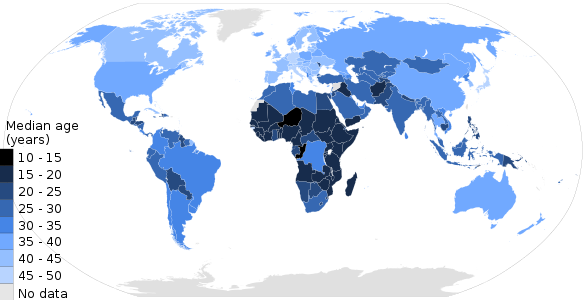 Median age by country in years in 2017. The youth bulge is evident in parts of Latin America, Africa, the Middle East and Southeast Asia.
 -
 Population pyramid of the world in 2018

.jpg)
As of 2020[update], although many countries have aging populations and declining birth rates, Generation Z was the largest generation alive.[156] Bloomberg's analysis of United Nations data predicted that, in 2019, members of Generation Z accounted for 2.47 billion (32%) of the 7.7 billion inhabitants of Earth, surpassing the Millennial population of 2.43 billion. The generational cutoff of Generation Z and Millennials for this analysis was placed at 2000 to 2001.[157][158]
Africa
[edit]In 2018, Generation Z comprised the majority of the population of Africa.[159] In 2017, 60% of the 1.2 billion people living in Africa fell below the age of 25.[160]
In 2019, 46% of the South African population, or 27.5 million people, are members of Generation Z.[161]
Statistical projections from the United Nations in 2019 suggest that, in 2020, the people of Niger had a median age of 15.2, Mali 16.3, Chad 16.6, Somalia, Uganda, and Angola all 16.7, the Democratic Republic of the Congo 17.0, Burundi 17.3, Mozambique and Zambia both 17.6. This means that more than half of their populations were born in the first two decades of the 21st century. These are the world's youngest countries by median age.[162]
Asia
[edit]According to a 2022 McKinsey & Company insight, Generation Z will account for a quarter of the population of the Asia-Pacific region by 2025, and possess a global spending power of approximately US$140bn by 2030.[163]
As a result of cultural ideals, government policy, and female modern medicine, there have been severe gender population imbalances in China and India. According to the United Nations, in 2018, there were 112 Chinese males for every hundred females ages 15 to 29; in India, there were 111 males for every hundred females in that age group. China had a total of 34 million excess males and India 37 million, more than the entire population of Malaysia. Together, China and India had a combined 50 million excess males under the age of 20. Such a discrepancy fuels loneliness epidemics, human trafficking (from elsewhere in Asia, such as Cambodia and Vietnam), and prostitution, among other societal problems.[164]
- Population pyramids of China, India, Japan, and Singapore in 2016
-

-

-

-


Europe
[edit]Out of the approximately 66.8 million people of the UK in 2019, there were approximately 12.6 million people (18.8%) in Generation Z, if defined as those born from 1997 to 2012.[165]
Generation Z is the most diverse generation in the European Union in regards to national origin.[166] In Europe generally, 13.9% of those ages 14 and younger in 2019 (which includes older Generation Alpha) were born in another EU Member State, and 6.6% were born outside the EU. In Luxembourg, 20.5% were born in another country, largely within the EU (6.6% outside the EU compared to 13.9% in another member state); in Ireland, 12.0% were born in another country; in Sweden, 9.4% were born in another country, largely outside the EU (7.8% outside the EU compared to 1.6% in another member state). In Finland, 4.5% of people aged 14 and younger were born abroad and 10.6% had a foreign-background in 2021.[167] However, Gen Z from eastern Europe is much more homogeneous: in Croatia, only 0.7% of those aged 14 and younger were foreign-born; in the Czech Republic, 1.1% aged 14 and younger were foreign-born.[166]
Higher portions of those ages 15 to 29 in 2019 (which includes younger Millennials) were foreign born in Europe. Luxembourg had the highest share of young people (41.9%) born in a foreign country. More than 20% of this age group were foreign-born in Cyprus, Malta, Austria and Sweden. The highest shares of non-EU born young adults were found in Sweden, Spain and Luxemburg. Like with those under age 14, countries in eastern Europe generally have much smaller populations of foreign-born young adults. Poland, Lithuania, Slovakia, Bulgaria and Latvia had the lowest shares of foreign-born young people, at 1.4 to 2.5% of the total age group.[166]
- Population pyramids of France, Greece, and Russia in 2016
-

-

-


North America
[edit]Data from Statistics Canada published in 2017 showed that Generation Z comprised 17.6% of the Canadian population.[168]

A report by demographer William Frey of the Brookings Institution stated that in the United States, the Millennials are a bridge between the largely white pre-Millennials (Generation X and their predecessors) and the more diverse post-Millennials (Generation Z and their successors).[169] Frey's analysis of U.S. Census data suggests that as of 2019, 50.9% of Generation Z is white, 13.8% is black, 25.0% Hispanic, and 5.3% Asian.[170] 29% of Generation Z are children of immigrants or immigrants themselves, compared to 23% of Millennials when they were at the same age.[171]
Members of Generation Z are slightly less likely to be foreign-born than Millennials;[172] the fact that more American Latinos were born in the U.S. rather than abroad plays a role in making the first wave of Generation Z appear better educated than their predecessors. However, researchers warn that this trend could be altered by changing immigration patterns and the younger members of Generation Z choosing alternate educational paths.[173] As a demographic cohort, Generation Z is smaller than the baby boomers and their children, the Millennials.[174] According to the U.S. Census Bureau, Generation Z makes up about one quarter of the U.S. population, as of 2015.[175] There was an 'echo boom' in the 2000s; this boom certainly increased the absolute number of future young adults, but did not significantly change the relative sizes of this cohort compared to their parents.[176]
According to a 2022 Gallup survey, 20.8%, or about one in five members, of Gen Z identify as LGBTQ+.[177]
- Population pyramids of Canada, the United States, and Mexico in 2016
-

-

-


Economic trends
[edit]Consumption
[edit]As consumers, members of Generation Z are typically reliant on the Internet to research their options and to place orders. They tend to be skeptical and will shun firms whose actions and values are contradictory.[178][179] Their purchases are heavily influenced by trends promoted by "influencers" on social media,[180][181] as well as the fear of missing out (FOMO) and peer pressure.[182] The need to be "trendy" is a prime motivator.[181] Due to their relatively high income, members of Generation Z have higher spending habits.[citation needed] According to new[when?] research, they rely on social media to make purchasing decisions, with health and beauty products being the most consumed category on these platforms.[183]
In the West, while majorities might signal their support for certain ideals such as "environmental consciousness" to pollsters, actual purchases do not reflect their stated views, as can be seen from their high demand for cheap but not durable clothing ("fast fashion"), or preference for rapid delivery.[178][179][180] Despite their socially progressive views, large numbers are still willing to purchase these items when human rights abuses in the developing countries that produce them are brought up.[181] However, young Western consumers of this cohort are less likely to pay a premium for what they want compared to their counterparts from emerging economies.[178][179] In China, young people have less disposable income than before due to a slowing economy. Even so, while they are saving money on basic necessities, they are willing to spend more money on hobbies or items that make them feel happy.[184] In culturally modernizing Saudi Arabia, where 63% of the population was under the age of 30 as of 2024, luxury brands have seen growth in the market aimed at young consumers, most of whom make online purchases and prefer products that not only reflects their cultural heritage but are also modern.[185]
In the United Kingdom, Generation Z's general avoidance of alcohol and tobacco has noticeably reduced government revenue in the form of the 'sin tax'.[186] Indeed, many young Britons remain dependent on their parents to pay their bills in a stagnant economy and about a quarter spends virtually nothing on luxuries.[187] In much of Western Europe, Generation Z faces economic stagnation or even falling standards of living. But in the United States, the reverse is true.[188]
Food choices
[edit].jpg)
The food choices made by Generation Z reflect the generation's concerns about climate, sustainability, and animal welfare. A study by catering firm Aramark found 79% of members of the generation would go meatless between once and twice a week.[189] The generation is considered the most interested in plant-based and vegan food choices, which they see as equal to other food types. As Generation Z's purchasing power grows, so does the amount of vegan and vegetarian food they eat.[190] Generation Z sees dining out with friends and sharing small plates of food as exciting and interesting. According to 2022 Ernst & Young data, plant-based meat, cultured meat, and fermented meat are forecast to grow to 40% of the market by volume by 2040 in the United States. Plant-based meat is widely available in supermarkets and restaurants, but cultured and fermented meats (which are made without slaughtering animals) are not commercially available but are now being developed by companies.[191]
Transportation choices
[edit]Across the developed world, young people are noticeably less likely to get a driver's license or to own a car than older generations.[192][193] This new trend is driven by the possibility of making online purchases, economic constraints, concerns for the environment, viability of alternatives to driving (walking, biking, public transit, and ride sharing), and growing restrictions on driving within urban areas.[192][193] In the United States, however, decades of auto-centric urban development have led to under-investment in walkable neighborhoods, bicycle lanes, and public transit, making it likely that most members of Generation Z will eventually become frequent drivers, like the Millennials before them, even if they dislike cars.[194]
Employment
[edit]According to the International Labor Organization (ILA), the COVID-19 pandemic has amplified youth unemployment, but unevenly. By 2022, youth unemployment stood at 12.7% in Africa, 20.5% in Latin America, and 8.3% in North America.[195]
In the early 2020s, Chinese youths find themselves struggling with job hunting. University education offers little help.[196] In fact, due to the mismatch between education and the job market, those with no university qualifications are less likely to be unemployed.[197] By June 2023, China's unemployment rate for people aged 16 to 24 was about one fifth.[198] In South Korea, people below the age of 40 are increasingly interested in relocating from the cities, especially Seoul, to the countryside and working on the farm. Working in a conglomerate like Samsung or Hyundai Group no longer appeals to young people, many of whom prefer to avoid becoming a workaholic or are pessimistic about their ability to be as successful as their fathers.[199]
In Germany, some public officials are recommending shorter work weeks at the same salary levels in spite of the struggling German economy. The situation is similar in other European countries.[200] In the United Kingdom, Generation Z is facing a gig economy with precarious prospects and stagnant wages.[187] Many young Europeans with high skills are leaving their home countries for places that offer more job opportunities, higher salaries, and lower taxes; they typically choose another country in Europe with a stronger economy or the United States.[201] In Canada, people aged 15 to 24 faced an unemployment rate of 12.2%, or more than twice that of prime working-age adults, as of 2025. Among university students, that number was over one fifth, the highest since the Great Recession of the late 2000s. Young graduates face not only a tough labor market, but also global trade wars, persistent inflation, industrial automation and artificial intelligence.[202] In the United States, the youth unemployment rate (16–24) was 7.5% in May 2023, the lowest in 70 years.[203] American high-school graduates could join the job market right away,[204] with employers offering them generous bonuses, high wages, and apprenticeship programs in order to offset the ongoing labor shortage.[205] Generation Z in the United States is projected to be richer than previous generations at the same age thanks to higher wage growth and greater inheritance from their parents and grandparents, who have accumulated enormous wealth.[206][207]
As of 2023, members of Generation Z in North America and especially developing Asian nations were a much more optimistic about their economic prospects and more likely to believe in the value of hard work than their counterparts in developed Asia, Western Europe, or Latin America.[88] As workers, Generation Z tends to prioritize a financial security, meaning, and their own well-being. They also value a work–life balance.[208]
Education
[edit]

Since the mid-20th century, enrollment rates in primary schools has increased significantly in developing countries.[209] In 2019, the OECD completed a study showing that while education spending was up 15% over the previous decade, academic performance had stagnated.[210] Results from Trends in International Mathematics and Science Study (TIMSS) in 2019 showed that the highest-scoring students in mathematics came from Asian polities and Russia.[210] The OECD's Program for International Student Assessment (PISA) tests administered in 2022 unveiled the continuation of a long-term decline in reading and mathematical skills since the early 2010s. In other words, the COVID-19 pandemic was only one contributing factor.[211][212] Even so, fifteen-year-old students (tenth graders) from Singapore, Macau, Hong Kong, Taiwan, South Korea, and Japan were largely unaffected or even saw an improvement. Once high-performing European countries—Iceland, Sweden, and Finland—continued their years-long decline. The U.S. national average remained behind those of other industrialized nations.[213][214]
East Asian and Singaporean students consistently earned the top spots in international standardized tests in the 2010s[215][216][217] and 2020s.[211][213][214] Globally, reading comprehension and numeracy have been declining.[211][140] As of the 2020s, young women have outnumbered men in higher education across the developed world.[218] By 2024, many places around the world have decided to ban the use of mobile phones in the classroom to help their students concentrate better.[219]
Different nations and territories approach the question of how to nurture gifted students differently. During the 2000s and 2010s, whereas the Middle East and East Asia (especially China, Hong Kong, and South Korea) and Singapore actively sought them out and steered them towards top programs, Europe and the United States had in mind the goal of inclusion and chose to focus on helping struggling students. In 2010, for example, China unveiled a decade-long National Talent Development Plan to identify able students and guide them into STEM fields and careers in high demand; that same year, England dismantled its National Academy for Gifted and Talented Youth and redirected the funds to help low-scoring students get admitted to elite universities.[220] Developmental cognitive psychologist David Geary observed that Western educators remained "resistant" to the possibility that even the most talented of schoolchildren needed encouragement and support and tended to concentrate on low performers. In addition, even though it is commonly believed that past a certain IQ benchmark (typically 120), practice becomes much more important than cognitive abilities in mastering new knowledge, recently published research papers based on longitudinal studies, such as the Study of Mathematically Precocious Youth (SMPY) and the Duke University Talent Identification Program, suggest otherwise.[220]
Among developed nations, young women have been outnumbering men in tertiary education during the 2020s, reversing a historical trend. At the same time, the number of men in their 20s who are in neither education, employment, or training (NEET) has been rising. In France and the United Kingdom, this number has surpassed that of women.[218]
Since the early 2000s, the number of students from emerging economies going abroad for higher education has risen markedly. This was a golden age of growth for many Western universities admitting international students.[221] In the late 2010s, around five million students traveled abroad each year for higher education, with the developed world being the most popular destinations and China the biggest source of international students.[221] In 2019, the United States was the most popular destination for international students, with 30% of its international student body coming from mainland China, Australia, Canada, the United Kingdom, and Japan.[222] Among children of the Chinese ruling class ("princelings"), attending elite institutions in the United States was commonplace and seen as a status symbol,[223] but the deterioration of Sino-American relations as exemplified by President Donald Trump's entry restrictions on Chinese students in addition to the complications produced by the COVID-19 pandemic reduced the number of Chinese students enrolling in many American colleges and universities.[224][221] But even before the pandemic, undergraduate and graduate enrollments of native-born American citizens have both been in decline,[225][226] while trade schools continue to attract growing numbers of students due to a shortage of high-skilled blue-collar workers.[227][228] Since the 2000s, numerous institutions of higher learning have permanently closed.[229][230] These trends have led to the speculation that the higher-education bubble in the United States might deflate.[224][221] But among the top colleges and universities, there is still growth in the number of applicants.[231] This is due partly to students sending their applications to more schools for a chance of getting admitted[232] and because these institutions have not significantly expanded their capacities.[233] Although international enrollments rebounded post-pandemic,[234] with a surge of students coming from India and sub-Saharan Africa,[235] dependency on foreign students is a long-term liability for many American schools,[236] which now face a political zeitgeist that has turned against immigration.[234] Meanwhile, in Canada, the government has cut the number of international student visas granted each year in response to growing public disapproval of current levels of immigration.[237] The same thing happened in Australia.[238]
Because China's expansion of higher education was done for political rather than economic reasons, the country is currently overproducing university graduates, who are struggling to find white-collar jobs that match their education.[239] In 2023, as many as one in five Chinese graduates struggled to find gainful employment.[240] Enrollment in higher education was just under 60% during the early 2020s, compared to around 40% in the United States.[239] In response, the government has recommended that students and their families consider vocational training programs to fill factory jobs.[241]
Health issues
[edit]Mental
[edit]In general, teenagers and young adults are especially vulnerable to depression and anxiety due to the changes to the brain during adolescence.[242] While materially well off, young people today commonly perceive the world in which they live to be highly precarious, complex, and ambiguous, which has a negative effect on their mental well-being.[243] A 2025 survey found that 46% of American Generation Z members had been diagnosed with a mental health condition.[244]
A 2020 meta-analysis found that the most common psychiatric disorders among adolescents were ADHD, anxiety disorders, behavioral disorders, and depression, consistent with a previous one from 2015.[245] Data from the World Health Organization (WHO) and the Program for International Student Assessment (PISA) indicate that while the percentages of teenagers reporting mental-health issues (such as psychological distress and loneliness) remained approximately the same during the 2000s, they steadily increased during the 2010s.[246] While the COVID-19 pandemic has damaged the mental health of people of all ages, the increase was most noticeable for people aged 15 to 24. A 2021 UNICEF report stated that 13% of ten- to nineteen-year-olds around the world had a diagnosed mental health disorder and that suicide was the fourth most common cause of death among fifteen- to nineteen-year-olds. It commented that "disruption to routines, education, recreation, as well as concern for family income, health and increase in stress and anxiety, [caused by the COVID-19 pandemic] is leaving many children and young people feeling afraid, angry and concerned for their future." It also noted that the pandemic had widely disrupted mental health services.[247] Anxiety over climate change has compounded the problem.[248] Though males remain more likely than females to commit suicide, the prevalence of suicide among teenage girls has risen significantly during the 2010s in many countries.[249] For example, data from the British National Health Service (NHS) showed that in England, hospitalizations for self-harm doubled among teenage girls between 1997 and 2018, but there was no parallel development among boys.[19]
In some Western countries—Australia, the Netherlands, Spain, the United Kingdom, and parts of the United States—intervention programs have been set up to prevent depression among teenagers. However, funding has been limited.[242]
Sleep deprivation
[edit]Sleep deprivation is on the rise among contemporary youths,[250][21] due to a combination of poor sleep hygiene, caffeine intake, beds that are too warm, a mismatch between biologically preferred sleep schedules at around puberty and social demands, insomnia, growing homework load, and having too many extracurricular activities.[21][22] Consequences of sleep deprivation include low mood, worse emotional regulation, anxiety, depression, increased likelihood of self-harm, suicidal ideation, and impaired cognitive functioning.[21][22] In addition, teenagers and young adults who prefer to stay up late tend to have high levels of anxiety, impulsivity, alcohol intake, and tobacco smoking.[251] A study by Glasgow University found that the number of schoolchildren in Scotland reporting sleep difficulties increased from 23% in 2014 to 30% in 2018. 37% of teenagers were deemed to have low mood (33% males and 41% females), and 14% were at risk of depression (11% males and 17% females). Older girls faced high pressure from schoolwork, friendships, family, career preparation, maintaining a good body image and good health.[252]
In Canada, teenagers sleep on average between 6.5 and 7.5 hours each night, much less than what the Canadian Paediatric Society recommends, 10 hours.[253] According to the Canadian Mental Health Association, only one out of five children who needed mental health services received it. In Ontario, for instance, the number of teenagers getting medical treatment for self-harm doubled in 2019 compared to ten years prior. The number of suicides has also gone up. Various factors that increased youth anxiety and depression include over-parenting,[254] perfectionism (especially with regards to schoolwork),[255] social isolation, social-media use, financial problems, housing worries, and concern over some global issues such as climate change.[256]
Cognitive abilities
[edit]In many countries, Generation Z youth are more likely to be diagnosed with intellectual disabilities and psychiatric disorders than older generations.[257][245]
A 2010 meta-analysis by an international team of mental health experts found that the worldwide prevalence of intellectual disability (ID) was around one percent. But the share of individuals with such a condition in low- to middle-income countries were up to twice as high as their wealthier counterparts. The researchers also found that ID was more common among children and adolescents than adults.[257] A 2020 literature review and meta-analysis confirmed that the incidence of ID was indeed more common than estimates from the early 2000s.[245]
In 2013, a team of neuroscientists from the University College London published a paper on how neurodevelopmental disorders can affect a child's educational outcome. They found that up to 10% of the human population have specific learning disabilities or about two to three children in a (Western) classroom. Such conditions include dyscalculia, dyslexia, attention deficit hyperactivity disorder (ADHD), and autism spectrum disorder.[258][259] A 2017 study from the Dominican Republic suggests that students from all sectors of the educational system utilize the Internet for academic purposes, yet those from lower socioeconomic backgrounds tend to rank the lowest in terms of reading comprehension skills.[260]
A 2020 report by psychologist John Protzko analyzed over 30 studies and found that children have become better at delaying gratification over the previous 50 years, corresponding to an average increase of 0.18 standard deviations per decade on the IQ scale. This is contrary to the opinion of the majority of the 260 cognitive experts polled (84%), who thought this ability was deteriorating. Researchers test this ability using the Marshmallow Test. Children are offered treats: if they are willing to wait, they get two; if not, they only get one. The ability to delay gratification is associated with positive life outcomes, such as better academic performance, lower rates of substance use, and healthier body weights. Possible reasons for improvements in the delaying gratification include higher standards of living, better-educated parents, improved nutrition, higher preschool attendance rates, more test awareness, and environmental or genetic changes. Some other cognitive abilities, such as simple reaction time, color acuity, working memory, the complexity of vocabulary usage, and three-dimensional visuospatial reasoning have shown signs of secular decline.[16]
In a 2018 paper, cognitive scientists James R. Flynn and Michael Shayer argued that the observed gains in IQ during the 20th century—commonly known as the Flynn effect—had either stagnated or reversed, as can be seen from a combination of IQ and Piagetian tests. In the Nordic nations, there was a clear decline in general intelligence starting in the 1990s, an average of 6.85 IQ points if projected over 30 years. In Australia and France, the data remained ambiguous; more research was needed. In the United Kingdom, young children experienced a decline in the ability to perceive weight and heaviness, with heavy losses among top scorers. In German-speaking countries, young people saw a fall in spatial reasoning ability but an increase in verbal reasoning skills. In the Netherlands, preschoolers and perhaps schoolchildren stagnated (but seniors gained) in cognitive skills. What this means is that people were gradually moving away from abstraction to concrete thought. On the other hand, the United States continued its historic march towards higher IQ, a rate of 0.38 per decade, at least up until 2014. South Korea saw its IQ scores growing at twice the average U.S. rate. The secular decline of cognitive abilities observed in many developed countries might be caused by diminishing marginal returns due to industrialization and to intellectually stimulating environments for preschoolers, the cultural shifts that led to frequent use of electronic devices, the fall in cognitively demanding tasks in the job market in contrast to the 20th century, and possibly dysgenic fertility.[261]
Physical
[edit]
A 2015 study found that the frequency of nearsightedness has doubled in the United Kingdom within the last 50 years. Ophthalmologist Steve Schallhorn, chairman of the Optical Express International Medical Advisory Board, noted that research has pointed to a link between the regular use of handheld electronic devices and eyestrain. The American Optometric Association sounded the alarm in a similar vein.[262] According to a spokeswoman, digital eyestrain, or computer vision syndrome, is "rampant, especially as we move toward smaller devices and the prominence of devices increase in our everyday lives." Symptoms include dry and irritated eyes, fatigue, eye strain, blurry vision, difficulty focusing, headaches. However, the syndrome does not cause vision loss or any other permanent damage. To alleviate or prevent eyestrain, the Vision Council recommends that people limit screen time, take frequent breaks, adjust the screen brightness, change the background from bright colors to gray, increase text sizes, and blinking more often. Parents should not only limit their children's screen time but should also lead by example.[263]
While food allergies have been observed by doctors since ancient times and virtually all foods can be allergens, research by the Mayo Clinic in Minnesota found they have been growing increasingly common since the early 2000s. Today, one in twelve American children has a food allergy, with peanut allergy being the most prevalent type. Reasons for this remain poorly understood.[264] Nut allergies in general have quadrupled and shellfish allergies have increased 40% between 2004 and 2019. In all, about 36% of American children have some kind of allergy. By comparison, this number among the Amish in Indiana is 7%. Allergies have also risen ominously in other Western countries. In the United Kingdom, for example, the number of children hospitalized for allergic reactions increased by a factor of five between 1990 and the late 2010s, as did the number of British children allergic to peanuts. In general, the better developed the country, the higher the rates of allergies.[265] Reasons for this remain poorly understood.[264] One possible explanation, supported by the U.S. National Institute of Allergy and Infectious Diseases, is that parents keep their children "too clean for their own good". They recommend exposing newborn babies to a variety of potentially allergenic foods, such as peanut butter before they reach the age of six months. According to this "hygiene hypothesis", such exposures give the infant's immune system some exercise, making it less likely to overreact. Evidence for this includes the fact that children living on a farm are consistently less likely to be allergic than their counterparts who are raised in the city, and that children born in a developed country to parents who immigrated from developing nations are more likely to be allergic than their parents are.[265]
A research article published in 2019 in the journal The Lancet reported that the number of South Africans aged 15 to 19 being treated for HIV increased by a factor of ten between 2010 and 2019. This is partly due to improved detection and treatment programs. However, less than 50% of the people diagnosed with HIV went onto receive antiviral medication due to social stigma, concerns about clinical confidentiality, and domestic responsibilities. While the annual number of deaths worldwide due to HIV/AIDS has declined from its peak in the early 2000s, experts warned that this venereal disease could rebound if the world's booming adolescent population is left unprotected.[266]
Data from the Australian Bureau of Statistics reveal that 46% of Australians aged 18 to 24, about a million people, were overweight in 2017 and 2018. That number was 39% in 2014 and 2015. Obese individuals face higher risks of type II diabetes, heart disease, osteoarthritis, and stroke. The Australian Medical Associated and Obesity Coalition have urged the federal government to levy a tax on sugary drinks, to require health ratings, and to regulate the advertisement of fast foods. In all, the number of Australian adults who are overweight or obese rose from 63% in 2014–15 to 67% in 2017–18.[267]
Puberty in girls
[edit]
Globally, there is evidence that girls in Generation Z experienced puberty at considerably younger ages compared to previous generations, with implications for their welfare and their future.[268][269][270][271][272] The prevalence of allergies among adolescents and young adults in this cohort is greater than in the general population.[264][265]
In Europe and the United States, the average age of the onset of puberty among girls was around 13 in the early 21st century, down from about 16 a hundred years earlier. Early puberty is associated with a variety of mental health issues, such as anxiety and depression (as people at this age tend to strongly desire conformity with their peers), early sexual activity, substance use, tobacco smoking, eating disorders, and disruptive behavioral disorders.[268] Girls who mature early also face higher risks of sexual harassment. Moreover, in some cultures, pubertal onset remains a marker of readiness for marriage, for, in their point of view, a girl who shows signs of puberty might engage in sexual intercourse or risk being assaulted, and marrying her off is how she might be 'protected'.[269] To compound matters, factors known for prompting mental health problems are themselves linked to early pubertal onset; these are early childhood stress, absent fathers, domestic conflict, and low socioeconomic status. Possible causes of early puberty could be positive, namely improved nutrition, or negative, such as obesity and stress.[268] Other triggers include genetic factors, high body-mass index (BMI), exposure to endocrine-disrupting substances that remain in use, such as Bisphenol A (found in some plastics) and dichlorobenzene (used in mothballs and air deodorants), and to banned but persistent chemicals, such as dichlorodiphenyl-trichloroethane (DDT) and dichlorodiphenyldichloroethylene (DDE), and perhaps a combination thereof (the 'cocktail effect').[272][273]
A 2019 meta-analysis and review of the research literature from all inhabited continents found that between 1977 and 2013, the age of pubertal onset among girls has fallen by an average of almost three months per decade, but with significant regional variations, ranging from 10.1 to 13.2 years in Africa to 8.8 to 10.3 years in the United States. This investigation relies on measurements of thelarche (initiation of breast tissue development) using the Tanner scale rather than self-reported menarche (first menstruation) and MRI brain scans for signs of the hypothalamic-pituitary-gonadal axis being reactivated.[272] Furthermore, there is evidence that sexual maturity and psychosocial maturity no longer coincide; 21st-century youth appears to be reaching the former before the latter. Neither adolescents nor societies are prepared for this mismatch.[270][271][e]
Political views and participation
[edit]-
 Greta Thunberg, a climate activist born in Sweden in 2003, led the September 2019 climate strikes around the world.
 -
 A University of Hong Kong student holds up a blank piece of paper to show support for the people in mainland China protesting against the COVID lockdown in 2022.
 -
 Amirkabir University of Technology students protest against the hijab and the government in the aftermath of the death of Mahsa Amini at the hands of the Iranian morality police for allegedly violating the hijab code in 2022.
 -
 Bangladesh's Student–People's uprising in 2024 has been dubbed the world's first successful Generation Z–led revolution, ending Sheikh Hasina's 15-year-long autocratic rule.
 -
 Gen-Z Kenyans take to the streets to protest a tax hike in 2024.
 -
 Young Americans, seen here with Make America Great Again (MAGA) hats at a 2024 event, have been moving towards the political right since 2020.


.jpg)

.jpg)
.jpg)
Generation Z initially held left-wing political views,[274] but has been moving towards the right since the early 2020s.[275][276][277] Moreover, there is a significant gender gap in political views among the young around the world.[278][279] Polling on immigration in various countries receives mixed responses from Generation Z.[280][281]
Among developed democracies, young people's faith in the institutions, including their own government, has declined compared to that of previous generations.[90] Among respondents aged 15–29, trust in their national governments was the lowest in Greece, Italy, the United States, the United Kingdom, and South Korea, and highest in New Zealand, Ireland, Finland, Lithuania, and Switzerland.[282] In Australia, where members of Generation Z as a group feel alienated by mainstream politics, about half vote only to avoid a fine. Voting is compulsory in that country.[283]
An early political movement primarily driven by Generation Z was School Strike for Climate of the late 2010s. The movement involved millions of young people around the world who followed the footsteps of Swedish activist Greta Thunberg to skip school in order to protest in favor of greater action on climate change.[284][285] Around the world, large numbers of people from this cohort feel angry, anxious, guilty, helpless, and sad about climate change and are dissatisfied with how their governments have responded so far.[248] However, their consumption choices (see above) reveal a gap between their stated values and their activism.[179][180][181]
In tandem with more members of Generation Z being able to vote in elections during the late 2010s and early 2020s, the youth vote has increased in both Europe and the United States.[286][287] In Australia, Millennials and Generation Z outnumbered the Baby Boomers as voters by the 2025 federal election.[288] By the mid-2020s, young adults on both sides of the North Atlantic have demonstrated a willingness to vote for the populist right.[289] In Europe, voters from Generation Z swung from favoring the Greens in the 2019 European Parliament elections to supporting parties of the (far) right in 2024.[275][289] In the United States, while Generation Z might still support some left-wing causes like the Millennials,[274][290] they have shifted noticeably towards the right since 2020 as their priorities change.[276][291] Polls consistently show that the Democratic Party has been steadily hemorrhaging support among young adults during the late 2010s and early 2020s, even though they largely disapprove of the Republican Party.[292][293][294] By the early 2020s, young voters in Europe have become increasingly concerned about the rising cost of living, violent crime, declining public services in rural areas, immigration, and the Russo-Ukrainian War.[275] In Canada, voters under the age of 30 are most worried about the housing shortage, the cost of living, and crime rates; they, especially men, favored the Conservatives by a sizeable margin in 2025.[295] In the United States, the single most important issue for Generation Z is the economy (including inflation; the costs of housing, healthcare, and higher education; income inequality; and taxes).[296][297] Political scientist Jean-Yves Camus dismissed the stereotype of young people altruistically voting for green or left-wing parties as misguided and outdated.[275] Living as young adults in what they perceive as a volatile world, they crave security.[276] Compared to older cohorts, young voters of the 2020s have grown up with dimmer economic prospects and as such are more likely to think of life as a zero-sum competition for scarce resources and opportunities.[289] Multinational polls conducted in the early 2020s reveal that with Generation Z, the age-old pattern of younger cohorts holding more liberal or progressive sociopolitical views than their elders is no longer true in general.[298] Nevertheless, in Australia, not only does Generation Z start out as more liberal than their predecessors when they were at the same age, they also do not transition towards conservatism at the same rate as they get older.[288]
But these broad trends conceal a significant gender divide across the Western world, with young women (under 30) being left-leaning and young men being right-leaning on a variety of issues from immigration to sexual harassment.[278][299] Both young men and young women are willing to vote for politically extreme parties or candidates. In the United Kingdom, young women are tilting heavily towards the Green Party whereas in the United States, both young men and young women have swung towards the nationalistic populist Donald Trump and his Republican Party.[289] Some individuals who support gender equality are hesitant to identify as "feminist" because there are different interpretations of what the term represents in contemporary society.[298] Furthermore, the backlash against feminism among young men is quite strong in many countries; older men tend to hold similar views to women across age groups on this topic.[279][300] Significant numbers of Gen-Z men support traditional gender roles,[301] believe that it is much harder to be a man today,[300] and that women's emancipation has gone too far and has come at their expense.[298] This political sex gap has been noticeable since the 2000s, but has widened since the mid-2010s. This growing difference has also been observed among young adults in China and South Korea.[279] Across the Western world, young men's socioeconomic status has been on the decline relative to young women's,[289] something certain online influencers such as Andrew Tate exploit in order to cultivate in their followers a zero-sum mindset and a deep resentment for women.[300] Anti-feminist circles—the manosphere—have attracted large numbers of Gen-Z men in Australia[301] and South Korea.[302] This polarization of the sexes is exacerbated by social media.[279][300]
Politically engaged members of Generation Z are more likely than their elders to avoid buying from or working for companies that do not share their sociopolitical views, and they take full advantage of the Internet as activists.[90] Consequently, maintaining a presence on social media networks, especially TikTok, is vital for politicians and political parties dependent upon the youth vote,[275][290][294] such as the Left (Die Linke) and the Alternative for Germany (AfD), the two most popular German political parties among young voters in the 2025 federal election.[303] Social media are platforms using which those on the margins of politics can directly address the public, eroding the advantages of establishment figures.[289] Moreover, 2025 has been a turning point in Australian politics as the three major political parties—the Labor Party, the Liberal-National Coalition, and the Green Party—all spent considerable resources campaigning on TikTok, vying for youth support.[288] For their part, members of Generation Z are also influenced by the political views of the people they follow on social media.[298]
Outside of Western countries, Generation Z has been politically active too. In Iran, activists, most of whom women, took to the streets in 2022 to voice their disapproval of their government after 22-year-old Mahsa Amini died in morality police custody; she was arrested for allegedly violating the state's Islamic dress code.[304] In Bangladesh, students overthrew the autocratic regime of Prime Minister Sheikh Hasina in the July Revolution of 2024, putting an end to what they deemed an unfair quota system of the Bangladeshi civil service and a massacre.[305] In Kenya, young people, long faced with government corruption and economic precariousness despite being better educated that older generations, protested the 2024 tax hikes of President William Ruto.[306] In 2025, Generation Z took to the streets of Nepal to protest a ban on social media platforms (which was later lifted) and the extravaganza and nepotism of the ruling class; they also toppled the communist government of Prime Minister Sharma Oli.[307][308] This cohort also demonstrated to voice their disapproval of their governments' corruption and economic mismanagement in Indonesia and the Philippines, taking advantage of social media to organize and plan their events.[309]
Religious tendencies
[edit]In the Middle East and North Africa, young people were much more pious in the early 2020s compared to the late 2010s.[310]
Young Latin Americans of the 2020s are markedly more likely to be irreligious than the previous decade, making their region as a whole more secular. Those with higher education are especially likely to be religiously unaffiliated. Nevertheless, belief in astrology and spirituality remained common.[311]
In Western Europe and North America, Generation Z is the least religious generation in history.[312][313][314] More members of Generation Z describe themselves as nonbelievers than any previous generation and reject religious affiliation, though many of them still describe themselves as spiritual.[314]
The 2016 British Social Attitudes Survey found that 71% of people between the ages of 18 and 24 had no religion, compared to 62% the year before. A 2018 ComRes survey found two-thirds of the same age group have never attended church; among the remaining third, 20% went a few times a year, and 2% multiple times per week.[315] According to British Office for National Statistics (ONS), people under the age of 40 in England and Wales are more likely to consider themselves irreligious rather than Christian.[316]
In Canada, 43% of people aged 15 to 35 were religiously unaffiliated in 2021. Young Canadian adults, who are much more likely to have higher education than their counterparts in other countries of the OECD in the 2020s, tend to have a negative opinion of religion, viewing it as incompatible with modernity.[317] In the United States, Millennials and Generation Z are driving the growth of secularism.[318] In particular, young women are leaving religion at a faster pace than young men.[319] Atheism is more common among Generation Z than in prior generations.[320]
Risky behaviors
[edit]Adolescent pregnancy
[edit]
Adolescent pregnancy has been in decline during the early 21st century all across the industrialized world, due to the widespread availability of contraception and the growing avoidance of sexual intercourse among teenagers.[321] In the European Union and the United Kingdom, teenage parenthood has fallen 58% and 69%, respectively, between the 1990s and the 2020s.[322] In New Zealand, the pregnancy rate for females aged 15 to 19 dropped from 33 per 1,000 in 2008 to 16 in 2016. Highly urbanized regions had adolescent pregnancy rates well below the national average whereas Māori communities had much higher than average rates. In Australia, it was 15 per 1,000 in 2015.[321] In the United States, teenage pregnancy rates continued to decline, reaching 13.5 in 2022, the lowest on record.[323] Northern European countries, above all the Netherlands, have some of the world's lowest teenage pregnancy and abortion rates by implementing thorough sex education.[324]
Alcoholism and substance use
[edit]2020 data from the UK Office for National Statistics (ONS) showed on a per-capita basis, members of Generation Z binged on alcohol 20% less often than Millennials. However, 9.9% of people aged 16 to 24 consumed at least one drug in the past month, usually cannabis, or more than twice the share of the population between the ages of 16 and 59. "Cannabis has now taken over from the opiates in terms of the most people in treatment for addiction," psychopharmacologist Val Curran of the University College London (UCL) told The Telegraph. Moreover, the quality and affordability of various addictive drugs have improved in recent years, making them an appealing alternative to alcoholic beverages for many young people, who now have the ability to arrange a meeting with a dealer via social media. Addiction psychiatrist Adam Winstock of UCL found using his Global Drug Survey that young people rated cocaine more highly than alcohol on the basis of value for money, 4.8 compared to 4.7 out of 10.[325]
As of 2019, cannabis was legal for both medical and recreational use in Uruguay, Canada, and 33 states in the US.[326] In the United States, Generation Z is the first to be born into a time when the legalization of marijuana at the federal level is being seriously considered.[327] While adolescents (people aged 12 to 17) in the late 2010s were more likely to avoid both alcohol and marijuana compared to their predecessors from 20 years before, college-aged youths are more likely than their elders to consume marijuana.[328] Marijuana use in Western democracies was three times the global average, as of 2012, and in the U.S., the typical age of first use is 16.[329] This is despite the fact that marijuana use is linked to some risks for young people,[326][330] such as in the impairment of cognitive abilities and school performance, though a causality has not been established in this case.[331]
Youth crime
[edit]During the 2010s, when most of Generation Z experienced some or all of their adolescence, reductions in youth crime were seen in some Western countries. A report looking at statistics from 2018 to 2019 noted that the numbers of young people aged ten to seventeen in England and Wales being cautioned or sentenced for criminal activity had fallen by 83% over the previous decade, while those entering the youth justice system for the first time had fallen by 85%.[332] In 2006, 3,000 youths in England and Wales were detained for criminal activity; ten years later, that number fell below 1,000.[10] In Europe, teenagers were less likely to fight than before.[10] Research from Australia suggested that crime rates among adolescents had consistently declined between 2010 and 2019.[333]
In a 2014 report, Statistics Canada stated that police-reported crimes committed by persons between the ages of 12 and 17 had been falling steadily since 2006 as part of a larger trend of decline from a peak in 1991. Between 2000 and 2014, youth crimes plummeted 42%, above the drop for overall crime of 34%. In fact, between the late 2000s and mid-2010s, the fall was especially rapid. This was primarily driven by a 51% drop in theft of items worth no more than CAN$5,000 and burglary. The most common types of crime committed by Canadian adolescents were theft and violence. At school, the most frequent offenses were possession of cannabis, common assault, and uttering threats. Overall, although they made up only 7% of the population, adolescents stood accused of 13% of all crimes in Canada. In addition, mid- to late-teens were more likely to be accused of crimes than any other age group in the country.[334]
Family and social life
[edit]Upbringing
[edit]
Parents increasingly realize that in order to ensure their children have the best future attainable, they must have fewer of them and invest more resources per child.[336] Sociologists Judith Treas and Giulia M. Dotti Sani analyzed the diaries of 122,271 parents (68,532 mothers and 53,739 fathers) aged 18 to 65 in households with at least one child below the age of 13 from 1965 to 2012 in eleven Western countries—Canada, the United Kingdom, the United States, Spain, Italy, France, the Netherlands, Germany, Denmark, Norway, and Slovenia—and discovered that in general, parents had been spending more and more time with their children. In 2012, the average mother spent twice as much time with her offspring than her counterpart in 1965. Among fathers, the average amount of time quadrupled. Nevertheless, women were still the primary caregivers. Parents of all education levels were represented, though those with higher education typically spent much more time with their children, especially university-educated mothers. France was the only exception. French mothers were spending less time with their children whereas fathers were spending more time. This overall trend reflected the dominant ideology of "intensive parenting"—the idea that the time parents spend with children is crucial for their development in various areas and the fact that fathers developed more egalitarian views with regards to gender roles over time and became more likely to want to play an active role in their children's lives.[335]
In the United Kingdom, there was a widespread belief in the early 21st century that rising parental, societal and state concern for the safety of children was leaving them increasingly mollycoddled and slowing the pace they took on responsibilities.[337][338][339] The same period saw a rise in child-rearing's position in the public discourse with parenting manuals and reality TV programs focused on family life, such as Supernanny, providing specific guidelines for how children should be cared for and disciplined.[340]
According to Statistics Canada, the number of households with both grandparents and grandchildren remained rare but grew in the early 21st century. In 2011, five percent of Canadian children below the age of ten lived with a grandparent, up from 3.3% in the previous decade. This is in part because Canadian parents in the early 21st century could not (or believe they could not) afford childcare and often find themselves having to work long hours or irregular shifts. Meanwhile, many grandparents struggled to keep up with their highly active grandchildren on a regular basis due to their age. Because Millennials and members of Generation X tend to have fewer children than their parents the baby boomers, each child typically receives more attention from grandparents and parents compared to previous generations.[341]
Friendships and socialization
[edit]According to the OECD PISA surveys, 15-year-olds in 2015 had a tougher time making friends at school than ten years prior. European teenagers were becoming more and more like their Japanese and South Korean counterparts in social isolation. This might be due to intrusive parenting, heavy use of electronic devices, and concerns over academic performance and job prospects.[10]
A study of social interaction among American teenagers found that the amount of time young people spent with their friends had been trending downwards since the 1970s but fallen into especially sharp decline after 2010. The percentage of students in the 12th grade (typically 17 to 18 years old) who said they met with their friends almost every day fell from 52% in 1976 to 28% in 2017. The percentage of that age group who said they often felt lonely (which had fallen during the early 2000s) increased from 26% in 2012 to 39% in 2017 whilst the percentage who often felt left out increased from 30% to 38% over the same period. Statistics for slightly younger teenagers suggested that parties had become significantly less common since the 1980s.[342]
Romance, marriage, and family
[edit]According to a 2014 report from UNICEF, some 250 million females were forced into marriage before the age of 15, especially in South Asia and sub-Saharan Africa. Problems faced by child brides include loss of educational opportunity, less access to medical care, higher childbirth mortality rates, depression, and suicidal ideation.[269][343]
During the 2020s, young adults around the world are much more likely to be romantically unattached, either by choice or circumstance, than older generations. This trend is most pronounced among the poor.[344] East Asia, the Middle East, North Africa, and Latin America saw the steepest declines compared to the 2000s.[344] Many youths are also uninterested in having children.[345][346][347] Some have pets instead.[348][349]
In Australia, growing numbers of older teenage boys and young men have been avoiding romantic relationships altogether, citing concerns over the traumatic experiences of older male family members, including false accusations of sexual misconduct or loss of assets and money after a divorce. This social trend—Men Going Their Own Way (MGTOW)—is an outgrowth of the men's rights movement, but one that emphasizes detachment from women as a way to deal with the issues men face.[350]
In China, young people nowadays are much more likely to deem marriage and children sources of stress rather than fulfillment, going against the Central Government's attempts to increase the birth rate. Women born between the mid-1990s to about 2010 are less interested in getting married than men their own age. In addition, the "lying flat" movement, popular among Chinese youths, also extends to the domain of marriage and child-rearing.[351] Pluralities of young urban residents of the 2020s told pollsters they were not planning to get married due to having trouble finding the right person, the high costs of marriage, or skepticism of marriage.[345]
In line with a fall in adolescent pregnancy in the developed world, which is discussed in more detail elsewhere in this article, there has also been a reduction in the percentage of the youngest adults with children. The Office for National Statistics has reported that the number of babies being born in the United Kingdom to 18 year old mothers had fallen by 58% from 2000 to 2016 and the amount being born to 18 year old fathers had fallen by 41% over the same period.[352] Pew Research reports that in 2016, 88% of American women aged 18 to 21 were childless as opposed to 80% of Generation X and 79% of millennial female youth at a similar age.[353]
Use of information and communications technologies
[edit].jpg)
.jpg)
Generation Z is one of the first cohorts to have Internet technology readily available at a young age.[354] With the Web 2.0 revolution that occurred throughout the mid-late 2000s and 2010s, they have been exposed to an unprecedented amount of technology in their upbringing, with the use of mobile devices growing exponentially over time[vague]. Anthony Turner characterizes Generation Z as having a "digital bond to the Internet", and argues that it may help youth to escape from emotional and mental struggles they face offline.[6]
According to U.S. consultants Sparks and Honey in 2014, 41% of Generation Z spend more than three hours per day using computers for purposes other than schoolwork, compared with 22% in 2004.[355] In 2015, an estimated 150,000 apps, 10% of apps in Apple's App Store, were educational and aimed at children up to college level,[356] though opinions are mixed as to whether the net result will be deeper involvement in learning[356] and more individualized instruction, or impairment through greater technology dependence[357] and a lack of self-regulation that may hinder child development.[357] Parents who raise Gen Z children fear the overuse of the Internet, and dislike the ease of access to inappropriate information and images, as well as social networking sites where minors can gain access to people worldwide. Gen Z children, inversely, feel annoyed with their parents and complain about parents being overly controlling when it comes to their Internet usage.[358]
A 2015 study by Microsoft found that 77% of respondents aged 18 to 24 said yes to the statement, "When nothing is occupying my attention, the first thing I do is reach for my phone," compared to just 10% for those aged 65 and over.[359]
In a TEDxHouston talk, Jason Dorsey of the Center for Generational Kinetics stressed the notable differences in the way that Millennials and Generation Z consume technology, with 18% of Generation Z feeling that it is okay for a 13-year-old to have a smartphone, compared with just 4% for the previous generation.[360][361][362] An online newspaper about texting, SMS and MMS writes that teens own cellphones without necessarily needing them; that receiving a phone is considered a rite of passage in some countries, allowing the owner to be further connected with their peers, and it is now a social norm to have one at an early age.[363] An article from the Pew Research Center stated that "nearly three-quarters of teens have or have access to a smartphone and 30% have a basic phone, while just 12% of teens 13 to 15 say they have no cell phone of any type".[364] These numbers are only on the rise[clarification needed][when?] and the fact that the majority own a cell phone became one of Generation Z's defining characteristics. The article states that "24% of teens go online 'almost constantly'."[364]
A survey of students from 79 countries by the OECD found that the amount of time spent using an electronic device has increased, from under two hours per weekday in 2012 to close to three in 2019, at the expense of extracurricular reading.[132]
Psychologists have observed that sexting, the transmission of sexually explicit content via electronic devices, has seen noticeable growth among contemporary adolescents. Older teenagers are more likely to participate in sexting. Besides some cultural and social factors such as the desire for acceptance and popularity among peers, the falling age at which a child receives a smartphone may contribute to the growth in this activity. However, while it is clear that sexting has an emotional impact on adolescents, it is still not clear how it precisely affects them. Some consider it a high-risk behavior because of the ease of dissemination to third parties leading to reputational damage and the link to various psychological conditions including depression and even suicidal ideation. Others defend youths' freedom of expression over the Internet. There is some evidence that at least in the short run, sexting brings positive feelings of liveliness or satisfaction. However, girls are more likely than boys to be receiving insults, social rejections, or reputational damage as a result of sexting.[365]
Digital literacy
[edit]Despite being labeled as digital natives, the 2018 International Computer and Information Literacy Study (ICILS), conducted on 42,000 eighth-graders (or equivalents) from 14 countries and education systems, found that only two percent of these people were sufficiently proficient with information devices to justify that description, and only 19% could work independently with computers to gather information and to manage their work.[7] ICILS assesses students on two main categories: Computer and Information Literacy (CIL), and Computational Thinking (CT). Countries or education systems whose students scored near or above the international average of 496 in CIL were, in increasing order, France, North Rhine-Westphalia, Portugal, Germany, the United States, Finland, South Korea, Moscow, and Denmark. Countries or education systems whose students scored near or above the international average of 500 were, in increasing order, the United States, France, Finland, Denmark, and South Korea.[366]
By the early 2020s, many members of Generation Z were entering the digital workplace without some basic ICT skills,[8] such as touch typing,[9] though they can learn more quickly than older workers.[8]
Pornography viewing
[edit]While pornography is made for entertainment, teenagers are increasingly turning to it as a source of information on sexuality,[367] especially what to do during a sexual encounter, as teachers tend to focus on contraception.[368] In fact, pornography is reaching an increasingly large youth audience — as young as people in their early teenage years – not only on social networks, but also on dedicated websites, thanks both to their access to electronic devices and the influence of their friends.[367][369][368] Although parents generally believe adolescents who view pornography for pleasure tend to be boys, surveys and interviews reveal that this behavior is also common among girls.[368] A 2020 report by the British Board of Film Classification (BBFC)—available only by request due to the presence of graphic materials—suggests that parents either are in denial or are completely oblivious to the prevalence of pornography viewership by adolescents, with three quarters telling researchers that they did not believe their children consumed such material.[368] Over half of the teenagers interviewed told researchers they had viewed pornography, though the actual number is likely higher due to the sensitivity of this topic.[368] Many interviewees told researchers they felt anxious about their body image and the expectations of their potential sexual partners as a result of viewing, and their concerns over sexual violence. About one-third of the British population watches these films, according to industry estimates.[368]
Use of social media networks
[edit]
Members of Generation Z live during a time of widespread access to social media platforms and have consequently integrated these into their daily lives, using them to not only communicate with friends and family but also interact with people they would otherwise never meet in the real world. Social media have become a tool for Generation Z to forge their personal identities.[358][370] Indeed, an absolute majority have used social media and are frequently online.[370] However, one side effect of this trend is that they interact "face to face" less often, causing them to feel more lonely and left out.[371] Some also report online fatigue and want to spend less time on the Internet[125] while others admit to having regrets about certain things they posted online.[372] Speed and reliability are important factors in their choice of social networking platform, and they make frequent use of emojis.[373] Unlike older generations, who prefer newspapers and television reports, Generation Z uses social media to access the news. Nevertheless, even though people aged 18 to 24 are heavily reliant upon social media networks, they have very little trust in them.[374]
Once the single most popular social media site among teenagers, Facebook has been on the decline since the early 2010s. The share of teenagers using Twitter has fallen as well. At the same time, YouTube has claimed the top spot while Snapchat and Instagram have also made significant gains among the young.[375] During the late 2010s and early 2020s, TikTok exploded in usage among adolescents and has become the second most frequently used platform,[375] surpassing Instagram in 2021.[376] Generation Z finds Snapchat and Tiktok appealing because videos, pictures, and messages send much faster on it than in regular messaging.[376] Another reason for the popularity of these platforms among Generation Z is that their parents do not typically use them.[377] So popular is TikTok among people under the age of 30 in Europe and North America that they typically ignore their own governments' concerns over issues of user privacy and national security.[378] As of 2022, TikTok has around 689 million active users, 43% of whom are from Gen Z.[379][380] Based on current growth figures, it is predicted that by the end of 2023, TikTok audience will grow by 1.5 billion active users, 70% of whom will be members of Generation Z.[381]
Effects of screen time
[edit]_(2).jpg)
In his 2017 book Irresistible, professor of marketing Adam Alter explained that not only are children addicted to electronic gadgets, but their addiction jeopardizes their ability to read non-verbal social cues.[382]
A 2019 meta-analysis of thousands of studies from almost two dozen countries suggests that while as a whole, there is no association between screen time and academic performance, when the relation between individual screen-time activity and academic performance is examined, negative associations are found. Watching television is negatively correlated with overall school grades, language fluency, and mathematical ability while playing video games was negatively associated with overall school grades only. According to previous research, screen activities not only take away the time that could be spent on homework, physical activities, verbal communication, and sleep (the time-displacement hypothesis) but also diminish mental activities (the passivity hypothesis).[23]
Furthermore, excessive television viewing is known for harming the ability to pay attention as well as other cognitive functions; it also causes behavioral disorders, such as having unhealthy diets, which could damage academic performance. Excessively playing video games, on the other hand, is known for impairing social skills and mental health, and as such could also damage academic performance. However, depending on the nature of the game, playing it could be beneficial for the child; for instance, the child could be motivated to learn the language of the game in order to play it better. Among adolescents, excessive Internet surfing is well known for being negatively associated with school grades, though previous research does not distinguish between the various devices used. Nevertheless, one study indicates that Internet access, if used for schoolwork, is positively associated with school grades but if used for leisure, is negatively associated with it. Overall, the effects of screen time are stronger among adolescents than children.[23]
Research conducted in 2017 reports that the social media usage patterns of this generation may be associated with loneliness, anxiety, and fragility and that girls may be more affected than boys by social media. According to 2018 CDC reports, girls are disproportionately affected by the negative aspects of social media than boys.[383] Researchers at the University of Essex analyzed data from 10,000 families, from 2010 to 2015, assessing their mental health utilizing two perspectives: Happiness and Well-being throughout social, familial, and educational perspectives. Within each family, they examined children who had grown from 10 to 15 during these years. At age 10, 10% of female subjects reported social media use, while this was only true for 7% of the male subjects. By age 15, this variation jumped to 53% for girls, and 41% for boys. This percentage influx may explain why more girls reported experiencing cyberbullying, decreased self-esteem, and emotional instability more than their male counterparts.[384]
Other researchers hypothesize that girls are more affected by social media usage because of how they use it. In a study conducted by the Pew Research Center in 2015, researchers discovered that while 78% of girls reported making a friend through social media, only 52% of boys could say the same.[385] However, boys are not explicitly less affected by this statistic. They also found that 57% of boys claimed to make friends through video gaming, while this was only true for 13% of girls.[385] Another Pew Research Center survey conducted in April 2015, reported that women are more likely to use Pinterest, Facebook, and Instagram than men, which are visual-heavy sites. In counterpoint, men were more likely to utilize online forums, e-chat groups, and Reddit than women.[385]
Cyberbullying, an act of bullying using technology, is more common now than among Millennials, the previous generation. It is more common among girls, 22% compared to 10% for boys. This results in young girls feeling more vulnerable to being excluded and undermined.[386][387]
According to a 2020 report by the British Board of Film Classification, "many young people felt that the way they viewed their overall body image was more likely the result of the kinds of body images they saw on Instagram."[368]
See also
[edit]


_Dec_2024.jpg)

- 9X Generation – Vietnamese demographic cohort born in the 1990s
- Asian Spring – Protests and revolutions in South and Southeast Asia in the 2020s
- Boomerang Generation – Young adults returning to live with their parents
- Cusper – Person born near the border separating two generations
- Gen Z stare – Generation Z behavior
- Generation K – A demographic cohort defined by Noreena Hertz
- Glossary of Generation Z slang
- List of generations
- Post-90s and Little emperor syndrome (China)
- Strawberry generation – Taiwanese neologism for sensitive people
- Thumb tribe – Term for people adept at texting
- Zillennials – Cohort born during the mid-to-late 1990s
Notes
[edit]- ^ Major news outlets using 1997 as the starting year include:
- The Wall Street Journal, citing Pew[48]
- PBS[49]
- NBC News, citing Pew[50]
- NPR, citing Pew[51]
- The New York Times[52]
- The Washington Post[53]
- CNBC[54]
- Bruce Tulgan writing for Forbes[55]
- Time Magazine[56]
- Associated Press, citing Brookings Institution[57]
- USA Today, citing Pew[58]
- ^ Think tanks and analytics companies that use 1997 as their start date include:
- ^ Management and consulting firms citing Pew's 1997 range include:
- ^ News outlets including 1995 and 1996:
- CBS News, citing McCrindle[78]
- University of Southern California[79]
- United Press International[80]
- ^ More broadly, contemporary human females are evolving to reach menarche earlier and menopause later compared to their ancestral counterparts. See "Human evolution from the Early Modern Period to the present".
References
[edit]- ^ McFall, Marni Rose (August 4, 2025). "What Gen Z Thinks of Sydney Sweeney's American Eagle Ad". Newsweek. Retrieved October 18, 2025.
Gen Z, typically defined as those born between 1997 and 2012
- ^ "Welcome Gen Beta - McCrindle". mccrindle.com.au. January 19, 2025. Retrieved August 29, 2025.
- ^ a b "Gen Z | Years, Age Range, Meaning, & Characteristics | Britannica". www.britannica.com. March 5, 2024. Retrieved March 5, 2024.
- ^ How younger voters will impact elections: Meet the Plurals
- ^ From Pixels To Paychecks: How Minecraft Is Launching Gen Z's Careers
- ^ a b Turner, Anthony (2015). "Generation Z: Technology And Social Interest". Journal of Individual Psychology. 71 (2): 103–113. doi:10.1353/jip.2015.0021. S2CID 146564218.
- ^ a b Strauss, Valerie (November 16, 2019). "Today's kids might be digital natives — but a new study shows they aren't close to being computer literate". Education. The Washington Post. Archived from the original on November 17, 2019. Retrieved November 21, 2019.
- ^ a b c Demopoulos, Alaina (February 28, 2023). "'Scanners are complicated': why Gen Z faces workplace 'tech shame'". The Guardian. Retrieved May 13, 2023.
- ^ a b Wells, Georgia (August 24, 2024). "Gen Z-ers Are Computer Whizzes. Just Don't Ask Them to Type". The Wall Street Journal. Archived from the original on August 25, 2024. Retrieved October 14, 2024.
- ^ a b c d e "Teenagers are better behaved and less hedonistic nowadays". International. The Economist. January 10, 2018. Archived from the original on September 19, 2020. Retrieved September 29, 2020.
- ^ Twenge, Jean (September 19, 2017). "Why today's teens aren't in any hurry to grow up". The Conversation. Archived from the original on November 15, 2020. Retrieved November 13, 2020.
- ^ Schepis, Ty (November 19, 2020). "College-age kids and teens are drinking less alcohol – marijuana is a different story". The Conversation. Archived from the original on November 21, 2020. Retrieved November 21, 2020.
- ^ Hymas, Charles (December 9, 2020). "Generation Z swap drink for drugs as class A use by 16-24-year-olds rises by half in seven years". The Daily Telegraph. Archived from the original on December 10, 2020. Retrieved December 19, 2020.
- ^ a b Chandler-Wilde, Helen (August 6, 2020). "The future of Gen Z's mental health: How to fix the 'unhappiest generation ever'". The Daily Telegraph. ISSN 0307-1235. Archived from the original on January 10, 2022. Retrieved August 8, 2020.
- ^ a b c "Generation Z is stressed, depressed and exam-obsessed". The Economist. February 27, 2019. ISSN 0013-0613. Archived from the original on March 28, 2019. Retrieved March 28, 2019.
- ^ a b Protzko, John (May–June 2020). "Kids These Days! Increasing Delay of Gratification Ability Over the Past 50 Years in Children". Intelligence. 80 (101451) 101451. doi:10.1016/j.intell.2020.101451. ISSN 0160-2896. S2CID 218789047. Archived from the original on February 3, 2023. Retrieved September 26, 2020.
- ^ Del Rey, Rosario; Ojeda, Mónica; Casas, José A.; Mora-Merchán, Joaquín A.; Elipe, Paz (August 21, 2019). Rey, Lourdes (ed.). "Sexting Among Adolescents: The Emotional Impact and Influence of the Need for Popularity". Educational Psychology. Frontiers in Psychology. 10 (1828): 1828. doi:10.3389/fpsyg.2019.01828. PMC 6712510. PMID 31496968.
- ^ American Psychological Association (March 15, 2019). "Mental Health Issues Increased Significantly in Young Adults over Last Decade". Science Daily. Archived from the original on December 20, 2020. Retrieved December 31, 2020.
- ^ a b Schraer, Rachel (February 11, 2019). "Is Young People's Mental Health Getting Worse?". Health. BBC News. Archived from the original on January 5, 2021. Retrieved December 26, 2020.
- ^ Twenge, Jean (October 19, 2017). "Teens Are Sleeping Less – But There's a Surprisingly Easy Fix". The Conversation. Archived from the original on November 12, 2020. Retrieved November 11, 2020.
- ^ a b c d Kansagra, Sujay (May 2020). "Sleep Disorders in Adolescents". Pediatrics. 145 (Supplement 2). American Academy of Pediatrics: S204 – S209. doi:10.1542/peds.2019-2056I. PMID 32358212.
- ^ a b c University of Rochester (January 9, 2020). "Parents aren't powerless when it comes to sleep-deprived teenagers". Science Daily. Archived from the original on April 17, 2021. Retrieved January 1, 2021.
- ^ a b c Adelantado-Renau, Mireia; Moliner-Urdiales, Diego; Cavero-Redondo, Iván; Beltran-Valls, Maria Reyes; Martínez-Vizcaíno, Vicente; Álvarez-Bueno, Celia (September 23, 2019). "Association Between Screen Media Use and Academic Performance Among Children and Adolescents: A Systematic Review and Meta-analysis". JAMA Pediatrics. 173 (11). American Medical Association: 1058–1067. doi:10.1001/jamapediatrics.2019.3176. hdl:10234/186798. PMC 6764013. PMID 31545344.
- ^ Petridis, Alexis (March 20, 2014). "Youth Subcultures: What Are They Now?". The Guardian. Archived from the original on November 22, 2020. Retrieved January 4, 2021.
- ^ Watts, Peter (April 10, 2017). "Is Youth Culture a Thing of the Past?". Apollo. Archived from the original on January 7, 2021. Retrieved January 4, 2021.
- ^ Arana, Ixone (October 14, 2023). "Modern Nostalgia: Why Do Young People Ache for a Past They Never Lived?". Lifestyle. El Pais. Retrieved December 4, 2023.
- ^ Isabel Slone (March 10, 2020). "Escape Into Cottagecore, Calming Ethos for Our Febrile Moment". The New York Times. Archived from the original on March 10, 2020. Retrieved May 23, 2020.
- ^ Shapiro, Jordan (2018). The New Childhood: Raising Kids to Thrive in a Connected World. Little, Brown.
- ^ "Generation Z". Lexico. Oxford University Press. Archived from the original on August 17, 2019. Retrieved May 19, 2021.
- ^ a b c d e f Horovitz, Bruce (May 4, 2012). "After Gen X, Millennials, what should next generation be?". USA Today. Archived from the original on October 28, 2020. Retrieved November 24, 2012.
- ^ a b c Howe, Neil (October 27, 2014). "Introducing the Homeland Generation (Part 1 of 2)". Forbes. Archived from the original on August 23, 2017. Retrieved May 2, 2016.
- ^ Takahashi, Toshie T. "Japanese Youth and Mobile Media". Rikkyo University. Archived from the original on September 26, 2020. Retrieved May 10, 2016.
- ^ "Generations in Canada". www12.statcan.gc.ca. Archived from the original on September 22, 2015. Retrieved November 3, 2015.
- ^ Capatides, Christina (September 22, 2015). "Meet Generation Z". CBS News. Archived from the original on January 21, 2021. Retrieved January 15, 2021.
Generation Z is also hugely synonymous with technology because Centennials grew up in the era of smartphones. In fact, most of today's youth can't even remember a time before social media.
- ^ Dimock, Michael (January 17, 2019). "Defining generations: Where Millennials end and Generation Z begins". Pew Research Center. Retrieved April 28, 2023.
- ^ a b Dimmock, Michael (January 17, 2019). "Defining generations: Where Millennials end and post-Millennials begin". Pew Research Center. Archived from the original on January 17, 2019. Retrieved December 21, 2019.
- ^ "Talking 'Bout iGeneration – MC Lars". ascap.com. Archived from the original on December 11, 2008.
- ^ MC Lars - iGeneration (Music Video) (2004) . "I would read the word 'iGeneration' in an article as a term used to describe Millennials. I wrote this song in 2003, a decade before I first saw the word used by others."
- ^ a b c "Words We're Watching: 'Zoomer'". Merriam-Webster. October 2021. Archived from the original on February 11, 2020. Retrieved October 25, 2021.
- ^ "zoomer". Dictionary.com. January 16, 2020. Archived from the original on January 26, 2021. Retrieved June 14, 2020.
- ^ "Definition of ZOOMER". Merriam-Webster.com Dictionary. Retrieved April 28, 2023.
- ^ Tiffany, Kaitlyn (February 3, 2020). "The Misogynistic Joke That Became a Goth-Meme Fairy Tale". The Atlantic. Archived from the original on June 4, 2020. Retrieved June 11, 2020.
- ^ "ᐅ Zoomers – Meaning & origin of the term". SlangLang. January 21, 2020. Archived from the original on June 11, 2020. Retrieved June 11, 2020.
- ^ "Is Zoomer The Real Name For Gen Z?". Dictionary.com. January 16, 2020. Retrieved April 28, 2023.
- ^ "Definition of Generation Z". Merriam-Webster. Archived from the original on January 27, 2022. Retrieved March 18, 2019.
- ^ "Definition of Generation Z noun from the Oxford Advanced Learner's Dictionary". Oxford Learner's Dictionaries.
- ^ a b Dimmock, Michael (January 17, 2019). "Defining generations: Where Millennials end and post-Millennials begin". Pew Research Center. Archived from the original on January 17, 2019. Retrieved December 21, 2019.
- ^ Zimmer, Ben (February 1, 2019). "'Z' Is for the Post-Millennial Generation". The Wall Street Journal. ISSN 0099-9660. Archived from the original on August 1, 2020. Retrieved July 23, 2021.
- ^ "How new Gen Z voters could shape the election". PBS NewsHour. October 31, 2020. Archived from the original on February 11, 2022. Retrieved July 23, 2021.
- ^ "Gen Z group seeks to flood anti-abortion websites after draft opinion overturning Roe". NBC News. May 3, 2022. Archived from the original on May 20, 2022. Retrieved May 20, 2022.
- ^ Moore, Elena (July 6, 2022). "The first Gen Z candidates are running for Congress — and running against compromise". NPR.org. NPR. Archived from the original on July 28, 2022. Retrieved July 28, 2022.
- ^ Astor, Maggie (November 9, 2022). "25-Year-Old Florida Democrat Secures Generation Z's First House Seat". The New York Times. ISSN 0362-4331. Archived from the original on February 3, 2023. Retrieved December 12, 2022.
- ^ "Gen Z women are breaking into the venture-capital boys club". The Washington Post. ISSN 0190-8286. Archived from the original on February 16, 2022. Retrieved January 28, 2022.
- ^ Jackson, Ashton (June 15, 2022). "These are Gen Z's top work priorities—and remote isn't one of them". CNBC. Archived from the original on July 12, 2022. Retrieved July 12, 2022.
- ^ Tulgan, Bruce. "Council Post: How Gen Zers Are Choosing Their Financial Services Provider And Why This Matters". Forbes. Archived from the original on March 18, 2023. Retrieved March 18, 2023.
- ^ "Homeownership May Seem Out of Reach for Generation Z. How You Can Prepare Now". Time. August 5, 2022. ISSN 0040-781X. Archived from the original on August 6, 2022. Retrieved August 6, 2022.
- ^ "Sorry, boomers: millennials and younger are new US majority". AP NEWS. April 20, 2021. Archived from the original on April 24, 2022. Retrieved May 19, 2022.
- ^ Hecht, Evan. "What years are Gen X? What about baby boomers? When each generation was born". USA Today. Archived from the original on February 3, 2023. Retrieved September 6, 2022.
- ^ "Create a Culture That Inspires: Generational Differences at Work". Gallup.com. August 26, 2020. Archived from the original on June 24, 2021. Retrieved June 21, 2021.
- ^ Frey, William H. (July 30, 2020). "Now, more than half of Americans are millennials or younger". Brookings. Archived from the original on August 20, 2020. Retrieved January 28, 2022.
- ^ Frey, William H. (January 11, 2021). "What the 2020 census will reveal about America: Stagnating growth, an aging population, and youthful diversity". Brookings. Archived from the original on January 28, 2022. Retrieved January 28, 2022.
- ^ Scislowicz, Chris (September 8, 2022). "How banks can embrace a Gen Z workforce". Accenture Banking Blog. Retrieved April 15, 2023.
- ^ Dunlop, Amelia; Pankowski, Michael. "Hey bosses: Here's what Gen Z actually wants at work". www.deloittedigital.com. Retrieved April 15, 2023.
- ^ "Gen Z: Leaders or laggards?". www.mckinsey.com. Retrieved August 3, 2025.
- ^ Future of Wellness, McKinsey & Company (September 6, 2025). "Millennial and Gen Z Glow-Up". McKinsey Future of Wellness. Retrieved September 6, 2025.
- ^ PricewaterhouseCoopers. "Reaching Gen Z online". PricewaterhouseCoopers.
- ^ Ernst & Young, Robert Stover EY Americas Family Enterprise and Family Office. "Understanding the value (and values) of Gen Z". www.ey.com. Retrieved September 6, 2025.
- ^ Lada, Ariadne (March 5, 2025). "Leading Across Generations: Bridging Age Gaps in the Workplace - KPMG Malta". KPMG. Retrieved September 6, 2025.
- ^ "Ipsos iris GenZ Category Report: A deep dive into online behaviour and attitudes". IRIS. September 15, 2025. Retrieved October 3, 2025.
- ^ Buell Hirsch, Peter (March 30, 2023). "The Light at the End of the Tunnel: Marketing to Seniors | Ogilvy". www.ogilvy.com. Retrieved April 15, 2023.
- ^ Bennett, Neil; Hays, Donald; Sullivan, Briana (August 1, 2022). "2019 Data Show Baby Boomers Nearly 9 Times Wealthier Than Millennials". United States Census Bureau. Archived from the original on August 1, 2022. Retrieved March 8, 2021.
- ^ "A generational portrait of Canada's aging population". Statistics Canada. 2022. Archived from the original on April 27, 2022. Retrieved April 27, 2022.
- ^ Burclaff, Natalie. "Research Guides: Doing Consumer Research: A Resource Guide: Generations". guides.loc.gov. Retrieved March 5, 2024.
- ^ "Generation Z". Collins. Archived from the original on October 17, 2023. Retrieved October 17, 2023.
- ^ Twenge, Jean (August 15, 2017). "What generation do I belong to? What are the birth year cutoffs?". Dr. Jean Twenge. Archived from the original on March 30, 2021. Retrieved March 27, 2023.
- ^ "Japanese Generations: Boom, Bubble, and Ice Age". nippon.com. May 12, 2022. Retrieved September 9, 2025.
- ^ "2021 Census shows Millennials overtaking Boomers | Australian Bureau of Statistics". www.abs.gov.au. June 28, 2022. Archived from the original on December 1, 2022. Retrieved December 11, 2022.
- ^ "Babies born in 2025 are part of a new generation - Gen Beta - CBS Miami". www.cbsnews.com. January 1, 2025. Retrieved October 7, 2025.
- ^ USC, libguides. "Research Guides: Demographics: Age Groups". libguides.usc.edu. Retrieved September 6, 2025.
- ^ Waldmeir, Patti. "Gen Z isn't all that into lab-grown meat, according to new study". United Press International. Retrieved October 17, 2020.
- ^ Hannah L. Ubl; Lisa X. Walden; Debra Arbit (April 24, 2017). "Chapter 13: Making Adjustments for Ages and Life Stages". Managing Millennials For Dummies. John Wiley & Sons. p. 266. ISBN 978-1-119-31022-8.
- ^ "The American Generations: Names, Years, & Key Differences | Britannica". www.britannica.com. Retrieved September 2, 2025.
- ^ "What is a Zalpha? – McCrindle". mccrindle.com.au. November 21, 2023. Retrieved July 20, 2024.
- ^ a b c d e Broadbent, Emma; Gougoulis, John; Lui, Nicole; Pota, Vikas; Simons, Jonathan (January 2017). "Generation Z: Global Citizenship Survey" (PDF). Varkey Foundation. Archived (PDF) from the original on August 20, 2019. Retrieved November 15, 2019.
- ^ Broadbent, Emma; Gougoulis, John; Lui, Nicole; Pota, Vikas; Simons, Jonathan (January 2017). What the World's Young People Think and Feel: Generation Z – Global Citizenship Survey (PDF) (Report). Varkey Foundation. pp. 31–33. Retrieved October 24, 2025.
- ^ Twenge, Jean (2023). "Event Interlude: The COVID-19 Pandemic". Generations: The Real Differences Between Gen Z, Millennials, Gen X and Silents—and What They Mean for America's Future. New York: Atria Books. ISBN 978-1-9821-8161-1.
- ^ Harari, Tali Te'eni; Sela, Yaron; Bareket-Bojmel, Liad (August 3, 2022). "Gen Z during the COVID-19 crisis: a comparative analysis of the differences between Gen Z and Gen X in resilience, values and attitudes". Current Psychology. 42 (28): 24223–24232. doi:10.1007/s12144-022-03501-4. PMC 9362676. PMID 35967492.
- ^ a b c "Gen Z and Millennial consumers: what defines them and what divides them". Nielsen IQ. August 31, 2023. Retrieved May 21, 2025.
- ^ McCarthy, Daniel (December 9, 2020). "5 Things Travel Advisors Need to Know About Generation Z". Travel Market Report. Archived from the original on February 3, 2023. Retrieved December 27, 2020.
- ^ a b c Carnegie, Megan (August 8, 2022). "Gen Z: How young people are changing activism". BBC Worklife. Archived from the original on February 3, 2023. Retrieved August 22, 2022.
- ^ Coughlan, Sean (January 30, 2020). "Most children sleep with mobile phone beside bed". Education. BBC News. Archived from the original on November 7, 2020. Retrieved October 14, 2020.
- ^ a b Dredge, Stuart (September 26, 2013). "Children's reading shrinking due to apps, games and YouTube". The Guardian. Archived from the original on November 6, 2020. Retrieved November 7, 2020.
- ^ a b Petridis, Alexis (March 20, 2014). "Youth subcultures: what are they now?". The Guardian. Archived from the original on November 22, 2020. Retrieved January 4, 2021.
- ^ a b Watts, Peter (April 10, 2017). "Is Youth Culture A Thing of the Past?". Apollo. Archived from the original on January 7, 2021. Retrieved January 4, 2021.
- ^ "Germany's youth 'have lost their sense of fun', study finds". The Local (Germany). July 24, 2020. Archived from the original on January 6, 2021. Retrieved January 4, 2021.
- ^ a b Arana, Ixone (October 14, 2023). "Modern nostalgia: Why do young people ache for a past they never lived?". Lifestyle. El Pais. Retrieved December 4, 2023.
- ^ a b Frey, Angelica (November 11, 2020). "Cottagecore debuted 2300 years ago". JSTOR daily. Archived from the original on December 5, 2020. Retrieved May 6, 2021.
- ^ Velasquez, Angela (June 10, 2020). "In Times of Crisis, Gen Z Embraces Escapist Fashion". Sourcing Journal. Archived from the original on January 19, 2021. Retrieved May 6, 2021.
- ^ Amelia Hall (April 15, 2020). "Why is 'cottagecore' booming? Because being outside is now the ultimate taboo: The visual and lifestyle movement is designed to fetishise the wholesome purity of the outdoors". The Guardian. London. Archived from the original on March 18, 2022. Retrieved April 23, 2020.
- ^ Isabel Slone (March 10, 2020). "Escape Into Cottagecore, Calming Ethos for Our Febrile Moment". The New York Times. Archived from the original on March 10, 2020. Retrieved May 23, 2020.
- ^ a b Carroll, Leah (December 18, 2023). "Nostalgia marketing is powerful. 'Nowstalgia' might be even more compelling". BBC Worklife. Retrieved October 15, 2024.
- ^ Jacobs, Bel (November 26, 2020). "Why buying vintage clothes is 'the new luxury'". BBC Culture. Archived from the original on November 17, 2020. Retrieved January 5, 2021.
- ^ Rowland, Miles (December 10, 2018). "Museums are most popular heritage attraction among young people". Museum Association. Archived from the original on November 27, 2020. Retrieved December 4, 2020.
- ^ Orazi, Davide Christian; Laer, Tom van (July 10, 2022). "It's not nostalgia. Stranger Things is fuelling a pseudo-nostalgia of the 1980s". The Conversation. Retrieved August 23, 2022.
- ^ Beaumont-Thomas, Ben (June 22, 2022). "'The whole world's gone mad!' Kate Bush on Running Up That Hill's success". The Guardian. ISSN 0261-3077. Retrieved November 4, 2023.
- ^ Frugal Gen Z fashionistas are bringing back ‘easy’ 1990s grunge looks
- ^ Why is Gen Z So Obsessed with Y2K Fashion?. L'Officiel. April 16, 2024.
- ^ Coromines, Laure (September 7, 2024). "L'esthétique « Frutiger Aero », cette nostalgie d'un futur techno-écolo qui n'a jamais eu lieu" [The 'Frutiger Aero' aesthetic, this nostalgia for a techno-eco future which never happened]. Le Monde (in French). ProQuest 3101497878. Archived from the original on November 15, 2024. Retrieved February 22, 2025.
- ^ Why are Gen Zers so obsessed with the 2000s, a decade they barely knew?. The Vibes. June 20, 2023.
- ^ Is Gen Z bringing flip phones back?. Mashable. November 10, 2021.
- ^ Ahmad, Nawaz; Salman, Atif; Ashiq, Rubab (April 30, 2015). "The Impact of Social Media on Fashion Industry: Empirical Investigation from Karachiites". SSRN 2603275 – via papers.ssrn.com.
- ^ Marvar, Alexandra (July 28, 2021). "The teen tycoons of Depop". The Verge. Retrieved November 25, 2021.
- ^ 復刻した「昭和レトロ」にZ世代も昭和世代もメロメロ!その理由は?. AERA dot. September 21, 2024.
- ^ たまごっち、写ルンです... 昭和から平成、レトロを楽しむZ世代. Mainichi Shimbun. October 30, 2021.
- ^ 松田聖子、中森明菜、松原みき、Z世代&海外でも話題の「昭和歌謡」令和の時代に刺さるこれだけの理由. 週刊女性Prime. September 12, 2024.
- ^ 映画の上映に熱狂の声続出…伝説のアイドル「中森明菜」が令和の若者にも支持されている理由. 現代ビジネス. June 23, 2023.
- ^ What exactly is City Pop, the Japanese music genre Harry Styles loves. Lifestyle Asia, via AFP. May 31, 2022.
- ^ How old, ambient Japanese music became a smash hit on YouTube. Ars Technica. November 26, 2020.
- ^ Kissell, Rick; Schneider, Michael (August 18, 2007). "'High School Musical 2' aces test". Variety. Archived from the original on February 9, 2012. Retrieved May 9, 2012.
- ^ "Nickelodeon Scores Record-Breaking Night with Brand-New iCarly and Big Time Rush Debut - Ratings". Zap2it. January 19, 2010. Archived from the original on November 3, 2012. Retrieved August 9, 2014.
- ^ "'Scooby-Doo' Movie Scares Up Record Ratings For Cartoon Network".
- ^ Szalai, Georg (November 10, 2011). "Viacom, Nielsen Investigating 'Inexplicable' Nickelodeon Ratings Drop". The Hollywood Reporter.
- ^ Low, Elaine (April 9, 2020). "Nickelodeon, Cartoon Network and other kids cable channels see viewership declines as streaming grows". Chicago Tribune. Archived from the original on January 7, 2021. Retrieved December 19, 2020.
- ^ "Disney Channels Lose 33% Of Its Audience In 2020". What's on Disney Plus. December 29, 2020. Archived from the original on January 1, 2021. Retrieved January 1, 2021.
- ^ a b c d Coughlan, Sean (January 30, 2019). "The one about Friends still being most popular". BBC News. Archived from the original on November 7, 2020. Retrieved December 4, 2020.
- ^ "These Are Gen Z & Millennials' 17 Favorite TV Shows Right Now". YPulse. Retrieved December 27, 2022.
- ^ Mumphrey, Cheyanne (April 19, 2024). "Not a toddler, not a parent, but still love 'Bluey'? You're not alone". Associated Press. Retrieved May 5, 2025.
- ^ Balanzategui, Jessica; Baker, Djoymi (May 1, 2024). "Why are adults without kids hooked on Bluey? And should we still be calling it a 'kids' show'?". The Conversation. Retrieved May 5, 2024.
- ^ Tait, Amelia (January 23, 2023). "The Internet Is Breeding Hordes of Adult Bluey Fans". Wired. Retrieved May 8, 2025.
- ^ Gray, Geordie; McMillen, Andrew (March 22, 2024). "We've seen the Bluey movie and yes it will make you cry". Weekend Australian Magazine. The Australian. Archived from the original on March 22, 2024. Retrieved May 28, 2025.
- ^ Gillette, Felix (May 13, 2025). "Cartoon Network's Last Gasp". Bloomberg. Archived from the original on May 13, 2025. Retrieved May 14, 2025.
- ^ a b c Thomas, Leigh (December 3, 2019). "Education levels stagnating despite higher spending: OECD survey". World News. Reuters. Archived from the original on February 5, 2020. Retrieved February 5, 2020.
- ^ a b Ferguson, Donna (February 29, 2020). "Children are reading less than ever before, research reveals". The Guardian. Archived from the original on November 1, 2020. Retrieved November 7, 2020.
- ^ Sliwa, Jim (August 20, 2018). "Teens Today Spend More Time on Digital Media, Less Time Reading". American Psychological Association. Archived from the original on November 1, 2020. Retrieved November 8, 2020.
- ^ "Too Much Screen Time?". Penn State University. Archived from the original on April 17, 2021. Retrieved March 31, 2021.
- ^ a b Massey University (September 20, 2010). "Vocabulary on decline due to fewer books". Social Sciences. Phys.org. Archived from the original on January 26, 2021. Retrieved November 7, 2020.
- ^ Adams, Richard (April 19, 2018). "Teachers in UK report growing 'vocabulary deficiency'". The Guardian. Archived from the original on November 12, 2020. Retrieved November 11, 2020.
- ^ Busby, Eleanor (April 19, 2018). "Children's grades at risk because they have narrow vocabulary, finds report". Education. The Independent. Archived from the original on November 9, 2020. Retrieved November 22, 2020.
- ^ Mac Donnell, Chloe (February 9, 2024). "'Reading is so sexy': gen Z turns to physical books and libraries". The Guardian. Retrieved January 5, 2025.
- ^ a b Barshay, Jill (May 17, 2021). "PROOF POINTS: Why reading comprehension is deteriorating". Hechinger Report. Retrieved August 7, 2023.
- ^ Roy, Nilanjana (May 15, 2025). "Gen Z are changing what it means to be a 'reader'". Financial Times. Archived from the original on May 16, 2025. Retrieved May 24, 2025.
- ^ Mathis, Joel (February 14, 2024). "Gen Z is bringing back reading". The Week. Retrieved January 5, 2025.
- ^ a b Harris, Elizabeth A. (March 20, 2021). "How Crying on TikTok Sells Books". The New York Times. Archived from the original on September 19, 2024. Retrieved June 5, 2025.
- ^ Asplund, Stig-Börje; Ljung Egeland, Birgitta; Olin-Scheller, Christina (July 3, 2024). "Sharing is caring: young people's narratives about BookTok and volitional reading". Language and Education. 38 (4): 635–651. doi:10.1080/09500782.2024.2324947. ISSN 0950-0782.
- ^ Flood, Alison (June 25, 2021). "The rise of BookTok: meet the teen influencers pushing books up the charts". The Guardian. Retrieved June 5, 2025.
- ^ a b Anderson, Porter (October 25, 2017). "YA Reading and Writing Trends from Wattpad's 60 Million Users". Publishing Perspectives. Archived from the original on January 7, 2021. Retrieved December 29, 2020.
- ^ a b Clements, Mikaella (August 8, 2018). "From Star Trek to Fifty Shades: how fanfiction went mainstream". The Guardian. Archived from the original on January 29, 2021. Retrieved December 29, 2020.
- ^ a b c d Aragon, Cecilia (December 27, 2019). "What I learned from studying billions of words of online fan fiction". MIT Technology Review. Archived from the original on December 15, 2020. Retrieved December 29, 2020.
- ^ a b Knorr, Catharine (July 5, 2017). "Inside the racy, nerdy world of fanfiction". CNN. Archived from the original on January 7, 2021. Retrieved January 4, 2021.
- ^ Beck, Julia (October 1, 2019). "What Fan Fiction Teaches That the Classroom Doesn't". The Atlantic. Archived from the original on January 4, 2021. Retrieved January 4, 2021.
- ^ a b ter Bogt, Tom; Canale, Natale; Lenzi, Michela; Vieno, Alessio; van den Eijnden, Regina (June 9, 2019). "Sad music depresses sad adolescents: A listener's profile". Psychology of Music. 49 (2): 257–272. doi:10.1177/0305735619849622. hdl:11577/3309842. S2CID 197727325.
- ^ a b Hodak, Brittany. "New Study Spotlights Gen Z's Unique Music Consumption Habits". Forbes. Archived from the original on September 1, 2018. Retrieved March 6, 2018.
- ^ Carman, Ashley (July 25, 2023). "Spotify Users Top Expectations Thanks to Gen Z Listeners". Bloomberg. Retrieved July 30, 2023.
- ^ McAlpine, Fraser (February 12, 2018). "Has pop music lost its fun?". BBC. Archived from the original on February 11, 2021. Retrieved December 29, 2020.
- ^ a b Leffer, Lauren (March 28, 2024). "Song Lyrics Really Are Getting Simpler and More Repetitive, Study Finds". Scientific American. Archived from the original on April 1, 2024.
- ^ "Generation Z is bigger than millennials — and they're out to change the world". New York Post. January 25, 2020. Archived from the original on February 3, 2023. Retrieved September 1, 2021.
- ^ Miller, Lee; Lu, Wei (August 20, 2018). "Gen Z Is Set to Outnumber Millennials Within a Year". Bloomberg L.P. Archived from the original on September 7, 2021. Retrieved August 31, 2021.
- ^ Forum, World Economic (August 27, 2018). "Generation Z will outnumber Millennials by 2019". The European Sting – Critical News & Insights on European Politics, Economy, Foreign Affairs, Business & Technology. Archived from the original on August 31, 2021. Retrieved August 31, 2021.
- ^ "African Millennials: The Myths, The Reality". GeoPoll. March 9, 2018. Archived from the original on September 1, 2021. Retrieved September 1, 2021.
- ^ "Africa's growing youthful population: reflections on a continent at a tipping point". Mo Ibrahim Foundation. Archived from the original on September 1, 2021. Retrieved September 1, 2021.
- ^ "Gen Z population credit-active has reached 10% in Africa [Partnered Content]". Ventureburn. July 1, 2020. Archived from the original on September 1, 2021. Retrieved September 1, 2021.
- ^ Myers, Joe (August 30, 2019). "19 of the world's 20 youngest countries are in Africa". World Economic Forum. Archived from the original on December 7, 2019. Retrieved December 6, 2019.
- ^ "Mind the Gap: What do Gen Zers in Asia want?". www.mckinsey.com. June 7, 2022. Archived from the original on January 29, 2023. Retrieved May 20, 2023.
- ^ Deyner, Simon; Gowen, Annie (April 24, 2018). "Too many men: China and India battle with the consequences of gender imbalance". South China Morning Post. Archived from the original on September 26, 2020. Retrieved December 6, 2019.
- ^ "UK generation population 2019". Statista. Archived from the original on September 1, 2021. Retrieved September 1, 2021.
- ^ a b c "Next generation or lost generation? Children, young people and the pandemic" (PDF). European Parliament. December 2020. Archived (PDF) from the original on August 31, 2021. Retrieved August 31, 2021.
- ^ "Väestö 31.12. Muuttujina Maakunta, Taustamaa, Sukupuoli, Ikä, Syntyperä, Vuosi ja Tiedot". Archived from the original on April 15, 2022. Retrieved March 30, 2022.
- ^ Patel, Arti (June 18, 2018). "Generation Z: Make room for Canada's connected, open and optimistic generation". Global News. Archived from the original on December 24, 2019. Retrieved December 24, 2019.
- ^ Frey, William H. (January 2018). "The millennial generation: A demographic bridge to America's diverse future". The Brookings Institution. Archived from the original on August 10, 2019. Retrieved September 9, 2019.
- ^ Frey, William (June 24, 2019). "Less than half of US children under 15 are white, census shows". Brookings Institution. Archived from the original on December 6, 2020. Retrieved December 4, 2020.
- ^ Kight, Stef W. (December 14, 2019). "Immigration is shaping the youngest generation of voters". Axios. Archived from the original on December 24, 2019. Retrieved December 24, 2019.
- ^ "Early Benchmarks Show 'Post-Millennials' on Track to Be Most Diverse, Best-Educated Generation Yet". Pew Research Center. November 15, 2018. Archived from the original on May 10, 2019. Retrieved May 11, 2019.
- ^ Wang, Hansi (November 15, 2018). "Generation Z Is The Most Racially And Ethnically Diverse Yet". NPR. Archived from the original on August 6, 2019. Retrieved August 6, 2019.
- ^ Kight, Stef W. (December 14, 2019). "Young people are outnumbered and outvoted by older generations". Axios. Archived from the original on December 24, 2019. Retrieved December 24, 2019.
- ^ Dill, Kathryn (November 6, 2015). "7 Things Employers Should Know About The Gen Z Workforce". Forbes. Archived from the original on June 5, 2019. Retrieved May 11, 2019.
- ^ Macunovich, Diane J. (September 8, 2015). "Baby booms and busts: how population growth spurts affect the economy". The Conversation. Archived from the original on November 14, 2020. Retrieved November 14, 2020.
- ^ "LGBT Identification in U.S. Ticks Up to 7.1%". Gallup.com. February 17, 2022. Archived from the original on February 20, 2022. Retrieved February 20, 2022.
- ^ a b c "How to sell to the young". The Economist. January 19, 2023. Archived from the original on January 22, 2023. Retrieved January 29, 2023.
- ^ a b c d "How the young spend their money". The Economist. January 16, 2023. Archived from the original on January 28, 2023. Retrieved January 29, 2023.
- ^ a b c Reice, Alex (December 1, 2021). "The most eco-conscious generation? Gen Z's fashion fixation suggests otherwise". The Week. Archived from the original on January 29, 2023. Retrieved January 29, 2023.
- ^ a b c d Kale, Sirin (October 6, 2021). "Out of style: Will Gen Z ever give up its dangerous love of fast fashion?". Fashion. The Guardian. Retrieved May 7, 2023.
- ^ Lovejoy, Ben (February 21, 2023). "Gen Z is key to Apple's dominance, due to their fear of green bubbles". 9to5Mac. Retrieved May 7, 2023.
- ^ Roman, Edwin (July 15, 2024). "Gen Z is projected to become the largest, wealthiest generation, according to report". Yahoo Finance. Retrieved July 16, 2024.
- ^ Guo, Peter (June 28, 2025). "Young Chinese consumers are spending to feel good amid slower economic growth". NBC News. Retrieved June 29, 2025.
- ^ Law, Julienne (February 21, 2024). "Inside Saudi's luxury evolution: Gen Z, women, innovation lead". Jing Daily. Retrieved May 28, 2025.
- ^ Rees, Tom (March 25, 2023). "Gen Z's Clean Living Means £14 Billion in Lost 'Sin Tax' for UK". Bloomberg. Archived from the original on March 25, 2023. Retrieved March 27, 2023.
- ^ a b Borrett, Amy (November 4, 2024). "Does Gen Z have it tougher than previous generations?". Financial Times. Archived from the original on November 4, 2024. Retrieved November 10, 2024.
- ^ Burn-Murdoch, John (January 24, 2025). "Gen Z Americans are leaving their European cousins in the dust". Financial Times. Archived from the original on April 3, 2025. Retrieved May 23, 2025.
- ^ "Aramark Brings Gen Z Food Trends To Life On College Campuses Nationwide". www.vendingtimes.com. August 12, 2018. Archived from the original on January 2, 2023. Retrieved January 2, 2023.
- ^ "Gen Z is leading a generational shift in plant-based food purchasing". Supermarket News. September 27, 2022. Archived from the original on January 2, 2023. Retrieved January 2, 2023.
- ^ "The protein system transformation | Food Engineering". www.foodengineeringmag.com. Archived from the original on January 2, 2023. Retrieved January 2, 2023.
- ^ a b Herbert, Geraldine (May 24, 2025). "Is Generation Z really shunning cars and driving?". Euronews. Retrieved June 10, 2025.
- ^ a b "Throughout the rich world, the young are falling out of love with cars". The Economist. February 16, 2023. Archived from the original on April 2, 2025. Retrieved June 10, 2025.
- ^ Zipper, David (March 1, 2023). "Gen Z's Turn Against Driving Is a Mirage". Bloomberg. Archived from the original on March 1, 2023. Retrieved June 10, 2025.
- ^ Schlein, Lisa (August 11, 2022). "COVID-19 Wreaks Havoc on Youth Employment". VOA News. Retrieved July 21, 2023.
- ^ Tsoi, Grace (June 10, 2023). "Kong Yiji: The memes that lay bare China's youth disillusionment". BBC News. Retrieved July 21, 2023.
- ^ "China's young want to work. For the government". The Economist. May 31, 2023. Archived from the original on May 31, 2023. Retrieved July 21, 2023.
- ^ Liang, Annabelle; Marsh, Nick (July 17, 2023). "China youth unemployment hits high as recovery falters". BBC News. Retrieved July 21, 2023.
- ^ "Young Koreans are moving to the countryside to farm". The Economist. September 1, 2022. Archived from the original on September 3, 2022. Retrieved September 3, 2022.
- ^ Fairless, Tom (July 17, 2023). "Europeans Are Becoming Poorer. 'Yes, We're All Worse Off.'". The Wall Street Journal. Archived from the original on July 17, 2023. Retrieved July 21, 2023.
- ^ Garcia, Pedro (February 24, 2025). "Countries compete to keep skilled young workers". BBC News. Retrieved March 19, 2025.
- ^ Stawnychko, Leda; Ferguson, Warren Boyd (June 29, 2025). "Gen Z is struggling to find work: 4 strategies to move forward". The Conversation. Retrieved June 29, 2025.
- ^ Napolitano, Elizabeth (May 17, 2023). "The class of 2023 is entering the strongest job market in 70 years". CBS News. Retrieved July 21, 2023.
- ^ Moody, Josh (May 26, 2022). "A 5th Straight Semester of Enrollment Declines". Inside Higher Education. Archived from the original on August 17, 2022. Retrieved August 21, 2022.
- ^ Binkley, Collin (March 9, 2023). "Jaded with education, more Americans are skipping college". Associated Press. Retrieved March 9, 2023.
- ^ "Gen Z is projected to become the largest, wealthiest generation, according to report". Yahoo Finance. July 15, 2024. Retrieved July 16, 2024.
- ^ Carbonaro, Giulia (March 19, 2025). "Gen Z To Become Richest Generation By 2035: Report". Newsweek. Retrieved May 23, 2025.
- ^ Faber, Elizabeth (2025). "2025 Gen Z and Millennial Survey". Deloitte. Retrieved May 23, 2025.
- ^ Worthman, Carol; Trang, Kathy (2018). "Dynamics of body time, social time and life history at adolescence". Nature. 554 (7693): 451–457. Bibcode:2018Natur.554..451W. doi:10.1038/nature25750. PMID 29469099. S2CID 4407844.
- ^ a b Chhor, Khatya (December 8, 2016). "French students rank last in EU for maths, study finds". France24. Archived from the original on November 8, 2020. Retrieved December 9, 2020.
- ^ a b c Thomas, Leigh (December 5, 2023). "Mathematics, reading skills in unprecedented decline in teenagers". Reuters. Retrieved October 2, 2024.
- ^ Burn-Murdoch, John (March 14, 2025). "Have humans passed peak brain power?". Financial Times. Archived from the original on March 14, 2025. Retrieved June 17, 2025.
- ^ a b "OECD education survey shows 'unprecedented' drop in student performance". France24. December 5, 2023. Retrieved January 7, 2024.
- ^ a b Saric, Ivana (December 5, 2023). "U.S. students' math scores plunge in global education assessment". Axios. Retrieved January 7, 2024.
- ^ Alphonso, Caroline (December 3, 2019). "Canadian high school students among top performers in reading, according to new international ranking". The Globe and Mail. Archived from the original on December 3, 2019. Retrieved November 13, 2019.
- ^ DeSilver, Drew (February 15, 2017). "U.S. students' academic achievement still lags that of their peers in many other countries". Pew Research Center. Archived from the original on November 20, 2020. Retrieved November 21, 2020.
- ^ Wai, Jonathan; Makel, Matthew C. (September 4, 2015). "How do academic prodigies spend their time and why does that matter?". The Conversation. Archived from the original on January 23, 2021. Retrieved December 19, 2020.
- ^ a b Burn-Murdoch, John (September 20, 2024). "Young women are starting to leave men behind". Financial Times. Archived from the original on April 4, 2025. Retrieved May 23, 2025.
- ^ Stechyson, Natalie; Fraser, Ashley (August 29, 2024). "There are cellphone bans in schools around the world. Do any of them work?". CBC News. Retrieved October 26, 2024.
- ^ a b Clynes, Tom (September 7, 2016). "How to raise a genius: lessons from a 45-year study of super-smart children". Nature. 537 (7619): 152–155. Bibcode:2016Natur.537..152C. doi:10.1038/537152a. PMID 27604932. S2CID 4459557.
- ^ a b c d Birrell, Hamish (November 17, 2020). "A golden age for universities will come to an end". The Economist. Archived from the original on December 30, 2020. Retrieved December 31, 2020.
- ^ Watanabe, Shin (November 4, 2020). "US visas for Chinese students tumble 99% as tensions rise". Nikkei Asia. Archived from the original on February 6, 2021. Retrieved February 7, 2021.
- ^ Higgins, Andrew; Fan, Maureen (May 19, 2012). "Chinese communist leaders denounce U.S. values but send children to U.S. colleges". The Washington Post. Archived from the original on March 25, 2014. Retrieved May 17, 2023.
- ^ a b "Covid-19 will be painful for universities, but also bring change". The Economist. August 8, 2020. Archived from the original on December 3, 2020. Retrieved December 3, 2020.
- ^ Nadworny, Elissa (May 25, 2018). "Why Is Undergraduate College Enrollment Declining?". Education. NPR. Retrieved November 28, 2019.
- ^ Moody, Josh (May 26, 2022). "A 5th Straight Semester of Enrollment Declines". Inside Higher Education. Archived from the original on August 17, 2022. Retrieved August 21, 2022.
- ^ Steinberg, Anya; Nadworny, Elissa (March 28, 2022). "Community college enrollment is down, but skilled-trades programs are booming". NPR. Retrieved May 2, 2023.
- ^ Sanchez, Olivia (April 17, 2023). "While some students skip college, trade programs are booming". Associated Press. Retrieved April 17, 2023.
- ^ Barshay, Jill (November 21, 2022). "PROOF POINTS: 861 colleges and 9,499 campuses have closed down since 2004". Hechinger Report. Retrieved January 16, 2023.
- ^ Surjadi, Milla (August 19, 2024). "A New Problem With Four-Year Degrees: The Surge in College Closures". The Wall Street Journal. Archived from the original on August 26, 2024. Retrieved September 29, 2024.
- ^ Dickler, Jessica (February 22, 2023). "More colleges set to close even as top schools experience application boom". CNBC. Retrieved April 1, 2023.
- ^ Kirshner, Jodie Adams (January 8, 2023). "Why Some Students Are Skipping College". The Atlantic. Archived from the original on January 8, 2023. Retrieved May 26, 2023.
- ^ Petrilli, Michael J.; Enamorado, Pedro (March 24, 2020). "Yes, It Really Is Harder to Get into Highly Selective Colleges Today". Education Next. Archived from the original on October 24, 2020. Retrieved February 19, 2021.
- ^ a b Thompson, Carolyn (March 25, 2025). "International students weigh new risks of pursuing higher education in the US under Trump". Associated Press. Retrieved May 5, 2025.
- ^ Anderson, Nick (November 13, 2023). "With surge from India, international students flock to United States". The Washington Post. Archived from the original on November 14, 2023. Retrieved October 26, 2024.
- ^ Seltzer, Rick (September 15, 2016). "The International Bubble". Inside Higher Education. Archived from the original on May 17, 2023. Retrieved May 17, 2023.
- ^ Yousif, Nadine; Murphy, Jessica (October 26, 2024). "How Canada soured on immigration". BBC News. Retrieved October 26, 2024.
- ^ Turnbull, Tiffany (November 16, 2024). "'Dreams quashed': Foreign students and universities fear Australia's visa cap". BBC News. Retrieved May 7, 2025.
- ^ a b Tong, Haoyu (July 19, 2023). "A Higher Education Bubble Stretches China's Blue-Collar Economy". The Diplomat. Archived from the original on July 21, 2023. Retrieved July 21, 2023.
- ^ Tsoi, Grace (June 10, 2023). "Kong Yiji: The memes that lay bare China's youth disillusionment". BBC News. Retrieved July 21, 2023.
- ^ Liu, Lucille (April 2, 2025). "China Tells Kids to Study Manufacturing to Fill Factory Jobs". Bloomberg. Archived from the original on April 2, 2025. Retrieved May 7, 2025.
- ^ a b Svoboda, Elizabeth (January 2024). "Intervention at an Early Age Can Help Hold Off the Onset of Depression". Scientific American. 330 (1): 50–57. doi:10.1038/scientificamerican0124-50. PMID 39017378.
- ^ Wright, Megan (January–February 2025). "When Do You Become Grown-up?". Psychology Today: 27–29.
- ^ Colvin, Casey (June 15, 2025). "State of Gen Z Mental Health 2025 - Harmony Healthcare IT". Retrieved September 8, 2025.
- ^ a b c Buckley, Nicholas; Glasson, Emma J.; et al. (May 30, 2020). "Prevalence estimates of mental health problems in children and adolescents with intellectual disability: A systematic review and meta-analysis". Australian and New Zealand Journal of Psychiatry. 54 (10). The Royal Australian and New Zealand College of Psychiatrists: 970–984. doi:10.1177/0004867420924101. PMID 32475125. S2CID 219170827.
- ^ Twenge, Jean (2023). "Chapter 7: Generation Z". Generations: The Real Differences Between Gen Z, Millennials, Gen X, Boomers, and Silents—and What The Mean for America's Future. New York: Atria Books. ISBN 978-1-9821-8161-1.
- ^ "Preventing a Lost Decade: Urgent action to reverse the devastating impact of COVID-19 on children and young people" (PDF). Unicef. p. 24. Archived (PDF) from the original on February 3, 2023. Retrieved December 11, 2021.
- ^ a b Hickman, Caroline; et al. (December 2021). "Climate anxiety in children and young people and their beliefs about government responses to climate change: a global survey". Lancet Planet Health. 5 (12): e863 – e873. doi:10.1016/S2542-5196(21)00278-3. hdl:10138/337441. PMID 34895496. S2CID 263447086.
- ^ "Suicide rates for girls are rising. Are smartphones to blame?". The Economist. May 3, 2023. Archived from the original on May 4, 2023. Retrieved May 5, 2023.
- ^ Lo, June; Chee, Michael WL (June 2020). "Cognitive effects of multi-night adolescent sleep restriction: current data and future possibilities". Current Opinion in Behavioral Sciences. 33: 34–41. doi:10.1016/j.cobeha.2019.12.005.
- ^ University of Surrey (December 14, 2020). "Young people who go to bed later drink and smoke more due to their impulsivity". Science Daily. Archived from the original on February 3, 2023. Retrieved January 5, 2021.
- ^ "Sleep deprivation makes Scots teenage girls' anxiety worse". BBC News. January 30, 2020. Archived from the original on February 3, 2023. Retrieved December 4, 2020.
- ^ McCue, Duncan (January 29, 2019). "Lack of sleep is 'epidemic' among Canadian teens. Here's why it has doctors worried". CBC News. Archived from the original on February 3, 2023. Retrieved December 4, 2020.
- ^ Curran, Thomas; Hill, Andrew P (July 2022). "Young people's perceptions of their parents' expectations and criticism are increasing over time: Implications for perfectionism". Psychological Bulletin. 148 (1–2): 107–128. doi:10.1037/bul0000347. PMID 35357848.
- ^ Curran, Thomas; Hill, Andrew P (January 2019). "Perfectionism Is Increasing Over Time: A Meta-Analysis of Birth Cohort Differences From 1989 to 2016". Psychological Bulletin. 145 (4): 410–429. doi:10.1037/bul0000138. PMID 29283599.
- ^ CBC Radio (December 13, 2019). "The mental health crisis among young Canadians". Sunday Magazine. CBC Radio. Archived from the original on February 3, 2023. Retrieved December 26, 2020.
- ^ a b Maulik, Pallab K.; Mascarenhas, Maya N.; Mathers, Colin D.; Dua, Tarun; Saxena, Shekhar (2011). "Prevalence of intellectual disability: A meta-analysis of population-based studies". Research in Developmental Disabilities. 32 (2): 419–436. doi:10.1016/j.ridd.2010.12.018. PMID 21236634. Archived from the original on September 26, 2020. Retrieved September 15, 2020.
- ^ University College London (April 18, 2013). "Learning disabilities affect up to 10 percent of children". Science Daily. Archived from the original on March 31, 2017. Retrieved September 13, 2020.
- ^ Butterworth, Brian; Kovas, Yulia (April 19, 2013). "Understanding Neurocognitive Developmental Disorders Can Improve Education for All". Science. 340 (6130): 300–305. Bibcode:2013Sci...340..300B. doi:10.1126/science.1231022. PMID 23599478. S2CID 15050021.
- ^ Amiama-Espaillat, Cristina; Mayor-Ruiz, Cristina (2017). "Digital Reading and Reading Competence – The influence in the Z Generation from the Dominican Republic". Comunicar (in Spanish). 25 (52): 105–114. doi:10.3916/c52-2017-10. hdl:10272/14092. ISSN 1134-3478.
- ^ Flynn, James R.; Shayer, Michael (January–February 2018). "IQ decline and Piaget: Does the rot start at the top?". Intelligence. 66: 112–121. doi:10.1016/j.intell.2017.11.010. Archived from the original on February 3, 2023. Retrieved September 29, 2020.
- ^ Stevens, Heidi (July 16, 2015). "Too much screen time could be damaging kids' eyesight". Chicago Tribune. Archived from the original on December 19, 2019. Retrieved September 8, 2019.
- ^ Hellmich, Nanci (January 25, 2014). "Digital device use leads to eye strain, even in kids". USA Today. Archived from the original on August 29, 2019. Retrieved September 8, 2019.
- ^ a b c Graphic Detail (October 3, 2019). "The prevalence of peanut allergy has trebled in 15 years". Daily Chart. The Economist. Archived from the original on October 4, 2019. Retrieved October 3, 2019.
- ^ a b c "Why everybody is suddenly allergic to everything". Health. National Post. July 30, 2019. Archived from the original on September 26, 2020. Retrieved November 24, 2019.
- ^ "10-fold surge in South Africa teens treated for HIV: Study". Channel NewsAsia. October 2, 2019. Archived from the original on October 16, 2019. Retrieved October 16, 2019.
- ^ McCauley, Dana (September 30, 2019). "Almost half young adults now overweight or obese, new ABS data shows". The Sydney Morning Herald. Archived from the original on October 18, 2019. Retrieved October 18, 2019.
- ^ a b c Weir, Kirsten (March 2016). "The risks of earlier puberty". Monitor. 47 (3). American Psychological Association: 40. Archived from the original on September 17, 2022. Retrieved December 20, 2020.
- ^ a b c Lamothe, Cindy (June 12, 2018). "The health risks of maturing early". BBC Future. Archived from the original on January 25, 2021. Retrieved January 9, 2021.
- ^ a b Hanson, Mark; Gluckman, Peter (November 30, 2005). "New research shows how evolution explains age of puberty". University of Southampton. Retrieved July 4, 2023.
- ^ a b Hochberg, Ze′ev; Konner, Melvin (2020). "Emerging Adulthood, a Pre-adult Life-History Stage". Frontiers in Endocrinology. 10 (918): 918. doi:10.3389/fendo.2019.00918. PMC 6970937. PMID 31993019.
- ^ a b c Eckert-Lind, Camilla; Busch, Alexander S.; Petersen, Jørgen H.; Biro, Frank M.; Butler, Gary; Bräuner, Elvira V.; Juul, Anders (2020). "Worldwide Secular Trends in Age at Pubertal Onset Assessed by Breast Development Among Girls: A Systematic Review and Meta-analysis". JAMA Pediatrics. 174 (4). American Medical Association: e195881. doi:10.1001/jamapediatrics.2019.5881. PMC 7042934. PMID 32040143.
- ^ EarthTalk (October 19, 2013). "Rises in Early Puberty May Have Environmental Roots". Scientific American. Archived from the original on November 12, 2020. Retrieved January 9, 2021.
- ^ a b Parker, Kim; Igielnik, Ruth (May 14, 2020). "On the Cusp of Adulthood and Facing an Uncertain Future: What We Know About Gen Z So Far". Pew Research Center. Retrieved May 2, 2025.
- ^ a b c d e Samuel, Henry; Jackson, James (June 10, 2024). "How Europe's young voters flocked to the hard-Right". The Telegraph. Archived from the original on June 14, 2024. Retrieved June 15, 2024.
- ^ a b c Hill, Faith (November 4, 2024). "The Myth of Woke Gen Z". The Atlantic. Archived from the original on November 14, 2024. Retrieved April 24, 2025.
- ^ Carter, Gus (February 27, 2025). "Meet the Zoomer Doomers: Britain's secret right-wing movement". The Spectator. Retrieved September 4, 2025.
Support for bracingly conservative positions among Gen-Z men isn't just a German phenomenon [...]. In Westminster and beyond, a new breed of young right-wing influencers is seeking to shift our politics.
- ^ a b Burn-Murdoch, John (January 26, 2024). "A new global gender divide is emerging". Financial Times. Archived from the original on January 26, 2024. Retrieved January 26, 2024.
- ^ a b c d "Why young men and women are drifting apart". The Economist. March 13, 2024. Archived from the original on May 18, 2024. Retrieved May 20, 2024.
- ^ Weale, Sally (February 8, 2017). "UK second only to Japan for young people's poor mental wellbeing". The Guardian. Archived from the original on April 19, 2018. Retrieved April 18, 2018.
- ^ Broadbent, Emma; Gougoulis, John; Lui, Nicole; Pota, Vikas; Simons, Jonathan (January 2017). "Generation Z: Global Citizenship Survey" (PDF). Varkey Foundation. Archived (PDF) from the original on August 20, 2019. Retrieved November 15, 2019.
- ^ Romei, Valentina; Munir, Zehra (March 17, 2025). "Young Americans lose trust in the state". Financial Times. Archived from the original on March 18, 2025. Retrieved April 24, 2024.
- ^ Ammassari, Sofia; McDonnell, Duncan; i Coma, Ferran Martinez (April 6, 2025). "47% of Gen Z mainly vote to avoid a fine. It's a sign of younger Australians' discontent with democracy". The Conversation. Retrieved May 15, 2025.
- ^ Luce, Ivan De (September 20, 2019). "12 Gen Zers who skipped school to march across New York for the Global Climate Strike share why this is the most urgent issue of their generation". Business Insider. Archived from the original on June 2, 2021. Retrieved May 30, 2021.
- ^ Keegan, Hannah (December 17, 2019). "Greta Thunberg's effect on youth action on the climate crisis". Stylist. Archived from the original on February 3, 2023. Retrieved May 30, 2021.
- ^ "2019 EU elections: A pro-European and young electorate with clear expectations". European Parliament. December 7, 2019. Archived from the original on June 29, 2021. Retrieved June 25, 2021.
- ^ "Half of Youth Voted in 2020, An 11-Point Increase from 2016". CIRCLE. Tufts University. April 29, 2021. Archived from the original on June 25, 2021. Retrieved June 25, 2021.
- ^ a b c Medhora, Shalailah (May 11, 2025). "The Coalition has a young person problem". ABC News (Australia). Retrieved May 15, 2025.
- ^ a b c d e f Burn-Murdoch, John (December 30, 2024). "What the 'year of democracy' taught us, in 6 charts". Financial Times. Archived from the original on December 30, 2024. Retrieved April 26, 2025.
- ^ a b Yang, John; Baldwin, Lorna; Mufson, Claire (September 8, 2024). "New book explores how Gen Z's politics differ from previous generations". PBS News Hour. Retrieved September 21, 2024.
- ^ Adeosun, Adeola (March 22, 2025). "Democratic Pollster 'Shocked' At Gen Z's Conservative Shift". Newsweek. Retrieved April 24, 2025.
- ^ Kahn, Chris (April 30, 2018). "Exclusive: Democrats lose ground with Millennials – Reuters/Ipsos poll". Reuters. Retrieved July 23, 2019.
- ^ "Young Americans are souring on Joe Biden". Daily Chart. The Economist. December 16, 2021. Archived from the original on December 16, 2021. Retrieved January 5, 2022.
- ^ a b Barinka, Alex (January 23, 2023). "TikTok Bans at Major Colleges Aren't Going Over Well With Students". Bloomberg. Archived from the original on January 23, 2023. Retrieved January 23, 2023.
- ^ Yousif, Nadine (April 30, 2025). "Why young voters flocked to Canada's Conservatives". BBC News. Retrieved April 30, 2025.
- ^ "What are we getting wrong about young voters?, with Cathy Cohen (Ep. 142)". Big Brains. University of Chicago. September 19, 2024.
- ^ Habeshian, Sareen (May 7, 2024). "Exclusive poll: Most college students shrug at nationwide protests". Axios. Retrieved May 28, 2024.
- ^ a b c d Petter, Olivia (March 19, 2025). "'They are even less progressive than older generations': Why Gen Z is less woke than you think". The Independent. Archived from the original on March 19, 2025. Retrieved March 20, 2025.
- ^ Otis, John (August 27, 2024). "The Gender Gap Among Gen Z Voters, Explained". The New York Times. Archived from the original on August 27, 2024. Retrieved September 8, 2024.
- ^ a b c d Omer, Nimo (February 2, 2024). "Friday briefing: Why the politics of young men and women are drifting further and further apart". The Guardian. Retrieved May 26, 2025.
- ^ a b Shepherd, Tory (April 20, 2025). "Australia's gen Z men more likely to hold sexist views, data shows, as 'manosphere' influences take hold". The Guardian. Retrieved June 2, 2025.
- ^ Sang-Hun, Choe (January 1, 2022). "The New Political Cry in South Korea: 'Out With Man Haters'". The New York Times. Archived from the original on November 29, 2023. Retrieved May 26, 2025.
- ^ Chassany, Anne-Sylvaine; Stabe, Martin; Vincent, Jonathan (February 24, 2025). "Five takeaways from Germany's historic election — in charts". Financial Times. Archived from the original on February 24, 2025. Retrieved April 24, 2025.
- ^ Rogin, Ali (October 1, 2022). "How Iran's Gen Z is leading protests in the streets and online". PBS Newshour. Retrieved May 3, 2025.
- ^ "Bangladesh: how the 'gen Z revolution' forced the prime minister to flee – video explainer". The Guardian. Archived from the original on August 14, 2024. Retrieved August 13, 2024.
- ^ Iraki, XN (June 28, 2024). "Kenya unrest: the deep economic roots that brought Gen-Z onto the streets". The Conversation. Retrieved May 3, 2025.
- ^ Sharma, Gopal; Chitrakar, Navesh (September 9, 2025). "Young anti-corruption protesters oust Nepal PM Oli". Reuters. Retrieved September 16, 2025.
- ^ Scarr, Charlotte; Fraser, Simon; Ethirajan, Anbarasan (September 9, 2025). "Nepal parliament set on fire after PM resigns over anti-corruption protests". BBC News. Retrieved September 22, 2025.
- ^ Wong, Tessa (September 24, 2025). "The Gen Z uprising in Asia shows social media is a double-edged sword". BBC News. Retrieved September 26, 2025.
- ^ Robbins, Michael (March 23, 2023). "MENA Youth Lead Return To Religion". Arab Barometer. Retrieved May 30, 2025.
- ^ "Latin America is becoming more secular". The Economist. April 16, 2022. Archived from the original on April 15, 2022. Retrieved May 30, 2025.
- ^ Manning, Christel J. (May 6, 2019). "Gen Z Is the Least Religious Generation. Here's Why That Could Be a Good Thing". Pacific Standard. Archived from the original on November 14, 2022. Retrieved November 14, 2022.
- ^ Sherwood, Harriet (August 27, 2018). "Religion: why faith is becoming more and more popular". The Guardian. Retrieved June 19, 2019.
- ^ a b Manalang, Aprilfaye T. (2021). "Generation Z, Minority Millennials and Disaffiliation from Religious Communities: Not Belonging and the Cultural Cost of Unbelief". Interdisciplinary Journal of Research on Religion. 17: 1–24. ISSN 1556-3723. ProQuest 1646347 EBSCOhost 154529170.
- ^ Sherwood, Harriet (July 12, 2018). "Post-millennial generation 'more tolerant' of Christianity". Religion. The Guardian. Archived from the original on September 17, 2019. Retrieved November 24, 2019.
- ^ Booth, Robert; Goodier, Michael (January 30, 2023). "Census data suggests UK faces 'non-religious future', say campaigners". The Guardian. Retrieved March 27, 2023.
- ^ Watts, Galen (January 13, 2025). "How religion's brand became unpopular in Canada". The Conversation. Retrieved May 30, 2025.
- ^ Mallenbaum, Carly (February 26, 2025). "Non-religious 'nones' are on the rise, study shows". Axios. Retrieved May 4, 2025.
- ^ Contreras, Russell (September 28, 2024). "Young women grow less religious than young men". Axios. Retrieved October 31, 2024.
- ^ "Atheism Doubles Among Generation Z". Barna Group. Archived from the original on October 23, 2019. Retrieved November 14, 2022.
- ^ a b Cooke, Henry (May 16, 2017). "Teen birth rate halves since 2008". Stuff. Archived from the original on November 17, 2020. Retrieved November 15, 2020.
- ^ "Some good news about America's fertility problem". The Economist. February 5, 2024. Archived from the original on February 6, 2024. Retrieved June 10, 2024.
- ^ Kekatos, Mary (June 1, 2023). "Teenage birth rates in the US reached historic lows in 2022, CDC report finds". ABC News. Retrieved December 7, 2023.
- ^ Brenot, Philippe; Coryn, Laetitia (2017). The Story of Sex: A Graphic History through the Ages. Translated by McMorran, Will. New York: Black Dog & Leventhal. p. 187. ISBN 978-0-316-47222-7.
- ^ Hymas, Charles (December 9, 2020). "Generation Z swap drink for drugs as class A use by 16-24-year-olds rises by half in seven years". The Telegraph. Archived from the original on December 10, 2020. Retrieved December 19, 2020.
- ^ a b Sohn, Emily (August 28, 2019). "Weighing the dangers of cannabis". Nature. 572 (7771): S16 – S18. Bibcode:2019Natur.572S..16S. doi:10.1038/d41586-019-02530-7. PMID 31462789. S2CID 201665162.
- ^ Ayesh, Rashaan (April 20, 2019). "Survey: Gen Z twice as likely to use marijuana than national average". Axios. Archived from the original on April 21, 2019. Retrieved September 5, 2019.
- ^ Schepis, Ty (November 19, 2020). "College-age kids and teens are drinking less alcohol – marijuana is a different story". The Conversation. Archived from the original on November 21, 2020. Retrieved November 21, 2020.
- ^ Caulkins JP, Hawken A, Kilmer B, Kleiman MA (2012). Marijuana Legalization: What Everyone Needs to Know. Oxford University Press. p. 16. ISBN 978-0-19-991373-2.
- ^ McCoppin, Robert (December 24, 2019). "Thinking of buying pot in Illinois on Jan. 1? Here's how experts say it could affect your health — for better and for worse". Chicago Tribune. Archived from the original on December 24, 2019. Retrieved December 24, 2019.
- ^ Curran HV, Freeman TP, Mokrysz C, Lewis DA, Morgan CJ, Parsons LH (May 2016). "Keep off the grass? Cannabis, cognition and addiction" (PDF). Nature Reviews. Neuroscience. 17 (5): 293–306. doi:10.1038/nrn.2016.28. hdl:10871/24746. PMID 27052382. S2CID 1685727. Archived from the original (PDF) on September 22, 2017. Retrieved August 12, 2022.
- ^ "Youth Justice Statistics 2018/19" (PDF). gov.uk. Youth Justice Board under the direction of the Ministry of Justice. January 30, 2020. Archived (PDF) from the original on June 9, 2020. Retrieved June 29, 2020.
- ^ "Youth Offenders". Australian Bureau of Statistics. February 6, 2020. Archived from the original on June 9, 2020. Retrieved June 9, 2020.
- ^ Allen, Marry K.; Superle, Tammy (February 17, 2016). "Youth crime in Canada, 2014". Statistics Canada. Archived from the original on November 12, 2020. Retrieved September 29, 2020.
- ^ a b University of California, Irvine (September 28, 2016). "Today's parents spend more time with their kids than moms and dads did 50 years ago". Science Daily. Archived from the original on October 30, 2020. Retrieved November 3, 2020.
- ^ a b Burn-Murdoch, John (March 29, 2024). "Why family-friendly policies don't boost birth rates". Financial Times. Archived from the original on March 29, 2024. Retrieved March 29, 2024.
- ^ Jackson, Marie (February 8, 2011). "Should a teenager be left to babysit a toddler?". BBC News. Archived from the original on April 16, 2021. Retrieved April 4, 2021.
- ^ Groskop, Viv (October 17, 2015). "The real risk to our kids? Mollycoddling". The Guardian. Archived from the original on April 17, 2021. Retrieved April 4, 2021.
- ^ Knight, India (March 2, 2008). "Mollycoddle curse of the middle class". The Times. ISSN 0140-0460. Archived from the original on April 4, 2021. Retrieved April 4, 2021.
- ^ Karpf, Anna (April 19, 2013). "Mothers on the naughty step: the growth of the parenting advice industry". The Guardian. Archived from the original on April 17, 2021. Retrieved April 4, 2021.
- ^ Hutchins, Aaron (June 4, 2016). "Why being a grandparent is more complicated than ever". Society. Maclean's. Archived from the original on February 25, 2020. Retrieved February 25, 2020.
- ^ Twenge, Jean (March 20, 2019). "Teens have less face time with their friends – and are lonelier than ever". The Conversation. Archived from the original on December 12, 2021. Retrieved December 12, 2021.
- ^ United Nations Children's Fund (2014). "Ending Child Marriage: Progress and Prospects" (PDF). UNICEF. Archived from the original (PDF) on July 27, 2019. Retrieved January 9, 2021.
- ^ a b Burn-Murdoch, John (January 11, 2025). "The relationship recession is going global". Financial Times. Archived from the original on April 3, 2025. Retrieved May 26, 2025.
- ^ a b Xinyu, Du; Yun, Fang (October 11, 2021). "44% of China's Urban Young Women Don't Plan to Marry, Survey Says". Sixth Tone. Archived from the original on January 16, 2023. Retrieved January 16, 2023.
- ^ Hill, Amelia (April 23, 2021). "'I had second thoughts': the Gen Z-ers choosing not to have children". Lifestyle. The Guardian. Archived from the original on June 26, 2021. Retrieved June 26, 2021.
- ^ Leanne, Italie (August 30, 2022). "Gen Z, millennials speak out on reluctance to become parents". Associated Press. Retrieved August 30, 2022.
- ^ Choi, Hayoung; Park, Minwoo (January 24, 2019). "Like a son but cheaper: harried South Koreans pamper pets instead of having kids". Reuters. Archived from the original on January 31, 2019. Retrieved April 21, 2023.
- ^ Blake, Suzanne (June 4, 2024). "Gen Z Is Choosing Pets Over Children". Newsweek. Retrieved April 27, 2025.
- ^ Barraclough, Corrine (April 3, 2017). "First men, now boys are 'Going Their Own Way'". News.com.au. Archived from the original on April 2, 2019. Retrieved January 1, 2021.
- ^ Huifeng, He (January 6, 2022). "Why are China's Gen Z women rejecting marriage, kids more than their male counterparts?". The South China Morning Post. Archived from the original on January 9, 2022. Retrieved January 9, 2022.
- ^ "Being 18 in 2018 – Office for National Statistics". ons.gov.uk. Archived from the original on July 24, 2021. Retrieved September 2, 2021.
- ^ "'Post-Millennial' Generation On Track To Be Most Diverse, Best-Educated". Pew Research Center's Social & Demographic Trends Project. November 15, 2018. Archived from the original on September 1, 2022. Retrieved September 2, 2021.
- ^ Prensky, Marc (2001). "Digital Natives, Digital Immigrants Part 1". On the Horizon.
- ^ "Meet Generation Z: Forget Everything You Learned About Millennials". Sparks and Honey. June 17, 2014. p. 39. Archived from the original on December 22, 2015. Retrieved December 16, 2015.
- ^ a b "Should CellPhones Be Allowed in School?". education.cu-portland.edu. November 9, 2012. Archived from the original on December 8, 2015. Retrieved December 1, 2015.
- ^ a b "Mobile and interactive media use by young children: The good, the bad and the unknown". EurekAlert!. Archived from the original on December 8, 2015. Retrieved December 1, 2015.
- ^ a b Borca, Gabriella; Bina, Manuela; Keller, Peggy S.; Gilbert, Lauren R.; Begotti, Tatiana (November 1, 2015). "Internet use and developmental tasks: Adolescents' point of view". Computers in Human Behavior. 52: 49–58. doi:10.1016/j.chb.2015.05.029. hdl:2318/1526174.
- ^ MacSpadden, Kevin (May 14, 2015). "You Now Have a Shorter Attention Span Than a Goldfish". Time. Archived from the original on February 22, 2022. Retrieved December 9, 2020.
- ^ "Jason Dorsey TEDx Talk On Generation After Millennials: iGen Gen Z". Jason Dorsey. Archived from the original on August 6, 2020. Retrieved April 6, 2016.
- ^ TEDx Talks (November 18, 2015), What do we know about the generation after millennials? | Jason Dorsey | TEDxHouston, archived from the original on July 21, 2020, retrieved April 6, 2016
- ^ Dorsey, Jason (2016). "iGen Tech Disruption" (PDF). Center for Generational Kinetics. Archived (PDF) from the original on July 31, 2020. Retrieved April 6, 2016.
- ^ Regine (28 March 2005). "Owning a cell phone is rite of passage for teenagers". Textuality.org. Archived from the original on 11 December 2015. Retrieved 7 December 2015.
- ^ a b Lenhart, Amanda (April 8, 2015). "Teens, Social Media & Technology Overview 2015". Pew Research Center. Pew Research Center Internet Science Tech RSS. Archived from the original on December 10, 2015. Retrieved December 5, 2015.
- ^ Del Rey, Rosario; Ojeda, Mónica; Casas, José A.; Mora-Merchán, Joaquín A.; Elipe, Paz (August 21, 2019). Rey, Lourdes (ed.). "Sexting Among Adolescents: The Emotional Impact and Influence of the Need for Popularity". Educational Psychology. Frontiers in Psychology. 10 (1828): 1828. doi:10.3389/fpsyg.2019.01828. PMC 6712510. PMID 31496968.
- ^ "ICILS 2018 U.S. Results". National Center for Education Statistics. 2019. Archived from the original on November 5, 2019. Retrieved November 21, 2019.
- ^ a b Pickhardt, Carl E. (August 2023). "The Challenging Combination of Childhood Curiosity and Internet Access". Psychology Today: 34–5.
- ^ a b c d e f g Waterson, Jim (January 31, 2020). "Porn survey reveals extent of UK teenagers' viewing habits". The Guardian. Archived from the original on November 6, 2020. Retrieved November 21, 2020.
- ^ Kingson, Jennifer (January 11, 2023). "Social media's effects on teen mental health come into focus". Axios. Retrieved January 23, 2024.
- ^ a b "Social Media and Teens". www.aacap.org. Retrieved March 28, 2023.
- ^ "The Generations – Which Generation Are You?". careerplanner.com. Archived from the original on May 7, 2018. Retrieved May 7, 2018.
- ^ J. Walter Thompson. "CONSUMER INSIGHTS, J. WALTER THOMPSON INTELLIGENCE Meet Generation Z". Archived from the original on February 6, 2017. Retrieved May 22, 2017.
- ^ Williams, Alex (September 18, 2015). "Move Over, Millennials, Here Comes Generation Z". The New York Times. Archived from the original on September 19, 2015. Retrieved April 8, 2016.
- ^ Ray, Julie (November 18, 2021). "Young People Rely on Social Media, but Don't Trust It". Gallup. Retrieved March 30, 2023.
- ^ a b Burn-Murdoch, John (December 20, 2024). "Why the TikTok era spells trouble for the establishment". The Financial Times. Archived from the original on December 20, 2024. Retrieved May 7, 2025.
- ^ a b "TikTok and Snapchat battle for Gen Z, as Instagram trails with kids". Advertising Age. May 11, 2021. Archived from the original on June 16, 2021. Retrieved December 30, 2022.
- ^ Madden, Mary; et al. (May 21, 2013). "Teens, Social Media, and Privacy". Pew Research Center. Archived from the original on December 6, 2015. Retrieved December 10, 2015.
- ^ Sherman, Natalie (March 12, 2023). "TikTok users shrug at China fears: 'It's hard to care'". BBC News. Retrieved March 13, 2023.
- ^ "Guide to understanding TikTok". socialboosting.com. February 7, 2022. Archived from the original on May 24, 2022. Retrieved May 23, 2022.
- ^ "Gen Z takes TikTok seriously – news publishers should too". thedrum.com. Archived from the original on May 23, 2022. Retrieved May 23, 2022.
- ^ "New Report Suggests TikTok Will Surpass 1.5 Billion Users in 2022". socialmediatoday.com. Archived from the original on May 24, 2022. Retrieved May 23, 2022.
- ^ Stevens, Heidi (March 13, 2017). "'Irresistible' technology is making our kids miss social cues". Chicago Tribune. Archived from the original on November 11, 2020. Retrieved December 10, 2020.
- ^ Centers for Disease Control and Prevention. 2015. Youth Risk Behavior Survey Data. Available at: cdc.gov/yrbs.
- ^ Booker, Cara L.; Kelly, Yvonne J.; Sacker, Amanda (March 20, 2018). "Gender differences in the associations between age trends of social media interaction and well-being among 10-15 year olds in the UK". BMC Public Health. 18 (1): 321. doi:10.1186/s12889-018-5220-4. PMC 5859512. PMID 29554883.
- ^ a b c "Men catch up with women on overall social media use". Pew Research Center. August 28, 2015. Archived from the original on May 13, 2020. Retrieved May 30, 2018.
- ^ "Smartphones and Social Media". Child Mind Institute. Archived from the original on May 7, 2018. Retrieved May 7, 2018.
- ^ Twenge, Jean (August 22, 2017). IGen: Why Today's Super-Connected Kids Are Growing Up Less Rebellious, More Tolerant, Less Happy--and Completely Unprepared for Adulthood--and What That Means for the Rest of Us.
Further reading
[edit]- Palfrey, John; Gasser, Urs (2008). Born Digital: Understanding the First Generation of Digital Natives. Basic Books. ISBN 978-0-465-00515-4.
- Arum, Richard; Roksa, Josipa (2011). Academically Adrift – Limited Learning on College Campuses. Chicago, Illinois: The University of Chicago Press. ISBN 978-0-226-02856-9.
- McCrindle, Mark; Wolfinger, Emily (2014). The ABC of XYZ: Understanding the Global Generations. McCrindle Research.
- Combi, Chloe (2015). Generation Z: Their Voices, Their Lives. London: Hutchinson. OCLC 91060.
- Greenspan, Louise; Deardorff, Julianna (2015). The New Puberty: How to Navigate Early Development in Today's Girls. Rodale Books. ISBN 978-1-62336-598-1.
- Katz, Roberta; Ogilvie, Sarah; Shaw, Jane; Wooodhead, Linda (2021). Gen Z, Explained: The art of living in a digital age. Chicago and London: University of Chicago Press. ISBN 978-0-226-79153-1.
External links
[edit]
- The Downside of Diversity. Michael Jonas. The New York Times. August 5, 2007.
- The Next America: Modern Family. Pew Research Center. April 30, 2014. (Video, 2:16)
- Meet Generation Z: Forget Everything You Learned About Millennials – 2014 presentation by Sparks and Honey
- Is a University Degree a Waste of Money? CBC News: The National. March 1, 2017. (Video, 14:39)
- A Generation Z Exploration Archived October 2, 2024, at the Wayback Machine. (Web version) Rubin Postaer and Associates (RPA). 2018.
- We asked teenagers what adults are missing about technology. This was the best response. Taylor Fang. MIT Technology Review. December 21, 2019.
- The Amish use tech differently than you think. We should emulate them. Jeff Smith. The Washington Post. February 17, 2020.
| International | |
|---|---|
| National | |
| Other | |

Generation Z
View on GrokipediaDefinition and Nomenclature
Etymology and generational boundaries
The term "Generation Z" designates the demographic cohort following Millennials, with the label "Z" extending the alphabetical progression from Generation X and Generation Y, the latter commonly referring to Millennials.[10][11] Australian social researcher Mark McCrindle introduced the term in a 2008 report, emphasizing its distinction from prior generations based on technological immersion and social shifts.[12] Unlike earlier cohorts such as Baby Boomers, defined by a measurable post-World War II birth surge, Generation Z lacks universally agreed-upon boundaries, with definitions varying by research institution and reflecting subjective criteria like cultural milestones or economic events rather than precise demographic data.[1] Pew Research Center delineates Generation Z as those born from 1997 to 2012, marking 1996 as the final year for Millennials to align with shifts in formative experiences, such as the ubiquity of smartphones and social media.[1][2] Other analyses diverge: McKinsey defines the range as 1996 to 2010, capturing early digital natives amid the rise of widespread internet access.[9] Broader interpretations, such as those from Purdue Global, extend to 2001–2020, incorporating later births influenced by similar global connectivity and economic recoveries post-2008 recession.[13] These inconsistencies arise because generational demarcations are not empirically fixed but heuristically drawn to facilitate sociological analysis, often prioritizing media adoption or event exposure over strict chronological cuts.[1]Birth years and age range as of 2025
Generation Z, also known as Zoomers, is the demographic cohort succeeding the Millennials and preceding Generation Alpha, with birth years most commonly defined as 1997 to 2012.[1][12] This range aligns with the Pew Research Center's demarcation, where Millennials conclude in 1996 and Generation Z begins in 1997, reflecting a cohort shaped by the rise of widespread internet access and smartphones during formative years.[1][2] While some sources propose slight variations—such as 1997–2010 or extensions to 1995—the 1997–2012 span is the predominant standard adopted by major research institutions and demographers for analytical consistency.[14][15] As of 2025, individuals born in 1997 are 28 years old, while those born in 2012 are 13 years old, positioning Generation Z as spanning early adolescence to young adulthood.[14][15] This age bracket encompasses the cohort's transition from digital natives in childhood to participants in higher education, early workforce entry, and independent living for older members.[4] The precise ages vary by birth date within the year, but the cohort collectively represents approximately 13- to 28-year-olds globally, though exact numbers depend on national fertility patterns and migration.[14]Demographics
Global population and diversity
Generation Z comprises approximately 25-30% of the world's population, totaling around 2 to 2.5 billion individuals as of 2025.[16][17] This estimate stems from birth years typically spanning 1997 to 2012, during which global fertility rates supported substantial cohort growth, particularly in developing regions.[18] The cohort's size positions it as the largest generational group globally, surpassing previous estimates for millennials in absolute numbers due to sustained higher birth rates in populous areas like Asia and Africa.[19] Geographically, Generation Z's distribution features a prominent youth bulge in regions with historically higher fertility, including sub-Saharan Africa, the Middle East, Latin America, and Southeast Asia, where over half the population in some countries is under 30.[20][21] In sub-Saharan Africa, for instance, more than 70% of residents are under 30, amplifying Gen Z's share amid limited economic absorption capacity.[22] Conversely, developed nations like those in Europe and East Asia have smaller proportions of Gen Z due to fertility declines since the 1990s, resulting in aging demographics and inverted population pyramids.[23] In terms of diversity, Generation Z reflects profound ethnic, racial, and religious heterogeneity driven by regional variances, with non-European ancestries predominant in high-growth areas. In Africa and the Middle East, the cohort is largely composed of indigenous African ethnic groups, Arabs, and Muslims, while South Asia contributes vast Hindu and Muslim populations.[24] Latin America's Gen Z features significant mestizo, indigenous, and Afro-Latino elements, alongside Catholic majorities. Religious affiliation globally mirrors these demographics, with Christianity, Islam, and Hinduism representing large segments, though secularization trends are more evident in Western subsets of the generation.[25] This diversity underscores Gen Z's role in shaping multicultural global dynamics, contrasting with less varied compositions in prior generations from higher-income countries.[26]Regional variations in size and composition
Generation Z constitutes a larger proportion of the population in developing regions than in developed ones, accounting for about 25% in the former and 17% in the latter as of recent estimates. This disparity arises from higher fertility rates in developing countries, leading to a pronounced youth bulge in areas like sub-Saharan Africa, where Gen Z comprises 33% of the population, and South Asia, at 28%.[27][28][28] In the Asia-Pacific region, Gen Z is expected to represent a quarter of the total population by 2025, driven by large cohorts in countries like India and Indonesia amid ongoing demographic transitions. Absolute numbers are vast in Asia: China and India alone host hundreds of millions of Gen Z individuals due to their overall population sizes exceeding 1.4 billion each. In contrast, European nations and other developed areas exhibit smaller shares, often below 20%, reflecting decades of sub-replacement fertility and aging demographics; for instance, in many Western European countries, Gen Z makes up around 15-18% of the populace.[9][17] Latin America displays a moderate youth bulge similar to parts of Asia, with Gen Z forming 20-25% of populations in countries like Mexico and Brazil, supported by historically higher birth rates now tapering. In Africa, the pattern intensifies: Nigeria's Gen Z population exceeds 35% of the total, underscoring the continent's position as home to the world's youngest demographics.[29][29] Regarding composition, regional variations reflect local ethnic, racial, and migratory patterns. In the United States, Gen Z is markedly more diverse than preceding generations, with approximately 50% identifying as white, 25% as Hispanic or Latino, 15% as Black, 6% as Asian or Pacific Islander, and 5% as multiracial or other races. This diversity stems from sustained immigration and higher birth rates among minority groups. European Gen Z cohorts remain predominantly of European descent but show growing multiculturalism from post-2000s immigration waves, particularly in urban centers of the UK, France, and Germany, where non-European ancestry constitutes 10-20% depending on the nation.[30][30] In Asia, composition is shaped by national majorities: China's Gen Z is overwhelmingly Han Chinese (over 90%), while India's mirrors the subcontinent's ethnic mosaic, with significant Hindu, Muslim, and regional linguistic groups. African Gen Z exhibits extreme ethnic heterogeneity, encompassing hundreds of groups across the continent, with no dominant racial uniformity but high intra-national diversity. Latin American Gen Z largely comprises mestizo (mixed European-Indigenous) majorities, alongside Indigenous, Afro-descendant, and white minorities, varying by country—e.g., higher Indigenous shares in Bolivia and Guatemala. These compositional differences influence social dynamics, with Western Gen Z benefiting from diversity-driven innovation but facing integration challenges, whereas homogeneous Asian cohorts prioritize collective stability.[17][4]Historical Context and Upbringing
Key formative events
The 2008 global financial crisis profoundly influenced Generation Z's early childhood, as many cohort members, aged approximately 0 to 11 at its onset in September 2008, witnessed parental job losses, foreclosures, and economic contraction that eroded household wealth by an estimated $10 trillion in the United States alone.[31] This event, triggered by the subprime mortgage collapse and Lehman Brothers' bankruptcy on September 15, 2008, led to U.S. unemployment peaking at 10% in October 2009 and affected family stability, fostering long-term financial caution and aversion to debt among survivors who internalized parental frugality without direct workforce participation.[32] [33] The rapid adoption of smartphones and social media platforms during the 2010s reshaped social, cognitive, and informational development for the cohort, with the iPhone's debut in June 2007 enabling constant connectivity by their elementary school years and platforms like Instagram (launched 2010) and Snapchat (2011) dominating adolescent interactions.[9] By 2015, over 70% of U.S. teens owned smartphones, correlating with increased screen time averaging 7-9 hours daily, which studies link to altered attention spans, heightened anxiety from social comparison, and a preference for digital over in-person socialization, though also enabling global awareness and activism.[34] [6] The COVID-19 pandemic from March 2020 onward interrupted critical adolescent milestones for those aged 8-23, enforcing widespread school closures that affected 1.6 billion students globally and shifted education online, exacerbating learning losses estimated at 0.5-1 year in core subjects for U.S. students. [35] Lockdowns reduced face-to-face interactions, contributing to elevated mental health issues like depression rates doubling among youth, while economic fallout reinforced recession-era prudence amid supply chain disruptions and remote work normalization.[36] [37] Recurrent mass school shootings, including Sandy Hook Elementary on December 14, 2012 (26 deaths) and Marjory Stoneman Douglas High on February 14, 2018 (17 deaths), heightened perceptions of vulnerability during school years, prompting survivor-led advocacy like March for Our Lives in 2018 and correlating with broader youth concerns over gun violence in surveys.[36] Ongoing Middle East conflicts and domestic terrorism post-9/11, such as the Boston Marathon bombing on April 15, 2013, further embedded a backdrop of insecurity, though empirical data shows Gen Z reporting higher institutional distrust compared to prior generations amid these threats.[38] [1]Family structures and parenting trends
Generation Z children were more likely to grow up in non-traditional family structures compared to prior cohorts, with approximately 25% of U.S. children residing in single-parent households during the late 1990s and 2000s, a figure that rose to 27% by 2010.[39] [40] This trend stemmed from sustained high divorce rates—averaging 4.0 to 4.3 per 1,000 population from 1997 to 2005, declining slightly to 3.4 by 2012—and a sharp increase in births to unmarried mothers, reaching 40% of all U.S. births by 2016.[41] [42] Over half of children born to cohabiting unmarried parents between 1997 and 2012 experienced parental separation by age 9, exacerbating instability.[43] Such arrangements correlated with adverse outcomes, including reduced family meal frequency (37% in single-parent homes versus 69% in two-parent homes) and elevated childhood loneliness.[44] Parenting practices during Gen Z's upbringing emphasized intensive involvement, particularly among Generation X parents who rejected their own "latchkey" childhoods of relative independence.[45] This manifested in "helicopter parenting," involving constant oversight, scheduled activities, and intervention in children's challenges, which became more prevalent from the 2000s onward as a response to perceived societal risks like crime peaks in the 1990s.[46] Early millennial parents contributed to trends like attachment parenting in the 2010s, prioritizing emotional closeness but often alongside dual-income demands that limited unstructured family time.[47] These styles, while intended to foster security, have been linked to Gen Z's higher self-reported childhood loneliness—56% felt lonely at least monthly, double the rate among baby boomers—with non-intact families and overprotective supervision as contributing factors.[44] [48] Empirical data indicate that children in intact, two-parent households experienced lower loneliness and better emotional adjustment, underscoring the causal role of stable family environments over intensive but substitutive parenting.[44]Education and Cognitive Development
Educational attainment and preferences
Generation Z has achieved historically high high school graduation rates in the United States, with the adjusted cohort graduation rate for public high school students reaching 87 percent in the 2021-2022 academic year, up 7 percentage points from a decade earlier.[49] This marks the highest completion levels for the cohort compared to prior generations, reflecting improved persistence amid challenges like the COVID-19 disruptions.[50] Postsecondary attainment remains substantial but shows signs of plateauing or slight decline relative to expectations. In 2023, 52 percent of U.S. individuals aged 18-24 had enrolled in some college, with 13 percent attaining at least a bachelor's degree; however, the overall college enrollment rate for this age group fell to 39 percent in 2022 from 41 percent in 2012.[51][52] Completion rates for entering cohorts hover around 62 percent after six years, unchanged from recent years.[53] These figures indicate that while Gen Z enters higher education at rates comparable to Millennials, economic pressures and perceived low returns on investment contribute to lower persistence and enthusiasm for traditional four-year degrees.[54] Preferences among Gen Z lean pragmatic, prioritizing skills with immediate employability over prestige-driven paths. Surveys reveal 51 percent view their college degrees as a waste of money, a sharp rise from 20 percent among Baby Boomers, driven by student debt averaging over $30,000 and stagnant wage premiums for many humanities and social science fields.[54] Increasingly, members opt for vocational and trade programs, which offer paid apprenticeships and lower costs; enrollment in such programs has surged, with examples like welding and electrical training attracting those seeking stability without four-year commitments.[55] A plurality of U.S. adults (39 percent) now recommend trade or technical schools over college for high school graduates, reflecting Gen Z's responsiveness to labor market signals like shortages in skilled trades.[56] Digital-native traits shape format preferences, with strong inclination toward online, hybrid, and self-paced learning accelerated by pandemic-era shifts. Gen Z favors personalized, tech-integrated education that accommodates shorter attention spans and asynchronous access, though payroll data tempers claims of wholesale rejection of white-collar paths, showing continued college pursuit for high-ROI fields like STEM.[57][58] Alternative models like homeschooling see rising parental interest—Gen Z parents are 74 percent more likely than older cohorts to consider it for their children—but for their own schooling, only modest upticks in non-traditional K-12 options occurred pre-college.[59] Despite optimism (83 percent deem college "important"), only 74 percent of teens aged 13-17 plan postsecondary attendance, down from prior generations, underscoring cost-benefit scrutiny over institutional inertia.[53][60]Cognitive abilities and learning styles
Generation Z, immersed in digital environments from infancy, demonstrates cognitive profiles shaped by technology saturation, with empirical studies highlighting challenges in sustained attention and multitasking efficiency. Research tracking screen-based focus reveals average attention durations on digital tasks have declined to approximately 47 seconds by the 2020s, down from 2.5 minutes in 2004, a trend intensified for Gen Z due to habitual social media scrolling and notifications interrupting deep processing.[61] This aligns with self-reported multitasking behaviors, where Gen Z individuals switch tasks every 19 seconds on average during digital sessions, correlating with reduced comprehension and error rates in cognitive performance tests compared to prior generations.[61] Claims of an 8-second attention span, derived from a 2015 Microsoft analysis of consumer eye-tracking data, have been critiqued for conflating voluntary media consumption with cognitive capacity, though they underscore preferences for rapid, bite-sized content over prolonged exposition.[62] Regarding general intelligence, IQ trends for Gen Z show stabilization or slight reversal of the historical Flynn effect in Western nations, with standardized cognitive test scores for cohorts born post-1997 averaging 1-3 points lower in fluid reasoning tasks than Millennials in comparable assessments, potentially attributable to diminished environmental enrichments like reading and outdoor play amid rising screen time.[63] A 2022 study of university entrants found Gen Z participants scoring marginally higher (by ~2 IQ points) in verbal and perceptual tasks than Gen X counterparts, but lower in working memory under distraction conditions simulating digital interference.[64] International assessments like TIMSS 2019 for fourth-graders (born ~2009-2010, late Gen Z) reveal stagnant or declining mathematics and science scores in many OECD countries, with the U.S. averaging 535 in math (below the 500 international benchmark) and linked to factors including instructional time displaced by devices.[65] In learning styles, Gen Z exhibits a strong inclination toward visual, interactive, and applied modalities over rote memorization, with surveys indicating 59% favor video platforms like YouTube for skill acquisition due to their multimodal engagement.[66] Empirical data from educational experiments supports problem-based and kinesthetic approaches to bolster critical thinking, as traditional lectures yield lower retention rates (under 20% in self-paced digital cohorts) compared to hands-on simulations fostering perseverance.[67] Tech-infused methods, such as gamified apps, enhance motivation but show mixed efficacy on core skills; a 2024 analysis found heavy technology reliance correlating with deficits in analytical writing and long-form synthesis, advocating blended models prioritizing causal reasoning over passive consumption.[68] Pragmatic and collaborative preferences emerge in cohort studies, where Gen Z thrives in peer-driven, real-world applications but underperforms in isolated, abstract tasks without immediate feedback loops.[69]Economic Participation
Employment patterns and workforce entry
Generation Z individuals, primarily those aged 13 to 28 as of 2025, have begun entering the workforce in significant numbers since the mid-2010s, with the oldest cohort (born 1997) accumulating up to eight years of experience by this date. In the United States, approximately 17.5 million Gen Z workers were employed as of 2024, comprising about 18% of the total labor force by the second quarter of that year. Globally, Gen Z is projected to represent 27% of the workforce by 2025, rising to around 30% by 2030, driven by their sheer demographic size and the retirement of older generations.[70][71][18][72] Labor force participation rates for youth aged 16-24, encompassing much of the entering Gen Z cohort, stood at 59.5% in July 2025, showing little change from the prior year. However, unemployment challenges persist, particularly for recent college graduates; the rate for this subgroup reached 8.6% in June 2025, exceeding levels for older cohorts and marking the highest since 1988 for new entrants. Entry-level job postings in the U.S. declined by 29 percentage points from January 2024 and by about 35% since early 2023, attributed partly to automation displacing routine tasks and employers demanding prior experience even for junior roles. Surveys indicate 58% of Gen Z graduates remain jobless post-graduation, compared to 25% in prior generations, amid a competitive market where overproduction of college degrees contributes to mismatches between skills supplied and entry opportunities demanded.[73][74][75][76][77][78] Employment patterns among employed Gen Z workers reflect shorter tenures and adaptive strategies, with the average job stint lasting 1.1 years, prompting frequent switches to build skills or income. In seeking employment and retention, Generation Z prefers leaders who demonstrate authentic, transformational, and servant leadership styles, valuing qualities such as transparency, empathy, mentorship, support for work-life balance, purpose-driven vision, flexibility, inclusion, and digital competence, while rejecting passive laissez-faire approaches in favor of those that inspire, empower, and guide. Authentic leadership exhibits the strongest correlation with perceived effectiveness among Gen Z employees, followed by transformational leadership.[79][80] Many combine traditional roles with upskilling via AI tools or side gigs to navigate scarcity, though 61% express concern that generative AI will further automate entry tasks, hindering workforce integration. Empirical evidence also indicates that some Gen Z workers are reducing their labor supply by working fewer hours and increasing consumption over saving, in response to unaffordable housing markets and related economic pressures such as student debt and stagnant wages, correlated with pessimism about achieving long-term financial goals. A 2025 working paper by economists Seung Hyeong Lee and Younggeun Yoo documents this reduced work effort among younger cohorts.[81] A 2024 Harris Poll found that 46% of Gen Z respondents agreed, "No matter how hard I work, I will never be able to afford a home I really love."[82][83][84] Male Gen Z unemployment has risen notably from January to July 2025, coinciding with stagnant participation, while overall youth employment rates dipped to 53.1% in July 2025 from 54.5% the previous year. These trends underscore a delayed and fragmented entry, exacerbated by economic shifts rather than solely technological displacement, as evidenced by sustained low overall unemployment juxtaposed against acute youth vulnerabilities.[85][86]Entrepreneurship and gig economy involvement
Generation Z exhibits higher entrepreneurial aspirations compared to prior cohorts, with surveys indicating that 54% aspire to start their own businesses, surpassing millennial interest levels.[87] A 2023 report found that 84% of Gen Z respondents planned to become business owners within five years, driven by desires for autonomy, work-life balance, flexibility, purpose, and financial independence amid economic uncertainty and a competitive job market.[88] However, actual business ownership remains low at around 0.5% of U.S. small businesses, attributable to the cohort's youth—many are under 25—and barriers like limited capital access, though 45% fund startups from personal savings.[89] This gap reflects optimism tempered by structural challenges, including post-recession instability and the 2020-2022 pandemic disruptions that accelerated side hustles, with 20% maintaining them for supplemental income.[90] Involvement in the gig economy aligns with these entrepreneurial leanings, as 46% of U.S. Gen Z workers participate, exceeding millennial rates of 37% and comprising about 30% of the overall gig workforce.[91][92] Gig platforms like ride-sharing, freelancing, content creation, and passive income streams appeal due to their flexibility, enabling work-life balance and pursuit of purpose while supplementing or replacing traditional roles; 36% rely on it as primary income, often earning over $5,000 monthly.[93] The sector's growth—three times faster than traditional employment—stems from Gen Z's digital nativity and skepticism toward corporate stability, exacerbated by job market ghosting and automation fears post-2020.[94] Preferences for gig work and side hustles over full-time jobs arise from aversion to rigid hierarchies and burnout risks, favoring diversified income streams that promote financial independence and personal branding via social media.[95][96] These patterns indicate a shift toward self-directed economic activity, influenced by formative experiences like the 2008 financial crisis and COVID-19 lockdowns, which normalized remote, platform-based work. While aspirations signal potential innovation in tech-driven ventures, sustained success depends on overcoming financial precarity and skill gaps, as gig income volatility affects 63% of participants financially.[97] Reports from firms like Deloitte and Square, while industry-aligned, consistently highlight these trends across surveys of thousands, corroborating self-reported data with platform usage metrics.[98][88]Consumption and financial behaviors
Generation Z exhibits cautious consumption patterns shaped by economic uncertainty, including the aftermath of the 2008 financial crisis and subsequent inflationary pressures, leading to reduced overall spending; for instance, U.S. Gen Z consumers decreased expenditures by 13% from January to April 2025 amid rising costs.[99] This frugality manifests in preferences for value-driven purchases, with over 50% favoring online shopping for efficiency and affordability, and 45% discovering products via social media platforms. They prefer personalized, authentic, and socially responsible brands, often eager to share experiences on social media and valuing quality and ethical alignment over mere price.[100][101][102] Brand loyalty among Gen Z prioritizes sustainability and ethics, as 64% express willingness to pay premiums for environmentally friendly products, influencing retail shifts toward eco-conscious offerings.[103] Consumption patterns also include lower alcohol intake compared to previous generations.[104] Additionally, they are 8% more likely than average consumers to opt for secondhand goods, reflecting thriftiness and a rejection of excess amid housing and living expense challenges.[105] Financial behaviors emphasize saving and debt avoidance, with Gen Z saving more relative to spending than Millennials, driven by early exposure to economic instability and a desire for long-term security. However, the Deloitte Global Gen Z and Millennial Survey 2025 reports that only 30% of Gen Z feel financially secure, compared to 28% of Millennials, highlighting ongoing financial concerns.[98] They demonstrate a greater focus on academics relative to predecessors, viewing higher education as essential for financial stability.[106] Average monthly earnings hover around $2,100, yet many prioritize budgeting and investing, with higher financial literacy correlating to regular saving and reduced reliance on debt.[107][108] However, persistent high costs have prompted adaptations like "soft saving," where over 70% favor present wellness over maximal future accumulation, sometimes dipping into retirement funds or seeking side income.[109] Debt aversion is pronounced, with Gen Z less inclined to borrow than prior generations, though 47% still receive parental financial support, down from 54% in 2024, underscoring self-reliance efforts amid wealth gaps—young adults hold $1.23 in assets per $1 owned by Gen X at similar ages by late 2024.[110][111][112]Health and Well-Being
Mental health trends and causal factors
Generation Z has experienced markedly elevated rates of mental health disorders compared to preceding generations. According to a 2023 Gallup survey, 47% of individuals aged 12 to 26 reported often or always feeling anxious, with over 20% experiencing frequent loneliness.[113] A 2025 analysis indicated that 46% of Gen Z Americans have received a diagnosis for a mental health condition, predominantly anxiety, depression, or ADHD.[114] The 2023 CDC Youth Risk Behavior Survey revealed that 40% of high school students reported persistent feelings of sadness or hopelessness.[115] Depression prevalence among 12- to 17-year-olds doubled from 8.5% in 2009 to 16.5% by 2019, per national self-report data.[116] Suicide-related outcomes have also surged. Gen Z suicide rates have outpaced those of prior generations, with 1,148 suicides recorded in the U.S. for January and February 2025 alone, continuing an upward trajectory.[117] Among Gen Z high school students, 18.8% reported suicidal ideation, 15.7% had formulated a suicide plan, and 8.9% attempted suicide, based on aggregated 2025 data.[118] Overall U.S. suicide rates rose nearly 40% from 2000 to 2022, with youth self-harm and suicidal ideation exhibiting sharp increases post-2010.[119][120] These trends disproportionately affect adolescent females, where rates of depression, anxiety, and self-harm accelerated after 2012.[120] Empirical studies attribute much of this decline to the rapid shift toward smartphone-based childhoods and social media immersion beginning around 2010-2015, a phenomenon termed the "great rewiring" by psychologist Jonathan Haidt.[121] Cross-national data show synchronized rises in adolescent mental illness coinciding with widespread smartphone adoption, with heavy screen users (over 3 hours daily) exhibiting 60% higher odds of depression and anxiety symptoms compared to light users.[122] Jean Twenge's analysis of multi-decade surveys links increased screen time to elevated mental health risks, noting that teens spending more time on devices report poorer outcomes, independent of other socioeconomic factors.[123] Experimental evidence, including reduced social media use trials, demonstrates causal improvements in well-being, particularly for girls, where platforms like Instagram exacerbate body image issues and social comparison.[124][125] Other contributing factors include diminished unstructured play and overreliance on institutional safety nets, which correlate with heightened fragility, though these predate digital shifts.[126] Economic pressures and global events like the COVID-19 pandemic exacerbated vulnerabilities but did not initiate the post-2010 uptick, as trends in depression and self-harm were evident prior to 2020.[120] Longitudinal data refute claims of mere increased reporting or historical equivalence, showing genuine period effects tied to technological changes rather than cohort maturation.[127] While some academic sources emphasize multifactorial influences without prioritizing digital causation, the temporal alignment and dose-response patterns in usage strongly implicate social media as a primary driver over alternatives like parenting styles alone.[128][120] Despite these elevated rates of mental health issues and anxiety, Generation Z displays pragmatic traits, with a strong focus on mental health awareness, work-life balance, and rejection of toxic workplace cultures that undermine well-being. They express significant concerns about future challenges, including climate change and economic pressures, yet remain optimistic and oriented toward initiating change.[129][130]Physical health and lifestyle choices
Generation Z exhibits varied physical health outcomes influenced by lifestyle factors such as diet, exercise, sleep, and substance use. Obesity rates among U.S. adolescents aged 12-19, encompassing much of Generation Z, rose from 5% in the late 1970s to 21% by the 2010s, reflecting broader trends in caloric intake and sedentary behavior during formative years.[131] However, current estimates for Gen Z young adults indicate lower obesity prevalence compared to Millennials, with approximately 9% of Gen Z females and 5% of males classified as obese in 2024, potentially due to heightened awareness of weight management.[132] Overweight and obesity in this cohort correlate with elevated risks of perceived stress and suboptimal sleep quality, compounding physical health burdens.[133] Dietary habits among Generation Z emphasize health-conscious choices, with nearly three-quarters following a specific diet or eating pattern in the past year, surpassing older generations in adoption rates.[134] This group shows greater engagement in weight loss efforts through dieting and exercise compared to teens from 1986 and 2005 surveys, driven by concerns over body image and long-term wellness.[135] Plant-based diets are particularly popular, with 7% identifying as vegetarian and 4% as vegan—rates higher than in prior cohorts—fueled by environmental, ethical, and health motivations, though sustained adherence remains challenged by taste preferences and accessibility.[136] About 17% use apps to track nutrition, indicating tech-integrated approaches to caloric control and macronutrient balance.[137] Physical activity levels are robust, with 73% exercising at least twice weekly and high participation in running or jogging (71%) and strength training (56%), often prioritizing mental health benefits alongside physical fitness.[138][139] Gym membership rates stand at 73% among active Gen Z individuals, exceeding those of older generations, though 44% report motivation challenges, particularly in maintaining consistency.[140][141] Strength training has surged in popularity for group workouts, rising to the top format by 2025.[142] Sleep deprivation is prevalent, with only 35% achieving more than seven hours nightly—below the 8-10 hours recommended for adolescents—and 93% attributing late bedtimes to social media engagement.[143][144] This "revenge bedtime procrastination" contributes to burnout and impaired physical recovery, as those sleeping six hours or less report higher fatigue levels.[145] Substance use patterns favor physical health relative to predecessors, with Gen Z consuming less alcohol overall, reducing risks of liver disease and acute injuries associated with binge drinking.[146] Vaping, however, remains a concern, serving as the primary nicotine delivery method and linked to respiratory issues like e-cigarette or vaping product use-associated lung injury (EVALI), though rates are declining amid awareness campaigns.[147] Lower traditional tobacco and alcohol co-use mitigates some cardiovascular and pulmonary risks compared to Millennials.[147]Risky behaviors and adolescent outcomes
Generation Z adolescents demonstrate notably lower engagement in many traditional risky behaviors compared to prior generations, including reduced substance use and sexual activity, though they face elevated risks in mental health-related outcomes such as self-harm and suicide. Data from the National Institute on Drug Abuse's Monitoring the Future survey indicate that illicit drug use among U.S. eighth, tenth, and twelfth graders held steady at historically low levels in 2024, marking the fourth consecutive year of minimal increases or declines across most substances.[148] Past-year marijuana use among 12- to 17-year-olds stood at 11.2% in recent national surveys, reflecting a broader trend of decreased experimentation with alcohol and tobacco, with Gen Z reporting lower rates than Millennials at similar ages; this reduced alcohol consumption among Gen Z, alongside similar trends among millennials, has contributed to an approximately $830 billion decline in market value for major alcohol companies over the past four years.[149] [150] [151] However, vaping nicotine and cannabis products remains a concern, with some upticks in psychedelic interest noted among teens, potentially linked to perceived lower risks amid changing legalization norms.[152] [153] Sexual behaviors among Gen Z show a marked decline, correlating with reduced risks of sexually transmitted infections and unintended pregnancies. In 2021, only 30% of U.S. high school students—predominantly Gen Z—reported ever having sexual intercourse, a 17 percentage point drop from rates observed in earlier cohorts like Millennials during their adolescence.[154] This "sex recession" extends to lower masturbation rates and fewer partners, with nearly 40% of young adults aged 18-24 in California reporting no sexual partners in the prior year as of 2021 surveys.[155] [156] Contributing factors may include heightened awareness of consent, online harassment fears, and economic pressures delaying relationships, though some studies note paradoxically higher interest in kinky fantasies despite overall abstinence.[157] [158] Despite these reductions in external risks, Gen Z adolescents experience poorer outcomes in internal psychosocial domains, particularly self-harm and suicide. Suicide rates for U.S. individuals aged 10-24 rose steadily from 2007 to 2021, with Gen Z cohorts showing sharper increases in depression, suicidal ideation, and attempts compared to Millennials, often exceeding 20% prevalence in national health surveys.[159] [120] Self-harm rates have similarly surged, with emergency department visits for non-suicidal self-injury among youth doubling in some regions since 2010, attributed in part to social media contagion and untreated anxiety rather than solely socioeconomic factors.[120] Suicide has emerged as the leading cause of death for those aged 15-24 in multiple countries, including Australia and the U.S., outpacing prior generations at equivalent ages.[160] [117] Motor vehicle risks present mixed trends, with Gen Z drivers logging fewer miles overall but facing higher incident rates per driver due to distractions like smartphone use. Analysis of insurance claims from 2023 data reveals Gen Z (aged 18-26) with 49.07 incidents per 1,000 drivers, the highest among generations, including elevated DUIs and at-fault accidents compared to Millennials.[161] [162] Fatality rates for young drivers have declined to about 1,800 annually since Gen Z's entry into driving age, aided by graduated licensing and parental monitoring, yet injury crashes remain elevated, with over 203,000 individuals aged 15-24 injured in U.S. vehicle incidents in 2023.[163] [164] These patterns suggest causal influences from digital distractions over inherent recklessness, contrasting with lower overall teen driving exposure.[165]Technology and Digital Engagement
Adoption of ICT and digital nativity
Generation Z, typically defined as individuals born between 1997 and 2012, constitutes the cohort with the most pervasive early-life exposure to information and communication technologies (ICT), distinguishing it from prior generations through near-universal integration of digital tools into daily routines from childhood.[9] This immersion stems from the rapid expansion of broadband internet in households during the early 2000s and the widespread availability of smartphones following the 2007 iPhone launch, when the oldest members of the generation were approximately 10 years old.[166] Unlike Millennials, who adopted these technologies as adolescents or young adults, Generation Z experienced ICT as ambient infrastructure, with many encountering internet-connected devices before formal schooling.[167] This immersion in digital networks from birth has endowed them with high digital literacy, proficiency in platforms like TikTok and Instagram, and strong multitasking abilities, though it also renders them prone to information overload.[168][169] Smartphone ownership exemplifies this digital nativity, with 95% of U.S. Generation Z consumers possessing a device as of 2024, rising to 97% among those aged 13 to 24.[170] Approximately 25% acquired their first smartphone before age 10, reflecting parental provisioning of mobile access for communication and entertainment from pre-adolescence.[171] Teen smartphone penetration surged notably between 2013 and 2016, reaching 76% among U.S. teenagers, coinciding with the cohort's entry into middle and high school years.[172] Daily internet usage stands at 97% for the generation, underpinned by 24/7 connectivity via personal devices rather than shared family computers prevalent in earlier eras.[173] ICT adoption extends beyond mobiles to encompass laptops, tablets, and emerging wearables, with 86% of Generation Z affirming technology's essential role in their lives—a higher rate than older cohorts.[174] Regular internet engagement averages 6 hours and 40 minutes daily, facilitated by high-speed access that became normative during their formative years.[175] However, disparities persist; low-income Generation Z teens exhibit lower computer ownership rates despite smartphone ubiquity, highlighting a residual digital divide in advanced ICT like desktops or high-end laptops.[30] This early and intensive adoption fosters intuitive digital proficiency but also correlates with heightened reliance on ICT for social, educational, and informational needs from infancy onward.[34]Social media usage and platform preferences
Generation Z demonstrates near-universal adoption of social media, with around 90% of individuals maintaining at least one account.[175] Daily usage is prevalent, as 81% engage with platforms each day, and 50% allocate three or more hours to such activities.[176] Overall time spent online averages 6 hours and 40 minutes per day, encompassing social media alongside other digital pursuits.[175] Usage rates for Generation Z grew by 7.7% in 2024, outpacing the general U.S. population's increase of 1.8%.[177] Platform preferences favor video-centric and visually oriented sites, particularly among younger members, reflecting communication styles that emphasize brevity, visual elements like memes and emojis, and interactive short-form content. YouTube commands the highest penetration, with 93% usage among 18- to 29-year-olds and frequent engagement reported by 73% of U.S. teens.[178][179] Instagram follows closely, utilized by 89% of Gen Z social media users and deemed the most important platform by 27% in surveys.[180][181] TikTok ranks third in popularity, attracting 82% of users and serving as a primary venue for short-form content consumption shaped by algorithmic recommendations.[180] Snapchat maintains strong appeal among teens, with 65% adoption in the 18-29 group, while Facebook sees 67% usage but lower preference among the youngest cohorts.[179] Platforms like X (formerly Twitter) and LinkedIn exhibit lower engagement, at 42% and 32% respectively for 18-29-year-olds.[179] These preferences reflect a shift toward ephemeral, algorithm-driven content over traditional text-based networking, with Gen Z comprising 27% of the U.S. social media audience as of March 2025 and habits of rapid scrolling through personalized feeds.[182] Emerging platforms like BeReal and Threads gain traction for emphasizing authenticity, though dominant sites like TikTok and Instagram continue to shape interaction patterns.[183]Screen time effects and digital literacy
Generation Z individuals, born approximately between 1997 and 2012, exhibit among the highest levels of screen engagement, averaging around 9 hours per day across devices such as smartphones, tablets, and computers.[184] [185] This figure surpasses other generations, with social media alone accounting for over 3 hours daily among those aged 11 to 26.[186] Such prolonged exposure stems from their formative years coinciding with the ubiquity of smartphones and high-speed internet, positioning them as digital natives accustomed to multitasking across platforms.[187] Excessive screen time correlates with adverse mental health outcomes in adolescents, including elevated risks of depression, anxiety, and behavioral dysregulation, as evidenced by observational and longitudinal studies.[188] [189] [190] For instance, preteens with higher screen use show increased symptoms of mental illness by ages 9 to 10, potentially mediated by disrupted sleep and reduced face-to-face interactions.[190] Causally, evening screen exposure disrupts melatonin production and sleep-wake cycles, leading to shorter sleep duration and poorer quality, which in turn exacerbates mood disorders.[191] [192] Physical health impacts include heightened obesity risk and cardiometabolic factors due to sedentary behavior replacing physical activity.[193] Myopia prevalence rises with screen time, with each additional hour daily linked to a 21% increased odds in children and teens, attributed to prolonged near-work focus and reduced outdoor time.[194] [195] ![Myopia Diagram.jpg][float-right]Cognitive effects involve potential attention deficits and brain structure changes, though evidence remains correlational; excessive use may impair sustained focus by fostering rapid content switching and attention span patterns adapted to short-form, algorithm-curated media, contrasting with deeper engagement in non-digital tasks.[196] While some research highlights positives, such as enhanced access to health resources and diverse online friendships, these benefits do not offset documented harms in meta-analyses of high-exposure cohorts.[197] [198] Regarding digital literacy, Generation Z demonstrates proficiency in technical skills like navigating interfaces and content creation, outperforming older cohorts due to lifelong immersion.[199] [200] Studies indicate higher digital health literacy and adaptive technology use intentions compared to prior generations.[201] [202] However, gaps persist in critical evaluation, with vulnerabilities to misinformation, heuristic biases in information processing, inadequate privacy management despite familiarity with platforms, and interactions with social media algorithms that amplify echo chambers.[203] [204] Challenging the "tech-savvy" stereotype, empirical assessments reveal inconsistent abilities in discerning credible sources or mitigating algorithmic echo chambers, necessitating targeted education to bolster evaluative competencies.[204] [205]
AI Adoption and Integration
Generation Z exhibits high adoption of artificial intelligence (AI) tools, particularly generative AI, for education, creativity, and productivity tasks. Surveys indicate that a majority of Gen Z individuals use AI applications such as ChatGPT for homework assistance, content generation, and problem-solving, reflecting their comfort with integrating advanced technologies into daily routines.[206] Attitudes toward AI are optimistic regarding its potential to enhance learning and innovation, yet tempered by concerns over job displacement, ethical implications, and dependency risks. This engagement positions AI as an extension of their digital nativity, with many encountering these tools during adolescence, similar to earlier cohorts' smartphone adoption.[206]Cultural and Social Values
Personal values and happiness metrics
![Young People Net Happiness 2016][float-right] Generation Z prioritizes personal authenticity, mental health, and financial stability (55%) as core values, often blending individualism with pragmatic concerns for security and achievement, emphasizing the pursuit of unique selves and inclusivity across multicultural aspects such as race, gender, and sexual orientation. They actively participate in social movements advocating for environmentalism, equality, and other progressive causes, prioritizing self-realization and sustainability.[207][9] A McKinsey analysis of consumer behaviors highlights Gen Z's emphasis on individual identity, rejection of stereotypes, and dialogue-oriented pragmatism, distinguishing them from more ideologically driven predecessors.[3] Surveys across regions, such as one in the Czech Republic and Slovakia, indicate preferences for collective-oriented values like benevolence and conformity alongside self-direction.[208] Deloitte's 2025 Gen Z and millennial survey underscores desires for work-life balance, mentorship, and financial security, with 60% of financially secure Gen Z respondents reporting higher life happiness.[83] Material aspirations appear elevated compared to older cohorts; a 2023 UK survey found 32% of Gen Z deeming wealth important, versus 26% of millennials and 16% of Gen X.[209] Broader value mappings link Gen Z to universalism, benevolence, achievement, and security, potentially amplified by events like the COVID-19 pandemic.[210] Gender differences emerge in priorities, with Gen Z women more likely to cite mental health as a top concern (55% vs. 37% for men).[211] Happiness metrics reveal Gen Z experiencing lower life satisfaction than prior generations at equivalent life stages. Gallup's 2024 data shows 75% of Gen Z (ages 12-27) self-identifying as happy (25% very happy, 50% somewhat), yet this trails historical benchmarks for young adults.[212] By 2025, thriving rates dropped to 45% overall, with adult Gen Z at 39%—a five-point decline from 2024—amid rising reports of stress and anxiety (46% feeling it most or all the time).[213][214] Only 37% expressed satisfaction with their lives in recent polling, down from 46% the prior year.[215] Global trends corroborate this, with the World Happiness Report noting post-1965 cohorts, including Gen Z, scoring about 0.25 points lower on life evaluations than boomers at similar ages.[216] Purpose emerges as a key driver; 3 in 4 Gen Z report happiness tied to school or work motivation, yet less than half of younger members feel engaged in education.[217][218] These metrics persist despite some financial security correlations, suggesting multifaceted causal factors beyond economics.[219]Arts, media consumption, and subcultures
Generation Z devotes an average of 6.6 hours per day to media consumption, exceeding prior generations in digital engagement.[220] This includes substantial time on streaming platforms, with individuals aged 18-24 allocating 59% of their television screen time to streaming services rather than linear TV.[221] Short-form video dominates preferences, driven by platforms like TikTok and YouTube, where content discovery occurs algorithmically rather than through traditional channels.[222] In music consumption, Generation Z listens for approximately 40 minutes more per day than older cohorts, primarily via on-demand streaming apps like Spotify, though many discover tracks through social media clips on TikTok or YouTube rather than dedicated music services.[223] [222] Preferences lean toward eclectic mixes influenced by algorithmic recommendations and peer sharing, with genres such as hip-hop, pop, and electronic music prominent, often tied to viral trends or artist communities.[224] Physical formats like vinyl see renewed interest among subsets, reflecting a partial rejection of purely digital streaming models.[225] Literature engagement shows Generation Z favoring physical books over e-books, with 80% of purchases by those aged 13-24 in print format in markets like the UK.[226] Platforms such as BookTok on TikTok have spurred reading volumes, encouraging more frequent consumption of genres like romance, fantasy, and young adult fiction through user-generated reviews and challenges.[227] Overall, 61% of Generation Z and millennials report reading a print, e-book, or audiobook in the past year, though self-identification as "readers" lags slightly at 57%. Among those who read, Generation Z averages about two print books per month.[228][229] ![A young reader Reading Book.jpg][center] Film and television viewing aligns with broader digital shifts, emphasizing on-demand streaming and user-generated content over theatrical releases or broadcast schedules.[230] Participation in visual arts, performing arts, and content creation remains high, with Generation Z reporting elevated rates of attending, creating, and performing compared to older groups, often through digital tools like social media editing apps.[231] Subcultures among Generation Z are predominantly digital and fragmented, emerging from online platforms rather than physical locales, fostering niche identities around aesthetics, interests, and shared experiences.[232] Examples include cottagecore, emphasizing rural simplicity and escapism; dark academia, romanticizing intellectual pursuits and classical motifs; e-girl/e-boy styles blending anime, gaming, and alternative fashion; and fandoms like K-pop stan communities or anime enthusiasts, which organize around global artists and virtual events.[232] [233] Gaming subcultures thrive in esports and multiplayer online environments, while 79% of Generation Z report stronger belonging in these virtual niches than in local offline groups.[234] Such communities prioritize authenticity and rapid trend evolution, often critiquing mainstream culture through memes and irony.[235]Friendships, romance, and family formation
Generation Z exhibits higher rates of social isolation compared to prior cohorts, with surveys indicating that 73% of individuals aged 18 to 27 report feeling alone sometimes or always.[236] [237] This aligns with data showing only 15% of Gen Z reporting never feeling lonely in the past year, versus 54% of baby boomers.[238] Broader trends reveal a "friendship recession," where the proportion of U.S. adults with no close friends has quadrupled to 12% since 1990, with Gen Z particularly affected: 27% report no close friends outside family, and 43% have none at work.[239] [240] Americans overall now spend less than three hours per week with friends, down from over six hours a decade ago, a shift exacerbated for Gen Z by economic barriers like the 44% who skip social events due to costs.[241] [242] In romantic relationships, Gen Z displays patterns of delay and reduced engagement. Forty-four percent of Gen Z men report no relationship experience during their teen years, double the rate among older men, contributing to a gender disparity in dating outcomes.[243] Seventy-five percent of Gen Z identify as single, with 37% of singles under 30 expressing disinterest in dating altogether.[244] [245] Sexual activity has declined markedly, with rates dropping most sharply among those under 25; in 2021, only 30% of Gen Z reported having had sexual intercourse by high school age, a 17% decrease from prior generations, and one in four Gen Z adults have never experienced partnered sex.[154] [246] While some surveys note Gen Z's higher satisfaction with sex lives when active, overall frequency remains lower than millennials or Gen X at similar ages, potentially linked to factors like antidepressant use, economic precarity, and digital alternatives.[247] [155] Family formation among Gen Z is characterized by postponement and diminished scale. Current trajectories suggest 58% of Gen Z women and 56% of Gen Z men will ever marry, lower than the 56-67% for millennials.[248] Approximately one-third are on track to never marry, favoring cohabitation over stable unions, which correlates with the U.S. fertility rate hitting a historic low of 1.7 births per woman as of 2023.[249] [250] Despite some expressed traditional inclinations—such as 73% desiring milestones like marriage with partners—behavioral data shows delayed partnerships driving fertility declines, independent of career ambitions alone.[251] [252] Seventy-two percent of Gen Z women report fertility anxiety by age 23, reflecting awareness of biological constraints amid these trends.[253]Political Views and Engagement
Ideological leanings and gender divides
Generation Z exhibits a notable ideological spectrum, with overall tendencies leaning more progressive than prior generations on social issues, though empirical surveys reveal increasing internal heterogeneity driven by gender. A 2024 Public Religion Research Institute (PRRI) analysis of U.S. Gen Z adults (born 1997–2012) found 36% identifying as liberal, 27% as conservative, and 37% as moderate, marking a slight leftward shift from Millennials but with conservative identification rising among subgroups.[254] This distribution reflects exposure to events like the 2008 financial crisis and social media amplification of identity-based movements, yet polls indicate pragmatism on economic matters, with support for free-market policies higher than among older liberals.[255] A pronounced gender divide has emerged, particularly since the mid-2010s, with Gen Z women skewing more left-leaning and men toward conservatism or centrism, reversing historical patterns where young people converged ideologically. In the PRRI survey, 39% of Gen Z women identified as liberal compared to 34% of men, while 31% of men identified as conservative versus 23% of women.[254] Party affiliation mirrors this: 34% of women versus 28% of men aligned with Democrats, and 27% of men versus 19% of women with Republicans.[254] A 2025 NBC News poll of U.S. Gen Z (ages 18–28) showed women at 74% disapproval of former President Trump's performance, compared to 53% for men, with men nearly split (47% approval).[256] This divide extends to social attitudes, including feminism and gender roles, where women endorse progressive stances at higher rates. A 2025 King's College London global study reported 53% of Gen Z women self-identifying as feminists, versus 32% of men—a 21-point gap widest among youth cohorts.[257] U.S. data from the same period indicate Gen Z women as the most liberal demographic on issues like abortion and transgender policies, with men showing greater skepticism toward institutional narratives on these topics.[256] Internationally, similar patterns appear: in South Korea's 2024 elections, over half of young men supported right-wing parties, while nearly half of young women favored left-wing candidates.[258] Explanations rooted in causal factors include differential media consumption—men gravitating toward unfiltered online discourse and women toward mainstream outlets—and educational disparities, with college-attending women (comprising 56% of young students) exposed to progressive curricula.[259] Polling firms like Ipsos note this gap widened post-2020, coinciding with cultural debates on identity, though data caution against overgeneralization, as economic pressures like inflation elicit bipartisan youth discontent.[255] Such divides challenge assumptions of uniform "woke" youth, highlighting empirical fractures in generational cohesion.Voting patterns and participation rates
In the United States, Generation Z voters, defined as those aged 18-29 during recent elections, exhibited turnout rates lower than older cohorts but with variability across cycles. In the 2020 presidential election, approximately 53% of eligible 18- to 29-year-olds voted, marking a historic high for youth participation driven by pandemic-related mobilization efforts and high-stakes issues like COVID-19 response.[260] By contrast, the 2024 presidential election saw youth turnout drop to around 42%, representing a decline of about 11 percentage points and reflecting factors such as disillusionment with candidates, economic pressures, and reduced enthusiasm compared to 2020's unique context.[261] [262] This rate lagged behind overall national turnout, which exceeded 60%, and was particularly pronounced among Gen Z relative to Baby Boomers and older Gen Xers, who consistently vote at rates 20-30 points higher in presidential contests.[263] Voting patterns among Gen Z revealed a pronounced gender divide and a rightward shift in 2024, diverging from prior progressive stereotypes. Young women aged 18-29 favored Democrat Kamala Harris by wide margins, consistent with trends in social issues like reproductive rights, while young men in the same group showed stronger support for Republican Donald Trump, with exit polls indicating Trump winning or nearly tying among this subgroup—up significantly from 2020 when he trailed by over 20 points.[264] [265] Overall, Harris won the 18-29 bloc by about 11 points nationally, but this margin narrowed compared to Biden's 24-point lead in 2020, with Trump gaining ground among non-white and working-class Gen Z voters amid concerns over inflation, immigration, and foreign policy.[266] [267] In the 2022 midterms, Gen Z turnout for first-time midterm voters (ages 18-24) exceeded that of prior generations at similar life stages, at around 23-27%, with preferences leaning Democratic but showing early signs of ideological diversity.[268] Globally, Gen Z participation varies by institutional factors and cultural context, often lower than in the U.S. but with rising influence in populous youth-bulge nations. In countries with compulsory voting like Australia and Brazil, youth turnout aligns closer to national averages (above 70%), though Gen Z abstention rates remain higher due to apathy toward established parties; voluntary systems in Europe and Asia show rates below 50% for under-30s, as in the UK's 2019 election where only 47% of 18-24-year-olds voted.[269] [270] Patterns emphasize economic pragmatism over ideology, with support for populist or anti-incumbent movements in places like France (where youth backed far-left and far-right extremes in 2022 legislative elections) and India (where Gen Z prioritized job creation in 2019 and 2024 polls).[270] Data limitations persist outside the West, with surveys indicating Gen Z's global turnout hovers 10-20 points below Millennials at equivalent ages, attributed to barriers like registration hurdles and distrust in electoral efficacy.[271]| Election Year | U.S. Gen Z Turnout (18-29) | Comparison to 2020 | Key Pattern Notes |
|---|---|---|---|
| 2020 Presidential | ~53% | Baseline high | Strong Democratic lean (24-pt margin for Biden)[260] |
| 2022 Midterms | ~23-27% (first-time voters) | N/A (midterm) | Higher than prior gens' debut; diverse leans[268] |
| 2024 Presidential | ~42% | -11 pts | Gender split; Trump gains among men/non-whites[261] [264] |