Hubbry Logo
HAT mediumHAT mediumMain
Open search
HAT medium
Community hub
HAT medium
logo
8 pages, 0 posts
0 subscribers
Be the first to start a discussion here.
HAT medium
HAT medium
from Wikipedia
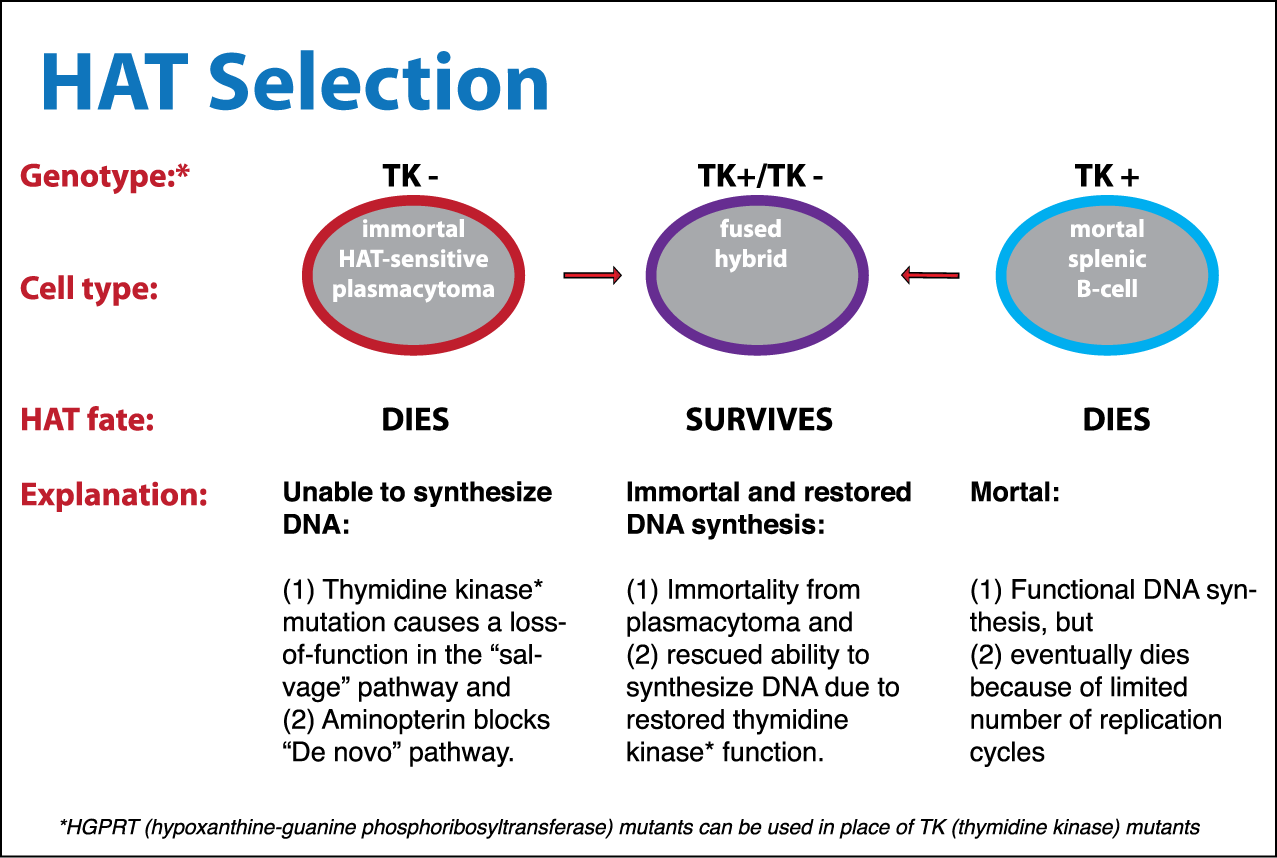
HAT selection depicted by a plasmacytoma thymidine kinase mutant fused with a mortal splenic B-cell.

HAT Medium (hypoxanthine-aminopterin-thymidine medium) is a selection medium for mammalian cell culture, which relies on the combination of aminopterin, a drug that acts as a powerful folate metabolism inhibitor by inhibiting dihydrofolate reductase, with hypoxanthine (a purine derivative) and thymidine (a deoxynucleoside) which are intermediates in DNA synthesis. The trick is that aminopterin blocks DNA de novo synthesis, which is absolutely required for cell division to proceed, but hypoxanthine and thymidine provide cells with the raw material to evade the blockage (the "salvage pathway"), provided that they have the right enzymes, which means having functioning copies of the genes that encode them.

The enzyme dihydrofolate reductase, which produces tetrahydrofolate (THF) by the reduction of dihydrofolate, is specifically blocked by aminopterin. THF, acting in association with specific proteins, can receive single carbon units that are then transferred to specific targets.

One of the important targets for cellular reproduction is thymidylate synthase, which creates thymidine monophosphate (TMP) from deoxyuridine monophosphate (dUMP). By additional phosphorylation reactions, TMP can be used to make thymidine triphosphate (TTP), one of the four nucleotide precursors that are used by DNA polymerases to create DNA. Without the THF required to convert dUMP, there can be no TTP, and DNA synthesis cannot proceed, unless TMP can be produced from another source. The alternative source is the thymidine present in the HAT medium that can be absorbed by the cells and phosphorylated by thymidine kinase (TK) into TMP.

The synthesis of IMP, (precursor to GMP and GTP, and to AMP and ATP) also requires THF, and also can be bypassed. In this case hypoxanthine-guanine phosphoribosyltransferase (HGPRT) reacts hypoxanthine absorbed from the medium with PRPP, liberating pyrophosphate, to produce IMP by a salvage pathway.

Therefore, the use of HAT medium for cell culture is a form of artificial selection for cells containing working TK and HGPRT. Many useful refinements to the scheme are made possible by poisons that kill cells, but to which they are immune if they lack one of these genes. Thus, a cell lacking TK is resistant to bromodeoxyuridine (BrdU) and a cell lacking HGPRT is resistant to 6-thioguanine (6-TG) and 8-azaguanine. Thus, selection with one of the latter two drugs, followed by HAT medium, will yield revertant colonies.[1]

Applications

[edit]

HAT medium is used for preparation of monoclonal antibodies. Laboratory animals (e.g., mice) are first exposed to an antigen against which we are interested in isolating an antibody. Once splenocytes are isolated from the mammal, the B cells are fused with HGPRT negative, immortalized myeloma cells using polyethylene glycol or the Sendai virus. Fused cells are incubated in the HAT medium. Aminopterin in the medium blocks the de novo pathway. Hence, unfused myeloma cells die, as they cannot produce nucleotides by the de novo or salvage pathway. Unfused B cells die as they have a short lifespan. In this way, only the B cell-myeloma hybrids survive. These cells produce antibodies (a property of B cells) and are immortal (a property of myeloma cells). The incubated medium is then diluted into multiwell plates to such an extent that each well contains only 1 cell. Then the supernatant in each well can be checked for the desired antibody. Since the antibodies in a well are produced by the same B cell, they will be directed towards the same epitope, and are known as monoclonal antibodies.

The production of monoclonal antibodies was first invented by César Milstein and Georges J. F. Köhler, which earned them the 1984 Nobel Prize in Physiology or Medicine, shared with Niels Kaj Jerne.

References

[edit]
Revisions and contributorsEdit on WikipediaRead on Wikipedia
from Grokipedia
HAT medium, also known as hypoxanthine--thymidine medium, is a selective culture medium used in mammalian to isolate hybridoma cells after the fusion of antibody-producing B lymphocytes with immortal myeloma cells, enabling the production of monoclonal antibodies. This medium plays a critical role in by eliminating unfused parental cells while allowing only the fused hybridomas to survive and proliferate. The composition of HAT medium includes hypoxanthine, , and supplemented to a standard basal medium, such as or DMEM. Hypoxanthine serves as a precursor, acts as a precursor for , and functions as a antagonist that inhibits , thereby blocking the de novo biosynthesis pathway for . These components create a selective environment where cells must rely on the salvage nucleotide synthesis pathway to survive. The mechanism of selection in HAT medium exploits biochemical differences between cell types: myeloma cells are typically deficient in hypoxanthine-guanine phosphoribosyltransferase (HGPRT), an enzyme essential for the salvage pathway of purines, rendering them unable to utilize and thus leading to their death under blockade. Unfused B lymphocytes, while possessing HGPRT and capable of short-term survival via the salvage pathway, lack immortality and eventually die out. In contrast, hybridoma cells inherit HGPRT from the and proliferative capacity from the myeloma cell, allowing them to thrive in HAT medium for 10–14 days post-fusion. HAT medium was integral to the pioneering work of Georges Köhler and , who developed in 1975, earning them the Nobel Prize in Physiology or Medicine in 1984 for revolutionizing antibody research. Since its introduction, HAT selection has become a cornerstone of production, facilitating applications in diagnostics, therapeutics, and .

Composition and Preparation

Key Components

HAT medium is composed of a basal medium supplemented with hypoxanthine, , , (FBS), L-glutamine, and antibiotics such as penicillin and . The basal medium is typically Dulbecco's Modified Eagle Medium (DMEM) or RPMI-1640, which provide essential nutrients, , vitamins, and salts for mammalian cell growth. Hypoxanthine, a purine derivative, is included at a typical concentration of 10410^{-4} M (100 μM) to support the salvage pathway for purine synthesis. , a folic acid analog and inhibitor of , is added at 4×1074 \times 10^{-7} M (0.4 μM) to block de novo synthesis. , a deoxyribonucleoside, is present at 1.6×1051.6 \times 10^{-5} M (16 μM) to facilitate the salvage pathway for pyrimidine through activity. The medium is further supplemented with 10-20% FBS to provide growth factors and proteins, 2 mM L-glutamine as an source, and antibiotics like 100 U/mL penicillin and 100 μg/mL to prevent bacterial contamination. These components collectively enable selective conditions, with roles in synthesis pathways detailed elsewhere. Concentrations of HAT components can vary across protocols; for instance, higher levels (up to 1 μM) may be used for stricter selection pressure in certain hybridoma fusions.

Preparation Protocols

The preparation of HAT medium begins with selecting a suitable base medium, such as Dulbecco's Modified Eagle Medium (DMEM) supplemented with 10% (FBS), which provides essential nutrients for mammalian cell growth. To assemble the medium from individual components, hypoxanthine, , and are dissolved directly into 500 mL of the pre-warmed base medium under sterile conditions in a laminar flow hood. The solution is then filter-sterilized using a 0.22 μm membrane filter to remove particulates and ensure sterility, preventing microbial contamination during subsequent . For convenience, commercial HAT supplements can be used, such as those from , which are added to the base medium at a typical 1:50 to 1:100 dilution ratio depending on the product concentration (e.g., 10 mL of 50× concentrate to 500 mL base medium). These lyophilized or liquid supplements simplify the process by pre-combining the components in stable form, reducing preparation time while maintaining efficacy for hybridoma selection. After addition, the medium is gently mixed and verified for clarity before use. Post-preparation, the of the medium should be adjusted to 7.2-7.4 using sterile or HCl to optimize buffering capacity for mammalian cells, followed by an osmolarity check targeting approximately 300 mOsm/L to ensure compatibility and prevent osmotic stress. The completed medium is stored at 4°C in the dark for up to 2 weeks to preserve component stability, though fresh batches are recommended for extended cultures to minimize degradation of sensitive additives like . Safety precautions are essential during handling, particularly for aminopterin, a folic acid antagonist classified as toxic and potentially teratogenic; laboratory personnel must wear nitrile gloves, lab coats, and eye protection, and prepare solutions in a well-ventilated to avoid inhalation or skin contact. Waste containing should be disposed of as hazardous per institutional guidelines. Variations in preparation include serum-free formulations, where chemically defined supplements replace FBS to support specific applications like downstream , often using base media like Iscove's Modified Dulbecco's Medium (IMDM) with added growth factors. Adjustments may also be made for different cell lines, such as reducing thymidine levels for sensitive hybridomas, while maintaining overall sterility and pH parameters.

Mechanism of Action

Biochemical Pathways Involved

The selectivity of HAT medium relies on the disruption of de novo nucleotide synthesis pathways and the enablement of salvage pathways, ensuring survival only of cells capable of the latter. , a analog, inhibits (DHFR), the enzyme responsible for reducing dihydrofolate to tetrahydrofolate—a critical cofactor in the of s and thymidylate (dTMP). This inhibition depletes tetrahydrofolate pools, blocking the one-carbon transfer reactions required for incorporating nitrogen into purine rings and for the methylation of dUMP to dTMP via , ultimately preventing and leading to in nucleotide synthesis-compromised cells. In contrast, the salvage pathways provide an alternative route for production, utilizing preformed bases supplied by hypoxanthine and in the medium. For salvage, (HGPRT) catalyzes the transfer of a phosphoribosyl group from 5-phospho-α-D-ribosyl-1-pyrophosphate (PRPP) to hypoxanthine, yielding monophosphate () and (PPi), which can then be converted to AMP and GMP. This reaction is represented as: Hypoxanthine+PRPPHGPRTIMP+PPi\text{Hypoxanthine} + \text{PRPP} \xrightarrow{\text{HGPRT}} \text{IMP} + \text{PP}_\text{i}
Add your contribution
Related Hubs
User Avatar
No comments yet.