Hubbry Logo
Hahoe Folk VillageHahoe Folk VillageMain
Open search
Hahoe Folk Village
Community hub
Hahoe Folk Village
logo
8 pages, 0 posts
0 subscribers
Be the first to start a discussion here.
Hahoe Folk Village
Hahoe Folk Village
from Wikipedia

The Hahoe Folk Village (Korean안동 하회마을) is a traditional village from the Joseon Dynasty, located in Andong, North Gyeongsang Province, South Korea. The 'Ha' is short for river and 'hoe' means to 'turn around, return, come back.[1]

Key Information

The village is a valuable part of Korean culture because it preserves Joseon period-style architecture, folk traditions, valuable books, and an old tradition of clan-based villages. It is listed by the South Korean government with UNESCO as a World Heritage Site with Yangdong Folk Village in 2010[2] and attracts around 1 million visitors every year.[3]

Overview

[edit]

Founded in the 14th-15th century, Hahoe, along with Yangdong, is one of the most highly-regarded historic villages centered around closely-linked families in South Korea. The settlement include the residences of the families, pavilions, Confucian academies and study pavilions that reflect the aristocratic Confucian culture of the early Joseon era. Within the village, six houses out of 124 have been designated as National Treasures.[4]

To the north of the village is Buyongdae Cliff while Mt. Namsan lies to the south. The village is organized around the geomantic guidelines of pungsu (Korean feng shui) and so the village has the shape of a lotus flower or two interlocking comma shapes.

History

[edit]

The Ryu (or Yu in some transcriptions) clan of Pungsan established the Hahoe Folk Village in the 15th century during the Joseon Dynasty and has been a one-clan community since that time. The village is notable because it has preserved many of its original structures, such as the village Confucian school and other buildings, and maintains folk arts such as the Hahoe Mask Dance Drama ('Byeonlsin-gut') which is a shamanist rite honoring the communal spirits of the village.

The village today is divided into Namchon (South Village) and Pukchon (North Village) with the main branch of the Pungsan Ryu clan, the Gyeomampa, in the Namchon side and the secondary branch, the Seoaepa, descended from Yu Sŏngnyong a noted prime minister during the reign of King Seonjo of Joseon in the Bukchon side. The north village contains Yangjindang Manor, designated as Treasure No. 306, and Pikchondaek House, designated Important Folklore Material No. 84. The south village contains Chunghyodang Manor, designated as Treasure No. 414 and Namchondaek House, an Important Folklore Material No. 90. While each branch of the Pungsan Ryu clan used lived in their respective manor homes and sides, today both branches live throughout the village.

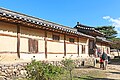
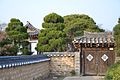
The village maintains old architectural styles that have been lost because of rapid modernization and development in South Korea. Aristocratic tile-roofed residences and thatched-roof servants' homes preserve the architectural styles of the Joseon Dynasty. Wonjijeongsa Pavilion and Byeongsan Confucian School are two notable structures in the village. The village has preserved the shamanist rite of Byeolsin-gut and preserved Hahoe masks used in the Hahoe Mask Dance. Another rite still practiced is the Jeulbul Nori which uses strings of fireworks fired at the base of the Buyongdae Cliff.[5] Yongmogak Shrine houses Yu Sŏngnyong's collection of books and includes South Korean National Treasure No. 132, the Jingbirok, a book which records the Imjin War of Korea in 1592. Treasure No. 160, Kunmundungok, is a record of the military encampments. Chunghyodang also holds 231 royal writs of appointment.

Inside the village there is a 650-year-old zelkova tree called Samsindan said to be home to the goddess Samsin, in Korean Shamanism. Visitors write their wishes on pieces of paper and hang them next to the tree.[6][5]

Queen Elizabeth II visited Hahoe Village in 1999. During her visit, locals in the village had a party to celebrate her 73rd birthday.[7]

Intangible cultural asset

[edit]

Hahoe Byeolsingut Mask Play

[edit]

The mask play, which has been staged in Hahoe-ri, Pungcheon-myeon, Andong City, North Gyeongsang Province, is National Intangible Cultural Treasure No. 69. The origin of this mask play is Seonangje's mask dance, which is an involuntary dramatic victory observed in Dongje, unlike Sandae Myeonghwajeon, a Korean traditional mask play. Byeolsingut Tal Nori is a mask play that is included in the overall village rite, and is a mixture of ritual, folk opera and pantomime.[8][5]

Sunyu Line Fire

[edit]

'Sunyu Line Fire' is a folk game in which people hang a bag filled with charcoal powder on a long string hanging in the air and enjoy a spectacular event in which flames leapt through the air. In Andong's Hahoe Village, the aristocrats took a poem and went out on the river where they sang and enjoyed the poem under the full moon in July. At this time, they enjoyed pouring oil on egg shells or buppy pieces and flying them with a wick, or dropping pine tree stems that had been lit at Buyongdae.

Tourism

[edit]

Hahoe Folk Village has been listed as a World Heritage Site since 2010 and attracts more than 1 million visitors a year.

It has been cited by the Ministry of Culture, Sports and Tourism and the Korea Tourism Organization as one of the '100 Must-Visit Tourist Spots in Korea,' every year from 2013 until 2025, except for 2016-2017.[9]

Since 2021, tour carts have been forbidden from entering the site in order to preserve the village.[10]

[edit]
Panoramic view of the village and the Nakdong River around it

See also

[edit]

References

[edit]
[edit]
Revisions and contributorsEdit on WikipediaRead on Wikipedia
from Grokipedia
Hahoe Folk Village, known as a living folk village, is a well-preserved traditional clan village from the Joseon Dynasty (1392–1910), located in Andong City, , , and recognized as a since 2010 alongside Yangdong Village, which together represent Korea's most representative historic clan villages. Founded in the 14th-15th centuries, it has been continuously inhabited by descendants of the Pungsan Ryu clan, who trace their origins to the village's founder, Ryu Jong-hye, reflecting over 600 years of aristocratic Confucian culture and social structure. Nestled at a bend of the Nakdong River and backed by Mount Hwa, the village's layout evokes the shape of a lotus flower or the yin-yang symbol, harmonizing human architecture with its natural surroundings of forested hills, rivers, and terraced fields. It comprises approximately 124 traditional houses, including nine tile-roofed hanok residences for clan elites—such as the head family homes Yangjindang and Chunghyodang—alongside 29 thatched-roof cottages for commoners, ancestral shrines, pavilions, study halls, and a Confucian academy. Six of these structures are designated as National Treasures under South Korea's Cultural Heritage Protection Act, underscoring their architectural and historical value. The village exemplifies the Joseon-era clan system, where family hierarchies, education, and rituals shaped daily life, producing influential figures like Ryu Seong-ryong (1542–1607). Its cultural significance extends to intangible heritage, including the UNESCO-recognized Hahoe Mask Dance Drama (Hahoe Byeolsingut Talnori), a satirical performance blending dance, music, and comedy that critiques social norms. Expanded in the late 18th and 19th centuries, Hahoe remains a living community of about 150 households, protected since 1984 and threatened by wildfires in March 2025 without reported damage, to preserve its role as a testament to Korea's Confucian heritage and vernacular .

Geography and Setting

Location and Environment

Hahoe Folk Village is situated in Andong-si, , in the southeastern region of , approximately 20 kilometers west of the city center. Its precise coordinates are 36°32′21″N 128°31′00″E. The village is nestled within a protective basin shaped by its natural surroundings, including the horseshoe bend of the that encircles it in an S-shape, Mount Hwa to the east, and the Buyongdae escarpment across the river to the east. This configuration, aligned with Korean geomantic principles known as pungsu (or ), creates a harmonious and sheltered landscape that historically favored settlement by providing natural defense and spiritual balance. The river's curving path played a key role in the site's selection, offering water resources, fertile land, and a barrier against external threats while enhancing the area's topological suitability for habitation. The region features a temperate inland with distinct four seasons, characterized by mild springs, warm summers, cool autumns, and cold winters. Seasonal changes vividly transform the environment: cherry blossoms bloom vibrantly along the riverbanks in spring, while autumn brings colorful foliage to the surrounding forested mountains, accentuating the village's scenic beauty. In March 2025, wildfires threatened the surrounding area but the village and its natural setting sustained no significant damage due to effective conservation measures. As part of the "Historic Villages of Korea: Hahoe and Yangdong," the village's core property spans approximately 500 hectares, with buffer zones established under South Korea's Cultural Heritage Protection Act to safeguard its natural setting from urban development and . These zones encompass surrounding agricultural fields, forests, and riverine areas, ensuring the preservation of the landscape's integrity through regulated and conservation measures.

Village Layout and Design

The Hahoe Folk Village is organized around a clan-based spatial division that underscores the social hierarchy of the Dynasty's Confucian society. The village is split into two primary sections: Namchon, the upper village associated with the Gyeomampa branch of the Ryu clan, and Pukchon, the lower village linked to the Seoaepa branch. This arrangement reflects the clan's internal structure, with Namchon positioned higher up and Pukchon situated lower, symbolizing distinctions in lineage and status within the . The design principles of the village embody Confucian ideals of harmony between human settlements and the natural environment, influenced by the bend of the that cradles the site. Upper-class residences, typically featuring tiled roofs, are oriented to face south toward the river to capture auspicious views and energy flow, while commoner dwellings with thatched roofs are clustered in the outer peripheral zones. Winding paths connect the sections, and low walls delineate the clan areas, fostering a sense of ordered community without rigid isolation. At the village's spiritual heart stands the Samsindan, a 650-year-old tree revered as the abode of the Samsin goddess, serving as a focal point for rituals and reinforcing the integration of shamanistic elements with Confucian layout. In terms of scale and zoning, the core zone of the property encompasses approximately 500 hectares, including the village and its surrounding landscape, embedded within a buffer zone of approximately 566 hectares that protects the broader landscape. Strict regulations prohibit modern constructions within the core, ensuring the retention of the original and architectural integrity as a living testament to Joseon-era clan villages.

History

Founding and Clan Origins

Hahoe Folk Village was established in the during the early Dynasty by members of the Pungsan Ryu , who migrated from Pungsan in search of a site with superior geomantic properties. The clan's founder, Ryu Jong-hye, was drawn to the location by its harmonious landscape, featuring the Nakdong River's protective bend and surrounding mountains that aligned with Confucian principles of feng shui for spiritual and physical well-being. This migration marked the beginning of Hahoe as a dedicated village, reflecting the era's emphasis on ancestral settlements guided by scholarly and ritualistic ideals. The Pungsan Ryu clan formed the core of the village's social structure, evolving into a dominant lineage that shaped its governance and inheritance practices. The clan divided into primary branches, including the Gyeomampa as the main line and the Seoaepa, descended from the prominent scholar Ryu Seong-ryong (1542–1607), who served as Prime Minister during the Imjin War and authored influential works on governance. These branches reinforced patrilineal succession and communal rules rooted in Confucian ethics, prioritizing family harmony, education, and ritual observances to maintain the village's aristocratic identity. Ryu Seong-ryong's legacy, in particular, elevated the clan's status, with his descendants occupying key residences that symbolized intellectual and moral authority. From its modest origins as a small settlement of clan households, Hahoe expanded through generations, reaching over 100 households by the while preserving its one- character. Confucian values permeated daily life, dictating through eldest sons, communal decision-making via clan elders, and the integration of with to foster a self-sustaining community. The village's name, "Hahoe," derives from "ha" (referring to the river below) and "hoe" (to embrace or turn), evoking the Nakdong River's horseshoe-shaped that cradles the settlement like protective arms. This natural embrace not only inspired the name but also underscored the deliberate choice of site for its auspicious configuration.

Key Developments and Events

During the Dynasty's period of prosperity from the 16th to 19th centuries, Hahoe Folk Village expanded significantly, reaching its current layout by the late 18th and early 19th centuries, as the Pungsan Ryu clan established a prominent Confucian community with aristocratic residences, pavilions, and study halls reflecting elite culture. The village's growth was bolstered by the Ryu clan's success in producing influential scholars and officials, including brothers Ryu Seong-ryong and Ryu Un-ryong, whose prominence drew admiration from contemporary literati and reinforced Hahoe's status as a model Confucian settlement praised in 17th- and 18th-century poetry for its harmonious landscape. A pivotal event was the Imjin War (1592–1598), when Ryu Seong-ryong, born in Hahoe and serving as Chief State Councillor, played a pivotal role in Joseon's military defenses; he later authored Jingbirok, a seminal war chronicle that documented strategies and preserved national memory, at the village's Ogyeonjeongsa pavilion. In the 20th century, Japanese colonial rule (1910–1945) disrupted clan continuity and traditions, abolishing the estate system and causing the decline of communal rituals like the Hahoe Mask Dance, as many practitioners emigrated amid cultural suppression and wartime turmoil. Following the Korean War's end in 1953, rapid industrialization imposed modernization pressures through rural-to-urban migration, yet the community resisted by upholding Confucian practices and vernacular architecture against encroaching development. Notable recognitions included its designation as Important Folklore Material No. 122 on January 10, 1984, under the National Heritage Protection Act, acknowledging its intact Joseon-era structures and clan-based layout. In 1999, Queen Elizabeth II visited Hahoe during her state tour of , where villagers hosted a traditional birthday celebration for her 73rd birthday and she planted a fir tree near the village entrance, highlighting its global cultural appeal. The village experienced significant decline in the mid-20th century, with population dropping from 942 residents in 166 households in to 437 residents in 116 households by due to outmigration; the village has since stabilized with around 120 households as of 2025. Revival efforts began in the 1970s under President Park Chung-hee's cultural policies, repositioning Hahoe as a symbol of Confucian heritage through targeted initiatives that restored traditions and attracted nationwide attention, culminating in annual visitor numbers exceeding 1 million by 1999. Following its 2010 World Heritage designation alongside Yangdong Village, increased while preservation efforts continued. In March 2025, severe wildfires threatened the site, prompting evacuation of residents, but firefighters successfully protected the village from damage through continuous water dousing.

Architecture and Preservation

Traditional Structures

The traditional structures of Hahoe Folk Village consist primarily of 127 hanok-style homes, constructed during the Dynasty (1392–1910), with six designated as Treasures by the Administration of . These homes exemplify the village's architectural diversity, reflecting the social hierarchy of the era: upper-class residences feature tile-roofed (giwa) designs divided into sarangchae (men's quarters for receiving guests) and anchae (women's quarters for family living), built with sturdy wooden frames and mud-plastered walls, while commoner homes employ simpler thatched (jip) roofs over single-story structures with similar earthen walls. Notable among these is Yangjindang, designated Treasure No. 306, serving as the residence of the head of the Pungsan Ryu clan during the late period. This upper-class , rebuilt in the , incorporates a walled compound (byeolga) enclosing the sarangchae and anchae, emphasizing and Confucian family norms. Similarly, Chunghyodang (Treasure No. 414), constructed in the early as the home of Ryu Seong-ryong's descendants, follows this layout with integrated systems—flues channeling wood smoke beneath floors for radiant warmth—highlighting practical adaptations to the region's cold winters. The Hahoe Mask Museum within the village preserves and displays the Hahoe Byeolsingut masks ( No. 121), a set of wooden tal used in traditional performances, underscoring the structures' role in safeguarding cultural artifacts. Construction across these buildings relies on with mortise-and-tenon joints for earthquake resistance, walls of clay mixed with , and roofs of curved giwa tiles or layered thatch secured by lattices, all designed to harmonize with the natural landscape. Walled byeolga compounds not only ensure seclusion but also reflect Joseon-era social structures, where extended families maintained distinct spaces for rituals and daily life. Symbolic elements, such as ornamental gates marking entrances, open pavilions for scholarly pursuits, and small shrines for , are seamlessly integrated, embodying Confucian principles of harmony and . The zoning of the village layout briefly influences this placement, positioning elite structures along auspicious orientations toward mountains and rivers.

Conservation Measures

Hahoe Folk Village has been safeguarded under South Korea's National Heritage Protection Act since 1984, which designates it as a key cultural asset and imposes restrictions on alterations to preserve its historical integrity. Following its inscription as a in 2010 alongside Yangdong Village, the site's —integrated into the broader Protection Area—prohibits new and developments that could compromise the village's landscape, architecture, or cultural values, ensuring the surrounding riverine and forested environment remains intact. These measures are further supported by provincial ordinances, such as Andong City's 2004 regulations on protection, which regulate in the core and buffer areas to maintain the village's Joseon-era spatial layout. Restoration efforts intensified in the late 20th and early 21st centuries through government-led initiatives, including the Master Plan for Hahoe Village Renovation established in 2002, which guided the repair and adaptation of structures using traditional materials to avoid authenticity loss. The Detailed Implementation Plan for the Conservation, Utilization, and Comprehensive Maintenance of Folk Villages, enacted in 2004, has facilitated ongoing renovations of tile- and thatch-roofed homes, with six residences individually designated as Treasures receiving prioritized funding from national (70%), provincial (9%), and local (21%) sources. Annual maintenance is conducted collaboratively by the City management office, the Hahoe Village Conservation Society—formed in 2009—and descendants of the founding Pungsan Ryu clan, who reside in the village and report modifications for approval to ensure compliance with design guidelines from 2007. Environmental challenges, particularly riverine erosion and flooding from the , have been addressed through infrastructure like 2-meter-high, 200-meter-long embankments and improved drainage systems constructed in 1994 to protect the village's low-lying structures and farmlands. pressures, including overcrowding and vehicle-related wear, prompted a 2021 ban on motorized tour carts within the village, redirecting visitors to pedestrian paths and guided walks to minimize and preserve the serene, historical ambiance. The Ryu clan plays a central role in community-driven , promoting traditional farming practices that supply for thatched renewals—essential for maintaining the village's 29 dwellings—while integrating eco-friendly methods to support long-term habitat preservation.

Cultural Heritage

UNESCO Designation

Hahoe Folk Village was inscribed on the World Heritage List in 2010 as part of the serial site "Historic Villages of Korea: Hahoe and Yangdong" (reference number 1324). This designation recognizes the villages' exceptional preservation of Dynasty (1392–1910) clan-based settlements, with Hahoe serving as a prime example of aristocratic Confucian layout integrated into its natural landscape. The site encompasses two clusters: Hahoe Village and the nearby Byeongsanseowon Confucian Academy, highlighting the interplay between residential structures and scholarly traditions. The nomination was submitted by the Republic of Korea in January 2009 and evaluated by the International Council on Monuments and Sites (ICOMOS), which recommended inscription following assessments of authenticity, , and management frameworks. ICOMOS noted the villages' high degree of preservation, though it highlighted minor issues in Hahoe such as some post-restoration modifications using modern materials. The core area for the Hahoe cluster measures 499.5 hectares, with a shared of approximately 885.2 hectares across the serial site to ensure protection from urban encroachment. The inscription was granted under criteria (iii) and (iv) of the Operational Guidelines. Criterion (iii) acknowledges the villages as outstanding testimony to the Confucian social and cultural systems of the era, exemplified by Hahoe's hierarchical arrangement of (elite class) residences, pavilions, and commoner homes. Criterion (iv) recognizes them as exemplary architectural ensembles illustrating East Asian clan village planning and building traditions over five centuries. As the first World Heritage site in Korea focused on rural heritage—contrasting with prior urban or monumental listings like palaces and fortresses—this designation has elevated global recognition of Korean folk culture and Confucian village models. Post-inscription, is required to submit periodic reports to on the state of conservation, with the most recent Cycle 3 Section II report (2023) confirming ongoing stability but emphasizing enhanced following regional incidents. A comprehensive management plan for 2015–2020, developed by the Cultural Heritage Administration, prioritizes , authentic restoration practices, and community involvement to maintain the site's outstanding ; subsequent updates continue these efforts as of 2025.

Intangible Assets

Hahoe Folk Village holds significant national recognition for its , including the designation of Hahoe Byeolsingut Talnori as Important Intangible Cultural Property No. 69 on November 17, 1980, by the Cultural Heritage Administration of . This mask dance drama, which blends performance arts with , is also included in "Talchum, mask dance drama in the Republic of Korea," inscribed on UNESCO's Representative List of the Intangible Cultural Heritage of Humanity in 2022. Additionally, the village itself was designated as Important Folklore Material No. 122 on January 10, 1984, acknowledging its role in preserving Joseon-era customs and community practices. Beyond these designations, the village encompasses broader intangible elements such as Confucian rituals and ancestral rites known as , which are conducted by the Pungsan Ryu clan to honor forebears and maintain familial harmony. Oral histories recounting the clan's settlement and daily life during the Dynasty are preserved and shared by Ryu clan elders, ensuring the continuity of narratives that reflect the community's historical identity. These practices highlight the village's role as a repository of non-physical heritage tied to elite scholarly lineages. Transmission of these traditions occurs through clan-based education within the Ryu family, where younger members learn rituals and histories from elders, supplemented by government-supported training programs initiated in the to safeguard intangible assets amid modernization. These efforts include workshops and apprenticeships focused on Confucian customs and folk performances, fostering intergenerational . The cultural value of Hahoe's intangible assets lies in their representation of the elite lifestyle, characterized by scholarly pursuits and moral conduct, while integrating folk beliefs that fuse shamanistic elements with Confucian principles for communal rituals and social cohesion. This synthesis underscores the village's enduring contribution to understanding society's hierarchical yet spiritually diverse fabric.

Traditions and Festivals

Hahoe Byeolsingut Mask Play

The Hahoe Byeolsingut Mask Play, also known as Hahoe Byeolsingut Talnori, originated in the mid-12th century in Hahoe Village, , when merchants performed it as a shamanic rite to appease the village guardian deity Seonangsin and pray for bountiful harvests and protection from misfortune. This ritual drama evolved during the period (918–1392) and was further refined in the era (1392–1910), incorporating sharp satire that mocked the rigid social hierarchy, particularly the pretensions and corruption of the nobility, Buddhist monks, and Confucian scholars. Traditionally performed annually on the First Full Moon Festival and lunar to invoke communal prosperity, the play served as both and , driving away evil spirits through humorous critique of societal follies. It has been designated as Important No. 69 by the South Korean government. The performance unfolds over 10 distinct episodes, featuring 10 to 12 masked characters such as the (a pompous nobleman), Halmi (a shrewd old woman), (a hypocritical scholar), a depraved , a , and a , each embodying exaggerated archetypes to lampoon class divisions and human vices. Accompanied by a small ensemble of musicians playing traditional instruments like the janggu drum and flute, the drama integrates rhythmic dances, acrobatic feats, and improvised banter in local dialects, allowing performers to engage the audience directly with witty ad-libs that amplify the . A full traditional enactment typically lasts 3 to 4 hours, building from invocatory rites to climactic confrontations, such as the ridiculing the elite's absurd pursuits, before concluding with rituals for communal harmony. Central to the play are the Hahoe masks, a set of 11 wooden artifacts carved from wood, designated as No. 121, with movable jaws that enable dynamic expressions during performance. These masks, stored and preserved at the Hahoe Mask Museum, feature boldly exaggerated traits—such as bulging eyes, wide grins, or furrowed brows—to symbolize , , and among the upper classes, contrasting with the more subdued faces of lower-status figures to underscore social inequities. No longer nomadic, these durable wooden pieces replaced earlier perishable versions, ensuring the tradition's continuity. Rooted in , the Hahoe Byeolsingut originally functioned as an exorcistic rite to purge malevolent forces and honor ancestral spirits, evolving into a vital expression of folk resistance against authority. In , it was inscribed on UNESCO's Representative List of the of Humanity as part of the broader mask dance drama tradition, recognizing its role in fostering community bonds and cultural identity through intergenerational transmission. Since the , local preservation troupes in Hahoe have undergone systematic training to maintain authenticity, adapting the play for contemporary audiences while preserving its ritual essence.

Other Folk Customs

In addition to its renowned performances, Hahoe Folk Village sustains a range of other living traditions rooted in Joseon-era practices, emphasizing communal harmony and spiritual protection. One prominent ritual is the Seonyu Julbul Nori, a traditional display along the , where villagers launch fire arrows and floating lanterns in a spectacle dating back to the Dynasty. This event, held several times annually in autumn, serves as a communal rite symbolizing renewal and warding off misfortune through fire and light. Ancestral and seasonal rites further anchor village life, including Jesa ceremonies conducted at clan shrines to honor forebears, often integrated with funeral and memorial processions that reenact historical protocols. These rites, performed monthly by residents, reinforce familial bonds and Confucian values of central to the Pungsan Ryu clan's structure. Complementing them are harvest observances featuring folk songs and communal gatherings, as well as annual at the Samsindan, a 600-year-old tree revered as the abode of the Samsin, who safeguards , birth, and village prosperity; a dedicated occurs on the 15th day of the first to pray for peace. Daily customs reflect ongoing adherence to traditional ways, with and ceremonial attire like the dopo robe donned during rites and reenactments to maintain cultural authenticity. Communal labor, known as gyeongjae, involves collective efforts for village upkeep, such as repairing structures and shared agricultural tasks, fostering social cohesion among the roughly 120 Ryu clan households. Storytelling of Ryu clan legends—tales of scholars like Ryu Seongryong, who led defenses against Japanese invasions, and his brother Ryu Unryong—passes orally through generations, preserving the clan's scholarly heritage during gatherings. Since the , these have evolved through adaptive preservation measures, including designation as a folk village in 1980 and Important Folklore Material No. 114 in 1984, which spurred restoration and educational demonstrations. Post-UNESCO listing in 2010, residents incorporated tourist-oriented reenactments—such as simulated daily chores and rites—to educate visitors while countering modernization's erosion, ensuring about 70 participants engage weekly from spring to autumn. These efforts blend tradition with outreach, safeguarding intangible heritage amid contemporary pressures.

Tourism

Major Attractions

Hahoe Folk Village offers visitors a range of key sites that showcase its preserved Joseon-era architecture and cultural significance. The Hahoe Mask Museum, situated near the village entrance, houses the renowned Hahoe masks designated as No. 121, along with an extensive collection of traditional Korean masks and international examples used in rituals and performances. Buyongdae Observatory, perched on a 64-meter cliff at the end of the Mountain Range, provides sweeping panoramic views of the village nestled along the , highlighting its unique "embracing arms" layout formed by the river's bend. Traditional stays and tea houses, such as those at Rakkojae Hahoe, allow guests to experience authentic Joseon-style accommodations with thatched or tiled roofs, often featuring courtyard gardens and ceremonies. Experiential activities enhance cultural immersion in the village. Guided walks traverse the Namchon (lower village) and Pukchon (upper village) areas, revealing the layout's Confucian principles with (aristocratic) residences in the center and commoner homes on the periphery. Visitors can rent traditional attire for photographic opportunities amid the historic surroundings, while seasonal festivals like the International Mask Dance Festival in September–October feature viewings of the Hahoe Byeolsingut mask play, a shamanistic performed for community prosperity. Unique features draw attention to the village's living heritage. Ryu clan residences, including Yangjindang (Treasure No. 306), are open for tours, offering insights into the Pungsan Ryu family's 600-year and Confucian values. The Samsindan shrine, centered around a 600-year-old tree believed to house the Samsin goddess of childbirth and fertility, serves as a focal point for folk beliefs, complemented by the adjacent pine grove along the for serene strolls. The village integrates with nearby attractions, such as the Andong Folk Museum, facilitating extended explorations of regional traditions. Since its World Heritage designation in 2010 alongside Yangdong Village, Hahoe has experienced a substantial boost, with visitor numbers rising to millions annually, particularly peaking in autumn for the vibrant foliage along the riverbanks. This influx underscores the site's role in promoting Korean cultural heritage while supporting local economies through experiential .

Visitor Guidelines

Hahoe Folk Village is accessible by a approximately 40-minute drive from Station, covering about 28 kilometers along rural roads. options include local buses, such as line 46 from the Andong Express Bus Terminal, taking around 50 minutes. The site operates year-round, generally from 9:00 AM to 6:00 PM in summer (March to October) and 9:00 AM to 5:00 PM in winter (November to February), with last admission 30 minutes before closing. Entry requires a fee of ₩5,000 for adults as of 2025, which grants access to the village and related facilities like the mask performance hall. Visitors must adhere to strict rules to preserve the site's integrity and respect its living residents, primarily from the Ryu clan. Since June 2021, motorized tour vehicles such as golf carts have been prohibited within the village to reduce environmental impact and congestion. exploration is encouraged, with bicycles available for rent as an alternative; etiquette includes obtaining permission before photographing private homes or individuals to maintain residents' privacy. The village may close temporarily during , such as or wildfires, as seen in evacuations during the 2025 Andong wildfires. Despite temporary evacuations during the March 2025 Andong wildfires, the village sustained no damage, and tourism has fully resumed. Accommodations within the village include traditional minbak guesthouses and stays, offering immersive experiences in historic buildings like those at Rakkojae Hahoe, where private bathrooms are available in select rooms. Spring (April to June) and autumn (September to November) are ideal visiting times, featuring mild weather, cherry blossoms, and vibrant foliage that enhance the riverside scenery without extreme summer heat or winter cold. English-language audio guides can be accessed via apps like the Korea Travel & Explore app or on-site services from the Korea Tourism Organization, providing narrated tours of key paths and structures. Sustainability is prioritized through low-impact tourism initiatives, including clan-led educational programs that promote cultural sensitivity and heritage preservation, as outlined in the village's World Heritage management plan. These efforts aim to balance visitor access with the long-term viability of the site, encouraging responsible behaviors like waste reduction and adherence to designated trails.

References

Add your contribution
Related Hubs
User Avatar
No comments yet.