


Community hub
Recent from talks
Contribute something
Nothing was collected or created yet.
Plough
View on Wikipedia

.jpg)
A plough or (in the United States) plow (both pronounced /plaʊ/) is a farm tool for loosening or turning soil before sowing seed or planting.[1] Ploughs were traditionally drawn by oxen and horses but modern ploughs are drawn by tractors. A plough may have a wooden, iron or steel frame with a blade attached to cut and loosen the soil. It has been fundamental to farming for most of history.[2] The earliest ploughs had no wheels; such a plough was known to the Romans as an aratrum. Celtic peoples first came to use wheeled ploughs in the Roman era.[3]
The prime purpose of ploughing is to turn over the uppermost soil,[4] bringing fresh nutrients to the surface[5] while burying weeds and crop remains to decay. Trenches cut by the plough are called furrows. In modern use, a ploughed field is normally left to dry and then harrowed before planting. Ploughing and cultivating soil evens the content of the upper 12 to 25 centimetres (5 to 10 in) layer of soil, where most plant feeder roots grow.
Ploughs were initially powered by humans, but the use of farm animals is considerably more efficient. The earliest animals worked were oxen. Later, horses and mules were used in many areas. With the Industrial Revolution came the possibility of steam engines to pull ploughs. These in turn were superseded by internal-combustion-powered tractors in the early 20th century. The Petty Plough was a notable invention for ploughing out orchard strips in Australia in the 1930s.
Use of the traditional plough has decreased in some areas threatened by soil damage and erosion. Used instead is shallower ploughing or other less-invasive conservation tillage.
The plough appears in one of the oldest surviving pieces of written literature, from the 3rd millennium BC, where it is personified and debating with another tool, the hoe, over which is better: a Sumerian disputation poem known as the Debate between the hoe and the plough.[6]
Etymology
[edit]In older English, as in other Germanic languages, the plough was traditionally known by other names, e.g. Old English sulh (modern dialectal sullow), Old High German medela, geiza, huohilī(n), Old Norse arðr (Swedish årder), and Gothic hōha, all presumably referring to the ard (scratch plough).
The modern word comes from the Old Norse plógr, and is therefore Germanic, but it appears relatively late (it is not attested in Gothic) and is thought to be a loan from one of the north Italic languages. The German cognate is "pflug", the Dutch "ploeg" and the Swedish "plog". In many Slavic languages and in Romanian the word is "plug". Words with the same root appeared with related meanings: in Raetic plaumorati "wheeled heavy plough" (Pliny, Nat. Hist. 18, 172), and in Latin plaustrum "farm cart", plōstrum, plōstellum "cart", and plōxenum, plōximum "cart box".[7][8] The word must have originally referred to the wheeled heavy plough, common in Roman north-western Europe by the 5th century AD.[9]
Many view plough as a derivative of the verb *plehan ~ *plegan 'to take responsibility' (cf. German pflegen 'to look after, nurse'), which would explain, for example, Old High German pfluog with its double meaning of 'plough' and 'livelihood'.[10][11][12] Guus Kroonen (2013)[13] proposes a vṛddhi-derivative of *plag/kkōn 'sod' (cf. Dutch plag 'sod', Old Norse plagg 'cloth', Middle High German pflacke 'rag, patch, stain'). Finally, Vladimir Orel (2003)[14] tentatively attaches plough to a PIE stem *blōkó-, which supposedly gave Old Armenian peɫem "to dig" and Welsh bwlch "crack", though the word may not be of Indo-European origin.[15]
Parts
[edit]
The basic parts of the modern plough are:
- beam
- hitch (British English: hake)
- vertical regulator
- coulter (knife coulter pictured, but disk coulter common)
- chisel (foreshare)
- share (mainshare)
- mouldboard
Other parts include the frog (or frame), runner, landside, shin, trashboard, and stilts (handles).
On modern ploughs and some older ploughs, the mould board is separate from the share and runner, so these parts can be replaced without replacing the mould board. Abrasion eventually wears out all parts of a plough that come into contact with the soil.
History
[edit]
Hoeing
[edit]When agriculture was first developed, soil was turned using simple hand-held digging sticks and hoes.[4] These were used in highly fertile areas, such as the banks of the Nile, where the annual flood rejuvenates the soil, to create drills (furrows) in which to plant seeds. Digging sticks, hoes and mattocks were not invented in any one place, and hoe cultivation must have been common everywhere agriculture was practised. Hoe-farming is the traditional tillage method in tropical or sub-tropical regions, which are marked by stony soils, steep slope gradients, predominant root crops, and coarse grains grown at wide intervals. While hoe-agriculture is best suited to these regions, it is used in some fashion everywhere.
Ard
[edit]

Some ancient hoes, like the Egyptian mr, were pointed and strong enough to clear rocky soil and make seed drills, which is why they are called hand-ards. However, domestication of oxen in Mesopotamia and the Indus Valley Civilisation, perhaps as early as the 6th millennium BC, provided mankind with the draft power needed to develop the larger, animal-drawn true ard (or scratch plough). A ploughed field, from c. 2800 BCE, was also discovered at Kalibangan, India.[16] A terracotta model of the early ards was found at Banawali, India, giving insight into the form of the tool used.[17] The ard remained easy to replace if it became damaged and easy to replicate.[18]
The earliest was the bow ard, which consists of a draft-pole (or beam) pierced by a thinner vertical pointed stick called the head (or body), with one end being the stilt (handle) and the other a share (cutting blade) dragged through the topsoil to cut a shallow furrow suitable for most cereal crops. The ard does not clear new land well, so hoes or mattocks had to be used to pull up grass and undergrowth, and a hand-held, coulter-like ristle could be made to cut deeper furrows ahead of the share. Because the ard left a strip of undisturbed earth between furrows, the fields were often cross-ploughed lengthwise and breadth-wise, which tended to form squarish Celtic fields.[19]: 42 The heavy soils of Northern Europe were difficult to work with a scratch plough.[19]:43 In fact, the ard is best suited to loamy or sandy soils that are naturally fertilised by annual flooding, as in the Nile Delta and Fertile Crescent, and to a lesser extent any other cereal-growing region with light or thin soil.
Mould-board ploughing
[edit]
To grow crops regularly in less-fertile areas, it was once believed that the soil must be turned to bring nutrients to the surface. A major advance for this type of farming was the turn plough, also known as the mould-board plough (UK), moldboard plow (U.S.), or frame-plough.[20] A coulter (or skeith) could be added to cut vertically into the ground just ahead of the share (in front of the frog), a wedge-shaped cutting edge at the bottom front of the mould board with the landside of the frame supporting the under-share (below-ground component). The heavy iron moldboard plow was invented in China's Han Empire in the 1st and 2nd century, and from there it spread to the Netherlands, which led the Agricultural Revolution.[21]: 20 The mould-board plough introduced in the 18th century was a major advance in technology.[4]
Chinese ploughs from Han times on fulfill all these conditions of efficiency nicely, which is presumably why the standard Han plough team consisted of two animals only, and later teams usually of a single animal, rather than the four, six or eight draught animals common in Europe before the introduction of the curved mould-board and other new principles of design in the 18th century. Though the mould-board plough first appeared in Europe in early medieval, if not in late Roman, times, pre-eighteenth century mould-boards were usually wooden and straight (Fig. 59). The enormous labour involved in pulling such a clumsy construction necessitated large plough-teams, and this meant that large areas of land had to be reserved as pasture. In China, where much less animal power was required, it was not necessary to maintain the mixed arable-pasture economy typical of Europe: fallows could be reduced and the arable area expanded, and a considerably larger population could be supported than on the same amount of land in Europe.[22]
— Francesca Bray
The upper parts of the frame carry (from the front) the coupling for the motive power (horses), the coulter, and the landside frame. Depending on the size of the implement, and the number of furrows it is designed to plough at one time, a fore-carriage with a wheel or wheels (known as a furrow wheel and support wheel) may be added to support the frame (wheeled plough). In the case of a single-furrow plough there is one wheel at the front and handles at the rear for the ploughman to maneuver it.[23]

When dragged through a field, the coulter cuts down into the soil and the share cuts horizontally from the previous furrow to the vertical cut. This releases a rectangular strip of sod to be lifted by the share and carried by the mould board up and over, so that the strip of sod (slice of the topsoil) that is being cut lifts and rolls over as the plough moves forward, dropping back upside down into the furrow and onto the turned soil from the previous run down the field. Each gap in the ground where the soil has been lifted and moved across (usually to the right) is called a furrow. The sod lifted from it rests at an angle of about 45 degrees in the adjacent furrow, up the back of the sod from the previous run.[24]
A series of ploughings run down a field leaves a row of sods partly in the furrows and partly on the ground lifted earlier. Visually, across the rows, there is the land on the left, a furrow (half the width of the removed strip of soil) and the removed strip almost upside-down lying on about half of the previous strip of inverted soil, and so on across the field. Each layer of soil and the gutter it came from forms a classic furrow. The mould-board plough greatly reduced the time needed to prepare a field and so allowed a farmer to work a larger area of land. In addition, the resulting pattern of low (under the mould board) and high (beside it) ridges in the soil forms water channels, allowing the soil to drain. In areas where snow build-up causes difficulties, this lets farmers plant the soil earlier, as the meltwater run-off drains away more quickly.[25]
Parts
[edit]There are five major parts of a mouldboard plough:
- Mouldboard
- Share
- Landside (short or long)
- Frog (sometimes called a standard)
- Tailpiece
The share, landside and mould board are bolted to the frog, which is an irregular piece of cast iron at the base of the plough body, to which the soil-wearing parts are bolted.[26]
The share is the edge that makes the horizontal cut to separate the furrow slice from the soil below. Conventional shares are shaped to penetrate soil efficiently: the tip is pointed downward to pull the share into the ground to a regular depth. The clearance, usually referred to as suction or down suction, varies with different makes and types of plough. Share configuration is related to soil type, particularly in the down suction or concavity of its lower surface. Generally three degrees of clearance or down suction are recognised: regular for light soil, deep for ordinary dry soil, and double-deep for clay and gravelly soils.[27]
As the share wears away, it becomes blunt and the plough will require more power to pull it through the soil. A plough body with a worn share will not have enough "suck" to ensure it delves the ground to its full working depth.

In addition, the share has horizontal suction related to the amount its point is bent out of line with the land side. Down suction causes the plough to penetrate to proper depth when pulled forward, while horizontal suction causes the plough to create the desired width of furrow. The share is a plane part with a trapezoidal shape. It cuts the soil horizontally and lifts it. Common types are regular, winged-plane, bar-point, and share with mounted or welded point. The regular share conserves a good cut but is recommended on stone-free soils. The winged-plane share is used on heavy soil with a moderate amount of stones. The bar-point share can be used in extreme conditions (hard and stony soils). The share with a mounted point is somewhere between the last two types. Makers have designed shares of various shapes (trapesium, diamond, etc.) with bolted point and wings, often separately renewable. Sometimes the share-cutting edge is placed well in advance of the mould board to reduce the pulverizing action of the soil.[29]
The mould board is the part of the plough that receives the furrow slice from the share.[4] It is responsible for lifting and turning the furrow slice and sometimes for shattering it, depending on the type of mould board, ploughing depth and soil conditions. The intensity of this depends on the type of mould board. To suit different soil conditions and crop requirements, mould boards have been designed in different shapes, each producing its own furrow profile and surface finish, but essentially they still conform to the original plough body classification. The various types have been traditionally classified as general purpose, digger, and semi-digger, as described below.[30]
- The general-purpose mould board has a low draft body with a gentle, cross-sectional convex curve from top to bottom, which turns a furrow three parts wide by two parts deep, e. g. 300 mm (12 in) wide by 200 mm (7.9 in) deep. It turns the furrow slice slowly almost without breaking it, and is normally used for shallow ploughing (maximum 200 mm (7.9 in) depth). It is useful for grassland ploughing and sets up the land for weathering by winter frosts, which reduces the time taken to prepare a seedbed for spring sown crops.[citation needed]
- The digger mould board is short, abruptly curved with a concave cross-section both from top to bottom and from shin to tail. It turns the furrow slice rapidly, giving maximum shatter, deeper than its width. It is normally used for very deep ploughing (300 mm (12 in) deep or more). It has a higher power requirement and leaves a very broken surface. Digger ploughs are mainly used for land for potatoes and other root crops.[citation needed]
- The semi-digger mould board is somewhat shorter than the general-purpose mould board, but with a concave cross-section and a more abrupt curve. Being intermediate between the two mould boards described above, it has a performance that comes in between (approximately 250 mm (9.8 in) deep), with less shattering than the digger mouldboard. It turns an almost square-sectioned furrow and leaves a more broken surface finish. Semi-digger mould boards can be used at various depths and speeds, which suits them for most of the general ploughing on a farm.[citation needed]
- In addition, slatted mould boards are preferred by some farmers, though they are a less common type. They consist of a number of curved steel slats bolted to the frog along the length of the mould board, with gaps between the slats. They tend to break up the soil more than a full mould board and improve soil movement across the mould board when working in sticky soils where a solid mould board does not scour well.[citation needed]

The land side is the flat plate which presses against and transmits the lateral thrust of the plough bottom to the furrow wall. It helps to resist the side pressure exerted by the furrow slice on the mould board. It also helps to stabilise the plough while in operation. The rear bottom end of the landslide, which rubs against the furrow sole, is known as the heel. A heel iron is bolted to the end of the rear of the land side and helps to support the back of the plough. The land side and share are arranged to give a "lead" towards the unploughed land, so helping to sustain the correct furrow width. The land side is usually made of solid medium-carbon steel and is very short, except at the rear bottom of the plough. The heel or rear end of the rear land side may be subject to excessive wear if the rear wheel is out of adjustment, and so a chilled iron heel piece is frequently used. This is inexpensive and can be easily replaced. The land side is fastened to the frog by plough bolts.[citation needed]
The frog (standard) is the central part of the plough bottom to which the other components of the bottom are attached. It is an irregular piece of metal, which may be made of cast iron for cast iron ploughs or welded steel for steel ploughs. The frog is the foundation of the plough bottom. It takes the shock resulting from hitting rocks, and therefore should be tough and strong. The frog is in turn fastened to the plough frame.[citation needed]
A runner extending from behind the share to the rear of the plough controls the direction of the plough, because it is held against the bottom land-side corner of the new furrow being formed. The holding force is the weight of the sod, as it is raised and rotated, on the curved surface of the mould board. Because of this runner, the mould board plough is harder to turn around than the scratch plough, and its introduction brought about a change in the shape of fields – from mostly square fields into longer rectangular "strips" (hence the introduction of the furlong).[citation needed]
Iron ploughshare
[edit]An advance on the basic design was the iron ploughshare, a replaceable horizontal cutting surface mounted on the tip of the share. The earliest ploughs with a detachable and replaceable share date from around 1000 BC in the Ancient Near East,[31] and the earliest iron ploughshares from about 500 BC in China.[32] Early mould boards were wedges that sat inside the cut formed by the coulter, turning over the soil to the side. The ploughshare spread the cut horizontally below the surface, so that when the mould board lifted it, a wider area of soil was turned over. Mould boards are known in Britain from the late 6th century onwards.[33]

Types
[edit]There are multiple types of ploughs available.[34]
- Mould board ploughs cut the soil into pieces.
- Disc ploughs can be used where mould plows are not suitable.
- Rotary ploughs are used to prepare seed beds.
Plough wheel
[edit]- The gauge wheel is an auxiliary wheel to maintain uniform depths of ploughing in various soil conditions. It is usually placed in a hanging position.[35]
- The land wheel of the plough runs on the ploughed land.[35]
- The front or rear furrow wheel of the plough runs in the furrow.[35]
Plough protective devices
[edit]When a plough hits a rock or other solid obstruction, serious damage may result unless the plough is equipped with some safety device. The damage may be bent or broken shares, bent standards, beams or braces.[citation needed]
The three basic types of safety devices used on mould-board ploughs are a spring release device in the plough drawbar, a trip beam construction on each bottom, and an automatic reset design on each bottom.[36]
The spring release was used in the past almost universally on trailing-type ploughs with one to three or four bottoms. It is not practical on larger ploughs. When an obstruction is encountered, the spring release mechanism in the hitch permits the plough to uncouple from the tractor. When a hydraulic lift is used on the plough, the hydraulic hoses will also usually uncouple automatically when the plough uncouples. Most plough makers offer an automatic reset system for tough conditions or rocky soils. The re-set mechanism allows each body to move rearward and upward to pass without damage over obstacles such as rocks hidden below soil surface. A heavy leaf or coil-spring mechanism that holds the body in its working position under normal conditions resets the plough after the obstruction is passed.[citation needed]
Another type of auto-reset mechanism uses an oil (hydraulic) and gas accumulator. Shock loads cause the oil to compress the gas. When the gas expands again, the leg returns to its working ploughing position after passing over the obstacle. The simplest mechanism is a breaking (shear) bolt that needs replacement. Shear bolts that break when a plough body hits an obstruction are a cheaper overload protection device.[citation needed]
Trip-beam ploughs are constructed with a hinge point in the beam. This is usually located some distance above the top of the plough bottom. The bottom is held in normal ploughing position by a spring-operated latch. When an obstruction is encountered, the entire bottom is released and hinges back and up to pass over the obstruction. It is necessary to back up the tractor and plough to reset the bottom. This construction is used to protect the individual bottoms. The automatic reset design has only recently[when?] been introduced on US ploughs, but has been used extensively on European and Australian ploughs. Here the beam is hinged at a point almost above the point of the share. The bottom is held in the normal position by a set of springs or a hydraulic cylinder on each bottom.[citation needed]
When an obstruction is encountered, the plough bottom hinges back and up in such a way as to pass over the obstruction, without stopping the tractor and plough. The bottom automatically returns to normal ploughing position as soon as the obstruction is passed, without any interruption of forward motion. The automatic reset design permits higher field efficiencies since stopping for stones is practically eliminated. It also reduces costs for broken shares, beams and other parts. The fast resetting action helps produce a better job of ploughing, as large areas of unploughed land are not left, as they are when lifting a plough over a stone.[citation needed]
Loy ploughing
[edit]Manual loy ploughing was a form used on small farms in Ireland where farmers could not afford more, or on hilly ground that precluded horses.[37] It was used up until the 1960s in poorer land.[38] It suited the moist Irish climate, as the trenches formed by turning in the sods provided drainage. It allowed potatoes to be grown in bogs (peat swamps) and on otherwise unfarmed mountain slopes.[39][40]
Heavy ploughs
[edit]
In the basic mould-board plough, the depth of cut is adjusted by lifting against the runner in the furrow, which limited the weight of the plough to what a ploughman could easily lift. This limited the construction to a small amount of wood (although metal edges were possible). These ploughs were fairly fragile and unsuitable for the heavier soils of northern Europe. The introduction of wheels to replace the runner allowed the weight of the plough to increase, and in turn the use of a larger mould-board faced in metal. These heavy ploughs led to greater food production and eventually a marked population increase, beginning around AD 1000.[41]
Before the Han dynasty (202 BC – AD 220), Chinese ploughs were made almost wholly of wood except for the iron blade of the ploughshare. These were V-shaped iron pieces mounted on wooden blades and handles.[21]: 18 By the Han period the entire ploughshare was made of cast iron. These are the earliest known heavy, mould-board iron ploughs.[32][42] Several advancements such as the three-shared plow, the plow-and-sow implement, and the harrow were developed subsequently. By the end of the Song dynasty in 1279, Chinese ploughs had reached a state of development that would not be seen in Holland until the 17th century.[21]: 18
The Romans achieved a heavy-wheeled mould-board plough in the late 3rd and 4th century AD, for which archaeological evidence appears, for instance, in Roman Britain.[43] The Greek and Roman mould-boards were usually tied to the bottom of the shaft with bits of rope, which made them more fragile than the Chinese ones, and iron mould-boards did not appear in Europe until the 10th century.[21]: 17 The first indisputable appearance after the Roman period is in a northern Italian document of 643.[19]: 50 Old words connected with the heavy plough and its use appear in Slavic, suggesting possible early use in that region.[19]: 49ff General adoption of the carruca heavy plough in Europe seems to have accompanied adoption of the three-field system in the later 8th and early 9th centuries, leading to improved agricultural productivity per unit of land in northern Europe.[19]: 69–78 This was accompanied by larger fields, known variously as carucates, ploughlands, and plough gates.
Improved designs
[edit]

The basic plough with coulter, ploughshare and mould board remained in use for a millennium. Major changes in design spread widely in the Age of Enlightenment, when there was rapid progress in design. Joseph Foljambe in Rotherham, England, in 1730, used new shapes based on the Rotherham plough, which covered the mould board with iron.[44] Unlike the heavy plough, the Rotherham, or Rotherham swing plough consisted entirely of the coulter, mould board and handles. It was much lighter than earlier designs and became common in England. It may have been the first plough widely built in factories and commercially successful there.[45]
In 1789 Robert Ransome, an iron founder in Ipswich, started casting ploughshares in a disused malting at St Margaret's Ditches. A broken mould in his foundry caused molten metal to come into contact with cold metal, making the metal surface extremely hard. This process, chilled casting, resulted in what Ransome advertised as "self-sharpening" ploughs. He received patents for his discovery.[46]
James Small further advanced the design. Using mathematical methods, he eventually arrived at a shape cast from a single piece of iron, an improvement on the Scots plough of James Anderson of Hermiston.[47] A single-piece cast-iron plough was also developed and patented by Charles Newbold in the United States. This was again improved on by Jethro Wood, a blacksmith of Scipio, New York, who made a three-part Scots plough that allowed a broken piece to be replaced. In 1833 John Lane invented a steel plough.[48] Then in 1837 John Deere introduced a steel plough; it was so much stronger than iron designs that it could work soil in US areas previously thought unsuitable for farming.
Improvements on this followed developments in metallurgy: steel coulters and shares with softer iron mould boards to prevent breakage, the chilled plough (an early example of surface-hardened steel),[49] and eventually mould boards with faces strong enough to dispense with the coulter.[citation needed]
By the time of the early 1900s, the steel plough had many uses, shapes and names. The "two horse breaking plough" had a point and wing used to break the soil's surface and turn the dirt out and over.[50] The "shovel plough" was used to lay off the rows.[50] The "harrow plough" was used to cover the planted seed.[50] The "scratcher" or "geewhiz" was used to deweed or cultivate the crop.[50] The "bulltongue" and "sweeps" were used to plough the middle of the rows.[50] All these metal plough points required being re-sharpened about every ten days, due to their use on rough and rocky ground.[50]
Single-sided ploughing
[edit]
The first mould-board ploughs could only turn the soil over in one direction (conventionally to the right), as dictated by the shape of the mould board; therefore, a field had to be ploughed in long strips, or lands. The plough was usually worked clockwise around each land, ploughing the long sides and being dragged across the short sides without ploughing. The length of the strip was limited by the distance oxen (later horses) could comfortably work without rest, and their width by the distance the plough could conveniently be dragged. These distances determined the traditional size of the strips: a furlong, (or "furrow's length", 220 yards (200 m)) by a chain (22 yards (20 m)) – an area of one acre (about 0.4 hectares); this is the origin of the acre. The one-sided action gradually moved soil from the sides to the centre line of the strip. If the strip was in the same place each year, the soil built up into a ridge, creating the ridge and furrow topography still seen in some ancient fields.[citation needed]
Turn-wrest plough
[edit]The turn-wrest plough allows ploughing to be done to either side. The mould board is removable, turning to the right for one furrow, then being moved to the other side of the plough to turn to the left. (The coulter and ploughshare are fixed.) Thus adjacent furrows can be ploughed in opposite directions, allowing ploughing to proceed continuously along the field and so avoid the ridge–furrow topography.[citation needed]
Reversible plough
[edit]
The reversible (or roll-over) plough has two mould-board ploughs mounted back to back, one turning right, the other left. While one works the land, the other is borne upside-down in the air. At the end of each row the paired ploughs are turned over so that the other can be used along the next furrow, again working the field in a consistent direction.[51]
These ploughs date back to the days of the steam engine and the horse. In almost universal use on farms, they have right and left-handed mould boards, enabling them to work up and down the same furrow. Reversible ploughs may either be mounted or semi-mounted and are heavier and more expensive than right-handed models, but have the great advantage of leaving a level surface that facilitates seedbed preparation and harvesting. Very little marking out is necessary before ploughing can start; idle running on the headland is minimal compared with conventional ploughs.[citation needed]
Driving a tractor with furrow-side wheels in the furrow bottom provides the most efficient line of draught between tractor and plough. It is also easier to steer the tractor; driving with the front wheel against the furrow wall will keep the front furrow at the correct width. This is less satisfactory when using a tractor with wide front tyres. Although these make better use of the tractor power, the tyres may compact some of the last furrow slice turned on the previous run. The problem is overcome by using a furrow widener or longer mould board on the rear body. The latter moves the soil further towards the ploughed land, leaving more room for the tractor wheels on the next run.[citation needed]
Driving with all four wheels on unploughed land is another solution to the problem of wide tyres. Semi-mounted ploughs can be hitched in a way that allows the tractor to run on unbroken land and pull the plough in correct alignment without any sideways movement (crabbing).[citation needed]
Riding and multiple-furrow ploughs
[edit]
Early steel ploughs were walking ploughs, directed by a ploughman holding handles on either side of the plough. Steel ploughs were so much easier to draw through the soil that constant adjustment of the blade to deal with roots or clods was no longer necessary, as the plough could easily cut through them. Not long after that the first riding ploughs appeared, whose wheels kept the plough at an adjustable level above the ground, while the ploughman sat on a seat instead of walking. Direction was now controlled mostly through the draught team, with levers allowing fine adjustments. This led quickly to riding ploughs with multiple mould boards, which dramatically increased ploughing performance.[citation needed]
A single draught horse can normally pull a single-furrow plough in clean light soil, but in heavier soils two horses are needed, one walking on the land and one in the furrow. Ploughs with two or more furrows call for more than two horses, and usually one or more have to walk on the ploughed sod, which is hard going for them and means they tread newly ploughed land down. It is usual to rest such horses every half-hour for about ten minutes.[52]
Improving metallurgy and design
[edit]John Deere, an Illinois blacksmith, noted that ploughing many sticky, non-sandy soils might benefit from modifications in the design of the mould board and the metals used. A polished needle would enter leather and fabric with greater ease and a polished pitchfork also require less effort. Looking for a polished, slicker surface for a plough, he experimented with portions of saw blades, and by 1837 was making polished, cast steel ploughs.[53]
Balance plough
[edit]
The invention of the mobile steam engine allowed steam power to be applied to ploughing from about 1850. In Europe, soil conditions were often too soft to support the weight of a traction engine. Instead, counterbalanced, wheeled ploughs, known as balance ploughs, were drawn by cables across the fields by pairs of ploughing engines on opposite field edges, or by a single engine drawing directly towards it at one end and drawing away from it via a pulley at the other. The balance plough had two sets of facing ploughs arranged so that when one was in the ground, the other was lifted in the air. When pulled in one direction, the trailing ploughs were lowered onto the ground by the tension on the cable. When the plough reached the edge of the field, the other engine pulled the opposite cable, and the plough tilted (balanced), putting the other set of shares into the ground, and the plough worked back across the field.[citation needed]
One set of ploughs was right-handed and the other left-handed, allowing continuous ploughing along the field, as with the turn-wrest and reversible ploughs. The man credited with inventing the ploughing engine and associated balance plough in the mid-19th century was John Fowler, an English agricultural engineer and inventor.[54] However the Fisken brothers demonstrated (and went on to patent) a balance plough about 4 years before Fowler.[55] One notable producer of steam-powered ploughs was J.Kemna of Eastern Prussia, who became the "leading steam plough company on the European continent and penetrated the monopoly of English companies on the world market" at the beginning of the 20th century.[56]
Stump-jump plough
[edit]The stump-jump plough was invented in 1876 by Australian Richard Bowyer Smith alongside his brother Clarence Herbert Smith. It is designed to break up new farming land that contains tree stumps and rocks expensive to remove.[57] It uses a moveable weight to hold the ploughshare in position. When a tree stump or rock is encountered, the ploughshare is thrown up clear of the obstacle, to avoid breaking its harness or linkage.[58] Ploughing can continue when the weight is returned to the earth.[59]

A simpler, later system uses a concave disc (or pair of them) set at a wide angle to the direction of progress, using a concave shape to hold the disc into the soil – unless something hard strikes the circumference of the disc, causing it to roll up and over the obstruction. As this is dragged forward, the sharp edge of the disc cuts the soil, and the concave surface of the rotating disc lifts and throws the soil to the side. It does not work as well as a mould-board plough (but this is not seen as a drawback, because it helps to fight wind erosion), but it does lift and break up the soil (see disc harrow).[citation needed]
Modern ploughs
[edit]Modern ploughs are usually multiply reversible, mounted on a tractor with a three-point linkage.[60] These commonly have from two to as many as seven mould boards – and semi-mounted ploughs (whose lifting is assisted by a wheel about halfway along their length) can have as many as 18. The tractor's hydraulics are used to lift and reverse the implement and to adjust furrow width and depth. The plougher still has to set the draughting linkage from the tractor, so that the plough keeps the proper angle in the soil. This angle and depth can be controlled automatically by modern tractors. As a complement to the rear plough a two or three mould-board plough can be mounted on the front of the tractor if it is equipped with front three-point linkage.[citation needed]
Specialist ploughs
[edit]Chisel plough
[edit]
The chisel plough is a common tool for deep tillage (prepared land) with limited soil disruption. Its main function is to loosen and aerate the soils, while leaving crop residue on top. This plough can be used to reduce the effects of soil compaction and to help break up ploughpan and hardpan. Unlike many other ploughs, the chisel will not invert or turn the soil. This feature has made it a useful addition to no-till and low-till farming practices that attempt to maximise the erosion-preventing benefits of keeping organic matter and farming residues present on the soil surface throughout the year. Thus the chisel plough is considered by some[who?] to be more sustainable than other types of plough, such as the mould-board plough.

Chisel ploughs are becoming more popular as a primary tillage tool in row-crop farming areas. Basically the chisel plough is a heavy-duty field cultivator intended to operate at depths from 15 cm (5.9 in) to as much as 46 cm (18 in). However some models may run much deeper.[clarification needed] Each individual plough or shank is typically set from 230 mm (9 in) to 360 mm (14 in) apart. Such a plough can meet significant soil drag: a tractor of sufficient power and traction is required. When ploughing with a chisel plough, 10–20 horsepower (7.5–14.9 kW) per shank is required, depending on depth.[citation needed]
Pull-type chisel ploughs are made in working widths from about 2.5 metres (8 ft 2 in) up to 13.7 metres (45 ft). They are tractor-mounted, and working depth is hydraulically controlled. Those more than about 4 metres (13 ft) wide may be equipped with folding wings to reduce transport width. Wider machines may have the wings supported by individual wheels and hinge joints to allow flexing of the machine over uneven ground. The wider models usually have a wheel each side to control working depth. Three-point hitch-mounted units are made in widths from about 1.5 to 9 metres (4 ft 11 in to 29 ft 6 in).
Cultivators are often similar in form to chisel ploughs, but their goals are different. Cultivator teeth work near the surface, usually for weed control, whereas chisel plough shanks work deep under the surface; therefore, cultivation takes much less power per shank than does chisel ploughing.
Country plough
[edit]The country plough is a slanted plough.[61] The most common plough in India,[62] it is recommended for crops like groundnut after the use of a tractor.[63]
Ridging plough
[edit]A ridging plough is used for crops such as potatoes or scallions grown buried in ridges of soil, using a technique called ridging or hilling. A ridging plough has two back-to-back mould boards cutting a deep furrow on each pass with high ridges either side. The same plough may be used to split the ridges to harvest the crop.
Scots hand plough
[edit]This variety of ridge plough is notable for having a blade pointing towards the operator. It is used solely by human effort rather than with animal or machine assistance and pulled backwards by the operator, requiring great physical effort. It is particularly used for second breaking of ground and for potato planting. It is found in Shetland, some western crofts, and more rarely Central Scotland, typically on holdings too small or poor to merit the use of animals.
Ice plough
[edit]
Functionally operating as a saw, but pulled as a plough, this device was created in the 19th century and was mainly used in Scandinavia, as part of the ice export industry, creating blocks of ice to ship to Great Britain.[64]
Mole plough
[edit]The mole plough allows under-drainage to be installed without trenches, or breaks up the deep impermeable soil layers that impede it. It is a deep plough with a torpedo or wedge-shaped tip and a narrow blade connecting it to the body. When dragged over ground, it leaves a channel deep under it that acts as a drain. Modern mole ploughs may also bury a flexible perforated plastic drain pipe as they go, making a more permanent drain – or may be used to lay pipes for water supply or other purposes. Similar machines, so-called pipe-and-cable-laying ploughs, are even used under the sea for laying cables or for preparing the earth for side-scan sonar in a process used in oil exploration.
Compacting a tennis ball-sized sample from moling depth by hand, then pushing a pencil through is a simple check to find if the subsoil is in the right condition for mole ploughing. If the hole stays intact without splitting the ball, the soil is in ideal condition for the mole plough.
Heavy land requires draining to reduce its water content to a level efficient for plant growth. Heavy soils usually have a system of permanent drains, using perforated plastic or clay pipes that discharge into a ditch. The small tunnels (mole drains) that mole ploughs form lie at a depth of up to 950 mm (37 in) at an angle to the pipe drains. Water from the mole drains seeps into the pipes and runs along them into a ditch.
Mole ploughs are usually trailed and pulled by a crawler tractor, but lighter models for use on the three-point linkage of powerful four-wheel drive tractors are also made. A mole plough has a strong frame that slides along the ground when the machine is at work. A heavy leg, similar to a sub-soiler leg, is attached to the frame and a circular section with a larger diameter expander on a flexible link is bolted to the leg. The bullet-shaped share forms a tunnel in the soil about 75 mm (3.0 in) diameter and the expander presses the soil outwards to form a long-lasting drainage channel.
Para-plough
[edit]The para-plough, or paraplow, loosens compacted soil layers 3 to 4 dm (12 to 16 inches) deep while maintaining high surface residue levels.[65] It is primary tillage implement for deep ploughing without inversion.
Spade plough
[edit]The spade plough is designed to cut the soil and turn it on its side, minimising damage to earthworms, soil microorganism and fungi. This increases the sustainability and long-term fertility of the soil.
Switch plough
[edit]Using a bar with square shares mounted perpendicularly and a pivot point to change the bar's angle, the switch plough allows ploughing in either direction. It is best in previously-worked soils, as the ploughshares are designed more to turn the soil over than for deep tillage. At the headland, the operator pivots the bar (and so the ploughshares) to turn the soil to the opposite side of the direction of travel. Switch ploughs are usually lighter than roll-over ploughs, requiring less horsepower to operate.
Effects of mould-board ploughing
[edit]Mould-board ploughing in cold and temperate climates, down to 20 cm (7.9 in), aerates the soil by loosening it. It incorporates crop residues, solid manures, limestone, and commercial fertilisers alongside oxygen, reducing nitrogen losses by denitrification, accelerating mineralisation, and raising short-term nitrogen availability for turning organic matter into humus. It erases wheel tracks and ruts from harvesting equipment. It controls many perennial weeds and delays the growth of others until spring. It accelerates spring soil warming and water evaporation due to lower residues on the soil surface. It facilitates seeding with a lighter seed, controls many crop enemies (slugs, crane flies, seedcorn maggots-bean seed flies, borers), and raises the number of "soil-eating" earthworms (endogic), but deters vertical-dwelling earthworms (anecic).[citation needed]
Ploughing leaves little crop residue on the surface that might otherwise reduce both wind and water erosion. Over-ploughing can lead to the formation of hardpan. Typically, farmers break that up with a subsoiler, which acts as a long, sharp knife slicing through the hardened layer of soil deep below the surface. Soil erosion due to improper land and plough utilisation is possible. Contour ploughing mitigates soil erosion by ploughing across a slope, along elevation lines. Alternatives to ploughing, such as a no-till method, have the potential to build soil levels and humus. These may be suitable for smaller, intensively cultivated plots and for farming on poor, shallow or degraded soils that ploughing would further degrade.[citation needed]
Social effects
[edit]Use of the mouldboard plough in Europe typically required cooperation between multiple households, since four to eight oxen (later horses) were needed to pull the heavy instrument through the soil, and this was more than a typical peasant household could muster on its own.[66] Thus, the introduction of the mouldboard plough made farming more of a communal effort and contributed to the rise of the manorial system in Northern Europe. It also led to farming being seen as men's work, because of the weight of the instrument.[67] Historian William H. McNeill suggested that the experience of cooperation with non-family members as a consequence of mouldboard tillage was conducive to the prevalence of the corporation in medieval Europe; peasants who engaged in this kind of work, including those who migrated to towns, were used to the idea of entering into agreements with people outside of their family and more readily formed corporations.[66]
Depictions
[edit]- Ploughs in art
-
 Back side of a 100 mark banknote issued 1908
 -
 1975 Italian lira coin
 -

-
 The Gefion Fountain in Copenhagen
 -
 Henry Herbert La Thangue, The Last Furrow, 1895
 -
 Ploughing in the Nivernais by Rosa Bonheur (1849)
 -
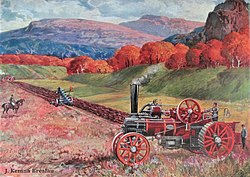 Plough usage was revolutionized with the advent of steam locomotives (as seen in this German 1890s watercolor)
 -
 World War I recruitment poster for the Women's Land Army
 -

-
 Plough pictured in the coat of arms of Aura
 -
 Flag of the Roman Catholic Archdiocese of Cincinnati


See also
[edit]
- Ard (plough) – Simple light plough without a mouldboard
- Foot plough – Manual agricultural tilling tool
- Headland (agriculture) – Area at each end of a planted field
- History of agriculture
- Railroad plough – Rail vehicle used to destroy railroad ties, making tracks unusable
- Ransome Victory Plough – Mouldbourd plow of southern Africa
- Snowplow – Device for removing snow
- Whippletree – Mechanism to distribute force evenly through linkages
- Wedge plow – Train-mounted snow removal plow
References
[edit]- ^ "Plough". Cambridge English Dictionary. Retrieved 16 September 2018.
- ^ "Anglo-Saxon 7th Century plough coulter found in Kent". BBC News. 7 April 2011.
- ^ Collingwood, R. G.; Collingwood, Robin George; Nowell, John; Myres, Linton (1998) [1936]. Roman Britain and the English Settlements. Biblo & Tannen Publishers. p. 211. ISBN 9780819611604.
- ^ a b c d "Plow". Encyclopaedia Britannica. Retrieved 16 September 2018.
- ^ Sahgal, A C; Sahgal, Mukul. Living Sci. 8 Silver Jubilee. India: Ratna Sagar. p. 7. ISBN 9788183325035.
- ^ Jiménez, Enrique (2017). The Babylonian disputation poems: with editions of the series of the Poplar, Palm and vine, the Series of the spider, and the Story of the poor, forlorn wren. Culture and history of the ancient Near East. Leiden ; Boston: Brill. pp. 13–18. ISBN 978-90-04-33625-4.
- ^ C. T. Onions, ed., Oxford Dictionary of English Etymology, s.v. "plough" (Oxford: Clarendon Press, 1996).
- ^ Webster's Encyclopedic Unabridged Dictionary of the English Language, s.v. "plow" (NY: Gramercy Books, 1996).
- ^ Weller, Judith A. (1999). "Agricultural Use". Roman Traction Systems. Retrieved 20 April 2012.
- ^ Jaan Puhvel, "The Indo-European and Indo-Aryan plough: a linguistic study of technological diffusion", Technology and Culture 5, no. 2 (1964): 176–190.
- ^ Jan de Vries, Nederlands Etymologisch Woordenboek, s.v. "ploeg" (Leiden: Brill, 1971).
- ^ Ruth Schmidt-Wiegand, 'Wörter und Sachen. Zur Bedeutung einer Methode für die Frühmittelalterforschung. Der Pflug und seine Bezeichnungen', in Wörter und Sachen im Lichte der Bezeichnungsforschung (Berlin: B.R.D.; NY: Walter de Gruyter, 1981), 1–41; Heinrich Beck, 'Zur Terminologie von Pflug und Pflügen – vornehmlich in den nordischen und kontinentalen germanischen Sprachen', in Untersuchungen zur eisenzeitlichen und frühmittelalterlichen Flur in Mitteleuropa und ihre Nutzung, eds. Heinrich Beck et al. (Göttingen: Vandenhoeck & Ruprecht, 1980), 2: 82–98.
- ^ Guus Kroonen, Etymological Dictionary of Proto-Germanic, s.v. "*plōga-" (Leiden: Brill, 2013), 398.
- ^ Vladimir Orel, A Handbook of Germanic Etymology, s.v. "*plōȝuz" (Leiden: Brill, 2003), 292.
- ^ "Góra Body (Hexentanzplatz – Góra Tańcujących Czarownic ) i Góra Bodo (Brocken) w Harzykowskich Górach (Harz)". Białczyński (in Polish). 22 January 2014. Retrieved 5 July 2023.
- ^ Lal, BB (2003). Excavations at Kalibangan, the Early Harappans, 1960–1969. Archaeological Survey of India. pp. 17 and 98
- ^ McIntosh, Jane (2008). The Ancient Indus Valley: New Perspectives. ABC-CLIO. p. 121. ISBN 9781576079072.
- ^ "The Plow". Story of Farming.
- ^ a b c d e Lynn White Jr., Medieval Technology and Social Change (Oxford: University Press, 1962)
- ^ Fraser, Evan D. G.; Rimas, Andrew (2011). Empires of food: feast, famine and the rise and fall of civilizations. London: Arrow Books. p. 37. ISBN 978-0099534723. Retrieved 17 April 2024.
- ^ a b c d Temple, Robert (2007). The Genius of China : 3,000 Years of Science, Discovery, and Invention. Inner Traditions. ISBN 9781594772177. OL 8879113M.
- ^ Bray 1984, p. 178.
- ^ Taonga, New Zealand Ministry for Culture and Heritage Te Manatu. "Single-furrow plough". teara.govt.nz. Retrieved 8 November 2022.
- ^ "FMP 211 :: Lecture 05". eagri.org. Retrieved 5 July 2023.
- ^ "runoff". education.nationalgeographic.org. Retrieved 5 July 2023.
- ^ "Animal Drawn Plough | Definition, Equipment Features & Uses | Golden Crop". www.rgexim.com. Retrieved 2 June 2023.
- ^ "tillage | Definition, Types, Equipment, Practices, Importance, & Facts | Britannica". www.britannica.com. Retrieved 8 November 2022.
- ^ Jagor, Fedor (1873). Reisen in den Philippinen. Berlin: Weidmannsche Buchhandlung.
- ^ "Farm Machinery and Equipment-I: Lesson 8. Study of mould board plough: accessories, adjustments, operation and material of construction Mould Board Ploughs". ecoursesonline.iasri.res.in. Retrieved 5 July 2023.
- ^ Muth, Reannon. "The 7 Types of Excavators: Which One Should You Choose?". www.heavyequipmentrentals.com. Retrieved 5 July 2023.
- ^ K. D. White (1984): Greek and Roman Technology, London: Thames and Hudson, p. 59.
- ^ a b Robert Greenberger, The Technology of Ancient China (New York: Rosen Publishing Group, Inc., 2006), pp. 11–12.
- ^ Hill and Kucharski 1990.
- ^ "What is a Plough - Meaning - Types of Plows & Use of Plough". Tractor Agriculture. 2 October 2019. Retrieved 22 April 2024.
- ^ a b c "FMP 211 :: Lecture 06". www.eagri.org. Retrieved 22 April 2024.
- ^ "Testing and evaluation of agricultural machinery and equipment". openknowledge.fao.org. 1994. ISBN 92-5-103458-3. Archived from the original on 8 August 2025. Retrieved 27 August 2025.
- ^ Paul Hughes (3 March 2011). "Castlepollard venue to host Westmeath ploughing finals". Westmeath Examiner. Archived from the original on 2 October 2011. Retrieved 1 June 2011.
- ^ Patrick Freyne (27 September 2009). "The plough and the stars". Sunday Tribune. Dublin. Archived from the original on 31 March 2012. Retrieved 1 June 2011.
- ^ "The Famine Potato". St Mary's Famine History Museum. Archived from the original on 24 May 2011. Retrieved 1 June 2011.
- ^ Jonathan Bell, "Wooden Ploughs From the Mountains of Mourne, Ireland", Tools & Tillage (1980) 4#1. pp. 46–56; Mervyn Watson, "Common Irish Plough Types and Tillage Techniques", Tools & Tillage (1985) 5#2. pp. 85–98.
- ^ Weber, William (2014). Production, Growth, and the Environment: An Economic Approach. CRC Press. p. 63. ISBN 9781482243062.
- ^ Wang Zhongshu, trans. by K. C. Chang etc., Han Civilization (New Haven and London: Yale University Press, 1982).
- ^ Evi Margaritis and Martin K. Jones: "Greek and Roman Agriculture", Oleson, John Peter, ed.: The Oxford Handbook of Engineering and Technology in the Classical World, Oxford University Press, 2008, ISBN 978-0-19-518731-1, pp. 158–174 (166, 170).
- ^ "A Brief History of The Plough".
- ^ "The Rotherham Plough". rotherhamweb.co.uk. Archived from the original on 24 September 2015.
- ^ "THE RANSOMES COLLECTION - Archives Hub". archiveshub.jisc.ac.uk. Retrieved 5 December 2023.
- ^ Wilson, Rick (2015). Scots Who Made America. Birlinn. ISBN 9780857908827.
- ^ "Debate: Who really invented the steel plow?". 9 November 2017.
- ^ "John Deere (1804–1886)". Archived from the original on 28 July 2020. Retrieved 1 September 2007.
- ^ a b c d e f The Heritage of Marion County, Alabama. Vol. 47 (2 ed.). Clanton, Al.: Heritage Publishing Consultants, County Heritage, & The Marion County Heritage. 2000. p. 67. ISBN 1-891647-28-8.
- ^ "What are the types of plough? | Amtec Group (amtec-group.com)". amtec-group.com. Retrieved 5 December 2023.
- ^ "Draft Horse Plowing Match". rbogash.com. Retrieved 13 December 2023.
- ^ "The John Deere Plow Invention and the NIHF Inductee". www.invent.org. 20 January 2024. Retrieved 21 January 2024.
- ^ Archives, The National. "The Discovery Service". discovery.nationalarchives.gov.uk. Retrieved 26 September 2017.
Patent litigation [TR FOW/CO5/116-137] is mainly concerned with a Chancery case of 1863 between John Fowler and his patent assignees in trust against James and Frederick Howard of Bedford for alleged infringement of his patents by the manufacture of balance ploughs.
- ^ Haining, John; Tyler, John (1985). Ploughing by Steam A History of Steam Cultivation Over the Years. Ashgrove press. pp. 104–105. ISBN 0906798493.
- ^ Zabel, Hans-Henning (1977). "Kemna, Julius". Neue Deutsche Biographie (in German). 11: 482. Retrieved 14 August 2025.
Die Entwicklung des Unternehmens zum industriellen Großbetrieb begann um die Jahrhundertwende.
- ^ Smith, Clarence Herbert. Digital Collections, ID: PRG 432/4. State Library of South Australia. Retrieved August 4, 2023.
- ^ Coleman, Dudley (22 January 1948). "Richard Smith and his Stump Jumping Plow". The Adelaide Chronicle. pp. 18, 23. Retrieved 4 August 2023.
- ^ Rudder, Debbie. Powerhouse Collection, ID: B526. Powerhouse Museum. Retrieved August 4, 2023.
- ^ Blanco-Canqui, Humberto; Lal, Rattan (2008). Principles of Soil Conservation and Management. Springer. p. 198. ISBN 9781402087097.
- ^ "Tillage and its Implements" (PDF). Himachal Pradesh Agriculture University, Palampur. Archived from the original (PDF) on 4 November 2019. Retrieved 11 January 2022.
- ^ "Fodder and Grass: Country plough".
- ^ "Agriculture :: Oil Seeds :: Groundnut". Archived from the original on 24 July 2019.
- ^ Case display notes, Canal and Ice Museum, London
- ^ "Tillage Equipment" (PDF). Natural Resources Conservation Service (FTP). Retrieved 11 June 2012.[dead ftp link] (To view documents see Help:FTP)
- ^ a b McNeill, William H. (1974). Venice: The Hinge of Europe, 1081–1797. University of Chicago Press. pp. 15–16. ISBN 978-0-226-56148-6.
- ^ Harford, Tim (27 November 2017). "How the plough made the modern economy possible". BBC. Retrieved 3 June 2025.
Further reading
[edit]- Bray, Francesca (1984). Science and Civilization in China 6.[full citation needed]
- Liam Brunt, "Mechanical Innovation in the Industrial Revolution: The Case of Plough Design". Economic History Review (2003) 56#3, pp. 444–477, JSTOR 3698571
- P. Hill and K. Kucharski, "Early Medieval Ploughing at Whithorn and the Chronology of Plough Pebbles", Transactions of the Dumfriesshire and Galloway Natural History and Antiquarian Society, Vol. LXV, 1990, pp 73–83
- V. Sankaran Nair, Nanchinadu: Harbinger of Rice and Plough Culture in the Ancient World
- Steven Stoll, Larding the Lean Earth: Soil and Society in Nineteenth-Century America (New York: Hill and Wang, 2002)
- Wainwright, Raymond P.; Wesley F. Buchele; Stephen J. Marley; William I. Baldwin (1983). "A Variable Approach-Angle Moldboard Plow". Transactions of the ASAE. 26 (2): 392–396. doi:10.13031/2013.33944.
External links
[edit]

- The Rotherham Plough – the first commercially successful iron plough
- History of the steel plough – as developed by John Deere in the United States
- Breast Ploughs and other antique hand farm tools Archived 24 March 2010 at the Wayback Machine
- "Tractor Guide Saves Labor for the Farmer", Popular Mechanics, December 1934

Plough
View on GrokipediaOverview
Etymology
The word "plough" originates from late Old English plōh or ploh, referring to an agricultural implement for turning soil, and is derived from Proto-Germanic plōga- or plōgaz.[6] This root appears in other Germanic languages, including Old High German pfluog, Old Norse plógr, Dutch ploeg, and modern German Pflug, all denoting similar soil-turning tools.[6] The deeper etymology of the Proto-Germanic term remains uncertain, though it may represent a borrowing from Proto-Celtic *plouyos or *plūgā, potentially linked to Indo-European concepts of flowing or floating motion, as the plough moves through earth like a ship through water. Across other Indo-European languages, related terms for plowing reflect shared agricultural heritage from Proto-Indo-European roots. For instance, the Latin verb arāre ("to plow") derives from PIE *h₂erh₃- ("to plow"), which also underlies the noun aratrum for the plough itself.[7] In Sanskrit, the common word for plough is lāṅgala, a term attested in the Rigveda describing a lance-pointed implement, though its precise PIE connection is debated and may involve non-Indo-European influences like Munda substrates.[8] Regional spelling variations emerged in English: "plough" retained the traditional form in British English, while "plow" became standard in American English following Noah Webster's 19th-century orthographic reforms to simplify pronunciation.[6] Related compounds like "plowshare" (or "ploughshare"), denoting the blade that cuts soil, trace to Old English plōhscite or Middle English plou-shar, evolving alongside the tool from primitive wooden ards to iron-tipped devices and eventually mechanized tractors. Over time, the term's usage shifted from denoting hand-pulled or animal-drawn implements to encompassing powered machinery, reflecting technological advancements in agriculture. The spread of European colonialism introduced "plough" as a loanword into non-Indo-European languages, particularly in agricultural contexts where Western tools were adopted. In Bantu languages of East Africa, such as Swahili, it appears as plau, directly borrowed from English during British colonial rule to describe introduced metal ploughs, supplementing native terms like jembe for hoes.[9] Similar borrowings occurred in other Niger-Congo and Austronesian languages across colonized regions, integrating the term into local lexicons for modern farming practices.[10]Basic Function and Principles
The plough serves as a primary tillage implement in agriculture, designed to till the soil by cutting, lifting, and turning over furrows to create a suitable environment for crop growth. This process aerates the soil by loosening compacted layers, enhances nutrient availability through exposure of subsoil, buries weeds and crop residues to suppress pests and facilitate decomposition, and prepares a level seedbed for planting. By inverting the topsoil, the plough disrupts weed cycles and incorporates organic matter, promoting better water infiltration and root development.[11][12] Key operational principles of the plough revolve around the application of draft force, typically provided by draft animals or tractors, which pulls the implement through the soil at a controlled depth and speed. The share, positioned at an optimal angle of attack, slices into the soil to form a clean cut, while the mouldboard then lifts and inverts the furrow slice to ensure thorough soil turnover. Furrow spacing, determined by the plough's width and the number of bottoms, maintains even field coverage and prevents overlapping or gaps, allowing for systematic tillage across the area. These principles enable the plough to achieve uniform inversion of soil layers, typically to depths of 15-30 cm depending on soil type and implement design.[11][13] From a physics perspective, ploughing encounters resistance forces primarily from soil cohesion, which binds particles together, and frictional forces between the soil and tool surfaces, both of which increase draft requirements and energy consumption. Plough design minimizes these forces through streamlined shapes that reduce adhesion and optimize soil-tool interaction, thereby lowering the overall power needed for operation. In the soil flow process over the mouldboard, the cut furrow slice adheres briefly to the curved surface before sliding off in an inverted position; this gradual deflection—often visualized as soil rising vertically from the share, curving laterally over the mouldboard's polished face, and depositing sideways into the previous furrow—ensures minimal disruption while achieving effective burial and aeration.[11][13]Components
Core Parts
The core parts of a traditional plough form its fundamental structure, enabling the primary function of soil disruption and inversion. These components work in concert to cut, lift, turn, and stabilize the soil during tillage, with the ploughshare serving as the leading edge that penetrates and slices the ground to create the furrow bottom.[14] The coulter, positioned ahead of the share, makes a vertical incision to ease the share's entry, particularly in compacted or residue-heavy soils.[15] Following the initial cut, the mouldboard elevates and inverts the soil slice, with its curved surface designed to fracture and flip the furrow, promoting burial of weeds and residues while exposing fresh soil to the surface. This curvature ensures efficient soil inversion, often up to 180 degrees, minimizing drag and optimizing turnover.[14] The landside, mounted parallel to the share, provides lateral stability by bearing against the unplowed land wall, preventing sideways drift and maintaining the plough's alignment during operation.[15] The beam, a robust structural element, connects these working parts to the draft source—such as animals or tractors—transmitting pulling force while supporting the overall assembly.[14] Materials for these components have evolved significantly for enhanced durability and performance; early designs relied on wood for the share, mouldboard, and beam due to availability, but transitions to iron and later hardened steel improved resistance to wear and enabled deeper tillage in tougher soils.[16] Steel construction, particularly for the mouldboard's polished surface, reduces soil adhesion and friction, allowing smoother interaction among parts as the share cuts, the mouldboard turns, and the landside stabilizes.[15] Practical adjustments enhance control and adaptability. A depth wheel, often attached to the beam, regulates furrow depth—typically 9 to 12 inches—by limiting downward penetration and maintaining consistent tillage.[14] Hitch points on the beam allow secure attachment to draft animals or tractors, with adjustable configurations to balance the plough and optimize pull angle for varying soil conditions.[15]Design Variations
Design variations of the plough have historically modified core components like the share and mouldboard to adapt to diverse soil conditions, terrains, and operational needs, enhancing efficiency while minimizing labor and equipment stress.[1] One key adaptation involves reversible shares, which allow the plough to operate in a single direction without requiring the draft animals or machinery to turn at the field end, thereby streamlining fieldwork. These shares, often paired with dual mouldboards mounted back-to-back, enable the soil to be turned alternately left or right across the field, reducing time and effort in headland maneuvers.[17] Adjustable mouldboards represent another variation, permitting farmers to alter the curvature or angle to accommodate varying furrow widths and soil types, from light sands to heavy clays, for optimal soil inversion and reduced draft resistance. Early experiments in the 18th century focused on varying mouldboard angles to improve turning efficiency, laying the groundwork for these adaptable designs.[1] Protective devices such as shear pins were incorporated to safeguard the plough from damage in rocky or obstructed soils; these weak links in the beam or linkage shear off upon impact with underground obstacles, preventing costly breakage of stronger components. By the early 20th century, such pins were standard in linkage systems to absorb shocks from serious impediments.[18] Regional designs further illustrate these adaptations, with the turn-wrest plough enabling alternating furrow directions by partially rotating the body under the beam, switching the faces of the share and mouldboard for left- or right-handed operation—particularly useful in hilly Italian terrains during the late 18th to early 19th centuries. Similarly, balance ploughs facilitated two-way operation without turning, using cable systems between steam engines to haul the implement back and forth across the field, with the plough balanced to maintain consistent depth and soil turnover.[19][20] Early innovations like the stump-jump mechanism addressed challenges in newly cleared lands with roots and stumps, featuring independently hinged shares that lift automatically upon encountering obstacles via pivoting blades and weighted returns, allowing the plough to continue without halting or breaking. Invented in 1876 in South Australia by Richard Bowyer Smith, this design used chains or springs to reset the blades into the soil post-obstacle, revolutionizing cultivation in mallee scrub regions.[21]Historical Development
Ancient and Primitive Ploughs
The earliest precursors to the plough were manual tools such as digging sticks and hoes, which early agricultural societies used to break soil and plant seeds before the development of animal traction. Digging sticks, essentially sharpened wooden or bone implements, allowed for poking holes in the ground to insert seeds, while paddle-shaped hoes or spades facilitated broader soil disturbance by hand or light pulling. These tools represented a transition from foraging to rudimentary cultivation, appearing in archaeological contexts across the Near East and beyond as early as the Neolithic period.[22][23] The ard, or scratch plough, emerged as the first true ploughing implement around 4000–3000 BCE in Mesopotamia, marking a significant advancement by harnessing animal power for tillage. This simple wooden device consisted of a beam attached to a draft animal, such as oxen, with a pointed share made of wood or stone at the end to create shallow furrows without turning the soil. Archaeological evidence, including pictorial depictions on Sumerian artifacts and textual references in ancient records, supports its use in preparing seedbeds for crops like barley and wheat in the fertile alluvial plains. Similar developments occurred in the Indus Valley Civilization, where the world's earliest known ploughed fields were discovered at Kalibangan, dated to approximately 2800–2600 BCE; these fields show intersecting furrows spaced about 10 cm and 1.90 m apart, indicative of ard use for mixed cropping of pulses and oilseeds, though no physical plough remains were found. Similar iron-tipped ards developed in China by the 4th–2nd centuries BCE for harder soils.[23][24][4] Regional variations of the ard appeared in ancient Egypt by the Early Dynastic Period (c. 3100–2686 BCE), evolving into the heel plough around 2000 BCE during the Middle Kingdom. The Egyptian design featured a lightweight wooden frame with a slanted share—often of wood tipped with metal—attached at a "heel" angle to the beam, pulled by oxen to slice shallow furrows in the Nile's silt-rich soil without inverting it. Tomb models and reliefs from sites like the Old Kingdom pyramids depict this tool in action, emphasizing its role in flood-dependent agriculture. In classical Greece and Rome, the ard remained symmetric and non-inverting, lacking a mouldboard to turn soil, with a basic wooden beam and share suited to the Mediterranean's light, sandy terrains. Roman agricultural texts, such as those by Varro and Columella, describe its use on large estates for minimal soil disruption, pulled by oxen or occasionally humans, highlighting its simplicity and limitations in heavier clays.[25][26]Medieval and Heavy Ploughs
The mouldboard plough emerged around 1000 CE in northern Europe, marking a significant advancement over earlier ard ploughs by incorporating a curved board that inverted the soil, allowing for deeper tilling of heavy, clay-rich soils previously unsuitable for cultivation.[27] This design facilitated better weed control and soil aeration, contributing to increased agricultural productivity in regions with wetter, heavier soils.[28] As a successor to the simpler ancient ard, which merely scratched the surface, the mouldboard plough represented a technological shift suited to the environmental challenges of medieval northern landscapes.[27] Key components of the heavy plough included an iron-tipped share for cutting through dense soil, a vertical coulter blade to slice the turf ahead of the share, and a mouldboard to turn the furrow slice over, often mounted on a robust wheeled frame for stability and depth control.[27] These ploughs required substantial draught power, typically provided by teams of up to eight oxen hitched in tandem, due to their weight and the resistance of heavy soils.[29] The heavy plough originated among Slavic tribes as early as 600 CE and gradually spread westward across Europe, reaching England by the 11th century where it became integral to open-field farming systems.[27] In Ireland, a manual variant known as the loy—a narrow, wedge-shaped spade used as a foot-operated plough—persisted for smaller plots and hand tilling, adapting the inverting principle without animal power.[30]Modern and Mechanized Ploughs
The transition to modern ploughs began in the late 18th and 19th centuries with the adoption of iron ploughshares, which replaced wooden components for greater durability and efficiency in soil turning. British inventor Robert Ransome patented a cast-iron ploughshare in 1803, enabling sharper cutting edges and reduced friction compared to earlier mouldboards, significantly boosting productivity during the Agricultural Revolution. Riding ploughs, pulled by horses and allowing the operator to sit on a wheeled platform, emerged in the mid-19th century (c. 1850s) in the United States. Multi-furrow ploughs, such as those developed by John Deere in the 1830s using steel mouldboards, permitted simultaneous creation of multiple furrows, scaling up tillage for larger farms and contributing to expanded crop yields in the Midwest. In the 20th century, mechanization accelerated with the integration of tractors, leading to tractor-mounted reversible ploughs that could invert soil in both directions without repositioning, first commercialized by firms like Fordson in the 1920s. These designs, often hydraulically controlled, improved turnaround times and fuel efficiency on expansive fields. Advances in metallurgy, including high-carbon steel and later alloy treatments, enhanced plough durability against wear, with post-World War II models like the Kverneland reversible plough incorporating heat-treated shares that extended service life by up to 50% in abrasive conditions. Semi-automatic adjustments for depth and angle, introduced in the 1950s by manufacturers such as Massey Ferguson, allowed real-time adaptations to varying soil types via mechanical linkages, reducing operator intervention and soil disturbance. Contemporary ploughs, from the late 20th century onward, incorporate precision technologies like GPS-guided systems for automated steering and depth control, as seen in John Deere's AutoTrac implementations since 2002, which optimize furrow alignment to within centimeters and minimize overlap for resource savings. Minimal-till variants, such as chisel ploughs and disc ploughs refined in the 1990s, reduce soil compaction by loosening without full inversion, preserving moisture and organic matter while cutting erosion by 30-50% compared to traditional methods. Post-2000 eco-designs, including those from Kuhn and Lemken, feature low-disturbance legs and biodegradable coatings to further mitigate compaction and chemical runoff, aligning with sustainable agriculture goals amid climate pressures.Types and Variants
Standard Plough Types
Standard plough types encompass the primary implements used in general farming for soil preparation, focusing on variants that address common tillage needs across various soil conditions. These include mouldboard ploughs, which invert the soil for thorough residue incorporation; disc ploughs, designed for challenging terrains; and chisel ploughs, which loosen soil without turning it over to promote conservation practices. These types are widely adopted in conventional and reduced-tillage systems to balance crop production with soil health. Mouldboard ploughs feature a curved blade that cuts, lifts, and inverts the furrow slice, typically to a depth of 15-25 cm, burying weeds and residues while creating a clean seedbed. This inversion enhances soil aeration and structure for most crops but can increase erosion risk on slopes if residues are fully buried. Common variants include the one-way plough, a fixed-direction model often semi-mounted for continuous furrowing in a single pass across the field; the turn-wrest plough, which uses a single bottom that can be manually reversed from right-hand to left-hand operation to alternate furrow directions without repositioning the tractor; and the reversible plough, equipped with hydraulic mechanisms to automatically flip multiple bottoms for uninterrupted ploughing on both sides of the furrow, reducing labor and improving efficiency in large-scale operations. These adaptations of core components like the share and mouldboard allow for versatile use in clay or loamy soils, though they require higher draft power, consuming 21.4-23.2 kW hours per hectare at 15-18 cm depth.[31][32][16] Disc ploughs employ a series of concave, rotating discs—typically 60-70 cm in diameter—angled to slice and partially turn the soil, achieving depths of 15-20 cm without the inversion of mouldboard types. They are particularly suited for sticky, heavy clay, or rocky soils where traditional shares might clog or break, as the discs roll over obstructions like stones or roots while mixing residues into the top layer at about 50% incorporation rate. This design minimizes compaction and works well in trashy fields post-harvest, though the smoother surface left behind may accelerate water runoff compared to rougher tillage methods. Fuel efficiency is a key advantage, with consumption around 11.7 litres per hectare for heavy offset models at 8-13 cm depth, making them economical for initial tillage in dry or uneven lands.[31][33] Chisel ploughs use narrow, spring-loaded shanks or tines spaced 20-40 cm apart to fracture and loosen compacted subsoil layers to depths of 20-40 cm, without inverting the topsoil or burying surface residues, thereby maintaining 50-70% crop cover for erosion mitigation. This non-inversion approach breaks hardpans that restrict root growth and water infiltration, ideal for conservation tillage in sandy or erosion-prone areas, where it can reduce soil loss by up to 94% compared to mouldboard ploughing by preserving a rough, cloddy surface. Points vary from straight for deep subsoiling to sweeps for shallower mixing, and the implement's low disturbance supports microbial activity while requiring less power, at 7.5-16.8 litres of fuel per hectare for 15-20 cm depths. Fall applications with 30% residue cover post-planting further cut erosion by 50-65% versus conventional methods.[31][34][16]Specialist Plough Types
Ridging ploughs are specialized implements designed to create raised rows or ridges in soil, primarily for potato cultivation and other horticultural crops such as beans, tomatoes, and corn, where improved drainage, soil warming, and weed suppression are essential. These ploughs form ridges by gathering soil from adjacent furrows, typically after initial tillage, allowing crops to be planted on the elevated beds that prevent waterlogging and promote root development. In horticultural applications, ridging covers the base of plants with soil from inter-row areas, enhancing stability and reducing erosion on sloped terrains.[35] Mole ploughs serve a unique drainage function by excavating unlined underground channels, known as mole drains, in heavy clay soils that impede water percolation, thereby facilitating subsurface drainage without surface disruption. Pulled by tractors, these implements feature a tapered mole head that compacts soil into a smooth pipe-like tunnel, typically at depths of 400 to 600 mm, connecting to main drains or ditches to alleviate waterlogging in poorly permeable subsoils.[36] Beyond agriculture, mole ploughs install small-diameter polyethylene pipes for rural water or cable systems, minimizing environmental impact through trenchless methods that preserve topsoil integrity.[37] This design also fractures compacted layers, improving overall soil porosity for crop growth in regions with high clay content. Spade ploughs, often hand-held or manually operated, are compact tools suited for tilling small plots, gardens, or boggy terrains where larger machinery is impractical, relying on human power to slice and invert soil slices. Also called breast ploughs or flaughter spades, they feature a broad blade pushed forward with the operator's chest or hands to cut turf and turn shallow furrows, historically used for preparing tiny fields or extracting peat in wetlands for fuel or fertilizer.[38] Country ploughs, a variant of light, portable designs for rural or marginal lands like bogs, employ similar manual principles to cut drainage channels or till soft, water-retentive soils, often as attachments on small tractors for peatland reclamation.[39] Para-ploughs provide deep tillage for alleviating soil compaction in heavy or trafficked fields, fracturing hardpans at depths of 12 to 16 inches with narrow shanks that lift and shatter subsoil without full inversion, thereby retaining surface residue for erosion control and moisture conservation. Developed as a conservation alternative to traditional mouldboard ploughs, this tool enhances water infiltration and root penetration in compacted layers while minimizing soil disturbance.[15] Studies confirm its efficacy in improving hydraulic conductivity and reducing runoff in clay-dominated soils.[40] Switch ploughs, also known as reversible or flip ploughs, enable alternating ploughing directions without tractor turns, ideal for inter-row tillage in orchards where space is limited and root damage must be avoided. Hydraulic mechanisms allow the plough body to rotate 180 degrees, permitting on-land operation that switches the mouldboard orientation to furrow soil bidirectionally, optimizing efficiency in tree-lined settings.[41] This design reduces compaction from repeated wheel traffic and suits undulating orchard terrains by maintaining consistent depth across passes.Impacts
Agricultural and Environmental Effects
Ploughing provides several key benefits to agricultural productivity by enhancing soil conditions and managing pests. It effectively controls weeds by burying seeds and plant residues below the surface, preventing germination and reducing competition for crops. Additionally, ploughing improves soil aeration by creating pore spaces that facilitate oxygen exchange and water infiltration, which in turn promotes deeper root penetration and stronger plant growth. Historically, the adoption of the medieval heavy plough significantly boosted yields, particularly on clay-heavy soils in Northern Europe, by enabling deeper tillage that improved drainage and nutrient access, contributing to an estimated 10% of the observed increases in population density and urbanization between AD 900 and 1300.[42][43][44] Despite these advantages, ploughing also imposes notable drawbacks on soil health and the environment. Soil inversion during ploughing disrupts surface stability, accelerating erosion through increased runoff and exposure of fine particles to wind and water, which can lead to substantial topsoil loss over time. Furthermore, the disturbance releases stored soil organic carbon into the atmosphere as CO2, contributing to greenhouse gas emissions and exacerbating climate change; for instance, ploughing grasslands can cause a temporary decline in carbon stocks due to reduced plant productivity and heightened decomposition. Heavy machinery used in modern ploughing often causes subsoil compaction, reducing pore space and limiting root growth and water movement, with effects that may persist even after subsequent tillage.[45][46][47] In response to these issues, modern agriculture has increasingly shifted toward no-till practices, which minimize soil disturbance to mitigate environmental harm. No-till farming reduces erosion by maintaining crop residues on the surface as a protective cover, preserving topsoil and enhancing water retention. It also supports greater carbon sequestration by limiting organic matter breakdown, with soil-based conservation practices like no-till potentially offsetting 5-15% of annual global agricultural emissions if widely adopted. As of 2023, no-till is practiced on approximately 12% of global cropland, with adoption rates exceeding 50% in countries like Brazil and Paraguay.[48][49][50][51] Studies indicate that ploughed fields experience biodiversity loss compared to no-till systems, with lower microbial and arthropod diversity due to disrupted habitats, whereas no-till promotes higher soil organism abundance and ecosystem resilience.[48][49][50]Social and Economic Effects
The introduction of the heavy plough in medieval Europe, particularly from the 11th century onward, facilitated the adoption of open-field systems, where arable land was divided into communal strips to accommodate the plough's requirements for cooperative farming.[52] This innovation enabled the cultivation of heavier, clay-rich soils in northern Europe, boosting agricultural productivity and accounting for an estimated 10% of the population growth across regions from c. 1000 to 1300 AD.[44][53] The shift toward open fields influenced feudal land division, transforming fragmented holdings into elongated furlongs and fostering peasant solidarity through shared labor obligations, which gradually relaxed serfdom by converting labor rents into monetary ones by the mid-13th century.[52] During the industrial era, mechanized ploughs and related innovations, such as horse-drawn threshers, accelerated the consolidation of smallholdings into larger farms through enclosure movements, enabling commercial-scale grain production and a 2.7-fold increase in agricultural output from 1700 to 1870 in Britain.[54] This shift displaced rural labor, reducing the agricultural workforce's share and driving urbanization, with England's urban population rising from 17% in 1801 to 54% by 1891 as workers migrated to industrial centers.[54] The resulting economic boom in grain production paralleled broader industrialization, though it echoed Luddite resistance to machinery-induced job losses in the early 19th century.[54] The colonial spread of the plough to the Americas and Africa exacerbated land inequality by favoring large-scale estates suited to plough-based cash crop cultivation, such as wheat in temperate North America and sugar plantations in tropical Latin America, where land Gini coefficients reached 80.3 in Argentina by 1914.[55] In Africa, colonial introductions of technologies like ox-drawn ploughs in 19th-century southern Africa enabled settler expansion but contributed to displacing indigenous smallholders into reserves, as reflected in Zambia's land Gini of 69.9 by 1971, concentrating ownership among colonial elites.[55][56] In modern contexts, government subsidies for mechanized ploughing have promoted adoption, increasing total factor productivity by about 2.8% and reducing family labor by 16% per acre in subsidized regions, though benefits accrue disproportionately to larger farms, potentially widening rural inequality.[57]Cultural Representations
Depictions in Art and Media
Ancient Egyptian tomb paintings from the New Kingdom period frequently illustrate agricultural labor, including the use of the ard, a simple wooden plough drawn by oxen. For instance, scenes in the tomb of Nakht at Thebes, dated to around 1400 BCE, show farmers guiding oxen to till the soil along the Nile, highlighting the centrality of ploughing to sustenance and the afterlife.[58] Similarly, the burial chamber of Sennedjem features vivid depictions of ploughing around 1200 BCE, where workers employ the ard to prepare fields for sowing, underscoring the ritualistic importance of farming in funerary art.[59] In ancient Greece, plough motifs appear on pottery, reflecting the tool's role in agrarian society. Black-figure cups from the Archaic period, such as those in the Louvre and British Museum collections, portray peasants ploughing fields with ox-drawn ards, often in narrative scenes of rural life.[60] A Boeotian red-figure vase in Berlin depicts a plough in a mythological context with Triptolemus, the legendary sower, emphasizing the plough's symbolic ties to fertility and agriculture.[60] Medieval illuminated manuscripts captured the labor-intensive nature of heavy ploughing in Europe. The 14th-century Luttrell Psalter, created around 1330–1340 in England, includes marginal illustrations of eight-ox teams pulling wheeled heavy ploughs through heavy clay soils, with peasants guiding the implement and sowing seed behind. These detailed scenes from folios like 84r depict collaborative farming efforts, illustrating the communal demands of medieval agriculture.[61] During the Renaissance, Flemish artist Pieter Bruegel the Elder incorporated ploughs into his panoramic landscapes to evoke everyday toil amid broader human narratives. In Landscape with the Fall of Icarus (c. 1560), a lone ploughman in the foreground turns the soil with a horse-drawn plough, oblivious to Icarus's distant plunge into the sea, symbolizing the persistence of rural labor.[62] In the 20th century, documentaries and photography documented the shift to mechanized ploughing and its consequences. The 1936 film The Plow That Broke the Plains, directed by Pare Lorentz, dramatizes tractor-ploughing on the Great Plains, showing vast fields turned under by steel ploughs that contributed to soil erosion and dust storms during the Dust Bowl era.[63] Photographers like Arthur Rothstein captured this transition in stark images, such as a 1936 photograph of a farmer and his sons battling a dust storm in Oklahoma, highlighting the environmental toll of intensive mechanized tillage.[64] Later documentaries, including Tractor Wars (2024), explore the early 20th-century innovations in tractor design that revolutionized ploughing, featuring archival footage of powerful machines transforming vast farmlands.[65]Symbolism and Legacy
The plough has long symbolized agricultural prosperity, fertility, and the labor essential to human sustenance across diverse cultures. In ancient and medieval traditions, it represented the transformation of wild land into productive fields, embodying renewal and the cyclical nature of seasons. This imagery extended to rituals invoking bountiful harvests, where the plough served as a sacred tool to ensure communal well-being and avert famine.[66][67] In Hindu tradition, the plough holds dual significance as a practical farming implement and a emblem of strength, notably as the weapon of Balarama, Krishna's brother, who wielded it in conflicts to protect dharma. It also features in spiritual rituals, such as those connecting earthly labor to ancestral offerings, underscoring its role in bridging the material and divine realms. Biblically, the plough evokes peace and redirection from violence, as in Isaiah 2:4, where nations are prophesied to "beat their swords into plowshares," transforming instruments of war into tools of cultivation for an era of harmony and productivity. European folk customs further illustrate this, with Plough Monday in England—observed as the first Monday after Epiphany—featuring processions and plays to bless the soil, while Scottish "Streeking the Plough" ceremonies involved offerings to the implement for prosperous yields, rooted in pre-Christian fertility rites adapted by Christianity.[68][69][67] The plough's legacy endures in modern cultural icons, notably the Starry Plough flag of Irish republicanism, designed in 1914 by the Irish Citizen Army under James Connolly. Drawing from the Big Dipper asterism—known as the Plough in British and Irish lore—the flag depicts a golden plough with a sword as its share against a green field, symbolizing the laborer's struggle for freedom and the biblical ideal of converting war to peace. This emblem, flown during the 1916 Easter Rising, continues to represent socialist and nationalist aspirations, highlighting the plough's shift from agrarian tool to metaphor for social justice. Historically, the plough's invention and evolution facilitated surplus production that underpinned civilizations, from Neolithic settlements to industrial agriculture, though it also perpetuated gender norms favoring male labor in plough-based societies. Its cultural resonance persists in literature and art as a marker of human ingenuity and environmental stewardship.[70][66][71] In non-Western traditions, the plough appears in ancient Chinese art on bronze ritual vessels from the Zhou dynasty (c. 1046–256 BCE), depicting ox-drawn ploughing to symbolize imperial agricultural policies and harmony with nature. Similarly, in Indian temple carvings, such as those at the 10th-century Brihadeeswarar Temple in Tamil Nadu, plough motifs illustrate Vedic farming rituals tied to prosperity and divine favor.[72][73][74]References
- https://en.wiktionary.org/wiki/Reconstruction:Proto-Indo-European/h%E2%82%82erh%E2%82%83-