


Community hub
0 subscribers8 pages, 0 posts
Recent from talks
Be the first to start a discussion here.
Be the first to start a discussion here.
Be the first to start a discussion here.
Be the first to start a discussion here.
Contribute something
Welcome to the community hub built to collect knowledge and have discussions related to Hashmi Miya.
Nothing was collected or created yet.
Hashmi Miya
View on Wikipediafrom Wikipedia
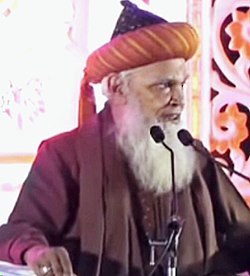
Syed Muhammad Hashmi Miyan (Urdu سید محمد ہاشمی میاں) is an Indian Sunni Sufi Baravali scholar and preacher. He is recognised as Ghazi-e-Millat (warrior of the community).[3] He is followed by many Hindi and Urdu speakers,[4]
Key Information


According to one British website Hashmi Miyan is the youngest son of Muhaddis e Azam e Hind.[5]
He is the younger brother of Madani Miya.[citation needed]
Views
[edit]He had opposed the Citizenship Amendment Act, quoting that it is fine to eliminate the illegal immigrants from India, but it is quite difficult for all the Indian citizens to prove their residence-ship in India.[6] He believes that there is no religion of terrorism.[7][4]
Literary works
[edit]Hashmi Miyan's literary works include
References
[edit]- ^ "पूर्वजों के कौमी एकता प्रयास को आगे बढ़ाएं : नूरानी मियां".Dainik Jagran (in Hindi) Retrieved 2021-09-04.
- ^ "मुसलमानों की एक आंख बरेली और दूसरी किछौछा है, इन्हें कोई जुदा नहीं कर सकता : हाशमी मियां". Dainik Bhaskar. Archived from the original on 2021-04-19. Retrieved 2021-04-19.
- ^ "Comment: Be aware of divisive forces among Muslims". The Siasat Daily. 2020-05-03. Archived from the original on 2020-07-22. Retrieved 2020-07-22.
- ^ a b "Islamic scholar shares dais with Indresh". The Milli Gazette — Indian Muslims Leading News Source. Archived from the original on 2020-07-23. Retrieved 2020-07-23.
- ^ "Ghazi-e-Millat". MA Mission London. 2015-10-18. Archived from the original on 2019-12-29. Retrieved 2020-07-23.
- ^ "घुसपैठियों को बाहर करने के लिए पूरा देश नागरिकता साबित करे, यह नियम सही नहीं: हाशमी मियां". Dainik Bhaskar (in Hindi). 2020-02-27. Archived from the original on 2020-07-22. Retrieved 2020-07-22.
- ^ "हिंदुस्तान का मुसलमान पैगंबर साहब की मजार को नहीं छू सकता". Nai Dunia (in Hindi). 2014-09-28. Archived from the original on 2020-07-25. Retrieved 2020-07-23.
- ^ a b "Hashmi Mian Ashrafi Aljilani". Books Library | Online Book Database | eBooks | Free | Read | Download | Learn. Archived from the original on 2020-07-23. Retrieved 2020-07-23.
- ^ "سید محمد ہاشمی میاں کچھوچھوی". www.goodreads.com. Archived from the original on 2023-03-17. Retrieved 2020-07-23.
- ^ "Hazrat Ameer Moaviyyah Khalifa Rashid Syed Muhammad Hashmi Mian : Muhammad Tariq Lahori : Free Download, Borrow, and Streaming". Internet Archive. 20 December 2015. Retrieved 2020-07-23.
- ^ Khutbat-e-Hashmi Miyan at Marfat Library. Retrieved-5 September 2021.
Hashmi Miya
View on Grokipediafrom Grokipedia
Syed Muhammad Hashmi Miyan (born 1947), commonly known as Hashmi Miya and honored with the title Ghazi-e-Millat, is an Indian Sunni Sufi scholar and preacher rooted in the Barelvi tradition from Ashrafpur Kichhauchha, Uttar Pradesh.[1][2]
As a descendant of the Ashrafi lineage tracing to Abdul Qadir Jilani, he has built a reputation through extensive preaching tours across India and abroad, delivering discourses in Hindi and Urdu that emphasize orthodox Sunni practices, devotion to the Prophet Muhammad, and rejection of Wahhabi influences equated by him with extremism.[3] His efforts have fostered a large following among Sufi-oriented Muslims, promoting messages of communal harmony while critiquing terrorism as antithetical to Islamic teachings.[3] Notable for sharing platforms with Hindu leaders to advocate interfaith dialogue, Hashmi Miya has faced intra-Muslim sectarian opposition, including criticisms from rival scholars over doctrinal positions and public stances on issues like India's Citizenship Amendment Act, where he supported deporting illegal immigrants but opposed the law's structure.[4]
Early Life and Background
Birth and Family Origins
Syed Mohammad Hashmi Ashraf, commonly known as Hashmi Miyan, was born on 8 July 1947 in Ashrafpur Kichhauchha, a village in present-day Ambedkar Nagar district, Uttar Pradesh, India.[5][6] At the time of his birth, the region was part of the United Provinces under British India, shortly after partition and independence.[5] He was the youngest son of Syed Mohammed Ashraf Ashrafi al-Jilani, a distinguished hadith scholar titled Mohaddis-e-Azam-e-Hind, who led the Ashrafi Sufi tradition centered in Ashrafpur Kichhauchha.[5][6] The family traces its origins to the Sayyid lineage, claiming descent from the Prophet Muhammad through the line of Imam Husayn, a heritage common among Ashrafi scholars but rooted in traditional genealogical records rather than independent historical verification.[7] Hashmi Miyan's upbringing occurred within this scholarly environment, with his father establishing Al-Jami'ah Ashrafiyyah as a key center for Barelvi Sunni learning and Qadiri Sufism.[1] His elder brother, Syed Mohammed Madni Ashraf (known as Madni Miyan, born 1938), continues the family legacy as a leading figure in Islamic jurisprudence and spirituality.[8] The Ashraf family has historically produced multiple generations of preachers and educators, emphasizing Hanafi fiqh, Sufi practices, and opposition to reformist movements like Deobandi and Wahhabism.[1]Upbringing in Ashrafpur Kichhauchha
Syed Muhammad Hashmi Miyan, known as Hashmi Miya, grew up in Ashrafpur Kichhauchha, a village in Ambedkar Nagar district, Uttar Pradesh, renowned as Kichhauchha Sharif for its historical association with the Sufi saint Syed Ashraf Jahangir Semnani and his descendants, the Ashrafi family.[9] The locality serves as a hub of Sunni Sufi scholarship, hosting institutions like Al Jamiatul Ashrafia, which fostered an environment steeped in Islamic traditions and spiritual practices. His family's khanqah, or spiritual hospice, provided a setting where religious discourse and devotion were central to daily life.[10] From an early age, Hashmi Miya's upbringing was profoundly influenced by his familial milieu, characterized by rigorous adherence to Sunni Barailvi practices and Sufi principles. His father, Syed Mohammed Abul Hamid Ashraf, titled Muhaddis-e-Azam-e-Hind, was a revered hadith scholar whose scholarly pursuits shaped the household's emphasis on theological study and piety. This paternal guidance, combined with the presence of his elder brother, Syed Mohammed Madni Ashraf (Madani Miya), a prominent spiritual mentor, instilled in him a deep commitment to Islamic mysticism and community leadership. Accounts describe his childhood as one of intense spiritual immersion, mirroring the traditions of the Ashrafiya lineage, which traces its roots to Semnani's sister.[11] The village's communal fabric, centered around annual urs celebrations and scholarly gatherings, further reinforced his early exposure to preaching and devotion. This formative period in Ashrafpur Kichhauchha laid the groundwork for his lifelong engagement with Sufi teachings, emphasizing love for the Prophet Muhammad and veneration of saints, within the broader context of the Ashrafi order's emphasis on spiritual purification and ethical conduct.[1]Education and Religious Training
Formal Islamic Studies
Syed Muhammad Hashmi Miyan began his formal Islamic education in the traditional maktab system at Maktabe Ashrafiya in Ashrafpur Kichhauchha, where he studied up to the third class, focusing on foundational Quranic recitation and basic religious texts.[5][12] This early training occurred within the Ashrafi khanqah environment, emphasizing Sunni Hanafi jurisprudence and devotional practices aligned with the Barelvi school. He progressed to Muhammad Hasan Madrasa in Jaunpur Sharif, completing studies up to the eighth class, advancing in subjects such as Arabic grammar, logic, and introductory fiqh as part of the Dars-e-Nizami curriculum standard in Indian madrasas.[5][12] Following a brief pursuit of secular education, Hashmi Miyan returned to Islamic studies at Madrassah Jamia Naeemia in Moradabad, then enrolled at the esteemed Jamia Ashrafiya in Mubarakpur, a key center for advanced Sunni scholarship.[5][12] Hashmi Miyan ultimately graduated from Jamia Arabia in Sultanpur, attaining proficiency in higher Islamic sciences including tafsir, hadith, and usul al-fiqh, qualifying him as a recognized alim in the Barelvi tradition.[5][12][1] These institutions, rooted in the Ashrafi scholarly lineage, provided rigorous training that prepared him for preaching and leadership within Sunni Sufi circles.Sufi Initiation and Mentorship
Syed Muhammad Hashmi Miyan, as a descendant of the Ashrafi family from Ashrafpur Kichhauchha—the seat of the Ashrafi Sufi order founded by Syed Ashraf Jahangir Semnani in the 14th century—underwent initiation (bay'ah) into the Ashrafi silsila, a branch emphasizing spiritual discipline, devotion to the Prophet Muhammad, and Sunni jurisprudential adherence aligned with Barelvi principles.[9] This order integrates elements of Suhrawardi Sufism with local Indian traditions, focusing on dhikr (remembrance of God), milad (celebrations of the Prophet's birth), and veneration of awliya (saints).[13] His spiritual mentorship was provided by Tajul Ulama Hazrat Syed Noorani Miyan Ashrafi Al-Jilani, whom he regards as his murshid (spiritual guide), fostering a deepened commitment to tasawwuf (Sufi path) through personal guidance and scholarly discourse. Under this tutelage, Hashmi Miyan imbibed practices such as adherence to the Qadiri influences within the Ashrafi lineage—evident in his later authorization to confer bay'ah to disciples—and emphasized causal chains of spiritual transmission (silsila) linking back to foundational figures like Abdul Qadir Jilani.[14] The mentorship extended beyond ritual initiation to intellectual formation, integrating formal Islamic studies with experiential gnosis, preparing him for preaching roles that defend Sufi orthodoxy against reformist critiques. Family ties further reinforced this, with maternal uncle Syed Mohammed Mukhtar Ashraf—known as Sarkar-e-Kalan and a revered Ashrafi saint—serving as an influential familial exemplar in the order's hierarchy. This phase solidified Hashmi Miyan's role as a custodian of the silsila, enabling him to propagate its teachings globally.[15]Scholarly Career and Preaching
Emergence as a Preacher
Syed Muhammad Hashmi Miyan emerged as a preacher within the Indian Sunni Sufi tradition after his religious training, focusing on public sermons that emphasized Barelvi orthodoxy and devotion to the Prophet Muhammad. His oratory, delivered primarily in Urdu and Hindi, addressed core Islamic tenets while critiquing perceived deviations from traditional practices.[3] Early evidence of his preaching includes a recorded bayan from 1986, showcasing his involvement in delivering talks on religious topics to audiences in India. This period marked the initial phase of his dawah efforts, which relied on personal charisma and scholarly depth to engage local Muslim communities.[16] Hashmi Miyan's distinctive preaching method, blending accessible rhetoric with firm theological positions, earned him recognition among Sunni scholars and followers, setting the foundation for broader influence. This approach facilitated his transition from regional sermons to wider platforms, though specific debut events remain undocumented in available records.[4]Key Positions and Travels
Syed Muhammad Hashmi Miyan serves as a leading itinerant preacher and orator in the Sunni Barelvi tradition, delivering sermons and lectures at religious gatherings, conferences, and madrasas primarily focused on Sufi principles and Islamic orthodoxy. His role emphasizes public discourse on faith, often at events organized by Sunni organizations, where he addresses large audiences on topics such as devotion to the Prophet Muhammad and opposition to extremist ideologies.[3] Hashmi Miyan has conducted extensive international travels as part of his preaching mission, reportedly visiting nearly every country worldwide to teach Islam's peaceful tenets and engage with Muslim communities. These tours, spanning decades, include addresses in diverse locations to promote interfaith harmony and critique terrorism, positioning him as a global ambassador of moderate Sufi Islam.[3] Notable documented trips encompass a 2014 visit to the United Kingdom, where he spoke at Jamia-tul-Madinah in Bradford, and a 2019 return to Canada after a 20-year absence, leading prayers in Ajax. More recent activities feature a 2025 tour of Mauritius for religious programs and engagements in Suriname's Paramaribo, underscoring his ongoing commitment to transnational da'wah efforts.[17][18][19]Titles and Recognition
Conferral of Ghazi e Millat
Syed Muhammad Hashmi Miyan is widely recognized by the title Ghazi-e-Millat within Sunni Barelvi and Sufi communities, a honorific denoting a defender or warrior of the faith community (millat). This title underscores his extensive preaching efforts aimed at promoting intra-community harmony and countering perceived threats from extremist ideologies.[5][20] The appellation reflects Hashmi Miyan's role as Sajjadah Nasheen of the Aastana-e-Mohaddise Azam e Hind in Kichhauchha Sharif, where he continues the legacy of his father, emphasizing orthodox Sunni practices rooted in Sufi traditions. Community events, discourses, and international tours frequently address him as Huzur Ghazi-e-Millat, indicating broad acceptance among disciples spanning multiple continents.[21][18] No formal documentation of a specific conferral ceremony or date by a centralized authority exists in public records; rather, it appears to have emerged organically through acclaim for his oratorical defenses of traditional Islam against reformist critiques.[5]Other Honors and Affiliations
In addition to the title of Ghazi-e-Millat, Hashmi Miyan holds the position of Sajjada Nasheen and Mutawalli of the Astana-e-Huzur Muhaddis-e-Azam-e-Hind in Kichhaucha Sharif, Uttar Pradesh, succeeding his father, Syed Muhammad Mohiuddin Husain, known as Muhaddis-e-Azam-e-Hind.[20][22] This hereditary role involves spiritual leadership and custodianship of the family shrine and associated madrasa, central to the local Barelvi Sufi tradition.[23] He has been conferred other honorific titles by Sunni scholars and communities, including Shahenshah-e-Khitabat (Emperor of Oratory) for his renowned preaching style and Burhan-e-Millat in recognition of his defense of orthodox Sunni doctrines.[24][25] In 2019, during an international visit, he received the Golden Jubilee Award from a Sunni organization honoring his lifelong service to Islamic propagation and community welfare.[26] Hashmi Miyan serves as Founder President of the World Peace Council, an organization based in Mumbai, India, aimed at promoting interfaith harmony and global Muslim unity through scholarly initiatives.[5] His affiliations extend to international Sunni networks, including invitations to lead conferences and discourses in the United Kingdom, South Africa, Canada, and Gujarat, reflecting endorsements from transnational Barelvi groups.[21][27]Teachings and Theological Views
Core Sufi and Barelvi Principles
Hashmi Miyan, as the leader of the Ashrafi tariqa—a Sufi lineage tracing to Syed Makhdoom Ashraf Jahangir Semnani—espouses core principles centered on spiritual wayfaring (suluk) under the guidance of a murshid, combining strict observance of sharia with inner purification through dhikr and moral discipline to attain divine gnosis (ma'rifah).[1] This aligns with classical Sufi emphases on fana (self-annihilation in God) and baqa (subsistence in divine presence), practiced via bay'ah (pledge of allegiance) and communal gatherings for remembrance of Allah, rejecting antinomian excesses while integrating tariqa as an extension of fiqh.[1] Within the Barelvi framework of Ahlus Sunnah wal Jama'ah, his teachings prioritize Hanafi jurisprudence and Maturidi theology, underscoring unwavering devotion to the Prophet Muhammad as the exemplar of faith and intercessor on Judgment Day, manifested in practices like salawat recitation and milad observance to foster communal love (ishq-e-Rasul).[28] He defends orthodox Sunni stances, such as affirming companions like Amir Muawiya as among the Rashidun caliphs, countering sectarian narratives that diminish their status, and promotes intra-Muslim unity alongside critiques of rival schools like Deoband for deviating from traditional veneration of awliya and prophetic sunnah.[1] These principles emphasize causal fidelity to prophetic example over puritanical reforms, viewing Sufi-Barelvi synthesis as preservative of Islam's spiritual depth against literalist reductions.[1]Positions on Islamic Orthodoxy
Syed Muhammad Hashmi Miyan upholds the Barelvi tradition as the authentic embodiment of Sunni Islamic orthodoxy, rooted in the creed of Ahl al-Sunnah wa al-Jama'ah. This includes adherence to the Hanafi school of jurisprudence, Maturidi theology, and Sufi practices such as tawassul (intercession through prophets and saints), celebration of the Prophet Muhammad's birthday (Milad al-Nabi), and veneration at saints' shrines (urs), which he presents as continuous from the early Muslim community rather than later innovations. He argues that these elements preserve the balanced middle path (wasatiyyah) against extremes, drawing from the authority of classical scholars like Imam Ahmad Raza Khan Barelvi, whose fatwas defended such practices as orthodox.[29] Hashmi Miyan frequently critiques Wahhabi and Salafi ideologies as deviations from this orthodoxy, accusing them of anthropomorphic literalism in divine attributes (tashbih) and rejection of established Sufi customs, which he claims lead to puritanical extremism. In a March 2014 speech in Chhattisgarh, India, he explicitly equated the Wahhabi sect with terrorism, stating it promotes violence contrary to the peaceful teachings of normative Sunni Islam.[4] His discourses, including those refuting Wahhabi (Najdi) thought, emphasize that true orthodoxy demands unqualified love (ishq) for the Prophet and awliya (saints), without the restrictive tawhid interpretations that dismiss intercession as polytheism (shirk).[30] Regarding intra-Sunni rivalries, such as with Deobandis, Hashmi Miyan positions Barelvi aqeedah (creed) as superior in upholding the Prophet's exalted status (maqam-e-Mahmud), including beliefs in his knowledge of the unseen (ilm al-ghayb) to a degree permissible in orthodoxy. He warns that Deobandi reticence on such matters risks diluting reverence, aligning instead with reformist trends that undermine traditional Sunni consensus. These views are articulated in his preaching tours and bayans (sermons), where he calls for Muslims to return to "pure" Sunni practices untainted by modern Wahhabi influences infiltrating South Asia since the 18th century. While critics from Salafi perspectives label Barelvi excesses as bid'ah (innovation), Hashmi Miyan's defense relies on historical chains of transmission (silsila) from Sufi orders like Qadiriyya and Ashrafiyya, asserting empirical continuity with pre-modern Islamic norms.[31]Views on Contemporary Issues
Stance Against Terrorism and Extremism
Hashmi Miyan has publicly condemned terrorism as incompatible with religious teachings, emphasizing that it stems from deviant ideologies rather than authentic faith. In February 2014, during a symposium titled “Bhartiya Musalmano Ki Dasha and Disha” organized by the Muslim Rashtriya Manch in Raipur, Chhattisgarh, he declared, "No religion ever taught or professed terrorism," asserting that terrorism lacks any religious basis and emerged only about 80 years prior, coinciding with the founding of Saudi Arabia and Israel.[3][4] He further specified, "There is no religion for terrorists," arguing that if terrorism were intrinsic to Islam, Hinduism, or Christianity, it would have manifested consistently over their millennia-long histories rather than appearing recently.[4] Attributing contemporary terrorism to Wahhabi ideology, Hashmi Miyan stated that "though not all Wahabis are terrorists, every terrorist arrested is essentially a Wahabi," linking the phenomenon to the puritanical strain of Islam promoted from Saudi Arabia.[3][4] He reiterated, "Every terrorist is Wahabi," positioning this as a critique of extremism that deviates from mainstream Sunni traditions, including the Barelvi school he represents, which emphasizes Sufi spirituality and opposition to rigid literalism.[4] Distinguishing legitimate struggle from violence, he defined jihad not as indiscriminate aggression but as "the name of an exercise of removing bad elements from an individual’s life and society," advocating character-building and societal purification over militant acts.[3] This stance reflects his broader theological commitment to orthodox Islam's rejection of targeting innocents, aligning with fatwas and declarations from Barelvi ulama against groups influenced by Salafi-Wahhabi thought, such as those perpetrating attacks in India and globally. His participation in interfaith dialogues, including sharing a platform with RSS leader Indresh Kumar at the same event, underscores a pragmatic approach to countering extremism through communal harmony and ideological clarity.[3][4]Critiques of Intra-Muslim Sectarianism
Hashmi Miya has consistently criticized Deobandi and Wahhabi ideologies for fostering intra-Muslim divisions through practices he describes as deviations from traditional Sunni orthodoxy, including the rejection of tawassul (intercession through prophets and saints) and milad-un-Nabi (celebration of the Prophet Muhammad's birthday). In numerous public discourses, he argues that such positions amount to takfir-like exclusion of fellow Muslims who adhere to Sufi-influenced customs, thereby weakening the ummah's unity against external threats.[32][33] He portrays Wahhabism, originating from Muhammad ibn Abd al-Wahhab's 18th-century reforms in Arabia, as importing alien rigidities that label age-old Sunni rituals as shirk (polytheism), exacerbating sectarian strife in regions like South Asia where Barelvi-Deobandi clashes have led to violence, such as the 2010 Lahore attacks on Ahmadi places of worship influenced by similar exclusivist rhetoric. Hashmi Miya emphasizes that true intra-Muslim harmony requires adherence to the balanced path of Ahl al-Sunnah wal Jama'at, which integrates fiqh with tasawwuf, rather than puritanical reforms that prioritize literalism over historical consensus.[34][35] These critiques align with broader Barelvi efforts to counter reformist movements' influence, as seen in his responses to Tablighi Jamaat activities, which he accuses of subtly eroding reverence for awliya (saints) and promoting a de-Prophetized Islam that sows discord. While his stance promotes unity among traditional Sunnis, it inherently positions Deobandi and Wahhabi adherents as outliers, reflecting a selective critique of sectarianism that prioritizes doctrinal preservation over ecumenical compromise.[36][37]Literary and Intellectual Contributions
Major Written Works
Lataif-e-Deoband is a key polemical work by Syed Muhammad Hashmi Miyan critiquing Deobandi theological positions and practices, emphasizing Sunni orthodox perspectives on issues like Prophet Muhammad's intercession and veneration of saints.[38][39] Hazrat Amir-e-Muawiya Khalifa-e-Rashid defends the historical role and caliphate of Muawiya ibn Abi Sufyan as a rightly guided companion, countering sectarian narratives that question his legitimacy.[40] Khutbaat-e-Hashmi Miyan compiles selections of his sermons (khutbas), covering topics from Quranic exegesis to refutations of rival ideologies, transcribed for wider dissemination among followers.[41][42] Other notable contributions include Rusumaat o Moharram o Taaziya, which examines Muharram observances and taziya customs within Sunni frameworks, and responses to Shi'a positions such as Mutah and Doh Shi’a Mussafir. Devotee compilations further list titles like Aftaabe Risalaat, Zarbe Akhir, Sa’ee ye Akhir, and Shaikhul Islam par Lagaye Gaye be Bunyad ilzamat ka Jawab, focusing on intra-Sunni debates and defenses against Deobandi and Shi'a critiques.[43]Oral Discourses and Bayans
Syed Muhammad Hashmi Miyan delivers oral discourses and bayans primarily in Urdu, focusing on Sunni Barelvi interpretations of Islamic practices and devotion to the Prophet Muhammad. His speeches, often recorded and distributed via audio cassettes and online platforms, emphasize themes such as the permissibility of celebrating the Prophet's birthday (Milad-un-Nabi) and the role of Sufi saints in spiritual guidance.[44] These bayans are typically presented at Sunni conferences, including the Jalsa-e-Sirat-e-Rasool in locations like Bolton, United Kingdom, where he has spoken since at least 2001.[44] Hashmi Miyan's rhetorical style is characterized by passionate defenses of traditional practices against reformist critiques, such as those from Wahhabi, Deobandi, and Ahl-e-Hadith groups. In a 2017 discourse, he critiqued literalist prayer interpretations by opponents, arguing for the validity of Hanafi fiqh in ritual purity and worship.[45] His bayans frequently invoke first-hand narrations from Sufi lineages and historical precedents to underscore the continuity of orthodox Sunni customs, attracting audiences seeking affirmation of folk Islamic traditions. Recordings from events in Mumbai, Hanumangarh, and Bhiwandi highlight his engagement with local congregations on topics like divine favor (barakah) and intercession (tawassul).[46][47] The dissemination of his oral teachings extends to international settings, with speeches in Toronto and Ahmedabad reinforcing his title as Ghazi-e-Millat among followers.[48] Recent bayans, such as one in 2025, continue to address contemporary relevance of prophetic remembrance, maintaining a format of exhortation interspersed with poetic recitations and audience interaction.[49] These discourses have garnered significant online viewership, with individual videos exceeding hundreds of thousands of views, indicating widespread appeal within Barelvi communities despite limited formal transcription or publication.[45]Controversies and Criticisms
Debates with Rival Scholars
Syed Muhammad Hashmi Miyan, recognized as Ghazi-e-Millat for his defenses of Sunni Sufi orthodoxy, has participated in several public munazras (debates) and issued refutations against scholars from Deobandi and Salafi traditions, who frequently critique Barelvi practices as innovations or polytheism. These exchanges typically address core disputes over tawassul through the Prophet and saints, the permissibility of grave visitation (ziyarat), and the Prophet's ongoing spiritual authority post-demise, with Hashmi Miyan arguing from classical Hanafi-Ash'ari texts that such acts align with prophetic sunnah while opponents invoke stricter literalist interpretations of tawhid.[45] A prominent example occurred in February 2024, when Hashmi Miyan debated Sheikh Tauseef ur Rehman, a Deobandi-affiliated scholar, on the proposition "Nabi Zinda Hai Ya Nahi" (Is the Prophet Alive or Not?). Hashmi Miyan contended that the Prophet Muhammad possesses a barzakh-based life and knowledge of ummah affairs, citing hadiths like the narration in Sunan al-Tirmidhi on the Prophet's awareness of distant events, whereas Rehman maintained physical death precludes such attributes to avoid anthropomorphism. The debate, lasting several hours, drew large audiences via live streams and underscored Barelvi assertions of prophetic preeminence against reformist reductions.[50] Hashmi Miyan has also indirectly confronted Salafi preachers like Dr. Zakir Naik, rebutting assertions that dargah visits equate to shirk by referencing historical consensus among early scholars like Imam al-Subki on seeking intercession at graves. In bayans and responses circulated widely, he challenged Naik's dismissal of urs celebrations and milad gatherings, framing them as legitimate expressions of love for the Prophet supported by chains of transmission from companions. These refutations, often delivered in Urdu speeches, emphasize empirical adherence to majority scholarly rulings over modern puritan critiques.[51][52] Further engagements include challenges issued to Deobandi ulama for formal munazras on intra-Sunni sectarianism, as documented in his public addresses from the 2010s onward, where he accused rivals of undermining prophetic reverence through texts like those of Ashraf Ali Thanvi. While formal debates remain sporadic due to mutual reluctance, Hashmi Miyan's oral ripostes have solidified his role as a defender of traditionalist positions, amassing millions of views on platforms hosting these discourses.[53][54]Responses to Accusations of Traditionalism
Hashmi Miyan has countered accusations of traditionalism—often leveled by Salafi and Deobandi scholars who deem Barelvi rituals such as Urs commemorations, Fatiha recitations, and saint veneration as impermissible innovations (bid'ah)—by asserting their alignment with prophetic sunnah and the practices of the salaf (early righteous predecessors). In lectures and debates, he cites hadith collections like Sunan al-Tirmidhi and Musnad Ahmad to demonstrate historical precedents, arguing that critics impose an anachronistic puritanism alien to classical Sunni jurisprudence.[45][33] A key example involves defenses of grave-related customs, where detractors claim acts like placing chadars (cloths) or flowers on tombs constitute shirk (polytheism) or excess. Hashmi Miyan responds by referencing narrations of Companions performing similar gestures of respect toward the Prophet's grave, framing such practices as expressions of love (mawaddah) mandated in Quran 42:23 rather than idolatry, and accusing opponents of neglecting the four Sunni madhhabs' consensus on their validity.[55] He emphasizes that Barelvi adherence preserves the ummah's lived tradition against selective literalism that discards contextual evidences from fiqh texts like al-Hidayah by al-Marghinani. In munazras against Wahhabi figures, Hashmi Miyan challenges the notion of traditionalism as backwardness by highlighting how reformist rejections of milad al-nabi (Prophet's birthday) ignore endorsements from scholars like Ibn al-Jawzi and al-Suyuti, positioning Barelvi methodology as the true guardian of orthodoxy while labeling puritan critiques as khariji-like extremism disruptive to communal harmony.[56] These rebuttals, often delivered in Urdu bayans to mass audiences, underscore empirical continuity in South Asian Sunni practice over abstract revivalism, with supporters viewing them as bulwarks against sectarian erosion of cultural Islamic heritage.Influence and Legacy
Follower Base and Institutions
Syed Muhammad Hashmi Miyan commands a substantial following primarily among Sunni Muslims adhering to the Barelvi tradition in India, particularly in Uttar Pradesh and neighboring states like Chhattisgarh, where his discourses on Islamic orthodoxy and opposition to extremism resonate widely.[57][4] His appeal extends to Urdu- and Hindi-speaking communities, drawn to his role as Ghazi-e-Millat, a title denoting a defender of the faith against perceived threats like terrorism and sectarian deviations. This base is reflected in his extensive online presence, including over 563,000 followers on his official Facebook page as of recent counts, where videos of his bayans (sermons) garner significant engagement.[20] Hashmi Miyan's institutional affiliations center on the spiritual lineage tied to Ashrafpur Kichhauchha, Uttar Pradesh, where he serves as Sajjadah Nasheen (successor custodian) of the Aastana-e-Huzur Mohaddise Azam-e-Hind, a prominent Sufi shrine honoring historical scholars in the Barelvi tradition.[20] This site functions as a hub for religious gatherings, education, and pilgrimage, reinforcing his authority within the community. Beyond India, his influence supports educational initiatives abroad, notably the Al-Hashmi Institute in South Africa, which offers online Islamic courses explicitly guided by his teachings on authentic Sunni practices.[58] These institutions emphasize traditional scholarship, taqleed (adherence to legal schools), and anti-extremist messaging, aligning with his broader doctrinal stance.Global Reach and Recent Activities
Syed Muhammad Hashmi Miyan's global reach manifests through international preaching tours targeting diaspora Muslim communities, particularly in Sunni Sufi circles, alongside digital dissemination of his discourses. His visits foster direct engagement with followers abroad, emphasizing spiritual guidance and traditional Sunni practices. Online platforms, including YouTube playlists of his bayans and Instagram updates, extend his teachings to a worldwide audience, with content viewed across continents via global video communities.[47][59] In 2025, Hashmi Miyan conducted several overseas activities. He visited Paramaribo, Suriname, sharing blessed glimpses of local engagements in early September.[19] He then traveled to Trinidad & Tobago for Mawlid-un-Nabi celebrations at Macoon Street ASJA Masjid in San Fernando on September 7.[60] A brief stay in Amsterdam, Netherlands, followed, where he interacted with devotees before departing.[61] Earlier, in July, he toured Mauritius for the 639th Urs of Makhdoum Sultan Syed Ashraf Jahangir Semnani.[62] Pilgrimages underscore his transnational commitments. During Ramadan 2025, he performed Umrah in Saudi Arabia, as documented in social media reels.[63] Domestically tied but globally resonant recent efforts include the 3rd Annual Sunni Conference and a December 2024 podcast interview with Aamir Qadri, discussing theological topics and attracting international listeners.[47][64] These activities reinforce his role as Ghazi-e-Millat, promoting anti-extremist Sunni orthodoxy to dispersed adherents.References
- https://www.wikidata.org/wiki/Q97704091
- https://handwiki.org/wiki/Biography:Muhammad_Madni_Ashraf_Ashrafi_Al-Jilani