


Community hub
0 subscribers8 pages, 0 posts
Recent from talks
All channels
Be the first to start a discussion here.
Be the first to start a discussion here.
Be the first to start a discussion here.
Be the first to start a discussion here.
Contribute something
Welcome to the community hub built to collect knowledge and have discussions related to Hawsehole.
Nothing was collected or created yet.
Hawsehole
View on Wikipediafrom Wikipedia

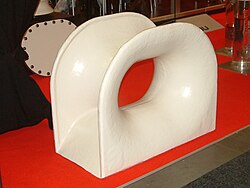
Hawsehole is a nautical term for a small hole in the hull of a ship through which hawsers may be passed.[1] It is also known as a cat hole.[2] In the (British) Royal Navy, a man who had risen from the lowest grade to officer was said to have "come in at the hawsehole".[3]
See also
[edit]References
[edit]- ^ "The Visual Dictionary, "Passenger Liner"". Archived from the original on 2016-06-16. Retrieved 2007-10-18.
- ^ "Cathole at dictionary.com".
- ^ E. Cobham Brewer (1894). Dictionary of Phrase and Fable. p. 1351.
Hawsehole
View on Grokipediafrom Grokipedia
A hawsehole is a hole in the bow or stem of a nautical vessel through which an anchor cable or chain passes.[1] These openings, typically two in number and located in the upper forward section of the hull, facilitate the deployment and retrieval of anchors while protecting the ship's structure.[2] The term originated in the mid-17th century and remains a standard feature in maritime design.[3]
In functional terms, hawseholes direct the anchor chain from the bow down through the deck to the chain locker below, minimizing friction and damage to the hull during anchoring operations.[4] They are often reinforced with a hawse pipe, a protective metal tube inserted into the hole to guide the chain smoothly and prevent abrasion against the wooden or steel hull.[5] Additional components, such as bolster plates adjacent to the hawsehole, further guard against chafing of the cable or hawser on the bow's cheek.[6] Historically, the design has evolved alongside anchoring technology; for instance, in 1785, Benjamin Franklin proposed fitting large pulley wheels into hawse-holes to aid vessels navigating the Gulf Stream by reducing drag on lines.[7] Today, hawseholes continue to be essential for safe mooring.
Definition and Terminology
Definition
A hawsehole is a reinforced, typically cylindrical opening in the bow, or forward hull, of a ship through which anchor cables, chains, or hawsers—thick mooring ropes—are passed to connect to anchors or other vessels.[8][9] This feature is essential for maritime operations, allowing the secure passage of heavy lines directly from the ship's interior to the exterior.[10] The primary purpose of a hawsehole is to enable the efficient deployment, retrieval, and securing of anchors, while safeguarding the hull against chafing or structural damage from the friction and tension of moving ropes or chains.[8][11] By providing a dedicated pathway, it ensures that anchoring maneuvers can be performed without compromising the vessel's integrity during dynamic sea conditions.[2] In distinction from similar deck-level features such as chocks or fairleads, hawseholes are fully integrated into the hull structure and positioned in the upper forward section of the hull, typically above the waterline, to allow direct, unobstructed handling of anchors from the bow area.[10][8] Hawseholes feature rounded edges to minimize wear on the passing lines. Often, a hawsepipe serves as a protective metal lining fitted within the hawsehole to further enhance durability.[8]Etymology and Related Terms
The term "hawsehole" derives from "hawse," a Middle English word denoting the space forward of a ship's bow between the anchors or the hawseholes themselves, ultimately tracing back to Old Norse hals, meaning "neck" or "forepart," evoking the ship's prow as an extension akin to a neck.[12][13] This nautical sense of "hawse" emerged in the late 15th century, with "hawsehole" itself forming as a compound by adding "hole" to describe the aperture.[9] The earliest recorded use of "hawsehole" in English appears in nautical texts around 1655–1665, reflecting its establishment in maritime lexicon during the Age of Sail.[1] Related terminology includes "cat hole," an archaic synonym particularly for smaller hawseholes associated with catheads, the projecting timbers used to support and raise anchors on traditional sailing vessels.[14] In contrast, "hawsepipe" refers specifically to the protective tubular fitting, often made of iron or steel, that lines the hawsehole to guide the anchor cable and prevent hull damage, distinguishing it from the hole proper.[8] Another term, "hawsepiper," is a metaphorical expression unrelated to the physical feature; it describes a mariner who advances from deckhand to officer through practical experience rather than formal academy training, metaphorically "climbing up the hawsepipe."[15] In non-English languages, equivalents persist, such as the French écubier, denoting the bow hole for anchor cables, highlighting shared Indo-European roots in nautical design across European traditions.[16]Historical Development
Origins in Sailing Ships
The hawsehole emerged in European naval architecture during the mid-17th century, aligning with innovations in anchor management amid the expanding Age of Sail, when larger fleets demanded more efficient mooring systems. Archaeological evidence from wrecks, such as the Edesö vessel in Sweden's Stockholm archipelago—dated to the latter half of the 17th century—reveals hawseholes as integral bow features, with two per side measuring 0.45–0.5 meters wide, positioned on hawse-pieces flanking the stem to guide anchor cables toward the windlass.[17] Similar designs appear in contemporary Dutch and English shipbuilding records, reflecting standardized practices in Northern European fleets by the 1660s for handling increased maritime trade and warfare.[8] Precursor holes for anchor cables are evident in 16th-century ship designs, such as replicas of Christopher Columbus's vessels.[18] In wooden sailing vessels like frigates and brigs, hawseholes consisted of simple bored cylindrical openings through the hull's outer planking, vertical oak frames, and inner planking, typically reinforced with oak timbers segmented in a "barrel stave" pattern to distribute stress and prevent splitting.[8] These apertures accommodated hemp anchor cables in early applications, though transitional use of iron chains began appearing by the late 18th century; linings of lead or copper, about 1–1.5 inches thick, were sometimes added to reduce friction and corrosion.[8] The term "hawse" derives from Old Norse háls ("neck"), referring to the ship's bow region where these holes were located, emphasizing their position forward of the stem.[12] During the Napoleonic Wars (1799–1815), robust hawseholes proved essential for rapid anchoring in prolonged blockades, enabling British fleets to maintain positions off enemy coasts despite adverse weather and enemy maneuvers.[8] Exemplified by HMS Victory (launched 1765), a first-rate ship of the line, the design featured paired hawseholes dedicated to the starboard and port bower anchors—the primary mooring anchors—allowing efficient deployment of heavy hemp cables of approximately 24 inches (61 cm) in circumference.[19] Early hawseholes faced significant challenges from constant seawater exposure, which accelerated wood rot in the surrounding oak timbers and planking, compromising hull integrity over voyages.[8] To mitigate ingress when not in use, crews inserted hawse bags—canvas sacks stuffed with tarred oakum fibers—or wooden plugs, providing temporary seals against spray and waves; failures during storms, as noted in 1815 logs, often required on-the-spot repairs with additional tarred canvas patches to staunch leaks and prevent further decay.[8]Evolution with Modern Shipbuilding
The transition to ironclad warships in the steam era during the 1860s marked a significant shift in hawsehole design, with the introduction of hawsepipes fitted within traditional hawseholes to provide robust protection for iron anchor chains against hull abrasion and seawater ingress.[8] Cast iron hawsepipes replaced softer lead or copper linings used in wooden ships, accommodating the heavier chain cables that became standard by the mid-19th century.[8] Concurrently, the evolution of mechanized windlasses—incorporating ratchets, gears, and sprockets—streamlined anchor handling, substantially reducing the manual labor required for heaving cables through hawseholes and enabling smaller crews on larger steam-powered vessels.[20] In the 20th century, advancements in steel-hulled vessels, such as the mass-produced Liberty ships during World War II, integrated hawseholes with more efficient anchor systems, featuring cast steel hawsepipes and welded chain pipes that connected directly from the windlass bedplate to the chain locker for smoother chain deployment.[21] These designs supported electric- or steam-driven windlasses, enhancing operational reliability under wartime conditions. Classification societies like Lloyd's Register played a key role in standardizing hawsehole dimensions and related equipment, basing requirements on vessel tonnage via an Equipment Number formula that scales anchor mass, chain diameter, and pipe sizing to displacement and hull proportions.[22] Contemporary shipbuilding has further refined hawseholes for large-scale vessels like supertankers and naval ships built after 2000, incorporating advanced anti-corrosion coatings on hawsepipes and surrounding structures to mitigate galvanic degradation in harsh marine environments. Protective covers, often weather-tight and designed for quick deployment, shield hawseholes from spray and debris when not in use, aligning with modern safety standards. In offshore rigs employing dynamic positioning, hawseholes are adapted for hybrid use, supporting occasional anchor deployment as a backup to thruster-based station-keeping, with reinforced designs to handle intermittent high loads without compromising primary DP operations.[23] A pivotal innovation in the early 20th century was the widespread adoption of roller fairleads within hawseholes, which guide anchor chains with minimal friction, significantly reducing wear on both cables and hull fittings during high-seas conditions.[22] These rollers, with diameters at least eleven times the chain size, prevent link bending stresses and chafing, extending equipment lifespan in demanding industrial applications.[22]Design and Construction
Structural Features
Hawseholes are positioned symmetrically on each side of the stem post at the bow of a ship, providing a protected passage for the anchor chain to exit the hull.[8] This placement ensures the chain leads directly from the chain locker through the bow structure without interfering with the ship's forward motion or structural integrity. The holes are often angled slightly downward, with a maximum of 15 degrees relative to the horizontal, to facilitate smooth anchor deployment and retrieval by aligning with the natural drop path of the chain.[24] The inner diameter of a hawsehole is designed to closely match the size of the anchor chain, typically ranging from 2 to 4 inches for merchant vessels to allow free passage while minimizing wear.[25] To maintain hull strength, hawseholes incorporate internal reinforcement elements such as flanges or bolsters that distribute loads and prevent deformation under chain tension.[26] These features often include doubler plates or lips around the opening to reinforce the surrounding shell plating and deck. Additionally, hawseholes integrate with the chain locker below decks via connecting spurling pipes, enabling efficient storage and management of the anchor cable within the vessel's forward compartment.[27] Protective adaptations in hawsehole design include rounded or chamfered edges to reduce friction and wear on the chain during operation. Optional watertight caps or plugs, known as hawse bags, can be fitted to seal the opening against water ingress when not in use, preserving the dryness of the chain locker.[8] Variations in hawsehole design occur based on ship type, with larger diameters and robust reinforcements in cargo vessels to accommodate heavy mooring chains, compared to smaller, more compact versions in yachts suited for lighter anchor systems.[28] These structural traits have evolved to support modern anchoring systems, enhancing reliability across diverse maritime applications.[26]Materials and Manufacturing
In historical sailing ships of the 18th century, hawseholes were typically constructed from durable hardwoods such as oak, which formed the primary structural material for the hull planking and frames through which the openings were cut.[8] These wooden hawseholes were often lined with materials like heavy-gauge copper or lead, typically 1 to 1.5 inches thick, to provide abrasion resistance against the friction caused by passing anchor cables.[8] Teak, prized for its resistance to rot and insects, was also employed in some naval vessels, particularly in British shipbuilding, where it supplemented oak in bow structures.[29] By the 19th century, the transition to metal components marked a significant evolution, with wrought and cast iron pipes being fitted into wooden hawseholes to accommodate the shift from hemp cables to chain anchors, enhancing durability and reducing wear.[8] This change began around the 1810s in naval fleets, such as the Royal Navy's adoption of chain cables in 1817, and became standard by the mid-century, as seen in refits like that of the USS Constitution in the 1840s and 1870s.[8] In modern shipbuilding, hawseholes and associated hawsepipes are primarily made from cast or forged steel, such as carbon steel conforming to ASTM A216 Grade WCB, valued for its high-temperature strength and resistance to deformation in corrosive saltwater environments.[30] For naval applications requiring stealth, non-magnetic bronze alloys, particularly aluminum bronze, are preferred due to their low magnetic permeability, which minimizes detectability by magnetic sensors.[31] Stainless steel grades like 316 are also common for their superior corrosion resistance in marine settings.[32] Manufacturing processes for contemporary hawseholes involve precision techniques adapted to shipyard environments, including boring and cutting the hull openings followed by welding of steel components for seamless integration.[33] Post-1950s advancements introduced CNC machining for accurate shaping and fitting of hawsepipes, ensuring tight tolerances in complex bow geometries.[33] To combat corrosion, surfaces are treated with galvanizing or epoxy coatings, which can extend component lifespan to over 20 years in harsh marine conditions by forming protective barriers against saltwater exposure.[34] For offshore applications, such as floating structures, quality standards for hawseholes emphasize compliance with ISO 19901-7, which governs stationkeeping systems and requires components to withstand mooring loads without deformation.[35] For ship applications, classification societies such as the American Bureau of Shipping (ABS) and Det Norske Veritas (DNV) provide rules for hawsehole design, ensuring compliance with structural and load requirements.[36]Function and Usage
Role in Anchoring
The hawsehole plays a central role in the anchor deployment process by serving as the conduit through which the anchor chain is fed from the ship's chain locker to the seabed. During deployment, the windlass, positioned on the foredeck, controls the payout of the chain, which originates in the chain locker below decks and passes through the hawse pipe connected to the hawsehole, ensuring a smooth and regulated descent of the anchor. This mechanism allows for precise control, accommodating water depths up to 12 shackles (180 fathoms, approximately 330 meters), a standard capability for many merchant vessels to reach secure holding grounds without excessive slack or tension.[37] In retrieval operations, the hawsehole facilitates the reverse process, where the windlass hauls the chain back aboard, guided by a fairlead such as a bow roller to maintain alignment and prevent jamming or binding within the pipe. Integration with capstans provides additional mechanical advantage for managing tension, particularly when the anchor is embedded in heavy seabeds, allowing the chain to be drawn steadily through the hawsehole without lateral forces that could damage the hull plating. This coordinated system ensures efficient recovery, with typical chain hauling speeds of at least 9 meters per minute under load.[38] Safety is paramount in the hawsehole's function, as its reinforced structure prevents chain whipping—sudden lateral movements that could occur if the chain parts or shifts under load—and mitigates risks of hull breach during stormy conditions by containing and directing the chain's path. For instance, in the deployment of RMS Titanic's center bow anchor in 1912, the alignment of the center hawse pipe was critical for safely lowering the 15.625-ton anchor without compromising the ship's forward shell plating, demonstrating the component's role in emergency or precise anchoring maneuvers. The system supports overall holding power sufficient for winds up to Beaufort scale 8 (gale-force, 34-40 knots), where controlled chain passage helps maintain anchor stability against wave-induced forces. The rounded lips of the hawsehole further aid smooth chain transit, reducing friction during these high-stress scenarios.[39][40][41]Applications in Mooring and Towing
In mooring operations, hawser ropes are passed through the hawsehole to secure vessels to bollards on piers, providing a reinforced pathway for lines that ensures controlled tension and minimizes chafe on the hull. This configuration is particularly effective for stable berthing in harbors experiencing significant tidal variations, such as those up to 15 meters in regions like the Bristol Channel, where the hawsehole allows lines to adjust dynamically to water level changes without compromising structural integrity. According to recommendations from Puertos del Estado, such setups account for astronomical and meteorological tides in mooring design, optimizing vessel stability during ebb and flood cycles.[42] For towing functions, towlines are routed through the hawsehole in salvage or convoy scenarios to apply forward pull, often with the anchor chain suspended or secured to avoid interference. The U.S. Navy Towing Manual specifies that towing via the hawse pipe requires inspection of the pipe's lip to prevent damage from chain abrasion, highlighting its role in emergency operations where rapid connection is essential. In auxiliary roles, the hawsehole secures bow lines in multi-point moorings, distributing loads across fore and aft attachments for enhanced vessel control in confined waters; for instance, in Mediterranean-style berthing, wide-angled bow lines exit via the hawsehole to jetty bollards.[43] Adaptations in icebreakers feature reinforced hawseholes to withstand polar towing demands, where the bow opening facilitates secure line handling amid ice pressures and extreme conditions. The Woods Hole Oceanographic Institution's documentation of the icebreaker Oden illustrates hawseholes integrated into the reinforced bow structure for deploying towlines during Arctic expeditions. Modern integrations pair hawseholes with automated winches for efficient mooring in container ports, where hydraulic or electric systems reel hawsers through the opening to bollards, reducing manual labor and turnaround times. Load limits for hawseholes are aligned with safe working loads for mooring fittings as per IMO guidelines, ensuring they handle peak environmental forces without failure.[44][45][46]References
- https://en.wiktionary.org/wiki/hawse
- https://en.wiktionary.org/wiki/hawsehole