Hubbry Logo
Hebrews 11Hebrews 11Main
Open search
Hebrews 11
Community hub
Hebrews 11
logo
8 pages, 0 posts
0 subscribers
Be the first to start a discussion here.
Hebrews 11
Hebrews 11
from Wikipedia
Hebrews 11
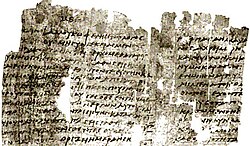
Epistle to the Hebrews 2:14–5:5; 10:8–22; 10:29–11:13; 11:28–12:17 in Papyrus 13 (AD. 225–250).
BookEpistle to the Hebrews
CategoryGeneral epistles
Christian Bible partNew Testament
Order in the Christian part19

Hebrews 11 is the eleventh chapter of the Epistle to the Hebrews in the New Testament of the Christian Bible. The author is anonymous, although the internal reference to "our brother Timothy" (Hebrews 13:23) causes a traditional attribution to Paul, but this attribution has been disputed since the second century and there is no decisive evidence for the authorship.[1][2] This chapter contains the exposition about the examples of faith's effective expression.[3][4]

Text

[edit]

The original text was written in Koine Greek. This chapter is divided into 40 verses.

Textual witnesses

[edit]

Some early manuscripts containing the text of this chapter are:

Old Testament references

[edit]

New Testament references

[edit]

Introductory Remarks of Faith (11:1–3)

[edit]

The chapter opens with three allusive verses to describe the complexity of faith.[7]

Verse 1

[edit]

Now faith is the substance of things hoped for, the evidence of things not seen.[8]

Formal definition of faith is in the style of Plato's definition of medicine (Symp. 186c) or Plutarch's definition of curiosity (On Curiosity, 6.518c).[7]

Verse 2

[edit]

For by it the elders obtained a good testimony.[9]

The accounts of exemplary people were often used to motivate people, either to imitate noble attitudes or to avoid the pattern of ignoble behaviors, such as Ben Sira (teacher of wisdom form Jerusalem in 2nd century BC) uses a long hymn to praise notable Jewish ancestors (Sirach 44–51), or the author of 4 Macabee in 4 Macabee 16:16-23, and Seneca with similar list as in Hebrews 11 (Ben. 3.36.2–3.38.2; 5.16.1–5.17–3).[10]

Verse 3

[edit]

By faith we understand that the worlds were framed by the word of God, so that the things which are seen were not made of things which are visible.[11]

The list of examples starts appropriately with the creation, indicating that "faith" produces "understanding".[7] The first manifestation of "trust" is connected to how a person of "faith" understands the visible creation as 'strictly secondary' to "things unseen".[10]

The Primordial Heroes (11:4–7)

[edit]

The first character, Abel, performed an 'acceptable sacrifice' (Genesis 4:4), and died as a martyr (Genesis 4:8).[7] Abel's choice of superior quality of offering compared to Cain's second rate one (Philo, Sacr. AC 52, 57, 88) is related to the presence of "faith", which attests Abel to be "righteous" or "just" (Matthew 23:35; 1 John 3:12; Josephus, Antiq. 1.2.1 §53).[12] Enoch 'pleased God' (Genesis 5:21–24 LXX version; Masoretic text: 'walked with God'[13]) and 'translated to heaven' according to Jewish tradition (such as Sirach 44:16; Philo, Mutat. 38; Josephus, Antiq. 1.85; 1 Enoch; 2 Enoch; 3 Enoch),[7] indicating that having faith in God leads to the transcendence of death (cf. verses 4-6, 11-12, 17-19, 35).[13] Noah believed in the 'unseen' event of divine judgment, and 'condemned' the world that didn't believe his preaching of repentance.[14] The LXX version of Genesis 6:9 introduces Noah both as "righteous" and "pleasing to God", thus connects naturally with "righteous" Abel and Enoch, who "pleased God".[13]

Verse 6

[edit]
But without faith it is impossible to please Him, for he who comes to God must believe that He is, and that He is a rewarder of those who diligently seek Him.[15]

This is one of the four things to be 'impossible' according to this epistle (Hebrews 6:4; 6:18; 10:4; 11:6).[16]

  • "Must believe that He is": The Arabic version renders "He is" as "He exists".[17]

The Faith of the Patriarchs (11:8–22)

[edit]

Abraham is a foremost example of faith in Jewish and early Christian literature (cf. Sirach 44:19–21; 1 Maccabee 2:52; 4 Maccabee 16:20; Wisdom 10:5; Acts 7:2–8; Romans 4; Galatians 3:6–9).[14] Sarah's faith is related to the conception and birth of Isaac (Genesis 17:15–18:15; 21:1–7), Isaac's to the blessings on Jacob and Esau (Genesis 27:27–40), Jacob's to the blessings on Ephraim and Manasseh (Genesis 48:8–22), and Joseph's to the prophecy concerning the transfer of his bones (Genesis 50:24–25) to hint a hope for the future of the family.[14]

The Faith of Moses (11:23–28)

[edit]

Moses is known as a faithful servant of God in both Jewish and Christian writings (cf. Sirach 45:1–5; Philo, Vit. Mos. 1:10–11; Josephus Antiq. 2.218; Acts 7:20–34; Hebrews 3:1–6).[14]

The Faith of Prophets and Martyrs (11:29–40)

[edit]

A group of biblical characters is listed with shorter recounts.[18]

Verse 35

[edit]

Women received their dead by resurrection. Others were tortured, refusing to accept release, in order to obtain a better resurrection.[19]

There is hope of eternal life after torture in this world.[21]

See also

[edit]
  • Related Bible parts: Genesis 4, Genesis 5, Genesis 6, Genesis 12, Genesis 21, Genesis 22, Genesis 27, Genesis 50, Exodus 2, Exodus 13, Exodus 14, Joshua 2, Joshua 6, Joshua 24, Judges 4, Judges 6, Judges 11, Judges 13, 1 Samuel 1, 1 Samuel 3, 1 Samuel 17, Daniel 6, Matthew 1, Hebrews 1, James 2, 2 Peter 3
  • References

    [edit]

    Bibliography

    [edit]
    [edit]
    Revisions and contributorsEdit on WikipediaRead on Wikipedia
    from Grokipedia
    Hebrews 11 is the eleventh chapter of the , a book in the that functions as a emphasizing the superiority of Christ and the . Often called the "Hall of Faith" or "Faith Chapter," it provides a foundational definition of and catalogs numerous figures who exemplified it through obedience and endurance, serving as an exhortation for believers to persevere amid trials. The chapter begins by defining faith as "confidence in what we hope for and assurance about what we do not see" (Hebrews 11:1, NIV), portraying it as a firm trust in God's unseen promises that undergirds righteous living and divine approval. This definition, the most explicit in the , frames faith not merely as intellectual assent but as a dynamic conviction that pleases God and enables understanding of creation through His word (Hebrews 11:3). Following this overture, Hebrews 11 recounts the faith of key biblical heroes in a structured progression: from early patriarchs like Abel, who offered a superior sacrifice; , who walked with God; and , who built the ark in obedience (Hebrews 11:4–7, NIV), to Abraham and , who trusted God's promise of descendants despite barrenness and advanced age (Hebrews 11:8–12, NIV). The narrative continues with , , , and , highlighting acts such as Moses' choice to identify with God's afflicted people over Egyptian luxury and his leadership in (Hebrews 11:20–29, NIV). It culminates in Rahab's welcoming of Israelite spies and a summary of later figures like , , , and unnamed prophets who conquered kingdoms, endured persecution, and faced martyrdom, yet did not receive the full promises in their lifetimes (Hebrews 11:30–40, NIV). Theologically, Hebrews 11 underscores faith's essential role in relating to , as "without faith it is impossible to please , because anyone who comes to him must believe that he exists and that he rewards those who earnestly seek him" (Hebrews 11:6, NIV). These exemplars, commended by for their , anticipated a heavenly and better , pointing forward to completion in Christ and the . In the broader context of the , written likely in the late first century CE to a community tempted by , the chapter motivates endurance by linking to Christian hope, demonstrating that true overcomes visible hardships through invisible realities.

    Introduction

    Overview and Structure

    Hebrews 11, often referred to as the "Hall of Faith," presents a catalog of figures whose lives exemplify faithful obedience to , serving to inspire early Christian readers enduring and temptation to abandon their . The chapter enumerates heroes from Abel to the prophets, highlighting how their trust in divine promises enabled perseverance despite trials, thereby encouraging believers to hold fast to their in Christ. The structure of Hebrews 11 divides into two main parts: verses 1–3 form a definitional that establishes as the assurance of hoped-for realities and of unseen truths, while verses 4–40 comprise an extensive catalog of faith exemplars spanning from the period (e.g., Abel, , ) through the patriarchal era, exodus narratives, judges, kings, and up to intertestamental martyrs. This organization functions as a historical summary and example series, drawing on Jewish literary traditions to build rhetorical momentum toward the chapter's conclusion in verses 39–40, which ties the ancient witnesses to the readers' own pursuit of eschatological alongside Christ. Within the broader Epistle to the Hebrews, addressed to Jewish Christians facing social ostracism and potential imperial pressure, chapter 11 serves an exhortatory purpose by linking faith to endurance of unseen spiritual realities and the anticipation of a heavenly inheritance that surpasses earthly afflictions. Stylistically, the chapter employs a repetitive formula—"by faith" (Greek pistei)—which appears 24 times to introduce each exemplar, creating a rhythmic litany that underscores faith's active role in obedience and commendation by God. This device, alongside the chapter's approximately 600 words in many English translations, reinforces its homiletic tone as a call to emulate the ancients' trust amid adversity.

    Theological Themes

    Hebrews 11 centers on as its defining theological theme, portraying it eschatologically as a confident trust in God's promises that transcends and anticipates future fulfillment. This is described as "the assurance of things hoped for, the conviction of ," enabling believers to perceive divine realities beyond the visible world. In this framework, orients the believer toward an unseen heavenly homeland, embodying in God's redemptive plan that culminates in eternal inheritance. Such eschatological trust underscores the chapter's emphasis on living by divine assurance rather than temporal certainties, as exemplified briefly in figures like Abraham who acted on promises of descendants and land without full realization. A key motif in the chapter is divine commendation of the faithful, where testifies to the elders' through their unwavering trust, highlighting a pattern of approval for those who persevere in . This commendation ties directly to the of 's , which the ancients received not in immediate possession but as a forward-looking assurance under the old covenant. The chapter emphasizes continuity between the old and new covenants by presenting the faithful of old as whose partial experiences of point to fuller realization in Christ, maintaining the shared covenantal formula of as "their God" while advancing toward eternal redemption. Through this lens, becomes a spiritual legacy, bridging covenantal eras and affirming 's across generations. In the broader argument of Hebrews, chapter 11 contrasts the incomplete faithfulness of the old covenant era—marked by obedience amid unfulfilled promises—with the superior fulfillment achieved through Christ's high priestly mediation and sacrifice. This juxtaposition serves to exhort readers to endure, avoiding regression to obsolete shadows by embracing the new covenant's better promises. Faith here is not abstract but dynamically intertwined with works, obedience, and suffering, as genuine belief manifests in active responses such as sacrifices, migrations, and endurance of persecution, demonstrating that true faith produces perseverance and aligns with God's will. These elements collectively reveal faith as the means to divine approval and covenantal completion, urging believers to mirror the ancients' obedient trust in the face of trials.

    Textual Foundations

    Manuscript Witnesses

    The primary manuscript witness for Hebrews 11 among the papyri is (P⁴⁶), dated to the early third century CE and part of the collection. This codex contains the , including the complete text of Hebrews chapters 1–13, with Hebrews positioned after Romans and before 1 Corinthians. P⁴⁶ preserves Hebrews 11 without significant lacunae, though it exhibits minor textual variants, such as in verse 11 where the subject of faith (Sarah or Abraham) is debated translationally, but includes "barren" (στεῖραν), aligning with the majority text. Among the major uncial manuscripts, (ℵ, fourth century CE) includes the full text of Hebrews 11 as part of its complete , showing close alignment with the Alexandrian textual tradition and supporting readings like " testifying to his gifts" in verse 4. Similarly, (B, fourth century CE) attests to the entire chapter without gaps, providing a high-fidelity witness to the Greek text, including the standard phrasing in verses 1–3. (A, fifth century CE) also contains Hebrews 11 intact, though the manuscript has lacunae elsewhere in the ; it features a minor variant in verse 4 ("testifying to his gifts, " instead of " testifying to his gifts"). Early translations further attest to the transmission of Hebrews 11, demonstrating overall fidelity to original. The Syriac Peshitta, completed in the fifth century CE, renders the chapter closely, preserving key terms like the "assurance" (hypostasis) of in verse 1 while adapting for Syriac idiom. Jerome's Latin , produced in the late fourth century CE from Greek exemplars, maintains the structure and content of Hebrews 11 with minimal deviation, translating verse 1 as "substantia rerum sperandarum" to convey the foundational sense of . Coptic versions, emerging from the third to fourth centuries CE in dialects like Sahidic and Bohairic, exhibit strong adherence to , including the full roster of exemplars in verses 4–40, though with occasional idiomatic adjustments for Egyptian usage. Notable textual variants in Hebrews 11 are minor and primarily involve word order, omissions, or substitutions without affecting core doctrinal elements, such as the definition of faith. For instance, in verse 1, the reading "hypostasis of things hoped for" is uniform across P⁴⁶, ℵ, B, and A, with no significant word order differences impacting meaning. In verse 4, a word order transposition appears between "God testifying to his gifts" (supported by P⁴⁶ and the majority text) and a reversed order in ℵ* and A, without altering the meaning. Verse 11 shows variation primarily in translation regarding the subject ("by faith even barren Sarah herself" or emphasizing Abraham), with early witnesses like P⁴⁶, ℵ, A including "barren." Verse 37 includes an omission of "they were tempted" in P⁴⁶ compared to the fuller reading in A and the majority text. These differences, often classified as orthographic or stylistic, do not alter theological interpretations of faith's role.

    Scriptural Allusions and Quotations

    Hebrews 11 is replete with allusions and quotations from the , drawing primarily from Genesis, Exodus, , Judges, 1-2 , and Kings to illustrate exemplars of faith. These references serve as typological precedents, linking ancient narratives to the fulfillment in Christ. For instance, the account of Abel's sacrifice in verse 4 alludes to Genesis 4:3-8, emphasizing his offering's acceptance by rather than its details. Similarly, Noah's construction of the ark in verse 7 references Genesis 6:13-22, portraying his obedience as a model of reverent . Abraham's journey and promise in verses 8-10 draw from Genesis 12:1-9 and 15:5-7, while the in verses 17-19 echoes Genesis 22:1-18, highlighting . Sarah's conception in verse 11 alludes to Genesis 18:11-14 and 21:1-2, underscoring barrenness overcome by . Isaac's blessing in verse 20 refers to Genesis 27:27-40, in verse 21 to Genesis 48:1-22, and Joseph's prophecy in verse 22 to Genesis 50:24-25. ' parents in verse 23 allude to Exodus 2:1-10, his refusal of Egyptian privileges in verses 24-26 to Exodus 2:10-15, his exodus leadership in verse 27 to Exodus 10:28-11:10 and 12:31-42, the in verse 28 to Exodus 12:21-30, and the Red Sea crossing in verse 29 to Exodus 14:21-31. The fall of in verse 30 references 6:12-21, and Rahab's hospitality in verse 31 to 2:1-21 and 6:22-25. The rapid enumeration in verses 32-38 summarizes figures like (Judges 6-8), (Judges 4-5), (Judges 13-16), (Judges 11-12), (1 16-17; 2 ), (1 7; 12), and unnamed prophets, alluding to events in 1-2 Kings and Daniel such as conquering kingdoms (2 5:6-10), stopping lions' mouths (Daniel 6:16-23), and quenching fire (Daniel 3:19-28). While Hebrews 11 centers on precedents, it contains subtle echoes of themes, particularly ' teachings on and the exhortations in Hebrews 12. The chapter's portrayal of faith moving mountains implicitly parallels ' mustard seed analogy in Matthew 17:20, where faith as small as a can relocate obstacles, though this connection is thematic rather than direct quotation. More prominently, the endurance of faithful in verse 35 anticipates the disciplinary suffering in Hebrews 12:1-11, mirroring ' own perseverance as described in 12:2-3. These links position chapter 11 as a bridge to Christ-centered . The author employs a non-verbatim allusive technique, compressing and reinterpreting narratives to prioritize faith's evidentiary role over chronological or historical precision. For example, Abraham's multifaceted life in Genesis is telescoped into verses 8-19, blending his call, sojourn, and sacrifice to underscore unwavering trust in God's promises. This midrashic style, common in Jewish interpretive traditions, adapts sources typologically to affirm the superiority of the . Scholars identify over 20 such allusions in the chapter, which collectively validate faith's efficacy by demonstrating its fulfillment in Christ's redemptive work.

    Definition of Faith

    Verses 1–2: Faith as Substance and Evidence

    Hebrews 11:1 presents a foundational definition of in the : "Now is the hypostasis of things hoped for, the elenchos of things not seen" (NA28). This verse articulates faith's dual role in bridging the present with eschatological hopes and affirming realities beyond sensory perception. The structure employs a verbless with estin de ("now is"), emphasizing faith's essential nature as an active rather than mere . The term hypostasis, appearing five times in the New Testament including here, conveys "assurance" or "substance," functioning as a title deed that guarantees ownership of promised realities. In extrabiblical papyri, hypostasis denoted a legal document securing claims, underscoring faith's objective foundation in God's covenants and its subjective provision of confident expectation amid uncertainty. This nuance aligns with its usage in Hebrews 1:3, where it describes the "exact representation" of God's being, implying a tangible undergirding for invisible hopes. Complementing this, elenchos signifies "conviction" or "proof," portraying faith as irrefutable of unseen truths, much like a verdict establishing guilt or innocence without direct sight (cf. John 8:9). In the forensic context of , which frequently evokes themes of and (e.g., Heb. 4:12–13; 12:23), elenchos highlights faith's persuasive power, transforming abstract divine promises into personal certainty. Scholars note that this term evokes a process of validation through God's , not empirical data, enabling believers to affirm transcendent realities. Verse 2 extends this historically: "For by it the elders were commended" (NA28), linking the abstract concept to concrete validation in the lives of ancient figures. The presbyteroi (elders or ancestors) received divine (emartyrēthēsan) precisely through this , as evidenced in the ensuing exemplars, demonstrating how hypostasis and elenchos yielded approval from despite earthly trials. Thus, verses 1–2 establish faith as the substantive assurance and evidential conviction that underpins the chapter's gallery of heroes, contrasting visible afflictions with the enduring reality of unseen divine promises. This framework not only defines faith theologically but also prepares readers for its outworking in obedience and perseverance.

    Verse 3: Creation by the Word

    By faith we understand that the universe was formed at God's command, so that what is seen was not made out of what was visible (Hebrews 11:3, NIV). This verse presents the first exemplification of faith in the chapter, emphasizing intellectual assent to God's creative act as foundational. The Greek phrase rhema tou theou ("word of God") denotes the divine utterance as the instrument of creation, directly alluding to the repeated imperatives in Genesis 1, such as "Let there be light" (Genesis 1:3), where God's speech brings order from formlessness. Theologically, Hebrews 11:3 underscores faith's role in perceiving divine agency in origins, affirming creation ex nihilo—that the visible arose not from preexisting material but from God's sovereign word alone. This counters empirical approaches limited to observable processes, positioning faith as the means to grasp transcendent realities beyond sensory evidence, much like the "evidence of things not seen" outlined in verses 1–2. Such understanding elevates God's power over naturalistic explanations, establishing the created order as a testament to invisible divine initiative (cf. Romans 1:20). Addressed to Jewish-Christian readers facing pressures to revert to traditional practices, the verse reinforces the biblical , urging them to regard the as an object of rooted in Yahweh's creative rather than pagan cosmologies involving eternal matter or cyclical emanations from lesser deities. By linking creation to the God of Israel, it bridges heritage with Christian conviction, fostering resilience amid cultural tensions. The motif of commendation introduced in verse 2, where the presbuteroi ("elders") receive divine through , encompasses ancient scriptural figures and extends to apostolic witnesses, inviting contemporary believers to emulate this approval by similarly comprehending creation's divine source. This inclusive commendation motivates the audience to live out 's cosmic insight in their historical context.

    Exemplars of Faith from Genesis

    Verses 4–5: Abel and Enoch

    Hebrews 11:4 begins the list of faith exemplars by referencing Abel, the second son of , whose offering to God is described as superior to that of his brother . According to Genesis 4:4, Abel brought "the of his flock and of their fat portions," which the respected, while Cain's offering of the fruit of the ground was not regarded. The author of Hebrews attributes this distinction not to the inherent quality or type of the sacrifice—such as animal versus vegetable—but to Abel's faith, which underlay his act of worship. Through this faith-motivated offering, Abel was commended as righteous, with God testifying to his uprightness by accepting the gifts. This commendation highlights faith as the essential element that renders worship acceptable to , contrasting Abel's heartfelt devotion with Cain's apparent lack thereof. Furthermore, the verse notes that "through , though he died, he still speaks," indicating that Abel's example continues to testify to the power of across generations, as his story inspires believers to offer sacrifices grounded in trust rather than mere ritual. This enduring testimony echoes Genesis 4:10, where Abel's shed blood "cries out" from the ground, and foreshadows 12:24, which contrasts Abel's righteous but avenging blood with the superior that speaks a better word of redemption and . Turning to verse 5, the author shifts to , the great-grandfather of , who "walked with God" for 300 years after fathering , as recorded in Genesis 5:22–24. By faith, was taken up (Greek: metetethē, from methistēmi, implying a or removal) so that he did not experience death, and "he was not found, because God had taken him up." This divine represents a miraculous exemption from mortality's curse, transforming instantaneously from a mortal state to an immortal one in God's presence, akin to Elijah's later ascent but unique as the first such event. The text affirms that before this event, "had this testimony, that he pleased God," underscoring his intimate, faithful communion with the divine as the basis for this reward. Both Abel and Enoch, as pre-Flood figures from the early chapters of Genesis, exemplify 's endurance in an increasingly corrupt world facing . Abel's faithful persisted in its despite his violent , while Enoch's walk of spared him from altogether, demonstrating that true sustains believers amid decay and anticipates 's ultimate vindication. This principle aligns with the subsequent verse 6, which states that without it is impossible to please , as Enoch's illustrates 's capacity to foster a relationship that delights the divine.

    Verses 6–7: Pleasing God and Noah's Ark

    Hebrews 11:6 establishes a foundational principle in the epistle, declaring that "without faith it is impossible to please ," underscoring faith as the essential prerequisite for any relationship or act of acceptable to the divine. This verse articulates that those who approach must believe two core truths: first, that He exists as the creator and sustainer, and second, that He actively rewards those who earnestly seek Him. As a general , this statement serves as the theological underpinning for the subsequent exemplars of in the chapter, emphasizing that divine approval hinges not on ritual or merit but on trust in 's revealed character. The requirements of this faith involve more than mere intellectual acknowledgment; they demand a heartfelt and obedient response, aligning with the pattern seen in Enoch's , where exemplified such pleasing faith. Scholars note that believing "is" refers to His real, personal existence beyond the visible world, while His role as a "rewarder" highlights His faithfulness to fulfill promises to diligent seekers, often in the face of adversity. This dual belief fosters perseverance, as the rewards may be eschatological or spiritual rather than immediate, encouraging believers to draw near with sincerity. Transitioning to a specific illustration, verse 7 applies this principle through Noah, who "by faith... being warned by God about events as yet unseen, in reverent fear prepared an ark for the salvation of his household; through which he condemned the world and became an heir of the righteousness that comes by faith." Drawing directly from Genesis 6–9, where God instructs Noah concerning the impending flood due to humanity's wickedness (Gen 6:5–13), Noah's response demonstrates faith as active obedience to divine revelation despite no empirical evidence of rain or deluge in his pre-flood world. Over approximately 120 years of construction (Gen 6:3), Noah's reverent fear—eulabeia in Greek, denoting pious caution rather than terror—propelled him to build the vessel that preserved his family and the animals, while his faithfulness implicitly judged the unbelieving world's corruption. As an heir of righteousness, Noah exemplifies justification by faith, not works, prefiguring the covenantal themes to follow. Exegetically, Noah's faith parallels the chapter's definition in verse 1, treating the "unseen" flood as assured reality through God's word, much like the trials faced by the epistle's original audience under persecution. This narrative bridges the primordial era's examples with later patriarchal faith by centering obedience as the outworking of trust, where building the ark symbolizes preparation for divine deliverance amid judgment. Thus, verses 6–7 reinforce faith's role in securing God's favor and righteousness, inviting readers to emulate such unwavering response to unseen promises.

    Patriarchal Faith

    Verses 8–19: Abraham's Journey and Sacrifice

    Hebrews 11:8-10 portrays Abraham's faith through his obedient response to God's call to leave his homeland. At age 75, Abraham departed from (having originated from of the Chaldeans), as recorded in Genesis 12:1-4, without knowing the destination, trusting in the promise of an inheritance. This act of obedience demonstrated his willingness to abandon a prosperous, settled life in a sophisticated urban center for an uncertain journey guided solely by divine direction. In , Abraham lived as a sojourner, dwelling in tents with his wife and later with and , who shared the same promise, owning no permanent property except a site purchased for . His nomadic existence underscored a oriented toward God's word rather than visible security, as he acknowledged himself an alien and stranger on earth. Abraham's hope extended beyond the earthly land, as he eagerly awaited the city with foundations, whose architect and builder is . This heavenly orientation reflected his trust in an eternal homeland, contrasting with temporary tents that symbolized transience. Scholars note that Abraham's life as a pilgrim exemplified 's forward-looking nature, prioritizing divine promise over immediate possession. Verses 11-12 shift focus to Sarah's role in the fulfillment of the promise of offspring, overcoming her barrenness through faith. Though past childbearing age at 90 and Abraham at 100 was "as good as dead" in terms of fertility, Sarah received strength to conceive , considering faithful to His word. This , detailed in Genesis 21:1-3, transformed her initial doubt—expressed by laughter in Genesis 18:12—into belief in 's power to do the impossible. The result was a lineage as numerous as the stars of heaven and the sand on the seashore, fulfilling the covenant promise from Genesis 15:5 and 22:17. Abraham's faith complemented this, as the conception highlighted 's creative authority over human limitations. In verses 13-16, the author reflects on Abraham, Sarah, and their heirs dying in without receiving the promises in full. They saw the assurances from afar and welcomed them, confessing themselves strangers and exiles on , unwilling to return to their former . This perspective revealed their desire for a better —a heavenly one—prompting to prepare a city for them, as He was not ashamed to be called their . Their endurance without earthly inheritance emphasized 's substance in unseen realities, modeling perseverance amid unfulfilled expectations. The pinnacle of Abraham's faith appears in verses 17-19, where he offered Isaac as a sacrifice when tested by God. Despite receiving the promises through Isaac, his only son, Abraham proceeded to Mount Moriah, binding and placing Isaac on the altar, as narrated in Genesis 22:1-14. He reasoned that God was able to raise the dead, ensuring the promise—"in Isaac your offspring shall be called" from Genesis 21:12—would endure. In this act, Abraham figuratively received Isaac back from death, prefiguring resurrection and demonstrating ultimate trust in God's power and fidelity. This trial refined his faith, positioning it as the summit of obedience in the patriarchal narrative.

    Verses 20–22: Isaac, Jacob, and Joseph

    In Hebrews 11:20–22, the author highlights the of , , and through their deathbed actions, which anticipated God's future promises to the patriarchs despite personal frailties and unfulfilled expectations. These verses build on the patriarchal narrative by emphasizing how transcends immediate circumstances, orienting the end of life toward the divine covenant's eventual realization. Verse 20 states, "By Isaac invoked future s on ," drawing from Genesis 27, where , though deceived by and Rebekah into the younger son first, ultimately pronounced s on both sons concerning their descendants' destinies. Despite his initial preference for and the ensuing family turmoil, 's act demonstrated in God's plan, as revealed earlier to Rebekah that "the older shall serve the younger" (Gen. 25:23), submitting to divine election over human intent. notes that this reflected 's reliance on the "Mighty One of ," trusting in God's promises for future generations even when circumstances appeared contradictory. In verse 21, "By faith Jacob, when dying, blessed each of the sons of and worshiped, leaning on the top of his staff," the text alludes to Genesis 48, where the aged and infirm adopts Ephraim and Manasseh as his own, deliberately crossing his hands to bless the younger Ephraim above the Manasseh, thus affirming their tribal status in Israel's future inheritance. This act, performed while worshiping in frailty (also echoed in Gen. 47:31), showcased 's matured faith, prioritizing God's covenant promises over cultural norms of and his own past deceptions. As John MacArthur observes, it marked 's progression from to humble trust in God's redemptive ordering of Israel's tribes. further interprets this as 's spiritual vision, transmitting covenant blessings to posterity despite exile in . Verse 22 declares, "By faith Joseph, at the end of his life, made mention of the exodus of the and gave directions concerning his bones," referencing Genesis 50:24–25, where , prosperous in , prophetically spoke of God's oath to Abraham (Gen. 15:13–16) and instructed that his remains be carried to the upon Israel's departure. This command, fulfilled centuries later during (Exod. 13:19), exemplified 's unwavering belief in divine deliverance from and return to , viewing his bones' transport as a tangible to the covenant's endurance. F.F. Bruce emphasizes that 's faith here transcended his Egyptian success, anchoring his legacy in God's unseeable future. Steven Cole adds that it underscored confidence in God's sovereignty amid apparent assimilation, ensuring a forward-looking . Collectively, these examples illustrate a theme of faith that reorients death toward posterity and divine fulfillment, contrasting the nomadic sojourning of Abraham by focusing on prophetic foresight in blessing and burial instructions. Unlike Abraham's active obedience in journey and sacrifice, the faith of his descendants here manifests in verbal and directive acts at life's close, affirming the covenant's continuity for generations yet unborn.

    Mosaic Faith

    Verses 23–27: Birth, Flight, and Endurance

    Hebrews 11:23-27 highlights the faith exemplified by and his parents during a time of severe oppression in , emphasizing choices that prioritized divine allegiance over personal safety and worldly privilege. By faith, ' parents—identified in Exodus as from the —hid their infant son for three months after his birth, defying Pharaoh's decree to drown all Hebrew male newborns in the River to curb the growing Israelite population. They perceived the child as extraordinary and were not intimidated by the king's command, acting on trust in God's protective purposes despite the risks of discovery and punishment. This act of defiance, rooted in faith, preserved ' life and set the foundation for his future role as Israel's deliverer. When Moses had grown to maturity, around the age of forty, he refused to be identified as the son of Pharaoh's daughter, rejecting the status, education, and luxuries afforded by his Egyptian upbringing in the royal court. This deliberate choice marked a pivotal rejection of assimilation into Egyptian , where he had been raised as an adopted prince with access to power and wealth. Instead, Moses aligned himself with his oppressed Hebrew kin, demonstrating that valued spiritual identity and divine calling over temporal security. As scholar notes, Moses could not maintain dual loyalties; he had to choose between the and the , opting for the latter through . In verses 25-26, the text elaborates on ' motivations: he preferred to share in the afflictions of 's people rather than enjoy the fleeting pleasures of sin associated with Egyptian elite life, esteeming the reproach borne for the sake of Christ as greater riches than the treasures of . This "reproach of Christ" refers to the endured by 's covenant , which anticipated as linked to the future messianic promises, choosing with the enslaved over complicity in their oppression. His enabled him to forgo immediate gratification and material splendor, fixing his eyes on an eternal reward from . Such decisions underscore 's role in fostering amid hardship, prioritizing communal faithfulness over individual comfort. Verse 27 describes ' departure from after he had killed an Egyptian taskmaster who was beating a Hebrew (Exodus 2:11-12), fleeing to not out of of the king's anger but through persevering , as if beholding the invisible King. This event, occurring around age forty, involved leaving despite Pharaoh's threats to kill him for the , sustained by a visionary trust in God's unseen presence and , which overshadowed visible perils. This endurance exemplifies how transforms into resolute obedience, enabling believers to act boldly under divine guidance.

    Verse 28: The Passover Observance

    Hebrews 11:28 states, "By he kept the and the sprinkling of the , so that the one who destroyed the would not touch them" (ESV). This verse highlights ' role in instituting the ritual as described in Exodus 12, where the were commanded to slaughter a lamb and apply its to their doorposts to their households from the final plague on . The Greek translated as "kept" is poiesai, a form of poieō meaning "to make" or "to institute," in the tense, emphasizing ' active initiation and observance of the ordinance rather than mere passive compliance. This act of involved trusting God's of despite the absence of immediate evidence, as the protective effect of the was invisible and depended on divine intervention. Theologically, the sprinkling of blood in Hebrews 11:28 symbolizes faith as a protective shield against judgment, mirroring the lamb's blood that averted the destroyer in Exodus 12:23. This imagery underscores the Passover as a foundational expression of obedience rooted in belief in God's redemptive power, where the blood served as a sign for the Lord to "pass over" the marked homes. In the broader New Testament context, this observance prefigures Christ's sacrificial death, with the Passover lamb pointing to Jesus as the ultimate atoning offering whose blood provides eternal protection from spiritual destruction (Hebrews 9:12–14). Early commentators like Matthew Henry noted this typology, describing the blood application as a type of Christ's merit appropriated by faith for salvation. Within the narrative arc of ' faith in Hebrews 11, verse 28 marks the climactic ritual that initiates , building on his earlier endurance and obedience (v. 27) from birth through flight and confrontation with (vv. 23–27). This observance represents the pivotal moment of communal , transitioning the from to liberation and demonstrating ' leadership in enacting God's covenant promises. As observed, such in unseen deliverance imputes righteousness, affirming the Passover's enduring role in salvation history.

    Later Heroes and Martyrs

    Verses 29–31: The Red Sea Crossing, Jericho's Fall, and Rahab's Faith

    Hebrews 11:29–31 transitions from the faith of Moses to exemplary acts spanning the end of the Mosaic era and the beginning of the conquest of Canaan, illustrating both collective obedience and individual trust in God's promises. These verses highlight how faith enabled the Israelites to overcome natural barriers during their journey to the promised land and how it preserved a Gentile outsider amid judgment, emphasizing obedience as the outworking of belief. In verse 29, the author commends the of the entire people who "passed through the as on dry land," while the perished upon attempting the same crossing. This event, recounted in Exodus 14, occurred when parted the waters through ' staff, allowing the to escape Pharaoh's army on a path of dry ground flanked by walls of water (Exodus 14:21–22). The ' pursuit led to their drowning when the waters returned (Exodus 14:27–28), demonstrating that true aligns with 's timing and provision, whereas without faith invites destruction. Scholarly notes this as a pivotal act of collective trust, where the people's faith in Yahweh's deliverance from overwhelming odds exemplified reliance on divine intervention over human strategy. Verse 30 shifts to the conquest era under Joshua, praising the faith that caused "the walls of Jericho to fall, after the army had marched around them for seven days." As detailed in Joshua 6, God instructed the Israelites to circle the fortified city once daily for six days, accompanied by priests blowing trumpets, followed by a seventh-day procession of seven circuits before shouting, which precipitated the walls' collapse (Joshua 6:3–5, 20). This victory stemmed not from military prowess but from unwavering obedience to an unconventional divine command, underscoring faith's role in conquering apparent impossibilities through persistence and submission to God's word. Finally, verse 31 celebrates Rahab's faith, stating that "by faith the prostitute Rahab, because she welcomed the spies, was not killed with those who were disobedient." Rahab, a Canaanite woman in Jericho, hid Joshua's two scouts and confessed her belief in Yahweh's supremacy after hearing of Israel's victories, securing a promise of safety for her family (Joshua 2:9–14). She marked her home with a scarlet cord, which spared her household when the city fell (Joshua 6:22–25). This act of protective hospitality demonstrated Rahab's genuine faith, integrating her into Israel's story as an outsider redeemed by trust in God's power, distinct from the city's unbelief. Commentators emphasize that her faith, evidenced by works, bridged the gap between paganism and covenant community. Collectively, these verses mark a progression from the exodus to Joshua's era, portraying faith in both communal exploits—like the and —and personal initiatives, such as Rahab's, to show its transformative power across generations and peoples.

    Verses 32–40: Judges, Kings, Prophets, and Unnamed Faithful

    In verse 32, the author of acknowledges the limitations of time, stating that further accounts of faith cannot be detailed for , , , , , , and the prophets, thereby compressing a vast array of narratives into a rapid enumeration. These figures span the periods of the judges, monarchy, and prophetic era, with victory over the Midianites through divine strategy (Judges 6–8), triumph aided by against (Judges 4–5), feats of strength against the despite personal flaws (Judges 13–16), and deliverance of from Ammonite oppression (Judges 11) all exemplifying reliance on God's power amid human weakness. , as king, embodies conquest and covenant faithfulness (1–2 Samuel), while represents judicial and prophetic leadership in restoring obedience (1 Samuel 7; 1 Samuel 3:20), and the prophets collectively point to those who spoke God's word through signs and confrontations (1–2 Kings). This abbreviated list underscores the breadth of faith's manifestations across history, transitioning from individual stories to collective exemplars. Verses 33–35a shift to the triumphs achieved through faith, describing how believers "conquered kingdoms, enforced , obtained promises, stopped the mouths of lions, quenched the power of fire, escaped the edge of the sword, were made strong out of weakness, became mighty in war, [and] put foreign armies to flight." These achievements allude to diverse events, such as David's conquest of kingdoms and administration of (2 Samuel 8:15; 1 Samuel 17), the prophets' receipt of divine promises (e.g., Elijah's confrontations in 1 Kings 18), Daniel's survival among lions (Daniel 6:22), Shadrach, Meshach, and Abednego's from the fiery furnace (Daniel 3:25–28), and escapes from peril like Elijah's flight from (1 Kings 19:1–3). The transformation from weakness to strength evokes Samson's renewed vigor (Judges 16:28–30) or Hezekiah's recovery (2 Kings 20:1–11), while military might recalls David's campaigns or even broader victories like those under , though the focus remains on faith's enabling role rather than mere heroism. Women receiving their dead raised back to life specifically references the widow of Zarephath (1 Kings 17:17–24) and the Shunammite woman (2 Kings 4:18–37), highlighting miraculous resurrections as acts of faithful trust in God's over . These examples illustrate faith's power to achieve extraordinary outcomes, yet they serve to encourage readers facing their own adversities by demonstrating divine intervention in history. The tone pivots dramatically in verses 35b–38 to the severe trials endured by the faithful, portraying a stark contrast between victory and suffering to emphasize faith's endurance without immediate relief. Some faced but refused release, choosing to obtain a "better ," a phrase that underscores eschatological beyond temporal deliverance, drawing on traditions of martyrdom where fidelity to outweighed survival (e.g., the Maccabean martyrs in 7, though rooted in prophetic defiance). Others were stoned, as with Zechariah son of (2 Chronicles 24:20–21) or possibly ( 26:8–11), sawn in two—a associated with the under Manasseh (though not in canonical texts, reflected in early Jewish sources like the ), or slain with the sword, evoking Uriah the prophet ( 26:20–23) and countless others. The of wandering in sheepskins and goatskins, destitute, afflicted, and ill-treated, alludes to Elijah's flight (1 Kings 19:13; 2 Kings 1:8) and Elisha's itinerant ministry (2 Kings 2:8), as well as broader prophetic hardships, culminating in their hiding in deserts, mountains, caves, and holes—echoing David's cave refuge (1 Samuel 22:1; 24:3) and Elijah's desert sojourn (1 Kings 19:9). These unnamed faithful, deemed "of whom the world was not worthy," exemplify faith's refusal to compromise, prioritizing eternal reward over earthly comfort, and serve as models for the epistle's audience amid . Finally, verses 39–40 provide theological closure, affirming that "these all" were commended through their faith yet did not receive the fulfillment of the promises in their lifetimes, as had foreseen "something better" involving the community. This "better" reality centers on Christ's redemptive work, which perfects both saints and contemporary believers together, uniting them in the consummation of salvation history. The concept of being "made perfect" (teleioō) links back to the epistle's emphasis on Christ's high priestly perfection ( 2:10; 5:9; 7:28), implying that the ancient faithful's partial experiences pointed forward to the complete realization in , ensuring no one attains full eschatological apart from him. This conclusion reinforces the chapter's rhetorical purpose: to exhort perseverance by showing faith's continuity across eras, with ultimate vindication in and heavenly inheritance.

    Enduring Legacy

    Eschatological Promise

    Hebrews 11 concludes with verses 39–40, which underscore the incomplete nature of the faith exhibited by the heroes: "And all these, though commended through their faith, did not receive what was promised, since had provided something better for us, that apart from us they should not be made perfect" (ESV). This reveals that the ancient faithful obtained divine approval but awaited the full realization of 's promise, which encompasses eschatological and eternal perfection. The phrase "not be made perfect apart from us" emphasizes a communal unity across covenants, where saints are perfected only in conjunction with believers through Christ's redemptive work, ensuring that the entire share in the ultimate fulfillment at the eschaton. Central to this vision is the hope motif woven throughout the chapter, portraying as oriented toward an enduring, heavenly reality. Abraham, for instance, looked forward to "the city that has foundations, whose designer and builder is " (v. 10), symbolizing a stable, eternal dwelling beyond earthly transience. Similarly, the patriarchs sought "a better country, that is, a heavenly one," desiring to prepare for them a in to come (v. 16). This eschatological hope transforms partial Old Covenant experiences—such as of —into anticipations of a perfected, resurrection-based existence, where bridges the temporal gap to divine completion. The chapter's eschatological promise transitions seamlessly into Hebrews 12, urging believers to "run with endurance the race that is set before us, looking to Jesus, the founder and perfecter of our faith" (12:1–2). Here, Christ's endurance on the cross, motivated by the "joy set before him," models the communal perfection anticipated in 11:40, as the assembly of the righteous—past and present—is made complete in the heavenly Jerusalem (12:22–23). This link reinforces that the Old Testament faithful's trials find resolution in the new covenant's inaugurated eschatology, where resurrection unites all in God's eternal rest. For the original audience, this framework carries profound implications: their actively completes begun by the ancients, calling them to steadfastness amid to inherit the shared . By persevering, contemporary believers participate in the eschatological that vindicates the entire of , transforming individual endurance into collective triumph in Christ.

    Influence on Christian Doctrine

    In the early church, Hebrews 11 served as a foundational text for illustrating exemplary faith amid persecution. Clement of Rome, writing in his First Epistle to the Corinthians around 96 CE, drew directly on the chapter's catalog of Old Testament figures in chapters 10–12, citing examples like Abraham's obedience and Rahab's hospitality to underscore the endurance of faith in the face of trials, thereby using it to exhort the Corinthian church toward unity and perseverance. During the Reformation, Hebrews 11 became central to debates on justification, reinforcing the doctrine of faith alone. Martin Luther frequently invoked the chapter in his writings to argue against works-righteousness, emphasizing in his Galatians commentary (1535) that true righteousness stems from faith exemplified in Hebrews 11:6, where without faith it is impossible to please God, thus positioning the text as scriptural proof that salvation relies solely on trust in divine promises rather than human merit. John Calvin, in his Commentary on Hebrews (1548), expounded the chapter as a source of assurance, describing faith therein as "a firm and certain knowledge of the divine benevolence" that not only justifies but sustains believers through trials, linking it to the certainty of eternal inheritance. In modern theology, Hebrews 11 has influenced eschatological and inclusive interpretations. , in III/1 (1945), referenced the chapter's portrayal of as forward-looking obedience—drawing on Hebrews 11:3 and 13—to frame eschatological hope as active participation in God's reconciling work, where believers live as "strangers and exiles" anticipating divine fulfillment. Post-1980s feminist scholarship has highlighted the roles of women like and , reinterpreting verse 11's attribution of to Sarah as empowering her agency in the promise of descendants, challenging patriarchal readings, while verse 31's commendation of Rahab underscores her bold solidarity as a model of inclusive beyond ethnic or boundaries. Liturgically, Hebrews 11 inspires communal remembrance of the saints. In the Revised Common Lectionary, verses 32–12:2 are appointed for (Year C), inviting reflection on the "great cloud of witnesses" as a call to faithful endurance. This usage echoes in hymns such as Frederick Faber's "Faith of Our Fathers" (), which draws on the chapter's ancestral exemplars to celebrate persevering faith amid adversity, often sung in services honoring martyrs and saints.

    References

    Add your contribution
    Related Hubs
    User Avatar
    No comments yet.