



Community hub
Recent from talks
Contribute something
Nothing was collected or created yet.
Radley Metzger
View on Wikipedia
 | This article may be written from a fan's point of view, rather than a neutral point of view. (May 2025) |
 |
Radley Metzger[a] (January 21, 1929 – March 31, 2017)[18] was an American filmmaker[2][19][unreliable source?] and film distributor, most noted for popular artistic pornographic films,[20][21] including Thérèse and Isabelle (1968), Camille 2000 (1969), The Lickerish Quartet (1970), Score (1974), The Private Afternoons of Pamela Mann (1974), The Image (1975), The Opening of Misty Beethoven (1976) and Barbara Broadcast (1977).[22][23] According to one film reviewer, Metzger's films, including those made during the Golden Age of Porn (1969–1984), are noted for their "lavish design, witty screenplays, and a penchant for the unusual camera angle".[24] Film and audio works by Metzger have been added to the permanent collection of the Museum of Modern Art (MoMA) in New York City.[25][26]
Key Information

Early life
[edit]Radley Henry Metzger was born on January 21, 1929, on the Grand Concourse in The Bronx, New York City, and was the second son of Jewish parents, Julius and Anne.[27][8] He said he found relief from his allergies in movie theaters, especially at the Audubon Ballroom theatre, while growing up.[28] Later, Metzger received a B.A. in dramatic arts from City College of New York,[24] where he studied with filmmakers Hans Richter and Leo Seltzer. He also studied acting privately with director Harold Clurman. During the Korean War, Metzger served in the U. S. Air Force with the 1350th Photographic Group, which interrupted his graduate studies at Columbia University.[24] His older brother, now deceased,[8] had become a physician. Metzger later married and had a daughter.[27]
Career
[edit]Early in his career, in the 1950s, Metzger worked primarily as a film editor[29] and was a member of Local 771 of the IATSE.[24] He was employed in editing trailers for Janus Films,[5] a major distributor of foreign art films, especially those of Michelangelo Antonioni,[24] Ingmar Bergman,[20] Federico Fellini,[30] Jean-Luc Godard[30] and François Truffaut.[1] In 1953, Metzger was credited as assistant director to William Kyriakis on the film Guerilla Girl.[30] In 1956, he worked on the dubbing of And God Created Woman starring Brigitte Bardot.[27] His directorial film debut, Dark Odyssey (1961) (co-directed with Kyriakis), was a drama concerning the experiences of a Greek immigrant arriving in New York. The film was favorably reviewed by The New York Times[31] and others.[32][33][34] In 1959, he edited the film The Gangster Story starring Walter Matthau and, in 1960, Metzger was a presenter for the Japanese film The Warped Ones.[35]
Later, in 1961, along with film distributor Ava Leighton, Metzger founded Audubon Films. The company was named after the Audubon Ballroom theatre, one of his favorite movie theaters while growing up.[28] The newly founded distribution company specialized in importing international features, some of which were marketed into the gradually expanding erotic film genre. Metzger's skills as an editor were employed in re-cutting and augmenting many of the features Audubon handled, including Les Collégiennes (The Twilight Girls) (FR,1957) and, their first runaway success, Mac Ahlberg's I, a Woman (DN/SW,1965).[36]

Metzger's second directorial effort, The Dirty Girls (shot in 1963 and released in 1965), marked his emergence as a major auteur in the pornographic film genre. His subsequent films were often shot in Europe[37] and adapted from novels or other literary sources, including Carmen (by Prosper Mérimée), La Dame aux Camélias (by Alexandre Dumas), L'image (by Catherine Robbe-Grillet), Naked Came the Stranger (by Penelope Ashe),[38] Pygmalion (by George Bernard Shaw), Six Characters in Search of an Author (by Luigi Pirandello),[30] The Cat and the Canary (by John Willard),[37] and Thérèse et Isabelle (by Violette Leduc).[39] He cites John Farrow, Claude Lelouch,[21] Michael Powell, Alain Resnais[40] and Orson Welles as influencing his work.[37] Metzger worked with the French film director Jean Renoir, as well as the American actor Hal Linden.[24] Andy Warhol, who helped begin the Golden Age of Porn with his 1969 film Blue Movie, was a fan of Metzger's film work[24] and commented that Metzger's 1970 film, The Lickerish Quartet, was “an outrageously kinky masterpiece”.[41] In 1972, Metzger directed the film Score,[42] based on an erotic off-Broadway play that included Sylvester Stallone.[43] Films directed by Metzger included musical scores composed by Georges Auric, Stelvio Cipriani, Georges Delerue, and Piero Piccioni.[37] Metzger's signature film style of his "elegant erotica"[44] had developed into being "a Euro-centric combination of stylish decadence, wealth and the aristocratic".[6]
Under the pseudonym "Henry Paris", Metzger directed several explicit pornographic features during the mid- to late-1970s. These films were released during the Golden Age of Porn (inaugurated by the 1969 release of Andy Warhol's Blue Movie) in the United States, at a time of "porno chic",[45][46] in which pornographic films were just beginning to be widely released, publicly discussed by celebrities (like Johnny Carson and Bob Hope)[47] and taken seriously by film critics (like Roger Ebert).[48][49] Metzger's films are typified by high production values, especially The Private Afternoons of Pamela Mann (1975)[6] and The Opening of Misty Beethoven (1976), and are generally critically celebrated.[1][50][51] Some historians assess The Opening of Misty Beethoven, based on the play Pygmalion by George Bernard Shaw (and its derivative, My Fair Lady), as attaining a mainstream level in storyline and sets[52][53][54] and is considered, by award-winning author Toni Bentley, the "crown jewel" of the Golden Age of Porn.[14]
When I was coming of age, eroticism was always in films, but eroticism was punished. The promiscuous girl never got the leading man, the woman who sold her charms, always had a bad fate. The “good girl” always achieved ends the bad girl never did. As a reaction to that, I tried to do the opposite. You could have a free attitude and behave in a free way and not be punished. A parallel to that is that it could also be light. It didn’t have to be tragedy. You could look at [sex] in a fun way. That was a personal thing, to work against the clichés in cinema when I was growing up.
— Radley Metzger, January 8, 2014, "Interview: Radley Metzger, film director of Score (1974)"[42]
Some of the pornographic "Henry Paris" films, including Score (1974),[55][56] have also been presented in softcore versions.[21] Many of Metzger's films, including Score (1974), The Image (1975), The Opening of Misty Beethoven (1976) and Barbara Broadcast (1977), as well as his earlier softcore films, Camille 2000 (1969) and The Lickerish Quartet (1970), have been released in Blu-ray versions.[57]
With his 1978 feature The Cat and the Canary,[40] Metzger distinguished himself as one of the few pornographic directors to direct a mainstream dramatic film. It starred Honor Blackman, Edward Fox, Dame Wendy Hiller and Carol Lynley.[1]
Later life
[edit]In the 1990s, as a result of the passing of his long-time partner, Ava Leighton, due to cancer, Metzger produced several videos on alternative health care, including one on cancer treatment and a five-part video series on homeopathy with Dr. Andrew Weil. According to Metzger: "I felt that in the 1990s, people needed more information on an intelligent approach to health and disease — that they needed to know about alleviating guilt. That was my emphasis."[24]
Later in life, Metzger considered several "Henry Paris"-like film projects, including one titled Solarium,[58] another one based on the book The Surrender by Toni Bentley, and a third one based on his own original script, using Shakespearean dialogue, tentatively titled The Heat of the Midnight Sun. However, all of these film projects were ultimately left unfinished.[59]
According to film reviewer Adam Schartoff of Filmmaker Magazine in April 2017, Metzger was a "truly unique and exquisitely talented director", his films had "strong visuals and narratives ... whimsical, funny, intelligent and always ambitious stories", his treatment of female characters were "way beyond his time". Schartoff and a producing partner, Judith Mizrachy, considered making a documentary overview about Metzger and his films, but the project currently is unfinished.[4]
Film and audio works by Metzger have been added to the permanent collection of the Museum of Modern Art (MoMA) in New York City.[60]
Death
[edit]Metzger died of undisclosed causes in New York City on Friday, March 31, 2017, at the age of 88.[3][61]
Awards (selected)
[edit]In 1977, Metzger's film The Opening of Misty Beethoven was the recipient of the first Adult Film Association of America awards for Best Direction (as Henry Paris), Best Film, and Best Actor (Jamie Gillis)[9][10][11] and, as well, won the X-Caliber award for Best Direction (as Henry Paris).[12]
In 2001, Metzger's film work was the subject of a retrospective in Boston, Massachusetts.[30]
In 2002, Metzger's film The Opening of Misty Beethoven won Best Classic Release on DVD by the Adult Film Association of America.[62]
In 2010, Metzger was also the recipient of a Lifetime Achievement Award from the Oldenburg International Film Festival, where he served as a judge in 2011.[13]
In 2011, Metzger's film work was the subject of a retrospective at the UCLA Film and Television Archive.[63][64]
In 2014, Metzger's film work was the subject of a retrospective at the Film Society of Lincoln Center.[20]
Partial filmography (director)
[edit]- Dark Odyssey (1961)
- La baie du désir (1964) (a.k.a. The Erotic Touch) (uncredited)[65]
- Dictionary of Sex (1964)
- The Dirty Girls (1965)
- The Alley Cats (1966)
- Carmen, Baby (1967)[66][67]
- Thérèse and Isabelle (1968)
- Camille 2000 (1969)
- The Lickerish Quartet (1970)
- Little Mother (1973) (a.k.a. Mother)
- Score (1974)[43]
- The Private Afternoons of Pamela Mann (1974) (as Henry Paris)
- Naked Came the Stranger (1975) (as Henry Paris)[38]
- The Image (1975) (a.k.a. L'image; The Punishment of Anne)
- The Opening of Misty Beethoven (1976) (as Henry Paris)
- Barbara Broadcast (1977) (as Henry Paris)
- Maraschino Cherry (1978) (as Henry Paris)
- The Cat and the Canary (1978)
- The Tale of Tiffany Lust (1979) (a.k.a. Body Lust) (uncredited)[3][68]
- The World of Henry Paris (1981) (as Henry Paris)
- Aphrodesia's Diary (1983) (uncredited)[3]
- The Princess and the Call Girl (1984)
- The Sins of Ilsa (1985) (unreleased)[69]
See also
[edit]Notes
[edit]References
[edit]- ^ a b c d e f Sandomir, Richard (April 4, 2017). "Radley Metzger, Whose Artful Erotica Turned Explicit, Dies at 88". New York Times. Retrieved April 5, 2017.
- ^ a b c Metzger, Juliette; Feldman, Caryl; West, Ashley (April 2, 2017). "Press Release: Radley Metzger, pioneering filmmaker, dies at 88". The Rialto Report. Retrieved April 2, 2017.
- ^ a b c d West, Ashley (April 2, 2017). "Radley Metzger – A Friendship Remembered". The Rialto Report. Retrieved April 2, 2017.
- ^ a b Schartoff, Adam (April 5, 2017). "Radley Metzger, 1929 – 2017". Filmmaker. Retrieved April 16, 2017.
- ^ a b Hudson, David (April 2, 2017). "Radley Metzger, 1929-2017". Fandor. Archived from the original on April 3, 2017. Retrieved April 6, 2017.
- ^ a b c d Staff (April 3, 2017). "'The Private Afternoons of Pamela Mann' (1974): The Birth of 'Henry Paris'". The Rialto Report. Retrieved April 3, 2017.
- ^ Vermuellen, Dries (May 29, 2019). "The X-Rated World of Radley Metzger". ReprobatePress.com. Retrieved November 12, 2019.
- ^ a b c Staff (August 29, 2017). "Paid Notice: Deaths Metzger, Anne". New York Times. Retrieved April 2, 2017.
- ^ a b Hilton, Thomas H. (August 1, 1977). "The Porn Awards". Adam Film World. Vol. 6, no. 6 (issue=66). pp. 16–17.
- ^ a b Hilton, Thomas H. (December 1, 1977). "The First Annual Erotica Awards". Adam Film World. Vol. 6, no. 8 (issue=68). pp. 18–21.
- ^ a b Staff (March 14, 1984). "AFAA - 8th Annual AFAA Erotic Film Awards — official program". Adult Film Association of America.
- ^ a b Staff (2016). "Henry Paris". IAFD. Retrieved February 9, 2016.
- ^ a b Staff (October 8, 2010). "Oldenburg International Film Festival honors a master of erotic cinema Radley Metzger". Oldenburg International Film Festival. Archived from the original on February 2, 2016. Retrieved January 28, 2016.
- ^ a b Bentley, Toni (June 2014). "The Legend of Henry Paris" (PDF). ToniBentley.com. Retrieved January 26, 2016.
- ^ Bentley, Toni (August 7, 2014). "The Art Cinema Erotica of Radley Metzger". The New York Review of Books. Retrieved February 10, 2016.
- ^ Staff (2017). "Radley H. Metzger". Complete Index to World Film. Retrieved April 4, 2017.
- ^ Staff. "Filmlexikon - Radley Metzger". zweitausendeins.de (in German). Archived from the original on April 5, 2017. Retrieved April 4, 2017.
- ^ Kernes, Mark (April 3, 2017). "Pioneering Adult Director Radley Metzger Passes". AVN. Retrieved November 12, 2019.
- ^ Hudson, David (August 7, 2014). "This Is Softcore: The Art Cinema Erotica of Radley Metzger". Fandor. Archived from the original on March 5, 2016. Retrieved February 29, 2016.
- ^ a b c Dollar, Steve (August 5, 2014). "Radley Metzger Retrospective Opens at Film Society of Lincoln Center". Wall Street Journal. Retrieved May 23, 2015.
- ^ a b c Staff (August 7, 2014). "This Is Softcore: The Art Cinema Erotica of Radley Metzger". Film Society of Lincoln Center. Retrieved May 23, 2015.
- ^ MacFarlane, Steve (August 6, 2014). "Interview: Radley Metzger". Slant Magazine. Retrieved May 23, 2015.
- ^ West, Ashley (April 7, 2017). "'The Opening of Misty Beethoven' (1976): Jamie Gillis and Constance Money". The Rialto Report. Retrieved April 7, 2017.
- ^ a b c d e f g h Gallagher, Steve (August 7, 2014). ""This is Softcore": The History of Radley Metzger". Filmmaker Magazine. Retrieved May 23, 2015.
- ^ Rist, Ray C. (January 4, 1974). Book - The Pornography Controversy: Changing Moral Standards in American Life. Transaction Publishers. p. 124. ISBN 9781412838467. Retrieved February 29, 2016.
{{cite book}}:|work=ignored (help) - ^ Lehman, Peter (2006). Book - Pornography: Film and Culture. Rutgers University Press. p. 9. ISBN 9780813538716. Retrieved February 29, 2016.
{{cite book}}:|work=ignored (help) - ^ a b c Bentley, Toni (June 2014). "The Legend of Henry Paris". Playboy. Archived from the original on February 10, 2018. Retrieved December 6, 2021.
- ^ a b West, Ashley (April 6, 2017). "Radley Metzger's Beginnings: The Audubon Ballroom". The Rialto Report. Retrieved April 6, 2017.
- ^ Staff. "Dreams of Desire – The Films of Radley Metzger". Mondo-Digital.com. Retrieved May 23, 2015.
- ^ a b c d e Staff (2015). "Radley Metzger – TCM Archive Materials". Turner Classic Movies. Archived from the original on March 26, 2015. Retrieved June 15, 2015.
- ^ Thompson, Howard (June 26, 1961). "Screen: 'Dark Odyssey':Low-Cost Drama Has Premiere at Cameo". New York Times. Retrieved April 10, 2017.
- ^ Morris, Gary (1998). "Radley Metzger - Dark Odyssey and Little Mother". ImagesJournal.com. Retrieved April 10, 2017.
- ^ Georgakas, Dan (1998). "Dark Odyssey". Senses of Cinema. Retrieved April 10, 2017.
- ^ Hasan, Mark R. (2011). "DVD: Dark Odyssey (1961)". KQEK.com. Retrieved April 10, 2017.
- ^ Staff. "The Warped Ones (1960) - Kyônetsu no kisetsu (original title)". IMDb. Retrieved April 4, 2017.
- ^ Gallagher, Steve (Summer 1997), "The Libertine", Filmmaker Magazine, retrieved May 24, 2015
- ^ a b c d Staff. "A Talk With Radley Metzger". Mondo-Digital.com. Retrieved May 23, 2015.
- ^ a b Staff (April 5, 2017). "'Naked Came the Stranger' (1975): The Hoax, The Film". The Rialto Report. Retrieved April 5, 2017.
- ^ Lezard, Nicholas (February 28, 2012). "Thérèse and Isabelle by Violette Leduc – review". The Guardian. Retrieved April 8, 2017.
- ^ a b Weston, Hillary (August 19, 2014). "Porn Before It Was Chic: An Interview With Radley Metzger on Sex and Cinema". BlackBook. Archived from the original on March 6, 2016. Retrieved February 29, 2016.
- ^ Staff (August 8, 2014). "The Lickerish Quartet". Film Society of Lincoln Center. Retrieved May 24, 2015.
- ^ a b Kramer, Gary M. (January 8, 2014). "Interview: Radley Metzger, dir. of Score". Cinedelphia. Retrieved April 4, 2017.
- ^ a b Staff (April 4, 2017). "Radley Metzger's 'Score' (1974): Behind the Scenes". The Rialto Report. Retrieved April 4, 2017.
- ^ Nichols, Peter M. (November 21, 1997). "Home Video; Elegant Exotica On Small Screen". New York Times. Retrieved April 13, 2017.
- ^ Blumenthal, Ralph (January 21, 1973). "Porno chic; 'Hard-core' grows fashionable-and very profitable". The New York Times Magazine. Retrieved January 20, 2016.
- ^ "Porno Chic". www.jahsonic.com. Archived from the original on May 17, 2021. Retrieved October 6, 2020.
- ^ Corliss, Richard (March 29, 2005). "That Old Feeling: When Porno Was Chic". Time. Retrieved January 27, 2016.
- ^ Ebert, Roger (June 13, 1973). "The Devil In Miss Jones - Film Review". RogerEbert.com. Retrieved February 7, 2015.
- ^ Ebert, Roger (November 24, 1976). "Alice in Wonderland:An X-Rated Musical Fantasy". RogerEbert.com. Retrieved February 26, 2016.
- ^ Staff (January 17, 2012). "The Films of Henry Paris". Mondo-Digital.com. Retrieved May 24, 2015.
- ^ Paasonen, Susanna; Saarenmaa, Laura (July 19, 2007). The Golden Age of Porn: Nostalgia and History in Cinema (PDF). Retrieved May 1, 2017.
{{cite book}}:|work=ignored (help) - ^ Hopkins, Brent (June 3, 2007). "Porn: The Valley's secret industry". Los Angeles Daily News. Archived from the original on July 23, 2018. Retrieved December 6, 2021.
- ^ Rohit, Nitesh (June 6, 2008). "The Opening of Misty Beethoven". WindsFromThe East. Retrieved April 6, 2017.
- ^ Mathijs, Ernest; Mendik, Xavier (2007). The Cult Film Reader. Open University Press. p. 517. ISBN 978-0335219230. Retrieved December 6, 2021.
- ^ Morris, Gary (April 1, 1998). "Seduction Is Universal: Thoughts on Radley Metzger". BrightLightsFilm.com. Retrieved November 22, 2018.
- ^ Morris, Gary (August 1, 1999). "Four Metzger Classics on DVD: Therese and Isabelle; Camille 2000; The Lickerish Quartet; Score". BrightLightsFilm.com. Retrieved November 22, 2018.
- ^ Staff (May 25, 2015). "Films of Radley Metzger on Blu-Ray". VideoxPix.com. Archived from the original on March 4, 2016. Retrieved April 25, 2021.
- ^ Staff (May 16, 2011). "Radley Metzger: A UCLA Retrospective, New DVD & New Film". AVN. Archived from the original on March 16, 2016. Retrieved February 21, 2016.
- ^ West, Ashley (April 9, 2017). "'The Heat of the Midnight Sun': The Untold Story of Radley Metzger's Last Film Project". The Rialto Report. Retrieved April 9, 2017.
- ^ Staff (2016). "Museum of Modern Art (MoMA) - DadaBase Search Results - Radley Metzger". Museum of Modern Art (MoMA). Retrieved February 29, 2016.
- ^ Staff (March 4, 2017). "Obituary Of The Righteous - The Porn Of The Fabulous 60s And 70s Loses One Of Its Pioneers And Masters: Radley Metzger - Photographer Of War, The MOMA Presents A Retrospective: His Erotic Films Made History - Video: 'Score', On The Relationships Of Couples Of The 70s, In An Uncensored Version". DagoSpia.com. Retrieved November 12, 2019.
- ^ Staff (January 11, 2002). "Adult Video News Awards - Winner - Best Classic DVD". AVN Award. Retrieved January 28, 2016.
- ^ Staff (June 2, 2011). "Smooth Operator: The Opulent Eroticism of Radley Metzger". UCLA Film and Television Archive. Retrieved January 28, 2016.
- ^ King, Susan (June 2, 2011). "Around Town: Radley Metzger's erotica, Tim Burton's exotica, Federico Fellini, Alfred Hitchcock and more". Los Angeles Times. Retrieved February 21, 2016.
- ^ Staff (2019). "La baie du désir". FilmAffinity. Retrieved November 11, 2019.
- ^ Morris, Gary (November 1, 1999). "Radley Metzger: The Dirty Girls, Carmen Baby, The Princess and the Call Girl on DVD". Bright Lights Film Journal. Retrieved April 13, 2017.
- ^ Staff (October 11, 1967). "'Carmen' Updated". New York Times. Retrieved April 13, 2017.
- ^ "Body Lust (1981) - Alternate title: The Tale of Tiffany Lust". Movies & TV Dept. The New York Times. 2016. Archived from the original on February 4, 2016. Retrieved June 15, 2015.
- ^ West, Ashley (June 23, 2019). "'The Sins of Ilsa' (1985): The Untold Story of Radley Metzger's Unreleased Last Film". The Rialto Report. Retrieved November 3, 2019.
Further reading
[edit]- Cook, David A. (2002). History of the American cinema. Vol. 9. University of California Press. pp. 274–275. ISBN 0-520-23265-8.
- Heffernan, Kevin, "A social poetics of pornography", Quarterly Review of Film and Video, Volume 15, Issue 3, December 1994, pp. 77–83. doi:10.1080/10509209409361441.
- Lehman, Peter, Pornography: film and culture, Rutgers depth of field series, Rutgers University Press, 2006, ISBN 0-8135-3871-8.
- Williams, Linda, Hard core: power, pleasure, and the "frenzy of the visible", University of California Press, 1999, ISBN 0-520-21943-0.
External links
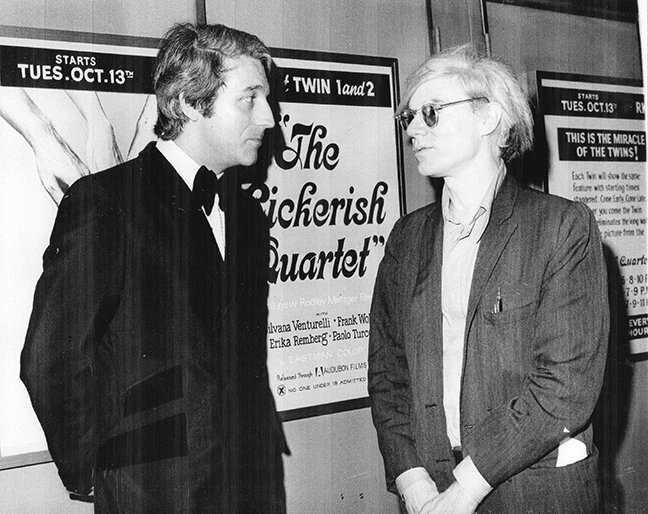
[edit]- Image: Radley Metzger and Andy Warhol (October 1970) (archive:1;2)
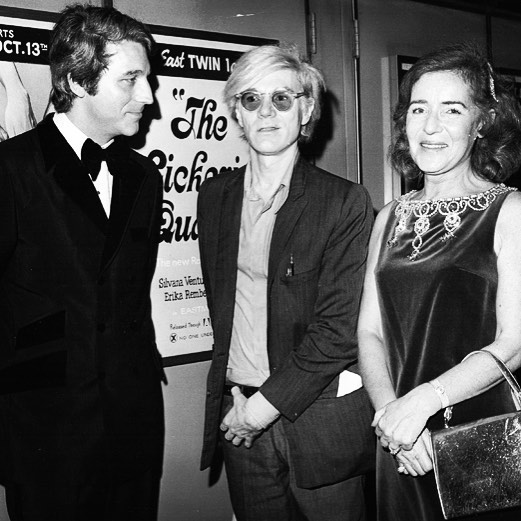
- Image: Radley Metzger, Andy Warhol and Ava Leighton (October 1970) (archive:1;2)
- Radley Metzger at MUBI (related to The Criterion Collection)
- Radley Metzger at IMDb
- Henry Paris at the Adult Film Database
- Henry Paris at the Internet Adult Film Database
- Radley Metzger – Archives at The Rialto Report (2013 to present)
- Radley Metzger – Thoughts and Reviews by Gary Morris (1998).
- Radley Metzger – The Films by Nathaniel Thompson (2007)
- Radley Metzger – Tribute (videos: 01:16; 01:10) (2017)
- Radley Metzger – Selected Film Trailers:
| International | |
|---|---|
| National | |
| People | |
| Other | |






Radley Metzger
View on GrokipediaEarly Life and Education
Childhood and Family Background
Radley Henry Metzger was born on January 21, 1929, in the Bronx borough of New York City, to Jewish parents Julius and Anne Metzger.[12][13] As the second son in the family, he grew up amid the economic hardships of the Great Depression, which shaped the modest circumstances of many working-class households in the city.[13] His father, Julius, worked as a bellhop, a position indicative of the limited opportunities available to immigrants and their descendants in urban service industries during that period.[12] The family resided initially in the Bronx before moving to Washington Heights in Manhattan, immersing young Metzger in New York's dense, multicultural environment of immigrant enclaves, street life, and emerging mass media.[4] This setting provided incidental exposure to vaudeville houses, nickelodeons, and early cinema venues, which dotted the city's neighborhoods and offered affordable entertainment to families like his amid widespread poverty.[12]Formal Education and Entry into Film
Metzger earned a Bachelor of Arts degree in dramatic arts from the City College of New York.[12] He later enrolled in a master's program at Columbia University but abandoned his academic pursuits to enter the film industry.[12] In the 1950s, Metzger commenced his entry into filmmaking through practical roles in post-production, primarily as an editor of trailers for imported European art-house films.[12] This work included cutting promotional material for films by directors such as Ingmar Bergman, affording him foundational experience in montage, timing, and narrative condensation essential to cinematic technique.[12] Such assignments at distribution companies exposed him to diverse international styles and the mechanics of adapting foreign content for American audiences, building his technical proficiency without formal vocational training beyond his undergraduate background.[14]Professional Career
Film Import and Distribution Beginnings
In the early 1960s, Radley Metzger co-founded Audubon Films with longtime partner Ava Leighton, establishing a distribution company focused on importing and releasing European erotic films to the American market.[15] This venture capitalized on the limited availability of sexually explicit content in the U.S., where domestic production was constrained, by sourcing titles from countries like Denmark, France, and Sweden that featured nudity and simulated sex scenes presented as artistic or educational.[1] Audubon often dubbed, recut, and retitled these imports to appeal to art-house audiences while minimizing legal risks, such as those posed by lingering state and local censorship boards enforcing moral standards derived from the Motion Picture Production Code (Hays Code), which had weakened but not fully dissolved until the late 1960s.[16] Metzger's imports included Danish sex education films and French erotic dramas, which Audubon marketed as sophisticated alternatives to cruder American exploitation fare, navigating customs seizures and obscenity challenges through claims of cultural or anthropological value.[1][17] For instance, the company distributed uncut or minimally altered European titles that depicted explicit themes, testing boundaries in theaters where prosecutors occasionally pursued charges under anti-obscenity laws, yet often succeeded due to judicial shifts toward protecting "redeeming social importance" as affirmed in cases like Jacobellis v. Ohio (1964).[18] This approach allowed Audubon to operate in a regulatory gray area, as the Hays Code's self-censorship regime had collapsed for independents by the early 1960s, replaced by fragmented local enforcement that distributors like Metzger exploited through selective editing and venue choices.[19] The business thrived amid rising public interest in sexual topics, fueled by the Kinsey Reports of 1948 and 1953, which documented widespread non-marital and variant sexual practices, eroding taboos and creating demand for visual representations beyond clinical texts. Audubon's niche for "elegant" erotica—distinguishing it from low-budget U.S. "nudie-cuties"—yielded strong returns in urban art-house circuits, with films grossing significantly due to repeat viewings and word-of-mouth among audiences seeking alternatives to repressed mainstream cinema.[14] Profits from these distributions, often in the range of several times acquisition costs for high-demand imports, enabled Metzger to expand operations before transitioning to domestic production, reflecting a market shift as sexual mores liberalized post-World War II.[5]Softcore Erotic Films Under Own Name
Radley Metzger directed his initial foray into erotic cinema with The Dirty Girls in 1965, marking his debut feature in the genre and focusing on the daily encounters of prostitutes in Paris and Munich with various clients, presented through a lens of voyeuristic detachment without explicit sexual penetration.[20] This film initiated a series of softcore productions through the early 1970s, characterized by narrative-driven eroticism that incorporated literary adaptations and psychological intrigue, distinguishing Metzger's work from more exploitative contemporaries.[21] Escalating in ambition, Metzger's Camille 2000 (1969) reimagined Alexandre Dumas fils' La Dame aux Camélias as a modern erotic drama set among Rome's elite, featuring opulent visuals, drug-fueled orgies, and a tragic romance between courtesan Marguerite Gautier (Danièle Gaubert) and Armand Duval (Nino Castelnuovo), filmed in widescreen format to emphasize lavish interiors and outdoor sequences.[22] Similarly, The Lickerish Quartet (1970), shot on location in an Italian castle and carnival settings, explored themes of illusion versus reality through a wealthy family's obsession with a stuntwoman resembling a figure from a pornographic film they viewed, employing Pirandellian motifs and non-explicit erotic tension to navigate contemporary obscenity standards.[23] These films utilized international production elements, such as European casts and locations, alongside sophisticated cinematography—including wide aspect ratios and deliberate framing—to elevate erotic content toward art-house sensibilities, appealing to audiences in both grindhouse theaters and upscale venues seeking intellectually tinged sensuality.[5] While specific box-office figures remain scarce, contemporaries like Carmen, Baby (1967)—another Metzger softcore adaptation of Prosper Mérimée's novella—achieved notable commercial success, grossing strongly in urban markets and influencing his subsequent output by demonstrating viability for "erotic art" hybrids.[24] This approach allowed Metzger to skirt legal prohibitions on hardcore depictions, prioritizing suggestion and narrative over graphic acts.[14]Transition to Hardcore Under Henry Paris Pseudonym
In the mid-1970s, following the commercial success of Deep Throat in 1972, which grossed millions and popularized explicit hardcore pornography amid a brief "porno chic" era, Metzger shifted from softcore erotica to producing films with unsimulated sexual acts.[25] This transition reflected broader industry pressures, as hardcore content increasingly dominated distribution channels, prompting established directors to adapt or risk obsolescence.[26] To maintain artistic separation and shield his reputation from prior upscale erotic works, Metzger adopted the pseudonym Henry Paris for these projects, reasoning that his directing experience would elevate the genre's quality.[12] Metzger's first film under the Henry Paris name, The Private Afternoons of Pamela Mann (1974), marked this entry into explicit territory, followed by titles emphasizing narrative structure over minimalist "gonzo" styles prevalent in lower-budget contemporaries.[27] These works featured ensemble casts, scripted dialogues, and on-location shooting in urban and international settings, contrasting with the era's typical quick-loop compilations. The 1973 Miller v. California Supreme Court ruling, which established a community-standards-based test for obscenity, facilitated this evolution by clarifying legal boundaries, enabling producers to incorporate explicit elements within structured films without uniform national censorship risks.[28] A pinnacle of this phase was The Opening of Misty Beethoven (1976), a loose adaptation parodying George Bernard Shaw's Pygmalion, wherein a sexologist transforms a Times Square prostitute into a refined courtesan. Produced on a reported budget of $250,000—substantial for adult films—it utilized elaborate sets in New York and Paris, professional cinematography, and performers like Constance Money and Jamie Gillis, yielding polished aesthetics uncommon in the genre.[29] This approach underscored Metzger's intent to infuse hardcore with cinematic sophistication, prioritizing causal narrative progression over mere depiction, amid post-Deep Throat market demands for explicit yet engaging content.[26]Attempts at Mainstream Cinema
In the late 1970s, Radley Metzger directed The Cat and the Canary (1978), an adaptation of John Willard's 1922 play, marking his primary effort to produce non-explicit cinema for broader audiences.[30] The film featured established actors including Honor Blackman, Edward Fox, Wendy Hiller, Olivia Hussey, and Michael Callan, and was released theatrically as a PG-rated horror mystery without adult content, distributed through channels separate from pornographic venues.[30] Produced independently in collaboration with a British company and handled by Quartet Films, it achieved moderate commercial viability, including strong ancillary sales that sustained Metzger financially for about a decade and a top-five grossing position in Italy that year.[5] Despite this, the project faced inherent barriers stemming from Metzger's established reputation in erotic and hardcore films, which deterred major studio investment in subsequent non-adult ventures.[31] Industry reluctance to back a director known for pornography—despite his earlier softcore works' artistic pretensions—highlighted a persistent stigma, as Hollywood prioritized directors without explicit associations for mainstream projects.[32] This prior success in adult genres, which had provided financial independence, paradoxically reinforced typecasting, limiting opportunities beyond niche horror remakes.[31] Critical reception was lukewarm, with the film earning a 5.6/10 on IMDb from nearly 1,900 ratings and 29% on Rotten Tomatoes, underscoring challenges in appealing to general audiences unacquainted with Metzger's stylistic flourishes from erotic cinema.[30][33] Post-1978, Metzger produced no further significant mainstream features, instead reverting to adult-oriented work amid shifting market dynamics like the home video boom, which eroded theatrical porn profitability but failed to open doors to conventional Hollywood production.[31] This pivot attempt thus represented a brief, ultimately constrained exploration of viability outside adult genres, constrained by both commercial realities and professional prejudice.[5]Artistic Approach and Innovations
Stylistic Techniques
Metzger consistently employed color cinematography to heighten visual impact, beginning with his early features where vibrant hues such as eye-popping reds and blues dominated costumes and sets, as seen in Carmen, Baby (1967), his first film shot in color.[34] In later works, including those under the Henry Paris pseudonym, he incorporated slow-motion sequences for erotic moments, such as optically printed effects emphasizing bodily fluids in Barbara Broadcast (1977).[35] Fluid camera movements, including circular and horizontal tracking shots, facilitated dynamic spatial traversal, evident in The Opening of Misty Beethoven (1976), where they followed characters through opulent interiors.[36] These choices reflected influences from directors like Max Ophüls, whose gliding style informed Metzger's emphasis on precise, aristocratic framing.[37] His mise-en-scène drew from European aesthetics, prioritizing lavish, upscale environments to evoke continental sophistication; films like Camille 2000 (1969) and The Opening of Misty Beethoven featured location shooting in Italy, France, and Rome, with detailed period sets and costumes that contrasted typical low-budget erotic fare.[37] [38] Sequence shots combined with rhythmic montage structured pacing, as in The Opening of Misty Beethoven, where extended takes integrated erotic action with narrative flow.[39] Metzger's sound design diverged from the minimalism prevalent in contemporary adult films through commissioned scores by notable composers, including Georges Auric's orchestral work for Thérèse and Isabelle (1968), which provided textured accompaniment to dialogue and visuals rather than generic underscoring.[37] Piero Piccioni's jazz-inflected yet sophisticated arrangements for Camille 2000 similarly enhanced atmospheric depth, aligning audio with the film's elegant eroticism.[37] Editing, rooted in his early career as a film editor, maintained narrative coherence across dual softcore and hardcore versions of titles like Score (1974), preserving shot continuity despite variant content.[37]Themes and Narrative Choices
Metzger frequently adapted literary sources to frame erotic narratives around core human drives such as desire and social ascent. In Camille 2000 (1969), drawn from Alexandre Dumas fils's La Dame aux Camélias, the protagonist Marguerite Gautier navigates a romance constrained by class distinctions and terminal illness, with sexual encounters underscoring her pursuit of autonomy amid economic dependency on patrons.[40][41] Similarly, The Opening of Misty Beethoven (1976), under his Henry Paris pseudonym, reworks George Bernard Shaw's Pygmalion—itself rooted in Ovid's myth—to depict a sexologist transforming a crude prostitute into an elite courtesan through targeted sexual training, highlighting power imbalances in mentorship and the fluidity of social roles via erotic mastery.[42][9] These choices prioritize plot progression driven by interpersonal dynamics over isolated titillation, using classic structures to dissect transformation through desire. Narratives in Metzger's films often positioned female protagonists as active agents in sexual and social spheres, diverging from the passive female roles prevalent in 1970s pornography, where women typically served as objects for male initiation. In The Opening of Misty Beethoven, Misty (Constance Money) evolves from novice to seductress, orchestrating encounters that invert power dynamics, such as dominating a male client in a reversal of her initial training.[43] This agency manifests empirically in script beats where female characters initiate or dictate erotic exchanges, contrasting with contemporaneous adult films like those from the Mitchell Brothers, which emphasized male-driven scenarios without comparable character arcs.[44] In Thérèse and Isabelle (1968), adapted from Violette Leduc's novella, the titular schoolgirls exercise mutual agency in their clandestine affair, exploring psychological intimacy without external male intervention.[45] Sex scenes in Metzger's work integrated causally with character psychology, advancing motivations rather than interrupting plot as extraneous inserts. He emphasized in interviews that audiences prioritize psychological underpinnings of encounters over mere physicality, structuring scripts to link eroticism to emotional or strategic goals, as in Misty's calculated seductions to ascend socially.[46] This approach yielded narratives where sexual acts revealed traits—like Marguerite's defiant hedonism in Camille 2000 or Misty's adaptive cunning—treating eros as a lens for behavioral realism, supported by dialogue-heavy setups that contextualized acts within relational cause-and-effect.[40][43]Reception, Influence, and Criticisms
Critical Acclaim and Artistic Recognition
Radley Metzger's The Opening of Misty Beethoven (1976), directed under his pseudonym Henry Paris, received widespread praise for its sophisticated adaptation of George Bernard Shaw's Pygmalion, blending explicit content with narrative elegance and production values that elevated adult cinema during the 1970s "porno chic" era.[47] Film scholars have highlighted its technical proficiency, including location shooting in Europe and a focus on character development, marking it as a pinnacle of Golden Age adult filmmaking.[5] The film garnered formal recognition at the inaugural Adult Film Association of America Awards in 1977, winning for Best Film and Best Direction, underscoring Metzger's ability to infuse erotic content with artistic intent.[48] Commercially, it achieved significant box-office success, contributing to the financial viability of high-production adult features through sustained theatrical runs and repeat viewings.[49] Retrospective screenings have affirmed Metzger's enduring artistic legacy, with UCLA's Film & Television Archive hosting the 2011 series "Smooth Operator: The Opulent Eroticism of Radley Metzger," featuring restored prints of his works to celebrate their aesthetic innovations.[8] Similarly, the Film Society of Lincoln Center presented "This Is Softcore: The Art Cinema Erotica of Radley Metzger" in 2014, a sold-out program that drew attention to his transitional role between European art erotica and American adult film.[50] Scholarly analysis continues to explore Metzger's contributions, as detailed in Rob King's Man of Taste: The Erotic Cinema of Radley Metzger (Columbia University Press, 2025), a critical biography that examines his integration of arthouse techniques into disreputable genres.[51] Modern restorations by boutique labels, such as Vinegar Syndrome's releases of titles like The Image (1975) in 4K UHD, ensure accessibility and highlight the films' visual and thematic durability for contemporary audiences.[52]Impact on Adult Film Industry
Metzger's work under the pseudonym Henry Paris during the mid-1970s pioneered scripted, feature-length hardcore films that elevated production standards beyond the short-loop formats dominant prior to the Golden Age of Porn (circa 1969–1984). Films such as The Opening of Misty Beethoven (1976) incorporated professional cinematography, elaborate sets, and narrative coherence, with budgets supporting 35mm filming and theatrical releases in mainstream venues. This shift demonstrated viability for higher investments, influencing producers to prioritize quality over minimalism and fostering a brief era of "porno chic" where adult features aspired to cinematic legitimacy.[12][53] His adaptations of literary sources, including Misty Beethoven's loose retelling of George Bernard Shaw's Pygmalion, established a template for plot-driven erotica that subsequent directors emulated, linking explicit content to character arcs and thematic depth rather than isolated acts. This normalization of ambitious storytelling in hardcore contributed to genre evolution, as evidenced by critical reception from figures like Roger Ebert, who praised its execution, and its role in inspiring similar high-concept features amid the 1970s sexual revolution.[54][2] Through Audubon Films, Metzger's control of production and distribution underscored adult film's economic potential, with Paris-era releases generating sustained revenue via extended theatrical engagements and later video markets. This model aligned with broader industry shifts, where 1970s features attracted crossover audiences and capital, transitioning porn from marginal loops to budgeted enterprises grossing millions collectively—exemplified by contemporaries like Deep Throat (1972)—and briefly positioning it as a legitimate commercial sector before video commoditization in the 1980s.[2][26]Controversies and Societal Critiques
Metzger's distribution company, Audubon Films, encountered significant legal challenges related to obscenity and censorship in the 1960s, as U.S. customs and local authorities frequently seized imported European erotic films on grounds of indecency. In Metzger v. Pearcy (1968), Metzger successfully challenged the warrantless seizure of films by Indiana prosecutors, with the Seventh Circuit Court of Appeals ruling that law enforcement could not confiscate allegedly obscene materials without a prior adversary hearing to assess their status under First Amendment protections, thereby reinforcing procedural safeguards against arbitrary censorship.[55][56] His works, such as Carmen, Baby (1967), faced obscenity charges in various jurisdictions, testing the boundaries of what constituted protected expression versus community-defined prurience. Following the 1973 Miller v. California Supreme Court decision, which established a three-prong test for obscenity—lacking serious literary, artistic, political, or scientific value; appealing to prurient interest; and depicting sexual conduct in a patently offensive manner—Metzger's transition to hardcore films under the pseudonym Henry Paris explicitly probed these limits, with productions like The Opening of Misty Beethoven (1976) incorporating narrative elements to claim artistic merit amid explicit content. To mitigate personal legal exposure in an era of heightened prosecutions, Metzger adopted the alias, reflecting the precarious status of directors in post-Miller pornography, where films risked local bans despite national protections.[57] A notable industry dispute arose in 1977 when actress Constance Money (real name Susan McIver) sued Metzger over her involvement in Barbara Broadcast, claiming breach of contract after footage from Misty Beethoven outtakes was repurposed without her explicit agreement for the new production; the acrimonious four-year litigation sought multi-million-dollar damages and was ultimately settled out of court, highlighting tensions over performer consent and compensation in adult filmmaking.[58][59] Feminist critiques of pornography, particularly from anti-pornography advocates during the 1980s sex wars, have characterized films like Metzger's as perpetuating female objectification and reinforcing patriarchal power dynamics through simulated or real sexual subordination, regardless of narrative framing.[60] However, defenders of Metzger's oeuvre point to the documented consent of adult performers and storylines emphasizing female agency, such as in Misty Beethoven, where the protagonist's sexual education leads to social ascension, challenging reductive exploitation narratives and aligning with pro-sex feminist views that distinguish erotic empowerment from harm.[10][14] Conservative perspectives have linked pornography consumption, including "arthouse" variants like Metzger's, to broader societal harms, arguing it erodes family structures by normalizing infidelity and desensitizing users to intimacy; empirical analyses, such as those reviewing longitudinal data, indicate correlations between frequent porn use and elevated divorce risks, with one study of over 400 couples finding heavy viewers 20% more likely to report marital dissatisfaction due to distorted expectations of sexual performance.[61] These critiques emphasize causal pathways from habitual exposure to addictive behaviors and relational breakdown, prioritizing community standards over individual liberty claims advanced in obscenity defenses.[18]Later Years and Legacy
Post-Production Activities
Following the release of his final hardcore films under the Henry Paris pseudonym in the late 1970s, Radley Metzger largely withdrew from the spotlight of active filmmaking during the 1980s, as the adult industry transitioned to low-budget home video production amid the rise of VHS technology and the devastating impacts of the AIDS crisis, which claimed numerous performers and shifted production dynamics toward safer, more anonymous formats.[12][62] Metzger formally retired from directing in 1984 after brief forays into mainstream cinema, opting instead for a low-profile existence focused on managing his existing body of work rather than pursuing new projects.[62] He sustained himself financially by licensing his film catalog—including titles like The Opening of Misty Beethoven (1976)—to video distributors, capitalizing on the era's demand for retro erotic content without re-entering production.[12] In subsequent decades, Metzger engaged sporadically in preservation and advisory efforts related to his oeuvre, overseeing restorations such as enhanced editions of his films for modern releases and granting occasional interviews that reflected on his career's artistic merits without announcing new endeavors; for instance, in a 2011 discussion, he emphasized stewardship of his library amid growing retrospective interest.[62] This included facilitating Blu-ray box sets like Radley Metzger’s Erotica Psychadelica, which highlighted his role in curating access to his back catalog for contemporary audiences.[62]Death and Posthumous Recognition
Radley Metzger died on March 31, 2017, in Manhattan, New York City, at the age of 88 from undisclosed causes.[12][2][63] The announcement came from Ashley Spicer, administrator of his estate, though coverage remained confined largely to specialized film publications rather than broader media outlets.[2] Posthumously, Metzger's work has sustained interest among cult film archivists and distributors, with continued emphasis on high-quality restorations of his Henry Paris pseudonym films to preserve their production values. Specialty labels have facilitated access through physical media, reflecting ongoing appreciation for his stylistic contributions despite the niche nature of the genre. Discussions in film criticism position him as a key figure in the evolution of erotic cinema, though formal institutional honors have been absent.[12][2]Filmography and Awards
Key Directorial Works
- Thérèse and Isabelle (1968): An erotic drama depicting the sexual awakening of two teenage girls at a boarding school, adapted from Violette Leduc's semi-autobiographical novel and filmed in France with a runtime of 118 minutes.[64][65]
- Camille 2000 (1969): A psychedelic update of Alexandre Dumas' La Dame aux Camélias, featuring opulent visuals and a runtime of 115 minutes, marking Metzger's exploration of high-society eroticism.[66][7]
- The Lickerish Quartet (1970): A psychological erotic thriller involving a father, son, and their female guest in a remote villa, with a runtime of 90 minutes, emphasizing voyeuristic and Oedipal themes.[66][67]
- Score (1974): A bisexual sex comedy set in 1970s London, following a couple who seduce a naive American, blending humor with explicit content in a 91-minute runtime and signaling Metzger's shift toward harder-edged erotica.[7][66]
- The Private Afternoons of Pamela Mann (1974, as Henry Paris): Metzger's debut in explicit hardcore pornography, a 1st-person narrative of a woman's sexual adventures with a runtime of 85 minutes, produced amid the post-Deep Throat boom.[68]
- The Opening of Misty Beethoven (1976, as Henry Paris): A pornographic adaptation of Pygmalion, where a sexologist transforms a streetwalker into a sophisticated courtesan, noted for its production values and 86-minute runtime.[69]
- Barbara Broadcast (1977, as Henry Paris): An ensemble piece simulating a live TV broadcast of sexual encounters, with a 112-minute runtime, exemplifying Metzger's narrative experimentation in adult film.[68][66]