


Community hub
Recent from talks
Contribute something
Nothing was collected or created yet.
Henry Shrapnel
View on Wikipedia
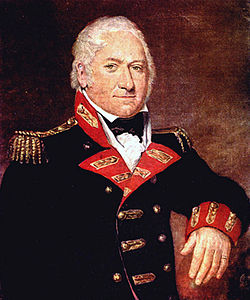
Lieutenant-General Henry Scrope Shrapnel (3 June 1761 – 13 March 1842) was a British Army officer whose name has entered the English language as the inventor of the shrapnel shell.
Key Information


Biography
[edit]Henry Shrapnel was born at Midway Manor in Bradford-on-Avon, Wiltshire, England, the ninth child of Zachariah Shrapnel and his wife Lydia. He was commissioned as a Royal Artillery lieutenant in 1779, serving first in Newfoundland. He returned to England in 1784, when he began to experiment with hollow cannonballs filled with lead shot that burst in mid-air.[1]
In 1787 he was posted to Gibraltar where he began demonstrations of his anti-personnel weapon which impressed senior officers commanding the fortress.[2] From Gibraltar, Shrapnel was sent to the West Indies in 1791.[1] Shrapnel served in Flanders, where he was wounded in 1793. He was promoted to major on 1 November 1803 after eight years as a captain.
In 1803, the British Army adopted a similar but elongated explosive shell which immediately acquired the inventor's name.[3] It has lent the term "shrapnel" to fragmentation from artillery shells and fragmentation in general ever since, long after it was replaced by high-explosive rounds. Until the end of World War I, the shells were still manufactured according to his original principles.
After his invention's success in battle at Fort Nieuw-Amsterdam, Surinam, on 30 April 1804,[4] Shrapnel was promoted to lieutenant colonel on 20 July 1804, less than nine months later.
In 1814, the British Government recognized Shrapnel's contribution by awarding him £1,200 (£106,000 in 2023) a year for life.[5] Bureaucracy, however, prevented him from receiving the full benefit of this award.[1] He was appointed to the office of colonel-commandant, Royal Artillery, on 6 March 1827. He rose to the rank of lieutenant general on 10 January 1837.[6]
Shrapnel lived at Peartree House, near Peartree Green, Southampton, from about 1835 until his death.[7][8]
His sister Rachel Shrapnel married the reverend Thomas Tregenna Biddulph. Gen. Sir Michael Anthony Shrapnel Biddulph was his great-nephew.[9]
See also
[edit]References
[edit]- ^ a b c John Sweetman (2004). "Shrapnel, Henry (1761–1842)". Oxford Dictionary of National Biography. Oxford University Press. Retrieved 10 August 2015.
- ^ Knight, R. J. B. (2013). Britain against Napoleon:The Organization of Victory, 1793-1815. London, England New York: Allen Lane an imprint of Penguin Books. p. 47. ISBN 978-1-84614-177-5.
- ^ Rich, Norman M. (1967). "Shrapnel Wounds". JAMA: The Journal of the American Medical Association. 202 (3): 245. doi:10.1001/jama.1967.03130160119038. ISSN 0098-7484.
- ^ Hogg, Oliver (1970). Artillery: its origin, heyday and decline. London: C. Hurst. p. 180. ISBN 978-0-900966-43-9.
- ^ Long, Tony (March 2008). "March 13, 1842: Henry Shrapnel Dies, But His Name Lives On". Wired. Archived from the original on 3 June 2008.
- ^ Vetch, Robert Hamilton (1897). . Dictionary of National Biography. Vol. 52. pp. 163–165.
- ^ Vale, Jessica (1980). "Peartree House". Lost Houses of Southampton. bitterne.net. Archived from the original on 16 March 2014. Retrieved 22 June 2012.
- ^ "Peartree House". Port Cities: Southampton. plimsoll.org. 1930. Archived from the original on 29 January 2013. Retrieved 22 June 2012.
- ^ Burke, Bernard (1898). A Genealogical and Heraldic History of the Landed Gentry of Great Britain & Ireland. Harrison & sons. p. 113. Retrieved 8 September 2024.


| International | |
|---|---|
| National | |
| People | |

Henry Shrapnel
View on GrokipediaEarly Life
Birth and Family Background
Henry Shrapnel was born on 3 June 1761 at Midway Manor, near Bradford-on-Avon in Wiltshire, England. He was the ninth and youngest of nine children born to Zachariah Shrapnel (1724–1796) and his wife Lydia (née Needham). Zachariah, a prosperous clothier and local landowner, had established the family at Midway Manor, reflecting their involvement in Wiltshire's thriving woolen trade during the mid-18th century.[3][4] The family's modest gentry status positioned them among the rural middling sort, with sufficient resources to support education and social advancement, though not among the highest aristocracy.[3]Education and Initial Commission
Henry Shrapnel benefited from his family's resources in pursuing a military career. This background afforded him the opportunity to enter the Royal Military Academy at Woolwich—colloquially known as "The Shop"—at around age 18 in 1779.[1] At Woolwich, Shrapnel underwent rigorous training tailored for future artillery and engineering officers, with a curriculum centered on mathematical theory and the scientific principles underlying gunnery, fortification, and practical engineering applications.[5] This technical education equipped cadets with essential skills in ballistics, siege warfare, and munitions handling, fostering an environment that encouraged innovation in artillery design and tactics.[6] Following his studies, Shrapnel received his commission as a second lieutenant in the Royal Artillery on 9 July 1779. He advanced to first lieutenant on 3 December 1781, marking the completion of his initial military preparation.Military Career
Early Postings and Service
Shrapnel's early military service began with his deployment to Newfoundland in 1780, where he performed artillery duties in the harsh northern climate as a young officer in the Royal Artillery.[7][8] This posting provided foundational experience in operating artillery under challenging environmental conditions, building on his initial training at Woolwich.[7] In 1787, Shrapnel was stationed in Gibraltar, serving there until 1791 in routine defensive artillery roles at the strategic fortress.[7][8] During this period, he conducted an initial test of a shell prototype in 1787, demonstrating its potential to senior officers.[7] Shrapnel's next assignment took him to the West Indies starting in 1791, where he handled artillery operations across several islands, including Barbados, St. Vincent, Grenada, Dominica, Antigua, and St. Kitts.[7] These postings involved managing logistics in tropical environments, adapting equipment to humidity and heat while supporting garrison defenses and regional security.[7][8] His service abroad contributed to steady promotions within the Royal Artillery. On 15 August 1793, Shrapnel advanced to captain-lieutenant.[7][8] He attained the rank of full captain on 3 October 1795.[7][8] By 29 April 1802, he had received brevet-major status, recognizing his growing expertise.[7][8]Major Campaigns and Promotions
Shrapnel's military service intensified during the French Revolutionary Wars, where he participated in the Flanders Campaign as part of the Duke of York's army. He sustained a wound during the unsuccessful Siege of Dunkirk in September 1793, an experience that underscored the limitations of contemporary artillery and influenced his later innovations.[7] Following years of routine postings that honed his expertise in artillery, Shrapnel received his promotion to major in the Royal Artillery on 1 November 1803, recognizing his technical contributions amid escalating tensions with Napoleonic France. The following year marked a pivotal moment when his newly adopted spherical case shot—known as the shrapnel shell—was employed for the first time in combat during the British invasion of Surinam on 30 April 1804, contributing to the swift capture of Fort Nieuw-Amsterdam from Dutch forces. This successful debut directly led to his rapid advancement to regimental lieutenant-colonel on 20 July 1804.[1] As the Napoleonic Wars progressed, Shrapnel transitioned to administrative roles, including assistant inspector of artillery at Woolwich, where he focused on ordnance improvements rather than field command. Nonetheless, his invention played an indirect but crucial role in major British victories; shrapnel shells were used effectively at the Battle of Vimeiro in the Peninsular War on 21 August 1808 and later proved decisive in the artillery barrages at the Battle of Waterloo on 18 June 1815, enhancing British firepower against French infantry. His continued service earned further promotions: to colonel in the army on 4 June 1813, and to major-general on 12 August 1819.[1] Shrapnel's career culminated in his elevation to lieutenant-general on 10 January 1837, a testament to his enduring impact on artillery doctrine during a transformative era of European conflict.Retirement from Active Duty
Shrapnel retired from active duty in the British Army on 29 July 1825, after more than 45 years of service that began with his commission as a cadet in the Royal Artillery in 1779.[9] This transition occurred amid significant post-Napoleonic reductions in the British Army, which saw its strength drop from approximately 149,000 personnel in 1816 to 100,000 by 1821, driven by budget cuts from £43 million in 1815 to £10 million in 1820 as the nation shifted to peacetime priorities.[10] His prior promotions, including to major-general in 1819, facilitated a dignified exit from frontline roles.[7] On 6 March 1827, Shrapnel received an honorary appointment as colonel-commandant of the Royal Artillery, a prestigious retired rank that recognized his long tenure without requiring further active involvement.[7] This position marked the formal end of his military career progression, allowing him to step fully into civilian life during the 1820s and 1830s.[11] In retirement, Shrapnel turned his attention to advocating for improved pensions, particularly frustrated by bureaucratic delays in accessing rewards for his inventions. Although granted an annual pension of £1,200 in 1814 for his contributions to artillery, a narrow, bureaucratic interpretation of the award terms reduced its value by treating it as encompassing all his improvements, limiting the additional financial benefit and prompting years of efforts to secure greater recognition.[7]Inventions and Innovations
Development of the Shrapnel Shell
In 1784, while serving as a lieutenant in the Royal Artillery, Henry Shrapnel conceived the idea for an innovative anti-personnel artillery projectile designed to explode in mid-air, thereby maximizing the dispersion and lethality of embedded bullets against infantry formations.[7][12] This development stemmed from his observations of the limitations of existing spherical case shot, which dispersed bullets only upon ground impact, and aimed to extend the effective range through aerial bursting.[13] Shrapnel funded the initial research himself upon returning to England from Newfoundland, marking the beginning of nearly two decades of experimentation.[7] The core design featured a hollow spherical iron shell, approximately 5.5 inches in diameter for common use, packed with musket balls (the number varying by caliber, typically 100–200)—and a small quantity of gunpowder as a bursting charge to fragment the casing and propel the balls outward.[12] A rudimentary time fuse, initially made of wood and gunpowder, was inserted to detonate the charge at a predetermined interval during flight, allowing the shell to burst hundreds of yards from the gun while the balls retained significant velocity.[13] Originally termed "spherical case ammunition," this configuration combined elements of canister shot with timed fuses, prioritizing dispersion over the shell's own destructive force.[12] Shrapnel refined the prototype through private trials in England from 1784 to 1787, focusing on fuse timing and shell integrity under firing stresses.[14] His posting to Gibraltar in 1787 provided a critical opportunity for official testing, where on December 21, Shrapnel demonstrated a prototype fired from an 8-inch mortar, bursting the shell half a second before impact over water and scattering 200 musket balls with notable range and effect.[12][8] Despite this success, early adoption faced significant hurdles, including unreliable fuses prone to premature detonation from friction between balls and powder, or failure to ignite altogether, leading to rejections by the Board of Ordnance in 1799 after resubmitted proposals.[7][12] Shrapnel persisted with refinements, such as improved boxwood fuses marked in one-second increments for gunner adjustment, while continuing service abroad in the West Indies and Flanders interrupted but did not halt his work.[14] By 1803, as a major, Shrapnel secured government funding for comprehensive trials at Woolwich, where a select committee reported on June 7 that the shell produced "very considerable" effects at distances up to 1,000 yards, outperforming traditional case shot in lethality.[12] These results addressed prior concerns, leading the Board of Ordnance to officially recognize and authorize production of the shell for British Army artillery that year.[7][13] The invention saw its first combat deployment in 1804 during British operations against the Dutch at Surinam, validating its practical efficacy despite ongoing minor fuse improvements.[12]Other Artillery and Weapon Improvements
In addition to his renowned work on explosive projectiles, Henry Shrapnel made several practical contributions to artillery operations and design during his service in the Royal Artillery. He compiled detailed artillery range tables based on experimental firings, which provided gunners with precise data for calculating trajectories and elevations, thereby enhancing accuracy in field conditions.[15][7] Shrapnel invented the brass tangent slide, a sighting device affixed to cannons that allowed for exact elevation adjustments using range markings rather than angular degrees, simplifying and speeding up aiming processes for various calibers like 6-pounders and 12-pounders.[15] This innovation, proposed around 1813, was prototyped and later manufactured, marking an early advancement in gun-sighting technology.[15] He also improved the design of mortars and howitzers by introducing parabolic chambers, which optimized the combustion of propellant powder and permitted larger charges without excessive pressure buildup.[7][14] For instance, his 1810 redesign of the ten-inch sea-service iron mortar increased its effective range through this chamber shape, allowing for more efficient energy transfer to the projectile.[15] Shrapnel developed the duplex disappearing mounting for gun carriages, a system that mounted two ordnance pieces on a shared platform where the recoil from firing one gun simultaneously lowered it below cover for reloading while elevating the second gun into position.[7][14] This mechanism, constructed during his tenure as inspector of artillery, facilitated quicker successive firings and better protection for crews in exposed positions.[7] Later in his career, Shrapnel contributed enhancements to small arms, ammunition, and fuses, focusing on reliability and performance. He patented a percussion lock for small arms in 1834, which replaced friction-based ignition with a more dependable striking mechanism to ensure consistent firing.[9] Additionally, he refined fuse designs and ammunition components, including augers for precise filling and constricted powder chambers in muskets and rifles to improve ignition efficiency, as documented in his designs from the 1830s and 1840s.[15][7] These modifications addressed common failures in wet or variable conditions, drawing from his extensive ordnance experiments.[14]Personal Life
Marriage and Family
Henry Shrapnel married Esther Squires, born in 1780, on 5 May 1810 at St. Mary's Church in Lambeth, London.[16] Esther, a resident of Lambeth parish, outlived Shrapnel and died in 1852. The couple had two sons and two daughters. Their eldest son, Henry Needham Scrope Shrapnel, was born on 26 July 1812 and died on 1 June 1896. He pursued a military career, attaining the rank of captain in the 3rd Dragoon Guards before serving as a barrack-master in locations including Ireland, Bermuda, Halifax, and Montreal. Around 1866, he retired from active service and settled in Orillia, Ontario, Canada, where he raised a large family of fifteen children with his wife, Louisa Sarah Jonsiffe, whom he married on 19 August 1835 at St. Mary's Church in Dover. Six of their children survived to adulthood, among them Edward Scrope Shrapnel, an artist based in Toronto. Shrapnel's family extended through marital ties to other prominent figures. His sister Rachel Shrapnel married Reverend Thomas Tregenna Biddulph on 19 February 1789; the couple had several children, including Thomas Shrapnel Biddulph.[17] Through this line, Shrapnel's great-nephew was General Sir Michael Anthony Shrapnel Biddulph (1823–1904), a distinguished British Army officer who rose to the rank of general, served as colonel commandant of the Royal Artillery, and held the position of Black Rod in the House of Lords.[17] Throughout Shrapnel's extensive military career, which involved postings across Gibraltar, the West Indies, and various British garrisons, his domestic life revolved around supporting his growing family amid frequent relocations and professional demands.[18] His wife Esther and their children provided continuity and emotional backing during these periods of service, with the eldest son's later career echoing his father's path in the artillery and colonial administration.[19]Later Residence and Death
In the mid-1830s, following his retirement from active military service, Henry Shrapnel relocated to Southampton, settling at Peartree House near Peartree Green for what became his final residence.[2] This move marked a period of relative seclusion in his later years, where he lived quietly until his death. Shrapnel's financial security was bolstered in 1814 by a lifetime pension of £1,200 per year awarded by the British Treasury in recognition of his inventive contributions to artillery. Equivalent to approximately £122,000 in 2025 terms, this sum was substantial but marred by significant delays due to government bureaucracy, limiting its practical benefit during his lifetime and contributing to ongoing financial struggles.[20][12] His family provided essential support during this retirement phase. In 1837, shortly after his promotion to lieutenant-general, Shrapnel received a personal acknowledgment from King William IV during a visit to Brighton, where the monarch promised him a baronetcy through Sir Herbert Taylor on 23 April; however, the offer remained unfulfilled following the king's death later that year. Shrapnel died at Peartree House on 13 March 1842, at the age of 80. He was buried in the family vault in the chancel of Holy Trinity Church, Bradford-on-Avon, Wiltshire.[21]Legacy
Military Impact and Adoption
The shrapnel shell saw its first combat application in 1804 during the British invasion of Surinam (now Suriname), where it served as an early proof of concept against Dutch colonial forces at Fort Nieuw-Amsterdam. The weapon's devastating effect prompted a swift Dutch surrender after minimal engagement, demonstrating its potential to disrupt fortifications and personnel from a distance.[1] This initial success validated the shell's design and paved the way for broader integration into British artillery inventories.[12] Widespread adoption followed in the British Army during the Peninsular War (1808–1814), where shrapnel shells became a staple of field artillery, significantly enhancing anti-infantry capabilities against French formations.[12] Employed effectively at battles such as Vimeiro in 1808, the shells inflicted heavy casualties on massed troops and disrupted enemy advances, earning praise from commanders like the Duke of Wellington for their "dreadful" impact. By the Battle of Waterloo in 1815, shrapnel munitions were integral to British tactics, contributing to the recapture of key positions like La Haye Sainte and proving decisive in countering Napoleonic infantry assaults.[1] Their use in these campaigns marked a shift toward more lethal long-range anti-personnel firepower, with ammunition allocations for shrapnel rising to over 20% in guns and 40% in howitzers.[12] The tactical advantages of the shrapnel shell lay in its extended range of up to 2,500 yards and innovative air-burst mechanism, which allowed it to explode mid-flight and disperse lead balls in a cone pattern over enemy lines, revolutionizing field artillery by bridging the gap between short-range canister shot and longer-range round shot.[22] This capability enabled gunners to target troops in the open at 1,000–1,200 meters effectively, breaking formations and morale without exposing batteries to close counterfire.[12] Over time, the term "shrapnel" evolved from denoting this specific timed-burst projectile to a generic reference for fragmentation munitions, a usage that persisted through World War I before shifting to encompass broader shell casing debris.[23]Honors and Recognition
In recognition of his contributions to artillery innovation, the British Treasury granted Henry Shrapnel an annual pension of £1,200 for life starting in 1814, serving as financial compensation for the rights to his invention of the spherical case-shot shell. Shrapnel's military career culminated in his appointment as colonel-commandant of the Royal Artillery on 6 March 1827, an honorary position that highlighted his longstanding service and expertise. In 1837, following his promotion to lieutenant-general, King William IV personally acknowledged Shrapnel's services during a visit to Brighton and proposed conferring a baronetcy upon him, a mark of royal esteem intended to honor his legacy and potentially extend to his heirs; however, the king's death later that year prevented its realization. Shrapnel's name endured through the widespread adoption of his shell design, with "shrapnel" entering the English lexicon by the early 19th century to denote the explosive projectile and, over time, extending to refer to shell fragments in military terminology, a usage that persists today.[24]References
- https://en.wikisource.org/wiki/Dictionary_of_National_Biography%2C_1885-1900/Shrapnel%2C_Henry