


Community hub
Recent from talks
Contribute something
Nothing was collected or created yet.
Image processor
View on Wikipedia
An image processor, also known as an image processing engine, image processing unit (IPU), or image signal processor (ISP), is a type of media processor or specialized digital signal processor (DSP) used for image processing, in digital cameras or other devices.[1][2] Image processors often employ parallel computing even with SIMD or MIMD technologies to increase speed and efficiency.[3] The digital image processing engine can perform a range of tasks. To increase the system integration on embedded devices, often it is a system on a chip with multi-core processor architecture.
Function
[edit] |
Bayer transformation
[edit]The photodiodes employed in an image sensor are color-blind by nature: they can only record shades of grey. To get color into the picture, they are covered with different color filters: red, green and blue (RGB) according to the pattern designated by the Bayer filter.[4] As each photodiode records the color information for exactly one pixel of the image, without an image processor there would be a green pixel next to each red and blue pixel.
This process, however, is quite complex, and involves a number of different operations. Its quality depends largely on the effectiveness of the algorithms applied to the raw data coming from the sensor. The mathematically manipulated data becomes the recorded photo file.
Demosaicing
[edit]As stated above, the image processor evaluates the color and brightness data of a given pixel, compares them with the data from neighboring pixels, and then uses a demosaicing algorithm to produce an appropriate color and brightness value for the pixel.[5] The image processor also assesses the whole picture to guess at the correct distribution of contrast. By adjusting the gamma value (heightening or lowering the contrast range of an image's mid-tones), subtle tonal gradations, such as in human skin or the blue of the sky, become much more realistic.
Noise reduction
[edit]Noise is a phenomenon found in any electronic circuitry. In digital photography its effect is often visible as random spots of obviously wrong color in an otherwise smoothly-colored area. Noise increases with temperature and exposure times. When higher ISO settings are chosen the electronic signal in the image sensor is amplified, which at the same time increases the noise level, leading to a lower signal-to-noise ratio. The image processor attempts to separate the noise from the image information and to remove it. This can be quite a challenge, as the image may contain areas with fine textures which, if treated as noise, may lose some of their definition.[6]
Image sharpening
[edit]As the color and brightness values for each pixel are interpolated some image sharpening is applied to even out any fuzziness that has occurred. To preserve the impression of depth, clarity and fine details, the image processor must sharpen edges and contours. It therefore must detect edges correctly and reproduce them smoothly and without over-sharpening.
Models
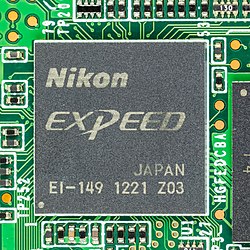
[edit]Image processor users are using industry standard products, application-specific standard products (ASSP) or even application-specific integrated circuits (ASIC) with trade names: Canon's is called DIGIC, Nikon's Expeed, Olympus' TruePic, Panasonic's Venus Engine and Sony's Bionz. Some are known to be based on the Fujitsu Milbeaut, the Texas Instruments OMAP, Panasonic MN103, Zoran Coach, Altek Sunny or Sanyo image/video processors.
ARM architecture processors with its NEON SIMD Media Processing Engines (MPE) are often used in mobile phones.
Processor brand names
[edit]- ATI - Imageon (graphics co-processor used in many early mobile photos to offer camera image signal processing[7])
- Canon - DIGIC (based on Texas Instruments OMAP)[8]
- Casio - EXILIM engine
- Epson - EDiART
- Fujifilm - EXR III or X Processor Pro
- Google - Pixel Visual Core[9]
- HTC - ImageSense
- Intel - IPU[10]
- MediaTek - Imagiq
- Minolta / Konica Minolta - SUPHEED with CxProcess
- Leica - MAESTRO (based on Fujitsu Milbeaut)[11]
- Nikon - Expeed (based on Fujitsu Milbeaut)[12]
- Olympus - TruePic (based on Panasonic MN103/MN103S)
- OPPO - MariSilicon X
- Panasonic - Venus Engine (based on Panasonic MN103/MN103S)
- Pentax - PRIME (Pentax Real IMage Engine) (newer variants based on Fujitsu Milbeaut)
- Qualcomm - Qualcomm Spectra (based on Qualcomm Snapdragon)
- Ricoh - GR engine (GR digital), Smooth Imaging Engine
- Samsung - DRIMe (based on Samsung Exynos)
- Sanyo - Platinum engine
- Sigma - True
- Sharp - ProPix
- Socionext - Milbeaut Family of ISPs - SC2000 (M-10V), SC2002 (M-11S)
- Sony - Bionz
- THine - THP series [1] with compatible SDK Kit for developing firmware [2]
- UNISOC - Vivimagic
Speed
[edit]With the ever-higher pixel count in image sensors, the image processor's speed becomes more critical: photographers don't want to wait for the camera's image processor to complete its job before they can carry on shooting - they don't even want to notice some processing is going on inside the camera. Therefore, image processors must be optimised to cope with more data in the same or even a shorter period of time.
Software
[edit]libcamera is a software library that supports using image signal processors for the capture of pictures.
See also
[edit]References
[edit]- ^ DIGITAL SIGNAL & IMAGE PROCESSING
- ^ Fundamentals of digital image processing
- ^ Merigot, Alain; Petrosino, Alfredo (2008-12-01). "Parallel processing for image and video processing: Issues and challenges". Parallel Computing. 34 (12): 694–699. doi:10.1016/j.parco.2008.09.009. ISSN 0167-8191.
- ^ Ben Andrews (2025-05-08). "Your camera sensor is mostly blind, but that could be about to change". Digital Camera World. Retrieved 2025-10-07.
- ^ Chang, Lanlan (Mar 2006). "Hybrid color filter array demosaicking for effective artifact suppression" (PDF). Journal of Electronic Imaging. 15 (1): 013003-1 – 013003-17. Bibcode:2006JEI....15a3003C. doi:10.1117/1.2183325. Archived from the original (PDF) on 29 December 2009.
- ^ Fan, Linwei; Zhang, Fan; Fan, Hui; Zhang, Caiming (2019-07-08). "Brief review of image denoising techniques". Visual Computing for Industry, Biomedicine, and Art. 2 (1): 7. doi:10.1186/s42492-019-0016-7. ISSN 2524-4442. PMC 7099553. PMID 32240414.
- ^ "Handheld Products". 11 March 2006. Archived from the original on 11 March 2006. Retrieved 14 September 2019.
- ^ Inside the Canon Rebel T4i DSLR Archived 2012-09-21 at the Wayback Machine Chipworks
- ^ Amadeo, Ron (17 October 2017). "Surprise! The Pixel 2 is hiding a custom Google SoC for image processing". Ars Technica. Retrieved 19 October 2017.
- ^ "7.8. Intel Image Processing Unit 6 (IPU6) Input System driver — The Linux Kernel documentation". docs.kernel.org. Retrieved 2024-08-30.
- ^ Fujitsu Microelectronics-Leica's Image Processing System Solution For High-End DSLR Archived 2008-10-07 at the Wayback Machine
- ^ Milbeaut and EXPEED Archived 2016-05-21 at the Wayback Machine byThom
Image processor
View on GrokipediaDefinition and Overview
Purpose and Role
An image processor, commonly referred to as an image signal processor (ISP), image processing unit (IPU), or image processing engine, is a specialized hardware component dedicated to the real-time manipulation of raw image data acquired from digital sensors.[6] It serves as the core engine in imaging pipelines, transforming unprocessed sensor outputs—such as those from charge-coupled device (CCD) or complementary metal-oxide-semiconductor (CMOS) sensors—into refined visual data that meets standards for human perception or machine analysis.[7] This specialization enables efficient handling of tasks that would otherwise burden general-purpose processors, ensuring seamless integration in compact devices.[8] The primary role of an image processor is to offload intensive computational workloads from the central processing unit (CPU), allowing for rapid conversion of raw Bayer-pattern or monochrome data into formats like sRGB for immediate use.[9] By executing a sequence of optimized operations, it enhances image fidelity while minimizing latency and power draw, which is critical in battery-constrained environments.[10] In essence, the ISP acts as the "brain" of the camera system, coordinating sensor inputs to produce clear, vibrant outputs without compromising device performance.[11] Image processors play a pivotal role in applications spanning consumer electronics and industrial systems, including digital cameras, smartphones, and embedded vision platforms.[12] They facilitate essential functions such as real-time video encoding for streaming and preprocessing steps that prepare data for advanced computer vision tasks, like object detection in autonomous devices.[13] For instance, in smartphones, the ISP ensures that raw captures are quickly adjusted for exposure and color balance to deliver professional-grade photos.[11] Unlike versatile CPUs, which handle diverse computations, or power-hungry GPUs suited for graphics rendering, image processors are tailored for parallel, low-latency execution of pixel-level operations with an emphasis on energy efficiency.[8] This optimization stems from their dedicated pipelines, which prioritize image-specific algorithms over general programmability, making them indispensable for always-on imaging in mobile and IoT contexts.[6]Basic Architecture
An image processor, commonly referred to as an Image Signal Processor (ISP), features a modular architecture designed to handle the conversion and enhancement of raw sensor data into usable image formats. This structure typically divides into three main sections: a front-end for interfacing with image sensors, a central processing pipeline for algorithmic transformations, and a back-end for delivering processed outputs. The front-end captures analog or raw digital signals from sensors via standardized interfaces such as MIPI CSI-2, supporting input formats like Bayer-pattern RAW data in 8- to 16-bit depths.[14][15] The processing pipeline consists of sequential stages, including analog-to-digital conversion, black level correction, and demosaicing, which interpolate color information from the sensor's mosaic filter array.[9] The back-end then routes the refined data to output interfaces, such as AXI4-Stream for direct display or DMA channels to system memory, enabling formats like YUV or RGB for further use.[15][14] At the core of this architecture are specialized processing elements tailored to the demands of image data handling. Scalar processors manage sequential tasks, such as control logic and parameter adjustments for exposure or focus. Vector units enable parallel operations across multiple pixels or data elements, accelerating computations like spatial filtering or color space conversions through SIMD (Single Instruction, Multiple Data) instructions. Dedicated hardware accelerators further optimize performance by implementing fixed-function blocks for compute-intensive operations, including noise reduction via algorithms like bilateral filtering and lens shading correction to compensate for optical distortions. These components are interconnected via high-bandwidth buses to minimize latency in the pipeline flow.[16][15] Power management is integral to the design, particularly for embedded applications, with features like dynamic voltage scaling (DVS) that adjust supply voltage and clock frequency based on workload intensity to reduce energy consumption without compromising functionality. In battery-powered devices, DVS dynamically lowers voltage during low-complexity tasks, such as basic exposure adjustments, while ramping up for demanding processes like high-resolution demosaicing, achieving significant power savings in some SoC implementations.[17][18] Conceptually, the block diagram of an image processor illustrates a linear data flow: raw inputs from CMOS or CCD sensors enter the front-end for initial digitization, then traverse fixed-function units in the pipeline—such as lens distortion correction modules and gamma tone mapping blocks—before reaching the back-end for formatting and storage. This unidirectional pipeline ensures deterministic processing, with bypass options for raw data passthrough in advanced configurations. In devices like smartphones, this architecture supports seamless integration for real-time imaging.[9][14]Historical Development
Early Innovations
The roots of modern image processors can be traced to the late 1960s with the invention of the charge-coupled device (CCD) imaging sensor at Bell Laboratories in 1969 by Willard Boyle and George E. Smith, who shared the 2009 Nobel Prize in Physics for this work.[19] This technology converted light into shiftable charge packets for digital readout, requiring initial signal processing circuits to amplify, digitize, and correct raw sensor data. NASA played a key role in early adoption, using CCDs for ultraviolet imaging on the Apollo 16 mission in 1972 and in the Skylab space station, which drove the development of specialized hardware for real-time image handling in space environments.[20] The pre-digital era of image processing was dominated by analog techniques, particularly in the 1960s and 1970s, where hardware focused on real-time video manipulation for artistic and experimental purposes. One seminal invention was the Sandin Image Processor, developed by artist and engineer Dan Sandin between 1971 and 1974, with its debut in 1973. This modular analog computer allowed users to perform real-time video synthesis and processing through patch-programmable circuits, enabling effects like colorization, feedback loops, and geometric transformations on live video signals. Designed as an accessible tool for video artists, it drew inspiration from audio synthesizers like the Moog and emphasized hands-on, performative interaction, influencing early electronic art and video installations.[21][22][23] The transition to digital image processing accelerated in the 1980s with the advent of dedicated digital signal processors (DSPs), which provided the computational power to handle pixel-based operations efficiently. Texas Instruments introduced the TMS32010, its first commercial single-chip DSP, in 1982, marking a pivotal shift from analog to programmable digital architectures capable of processing image data. These early DSPs were adapted for imaging applications, including initial digital video systems, where they managed tasks like filtering and compression in emerging consumer electronics such as prototype camcorders transitioning from analog formats. By the mid-1980s, TI's research and development efforts specifically targeted image processing, laying the groundwork for real-time digital manipulation in video equipment.[24][25][26] Key milestones in the 1990s included the integration of dedicated image pipelines into consumer cameras, exemplified by Kodak's Digital Camera System (DCS) series. Launched in 1991, the Kodak DCS 100 was the first commercially available digital SLR, featuring a 1.3-megapixel CCD sensor paired with a separate digital storage unit that handled basic image acquisition and preliminary processing to produce raw digital files. This represented an early dedicated pipeline for converting sensor data into usable digital images, paving the way for broader adoption in photography. Influential contributions from figures like Dan Sandin in analog realms and Texas Instruments' DSP innovations underscored the foundational shift toward hardware that could support scalable, real-time image handling in both artistic and commercial contexts.[27][28]Evolution in Digital Era
In the 2000s, the proliferation of mobile devices drove the development of integrated image signal processors (ISPs) capable of handling multi-megapixel sensors, enabling higher resolution photography on smartphones. Qualcomm played a pivotal role by incorporating its Hexagon DSP into early Snapdragon platforms, starting with the 2008 Snapdragon S1, to accelerate imaging tasks such as noise reduction and color correction, which were essential for processing the increasing data from cameras evolving from VGA to 5-megapixel resolutions.[29][30] The 2010s marked a significant shift toward AI integration in image processors, particularly for computational photography, where machine learning algorithms enhanced features like scene recognition and portrait mode. Apple's introduction of the Neural Engine in the 2017 A11 Bionic chip exemplified this trend, providing dedicated neural network acceleration for on-device tasks such as depth estimation and low-light image fusion, which improved smartphone camera performance without relying solely on cloud processing.[31][32] Entering the 2020s, advancements focused on multi-frame processing techniques to boost dynamic range and low-light capabilities, with Sony's BIONZ XR processor, debuted in the 2021 Alpha 1 camera, leveraging dual processors and a stacked sensor for real-time HDR merging from multiple exposures, resulting in reduced noise and wider tonal latitude at high ISOs.[33] More recently, in 2025, Sony introduced a triple-layer image sensor that stacks a processing layer beneath the photodiodes and transistors, enabling advanced noise reduction and higher dynamic range directly at the sensor, further blurring the lines between sensing and processing in high-performance imaging systems.[34] This era has also seen a broader trend toward heterogeneous computing in system-on-chips (SoCs), where CPUs, GPUs, and dedicated image processing units (IPUs) or neural processing units (NPUs) are co-designed for efficient workload distribution, optimizing power and performance in mobile imaging pipelines.[35]Core Functions
Sensor Data Acquisition
Sensor data acquisition in image processors begins with capturing raw data from digital image sensors, typically complementary metal-oxide-semiconductor (CMOS) devices equipped with a color filter array (CFA). The CFA overlays the sensor's pixel grid to enable single-sensor color imaging, where each photosite records intensity for only one color channel. The most prevalent CFA pattern is the Bayer filter, developed by Bryce E. Bayer at Eastman Kodak, which arranges red (R), green (G), and blue (B) filters in an RGGB mosaic: 50% green pixels for enhanced luminance sensitivity matching the human visual system, 25% red, and 25% blue, repeating in a 2x2 block.[36] This mosaic pattern results in a raw image where full-color information is incomplete at each pixel, necessitating demosaicing algorithms to interpolate missing color values and reconstruct a complete RGB image. Bilinear interpolation, a foundational method, estimates missing greens at red or blue positions by averaging adjacent green samples; for a red pixel at position (i,j), the interpolated green is given by where denotes known green values from neighboring pixels.[37] More advanced edge-directed interpolation methods, such as those proposed by Zhang and Wu, adaptively select interpolation directions based on local gradients to preserve edges and reduce artifacts, analyzing horizontal and vertical differences (e.g., ) to favor smoother paths. These algorithms exploit inter-channel correlations, first interpolating the green channel for detail preservation, then deriving red and blue using color ratios or differences.[36] Raw sensor data from CMOS arrays is typically encoded in 10- to 14-bit depth per channel to capture a wide dynamic range, stored in formats like packed 8-bit or 16-bit words before processing. Initial corrections include black level subtraction, which offsets the non-zero baseline signal from dark current or amplifier noise by subtracting a calibrated value (e.g., 0 to 16383 in 14-bit systems) derived from optical black pixels or a constant.[38] Defect pixel correction addresses manufacturing imperfections, such as hot or dead pixels, by identifying up to thousands of faulty locations via lookup tables and replacing their values through neighboring interpolation, often horizontal or vertical averaging in the raw domain.[38] Challenges in this acquisition stage include aliasing and moiré patterns, arising from the subsampled color channels in the CFA, which can fold high-frequency details into lower frequencies, producing false colors or wavy artifacts. Mitigation occurs primarily through demosaicing techniques that incorporate anti-aliasing, such as edge-adaptive filtering to suppress high-frequency components in chrominance while retaining luminance detail, often leveraging the denser green sampling to cancel aliases.[36]Image Enhancement Techniques
Image enhancement techniques in image signal processors (ISPs) focus on improving perceptual quality by addressing common degradations such as noise, blur, and low contrast, typically applied to demosaiced image data to refine details without altering core content. These methods are essential for real-time processing in cameras and devices, balancing computational efficiency with visual fidelity. By suppressing imperfections and amplifying relevant features, they enable clearer images under varied capture conditions.[39] Noise reduction forms a foundational step in ISPs, targeting random variations from sensor readout or environmental factors that degrade signal integrity. Spatial domain techniques like Gaussian filtering convolve the image with a Gaussian kernel to smooth out high-frequency noise while preserving edges, effectively reducing Gaussian noise variance through weighted averaging of neighboring pixels. Wavelet denoising, another prominent approach, transforms the image into wavelet coefficients, applies thresholding to eliminate small-magnitude noise components, and reconstructs the signal via inverse transform, excelling in retaining structural details compared to purely spatial methods. A basic implementation of spatial noise reduction is the mean filter, which computes each output pixel as the average of its 3x3 neighborhood: where denotes the input image intensity and the local neighborhood, providing simple yet effective smoothing for uniform noise patterns.[39][40] Image sharpening counters the blurring effects from optics or prior filtering by emphasizing edges and fine textures, a critical function in ISPs for enhancing perceived resolution. The unsharp masking algorithm achieves this by subtracting a low-pass filtered (blurred) version of the image from the original to isolate high-frequency details, then adding a scaled version back to the input. Mathematically, the sharpened output is given by: where is the original image, results from Gaussian low-pass filtering, and controls the enhancement strength, typically between 0.5 and 2.0 to avoid artifacts like overshoot. This technique, adapted from analog photography, is widely implemented in digital ISPs for its efficiency and control over edge enhancement.[41] Contrast adjustment via histogram equalization redistributes intensity values to expand the dynamic range, making under- or over-exposed regions more visible without introducing new information. The process computes the cumulative distribution function (CDF) of the image histogram and maps input pixel values to a uniform distribution, stretching the contrast across the full intensity scale. For a grayscale image with levels, the mapping transforms input to output , where is the total pixel count, ensuring even utilization of the available range. In ISPs, this global method is often applied post-denoising to boost overall visibility, though adaptive variants limit over-amplification in uniform areas.[42] In low-light scenarios, where photon shot noise dominates, ISPs leverage multi-frame averaging for real-time noise suppression by capturing and temporally aligning multiple short exposures of the same scene. This technique reduces noise variance proportionally to for frames, as uncorrelated noise components cancel out during summation, while signal strength accumulates. Implemented in hardware pipelines of modern camera ISPs, it enables effective denoising without excessive motion blur, particularly for video or burst photography, improving signal-to-noise ratios by up to 3-6 dB with 4-16 frames depending on alignment accuracy.Output Processing
Output processing in image processors involves the final stages of refining the enhanced image data for efficient storage, transmission, or display, ensuring color accuracy, reduced file size, and compatibility with output formats. This phase applies corrections to achieve perceptual fidelity and incorporates compression and conversion techniques to optimize the data without introducing significant artifacts. Building on the enhanced images from prior stages, output processing prepares the pixel data for practical use in devices like cameras and displays.[43] Color correction during output processing primarily addresses white balance and gamma adjustments to compensate for illumination variations and nonlinear display responses, often implemented via a 3x3 color correction matrix (CCM) transformation that maps input RGB values to corrected outputs. The transformation is given by: where is the calibration matrix derived from sensor characterization, typically adjusting for spectral sensitivities and achieving neutral whites under different lighting conditions.[43] White balance scales the channels to neutralize color casts, while gamma correction applies a power-law nonlinearity (often approximated within the matrix pipeline) to match display gamma, ensuring linear light perception.[44] Image compression in this stage reduces data volume for storage, with JPEG encoding serving as a foundational lossy method that partitions the image into 8x8 blocks and applies the discrete cosine transform (DCT) to concentrate energy in low-frequency coefficients. The 2D DCT for an block is defined as: where are the pixel values, and subsequent quantization and Huffman coding further compress the transform coefficients, enabling typical compression ratios of 10:1 to 20:1 with minimal visible loss.[45] Format conversion prepares the RGB data for video or broadcast applications by transforming it to YUV color space, separating luminance (Y) from chrominance (U, V) to exploit human vision's lower acuity for colors. The standard RGB to YUV conversion follows ITU-R BT.601 coefficients: followed by chroma subsampling such as 4:2:2 (horizontal reduction by half) or 4:2:0 (both horizontal and vertical reduction by half), which halves or quarters the chrominance data bandwidth while preserving perceived quality in video streams.[46] Metadata embedding integrates device-specific information into the output file header, with EXIF tags standardizing the inclusion of camera settings like aperture, shutter speed, ISO sensitivity, and focal length to facilitate post-processing and archival. Defined in the JEITA EXIF 2.3 specification, these tags are stored in TIFF/IFD structures within JPEG or TIFF files, ensuring interoperability across devices without altering the image pixels.[47][48]Hardware Implementations
Notable Processors and Brands
In the mobile computing sector, Qualcomm's Snapdragon processors feature the Spectra series Image Signal Processor (ISP), which supports high-resolution imaging up to 320 megapixels in models from the 2020s, such as the Snapdragon 7 Gen 3, 6 Gen 4 (2025), and 8 Elite Gen 5 (2025), enabling triple-camera simultaneous capture, advanced low-light performance, and AI features like Night Vision 3.0.[49] Similarly, Apple's A-series chips integrate a dedicated Image Signal Processor within the A17 Pro SoC (2023) for the iPhone 15 Pro and the updated A19 Pro (2025) for the iPhone 17, leveraging a 16-core Neural Engine to power computational photography features like Smart HDR 5, Deep Fusion, and enhanced Fusion cameras for improved detail and dynamic range in photos and videos.[50][51] For professional and consumer cameras, Sony's BIONZ series stands out, with the BIONZ X processor introduced in the 2010s for Alpha mirrorless cameras, offering improved noise reduction and faster processing, while the subsequent BIONZ XR variant, debuting around 2020, provides up to eight times the computational power for real-time autofocus and high-resolution imaging in models like the Alpha 1.[52] Canon's DIGIC processors, such as the latest DIGIC X used in EOS series cameras, deliver efficient image processing for 4K video and high-speed burst shooting, emphasizing color accuracy and reduced noise in professional workflows.[53] Other notable implementations include Ambarella's SoCs, like the H32 series tailored for action cameras in wearable and high-motion applications, supporting advanced video stabilization and HDR processing for devices from brands like YI Technology.[54] HiSilicon's Kirin series, developed by Huawei, incorporates multi-generation ISPs, such as the fifth-generation unit in the Kirin 990, enabling dual-camera processing and AI-enhanced imaging for smartphones.[55] Texas Instruments offers embedded vision solutions through its Jacinto and AM6xA processor families, featuring integrated ISPs for real-time AI tasks in machine vision systems like smart cameras and industrial automation.[56] Market leadership in image processors divides along application lines, with Qualcomm and Apple dominating the mobile smartphone segment due to their integrated SoC designs that prioritize on-device computational photography, while Sony and Canon lead in professional camera markets through specialized engines optimized for interchangeable-lens systems and broadcast-quality output.[57]Performance Metrics
Performance metrics for image processors quantify their efficiency in handling visual data, focusing on throughput, power consumption, supported resolutions, and standardized benchmarks. These metrics are crucial for evaluating suitability in applications ranging from mobile devices to professional cameras, where real-time processing demands balance speed, energy use, and quality.[1] Speed is primarily measured in megapixels per second (MP/s) or gigapixels per second (GP/s), indicating pixel throughput capacity. For instance, processing 4K video at 60 frames per second requires approximately 500 MP/s, given the 8.3-megapixel resolution per frame, while advanced processors like the Qualcomm Spectra ISP in the Snapdragon 8 Elite Gen 5 achieve over 3.2 GP/s with 20-bit processing to support high-resolution imaging and video. Clock speeds in modern image processors typically range from 500 MHz to 2 GHz, enabling efficient parallel processing of sensor data.[11][58][59] Power efficiency is assessed in milliwatts per megapixel (mW/MP) or total power for specific workloads, critical for battery-constrained devices. Mobile image signal processors (ISPs) often operate under 1 W while handling 108 MP images, prioritizing low-power architectures for sustained performance. The Ambarella CV5 AI vision processor, for example, encodes 8K video at 30 fps with less than 2 W consumption, demonstrating advancements in energy-efficient design for high-throughput tasks.[60][61] Resolution and frame rate support highlight capabilities from still imaging to dynamic video. Processors commonly handle 12 MP stills and extend to 8K video (7680 × 4320 pixels) at up to 60 fps, with burst modes enabling 30 fps RAW capture for rapid sequences in professional photography. The Qualcomm Spectra ISP supports up to 320 MP single photos and 8K video recording, often with concurrent features like AI-enhanced stabilization.[11][62] Benchmarking employs standards like ISO 12233 for measuring spatial frequency response and sharpness, using test charts to evaluate resolution limits under controlled conditions. Custom tests assess latency in AI-driven features, such as object detection processing times, ensuring processors meet real-world demands without excessive delays. These metrics provide objective comparisons, with ISO 12233 focusing on edge acuity and overall image fidelity.[63]Software Integration
Dedicated Software Tools
Dedicated software tools encompass standalone libraries and applications designed to implement, simulate, or optimize image processing functions typically handled by hardware image signal processors (ISPs), enabling developers to prototype pipelines without dedicated hardware.[64] These tools facilitate tasks such as demosaicing raw sensor data, applying enhancement algorithms like noise reduction and sharpening, and integrating AI-based adjustments, often serving as bridges between algorithmic development and hardware deployment. Open-source libraries like OpenCV provide comprehensive modules for core ISP-like operations, including demosaicing of Bayer-pattern raw images via functions such ascv::demosaicing and enhancement techniques like histogram equalization and edge-preserving filters.[65] OpenCV's image processing module supports real-time video stream handling on CPUs or GPUs, making it suitable for simulating hardware pipelines in software environments.[66] Similarly, Halide is a domain-specific language and compiler that separates image processing algorithms from their scheduling, allowing automatic optimization of parallelism and locality for pipelines involving multiple stages like blurring and color correction.[67] By generating platform-specific code, Halide achieves performance comparable to hand-optimized implementations, as demonstrated in benchmarks where it outperforms traditional libraries by up to 2-4x on multi-core systems for tasks such as local Laplacian filters.[68]
Proprietary tools extend these capabilities with specialized interfaces for post-capture adjustments and AI integration. Adobe Camera Raw offers a non-destructive editing environment for raw files, enabling precise post-ISP modifications such as white balance correction, exposure adjustments, and local enhancements using tools like the Adjustment Brush, which target specific image regions without altering the original data.[69] Qualcomm's Snapdragon Neural Processing Engine (SNPE) SDK supports deployment of AI-enhanced image processing models on Snapdragon processors, including neural networks for scene-based noise reduction and super-resolution, optimizing inference across CPU, GPU, and DSP for low-latency execution in mobile applications.[70] SNPE's quantization and layer fusion features reduce model size by up to 4x while maintaining accuracy, facilitating efficient simulation of AI-augmented ISP functions.[71]
Development kits from hardware vendors provide APIs and frameworks for customizing ISP behaviors in software. ARM's Mali ISP documentation and driver porting guides enable developers to integrate and tune the Mali-C55 ISP's firmware for multi-camera HDR processing, supporting custom algorithms for features like tone mapping through Linux-based simulations.[72] Intel's libxcam library offers an SDK-like interface for image pre- and post-processing, bridging CPU/GPU computation with ISP emulation for tasks such as video stabilization and format conversion, allowing firmware prototyping on x86 platforms.[73]
These tools are particularly valuable for use cases like software-based prototyping of hardware ISP functions, where developers simulate real-time video processing on PCs to validate pipelines before hardware integration; for instance, OpenCV and Halide combinations enable iterative testing of enhancement stages like sharpening on live feeds at 30-60 FPS.[74] Such simulations reduce development cycles by allowing algorithmic refinements in a hardware-agnostic environment, as seen in embedded vision workflows using MATLAB/Simulink for deploying prototyped models to target devices.[64]