Hubbry Logo
In-camera effectIn-camera effectMain
Open search
In-camera effect
Community hub
In-camera effect
logo
8 pages, 0 posts
0 subscribers
Be the first to start a discussion here.
Contribute something
In-camera effect
In-camera effect
from Wikipedia
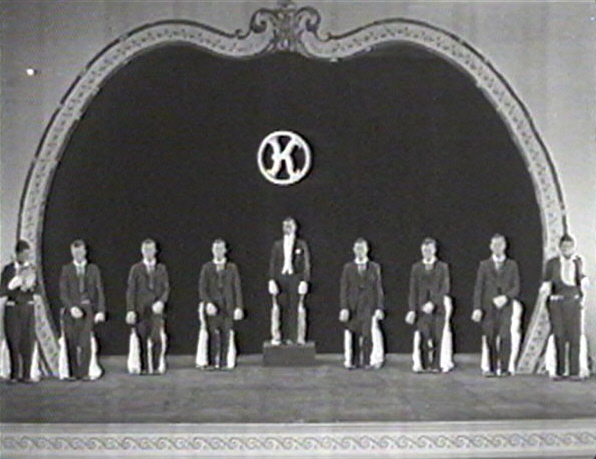
Cinematographer Elgin Lessley photographed Buster Keaton as nine members of a minstrel show in the opening of The Playhouse (1921)

An in-camera effect is any visual effect in a film or video that is created solely by using techniques in and on the camera and/or its parts. The in-camera effect is defined by the fact that the effect exists on the original camera negative or video recording before it is sent to a lab or modified. Effects that modify the original negative at the lab, such as skip bleach or flashing, are not included. Some examples of in-camera effects include the following:

There are many ways one could use the in-camera effect. The in-camera effect is something that often goes unnoticed but can play a critical part in a scene or plot. A popular example of this type of effect is seen in Star Trek, in which the camera is shaken to give the impression of motion happening on the scene. Another simple example could be using a wine glass to give the effect that "ghosting, flares, and refractions" from DIY photography.[1]

See also

[edit]

References

[edit]
Revisions and contributorsEdit on WikipediaRead on Wikipedia
from Grokipedia
An in-camera effect is a visual effect in , , or that is achieved directly during the capture process by manipulating the camera, its components, or physical elements on set, without subsequent digital or alterations. These techniques rely on optical, mechanical, or environmental manipulations to create illusions such as motion blur, superimpositions, or scale distortions, offering a sense of immediacy and realism that digital methods often replicate. In-camera effects encompass a broad range of practical approaches, including multiple exposures for ghosting or elements, matte paintings to simulate backgrounds, to alter perceived distances, and stop-motion using physical models. Early pioneers like employed these methods in the 1930s, as seen in (1933), where stop-motion and miniature sets brought fantastical creatures to life through painstaking frame-by-frame . By the mid-20th century, filmmakers such as advanced the craft with innovative miniatures and pyrotechnics in films like Jason and the Argonauts (1963), emphasizing tangible props and camera tricks over emerging optical printing. The evolution of in-camera effects accelerated in the late 20th century with directors like George Lucas and Steven Spielberg, who integrated motion-control cameras and detailed models in Star Wars: Episode IV - A New Hope (1977) to achieve seamless space battles captured live. In contemporary production, in-camera visual effects (ICVFX) represent a technological leap, utilizing real-time LED walls and game engines to project dynamic environments directly into the camera's view, as pioneered in The Mandalorian (2019–present) by Industrial Light & Magic's StageCraft system. This method provides interactive lighting and reflections on actors and sets in real time, reducing post-production costs while enhancing creative experimentation on location-less stages. Despite the rise of CGI, in-camera effects remain prized for their authenticity, influencing hybrid workflows in major blockbusters and independent projects alike.

Definition and Overview

Core Definition

An in-camera effect is any visual effect in a film or video that is created solely by using techniques applied directly to the camera, its parts, or during , without relying on editing or digital alteration. This approach ensures the effect is embedded in the original footage captured by the camera. Key characteristics of in-camera effects include their real-time capture on or a , distinguishing them from later manipulations. These effects encompass optical manipulations, such as lens adjustments or filters; mechanical techniques, like camera movement or shutter controls. Early filmmakers like employed such methods to pioneer innovative visual storytelling in the late 19th and early 20th centuries. The term "in-camera" in derives from the camera as an enclosed chamber for image exposure, with this usage first attested in the mid-20th century. It emphasizes effects generated directly during the capture process within the camera's light-tight space. The scope of in-camera effects is delimited to camera-centric processes, excluding broader practical effects like standalone props or makeup applications unless they are directly integrated with the camera, such as through custom attachments or optical interventions. This focus maintains a clear boundary around manipulations that occur at the point of image capture, preserving the integrity of the principal photography phase.

Comparison to Other Visual Effects

In-camera effects represent a specific subset of practical effects, which encompass a broader range of on-set physical techniques such as , , and prosthetics that create tangible illusions without relying on digital manipulation. Unlike standalone practical effects that operate independently of the camera—such as a mechanical prop or controlled —in-camera effects specifically leverage the camera's , lenses, or exposure settings to generate the illusion in a single live shot, ensuring seamless integration with performers and environments. This distinction emphasizes the camera's active role in in-camera work, fostering authentic actor interactions that broader practical effects may not always prioritize. In contrast to post-production visual effects (VFX), which involve digital and added after filming—often using software like to layer elements or create impossible scenarios—in-camera effects capture the entire visual outcome during the initial exposure, eliminating the need for multi-pass editing or synthetic overlays. This single-pass approach avoids the potential artifacts of digital integration, such as mismatched lighting or motion blur from compositing, while VFX offers greater flexibility for complex alterations but requires extensive computational resources and can sometimes undermine the organic feel of live-action footage. For instance, whereas VFX might digitally insert a creature into a scene, in-camera methods achieve similar results through real-time camera tricks, preserving the immediacy of the production environment. Optical printing differs fundamentally from in-camera effects as a laboratory-based post-filming process that re-photographs and manipulates exposed to produce composites, dissolves, or other alterations, rather than generating visuals directly during the original camera exposure. This intermediate step, historically used for matching disparate shots or adding elements like matte overlays, introduces potential generational loss in image quality due to repeated exposures, contrasting with the direct, unmediated capture of in-camera techniques that maintain the integrity of the initial footage. Modern filmmaking often employs hybrid approaches that blend in-camera setups with minimal enhancements, such as using practical on-set elements captured in-camera and then lightly refined digitally to correct minor imperfections or extend the effect's scope. However, these hybrids diverge from pure in-camera effects by incorporating VFX layers, potentially diluting the technique's emphasis on self-contained, real-time execution; notable examples include the animatronic dinosaurs in Jurassic Park (1993), which were filmed in-camera but augmented with CGI for broader integration. This balance allows filmmakers to harness the tactile authenticity of in-camera purity while leveraging digital tools for efficiency, though purists advocate maintaining the unadulterated single-shot methodology to preserve visual coherence.

Historical Development

Origins in Early Cinema

The origins of in-camera effects trace back to the late , when pioneering filmmakers began experimenting with the nascent technology of motion pictures to create illusions directly during filming, distinguishing these methods from later techniques. French innovator , a former stage magician, played a pivotal role in these early developments during the 1890s. While filming a street scene in , Méliès experienced a camera malfunction that jammed and then restarted, inadvertently causing an object in the frame—a horse-drawn carriage—to transform into a , revealing the potential of what became known as the stop-motion or technique. He first applied this effect deliberately in his 1896 short The Vanishing Lady, and refined it for narrative purposes in landmark films like (1902), where it enabled fantastical disappearances and transformations without editing. These experiments were enabled by foundational advancements in film technology. The invention of flexible roll film by at in 1889 provided a durable, transparent medium that could be exposed multiple times in a single camera pass, essential for layering images in-camera. Complementing this, the Lumière brothers' Cinématographe, patented in 1895, was a hand-cranked device that combined camera, printer, and projector functions, with its intermittent claw mechanism allowing precise control over film advancement and stationary exposures—facilitating repeatable shots and basic multiple exposures by rewinding the film. Key techniques emerged from these tools, including simple superimpositions and multiple exposures achieved by cranking the camera manually to overlay images on the same strip of film, often against dark backgrounds to enhance visibility. Méliès used painted backdrops and black cloth to mask areas for multiple exposures and substitutions, live action with static artwork, as seen in his elaborate fantasy sets. This approach, rooted in theatrical illusionism, allowed for seamless blends of reality and imagination during . Méliès' background in stage magic profoundly shaped these innovations, drawing from 19th-century illusions at venues like the Théâtre Robert-Houdin to adapt tricks such as ghostly apparitions and object metamorphoses to cinema. Over his career from 1896 to 1914, he produced more than 500 short films, with a significant portion—estimated at over 200—incorporating in-camera effects to drive storytelling in fantasy and science-fiction genres, elevating visual trickery from novelty to narrative essential.

Evolution in the 20th and 21st Centuries

In the 1920s, in-camera effects advanced through innovative stop-motion techniques that integrated animated models with live-action footage in the same frame, as demonstrated by Willis O'Brien's work on The Lost World (1925), the first feature-length film to achieve this seamless compositing. emerged in as a key Hollywood technique, allowing actors to perform against pre-filmed backgrounds projected onto a translucent screen, with early implementations credited to technicians like George J. Teague and used in films such as (1933). By the and 1950s, refinements like synchronized motors and improved film stocks enhanced rear projection's quality, enabling more dynamic scenes in vehicles and reducing the need for on-location shoots. The golden age of Hollywood in the 1930s through 1960s saw the maturation of in-camera effects through Ray Harryhausen's Dynamation process, which combined stop-motion with live-action using a rear projector, matte glass, and double exposures to create lifelike creature interactions. This technique reached a pinnacle in Jason and the Argonauts (1963), where Dynamation animated the film's iconic skeleton army and giant statue, blending miniatures with actors via and precise frame-by-frame . Following the , the rise of (CGI) in the led to a decline in traditional in-camera effects, as (1993) showcased CGI dinosaurs integrated with live-action, convincing the industry of digital alternatives to practical models and stop-motion after decades of reliance on physical techniques. However, the marked a revival in practical-heavy productions seeking authenticity, exemplified by (2009), which employed in-camera methods like practical muzzle flashes for weaponry, on-set gags such as air-cable crashes, and suits for alien interactions to ground its visual effects in tangible realism. In the , digital cameras have integrated in-camera effects through advanced sensors and controls, with the series enabling precise exposures via 14+ stops of and adjustable electronic shutters, allowing filmmakers to capture high-quality composites without film labs. LED panels have further revolutionized on-set lighting, providing dynamic, real-time illumination that interacts with actors and environments, as seen in virtual production workflows for series like , where curved LED walls deliver in-camera backgrounds and reflective lighting. In indie cinema, these tools have democratized practical effects, with low-budget filmmakers using LED strips for mood lighting, fog machines for atmosphere, and everyday props for illusions in genres like horror and sci-fi throughout the 2000s and .

Common Techniques

Exposure-Based Methods

Exposure-based methods in in-camera effects rely on manipulating the amount and timing of light reaching the film or sensor during capture to produce layered, altered, or accelerated visuals without post-production intervention. These techniques exploit the photochemical properties of film or the digital capture process to overlay images, reverse tones, or compress time, often requiring careful control of shutter speed, aperture, and frame intervals to achieve the desired outcome. Pioneered in early cinema, such methods, including those employed by Georges Méliès, laid foundational approaches for creating illusory depth and motion directly in the camera. Multiple exposure involves rewinding the film partially after an initial shot to realign and overlay subsequent images onto the same frame, creating superimposed visuals through repeated exposure of the emulsion. This process demands precise timing and manual intervention, such as using a film's rewind knob to advance only the necessary amount, to ensure alignment and prevent slippage that could ruin the frame. To avoid overexposure, each subsequent exposure must be reduced, typically by applying negative compensation equivalent to the number of overlays. The technique is particularly effective for generating ghost effects, where translucent figures or elements appear to haunt the primary scene, evoking a spectral quality through partial transparency determined by the relative densities of the overlaid images. Double exposure represents a targeted variant of multiple exposure, limited to exactly two distinct shots combined into one frame to produce blended or composite imagery. The key to balanced results lies in mathematical exposure control: for optimal density, each exposure is halved relative to a standard single shot, achieved by either halving the shutter duration (e.g., from 1/125 to 1/250 second) or reducing the aperture by one stop (e.g., from f/8 to f/11), ensuring the cumulative light does not exceed the film's latitude. This adjustment maintains proportional transparency between the elements, allowing one image to subtly integrate with the other without dominance or muddiness. Solarization, sometimes referred to as the , produces a dramatic tone reversal through intentional extreme overexposure directly in the camera, causing highlights to darken and shadows to lighten in a surreal, high-contrast manner. Unlike milder overexposures, this effect arises when the film's crystals reach saturation, leading to a partial reversal observable upon development; it can be initiated camera-side by subjecting the scene to intense lighting conditions, such as direct or artificial floods, far exceeding normal exposure values. The related , often conflated with solarization, involves a similar reversal but is triggered by brief re-exposure to light during the chemical development process after initial capture, resulting in an edge-highlighting halo that enhances contours for an otherworldly glow—though the core initiation here emphasizes the in-camera overexposure phase. True solarization differs from the in its origin during exposure rather than development, though both yield pseudoreversed tones prized in experimental and filmmaking. Time-lapse and reverse exposure techniques alter by varying frame rates during capture relative to standard playback, compressing or expanding temporal events within the camera's recording process. In time-lapse, frames are exposed at a reduced capture rate (e.g., one frame every few seconds or minutes) while played back at the conventional 24 frames per second, accelerating slow phenomena like plant growth or cloud drift into dynamic sequences. The effective speed multiplier, denoting how much faster the action appears compared to real time, is calculated as the playback rate divided by the capture rate; for instance, a capture rate of 1 frame per second yields a 24-fold speedup when played at 24 fps. Reverse exposure extends this by capturing frames in a sequence that, when played backward at normal rate, simulates reversed motion, such as objects un-breaking or crowds dispersing, achieved through intervalometers or manual reversal of advance to manipulate playback without altering exposure per frame. These methods prioritize in-camera timing devices for automated interval control, ensuring consistent exposure across sparse captures.

Camera and Lens Manipulation

Camera and lens manipulation encompasses techniques that physically alter the camera's position, internal components, or to create directly during filming, without relying on compositing. These methods leverage hardware modifications to distort, divide, or enhance the image captured on or , often exploiting and for illusionistic results. Split-screen and masking techniques divide the frame in-camera using physical barriers or dividers, allowing multiple elements to be filmed simultaneously or sequentially within isolated portions of the image. Matte boxes attached to the lens front enable precise masking by inserting black cards or slides to block in specific areas, facilitating composite shots where foreground subjects are exposed against unexposed backgrounds. For instance, in early cinema, cinematographers used matte boxes to create double exposures, recording a in one pass and filling the masked area in a second exposure on the same frame, as demonstrated in 35mm setups where transparencies serve as static backgrounds. Beam splitters, prisms that divide incoming into separate paths, further enable split-screen effects by directing portions of the scene to different strips or sensors, a method refined in stereoscopic to capture dual images without mechanical duplication. In historical color processes like early , bipack —two emulsion layers sandwiched together in the camera—achieved simultaneous color separation by filtering to expose red and green records on adjacent strips in subtractive two-color systems. Forced perspective manipulates camera positioning and lens tilt to alter perceived scale and depth, creating illusions of disproportionate sizes or distances through geometric alignment. By placing subjects and sets at varying distances from the lens while maintaining focus planes, cinematographers exploit similar triangles in the optical field to make foreground elements appear giant relative to backgrounds, as seen in dynamic tracking shots where rigs synchronize actor and prop movements. Tilting the lens or camera angle enhances this distortion, dwarfing or enlarging figures without digital intervention; for example, in fantasy films, low-angle wide lenses positioned actors closer to the camera than sets to simulate height differences, relying on precise measurements to align sightlines. This technique, rooted in stagecraft principles adapted to cinema, avoids complex setups by using the camera's inherent perspective projection. Front and rear projection integrate live action with pre-filmed backgrounds by projecting images onto screens during , synchronizing the projector with the camera to ensure seamless motion without flicker. In rear projection, a projector behind a translucent screen casts the background plate, with actors performing in front; synchronization aligns the projector's shutter with the camera's to match frame rates, typically 24 fps, preventing visible artifacts as the screen's balances exposure. Front projection, an advancement using highly reflective Scotchlite screens (reflecting up to 95% of light back to its source), positions the projector and camera on the same axis via a 45-degree mirror, minimizing shadows and allowing brighter backgrounds for day exteriors. This setup, pioneered for complex composites, requires exact alignment of lenses at equal heights and balanced lighting to match subject illumination with the projected image, as employed in science fiction sequences for illusions. Lens flares and filters introduce stylized optical artifacts by intentionally directing stray light through the lens path, enhancing atmospheric or futuristic aesthetics common in sci-fi cinematography. Prisms or diffraction filters inserted between lens elements create rainbow streaks or glowing halos from point sources, simulating ethereal energy fields; for instance, rotating prism attachments bend light rays to produce angular flares synchronized with narrative tension. Light leaks engineered via partially removed lens caps or anamorphic flares from cylindrical elements add veiling glare and starbursts, embracing imperfections for realism, as in space operas where uncontrolled highlights evoke cosmic vastness. These manipulations prioritize the lens's natural aberrations, often using uncoated optics to amplify effects without digital simulation.

Motion and Animation Techniques

Stop-motion animation is an in-camera technique that creates the illusion of movement by physically manipulating models or puppets frame by frame, with each incremental adjustment captured in a single exposure before the next pose is set. Puppets are typically constructed around internal armatures—skeletal frameworks made from materials like aluminum wire to allow precise control over limb positions while maintaining structural integrity during repeated handling. For smooth playback matching standard projection, animators expose at least 24 frames per second, requiring meticulous adjustments to achieve fluid motion without alterations. Pixilation extends stop-motion principles to live actors, treating human performers as animated objects by photographing them in static poses between exposures, resulting in jerky, exaggerated movements that blend realism with . In this process, actors hold precise positions for each frame while the camera remains stationary, demanding exceptional discipline to minimize unintended shifts during the sequence. A seminal example is Norman McLaren's 1952 Neighbours, where two actors are pixilated to depict a escalating feud over a flower, employing frame-by-frame posing to animate everyday actions into cartoon-like absurdity. Reverse motion produces an illusion of backward time progression by filming actions in forward sequence and then reversing their playback order, achievable in analog setups through in-camera methods like cranking the film backward or inverting the camera during capture. One early technique involved turning the camera upside down to film a scene, followed by flipping the developed film strip end-over-end for projection, ensuring the imagery rights itself while the action unfolds reversely. Pioneered in the late 1890s, this effect was demonstrated in Lumière's Demolition of a Wall (1896, projected in reverse in 1897), where a collapsed structure appears to reconstruct itself by manually reversing the film's advance in the Cinématographe. Pre-digital bullet time simulates extreme slow-motion from a dynamic viewpoint by deploying multiple synchronized cameras in a rotating rig around a stationary subject, triggering them sequentially to capture a 360-degree arc in a single frozen instant. In analog implementations predating widespread CGI, such as late 20th-century innovations in music videos and refined for films like (1999), film cameras like modified Nikons were wired in a circular array—often 100 or more units spaced evenly—to fire in rapid succession, with the resulting stills interpolated into fluid motion during editing. This setup allowed directors to freeze high-speed events like dodging projectiles while the "camera" orbits, as seen in early action sequences emphasizing temporal distortion.

Notable Examples

Classic Film Applications

In the early days of cinema, in-camera effects played a pivotal role in creating fantastical narratives, allowing filmmakers to conjure otherworldly scenes without relying on post-production manipulation. , a pioneer in this domain, masterfully employed superimpositions in his 1902 film (Le Voyage dans la lune) to depict the rocket's launch illusions, blending live action with ethereal overlays that evoked the wonder of space travel. This 13-minute production incorporated over a dozen , showcasing Méliès's innovative and techniques to transform simple stage setups into interstellar adventures, thereby establishing a blueprint for storytelling. By the 1930s, in-camera effects had evolved to integrate stop-motion animation with live-action elements, as seen in and Ernest B. Schoedsack's (1933). Animator Willis O'Brien utilized to composite miniature stop-motion dinosaurs with live actors during the film's intense Skull Island battles, creating a seamless illusion of colossal creatures rampaging through jungles. The production demanded meticulous frame-by-frame filming over approximately 18 months, highlighting the labor-intensive nature of these techniques and their capacity to immerse audiences in prehistoric spectacle. The 1940 fantasy The Thief of Bagdad, directed by Ludwig Berger, Tim Whelan, and , further advanced in-camera for its iconic flying carpet sequences. Effects artists combined matte paintings of vast Arabian landscapes with miniature models, employing traveling mattes to integrate actors against blue-screen backdrops, resulting in fluid aerial journeys that won the film a Special Effects Academy Award. This approach not only enhanced the film's exotic allure but also demonstrated the potential of in-camera methods to evoke magical realism in Technicolor grandeur. A pinnacle of mid-20th-century innovation came with Stanley Kubrick's 2001: A Space Odyssey (1968), where visual effects supervisor devised the slit-scan process for the psychedelic "Star Gate" sequence. This custom camera rig featured a moving slit aperture that exposed elongated, abstract imagery onto 70mm film, producing hypnotic, infinite corridors of light and color to symbolize cosmic transcendence. , requiring precise mechanical control over the camera's horizontal scan, profoundly impacted the narrative's exploration of and the unknown, earning widespread acclaim for its hypnotic visual poetry.

Modern and Contemporary Uses

In the 1980s, in-camera effects experienced a revival in blockbuster cinema, particularly through the innovative use of practical mattes and model integration in high-speed sequences. In Star Wars: Episode VI - Return of the Jedi (1983), the Endor speeder bike chase sequence blended live-action footage of actors on custom-built bike rigs with miniature models filmed using motion-control photography and traveling matte compositing to create seamless illusions of high-velocity forest pursuits. This approach, overseen by Industrial Light & Magic, used motion-control photography for the miniature models and practical live-action bike rigs, with post-production compositing to blend elements, highlighting the practical foundation that minimized extensive digital post-production. By the 2000s, independent films and genre projects highlighted in-camera techniques to achieve raw authenticity in found-footage styles, prioritizing practical camera work over digital augmentation. (2008), directed by , captured its core realism through handheld footage shot using professional cameras such as the F23 and AG-HVX200 to simulate a aesthetic, incorporating natural lens flares from on-set lighting and deliberate camera shakes to simulate amateur documentation of a monster attack, with minimal CGI reserved for the creature itself rather than foundational visuals. This method enhanced the film's immersive, documentary-like tension without altering the primary in-camera aesthetic. Recent blockbusters have further championed practical in-camera effects to counterbalance digital dominance, focusing on tangible builds and on-location . In Mad Max: Fury Road (2015), director George Miller deployed over 150 custom-built vehicle rigs for extended desert chases, capturing explosive stunts and interactions in-camera with limited green-screen use primarily for wire removals and minor extensions, resulting in approximately 2,000 shots that augmented rather than supplanted the practical foundation. Similarly, Dune (2021), under , integrated practical miniatures of sandworms—constructed as detailed physical models—with motion-control rigging to simulate their emergence and movement, blending these elements in-camera against real desert locations for authentic scale and texture before digital refinement. In the digital era, in-camera effects have adapted to video game cinematics and streaming productions, leveraging technologies like LED volume walls for real-time environmental integration. For instance, The Last of Us Part II (2020) employed motion-capture sessions with practical sets and in-camera lighting to ground its narrative cutscenes in physical performances, enhancing emotional realism amid rendered elements. This technique extends to streaming series, where LED volume walls—high-resolution screens displaying game-engine-generated backgrounds—enable actors to interact with dynamic, in-camera environments, as pioneered in The Mandalorian (2019–present) to produce immersive scenes with accurate lighting reflections captured live. Such methods have influenced video game development, allowing cutscene production to incorporate real-time LED backdrops for hybrid practical-digital workflows. For instance, Dune: Part Two (2024) employed practical mechanical ornithopters and sandworm rigs filmed in-camera against real locations, combined with LED screens for environmental integration, building on prior hybrid methods.

Advantages and Challenges

Key Benefits

In-camera effects provide a heightened sense of authenticity and tactility by integrating seamlessly with live-action footage, capturing natural lighting, shadows, and physical interactions that digital compositing often struggles to replicate perfectly. This approach minimizes the "" effect commonly associated with CGI, where artificial elements can appear unnaturally stiff or detached from performers. Furthermore, the presence of tangible props and environments enhances immersion, allowing performers to react genuinely to real stimuli during shoots, which fosters more nuanced and believable portrayals. For certain productions, in-camera effects offer notable cost and time efficiencies, particularly in low-budget scenarios, by eliminating the need for resource-intensive rendering and . Techniques such as multiple exposures, for instance, can achieve complex visuals directly on set with minimal equipment, proving more economical than digital alternatives that require specialized software and extended editing timelines. The creative immediacy of in-camera effects enables directors to preview results in , promoting spontaneous on-set experimentation and rapid iteration, a practice especially valuable in pre-digital eras when post-production capabilities were limited. This hands-on process encourages innovative problem-solving within production constraints, yielding distinctive visuals that stand out from standardized digital workflows. Additionally, in-camera effects contribute environmental and archival value through the creation of physical artifacts, such as models and props, which serve as tangible historical records of the production process. These durable elements facilitate easier restorations and exhibitions without the risks of digital file degradation or obsolescence over time. In modern contexts, films like leverage these benefits by prioritizing practical shots to enhance overall believability.

Limitations and Drawbacks

In-camera effects are inherently prone to technical risks and unpredictability because they depend on physical execution in real time, where external factors like fluctuations or mechanical malfunctions can compromise entire shoots. For example, stop-motion techniques demand meticulously controlled environments to avoid disruptions from air currents or material inconsistencies, such as or fabric shifting unexpectedly during frame captures. Without digital post-processing options, errors cannot be easily undone, often necessitating complete reshoots and escalating production challenges. Scalability issues further constrain in-camera effects, particularly for intricate setups like large-scale projections or explosive elements, which require substantial labor and resources while introducing hazards from heavy machinery and on-set dangers. These processes demand precise coordination among teams and can limit applicability in fast-paced or high-action sequences, where replicating conditions repeatedly becomes inefficient and risky. A key flexibility deficit arises from the inability to modify in-camera effects after filming without returning to the set for new takes, unlike CGI workflows that allow iterative adjustments in . This rigidity increases upfront planning demands and revision costs, as any creative or technical changes post-capture compel resource-intensive rework. While the rise of digital technologies like green screen keying and CGI compositing since the 1990s led to a decline in in-camera effects by offering safer, more efficient alternatives that minimize physical risks and enable rapid iterations, recent developments as of 2025 have spurred a resurgence, with hybrid in-camera (ICVFX) like LED walls addressing some limitations through real-time rendering and enhanced safety.

References

Add your contribution
Related Hubs
Contribute something
User Avatar
No comments yet.