Hubbry Logo
Stop motionStop motionMain
Open search
Stop motion
Community hub
Stop motion
logo
8 pages, 0 posts
0 subscribers
Be the first to start a discussion here.
Contribute something
Stop motion
Stop motion
from Wikipedia
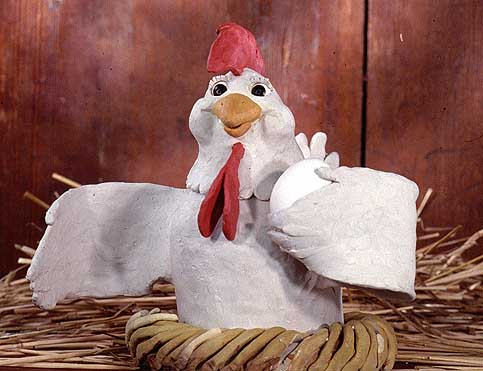
A clay model of a chicken, designed to be used in a clay stop motion animation[1]

Stop motion (also known as stop frame animation) is an animated filmmaking and special effects technique in which objects are physically manipulated in small increments between individually photographed frames so that they will appear to exhibit independent motion or change when the series of frames is played back. Any kind of object can thus be animated, but puppets with movable joints (puppet animation) or clay figures (claymation) are most commonly used. Puppets, models or clay figures built around an armature are used in model animation. Stop motion with live actors is often referred to as pixilation. Stop motion of flat materials such as paper, fabrics or photographs is usually called cutout animation.

Terminology

[edit]

The term "stop motion", relating to the animation technique, is often spelled with a hyphen as "stop-motion"—either standalone or as a compound modifier. Both orthographic variants, with and without the hyphen, are correct, but the hyphenated one has a second meaning that is unrelated to animation or cinema: "a device for automatically stopping a machine or engine when something has gone wrong".[2]

History

[edit]

1849 to 1895: Before film

[edit]

Before the advent of chronophotography in 1878, a small number of picture sequences were photographed with subjects in separate poses. These can now be regarded as a form of stop motion or pixilation, but very few results were meant to be animated. Until celluloid film base was established in 1888 and set the standard for the moving image, animation could only be presented via mechanisms such as the zoetrope.

In 1849, Joseph Plateau published a note about improvements for his Fantascope (a.k.a. phénakisticope). A new translucent variation had improved picture quality and could be viewed with both eyes, by several people at the same time. Plateau stated that the illusion could be advanced even further with an idea communicated to him by Charles Wheatstone: a combination of the fantascope and Wheatstone's stereoscope. Plateau thought the construction of a sequential set of stereoscopic image pairs would be the more difficult part of the plan than adapting two copies of his improved fantascope to be fitted with a stereoscope. Wheatstone had suggested using photographs on paper of a solid object, for instance a statuette. Plateau concluded that for this purpose 16 plaster models could be made with 16 regular modifications. He believed such a project would take much time and careful effort, but would be quite worth it because of the expected marvelous results.[3] The plan was never executed, possibly because Plateau was almost completely blind by this time.

In 1852, Jules Duboscq patented a "Stéréoscope-fantascope ou Bïoscope" (or abbreviated as stéréofantascope) stroboscopic disc. The only known extant disc contains stereoscopic photograph pairs of different phases of the motion of a machine. Due to the long exposure times necessary to capture an image with the photographic emulsions of the period, the sequence could not be recorded live and must have been assembled from separate photographs of the various positions of the machinery.

In 1855, Johann Nepomuk Czermak published an article about his Stereophoroskop and other experiments aimed at stereoscopic moving images. He mentioned a method of sticking needles in a stroboscopic disc so that it looked like one needle was being pushed in and out of the cardboard when animated. He realized that this method provided basically endless possibilities to make different 3D animations. He then introduced two methods to animate stereoscopic pairs of images, one was basically a stereo viewer using two stroboscopic discs and the other was more or less similar to the later zoetrope. Czermak explained how suitable stereoscopic photographs could be made by recording a series of models, for instance to animate a growing pyramid.[4]

On 27 February 1860, Peter Hubert Desvignes received British patent no. 537 for 28 monocular and stereoscopic variations of cylindrical stroboscopic devices (much like the later zoetrope).[5] Desvignes' Mimoscope, received an Honourable Mention "for ingenuity of construction" at the 1862 International Exhibition in London.[6] Desvignes "employed models, insects and other objects, instead of pictures, with perfect success".[7]

In 1874, Jules Janssen made several practice discs for the recording of the passage of Venus with his series Passage de Vénus with his photographic revolver. He used a model of the planet and a light source standing in for the sun.[8] While actual recordings of the passage of Venus have not been located, some practice discs survived and the images of one were turned into a short animated film decades after the development of cinematography.

In 1887, Étienne-Jules Marey created a large zoetrope with a series of plaster models based on his chronophotographs of birds in flight.[9]

1895–1928: The silent film era

[edit]

It is estimated that 80 to 90 percent of all silent films are lost.[10] Extant contemporary movie catalogs, reviews and other documentation can provide some details on lost films, but this kind of written documentation is also incomplete and often insufficient to properly date all extant films or even identify them if original titles are missing. Possible stop motion in lost films is even harder to trace. The principles of animation and other special effects were mostly kept a secret, not only to prevent use of such techniques by competitors, but also to keep audiences interested in the mystery of the magic tricks.[11]

Stop motion is closely related to the stop trick, in which the camera is temporarily stopped during the recording of a scene to create a change before filming is continued (or for which the cause of the change is edited out of the film). In the resulting film, the change will be sudden and a logical cause of the change will be mysteriously absent or replaced with a fake cause that is suggested in the scene. The oldest known example is used for the beheading in Edison Manufacturing Company's 1895 film The Execution of Mary Stuart. The technique of stop motion can be interpreted as repeatedly applying the stop trick. In 1917, clay animation pioneer Helena Smith-Dayton referred to the principle behind her work as "stop action",[12] a synonym of "stop motion".

French trick film pioneer Georges Méliès claimed to have invented the stop-trick and popularized it by using it in many of his short films. He reportedly used stop-motion animation in 1899 to produce moving letterforms.[13]

Segundo de Chomón

[edit]
Julienne Mathieu in a stop motion/pixilation scene from Hôtel électrique (1908)

Spanish filmmaker Segundo de Chomón (1871–1929) made many trick films in France for Pathé. He has often been compared to Georges Méliès as he also made many fantasy films with stop tricks and other illusions (helped by his wife, Julienne Mathieu).

Le théâtre de Bob (April 1906)[14] features stop motion with dolls and objects to represent a fictional automated theatre owned by Bob, played by a live-action child actor. The film used to be credited to Chomón, but he didn't come to Paris (to work for Pathé) until later. Direction and special effects have been attributed to Gaston Velle.[15]

La Maison ensorcelée (1906 or 1907)

De Chomón's La maison ensorcelée (December 1907,[16] or 1906[17]) features stop-motion-animated cutlery and food, among other special effects that depict paranormal activity.

The Sculptor's Nightmare (1908)

De Chomón's Sculpteur moderne was released on 31 January 1908[18] and features heaps of clay molding itself into detailed sculptures that are capable of minor movements. The final sculpture depicts an old woman and walks around before it's picked up, squashed and molded back into a sitting old lady.[19]

Edwin S. Porter and Wallace McCutcheon Sr.

[edit]

American film pioneer Edwin S. Porter filmed a single-shot "lightning sculpting" film with a baker molding faces from a patch of dough in Fun in a Bakery Shop (1902), considered as foreshadowing of clay animation.

In 1905, Porter showed animated letters and very simple cutout animation of two hands in the intertitles in How Jones Lost His Roll.[20]

Porter experimented with a small bit of crude stop-motion animation in his trick film Dream of a Rarebit Fiend (1906).

The "Teddy" Bears (2 March 1907), made in collaboration with Wallace McCutcheon Sr.,[21] mainly shows people in bear costumes, but the short film also features a short stop motion segment with small teddy bears.[22]

On 15 February 1908, Porter released the trick film A Sculptor's Welsh Rabbit Dream that featured clay molding itself into three complete busts.[23] No copy of the film has yet been located. It was soon followed by the similar extant film The Sculptor's Nightmare (6 May 1908) by Wallace McCutcheon Sr.[24]

J. Stuart Blackton

[edit]

J. Stuart Blackton's The Haunted Hotel (23 February 1907)[25] featured a combination of live-action with practical special effects and stop-motion animation of several objects, a puppet and a model of the haunted hotel. It was the first stop-motion film to receive wide scale appreciation. Especially a large close-up view of a table being set by itself baffled viewers; there were no visible wires or other noticeable well-known tricks.[26] This inspired other filmmakers, including French animator Émile Cohl[27] and Segundo de Chomón. De Chomón would release the similar The House of Ghosts (La maison ensorcelée) and Hôtel électrique in 1908, with the latter also containing some very early pixilation.

The Humpty Dumpty Circus (1908, considered lost) by Blackton and his British-American Vitagraph partner Albert E. Smith showed an animated performance of figures from a popular wooden toy set.[28] Smith would later claim that this was "the first stop motion picture in America". The inspiration would have come from seeing how puffs of smoke behaved in the interrupted recordings for a stop trick film they were making. Smith would have suggested to get a patent for the technique, but Blackton thought it wasn't that important.[29] Smith's recollections are not considered to be very reliable.[30][31]

Émile Cohl

[edit]
Émile Cohl's Japon de fantaisie (1907)

Blackton's The Haunted Hotel made a big impression in Paris, where it was released as L'hôtel hanté: fantasmagorie épouvantable. When Gaumont bought a copy to further distribute the film, it was carefully studied by some of their filmmakers to find out how it was made. Reportedly it was newcomer Émile Cohl who unraveled the mystery.[32] Not long after, Cohl released his first film, Japon de fantaisie (June 1907),[33] featuring his own imaginative use of the stop motion technique. It was followed by the revolutionary hand-drawn Fantasmagorie (17 August 1908) and many more animated films by Cohl.

Other notable stop-motion films by Cohl include Les allumettes animées (Animated Matches) (1908),[34] and Mobilier fidèle (1910, in collaboration with Romeo Bosetti).[35] Mobilier fidèle is often confused with Bosetti's object animation tour de force Le garde-meubles automatique (The Automatic Moving Company) (1912).[36][37] Both films feature furniture moving by itself.

Arthur Melbourne-Cooper

[edit]

Of the more than 300 short films produced between 1896 and 1915 by British film pioneer Arthur Melbourne-Cooper, an estimated 36 contained forms of animation. Based on later reports by Melbourne-Cooper and by his daughter Audrey Wadowska, some believe that Cooper's Matches: an Appeal was produced in 1899 and therefore the first stop-motion animation. The extant black-and-white film shows a matchstick figure writing an appeal to donate a Guinea for which Bryant & May would supply soldiers with sufficient matches. No archival records are known that could prove that the film was indeed created in 1899 during the beginning of the Second Boer War. Others place it at 1914, during the beginning of World War I.[38][39] Cooper created more Animated Matches scenes in the same setting. These are believed to also have been produced in 1899,[40] while a release date of 1908 has also been given.[41] The 1908 Animated Matches film by Émile Cohl may have caused more confusion about the release dates of Cooper's matchstick animations. It also raises the question whether Cohl may have been inspired by Melbourne-Cooper or vice versa.

Melbourne-Cooper's lost films Dolly’s Toys (1901) and The Enchanted Toymaker (1904) may have included stop-motion animation.[27] Dreams of Toyland (1908) features a scene with many animated toys that lasts approximately three and a half minutes.

Alexander Shiryaev

[edit]

As a means to plan his performances, ballet dancer and choreographer Alexander Shiryaev started making approximately 20- to 25-centimeter-tall puppets out of papier-mâché on poseable wire frames. He then sketched all the sequential movements on paper. When he arranged these vertically on a long strip, it was possible to give a presentation of the complete dance with a home cinema projector. Later on, he bought a movie camera and between 1906 and 1909 he made many short films, including puppet animations. As a dancer and choreographer, Shiryaev had a special talent to create motion in his animated films. According to animator Peter Lord his work was decades ahead of its time. Part of Shiryaev's animation work is featured in Viktor Bocharov's documentary Alexander Shiryaev: A Belated Premiere (2003).[42][43]

Ladislas Starevich (Russian period)

[edit]

Polish-Russian Ladislas Starevich (1882–1965), started his film career around 1909 in Kaunas filming live insects. He wanted to document rutting stag beetles, but the creatures wouldn't cooperate or would even die under the bright lamps needed for filming. He solved the problem by using wire for the limbs of dried beetles and then animating them in stop-motion. The resulting short film, presumably 1 minute long,[44] was probably titled by the Latin name for the species: Lucanus Cervus (Жук-олень, 1910, considered lost).

Starewicz' The Beautiful Leukanida (1912)

After moving to Moscow, Starevich continued animating dead insects, but now as characters in imaginative stories with much dramatic complexity. He garnered much attention and international acclaim with these short films, including the 10-minute The Beautiful Leukanida (Прекрасная Люканида, или Война усачей с рогачами) (March 1912), the two-minute Happy Scenes from Animal Life (Веселые сценки из жизни животных), the 12-minute The Cameraman's Revenge (Прекрасная Люканида, или Война усачей с рогачами, October 1912) and the 5-minute The Grasshopper and the Ant (Стрекоза и муравей, 1913). Reportedly many viewers were impressed with how much could be achieved with trained insects, or at least wondered what tricks could have been used, since few people were familiar with the secrets of stop-motion animation. The Insects' Christmas (Рождество обитателей леса, 1913) featured other animated puppets, including Father Christmas and a frog. Starevich made several other stop-motion films in the next two years, but mainly went on to direct live-action short and feature films before he fled from Russia in 1918.

Willis O'Brien's early films

[edit]
The Dinosaur and the Missing Link (1915)
Excerpt from The Lost World (1925); animation by Willis O'Brien

Willis O' Brien's first stop-motion film was The Dinosaur and the Missing Link: A Prehistoric Tragedy (1915). Apart from the titular dinosaur and "missing link" ape, it featured several cavemen and an ostrich-like "desert quail", all relatively lifelike models made with clay.[45] This led to a series of short animated comedies with a prehistoric theme for Edison Company, including Prehistoric Poultry (1916), R.F.D. 10,000 B.C. (1917), The Birth of a Flivver (1917) and Curious Pets of Our Ancestors (1917). O'Brien was then hired by producer Herbert M. Dawley to direct, create effects, co-write and co-star with him for The Ghost of Slumber Mountain (1918). The collaborative film combined live-action with animated dinosaur models in a 45-minute film, but after the premiere it was cut down to approximately 12 minutes. Dawley did not give O'Brien credits for the visual effects, and instead claimed the animation process as his own invention and even applied for patents.[46] O'Brien's stop motion work was recognized as a technique to create lifelike creatures for adventure films. O' Brien further pioneered the technique with animated dinosaur sequences for the live-action feature The Lost World (1925).

Helena Smith Dayton

[edit]
Stills from Battle of the Suds and other Helena Smith-Dayton films (1917)

New York artist Helena Smith Dayton, possibly the first female animator, had much success with her "Caricatypes" clay statuettes before she began experimenting with clay animation. Some of her first resulting short films were screened on 25 March 1917. She released an adaptation of William Shakespeare's Romeo and Juliet approximately half a year later. Although the films and her technique received much attention of the press, it seems she did not continue making films after she returned to New York from managing a YMCA in Paris around 1918. None of her films have yet surfaced, but the extant magazine articles have provided several stills and approximately 20 poorly printed frames from two film strips.[47]

Starewicz in Paris

[edit]

By 1920 Starewicz had settled in Paris, and started making new stop-motion films. Dans les Griffes de L'araignée (finished 1920, released 1924) featured detailed hand-made insect puppets that could convey facial expressions with moving lips and eyelids.

Other silent stop motion

[edit]

One of the earliest clay animation films was Modelling Extraordinary, which impressed audiences in 1912.[citation needed]

The early Italian feature film Cabiria (1914) featured some stop motion techniques.[citation needed]

1930s and 1940s

[edit]

Starewicz finished the first feature stop-motion film Le Roman de Renard (The Tale of the Fox) in 1930, but problems with its soundtrack delayed its release. In 1937 it was released with a German soundtrack and in 1941 with its French soundtrack.

Hungarian-American filmmaker George Pal developed his own stop motion technique of replacing wooden dolls (or parts of them) with similar figures displaying changed poses and/or expressions. He called it Pal-Doll and used it for his Puppetoons films since 1932. The particular replacement animation method itself also became better known as puppetoon. In Europe he mainly worked on promotional films for companies such as Philips. Later Pal gained much success in Hollywood with a string of Academy Award for Best Animated Short Films, including Rhythm in the Ranks (1941), Tulips Shall Grow (1942), Jasper and the Haunted House (1942), the Dr. Seuss penned The 500 Hats of Bartholomew Cubbins (1943) and And to Think That I Saw It on Mulberry Street (1944), Jasper and the Beanstalk (1945), John Henry and the Inky-Poo (1946), Jasper in a Jam (1946), and Tubby the Tuba (1947). Many of his puppetoon films were selected for preservation in the United States National Film Registry.

Willis O' Brien's expressive and emotionally convincing animation of the big ape in King Kong (1933) is widely regarded as a milestone in stop-motion animation and a highlight of Hollywood cinema in general.

In 1935, The New Gulliver, a Soviet stop motion-animated cartoon, made an extensive use of puppet animation, running almost all the way through the film (it begins and ends with short live-action sequences). The film was released to widespread acclaim and earned director Aleksandr Ptushko a special prize at the International Cinema Festival in Milan.

A 1940 promotional film for Autolite, an automotive parts supplier, featured stop-motion animation of its products marching past Autolite factories to the tune of Franz Schubert's Military March. An abbreviated version of this sequence was later used in television ads for Autolite, especially those on the 1950s CBS program Suspense, which Autolite sponsored.

The first British animated feature was the stop motion instruction film Handling Ships (1945) by Halas and Batchelor for the British Admiralty. It was not meant for general cinemas, but did become part of the official selection of the 1946 Cannes Film Festival.

The first Belgian animated feature was an adaptation of the Tintin comic The Crab with the Golden Claws (1947) with animated puppets.

The first Czech animated feature was the package film The Czech Year (1947) with animated puppets by Jiří Trnka. The film won several awards at the Venice Film Festival and other international festivals. Trnka would make several more award-winning stop motion features including The Emperor's Nightingale (1949), Prince Bayaya (1950), Old Czech Legends (1953), or A Midsummer Night's Dream (1959). He also directed many short films and experimented with other forms of animation.

1950s

[edit]
Gumbasia (1955) by Art Clokey

Ray Harryhausen learned under O'Brien on the film Mighty Joe Young (1949). Harryhausen would go on to create many memorable stop motion effects for a string of successful fantasy films over the next three decades. These included The Beast from 20,000 Fathoms (1953), It Came from Beneath the Sea (1955), Jason and the Argonauts (1963), The Golden Voyage of Sinbad (1973), and Clash of the Titans (1981).

It wasn't until 1954 before a feature animated film with a technique other than cel animation was produced in the US. The first was the stop motion adaptation of 19th century composer Engelbert Humperdinck's opera Hänsel und Gretel as Hansel and Gretel: An Opera Fantasy.

In 1955, Karel Zeman made his first feature film Journey to the Beginning of Time inspired by Jules Verne, featuring stop-motion animation of dinosaurs and other prehistoric creatures.

Art Clokey started his adventures in clay with a freeform clay short film called Gumbasia (1955), which shortly thereafter propelled him into the production of his more structured TV series Gumby (1955–1989), with the iconic titular character. In partnership with the United Lutheran Church in America, he also produced Davey and Goliath (1960–2004). The theatrical feature Gumby: The Movie (1992, released in 1995) was a box-office bomb.

In Hungary, Hungarian–French puppet designer and animated film director, Éva Balla‑Falus, began her series of 6 animated films with various collaborators (with the sculptor Zoltán Olcsai-Kiss, Megy a juhász szamáron in 1948, and Vitamin ABC in 1950, Kacsa in 1951, Balkéz Tóbiás in 1953, Mese a mihaszna köcsögről in 1956, and A didergő király in 1957.

On 22 November 1959, the first episode of Unser Sandmänchen (Our Little Sandman) was broadcast on DFF (East German television). The 10-minute daily bedtime show for young children features the title character as an animated puppet, and other puppets in different segments. A very similar Sandmänchen series, possibly conceived earlier, ran on West German television from 1 December 1959 until the German reunification in 1989. The East German show was continued on other German networks when DFF ended in 1991, and is one of the longest running animated series in the world.[citation needed] The theatrical feature Das Sandmännchen – Abenteuer im Traumland (2010) was fully animated with stop-motion puppets.

1960s and 1970s

[edit]
Pat & Mat, two inventive but clumsy neighbors, was introduced in 1976,[48] while the first made-for-TV episode Tapety (translated Wallpaper) was produced in 1979 for ČST Bratislava.

Japanese puppet animator Tadahito Mochinaga started out as assistant animator in short anime (propaganda) films Arichan (1941) and Momotarō no Umiwashi (1943). He fled to Manchukuo during the war and stayed in China afterwards. Due to the scarcity of paint and film stock shortly after the war, Mochinaga decided to work with puppets and stop motion. His work helped popularize puppet animation in China, before he returned to Japan around 1953 where he continued working as animation director. In the 1960s, Mochinaga supervised the "Animagic" puppet animation for productions by Arthur Rankin Jr. and Jules Bass' Videocraft International, Ltd. (later called Rankin/Bass Productions, Inc.) and Dentsu, starting with the syndicated television series The New Adventures of Pinocchio (1960-1961). The Christmas TV special Rudolph the Red-Nosed Reindeer has been telecasted annually since 1964 and has become one of the most beloved holiday specials in the United States. They made three theatrical feature films Willy McBean and His Magic Machine (1965), The Daydreamer (1966, stop motion / live-action) and Mad Monster Party? (1966, released in 1967), and the television special Ballad of Smokey the Bear (1966) before the collaboration ended. Rankin/Bass worked with other animators for more TV specials, with titles such as The Little Drummer Boy (1968), Santa Claus is Comin' to Town (1970) and Here Comes Peter Cottontail (1971).

British television has shown many stop motion series for young children since the 1960s. An early example is Snip and Snap (1960-1961) by John Halas in collaboration with Danish paper sculptor Thok Søndergaard (Thoki Yenn), featuring dog Snap, cut from a sheet of paper by pair of scissors Snip.

Apart from their cutout animation series, British studio Smallfilms (Peter Firmin and Oliver Postgate) produced several stop motion series with puppets, beginning with Pingwings (1961-1965) featuring penguin-like birds knitted by Peter's wife Joan and filmed on their farm (where most of their productions were filmed in an unused barn). It was followed by Pogles' Wood (1965-1967), Clangers (1969-1972, 1974, revived in 2015), Bagpuss (1974) and Tottie: The Story of a Doll's House (1984).

Czech surrealist filmmaker Jan Švankmajer's released his short artistic films since 1964, which usually contain much experimental stop motion. He started to gain much international recognition in the 1980s. Since 1988 he has mostly been directing feature films which feature much more live action than stop motion. These include Alice, an adaptation of Lewis Carroll's Alice's Adventures in Wonderland, and Faust, a rendition of the legend of the German scholar. Švankmajer's work has been highly influential on other artists, such as Terry Gilliam and the Quay brothers (although the latter claim to have only discovered Švankmajer's films after having developed their own similar style).

French animator Serge Danot created The Magic Roundabout (1965) which played for many years on the BBC.

Polish studio Se-ma-for produced popular TV series with animated puppets in adaptations of Colargol (Barnaby the Bear in the UK, Jeremy in Canada) (1967-1974) and The Moomins (1977-1982).

In the 1960s and 1970s, independent clay animator Eliot Noyes Jr. refined the technique of "free-form" clay animation with his Oscar-nominated 1965 film Clay (or the Origin of Species). Noyes also used stop motion to animate sand lying on glass for his musical animated film Sandman (1975).

Italian director Francesco Misseri created the clay animation TV series Mio Mao (1970-1976, 2002–2007), The Red and the Blue (Il Rosso e il Blu, 1976), and a TV series with an animated origami duck Quaq Quao (1978-1979).

The British artists Brian Cosgrove and Mark Hall (Cosgrove Hall Films) produced two stop-motion animated adaptions of Enid Blyton's Noddy book series, including the original series of the same name (1975–1982) and Noddy's Toyland Adventures (1992–2001), a full-length film The Wind in the Willows (1983) and later a multi-season TV series, both based on Kenneth Grahame's classic children's book of the same title. They also produced a documentary of their production techniques, Making Frog and Toad.

In 1975, filmmaker and clay animation experimenter Will Vinton joined with sculptor Bob Gardiner to create an experimental film called Closed Mondays which became the first stop-motion film to win an Oscar. Will Vinton followed with several other successful short film experiments including The Great Cognito, The Creation, and Rip Van Winkle which were each nominated for Academy Awards. In 1977, Vinton made a documentary about this process and his style of animation which he dubbed "claymation"; he titled the documentary Claymation. Soon after this documentary, the term was trademarked by Vinton to differentiate his team's work from others who had been, or were beginning to do, "clay animation". While the word has stuck and is often used to describe clay animation and stop motion, it remains a trademark owned currently by Laika Entertainment, Inc. Twenty clay-animation episodes featuring the clown Mr. Bill were a feature of Saturday Night Live, starting from a first appearance in February 1976.

At very much the same time in the UK, Peter Lord and David Sproxton formed Aardman Animations that would produce many commercials, TV series, short films and eventually also feature films. In 1976 they created the character Morph who appeared as an animated side-kick to the TV presenter Tony Hart on his BBC TV programme Take Hart. The five-inch-high presenter was made from a traditional British modelling clay called Plasticine. In 1977 they started on a series of animated films, again using modelling clay, but this time made for a more adult audience. The soundtrack for Down and Out was recorded in a Salvation Army Hostel and Plasticine puppets were animated to dramatise the dialogue. A second film, also for the BBC followed in 1978. A TV series The Amazing Adventures of Morph was aired in 1980.

Sand-coated puppet animation was used in the Oscar-winning 1977 film The Sand Castle, produced by Dutch-Canadian animator Co Hoedeman. Hoedeman was one of dozens of animators sheltered by the National Film Board of Canada, a Canadian government film arts agency that had supported animators for decades. A pioneer of refined multiple stop-motion films under the NFB banner was Norman McLaren, who brought in many other animators to create their own creatively controlled films. Notable among these are the pinscreen animation films of Jacques Drouin, made with the original pinscreen donated by Alexandre Alexeieff and Claire Parker.

Czech filmmakers Lubomír Beneš and Vladimír Jiránek debuted their animated puppet characters Pat & Mat, two inventive but clumsy neighbors, in the 7-minute short Kuťáci in 1976. Since 1979, over 100 episodes have been broadcast irregularly.[49] Since 2014, new episodes were presented in theatrically released package films. The series became very popular in several countries, especially in The Netherlands, the only country where the characters are voiced.

One of the main British animation teams, John Hardwick and Bob Bura, were the main animators in many early British TV shows, and are famous for their work on the Trumptonshire trilogy (Camberwick Green, Trumpton and Chigley). Their company was named Stop Motion Limited,[50] the term having been their trademark until it became generic.[51]

Disney experimented with several stop-motion techniques by hiring independent animator-director Mike Jittlov to make the first stop-motion animation of Mickey Mouse toys ever produced, in a short sequence called Mouse Mania, part of a TV special, Mickey's 50, which commemorated Mickey's 50th anniversary in 1978. Jittlov again produced some impressive multi-technique stop-motion animation a year later for a 1979 Disney special promoting their release of the feature film The Black Hole. Titled Major Effects, Jittlov's work stood out as the best part of the special. Jittlov released his footage the following year to 16mm film collectors as a short film titled The Wizard of Speed and Time, along with four of his other short multi-technique animated films, most of which eventually evolved into his own feature-length film of the same title. Effectively demonstrating almost all animation techniques, as well as how he produced them, the film was released to theaters in 1987 and to video in 1989.

1980s

[edit]

In the 1970s and 1980s, Industrial Light & Magic often used stop-motion model animation in such films as the original Star Wars trilogy: the holochess sequence in Star Wars, the Tauntauns and AT-AT walkers in The Empire Strikes Back, and the AT-ST walkers in Return of the Jedi were all filmed using stop-motion animation, with the latter two films utilising go motion: an invention from renowned visual effects veteran Phil Tippett. The many shots including the ghosts in Raiders of the Lost Ark , the Dragon in Dragonslayer, and the first two feature films in the RoboCop series use Tippett's go motion.

In the UK, Aardman Animations continued to grow. Channel 4 funded a new series of clay animated films, Conversation Pieces, using recorded soundtracks of real people talking. A further series in 1986, called Lip Sync, premiered the work of Richard Goleszowski (Ident), Barry Purves (Next), and Nick Park (Creature Comforts), as well as further films by Sproxton and Lord. Creature Comforts won the Oscar for Best Animated Short in 1990. In 1986, they also produced a notable music video for "Sledgehammer", a song by Peter Gabriel.

In 1980, Marc Paul Chinoy directed the 1st feature-length clay animated film, based on the famous Pogo comic strip. Titled I go Pogo. It was aired a few times on American cable channels but has yet to be commercially released. Primarily clay, some characters required armatures, and walk cycles used pre-sculpted hard bases legs.[52]

Stop motion was also used for some shots of the final sequence of the first Terminator movie, also for the scenes of the small alien ships in Spielberg's Batteries Not Included in 1987, animated by David W. Allen. Allen's stop motion work can also be seen in such feature films as The Crater Lake Monster (1977), Q - The Winged Serpent (1982), The Gate (1987) and Freaked (1993). Allen's King Kong Volkswagen commercial from the 1970s is now legendary among model animation enthusiasts.

In 1985, Will Vinton and his team released an ambitious feature film in stop motion called "The Adventures Of Mark Twain" based on the life and works of the famous American author. While the film may have been a little sophisticated for young audiences at the time, it got rave reviews from critics and adults in general.[citation needed] Vinton's team also created the Nomes and the Nome King for Disney's "Return to Oz" feature, for which they received an Academy Award Nomination for Special Visual Effects. In the late 1980s and early 1990s, Will Vinton became very well known for his commercial work as well with stop motion campaigns including The California Raisins and The Noid.

Jiří Barta released his award-winning fantasy film The Pied Piper (1986).

From 1986 to 1991, Churchill Films produced The Mouse and the Motorcycle, Runaway Ralph, and Ralph S. Mouse for ABC television. The shows featured stop-motion characters combined with live action, based on the books of Beverly Cleary. John Clark Matthews was the animation director, with Justin Kohn, Joel Fletcher, and Gail Van Der Merwe providing character animation.[53] The company also produced other films based on children's books.

From 1986 to 2000, over 150 five-minute episodes of Pingu, a Swiss children's comedy, were produced by Trickfilmstudio.

Aardman Animations' Nick Park became very successful with his short claymation Creature Comforts in 1989, which had talking animals voicing vox pop interviews. Park then used the same format to produce a series of commercials between 1990 and 1992. The commercials have been credited as having introduced a more "caring" way of advertising in the UK. Richard Goleszowski later directed two 13-episode Creature Comforts TV series (2003, 2005–2006) and a Christmas special (2005). Also in 1989, Park introduced his very popular clay characters Wallace and Gromit in A Grand Day Out. Three more short films and one feature film and many TV adaptions and spin-offs would follow. Among many other awards, Park won the Academy Award for Best Animated Feature for the feature-length outing Wallace & Gromit: The Curse of the Were-Rabbit. Park also worked on the Chicken Run movie, which was another film from Aardman Animations.

1990s

[edit]

In 1992, Trey Parker and Matt Stone made The Spirit of Christmas, a short cutout animated student film made with construction paper. In 1995 they made a second short with the same titled, commissioned as a Christmas greeting by Fox Broadcasting Company executive Brian Graden. The concepts and characters were further developed into the TV hit series South Park (since 1997). Except for the pilot, all animation has been created on computers in the same style.

The Nightmare Before Christmas (1993), directed by Henry Selick and produced by Tim Burton, was one of the more widely released stop-motion features and became the highest grossing stop-motion animated movie of its time, grossing over $50 million domestic. Henry Selick also went on to direct James and the Giant Peach and Coraline, and Tim Burton went on to direct Corpse Bride and Frankenweenie.

The stop-motion feature The Secret Adventures of Tom Thumb was released in 1993.

In November 1998, the first episode of Bob the Builder released on BBC. Bob the Builder was a popular British stop-motion television series created by Keith Chapman & produced and owned by HIT Entertainment.

In 1999, Will Vinton launched the first US prime-time stop-motion television series called The PJs, co-created by actor-comedian Eddie Murphy. The Emmy-winning sitcom aired on Fox for two seasons, then moved to the WB for an additional season. Vinton launched another series, Gary & Mike, for UPN in 2001.

In 1999, Tsuneo Gōda directed 30-second sketches of the character Domo. The shorts, animated by stop-motion studio Dwarf, are currently still produced in Japan and have received universal critical acclaim from fans and critics. Gōda also directed the stop-motion movie series Komaneko in 2004.

21st century

[edit]
The music video to "Green" (2018) by Cavetown, a modern example of stop-motion animation

The BBC commissioned thirteen episodes of stop frame animated Summerton Mill in 2004 as inserts into their flagship pre-school program, Tikkabilla. Created and produced by Pete Bryden and Ed Cookson, the series was then given its own slot on BBC1 and BBC2 and has been broadcast extensively around the world.

Other notable stop-motion feature films released since 2000 include Fantastic Mr. Fox (2009), $9.99 (2009), Hell and Back (2015), Anomalisa (2015), Isle of Dogs (2018), Alien Xmas (2020), Henry Selick's Wendell & Wild (2022) and Guillermo del Toro's Pinocchio (2022).

In 2003, the pilot film for the series Curucuru and Friends, produced by Korean studio Ffango Entertoyment is greenlighted into a children's animated series in 2004 after an approval with the Gyeonggi Digital Contents Agency. It was aired in KBS1 on November 24, 2006, and won the 13th Korean Animation Awards in 2007 for Best Animation. Ffango Entertoyment also worked with Frontier Works in Japan to produce the 2010 film remake of Cheburashka.[54]

Since 2005, Robot Chicken has mostly utilized stop-motion animation, using custom made action figures and other toys as principal characters.

Since 2009, Laika, the stop motion successor to Will Vinton Studios, has released six feature films, which have collectively grossed over $400 million: Coraline (2009), ParaNorman (2012), The Boxtrolls (2014), Kubo and the Two Strings (2016), Missing Link (2019) and Wildwood (2026).

Directors like Tim Burton and Wes Anderson are still using stop-motion animation in some of their live action films.[55][56]

In 2019 and 2020, cinematographer Jeffrey Gardner won back-to-back Daytime Creative Arts Emmy Awards for Outstanding Cinematography on the stop-motion series Tumble Leaf (Amazon Studios), marking one of the rare instances where a director of photography has been recognized for work in stop-motion television.[57][58] While stop-motion histories often highlight animators and directors, Gardner’s awards underscore the vital role of cinematography in the medium, where lighting, lenses, and miniature set design create the show’s distinctive visual storytelling.

In November 2024, Disney released Mickey & Minnie's Christmas Carols, a series of five stop motion shorts featuring Mickey, Minnie, Donald, Daisy, Goofy and Pluto.

Variations of stop motion

[edit]

Stereoscopic stop-

[edit]

Stop motion has very rarely been shot in stereoscopic 3D throughout film history. The first 3D stop motion short was In Tune With Tomorrow (also known as Motor Rhythm), made in 1939 by John Norling. The second stereoscopic stop motion release was The Adventures of Sam Space in 1955 by Paul Sprunck. The third and latest stop motion short in stereo 3D was The Incredible Invasion of the 20,000 Giant Robots from Outer Space in 2000 by Elmer Kaan[59] and Alexander Lentjes.[60][61] This is also the first ever 3D stereoscopic stop motion and CGI short in the history of film. The first all stop-motion 3D feature is Coraline (2009), based on Neil Gaiman's best-selling novel and directed by Henry Selick.[62] Another recent example is the Nintendo 3DS video software which comes with the option for Stop-Motion videos. This has been released December 8, 2011 as a 3DS system update. Also, the film ParaNorman is in 3D stop motion.

Go motion

[edit]

Another more complicated variation on stop motion is go motion, co-developed by Phil Tippett and first used on the films The Empire Strikes Back (1980), Dragonslayer (1981), and the RoboCop films. Go motion involved programming a computer to move parts of a model slightly during each exposure of each frame of film, combined with traditional hand manipulation of the model in between frames, to produce a more realistic motion blurring effect. Tippett also used the process extensively in his 1984 short film Prehistoric Beast, a 10 minutes long sequence depicting a herbivorous dinosaur (Monoclonius), being chased by a carnivorous one (Tyrannosaurus). With new footage Prehistoric Beast became Dinosaur! in 1985, a full-length dinosaurs documentary hosted by Christopher Reeve. Those Phil Tippett's go motion tests acted as motion models for his first photo-realistic use of computers to depict dinosaurs in Jurassic Park in 1993. A low-tech, manual version of this blurring technique was originally pioneered by Władysław Starewicz in the silent era, and was used in his feature film The Tale of the Fox (1931).

Comparison to computer-generated imagery

[edit]

The reasons for using stop motion instead of the more advanced computer-generated imagery (CGI) include the appeal of its distinct look and the notion that it accurately displays real-life textures, while CGI texturing can look more artificial and isn't always quite as close to realism.[63][64] This is appreciated by a number of animation directors, such as Guillermo del Toro,[65] Henry Selick,[66] Tim Burton[67] and Travis Knight.[68]

Guillermo del Toro aimed to praise the benefits of stop motion in his movie Pinocchio, saying that he wanted "the expressiveness and the material nature of a handmade piece of animation — an artisanal, beautiful exercise in carving, painting, sculpting".[69]

Stop motion in other media

[edit]

Many young people begin their experiments in movie making with stop- , thanks to the ease of modern stop-motion software and online video publishing.[70] Many new stop-motion shorts use clay animation into a new form.[71]

Singer-songwriter Oren Lavie's music video for the song Her Morning Elegance was posted on YouTube on January 19, 2009. The video, directed by Lavie and Yuval and Merav Nathan, uses stop motion and has achieved great success with over 25.4 million views, also earning a 2010 Grammy Award nomination for "Best Short Form Music Video".

Stop motion has occasionally been used to create the characters for computer games, as an alternative to CGI. The Virgin Interactive Entertainment Mythos game Magic and Mayhem (1998) featured creatures built by stop-motion specialist Alan Friswell, who made the miniature figures from modelling clay and latex rubber, over armatures of wire and ball-and-socket joints. The models were then animated one frame at a time, and incorporated into the CGI elements of the game through digital photography. "ClayFighter" for the Super NES and The Neverhood and Hylics 2[72] for the PC are other examples.

Scientists at IBM used a scanning tunneling microscope to single out and move individual atoms which were used to make characters in A Boy and His Atom. This was the tiniest scale stop-motion video made at that time.[73]

Replicating the distinct tactile look of traditional stop motion has gained popularity in contemporary media through the use of CGI. This approach can often provide a more cost-effective and accessible means of achieving the stop motion aesthetic. Noteworthy among such endeavors is the work of Blender animator Ian Worthington, exemplified by his 2021 short film "Captain Yajima".[74] Another prominent example of this trend includes The LEGO Movie, which uses CGI to replicate the visual style and imperfections of stop motion.[75]

See also

[edit]

References

[edit]

Further reading

[edit]
[edit]
Revisions and contributorsEdit on WikipediaRead on Wikipedia
from Grokipedia
Stop motion is an animated technique in which physical objects, such as models, puppets, or figures, are moved in small increments between individually photographed frames, creating the illusion of fluid motion when the sequence is played back at standard speed. This labor-intensive process, often requiring thousands of frames for even short sequences, distinguishes it from digital or drawn by relying on tangible, real-world manipulation to produce lifelike or fantastical movements. The origins of stop motion trace back to the late 19th century, with the earliest documented example being Albert E. Smith's The Humpty Dumpty Circus in 1898, which used articulated wooden figures to depict a miniature circus performance. By the early 20th century, the technique evolved into a cornerstone of special effects in live-action films, most notably through Willis H. O'Brien's groundbreaking work on The Lost World (1925) and King Kong (1933), where detailed armatures and miniature sets brought prehistoric creatures to life in ways that captivated audiences and set new standards for visual storytelling. Mid-century innovations, such as Art Clokey's clay-based Gumby series (1957–1969), further popularized accessible forms of the medium, while studios like Aardman Animations and Laika advanced puppetry and character design in the late 20th century. Stop motion encompasses several specialized subtypes, each leveraging different materials and methods to achieve animation: molds pliable clay figures for organic deformations, as seen in Nick Park's Wallace & Gromit shorts; puppet animation employs wire-armatured dolls for precise control, common in feature films; applies the technique to human actors by photographing them in incremental poses; and cut-out animation uses flat paper or card shapes for simpler, silhouette-driven narratives. These approaches demand meticulous , lighting consistency, and often custom-built sets, with animators adjusting elements by mere millimeters per frame to avoid unnatural jerks. Modern productions increasingly integrate digital tools, such as for facial expressions or CGI for complex backgrounds, enhancing efficiency without sacrificing the handmade aesthetic. Among its most celebrated works are Tim Burton-produced classics like The Nightmare Before Christmas (1993), which featured 227 handcrafted puppets, and Wes Anderson's Fantastic Mr. Fox (2009), praised for its textured, fabric-based models. In the 2020s, stop motion continues to thrive through innovative features such as Marcel the Shell with Shoes On (2021), a hybrid of practical animation and live-action, and Guillermo del Toro's Pinocchio (2022), which combined traditional puppetry with subtle digital refinements to earn critical acclaim and an Academy Award for Best Animated Feature. This enduring appeal stems from its tactile charm and storytelling depth, attracting filmmakers who value craftsmanship amid the dominance of computer-generated imagery.

Fundamentals

Definition

Stop motion is an animated filmmaking technique in which physical objects, such as models, puppets, or cutouts, are manipulated in small increments between individually photographed frames, creating the illusion of movement when the frames are played in rapid succession. This method relies on frame-by-frame as its foundational mechanism, capturing sequential still images of incremental changes to simulate lifelike motion. At standard film playback speeds of 24 frames per second, the quick succession of these images blends them into perceived continuous action, leveraging the human eye's retention of visual . Stop motion originates from analog practices centered on hands-on physical manipulation of tangible elements, setting it apart from digital animation approaches that rely on and algorithms. The technique draws on the persistence of vision principle, an where the eye briefly holds onto an image after it vanishes, enabling a series of static frames to appear as fluid movement; its first practical uses appeared in early cinema to bring inanimate objects to life.

Principles

Stop motion animation adheres to core principles adapted from the foundational 12 principles of animation developed by Disney animators, which are applied to physical models to create lifelike movement despite the medium's frame-by-frame nature. These include , where models are deformed to convey flexibility and weight, such as compressing a puppet's body upon impact to simulate elasticity; , building tension before an action, like a slight backward lean prior to a jump to prepare the viewer; staging, positioning elements for clear visibility of key poses without obstruction; and follow-through, allowing parts of the model to continue moving after the main action stops, mimicking natural deceleration. These principles guide animators in breaking down complex motions into discrete poses that, when sequenced, produce fluid, believable results in physical setups. A fundamental aspect of achieving realistic motion is the incremental adjustment of models between frames, typically limited to 1-2 mm per frame to approximate the subtlety of natural or object movement at standard rates like 24 frames per second (fps). This small displacement ensures smooth transitions without jerky artifacts, with variations in increment size—larger for fast actions and smaller for delicate ones—applied to create acceleration and deceleration. To prevent motion blur from any unintended shifts during exposure, animators calculate based on the ; for 24 fps, a of approximately 1/50 second adheres to the , providing just enough exposure time for natural-looking playback while keeping each static frame sharp. Physical setups in stop motion must account for real-world physics, particularly and , which armatures are engineered to counter and simulate. Armatures, serving as internal skeletons, provide the rigidity needed to hold poses against gravitational pull, allowing animators to position limbs in ways that defy easy collapse while conveying a sense of weight through subtle sagging or tension in materials. is replicated by posing elements to show carryover, such as trailing fabric or delayed settling of joints after a turn, ensuring movements follow natural arcs rather than rigid lines. These physical constraints demand precise adjustments to avoid unnatural floating or stiffness. Artistically, stop motion balances meticulous precision in posing with to infuse , where subtle variations in pose—like a slight head tilt or finger curl—convey nuance beyond mechanical accuracy. Techniques such as onionskinning, which overlays translucent previews of prior frames, aid this by helping animators maintain continuity in subtle adjustments. This interplay allows animators to evoke personality and intent through the inherent tactility of physical models, turning technical rules into expressive tools.

Terminology

Stop motion, as a technique, is distinct from , where the latter captures natural changes over time by taking photographs at set intervals without manual intervention between frames, whereas stop motion involves deliberate, incremental manipulation of objects or puppets to simulate movement. Similarly, refers specifically to a subset of stop motion that uses malleable clay or figures for characters and sets, allowing for deformation and reshaping between frames, in contrast to the broader category that encompasses rigid or modular puppets. Central to stop motion puppetry is the armature, an internal skeletal typically constructed from metal joints, wires, and ball-and-socket mechanisms that enables precise posing and stability to maintain positions during extended shoots. Replaceable parts, also known as replacement animation components, are modular elements such as interchangeable , eyes, or limbs designed to be swapped out frame by frame, facilitating complex actions like facial expressions without altering a single body. in this context denotes the synchronization of a puppet's mouth shapes—often achieved via replaceable parts or sculpted adjustments—with pre-recorded audio to create the illusion of speech. Onion skin, or , is a visualization aid that overlays semi-transparent images of previous and subsequent onto the current one, helping animators ensure smooth transitions and consistent motion paths, much like tracing through onion-skin paper in . Industry acronyms include FPS, or frames per second, which measures the rate at which individual images are captured and played back to achieve fluid , typically ranging from 12 to 24 FPS depending on the desired and production constraints. , shorthand for , describes the focused range within a shot, crucial in stop motion for selectively blurring backgrounds or foregrounds to enhance three-dimensionality and direct viewer attention through camera control. Terminology has evolved from analog-era tools like the —a vertical stand with an overhead camera for multiplane effects and precise tabletop movements in early stop motion setups—to digital equivalents such as the motion control rig, a computer-programmed system that automates repeatable camera paths, pans, and tilts for complex sequences.

History

Precursors ()

The 19th-century precursors to stop motion emerged from and early photographic experiments that harnessed the persistence of vision principle to simulate motion through sequential static images, without the use of . These innovations focused on mechanical devices displaying drawings or photographs in rapid succession, establishing the conceptual foundation for frame-by-frame . Key among them was the phenakistoscope, invented by Belgian physicist Joseph Plateau in 1832, which featured a cardboard disk with sequential drawings around its edge and evenly spaced radial slits; when spun and viewed through the slits against a mirror, the images appeared to move fluidly. Plateau's device, also known as the fantascope, demonstrated how brief glimpses of successive phases could trick the eye into perceiving continuous action, influencing later principles. Building on this, the was patented in 1834 by British mathematician as the "daedalum," though it gained its common name in 1866. This cylindrical drum contained a strip of sequential drawings or printed images inside, with viewing slits around its upper edge; rotation allowed observers to peer through the slits and see the images blend into apparent motion, accommodating multiple viewers unlike the single-user phenakistoscope. Horner's invention popularized the idea of interchangeable image strips, making it a versatile tool for creating simple animations of figures in motion, such as dancers or animals. In the late , Plateau further advanced sequential imagery by creating detailed drawings for phenakistoscope discs, including complex scenes like a dancer performing a pirouette, which showcased refined techniques for capturing fluid movement in discrete stages. Photographic advancements brought these concepts closer to stop motion by capturing real-world motion in isolated frames. In 1878, photographer Eadweard Muybridge conducted groundbreaking experiments at Palo Alto, California, commissioned by railroad magnate Leland Stanford, using a battery of up to 24 cameras arranged in a line and triggered by electromagnetic wires tripped by the subject. His series of stop-action photographs of a trotting horse named Occident proved the "unsupported transit" theory—that all four hooves briefly leave the ground—producing sequences that, when viewed in order, revealed natural locomotion in unprecedented detail. Muybridge's work, later published in Animal Locomotion (1887), emphasized the power of sequential stills to dissect and reconstruct movement, directly inspiring frame-by-frame techniques in animation. Toward the century's end, Thomas Edison's , patented in 1891 but commercially debuted in 1894, represented a transitional device that displayed short loops of sequential photographs through a viewer, including early experiments with posed figures to simulate motion. These non-film precursors collectively shifted focus from continuous motion illusions to deliberate, incremental image sequencing, paving the way for stop motion's reliance on manipulated static frames without involving actual cinematic projection.

Silent Era (1897–1929)

The silent era marked the emergence of stop motion as a viable technique in early cinema, transforming static objects and drawings into apparent motion through painstaking frame-by-frame manipulation. Pioneers experimented with rudimentary cameras and hand-cranked mechanisms, laying the groundwork for animation's integration into narrative filmmaking. These efforts were constrained by the era's technological limitations, such as inconsistent and the absence of synchronized , yet they demonstrated stop motion's potential for creating fantastical effects in short films. The earliest documented stop-motion film is The Humpty Dumpty Circus (1898), directed by and produced by Albert E. Smith for . This short featured articulated wooden figures performing a miniature circus act, including acrobats and animals, captured frame by frame to create the illusion of movement, marking the first use of stop-motion technique in filmed animation. One of the earliest documented examples of filmed stop motion appeared in Arthur Melbourne-Cooper's Matches: An Appeal (1899), a British public service announcement that animated matchstick figures using stop-trick to depict matchsticks assembling and writing a message on a blackboard, advocating for donations to soldiers in the Boer War. This work highlighted stop motion's capacity for simple, object-based storytelling with everyday materials. Shortly thereafter, in 1900, produced The Enchanted Drawing, widely regarded as the first filmed stop motion sequence, where he drew a of a man with a hat and bottle on an easel, then used single-frame exposures to alter the drawing—erasing and redrawing elements—to make the figure appear to interact with the objects as Blackton himself entered the frame. The film's jerky motion resulted from manual camera cranking, a common challenge that caused flicker, but it showcased stop motion's illusion of life through incremental changes. In the early 1900s, Russian choreographer Alexander Shiryaev advanced stop motion for documenting ballet, creating frame-by-frame sketches on long paper strips to record dance poses from performances at the between 1900 and 1906; these were viewed through a custom "peep-show" device to replay movements, effectively pioneering animated notation for choreography. Around the same period, Spanish filmmaker contributed to stop motion's development in trick films, notably employing dissolving effects in works like Aladin ou la lampe merveilleuse (1906), where he used single-frame stops combined with matte techniques to seamlessly transition between static scenes and animated transformations, enhancing magical narratives. Émile Cohl's Fantasmagorie (1908) further innovated with a hand-drawn cut-out style, the first fully animated produced using stop motion on articulated paper figures captured via the "one turn/one picture" method—advancing the camera one frame per drawing alteration—to create a surreal sequence of shapes against a black background, totaling over 700 drawings. This approach minimized visible flicker by ensuring precise single-frame exposures and leveraged dark backdrops to conceal manipulations, a technique that became standard for isolating animated elements. A pinnacle of early puppet stop motion came with Ladislas Starevich's The Cameraman's Revenge (), a satirical featuring real corpses as s—dissected and rewire with their original legs and jaws intact—to portray a beetle's infidelity and vengeful filming of the act, animated frame-by-frame over months of production. Starevich's method, including fine wire attachments and black backgrounds to hide supports, allowed naturalistic movement while avoiding the decay issues of live insects, establishing sophisticated object in silent cinema. These innovations in single-frame exposure and background staging addressed flicker and visibility challenges, enabling more fluid illusions despite the era's manual processes.

Sound Era Foundations (1930s–1940s)

The advent of synchronized sound in the early 1930s transformed stop motion animation, demanding meticulous frame-by-frame alignment with dialogue, music, and effects to maintain narrative coherence in films. Animators faced significant technical hurdles, as the incremental manipulation of models required pre-recorded sound tracks to guide timing, often involving exposure sheets and multiple test exposures to ensure lip-sync and action synchronization without visible discrepancies. This shift elevated stop motion from visual novelty to integral storytelling tool, particularly in special effects for Hollywood productions. In Hollywood, Willis O'Brien's pioneering efforts on (1933) revolutionized model animation by integrating stop-motion sequences with live-action through , allowing giant ape models to interact convincingly with human actors against dynamic backgrounds. This innovation, developed with miniature projectors to overlay footage, overcame the limitations of static sets and enabled fluid, immersive scenes that synchronized seamlessly with the film's , establishing stop motion as a cornerstone of sound-era . O'Brien's techniques, refined during wartime shorts, influenced subsequent Hollywood productions by demonstrating scalable methods for blending animation with orchestral scores and dialogue. Emerging talents like built on this foundation in the 1940s, starting with personal shorts such as Evolution of the World (1940), a dinosaur animation test that explored naturalistic movement and environmental interaction. By mid-decade, Harryhausen's work on educational and fairy-tale shorts, including contributions to George Pal's series, introduced early compositing approaches resembling match-moving, where animated elements were aligned to match live or pre-filmed motion for realistic integration with sound cues. These experiments during wartime, often for morale-boosting films, honed techniques for syncing creature roars and footsteps to audio tracks, paving the way for his later Dynamation process. Across Europe, , having relocated to in 1920, produced The Tale of the Fox (1937), his first full-length stop-motion feature, which incorporated dialogue and foley effects to animate anthropomorphic animals in a fable based on medieval tales. Filmed over several years with intricate , the production addressed sound synchronization by animating to a scripted audio guide, achieving nuanced expressions and interactions that rivaled live-action films. The rise of systems in the late , initially for , inspired stop-motion practitioners to adopt layered setups for depth, stacking model elements at varying distances to simulate and enhance spatial realism in sound-synced sequences. These wartime innovations, constrained by resources yet driven by demands, solidified stop motion's role in immersive, audio-integrated storytelling.

Post-War Expansion (1950s–1960s)

Following , stop motion animation experienced significant growth, particularly in television and fantasy filmmaking, as the medium adapted to new technological advancements and audience demands. The introduction of , Kodak's 35mm color negative in 1950, allowed for more vibrant and cost-effective color production, expanding stop motion's visual possibilities beyond black-and-white limitations. Television's rise further accelerated this expansion, requiring quicker production cycles and shorter formats that favored stop motion's tactile, economical approach over more labor-intensive cel animation. George Pal's innovative series, which continued to influence the field into the through syndication and commercial work, exemplified replacement techniques for achieving fluid, lifelike motion. This method involved crafting multiple interchangeable parts—such as dozens of carved wooden heads for subtle expressions—to capture seamless movements frame by frame, a Pal patented and refined during his earlier productions but applied in projects like the "Sweet Pacific" commercial. His work bridged wartime innovations to commercial viability, inspiring effects animators in fantasy genres. In , Jiří Trnka elevated puppet stop motion to an artistic pinnacle with films that intertwined technical mastery and socio-political commentary. His 1965 short The Hand depicts a sculptor's struggle against an oppressive force symbolizing communist control, using intricate wooden puppets and detailed sets to convey themes of artistic freedom and resistance; completed just before the , it was banned for decades in . Trnka's approach, blending folklore-inspired narratives with refined 35mm , showcased stop motion's potential for profound storytelling amid tensions. Art Clokey's introduction of to American television marked a pivotal shift toward accessible, character-driven content. Debuting in 1955 on The Show and expanding to The Show by 1957, the green clay figure and his horse brought malleable, deformable models to young audiences, leveraging television's demand for simple, repeatable animations produced on tight budgets. This series popularized clay as a versatile medium for TV, influencing subsequent children's programming with its whimsical, educational tone.

Innovation and Experimentation (1970s–1980s)

During the 1970s and 1980s, stop motion animation saw significant experimentation, particularly in commercial applications and artistic shorts, as animators pushed the boundaries of clay and cut-out techniques amid the rise of practical effects in film and television. In the United States, pioneered "," a trademarked form of clay-based stop motion that emphasized expressive, three-dimensional modeling for advertising. Vinton's studio, founded in 1975, produced innovative commercials throughout the decade, such as those for and an ecology film for by 1980, which showcased fluid character movements and satirical narratives. This approach culminated in the 1986 campaign, where anthropomorphic raisins formed a singing R&B group in claymation spots that became a cultural phenomenon, blending humor with and earning widespread acclaim for its lively animation. In the , , established in 1972 by and , built on 1970s foundations with character-driven shorts like the children's TV figure Morph, introduced in 1977, which demonstrated precise lip-sync and everyday scenarios in . The studio's experimentation evolved in the 1980s through series like Conversation Pieces (1982–1983), which animated real-life interviews with overlaid dialogue to create surreal, observational humor, laying groundwork for more ambitious works. Animator joined Aardman in 1985, bringing his Wallace & Gromit prototype from (completed 1989), and extended these roots in (1989), a series of shorts featuring zoo animals voicing human complaints drawn from interviews, revitalizing stop motion's narrative potential through whimsical, empathetic storytelling. Eastern Bloc animators contributed profound artistic innovations during this period, with Soviet director Yuri Norstein's Tale of Tales (1979) exemplifying layered cut-out animation. Norstein employed a custom multiplane setup of glass sheets to manipulate hand-cut paper figures and backgrounds, achieving painterly depth and ethereal movement that evoked and memory without traditional puppets. This technique, refined over years with his wife Francheska Yarbusova's designs, allowed for subtle atmospheric effects like fog through layered , influencing global perceptions of stop motion as a medium for poetic . Experimenters also integrated stop motion with live-action to heighten , as seen in the Bolex Brothers' , developed in the late 1980s and released in 1993, where pixilated human actors interacted seamlessly with grotesque clay puppets in a dystopian . Technical advancements supported these hybrids, notably the adoption of monitors in the 1980s, which provided real-time frame previews via beam-splitter systems—initially innovated in 1968 but widely applied to stop motion by the decade's end—reducing posing errors and enabling more precise integration with live footage.

Digital Integration (1990s–2000s)

The integration of digital technologies into stop-motion animation during the 1990s and 2000s marked a pivotal evolution, allowing filmmakers to enhance traditional techniques with (CGI), precise , and specialized software while preserving the medium's tactile charm. Early adopters like Tim Burton's (1993) exemplified this hybrid approach by employing Disney's Computer-Aided Paint System (CAPS) in to create certain backgrounds and correct minor imperfections such as camera bumps, thereby streamlining workflows without fully abandoning physical models. This digital intervention reduced the need for exhaustive physical reshoots, enabling more efficient production on a scale previously unimaginable for stop motion. Advancements continued into the 2000s with innovations in puppet animation that leveraged digital fabrication. Laika's (2009), directed by , pioneered the use of for replacement faces, producing over 20,000 individually crafted facial expressions for characters like Coraline Jones, which were hand-painted and swapped during animation to convey subtle emotions. Similarly, ' Wallace & Gromit: The Curse of the Were-Rabbit (2005) utilized motion-control rigs, such as the Milo system, to execute complex camera movements with programmable precision, facilitating dynamic sequences like the were-rabbit's tunneling pursuits across multiple sets. These tools minimized manual adjustments, cutting down on the physical labor inherent in traditional setups. Software played a crucial role in this digital shift, with Dragonframe—developed by brothers and Dyami Caliri since 1993—emerging as a landmark tool for digital frame capture and on-set editing. Initially known as , it provided animators with real-time onion-skinning and live-view capabilities via supported digital cameras, making the capture process more accessible and less prone to errors compared to film-based methods. Overall, digital techniques during this era significantly alleviated physical demands by enabling seamless integration of elements in , yet the deliberate retention of hand-crafted models and armatures ensured the signature imperfect, artisanal aesthetic of stop motion endured.

Contemporary Developments (2010s–Present)

In the and , stop-motion animation experienced a notable revival despite the dominance of (CGI) in mainstream production, driven by studios emphasizing its tactile, artisanal appeal and innovative hybrid techniques. Studios exemplified this resurgence with Kubo and the Two Strings (2016), which advanced character expressiveness through facial expressions and replacement parts for puppets—earning the studio a Scientific and Technical Academy Award in 2023 for pioneering this method in stop-motion films. 's upcoming Wildwood (expected 2026), directed by , continues this tradition, employing bluescreen motion-control stop-motion photography to create immersive fantasy environments based on Colin Meloy's novel. Aardman Animations maintained its stop-motion legacy with films like Early Man (2018), a prehistoric comedy directed by Nick Park that relied on traditional puppet animation for its humorous, claymolded characters and dynamic soccer sequences. The studio's Shaun the Sheep franchise, including A Shaun the Sheep Movie: Farmageddon (2019), blended core stop-motion with minimal CGI for elements like alien spacecraft, preserving the series' signature "thumbiness" while enhancing visual effects efficiency. Independent creators also contributed to the medium's emotional depth, as seen in Adam Elliot's Memoir of a Snail (2024), a tragicomedy about isolation and hoarding that won the Cristal for Best Feature at the Annecy International Animation Film Festival and became the first stop-motion film to claim the top prize at the BFI London Film Festival. Post-2020, stop-motion gained cultural traction through high-profile recognition, such as Guillermo del Toro's Pinocchio (2022), a stop-motion adaptation set in that secured the Academy Award for Best Animated Feature in 2023, highlighting the technique's capacity for mature storytelling. This period also saw growing emphasis on in physical production, with studios like AplusC implementing material reuse and for sets and puppets to minimize waste, contrasting CGI's high-energy rendering demands. By 2025, trends included successes at StopTrik, where Detlev (dir. Ferdinand Ehrhardt) won the Audience Grand Prix for its poignant narrative, alongside explorations in VR/AR integration—such as photogrammetry-based stop-motion VR projects—and accessible tools like the Stop Motion Studio app, enabling mobile frame-by-frame creation for broader experimentation.

Techniques

Core Process

The core process of traditional stop motion animation begins with the construction of a stable set, where the environment is built using materials that allow for consistent and minimal disruptions during production. Once the set is ready, models—such as puppets or figures—are positioned in their starting poses, often incorporating internal armatures or external rigs to secure them firmly and prevent any accidental shifts that could ruin continuity between frames. A test shot is typically taken at this stage to verify camera angles, consistency, and overall composition, ensuring adjustments can be made before committing to the full . With the setup complete, the captures the frame by frame using a single-exposure for each increment of movement. After snapping a photo with a stationary camera—usually mounted on a to avoid vibrations—the model is carefully adjusted in tiny, deliberate increments, such as a fraction of a millimeter for limbs or facial features, to simulate natural motion when sequenced. This cycle of posing, capturing, and reviewing via quick playback repeats for every frame, allowing the to detect and correct inconsistencies in timing or fluidity on the spot. Exposure sheets, or dope sheets, play a vital role here by documenting each pose, movement details, and timing notes, facilitating precise error correction and maintaining with audio or other elements if planned. Frame rate decisions are integral to the process, with traditional stop motion typically operating at 12 to 24 (fps), selected based on , aesthetic goals, and the intended pace of motion—lower rates like 12 fps suit more deliberate, stylized effects by requiring fewer adjustments, while 24 fps aims for smoother, film-like realism at the cost of increased labor. measures emphasize gentle handling to preserve model integrity; armatures with ball-and-socket joints or wire supports are tightened to lock poses securely, and tools like are employed for fine manipulations to avoid fingerprints or displacements. Due to these meticulous manual adjustments per frame, the process is highly labor-intensive, averaging 1 to 2 minutes to produce one second of final footage at standard rates.

Models and Materials

In stop motion animation, models are constructed using armatures that serve as internal skeletons to allow precise posing and repositioning frame by frame. These armatures typically consist of wire frameworks, often made from 1/16-inch aluminum wire twisted into double strands for strength and flexibility, secured with at joints to maintain structure during manipulation. For more complex puppets, ball-and-socket joints constructed from metals like aluminum or provide superior durability and range of motion, enabling smooth articulation without sagging over extended shoots, as seen in professional productions like those from . The outer surfaces of these models are built over the armature using materials that balance flexibility, detail, and longevity. is commonly applied to bulk out limbs and secure components, hardening quickly to create rigid yet lightweight forms that resist deformation. , a spongy material formed by mixing liquid agents and baking, is widely used for skin and flesh textures due to its ability to spring back into shape after posing, making it ideal for organic characters; it is repairable and lightweight but requires careful mixing to avoid bubbles. , a non-drying oil-based clay, covers malleable figures like heads and hands, allowing animators to resculpt details directly on the model for expressive , though it must be sulfur-free to prevent issues with mold-making processes. In modern productions, is increasingly utilized to create detailed components such as replacement facial expressions or limbs, enabling and customization while maintaining the tactile quality of stop motion, as employed by studios like . Sets and environments are crafted from lightweight, easily modifiable materials to facilitate camera access and adjustments during production. Foam core boards are frequently employed for structural elements like walls and props, offering a rigid yet carveable surface for sculpting details such as architectural features or . provides a cost-effective base for miniatures, cut and layered to build depth in scenes like rooms or landscapes. Fabrics and papers add realistic textures, with cloth simulating or and textured papers mimicking surfaces like or foliage, enhancing visual depth without adding excessive weight. Puppet scale is a critical consideration, with most figures measuring 6 to 12 inches in to align with standard camera fields of view and allow detailed manipulation; this range, often equivalent to 1:6 or 1:8 proportions for human characters, balances visibility and practicality in frame composition. To achieve realism over the course of lengthy productions, weathering techniques involve applying layered paints for aging effects like or wear, combined with dust or dirt particles embedded during molding or dusted on post-construction to simulate environmental exposure.

Equipment and Setup

Stop motion animation requires precise capture equipment to ensure frame-to-frame consistency, with digital single-lens reflex (DSLR) and mirrorless cameras being the standard choice for their high-resolution live view capabilities and compatibility with animation software. Canon EOS series cameras, such as the EOS R100 and EOS R6 Mark II, feature specialized stop motion firmware that enhances live view resolution to 1920x1280 pixels when tethered to software like Dragonframe, allowing animators to monitor focus and movement accurately without HDMI output interruptions. These cameras are typically equipped with macro lenses, such as the Canon RF 100mm f/2.8L Macro IS USM, to capture fine details of small-scale models from close distances while maintaining sharp focus across the frame. Fixed mounts are essential to prevent vibration-induced shifts; sturdy tripods or articulated arms, like those from Manfrotto, secure the camera rigidly, ensuring no unintended movement between exposures. Lighting setups prioritize even, flicker-free illumination to avoid inconsistencies across thousands of frames, with LED panels serving as the primary source due to their stability and low heat output. Bi-color LED panels, such as those in the GVM560AS series used in educational facilities, provide adjustable color temperatures from 2300K to 6800K, commonly set to 5600K for daylight-balanced neutrality that matches digital sensors. Diffusers, including fabric sheets or barn door attachments, are employed to soften light and minimize harsh shadows, ensuring uniform exposure on models and sets without hotspots. Continuous lighting is preferred over strobes to maintain color fidelity and prevent banding in long exposures typical of stop motion sequences. Rigs and support systems enable precise camera and model manipulation, with rigs automating repeated movements for complex shots like pans or zooms. Professional setups, such as the Animoko rig from MrMoco, offer multi-axis control for stop-frame and stereoscopic , integrating with software to program paths and repeat actions seamlessly. Similarly, the Manta motion control system at studios like Second Home Animation supports steady time-lapses and multi-pass effects in stop motion productions. systems, often integrated into software like Dragonframe, facilitate frame logging by overlaying digital clappers or timecode markers on the first frame of each take, aiding organization and synchronization. Studio environments are designed for stability and control, featuring vibration-free tables constructed from heavy materials like or metal frames to isolate setups from external disturbances such as footsteps or nearby traffic. Black infinity coves, curved seamless backdrops made from painted fabric or custom-built walls, create distraction-free behind models, allowing for clean and infinite depth illusion in shots. These elements, combined with enclosed stages at facilities like Studios, minimize dust and light leaks while supporting the meticulous positioning required for . A key evolution in stop motion production is the shift to digital sensors, which drastically reduces costs by eliminating the need for expensive analog and processing—potentially saving thousands per project—while enabling immediate review and adjustments. However, some productions retain analog film's distinctive grain texture for organic aesthetic depth, often emulating it digitally in post to balance efficiency with visual authenticity.

Variations

Object Animation

Object animation is a form of stop motion animation that involves manipulating everyday inanimate objects, such as household items, , , or , in small increments between photographed to create the illusion of movement. This technique relies on rigid, non-malleable materials like chess pieces being repositioned across a board or liquids simulated by incrementally spilling and adjusting small amounts frame by frame, emphasizing straightforward positional changes rather than deformation. Posing adjustments are typically minimal, often in the range of 0.5 to 1 mm per frame, to achieve smooth motion when frames are played back at standard speeds. One of the earliest documented examples is British filmmaker Melbourne-Cooper's Matches: An Appeal (1914), a 30-second short where small figures assembled from matchsticks animate to write a message appealing for donations of matches to soldiers in . In this pioneering work, the matchstick puppets perform simple actions like drawing letters on a surface, demonstrating the technique's potential for narrative simplicity using readily available materials. A modern exemplar is PES's Western Spaghetti (2008), a humorous two-minute short that depicts the preparation of a spaghetti meal using surrogate objects: for noodles, for boiling water, and dice for meatballs, all animated frame by frame to mimic cooking processes. This highlights object animation's capacity for surreal, comedic effects through unexpected substitutions. The primary advantages of object animation include its low cost and high accessibility, as it requires no custom-built models or specialized sculpting, allowing animators to repurpose found items from daily life. However, challenges arise in controlling non-deformable objects, particularly when simulating dynamic actions like bouncing or flying, where precise incremental adjustments are difficult to maintain without visible or unintended shifts. Often employed for abstract or lighthearted storytelling, this variation fosters creativity by transforming mundane items into expressive elements, typically using basic equipment like a fixed camera and for consistent framing.

Clay and Plasticine Animation

Clay and plasticine animation, a subset of stop-motion techniques, involves creating characters from moldable, oil-based clays such as or Newplast, which remain pliable without drying out during extended production periods. Animators sculpt and reshape these figures between each frame to achieve fluid deformations and organic movements, allowing for seamless transformations that emphasize tactile expressiveness in . This method relies on small incremental adjustments, typically on the order of 1 mm per frame, to produce smooth effects when frames are sequenced at 12 to 24 frames per second. The primary materials include non-drying, oil-based polymer clays that maintain consistency under manipulation, often combined with sculpting tools like wire loops, needles, and spatulas for precise reshaping. Internal armatures, typically made from aluminum wire, provide structural support to prevent collapse during posing, especially for larger figures. These elements enable animators to craft detailed, character-driven models suited for exaggerated poses and dynamic expressions. Pioneering examples include Art Clokey's series, first introduced in 1955 as a flexible green humanoid character whose malleable form allowed for whimsical, stretching animations in over 200 episodes. Will Vinton advanced the technique with works like (1979), a clay adaptation of Antoine de Saint-Exupéry's that showcased intricate environmental sculpting and emotional deformations. Vinton trademarked the term "" in the late 1970s to describe his refined approach, which became synonymous with the style's commercial success in television specials and advertisements. Despite its advantages, clay animation presents challenges such as material drift, where heat from studio lights causes sagging or unintentional shifting over long shoots, necessitating frequent touch-ups to maintain pose integrity. However, this tactile process excels in delivering exaggerated, visceral expressions that convey humor and emotion, distinguishing it from more rigid methods and enhancing depth in character-focused stories.

Cut-Out Animation

Cut-out animation is a form of technique that employs flat, two-dimensional elements, such as paper or cardstock figures, manipulated frame by frame to create the illusion of movement on a planar surface. This method typically involves cutting out shapes for characters, props, and backgrounds, which are then positioned on a flat or glass surface and photographed incrementally under consistent lighting. To achieve articulation, limbs and joints are often hinged using pins, brads, or thin wire rods, allowing for subtle pivoting motions that simulate gestures and actions. For added depth, animators may employ a multiplane setup, where layered elements are stacked on horizontal planes and captured from above, producing effects that enhance the sense of three-dimensionality despite the inherently flat materials. The primary materials for cut-out animation include cardstock, colored paper, or thin sheets of lead for durable silhouettes, often combined with transparent paper for backgrounds to allow light transmission and shadow play. These elements are assembled into hinged puppets that can be moved in small increments—typically 2-3 mm per frame—to maintain smooth animation at standard rates like 12 or 24 frames per second. The process emphasizes precision, with each adjustment photographed singly to build sequences that evoke a stylized, abstract quality, often resulting in dreamlike or surreal visuals due to the technique's restriction to planar motion without full volumetric depth. Early examples of cut-out animation trace back to pioneers like , whose experimental works in the 1910s incorporated cut-out elements alongside drawn animation to explore transformative effects. A landmark achievement is Lotte Reiniger's 1926 feature , the oldest surviving animated feature film, which utilized intricate cut-outs on a multiplane setup to narrate an Arabian Nights tale with ethereal, shadow-like characters. In modern contexts, the technique gained popularity through the early seasons of (1997–2000), where creators and employed paper cut-outs for rapid production of satirical episodes, as seen in the pilot "." This approach offers distinct advantages, including quick production times due to reusable assets and minimal need for complex modeling, as well as easy revisions through simple repositioning of flat pieces. Unlike more labor-intensive methods, cut-out animation facilitates experimentation with layering and shadows for atmospheric effects, making it ideal for stylized narratives while keeping costs low with everyday materials. Its planar limitations, however, lend a unique abstraction that prioritizes and composition over realistic depth, fostering creative interpretations in educational, short-form, and television content.

Puppet Animation

Puppet animation is a foundational technique in stop motion filmmaking, involving the meticulous manipulation of articulated three-dimensional figures to create lifelike character movements. Animators pose jointed puppets frame by frame, often using internal wire armatures or external rods to adjust limbs and maintain balance during sequences such as walking or gesturing. For dialogue and expressive performances, replacement animation is commonly employed, where interchangeable mouth shapes or facial parts are swapped out to simulate lip sync and emotional variations without altering the puppet's core structure. This method, akin to the core posing sequence in stop motion, allows for subtle, realistic performances that emphasize character depth over abstract forms. The construction of these puppets prioritizes durability and flexibility, typically starting with a skeletal armature made from aluminum wire or ball-and-socket joints to enable precise articulation. Bodies are often built from lightweight materials like fabric-covered foam for ease of handling, while heads are cast in for detailed sculpting and longevity during repeated posing. Interchangeable components, such as removable limbs secured with tubing and set screws or replacement mouths molded in , facilitate complex actions like strides or falls, as well as repairs without disrupting production. Puppets are generally scaled to 9-15 inches in height to balance detail visibility with practical control. Early pioneers demonstrated the technique's potential for narrative innovation. Ladislas Starevich's insect films, such as The Cameraman's Revenge (1912), utilized real preserved insects rigged as s with fine wires to depict satirical human-like behaviors, achieving groundbreaking fluidity in stop motion character animation. Similarly, Jiří Trnka's features, including The Czech Year (1947), elevated the form through handcrafted wooden and fabric figures that conveyed poetic tales with emotional nuance. These works highlight puppet animation's capacity for immersive . Despite its advantages, puppet animation presents challenges, particularly in achieving natural weight distribution to simulate realistic falls or dynamic poses. Top-heavy designs, common with expressive heads, require reinforced bases and careful armature balancing to counteract , preventing unintended collapses during jumps or walks. However, the technique excels in expressive facial animation, where replacement parts enable nuanced emotions that enhance character relatability in theatrical releases, typically shot at 24 frames per second for smooth, cinematic motion.

Pixilation

Pixilation is a animation technique that applies frame-by-frame to live performers, creating the of unnatural or exaggerated movements by posing actors between each exposure. The term "pixilation" was coined by Canadian filmmaker in the early , deriving from "pixilated," an archaic word meaning or slightly mad, to evoke the whimsical, otherworldly effects achieved through the method. McLaren popularized the technique at the , integrating it into experimental films to blend realism with . In practice, performers strike deliberate poses or make incremental adjustments while the camera remains stationary, with exposures taken at rates typically between 4 and 24 frames per second to control the final motion's speed and fluidity. This often involves exaggerated holds to emphasize jerky, animated qualities, and actors may interact with simple props to enhance the scene's dynamics. Materials are minimal, relying primarily on human performers in everyday or basic attire to allow for rapid repositioning between frames, avoiding elaborate costumes that could slow the process. A seminal example is McLaren's Neighbors (1952), an anti-war parable where actors portray neighbors in a escalating conflict, using to depict impossible actions like levitating objects and sudden displacements, earning an Academy Award for Best Live Action . In modern contexts, filmmaker PES (Adam Pesapane) has employed in hybrids like Human Skateboard (2008), where performers manipulate skateboards in frame-by-frame sequences to simulate fluid, improbable tricks. The technique has also found application in music videos, such as Peter Gabriel's (1986), which combined with other effects to create vibrant, cost-effective visual whimsy that won nine . One key advantage of lies in its ability to seamlessly merge the tangible presence of live with animated impossibilities, fostering a dreamlike interplay between reality and fantasy without relying on digital tools. However, it demands significant endurance, as producing even a single minute of footage can require hours of repetitive posing and precise coordination under varying lighting conditions.

Advanced Methods

Go-motion represents a significant advancement in stop-motion animation, integrating computer-controlled mechanisms to introduce motion blur during frame exposure, thereby enhancing realism in dynamic sequences. Developed collaboratively by (ILM) and animator , this technique involves attaching to servo-driven rods that execute programmed movements while the camera shutter remains open, capturing a natural blur effect absent in traditional stop-frame methods. The process relies on precise systems to ensure repeatability, with servo motors enabling automated, incremental adjustments to puppet positions across multiple takes. This method was notably employed in the 1981 film for the dragon sequences, where it allowed for fluid, lifelike motion integration with live-action footage. Stereoscopic stop motion further elevates the technique by employing dual-camera rigs to capture depth for 3D viewing, simulating through offset perspectives. In this setup, two synchronized cameras, positioned a few inches apart, photograph the scene simultaneously for each frame, generating left- and right-eye images that are later composited for stereoscopic projection. The 2009 film , produced by Studios, pioneered this approach as the first stop-motion feature conceived and shot entirely in stereoscopic 3D, utilizing custom rigs to maintain alignment and minimize errors across its 24 frames per second rate. Viewing typically involves polarized glasses or anaglyph filters, where red-cyan lenses separate the image channels to create the illusion of depth, though modern implementations like RealD in favor passive polarization for higher fidelity. Servo motors play a crucial role here too, ensuring repeatable camera and positioning to synchronize the dual exposures without drift. Beyond these, specialized variants include brickfilms, which adapt stop motion to or similar construction bricks for accessible, modular animation. This subset uses rigid brick elements posed incrementally, often with minifigures for characters, to build intricate sets and narratives, as seen in early works like The Magic Portal () by Lindsay Fleay, which popularized the form through its innovative use of interlocking pieces for dynamic environments. variants enhance dramatic effect via backlighting, where cut-out figures are placed against a translucent screen illuminated from behind, casting sharp shadows to form fluid, abstract movements without detailed modeling. This backlit method, reminiscent of Lotte Reiniger's pioneering work, emphasizes contour and gesture, with light intensity controlled to avoid spillover and maintain edge definition. These advanced methods generally accelerate production by automating repetitive tasks—such as through for multiple angles—but introduce complexity in calibration and synchronization, demanding specialized hardware and software integration. Post-2010 adaptations have extended into (VR), where stop-motion principles inform previsualization; for instance, utilized VR sculpting in 2023's Chicken Run: Dawn of the Nugget to design scalable 3D sets, bridging physical puppets with digital planning for immersive depth cues.

Production Workflow

Pre-Production

Pre-production in stop motion animation is the foundational phase where creators develop the project's blueprint, ensuring alignment between creative vision and practical execution. This stage involves meticulous planning to address the labor-intensive nature of the medium, where each frame requires physical manipulation. Key activities include visualizing sequences, designing assets, preparing audio elements, and forecasting resources, all aimed at minimizing revisions during filming. Storyboarding forms the core of , providing a visual script that breaks down the narrative into individual frames with sketches of poses, camera angles, and timing notes. In stop motion, storyboards must account for the technique's constraints, such as limited mobility and the need for incremental movements, often using simple thumbnails to map out 12 to 24 frames per second of action. For television series like Thunderbirds, storyboards integrated sequences with , linking scenes under the direction of artists like to facilitate efficient weekly production. Modern tools, such as Storyboard That, enable digital pre-visualization, allowing animators to create interactive boards with drag-and-drop elements for rapid iteration. Model design begins with prototyping armatures—internal skeletons typically made from aluminum wire or ball-and-socket joints—to support puppets that withstand repeated posing without deformation. Designers reference the script to determine scale, materials, and durability; for instance, puppets in productions like those from use over armatures for expressive replacement faces. Sets are similarly prototyped using lightweight materials like foam board and to match the puppets' scale, ensuring stability under studio lighting. This phase emphasizes testing for , as rigid designs can halt production if joints fail during animation. Audio recording occurs early to guide lip synchronization, with voice actors delivering under direction—often by figures like in Thunderbirds—to capture natural performances on 16mm film for precise timing. Pre-recorded tracks are analyzed for phonemes, informing mouth shape designs or replacement animation techniques, and filtered audio is played on set to aid puppeteers in matching movements. Software like Lip Sync Pro assists in breaking down into frame-accurate cues, reducing errors in sync-heavy scenes. Budgeting in focuses on estimating frame counts and material costs, given the medium's high demands; at 24 frames per second, a one-minute sequence requires 1,440 individual exposures, influencing labor and storage needs. Planners calculate based on script length—for example, a 30-second clip demands 720 frames—while factoring in armature fabrication (e.g., kits at professional scales) and . Thunderbirds exemplified TV budgeting through a repertory system, reusing durable across episodes to control expenses in a two-week puppet filming cycle per installment.

Animation Phase

The animation phase of stop-motion production centers on the labor-intensive capture of individual on the animation , where physical models are adjusted incrementally to create the of movement. Animators work at specialized tables equipped with rulers, grids, and marking systems to measure and track precise adjustments, often down to millimeters, ensuring consistent positioning across thousands of . Typical daily output for a single ranges from 3 to 5 seconds of finished , depending on shot complexity, with simpler sequences allowing up to 10 seconds in exceptional cases. This pace reflects the need for painstaking manipulation of puppets or objects, often shot on "twos" (holding poses for two ) to optimize efficiency while maintaining fluid motion at 24 frames per second. Collaboration among the team is essential during filming, as directors provide cues to animators in conveying character emotions and actions through subtle poses, much like directing live actors. Assistants support this by making real-time adjustments to prevent or shadows, using tools like diffusers and LED panels for consistent illumination across frames. The process demands close coordination, with animators reviewing —test footage from the day's shoot—to refine timing and expression before proceeding. Troubleshooting unforeseen issues is a core part of the , as physical sets and models are prone to breakage from repeated handling or minor vibrations. When a limb snaps or a set element collapses, teams rely on pre-fabricated replacement parts and quick repairs to minimize downtime, while shooting backup frames allows for later insertion to cover minor errors without reshooting entire sequences. These challenges highlight the tactile nature of stop-motion, requiring on-the-fly adaptation to preserve continuity. The duration of this phase varies by project scale, with feature-length films often requiring 2 to 5 years for full production, though the core animation shooting can span 18 months or more—as seen in Missing Link (2019), where 35 animators captured over 120,000 frames across 92 weeks. Modern digital aids streamline the process without interrupting the physical workflow; software like Dragonframe enables real-time previews on tablets, allowing animators to check exposure, focus, and motion paths instantly via wireless connection to the camera.

Post-Production

In the post-production phase of stop motion animation, raw footage captured frame by frame is assembled and refined to create a cohesive final product. Editing begins with importing sequences into software such as or Premiere Pro, where animators compile individual frames into animated segments and adjust playback speed to achieve desired pacing, often slowing or accelerating motion to enhance the tactile feel of the . Sound design follows, involving the of audio elements to the visual timeline. Foley artists record custom effects using everyday objects—such as coconut shells for footsteps—to match puppet movements, layering these with ambient noise, music, and voice-overs in workstations like Audacity or for precise frame-by-frame alignment. Audio cleanup addresses imperfections like background hums or inconsistencies, ensuring the handmade aesthetic remains intact without overpowering the visuals. Compositing integrates additional elements to polish the footage, including the addition of digital backgrounds, CGI assets, or multiple layers for complex scenes. For instance, in Aardman's Wallace & Gromit: Vengeance Most Fowl (2024), blue-screen shots of puppet rows were motion-controlled and layered in to simulate large crowds, with applied for consistent lighting across composites. Similarly, Studios employs software to blend physical animation with CGI, such as water simulations in Kubo and the Two Strings (2016), while maintaining the artisanal quality. The phase concludes with output rendering, exporting the edited composite to digital formats like MP4 or traditional for distribution. Since the , digital tools have streamlined these processes—enabling automated rig removal and efficient —reducing post-production timelines from months to weeks for feature-length projects. In the 2020s, AI-assisted tools further aid cleanup, such as for refining puppet facial expressions at , minimizing manual labor while preserving creative intent.

Comparison to CGI

Technical Similarities

Stop motion and (CGI) animation share several core technical principles that underpin their workflows, enabling animators to achieve fluid and expressive motion despite differing mediums. A primary commonality is the reliance on keyframing, where critical poses are established at specific intervals to define the arc of movement, followed by to generate intermediate frames for smoothness. In stop motion, animators physically manipulate puppets or models to set these keyframes, capturing each pose photographically, while CGI artists use digital software to position virtual models; however, both processes demand precise timing and spatial awareness to mimic natural trajectories. Frame-by-frame review remains essential in each, allowing creators to scrutinize and refine sequences for consistency in performance and visual continuity. Pre-production planning further aligns the two techniques through identical use of storyboarding and pre-visualization (pre-vis). Storyboards serve as sequential visual scripts in both, outlining camera angles, character actions, and scene composition to guide the narrative flow and anticipate challenges in complex shots. Pre-vis extends this by creating rough animated proxies—hand-drawn or digital in stop motion, and often 3D roughs in CGI—to test pacing, lighting, and spatial dynamics before full production begins. This shared methodology ensures efficient and cohesive storytelling, regardless of whether the final output is physical or rendered. Artistically, both stop motion and CGI emphasize simulating realistic physics, such as and , to ground fantastical elements in believable interactions. Animators iteratively pose subjects to replicate these forces—adjusting physical rigs in stop motion to account for weight shifts or using physics engines in CGI software for dynamic simulations—fostering a of authenticity in character movements and environmental responses. This iterative approach allows for experimentation and refinement, honing poses until they convey intended and realism.

Key Differences

Stop motion animation fundamentally differs from (CGI) in its reliance on physical materials versus digital creation. In stop motion, animators construct tangible sets, s, and props from materials like clay, fabric, or , which are meticulously posed and photographed frame by frame, leading to inevitable wear and degradation from repeated handling. This physicality requires ongoing maintenance, such as replacing parts to combat material warping influenced by environmental factors like humidity and temperature. In contrast, CGI involves software-based modeling and rendering in virtual environments using tools like Maya or , eliminating physical deterioration and allowing for non-destructive edits at any stage. Regarding time and cost, stop motion's manual process makes it significantly slower, with even a single scene potentially requiring hours or days of frame-by-frame adjustments, as seen in productions like (1993), which demanded extensive labor for its $18 million budget. While stop motion can be more affordable for small-scale or independent projects due to lower upfront hardware needs and flexible budgets, it escalates in expense for larger endeavors owing to material and team demands. CGI, however, accelerates production through and , though it demands substantial initial investments in software and computing power, rendering it hardware-intensive but ultimately cost-effective for expansive works. Aesthetically, stop motion's tactile imperfections—such as visible fingerprints on clay models or subtle shifts in and fabric—impart a raw, handmade charm that underscores artistry, as evident in films like (2009), where intentional details like rippling enhance authenticity. These organic flaws contrast sharply with CGI's polished, seamless scalability, which prioritizes hyper-realistic visuals and flawless execution but can appear synthetic without deliberate texturing. A core limitation of stop motion lies in its confinement to practical scales and real-world physics, restricting animators to what physical models and sets can realistically achieve without complex rigging. CGI, by comparison, effortlessly simulates impossible scenarios, such as vast cosmic environments or defying gravity, offering unparalleled flexibility in depicting fantastical elements.

Hybrid Approaches

Hybrid approaches in stop motion animation integrate traditional physical techniques with (CGI) to leverage the tactile authenticity of puppets while addressing limitations in scale, complexity, and production efficiency. One common method involves using CGI to create or extend backgrounds and environments, allowing filmmakers to depict expansive scenes without constructing elaborate physical sets. For instance, in the 2009 film , directed by , stop-motion puppets were animated against digitally composited backgrounds to evoke a storybook aesthetic while enabling dynamic outdoor and interior transitions that would be challenging to build physically. Another technique employs of physical puppets to enhance facial expressions and subtle movements digitally; this process captures the puppet's and texture, which is then refined in software for seamless integration with CGI elements, preserving the handmade charm while adding fluidity. These hybrids offer distinct benefits, combining stop motion's inherent warmth and character-driven appeal—derived from the visible craftsmanship of physical models—with CGI's capacity for handling crowds, particle effects, and intricate simulations. In Missing Link (2019), produced by Studios, stop-motion animation drove the core character performances to convey emotional depth and humor, while CGI populated distant crowds in adventure sequences and simulated environmental effects like and , reducing the need for multiple physical puppets and enhancing narrative scale. This mitigates stop motion's labor-intensive nature, allowing for more ambitious without sacrificing the medium's unique visual texture. Software tools like facilitate this integration by enabling the modeling, rigging, and animation of digital assets that complement physical footage. At , Maya is used to design initial digital sculpts of characters and sets, which are then 3D-printed for physical animation, with CGI elements layered in for consistency across shots. In Laika's 2020s pipeline, physical models and puppets are scanned using or techniques to generate accurate 3D data, allowing VFX artists to apply digital tweaks—such as seam removal via AI-driven or expression refinements—before with stop-motion frames, streamlining workflows for recent and upcoming productions such as (2016) and Wildwood (2026). Recent trends in 2024 and 2025 emphasize hybrid techniques in independent productions, where budget constraints drive the use of CGI to minimize physical builds, such as generating proxy digital puppets for testing before committing to fabrication. AI-assisted tools further advance these hybrids by automating motion matching between stop-motion sequences and CGI overlays, significantly reducing manual time in some pipelines and enabling indies to achieve professional polish. In 2025, advancements include enhanced AI for puppet seam removal and hybrid effects, as seen in Laika's ongoing work on Wildwood. This evolution addresses production gaps, fostering accessible innovation in short films and while maintaining stop motion's artistic integrity.

Applications in Media

Film and Television

Stop motion has been prominently featured in feature films, where studios like Aardman Animations and Laika have established dominance through their innovative use of the technique to create immersive, character-driven narratives. Aardman, based in Bristol, UK, pioneered large-scale stop-motion productions with films such as Chicken Run (2000), the first stop-motion feature to achieve blockbuster status with a budget of $45 million and global box office earnings exceeding $224 million, showcasing claymation-style puppets in a World War II-inspired escape story. The studio continued this legacy with Wallace & Gromit: The Curse of the Were-Rabbit (2005), which blended humor and horror elements using intricate plasticine models, earning widespread acclaim for its meticulous craftsmanship. Laika, an Oregon-based studio, has similarly elevated stop-motion in features like The Boxtrolls (2014), which utilized 3D-printed puppets and custom-built sets to depict a quirky tale of outcasts in Victorian-era England, highlighting the technique's ability to convey tactile textures and emotional depth. These studios' outputs demonstrate stop motion's enduring appeal in long-form storytelling, often prioritizing handmade artistry over digital alternatives to foster a sense of whimsy and authenticity. In television, stop motion lends itself to episodic formats through its capacity for repeatable, detailed animation cycles, as seen in enduring series from Aardman and international creators. (2007–present), a spin-off from the Wallace & Gromit universe, employs silent, humor in seven-minute episodes featuring a mischievous flock on a , broadcast across more than 170 territories and maintaining its run through multiple seasons due to its universal accessibility and low-dialogue style. Similarly, the Czech series (1976–ongoing) follows two inventive handymen in wordless misadventures, using simple wooden puppets to explore everyday problem-solving with comedic chaos, and has aired internationally for over four decades, influencing generations with its minimalist yet expressive animation. These programs exemplify stop motion's suitability for family-oriented content, where the technique's deliberate pacing enhances timing-based gags and character interactions without relying on . Recent adaptations have revitalized classic tales via stop motion, blending tradition with modern themes, while upcoming projects signal continued innovation. Guillermo del Toro's Pinocchio (2022), a dark musical reimagining of the Carlo Collodi novel set in , was crafted entirely in stop motion over 940 days of production, utilizing hand-carved wooden puppets and expansive sets to emphasize themes of disobedience and humanity, resulting in three Academy Award nominations including Best Animated Feature. Looking ahead, 's Wildwood (set for 2026 release) adapts Colin Meloy's novel into a fantasy epic following a girl's quest in a magical forest, employing advanced stop-motion with flying sequences and mythical creatures, building on the studio's reputation for visually ambitious storytelling. Such works underscore stop motion's versatility in adapting literature for cinematic audiences. Despite its niche status in an industry dominated by , stop motion in film and television remains award-winning, with features accumulating significant recognition for technical and artistic excellence. By 2025, stop-motion animated features have secured multiple Oscar nominations in the Best Animated Feature category, including wins like Wallace & Gromit: The Curse of the Were-Rabbit in 2006 and recent nods for Wallace & Gromit: Vengeance Most Fowl and Memoir of a Snail in 2025, affirming the technique's cultural impact through its labor-intensive charm and innovative . This acclaim, often from prestigious bodies like the , highlights stop motion's ability to deliver emotionally resonant narratives that stand out in a CGI-saturated landscape.

Advertising and Commercials

Stop motion animation plays a pivotal role in and commercials, particularly for short-form promotional content where its tactile, handmade aesthetic captures attention and enhances brand appeal through quick, engaging narratives. Object animation techniques are frequently utilized to animate everyday products, allowing brands to demonstrate functionality in innovative ways; for instance, has incorporated stop motion in campaigns to bring furniture and accessories to life, such as in app-based catalog features where toys and items move dynamically to illustrate design possibilities. Clay animation, by contrast, introduces whimsy and personality, often transforming simple materials into charming characters that evoke and emotional connection, making it ideal for infusing humor or warmth into product endorsements. The 1980s marked a boom in stop motion's advertising applications, spearheaded by animator Will Vinton's innovations, which revolutionized commercial storytelling with their distinctive, textured visuals. Vinton's work on the campaign for the California Raisin Advisory Board, launched in 1986, exemplified this surge; the clay-animated raisins dancing to "I Heard It Through the Grapevine" not only boosted raisin consumption by an estimated 20% but also turned a niche product into a pop culture icon. This era highlighted stop motion's advantages in creating memorable tactility—the physical manipulation of materials lends an authentic, approachable quality that digital effects often lack, fostering stronger consumer recall and in fast-paced ad environments. Contemporary examples underscore stop motion's enduring versatility in commercials, such as Red Bull's campaigns that employ object-based animation to depict energy drink cans embarking on adventurous journeys, emphasizing the brand's "gives you wings" through playful, high-energy sequences. These approaches prioritize brevity and persuasion, aligning with the medium's strengths in micro-advertising where a single, visually striking moment can drive engagement. In the , trends have shifted toward accessible production via mobile apps like Stop Motion Studio, which empower brands and creators to produce user-generated promotional shorts for platforms, extending stop motion's reach into viral, low-budget content while maintaining its signature charm.

Music Videos and Art Installations

Stop motion has found a vibrant niche in music videos, where its tactile, frame-by-frame technique allows for surreal and rhythmic visuals that sync with soundtracks, often employing —a form of stop motion using live actors as "puppets" to create impossible movements. Björk's 1997 video for "I Miss You," directed by of , blends pixilation with abstract animation to depict the singer's body morphing into fantastical forms, emphasizing emotional fragmentation through jerky, otherworldly motions that mirror the song's electronic beats. Similarly, OK Go's 2011 video for "All Is Not Lost," a collaboration with dance troupe Pilobolus and director , utilizes pixilation-inspired in an interactive format, enabling viewers to insert custom messages into the dancers' movements, which unfold in a seamless yet meticulously timed sequence across multiple windows. In art installations, stop motion extends beyond screens into physical spaces, transforming everyday objects into dynamic sculptures that invite viewer engagement and highlight the medium's experimental potential. Artist PES, known for object-based animations, has created gallery pieces like button collages that reimagine mundane items as living entities, displayed in exhibitions where the stop-frame process underscores themes of transformation and whimsy, as seen in works evolving from his shorts like "" (2012). In the 2020s, festivals such as StopTrik International Film Festival in have featured interactive exhibits, including video mapping projections and hands-on workshops where attendees manipulate puppets for real-time stop motion displays, fostering communal creativity during events like the 2020 edition's animation showcases. These installations benefit from stop motion's abstract expression, enabling artists to convey non-literal concepts like fluidity and impermanence through tangible materials, while its low-budget appeal—relying on household props and basic cameras—empowers independent creators to produce high-impact work without extensive resources. Globally, stop motion thrives in experimental art scenes, particularly in , where shorts push boundaries with cultural motifs and innovative materials. Japanese Rika Nakayama's 2022 short "Under a Shooting Contrail" uses to explore isolation in a post-pandemic world, with delicate fabric figures navigating vast landscapes to evoke quiet . Similarly, Chinese artist Siqi Song's felted stop motion in shorts like those from the 2019 San Diego Asian delves into familial "what ifs," blending soft textures with emotional narratives to create intimate, handmade worlds. These pieces reflect a broader Asian experimental surge, as seen in Soejima Shinobu's decade-long oeuvre of quirky object animations that merge traditional craftsmanship with modern absurdity. The 2024-2025 period has seen a notable rise in NFT-linked stop motion animations, driven by blockchain's ability to authenticate and monetize short, looping pieces for digital collectors. Projects like the NFT edition of "Bells" by Hernandez Dreamphography package infinity-looped stop motion sequences as unique assets, allowing artists to reach indie audiences beyond galleries while preserving the medium's artisanal essence amid trends blending physical textures with virtual ownership. This integration enhances abstract expression by enabling interactive, evolving installations in spaces, appealing to low-budget indies seeking sustainable revenue streams.

References

Add your contribution
Related Hubs
Contribute something
User Avatar
No comments yet.